

1. Establish authority and the rescue thesis
The transaction team should confirm board powers, shareholder matters, lender rights, adviser mandates, prospective officeholder independence and the legal routes available to sell or transfer part of the group. Evidence should come from constitutional documents, financing agreements, security records, board minutes, engagement letters and current jurisdiction-specific advice. The controlling question is who can authorise preparation, select a perimeter, disclose information, sign and complete, and what outcome the process must serve. The answer should be dated, attributed and linked to the legal entity, asset, liability or operating dependency it describes [1][2][3][5].
The controlled output is an authority, duties and rescue-thesis memorandum. It should state the source, calculation method, owner, exceptions, required approvals and the next irreversible deadline. This allows a board, officeholder, creditor or buyer to reproduce the conclusion when facts change.
The principal risk is that work can begin around a commercially attractive division without a lawful route, an authorised decision-maker or a defined creditor-interest test. The team should quantify the effect on liquidity, stand-alone earnings, creditor recoveries, operating continuity and completion probability. A material exception should update the perimeter and funding plan.
2. Map every entity and jurisdiction
This workstream requires the company and its advisers to record ownership, centre of main interests, branches, joint ventures, guarantees, intercompany balances, tax groups, regulated permissions and insolvency status for each relevant entity, using corporate registers, statutory books, group charts, audited accounts, tax filings, finance documents and local counsel confirmations. The practical test is which legal entities own the operating inputs and which proceedings or approvals can affect their transfer. Analysis should use one cut-off date so that cash, claims, contracts, people and transaction documents reconcile [1][4][6][57].
Decision-makers should maintain a legal-entity and jurisdiction map linked to the proposed business perimeter. It should distinguish legal ownership from economic allocation, current evidence from forecast assumptions and committed funding from indications. Qualified advisers retain responsibility for legal, insolvency, tax, pensions, accounting and regulatory judgements.
Execution can fail when assets, people and contracts may sit in different entities, leaving the buyer with an incomplete business or the estate with unsupported liabilities. Each dependency needs a control, evidence threshold, escalation route and decision time. The transaction remains viable only while the funded separation plan can absorb a credible delay or shortfall.
3. Fix the liquidity and enforcement clock
The readiness team should translate payroll, tax, utilities, rent, insurance, supplier, debt, licence, court and enforcement dates into one controlled timetable. The evidence base includes a reconciled thirteen-week cash forecast, bank data, creditor demands, covenant reports, court schedules and management interviews. The central question is the last practical dates for stabilisation, marketing, consultation, approvals, signing, funding and completion. Conclusions should remain at entity and dependency level because the failing group may have pooled cash, shared rights and cross-guarantees [1][5][18][24].
The required deliverable is a dated liquidity and execution clock with trigger points. It should connect the proposed sale documents to the stand-alone operating model and the residual estate. Every material assumption should show its source and sensitivity.
The downside is that value can disappear before separation documents or buyer funding are ready. Management should test the base case and a combined downside against minimum cash, customer continuity and the completion timetable. Unsupported benefits should not be treated as available funding.
4. Define the viable core
The seller should identify the products, customers, locations, capabilities and cash-generating activities that can support a sustainable business after separation. Relevant evidence includes customer profitability, order book, pipeline, unit economics, capacity, workforce, contracts and current trading. The decision asks which activities have a credible market, positive contribution after replacement costs and a fundable path to stand-alone operation. A reliable answer links financial analysis to title, transfer mechanics, operating capability and the applicable approval process [7][8][39][40].
The decision pack should contain a viable-core memorandum with inclusion and exclusion reasons. It should show calculation dates, owners, dependencies and the documents that implement the conclusion. This creates a defensible record for later scrutiny and post-completion reconciliation.
A material failure occurs when a perimeter can preserve revenue while carrying structural losses, unavailable capabilities or unaffordable working capital. The response should identify a funded cure, alternative perimeter or fallback route. Continuing without one can reduce going-concern value and creditor recovery.
5. Reconcile the legal economic and operating perimeters
The transaction team should compare what is legally owned, historically reported and operationally required, then identify gaps among those three views. Evidence should come from entity-level ledgers, management accounts, asset registers, contracts, systems maps, payroll, licences and site records. The controlling question is whether the assets and liabilities in the sale documents can reproduce the economics described to buyers. The answer should be dated, attributed and linked to the legal entity, asset, liability or operating dependency it describes [6][7][8][43].
The controlled output is a three-view perimeter reconciliation with named exceptions. It should state the source, calculation method, owner, exceptions, required approvals and the next irreversible deadline. This allows a board, officeholder, creditor or buyer to reproduce the conclusion when facts change.
The principal risk is that the buyer may acquire the reported division while missing legal title or operational dependencies. The team should quantify the effect on liquidity, stand-alone earnings, creditor recoveries, operating continuity and completion probability. A material exception should update the perimeter and funding plan.
Table 1. Reconciliation of the three perimeters
| View | Core evidence | Failure signal |
|---|---|---|
| legal | title, entities and enforceable rights | asset or contract sits outside sale entity |
| economic | stand-alone revenue, cost and cash | group allocations mask replacement cost |
| operating | people, systems, licences and sites | day-one dependency has no transfer path |
| completion | documents, funding and approvals | condition cannot clear within runway |
Values and scores are analytical scenarios; transaction evidence should replace model values.
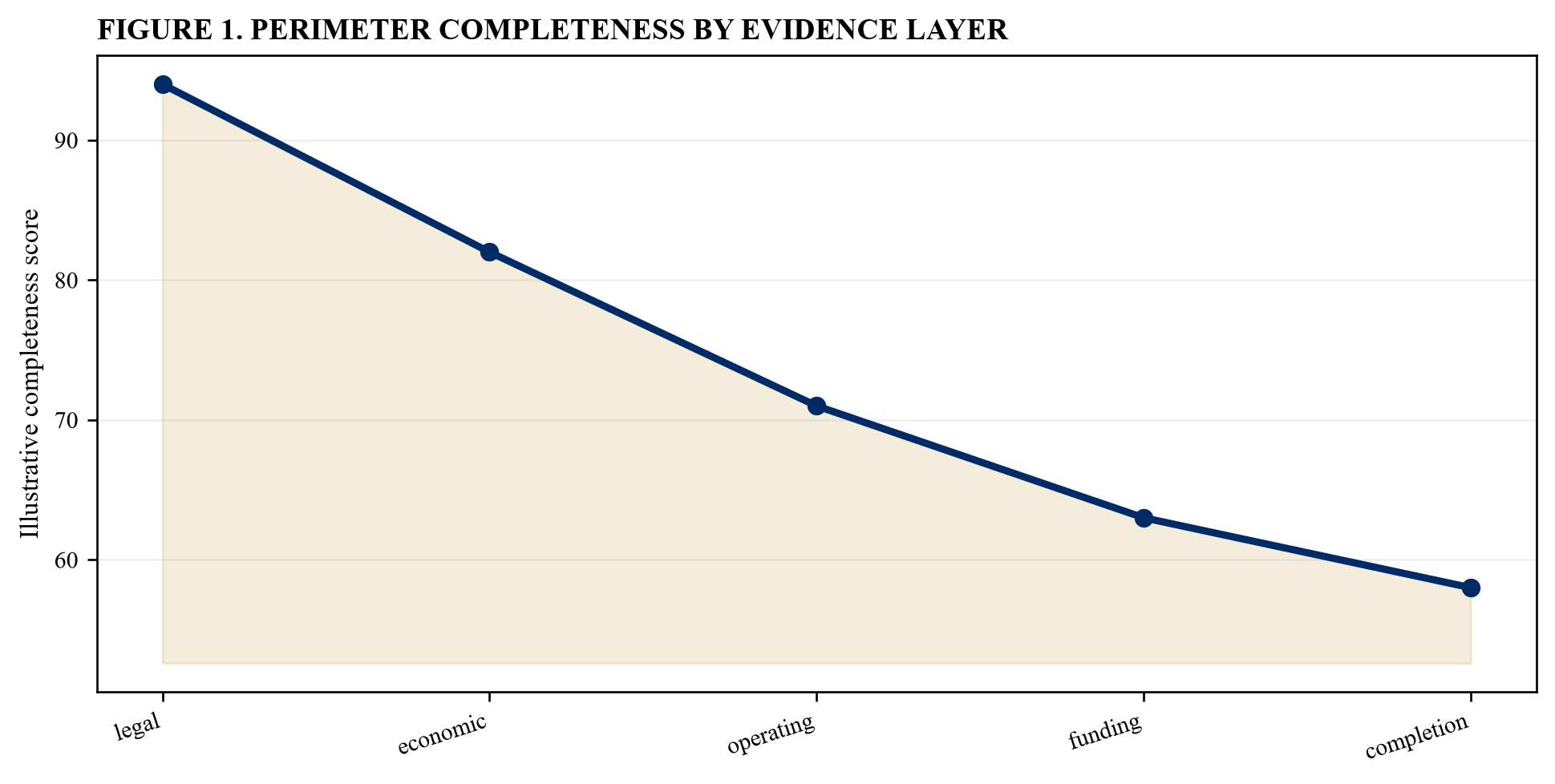
Illustrative analytical scenario; transaction evidence should replace model values.
6. Diagnose the causes of distress
This workstream requires the company and its advisers to separate group-level financing pressure from business-specific losses, underinvestment, customer decline, execution failures, litigation and governance problems, using cash bridges, covenant histories, customer data, margin analysis, project records, claims, board papers and management interviews. The practical test is which causes leave the carved-out business with residual risk and which disappear when it leaves the group. Analysis should use one cut-off date so that cash, claims, contracts, people and transaction documents reconcile [5][58][59].
Decision-makers should maintain a cause-and-remedy analysis tied to the stand-alone forecast. It should distinguish legal ownership from economic allocation, current evidence from forecast assumptions and committed funding from indications. Qualified advisers retain responsibility for legal, insolvency, tax, pensions, accounting and regulatory judgements.
Execution can fail when the transaction may move the same failure mechanism into a new capital structure. Each dependency needs a control, evidence threshold, escalation route and decision time. The transaction remains viable only while the funded separation plan can absorb a credible delay or shortfall.
7. Rebuild stand-alone revenue
The readiness team should reconcile billed revenue, contracted backlog, renewals, pipeline, rebates, returns, customer concentration and revenue that depends on group brands or bundled offerings. The evidence base includes general ledger, contract repository, CRM, billing data, order book, customer interviews and revenue-recognition policies. The central question is what revenue the carved-out business can lawfully and operationally retain after completion. Conclusions should remain at entity and dependency level because the failing group may have pooled cash, shared rights and cross-guarantees [8][9][40][43].
The required deliverable is a customer-level stand-alone revenue bridge. It should connect the proposed sale documents to the stand-alone operating model and the residual estate. Every material assumption should show its source and sensitivity.
The downside is that historical revenue can include group referrals, bundled contracts or permissions that do not transfer. Management should test the base case and a combined downside against minimum cash, customer continuity and the completion timetable. Unsupported benefits should not be treated as available funding.
8. Rebuild stand-alone operating costs
The seller should identify direct costs, centrally allocated expenses, omitted functions, replacement costs, diseconomies of scale and temporary separation costs. Relevant evidence includes cost-centre ledgers, payroll, procurement, service catalogues, supplier contracts, benchmarks and function-owner interviews. The decision asks what it costs to run the perimeter independently at the expected volume and service level. A reliable answer links financial analysis to title, transfer mechanics, operating capability and the applicable approval process [8][9][40][41].
The decision pack should contain a historical-to-stand-alone cost bridge with allocation policies. It should show calculation dates, owners, dependencies and the documents that implement the conclusion. This creates a defensible record for later scrutiny and post-completion reconciliation.
A material failure occurs when reported divisional earnings can overstate sustainable earnings when central services were underallocated or free. The response should identify a funded cure, alternative perimeter or fallback route. Continuing without one can reduce going-concern value and creditor recovery.
9. Allocate shared assets and liabilities
The transaction team should trace shared inventory, receivables, cash, debt, leases, provisions, insurance, litigation, guarantees and employee obligations to their legal owner and economic beneficiary. Evidence should come from balance-sheet schedules, subledgers, contracts, claims records, actuarial data, security documents and accounting policies. The controlling question is which balances transfer, remain, require settlement or need contractual protection. The answer should be dated, attributed and linked to the legal entity, asset, liability or operating dependency it describes [1][7][40][42].
The controlled output is an asset-liability allocation schedule reconciled to the transaction documents. It should state the source, calculation method, owner, exceptions, required approvals and the next irreversible deadline. This allows a board, officeholder, creditor or buyer to reproduce the conclusion when facts change.
The principal risk is that unallocated liabilities can change creditor recoveries or create post-completion disputes. The team should quantify the effect on liquidity, stand-alone earnings, creditor recoveries, operating continuity and completion probability. A material exception should update the perimeter and funding plan.
10. Build the working-capital baseline
This workstream requires the company and its advisers to normalise receivables, inventory, payables, customer advances, retentions, seasonality, overdue balances and group cash-management effects, using aged ledgers, inventory records, bank flows, contract terms, collections history and operating forecasts. The practical test is how much working capital the independent business needs at completion and through its first trading cycle. Analysis should use one cut-off date so that cash, claims, contracts, people and transaction documents reconcile [7][8][42][44].
Decision-makers should maintain a normalised working-capital model and completion mechanism. It should distinguish legal ownership from economic allocation, current evidence from forecast assumptions and committed funding from indications. Qualified advisers retain responsibility for legal, insolvency, tax, pensions, accounting and regulatory judgements.
Execution can fail when a business with positive accounting earnings may fail because cash was historically supplied by the group. Each dependency needs a control, evidence threshold, escalation route and decision time. The transaction remains viable only while the funded separation plan can absorb a credible delay or shortfall.
Table 2. Illustrative stand-alone earnings bridge
| Measure | Historical division | Adjustment | Stand-alone |
|---|---|---|---|
| revenue | 120 | -8 | 112 |
| operating costs | 82 | +13 | 95 |
| EBITDA | 38 | -21 | 17 |
| working capital required | 12 | +9 | 21 |
Values and scores are analytical scenarios; transaction evidence should replace model values.
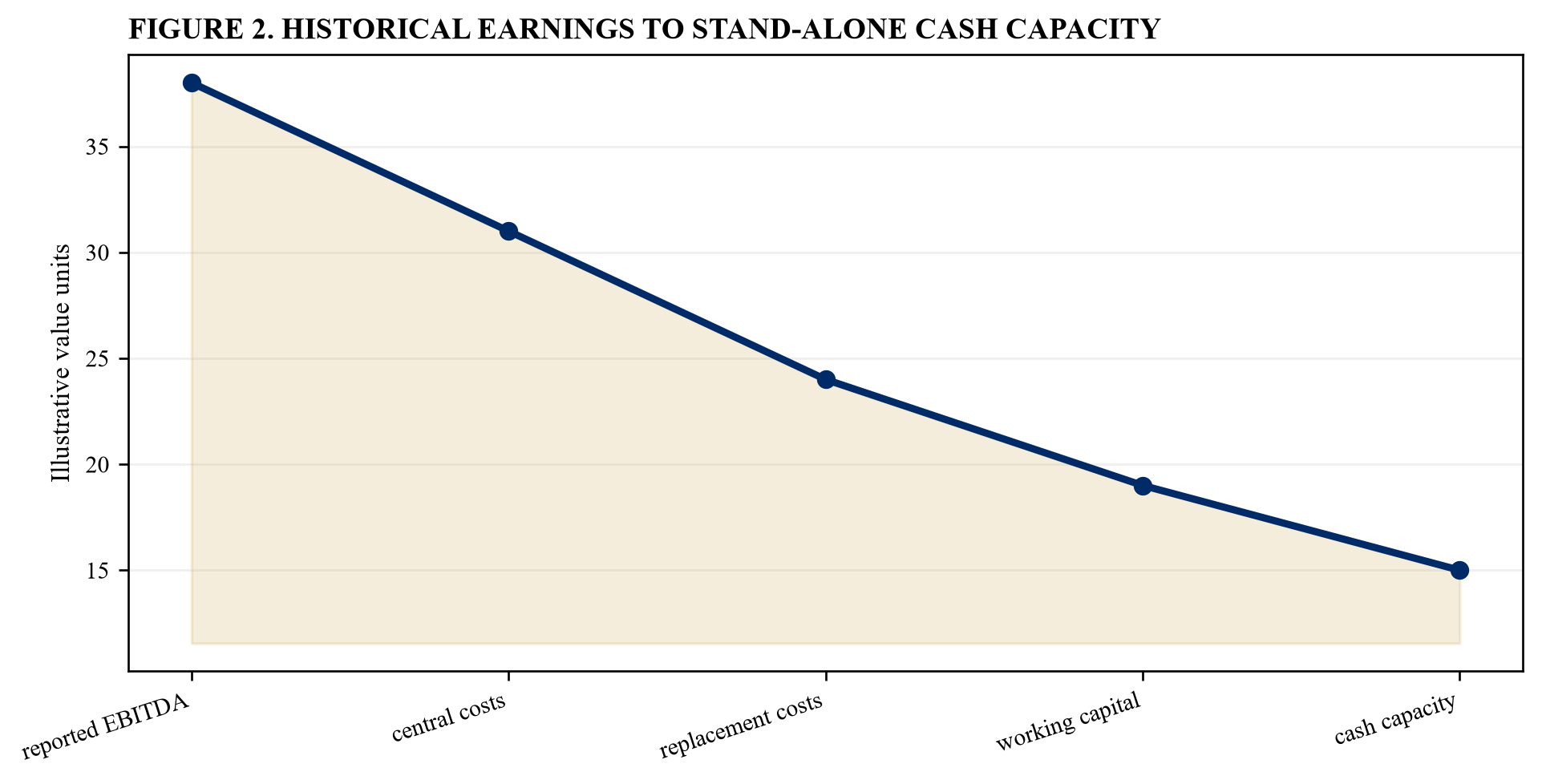
Illustrative analytical scenario; transaction evidence should replace model values.
11. Trace cash and intercompany flows
The readiness team should map collections, payments, sweeps, pooling, netting, shared bank accounts, guarantees, transfer pricing and intercompany settlement by entity. The evidence base includes bank statements, treasury records, intercompany ledgers, tax policies, payment authorities and facility documents. The central question is how cash becomes controlled by the carved-out business and how legacy balances are resolved. Conclusions should remain at entity and dependency level because the failing group may have pooled cash, shared rights and cross-guarantees [24][37][38][47].
The required deliverable is a cash-control and intercompany settlement plan. It should connect the proposed sale documents to the stand-alone operating model and the residual estate. Every material assumption should show its source and sensitivity.
The downside is that collections may continue to reach the failing group while the buyer funds operations. Management should test the base case and a combined downside against minimum cash, customer continuity and the completion timetable. Unsupported benefits should not be treated as available funding.
12. Inventory operational entanglements
The seller should identify every shared process, person, system, facility, licence, supplier and governance forum used by the viable core. Relevant evidence includes service catalogues, organisation charts, application inventories, process maps, site visits and function workshops. The decision asks which dependencies must transfer, be replaced, continue temporarily or stop. A reliable answer links financial analysis to title, transfer mechanics, operating capability and the applicable approval process [31][32][41].
The decision pack should contain an entanglement register with owners, service levels, costs and exit dates. It should show calculation dates, owners, dependencies and the documents that implement the conclusion. This creates a defensible record for later scrutiny and post-completion reconciliation.
A material failure occurs when an apparently simple asset sale can fail when invisible group services stop at completion. The response should identify a funded cure, alternative perimeter or fallback route. Continuing without one can reduce going-concern value and creditor recovery.
13. Secure intellectual property
The transaction team should verify ownership, registrations, development agreements, employee inventions, third-party licences, open-source obligations, domains and brand rights. Evidence should come from IP registers, assignment documents, employment terms, code repositories, licence agreements and registry searches. The controlling question is whether the buyer receives enforceable rights to use, develop and protect the products and brands in the perimeter. The answer should be dated, attributed and linked to the legal entity, asset, liability or operating dependency it describes [35][36][43].
The controlled output is an IP title and transfer schedule. It should state the source, calculation method, owner, exceptions, required approvals and the next irreversible deadline. This allows a board, officeholder, creditor or buyer to reproduce the conclusion when facts change.
The principal risk is that value can be stranded where ownership sits elsewhere in the group or a licence cannot be assigned. The team should quantify the effect on liquidity, stand-alone earnings, creditor recoveries, operating continuity and completion probability. A material exception should update the perimeter and funding plan.
14. Design the data transfer
This workstream requires the company and its advisers to classify customer, employee, supplier, financial and technical data; identify controllers, purposes, lawful bases, retention rules, cyber risks and transfer restrictions, using data maps, privacy notices, processing records, contracts, security assessments, incident logs and jurisdictional advice. The practical test is what data can transfer, under which safeguards, and what must remain accessible to the residual estate. Analysis should use one cut-off date so that cash, claims, contracts, people and transaction documents reconcile [17][34][50].
Decision-makers should maintain a lawful data-migration and records-retention plan. It should distinguish legal ownership from economic allocation, current evidence from forecast assumptions and committed funding from indications. Qualified advisers retain responsibility for legal, insolvency, tax, pensions, accounting and regulatory judgements.
Execution can fail when an unlawful or insecure transfer can impair operations and expose both parties to claims or regulatory action. Each dependency needs a control, evidence threshold, escalation route and decision time. The transaction remains viable only while the funded separation plan can absorb a credible delay or shortfall.
15. Protect customer contracts and revenue continuity
The readiness team should identify assignment, novation, change-of-control, termination, set-off, arrears, service credits, data and consent provisions in material customer arrangements. The evidence base includes executed contracts, amendments, correspondence, billing history, disputes and customer-owner interviews. The central question is which revenue streams will transfer on the intended date and which require consent, cure or replacement. Conclusions should remain at entity and dependency level because the failing group may have pooled cash, shared rights and cross-guarantees [3][12][17].
The required deliverable is a contract transfer and customer-continuity schedule. It should connect the proposed sale documents to the stand-alone operating model and the residual estate. Every material assumption should show its source and sensitivity.
The downside is that buyers can price revenue that disappears when contracts stay with the seller or customers terminate. Management should test the base case and a combined downside against minimum cash, customer continuity and the completion timetable. Unsupported benefits should not be treated as available funding.
16. Stabilise suppliers and critical services
The seller should rank suppliers by operational criticality, payment status, title rights, credit insurance, tooling, exclusivity and replacement lead time. Relevant evidence includes supplier contracts, aged payables, purchase orders, inventory, correspondence and continuity plans. The decision asks which relationships need cash, consent, assurance or a substitute before day one. A reliable answer links financial analysis to title, transfer mechanics, operating capability and the applicable approval process [1][3][23][25].
The decision pack should contain a supplier continuity and cure plan. It should show calculation dates, owners, dependencies and the documents that implement the conclusion. This creates a defensible record for later scrutiny and post-completion reconciliation.
A material failure occurs when a small unpaid balance or retained-title claim can stop production and destroy going-concern value. The response should identify a funded cure, alternative perimeter or fallback route. Continuing without one can reduce going-concern value and creditor recovery.
17. Map employees and consultation duties
The transaction team should identify assigned employees, shared roles, contractors, consultation bodies, immigration status, arrears, incentives and the employment effect of each legal route. Evidence should come from payroll, contracts, organisation charts, time records, benefit plans, works-council data and specialist advice. The controlling question is who transfers, who remains, what information and consultation is required, and how critical roles are retained. The answer should be dated, attributed and linked to the legal entity, asset, liability or operating dependency it describes [13][14][15][49].
The controlled output is an employee transfer, consultation and retention plan. It should state the source, calculation method, owner, exceptions, required approvals and the next irreversible deadline. This allows a board, officeholder, creditor or buyer to reproduce the conclusion when facts change.
The principal risk is that incorrect assumptions about transfer rules can create liability, delay and immediate loss of operating capability. The team should quantify the effect on liquidity, stand-alone earnings, creditor recoveries, operating continuity and completion probability. A material exception should update the perimeter and funding plan.
18. Resolve pensions and benefit obligations
This workstream requires the company and its advisers to map defined-benefit exposure, defined-contribution arrangements, insured benefits, accrued obligations, change notifications and transaction-specific clearance issues, using scheme documents, actuarial reports, trustee correspondence, payroll, benefit contracts and pensions advice. The practical test is which obligations follow employees or entities and what funding or protection is required. Analysis should use one cut-off date so that cash, claims, contracts, people and transaction documents reconcile [16][40].
Decision-makers should maintain a pensions and benefits allocation memorandum. It should distinguish legal ownership from economic allocation, current evidence from forecast assumptions and committed funding from indications. Qualified advisers retain responsibility for legal, insolvency, tax, pensions, accounting and regulatory judgements.
Execution can fail when hidden deficits, loss of cover or missed consultation can alter value and completion timing. Each dependency needs a control, evidence threshold, escalation route and decision time. The transaction remains viable only while the funded separation plan can absorb a credible delay or shortfall.
19. Transfer licences permits and regulated permissions
The readiness team should inventory operating licences, professional registrations, environmental permits, concessions, product approvals, accreditations and change-of-control requirements. The evidence base includes regulatory registers, permits, correspondence, compliance records, site files and buyer credentials. The central question is what the buyer needs to operate lawfully on day one and whether transfer, variation or a new application is required. Conclusions should remain at entity and dependency level because the failing group may have pooled cash, shared rights and cross-guarantees [18][27][28][29].
The required deliverable is a regulatory-permissions critical path. It should connect the proposed sale documents to the stand-alone operating model and the residual estate. Every material assumption should show its source and sensitivity.
The downside is that legal title can transfer while the acquired business remains unable to trade. Management should test the base case and a combined downside against minimum cash, customer continuity and the completion timetable. Unsupported benefits should not be treated as available funding.
20. Model tax and transfer consequences
The seller should analyse corporation tax, VAT, transfer taxes, losses, group relief, payroll, withholding, transfer pricing, customs and transaction-specific clearances. Relevant evidence includes tax returns, group structure, intercompany policies, asset values, contracts and qualified tax advice. The decision asks how the structure and perimeter change cash proceeds, buyer cost, tax attributes and residual liabilities. A reliable answer links financial analysis to title, transfer mechanics, operating capability and the applicable approval process [23][24][25][37][38].
The decision pack should contain a tax structure and cash-impact memorandum. It should show calculation dates, owners, dependencies and the documents that implement the conclusion. This creates a defensible record for later scrutiny and post-completion reconciliation.
A material failure occurs when unmodelled tax can reduce recoveries, interrupt supply chains or make the selected perimeter uneconomic. The response should identify a funded cure, alternative perimeter or fallback route. Continuing without one can reduce going-concern value and creditor recovery.
21. Separate property and environmental obligations
The transaction team should identify owned and leased sites, shared occupancy, access, utilities, repair, contamination, permits, security and landlord consent requirements. Evidence should come from title documents, leases, surveys, environmental reports, facilities records, utility contracts and site inspections. The controlling question is which premises are required, what rights transfer and what obligations remain with each party. The answer should be dated, attributed and linked to the legal entity, asset, liability or operating dependency it describes [3][26][27][41].
The controlled output is a property, utilities and environmental separation plan. It should state the source, calculation method, owner, exceptions, required approvals and the next irreversible deadline. This allows a board, officeholder, creditor or buyer to reproduce the conclusion when facts change.
The principal risk is that the operating perimeter may lack lawful access, essential services or funded remediation. The team should quantify the effect on liquidity, stand-alone earnings, creditor recoveries, operating continuity and completion probability. A material exception should update the perimeter and funding plan.
22. Create the technology separation architecture
This workstream requires the company and its advisers to map applications, infrastructure, cloud, networks, identities, interfaces, licences, cybersecurity controls, data stores, support teams and recovery arrangements, using CMDB records, architecture diagrams, vendor contracts, access logs, incident reports and recovery tests. The practical test is what must be transferred, cloned, replaced or provided under transition services for safe day-one operation. Analysis should use one cut-off date so that cash, claims, contracts, people and transaction documents reconcile [31][32][33].
Decision-makers should maintain a technology separation blueprint and cutover plan. It should distinguish legal ownership from economic allocation, current evidence from forecast assumptions and committed funding from indications. Qualified advisers retain responsibility for legal, insolvency, tax, pensions, accounting and regulatory judgements.
Execution can fail when access failure, licence breach, cyber compromise or an untested interface can stop the business at completion. Each dependency needs a control, evidence threshold, escalation route and decision time. The transaction remains viable only while the funded separation plan can absorb a credible delay or shortfall.
23. Reconcile debt security and guarantees
The readiness team should trace funded debt, security, guarantees, letters of credit, hedges, cash collateral, set-off, receivables finance and release mechanics to assets and entities. The evidence base includes facility agreements, security registers, bank confirmations, guarantee logs, hedge documents and legal opinions. The central question is which encumbrances must be released, refinanced, assumed or preserved for creditor value. Conclusions should remain at entity and dependency level because the failing group may have pooled cash, shared rights and cross-guarantees [1][10][11][47].
The required deliverable is a debt, security and release schedule. It should connect the proposed sale documents to the stand-alone operating model and the residual estate. Every material assumption should show its source and sensitivity.
The downside is that the buyer may not receive clean title or the residual estate may lose value through an unintended release. Management should test the base case and a combined downside against minimum cash, customer continuity and the completion timetable. Unsupported benefits should not be treated as available funding.
24. Choose the transaction structure
The seller should compare share, asset, business, hive-down, newco and jurisdiction-specific insolvency sale routes against transferability, liability, tax, speed and approvals. Relevant evidence includes legal advice, perimeter schedules, tax analysis, employee treatment, regulatory requirements and bidder feedback. The decision asks which structure can deliver the viable core within runway with an acceptable residual-liability position. A reliable answer links financial analysis to title, transfer mechanics, operating capability and the applicable approval process [1][3][10][12].
The decision pack should contain a structure decision memorandum with fallback routes. It should show calculation dates, owners, dependencies and the documents that implement the conclusion. This creates a defensible record for later scrutiny and post-completion reconciliation.
A material failure occurs when a preferred commercial structure may be incapable of transferring the required contracts, permissions or people. The response should identify a funded cure, alternative perimeter or fallback route. Continuing without one can reduce going-concern value and creditor recovery.
25. Design transition services
The transaction team should define services, scope, service levels, volumes, charges, data access, security, governance, change control, liability, termination and exit for each temporary dependency. Evidence should come from the entanglement register, operating model, cost estimates, vendor terms and separation timetable. The controlling question is which services are genuinely temporary and how the buyer exits them without disrupting operations. The answer should be dated, attributed and linked to the legal entity, asset, liability or operating dependency it describes [12][31][41].
The controlled output is an executable transition-services agreement and service schedule. It should state the source, calculation method, owner, exceptions, required approvals and the next irreversible deadline. This allows a board, officeholder, creditor or buyer to reproduce the conclusion when facts change.
The principal risk is that vague services can become unfunded long-term dependencies or fail under the seller's continuing distress. The team should quantify the effect on liquidity, stand-alone earnings, creditor recoveries, operating continuity and completion probability. A material exception should update the perimeter and funding plan.
26. Fund stranded costs and residual operations
This workstream requires the company and its advisers to identify functions, leases, systems, people, contracts and corporate overhead left behind after the viable core transfers, using stand-alone cost bridges, organisation plans, lease schedules, vendor contracts and residual-estate forecasts. The practical test is what costs remain, how quickly they can be removed and who funds the period before exit. Analysis should use one cut-off date so that cash, claims, contracts, people and transaction documents reconcile [7][8][40].
Decision-makers should maintain a stranded-cost and residual-estate plan. It should distinguish legal ownership from economic allocation, current evidence from forecast assumptions and committed funding from indications. Qualified advisers retain responsibility for legal, insolvency, tax, pensions, accounting and regulatory judgements.
Execution can fail when sale proceeds can be consumed by obligations that remain after the earnings base has left. Each dependency needs a control, evidence threshold, escalation route and decision time. The transaction remains viable only while the funded separation plan can absorb a credible delay or shortfall.
27. Define the day-one operating model
The readiness team should set decision rights, management roles, legal employers, bank mandates, policies, controls, reporting, customer ownership and incident escalation for the buyer's first day. The evidence base includes organisation design, delegated authorities, process maps, control registers, bank forms and regulatory requirements. The central question is whether the carved-out business can make decisions, collect cash, pay staff and serve customers independently. Conclusions should remain at entity and dependency level because the failing group may have pooled cash, shared rights and cross-guarantees [6][31][32].
The required deliverable is a signed-off day-one operating model. It should connect the proposed sale documents to the stand-alone operating model and the residual estate. Every material assumption should show its source and sensitivity.
The downside is that assets may transfer without the governance and controls required to use them safely. Management should test the base case and a combined downside against minimum cash, customer continuity and the completion timetable. Unsupported benefits should not be treated as available funding.
28. Build the separation sources and uses
The seller should size purchase consideration, cure and consent costs, fees, taxes, employee payments, retention, inventory, working capital, capital expenditure, transition services and contingency. Relevant evidence includes the liquidity forecast, perimeter model, separation plans, bidder terms and financing evidence. The decision asks how much capital is required through completion and the first stable operating cycle. A reliable answer links financial analysis to title, transfer mechanics, operating capability and the applicable approval process [10][11][18].
The decision pack should contain a dated sources-and-uses model with funding conditions. It should show calculation dates, owners, dependencies and the documents that implement the conclusion. This creates a defensible record for later scrutiny and post-completion reconciliation.
A material failure occurs when an otherwise viable business can fail during separation because the transaction funds price but not continuity. The response should identify a funded cure, alternative perimeter or fallback route. Continuing without one can reduce going-concern value and creditor recovery.
Table 3. Illustrative separation sources and uses
| Use | Base case | Delay case | Control |
|---|---|---|---|
| cure and consents | 6 | 9 | named approvals |
| working capital | 21 | 27 | daily cash forecast |
| transition services | 5 | 8 | priced service catalogue |
| contingency | 4 | 10 | committed liquidity reserve |
Values and scores are analytical scenarios; transaction evidence should replace model values.
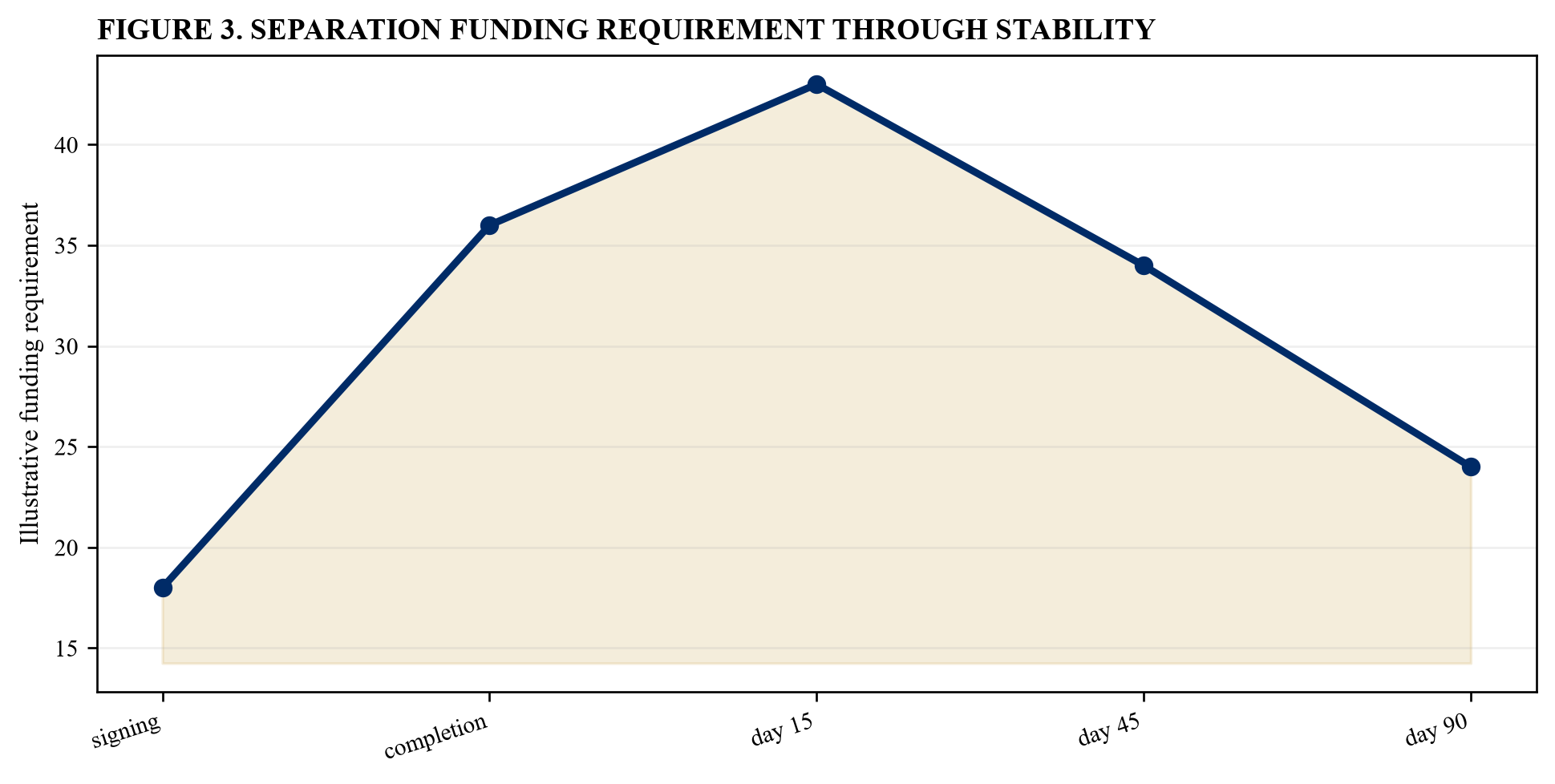
Illustrative analytical scenario; transaction evidence should replace model values.
29. Value the stand-alone business
The transaction team should prepare market, income, asset and transaction analyses using stand-alone revenue, costs, working capital, capital expenditure, liabilities and separation risk. Evidence should come from reconciled historical data, operating forecast, market evidence, asset appraisals, bids and valuation standards. The controlling question is what the viable core is worth under the selected perimeter and funding structure. The answer should be dated, attributed and linked to the legal entity, asset, liability or operating dependency it describes [7][8][39][43].
The controlled output is a valuation memorandum with sensitivities and evidence grades. It should state the source, calculation method, owner, exceptions, required approvals and the next irreversible deadline. This allows a board, officeholder, creditor or buyer to reproduce the conclusion when facts change.
The principal risk is that using group economics or excluding separation costs can overstate recoverable value. The team should quantify the effect on liquidity, stand-alone earnings, creditor recoveries, operating continuity and completion probability. A material exception should update the perimeter and funding plan.
30. Build the insolvency counterfactual
This workstream requires the company and its advisers to estimate timing, costs, recoveries, contract loss, employee effects, asset realisations and claims if the carve-out does not complete or the group is sold or liquidated differently, using liquidation appraisals, creditor hierarchy, cash forecast, contract analysis, valuation and insolvency advice. The practical test is whether the proposed carve-out improves the relevant statutory and creditor outcome. Analysis should use one cut-off date so that cash, claims, contracts, people and transaction documents reconcile [1][3][20][58].
Decision-makers should maintain a counterfactual recovery model on the same date as the bids. It should distinguish legal ownership from economic allocation, current evidence from forecast assumptions and committed funding from indications. Qualified advisers retain responsibility for legal, insolvency, tax, pensions, accounting and regulatory judgements.
Execution can fail when an optimistic fallback or inconsistent assumptions can make the selected sale appear superior. Each dependency needs a control, evidence threshold, escalation route and decision time. The transaction remains viable only while the funded separation plan can absorb a credible delay or shortfall.
31. Design the buyer universe and market process
The readiness team should identify strategic buyers, sponsors, lenders, management, competitors and specialist turnaround investors with the capability to own and separate the perimeter. The evidence base includes sector maps, transaction evidence, ownership data, sanctions checks, funding capacity and confidentiality analysis. The central question is which parties can diligence, finance, obtain approvals and complete within the available timetable. Conclusions should remain at entity and dependency level because the failing group may have pooled cash, shared rights and cross-guarantees [3][18][19].
The required deliverable is a prioritised buyer universe and documented market strategy. It should connect the proposed sale documents to the stand-alone operating model and the residual estate. Every material assumption should show its source and sensitivity.
The downside is that a broad list can create false comfort when few bidders can execute the separation. Management should test the base case and a combined downside against minimum cash, customer continuity and the completion timetable. Unsupported benefits should not be treated as available funding.
32. Build the carve-out data room
The seller should organise finance, tax, legal, commercial, employee, pensions, property, IP, data, technology, regulation, separation and transaction evidence around the perimeter. Relevant evidence includes the evidence register, source files, redaction protocol, access matrix, Q&A log and completeness review. The decision asks whether bidders can reproduce the stand-alone case and test every day-one dependency. A reliable answer links financial analysis to title, transfer mechanics, operating capability and the applicable approval process [8][17][31].
The decision pack should contain a permissioned data room with a perimeter index and exception log. It should show calculation dates, owners, dependencies and the documents that implement the conclusion. This creates a defensible record for later scrutiny and post-completion reconciliation.
A material failure occurs when buyers may withdraw or discount value when evidence is allocated by group function rather than transaction dependency. The response should identify a funded cure, alternative perimeter or fallback route. Continuing without one can reduce going-concern value and creditor recovery.
33. Issue a separation-specific bid protocol
The transaction team should require bidders to state perimeter, assumed liabilities, excluded assets, transition services, funding, employee treatment, approvals, conditions, mark-ups and completion plan. Evidence should come from the transaction structure, data room, valuation, legal process, timetable and buyer feedback. The controlling question is what constitutes a compliant, comparable and executable carve-out offer. The answer should be dated, attributed and linked to the legal entity, asset, liability or operating dependency it describes [3][10][19].
The controlled output is a bid-process letter and compliance schedule. It should state the source, calculation method, owner, exceptions, required approvals and the next irreversible deadline. This allows a board, officeholder, creditor or buyer to reproduce the conclusion when facts change.
The principal risk is that headline prices cannot be compared where bidders assume different liabilities or separation support. The team should quantify the effect on liquidity, stand-alone earnings, creditor recoveries, operating continuity and completion probability. A material exception should update the perimeter and funding plan.
34. Compare bids on one economic basis
This workstream requires the company and its advisers to bridge cash price, assumed liabilities, cure costs, stranded costs, transition services, tax, funding certainty, regulatory timing and execution probability, using bid forms, mark-ups, funds-flow drafts, separation estimates, diligence findings and valuation scenarios. The practical test is which offer produces the strongest risk-adjusted recovery and continuity outcome. Analysis should use one cut-off date so that cash, claims, contracts, people and transaction documents reconcile [1][3][19].
Decision-makers should maintain a common-basis bid comparison and recommendation. It should distinguish legal ownership from economic allocation, current evidence from forecast assumptions and committed funding from indications. Qualified advisers retain responsibility for legal, insolvency, tax, pensions, accounting and regulatory judgements.
Execution can fail when the highest nominal price may produce less distributable value or a lower probability of completion. Each dependency needs a control, evidence threshold, escalation route and decision time. The transaction remains viable only while the funded separation plan can absorb a credible delay or shortfall.
Table 4. Illustrative common-basis bid comparison
| Measure | Bid A | Bid B | Bid C |
|---|---|---|---|
| cash at completion | 74 | 68 | 61 |
| assumed liabilities | 8 | 19 | 25 |
| separation leakage | 15 | 9 | 6 |
| risk-adjusted value | 63 | 70 | 67 |
Values and scores are analytical scenarios; transaction evidence should replace model values.
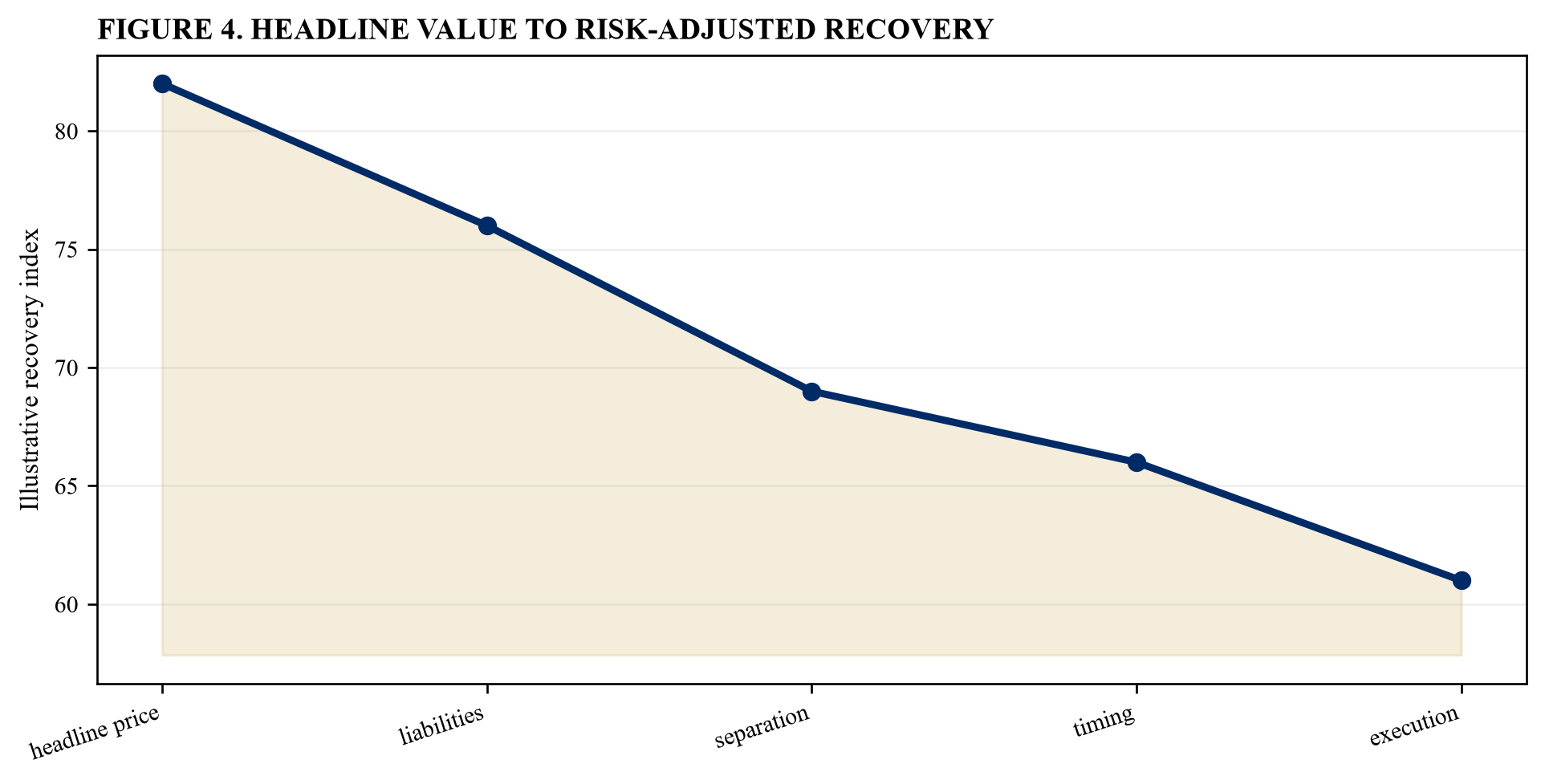
Illustrative analytical scenario; transaction evidence should replace model values.
35. Clear competition and investment controls
The readiness team should screen merger control, failing-firm arguments, foreign-investment rules, sector ownership, sanctions and public-interest review in each relevant jurisdiction. The evidence base includes turnover, market shares, ownership, buyer information, sector data, distress evidence and official guidance. The central question is whether approvals can be obtained within runway and what remedies or perimeter changes may be required. Conclusions should remain at entity and dependency level because the failing group may have pooled cash, shared rights and cross-guarantees [18][19][20][21][22][51][52][53].
The required deliverable is a regulatory approval critical path with evidence owners. It should connect the proposed sale documents to the stand-alone operating model and the residual estate. Every material assumption should show its source and sensitivity.
The downside is that mandatory standstill or an incomplete distress case can make a funded bid incapable of timely completion. Management should test the base case and a combined downside against minimum cash, customer continuity and the completion timetable. Unsupported benefits should not be treated as available funding.
36. Negotiate liability allocation and completion documents
The seller should align title, assets, liabilities, exclusions, consideration, conditions, warranties, indemnities, covenants, releases, transition services, tax and records retention. Relevant evidence includes the perimeter reconciliation, diligence findings, legal advice, bid comparison and funds-flow model. The decision asks whether the documents deliver the approved economic and operating outcome. A reliable answer links financial analysis to title, transfer mechanics, operating capability and the applicable approval process [1][3][10][12].
The decision pack should contain an execution-ready sale agreement and ancillary document suite. It should show calculation dates, owners, dependencies and the documents that implement the conclusion. This creates a defensible record for later scrutiny and post-completion reconciliation.
A material failure occurs when schedule gaps or inconsistent definitions can undo the carefully designed perimeter. The response should identify a funded cure, alternative perimeter or fallback route. Continuing without one can reduce going-concern value and creditor recovery.
37. Run the completion readiness gate
The transaction team should reconcile approvals, funds, releases, employee steps, contracts, licences, property, systems, data, inventory, bank access, notices and day-one governance. Evidence should come from signed documents, closing checklist, bank confirmations, cutover rehearsals, consent evidence and responsible-owner certifications. The controlling question is whether every legal, financial and operational dependency is satisfied or lawfully waived. The answer should be dated, attributed and linked to the legal entity, asset, liability or operating dependency it describes [10][12][18][31].
The controlled output is a completion certificate, funds-flow statement and cutover authority. It should state the source, calculation method, owner, exceptions, required approvals and the next irreversible deadline. This allows a board, officeholder, creditor or buyer to reproduce the conclusion when facts change.
The principal risk is that a last-minute gap can leave the business without liquidity, title, access or permission to trade. The team should quantify the effect on liquidity, stand-alone earnings, creditor recoveries, operating continuity and completion probability. A material exception should update the perimeter and funding plan.
Table 5. Separation implementation sequence
| Horizon | Decision | Evidence |
|---|---|---|
| first 48 hours | authority, cash and viable core | mandates, forecast and perimeter map |
| days 3 to 10 | stand-alone case and market launch | data room, model and buyer protocol |
| selection to completion | funded executable bid | comparison, approvals and documents |
| day one to day 100 | independent operation | cutover, TSA exits and cash control |
Values and scores are analytical scenarios; transaction evidence should replace model values.
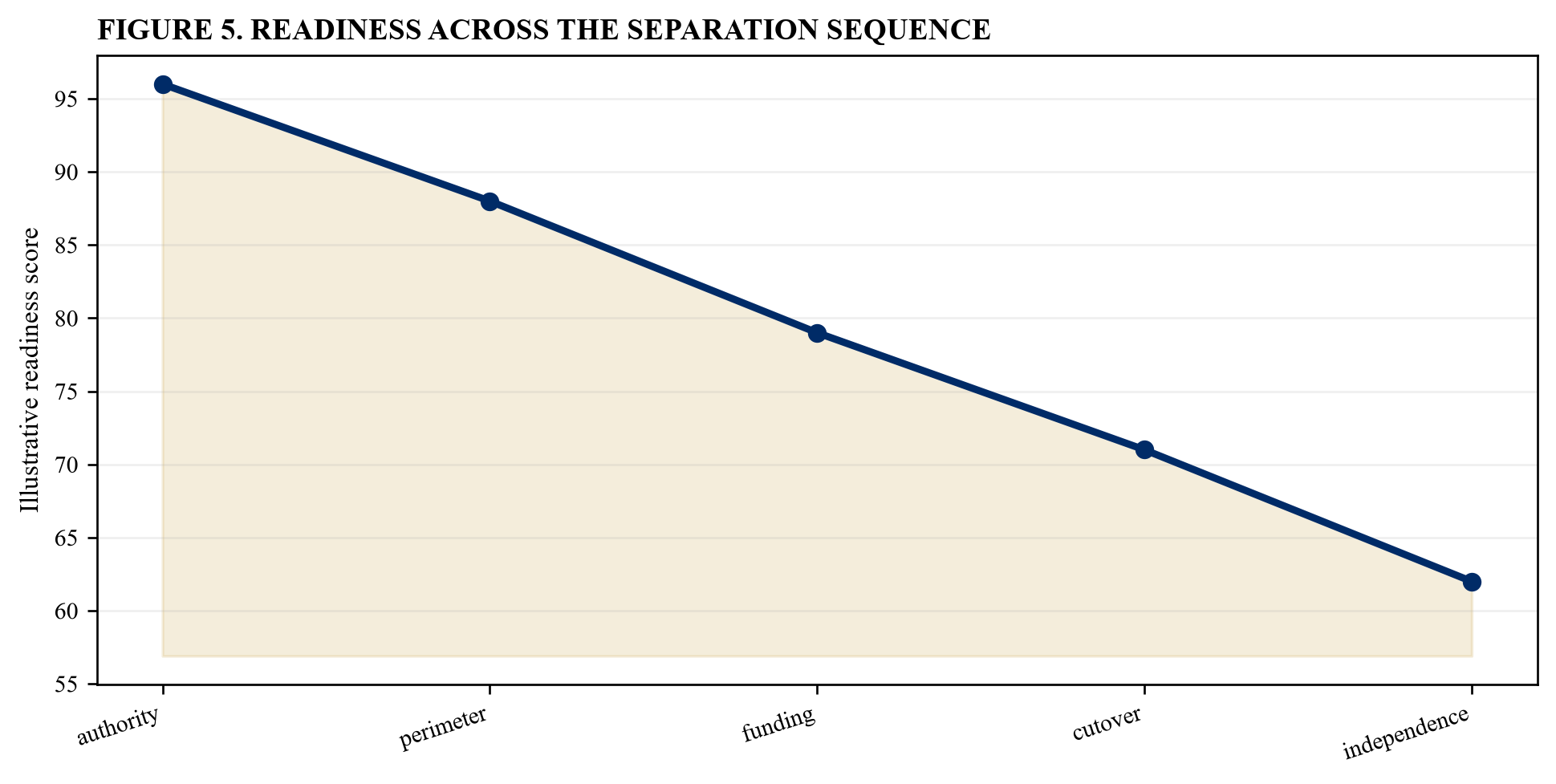
Illustrative analytical scenario; transaction evidence should replace model values.
38. Execute the first hundred days and preserve evidence
This workstream requires the company and its advisers to complete transition exits, remove stranded costs, stabilise customers and suppliers, reconcile opening balances, monitor cash, retain claims evidence and report against the rescue case, using the day-one plan, transition schedules, operating KPIs, cash reports, closing archive and residual-estate records. The practical test is whether the separated business is reaching independence and the seller can administer remaining obligations and claims. Analysis should use one cut-off date so that cash, claims, contracts, people and transaction documents reconcile [4][31][32][57].
Decision-makers should maintain a hundred-day separation plan and indexed transaction archive. It should distinguish legal ownership from economic allocation, current evidence from forecast assumptions and committed funding from indications. Qualified advisers retain responsibility for legal, insolvency, tax, pensions, accounting and regulatory judgements.
Execution can fail when value can leak after closing through service failure, unreconciled balances, delayed exits or missing evidence. Each dependency needs a control, evidence threshold, escalation route and decision time. The transaction remains viable only while the funded separation plan can absorb a credible delay or shortfall.
References
- UK Parliament, Insolvency Act 1986, https://www.legislation.gov.uk/ukpga/1986/45/contents
- UK Parliament, Insolvency Rules 2016, https://www.legislation.gov.uk/uksi/2016/1024/contents
- European Union, Directive EU 2026/799 Harmonising Certain Aspects of Insolvency Law, https://eur-lex.europa.eu/eli/dir/2026/799/oj
- UNCITRAL, Model Law on Enterprise Group Insolvency, https://uncitral.un.org/en/MLEGI
- UK Government, Corporate Financial Distress Guidance Note, https://www.gov.uk/government/publications/the-sourcing-and-consultancy-playbooks/corporate-financial-distress-guidance-note-html
- UK Parliament, Companies Act 2006, https://www.legislation.gov.uk/ukpga/2006/46/contents
- IFRS Foundation, IFRS 5 Non-current Assets Held for Sale and Discontinued Operations, https://www.ifrs.org/issued-standards/list-of-standards/ifrs-5-non-current-assets-held-for-sale-and-discontinued-operations/
- US Securities and Exchange Commission, Financial Reporting Manual Topic 2, https://www.sec.gov/corpfin/cf-manual/topic-2
- US Securities and Exchange Commission, Financial Reporting Manual Topic 3, https://www.sec.gov/about/divisions-offices/division-corporation-finance/financial-reporting-manual/frm-topic-3
- US House of Representatives, Bankruptcy Code Section 363, https://uscode.house.gov/view.xhtml?req=granuleid:USC-prelim-title11-section363
- US House of Representatives, Bankruptcy Code Section 364, https://uscode.house.gov/view.xhtml?req=granuleid:USC-prelim-title11-section364
- US House of Representatives, Bankruptcy Code Section 365, https://uscode.house.gov/view.xhtml?req=granuleid:USC-prelim-title11-section365
- UK Parliament, Transfer of Undertakings Protection of Employment Regulations 2006, https://www.legislation.gov.uk/uksi/2006/246/contents
- UK Government, Business Transfers and Insolvent Businesses, https://www.gov.uk/transfers-takeovers/insolvent-businesses
- UK Government, Employment Law and Insolvency, https://www.gov.uk/guidance/technical-guidance-for-official-receivers/58-employment-law-and-insolvency
- The Pensions Regulator, Clearance Applications, https://www.thepensionsregulator.gov.uk/en/document-library/regulatory-guidance/clearance
- Information Commissioner's Office, Due Diligence Following Mergers and Acquisitions, https://ico.org.uk/for-organisations/uk-gdpr-guidance-and-resources/data-sharing/data-sharing-a-code-of-practice/due-diligence/
- UK Government, National Security and Investment Act Guidance on Acquisitions, https://www.gov.uk/guidance/national-security-and-investment-act-guidance-on-acquisitions
- Competition and Markets Authority, Merger Assessment Guidelines, https://www.gov.uk/government/publications/merger-assessment-guidelines
- Competition and Markets Authority, Mergers Involving Failing Firms, https://www.gov.uk/government/publications/mergers-involving-failing-firms
- European Union, Council Regulation EC 139/2004 on the Control of Concentrations, https://eur-lex.europa.eu/legal-content/EN/TXT/?uri=CELEX:32004R0139
- European Commission, Guidelines on Horizontal Mergers, https://eur-lex.europa.eu/legal-content/EN/TXT/?uri=CELEX:52004XC0205(02)
- HM Revenue and Customs, Transfer of a Business as a Going Concern, https://www.gov.uk/guidance/insolvency-practitioner-s-handbook/18-transfer-of-a-business-as-a-going-concern
- HM Revenue and Customs, Insolvency Manual, https://www.gov.uk/hmrc-internal-manuals/insolvency
- HM Revenue and Customs, VAT Notice 700/9 Transfer of a Business as a Going Concern, https://www.gov.uk/guidance/transfer-a-business-as-a-going-concern-notice-7009
- HM Land Registry, Practice Guides, https://www.gov.uk/government/collections/land-registration-practice-guides
- UK Environment Agency, Transfer or Surrender an Environmental Permit, https://www.gov.uk/guidance/transfer-or-surrender-your-environmental-permit
- Financial Conduct Authority, Change in Control, https://www.fca.org.uk/firms/change-control
- Prudential Regulation Authority, Change in Control, https://www.bankofengland.co.uk/prudential-regulation/authorisations/new-firm-authorisation/change-in-control
- Financial Conduct Authority, Insolvency Practitioners, https://www.fca.org.uk/firms/insolvency-practitioners
- National Institute of Standards and Technology, Cybersecurity Framework 2.0, https://www.nist.gov/cyberframework
- National Institute of Standards and Technology, SP 800-61 Computer Security Incident Handling Guide, https://csrc.nist.gov/pubs/sp/800/61/r2/final
- US Cybersecurity and Infrastructure Security Agency, Cybersecurity Performance Goals, https://www.cisa.gov/cyber-guidance/cybersecurity-performance-goals
- Information Commissioner's Office, Data Sharing Code of Practice, https://ico.org.uk/for-organisations/uk-gdpr-guidance-and-resources/data-sharing/data-sharing-a-code-of-practice/
- UK Intellectual Property Office, Change of Ownership, https://www.gov.uk/guidance/change-of-ownership
- World Intellectual Property Organization, IP Due Diligence, https://www.wipo.int/sme/en/ip_business/managing_ip/due_diligence.htm
- OECD, Transfer Pricing Guidelines for Multinational Enterprises and Tax Administrations, https://www.oecd.org/tax/transfer-pricing/oecd-transfer-pricing-guidelines-for-multinational-enterprises-and-tax-administrations-20769717.htm
- OECD, Base Erosion and Profit Shifting, https://www.oecd.org/tax/beps/
- IFRS Foundation, IAS 36 Impairment of Assets, https://www.ifrs.org/issued-standards/list-of-standards/ias-36-impairment-of-assets/
- IFRS Foundation, IAS 37 Provisions Contingent Liabilities and Contingent Assets, https://www.ifrs.org/issued-standards/list-of-standards/ias-37-provisions-contingent-liabilities-and-contingent-assets/
- IFRS Foundation, IFRS 16 Leases, https://www.ifrs.org/issued-standards/list-of-standards/ifrs-16-leases/
- IFRS Foundation, IFRS 9 Financial Instruments, https://www.ifrs.org/issued-standards/list-of-standards/ifrs-9-financial-instruments/
- IFRS Foundation, IFRS 3 Business Combinations, https://www.ifrs.org/issued-standards/list-of-standards/ifrs-3-business-combinations/
- IFRS Foundation, IAS 7 Statement of Cash Flows, https://www.ifrs.org/issued-standards/list-of-standards/ias-7-statement-of-cash-flows/
- US Securities and Exchange Commission, Financial Disclosures about Acquired and Disposed Businesses, https://www.sec.gov/resources-small-businesses/small-business-compliance-guides/financial-disclosures-about-acquired-disposed-businesses
- US Securities and Exchange Commission, Regulation S-X Article 11, https://www.ecfr.gov/current/title-17/chapter-II/part-210/article-11
- UK Companies House, Register a Charge, https://www.gov.uk/government/publications/register-particulars-of-a-charge-mr01
- UK Government, Information about Employees during Transfers, https://www.gov.uk/transfers-takeovers/information-about-employees-during-transfers
- European Union, Directive 2001/23/EC on Safeguarding Employees' Rights, https://eur-lex.europa.eu/legal-content/EN/TXT/?uri=CELEX:32001L0023
- European Union, General Data Protection Regulation, https://eur-lex.europa.eu/eli/reg/2016/679/oj
- US Federal Trade Commission, Premerger Notification and the HSR Act, https://www.ftc.gov/enforcement/premerger-notification-program
- US Department of Justice and Federal Trade Commission, 2023 Merger Guidelines, https://www.justice.gov/atr/2023-merger-guidelines
- US Department of the Treasury, Committee on Foreign Investment in the United States, https://home.treasury.gov/policy-issues/international/the-committee-on-foreign-investment-in-the-united-states-cfius
- US Courts, Federal Rules of Bankruptcy Procedure, https://www.uscourts.gov/forms-rules/current-rules-practice-procedure/federal-rules-bankruptcy-procedure
- UK Insolvency Service, Requirements for Independent Scrutiny of Disposals in Administration, https://www.gov.uk/government/publications/requirements-for-independent-scrutiny-of-the-disposal-of-assets-in-administration-including-pre-pack-sales/requirements-for-independent-scrutiny-of-the-disposal-of-assets-in-administration-including-pre-pack-sales
- UK Parliament, Administration Restrictions on Disposal to Connected Persons Regulations 2021, https://www.legislation.gov.uk/uksi/2021/427/contents
- UNCITRAL, Model Law on Cross-Border Insolvency, https://uncitral.un.org/en/texts/insolvency/modellaw/cross-border_insolvency
- World Bank, Principles for Effective Insolvency and Creditor and Debtor Regimes, https://www.worldbank.org/en/topic/financialsector/brief/the-world-bank-principles-for-effective-insolvency-and-creditor-rights
- International Monetary Fund, Orderly and Effective Insolvency Procedures, https://www.imf.org/external/pubs/ft/orderly/
- International Valuation Standards Council, International Valuation Standards, https://ivsc.org/standards/
