

1. The ten day decision
A distressed seller rarely has time to build a conventional data room. Cash may be declining, suppliers may be changing terms, employees may be leaving and lenders may be reserving rights. A buyer still needs enough evidence to price the business, identify the assets it can acquire, understand the liabilities it may inherit and decide whether it can complete. Management therefore needs a triage decision: which evidence must become reliable within ten business days, which evidence can follow, and which gaps require an explicit commercial or legal response.
The answer should follow the decisions that buyers, lenders, insolvency practitioners and the board must make. A long index of uploaded files is weak evidence of readiness. A smaller room can be more useful when every material claim links to a source document, an owner, a current date and a known exception. The proposed framework ranks evidence by its effect on liquidity, ownership, transferability, continuity, regulatory permission and potential claims. It then assigns a daily production sequence and an escalation route for missing or contradictory records.
This paper addresses accelerated sale preparation in a UK-oriented setting. It does not determine directors' duties, insolvency status, privilege, disclosure obligations, employee-transfer treatment or the legal effect of any contract. Qualified advisers must apply the current law and the facts of the case.
2. Why ordinary data room methods fail under distress
Conventional diligence preparation often starts with a broad request list and distributes it across functions. Each team uploads what it has, advisers review the room and questions accumulate. That sequence assumes the seller has enough time to correct the index, reconcile contradictory versions and obtain missing consents. Financial distress removes that assumption. The UK Government's corporate financial distress guidance recognises accelerated M&A as one possible response and identifies lenders as important to continued trading [1]. The practical implication is that evidence production and liquidity governance must operate together.
Three failure patterns recur. A bulk upload creates volume without certainty, so buyers spend scarce time identifying the current document. A legal-first process can establish corporate and contractual positions while leaving cash, customers and operating continuity unresolved. A polished management presentation can describe value without providing the records required to verify it. Each route can delay an executable bid because decision makers cannot distinguish a missing document from a missing right, a stale record or an adverse fact.
The ten-day method treats every request as a decision dependency. Management first identifies what must be true for the business or selected assets to trade after completion. It then builds evidence around those claims. The room grows in controlled layers, and every layer carries a defined quality threshold.
3. A data room is an evidence system
The room should allow an informed reviewer to move from a commercial claim to the underlying record and then to the exception that could change the transaction. If management says a customer contract is recurring, the room should identify the signed contract, term, renewal mechanism, termination rights, change-of-control provision, current revenue, disputed amounts and relationship owner. If the company says it owns a machine, the room should connect the fixed-asset register, invoice, location, serial number, financing statement, insurance schedule and any registered charge.
This structure requires four attributes. Provenance identifies where a record came from and who controls it. Currency identifies the period or effective date. Integrity identifies whether the record is signed, complete, reconciled and free from unexplained alteration. Decision relevance states which buyer, board or creditor question the record answers. A file without these attributes may still be useful, but it should not be presented as conclusive evidence.
The room also needs a negative-evidence process. A search that finds no permit, licence, guarantee or side letter is not proof that none exists. The owner should record the systems searched, the period covered, the people consulted and the remaining uncertainty. This practice prevents a blank folder from being mistaken for a clean position.
4. Authority and liquidity come first
Day zero begins with authority. The board should identify who may instruct advisers, approve disclosures, communicate with lenders, invite buyers, grant data access and negotiate transaction documents. The authority map should also record conflicts, delegated limits and matters reserved for the board, an insolvency practitioner, a secured creditor or another stakeholder. A fast process becomes fragile when advisers act on inconsistent instructions or when a buyer relies on information that the company was not authorised to release.
Liquidity evidence determines how much time the process actually has. The core pack should include opening cash by account, blocked or restricted cash, daily receipts, payroll, taxes, critical suppliers, debt service, available facilities, covenant status and payment authorities. Each amount should reconcile to bank evidence or be identified as a management estimate. The FRC's 2025 going-concern guidance asks directors to consider solvency and liquidity risks using an appropriate range of factors and techniques [4]. An accelerated sale requires a more frequent operating view, often daily, because the value of evidence falls sharply if the business cannot continue trading through completion.
The cash model should remain separate from the sale valuation. It answers whether the process can reach a decision date and which payments preserve optionality. It does not establish distributable value or creditor priority.
Table 1. Proposed risk ranked evidence map
| Evidence domain | Weight | Baseline | Decision supported |
|---|---|---|---|
| Cash and liquidity | 15% | 35 | Runway, payment authority and completion capacity |
| Security and asset title | 12% | 30 | Sale perimeter, encumbrance and required release |
| Customer contracts | 10% | 25 | Revenue continuity, consent and transferable rights |
| Supplier continuity | 8% | 20 | Supply continuity, terms and operational dependency |
| People and transfer duties | 10% | 30 | Transfer duties, liabilities and critical roles |
| Tax | 8% | 25 | Recorded, asserted and contingent tax exposure |
| Claims and litigation | 8% | 20 | Claim status, cash timing and transaction treatment |
| Regulation and permits | 8% | 25 | Operating permission, transfer and clearance path |
| IP data and cyber | 7% | 20 | Ownership, lawful sharing, resilience and access |
| Pensions | 5% | 20 | Employer obligation, funding and covenant effect |
| Insurance and safety | 4% | 35 | Coverage, incidents, safety and environmental exposure |
| Process governance | 5% | 40 | Authority, access control, questions and exceptions |
Author-designed starting weights and scores. Management should replace them with company-specific evidence and advice. The weights sum to 100.
5. The risk ranked evidence map
The proposed evidence map covers twelve domains. Cash and liquidity receive the highest model weight because they govern survival through the process. Security and asset title follow because a buyer must know what can be sold and which releases may be required. Customer contracts, supplier continuity and people evidence support the transfer of the operating business. Tax, claims, regulation, intellectual property, data, pensions, insurance, safety and process governance complete the map.
Weights should be tailored to the transaction. A regulated healthcare provider may assign more weight to licences and patient data. A software company may emphasise intellectual-property ownership, source-code access, cyber incidents and customer data. An asset-heavy manufacturer may prioritise title, environmental permits, maintenance records and fixed-charge releases. The framework does not claim that one universal ordering is correct. It supplies a disciplined way to make the ordering explicit.
Each domain should have one accountable evidence owner and one reviewer who is independent of the file-preparation step. The owner assembles records and answers factual questions. The reviewer tests completeness, currency and reconciliation. Material exceptions enter a central log rather than remaining buried in email. A room is ready for a decision when the important claims have reliable support and open exceptions have named consequences, owners and response dates.
6. Evidence quality and version control
The index should distinguish executed agreements from drafts, current policies from superseded versions, statutory filings from internal registers and independently generated records from management schedules. File names need consistent dates and status labels. The room should preserve original files, while a controlled index records the version presented for diligence. Replacing a file without an audit trail can create uncertainty about what a buyer reviewed.
Quality checks should be concrete. A signed contract must include schedules, amendments and incorporated terms. A trial balance should reconcile to the management accounts for the same period. A cash balance should reconcile to a bank statement or bank portal record. A property schedule should link to title documents and occupancy arrangements. A claims schedule should link to pleadings, correspondence, reserves and insurance notifications. A licence record should show the legal entity, activity, site, conditions, expiry and transfer process.
Contradictions require visible treatment. If a contract register states a three-year term and the executed amendment provides twelve months, the index should show the discrepancy and the reviewed conclusion. Quietly choosing the favourable version weakens trust and can cause a buyer to widen diligence. The fastest route is usually a concise exception note linked to both records and assigned to the qualified adviser or executive who can resolve it.
7. Cash and working capital evidence
The cash folder should answer four questions. It should show how much unrestricted cash exists, how quickly cash changes, which payments protect operations, and which receipts are exposed to customer or legal dispute. Daily bank data, aged receivables, collections notes, aged payables, purchase commitments, payroll, taxes, facility availability and payment runs should share a common cut-off date. Differences between bank, ledger and forecast positions require reconciliation.
Working capital needs transaction context. A buyer considering an asset purchase may focus on which receivables, inventories and liabilities transfer. A share buyer may examine normalised working capital, leakage, priority claims and post-completion funding. An insolvency practitioner will consider statutory duties and creditor outcomes. The data room should present facts and clearly identified scenario assumptions, leaving legal entitlement and deal mechanics to the transaction documents and professional advice.
The evidence pack should also identify cash controls. Dual authorisation, bank mandates, payment limits and emergency approvals matter when senior staff are distracted by the sale. A thirteen-week forecast is useful only when someone compares forecast and actual cash, explains variances and updates operational assumptions. In a ten-day preparation period, this comparison should begin immediately and continue alongside diligence.
8. Security and asset title
A distressed sale can fail when the seller cannot establish ownership or obtain releases. The security workstream should reconcile Companies House charges, facility and security documents, intercreditor arrangements, guarantees, asset registers, property titles, hire-purchase agreements, leases and retention-of-title exposure. Companies House guidance explains that a charge is security given for a loan and that outstanding registered charges should be kept accurate and current [5]. The public register is a starting point rather than a complete legal analysis.
The asset perimeter should show each material asset, legal owner, location, operational user, book value, estimated relevance, encumbrance, maintenance dependency and transfer condition. Assets owned by another group entity or founder require special attention. Intellectual property, software accounts and domain names often sit outside the operating entity. Equipment may be leased, financed or subject to supplier rights. Inventory may be held at third-party sites or incorporate consigned materials.
The team should create a release map rather than waiting for completion documents. Each secured party, landlord, lessor or counterparty should have a required action, evidence owner, contact protocol and lead time. The map remains confidential and access-controlled because premature contact can destabilise the business.
9. Customer contracts and revenue quality
Customer evidence should support the revenue that a buyer is expected to underwrite. The contract population needs a reconciliation to billing and reported revenue, followed by prioritisation based on value, margin, concentration and continuity risk. For each material customer, the room should capture executed terms, amendments, pricing, service obligations, renewal, termination, change of control, assignment, set-off, disputes, service credits, arrears and current trading status.
Revenue schedules should separate invoiced revenue, recognised revenue, contracted backlog, forecast orders and management opportunities. These categories have different evidential strength. A pipeline entry does not carry the same certainty as a signed order. A recurring invoice can still depend on terminable terms. Customer deposits may create cash and performance obligations. Clear classification gives buyers a faster basis for their own downside analysis.
Contact with customers should follow a board-approved plan. Some consents may be required before transfer, while other discussions can wait until a preferred bidder has funding and an executable structure. The data room should therefore link contract facts to the disclosure plan. It should never imply that a counterparty will consent or continue trading unless that commitment has been obtained and documented.
10. Supplier and operational continuity
Supplier evidence needs to identify the relationships that keep the business trading through the sale and immediately afterward. The schedule should rank suppliers by operational criticality, replacement time, payment status, credit terms, ownership of inventory, contractual rights and concentration. Utilities, hosting, logistics, maintenance, key materials and outsourced labour may deserve attention even when their annual spend is modest.
Distress can change supplier behaviour quickly. A supplier may shorten terms, stop dispatches, exercise set-off, rely on retention-of-title provisions or request deposits. The room should pair the contractual position with current operational evidence. Purchase orders, account statements, dispute logs and communications can show a more current picture than the master agreement alone. Management should identify which suppliers require controlled engagement and what financial support, assurance or transition arrangement might be needed.
Continuity evidence also includes production plans, stock counts, quality records, maintenance status and dependency on particular employees or sites. Buyers need to understand whether the transaction perimeter can deliver customer obligations. The ten-day pack should prioritise the critical path and disclose known constraints in a structured form rather than attempting to perfect every operational record.
11. People and transfer duties
The people folder should reconcile the payroll, employee list, contracts, benefit plans, accrued leave, bonuses, commission, pensions, immigration status, disputes, absence, disciplinary matters and critical-role map. Personal data requires restricted access and a lawful basis for sharing. Summary information may support early diligence, followed by controlled identifiable data when the process and legal advice permit it.
UK Government guidance states that employee liability information must normally be provided to the new employer at least four weeks before a transfer [6]. A ten-business-day triage process therefore needs to identify this timing issue early. The sale timetable, transaction structure and applicable exceptions require employment advice. The room should not use an accelerated internal target to imply that statutory or consultation requirements can be compressed.
Critical-role analysis should distinguish employment status, formal authority, practical knowledge, customer relationships, licences and systems access. A retention proposal should connect the individual to a defined continuity risk and approved cost. It should also consider fairness, communication and the risk created if the transaction fails. The evidence pack records the decision; it does not promise that an employee will remain.
12. Tax evidence
Tax diligence should start with legal entities, registrations, filing status, payment status, open enquiries, elections, losses, group arrangements, payroll taxes, indirect taxes and transaction taxes relevant to the anticipated perimeter. The team should reconcile filed returns to accounts and identify overdue amounts, time-to-pay arrangements, security deposits, correspondence and contingent exposures.
Distress can make tax records particularly sensitive because unpaid liabilities affect cash and may influence process options. The pack should distinguish liabilities recorded in the ledger, amounts asserted by an authority, management estimates and adviser assessments. It should also identify whether a proposed asset or share transaction changes the expected treatment. Those questions require case-specific advice.
Data-room triage should prioritise records that alter cash, price, structure or completion conditions. Historical files with no plausible decision effect can follow. A concise tax status memorandum can help the buyer understand what has been filed, what remains open and where supporting evidence sits. The memorandum should link to source documents and avoid presenting an unresolved position as settled.
13. Claims litigation and investigations
The claims workstream should capture litigation, arbitration, complaints, threatened claims, investigations, warranty issues, product liability, employment disputes, regulatory correspondence and material contractual notices. For each matter, the schedule should state parties, forum, status, next deadline, relief sought, management reserve, adviser, insurance notification and operational consequence. Privilege and disclosure strategy require legal direction.
The board needs to understand the difference between the amount claimed, the accounting provision, the insured amount and the likely cash timing. These figures can diverge substantially. The room should preserve the distinction. A buyer may also examine whether a claim transfers with the business, remains with the seller or affects an asset's value. The answer depends on structure and law.
Missing claims evidence is itself a priority when operational teams know of disputes that legal and finance records do not capture. Interviews with customer service, HR, quality, procurement and site management can reveal matters absent from a central register. The process should record who was consulted and how the results were reconciled.
14. Regulation permits and national security
The regulatory folder should map each licence, permit, approval, registration and reporting obligation to the relevant legal entity, site and activity. It should identify expiry, breaches, open correspondence, transferability and the expected approval route. Environmental permits can require a formal transfer to a different operator and updated operating documents [7]. Sector regulators may impose additional ownership, fitness, capital or operational requirements.
Potential national-security review belongs in the early triage. UK Government guidance on the National Security and Investment Act identifies acquisitions that may require mandatory notification or permit voluntary notification [8]. The seller should obtain current advice on the target activities, control thresholds, buyer identity and timetable. The data room can support that analysis with accurate group, activity, asset and customer information.
Competition review also needs evidence about markets, competitors, customers and alternatives. The CMA's failing-firm framework examines whether the firm would exit absent the transaction, whether another purchaser exists and what would happen to sales or assets on exit [9]. Management should not label the business a failing firm or assume a clearance outcome. It should assemble the evidence that qualified advisers and authorities would need to assess the facts.
15. Intellectual property data and cyber evidence
The intellectual-property map should show registered rights, applications, licences, assignments, employee and contractor provisions, domains, software repositories, source-code controls and material third-party dependencies. Ownership gaps can arise when founders, contractors or other group entities created assets without complete assignments. The ten-day process should locate the underlying instruments and identify gaps requiring cure, licence or deal treatment.
Data and cyber evidence require careful staging. The ICO states that a change of controller in a merger or acquisition requires data-sharing due diligence, including the original purpose, lawful basis, governance, security and communication with data subjects [3]. A buyer's interest does not remove those obligations. The room should apply need-to-know access, redaction, aggregation, clean teams and logging as appropriate.
The cyber pack should cover systems architecture, privileged access, material incidents, backups, recovery testing, vulnerabilities, insurance notifications and critical vendors. Management should distinguish tested capability from policy. A written disaster-recovery plan does not establish that restoration works. Buyers will value concise evidence of recent tests and known remediation more than a large library of generic policies.
16. Pensions insurance and safety
Pension evidence should identify every arrangement, participating employer, funding status, contributions, guarantees, contingent assets and transaction correspondence. The Pensions Regulator describes the employer covenant as the employer's legal obligation and financial ability to support a scheme, including suitable contingent assets [10]. M&A, restructuring and distress can change that support. The seller should therefore identify the relevant employers and obtain current covenant and legal advice where a defined-benefit scheme is involved.
Insurance schedules should reconcile policies, limits, deductibles, premiums, claims, notifications and renewal dates. The buyer will need to know which coverage can continue, which policies respond on a claims-made basis and which historic incidents may require notification. The pack should avoid implying coverage before the insurer or adviser confirms it.
Health, safety and environmental records can affect both continuity and liability. Material audits, incidents, enforcement correspondence, remediation commitments and site conditions should be prioritised. A short issue schedule linked to primary evidence is more useful than hundreds of unindexed inspection documents. Site-specific and technical advice may be required.
17. Process governance and confidentiality
The data room should have an owner, an approval matrix, defined access groups, document-level permissions, watermarking where appropriate, download controls and an access log. The board should approve the disclosure principles and receive material exceptions. Legal advisers should direct privilege, confidentiality and regulatory questions. Operations and finance should remain responsible for factual accuracy within their domains.
Buyer access should expand with qualification. An initial room can contain anonymised or aggregated information. A qualified buyer with a credible transaction thesis, decision authority and funding evidence can receive a broader commercial layer. Sensitive customer, employee, pricing, cyber and personal data can move to restricted groups or clean teams. The sequence should be documented so the company can explain why information was released.
Confidentiality also depends on behaviour outside the platform. Staff should know which communications channel to use, who may contact buyers and how to respond to rumours or unsolicited questions. The room cannot compensate for uncontrolled email, personal-device sharing or inconsistent stakeholder messages.
Table 2. Proposed ten business day evidence sprint
| Day | Primary work | Review gate | Board output |
|---|---|---|---|
| 0 | Authority, perimeter, liquidity and advisers | Instruction and access authority confirmed | Scope, owners and escalation rules |
| 1-2 | Reconcile entities, cash, debt, assets and populations | Source systems and cut-off dates tested | Baseline readiness and missing evidence |
| 3-4 | Build title, contract, people and continuity links | Executed documents and current schedules compared | Transfer and continuity exceptions |
| 5-6 | Independent review and contradiction testing | Material claims traced to evidence | Red-flag log and proposed response |
| 7 | Buyer decision simulation | Core price, perimeter and execution questions answered | Question gaps and access decision |
| 8-9 | Resolve high-impact gaps and prepare responses | Cures and unresolved matters evidenced | Completion dependencies |
| 10 | Freeze reviewed version and residual uncertainty | Release approval and audit trail complete | Readiness report and next workplan |
Management framework only. Statutory, contractual, consultation and regulatory timetables remain controlling.
18. The ten business day operating plan
The plan begins with a two-hour authority and liquidity meeting. Management confirms the transaction perimeter under consideration, available cash, process deadline, advisers, accountable owners and escalation rules. It then freezes the initial index and assigns the twelve evidence domains. Every request receives a priority of decision-critical, important or later, based on the consequence of delay or uncertainty.
Days one and two establish the source systems and reconcile the core populations: bank accounts, debt, assets, customers, suppliers, employees, claims, permits and entities. Days three and four build the contract, title and continuity links. Days five and six complete the first reviewer challenge and create exception notes. Day seven tests whether a buyer can answer the core investment and execution questions. Days eight and nine address the highest-impact gaps and prepare controlled management responses. Day ten freezes a review version, records residual uncertainty and obtains the board's release decision.
This sequence is a management framework. Actual legal timetables, consultation periods, regulatory reviews, lender approvals and insolvency procedures remain outside the model and can be longer.
19. Daily control room
A daily control room should last no more than the time needed to make decisions. It reviews cash, new adverse events, evidence delivered, reviewer failures, buyer questions, access incidents and items requiring senior intervention. The meeting should use one exception log rather than multiple function-level trackers. Owners leave with a specific deliverable and deadline.
The control room should measure verified readiness rather than file count. Useful measures include the weighted share of decision-critical claims supported by current evidence, the number of unresolved contradictions, the share of high-risk records independently reviewed and the age of buyer questions. Download volume and raw uploads are secondary operational measures.
The chair should protect operations from the diligence burden. Requests that do not affect the active transaction decision can be deferred or answered through a summary. Repeated questions may reveal that the room's evidence chain is unclear. The response should improve the index or exception note rather than create another disconnected file.
20. The request and evidence register
Every material request should have a unique identifier, domain, question, decision affected, source owner, reviewer, due date, status and exception. A completed status means the reviewer has confirmed that the evidence answers the stated question. Uploading a file changes the status to submitted, not completed. This distinction prevents false readiness.
The register should also record the buyer-facing response. A request can be answered with a document, a schedule, an explanation, a planned cure, a transaction-document allocation or a statement that the evidence is unavailable. The response must remain accurate and authorised. Silence or vague language tends to generate more questions and reduce confidence.
The evidence register becomes the basis for board reporting and the completion workplan. It can show which conditions, consents and deliverables remain open. It also preserves the history when the preferred bidder changes or a second process begins. Access to personal, privileged and commercially sensitive information should remain controlled.
21. Buyer qualification and access progression
The seller should require enough buyer evidence before releasing sensitive information. Relevant factors include acquisition rationale, decision authority, funding sources, approval process, regulatory route, conflicts, advisers and completion record. A buyer that cannot explain its perimeter or funding path may still receive an initial pack, but deeper access should follow a defined cure milestone.
Access progression can use four layers. The first contains public and anonymised information. The second provides core commercial, financial and operational evidence to qualified bidders. The third restricts customer-level, employee-level, cyber, pricing and other sensitive material. The fourth supports confirmatory diligence and completion with named individuals, consents, originals and operational transition records. The exact design depends on the deal and advice.
The company should monitor access patterns. Unusual downloads, competitor concentration, unapproved contacts or attempts to bypass the process require investigation. Suspension criteria should be agreed before an incident occurs. The access log then provides a contemporaneous record for the board and advisers.
22. Red flag management
A red flag is useful only when it changes an action. The log should state the fact, source, uncertainty, decision affected, estimated cash or timing consequence where supportable, owner, adviser, proposed response and deadline. It should avoid labels such as high risk without explaining why. A missing licence and a late filing may both be red, yet their consequences can differ sharply.
The team should distinguish cure, allocation and acceptance. A cure corrects the underlying position before completion. Allocation addresses the issue through price, structure, indemnity, insurance, escrow or another negotiated mechanism. Acceptance records that the buyer and seller proceed with the known position. Each route needs authority and evidence. The data room should never imply that disclosure alone removes a liability.
Closed flags remain visible with their resolution evidence. Deleting them can obscure the history and cause repeated diligence. The board should receive a short list of issues that could stop completion, impair continuity or change value, supported by links to the full register.
Table 3. Hypothetical preparation route assumptions
| Input | Bulk upload | Legal first | Decision critical triage |
|---|---|---|---|
| Available capacity | 320 hours | 320 hours | 320 hours |
| Record handling rate | 5.5 per hour | 3.2 per hour | 4.0 per hour |
| Share independently verified | 20% | 72% | 88% |
| Critical-question coverage | 58% | 73% | 93% |
| Integrity factor | 0.58 | 0.78 | 0.90 |
| Initial red flags | 24 | 24 | 24 |
All inputs are author assumptions. Record handling can include repeated work and does not equal unique documents completed.
23. Hypothetical readiness model
The model illustrates how resource allocation and verification can change data-room usefulness over ten business days. It assumes 1,200 candidate records, four full-time-equivalent team members, eight hours per person per day and 24 initial red flags. The twelve evidence domains carry explicit weights that sum to 100. Starting readiness ranges from 20 to 40 across the domains, producing a weighted baseline of 27.4.
Three preparation routes use the same 320-hour capacity. Bulk upload processes records quickly but verifies a smaller share and covers fewer decision-critical claims. Legal first devotes more time to signed, legal and regulatory records, increasing integrity in those domains while leaving some cash and operating evidence less developed. Decision critical triage follows the risk-ranked evidence map and uses an independent review step for a larger share of the material.
All numbers are author assumptions. The model has no empirical calibration, probability estimate or transaction-specific legal analysis. It shows the arithmetic of a governance choice. It cannot predict a sale, buyer confidence, valuation, recovery or completion.
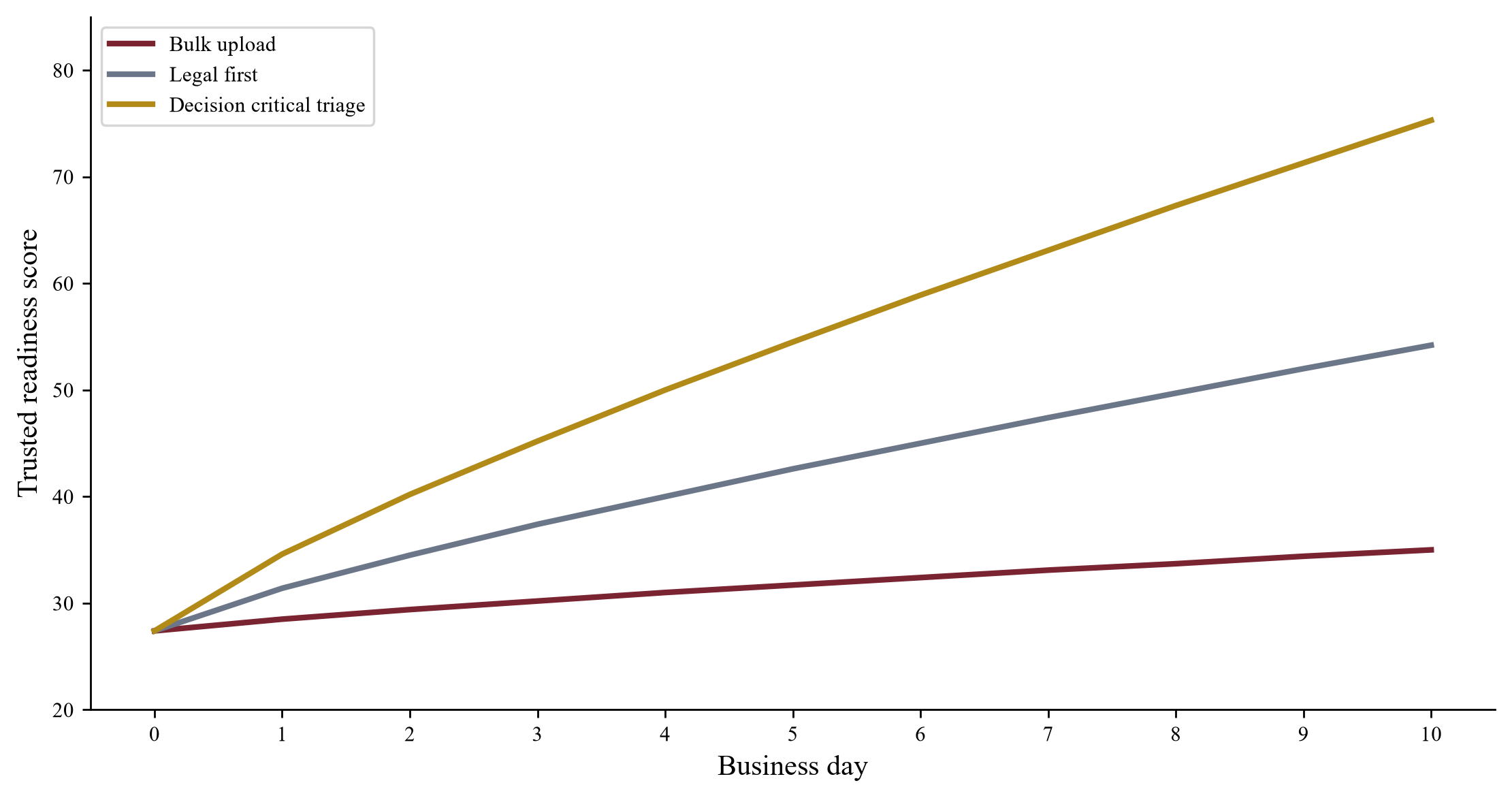
Author assumptions. Trusted readiness equals weighted readiness multiplied by the stated integrity factor. No proceeding threshold is implied.
Table 4. Hypothetical route results on day ten
| Route | Weighted readiness | Trusted readiness | Critical coverage points |
|---|---|---|---|
| Bulk upload | 60.4 | 35.0 | 33.6 |
| Legal first | 69.5 | 54.2 | 56.9 |
| Decision critical triage | 83.7 | 75.3 | 83.7 |
Scores follow directly from the author assumptions. They do not predict buyer behaviour, transaction value or completion.
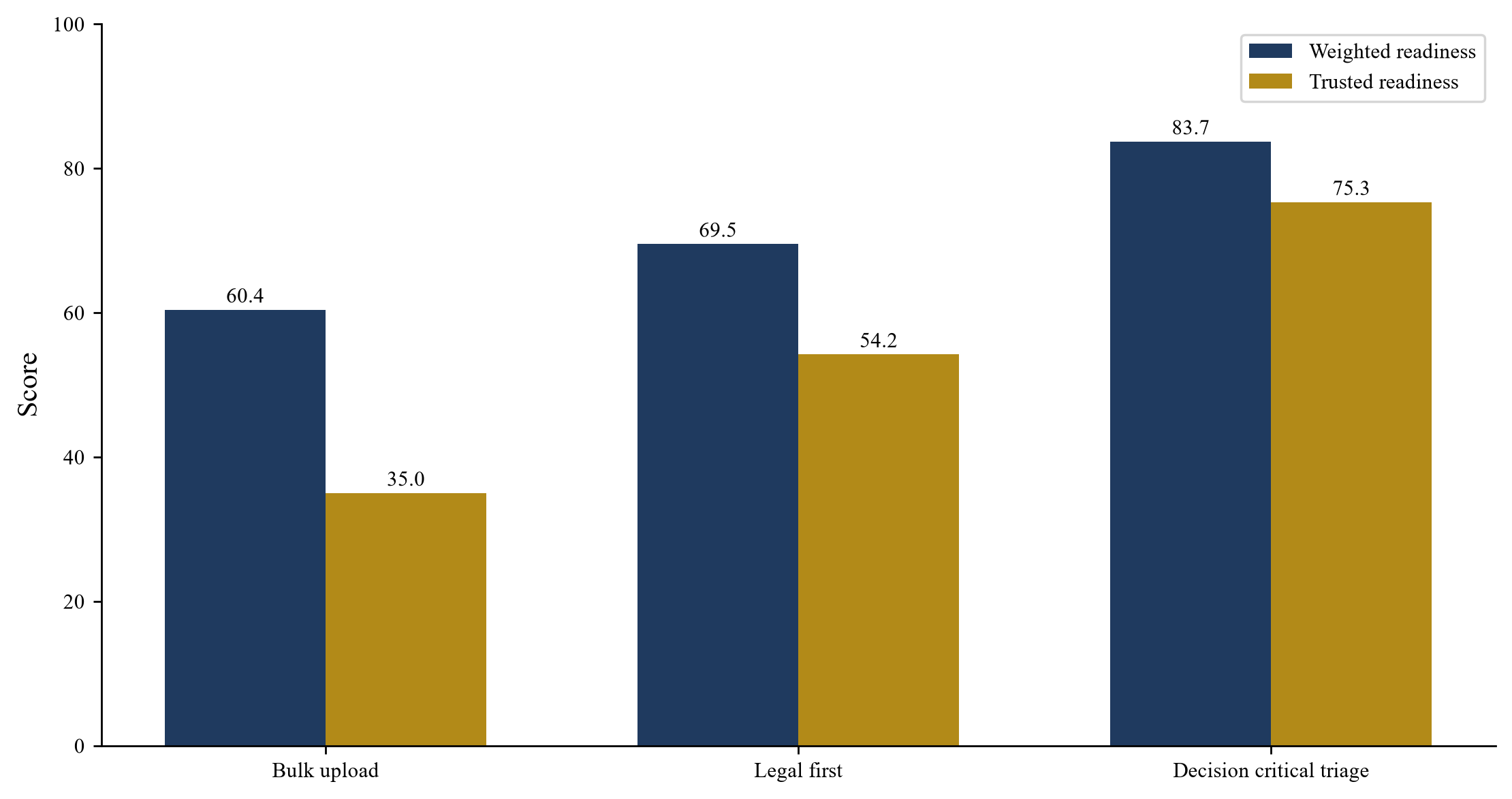
Author assumptions. Integrity discounts the nominal readiness score when evidence has weaker provenance, currency, reconciliation or review.
24. Comparing the three preparation routes
Bulk upload is assumed to process 1,760 record-handling actions during the available hours, which exceeds the 1,200-record candidate population and therefore illustrates duplicated or low-value handling rather than useful completion. Its modeled weighted readiness reaches 60.4, while a 0.58 integrity factor reduces trusted readiness to 35.0. The route closes seven of the 24 initial red flags under the stated assumptions.
Legal first processes 1,024 records, verifies 72 percent of the work and reaches weighted readiness of 69.5. Its 0.78 integrity factor produces trusted readiness of 54.2. The route closes twelve modeled red flags. It performs strongly in security, tax, claims and regulation, while the assumed cash, supplier and technology scores remain lower.
Decision critical triage processes 1,280 record-handling actions, verifies 88 percent of the work and covers 93 percent of the defined critical questions. Weighted readiness reaches 83.7, and the 0.90 integrity factor produces trusted readiness of 75.3. It closes eighteen red flags. These results follow from the assumed scores and factors. They demonstrate internal consistency rather than market evidence.
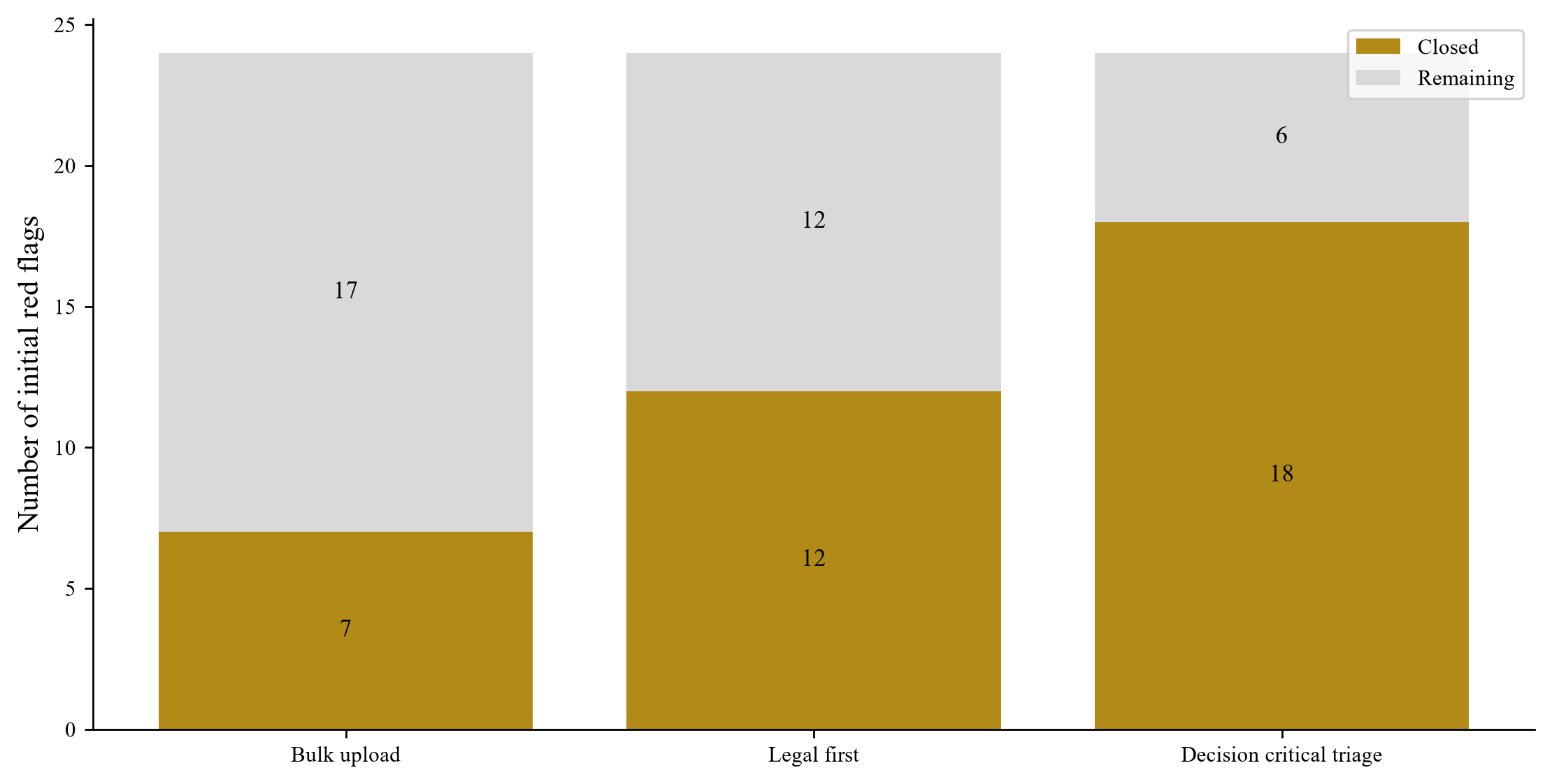
Author assumptions. Closure means the modeled issue has a reviewed evidence response; it does not mean that a liability has been removed.
25. What the model changes for management
The model directs attention to the combination of coverage and integrity. A room can contain every requested file and still fail when evidence is stale, contradictory or disconnected from the decision. Conversely, a ten-day room can support an initial executable decision when it covers the material perimeter, makes uncertainty visible and directs the remaining work.
Management should use the model as a planning discussion. Domain weights can be changed, the baseline can be scored by independent reviewers and the integrity factor can be tied to defined tests. The team can then compare proposed resource allocations before committing scarce executive time. The model should remain separate from the buyer's valuation and from any professional opinion.
The most important output is the work queue. Low scores in a heavily weighted domain become immediate priorities. A high score supported by weak provenance requires re-verification. A low-weight record with no plausible transaction consequence can wait. This discipline preserves time for operational continuity and negotiations.
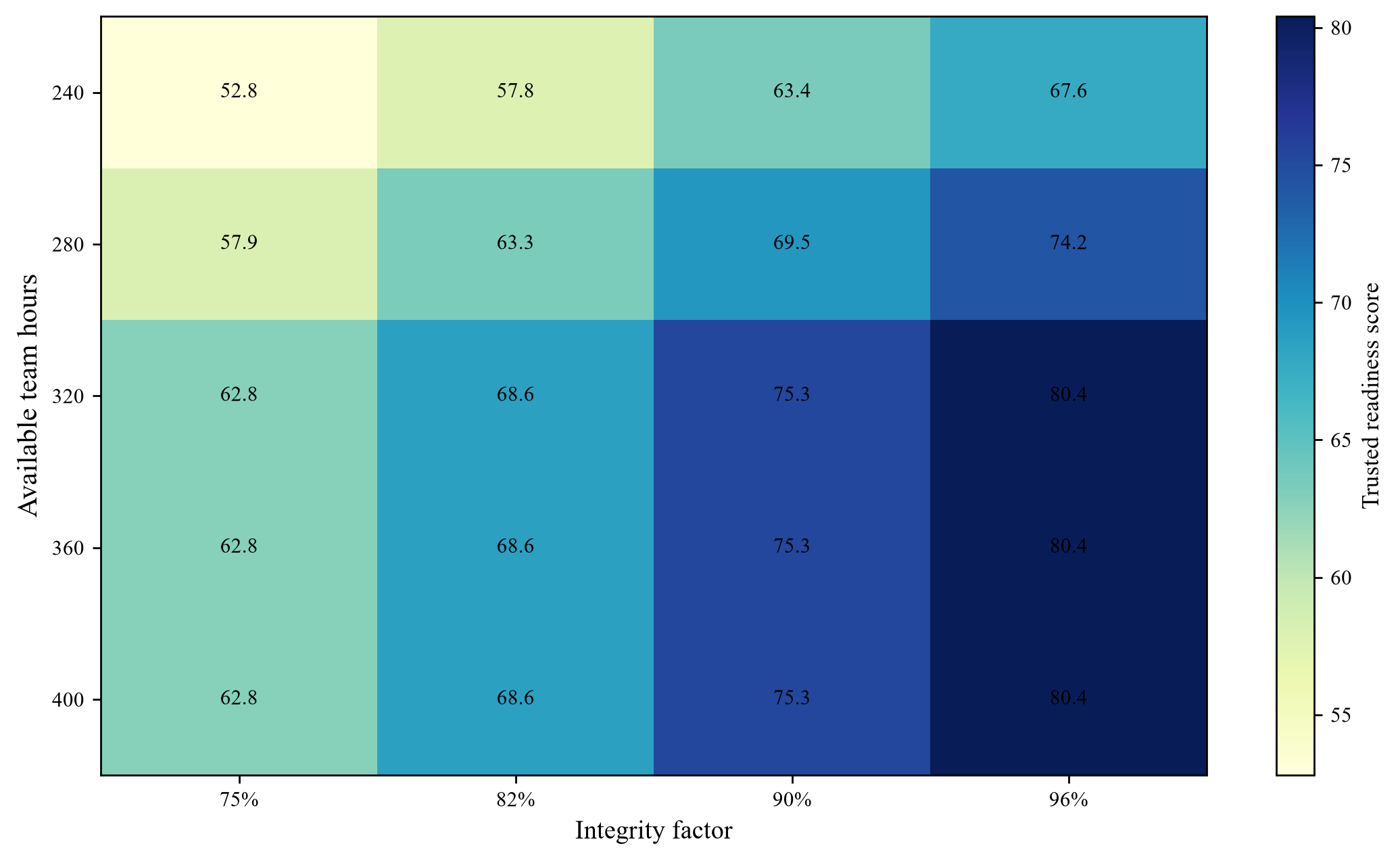
Author assumptions. Capacity beyond 320 hours is capped in the simplified model because external dependencies can limit further progress.
26. Capacity and integrity sensitivity
The sensitivity analysis varies total team capacity from 240 to 400 hours and the integrity factor from 0.75 to 0.96. Readiness improves with additional hours, subject to diminishing returns in the model. Integrity changes the trusted score directly because evidence that has not been reconciled or reviewed receives less weight. The twenty cells show how a nominally complete room can remain weak when its verification standard is low.
The calculation assumes that the decision-critical route retains the same domain allocation as capacity changes. Real projects will have bottlenecks. A missing title document may require an external search. A contract may be held by a counterparty. A permit transfer may depend on a regulator. An employee process may have a statutory timetable. Adding analysts cannot remove those dependencies.
Sensitivity should therefore inform contingency planning. Management can identify which gaps respond to more internal capacity, which need external action and which require a different transaction structure or timetable. No cell should be read as a threshold for proceeding.
Table 5. Proposed accelerated diligence risk control matrix
| Failure mode | Early indicator | Control | Evidence retained |
|---|---|---|---|
| False completion | Files uploaded without review | Submitted and completed statuses kept separate | Reviewer, test and exception record |
| Version confusion | Conflicting drafts or dates | Controlled index and superseded-file history | Current version and reconciliation note |
| Unlawful disclosure | Personal or restricted data in broad access | Legal review, aggregation, redaction and permissions | Release decision and access log |
| Privilege loss | Advice uploaded without clearance | Counsel-controlled privilege review | Privilege decision and restricted location |
| Operations weakened | Collections or service metrics deteriorate | Request prioritisation and protected operating capacity | Daily capacity and performance review |
| Material gap hidden | Blank folder or repeated buyer question | Negative-evidence search and visible exception log | Search scope, owner and response |
Proposed controls. The board and qualified advisers determine the controls appropriate to the company, transaction and jurisdiction.
27. Risk controls for accelerated preparation
The process needs controls for inaccurate evidence, privilege loss, unlawful data sharing, unauthorised disclosure, version confusion, operational disruption and overreliance on management estimates. Each control should have a trigger and an evidence record. For example, personal data can require aggregation, redaction, restricted access and a decision log. A material financial schedule can require reconciliation to the ledger and bank evidence. A privileged document can require legal review before upload.
Operational disruption deserves a specific control. Executives and staff can spend so much time answering diligence that collections, production or customer service deteriorate. The daily control room should track requests against capacity and defer low-decision-value work. A designated buyer-question team can protect operational managers from repeated approaches.
The framework should also identify reliance boundaries. Management schedules, adviser memoranda, public filings and third-party confirmations have different purposes. The room should state the source and date rather than using visual polish to imply assurance.
28. Management presentations and buyer questions
The management presentation should follow the evidence map. Each material claim needs a clear basis, current period and link to the supporting room section. Forecasts should separate contractual commitments, run-rate assumptions, management actions and external dependencies. Scenario analysis should show which variables matter and avoid presenting one case as certain.
Buyer questions can be used as a diagnostic. Repeated requests about cash, title or customer continuity indicate that the existing evidence does not answer the decision. The seller should improve the evidence chain and publish an authorised response. Conflicting answers from different executives require immediate escalation.
The question log should capture who asked, when, which bidder received the answer and whether the answer changes previous information. Material corrections should reach all relevant bidders consistently, subject to process rules and advice. Selective or informal disclosure can impair fairness and trust.
29. Board reporting and decision records
The board pack should remain concise. It should show unrestricted cash and runway, buyer status, weighted readiness, unresolved critical gaps, new adverse events, required consents, access incidents and decisions due. Detailed evidence remains in the registers. The board should be able to understand what could prevent completion and which actions preserve options.
Decision records should state the information considered, conflicts, advice obtained, alternatives and authority. They should avoid retrospective certainty. A ten-day process will contain unresolved matters, and the record should explain how those uncertainties were handled. Directors and advisers determine the appropriate legal standard and documentation for the company.
If a connected-person administration disposal is contemplated, the Insolvency Service guidance explains that a qualifying evaluator's report must be received and considered before a substantial disposal within the first eight weeks, unless creditor approval applies [2]. The connected person may need to provide financial accounts, a statement of affairs, business plans, forecasts and other documentary evidence. Early evidence triage can support that process, while the statutory and professional requirements remain controlling.
30. Cross border and sector adaptation
The framework uses UK sources because the tracker topic and adjacent series concern distressed-business sales under a UK-oriented legal and regulatory context. Cross-border groups require a jurisdiction-by-jurisdiction map of entities, assets, employees, security, insolvency procedures, data transfers, permits and approvals. A single group data room should not imply that the same transfer rules apply everywhere.
Sector adaptation begins with the operating permission and value driver. Financial services may require regulatory capital, client-money, outsourcing and change-of-control evidence. Energy and infrastructure businesses may prioritise concessions, licences, land rights, grid arrangements, environmental obligations and government contracts. Technology businesses may focus on intellectual property, cyber resilience, data rights and key personnel. Healthcare may require patient-data, professional-registration and facility-licence controls.
The twelve-domain map can accommodate these differences by changing weights, subfolders and tests. The governance principles remain useful: establish provenance, currency, integrity and decision relevance; expose exceptions; control access; connect evidence to cash and continuity.
31. Limitations
The paper provides an analytical framework and a hypothetical model. It does not provide legal, insolvency, accounting, tax, regulatory, employment, pensions, environmental, data-protection, valuation or investment advice. The cited sources support specific principles in their stated contexts. They do not validate the model's weights, scores, throughput, integrity factors or red-flag outcomes.
The ten-business-day period is a management preparation target. It does not override statutory notice, consultation, filing, approval or procedural requirements. Evidence availability will vary by company. Some records may require external confirmation or reconstruction. Some information may be privileged, personal, market-sensitive or restricted by contract.
The model omits buyer behaviour, sale probability, valuation, creditor priority, taxes, professional costs, financing terms, fraud, data loss and post-completion performance. Management should replace every assumption with verified company evidence and obtain qualified advice before using the framework in a live transaction.
32. Implementation roadmap
The first implementation step is a short readiness diagnostic. Management scores the twelve domains, identifies the decisions due within the cash runway and names the evidence owners. The board approves authority, confidentiality, buyer-access and escalation rules. Advisers confirm the legal and regulatory perimeter.
The second step is a controlled ten-day sprint using the daily plan, request register, red-flag log and reviewer challenge. The team releases information in layers, tracks buyer questions and protects operating capacity. At the end of day ten, the board receives a frozen readiness report with residual gaps and proposed responses.
The third step continues through signing and completion. Evidence is refreshed, consents and releases are tracked, transaction documents allocate known issues, and transition records are prepared. The room becomes a controlled completion archive. Each stage should preserve a clear record of what was known, what remained uncertain and who authorised the action.
33. Conclusion
A distressed data room should help decision makers determine whether a business or asset perimeter can trade, transfer and complete within the available time. Ten business days can produce a useful first decision pack when management ranks evidence by consequence, reconciles the material claims, controls access and exposes unresolved matters. A large upload without these disciplines can consume the same capacity while leaving buyers and the board unable to act.
The proposed framework combines twelve evidence domains, a daily operating plan, an exception register, buyer-access progression and a transparent readiness model. Its value lies in the questions and controls it imposes. Company-specific evidence, current professional advice and the actual process timetable remain decisive.
References
- UK Government. Corporate Financial Distress Guidance Note. Updated 15 June 2026; accessed 6 September 2026. https://www.gov.uk/government/publications/the-sourcing-and-consultancy-playbooks/corporate-financial-distress-guidance-note-html
- The Insolvency Service. Requirements for independent scrutiny of the disposal of assets in administration, including pre-pack sales. Published 30 April 2021; accessed 6 September 2026. https://www.gov.uk/government/publications/requirements-for-independent-scrutiny-of-the-disposal-of-assets-in-administration-including-pre-pack-sales/requirements-for-independent-scrutiny-of-the-disposal-of-assets-in-administration-including-pre-pack-sales
- Information Commissioner's Office. Due diligence when sharing data following mergers and acquisitions. Accessed 6 September 2026. https://ico.org.uk/for-organisations/uk-gdpr-guidance-and-resources/data-sharing/data-sharing-a-code-of-practice/due-diligence/
- Financial Reporting Council. Guidance on the Going Concern Basis of Accounting and Related Reporting, including Solvency and Liquidity Risks. Published 25 February 2025; accessed 6 September 2026. https://www.frc.org.uk/library/standards-codes-policy/accounting-and-reporting/annual-corporate-reporting/guidance-on-going-concern-basis/
- Companies House. Register a charge for a limited company. Updated 1 February 2026; accessed 6 September 2026. https://www.gov.uk/guidance/register-a-charge-mortgage-for-a-limited-company
- UK Government. Business transfers, takeovers and TUPE: information about employees during transfers. Accessed 6 September 2026. https://www.gov.uk/transfers-takeovers/information-about-employees-during-transfers
- Environment Agency. Environmental permitting charges guidance, transfer of a permit. Updated 2026; accessed 6 September 2026. https://www.gov.uk/government/publications/environmental-permitting-charges-guidance/environmental-permitting-charges-guidance
- UK Government. National Security and Investment Act guidance on acquisitions. Updated 15 July 2026; accessed 6 September 2026. https://www.gov.uk/guidance/national-security-and-investment-act-guidance-on-acquisitions
- Competition and Markets Authority. Summary of the CMA's position on mergers involving failing firms. Published 22 April 2020; accessed 6 September 2026. https://www.gov.uk/government/publications/merger-assessments-during-the-coronavirus-covid-19-pandemic/annex-a-summary-of-cmas-position-on-mergers-involving-failing-firms
- The Pensions Regulator. Introduction to assessing employer covenant. Published December 2024; accessed 6 September 2026. https://www.thepensionsregulator.gov.uk/en/document-library/scheme-management-detailed-guidance/funding-and-investment-detailed-guidance/assessing-covenant-detailed-guidance/introduction
