

Introduction
The energy transition is creating a large stock of renewable projects at different stages of development and construction. Many will reach operation. Others will encounter a financing gap, a delayed connection, a permit challenge, a withdrawn power purchase agreement, a contractor claim or a sponsor that can no longer fund the next milestone. Distress can arise from a weak project, an unsuitable capital structure, a market shock or a combination of all three.
The distinction matters because a distressed project can contain scarce and transferable rights. A site with planning consent, a mature interconnection position and completed engineering may offer a buyer a shorter route to operation than a greenfield project. The same site can have little value if its grid offer is unaffordable, its revenue contract has terminated, its permits cannot transfer or the remaining cost exceeds the economic value of output.
Recent evidence shows why the problem requires project-level analysis. IRENA reported that financing costs, revenue certainty, capital structure and macroeconomic conditions remain important determinants of renewable project viability. The United Kingdom raised maximum auction prices after financing and supply-chain costs increased, and later extended delivery windows for offshore wind in response to supply-chain pressure and longer lead times. Lawrence Berkeley National Laboratory found that United States interconnection costs and delays vary widely, with withdrawn wind and solar projects facing much higher interconnection costs relative to total project cost than completed projects. Public company disclosures provide direct examples of impairment following cost escalation, delay, changed regulation and terminated offtake.
A buyer therefore needs a recovery case rather than a simple discount to the seller's prior valuation. The recovery case should show the rights that survive, the cash required to complete, the revenue available after cure, the consents needed for transfer, the financing that can be committed and the governance required to stop further loss. This paper sets out that decision process.
1. Define the transaction perimeter
A distressed renewable transaction can involve shares in a developer, shares in a project company, selected assets, secured debt, a loan-to-own strategy, a partnership interest or a sale through an insolvency process. Each route transfers a different combination of rights, liabilities and execution risk. The investment committee should approve the legal and economic perimeter before it approves value.
The perimeter schedule should list every entity, asset, contract, licence, permit, bank account, security interest, claim, employee, data set and shared service required to complete and operate the project. It should identify ownership, governing law, transfer restrictions, change-of-control provisions, defaults, cure periods, termination rights and required consents. The schedule should also identify assets that appear operationally necessary while sitting outside the proposed transaction.
A share acquisition usually preserves contracts and licences within the project company, subject to change-of-control clauses. It can also preserve unknown liabilities, tax history, disputes and related-party arrangements. An asset acquisition can select the desired perimeter and leave some liabilities behind, subject to local law, creditor rights, permit transfer and successor-liability rules. An insolvency sale may provide a court-supervised process and stronger title in some jurisdictions; its protections, timetable and consent treatment require jurisdiction-specific advice.
The buyer should map economic exposure separately from legal ownership. A sponsor may hold a minority interest, a development fee, a carried interest, a shareholder loan and rights under a management agreement. Secured lenders may control enforcement and sale through collateral. Contractors and offtakers may hold termination claims or set-off rights. The valuation should follow the rights that the buyer can acquire and enforce.
2. Diagnose the cause of distress
The recovery plan begins with a causal diagnosis. A symptom such as unpaid invoices or missed milestones can result from several underlying problems. The project may have suffered construction inflation, design change, weak cost control, grid restudy, lower expected output, financing withdrawal, an uncreditworthy offtaker, a terminated auction award or sponsor-level liquidity pressure. Each cause requires a different acquisition structure.
The buyer should create a dated distress chronology. The record should show the original investment case, contracts, financing plan, budget revisions, milestone slippage, notices, covenant breaches, sponsor decisions and current cash position. Board papers, lender reports, engineer reports, claims correspondence and bank statements should reconcile to the chronology. Management interviews can explain events; documents should support every material conclusion.
The diagnosis should separate project distress from sponsor distress. A project can remain economically sound while its sponsor faces unrelated leverage or liquidity pressure. A sponsor can also support a project whose economics have deteriorated. The first situation may support a clean transfer and conventional project financing. The second may require repricing, contract renegotiation, additional equity or abandonment.
The buyer should identify whether the cause can be cured within the transaction timetable. A missing consent may be obtainable. An expired site option may be lost permanently. An EPC claim may be settled. A terminated PPA may require a new procurement round with uncertain timing. A grid cost increase may make the current design unfinanceable while a smaller or hybrid design remains viable. The recovery thesis should state the cure, cost, owner, evidence and deadline for each cause.
3. Establish the rights that still exist
Distress can weaken rights before a buyer reaches signing. Land options expire, permits lapse, grid deposits become due, contractors suspend performance and counterparties issue default notices. A current rights register should replace historic project summaries.
The register should identify the legal holder, term, status, transferability, conditions, security, current compliance and next action for each right. Core categories include land, access, easements, resource data, environmental approval, planning consent, construction licence, grid application, interconnection agreement, offtake, equipment, warranties, intellectual property and project data. The buyer should record whether a right survives insolvency and whether a counterparty can terminate or demand security after change of control.
Grid and land rights require joint review. A connection may depend on the same project entity, site coordinates, technology and capacity stated in the application. A design change can trigger restudy or a new application. A land assignment may require consent or release of sponsor security. Permits can attach to the land, project company, named applicant or approved design. The acquisition plan should preserve the combination of rights that makes the project capable of completion.
The project data room should contain original executed documents and current official correspondence. A spreadsheet status entry cannot establish a transferable right. The buyer should obtain confirmations where the project has missed milestones, entered a cure period or received an informal accommodation.
4. Rebuild cost to complete
Historical spend can show sunk capital and work performed. It does not establish the amount required to reach commercial operation. The buyer should rebuild cost to complete from current scope, contracts, physical progress, claims, procurement status, schedule and financing assumptions.
The cost model should cover remaining equipment, civil and electrical works, network upgrades, contractor mobilisation, owner costs, land, insurance, taxes, customs, contingency, working capital, reserves, interest during construction and transaction costs. It should distinguish fixed, indexed, reopenable, disputed and uncontracted amounts. Currency and commodity exposure should remain visible.
Physical completion should reconcile to earned value and remaining scope. A project described as 70 percent complete by expenditure may have paid deposits for equipment while critical construction remains. A project described as 70 percent complete by engineering quantities may face most of its interface and commissioning risk ahead. An independent technical adviser should validate progress, design maturity, defect exposure, long-lead items and the critical path.
Claims belong in the completion budget. Liquidated damages receivable should enter the base case only when liability, collectability and timing are supportable. Contractor claims, termination payments, remobilisation and replacement costs should remain explicit. A buyer should avoid netting uncertain claims against firm completion costs.
The schedule affects cost through labour, equipment storage, warranty start dates, financing carry, seasonal access and revenue delay. The model should connect each delay case to cash, rather than apply one percentage contingency to the entire budget.
5. Test the route to revenue after an offtake shock
The PPA, contract for difference, regulated tariff, certificate regime or merchant route determines how project output becomes cash. A distressed project may have lost the contract that supported its original financing. The buyer should treat replacement revenue as a new underwriting decision.
The World Bank's PPA guidance identifies the agreement as a central contract for independent power generation and explains the importance of risk allocation, payment security, dispatch, curtailment, force majeure, termination and lender rights. The acquisition review should examine every notice, milestone, security obligation, performance requirement and default. It should determine whether the contract remains effective, can be cured, can transfer and can support the proposed financing.
Where the PPA has terminated, the buyer should map available routes: reinstatement, novation, bilateral replacement, public auction, regulated support, portfolio hedge or merchant exposure. Each route has a different probability, timetable, price shape, credit profile and security requirement. A forecast that assumes a future PPA should identify the procurement route and evidence supporting the expected price.
Public filings illustrate the accounting and economic consequences. A United States renewable company reported impairments after two development-stage projects lost PPAs following missed contractual milestones, including charges associated with plant, right-of-use assets, upfront payments and favourable PPA intangibles. The example shows how offtake failure can affect several asset categories and create termination costs. It does not establish a general loss rate.
Contract quality extends beyond headline price. The model should include indexation, volume, shape, negative prices, curtailment, availability, imbalance, certificates, credit support, termination compensation and change of control. A high nominal tariff can carry delivery obligations that the impaired project cannot meet.
6. Reassess grid value and connection risk
A grid position can represent substantial development value. Its value depends on location, capacity, timing, upgrade scope, security requirements, curtailment, transferability and the probability that the project remains eligible under changing queue rules.
Berkeley Lab reported approximately 10,300 projects seeking United States transmission interconnection at the end of 2024, representing 1,400 GW of generation and about 890 GW of storage. Only 13 percent of capacity entering surveyed queues from 2000 through 2019 had reached commercial operation by the end of 2024. The median time from interconnection request to commercial operation exceeded four years for projects built during 2018 through 2024 in regions with available data.
Its separate interconnection-cost research found a wide distribution. Completed wind and solar projects had interconnection costs equal to about 6 to 8 percent of total project costs in the reported sample, while withdrawn projects faced costs of about 30 to 37 percent. These results demonstrate selection and project-specific risk. They should not be applied as a universal valuation adjustment.
FERC Order No. 2023 introduced cluster studies, readiness deposits, site-control requirements and withdrawal penalties for covered transmission providers. Great Britain's TMO4+ reforms prioritise projects considered ready and needed and can move other projects to an indicative queue. A buyer should identify the current regime, the target's compliance evidence and the effect of transfer or design change.
Grid diligence should reconcile executed agreements, studies, deposits, securities, milestones, network works, curtailment and correspondence. The cost-to-complete model should include the latest assigned network cost and a dated downside case. A connection date should align with the network operator's delivery plan and the project's construction schedule.
7. Verify permits, land and community obligations
Permits can preserve development value after financial distress. Their conditions can also require redesign, mitigation, community commitments and decommissioning security. The buyer should review the full permit chain and the work required to keep each approval effective.
The European Commission's 2024 recommendation on permit granting encourages coordinated procedures, early engagement and comprehensive permitting schedules. National law and project facts remain decisive. The buyer should identify every authority, approval, condition, appeal period, legal challenge, expiry date and transfer requirement.
Land review should cover title, options, leases, access, easements, rent, indexation, construction rights, lender step-in, assignment and restoration. A project may require separate rights for generation, cabling, substation, laydown areas and access roads. The buyer should confirm that the rights last through construction, operation and decommissioning.
Environmental and social obligations remain with the project after a financial restructuring. IFC Performance Standards provide a widely used framework for assessment, labour, community, land, biodiversity and cultural heritage. The Equator Principles expressly cover project-related acquisition finance within their scope. A buyer seeking compliant financing should integrate environmental and social diligence into the acquisition timetable and completion budget.
Community agreements and grievance history deserve direct review. A permit can remain valid while opposition creates delay or litigation risk. The buyer should assess consultation commitments, benefit arrangements, indigenous or cultural rights where relevant, unresolved complaints and the target's capacity to implement the management plan.
8. Review equipment, construction and warranty rights
Equipment can carry value through deposits, manufacturing slots, title, warranties and favourable pricing. It can also create storage cost, obsolescence, mismatch and cancellation liability. The buyer should build an equipment register by serial number or contract package.
The register should show specification, manufacturer, price, payment, title transfer, delivery, storage, inspection, acceptance, warranty, performance security, cancellation and assignment. The technical adviser should confirm that the equipment remains compatible with the approved design, grid code, permit and expected operating regime.
Construction contracts should be reviewed for scope gaps, interfaces, completion tests, delay, defects, caps, security, step-in, suspension, termination and change of control. A distressed sponsor may have waived rights, missed notice deadlines or agreed side arrangements. The buyer should reconcile contract terms to current claims and site practice.
Replacement contracting can reset risk. A new EPC contractor may refuse responsibility for prior work, design and latent defects. Split packages can reduce price while increasing interface risk. The acquisition model should reflect the proposed delivery structure after closing rather than assume the seller's old contract resumes unchanged.
Warranty value depends on enforceability, start date, maintenance compliance and assignment. Equipment stored for an extended period may require inspection, preservation records and manufacturer approval before installation.
9. Map financing, security and creditor control
Distressed projects often have several claims on the same assets: senior debt, shareholder loans, contractor liens, equipment finance, hedges, land security, deposit accounts and guarantees. The buyer needs a complete capital and security map before it can determine how control transfers.
The map should identify principal, accrued interest, fees, defaults, cure rights, enforcement status, collateral, guarantees, intercreditor terms, cash control and transfer restrictions. It should distinguish legal priority from expected economic recovery. Tax, employee and statutory claims can have priority under local law.
Consent and release mechanics should be included in the funds flow. A purchase price cannot be assessed independently from debt paydown, cure amounts, working capital, claim settlement and new-money needs. The buyer should confirm which obligations remain in the acquired entity and which receive a release at closing.
Lenders may have step-in or substitution rights under direct agreements. These rights can preserve permits, offtake and construction contracts while ownership changes. The buyer should coordinate the transaction with the parties whose consent or release is required. Informal expectations should not be treated as committed releases.
The financing plan should state the source of closing funds, completion equity, senior debt, contingencies and liquidity. A buyer can acquire a project at a low price and still overpay if it underfunds completion.
10. Select the sale process and control route
The transaction route influences timing, title, competition, consent and liability. A consensual share sale can provide time for diligence and consent. A secured enforcement can transfer control through collateral. A court-supervised sale can protect value and coordinate creditors in some jurisdictions. A debt purchase can create influence without immediate ownership.
UNCITRAL's Legislative Guide discusses the use and disposal of insolvency-estate assets and the objective of preserving going-concern value where appropriate. The World Bank's insolvency principles emphasise transparent creditor rights, stays and mechanisms that support productive restructuring. These sources provide policy frameworks. They do not determine the law applicable to a particular transaction.
The buyer should test whether the proposed route preserves licences, land, grid, PPA, tax attributes, employees, data and financing. It should identify approvals and challenge risk. A rapid auction can limit diligence and require stronger price protection, escrow, insurance or a narrower perimeter.
Transaction certainty has value to the estate and creditors. The buyer can improve certainty through committed funding, limited conditions, a clear consent plan and credible completion capability. It should avoid conditions that depend on discretionary future financing when the seller needs a binding solution.
The process should include a clean decision on abandoned entities and liabilities. A buyer that acquires a platform to obtain one project may inherit governance, reporting and closure costs across the remaining estate.
11. Convert diligence into a heat map
Diligence should connect evidence to price, structure, closing and the post-close plan. A large issue list without decision consequences creates delay while leaving risk unresolved.
The heat map should record the evidence, finding, value effect, cash effect, contract response, owner, deadline and stop condition. It should separate facts from management estimates and legal or technical opinions. Open matters should state the decision that cannot be made until evidence arrives.
Table 1. Distressed renewable acquisition evidence matrix
| Risk area | Required evidence | Value and funding response | Transaction control |
|---|---|---|---|
| Offtake | Executed contract, notices, defaults, security, replacement route | Rebuild revenue case and termination exposure | Cure, consent or replacement as a closing condition |
| Grid | Studies, agreement, deposits, upgrade cost, queue status | Update connection cost, delay and curtailment | Operator confirmation and protected transfer |
| Permits and land | Approvals, title, leases, conditions, challenges | Cost mitigation and extension requirements | Transfer, renewal and no-lapse covenant |
| Construction | Progress, scope, claims, contractor capacity, warranties | Independent cost to complete and contingency | Settlement, replacement contract and completion support |
| Financing | Debt, security, defaults, intercreditor, cash control | Funds flow, release cost and new-money plan | Payoff, release and direct-agreement transfer |
| Environmental and social | Impact studies, management plans, grievances, liabilities | Remediation budget and financing eligibility | Action plan, indemnity and ongoing monitoring |
| Sponsor and governance | Related parties, shared services, people, systems | Standalone cost and transition budget | TSA, retention and authority plan |
The matrix is a transaction-control framework. Legal effect and required evidence depend on jurisdiction and project documents.
Issues should be rated by probability, severity, timing and controllability. A high-severity issue with an objective consent path can be manageable. A lower-cost issue can become a stop condition when it prevents transfer of the grid position or revenue contract.
The heat map should drive daily execution during exclusivity and the first 100 days. Closed items should retain the evidence that supports closure. Risks should not disappear because a seller changes their description.
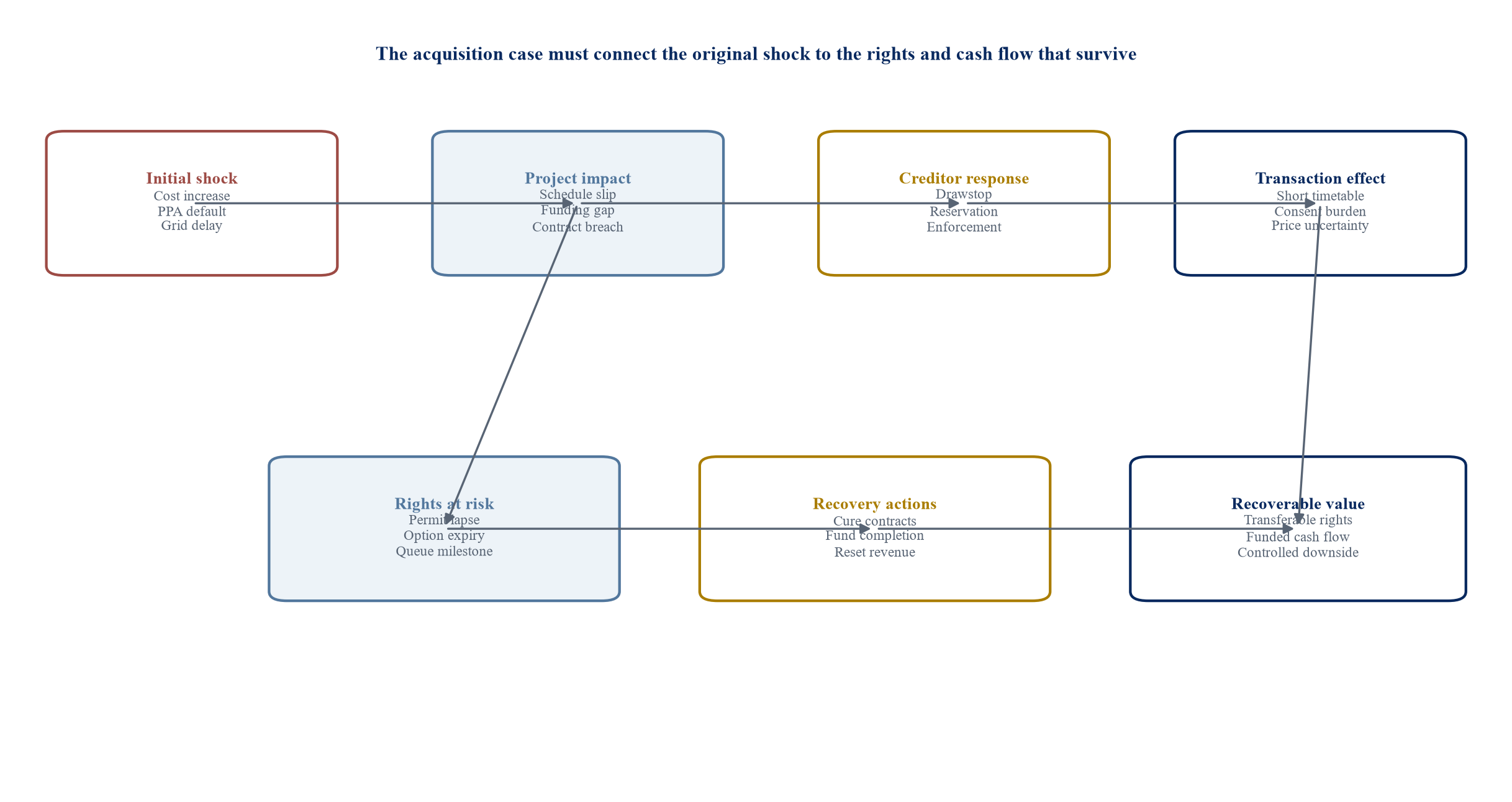
The pathways illustrate common dependencies. Actual causes and consequences require project-specific evidence.
12. Rebuild the operating and financial model
The seller's model can preserve history and assumptions. The buyer needs a controlled model built from verified contracts, technical evidence and a dated completion plan. Every material input should show source, unit, currency, date, owner and status.
The model should separate committed and uncommitted items. Executed debt, fixed-price contracts and valid tariffs belong in the contracted case, subject to conditions. Indicative financing, replacement PPAs and disputed claims belong in scenarios. Management targets should be identified as estimates.
Construction periods require monthly cash flow. The model should show equity, debt draw, eligible costs, interest, fees, reserves, tax, claims, revenue and minimum liquidity. Operations can use monthly or quarterly output with resource, availability, degradation, curtailment, price, imbalance and operating-cost assumptions.
The model should contain a rights-loss case. Examples include loss of PPA, loss of queue position, permit redesign or contractor termination. The case should identify salvage, sale and abandonment costs. A zero value assigned to a failed project may still omit decommissioning, land and claim exposure.
The buyer should reconcile the model to the funds flow and acquisition agreement. Purchase consideration, debt payoff, cure payments, transaction costs and completion capital should draw from the same financing sources used in the approved model.
13. Build value from the post-cure project
The valuation should start with post-cure economics. The buyer forecasts cash flow after the required contracts, funding and schedule changes, then deducts the cost and risk of reaching that state. Prior sponsor expenditure can inform replacement cost and negotiation. It does not create recoverable value by itself.
A discounted cash-flow model should reflect the revised revenue contract, output, operating cost, capital cost, schedule, tax, financing and terminal obligations. Scenario weighting can represent mutually exclusive recovery routes when probabilities have an evidential basis. Where probabilities cannot be supported, the committee should review separate cases rather than invent a precise expected value.
Market evidence can test the result through operating-asset yields, development-stage transactions, replacement cost and public disclosures. Comparability requires technology, jurisdiction, contract, stage, grid, remaining cost and control. A price per megawatt can conceal decisive differences.
IAS 36 states that an asset should not be carried above its recoverable amount, defined as the higher of value in use and fair value less costs of disposal. IFRS 3 requires acquisition-date recognition and measurement of identifiable assets and liabilities for a business combination. IAS 37 addresses provisions for onerous contracts when unavoidable costs exceed expected benefits. These standards guide financial reporting; transaction valuation, legal perimeter and accounting conclusions require separate professional analysis.
The valuation bridge should show gross project value after cure, remaining capital, claims, delay, remediation, corporate costs, debt and transaction costs. It should separately identify buyer-specific benefits and contingent value.
14. Price uncertainty through scenarios
Distressed-project valuation depends on a small number of high-impact uncertainties. The committee should see how value changes when those uncertainties move together.
The central case should use rights and contracts that can be preserved with defined cures. The downside case should include delayed consent, higher grid cost, lower offtake price, additional construction claims and later commercial operation. A severe case should test loss of the preferred revenue route and a sale or redesign decision.
Correlation matters. Cost escalation can delay financing; delay can breach the PPA; PPA breach can stop debt; debt withdrawal can cause contractor suspension. The model should avoid assigning independent probabilities to events that share one cause.
Reverse stress testing should identify the point at which acquisition value becomes zero or liquidity becomes insufficient. Variables can include completion cost, revenue price, capacity factor, grid cost, delay and financing margin. The result helps management define price caps, walk-away conditions and required reserves.
The committee should approve ranges and triggers. A single number can create false precision when the transaction depends on consents and negotiated cures.
15. Structure consideration around verified recovery
The purchase price should reflect value that transfers at closing and value that depends on future recovery. Cash at closing can pay for transferable rights, equipment, data and control. Deferred or contingent consideration can address unresolved permits, grid, offtake, claims and completion.
Milestones should be objective, time-bound and economically relevant. A replacement PPA milestone can require an executed contract with an approved counterparty, minimum tenor, defined price economics and lender acceptance. A grid milestone can require an effective agreement, confirmed cost and a connection date compatible with the project schedule. A permit milestone can require final effectiveness and an approved design.
Price adjustments should avoid double counting. A lower closing price for a lost PPA and an earn-out based on securing replacement revenue can allocate the same uncertainty once. A completion-account adjustment should address balance-sheet changes, while contingent consideration addresses future project outcomes.
Escrow, holdback, warranty insurance and specific indemnities can address identified liabilities. Their effectiveness depends on coverage, exclusions, credit and claim procedure. In an insolvency sale, seller recourse may be limited and price may carry more risk.
Seller protections can govern buyer-controlled milestones. The agreement can define the development budget, information rights, reasonable efforts, substitution rules and acceleration on sale. The buyer should retain authority to stop a project that fails agreed investment criteria.
16. Allocate contract and claim risk
Distressed transactions contain known claims and unknown exposure. The agreement should allocate them by subject, time and control.
Specific indemnities can address identified tax, environmental, contractor, land, PPA and permit matters. Warranties can cover ownership, disclosed contracts, notices, disputes and compliance. Covenants can preserve rights between signing and closing. Conditions can require consents, releases, cure agreements and funding.
Material-adverse-change language should align with the distressed baseline. Known problems should be scheduled and priced. New deterioration between signing and closing should have clear consequences. A broad condition can reduce seller certainty and weaken an insolvency process.
Claims should be tested for both asset and liability value. A contractor claim may create payment exposure while the project holds counterclaims for delay or defect. The buyer should assess procedure, evidence, netting, security and collectability. It should avoid valuing a gross claim at face value.
The agreement should preserve books, data, models, permits and correspondence. Project recovery depends on institutional knowledge. A missing data transfer can impair warranties, financing and future claims.
17. Fund the rescue and completion plan
New money creates value only when it reaches the milestones needed for operation. The financing structure should match the revised risk profile.
Completion funding can include buyer equity, senior project debt, bridge finance, vendor support, shareholder loans, preferred equity or a portfolio facility. Lenders may require an updated technical report, cost-to-complete test, contingency, fixed or capped contracts, direct agreements, reserves and sponsor completion support.
The buyer should size liquidity from closing through a funded contingency period. It should include debt service, fees, claims, delayed revenue, remobilisation, staff, insurance and preservation of permits and equipment. The plan should identify sources available after a downside event.
Priority and security should remain transparent. Rescue funding may require super-priority or priming under local law. Existing creditors may exchange debt, extend maturity, capitalise interest or share upside. The intercreditor agreement should state control over budgets, waivers, enforcement and sale.
Funding should be released against verified work and rights. A monthly draw process can link engineer certification, contract evidence and updated liquidity. The governance burden should be proportionate while preserving control.
18. Address merger control and foreign-investment review
Renewable-project acquisitions can require merger control, foreign-investment review, energy-sector approval, land consent and licence transfer. The assessment depends on jurisdiction, transaction structure, ownership and asset characteristics.
The United Kingdom CMA's merger guidelines describe the assessment of competition and theories of harm, including future competition and innovation. Energy-network mergers also have sector-specific guidance. A project acquisition can raise different issues from a network acquisition, while portfolio concentration and access to scarce development rights can still matter.
The buyer should prepare a jurisdictional approvals map early. Filing, standstill, information and remedy risk affect timetable and value. Clean-team arrangements may be needed where the parties compete for projects, land, grid, auctions or suppliers.
Foreign-investment regimes can focus on critical infrastructure, energy security, technology, government contracts and control. The transaction team should identify direct and indirect ownership and governance rights. A minority investment can still trigger review where it grants material influence or access.
Approval risk should enter the transaction timetable and long-stop date. The parties should define cooperation, remedy obligations, cost and termination consequences.
19. Protect value between signing and closing
The distressed asset can deteriorate quickly during a consent period. Interim covenants should preserve value without transferring control before closing.
The target should maintain land, permits, grid positions, insurance, equipment preservation, staff and records. It should avoid new debt, settlements, contract amendments, asset transfers and extraordinary expenditure outside an agreed budget. The buyer should receive regular cash, schedule, claim and rights updates.
The interim budget should fund mandatory actions. A covenant that prevents the seller from paying a grid deposit or renewing a land option can destroy the value being acquired. The parties should pre-approve critical payments and escalation authority.
The buyer should monitor contractor and offtaker communications. Direct contact requires consent and coordination. A structured consent plan can improve confidence while respecting confidentiality and competition law.
Conditions should be updated against actual evidence. A closing certificate should identify changes since signing, unresolved notices and the final funds flow. The buyer should rerun the completion model immediately before closing.
20. Plan integration and separation before control
A distressed acquisition usually requires immediate operating decisions. The buyer should design the first-day authority, cash control, project governance, communications and contractor engagement before closing.
The acquired project may depend on sponsor systems, treasury, engineering, procurement, data, licences and personnel. A transition-services agreement should identify service, capacity, term, price, data, security, exit and failure remedies. The buyer should confirm that the seller can deliver the service during its own restructuring.
Critical people should be identified by role and project knowledge. Retention should cover decision rights, handover and succession. A broad retention pool can spend cash without protecting the capabilities needed for completion.
Integration should preserve regulator, community, landowner, grid, offtaker and lender relationships. The buyer should assign an accountable owner for each stakeholder. Communications should describe the funded plan and governance without making unsupported commitments.
The first operating model should remain simple. One project register, one cost-to-complete model, one claims register, one risk register and one decision calendar can provide the control needed during recovery.
21. Hypothetical acquisition case
Consider a hypothetical infrastructure investor evaluating a 420 MW onshore wind project and associated 120 MW battery design. The example is illustrative. It does not describe an actual project, offer, valuation, forecast or market benchmark.
The seller has spent 96 illustrative value units on development, equipment deposits and early works. The original 20-year PPA terminated after missed milestones. Construction costs increased and the senior lender stopped further draws. The project retains land, principal permits, an executed grid agreement and equipment contracts. The grid operator requires a revised security package after change of control.
Independent review estimates 510 units of remaining construction and owner cost, including 55 units of contingency. The preferred recovery route is a new fifteen-year corporate PPA for part of output, a regulated auction for another share and merchant exposure for the balance. The offtake route remains uncommitted at signing. The buyer models a central commercial-operation date twenty-four months after closing and a downside date thirty-four months after closing.
The post-cure project has an illustrative enterprise value of 690 units in the central case. Deducting remaining construction, claims, transaction cost, net debt and remediation produces 82 units of closing equity value. A further 54 units depends on executed offtake and grid confirmation. Buyer-specific financing benefits remain outside standalone value.
Table 2. Hypothetical distressed-project valuation bridge
| Value component | Central case | Downside case | Evidence or condition |
|---|---|---|---|
| Post-cure project enterprise value | 690 | 555 | Revised output, revenue and operating model |
| Remaining construction and owner cost | (510) | (590) | Independent cost-to-complete review |
| Contractor and termination claims | (28) | (45) | Settlement and legal assessment |
| Environmental and permit remediation | (12) | (22) | Action plan and authority engagement |
| Transaction cost and transition services | (18) | (24) | Approved execution budget |
| Net debt and creditor settlement | (40) | (40) | Closing funds flow and releases |
| Illustrative equity value before contingent value | 82 | (166) | Derived from the stated cases |
| Contingent value for offtake and grid milestones | Up to 54 | 0 | Objective post-signing milestones |
All amounts and probabilities are illustrative. They do not describe an actual project, transaction or valuation benchmark.
The parties agree on 70 units payable at closing, subject to debt release and transfer confirmations. Twelve units remain in escrow for identified claims. Up to 54 units become payable after an eligible PPA, confirmed grid cost and financing close. The buyer commits a 620-unit completion funding package covering the central case and additional liquidity.
The downside case assumes a ten-month delay, lower contract price, an additional grid payment and contractor settlement. Equity value becomes negative before restructuring. The buyer therefore makes closing conditional on a maximum grid cost, minimum revenue economics and binding creditor settlement.
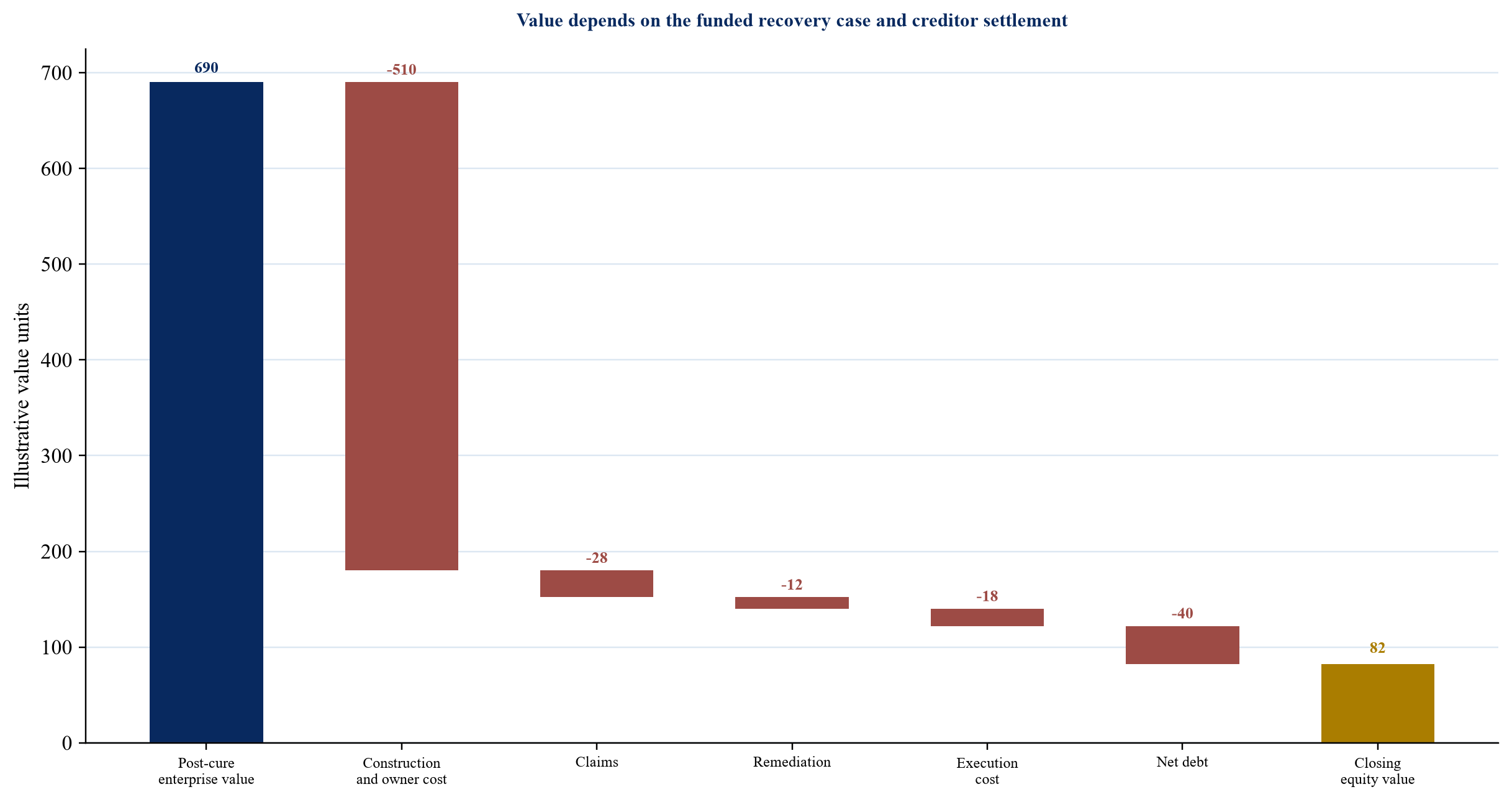
Amounts are illustrative value units and do not represent a market benchmark.
22. Stress the hypothetical case
The downside demonstrates that a low purchase price cannot compensate for an unfunded completion plan. The project requires 80 additional units of construction and owner cost, 17 additional units of claims and 10 additional units of remediation. Delayed commercial operation also reduces revenue value.
The buyer should therefore treat the negative downside equity value as a structuring problem. Possible responses include lower or zero closing consideration, creditor write-down, additional seller funding, a smaller project design, staged ownership or an option that becomes exercisable after revenue is secured. Each response changes control and consent.
The transaction should stop when the buyer cannot secure a viable revenue route, preserve the grid right or fund completion within the approved loss tolerance. Sunk costs and strategic ambition do not restore value.
Table 3. Hypothetical risk triggers and transaction responses
| Trigger | Central assumption | Illustrative stop or restructure threshold | Response |
|---|---|---|---|
| Remaining cost | 510 value units | More than 590 without committed funding | Reprice, resize or stop |
| Grid obligation | Included in central budget | Additional cost above approved reserve | Require operator confirmation or restructure |
| Offtake | Mixed contracted and merchant route | No eligible contract by long-stop date | Defer closing or convert to option |
| Commercial operation | 24 months after closing | Delay beyond 34 months | Reset value, liquidity and milestones |
| Creditor settlement | 40 value units | No binding release at closing | Do not close |
| Environmental action | 12 value units | Unfunded condition or unresolved licence risk | Fund, indemnify or exclude asset |
| Completion liquidity | 620 committed units | Downside case cannot be funded | Add capital or abandon transaction |
Thresholds are illustrative and should be replaced with project-specific approved criteria.
23. Govern the first 100 days
The first 100 days should protect rights, establish cash control and convert the recovery plan into accountable work. The board should receive a weekly completion and liquidity report until the project reaches a stable financing and construction state.
Day one actions include bank authority, budget control, creditor settlement, contractor instruction, insurance confirmation, data custody, project leadership and stakeholder communications. Critical permits, grid deposits, site payments and equipment preservation should be confirmed immediately.
The first thirty days should complete contractor and claim strategy, refresh the schedule, validate procurement, launch the offtake process and close environmental actions that affect financing. The technical adviser should issue an agreed baseline for physical progress and cost to complete.
Days thirty-one through sixty should secure the revised delivery package, advance consents and align lender diligence. The board should approve any design or capacity change. Procurement decisions should follow the model's approved cost and schedule assumptions.
Days sixty-one through one hundred should target binding revenue, financing and construction documents or a clear stop decision. Management should update the acquisition model with actual evidence and explain every variance.
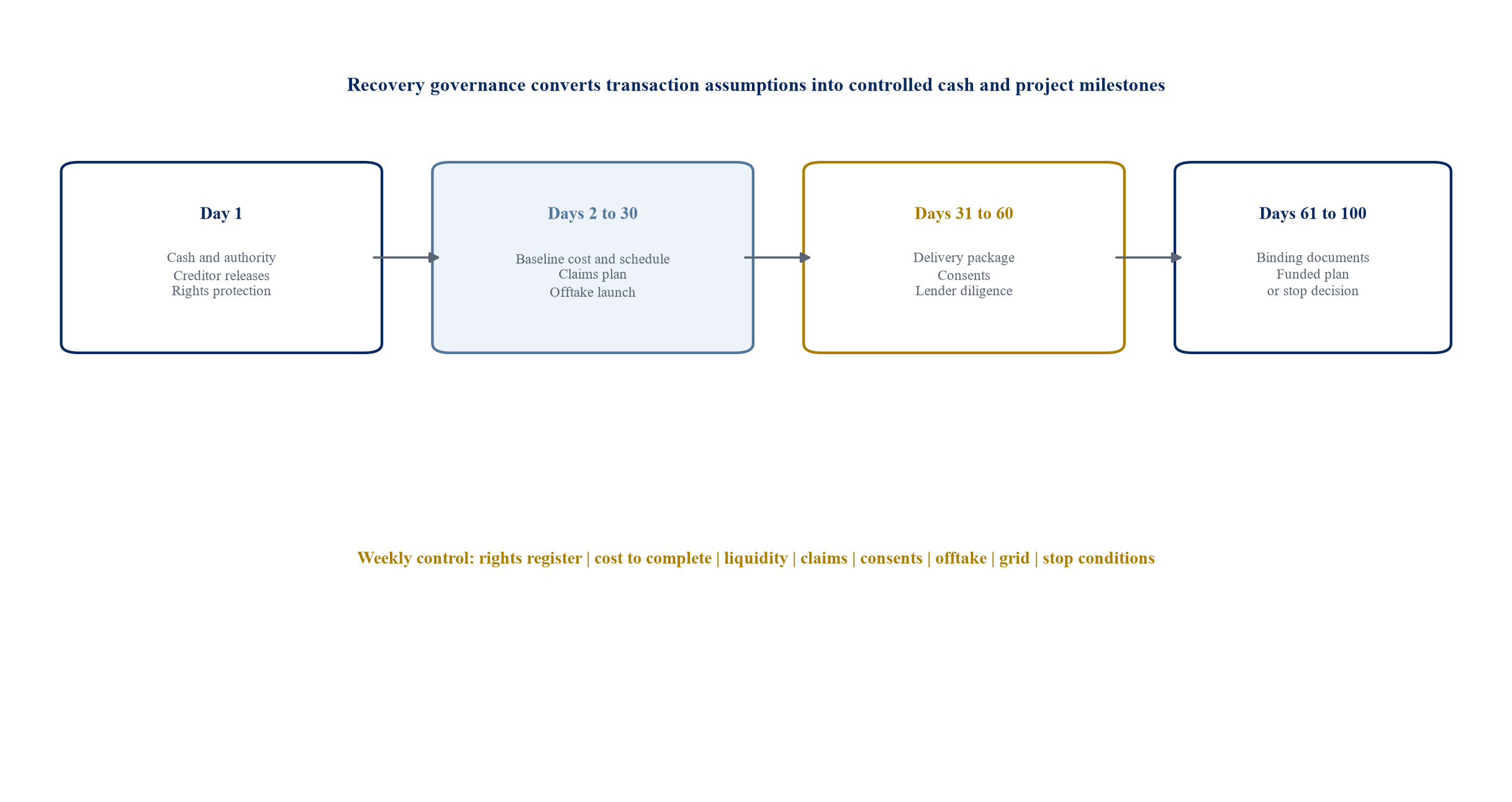
The sequence is illustrative. Legal control, project condition and consent timing determine the actual plan.
24. Apply a transaction decision framework
The investment committee should answer a defined sequence. What rights and liabilities transfer? What caused distress? Which rights remain effective and transferable? What is the independently assessed cost and time to complete? Which revenue route can support financing? Which consents, releases and cures are required? How much completion liquidity is committed? Which claims remain? What is the post-cure value under central and downside cases? Which consideration depends on future evidence? Which facts require repricing, restructuring or withdrawal?
The committee pack should include the rights register, distress chronology, cost-to-complete report, revenue analysis, creditor map, valuation bridge, downside liquidity, approval map and 100-day plan. Each open item should state its owner and decision consequence.
The approval should specify maximum closing cash, total capital at risk, minimum revenue economics, maximum grid and completion cost, required consents, liquidity floor and stop conditions. It should identify buyer-specific benefits separately from standalone value.
The transaction documents and financing commitments should implement the approved case. A committee should reconvene when a defined threshold changes before closing.
25. Recognise the limits of the framework
Distressed-project analysis depends on incomplete and changing information. Rights can change during a sale process. Claims can emerge after site access. Ofgem, FERC and other regulators can change connection regimes. Public procurement and PPA terms differ materially across jurisdictions.
The framework cannot establish legal title, insolvency priority, permit validity, technical completion, environmental liability, fair value, tax treatment or regulatory approval. Qualified advisers should address those matters under the applicable law and professional standards.
Public company impairments provide useful evidence of specific events. They do not create transaction benchmarks. Accounting impairment reflects the reporting entity, standard and assumptions. A buyer should perform its own valuation and diligence.
The hypothetical case demonstrates decision structure. Its values and thresholds should not be transferred to another project. A project-specific model should use verified contracts, technical evidence and approved management estimates.
Conclusion
A distressed renewable project can preserve valuable rights after its original capital structure fails. The buyer should identify those rights, fund the work needed to preserve them and price the project from post-cure cash flow.
The acquisition begins with a precise perimeter and distress diagnosis. It then requires a current rights register, independent cost to complete, route-to-revenue analysis, grid and permit confirmation, creditor settlement and a funded completion plan. Diligence findings should connect directly to price, conditions, covenants, indemnities and the first 100 days.
Consideration should follow evidence. Closing cash should pay for value that transfers. Deferred value should depend on objective offtake, grid, permit, financing and completion milestones. The downside case should test correlated delay, cost, claim and revenue shocks and should show the cash needed to survive them.
The transaction should proceed when transferable rights, funded completion economics and controlled downside support the approved return. It should be restructured or stopped when a critical right, viable revenue route or completion funding cannot be secured.
Frequently Asked Questions
1. Can a project retain value after its PPA terminates?
Yes. Land, permits, grid rights, equipment and completed development work can retain value. The buyer must underwrite a replacement revenue route, including timing, price, credit, security and financing consequences.
2. Should the buyer value historical development spend?
Historical spend can show work performed and replacement cost. Recoverable value depends on the rights and post-cure cash flow that remain, less the capital and risk required to reach operation.
3. When is an asset purchase preferable to a share purchase?
An asset purchase may allow a narrower perimeter. Its suitability depends on transferability, successor liabilities, creditor rights, permit and grid treatment, tax and jurisdiction-specific insolvency law. A share purchase can preserve entity-held contracts while carrying entity liabilities.
4. How should the buyer treat a replacement PPA in valuation?
The buyer should model the documented procurement route, expected terms, probability and timing. An uncommitted replacement should remain a scenario or contingent-value milestone rather than a contracted base-case fact.
5. What is the most important cost measure?
Independent cost to complete is central. It should include remaining physical work, claims, network cost, owner cost, contingency, financing carry, working capital and the effect of delay.
6. How can consideration protect both buyer and seller?
Closing cash can reflect transferable rights. Deferred consideration can depend on objective milestones. Seller protections can define budgets, information, efforts and acceleration when the buyer controls milestone achievement.
7. What should make the buyer stop?
Stop conditions can include loss of a critical permit or grid right, no viable revenue route, unavailable creditor release, completion cost above the funded limit, unresolved environmental exposure or insufficient downside liquidity.
8. What should the board monitor after closing?
The board should monitor rights, cost to complete, liquidity, claims, schedule, grid, permits, offtake, financing, environmental actions and stop conditions. Each variance should have an owner and decision consequence.
References
- International Energy Agency. World Energy Investment 2025. https://www.iea.org/reports/world-energy-investment-2025
- International Energy Agency. Cost of capital expectations for 2025 diverge amid rising uncertainty. https://www.iea.org/commentaries/cost-of-capital-expectations-for-2025-diverge-amid-rising-uncertainty
- International Renewable Energy Agency. Renewable Power Generation Costs in 2024, 2025. https://www.irena.org/Publications/2025/Jun/Renewable-Power-Generation-Costs-in-2024
- United Kingdom Department for Energy Security and Net Zero. Contracts for Difference and Capacity Market Scheme Update 2025. https://www.gov.uk/government/publications/contracts-for-difference-and-capacity-market-scheme-update-2025
- United Kingdom Department for Energy Security and Net Zero. Further reforms to the Contracts for Difference scheme for Allocation Round 7. https://www.gov.uk/government/consultations/further-reforms-to-the-contracts-for-difference-scheme-for-allocation-round-7
- World Bank Group. Understanding Power Purchase Agreements. https://ppp.worldbank.org/library/understanding-power-purchase-agreements
- World Bank Group. Power Purchase Agreements and Energy Purchase Agreements. https://ppp.worldbank.org/sector/energy/energy-power-agreements/power-purchase-agreements
- Lawrence Berkeley National Laboratory. Queued Up: 2025 Edition, 2025. https://emp.lbl.gov/publications/queued-2025-edition-characteristics
- Lawrence Berkeley National Laboratory. Grid Connection Barriers to New-Build Power Plants in the United States, 2025. https://emp.lbl.gov/news/grid-connection-barriers-new-build-power-plants-united-states
- Federal Energy Regulatory Commission. Improvements to Generator Interconnection Procedures and Agreements, Order No. 2023. https://www.ferc.gov/explainer-interconnection-final-rule
- Ofgem. Decision on Connections Reform Package TMO4+, 2025. https://www.ofgem.gov.uk/decision/decision-connections-reform-package-tm04
- Ofgem. Connections Reform: Guidance on Offer Ambition for Clean Power 2030, 2025. https://www.ofgem.gov.uk/guidance/connections-reform-guidance-offer-ambition-clean-power-2030
- European Commission. Recommendation and Guidance on Speeding Up Permit-Granting for Renewable Energy and Related Infrastructure Projects, 2024. https://energy.ec.europa.eu/publications/recommendation-and-guidance-speeding-permit-granting-renewable-energy-and-related-infrastructure_en
- European Commission. Electricity Market Design. https://energy.ec.europa.eu/topics/markets-and-consumers/electricity-market-design_en
- International Finance Corporation. Performance Standards on Environmental and Social Sustainability. https://www.ifc.org/en/insights-reports/2012/ifc-performance-standards
- Equator Principles Association. The Equator Principles. https://equator-principles.com/about-the-equator-principles/
- World Bank Group. Principles for Effective Insolvency and Creditor Debtor Regimes. https://www.worldbank.org/en/brief/2026/02/24/the-world-bank-principles-for-effective-insolvency-and-creditor-rights
- United Nations Commission on International Trade Law. Legislative Guide on Insolvency Law. https://uncitral.un.org/en/texts/insolvency/legislativeguides/insolvency_law
- IFRS Foundation. IAS 36 Impairment of Assets. https://www.ifrs.org/issued-standards/list-of-standards/ias-36-impairment-of-assets/
- IFRS Foundation. IFRS 3 Business Combinations. https://www.ifrs.org/content/dam/ifrs/publications/pdf-standards/english/2022/issued/part-a/ifrs-3-business-combinations.pdf
- IFRS Foundation. IAS 37 Provisions, Contingent Liabilities and Contingent Assets. https://www.ifrs.org/content/dam/ifrs/publications/pdf-standards/english/2021/issued/part-a/ias-37-provisions-contingent-liabilities-and-contingent-assets.pdf
- United Kingdom Competition and Markets Authority. Merger Assessment Guidelines, 2026. https://www.gov.uk/government/publications/merger-assessment-guidelines
- United States Securities and Exchange Commission. Public filing on renewable project impairments and PPA termination, 2026. https://www.sec.gov/Archives/edgar/data/1563922/000156392226000006/R16.htm
- Orsted. Annual Report 2025. https://orsted.com/en/investors/financial-reports
- Orsted. Impairments relating to United States interest rates, seabed leases and project execution, 2025. https://orsted.com/en/company-announcement-list/2025/01/orsted-announces-impairments-relating-to-us-intere-142283101
About the Author
Chennakeshav (CK) is a corporate finance and investment banking executive with 25+ years of global experience in deal origination, structuring and execution across M&A, growth capital and corporate strategy. He has led value-creation mandates for founders, corporates and funds — bridging the boardroom view to hands-on execution and close.
His career spans Morgan Stanley, HSBC, Lloyds Banking Group, EWEC, ADQ portfolio companies and Emirates Growth Fund, across TMT, real estate, fintech, deeptech, cleantech, infrastructure and energy. He has partnered with C-suite leaders, private equity and venture funds, sovereign wealth funds and family offices to finance complex fund raises and scale-up ventures, and has led M&A due diligence, post-merger integration and business-transformation initiatives to create value.
At Matchpoint Partners he is Managing Partner, leading the firm's corporate finance, M&A and capital-raising practice. He holds an MBA from London Business School, an engineering degree from VTU and a Master of Laws (LLM, in progress) from UCL London.
An active start-up mentor, CK mentors at Techstars, DIFC FinTech Hive, Startup Grind, Founder Institute and IN5, serves as Entrepreneur Mentor in Residence (EMiR) at London Business School, and judges the Entrepreneurship World Cup.
