

1. Treat the recapitalisation as a seven-gate board decision
A dividend recapitalisation replaces part of the equity cushion with additional debt and distributes the proceeds to shareholders. It can accelerate cash returns, reduce capital at risk and demonstrate financing access. It can also raise fixed charges, narrow covenant headroom, increase refinancing dependence and reduce the company's ability to invest through a downturn. A sound decision therefore requires evidence across the whole capital system rather than a single leverage ratio.
The first gate is legal capacity. The proposed distribution must satisfy the governing company's law, constitutional documents, existing financing restrictions and required corporate approvals. The second is economic debt capacity: sustainable cash generation must support the new fixed charges after maintenance investment and working-capital needs. The third is liquidity: the business must retain enough immediately available resources for seasonal peaks, operational shocks and execution delays. The fourth is covenant resilience under both base and downside cases.
The fifth gate is market execution. Proposed pricing, tenor, amortisation, security, call protection, information rights and lender concentration must be credible for the company and current financing market. The sixth is tax and accounting integrity. Interest deductions, withholding, transfer pricing, distributable reserves, classification and disclosures can materially change net proceeds and reported outcomes. The seventh is exit optionality: the recapitalised structure should remain compatible with the likely strategic sale, sponsor sale, initial public offering, refinancing or continuation route.
United States leveraged-lending guidance asks institutions to assess a sound business premise, reasonable leverage, realistic repayment capacity, liquidity, covenant-breach risk and contingency plans for market disruption [1][2]. The European Central Bank and European Banking Authority similarly emphasise borrower-level creditworthiness, cash-flow analysis, monitoring and leveraged-transaction risk [3][4]. Those supervisory principles are lender-facing. They also provide a useful board discipline because each gate tests whether the proposed distribution is supported by durable enterprise cash flow rather than refinancing optimism.
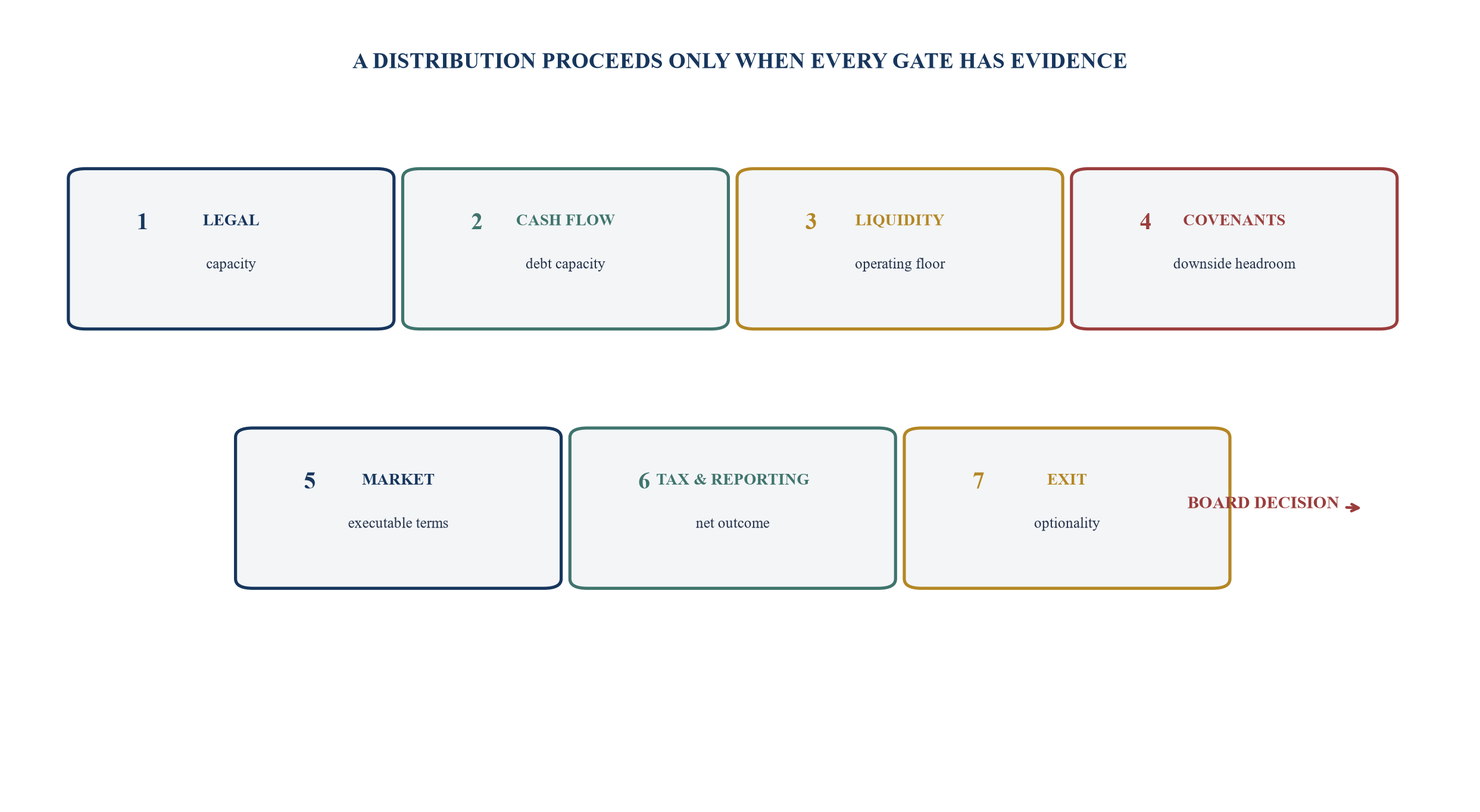
The sequence is a strategic decision aid. Governing law, financing documents and qualified advice determine the final approvals.
2. Establish lawful distribution capacity before financing appetite
Financing availability does not establish that a distribution may lawfully be paid. The board should identify the distributing entity, governing law, source of funds and route by which cash moves through the group. It should obtain current accounts, reserve calculations, intercompany balances, constitutional documents, shareholder arrangements and existing debt restrictions. The analysis should be dated near the proposed payment because profits, liabilities and cash needs can change between approval and settlement.
Distribution tests vary materially. Under the United Kingdom Companies Act 2006, distributions generally may be made only out of profits available for the purpose, determined by reference to relevant accounts [12]. Delaware corporations generally may pay dividends from surplus or, in specified circumstances, current or preceding-year net profits, subject to statutory limitations [17]. Canada's federal corporate statute applies solvency and balance-sheet conditions [20]. Australia's Corporations Act requires assets to exceed liabilities immediately before the dividend, fairness to shareholders and no material prejudice to creditors [21]. Singapore law restricts dividends to profits and provides consequences for contravention [22].
United Arab Emirates company law prohibits fictitious profits and provides for creditor recourse in relation to unlawful distributions; it also links shareholder distributions to net profits after required reserves [10]. The exact rule depends on the entity type, jurisdiction, free-zone regime, constitutional documents and transaction structure. Qualified counsel should determine the applicable test and board duties. A consolidated group surplus does not by itself prove that the intended distributing entity has adequate capacity.
The board record should show the evidence reviewed, the amount proposed, retained resources, creditor considerations, conflicts, approvals and reliance on professional advice. It should also distinguish a dividend from a repayment of shareholder debt, capital reduction, redemption, upstream loan or other value transfer because different rules and tax consequences may apply. Where funds cross jurisdictions, the review should address withholding, exchange controls, financial assistance, transfer pricing and minority rights.
Existing financing documents may impose a stricter gate than company law. Restricted-payment baskets, leverage conditions, no-default tests, builder baskets, available amount calculations, permitted payment definitions and notice requirements should be modelled using the exact contract language. The approval pack should reconcile the legal distribution capacity with contractual capacity and available cash. A recap should stop if any of these amounts is lower than the proposed payment and cannot be validly remedied.
Table 1. Legal and contractual eligibility gate
| Test | Evidence required | Decision question | Typical hidden issue | Gate output |
|---|---|---|---|---|
| entity-law capacity | current accounts, reserves, liabilities and board materials | can this entity lawfully make this form and amount of distribution? | group profits are mistaken for entity-level capacity | signed legal and financial capacity memorandum |
| constitutional authority | articles, shareholder agreement and reserved matters | which approvals, notices and class consents are required? | minority or investor consent is overlooked | approval map and completed resolutions |
| debt-document permission | facilities, intercreditor terms, waivers and calculations | is the payment permitted on the settlement date? | basket definitions differ from management EBITDA | lender-certified restricted-payment calculation |
| creditor protection | solvency, liquidity, contingent liabilities and forecasts | does the board retain adequate resources after payment? | contingent or seasonal needs are excluded | dated board assessment and sensitivity record |
| cash movement | legal-entity funds flow, intercompany balances and tax | can proceeds reach the distributing entity and shareholders? | trapped cash, withholding or unlawful upstreaming | approved funds-flow memorandum |
| conflict governance | interests, recusals, independent advice and minutes | was the decision made through an appropriately governed process? | sponsor return objective obscures company interest | complete conflict and decision record |
The table is a diligence aid. Qualified advisers must apply the rules and documents governing the actual transaction.
3. Define sustainable cash flow before calculating leverage
Debt capacity begins with cash that can be generated repeatedly after the expenditures necessary to operate and protect the business. Management should bridge reported EBITDA to cash available for debt service. The bridge includes cash taxes, maintenance capital expenditure, working-capital changes, lease and pension cash costs, restructuring, litigation, one-off remediation, minority leakage and other claims. Each adjustment needs a source, owner and expiry rather than a generic label.
Quality of earnings matters because a recap is funded today against future performance. Revenue concentration, backlog conversion, pricing, customer churn, project completion, commodity exposure and supplier dependency can change the durability of EBITDA. Acquisitions and cost-saving programmes introduce further judgement. Pro forma adjustments should be separated into realised, contracted, executable and aspirational categories. Lender definitions may permit an adjustment that the board should still exclude from its downside cash view.
The forecast should cover at least the proposed financing tenor and include monthly detail through the first seasonal cycle. Annual models can hide intra-year borrowing peaks. The model should reconcile opening debt, drawdowns, amortisation, cash interest, hedging, fees, mandatory prepayments and closing cash. It should include the date on which each covenant is measured and the period used in the calculation. Balance-sheet cash should be divided into unrestricted, trapped, operational and surplus components.
Supervisory guidance treats repayment capacity and credible deleveraging as core leveraged-credit considerations [1][3]. The United States guidance notes that an inability to repay or amortise a meaningful amount of debt from cash flow over a reasonable period can indicate excessive leverage [1]. This is a prudential reference point rather than a universal transaction rule. Boards should set company-specific limits based on cash volatility, asset intensity, cyclicality and refinancing access.
Debt capacity should be expressed as a range. A base case can show the expected operating plan, while a board case removes uncertain benefits and a downside case applies linked operational shocks. The recap amount is then limited by the weakest credible case, minimum liquidity and covenant requirements. This approach keeps the distribution subordinate to business resilience and avoids reverse-engineering EBITDA to reach a desired shareholder payment.
4. Set a minimum liquidity floor that reflects the operating cycle
Liquidity is the company's capacity to meet obligations when cash receipts arrive late, costs accelerate or financing markets are unavailable. It comprises unrestricted cash, genuinely committed undrawn facilities and dependable near-term inflows. It excludes trapped cash, facilities subject to conditions the company may fail, and receivables that cannot be collected during the scenario being tested. The minimum floor should be approved before proceeds are sized.
The floor should reflect payroll, tax, interest, rent, critical suppliers, maintenance capital expenditure, customer refunds, collateral, margin requirements and seasonal working capital. Management should identify the largest plausible cash trough rather than using average monthly costs. A project business may need liquidity for bonding and milestone delays. A distributor may require inventory before peak sales. A regulated or infrastructure company may need reserves, ring-fenced cash or emergency procurement.
Committed revolving capacity can supplement cash, but the board should test availability. Draw conditions, financial covenants, representations, clean-down requirements, borrowing-base eligibility, lender set-off and material-adverse-effect language can matter. A facility shared across subsidiaries may be legally or operationally inaccessible where needed. The model should also include letters of credit and guarantees that consume the same limit.
The Bank of England has highlighted refinancing and debt-servicing vulnerabilities in private-equity-backed companies during periods of higher financing costs and weak exits [5]. Its subsequent financial-stability work continues to monitor private-market leverage and interconnected risk [6][7]. The IMF has also noted floating-rate exposure, layered leverage, valuation uncertainty and liquidity links within private credit [8]. These systemic observations reinforce a company-level rule: liquidity should support the operating plan without assuming that a refinancing, asset sale or equity injection arrives exactly when required.
The board should approve both a hard floor and an early-warning buffer. Crossing the buffer triggers cash conservation, lender engagement and a refreshed downside case. Crossing the floor triggers defined authority over distributions, acquisitions, capital expenditure and discretionary payments. The post-recap monitoring pack should show daily or weekly liquidity during periods of stress and monthly visibility during ordinary operation.
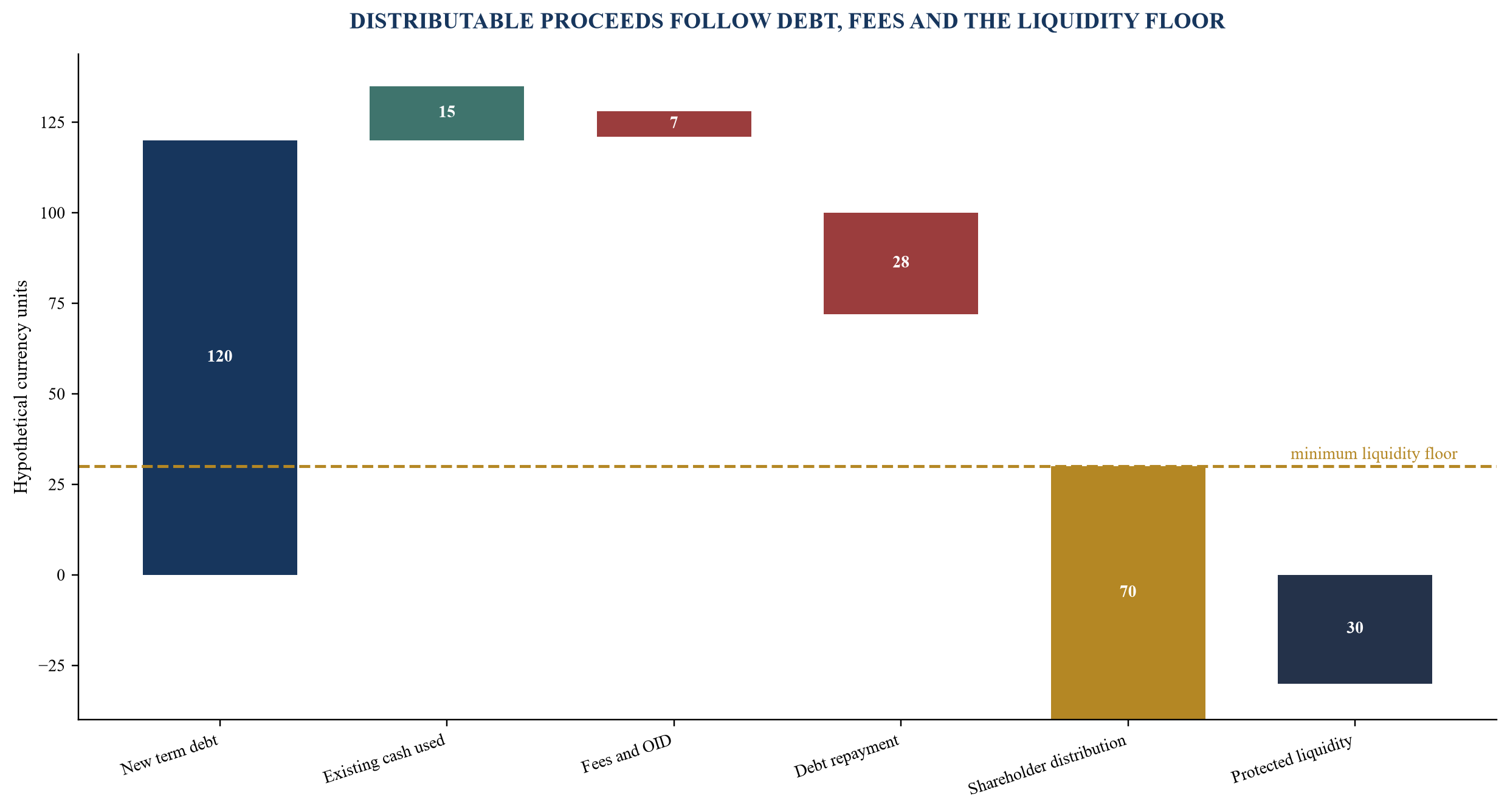
Amounts are hypothetical management assumptions and do not represent a transaction or market benchmark.
5. Rebuild every covenant from the executed definitions
Covenant analysis should begin with the signed or proposed documents, not a model label. Net leverage, senior leverage, fixed-charge coverage, interest coverage, minimum liquidity, debt-service coverage and borrowing-base tests can each use different definitions. Cash netting may be capped. Leases, guarantees, securitisations, supplier finance and shareholder instruments may enter debt differently. EBITDA add-backs can have caps, time limits and evidence requirements.
Management should build a definition book that links each model line to the relevant clause. The calculation should show numerator, denominator, permitted adjustments, currency translation, testing date, cure rights and required certification. It should separately show management's economic view. This dual presentation reveals when contractual headroom is supported by a permissive definition rather than cash resilience.
Headroom should be assessed as both a ratio and an amount. A company can show comfortable ratio headroom while a small EBITDA decline consumes it because debt remains fixed. The board should calculate the EBITDA reduction, cash-interest increase, working-capital outflow and debt increase that would reach the covenant. Linked shocks matter. A revenue shortfall can reduce EBITDA and increase receivables simultaneously, while higher interest rates increase cash cost and may reduce valuation multiples.
Maintenance covenants provide recurring tests. Incurrence covenants restrict actions when a test is failed. Springing covenants activate when revolving utilisation crosses a threshold. Restricted-payment conditions can use a different leverage test from the maintenance covenant. The transaction model should therefore calculate every relevant test on the payment date and through the forecast. It should identify what operational or financing decisions become unavailable in the downside.
The covenant plan should include cure mechanics and lender dialogue. Equity cures, EBITDA cures, deemed cures and prepayments have different effects and frequency limits. A cure may prevent an event of default while leaving liquidity or business risk unresolved. The board should see the time available, information required and stakeholder authority. Early engagement is usually more credible when management can present a supported diagnosis, corrective actions and revised financing plan.
Table 2. Covenant definition and headroom register
| Covenant lens | Definition evidence | Headroom test | Downside linkage | Board concern |
|---|---|---|---|---|
| net leverage | debt perimeter, cash-netting cap and adjusted EBITDA | ratio and EBITDA decline to threshold | lower earnings plus revolver draw | permissive add-backs conceal weak cash conversion |
| interest coverage | cash or accrued interest, hedging and permitted adjustments | rate increase and EBITDA decline to threshold | floating-rate reset plus margin ratchet | contractual pass while cash interest strains liquidity |
| fixed-charge coverage | interest, leases, taxes, capex and distributions | fixed-charge increase to threshold | inflation and maintenance spend | essential expenditure omitted from denominator |
| minimum liquidity | eligible cash, facility availability and exclusions | lowest daily and monthly balance | customer delay plus inventory build | facility cannot be drawn when required |
| restricted payment | basket, available amount, leverage condition and no-default test | capacity on approval and payment dates | trading change between dates | distribution becomes impermissible before settlement |
| springing test | revolver utilisation trigger and cure mechanics | usage needed to activate covenant | seasonal draw or delayed refinancing | emergency liquidity creates a covenant test |
Illustrative terms only. Executed documents and qualified advice govern actual calculations and remedies.
6. Model downside as connected operating and financing shocks
A downside case should describe how the business deteriorates, how cash responds and how financing terms react. Applying a flat percentage reduction to EBITDA can miss the transmission mechanism. Management should define scenarios such as customer loss, volume decline, price compression, project delay, input-cost inflation, operational outage, regulatory restriction, acquisition underperformance or a combination. Each driver should flow through revenue, margin, working capital, capital expenditure and liquidity.
Financing variables should move with the scenario. Base rates can remain elevated while earnings fall. A margin ratchet can increase spread when leverage rises. Hedging may cover only part of the debt or expire before maturity. Revolver utilisation can trigger commitment fees or a springing covenant. Rating or performance deterioration can reduce supplier terms, bonding capacity or customer confidence. These links should appear explicitly in the model.
The board should consider a severe but plausible case and a reverse stress. The first tests a coherent adverse environment. The second asks what combination of EBITDA, working capital, rates and capital expenditure would breach minimum liquidity or a covenant. Reverse stress identifies the distance to failure and the earliest observable indicators. It also supports a contingency plan linked to practical lead times.
Mitigations require credibility. Reducing discretionary capital expenditure may be possible; cutting maintenance expenditure can impair service and future earnings. Working-capital release may conflict with customer retention or supplier stability. Asset sales require time, approvals and buyers. Sponsor equity is a choice rather than committed liquidity unless formally documented. Refinancing should not be treated as a mitigation if the same scenario would close the market.
The output is a decision matrix rather than a single pass or fail. A transaction can be affordable in the base case and unacceptable in the downside because liquidity falls below the floor, exit leverage becomes too high or covenant cure depends on new equity. The board can then reduce the distribution, change the instrument, extend tenor, add amortisation flexibility, increase hedging, retain cash or postpone the recap until operating evidence improves.
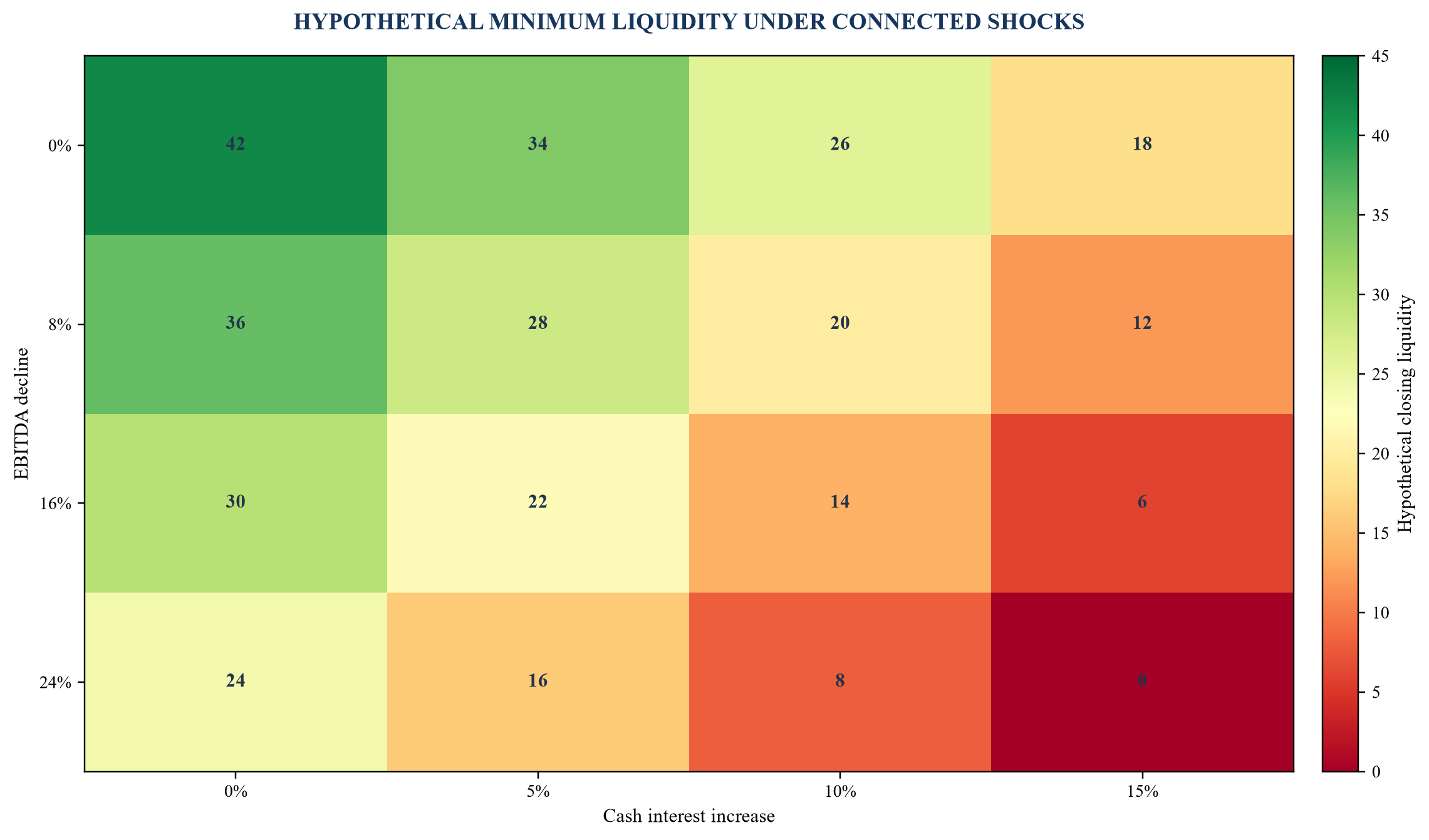
Values are hypothetical management assumptions. The matrix demonstrates sensitivity architecture, not predicted performance.
7. Separate reported EBITDA, covenant EBITDA and cash earnings
The recap decision needs three reconciled earnings views. Reported EBITDA follows the company's accounting policies and reporting perimeter. Covenant EBITDA follows the negotiated debt definitions. Cash earnings show the recurring cash contribution available after operational requirements. Differences among them should be transparent because each answers a different question.
Adjustments commonly include acquired earnings, run-rate synergies, cost savings, restructuring, extraordinary items, discontinued operations, start-up losses and projected initiatives. Each adjustment should have a calculation, evidence source, accountable owner, delivery period and duplication check. Realised benefits can be shown separately from approved but unimplemented actions. Caps and sunset dates in financing documents must be applied exactly.
Cash conversion should be assessed over several operating cycles. Management should reconcile EBITDA to operating cash flow, identify recurring exceptions and explain seasonality. A business that capitalises development costs, offers customer financing, grows inventory or depends on milestone billing can report strong EBITDA while consuming cash. Maintenance and growth capital expenditure should be separated through an asset-level policy, with ambiguity presented to the board.
The quality-of-earnings work should also test concentration and recurrence. A large contract renewal, rebate, price increase, favourable commodity movement or working-capital release may not persist through the financing tenor. The downside case should remove benefits whose evidence is insufficient. Sensitivities should identify the most material assumptions and the date by which evidence will become available.
The board pack should bridge all three views to cash interest and debt service. Where covenant EBITDA materially exceeds cash earnings, the board should require stronger liquidity, lower leverage or additional monitoring. This discipline preserves the distinction between contractual compliance and economic capacity. It also improves lender credibility and reduces surprises during buyer diligence at exit.
8. Design the instrument around resilience and strategic purpose
The financing instrument determines how risk appears through time. A first-lien term loan may offer scale but increase secured leverage and refinancing concentration. A second-lien or subordinated instrument can preserve senior capacity while carrying higher cost and intercreditor complexity. Private credit may offer bespoke terms, delayed draws or acquisition capacity. Bonds can diversify funding but introduce issuance thresholds, disclosure and call economics.
The board should compare amount, all-in cash cost, payment-in-kind features, amortisation, maturity, call protection, security, guarantees, covenants, baskets, reporting, transfer rights and hedging. Upfront fees and original-issue discount reduce net proceeds. A nominally larger facility can produce a smaller lawful distribution after refinancing existing debt, transaction fees, required reserves and minimum cash.
Tenor should match the operating and exit plan. A maturity that arrives before the expected exit creates refinancing dependency. A long non-call period can reduce sale proceeds or complicate an early exit. Aggressive amortisation may protect deleveraging while consuming capital needed for investment. A bullet maturity preserves near-term cash but concentrates risk. The trade-off should be shown for each likely route.
Currency matters where debt service and operating cash flows differ. The company should model exchange-rate exposure, hedging availability, collateral requirements and accounting effects. Cross-border guarantees and security can create legal, tax and perfection questions. Cash pools and intercompany loans should be tested for access during stress, not simply assumed from consolidated reporting.
Optionality features can create value when their cost is explicit. Incremental facilities, delayed-draw tranches, acquisition baskets, portability, extension options and prepayment rights can support future decisions. They can also increase documentation complexity or lender pricing. The chosen structure should support the business plan while preserving enough capacity to respond to opportunities and shocks.
9. Control interest-rate, hedging and refinancing exposure
Floating-rate debt passes benchmark movements into cash interest. The company should model the benchmark curve, credit spread, floors, margin ratchets, fees and hedge settlements. Sensitivities should show annual cash interest, coverage, liquidity and covenant headroom. The analysis should include the period after existing hedges expire and before refinancing is expected.
Hedging decisions should follow risk appetite and cash-flow resilience. Interest-rate swaps can create fixed payments and collateral or break costs. Caps limit exposure above a strike while requiring a premium. Natural offsets may exist where revenue or asset values respond to rates, but evidence should support the relationship. Hedge accounting, counterparty credit and documentation require specialist review.
Refinancing risk is a joint function of maturity, enterprise performance, market access and lender concentration. The company should map every maturity, amortisation payment, revolver expiry, hedge expiry and call step-down. It should estimate lead times for audited information, ratings, lender approvals, security releases, regulatory clearances and investor marketing. The plan should begin before liquidity or covenants force action.
Market conditions can transmit rapidly. The Bank of England and IMF have described how higher rates and weak exit activity can interact with leveraged borrowers and private-credit exposures [5][8]. A recap should therefore retain a contingency for unavailable debt markets. Options may include earlier lender engagement, partial amortisation, reduced distributions, committed extension rights, asset-level financing or sponsor capital. Each requires authority and realistic implementation time.
The monitoring system should set refinancing triggers. Examples include remaining maturity, leverage, interest coverage, lender concentration, market pricing, business-plan variance and exit timetable. Trigger breaches should lead to a named action rather than a status colour. This converts refinancing from an event into a managed process and protects negotiating leverage.
10. Apply tax and accounting analysis to net proceeds and future choices
Interest deductibility can materially change the recap economics. The board should model cash tax with and without the transaction, including limits, carryforwards, group rules, related-party conditions, withholding and transfer pricing. A deduction delayed for several periods has a different present value from an immediate deduction. Tax assumptions should reconcile to the financing entity and income that can actually absorb them.
The United Arab Emirates general interest-deduction limitation generally uses the greater of thirty percent of adjusted EBITDA or an AED 12 million threshold, subject to the detailed corporate-tax rules, exclusions and guidance [11]. The United Kingdom corporate interest restriction includes a GBP 2 million de minimis and fixed-ratio and group-ratio mechanisms [13][14]. United States Internal Revenue Code section 163(j) generally limits business-interest deductions by reference to business interest income, thirty percent of adjusted taxable income and floor-plan financing interest, subject to applicable exceptions and rules [18]. Qualified tax advisers should apply the current provisions.
The recap can also affect withholding, hybrid-mismatch treatment, thin capitalisation, transfer pricing, controlled foreign company outcomes and deductibility of transaction fees. Intercompany debt requires a defensible borrower benefit, pricing and capacity analysis. Security and guarantees can create additional value-transfer questions. Cross-border funds flows should be mapped by entity, date and currency.
Accounting work should cover debt classification, fees, modification or extinguishment, effective interest, covenant disclosures, going concern, subsequent events and distributions. IAS 1 requirements and the International Accounting Standards Board's covenant amendments affect the presentation and information provided about liabilities with covenants [9]. The exact treatment depends on reporting framework and facts. The audit timetable should be considered before execution.
The board should decide on after-tax, after-fee proceeds and retained liquidity. A headline dividend amount can overstate shareholder cash if withholding, financing fees or required debt repayment are excluded. The model should also show future cash taxes and balance-sheet effects. This prevents tax benefit from being used twice in valuation, debt capacity or sponsor-return analysis.
Table 3. Comparative legal, tax and reporting controls
| Jurisdiction or framework | Distribution control | Interest or reporting control | Transaction question | Required specialist evidence |
|---|---|---|---|---|
| United Arab Emirates | company-law profit, reserve and creditor protections | corporate-tax interest limitation and related-party rules | can cash be distributed and interest deducted by the relevant entities? | legal capacity, tax model and legal-entity funds flow |
| United Kingdom | Part 23 distributable-profit framework and relevant accounts | corporate interest restriction and accounting disclosures | do reserves, group ratios and reporting dates support execution? | distribution memorandum, CIR model and audit view |
| United States | state-law surplus or profits test for the distributing corporation | section 163(j), state tax and debt-equity considerations | does the corporate and tax structure preserve intended economics? | state-law opinion, tax analysis and solvency evidence |
| Canada | statutory solvency and balance-sheet conditions under applicable law | federal and provincial tax rules | does the post-payment entity meet both statutory tests? | board solvency record and tax advice |
| Australia | assets-over-liabilities, shareholder fairness and creditor-prejudice tests | tax and financial-reporting requirements | could the distribution materially prejudice creditors? | balance-sheet support, board analysis and tax advice |
| Singapore | dividends generally restricted to profits | tax, withholding and accounting requirements | does the entity have supported profits and approvals? | current accounts, resolutions and tax analysis |
High-level research summary only. Current law, entity facts and qualified advice govern every transaction.
11. Build a lender process that tests the thesis before marketing
The financing process should begin with an internal challenge session. Management, sponsor, financial adviser, legal counsel, tax adviser and accounting specialists should review the seven gates, sources and unresolved issues. The output should be a preliminary structure, maximum distribution range, information plan, lender universe and walk-away conditions. This reduces the risk of marketing an amount that later fails legal, liquidity or covenant analysis.
Lender materials should present the business model, market, management, historical performance, quality of earnings, cash conversion, capital expenditure, working capital, acquisition history, existing debt and proposed use of funds. The recap rationale should be explicit. Forecasts should reconcile to audited or reviewed information, and adjustments should have evidence. Risks should be paired with management actions rather than omitted.
The lender universe should reflect instrument, cheque size, sector, geography, hold appetite, relationship value and likely diligence depth. A broad process can create pricing tension but increase information leakage and management burden. A targeted process can improve certainty but reduce competitive pressure. Clean-team arrangements and confidentiality controls may be needed where information is sensitive or future strategic activity is contemplated.
Term sheets should be compared on full economics and control. Pricing includes benchmark, spread, floors, fees, discount, commitment fees, hedging and prepayment cost. Documentation includes EBITDA, debt, cash netting, covenants, baskets, transfers, reporting, defaults, equity cures, incremental debt and portability. Execution risk includes credit committee timing, syndication, diligence conditions, ratings and market flex.
The board should receive a final sources-and-uses statement, funds flow, legal-capacity confirmation, tax outcome, covenant model, downside case, lender terms and execution risks before approval. Conditions precedent should be assigned and tracked. No distribution should be released until the closing team confirms that financing, corporate, funds-flow and payment conditions have been satisfied.
12. Protect governance when shareholder and company interests diverge
A recap can benefit shareholders through an earlier cash return while increasing obligations at the company. This creates a governance question that should be addressed directly. Directors should understand their duties under applicable law, the company's interests, creditor considerations, conflicts and the evidence supporting the decision. Sponsor representatives should disclose interests and follow required recusal or approval processes.
The board should have enough time, information and independent challenge. The pack should compare recap size, no transaction, reduced transaction, delayed transaction and alternative capital allocation. It should show uses of cash, downside outcomes, retained investment capacity and exit effects. Minutes should record questions, sources, advice, conflicts, alternatives and reasons for the decision. Generic statements of benefit are weaker than company-specific evidence.
Management incentives can influence forecasts. A transaction that pays shareholders or affects equity value may shape assumptions about EBITDA, working capital or exit timing. The review should identify who prepared and challenged the model, how adjustments were verified and whether incentives create a conflict. Independent quality-of-earnings, tax, solvency or valuation work may be appropriate where the risk is material.
Creditor interests become increasingly important as financial distress approaches. The relevant threshold and duties depend on jurisdiction and facts. The board should establish an escalation route if forecast liquidity, covenant headroom or solvency deteriorates before payment. Approval should be capable of being paused when new information arises. A stale board paper should not control a distribution after a material adverse change.
Post-close accountability also matters. Management should report whether the assumptions used for approval remain valid, how proceeds were applied and whether risk triggers have been reached. Sponsor oversight should support timely action and should not replace the company's governance. A disciplined record protects decision quality, stakeholder trust and later diligence.
13. Integrate merger-control and regulatory timing with the capital plan
A recap may occur near an acquisition, divestment or ownership change. The capital plan should distinguish ordinary financing from steps that require competition, sector, foreign-investment or other regulatory clearance. Premature integration, information sharing or exercise of control can create legal risk. Transaction counsel should identify what may be prepared, signed, funded or implemented before clearance.
In the European Union, qualifying concentrations follow Commission procedures with a standard Phase I review period of twenty-five working days and a Phase II period of ninety working days, subject to the governing rules and possible extensions [16]. United Kingdom merger review follows its own statutory and procedural framework [15]. United States reportable transactions may require premerger notification and waiting periods [19]. United Arab Emirates economic-concentration rules use turnover and market-share thresholds under the current competition framework [23][24].
These timelines can affect a recap in several ways. Acquisition debt may depend on clearance. A planned asset sale may be delayed. Debt portability may require a qualifying transaction. Restricted-payment capacity may change after completion. A lender may condition funding on regulatory approvals. The company should model sequencing, long-stop dates, ticking fees, commitment expiry and alternate sources.
The information protocol should protect competitively sensitive data. Clean teams can analyse customer, pricing, pipeline or cost information under approved rules. The financing process should align with confidentiality obligations and securities restrictions. Public-company situations may require additional controls over inside information, disclosure and dealing.
The board should receive a combined transaction and financing timeline. It should show approvals, diligence, lender committees, documentation, funds flow, payment dates and contingency points. This prevents a legally sound recap structure from failing because the expected cash source or exit event cannot occur on the assumed date.
14. Make the funds flow a control document
The funds flow translates the approved transaction into legal-entity movements. It should identify every source, use, account, currency, payer, recipient, timing and authorisation. Sources include new debt, existing cash and any equity contribution. Uses include debt repayment, accrued interest, break costs, fees, taxes, hedging, reserves and the shareholder distribution. The closing balance should reconcile to the approved minimum liquidity.
Each amount should connect to evidence. Debt payoffs require valid statements and release mechanics. Fees require invoices or agreed estimates. Tax and withholding require advice. Distribution recipients require ownership and payment verification. Intercompany transfers require legal and accounting support. Foreign-exchange conversions should identify rate, provider, settlement and residual exposure.
The closing checklist should separate conditions precedent, deliverables and post-closing obligations. Corporate approvals, capacity evidence, legal opinions, security, know-your-customer checks, account controls, hedge documents and lender notices may be required. The closing team should use dual review and secure verification for payment instructions. Changes should be version-controlled and approved.
Funds should be released in the correct sequence. New financing may first repay existing secured debt and establish required reserves. Security releases and new security may need coordination. The shareholder payment should occur only when closing conditions and the legal distribution test remain satisfied. A material last-minute change in trading, cash, recipient or tax should trigger escalation.
After close, treasury and accounting should reconcile every bank movement to the approved statement. They should confirm debt balances, fees, hedge positions, cash, intercompany accounts and shareholder payments. The board should receive a completion memorandum and any deviations. This closes the evidence chain and creates a reliable opening position for post-recap monitoring.
15. Test how the recap changes a strategic-sale exit
A strategic buyer evaluates enterprise value, debt-like items, cash, working capital, integration needs and financing certainty. Additional recap debt reduces equity proceeds unless enterprise value increases or debt is repaid before exit. It may also introduce prepayment costs, lender consents, security releases and information requirements. The exit model should show these effects at several sale dates.
The buyer's leverage tolerance may differ from the company's lender covenant. A buyer may need capacity for integration, restructuring or acquisition financing. High debt can reduce the number of credible bidders or change their financing conditions. Conversely, a well-structured recap with transparent documentation and improving leverage may be manageable. The outcome depends on business quality, market conditions and buyer strategy.
Call protection and make-whole provisions should be incorporated into sale proceeds. Portability can permit debt to remain after a change of control under defined conditions, but a buyer may prefer its own financing. Change-of-control provisions, mandatory prepayment, ratings conditions and consent rights should be reviewed at recap approval. Optionality has value only when the likely buyer can use it.
Diligence should be exit-ready from close. The data room should retain the capacity analysis, lender documents, compliance certificates, covenant calculations, funds flow, tax and legal work, hedging, board approvals and monitoring record. Buyers should be able to reconcile the recap to financial statements and current debt. Unexplained adjustments or repeated waivers can increase scrutiny.
The board should model enterprise value, debt, cash, prepayment cost and working-capital adjustment across downside, base and upside cases. It should compare the shareholder distribution received today with potential changes in later proceeds. This is a scenario comparison rather than a guaranteed return calculation. The final decision should preserve a credible sale path under more than one operating outcome.
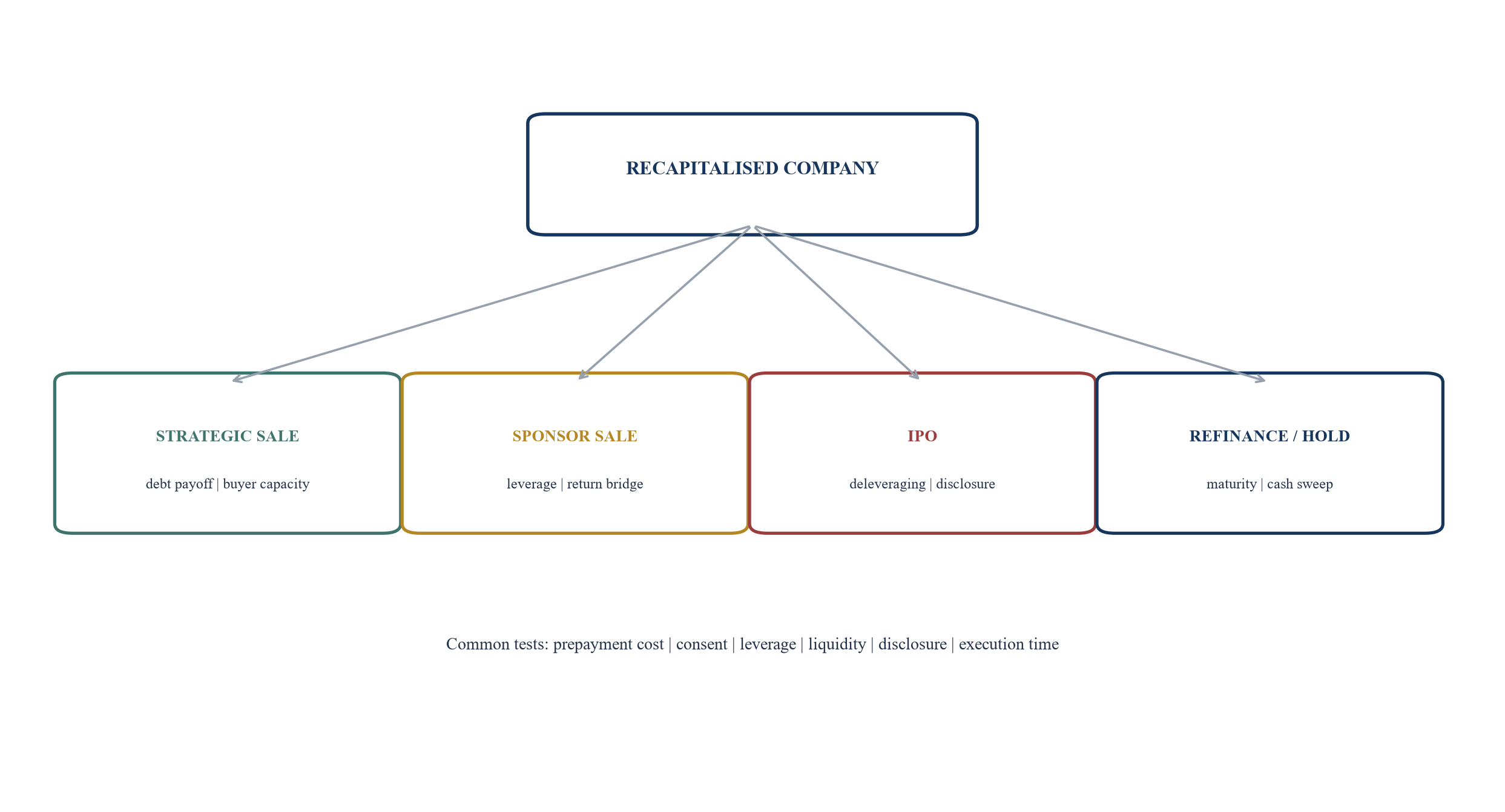
The decision tree is illustrative. Actual routes depend on performance, markets, documents, approvals and buyer requirements.
16. Preserve IPO, refinancing and continuation options
An initial public offering usually requires a capital structure that public investors, underwriters and regulators can understand. Recap debt may need to be refinanced, repaid from proceeds or presented with a credible deleveraging plan. Historical distributions, related-party transactions, use of proceeds, liquidity and covenant risk may require disclosure. The company should consider the expected reporting, governance and capital requirements before accepting financing terms.
Refinancing provides another route, but it should not be the only repayment plan. The company should demonstrate cash generation, documented compliance, stable reporting and adequate lead time. A recap close that leaves the next maturity near the expected exit can weaken negotiating leverage. Extension options, amortisation, cash sweeps and voluntary prepayment rights should be assessed against the intended hold period.
A sponsor-to-sponsor sale transfers the company into another leveraged ownership structure. The buyer will test sustainable EBITDA, debt capacity, working capital, capital expenditure and management's value-creation plan. Existing leverage can reduce incremental financing capacity. Portability may help, subject to terms and buyer acceptance. The seller should preserve evidence that the recap did not defer necessary investment.
Continuation vehicles or extended holds can change the relevant horizon. Debt designed for a near-term sale may become expensive or restrictive if the asset remains in the portfolio. The board should test whether the structure can support the longer operating plan, follow-on acquisitions and management incentives. Lender transfer provisions also matter because ownership of the debt can change during the hold.
Optionality should be measured through constraints, cost and lead time. For each route, management should identify maximum tolerable leverage, required financial history, lender actions, regulatory steps, debt repayment, liquidity and execution window. The recap size can then be set at a level that preserves at least two credible routes under the board case, with contingency actions if performance diverges.
Table 4. Exit-route implications of a dividend recapitalisation
| Route | Capital-structure question | Documentation issue | Timing risk | Option-preserving action |
|---|---|---|---|---|
| strategic sale | can the buyer refinance or assume debt while funding integration? | change of control, security releases and call protection | buyer financing and regulatory approvals | retain payoff flexibility and current debt evidence |
| sponsor sale | how much incremental leverage can the next owner support? | portability, EBITDA definitions and lender consent | syndication and diligence | preserve covenant performance and quality-of-earnings support |
| initial public offering | what deleveraging and disclosure will investors require? | proceeds, related parties, covenants and historical distributions | audit readiness and market window | maintain reporting quality and a credible debt-reduction plan |
| refinancing | can cash flow support new terms without relying on a sale? | maturity, hedge, prepayment and security transition | market closure and lender committee | start early and retain committed liquidity |
| continuation or hold | can the debt support a longer value-creation plan? | tenor, incremental capacity and transfer rights | delayed operating initiatives or fund process | match maturity and flexibility to the revised horizon |
| partial asset sale | can proceeds be retained or must they prepay debt? | asset-sale sweep, releases and permitted reinvestment | separation and buyer execution | map release price and reinvestment periods before recap |
Route requirements are illustrative and require transaction-specific legal, accounting, tax and financing analysis.
17. Compare the recap with other capital-allocation choices
The relevant alternative is not always an immediate full distribution. The board can retain cash for organic investment, acquisitions, resilience, debt reduction or working capital. It can execute a smaller recap, stage the financing, use an asset-level facility, sell a non-core asset, repurchase shares or wait for operating evidence. Each option has a different effect on risk, return and exit flexibility.
The comparison should use common assumptions and show sources of value. A recap produces current cash and increases fixed charges. Debt reduction lowers risk and interest but delays distributions. Organic investment may create value if returns exceed the risk-adjusted cost of capital and management can execute. Acquisitions can accelerate growth while adding integration and leverage risk. Retained liquidity can protect against downside and support opportunistic action.
Sponsor returns should be presented as scenarios. Internal rate of return can increase when cash is returned earlier, even if total value remains unchanged. Multiple of invested capital may respond differently. The board should see company outcomes alongside sponsor metrics, including later equity proceeds, downside equity value and any need for new capital. Model precision should not be mistaken for forecast certainty.
Capital allocation should connect to strategy. If the investment thesis depends on capacity expansion, technology, market entry or bolt-on acquisitions, the recap should not consume the resources needed to deliver it. A company with limited reinvestment opportunities and stable cash may support more distribution. A cyclical, project-based or rapidly growing company may require a larger buffer.
The final recommendation should state why the selected amount and timing outperform the realistic alternatives under the approved objectives. It should identify what evidence could change the decision. This creates a reviewable capital policy rather than a one-time financing event driven by market availability.
18. Assess portfolio and fund-level contagion
A company recap can interact with obligations elsewhere in the sponsor structure. Fund-level subscription facilities, net-asset-value facilities, continuation financing, hedging and commitments can create additional leverage layers. A distribution may be used to repay fund debt, meet commitments or return capital to investors. The sponsor should understand how the company transaction affects liquidity and risk across these layers.
The IMF has identified leverage and liquidity interactions within private credit and private capital structures, including floating-rate borrower exposure and potential valuation or collateral pressures [8]. The Bank of England has examined the transmission of private-equity-related vulnerabilities through financing and market channels [5][6]. These analyses do not determine a specific company decision. They support transparent mapping of obligations, collateral, covenants and cash dependence.
The sponsor should identify concentration. Several portfolio companies may face refinancing in the same period, depend on the same lenders or operate in correlated sectors. A distribution from one company can improve fund liquidity while leaving less company resilience. Concurrent downside scenarios should test whether the sponsor has enough capital, expertise and lender capacity to support multiple assets.
Cross-defaults, guarantees and security links should be verified. Most portfolio structures seek ring-fencing, but contractual or operational connections may transmit stress. Shared cash pools, procurement, insurance, customers or critical suppliers can create indirect links. Fund documentation and investor reporting may also impose conditions or disclosure requirements.
The investment committee should receive a portfolio view before approving a material recap. It should show company resilience, fund uses, leverage layers, maturity concentration, support capacity and conflicts. The board of the distributing company retains its own responsibilities and should receive the company-specific evidence required for its decision.
19. Operate an early-warning and intervention system
Post-recap monitoring should begin at closing. The first report should reconcile actual debt, cash, fees, interest, hedging and distribution with the approved model. Monthly reporting should then cover liquidity, cash conversion, leverage, coverage, covenant headroom, working capital, capital expenditure, trading variance and refinancing milestones. Definitions should remain consistent with the approval pack.
Early-warning indicators should link to action. A fall in backlog conversion may trigger a forecast refresh. A liquidity-buffer breach may pause discretionary expenditure and distributions. A covenant-headroom threshold may initiate lender engagement. A customer loss, regulatory event or project delay may require a new downside case. A refinancing trigger may activate adviser preparation and data-room work.
The system should identify leading and lagging indicators. EBITDA and covenant compliance are lagging outcomes. Order intake, churn, utilisation, pricing, debtor days, inventory, supplier terms, capex commitments and hedge coverage can provide earlier evidence. The set should be limited to drivers that management can explain and act upon.
Forecast accuracy should be measured. Repeated favourable bias in revenue, working capital or cash interest reduces confidence in future cases. Management should reconcile variances and update ranges. Covenant add-backs should be tracked to actual delivery and expiration. The board should see which headroom depends on incomplete actions.
Intervention authority must be clear. The company board, sponsor, treasury, management and lenders have different rights. A trigger should identify who convenes, what information is produced, which decisions are available and the deadline. This makes the monitoring system operational rather than descriptive.
Table 6. Post-recap board scorecard and intervention actions
| Board lens | Decision-grade measure | Early-warning evidence | Required intervention | Closure proof |
|---|---|---|---|---|
| liquidity | lowest actual and forecast eligible liquidity against floor and buffer | customer receipts, inventory and revolver availability | refresh cash plan, conserve cash and test facility access | restored buffer supported by bank and forecast evidence |
| leverage | contractual and economic leverage with adjustment bridge | EBITDA delivery and debt movement | update downside, restrict debt-funded actions and engage lenders | supported earnings, debt reduction or valid amendment |
| interest coverage | cash interest and fixed-charge coverage through hedge horizon | benchmark, margin and hedge expiry | evaluate hedge, pricing and refinancing actions | executed protection and compliant forecast |
| covenant capacity | headroom by test date and distance to reverse stress | add-back delivery and revolver trigger | prepare cure or amendment plan before threshold | certificate, waiver or sustained operating recovery |
| investment capacity | maintenance and approved growth funding after debt service | deferred capex and service performance | protect essential investment and rephase discretionary uses | funded plan and delivery evidence |
| exit readiness | debt payoff, call cost, reporting and route lead time | buyer feedback, audit and refinancing milestones | activate selected route and contingency timetable | approved transaction path or renewed financing runway |
Measures and thresholds are hypothetical management assumptions. Company-specific definitions require board and lender agreement.
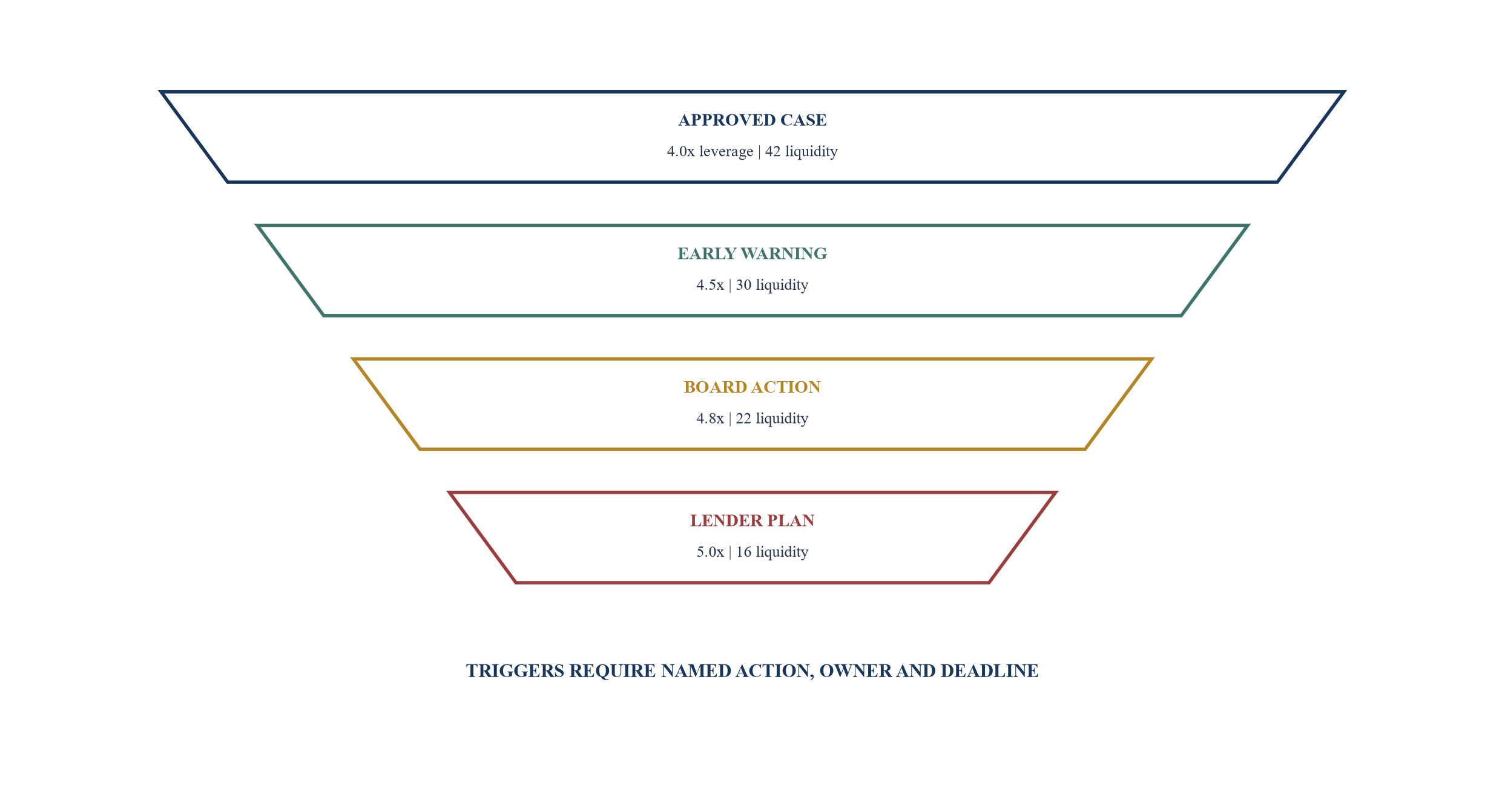
Thresholds are hypothetical management assumptions and require company-specific board approval.
20. Apply the framework to a hypothetical worked case
Consider a hypothetical company with currency-unit EBITDA of 80, existing debt of 160, unrestricted cash of 45 and a committed revolving facility of 40. Management proposes 120 of new term debt, repayment of 28 of existing obligations, 7 of fees and a 70 shareholder distribution. The post-close plan retains 30 of protected liquidity. These figures are assumptions for method illustration and are not a recommendation or market benchmark.
The initial presentation shows post-close debt of 252 and headline leverage of 3.15 times EBITDA. The board case removes 8 of unimplemented cost savings and recognises 6 of recurring maintenance expenditure previously treated as growth. Cash interest is modelled at 27, cash taxes at 8 and normal working-capital investment at 10. The remaining cash before discretionary growth is materially smaller than the headline EBITDA measure suggests.
The company has a maximum net-leverage covenant of 4.75 times, tested quarterly, and a minimum-liquidity requirement of 15. Contractual EBITDA permits part of the cost-saving adjustment. In the base case, the company complies. Under a linked downside of sixteen percent EBITDA decline, delayed customer receipts and higher cash interest, liquidity falls to 14 and leverage approaches the covenant. A further working-capital outflow would breach the liquidity requirement before the leverage covenant.
Exit analysis assumes a possible sale in twenty-four months. The debt carries call protection during part of that period. If EBITDA grows, deleveraging and a sale remain credible. If EBITDA is flat, the recap debt reduces buyer financing capacity and equity proceeds. If EBITDA declines, the company may need to refinance early, reduce investment or seek new equity. The board therefore compares the proposed 70 distribution with 45 and 55 alternatives.
The framework supports a conditional decision. A smaller distribution can preserve a larger liquidity buffer, fund the highest-return operating programme and keep the reverse-stress distance above the approved threshold. The company can also require a longer hedge, revised covenant terms and a six-month evidence period for cost savings. The example demonstrates why the recap amount should emerge from the gates rather than drive them.
Table 5. Hypothetical worked-case decision bridge
| Decision item | Proposed case | Board adjustment | Downside effect | Decision implication |
|---|---|---|---|---|
| EBITDA | 80 | exclude 8 of unimplemented savings | sixteen percent decline from board case | size debt from supported cash earnings |
| post-close debt | 252 | unchanged | revolver draw increases debt | preserve borrowing capacity for operations |
| protected liquidity | 30 | retain an additional buffer | falls to 14 under linked stress | proposed payment fails approved floor |
| cash interest | 27 | include fees and hedge outcome | rate and margin increase | coverage and cash conversion weaken together |
| shareholder distribution | 70 | compare 45 and 55 alternatives | no direct operating benefit | reduce or stage payment if gates require |
| exit timing | twenty-four months | include call and process costs | sale delayed by twelve months | match tenor and prepayment flexibility to routes |
All figures are hypothetical management assumptions. They do not describe a company, transaction, forecast or recommendation.
21. Sequence a one-hundred-day execution and monitoring plan
Days zero to twenty establish the decision foundation. The company confirms legal entities, corporate approvals, distribution capacity, debt restrictions, cash ownership and conflicts. Management completes quality-of-earnings and cash-conversion work, defines the liquidity floor and builds the integrated operating and financing model. Advisers confirm tax, accounting, legal and regulatory workstreams. The board approves objectives, alternatives and walk-away conditions.
Days twenty-one to forty-five test financing and downside. The company runs linked scenarios, reverse stresses, covenant calculations and exit routes. It prepares lender materials and a definition book. The sponsor and board challenge adjustments, working capital, maintenance capital expenditure, refinancing and mitigations. The lender process begins only after the seven gates support a credible distribution range.
Days forty-six to seventy-five execute the market and documents. Management answers diligence, evaluates term sheets, selects the financing path and negotiates economics and controls. Counsel, tax and accounting teams refine capacity, funds flow and closing requirements. The board receives updated pricing, covenant, liquidity and exit analysis if terms change. Hedge and foreign-exchange execution are prepared with approved counterparties.
Days seventy-six to one hundred complete and stabilise. The closing team verifies conditions, payment instructions, funds flow and retained liquidity. Treasury reconciles actual balances. Management launches the monitoring dashboard, lender calendar, covenant certification and refinancing triggers. The board records the final decision and receives a close memorandum. Material deviations are escalated before shareholder funds are released.
The timetable should compress or extend according to complexity and market conditions. Legal capacity, evidence quality and governance should not be weakened to meet a financing window. An active liquidity issue, covenant concern or material trading change requires immediate reassessment. A transaction that cannot survive a short delay may already rely too heavily on favourable execution.
At day one hundred, success means the distribution is supported by a complete evidence chain: lawful capacity, sustainable cash flow, protected liquidity, tested covenant headroom, executable financing, supported tax and accounting, and credible exit routes. Continued success requires management to operate the triggers, preserve documentation and adjust early when actual performance diverges.
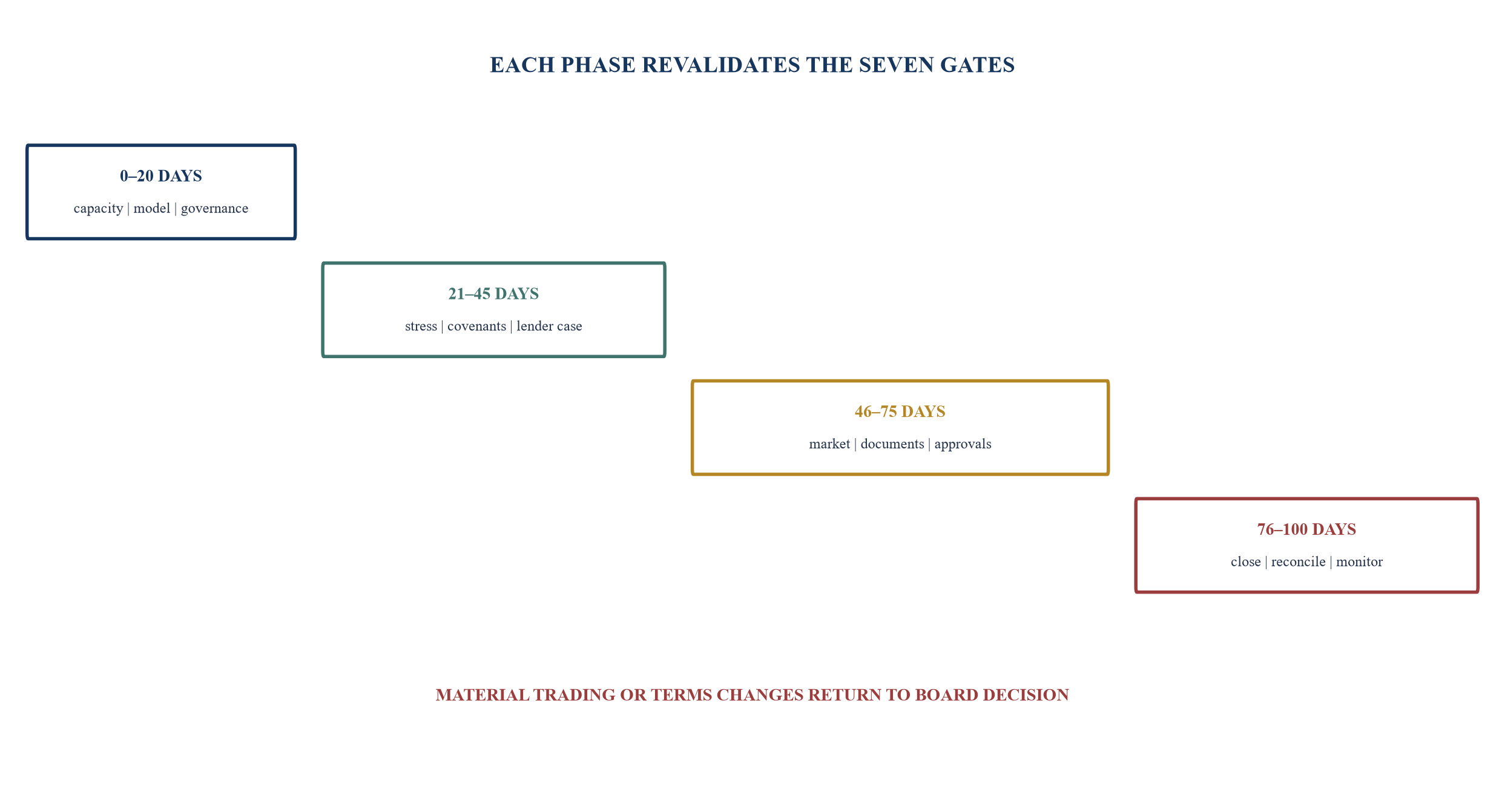
Timing is an illustrative management sequence. Transaction complexity and approval requirements determine the actual calendar.
Sources and further reading
- Board of Governors of the Federal Reserve System, Interagency Guidance on Leveraged Lending Official source
- Board of Governors of the Federal Reserve System, SR 13-3 Interagency Guidance on Leveraged Lending Official source
- European Central Bank, Guidance on Leveraged Transactions Official source
- European Banking Authority, Guidelines on Loan Origination and Monitoring Official source
- Bank of England, Financial Stability Report June 2024 Official source
- Bank of England, Financial Stability Report December 2025 Official source
- Bank of England, Financial Policy Committee Summary and Record April 2026 Official source
- International Monetary Fund, Global Financial Stability Report April 2024 Chapter 2 Official source
- IFRS Foundation, IAS 1 Presentation of Financial Statements Official source
- United Arab Emirates, Federal Decree-Law No. 32 of 2021 on Commercial Companies Official source
- United Arab Emirates Federal Tax Authority, Interest Deduction Limitation Rules Guide Official source
- United Kingdom, Companies Act 2006 Part 23 Official source
- HM Revenue and Customs, Corporate Interest Restriction Overview Official source
- HM Revenue and Customs, Restriction on Corporation Tax Relief for Interest Deductions Official source
- United Kingdom Competition and Markets Authority, Quick Guide to UK Merger Assessment Official source
- European Commission, Merger Procedures Official source
- State of Delaware, General Corporation Law Sections 154 and 170 to 173 Official source
- United States Internal Revenue Service, Limitation on the Deduction for Business Interest Expense Official source
- United States Federal Trade Commission, Premerger Notification Program Official source
- Government of Canada, Canada Business Corporations Act Section 42 Official source
- Australian Government, Corporations Act 2001 Section 254T Official source
- Singapore Statutes Online, Companies Act 1967 Section 403 Official source
- United Arab Emirates Ministry of Economy and Tourism, Economic Concentration Official source
- United Arab Emirates, Cabinet Decision No. 3 of 2025 on Competition Thresholds Official source
- Organisation for Economic Co-operation and Development, Limiting Base Erosion Involving Interest Deductions and Other Financial Payments Action 4 Official source
- Basel Committee on Banking Supervision, Principles for the Management of Credit Risk Official source
- Financial Conduct Authority, Private Market Valuation Practices Official source
- International Organization of Securities Commissions, Thematic Analysis Emerging Risks in Private Finance Official source
- Financial Stability Board, Global Monitoring Report on Non-Bank Financial Intermediation 2025 Official source
- IFRS Foundation, IASB Amendments on Long-Term Debt with Covenants Official source
