

Introduction
Electricity networks sit between almost every energy-transition ambition and the customer who must ultimately receive reliable power. Renewable generation cannot deliver value when connection capacity is unavailable. Industrial electrification cannot proceed when substations and transmission corridors lag demand. Data centres, transport systems, water infrastructure and new manufacturing facilities depend on grid capacity that has to be planned years before the load becomes certain. The network therefore carries a sequencing problem: capital is required before revenues are proven, while many of the decisions that determine revenue sit outside the project company.
The financing challenge is especially acute in emerging markets and developing economies. The International Energy Agency and International Finance Corporation estimated that clean-energy investment outside China would need roughly USD 0.9 trillion to USD 1.1 trillion annually by the early 2030s, supported by approximately USD 80 billion to USD 100 billion of concessional finance each year. Their sector estimate allocated the largest portion of that concessional requirement to low-emission power, grids and storage. More recent IEA work on electricity access in Africa finds that the cost of capital for access projects can be several times the level faced by transmission and distribution projects in advanced economies. Public finance remains central, while private capital is constrained by affordability, utility credit, regulation, currency and project scale.
Grid finance differs from a conventional generation project. A power plant can have a defined asset, construction contract, fuel or resource input and power purchase agreement. A network investment can be justified by system benefits, avoided curtailment, reliability, future demand and public policy. Those benefits may accrue to generators, consumers, regions and the wider economy rather than to one contractual counterparty. A transmission project can be complete and technically available while the expected generation or load is delayed. A distribution expansion can connect customers who cannot immediately afford service. The commercial structure has to translate public and system value into a bankable revenue mechanism.
Blended finance can bridge this gap. It combines development or concessional resources with commercial capital so that risks are borne by parties able to manage or absorb them. The term covers several instruments: grants, project-development facilities, viability-gap funding, concessional debt, subordinated capital, guarantees, political-risk insurance, foreign-exchange facilities, local-currency funding and results-based payments. The instrument should follow the risk. A grant cannot repair an unworkable tariff. A guarantee cannot replace weak engineering. Cheap debt cannot make an unresolved land corridor constructible. Effective blending begins with diagnosis and allocation.
1. Define early grid risk
Early grid risk is the possibility that capital committed before stable operations will not earn the expected return because the project, regulatory system or connected market fails to reach the required state. It begins before financial close and can continue through construction, energisation, ramp-up and the first tariff period. The label covers several distinct exposures that should not be collapsed into a single country-risk premium.
Development risk includes route selection, feasibility, permits, environmental and social assessment, land rights, technical studies, procurement design and stakeholder engagement. Regulatory risk includes licence terms, allowed revenue, tariff methodology, cost recovery, connection rules and future review. Interface risk arises when generators, interconnectors, substations, control systems and customer loads must be ready in sequence. Currency risk arises when revenues, capital expenditure and debt service use different currencies. Political risk includes expropriation, breach of contract, transfer restriction, war and civil disturbance. Counterparty risk concerns the utility, government, offtaker or payment administrator. Construction risk includes cost, schedule, performance and supply-chain exposure.
The first discipline is to assign every risk to an owner and a treatment. Some risks should remain with the public authority because they arise from sovereign or regulatory action. Some belong with the sponsor or contractor because those parties control execution. Some can be shared through contractual thresholds. Some can be transferred to insurers or guarantors. Some should be reduced before procurement through better preparation. A risk left unnamed will still be priced, usually through a higher return, lower leverage, shorter tenor or refusal to invest.
2. Follow risk through the project lifecycle
Risk changes as the project progresses. During concept development, the central questions are system need, route feasibility and institutional authority. During preparation, the project must establish land access, environmental compliance, technical design, revenue architecture and procurement. At financial close, lenders test enforceability, security, construction, guarantees, currency and the credibility of public obligations. During construction, the emphasis moves to cost, interface and completion. After energisation, operating performance, demand, tariff collection, refinancing and political durability dominate.
Capital should follow the same progression. Grants and public project-development funds are often suitable when the asset cannot yet support debt. Sponsor equity and reimbursable development funding can enter once the project has a credible route and procurement plan. Concessional debt, guarantees and insurance can support financial close. Commercial senior debt is more appropriate when contracts, permits and completion protections are effective. Institutional capital generally fits best after construction and early operating risk have reduced.
The transition between stages should be governed by evidence. A project should not be described as bankable because a development institution has expressed interest. It becomes ready for a particular source of capital when the conditions required by that capital are satisfied. Stage gates prevent concessional resources from masking unresolved preparation work.
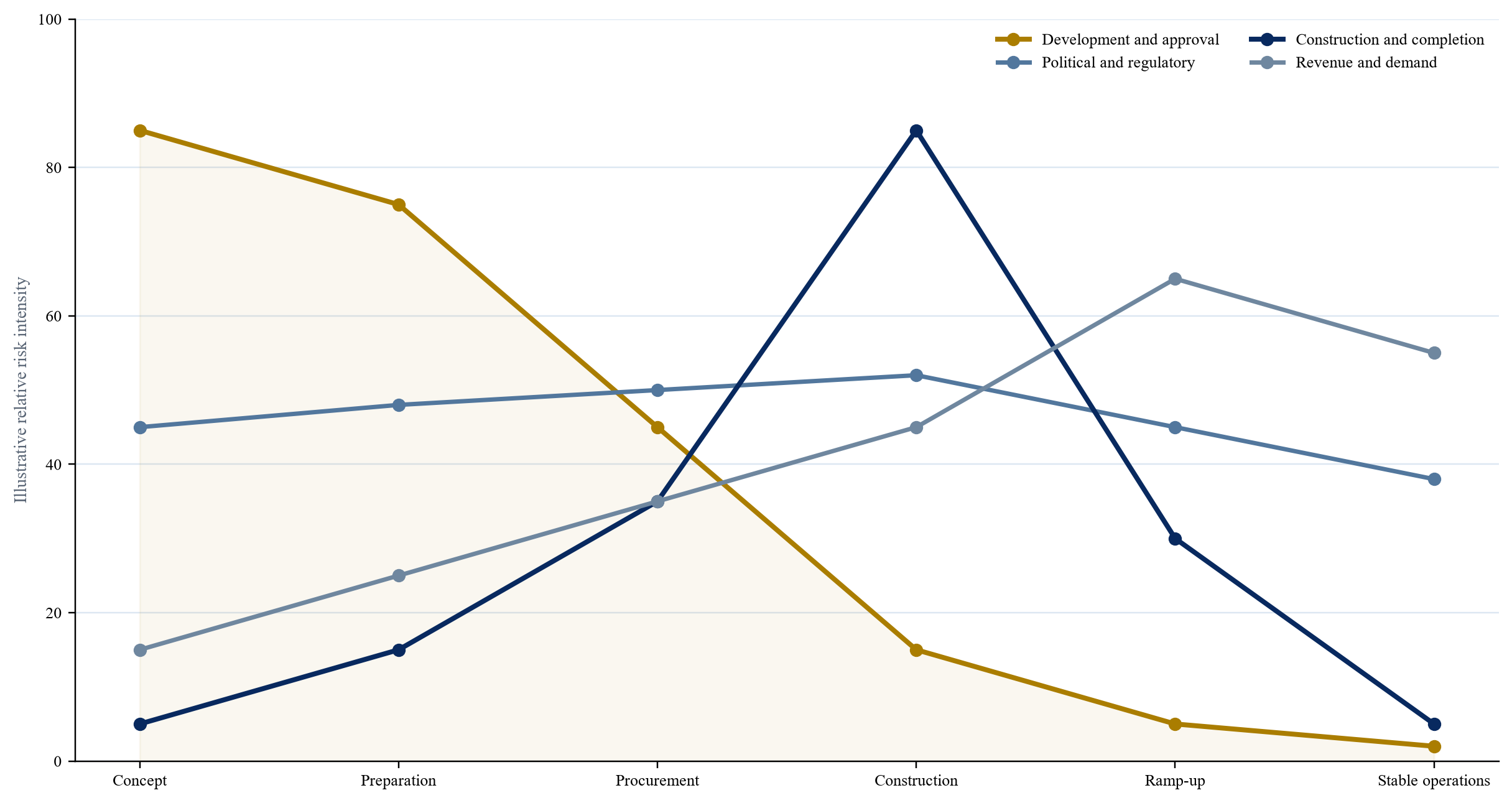
Risk does not disappear at financial close. Its composition changes, and the capital provider should change with it.
3. Explain why grids resist conventional project finance
Project finance works best when the asset, revenue contract, operating obligations and security package are clearly bounded. Electricity grids often have broader system responsibilities. A regulated network may recover revenue through a multi-year tariff based on an allowed asset base. A public utility may collect charges from many customers and fund investment through its balance sheet. A cross-border interconnector may depend on transmission-service agreements and electricity trade among several parties. A distribution expansion may combine commercial demand with social access obligations.
The revenue model can therefore be less direct than a generation power purchase agreement. Tariffs may be politically sensitive. Losses and poor collection can reduce utility cash. Government compensation for subsidised tariffs can be delayed. Capital expenditure may enter the regulated asset base only after review. Cross-border settlements can depend on market rules that are still developing. A lender cannot rely on the physical line alone; it must understand the institutional system that converts availability into cash.
Early expenditure also creates stranded-cost risk. Route studies, environmental work and land negotiations may have limited recovery value if the project stops. A private sponsor will price that exposure or seek reimbursement. A public authority may be best placed to fund common studies and preserve the information for future procurement. The allocation should reward genuine development work while avoiding payment for weak or duplicative studies.
4. Establish the transaction perimeter
The transaction perimeter defines which assets, rights, obligations, revenue streams and public functions sit inside the financed vehicle. It may cover a single line, a package of substations, a distribution concession, a portfolio of grid upgrades or a regional platform. The perimeter should align with the revenue and the risks that can be governed together.
A narrow perimeter can make construction and security easier to define, while leaving critical interfaces outside the vehicle. A line without the terminal substation, system-control upgrade or connected generation can be technically complete and commercially impaired. A broad perimeter can internalise interfaces, while increasing complexity and exposing investors to functions they cannot control. The preferred boundary depends on who controls planning, dispatch, customer collection, land and connection sequencing.
The parties should map every dependency at the perimeter. They should identify the responsible entity, required completion date, evidence of funding, remedies for delay and the effect on revenue. Government support should cover only obligations within public control. The sponsor should retain responsibilities within its technical and commercial control.
Table 1. Early grid risk allocation matrix
| Risk | Primary control party | Contractual or financial treatment | Evidence before commercial capital |
|---|---|---|---|
| System need and planning | Ministry, regulator and system operator | Approved plan, demand study and least-cost analysis | Published need case and governance approval |
| Route, land and permits | Public authority and project company | Corridor support, acquisition protocol and long-stop dates | Legally effective access and permit schedule |
| Environmental and social impact | Project company with public oversight | Action plans, consultation, grievance and monitoring | Completed assessment and funded obligations |
| Tariff and allowed revenue | Regulator and government | Multi-year methodology, indexation and review rules | Enforceable licence and base-case cost recovery |
| Utility payment | Utility and public shareholder | Escrow, liquidity facility, guarantee or payment security | Payment record and funded security mechanism |
| Currency mismatch | Borrower, treasury and financiers | Local-currency debt, hedge, indexation or liquidity facility | Defined exposure, tenor and affordability test |
| Construction and performance | Sponsor and contractors | Fixed-price scope, performance security and contingency | Bankable contracts and independent technical review |
| Connected generation or demand | System planner, counterparties and project company | Milestones, availability payment or phased investment | Funded counterpart projects and synchronised schedule |
| Political and breach risk | Government and insurer or guarantor | Political-risk insurance, contractual guarantee and dispute process | Coverage terms and enforceable public obligations |
| Operations and losses | Operator and utility | Performance standards, loss trajectory and incentive regime | Operating plan, baseline data and accountable management |
The allocation is a starting framework. Applicable law, procurement rules and project facts determine the final structure.
5. Remove preparation risk before subsidising finance
Poor preparation is not a financial-market failure. An incomplete route survey, uncertain land access or untested demand forecast should be repaired through project development rather than hidden through cheap capital. Grants and technical assistance can fund the studies, legal work, environmental assessment, regulatory design and transaction advice required to create a credible asset.
Preparation should be proportionate. Excessive studies can delay procurement and create a false impression of certainty. The objective is to reach decisions with reliable evidence, define residual risk and allocate responsibility. Independent review should challenge demand, cost, schedule, network model, climate resilience and interface assumptions.
Development funding should also create reusable public assets. Survey data, environmental baselines, standard contracts and tender materials should remain available if the first procurement fails. Reimbursement mechanisms can allow the winning sponsor to repay part of public development cost at financial close, recycling scarce preparation capital.
6. Resolve land, environmental and social obligations
Transmission and distribution assets require corridors across many parcels and communities. Delayed access can stop construction even when equipment and financing are ready. The public authority often controls compulsory acquisition and statutory approvals, while the project company controls detailed design, contractor conduct and implementation of environmental and social measures.
The structure should separate legal acquisition from construction access. A nominal right that remains contested may not support the schedule. The land plan should show parcel status, compensation, livelihood restoration, vulnerable groups, cultural heritage, biodiversity and grievance mechanisms. Contingencies should address rerouting and delayed sections.
Lenders and development institutions require continuing compliance, not a one-time permit. Costs should be included in the financing plan. Completion tests should avoid encouraging energisation before material obligations are met. Government support can cover delays caused by statutory processes, while the sponsor remains responsible for design changes, contractor behaviour and compliance failures within its control.
7. Convert system value into bankable revenue
A grid asset can create value through reliability, congestion relief, renewable integration, reduced losses, access, regional trade and deferred generation cost. The revenue model must translate those benefits into a predictable payment obligation. Common approaches include regulated asset-base returns, availability payments, transmission charges, concession tariffs and utility-service payments.
An availability model pays for the network being ready to deliver the contracted service, subject to performance deductions. It can protect the investor from demand that the system planner controls. A volume-based tariff transfers more demand and dispatch risk. A regulated asset-base model depends on transparent capital approval, depreciation, operating allowances and allowed return. A concession can combine investment obligations with customer collection and loss reduction.
Tariff design should preserve affordability and utility solvency. A nominal cost-reflective tariff can fail when collection is weak or government subsidy is unpaid. The financing case should reconcile allowed revenue, actual billing, collection, losses, subsidy and cash remittance. Blended finance can reduce required revenue, while the tariff and operating system still need a credible path to sustainability.
8. Treat utility credit as a system problem
The payment obligation may sit with a public utility whose credit reflects tariffs, losses, collection, debt, governance and government support. A sovereign guarantee can strengthen the immediate obligation, while transferring contingent liability to the state. It should be used within a transparent fiscal framework and accompanied by measures that improve the utility's underlying performance.
Payment security can be layered. A project may use billing priority, escrow, letters of credit, liquidity facilities, partial-risk guarantees and termination compensation. Each layer should have a defined trigger, amount, duration and replenishment mechanism. An unfunded government support agreement provides limited comfort.
The structure should avoid removing all accountability from the utility. Performance incentives, loss-reduction targets, reporting and governance reform can operate alongside credit support. If private capital is protected from payment risk while the utility has no path to improve, the public exposure becomes permanent.
9. Allocate currency risk explicitly
Grid revenues are commonly collected in local currency, while imported equipment and international debt may be denominated in dollars, euros, yen or renminbi. A depreciation can increase debt service without increasing revenue. Full indexation can transfer the cost to customers or government, creating affordability and political risk. An unhedged hard-currency loan can appear cheaper at closing and become expensive after depreciation.
The OECD's 2025 blended-finance guidance identifies hedges, first-loss guarantees and foreign-exchange liquidity facilities as tools for currency risk. It also notes that long-tenor infrastructure hedges can be expensive or unavailable. Local-currency finance removes the operating mismatch, although tenor and pricing may be constrained by domestic market depth. Development institutions can lend locally, provide swaps, support liquidity facilities or share tail risk.
The financing plan should measure the mismatch by period. It should distinguish construction imports from long-term debt service, test depreciation and inflation, and model tariff indexation delays. The objective is an affordable allocation, not the lowest initial coupon. A solution that relies on repeated public compensation for currency losses should be recognised as a contingent fiscal obligation.
10. Separate political risk from commercial weakness
Political-risk insurance can cover defined non-commercial events such as expropriation, transfer restriction, war, civil disturbance and breach of contract. Credit guarantees can cover scheduled debt service after specified defaults. These instruments can extend tenor, improve lender participation and reduce capital charges. They should be linked to clear obligations and dispute processes.
Commercial weakness requires different treatment. Political-risk insurance does not correct an overestimated demand forecast, weak contractor, poor maintenance plan or inefficient utility. A government guarantee should not absorb cost overruns caused by the sponsor. The risk register should identify whether each exposure arises from public action, private execution, market conditions or shared interfaces.
The World Bank Group Guarantee Platform, launched in July 2024 and housed at MIGA, consolidates credit guarantees, trade-finance guarantees and political-risk insurance from across the World Bank, IFC and MIGA. The World Bank Group reported USD 12.3 billion of guarantees across 77 projects in 40 countries and one regional development bank during fiscal 2025. Scale alone does not establish suitability for a particular grid transaction. The project must match coverage to a defined obligation and demonstrate development impact, additionality and financial viability.
11. Make construction risk bankable
Grid projects combine civil works, towers, cables, substations, transformers, protection systems, communications and control software. The interfaces can involve several contractors and public entities. A fixed-price, date-certain engineering contract can transfer part of the risk, although contractors will price uncertainty and may exclude land, permits, geotechnical conditions, customs, security and third-party connections.
The sponsor should create an integrated schedule and responsibility matrix. Liquidated damages, performance security, parent guarantees, retention and contingency provide remedies, while they cannot replace capable contractors and realistic design. Independent engineers should test cost, schedule, procurement, climate resilience, spares and commissioning.
Completion should be defined by service capability rather than physical construction alone. Tests can include energisation, availability, losses, protection, communications, dispatch integration and reliability. Where connected projects are late, deemed-availability payments or public compensation can protect the grid vehicle if the dependency was outside its control. Such protection should expire when the dependency is resolved.
12. Synchronise the line, generation and load
Network assets often lead or lag the projects they serve. Building late creates congestion and delays investment. Building early creates underutilisation and political criticism. The financing structure should treat timing as a portfolio problem rather than assign every delay to the line.
Milestone agreements can align generators, large customers, system operators and the network company. The parties should publish a common critical path, identify substitute demand and define consequences for delay. Phased construction can reduce stranded capacity. Modular substations, staged circuits and expandable rights of way can preserve options.
Revenue can also be phased. An availability payment can begin when the network meets its obligations, with later adjustments as connected capacity grows. A public service payment can compensate for access or resilience benefits that users do not directly pay. The structure should disclose who bears underutilisation risk and for how long.
13. Choose the instrument after diagnosing the risk
Blended finance is a toolkit. The correct instrument depends on the barrier. A grant can fund public preparation or affordability support. Concessional senior debt can reduce the weighted financing cost. Subordinated debt or first-loss capital can protect commercial lenders against defined losses. A guarantee can address payment, political or credit risk. Results-based finance can pay after verified connections or performance. Local-currency facilities can reduce exchange mismatch.
The instrument should be no larger or longer than required to mobilise appropriate commercial capital. Excess concessionality can displace private finance, reward weak structuring and create expectations that future projects will receive the same terms. Insufficient support can leave a sound project unable to close. The sponsor and public institution should test the minimum effective intervention under transparent scenarios.
Additionality has several dimensions. Financial additionality means the transaction would not proceed on comparable terms without the intervention. Development additionality concerns outcomes such as access, reliability, affordability, emissions reduction and institutional capacity. Demonstration additionality arises when the transaction proves a structure that later projects can use with less support. Each claim should have evidence and a monitoring plan.
Table 2. Blended-finance instruments and the risks they can address
| Instrument | Appropriate use | Risk retained elsewhere | Key governance question |
|---|---|---|---|
| Project-development grant | Common studies, legal work, environmental assessment and transaction preparation | Sponsor execution and subsequent project viability | Does the grant create reusable preparation assets? |
| Viability-gap grant | One-off capital shortfall caused by an affordable tariff or public-service requirement | Operations, maintenance and collection | Is the gap transparent and competitively determined? |
| Concessional senior debt | Reduce financing cost or extend tenor where cash flow is viable | Equity loss and operational performance | Is the subsidy the minimum needed for bankability? |
| Subordinated or first-loss capital | Absorb defined initial losses and mobilise senior lenders | Losses above the layer and sponsor conduct | Are triggers objective and sponsor incentives preserved? |
| Partial credit guarantee | Cover scheduled debt service or a portion of default loss | Uncovered credit and project performance | Does coverage improve tenor or participation measurably? |
| Political-risk insurance | Cover defined sovereign and non-commercial events | Commercial and construction risk | Are public obligations specific and enforceable? |
| Payment liquidity facility | Bridge temporary delay by a utility or government payer | Permanent insolvency and operational weakness | How is the facility replenished and when does it end? |
| Currency hedge or facility | Reduce local versus hard-currency mismatch | Residual basis, tenor and convertibility risk | Is the all-in cost affordable under downside? |
| Results-based payment | Reward verified access, service or performance | Upfront development and delivery risk | Are results measurable, independent and durable? |
| Refinancing or take-out commitment | Bring long-term capital after construction | Completion and early operating risk | Are take-out conditions objective and funded? |
Instruments should address defined barriers and include governance, pricing and an exit condition.
14. Use guarantees as precision instruments
A guarantee changes who bears a defined loss. It can protect a lender against government payment failure, support refinancing, cover termination obligations or insure an investor against specified political events. The value comes from the guarantor's credit, claims process and ability to engage with public authorities.
Coverage should be narrower than the entire project risk where possible. A guarantee that protects all losses can weaken lender diligence and sponsor discipline. Partial coverage encourages private participants to retain exposure. The covered obligation should have a clear amount, maturity, trigger, cure process and recovery right. Counter-indemnities and fiscal approvals should be addressed before closing.
The guarantee fee and capital treatment belong in the economic analysis. A lower coupon can be offset by fees, reserve requirements or process costs. The project should compare guaranteed and unguaranteed structures on total cost, tenor, leverage, resilience and execution certainty.
15. Design concessional debt and subordination carefully
Concessional debt can extend maturity, reduce interest or provide grace during construction and ramp-up. It is suitable when the project has durable cash generation and the commercial market cannot offer affordable tenor. Subordinated debt or first-loss equity can improve senior-lender protection by absorbing initial loss.
The size of the junior layer should follow a quantified loss distribution. A layer chosen only to reach a target credit rating may create hidden subsidy. The model should show expected loss, stress loss and recovery. Sponsor equity should remain meaningful so that construction and operating incentives are preserved.
Concessional capital should have a repayment and exit path. It may amortise after senior debt, convert to market terms after performance milestones or refinance once operating history is established. Recycling repayments into future projects can increase development impact.
16. Use grants for public goods and affordability
Grants are appropriate where the expenditure creates a public good, serves customers who cannot support full commercial cost or develops information that the private market will not fund. They can support planning, connections, social measures, climate resilience, regulatory systems, training and independent transaction advice.
A capital grant can close a viability gap between affordable revenue and required investment. Competitive procurement can reveal the minimum grant required. The grant should be paid against milestones or verified expenditure, with recovery for non-performance where feasible. Operating grants require particular care because they can become permanent and obscure the true cost of service.
Results-based finance can reward verified connections, reliability or loss reduction. It transfers delivery risk to the operator, while the operator still needs working capital. A bridge facility or partial advance may be necessary when smaller local companies cannot pre-finance delivery.
17. Build local-currency capacity
Local-currency finance aligns debt service with revenue and can involve domestic banks, pension funds, insurers and capital markets. It also retains savings within the local infrastructure system. Tenor, liquidity, benchmark curves and investor limits may constrain availability.
Development institutions can support local markets through local-currency lending, swaps, guarantees, cornerstone investment, bond enhancement and standard documentation. The IFC's 2024 annual report described its role as anchor investor in a social bond supporting Cote d'Ivoire's Electricity for All Programme, with backing from the IDA Private Sector Window's blended-finance and local-currency facilities. The example links household access, local capital markets and risk sharing.
Local investors should receive sufficient information to assess infrastructure risk rather than rely solely on a public guarantee. Disclosure, ratings, trustee arrangements, covenants and secondary-market liquidity matter. A transaction that broadens domestic participation can create a platform for later issuances with less concessional support.
18. Aggregate projects without hiding heterogeneity
Small distribution upgrades, mini-grids and connection programmes can be expensive to finance individually. Aggregation can combine procurement, servicing, reporting and financing. A portfolio can diversify site-specific risk and create an issuance large enough for institutional investors.
Aggregation introduces new risks. Assets may have different tariffs, customer groups, currencies, technologies and legal rights. Weak data can obscure performance. Cross-collateralisation can transfer losses among projects. The platform should use standard eligibility, contracts, reporting and reserve rules while preserving visibility at asset level.
Warehousing can fund projects until the portfolio reaches scale. A development institution or specialist vehicle can provide the warehouse, after which long-term investors refinance seasoned assets. The take-out criteria should be defined in advance. Projects that fail criteria should remain with the originator or use a transparent workout process.
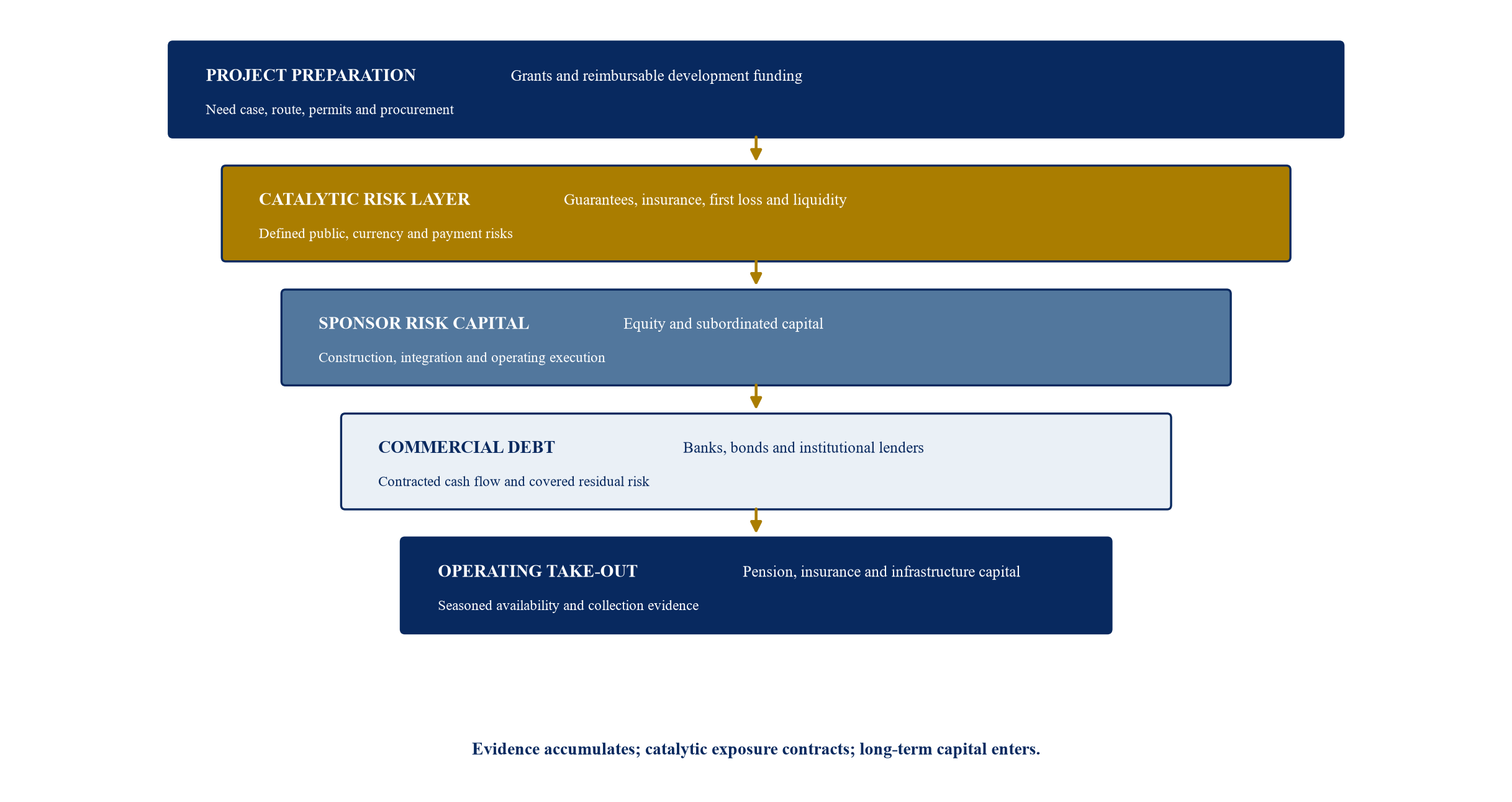
Public and catalytic instruments should reduce as evidence accumulates and operating risk falls.
19. Procure for bankability and public value
Procurement should reveal price, capability and required public support. The tender documents need a settled perimeter, risk matrix, revenue mechanism, minimum technical standards, evaluation method and draft contracts. Bidders should have access to reliable studies and enough time to diligence the project.
Evaluation should consider total economic value rather than the lowest construction price. Relevant factors can include required tariff or availability payment, public contribution, financing certainty, technical resilience, loss reduction, lifecycle cost, local capability and timetable. Subjective criteria require clear scoring and governance.
Bid conditions should avoid transferring risks that bidders cannot control. When every bidder qualifies a public obligation, the allocation should be reconsidered rather than treated as competitive tension. Competitive dialogue can help refine complex structures, while equal information and audit trails remain essential.
20. Govern blended finance as a scarce public resource
Blended finance creates contingent and direct public exposure. Governance should therefore resemble capital allocation. The approving body should understand the risk addressed, expected mobilisation, development outcome, fiscal cost, pricing, conflicts and exit condition. Decisions should be documented and monitored after closing.
Mobilisation ratios should be interpreted carefully. A high ratio can arise from providing a narrow guarantee to a mature project. A lower ratio can be appropriate in a fragile market where the project creates access and demonstration value. The quality of mobilisation depends on the risk transferred and whether commercial capital would otherwise have entered on comparable terms.
Transparency also protects competition. Public support should be disclosed in tender materials or determined through a competitive process. Related-party service providers, advisers and fund managers should be governed. Concessional capital should not improve sponsor returns beyond the level required for delivery.
21. Learn from current transaction examples
MIGA's transmission and distribution materials describe a private-utility model in Burundi. In December 2024, the World Bank Group Guarantee Platform issued a USD 10.9 million guarantee covering breach-of-contract risk for investment in Weza Power. The project uses a public-private framework to expand rural and suburban distribution. The structure illustrates a targeted guarantee supporting a new institutional model. The project's results depend on subsequent construction, connections, operations and public performance and should be assessed through continuing evidence.
In Rwanda, MIGA issued USD 9 million of guarantees to three investors in ARC Power Rwanda. MIGA states that the cover protects against breach of contract for up to eight years. ARC's model combines transmission and distribution infrastructure with distributed solar generation and productive users. The case shows how political-risk cover can support equity at a stage where the private investor is building both network and demand relationships.
The Cote d'Ivoire Electricity for All social-bond example demonstrates a different route. IFC acted as anchor investor in a capital-market instrument intended to support household grid connections, backed by IDA blended-finance and local-currency facilities. The transaction links affordability, domestic finance and a programme of connections rather than isolating one network asset.
Regional interconnectors add coordination risk. The IEA's 2026 analysis of the ASEAN Power Grid estimates more than USD 300 billion of grid expansion and modernisation investment from 2025 to 2040. It notes that export-linked interconnections associated with generation have mobilised project finance more readily than grid-to-grid interconnectors. The difference highlights the importance of a bankable trade and revenue arrangement, multilateral rules and coordinated public support.
22. Build a stage-gated financing plan
The financing plan should identify capital by stage, purpose, risk and exit. Preparation funding pays for evidence and transaction design. Construction capital funds physical delivery and reserves. Operating capital refinances the project after completion. The plan should avoid assuming that the same investor will carry every stage.
Conditions precedent should correspond to the incoming capital. Commercial debt may require effective land access, permits, construction contracts, revenue documents, public support, insurance and sponsor equity. A take-out investor may require completion, operating history, collection performance and stable regulation. A guarantee may require government indemnity and defined covered obligations.
The sources-and-uses model should include fees, taxes, hedging, reserves, social measures, contingencies and interest during construction. It should also show the cost of delayed completion and the funding source for overruns. Every public instrument should appear in the model as a priced or disclosed contribution.
23. Illustrative transmission programme
Consider a hypothetical 500-kilometre transmission programme linking renewable zones to two industrial regions. The numbers below demonstrate the framework and do not describe an actual country, company or transaction. Total uses at financial close are USD 1.20 billion. Sponsor and public equity provide USD 240 million. A development institution provides USD 210 million of subordinated debt. Commercial lenders provide USD 600 million of senior debt, supported by a partial credit guarantee covering specified scheduled payments. A USD 90 million capital grant funds public-service and resilience features. A USD 60 million liquidity and contingency facility supports temporary payment and currency stress.
The revenue is an availability payment denominated in local currency and indexed partly to inflation. Seventy percent of construction cost is in hard currency. The project uses a construction-period hedge for committed imports and local-currency senior debt for part of the long-term financing. The public authority provides land and specified interconnection milestones. The sponsor retains cost, schedule and performance risk within the defined construction scope.
The base case assumes completion within 42 months and operating availability above the contractual threshold. A moderate downside assumes a nine-month delay in one connected generation zone, a 12 percent local-currency depreciation and a six-month utility payment delay. The availability structure protects the grid vehicle from the generation delay after it meets its own completion obligations. The liquidity facility covers temporary payment timing. Currency protection is limited to the defined hedge and indexation; residual depreciation reduces equity distributions. A severe case assumes construction overrun caused by contractor performance. Sponsor support and contingency absorb the first loss before concessional or guaranteed instruments respond.
Table 3. Hypothetical financing and loss-allocation bridge
| Financing component or stress | Amount | Risk addressed | First economic bearer |
|---|---|---|---|
| Sponsor and public equity | 240 | Development, construction and residual project risk | Equity investors |
| Subordinated development debt | 210 | Tenor and initial credit enhancement | Subordinated lender after equity |
| Commercial senior debt | 600 | Funded construction and long-term asset finance | Senior lenders subject to security and guarantee |
| Capital grant | 90 | Public-service, access and resilience features | Public programme budget |
| Liquidity and contingency facility | 60 | Temporary payment and defined currency timing | Facility provider until replenishment |
| Base total sources and uses | 1,200 | Full programme funding | Allocated across the stack |
| Moderate delay and currency stress | 78 | Payment timing and residual FX exposure | Liquidity facility, reserves and equity |
| Construction-performance overrun | 105 | Contractor delay and rectification | Contractor security, sponsor support and equity |
| Covered scheduled-payment default | 140 maximum | Defined public or utility payment default | Guarantor for covered amount, with recovery rights |
| Operating underperformance | Variable | Availability deductions and higher cost | Operator and equity after contractual remedies |
All amounts are hypothetical USD millions. The example demonstrates structuring logic and is not a forecast, offer or observed transaction.
The base structure should be compared with alternatives. A larger grant lowers required revenue while consuming scarce public funds. A larger guarantee can reduce lender pricing while increasing contingent fiscal exposure. More local-currency debt reduces exchange mismatch while potentially raising nominal interest cost. The decision should minimise total risk-adjusted public and private cost while preserving delivery incentives.
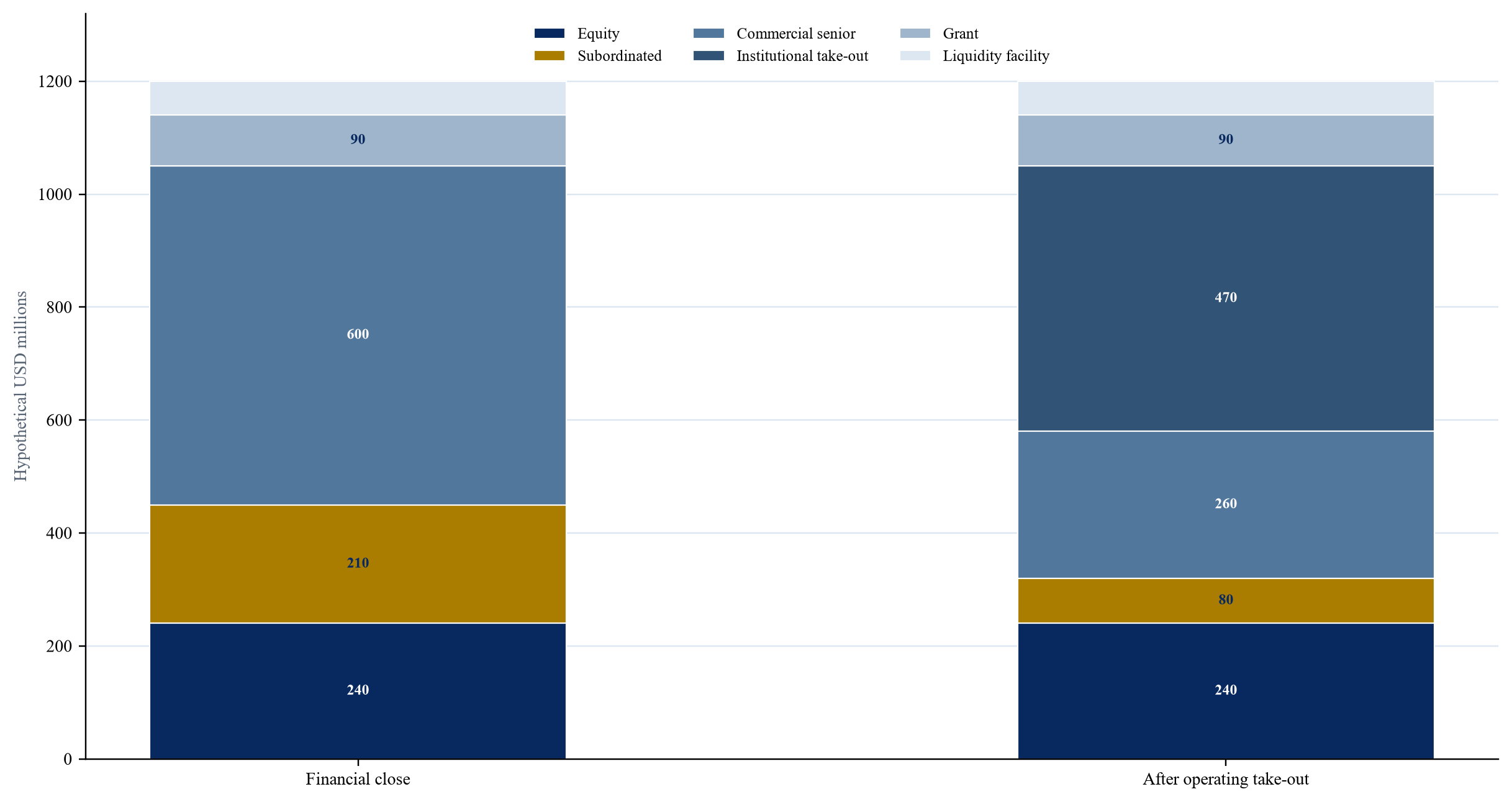
The refinancing replaces part of the catalytic and bank capital after completion evidence is available. Amounts are hypothetical USD millions.
24. Conduct diligence on the public and private system
Technical diligence should test system need, load flow, route, design, cost, schedule, losses, resilience, spares and operating capability. Commercial diligence should test the revenue mechanism, tariff, collection, payment security, connected projects and demand. Financial diligence should test sources and uses, currency, inflation, interest, reserves, covenants and refinancing.
Legal diligence should cover authority, procurement, licence, land, permits, security, government support, dispute resolution and termination. Environmental and social diligence should examine compliance, consultation, compensation, biodiversity, labour and grievance. Integrity diligence should cover ownership, sanctions, conflicts, procurement conduct and intermediaries.
Institutional diligence is equally important. The transaction depends on the regulator, utility, ministry, system operator and fiscal authority. Their mandates, decision processes, data, staffing and record of implementation affect risk. Capacity-building commitments should have budgets, milestones and accountable owners.
25. Plan the refinancing and public exit
Early-stage risk capital is expensive and scarce. The transaction should plan how it will be replaced after completion and operating evidence. Take-out financing can come from domestic bonds, infrastructure debt funds, pension funds, insurers, securitisation or utility balance-sheet finance.
Refinancing conditions should be objective. They may include completion, minimum availability, payment history, stable tariff, reserve funding and absence of default. The allocation of refinancing benefit should be agreed. Part can reduce tariffs, repay concessional capital, reward sponsor delivery or fund the next project.
Guarantees and liquidity facilities also need exit rules. Coverage can decline as payment performance improves or debt amortises. A guarantee that remains unchanged after risk falls can crowd out the market and tie up public capacity. Exit should be linked to evidence rather than an arbitrary date.
26. Apply a decision framework
Decision-makers can use eight questions. First, what system problem does the project solve and who receives the benefit? Second, what asset and obligations sit inside the transaction perimeter? Third, which risks can be removed through preparation? Fourth, which party controls each residual risk? Fifth, what revenue mechanism converts service into cash? Sixth, which blended instrument addresses the remaining financing barrier at minimum public cost? Seventh, how will outcomes, fiscal exposure and additionality be monitored? Eighth, how and when will concessional or guaranteed support exit?
The answer should be documented in a transaction memorandum and financial model. Every instrument should map to one or more risks, and every risk should map to an accountable party. Unsupported risk should appear as a financing gap, not disappear into a higher terminal value or optimistic refinancing assumption.
A project can proceed with substantial public support when its public benefits justify that support and the exposure is governed. It can proceed with limited support when policy, revenue and execution are strong. It should return to preparation when the basic allocation remains unresolved.
Conclusion
The early grid-financing problem is an allocation problem before it becomes a pricing problem. Land, permits, regulation, utility payment, currency, political decisions, connected projects and construction interfaces determine whether capital can earn a durable return. Assigning all these exposures to a project company raises cost or prevents investment. Assigning them all to government weakens incentives and creates opaque fiscal risk.
Blended finance provides a disciplined middle path when each instrument follows a defined risk. Grants can create preparation assets and protect affordability. Concessional debt can extend tenor. Subordination can protect senior capital against quantified losses. Guarantees and insurance can cover specific public and political obligations. Local-currency finance and hedging can reduce exchange mismatch. Results-based payments can link support to verified service.
The strongest structure removes avoidable risk before financing, preserves sponsor responsibility for execution, prices public exposure and establishes an exit from catalytic support. It converts system value into enforceable revenue and synchronises the network with generation and demand. It also records the residual risks that remain with customers, taxpayers, investors and lenders.
Emerging-market grids require more capital and better institutions. A well-governed transaction can contribute to both. The project delivers infrastructure, while the financing process builds data, contracts, regulatory capability and a record that later investors can use. That cumulative evidence is the route from exceptional blended transactions to a repeatable market.
Frequently Asked Questions
1. What makes early grid risk different from operating risk?
Early grid risk arises before stable service and payment evidence. It includes development, land, approvals, procurement, construction, connection sequencing and initial regulatory performance. Operating risk concerns availability, cost, losses, collection, maintenance and continuing regulation after the asset is in service.
2. Should government guarantee the entire grid project?
Government support should cover obligations within public control and should be measured within a fiscal framework. Construction, operating and commercial risks within sponsor control should remain with the sponsor or contractor. Partial and targeted coverage usually preserves stronger incentives than blanket protection.
3. When is a capital grant appropriate?
A capital grant can be appropriate when affordable revenue cannot fund a public-service, access or resilience feature with a strong economic benefit. The size should be transparent, competitively determined where feasible and linked to verified delivery.
4. How can currency risk be reduced?
Options include local-currency debt, tariff indexation, cross-currency swaps, forward contracts, foreign-exchange liquidity facilities, reserve accounts and risk sharing. The structure should test total cost, tenor, affordability and residual mismatch under depreciation scenarios.
5. What does a partial credit guarantee achieve?
A partial credit guarantee covers defined debt-service payments or a portion of lender loss. It can extend tenor, improve participation and reduce financing cost. The uncovered exposure encourages lenders to retain diligence and monitoring responsibility.
6. How should concessionality be measured?
The parties should compare the blended terms with credible market terms and quantify grant equivalent, expected loss, fees and contingent exposure. They should also document why the project could not proceed on comparable commercial terms and how support will decline or exit.
7. Can institutional investors finance a grid before construction?
Some investors can accept construction risk, particularly through specialist debt or equity strategies. Many pension and insurance investors prefer completed assets with operating and payment history. A take-out structure can match each stage with suitable capital.
8. What is the central test for a blended grid transaction?
The central test is whether each public instrument addresses a defined barrier, mobilises suitable private capital, preserves delivery incentives, creates measurable public value and contains transparent pricing, monitoring and exit conditions.
References
- International Energy Agency and International Finance Corporation. Scaling Up Private Finance for Clean Energy in Emerging and Developing Economies, 2023. https://www.iea.org/reports/scaling-up-private-finance-for-clean-energy-in-emerging-and-developing-economies
- International Energy Agency. Financing Electricity Access in Africa, 2025. https://www.iea.org/reports/financing-electricity-access-in-africa
- International Energy Agency. Unlocking Smart Grid Opportunities in Emerging Markets and Developing Economies, 2023. https://www.iea.org/reports/unlocking-smart-grid-opportunities-in-emerging-markets-and-developing-economies
- International Energy Agency. Grid Investments, 2025. https://www.iea.org/reports/grid-investments
- International Energy Agency. Financing the ASEAN Power Grid, 2026. https://www.iea.org/reports/financing-the-asean-power-grid
- International Energy Agency. China's Official Energy Finance in Emerging and Developing Economies, 2025. https://www.iea.org/reports/chinas-official-energy-finance-in-emerging-and-developing-economies
- International Renewable Energy Agency. Renewable Power Generation Costs in 2024, 2025. https://www.irena.org/Publications/2025/Jul/Renewable-Power-Generation-Costs-in-2024
- Organisation for Economic Co-operation and Development. OECD DAC Blended Finance Guidance 2025. https://doi.org/10.1787/e4a13d2c-en
- Organisation for Economic Co-operation and Development. The Currency Exchange Fund, 2025. https://www.oecd.org/en/publications/blended-finance-case-studies_2fb90b9a-en/the-currency-exchange-fund_321fe70e-en.html
- Organisation for Economic Co-operation and Development. Addressing Foreign Currency Risk to Unlock Clean Energy Investment in Emerging Markets and Developing Economies, 2024. https://www.oecd.org/en/events/2024/10/Addressing--Foreign-Currency-Risk-to-unlock-clean-energy-investment-in-EMDEs1.html
- World Bank Group. World Bank Group Guarantees Platform, 2025. https://www.worldbank.org/en/about/unit/brief/guarantees-platform
- World Bank Group. Annual Report 2025, Multilateral Investment Guarantee Agency. https://www.worldbank.org/en/about/annual-report/miga
- World Bank Group. World Bank Group Guarantee Platform Goes Live, 2024. https://www.worldbank.org/en/news/press-release/2024/07/01/world-bank-group-guarantee-platform-goes-live
- Multilateral Investment Guarantee Agency. Transmission and Distribution Projects. https://www.miga.org/transmission-and-distribution-projects
- Multilateral Investment Guarantee Agency. Rwanda: Advancing Universal Electricity Access. https://www.miga.org/project/arc-power-rwanda
- International Finance Corporation. Annual Report 2024. https://www.ifc.org/en/insights-reports/2024/annual-report-2024
- World Bank Group. Private Participation in Infrastructure Annual Report 2024. https://ppi.worldbank.org/en/ppi
- World Bank Group. Public-Private Partnership Reference Guide. https://ppp.worldbank.org/public-private-partnership/ppp-reference-guide
- Global Infrastructure Hub. Infrastructure Monitor 2024. https://www.gihub.org/infrastructure-monitor/
- World Bank Group. Off-Grid Solar Market Trends Report 2024. https://www.worldbank.org/en/topic/energy/publication/off-grid-solar-market-trends-report-2024
About the Author
Chennakeshav (CK) is a corporate finance and investment banking executive with 25+ years of global experience in deal origination, structuring and execution across M&A, growth capital and corporate strategy. He has led value-creation mandates for founders, corporates and funds — bridging the boardroom view to hands-on execution and close.
His career spans Morgan Stanley, HSBC, Lloyds Banking Group, EWEC, ADQ portfolio companies and Emirates Growth Fund, across TMT, real estate, fintech, deeptech, cleantech, infrastructure and energy. He has partnered with C-suite leaders, private equity and venture funds, sovereign wealth funds and family offices to finance complex fund raises and scale-up ventures, and has led M&A due diligence, post-merger integration and business-transformation initiatives to create value.
At Matchpoint Partners he is Managing Partner, leading the firm's corporate finance, M&A and capital-raising practice. He holds an MBA from London Business School, an engineering degree from VTU and a Master of Laws (LLM, in progress) from UCL London.
An active start-up mentor, CK mentors at Techstars, DIFC FinTech Hive, Startup Grind, Founder Institute and IN5, serves as Entrepreneur Mentor in Residence (EMiR) at London Business School, and judges the Entrepreneurship World Cup.
