

1. An earnout is an operating-governance system
An earnout converts uncertainty about future business performance into a contingent part of transaction consideration. The mechanism can help buyer and seller agree a closing price when they hold different views of growth, customer retention, product approval or profitability. The apparent simplicity of a target multiplied by a formula hides a more demanding operating problem: the metric must remain intelligible after control changes and integration begins.
Operational change is expected after an acquisition. The buyer may replace the enterprise resource planning system, combine legal entities, centralise sales, renegotiate suppliers, move employees, alter pricing, discontinue products, add shared services or fund growth. Each change can affect the numerator, denominator, timing, classification or source of the earnout calculation. The same commercial activity may appear in a different ledger, entity, channel or period.
The board should therefore treat an earnout as a governed measurement system. The purchase agreement supplies the legal formula. Finance translates that formula into a calculation policy. Operations maintain the business and evidence. Integration leaders identify changes that affect measurement. The company secretary preserves decisions. Qualified advisers address legal, accounting, tax and competition questions. The seller receives the information and challenge rights stated in the agreement.
The system needs three linked records. The contract ledger calculates the amount payable under the agreement. The statutory ledger supports financial statements and accounting for contingent consideration. The management ledger helps leaders run the combined business. The three records may use related data while serving different purposes. A management reporting change should not silently rewrite the contractual formula. An accounting fair-value update should not be confused with the eventual amount contractually earned.
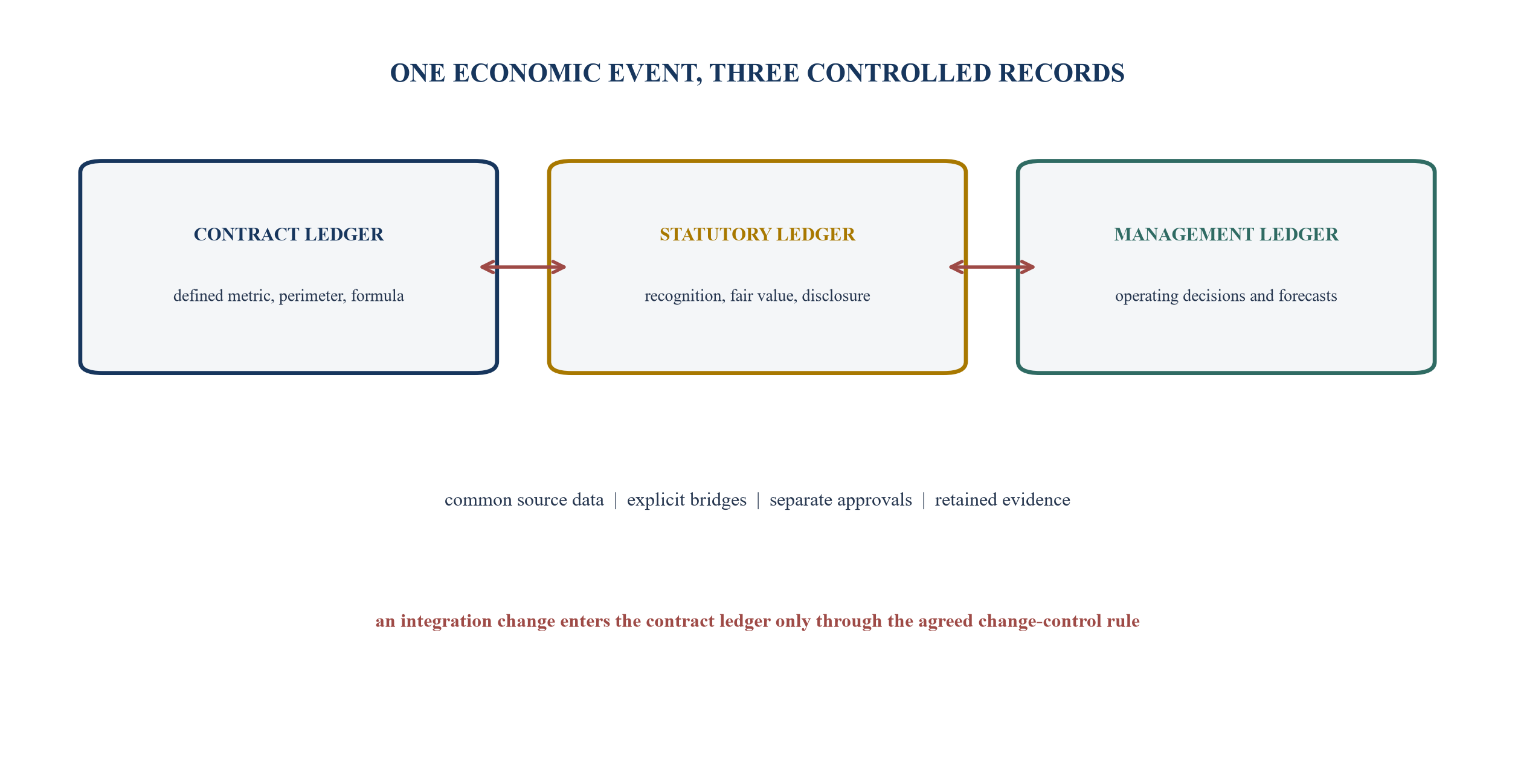
Contract, statutory accounting and management reporting serve distinct decision purposes.
2. Start with the economic question and payment mechanics
Metric selection should begin with the uncertainty the parties are pricing. Revenue can be relevant when the principal disagreement concerns customer demand. EBITDA can be relevant when the dispute concerns sustainable profitability. Cash collection can matter when reported revenue does not establish economic conversion. A regulatory or product milestone can be appropriate when value depends on a discrete event. A formula copied from another deal may measure activity that neither party intended to price.
The term sheet should state the economic question in one sentence. Examples include whether an installed customer base retains revenue after ownership change, whether a product reaches a specified approval, or whether a business achieves defined contribution after agreed investment. That sentence becomes the test for every definition. If an adjustment does not preserve the intended economic question, it requires challenge.
Payment mechanics should also be visible. The agreement should define the measurement period, currency, target, threshold, cap, floor, interpolation, payment date, set-off rights, security, withholding, late-payment treatment and effect of a sale or restructuring. It should address whether separate periods stand alone or aggregate, whether a miss can be recovered later and whether negative performance creates a clawback.
The board should review the earnout as part of total committed consideration. Acquisition-date accounting under IFRS 3 recognises the fair value of contingent consideration as part of consideration transferred. Classification and subsequent measurement can affect later profit or loss. The contractual maximum, accounting fair value, expected cash payment and funded liquidity requirement are different measures. A decision paper should present each one clearly.
3. Build a metric charter before signing
A metric charter translates the commercial bargain into an operating specification. It should be completed before signing, attached to the final approval paper and reflected in the purchase agreement or an agreed schedule. The charter defines the metric name, purpose, formula, source systems, data fields, legal-entity perimeter, products, customers, channels, geography, currency, accounting policies, permitted adjustments, responsible owner, review frequency and dispute route.
The charter should include a worked example using historical data. A formula can be grammatically clear while remaining computationally ambiguous. Applying it to two prior periods reveals questions about rebates, returns, foreign exchange, intercompany revenue, bad debt, acquisitions, discontinued lines and shared costs. The worked example also establishes whether the data exists at the required level.
Definitions need precedence. The agreement may reference accounting standards, historical practices, a specific chart of accounts and enumerated exceptions. Those layers can conflict. The document should state which rule controls. A broad reference to generally accepted accounting principles rarely resolves whether the parties intended the seller's pre-closing policy, the buyer's policy or a bespoke contractual measure.
The charter should name the record of truth for each input. It can identify invoice tables, customer master data, payroll, procurement records, bank receipts and manual schedules. It should define the cut-off, approval and retention process. A source-system migration plan belongs in the transaction workplan because the earnout cannot depend on data that will be deleted or overwritten during integration.
Table 1. Minimum contents of an earnout metric charter
| field | required definition | control question | accountable owner |
|---|---|---|---|
| economic purpose | uncertainty the payment is intended to resolve | does the metric still answer the original question? | board sponsor |
| formula | numerator, denominator, thresholds, cap and interpolation | can an independent reviewer reproduce the amount? | finance lead |
| perimeter | entities, products, customers, channels and geography | what enters or leaves after integration? | transaction lead |
| policy basis | accounting policies, contract overrides and precedence | which rule controls a conflict? | controller and counsel |
| source data | systems, fields, cut-off, currency and retention | is evidence complete and traceable? | data owner |
| change control | events, adjustments, approvals and notice | who can approve a measurement change? | earnout committee |
| dispute route | review period, access, expert scope and timetable | can a disagreement reach final determination? | company secretary |
The final charter should be aligned with the executed agreement and reviewed by qualified advisers.
4. Choose a metric close to the value thesis
The best metric is usually the narrowest reliable measure that captures the uncertainty being priced. Distance between the value thesis and the formula creates room for unintended incentives. If the thesis concerns retained customers, total group EBITDA may be affected by unrelated acquisitions and corporate allocations. If the thesis concerns profit quality, booked revenue can reward low-margin or uncollected sales.
Revenue is observable and can be less exposed to discretionary cost allocation. It remains sensitive to recognition, gross-versus-net presentation, channel movement, pricing, returns, bundling, intercompany treatment and contract timing. EBITDA captures more economics while increasing the number of judgemental adjustments. Cash metrics strengthen conversion discipline while becoming sensitive to collection policy, payment terms and working-capital management.
Non-financial milestones can fit businesses in which value depends on regulatory approval, product release, installed capacity or contracted volume. Their apparent binary nature can conceal scope questions. Approval may be limited by geography, indication or label. A launch may occur before commercial readiness. Installed capacity may lack connection, utilisation or customer acceptance. Each milestone needs objective evidence and a defined authority.
Mixed metrics can reduce single-measure distortion. A revenue threshold combined with a margin floor discourages uneconomic sales. A product milestone combined with contracted demand connects technical progress to commercial proof. Complexity should remain proportionate. Every additional condition expands the evidence burden and the probability of dispute.
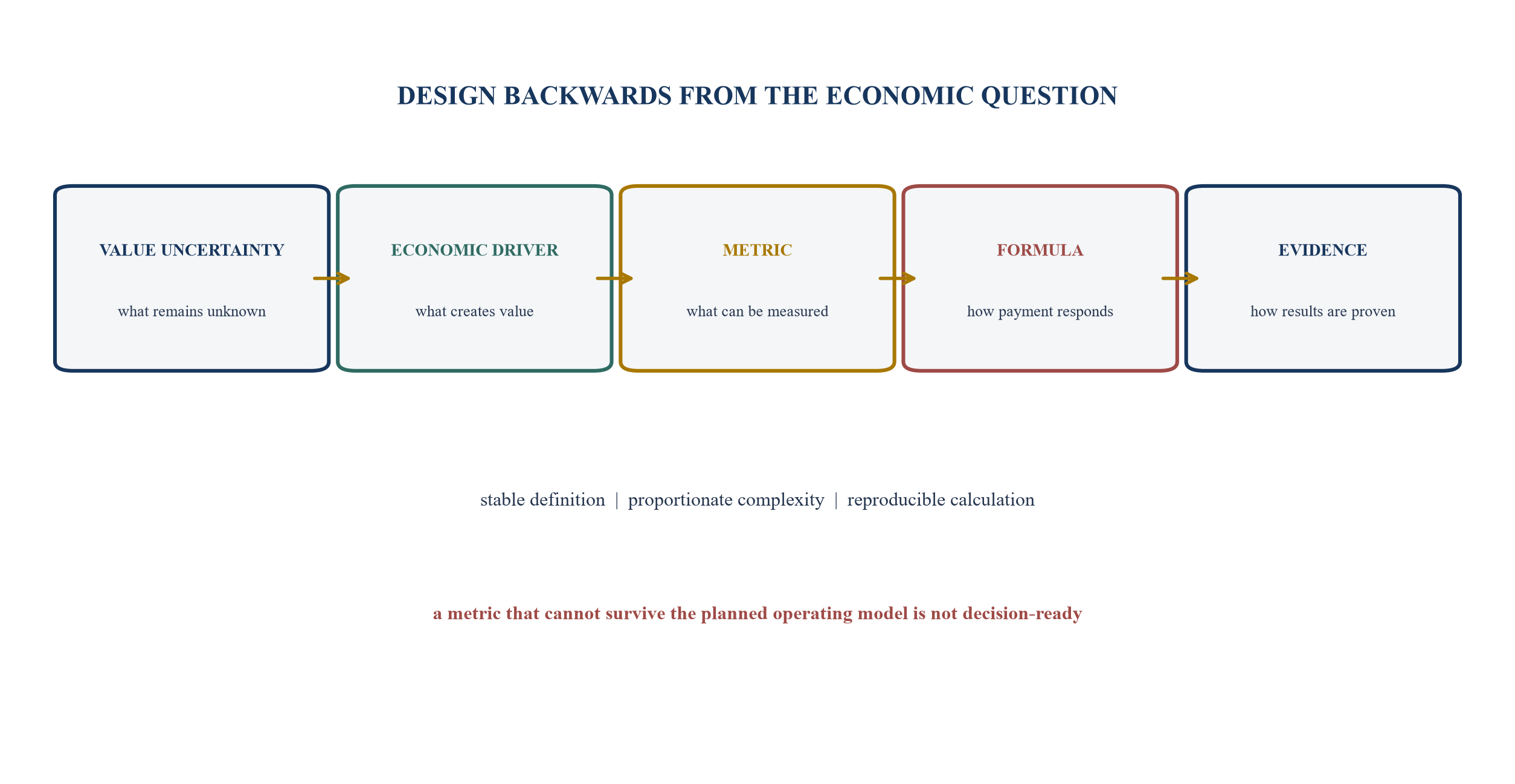
Each step should narrow ambiguity before the formula is executed.
5. Establish the standalone baseline and the integration bridge
An earnout calculated after integration needs a baseline that describes the business before change. The baseline should include historical financial statements, management accounts, chart of accounts, customer and product master data, payroll, procurement, revenue policies, allocation methods and a reconciliation between statutory and management reporting. It should record known weaknesses rather than present history as perfectly controlled.
The buyer should build an integration bridge from the baseline to the planned operating model. Each workstream identifies changes to entity structure, systems, people, pricing, channels, procurement, product, financing and shared services. The bridge states whether each change affects the earnout perimeter, data source, policy or formula. It also identifies the evidence required to preserve comparability.
The bridge is a living control. Management updates it when the integration plan changes. An early decision to migrate finance systems in month four can become a month-two migration. A target product can be bundled with the buyer's service. A salesperson can move from the acquired entity to a regional team. The control should capture the event before data and accountability become diffuse.
The board should approve integration principles that protect the measurement process while allowing legitimate operating decisions. The buyer should retain the right to run the acquired business subject to the negotiated covenant. The seller should receive the protections actually agreed. The framework should avoid an implicit freeze that prevents value creation and avoid unrestricted change that makes the formula meaningless.
6. Preserve the measurement perimeter through reorganisation
Perimeter determines which activity counts. The agreement should define relevant entities, branches, products, customers, employees, contracts, intellectual property and territories. It should explain the treatment of transfers into or out of that perimeter. A legal-entity definition alone can fail when integration moves contracts or staff while the underlying business continues.
Operational attribution can follow a tagged business unit, customer cohort, product list or combination. The approach should remain observable. A broad concept such as revenue attributable to the acquired business needs rules for bundled sales, cross-selling, channel substitution and products developed after closing. A schedule of identifiers can be updated through a controlled process.
Acquisitions and disposals during the earnout period also require treatment. The buyer may acquire another company that shares customers or products. The target may divest a non-core unit. The formula should address inclusion, exclusion and pro forma adjustments. A mechanistic inclusion of acquired revenue can produce payment unrelated to the seller's business; a mechanistic exclusion can miss genuine organic performance.
Entity mergers, liquidations and migrations should not destroy the audit trail. Closing balances need mapping to opening balances in the new system. Customer and product identifiers need a crosswalk. Historical source data should be preserved in read-only form. The company should document which system owns the contractual calculation after each change.
Table 2. Integration events and perimeter responses
| integration event | measurement risk | possible treatment | evidence retained | approval route |
|---|---|---|---|---|
| legal-entity merger | activity disappears from original entity | follow tagged business activity across successor entity | entity map and migration reconciliation | earnout committee |
| product bundling | revenue no longer invoiced separately | allocate through agreed standalone selling-price rule | price list, bundle records and calculation | finance and seller review |
| customer transfer | account moves to regional sales team | preserve cohort attribution where defined | customer crosswalk and order history | commercial owner |
| add-on acquisition | unrelated activity inflates metric | exclude acquired activity or use agreed pro forma | acquisition ledger and segment records | board under change rule |
| shared-service migration | costs move into central functions | apply defined allocation or protected baseline | cost-pool ledger and allocation basis | controller |
| discontinued product | buyer action reduces measurable activity | apply covenant, substitute metric or stated treatment | decision record and commercial evidence | authorised forum |
Responses are framework options rather than universal contract terms.
7. Define revenue when customers and channels move
Revenue earnouts need more than a reference to recognised revenue. The contract should define gross or net presentation, returns, rebates, credits, discounts, taxes, pass-through charges, intercompany sales, barter, foreign exchange, bad debt and cut-off. SEC guidance on non-GAAP measures illustrates the broader importance of clear labels, consistent measurement and reconciliation. IFRS 15 and local equivalents govern statutory recognition; a contract can still require a bespoke calculation if drafted clearly.
Customer attribution becomes difficult when the buyer cross-sells. The agreement can define a named customer cohort, target-originated opportunity, product identifier or booking source. Each approach creates incentives. A customer cohort can include buyer products unrelated to the acquired business. A product rule can exclude new versions. An opportunity-source rule can depend on subjective CRM entries. The metric charter should choose the least manipulable proxy for the value thesis.
Channel change also matters. Direct sales can become distributor sales; licence revenue can become subscription revenue; a service can be bundled into a platform fee. The formula should address timing and gross-versus-net treatment. It may use invoiced value, recognised revenue, contracted annual value or cash collected. The selected measure should have an evidence trail and a reason connected to the bargain.
The monthly pack should reconcile contractual revenue to statutory revenue. Reconciling items should be coded and explained. Changes in estimates, returns or credits should be tracked to the originating period where the agreement requires it. Manual journals affecting the metric should receive enhanced review.
Table 3. Revenue-definition choices under integration
| issue | definition question | control | warning signal | evidence |
|---|---|---|---|---|
| gross versus net | does the business act as principal or agent for the contract metric? | approved policy and reconciliation | margin changes without volume change | customer contract and invoice flow |
| bundling | how is consideration allocated across combined products? | agreed allocation hierarchy | acquired product loses standalone price | bundle schedule and price evidence |
| channel migration | does distributor sell-in or end-customer sell-through count? | channel-specific rule | inventory build near period end | distributor records and customer data |
| returns and credits | which period bears later reversals? | cohort and cut-off schedule | post-period credit spike | credit-note register |
| foreign exchange | which rate and date convert revenue? | fixed source and frequency | FX result diverges from operations | rate table and currency ledger |
| cross-selling | which customer or product activity is attributable? | tagged cohort or product map | subjective CRM reassignment | order lines and ownership history |
The parties should select and document treatments before the measurement period begins.
8. Define EBITDA through shared costs and synergy actions
EBITDA earnouts create a wider measurement perimeter than revenue. The agreement should define the starting profit measure and every permitted adjustment. It should address owner compensation, transaction costs, integration costs, restructuring, central charges, one-time items, stock compensation, leases, foreign exchange, bad debt, provisions, transfer pricing, acquisitions, disposals and synergies.
The term adjusted EBITDA should never operate as an invitation to negotiate later. SEC guidance states that misleading adjustments can arise when normal recurring cash operating costs are excluded, periods are treated inconsistently or labels do not reflect calculation. ESMA guidelines similarly emphasise definitions, reconciliations and consistency for alternative performance measures. Contractual parties can design their own measure, while these disclosure principles offer useful control discipline.
Shared services require an allocation rule. The buyer may centralise finance, technology, human resources, insurance, legal and procurement. An allocation can reflect usage, headcount, revenue, transactions or a protected baseline. Each method has economic consequences. The agreement should distinguish incremental services delivered to the business from buyer overhead that would exist without it.
Synergy treatment must be explicit. Procurement savings, facility consolidation and cross-selling can raise profit while also changing the operating perimeter. If the earnout is meant to reward total post-combination value, selected synergies may count. If it is meant to test standalone performance, they may be excluded. The board should understand which party funds the investment and receives the upside.
Table 4. EBITDA adjustment register
| adjustment | default question | possible contract rule | evidence | control owner |
|---|---|---|---|---|
| integration costs | are costs caused by buyer-directed combination? | add back only enumerated and documented categories | invoices, payroll and workstream approval | integration finance |
| central charges | does the acquired business receive a service? | allocate on stated driver or protected baseline | service catalogue and cost pool | controller |
| restructuring | is the action ordinary performance or buyer initiative? | separate agreed actions from operational underperformance | board paper and implementation record | CFO |
| owner compensation | is remuneration market-based and consistently treated? | use stated amount or policy | contracts and payroll | remuneration lead |
| synergies | are savings inside the intended economic bargain? | include, exclude or share named categories | baseline and realised-value bridge | value-creation lead |
| exceptional items | is the item truly outside normal recurring operations? | closed list with symmetric gains and losses | ledger detail and approval | earnout committee |
Every adjustment should have a defined rationale, evidence standard and period treatment.
9. Use cash and working-capital metrics with disciplined cut-off
Cash collection can protect against revenue that does not convert. It is also sensitive to payment terms, collection effort, factoring, customer disputes and the timing of invoices. The agreement should define whether collections after the measurement period count, how deposits and refunds are treated, and whether receivables sold or financed are considered collected.
Working capital can operate as a supporting covenant or payment modifier. A business can meet EBITDA while consuming cash through receivables or inventory. The target level should reflect seasonality, growth and policy. A simple closing-style peg may be unsuitable for a multi-period earnout. A rolling measure with consistent definitions can be more informative.
Management should monitor leading indicators such as days sales outstanding, overdue receivables, deferred revenue, inventory ageing and supplier terms. These indicators do not replace the contractual formula unless the agreement says so. They help the board identify behaviour that can inflate one metric at the expense of durable value.
Treasury changes need specific treatment. The buyer may sweep cash, centralise collections or change bank accounts. Contractual cash attribution should follow underlying customer receipts rather than account ownership where that reflects the bargain. The evidence design should preserve bank-to-invoice matching.
10. Make non-financial milestones objectively verifiable
Product, regulatory, technical and commercial milestones can match the value thesis better than financial metrics. The drafting should identify the required event, issuing authority, geography, product version, evidence, deadline and effect of conditions. Terms such as commercial launch, successful implementation and customer acceptance need objective tests.
Regulatory milestones should address approval scope. A medical, financial or industrial approval can include limitations that affect commercial value. The formula can distinguish filing, acceptance, approval and unrestricted approval. It should state how delays outside the parties' control are treated and whether the buyer must pursue a defined strategy.
Technical milestones should use test protocols agreed before closing. The protocol identifies environment, sample, tolerance, observer, retest and change procedure. A buyer-led architecture change can make the original test irrelevant. The contract should state whether equivalence, substitution or an independent expert can resolve the issue.
Commercial milestones such as contracted annual value need signed-contract and cancellation rules. Bookings can overstate durable value when customers hold broad termination rights. A combined measure can require contract execution, minimum margin and continued service for a stated period.
11. Separate contractual calculation from financial-statement accounting
Accounting for contingent consideration begins at the acquisition date. IFRS 3 requires recognition of acquisition-date fair value and classification based on applicable financial-instrument principles. Subsequent treatment depends on classification and whether later information relates to acquisition-date facts or post-acquisition events. Comparable requirements appear in Australian AASB 3 and Indian Ind AS 103.
The contractual amount and accounting carrying amount can diverge. Fair value reflects probability-weighted outcomes, timing, risk and other valuation inputs. The contractual calculation applies the executed formula to observed results. A decline in fair value does not amend the seller's rights. A forecast that the cap will be reached does not establish payment before the contractual conditions are met.
The controller should maintain a bridge among maximum exposure, contractual forecast, fair-value measurement, recognised liability or equity classification, settlements and disclosures. The valuation model should use source data consistent with approved budgets and forecasts or explain differences. PCAOB AS 2501 illustrates the audit importance of methods, data, significant assumptions, sensitivity and management bias in accounting estimates.
The board and audit committee should understand profit-or-loss volatility from remeasurement where applicable. A favourable operating development can increase both expected payment and the accounting liability. The economic interpretation differs from ordinary operating expense. Communication should remain accurate and appropriately reconciled.
12. Distinguish purchase consideration from remuneration
Earnout recipients often remain as executives. Continued service can support transition and growth, while payment terms may affect whether an arrangement is treated as purchase consideration or remuneration. IFRS 3 application guidance considers factors including automatic forfeiture on termination, duration of required employment, remuneration levels, differential payments, formula and related agreements.
The transaction team should separate the sale consideration, employment agreement, retention award, non-compete and consulting arrangements. Each instrument should have a documented commercial purpose. Combining unrelated objectives in one formula can create accounting, tax and incentive ambiguity.
Operational governance should avoid using employment decisions to manipulate the earnout. The buyer retains legitimate management responsibilities. The agreement can define treatment for termination without cause, resignation, death, disability or role changes. Qualified legal, tax and accounting advice is necessary because jurisdiction and facts matter.
The remuneration committee should understand the incentive interaction. A seller-manager may influence pricing, hiring, investment and revenue recognition while holding a personal earnout. Decision rights, conflicts and approval thresholds should be explicit. Performance management should continue on the evidence, with conflicted decisions escalated appropriately.
13. Write operational covenants that permit accountable integration
An operational covenant can require the buyer to operate consistently, use reasonable efforts, avoid specified actions or preserve selected resources. The standard matters, as does the list of actions it governs. A broad promise to maximise the earnout can conflict with the buyer's responsibility to the combined business. An unrestricted discretion clause can leave the metric exposed to avoidable change.
The covenant should focus on value-sensitive actions. These may include discontinuing a product, diverting customers, changing pricing, withholding agreed investment, moving intellectual property, altering transfer prices, reallocating employees or accelerating costs. The agreement can require consent, consultation, notice, a neutralising adjustment or no restriction, depending on the bargain.
The board should map covenant decisions into the integration governance structure. Workstream leaders need to know which actions require earnout review. A short checklist in project approvals is more effective than leaving the covenant inside a lengthy agreement. The legal team should remain involved in interpretation.
Decisions should record commercial rationale, alternatives, expected metric effect and approval. A negative impact does not by itself establish breach. The record shows whether management followed the agreed process and business purpose. It also supports a timely adjustment where the contract provides one.
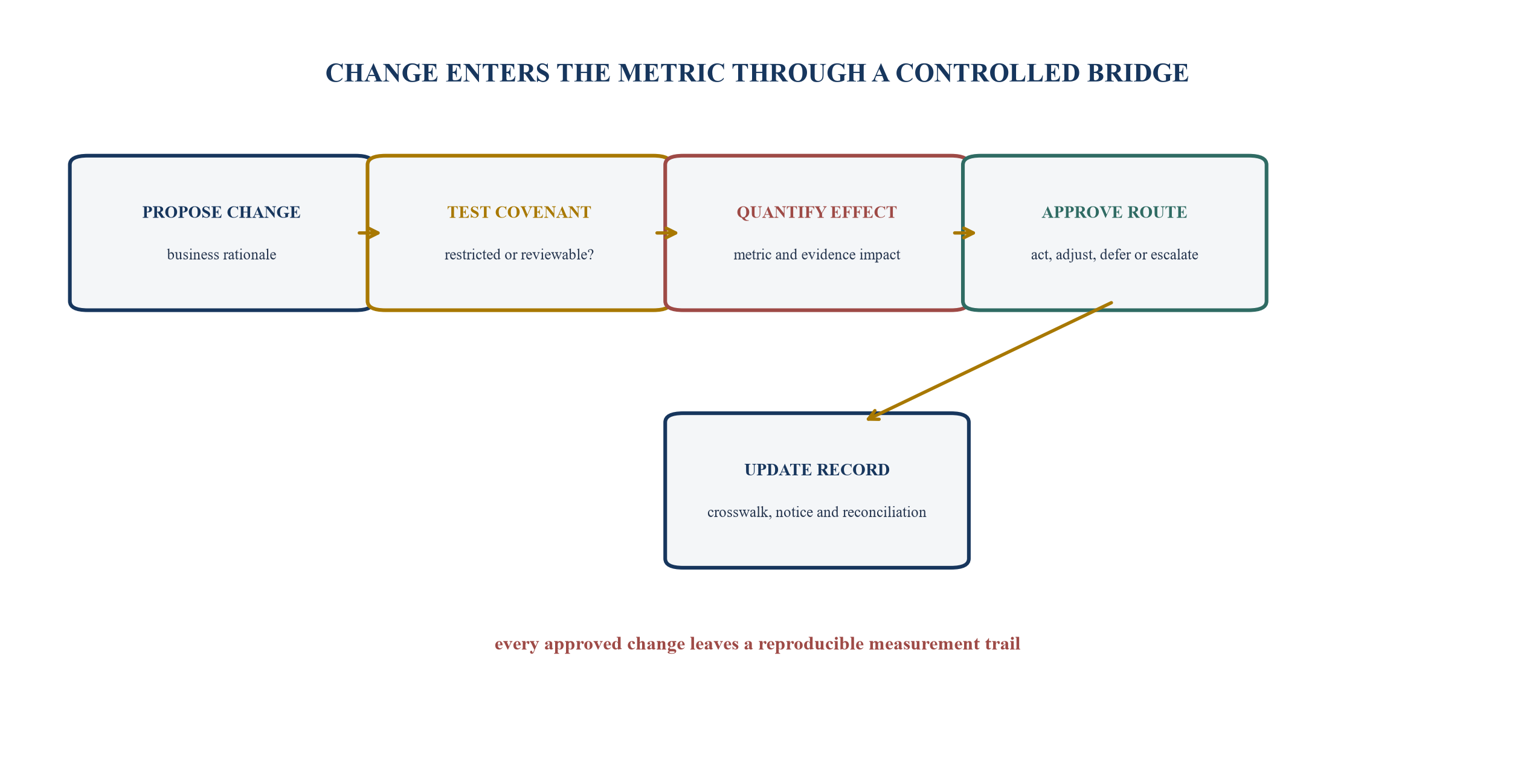
The route preserves operating flexibility while making measurement consequences visible.
14. Design information rights around reproducibility
Information rights should allow the defined calculation to be reviewed without creating unlimited access to the buyer's wider business. The agreement can specify monthly statements, calculation workpapers, source records, management explanations, system access, confidentiality, privilege and record-retention periods. It should address seller representatives and advisers.
The monthly pack should arrive in a stable format. It includes the metric result, target comparison, forecast, reconciliations, adjustments, perimeter changes, significant decisions, data-quality exceptions and open questions. Each line should connect to a source and owner. The company should preserve versions so that later changes remain visible.
Data lineage is essential during migration. The process should map source transaction to transformation, calculation and reported result. Automated pipelines should have access controls, validation and exception reporting. Manual spreadsheets should have version control, locked formulas, input checks and independent review.
The agreement should define the review clock. The seller needs enough time to analyse the statement and raise a specific objection. The buyer needs finality. An objection should identify the disputed item, amount, contractual basis and proposed correction. Undisputed amounts can be paid where the agreement provides.
15. Govern policy, system and methodology changes
Changes in accounting policy, estimate, chart of accounts, system or allocation method can alter the earnout without changing the business. The contract should distinguish required changes from discretionary changes. A new accounting standard may require statutory treatment that differs from the contractual basis. The contract ledger can preserve the agreed historical policy through an explicit reconciliation where legally and operationally feasible.
The change-control register should capture date, reason, affected metric, quantitative estimate, evidence, proposed treatment, approval and notification. Material changes should be tested on prior-period data before implementation. Parallel runs can reveal differences during system migration.
Methodology changes need symmetric treatment. A buyer should not exclude losses while including comparable gains. A seller should not demand historical treatment when the source data no longer supports it and an agreed equivalent exists. The governing principle is preservation of the contractual economic meaning through a reproducible method.
An independent reviewer should be able to reconstruct both the pre-change and post-change result. The company should retain mapping tables, transformation logic, configuration, journals and approvals. Deleting the legacy environment before extraction and reconciliation creates avoidable dispute risk.
Table 5. Change-control decision matrix
| change type | trigger | required analysis | possible response | approval |
|---|---|---|---|---|
| mandatory accounting change | new binding reporting requirement | statutory and contract-ledger difference | retain contract basis through reconciliation | controller and counsel |
| ERP migration | source or transformation changes | parallel run and field-level crosswalk | approve mapped calculation with exceptions | earnout committee |
| allocation-method change | cost driver no longer represents service | old versus new result and rationale | use agreed baseline or revised driver | CFO |
| business reorganisation | activity moves across entities | perimeter and attribution assessment | follow tagged activity or neutralise effect | board if material |
| product or channel redesign | metric source loses standalone identity | value-thesis and evidence test | substitute rule under contract | authorised forum |
| error correction | source or formula error identified | root cause and period impact | correct affected periods and notify | controller |
Materiality and approval thresholds are hypothetical management assumptions.
16. Create a dispute process that resolves the right question
Earnout disputes can concern calculation, contract interpretation, conduct or evidence. A single procedure may not fit every issue. An independent accountant can determine accounting calculations within a defined mandate. A court or arbitrator may need to decide legal interpretation or covenant breach. The agreement should state scope, standard of review, authority, timetable, cost allocation and finality.
The procedure should begin with a specific objection and management meeting. Many issues can be resolved through source evidence or an agreed correction. Unresolved items can proceed to a structured position exchange and expert determination. The expert should receive the agreement, charter, calculation, objections, evidence and permitted legal assumptions.
Recent Delaware decisions demonstrate the importance of the written agreement, calculation procedure, information production and dispute scope. Courts give weight to the contract the parties signed. Ambiguous product scope, missed evidence and an unclear boundary between expert determination and litigation can extend disputes significantly.
The board should monitor dispute readiness before a dispute exists. Records should be complete, neutral and timely. Delayed production can damage credibility and increase cost. The control objective is a calculation capable of independent reproduction, with genuine interpretation questions routed to the forum authorised to decide them.
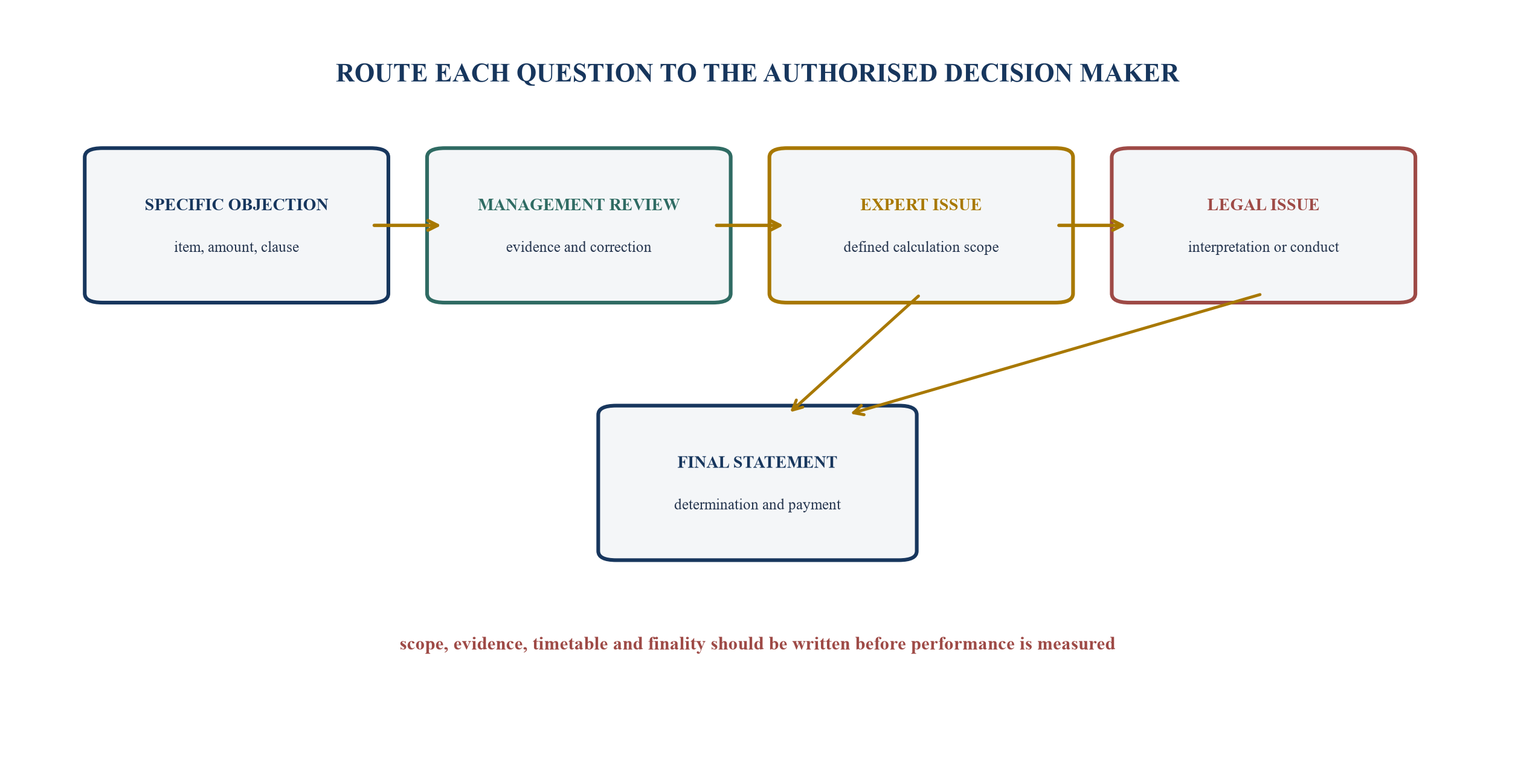
The executed agreement determines the available route and decision authority.
17. Place tax, merger-control and regulatory rules on the critical path
Earnout tax treatment differs across jurisdictions and structures. HMRC guidance addresses deferred consideration and earnout rights. IRS Publication 537 describes contingent payment sales. Australian rules provide look-through treatment for qualifying earnout rights, subject to conditions. Singapore guidance and a 2025 advance-ruling summary illustrate that contingent consideration can create fact-specific tax questions. Qualified tax advice should be obtained before terms are fixed.
Tax treatment can affect payment form, timing, withholding, valuation and the distinction between consideration and remuneration. The agreement should allocate responsibilities for filings, information and withholding. The financial model should show gross obligation, expected withholding, recipient cash and buyer tax assumptions separately.
Merger control can constrain pre-closing coordination and integration. The UAE Ministry of Economy and Tourism administers economic-concentration review under the competition regime, with current thresholds and review timing. Saudi Arabia's General Authority for Competition publishes economic-concentration guidelines. The European Union, United Kingdom, Canada and Singapore maintain their own review processes.
The earnout team should not seek operational data or direct the target in a way that conflicts with applicable competition rules before closing. Clean teams, permitted-information protocols and standstill controls belong in the transaction plan. Regulatory conditions or remedies may also change the post-closing operating model. The earnout needs a defined response if a required remedy removes customers, assets or products from the measurement perimeter.
18. Run a monthly earnout control tower
The control tower should combine finance, operations, integration, legal and data ownership. Its mandate is to produce the contractual calculation, monitor forecast and changes, preserve evidence, administer information rights and escalate decisions. It should not rewrite the agreement or negotiate disputes without authority.
The monthly agenda begins with the metric result and source reconciliation. It then reviews forecast, integration changes, covenant-sensitive actions, policy changes, data exceptions, accounting valuation, tax matters, seller questions and upcoming deadlines. Actions receive an owner and date. The company secretary preserves minutes and approvals.
Forecasting should use scenarios rather than a single point. The team can show base, downside and upside outcomes, together with operational drivers and payment implications. Probability-weighted accounting valuation may use a different method. The pack should explain the connection without merging the two calculations.
The board should receive a concise quarterly summary. It shows expected payment range, liquidity, principal sensitivities, disputes, significant integration decisions, data quality and control exceptions. A deteriorating metric can reflect operating performance, measurement change or both. The bridge should separate these effects.
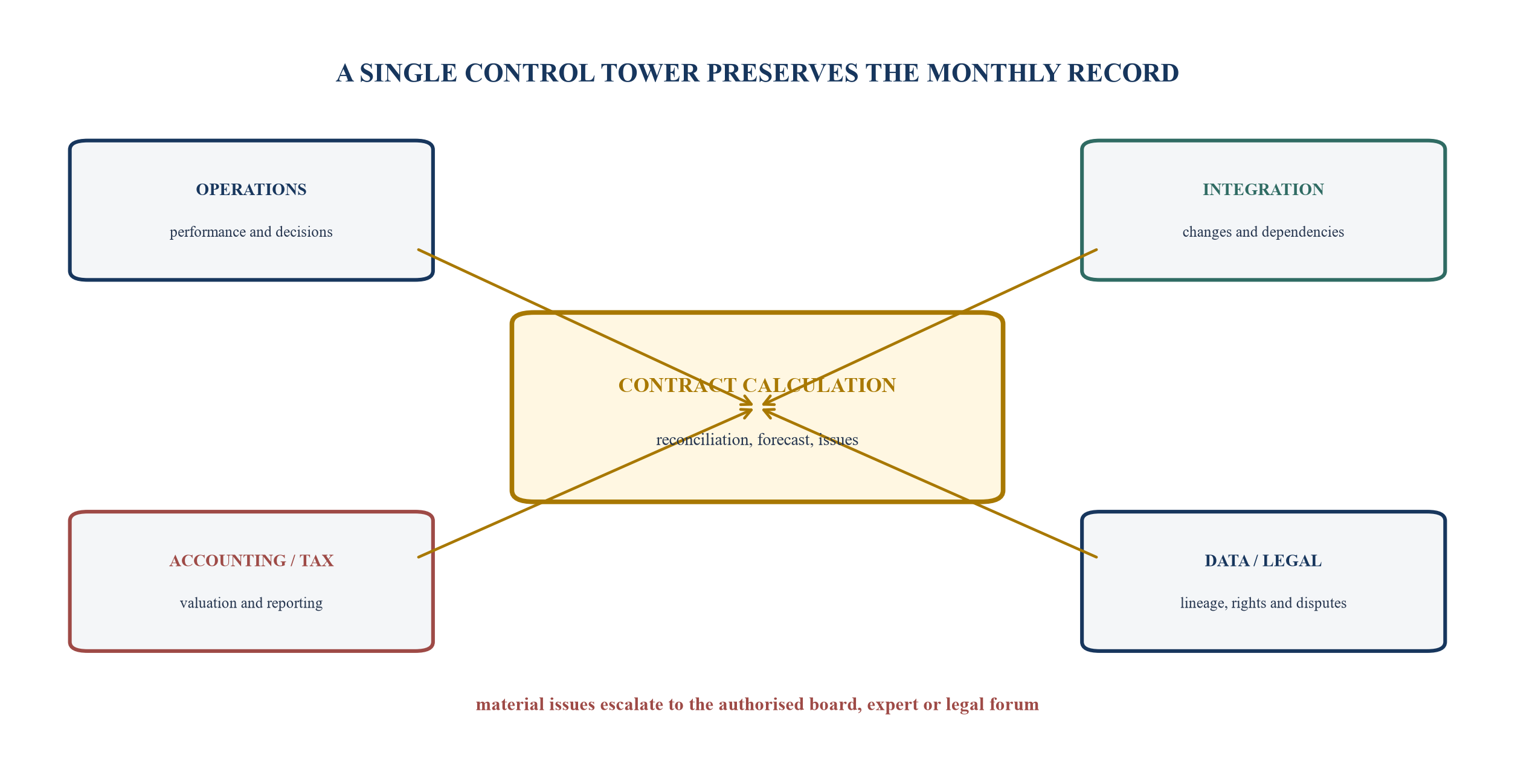
The control tower administers evidence and escalation within delegated authority.
19. Measure control quality as well as headline performance
The board needs evidence that the measurement system is working. A scorecard can track statement timeliness, reconciliation differences, unresolved data exceptions, manual adjustments, change-control compliance, seller questions, dispute age, forecast accuracy and evidence completeness. These indicators do not determine payment unless contractually incorporated.
Early warnings include repeated late closes, unexplained changes in customer mapping, increasing manual journals, system migrations without parallel runs, unapproved allocations, missing source documents and disputes that remain broadly described. A growing gap between management reporting and the contract ledger deserves review.
The scorecard should distinguish measurement risk from commercial risk. Revenue can fall because customers leave, because invoicing is delayed or because attribution changed. Each cause requires a different response. The board should see an operating bridge, not a single red status.
Post-settlement review creates institutional learning. The buyer can compare the original valuation uncertainty, integration decisions, forecast, payment and dispute experience. That evidence improves future metric selection, due diligence, drafting, system planning and purchase-price governance.
Table 6. Earnout governance scorecard
| measure | purpose | illustrative warning | management response | board question |
|---|---|---|---|---|
| statement timeliness | preserve review clock | pack more than five working days late | close-calendar recovery plan | is delay affecting information rights? |
| reconciliation variance | connect contract and statutory ledgers | unexplained difference above defined materiality | item-level bridge and approval | does policy or perimeter require a decision? |
| manual adjustments | identify manipulation or weak systems | repeated unsupported journals | independent review and source correction | can the result be reproduced? |
| change-control compliance | protect metric meaning | material integration action without review | retrospective impact test and escalation | did the action breach an agreed process? |
| data exceptions | maintain evidence quality | missing customer or product identifiers | crosswalk and exception ownership | is payment estimation reliable? |
| dispute ageing | control cost and finality | objection misses contractual timetable | route issue under dispute procedure | is authority clear for the next step? |
| forecast accuracy | improve liquidity and governance | persistent directional bias | revise drivers and examine incentives | are assumptions complete and neutral? |
Thresholds are illustrative management assumptions and do not determine contractual payment.
20. Apply the framework to a hypothetical integration
Consider a hypothetical buyer acquiring a regional software-services company. The seller receives USD 60 million at closing and can receive up to USD 18 million over two years. The earnout pays against annual recurring revenue, subject to a minimum gross-margin threshold. All values, dates, probabilities and outcomes in this example are hypothetical management assumptions.
The acquired company bills subscription, implementation and managed-service revenue from two legal entities. The buyer plans to migrate contracts to a regional contracting entity, combine sales teams, bundle the acquired product with its cyber service and move finance to a new ERP after six months. The seller-founder remains commercial director under a separate employment agreement.
Before signing, the parties complete a metric charter. Annual recurring revenue includes recurring subscription and managed-service fees from a named product and customer cohort. It excludes one-time implementation, taxes, pass-through cloud charges and intercompany revenue. Bundle consideration is allocated using an agreed price hierarchy. Gross margin uses specified direct hosting and delivery costs. The founder's earnout is not forfeited automatically on termination under the hypothetical terms; qualified advisers assess the accounting and tax implications.
The board receives four values: the USD 18 million contractual cap, a hypothetical acquisition-date fair value of USD 10.5 million, a base-case expected payment of USD 12 million and a downside liquidity case of USD 7 million. These amounts serve different purposes. The purchase agreement establishes the contractual amount. The accounting valuation follows applicable standards and assumptions. Treasury plans liquidity against scenarios.
The integration bridge identifies five sensitive changes. Contract migration can move revenue across entities. Bundling can obscure standalone price. Shared sales teams can change opportunity ownership. ERP migration can alter customer and product identifiers. Central hosting can change direct-cost classification. Each workstream receives an earnout control requirement.
During month four, the buyer launches a combined product. The contract ledger allocates consideration using the agreed standalone price hierarchy. The management ledger reports the bundle as one regional offering. Finance reconciles the difference monthly. The seller receives the calculation and supporting schedule under the stated information rights.
During month seven, the ERP migration produces a one-month parallel run. The team finds that credit notes in the new system default to the current month rather than the original invoice cohort. The change-control register records the issue. Finance corrects the contract ledger under the agreed period rule, while statutory accounting follows its applicable policy.
During month ten, management proposes moving three acquired salespeople into a central enterprise team. The operational case is positive, but opportunity attribution would become less reliable. The earnout committee approves the move subject to preserving CRM identifiers, customer ownership history and an independent monthly review of manual attribution.
At year end, contractual annual recurring revenue reaches USD 25 million and the gross-margin condition is met under the agreed formula. The statutory ledger reports different segment revenue because bundle presentation and legal-entity reporting follow the combined model. The reconciliation explains each difference. The buyer issues the earnout statement on time.
The seller objects to the exclusion of a new product module. The objection identifies the amount, product identifier and clause. Management cannot resolve whether the module is a successor to the named product. The calculation issue and contract-interpretation issue are separated. The authorised legal forum determines scope; the expert then applies the result to the calculation.
The board does not assess success only by whether the target was met. It reviews business performance, integration choices, control compliance, evidence quality, accounting volatility, liquidity and dispute cost. The framework does not predict the correct payment or commercial outcome. It shows how the parties can preserve the economic question through operational change.
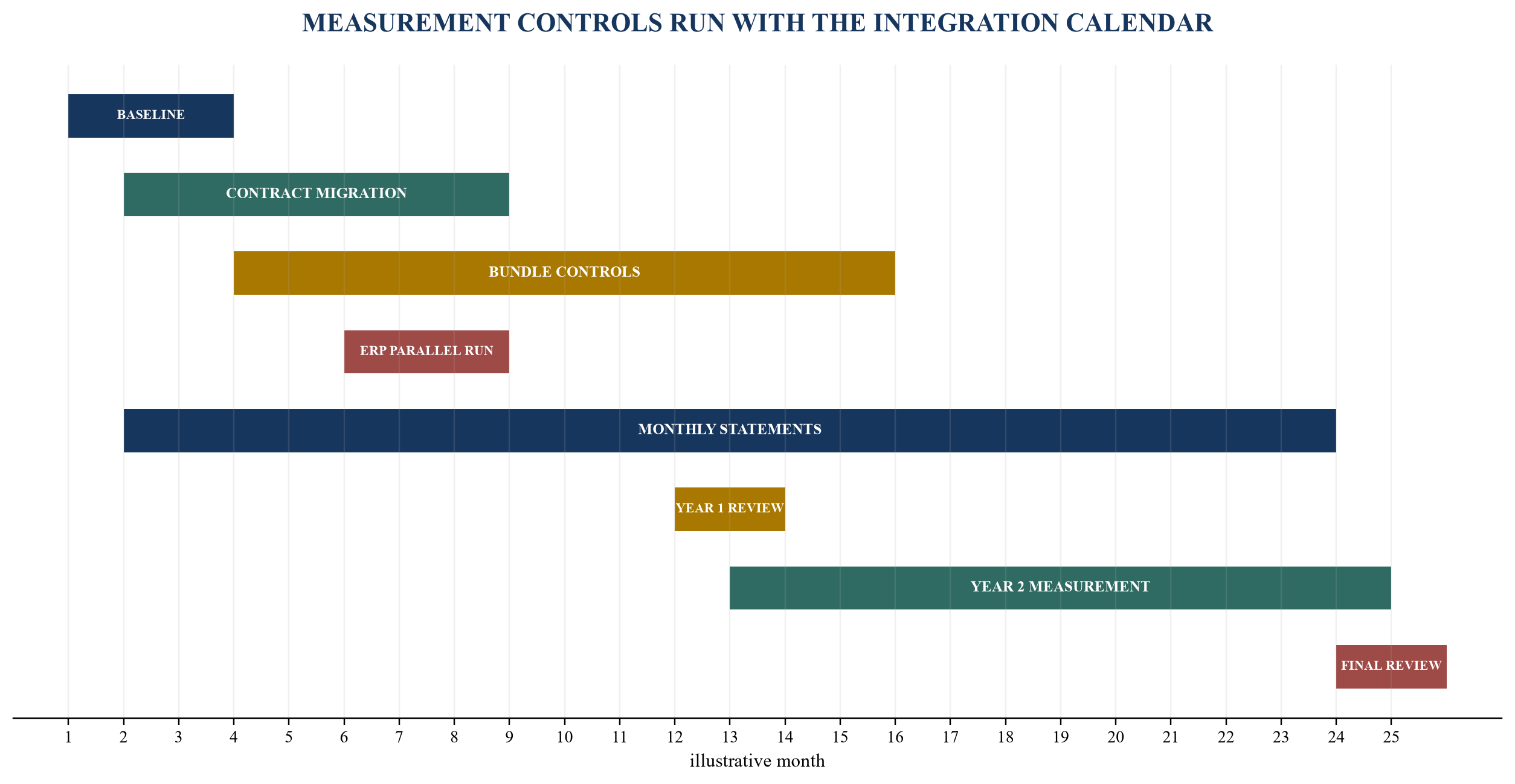
Timing and outcomes are hypothetical management assumptions.
21. Implement earnout readiness in 90 days
The first 30 days should establish the metric and evidence baseline. Finance, operations, legal, tax, accounting and integration leaders review the executed terms, worked examples, historical policies, source systems, perimeter and information rights. They identify every planned integration action that can change measurement. The board confirms governance and escalation.
Days 31 to 60 should build the operating controls. The team creates the contract ledger, statutory bridge, source crosswalk, monthly pack, adjustment register, change-control form, forecast model, seller-review process, dispute file and retention schedule. System owners test extraction and reconciliation. Workstream approval templates include the earnout impact test.
Days 61 to 90 should complete a dry run. The company calculates the metric using live post-closing data, reconciles it to financial reporting, tests a hypothetical policy change and prepares a sample seller statement. An independent reviewer reproduces the result. Gaps receive owners and deadlines before the first contractual statement.
The dry run should begin from source records rather than a management dashboard. The reviewer selects a representative customer, product, invoice, credit note, employee cost, supplier cost and manual adjustment, then traces each item through the source system, transformation logic, contract ledger and statement. This walk-through tests whether definitions, mappings and approvals operate together. It also identifies evidence that could disappear when a legacy system is retired.
Management should maintain a readiness log for unresolved dependencies. Each entry records the affected clause or metric, financial exposure, decision owner, required evidence, deadline and escalation route. High-exposure items include missing baseline data, incomplete contract migration, untested allocation logic, material manual journals and integration actions that have proceeded without an earnout impact assessment. The board receives the log with the first dry-run reconciliation.
The team should also rehearse the information-rights timetable. A complete sample statement is delivered through the agreed channel, the review period is measured, a model question is answered with supporting data and a model objection is routed through the contract procedure. This operational rehearsal tests access, confidentiality, authority and response ownership before a real disagreement consumes the contractual clock.
Readiness should be signed by accountable functions. Finance confirms calculation and reconciliation; operations confirms the performance drivers; data owners confirm lineage and retention; integration confirms planned changes; legal confirms administration of notices and dispute steps; tax and accounting leaders confirm their separate analyses. Sign-off records responsibility without replacing professional judgement or the agreement.
The board gate should require seven conclusions. The metric answers the economic question. The formula and perimeter are reproducible. Integration changes enter through a visible bridge. Contract, statutory and management ledgers are reconciled. Information rights can be administered. Tax, accounting and regulatory dependencies are mapped. The dispute route can reach final determination.
A well-governed earnout does not freeze the business. It preserves the bargain while the operating model changes. Management can integrate within clear rules, the seller can review defined evidence, finance can distinguish accounting from payment, and the board can see whether performance, measurement or both explain the outcome.
Sources and further reading
- IFRS Foundation, IFRS 3 Business Combinations Official source
- IFRS Foundation, IFRS 3 Business Combinations Standard PDF Official source
- IFRS Foundation, Accounting for Contingent Consideration in a Business Combination Official source
- IFRS Foundation, IFRS 3 Supporting Material Official source
- Financial Accounting Standards Board, Accounting Standards Update No. 2025-03 Business Combinations Official source
- Public Company Accounting Oversight Board, AS 2501 Auditing Accounting Estimates Including Fair Value Measurements Official source
- United States Securities and Exchange Commission, Non-GAAP Financial Measures Official source
- European Securities and Markets Authority, Guidelines on Alternative Performance Measures Official source
- Australian Accounting Standards Board, AASB 3 Business Combinations Official source
- Australian Accounting Standards Board, Subsequent Measurement of Contingent Consideration Official source
- Government of India Ministry of Corporate Affairs, Indian Accounting Standard 103 Official source
- Accounting and Corporate Regulatory Authority Singapore, Guide to Accounting Standards Official source
- HM Revenue and Customs, Deferred Consideration and Earnout Rights Official source
- HM Revenue and Customs, Share Reorganisations, Company Takeovers and Capital Gains Tax 2026 Official source
- United States Internal Revenue Service, Publication 537 Installment Sales 2025 Official source
- Australian Taxation Office, Look-Through Earnout Right Qualification Official source
- Australian Taxation Office, Look-Through Earnout Rights Explanatory Memorandum Official source
- Canada Revenue Agency, Shares Sold Subject to an Earnout Agreement Official source
- Inland Revenue Authority of Singapore, Advance Ruling Summary No. 01/2025 Official source
- United Arab Emirates Ministry of Economy and Tourism, Economic Concentration Official source
- United Arab Emirates Ministry of Economy and Tourism, Regulation of Competition Official source
- United Arab Emirates Ministry of Economy and Tourism, Cabinet Decision No. 3 of 2025 on Economic Concentration Thresholds Official source
- Saudi Arabia General Authority for Competition, Economic Concentration Review Guidelines Official source
- United Kingdom Competition and Markets Authority, Merger Assessment Guidelines 2026 Official source
- United Kingdom Competition and Markets Authority, Merger Remedies Guidance 2025 Official source
- Competition Bureau Canada, Overview of the Merger Review Process Official source
- Competition and Consumer Commission of Singapore, Mergers and Acquisitions Official source
- Delaware Court of Chancery, Earnout Decision on Revenue and EBITDA Targets Official source
- Delaware Supreme Court, Earnout Calculation and Dispute Procedure Decision Official source
- Delaware Court of Chancery, Earnout Contract Interpretation Decision Official source
