

1. Define the transaction decision
The board must decide whether convergence should be pursued through acquisition, merger, joint venture, commercial partnership, selective co-location or an internally funded build. The decision should state the intended customers, geographies, services, ownership perimeter, capital commitment, return threshold and downside limit. The analysis should distinguish observed technical, commercial, contractual, regulatory and financial evidence from management assumptions and connect each material judgment to customer demand, service quality, capital efficiency, financing and transaction value. Approval should compare the combined platform with credible standalone and partnership alternatives using the same demand, cost, funding and risk assumptions. The work should test central and correlated downside cases for customer timing, site eligibility, power, fibre diversity, utilisation, pricing, vendor concentration, integration cost, operating cost, maintenance capital, interest rates, liquidity and regulatory change. Exceptions require a named owner, source, due date and decision consequence. Unsupported demand, synergies, utilisation, savings, premium valuation or refinancing remains outside the central case until enforceable evidence supports it. The section output should identify the governing source, contract, asset, model line, accountable owner, warning threshold and capital consequence. This creates a traceable bridge from convergence thesis to realised cash.
Convergence should be analysed as a transaction and operating-system decision. Towers, fibre and edge facilities can share locations, transport, power, customers and field operations, yet each layer has distinct contracts, engineering constraints, capital cycles and regulatory duties. The transaction thesis becomes credible when specific workloads generate contracted demand at sites with deliverable power, resilient fibre, secure operations and rights that survive closing. Asset adjacency is a starting hypothesis. Value arises from measurable changes in revenue, cost, capital intensity, resilience and customer outcomes. Scenario analysis should combine related pressures. Customer deployments can slip while power upgrades, fibre diversity, equipment and integration cost rise. Existing customers can churn during migration, vendors can delay interoperability, and regulators can impose access or security conditions. A decision-grade model therefore tests revenue timing, utilisation, pricing, operating cost, maintenance capital, integration spending, interest, liquidity and exit value together. Each downside should link to warning indicators, contractual protections, operational remedies and capital gates.
2. Use the Edge Infrastructure Convergence Transaction Framework
The framework connects physical assets, network functions, customer contracts, operating capabilities and capital rather than treating towers, fibre and edge facilities as interchangeable infrastructure. Each claimed benefit should map to named sites, routes, power capacity, service functions, customers, contracts, cost centres and implementation owners. The analysis should distinguish observed technical, commercial, contractual, regulatory and financial evidence from management assumptions and connect each material judgment to customer demand, service quality, capital efficiency, financing and transaction value. The investment committee should reject portfolio-level synergy percentages that cannot be reconciled to asset-level evidence and an executable operating change. The work should test central and correlated downside cases for customer timing, site eligibility, power, fibre diversity, utilisation, pricing, vendor concentration, integration cost, operating cost, maintenance capital, interest rates, liquidity and regulatory change. Exceptions require a named owner, source, due date and decision consequence. Unsupported demand, synergies, utilisation, savings, premium valuation or refinancing remains outside the central case until enforceable evidence supports it. Evidence should remain traceable to site, route, power allocation, workload, customer, product, order, asset, invoice, cash receipt and forecast period. Board and lender reporting should reconcile to the same operating records.
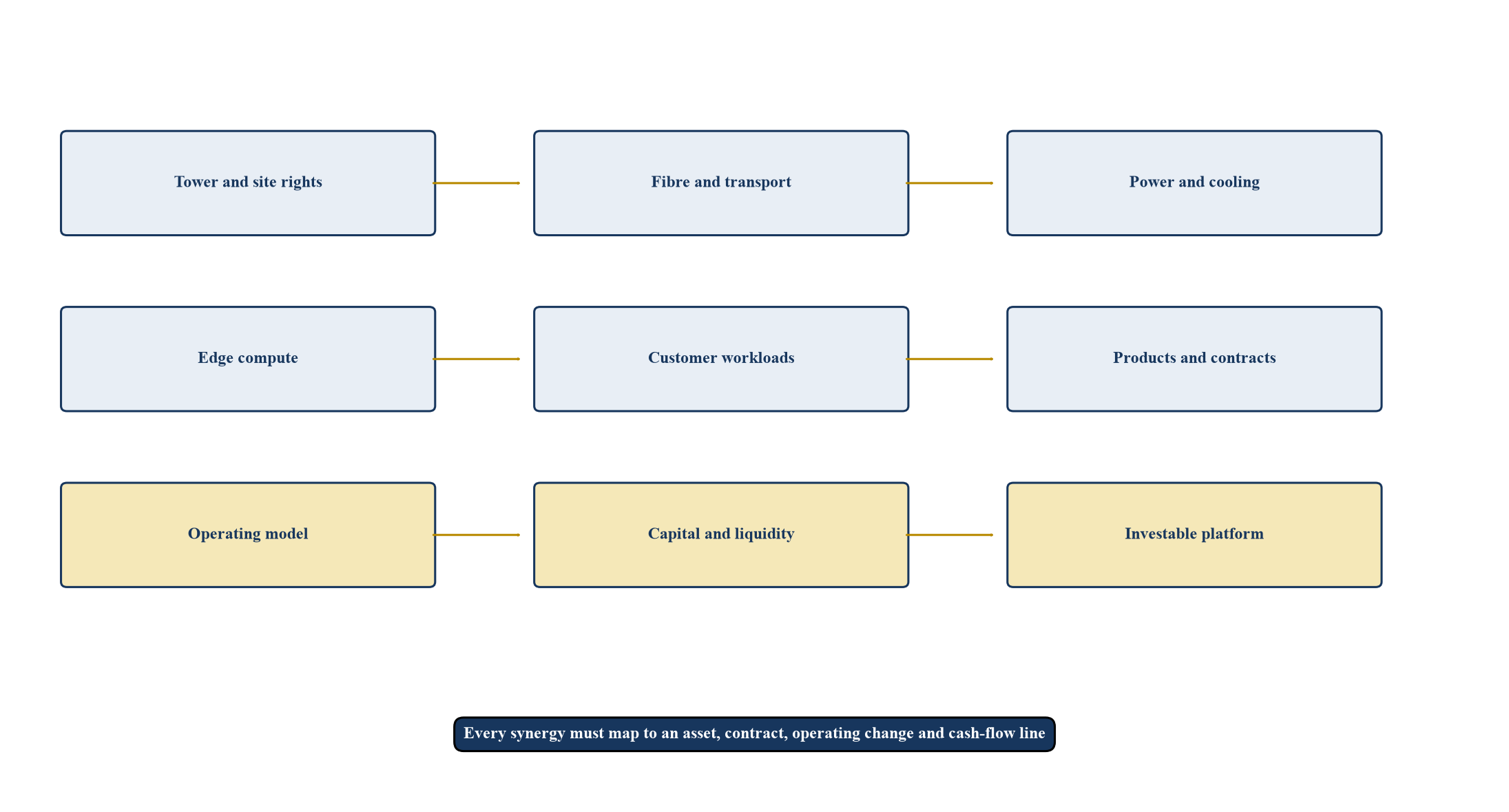
Transaction value depends on alignment across physical assets, customer demand, operations and capital.
3. Define the convergence perimeter
A platform can include ground interests, towers, shelters, power systems, ducts, dark fibre, active transport, internet exchange connectivity, edge rooms, modular data halls, network functions and orchestration software. Ownership, lease, access, control and maintenance rights should be documented for every included layer. The analysis should distinguish observed technical, commercial, contractual, regulatory and financial evidence from management assumptions and connect each material judgment to customer demand, service quality, capital efficiency, financing and transaction value. The transaction perimeter should exclude assets whose permits, land rights, customer contracts, power rights or technical interfaces cannot transfer on acceptable terms. The work should test central and correlated downside cases for customer timing, site eligibility, power, fibre diversity, utilisation, pricing, vendor concentration, integration cost, operating cost, maintenance capital, interest rates, liquidity and regulatory change. Exceptions require a named owner, source, due date and decision consequence. Unsupported demand, synergies, utilisation, savings, premium valuation or refinancing remains outside the central case until enforceable evidence supports it. Management should define the earliest warning indicator, intervention trigger and executable remedy. Reporting should preserve the approved baseline, change history, actual cost, service outcome and realised cash.
4. Map demand by workload and location
Edge demand is local and workload-specific because latency, data sovereignty, traffic volume, resilience and processing economics vary by application. The commercial case should identify users, workloads, required locations, compute profiles, data flows, latency limits, contract status and migration dependencies. The analysis should distinguish observed technical, commercial, contractual, regulatory and financial evidence from management assumptions and connect each material judgment to customer demand, service quality, capital efficiency, financing and transaction value. Uncontracted market estimates should remain in sensitivities until customer evidence supports location, volume, price, duration and implementation timing. The work should test central and correlated downside cases for customer timing, site eligibility, power, fibre diversity, utilisation, pricing, vendor concentration, integration cost, operating cost, maintenance capital, interest rates, liquidity and regulatory change. Exceptions require a named owner, source, due date and decision consequence. Unsupported demand, synergies, utilisation, savings, premium valuation or refinancing remains outside the central case until enforceable evidence supports it. The section output should identify the governing source, contract, asset, model line, accountable owner, warning threshold and capital consequence. This creates a traceable bridge from convergence thesis to realised cash.
5. Segment the site estate
Tower sites differ materially in land tenure, structural loading, power, cooling potential, fibre access, security, permitting, flood exposure and proximity to demand. Create a site-level suitability register that distinguishes radio-only sites, aggregation nodes, fibre points of presence, micro-edge candidates and regional-edge candidates. The analysis should distinguish observed technical, commercial, contractual, regulatory and financial evidence from management assumptions and connect each material judgment to customer demand, service quality, capital efficiency, financing and transaction value. Capital should be released only for sites that pass technical, commercial, legal, power, security and financial gates. The work should test central and correlated downside cases for customer timing, site eligibility, power, fibre diversity, utilisation, pricing, vendor concentration, integration cost, operating cost, maintenance capital, interest rates, liquidity and regulatory change. Exceptions require a named owner, source, due date and decision consequence. Unsupported demand, synergies, utilisation, savings, premium valuation or refinancing remains outside the central case until enforceable evidence supports it. Evidence should remain traceable to site, route, power allocation, workload, customer, product, order, asset, invoice, cash receipt and forecast period. Board and lender reporting should reconcile to the same operating records.
| Dimension | Evidence | Failure mode | Transaction response |
|---|---|---|---|
| Land and permits | Transferable rights and allowed use | Conversion prohibited or delayed | Exclude, reprice or condition closing |
| Structure and space | Survey and loading assessment | Equipment cannot be installed safely | Redesign or select another site |
| Power and cooling | Contracted capacity and engineered design | Capacity unavailable or unreliable | Phase load or fund upgrade |
| Fibre | Diverse routes and service rights | Single-path outage exposure | Build or contract diversity |
| Demand | Named workload and customer evidence | Stranded capacity | Defer capital |
| Security | Physical and cyber control design | Customer or regulatory rejection | Remediate before launch |
Site conversion requires a combined technical, legal, commercial and financial test.
6. Underwrite fibre topology and redundancy
An edge node without diverse transport can concentrate operational risk and fail customer availability commitments. Map owned and leased routes, route diversity, capacity, latency, hand-off points, restoration rights, planned upgrades and third-party dependencies. The analysis should distinguish observed technical, commercial, contractual, regulatory and financial evidence from management assumptions and connect each material judgment to customer demand, service quality, capital efficiency, financing and transaction value. The model should recognise route construction, leased-capacity charges, cross-connects, equipment refresh and outage remedies before recording convergence savings. The work should test central and correlated downside cases for customer timing, site eligibility, power, fibre diversity, utilisation, pricing, vendor concentration, integration cost, operating cost, maintenance capital, interest rates, liquidity and regulatory change. Exceptions require a named owner, source, due date and decision consequence. Unsupported demand, synergies, utilisation, savings, premium valuation or refinancing remains outside the central case until enforceable evidence supports it. Management should define the earliest warning indicator, intervention trigger and executable remedy. Reporting should preserve the approved baseline, change history, actual cost, service outcome and realised cash.
7. Secure power and cooling capacity
Distributed facilities need firm power, backup, heat rejection and operating headroom at locations originally designed for telecom equipment. Verify grid connection, contracted capacity, load profile, generator and battery autonomy, fuel logistics, cooling design, metering, tariffs and upgrade cost. The analysis should distinguish observed technical, commercial, contractual, regulatory and financial evidence from management assumptions and connect each material judgment to customer demand, service quality, capital efficiency, financing and transaction value. The base case should include only power that is contracted, deliverable on the required date and compatible with permits, resilience obligations and equipment density. The work should test central and correlated downside cases for customer timing, site eligibility, power, fibre diversity, utilisation, pricing, vendor concentration, integration cost, operating cost, maintenance capital, interest rates, liquidity and regulatory change. Exceptions require a named owner, source, due date and decision consequence. Unsupported demand, synergies, utilisation, savings, premium valuation or refinancing remains outside the central case until enforceable evidence supports it. The section output should identify the governing source, contract, asset, model line, accountable owner, warning threshold and capital consequence. This creates a traceable bridge from convergence thesis to realised cash.
8. Design the service and product ladder
A converged platform can sell site access, fibre, backhaul, wavelength, internet transit, interconnection, colocation, bare metal, private edge cloud and managed network services. Each product needs a defined technical boundary, service level, price unit, contract term, capacity commitment, security model and support process. The analysis should distinguish observed technical, commercial, contractual, regulatory and financial evidence from management assumptions and connect each material judgment to customer demand, service quality, capital efficiency, financing and transaction value. Product breadth should follow repeatable customer demand and operating capability rather than a desire to present the assets as a full-stack technology platform. The work should test central and correlated downside cases for customer timing, site eligibility, power, fibre diversity, utilisation, pricing, vendor concentration, integration cost, operating cost, maintenance capital, interest rates, liquidity and regulatory change. Exceptions require a named owner, source, due date and decision consequence. Unsupported demand, synergies, utilisation, savings, premium valuation or refinancing remains outside the central case until enforceable evidence supports it. Evidence should remain traceable to site, route, power allocation, workload, customer, product, order, asset, invoice, cash receipt and forecast period. Board and lender reporting should reconcile to the same operating records.
9. Test anchor-customer quality
A mobile operator, cloud provider, content platform, enterprise, government or industrial customer can accelerate utilisation when its commitment is enforceable and technically aligned. Review minimum capacity, sites, ramp, price, credit support, termination, renewal, change control, equipment ownership and service remedies. The analysis should distinguish observed technical, commercial, contractual, regulatory and financial evidence from management assumptions and connect each material judgment to customer demand, service quality, capital efficiency, financing and transaction value. The financing case should distinguish signed take-or-pay commitments, contracted but conditional demand, pipeline opportunities and management aspirations. The work should test central and correlated downside cases for customer timing, site eligibility, power, fibre diversity, utilisation, pricing, vendor concentration, integration cost, operating cost, maintenance capital, interest rates, liquidity and regulatory change. Exceptions require a named owner, source, due date and decision consequence. Unsupported demand, synergies, utilisation, savings, premium valuation or refinancing remains outside the central case until enforceable evidence supports it. Management should define the earliest warning indicator, intervention trigger and executable remedy. Reporting should preserve the approved baseline, change history, actual cost, service outcome and realised cash.
10. Quantify latency and data-path economics
Lower physical distance can improve response time, yet application performance also depends on routing, software, workload placement, congestion and customer architecture. Measure end-to-end latency, traffic paths, data-transfer charges, backhaul utilisation, cache efficiency, compute occupancy and service-level requirements. The analysis should distinguish observed technical, commercial, contractual, regulatory and financial evidence from management assumptions and connect each material judgment to customer demand, service quality, capital efficiency, financing and transaction value. Revenue attribution should reflect the customer problem solved and the contract earned rather than a generic premium for being closer to end users. The work should test central and correlated downside cases for customer timing, site eligibility, power, fibre diversity, utilisation, pricing, vendor concentration, integration cost, operating cost, maintenance capital, interest rates, liquidity and regulatory change. Exceptions require a named owner, source, due date and decision consequence. Unsupported demand, synergies, utilisation, savings, premium valuation or refinancing remains outside the central case until enforceable evidence supports it. The section output should identify the governing source, contract, asset, model line, accountable owner, warning threshold and capital consequence. This creates a traceable bridge from convergence thesis to realised cash.
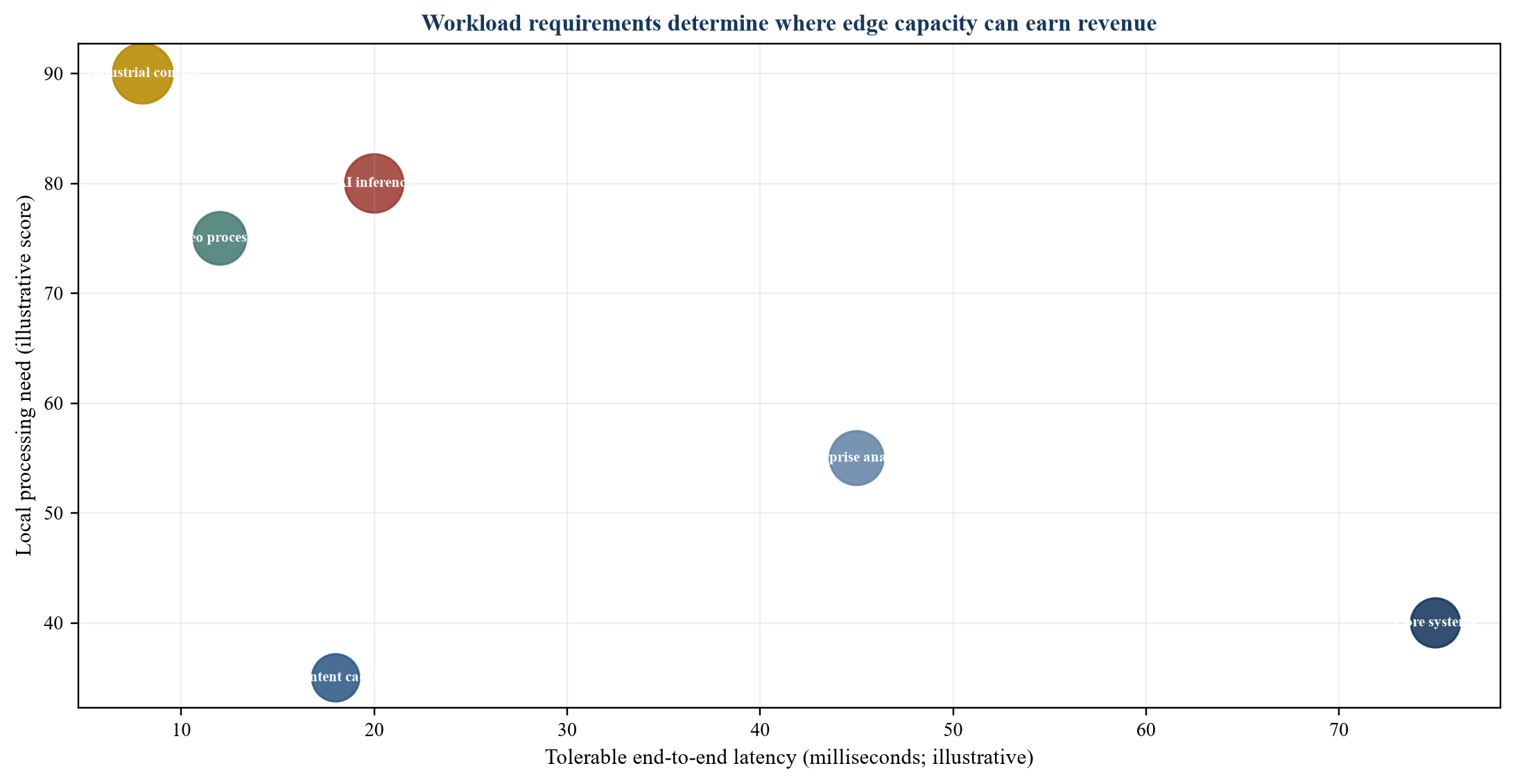
Illustrative qualitative map; placement depends on verified application and network requirements.
11. Build the revenue-synergy register
Revenue synergies may arise from cross-selling, faster market entry, combined bids, higher site occupancy, additional fibre connections and new edge services. For each opportunity record the named customer, product, sites, capacity, probability, sales owner, implementation cost, contract milestone and expected contribution margin. The analysis should distinguish observed technical, commercial, contractual, regulatory and financial evidence from management assumptions and connect each material judgment to customer demand, service quality, capital efficiency, financing and transaction value. Only signed or strongly evidenced opportunities should enter the central case, with probability-weighted and uncontracted opportunities shown separately. The work should test central and correlated downside cases for customer timing, site eligibility, power, fibre diversity, utilisation, pricing, vendor concentration, integration cost, operating cost, maintenance capital, interest rates, liquidity and regulatory change. Exceptions require a named owner, source, due date and decision consequence. Unsupported demand, synergies, utilisation, savings, premium valuation or refinancing remains outside the central case until enforceable evidence supports it. Evidence should remain traceable to site, route, power allocation, workload, customer, product, order, asset, invoice, cash receipt and forecast period. Board and lender reporting should reconcile to the same operating records.
| Evidence state | Commercial meaning | Model treatment | Required control |
|---|---|---|---|
| Strategic adjacency | Assets appear complementary | Narrative only | Define use case and owner |
| Customer discussion | Indicated interest | Sensitivity | Record scope and probability |
| Qualified proposal | Product, site and price specified | Risk-adjusted case | Delivery and approval plan |
| Signed commitment | Enforceable demand | Central case subject to conditions | Credit and implementation review |
| Billable service | Delivered and accepted | Observed revenue | Invoice and cash reconciliation |
Valuation weight should rise only as the opportunity becomes contracted and operational.
12. Build the cost and capital-synergy register
Common network operations, field maintenance, procurement, monitoring, security, real estate and corporate functions can reduce duplicated cost. Quantify the current baseline, future operating design, one-time cost, timing, workforce effect, vendor consent, service risk and accountable owner. The analysis should distinguish observed technical, commercial, contractual, regulatory and financial evidence from management assumptions and connect each material judgment to customer demand, service quality, capital efficiency, financing and transaction value. Avoided capital should be recognised only when an approved standalone project is genuinely displaced without weakening capacity, resilience or customer commitments. The work should test central and correlated downside cases for customer timing, site eligibility, power, fibre diversity, utilisation, pricing, vendor concentration, integration cost, operating cost, maintenance capital, interest rates, liquidity and regulatory change. Exceptions require a named owner, source, due date and decision consequence. Unsupported demand, synergies, utilisation, savings, premium valuation or refinancing remains outside the central case until enforceable evidence supports it. Management should define the earliest warning indicator, intervention trigger and executable remedy. Reporting should preserve the approved baseline, change history, actual cost, service outcome and realised cash.
13. Separate transferable and owner-specific synergies
Some benefits depend on a particular acquirer's customers, cloud relationships, spectrum, network traffic, tax position or procurement scale. Classify each synergy as market-available, buyer-specific, seller-retained, shared or dependent on third-party consent. The analysis should distinguish observed technical, commercial, contractual, regulatory and financial evidence from management assumptions and connect each material judgment to customer demand, service quality, capital efficiency, financing and transaction value. The valuation and negotiation strategy should protect the buyer from paying the seller for value that only the buyer can create after closing. The work should test central and correlated downside cases for customer timing, site eligibility, power, fibre diversity, utilisation, pricing, vendor concentration, integration cost, operating cost, maintenance capital, interest rates, liquidity and regulatory change. Exceptions require a named owner, source, due date and decision consequence. Unsupported demand, synergies, utilisation, savings, premium valuation or refinancing remains outside the central case until enforceable evidence supports it. The section output should identify the governing source, contract, asset, model line, accountable owner, warning threshold and capital consequence. This creates a traceable bridge from convergence thesis to realised cash.
14. Value the platform by asset and cash-flow driver
Tower cash flow, wholesale fibre and distributed compute can carry different growth, capex, contract, technology and terminal-value characteristics. Use a sum-of-the-parts model with asset-specific revenue, EBITDA, maintenance capital, growth capital, working capital, tax, discount rate and terminal assumptions. The analysis should distinguish observed technical, commercial, contractual, regulatory and financial evidence from management assumptions and connect each material judgment to customer demand, service quality, capital efficiency, financing and transaction value. The combined multiple should be a consequence of cash-flow quality and risk rather than an assumed convergence premium. The work should test central and correlated downside cases for customer timing, site eligibility, power, fibre diversity, utilisation, pricing, vendor concentration, integration cost, operating cost, maintenance capital, interest rates, liquidity and regulatory change. Exceptions require a named owner, source, due date and decision consequence. Unsupported demand, synergies, utilisation, savings, premium valuation or refinancing remains outside the central case until enforceable evidence supports it. Evidence should remain traceable to site, route, power allocation, workload, customer, product, order, asset, invoice, cash receipt and forecast period. Board and lender reporting should reconcile to the same operating records.
| Layer | Primary value driver | Material risk | Diligence focus |
|---|---|---|---|
| Towers and sites | Contracted rent and tenancy | Ground rights and concentration | Lease durability and capex |
| Fibre and transport | Route utilisation and price | Overbuild and restoration | Route rights, capacity and churn |
| Edge facilities | Contracted power and occupancy | Stranded capacity and refresh | Power, customer fit and lifecycle |
| Platform services | Recurring service margin | Capability and vendor dependence | Contracts, people, software and support |
| Synergies | Realised incremental cash | Delay, leakage and one-time cost | Owner, evidence, timing and control |
Each infrastructure layer requires its own cash-flow and risk assumptions.
15. Test utilisation before expansion
Edge economics are sensitive to occupancy, power utilisation, fibre capacity, rack density and the timing of customer deployments. Model committed, installed, billable and collected utilisation by site and product, including stranded capacity and customer-specific fit-out. The analysis should distinguish observed technical, commercial, contractual, regulatory and financial evidence from management assumptions and connect each material judgment to customer demand, service quality, capital efficiency, financing and transaction value. Expansion gates should require evidence of contracted demand, remaining capacity, service performance, cost to complete and liquidity. The work should test central and correlated downside cases for customer timing, site eligibility, power, fibre diversity, utilisation, pricing, vendor concentration, integration cost, operating cost, maintenance capital, interest rates, liquidity and regulatory change. Exceptions require a named owner, source, due date and decision consequence. Unsupported demand, synergies, utilisation, savings, premium valuation or refinancing remains outside the central case until enforceable evidence supports it. Management should define the earliest warning indicator, intervention trigger and executable remedy. Reporting should preserve the approved baseline, change history, actual cost, service outcome and realised cash.
16. Design the network and cloud operating model
Convergence introduces responsibilities across passive infrastructure, transport, network functions, compute, storage, virtualisation, orchestration, cybersecurity and customer support. Define design authority, change control, service ownership, incident command, field operations, software lifecycle, capacity planning and vendor management. The analysis should distinguish observed technical, commercial, contractual, regulatory and financial evidence from management assumptions and connect each material judgment to customer demand, service quality, capital efficiency, financing and transaction value. A single accountable service owner should coordinate end-to-end performance even when delivery uses multiple internal teams and contractors. The work should test central and correlated downside cases for customer timing, site eligibility, power, fibre diversity, utilisation, pricing, vendor concentration, integration cost, operating cost, maintenance capital, interest rates, liquidity and regulatory change. Exceptions require a named owner, source, due date and decision consequence. Unsupported demand, synergies, utilisation, savings, premium valuation or refinancing remains outside the central case until enforceable evidence supports it. The section output should identify the governing source, contract, asset, model line, accountable owner, warning threshold and capital consequence. This creates a traceable bridge from convergence thesis to realised cash.
17. Integrate systems and operational data
Separate tower, fibre and data-centre businesses often use different asset registers, customer systems, monitoring tools, billing platforms and incident taxonomies. Create a common data model for sites, routes, circuits, equipment, power, capacity, contracts, orders, tickets, invoices and cash. The analysis should distinguish observed technical, commercial, contractual, regulatory and financial evidence from management assumptions and connect each material judgment to customer demand, service quality, capital efficiency, financing and transaction value. Integration should preserve source lineage and controls so operational dashboards reconcile with customer obligations and financial reporting. The work should test central and correlated downside cases for customer timing, site eligibility, power, fibre diversity, utilisation, pricing, vendor concentration, integration cost, operating cost, maintenance capital, interest rates, liquidity and regulatory change. Exceptions require a named owner, source, due date and decision consequence. Unsupported demand, synergies, utilisation, savings, premium valuation or refinancing remains outside the central case until enforceable evidence supports it. Evidence should remain traceable to site, route, power allocation, workload, customer, product, order, asset, invoice, cash receipt and forecast period. Board and lender reporting should reconcile to the same operating records.
18. Protect cybersecurity and physical security
A converged platform increases the number of access points and can connect critical telecom, enterprise and public-sector workloads. Assess identity, privileged access, segmentation, patching, supply chain, logging, incident response, site access, surveillance, tamper controls and recovery. The analysis should distinguish observed technical, commercial, contractual, regulatory and financial evidence from management assumptions and connect each material judgment to customer demand, service quality, capital efficiency, financing and transaction value. Security design, operating cost and remediation capital should be included before the platform commits to regulated or mission-critical services. The work should test central and correlated downside cases for customer timing, site eligibility, power, fibre diversity, utilisation, pricing, vendor concentration, integration cost, operating cost, maintenance capital, interest rates, liquidity and regulatory change. Exceptions require a named owner, source, due date and decision consequence. Unsupported demand, synergies, utilisation, savings, premium valuation or refinancing remains outside the central case until enforceable evidence supports it. Management should define the earliest warning indicator, intervention trigger and executable remedy. Reporting should preserve the approved baseline, change history, actual cost, service outcome and realised cash.
19. Review regulation and competition
Common ownership across towers, fibre and edge facilities can affect wholesale access, discrimination risk, market power, data location and critical-infrastructure obligations. Map licences, access rules, price controls, merger review, foreign investment, cybersecurity, data protection, lawful access and sector-specific requirements. The analysis should distinguish observed technical, commercial, contractual, regulatory and financial evidence from management assumptions and connect each material judgment to customer demand, service quality, capital efficiency, financing and transaction value. The transaction timetable and valuation should reflect approval conditions, remedies, ring-fencing, information barriers and continuing compliance cost. The work should test central and correlated downside cases for customer timing, site eligibility, power, fibre diversity, utilisation, pricing, vendor concentration, integration cost, operating cost, maintenance capital, interest rates, liquidity and regulatory change. Exceptions require a named owner, source, due date and decision consequence. Unsupported demand, synergies, utilisation, savings, premium valuation or refinancing remains outside the central case until enforceable evidence supports it. The section output should identify the governing source, contract, asset, model line, accountable owner, warning threshold and capital consequence. This creates a traceable bridge from convergence thesis to realised cash.
20. Control land rights permits and change of use
Tower and telecom leases may not permit data-centre equipment, higher power draw, generators, batteries, cooling systems or additional customer access. Review title, lease term, assignment, permitted use, loading rights, easements, neighbour constraints, environmental approvals and reinstatement obligations. The analysis should distinguish observed technical, commercial, contractual, regulatory and financial evidence from management assumptions and connect each material judgment to customer demand, service quality, capital efficiency, financing and transaction value. Site conversion should proceed only after required rights and permits are documented, transferable and aligned with the investment horizon. The work should test central and correlated downside cases for customer timing, site eligibility, power, fibre diversity, utilisation, pricing, vendor concentration, integration cost, operating cost, maintenance capital, interest rates, liquidity and regulatory change. Exceptions require a named owner, source, due date and decision consequence. Unsupported demand, synergies, utilisation, savings, premium valuation or refinancing remains outside the central case until enforceable evidence supports it. Evidence should remain traceable to site, route, power allocation, workload, customer, product, order, asset, invoice, cash receipt and forecast period. Board and lender reporting should reconcile to the same operating records.
21. Manage technology and vendor concentration
Edge infrastructure can depend on proprietary hardware, virtualisation, orchestration, accelerators, network equipment and cloud interfaces with different replacement cycles. Identify sole-source components, licence terms, interoperability, support periods, export controls, security obligations and migration paths. The analysis should distinguish observed technical, commercial, contractual, regulatory and financial evidence from management assumptions and connect each material judgment to customer demand, service quality, capital efficiency, financing and transaction value. The model should include refresh capital, support cost, exit assistance and service risk where vendor substitution is slow or technically complex. The work should test central and correlated downside cases for customer timing, site eligibility, power, fibre diversity, utilisation, pricing, vendor concentration, integration cost, operating cost, maintenance capital, interest rates, liquidity and regulatory change. Exceptions require a named owner, source, due date and decision consequence. Unsupported demand, synergies, utilisation, savings, premium valuation or refinancing remains outside the central case until enforceable evidence supports it. Management should define the earliest warning indicator, intervention trigger and executable remedy. Reporting should preserve the approved baseline, change history, actual cost, service outcome and realised cash.
22. Design the integration programme
Closing the transaction starts a programme across governance, customers, networks, sites, systems, people, vendors, finance and regulatory commitments. Sequence Day One controls, service continuity, consent management, operating-model decisions, systems integration, synergy delivery and capital projects. The analysis should distinguish observed technical, commercial, contractual, regulatory and financial evidence from management assumptions and connect each material judgment to customer demand, service quality, capital efficiency, financing and transaction value. The programme should protect existing service levels and cash collection while creating the evidence needed for later convergence investments. The work should test central and correlated downside cases for customer timing, site eligibility, power, fibre diversity, utilisation, pricing, vendor concentration, integration cost, operating cost, maintenance capital, interest rates, liquidity and regulatory change. Exceptions require a named owner, source, due date and decision consequence. Unsupported demand, synergies, utilisation, savings, premium valuation or refinancing remains outside the central case until enforceable evidence supports it. The section output should identify the governing source, contract, asset, model line, accountable owner, warning threshold and capital consequence. This creates a traceable bridge from convergence thesis to realised cash.
23. Protect customers during migration
Routing changes, equipment moves, contract novations and support transitions can interrupt services or weaken accountability. Build a customer-by-customer migration plan covering notification, consent, design, testing, rollback, acceptance, billing and service credits. The analysis should distinguish observed technical, commercial, contractual, regulatory and financial evidence from management assumptions and connect each material judgment to customer demand, service quality, capital efficiency, financing and transaction value. Revenue synergies should not be credited where migration risk threatens existing recurring revenue or renewal probability. The work should test central and correlated downside cases for customer timing, site eligibility, power, fibre diversity, utilisation, pricing, vendor concentration, integration cost, operating cost, maintenance capital, interest rates, liquidity and regulatory change. Exceptions require a named owner, source, due date and decision consequence. Unsupported demand, synergies, utilisation, savings, premium valuation or refinancing remains outside the central case until enforceable evidence supports it. Evidence should remain traceable to site, route, power allocation, workload, customer, product, order, asset, invoice, cash receipt and forecast period. Board and lender reporting should reconcile to the same operating records.
24. Build the hypothetical combined platform
The hypothetical platform produces USD 126 million of recurring revenue and USD 65 million of standalone EBITDA at an assumed enterprise value of USD 650 million. An assumed USD 45 million integration and expansion programme supports USD 15 million of steady-state EBITDA improvement, producing central-case EBITDA of USD 80 million. The analysis should distinguish observed technical, commercial, contractual, regulatory and financial evidence from management assumptions and connect each material judgment to customer demand, service quality, capital efficiency, financing and transaction value. The case treats every value as a management assumption and uses the downside to test whether the proposed debt, capital programme and integration pace remain supportable. The work should test central and correlated downside cases for customer timing, site eligibility, power, fibre diversity, utilisation, pricing, vendor concentration, integration cost, operating cost, maintenance capital, interest rates, liquidity and regulatory change. Exceptions require a named owner, source, due date and decision consequence. Unsupported demand, synergies, utilisation, savings, premium valuation or refinancing remains outside the central case until enforceable evidence supports it. Management should define the earliest warning indicator, intervention trigger and executable remedy. Reporting should preserve the approved baseline, change history, actual cost, service outcome and realised cash.
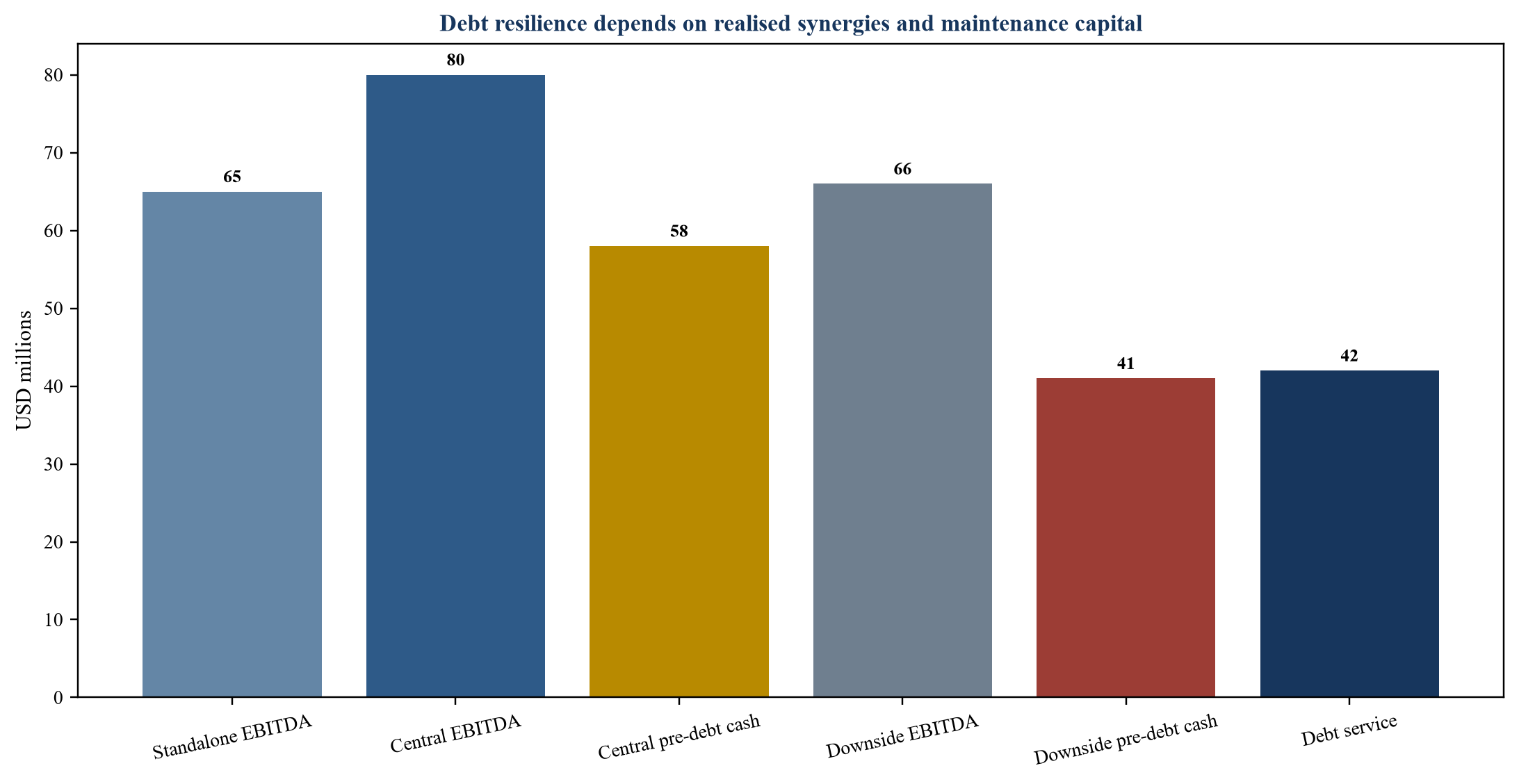
USD millions before tax and working capital; every value is an illustrative management assumption.
| Measure | Standalone or entry | Central case | Correlated downside |
|---|---|---|---|
| Recurring revenue | 126 | 142 | 130 |
| EBITDA | 65 | 80 | 66 |
| Acquisition enterprise value | 650 | 650 | 650 |
| Integration and expansion programme | 45 | 45 | 52 |
| Maintenance capital | 20 | 22 | 25 |
| Cash before debt service | 45 | 58 | 41 |
| Annual debt service | 42 | 42 | 42 |
| DSCR | 1.07x | 1.38x | 0.98x |
| Entry EV / standalone EBITDA | 10.00x | 10.00x | 10.00x |
| EV / case EBITDA | 10.00x | 8.13x | 9.85x |
USD millions except ratios; every value is an illustrative management assumption.
25. Size debt to post-integration cash flow
Acquisition leverage must survive customer churn, delayed synergies, integration cost, growth capital, maintenance capital and interest-rate stress. Model draw, amortisation, cash interest, hedging, covenant headroom, restricted payments, reserve accounts, equity cure and refinancing dependency. The analysis should distinguish observed technical, commercial, contractual, regulatory and financial evidence from management assumptions and connect each material judgment to customer demand, service quality, capital efficiency, financing and transaction value. Debt capacity should follow downside cash after maintenance capital and required integration spending, with no reliance on uncontracted revenue or multiple expansion. The work should test central and correlated downside cases for customer timing, site eligibility, power, fibre diversity, utilisation, pricing, vendor concentration, integration cost, operating cost, maintenance capital, interest rates, liquidity and regulatory change. Exceptions require a named owner, source, due date and decision consequence. Unsupported demand, synergies, utilisation, savings, premium valuation or refinancing remains outside the central case until enforceable evidence supports it. The section output should identify the governing source, contract, asset, model line, accountable owner, warning threshold and capital consequence. This creates a traceable bridge from convergence thesis to realised cash.
26. Stage capital through evidence gates
A portfolio-wide edge rollout can consume capital faster than demand and operating capability develop. Create stage gates for site rights, power, fibre diversity, anchor demand, product readiness, build cost, commissioning, utilisation and cash collection. The analysis should distinguish observed technical, commercial, contractual, regulatory and financial evidence from management assumptions and connect each material judgment to customer demand, service quality, capital efficiency, financing and transaction value. Later waves should require verified performance from earlier sites and a refreshed view of liquidity, capacity and customer demand. The work should test central and correlated downside cases for customer timing, site eligibility, power, fibre diversity, utilisation, pricing, vendor concentration, integration cost, operating cost, maintenance capital, interest rates, liquidity and regulatory change. Exceptions require a named owner, source, due date and decision consequence. Unsupported demand, synergies, utilisation, savings, premium valuation or refinancing remains outside the central case until enforceable evidence supports it. Evidence should remain traceable to site, route, power allocation, workload, customer, product, order, asset, invoice, cash receipt and forecast period. Board and lender reporting should reconcile to the same operating records.
27. Design governance for a multi-layer platform
Capital allocation can become distorted when tower, fibre and compute units compete for funding and report different performance measures. Define board oversight, investment thresholds, related-party controls, customer neutrality, security committees, regulatory reporting and information rights. The analysis should distinguish observed technical, commercial, contractual, regulatory and financial evidence from management assumptions and connect each material judgment to customer demand, service quality, capital efficiency, financing and transaction value. Management reporting should reconcile asset utilisation, service performance, customer economics, capital deployed and cash returns on a consistent basis. The work should test central and correlated downside cases for customer timing, site eligibility, power, fibre diversity, utilisation, pricing, vendor concentration, integration cost, operating cost, maintenance capital, interest rates, liquidity and regulatory change. Exceptions require a named owner, source, due date and decision consequence. Unsupported demand, synergies, utilisation, savings, premium valuation or refinancing remains outside the central case until enforceable evidence supports it. Management should define the earliest warning indicator, intervention trigger and executable remedy. Reporting should preserve the approved baseline, change history, actual cost, service outcome and realised cash.
28. Prepare separation and exit options
Future buyers may value the platform as an integrated network, a sum of infrastructure verticals or a collection of regional assets. Preserve asset registers, contracts, licences, systems boundaries, transfer rights and standalone financial information needed for refinancing, partial sale, joint venture or carve-out. The analysis should distinguish observed technical, commercial, contractual, regulatory and financial evidence from management assumptions and connect each material judgment to customer demand, service quality, capital efficiency, financing and transaction value. Integration choices should create operational value without making later separation prohibitively expensive or contractually impossible. The work should test central and correlated downside cases for customer timing, site eligibility, power, fibre diversity, utilisation, pricing, vendor concentration, integration cost, operating cost, maintenance capital, interest rates, liquidity and regulatory change. Exceptions require a named owner, source, due date and decision consequence. Unsupported demand, synergies, utilisation, savings, premium valuation or refinancing remains outside the central case until enforceable evidence supports it. The section output should identify the governing source, contract, asset, model line, accountable owner, warning threshold and capital consequence. This creates a traceable bridge from convergence thesis to realised cash.
29. Build the thirty-month execution roadmap
The roadmap should move from diligence and perimeter confirmation through closing, service continuity, system integration, pilot sites, customer conversion and scaled deployment. Each workstream needs an owner, dependency, evidence requirement, budget, decision date, warning indicator and fallback action. The analysis should distinguish observed technical, commercial, contractual, regulatory and financial evidence from management assumptions and connect each material judgment to customer demand, service quality, capital efficiency, financing and transaction value. Board gates should control customer risk, capital release, leverage, regulatory commitments and the pace of physical conversion. The work should test central and correlated downside cases for customer timing, site eligibility, power, fibre diversity, utilisation, pricing, vendor concentration, integration cost, operating cost, maintenance capital, interest rates, liquidity and regulatory change. Exceptions require a named owner, source, due date and decision consequence. Unsupported demand, synergies, utilisation, savings, premium valuation or refinancing remains outside the central case until enforceable evidence supports it. Evidence should remain traceable to site, route, power allocation, workload, customer, product, order, asset, invoice, cash receipt and forecast period. Board and lender reporting should reconcile to the same operating records.
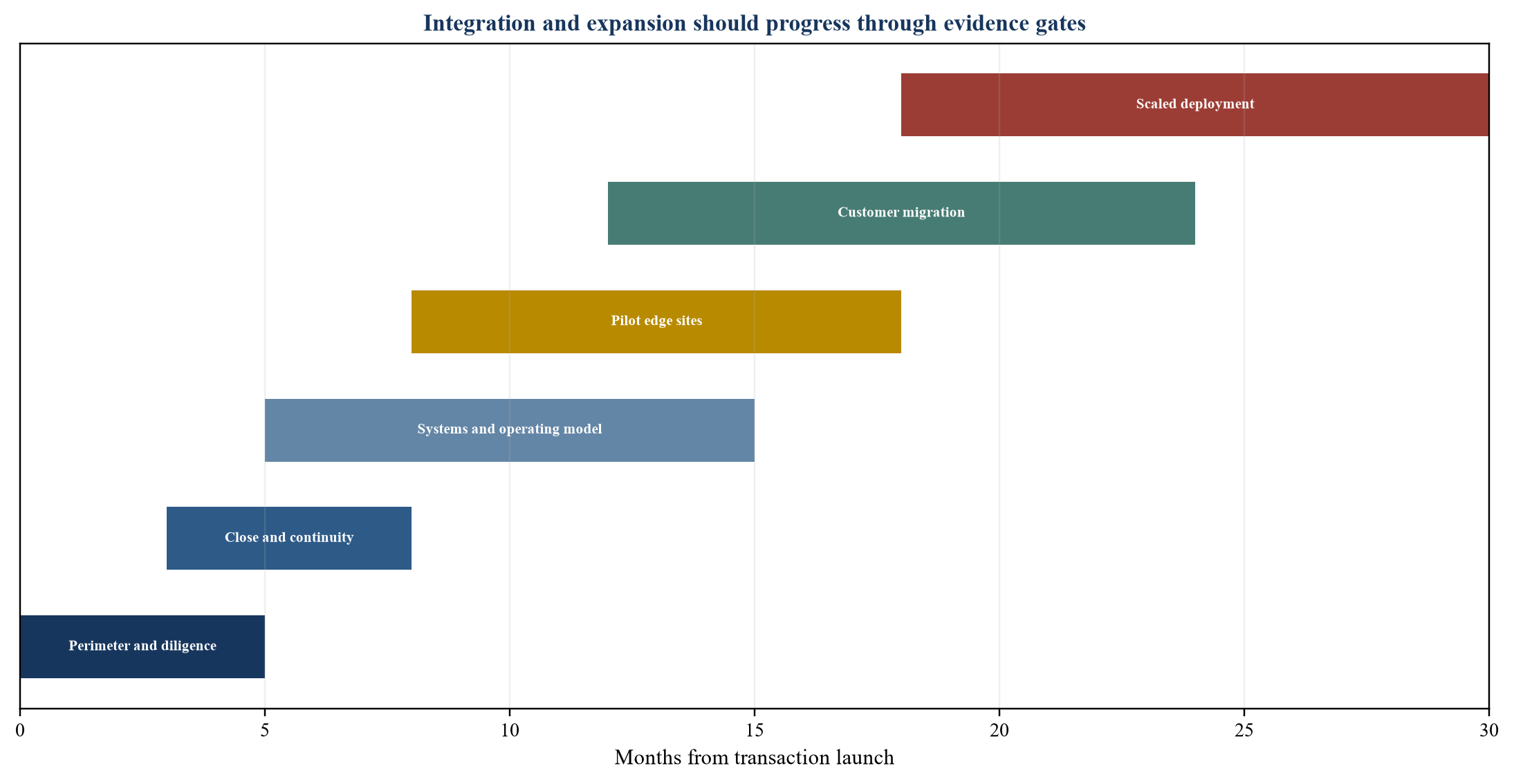
Capital release follows verified operational and customer evidence.
30. Define the investable convergence case
An investable case combines contracted demand, suitable sites, diverse fibre, deliverable power, repeatable products, secure operations, disciplined capital and credible governance. The final memorandum should present the asset perimeter, customer evidence, site register, network map, operating model, synergy register, integration budget, downside liquidity and exit options. The analysis should distinguish observed technical, commercial, contractual, regulatory and financial evidence from management assumptions and connect each material judgment to customer demand, service quality, capital efficiency, financing and transaction value. Commitment conditions should close material evidence gaps before adjacency, scale or technology narrative is treated as transaction value. The work should test central and correlated downside cases for customer timing, site eligibility, power, fibre diversity, utilisation, pricing, vendor concentration, integration cost, operating cost, maintenance capital, interest rates, liquidity and regulatory change. Exceptions require a named owner, source, due date and decision consequence. Unsupported demand, synergies, utilisation, savings, premium valuation or refinancing remains outside the central case until enforceable evidence supports it. Management should define the earliest warning indicator, intervention trigger and executable remedy. Reporting should preserve the approved baseline, change history, actual cost, service outcome and realised cash.
Sources
- International Telecommunication Union. Recommendation ITU-T Y.3223: Fixed, mobile and satellite convergence; multi-access edge computing for IMT-2020 networks and beyond, 29 August 2025. Read the primary source
- International Telecommunication Union. Recommendation ITU-T X.1815: Security guidelines and requirements for IMT-2020 edge computing services, March 2023. Read the primary source
- International Telecommunication Union. Supplement 52 to ITU-T L-series Recommendations: Edge computing and cloud data-centre infrastructure. Read the primary source
- European Commission. Telco Cloud Reference Architecture, 28 February 2025. Read the primary source
- European Commission. Telco Cloud Thematic Roadmap, 10 July 2024. Read the primary source
- European Commission. White Paper: How to master Europe's digital infrastructure needs, 21 February 2024. Read the primary source
- European Commission. EURO-3C federated Telco-Edge-Cloud infrastructure project, 3 March 2026. Read the primary source
- European Commission. Results of the exploratory consultation on the future of the electronic communications sector and its infrastructure, 10 October 2023. Read the primary source
- BEREC. Draft report on cloud services and edge computing, BoR (24) 52, March 2024. Read the primary source
- World Bank Group. Advancing Cloud and Data Infrastructure Markets, 22 May 2024. Read the primary source
- World Bank Group. Building Data Infrastructure for AI Readiness, 6 May 2026. Read the primary source
- World Bank Group. Infrastructure Foundations: From Current Assets to Future Growth, 24 April 2026. Read the primary source
- World Bank Group. Making it Possible for the World to Log On, 6 June 2022. Read the primary source
- GSMA. Telco Edge Cloud Value and Achievements Whitepaper, 25 March 2022. Read the primary source
- GSMA. China Tower joins GSMA to advance AI-ready mobile infrastructure, 24 June 2026. Read the primary source
- GSMA. Network Coverage and Infrastructure, State of Mobile Internet Connectivity. Read the primary source
- Ofcom. Connected Nations Interactive Report 2025, 19 November 2025. Read the primary source
- European Commission. Connectivity policy and the computing continuum. Read the primary source
- European Commission. IPCEI Next Generation Cloud Infrastructure and Services. Read the primary source
- European Commission. Digital Europe calls supporting cloud-to-edge infrastructure, 1 March 2024. Read the primary source
