

1. Define the bankability decision
The sponsor must decide whether a proposed wholesale network can convert coverage into durable contracted cash flow before approving the full build. State the coverage objective, customer segment, access model, ownership, capital structure, public purpose and decision thresholds. The analysis should distinguish observed technical, commercial, contractual, regulatory and financial evidence from management assumptions and connect each material judgment to coverage, competition, service quality, capital efficiency, financing and public purpose. Approval should compare phased build, full build, concession, co-investment, acquisition and targeted subsidy alternatives. The work should test central and correlated downside cases for build cost, permit delay, premises released, take-up, price, provider concentration, installation, churn, operating cost, maintenance capital, interest rates, liquidity and regulatory change. Exceptions require a named owner, source, due date and decision consequence. Unsupported demand, savings, subsidy, price growth, multiple expansion or refinancing remains outside the base case until enforceable evidence supports it. The section output should identify the governing source, contract, model line, accountable owner, warning threshold and capital consequence. This creates a traceable bridge from mapped demand to construction, wholesale revenue and financing.
Open access should be analysed as an integrated commercial and regulatory system. The network company funds and operates long-lived infrastructure; access seekers need competitive wholesale inputs; public authorities seek coverage, affordability and neutral treatment; lenders require predictable cash and enforceable controls. A viable structure connects these interests through measurable products, contracts, service levels, information rights and capital gates. Coverage alone does not repay financing. Each premise must move through design, construction, serviceability, order, installation, activation, billing and collection before it contributes durable cash. Scenario analysis should combine related pressures. Lower take-up can coincide with price competition, provider onboarding delay, higher installation cost, overbuild and slower public-sector migration. Construction inflation or permit delay can consume contingency while interest accrues before revenue. Regulated-price changes can weaken yield as maintenance, energy, labour and security costs rise. A decision-grade model therefore tests cost-to-complete, activation timing, price, operating cost, maintenance capital, liquidity and debt service together, with contractual and operational remedies for every material exception.
2. Use the Open-Access Fibre Bankability Framework
The framework links mapped demand, physical design, access products, contracts, prices, operating delivery, capital and financing. Every material assumption should reconcile to a geography, premise, route, product, wholesale customer, contract, cost centre and forecast period. The analysis should distinguish observed technical, commercial, contractual, regulatory and financial evidence from management assumptions and connect each material judgment to coverage, competition, service quality, capital efficiency, financing and public purpose. Sponsors and lenders should use the same definitions for premises passed, serviceable premises, ordered lines, installed lines and paying lines. The work should test central and correlated downside cases for build cost, permit delay, premises released, take-up, price, provider concentration, installation, churn, operating cost, maintenance capital, interest rates, liquidity and regulatory change. Exceptions require a named owner, source, due date and decision consequence. Unsupported demand, savings, subsidy, price growth, multiple expansion or refinancing remains outside the base case until enforceable evidence supports it. Evidence should remain traceable to premise, route, product, access seeker, order, asset, invoice, cash receipt and forecast period. Board and lender reporting should reconcile to the same operating records.
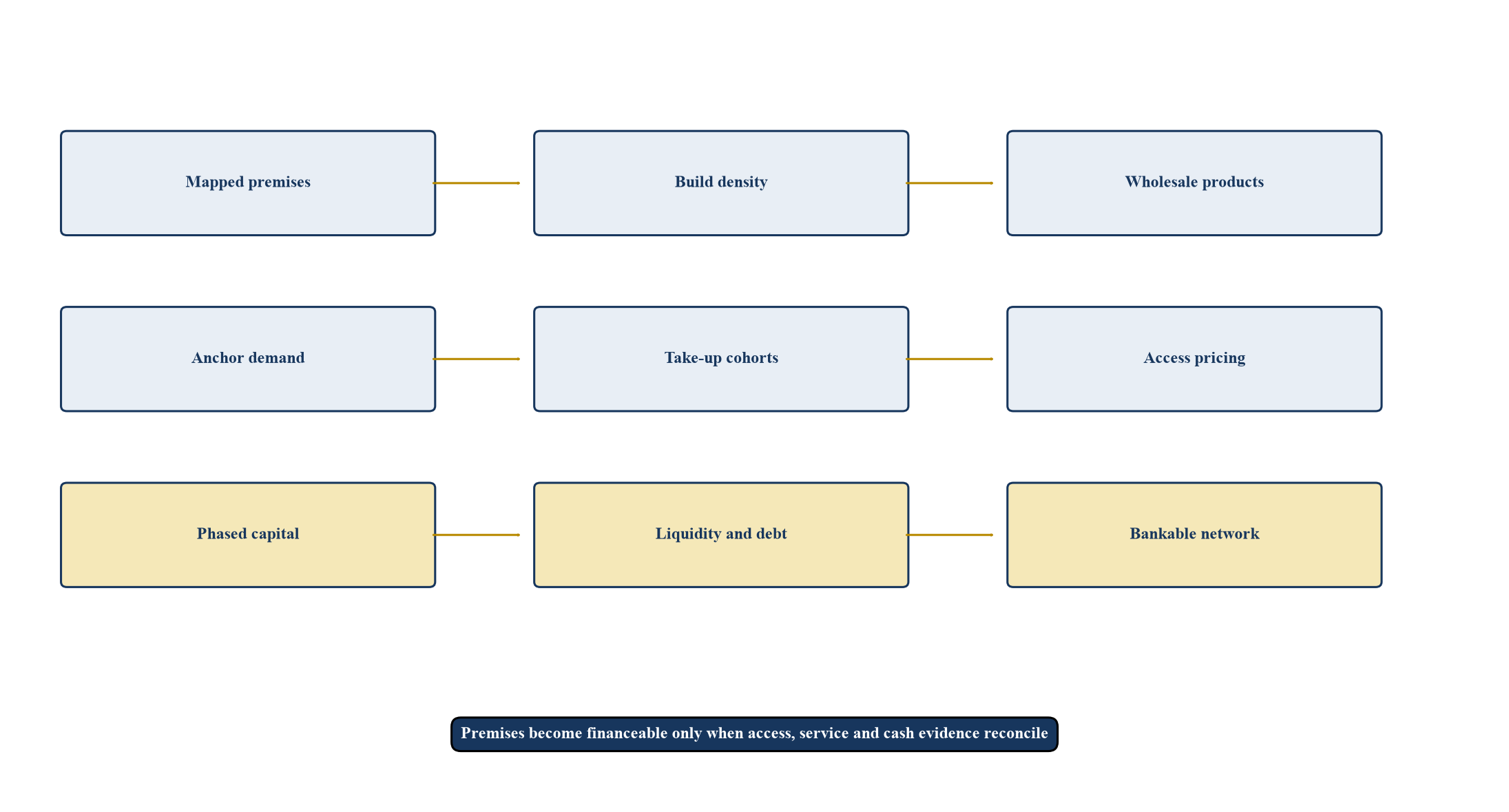
Bankability connects mapped demand, network delivery, wholesale access, operating evidence and capital.
3. Map address-level demand
Aggregate population or household counts can conceal low-density routes, unserviceable buildings and weak willingness to pay. Build a geocoded premise register with serviceability, income, business activity, public sites, existing networks, expected demand and installation constraints. The analysis should distinguish observed technical, commercial, contractual, regulatory and financial evidence from management assumptions and connect each material judgment to coverage, competition, service quality, capital efficiency, financing and public purpose. The investment case should use address-level evidence and documented sampling quality rather than broad coverage percentages. The work should test central and correlated downside cases for build cost, permit delay, premises released, take-up, price, provider concentration, installation, churn, operating cost, maintenance capital, interest rates, liquidity and regulatory change. Exceptions require a named owner, source, due date and decision consequence. Unsupported demand, savings, subsidy, price growth, multiple expansion or refinancing remains outside the base case until enforceable evidence supports it. Management should define the earliest warning indicator, intervention trigger and executable remedy. Reporting should preserve the approved baseline, change history, actual cost, service outcome and realised cash.
4. Fix the network and service perimeter
A wholesale network may include ducts, poles, dark fibre, access fibre, splitters, cabinets, active electronics, core transport, systems and customer installations. Define owned, leased, shared and third-party components and identify where another party controls capacity, maintenance or restoration. The analysis should distinguish observed technical, commercial, contractual, regulatory and financial evidence from management assumptions and connect each material judgment to coverage, competition, service quality, capital efficiency, financing and public purpose. The financial model, access offer and operating plan should follow one verified asset and service boundary. The work should test central and correlated downside cases for build cost, permit delay, premises released, take-up, price, provider concentration, installation, churn, operating cost, maintenance capital, interest rates, liquidity and regulatory change. Exceptions require a named owner, source, due date and decision consequence. Unsupported demand, savings, subsidy, price growth, multiple expansion or refinancing remains outside the base case until enforceable evidence supports it. The section output should identify the governing source, contract, model line, accountable owner, warning threshold and capital consequence. This creates a traceable bridge from mapped demand to construction, wholesale revenue and financing.
5. Design the wholesale product ladder
Open access can include duct access, dark fibre, wavelength, active Ethernet, bitstream, backhaul and managed services with different capex and operating obligations. Specify technical interface, service level, ordering process, capacity unit, term, price, indexation and fault responsibility for each product. The analysis should distinguish observed technical, commercial, contractual, regulatory and financial evidence from management assumptions and connect each material judgment to coverage, competition, service quality, capital efficiency, financing and public purpose. The product ladder should let access seekers differentiate retail offers without creating uneconomic bespoke operations. The work should test central and correlated downside cases for build cost, permit delay, premises released, take-up, price, provider concentration, installation, churn, operating cost, maintenance capital, interest rates, liquidity and regulatory change. Exceptions require a named owner, source, due date and decision consequence. Unsupported demand, savings, subsidy, price growth, multiple expansion or refinancing remains outside the base case until enforceable evidence supports it. Evidence should remain traceable to premise, route, product, access seeker, order, asset, invoice, cash receipt and forecast period. Board and lender reporting should reconcile to the same operating records.
| Product | Network layer | Access-seeker control | Financeability test |
|---|---|---|---|
| Duct and pole access | Civil infrastructure | High | Survey, capacity, price and remedy |
| Dark fibre | Passive optical path | High | Route, repair, term and utilisation |
| Wavelength | Managed optical capacity | Medium-high | Capacity commitment and upgrade |
| Active Ethernet | Layer 2 connection | Medium | Interface, contention and service level |
| Bitstream | Managed wholesale access | Lower | Scale, price, systems and neutrality |
| Backhaul | Aggregation and transport | Medium | Anchor volume and route resilience |
Product scope determines investment, differentiation and operating responsibility.
6. Secure credible anchor demand
An anchor commitment can reduce ramp risk when it represents enforceable volumes rather than a non-binding expression of interest. Verify minimum lines, migration schedule, eligible premises, service mix, pricing, credit support, termination rights and remedies. The analysis should distinguish observed technical, commercial, contractual, regulatory and financial evidence from management assumptions and connect each material judgment to coverage, competition, service quality, capital efficiency, financing and public purpose. Anchor terms should support financing while preserving neutral access and capacity for additional providers. The work should test central and correlated downside cases for build cost, permit delay, premises released, take-up, price, provider concentration, installation, churn, operating cost, maintenance capital, interest rates, liquidity and regulatory change. Exceptions require a named owner, source, due date and decision consequence. Unsupported demand, savings, subsidy, price growth, multiple expansion or refinancing remains outside the base case until enforceable evidence supports it. Management should define the earliest warning indicator, intervention trigger and executable remedy. Reporting should preserve the approved baseline, change history, actual cost, service outcome and realised cash.
7. Underwrite take-up by cohort
Network value depends on the timing and persistence of active lines, not the final penetration assumption alone. Model residential, SME, enterprise, public-sector, mobile-backhaul and wholesale-carrier cohorts by zone and month. The analysis should distinguish observed technical, commercial, contractual, regulatory and financial evidence from management assumptions and connect each material judgment to coverage, competition, service quality, capital efficiency, financing and public purpose. Base-case take-up should be supported by orders, binding commitments, comparable conversion and a funded sales and installation plan. The work should test central and correlated downside cases for build cost, permit delay, premises released, take-up, price, provider concentration, installation, churn, operating cost, maintenance capital, interest rates, liquidity and regulatory change. Exceptions require a named owner, source, due date and decision consequence. Unsupported demand, savings, subsidy, price growth, multiple expansion or refinancing remains outside the base case until enforceable evidence supports it. The section output should identify the governing source, contract, model line, accountable owner, warning threshold and capital consequence. This creates a traceable bridge from mapped demand to construction, wholesale revenue and financing.
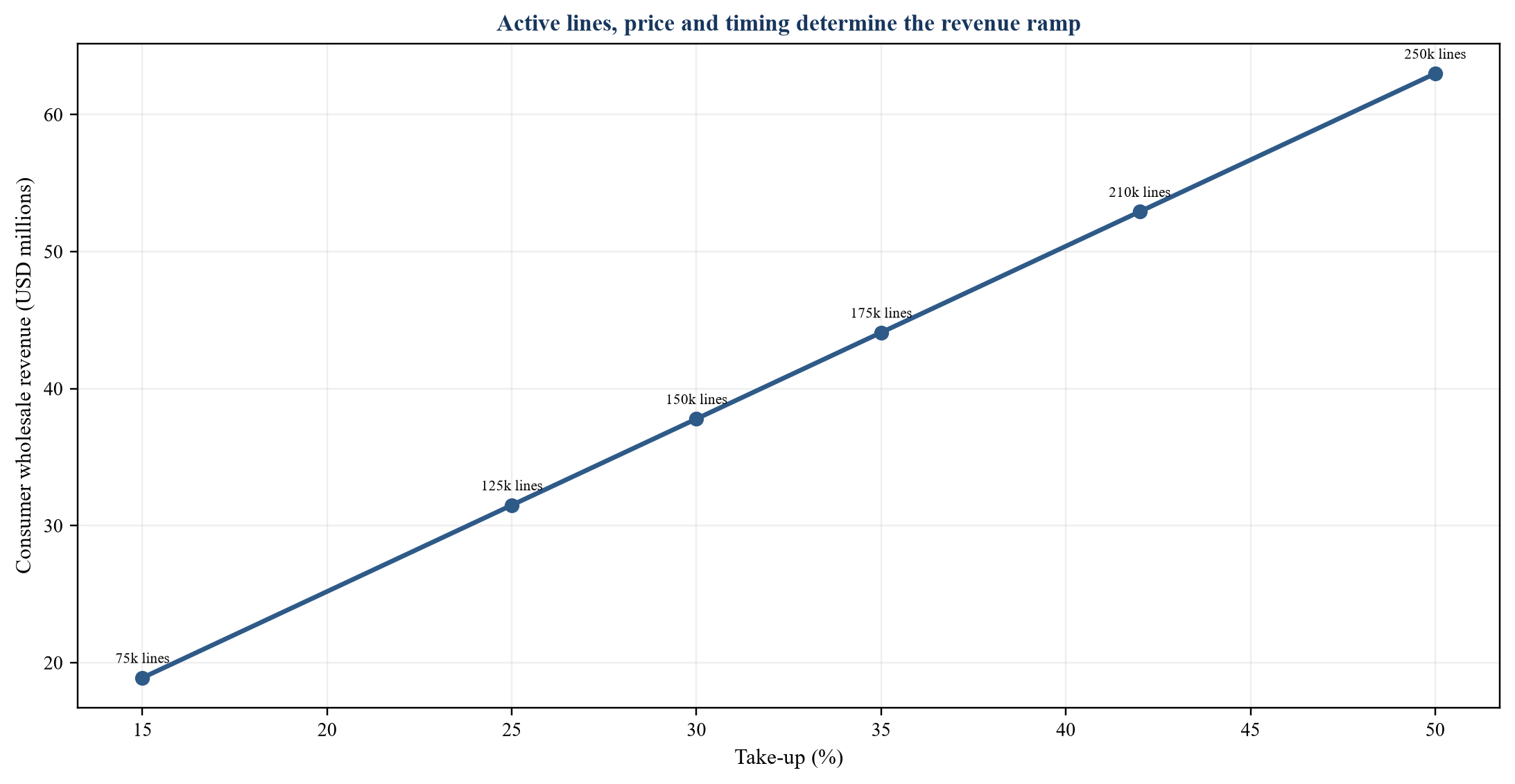
USD millions; every value is an illustrative management assumption.
| Evidence state | Commercial meaning | Model treatment | Required control |
|---|---|---|---|
| Market survey | Indicated interest | Sensitivity only | Sampling and affordability review |
| Provider forecast | Planned demand | Upside or weighted case | Named zones and timetable |
| Signed framework | Contractual route | Conditional base case | Product and onboarding readiness |
| Minimum commitment | Enforceable volume | Base case subject to credit | Security and remedy |
| Activated paying line | Realised demand | Observed revenue | Invoice and cash reconciliation |
Forecast weight should increase only as evidence becomes enforceable and operational.
8. Connect pricing to efficient cost and demand
Wholesale prices must remain commercially attractive to access seekers while supporting cost recovery, maintenance and a risk-adjusted return. Model connection fees, recurring access, capacity tiers, volume discounts, long-term commitments, inflation, regulated resets and pass-throughs. The analysis should distinguish observed technical, commercial, contractual, regulatory and financial evidence from management assumptions and connect each material judgment to coverage, competition, service quality, capital efficiency, financing and public purpose. Price scenarios should test affordability, retail margin, competition, utilisation and the build-or-buy incentive. The work should test central and correlated downside cases for build cost, permit delay, premises released, take-up, price, provider concentration, installation, churn, operating cost, maintenance capital, interest rates, liquidity and regulatory change. Exceptions require a named owner, source, due date and decision consequence. Unsupported demand, savings, subsidy, price growth, multiple expansion or refinancing remains outside the base case until enforceable evidence supports it. Evidence should remain traceable to premise, route, product, access seeker, order, asset, invoice, cash receipt and forecast period. Board and lender reporting should reconcile to the same operating records.
9. Make the reference offer operational
A published price list creates little value when ordering, provisioning, assurance and dispute processes are incomplete. Define product specifications, eligibility, forecasts, lead times, installation, acceptance, billing, faults, service credits, change and termination. The analysis should distinguish observed technical, commercial, contractual, regulatory and financial evidence from management assumptions and connect each material judgment to coverage, competition, service quality, capital efficiency, financing and public purpose. The reference offer should be executable in systems and measurable through operating records. The work should test central and correlated downside cases for build cost, permit delay, premises released, take-up, price, provider concentration, installation, churn, operating cost, maintenance capital, interest rates, liquidity and regulatory change. Exceptions require a named owner, source, due date and decision consequence. Unsupported demand, savings, subsidy, price growth, multiple expansion or refinancing remains outside the base case until enforceable evidence supports it. Management should define the earliest warning indicator, intervention trigger and executable remedy. Reporting should preserve the approved baseline, change history, actual cost, service outcome and realised cash.
10. Measure build density and unit economics
Cost per premise can rise sharply when routes lengthen, reinstatement becomes complex or eligible connections disperse. Measure route kilometres, premises per kilometre, civil-work type, reusable infrastructure, drops, wayleaves, installation cost and expected active lines. The analysis should distinguish observed technical, commercial, contractual, regulatory and financial evidence from management assumptions and connect each material judgment to coverage, competition, service quality, capital efficiency, financing and public purpose. Zone approval should use lifetime cash economics and correlated downside rather than an average programme cost. The work should test central and correlated downside cases for build cost, permit delay, premises released, take-up, price, provider concentration, installation, churn, operating cost, maintenance capital, interest rates, liquidity and regulatory change. Exceptions require a named owner, source, due date and decision consequence. Unsupported demand, savings, subsidy, price growth, multiple expansion or refinancing remains outside the base case until enforceable evidence supports it. The section output should identify the governing source, contract, model line, accountable owner, warning threshold and capital consequence. This creates a traceable bridge from mapped demand to construction, wholesale revenue and financing.
11. Phase capital against evidence
Full upfront construction exposes equity and debt to demand, permit, contractor and technology risk before revenue is proven. Divide the programme into independently testable zones with release conditions for design, permits, demand, cost, funding and operating readiness. The analysis should distinguish observed technical, commercial, contractual, regulatory and financial evidence from management assumptions and connect each material judgment to coverage, competition, service quality, capital efficiency, financing and public purpose. Later capital should depend on verified cost-to-complete, connection conversion, service quality and liquidity. The work should test central and correlated downside cases for build cost, permit delay, premises released, take-up, price, provider concentration, installation, churn, operating cost, maintenance capital, interest rates, liquidity and regulatory change. Exceptions require a named owner, source, due date and decision consequence. Unsupported demand, savings, subsidy, price growth, multiple expansion or refinancing remains outside the base case until enforceable evidence supports it. Evidence should remain traceable to premise, route, product, access seeker, order, asset, invoice, cash receipt and forecast period. Board and lender reporting should reconcile to the same operating records.
12. Separate passed, ready and connected premises
Headline coverage can overstate economic progress when buildings cannot order service or installations remain incomplete. Maintain explicit definitions for premises planned, passed, serviceable, released for sale, ordered, installed, activated and billed. The analysis should distinguish observed technical, commercial, contractual, regulatory and financial evidence from management assumptions and connect each material judgment to coverage, competition, service quality, capital efficiency, financing and public purpose. Board and lender reporting should reconcile physical milestones to customer orders, invoices and cash. The work should test central and correlated downside cases for build cost, permit delay, premises released, take-up, price, provider concentration, installation, churn, operating cost, maintenance capital, interest rates, liquidity and regulatory change. Exceptions require a named owner, source, due date and decision consequence. Unsupported demand, savings, subsidy, price growth, multiple expansion or refinancing remains outside the base case until enforceable evidence supports it. Management should define the earliest warning indicator, intervention trigger and executable remedy. Reporting should preserve the approved baseline, change history, actual cost, service outcome and realised cash.
13. Control acquisition, installation and churn
A technically complete network can underperform when retail partners lack sales capacity or installation creates delay and customer loss. Track lead generation, orders, cancellations, failed visits, installation time, activation, early-life faults, churn and win-back by provider and zone. The analysis should distinguish observed technical, commercial, contractual, regulatory and financial evidence from management assumptions and connect each material judgment to coverage, competition, service quality, capital efficiency, financing and public purpose. The cash model should reflect gross additions, installation cost, provider concentration and line survival. The work should test central and correlated downside cases for build cost, permit delay, premises released, take-up, price, provider concentration, installation, churn, operating cost, maintenance capital, interest rates, liquidity and regulatory change. Exceptions require a named owner, source, due date and decision consequence. Unsupported demand, savings, subsidy, price growth, multiple expansion or refinancing remains outside the base case until enforceable evidence supports it. The section output should identify the governing source, contract, model line, accountable owner, warning threshold and capital consequence. This creates a traceable bridge from mapped demand to construction, wholesale revenue and financing.
14. Build a diversified access-seeker pipeline
A wholesale-only model needs capable retail and enterprise providers that can sell, support and pay for services. Assess each access seeker's coverage plan, systems readiness, credit, committed volumes, product fit, marketing budget and migration capability. The analysis should distinguish observed technical, commercial, contractual, regulatory and financial evidence from management assumptions and connect each material judgment to coverage, competition, service quality, capital efficiency, financing and public purpose. Pipeline reporting should distinguish signed contract, forecast order, technical onboarding and live revenue. The work should test central and correlated downside cases for build cost, permit delay, premises released, take-up, price, provider concentration, installation, churn, operating cost, maintenance capital, interest rates, liquidity and regulatory change. Exceptions require a named owner, source, due date and decision consequence. Unsupported demand, savings, subsidy, price growth, multiple expansion or refinancing remains outside the base case until enforceable evidence supports it. Evidence should remain traceable to premise, route, product, access seeker, order, asset, invoice, cash receipt and forecast period. Board and lender reporting should reconcile to the same operating records.
15. Test overbuild and competitive response
Incumbent upgrades, rival fibre, fixed wireless, cable and mobile substitution can reduce addressable demand and price headroom. Map current and announced networks, retail offers, switching costs, customer contracts, route overlap and likely tactical responses. The analysis should distinguish observed technical, commercial, contractual, regulatory and financial evidence from management assumptions and connect each material judgment to coverage, competition, service quality, capital efficiency, financing and public purpose. The downside should combine slower take-up, lower price, higher acquisition cost and stranded zones. The work should test central and correlated downside cases for build cost, permit delay, premises released, take-up, price, provider concentration, installation, churn, operating cost, maintenance capital, interest rates, liquidity and regulatory change. Exceptions require a named owner, source, due date and decision consequence. Unsupported demand, savings, subsidy, price growth, multiple expansion or refinancing remains outside the base case until enforceable evidence supports it. Management should define the earliest warning indicator, intervention trigger and executable remedy. Reporting should preserve the approved baseline, change history, actual cost, service outcome and realised cash.
16. Target public support to the viability gap
Public funding can extend coverage where efficient social investment exceeds private financial returns. Quantify the minimum subsidy, guarantee, availability payment, demand commitment or concessional tranche needed after competitive procurement. The analysis should distinguish observed technical, commercial, contractual, regulatory and financial evidence from management assumptions and connect each material judgment to coverage, competition, service quality, capital efficiency, financing and public purpose. Support should remain transparent, technologically neutral, proportionate and linked to measurable coverage and open-access obligations. The work should test central and correlated downside cases for build cost, permit delay, premises released, take-up, price, provider concentration, installation, churn, operating cost, maintenance capital, interest rates, liquidity and regulatory change. Exceptions require a named owner, source, due date and decision consequence. Unsupported demand, savings, subsidy, price growth, multiple expansion or refinancing remains outside the base case until enforceable evidence supports it. The section output should identify the governing source, contract, model line, accountable owner, warning threshold and capital consequence. This creates a traceable bridge from mapped demand to construction, wholesale revenue and financing.
17. Allocate PPP and concession risks
Public-private structures fail when land, permits, demand, construction, technology, operation, regulation or termination risks sit with parties unable to control them. Create a contractual risk matrix covering design, cost, delay, availability, take-up, price, access, force majeure, change in law and handback. The analysis should distinguish observed technical, commercial, contractual, regulatory and financial evidence from management assumptions and connect each material judgment to coverage, competition, service quality, capital efficiency, financing and public purpose. Payment and relief mechanisms should follow controllability, evidence and the public-interest objective. The work should test central and correlated downside cases for build cost, permit delay, premises released, take-up, price, provider concentration, installation, churn, operating cost, maintenance capital, interest rates, liquidity and regulatory change. Exceptions require a named owner, source, due date and decision consequence. Unsupported demand, savings, subsidy, price growth, multiple expansion or refinancing remains outside the base case until enforceable evidence supports it. Evidence should remain traceable to premise, route, product, access seeker, order, asset, invoice, cash receipt and forecast period. Board and lender reporting should reconcile to the same operating records.
| Risk | Public authority role | Private partner role | Bankability evidence |
|---|---|---|---|
| Coverage and access | Define objective and rights | Design compliant network | Verified premise and route register |
| Construction | Facilitate permits | Deliver cost and schedule | Fixed scope, contingency and acceptance |
| Demand | Aggregate public demand | Acquire and serve access seekers | Enforceable commitments and pipeline |
| Pricing | Set transparent framework | Operate within reference offer | Predictable reset and cost recovery |
| Availability | Define service outcome | Operate and restore network | Measured SLA and remedies |
| Change and termination | Protect public interest | Manage controllable delivery | Compensation and handback formula |
Risk should sit with the party best able to control, absorb and evidence it.
18. Secure permits, wayleaves and building access
Route consent and in-building access can determine schedule and unit cost even when trunk construction is complete. Build a consent register for roads, utilities, rail, municipalities, private land, buildings and environmental constraints. The analysis should distinguish observed technical, commercial, contractual, regulatory and financial evidence from management assumptions and connect each material judgment to coverage, competition, service quality, capital efficiency, financing and public purpose. Construction commitments should follow verified access dates, reinstatement standards and escalation routes. The work should test central and correlated downside cases for build cost, permit delay, premises released, take-up, price, provider concentration, installation, churn, operating cost, maintenance capital, interest rates, liquidity and regulatory change. Exceptions require a named owner, source, due date and decision consequence. Unsupported demand, savings, subsidy, price growth, multiple expansion or refinancing remains outside the base case until enforceable evidence supports it. Management should define the earliest warning indicator, intervention trigger and executable remedy. Reporting should preserve the approved baseline, change history, actual cost, service outcome and realised cash.
19. Reuse ducts, poles and coordinated civil works
Civil engineering often dominates fibre deployment cost and disruption. Test the availability, capacity, condition, safety, price and service process for existing telecom, energy, transport and public infrastructure. The analysis should distinguish observed technical, commercial, contractual, regulatory and financial evidence from management assumptions and connect each material judgment to coverage, competition, service quality, capital efficiency, financing and public purpose. The model should recognise survey, remediation, access delay and dispute cost before crediting reuse savings. The work should test central and correlated downside cases for build cost, permit delay, premises released, take-up, price, provider concentration, installation, churn, operating cost, maintenance capital, interest rates, liquidity and regulatory change. Exceptions require a named owner, source, due date and decision consequence. Unsupported demand, savings, subsidy, price growth, multiple expansion or refinancing remains outside the base case until enforceable evidence supports it. The section output should identify the governing source, contract, model line, accountable owner, warning threshold and capital consequence. This creates a traceable bridge from mapped demand to construction, wholesale revenue and financing.
20. Define the passive-active operating boundary
Ownership of fibre and ducts can be separated from electronics, service orchestration and retail activity. Map design authority, capacity planning, equipment refresh, cybersecurity, monitoring, field maintenance and customer-interface responsibilities. The analysis should distinguish observed technical, commercial, contractual, regulatory and financial evidence from management assumptions and connect each material judgment to coverage, competition, service quality, capital efficiency, financing and public purpose. The structure should preserve wholesale neutrality and avoid fragmented accountability during incidents. The work should test central and correlated downside cases for build cost, permit delay, premises released, take-up, price, provider concentration, installation, churn, operating cost, maintenance capital, interest rates, liquidity and regulatory change. Exceptions require a named owner, source, due date and decision consequence. Unsupported demand, savings, subsidy, price growth, multiple expansion or refinancing remains outside the base case until enforceable evidence supports it. Evidence should remain traceable to premise, route, product, access seeker, order, asset, invoice, cash receipt and forecast period. Board and lender reporting should reconcile to the same operating records.
21. Engineer service levels and remedies
Wholesale customers need predictable installation, availability, latency, restoration and information to support retail commitments. Define metrics, exclusions, measurement sources, service credits, chronic failure, capacity relief and escalation. The analysis should distinguish observed technical, commercial, contractual, regulatory and financial evidence from management assumptions and connect each material judgment to coverage, competition, service quality, capital efficiency, financing and public purpose. Service levels should be technically achievable, funded in the operating model and auditable by all parties. The work should test central and correlated downside cases for build cost, permit delay, premises released, take-up, price, provider concentration, installation, churn, operating cost, maintenance capital, interest rates, liquidity and regulatory change. Exceptions require a named owner, source, due date and decision consequence. Unsupported demand, savings, subsidy, price growth, multiple expansion or refinancing remains outside the base case until enforceable evidence supports it. Management should define the earliest warning indicator, intervention trigger and executable remedy. Reporting should preserve the approved baseline, change history, actual cost, service outcome and realised cash.
22. Build the standalone operating model
A network requires skilled field operations, network control, product management, billing, assurance, cybersecurity, finance and regulatory reporting. Map retained, outsourced and newly built capabilities, systems, staffing, vendor contracts and transition dependencies. The analysis should distinguish observed technical, commercial, contractual, regulatory and financial evidence from management assumptions and connect each material judgment to coverage, competition, service quality, capital efficiency, financing and public purpose. The steady-state cost base should include every capability required after temporary sponsor support ends. The work should test central and correlated downside cases for build cost, permit delay, premises released, take-up, price, provider concentration, installation, churn, operating cost, maintenance capital, interest rates, liquidity and regulatory change. Exceptions require a named owner, source, due date and decision consequence. Unsupported demand, savings, subsidy, price growth, multiple expansion or refinancing remains outside the base case until enforceable evidence supports it. The section output should identify the governing source, contract, model line, accountable owner, warning threshold and capital consequence. This creates a traceable bridge from mapped demand to construction, wholesale revenue and financing.
23. Protect resilience, security and critical service
Fibre cuts, power failures, equipment faults, cyber incidents and supplier concentration can interrupt public and commercial services. Assess route diversity, spares, backup power, monitoring, incident response, vendor support, data controls and recovery time. The analysis should distinguish observed technical, commercial, contractual, regulatory and financial evidence from management assumptions and connect each material judgment to coverage, competition, service quality, capital efficiency, financing and public purpose. Resilience obligations should map to customer priority, regulatory requirements, capex and insurance. The work should test central and correlated downside cases for build cost, permit delay, premises released, take-up, price, provider concentration, installation, churn, operating cost, maintenance capital, interest rates, liquidity and regulatory change. Exceptions require a named owner, source, due date and decision consequence. Unsupported demand, savings, subsidy, price growth, multiple expansion or refinancing remains outside the base case until enforceable evidence supports it. Evidence should remain traceable to premise, route, product, access seeker, order, asset, invoice, cash receipt and forecast period. Board and lender reporting should reconcile to the same operating records.
24. Build the hypothetical wholesale network
The hypothetical programme passes 500,000 premises for USD 500 million and connects 210,000 premises in the central case. At USD 21 monthly blended wholesale revenue, consumer revenue is USD 52.92 million; assumed other revenue is USD 12 million. The analysis should distinguish observed technical, commercial, contractual, regulatory and financial evidence from management assumptions and connect each material judgment to coverage, competition, service quality, capital efficiency, financing and public purpose. After USD 25 million of operating cost and USD 7 million of maintenance capital, the case leaves USD 32.92 million before debt service, tax and working capital. The work should test central and correlated downside cases for build cost, permit delay, premises released, take-up, price, provider concentration, installation, churn, operating cost, maintenance capital, interest rates, liquidity and regulatory change. Exceptions require a named owner, source, due date and decision consequence. Unsupported demand, savings, subsidy, price growth, multiple expansion or refinancing remains outside the base case until enforceable evidence supports it. Management should define the earliest warning indicator, intervention trigger and executable remedy. Reporting should preserve the approved baseline, change history, actual cost, service outcome and realised cash.
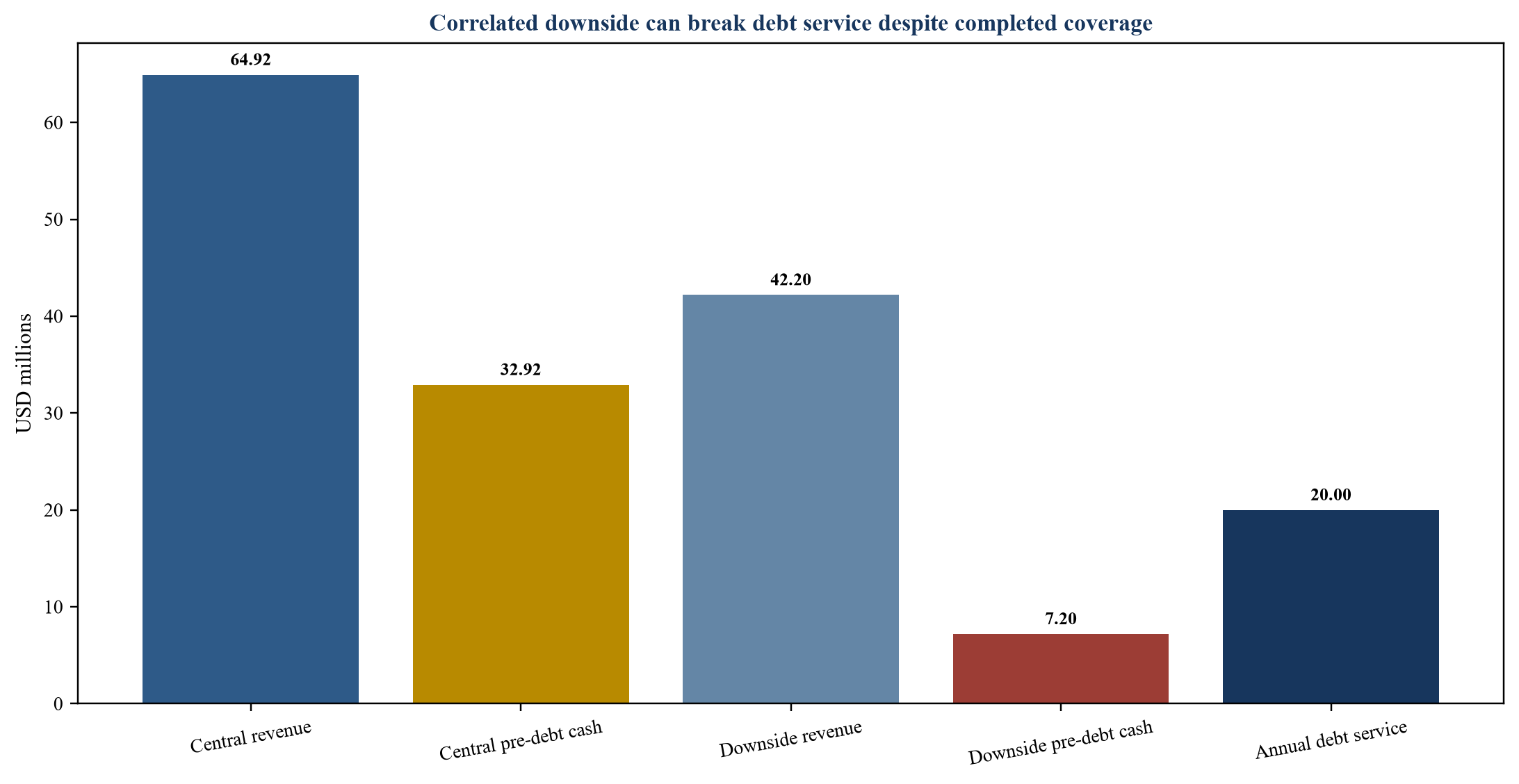
USD millions before tax and working capital; every value is an illustrative management assumption.
| Measure | Central case | Correlated downside | Decision meaning |
|---|---|---|---|
| Premises passed | 500,000 | 500,000 | Completed physical coverage |
| Active connections | 210,000 | 150,000 | Paying wholesale lines |
| Take-up | 42% | 30% | Demand conversion |
| Monthly wholesale price | 21 | 19 | Blended access yield |
| Consumer wholesale revenue | 52.92 | 34.20 | Recurring access revenue |
| Other revenue | 12.00 | 8.00 | Business and backhaul |
| Total revenue | 64.92 | 42.20 | Cash-generating base |
| Operating cost | 25.00 | 27.00 | Network and platform cost |
| Maintenance capital | 7.00 | 8.00 | Sustaining investment |
| Cash before debt service | 32.92 | 7.20 | Pre-tax, pre-working-capital cash |
| Annual debt service | 20.00 | 20.00 | Illustrative financing burden |
| DSCR | 1.65x | 0.36x | Liquidity and covenant outcome |
USD millions except premises, percentages and monthly price; every value is an illustrative management assumption.
25. Size debt to ramp and operating cash flow
Leverage must survive construction draw, delayed activation, working capital, interest during construction and the slowest credible take-up path. Model debt quantum, draw conditions, grace period, amortisation, interest, reserve accounts, covenants, cash sweep, hedging and refinancing. The analysis should distinguish observed technical, commercial, contractual, regulatory and financial evidence from management assumptions and connect each material judgment to coverage, competition, service quality, capital efficiency, financing and public purpose. Debt service should fit downside cash flow after operating cost and maintenance capital, with explicit cure and equity-support mechanics. The work should test central and correlated downside cases for build cost, permit delay, premises released, take-up, price, provider concentration, installation, churn, operating cost, maintenance capital, interest rates, liquidity and regulatory change. Exceptions require a named owner, source, due date and decision consequence. Unsupported demand, savings, subsidy, price growth, multiple expansion or refinancing remains outside the base case until enforceable evidence supports it. The section output should identify the governing source, contract, model line, accountable owner, warning threshold and capital consequence. This creates a traceable bridge from mapped demand to construction, wholesale revenue and financing.
26. Design equity and public-capital layers
Equity, subordinated capital and public support absorb different risks and should receive returns consistent with those risks. Define sponsor equity, institutional equity, concessional funding, grants, guarantees, preferred return, distributions and exit rights. The analysis should distinguish observed technical, commercial, contractual, regulatory and financial evidence from management assumptions and connect each material judgment to coverage, competition, service quality, capital efficiency, financing and public purpose. The capital stack should avoid hidden refinancing dependence and align completion, access and affordability obligations. The work should test central and correlated downside cases for build cost, permit delay, premises released, take-up, price, provider concentration, installation, churn, operating cost, maintenance capital, interest rates, liquidity and regulatory change. Exceptions require a named owner, source, due date and decision consequence. Unsupported demand, savings, subsidy, price growth, multiple expansion or refinancing remains outside the base case until enforceable evidence supports it. Evidence should remain traceable to premise, route, product, access seeker, order, asset, invoice, cash receipt and forecast period. Board and lender reporting should reconcile to the same operating records.
27. Fund liquidity through correlated downside
Construction delay, weaker take-up, price pressure and higher operating cost can occur together. Model minimum cash, committed liquidity, contingency, debt-service reserve, capex reserve and sponsor support under correlated scenarios. The analysis should distinguish observed technical, commercial, contractual, regulatory and financial evidence from management assumptions and connect each material judgment to coverage, competition, service quality, capital efficiency, financing and public purpose. Management should state warning thresholds, draw conditions, remediation actions and the point at which expansion stops. The work should test central and correlated downside cases for build cost, permit delay, premises released, take-up, price, provider concentration, installation, churn, operating cost, maintenance capital, interest rates, liquidity and regulatory change. Exceptions require a named owner, source, due date and decision consequence. Unsupported demand, savings, subsidy, price growth, multiple expansion or refinancing remains outside the base case until enforceable evidence supports it. Management should define the earliest warning indicator, intervention trigger and executable remedy. Reporting should preserve the approved baseline, change history, actual cost, service outcome and realised cash.
28. Establish neutral governance and information rights
Open access requires confidence that pricing, capacity, service and confidential information are handled without discrimination. Define board independence, related-party approvals, access-seeker information barriers, product change, capex priorities, regulatory reporting and complaints. The analysis should distinguish observed technical, commercial, contractual, regulatory and financial evidence from management assumptions and connect each material judgment to coverage, competition, service quality, capital efficiency, financing and public purpose. Governance should support commercial execution while protecting equal treatment and lender controls. The work should test central and correlated downside cases for build cost, permit delay, premises released, take-up, price, provider concentration, installation, churn, operating cost, maintenance capital, interest rates, liquidity and regulatory change. Exceptions require a named owner, source, due date and decision consequence. Unsupported demand, savings, subsidy, price growth, multiple expansion or refinancing remains outside the base case until enforceable evidence supports it. The section output should identify the governing source, contract, model line, accountable owner, warning threshold and capital consequence. This creates a traceable bridge from mapped demand to construction, wholesale revenue and financing.
29. Build the implementation roadmap
A financeable programme sequences mapping, design, anchor contracting, procurement, permits, funding, construction, systems, onboarding and service launch. Set stage gates, acceptance evidence, accountable owners, critical dependencies and contingency for each zone and workstream. The analysis should distinguish observed technical, commercial, contractual, regulatory and financial evidence from management assumptions and connect each material judgment to coverage, competition, service quality, capital efficiency, financing and public purpose. The roadmap should preserve operating continuity and cash control from first draw through stable take-up. The work should test central and correlated downside cases for build cost, permit delay, premises released, take-up, price, provider concentration, installation, churn, operating cost, maintenance capital, interest rates, liquidity and regulatory change. Exceptions require a named owner, source, due date and decision consequence. Unsupported demand, savings, subsidy, price growth, multiple expansion or refinancing remains outside the base case until enforceable evidence supports it. Evidence should remain traceable to premise, route, product, access seeker, order, asset, invoice, cash receipt and forecast period. Board and lender reporting should reconcile to the same operating records.
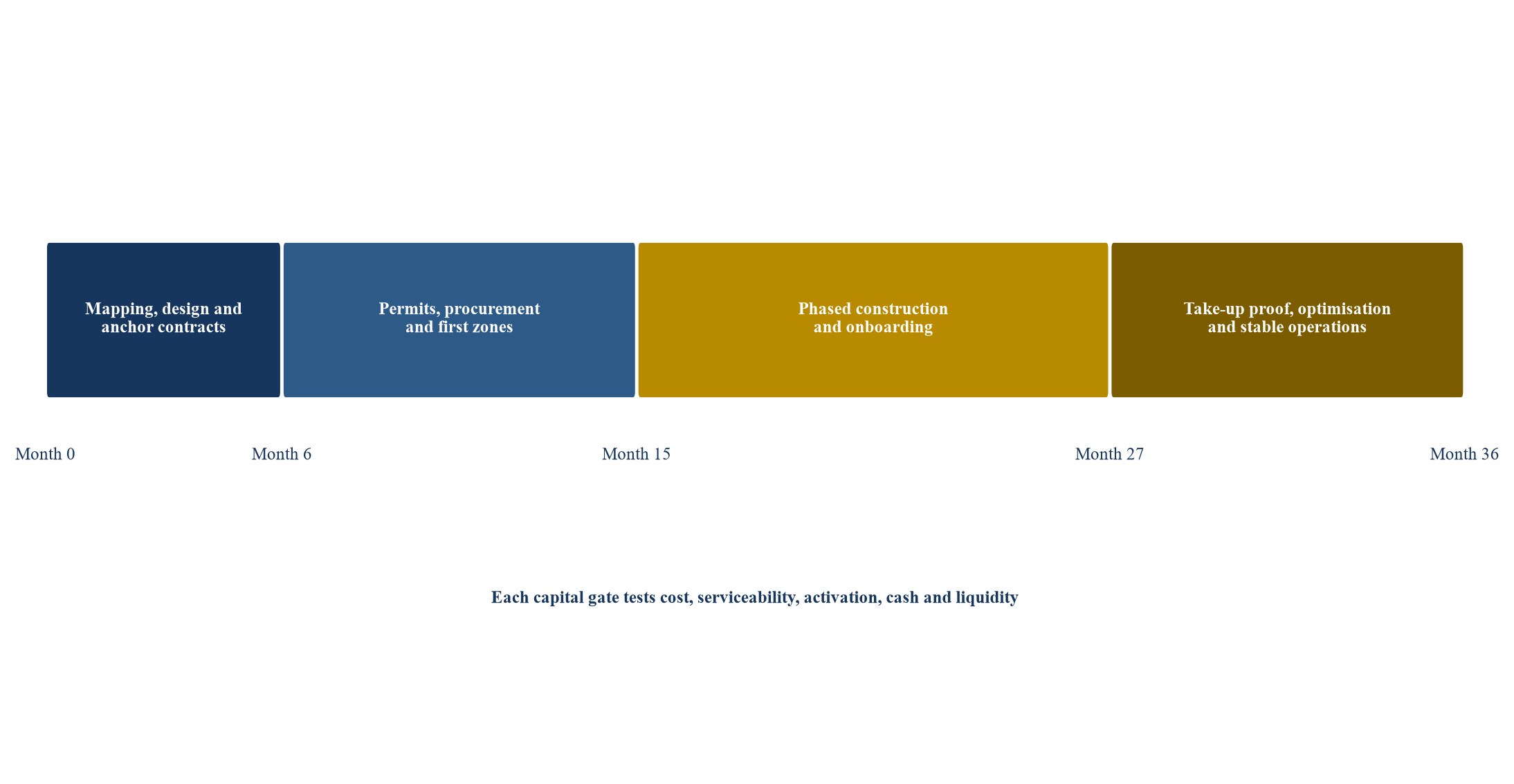
Capital release follows verified evidence, construction acceptance and take-up performance.
30. Define the investment and financing case
A bankable open-access network combines verified demand, efficient routes, enforceable access contracts, transparent pricing, phased build and resilient operations. Present the premise register, product ladder, anchor evidence, cost-to-complete, ramp, operating model, capital stack, downside liquidity and governance. The analysis should distinguish observed technical, commercial, contractual, regulatory and financial evidence from management assumptions and connect each material judgment to coverage, competition, service quality, capital efficiency, financing and public purpose. Commitment conditions should close material evidence gaps before unbuilt coverage or forecast take-up is treated as value. The work should test central and correlated downside cases for build cost, permit delay, premises released, take-up, price, provider concentration, installation, churn, operating cost, maintenance capital, interest rates, liquidity and regulatory change. Exceptions require a named owner, source, due date and decision consequence. Unsupported demand, savings, subsidy, price growth, multiple expansion or refinancing remains outside the base case until enforceable evidence supports it. Management should define the earliest warning indicator, intervention trigger and executable remedy. Reporting should preserve the approved baseline, change history, actual cost, service outcome and realised cash.
Sources
- International Telecommunication Union. Developing successful public-private partnerships to foster investment in universal broadband networks. Read the primary source
- International Telecommunication Union. ITU BBmaps Toolkit and Business Planning Toolkit. Read the primary source
- International Telecommunication Union. The Importance of Broadband Infrastructure and Services Mapping, 2024. Read the primary source
- International Telecommunication Union. Connectivity planning and broadband mapping. Read the primary source
- Broadband Commission for Sustainable Development. State of Broadband 2024. Read the primary source
- World Bank Group. Access: digital infrastructure and innovative financing solutions. Read the primary source
- World Bank Group. Bridging the Digital Divide: Digital Infrastructure Driving Jobs and Economic Growth, 15 May 2026. Read the primary source
- World Bank Group. Infrastructure Foundations: From Current Assets to Future Growth, 24 April 2026. Read the primary source
- World Bank PPP Resource Center. Next Generation Nationwide Broadband Network, Singapore. Read the primary source
- World Bank PPP Resource Center. Network and service separation and network or facilities access. Read the primary source
- World Bank PPP Resource Center. Broadband: Delivering next generation access through PPP. Read the primary source
- World Bank. Broadband Strategies Toolkit. Read the primary source
- Ofcom. Telecoms Access Review 2026-31 consultation, updated 10 February 2026. Read the primary source
- Ofcom. Review of the wholesale local access market. Read the primary source
- European Union. Regulation (EU) 2024/1309, Gigabit Infrastructure Act. Read the primary source
- European Commission. Gigabit Infrastructure Act policy page, updated 27 July 2026. Read the primary source
- European Commission. Recommendation on the regulatory promotion of gigabit connectivity, 6 February 2024. Read the primary source
- European Commission. Broadband State aid framework, 2025 scoreboard note. Read the primary source
- BEREC. Consistent approaches to price-control obligations and investment incentives, 3 May 2023. Read the primary source
- BEREC. Common Position on Layer 2 Wholesale Access Products. Read the primary source
- NBN Co. Annual Report 2025. Read the primary source
