

1. Define the separation decision
The telecom board must decide whether selling, partially monetising or independently capitalising passive infrastructure creates value after lease commitments, tax, separation cost and loss of control are recognised. State the strategic objective, asset perimeter, ownership outcome, proceeds use, anchor requirements, financing, governance and end-state operating model. The analysis should distinguish observed site, contract, operating, regulatory and financial evidence from management assumptions and connect each material judgment to network continuity, customer access, capital efficiency, financing and value. Approval should compare a carve-out with continued ownership, minority investment, joint venture and contractual sharing alternatives. The work should test central and correlated downside cases for anchor rent, escalation, ground rights, tenancy, colocation delivery, churn, power, operating cost, maintenance, build-to-suit capex, interest rates, currency, tax and regulatory remedies. Exceptions require a named owner, source, due date and decision consequence. Unsupported revenue, savings, multiple expansion or refinancing remains outside the base case until enforceable evidence supports it. The section output should identify the governing contract, site evidence, cash-flow line, risk owner, approval right and network consequence. This creates a traceable bridge from perimeter diligence to valuation, separation and post-close control.
A carve-out should be analysed as a bilateral value system. The operator may receive cash, reduce reported capital intensity and gain access to an infrastructure specialist, while assuming long-term occupancy payments and contractual limits on network change. The TowerCo acquires contracted anchor revenue and the opportunity to add tenants, while accepting site, ground, energy, operational, regulatory and financing risks. The two models should therefore reconcile site by site and year by year. Revenue to the TowerCo should map to cost or commitment for the operator, and every promised efficiency should identify the capability, contract or capital action that creates it. Scenario analysis should combine related pressures. Mobile consolidation can reduce anchor sites and third-party demand. Inflation can raise ground rent, power and maintenance faster than tenant escalators. New radio designs can change equipment loading and site density. Delayed colocations can weaken growth while build-to-suit commitments consume cash. Currency and interest-rate stress can affect financing while the anchor lease remains locally regulated or commercially fixed. A decision-grade model tests correlated outcomes, contract relief, liquidity and capex before using a transaction multiple or headline proceeds as evidence of value creation.
2. Use the Tower Carve-Out Economics Framework
The framework links physical sites, legal rights, network demand, commercial contracts, costs, capex, financing and valuation. Every assumption should reconcile to a site, structure, ground interest, tenant, contract, technology, cost centre and forecast year. The analysis should distinguish observed site, contract, operating, regulatory and financial evidence from management assumptions and connect each material judgment to network continuity, customer access, capital efficiency, financing and value. The seller and buyer models should use the same perimeter and translate every contract clause into both parties' cash flows. The work should test central and correlated downside cases for anchor rent, escalation, ground rights, tenancy, colocation delivery, churn, power, operating cost, maintenance, build-to-suit capex, interest rates, currency, tax and regulatory remedies. Exceptions require a named owner, source, due date and decision consequence. Unsupported revenue, savings, multiple expansion or refinancing remains outside the base case until enforceable evidence supports it. Evidence should remain traceable to site, structure, ground interest, tenant, contract, technology, cost centre and forecast year. The operator and TowerCo models should reconcile to the same physical and legal register.
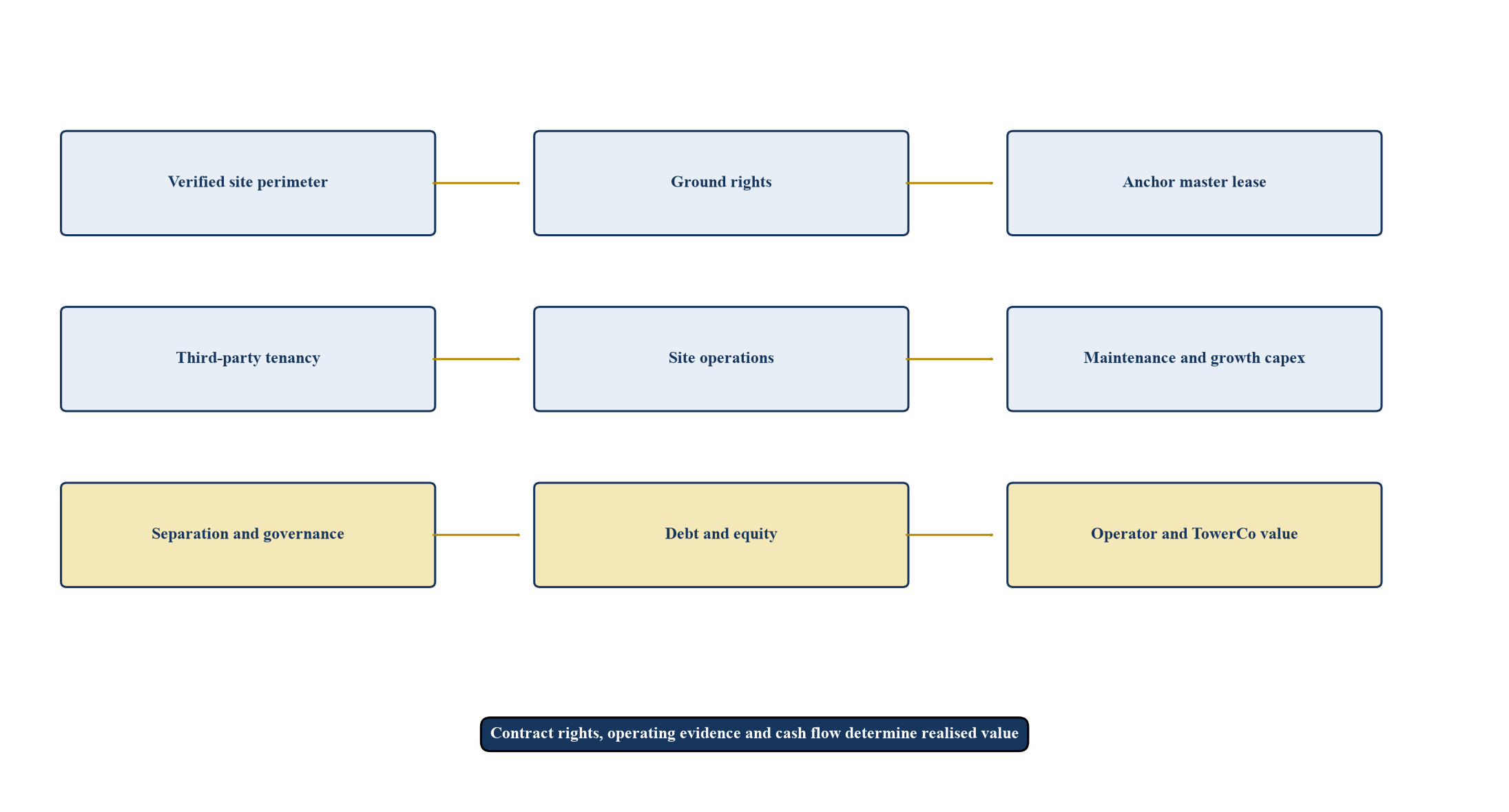
The value system connects the operator, TowerCo, customers, sites and capital providers.
3. Fix the asset perimeter
A tower portfolio may include masts, rooftops, land, shelters, power, fibre, access roads, permits, monitoring systems and active radio equipment. Classify owned, leased, licensed, shared, disputed and third-party-managed assets and identify active components that remain with the operator. The analysis should distinguish observed site, contract, operating, regulatory and financial evidence from management assumptions and connect each material judgment to network continuity, customer access, capital efficiency, financing and value. Completion accounts and post-close responsibility should follow a verified site register rather than a headline tower count. The work should test central and correlated downside cases for anchor rent, escalation, ground rights, tenancy, colocation delivery, churn, power, operating cost, maintenance, build-to-suit capex, interest rates, currency, tax and regulatory remedies. Exceptions require a named owner, source, due date and decision consequence. Unsupported revenue, savings, multiple expansion or refinancing remains outside the base case until enforceable evidence supports it. Management should define the earliest warning indicator, intervention trigger and executable remedy. Reporting should preserve the approved baseline, contract change and realised cash so growth, indexation and timing shifts remain distinguishable.
| Layer | Included evidence | Separation question | Value consequence |
|---|---|---|---|
| Structure | Tower, mast, rooftop and compound | What transfers? | Verified site count |
| Ground | Title, easement, lease and consent | Is use durable? | Contracted life |
| Network | Active and passive equipment | Who controls service? | Capex and operations |
| Commercial | Anchor and third-party contracts | What revenue is enforceable? | Cash-flow quality |
| Systems | Asset, billing and field data | Can the platform operate? | Standalone cost |
The site register should link physical, legal, operational and financial evidence.
4. Verify title and ground rights
Tower economics can be impaired when ground leases expire before tenant contracts, contain change-of-control restrictions or escalate faster than site revenue. Review land ownership, easements, rooftop licences, renewal options, landlord consent, access, registration, rent escalation, taxes and restoration obligations. The analysis should distinguish observed site, contract, operating, regulatory and financial evidence from management assumptions and connect each material judgment to network continuity, customer access, capital efficiency, financing and value. Value should reflect the duration and enforceability of the underlying right at each material site. The work should test central and correlated downside cases for anchor rent, escalation, ground rights, tenancy, colocation delivery, churn, power, operating cost, maintenance, build-to-suit capex, interest rates, currency, tax and regulatory remedies. Exceptions require a named owner, source, due date and decision consequence. Unsupported revenue, savings, multiple expansion or refinancing remains outside the base case until enforceable evidence supports it. The section output should identify the governing contract, site evidence, cash-flow line, risk owner, approval right and network consequence. This creates a traceable bridge from perimeter diligence to valuation, separation and post-close control.
5. Define the passive-active boundary
The transaction boundary determines network control, maintenance responsibility, upgrade rights and accounting treatment. Map structure, compound, power, cooling, security, fibre, backhaul, antenna, radio and software responsibilities. The analysis should distinguish observed site, contract, operating, regulatory and financial evidence from management assumptions and connect each material judgment to network continuity, customer access, capital efficiency, financing and value. The master lease and separation plan should prevent unowned assets, duplicate obligations and operational gaps. The work should test central and correlated downside cases for anchor rent, escalation, ground rights, tenancy, colocation delivery, churn, power, operating cost, maintenance, build-to-suit capex, interest rates, currency, tax and regulatory remedies. Exceptions require a named owner, source, due date and decision consequence. Unsupported revenue, savings, multiple expansion or refinancing remains outside the base case until enforceable evidence supports it. Evidence should remain traceable to site, structure, ground interest, tenant, contract, technology, cost centre and forecast year. The operator and TowerCo models should reconcile to the same physical and legal register.
6. Design the anchor master lease
The anchor contract creates the base cash flow and can also transfer inflexibility and cost back to the operator. Specify sites, reserved space, permitted equipment, service levels, term, renewals, pricing, escalators, pass-throughs, access, remedies and termination. The analysis should distinguish observed site, contract, operating, regulatory and financial evidence from management assumptions and connect each material judgment to network continuity, customer access, capital efficiency, financing and value. Model the operator's full cash commitment and the TowerCo's enforceable revenue before valuing the transaction. The work should test central and correlated downside cases for anchor rent, escalation, ground rights, tenancy, colocation delivery, churn, power, operating cost, maintenance, build-to-suit capex, interest rates, currency, tax and regulatory remedies. Exceptions require a named owner, source, due date and decision consequence. Unsupported revenue, savings, multiple expansion or refinancing remains outside the base case until enforceable evidence supports it. Management should define the earliest warning indicator, intervention trigger and executable remedy. Reporting should preserve the approved baseline, contract change and realised cash so growth, indexation and timing shifts remain distinguishable.
| Clause | TowerCo objective | Operator objective | Required test |
|---|---|---|---|
| Term and renewal | Durable contracted cash | Network flexibility | Effective duration |
| Escalation | Inflation protection | Cost predictability | Nominal and real burden |
| Reserved space | Anchor certainty | Upgrade capacity | Physical utilisation |
| Colocation | Third-party growth | Security and interference control | Neutral access |
| Decommissioning | Revenue protection | Network modernisation | Exit allowance and price |
| Build-to-suit | Growth pipeline | Delivery certainty | Order and acceptance evidence |
Each clause affects operator flexibility and TowerCo financeability.
7. Align lease term with network strategy
A long lease supports financing while constraining the operator's ability to modernise, consolidate or exit sites. Test initial term, renewal control, technology change, swap rights, relocation, decommissioning, termination payments and minimum-site commitments. The analysis should distinguish observed site, contract, operating, regulatory and financial evidence from management assumptions and connect each material judgment to network continuity, customer access, capital efficiency, financing and value. Flexibility should be priced explicitly rather than buried in a nominal headline rent. The work should test central and correlated downside cases for anchor rent, escalation, ground rights, tenancy, colocation delivery, churn, power, operating cost, maintenance, build-to-suit capex, interest rates, currency, tax and regulatory remedies. Exceptions require a named owner, source, due date and decision consequence. Unsupported revenue, savings, multiple expansion or refinancing remains outside the base case until enforceable evidence supports it. The section output should identify the governing contract, site evidence, cash-flow line, risk owner, approval right and network consequence. This creates a traceable bridge from perimeter diligence to valuation, separation and post-close control.
8. Price escalation and indexation
Fixed and inflation-linked escalators can create value for the TowerCo and a compounding cost burden for the anchor tenant. Model caps, floors, reference indices, reset dates, currency, pass-throughs and asymmetry between ground and tenant leases. The analysis should distinguish observed site, contract, operating, regulatory and financial evidence from management assumptions and connect each material judgment to network continuity, customer access, capital efficiency, financing and value. The operator should test nominal and real lease cost through every renewal period. The work should test central and correlated downside cases for anchor rent, escalation, ground rights, tenancy, colocation delivery, churn, power, operating cost, maintenance, build-to-suit capex, interest rates, currency, tax and regulatory remedies. Exceptions require a named owner, source, due date and decision consequence. Unsupported revenue, savings, multiple expansion or refinancing remains outside the base case until enforceable evidence supports it. Evidence should remain traceable to site, structure, ground interest, tenant, contract, technology, cost centre and forecast year. The operator and TowerCo models should reconcile to the same physical and legal register.
9. Measure the starting tenancy ratio
Tenancy ratio can overstate commercial depth when multiple technologies from one customer, inactive equipment or contracted future installations are counted inconsistently. Define active billable tenants, amendments, reserved capacity, colocations and pending orders at site level. The analysis should distinguish observed site, contract, operating, regulatory and financial evidence from management assumptions and connect each material judgment to network continuity, customer access, capital efficiency, financing and value. Diligence should reconcile commercial metrics to invoices, contracts and physical equipment. The work should test central and correlated downside cases for anchor rent, escalation, ground rights, tenancy, colocation delivery, churn, power, operating cost, maintenance, build-to-suit capex, interest rates, currency, tax and regulatory remedies. Exceptions require a named owner, source, due date and decision consequence. Unsupported revenue, savings, multiple expansion or refinancing remains outside the base case until enforceable evidence supports it. Management should define the earliest warning indicator, intervention trigger and executable remedy. Reporting should preserve the approved baseline, contract change and realised cash so growth, indexation and timing shifts remain distinguishable.
10. Underwrite colocation growth
The value thesis often depends on adding tenants at relatively low incremental site cost. Map demand by geography, spectrum, coverage gap, operator network plan, site loading, power, permits and competing infrastructure. The analysis should distinguish observed site, contract, operating, regulatory and financial evidence from management assumptions and connect each material judgment to network continuity, customer access, capital efficiency, financing and value. Only evidenced pipeline with executable rights, structural capacity and realistic delivery timing should enter the base case. The work should test central and correlated downside cases for anchor rent, escalation, ground rights, tenancy, colocation delivery, churn, power, operating cost, maintenance, build-to-suit capex, interest rates, currency, tax and regulatory remedies. Exceptions require a named owner, source, due date and decision consequence. Unsupported revenue, savings, multiple expansion or refinancing remains outside the base case until enforceable evidence supports it. The section output should identify the governing contract, site evidence, cash-flow line, risk owner, approval right and network consequence. This creates a traceable bridge from perimeter diligence to valuation, separation and post-close control.
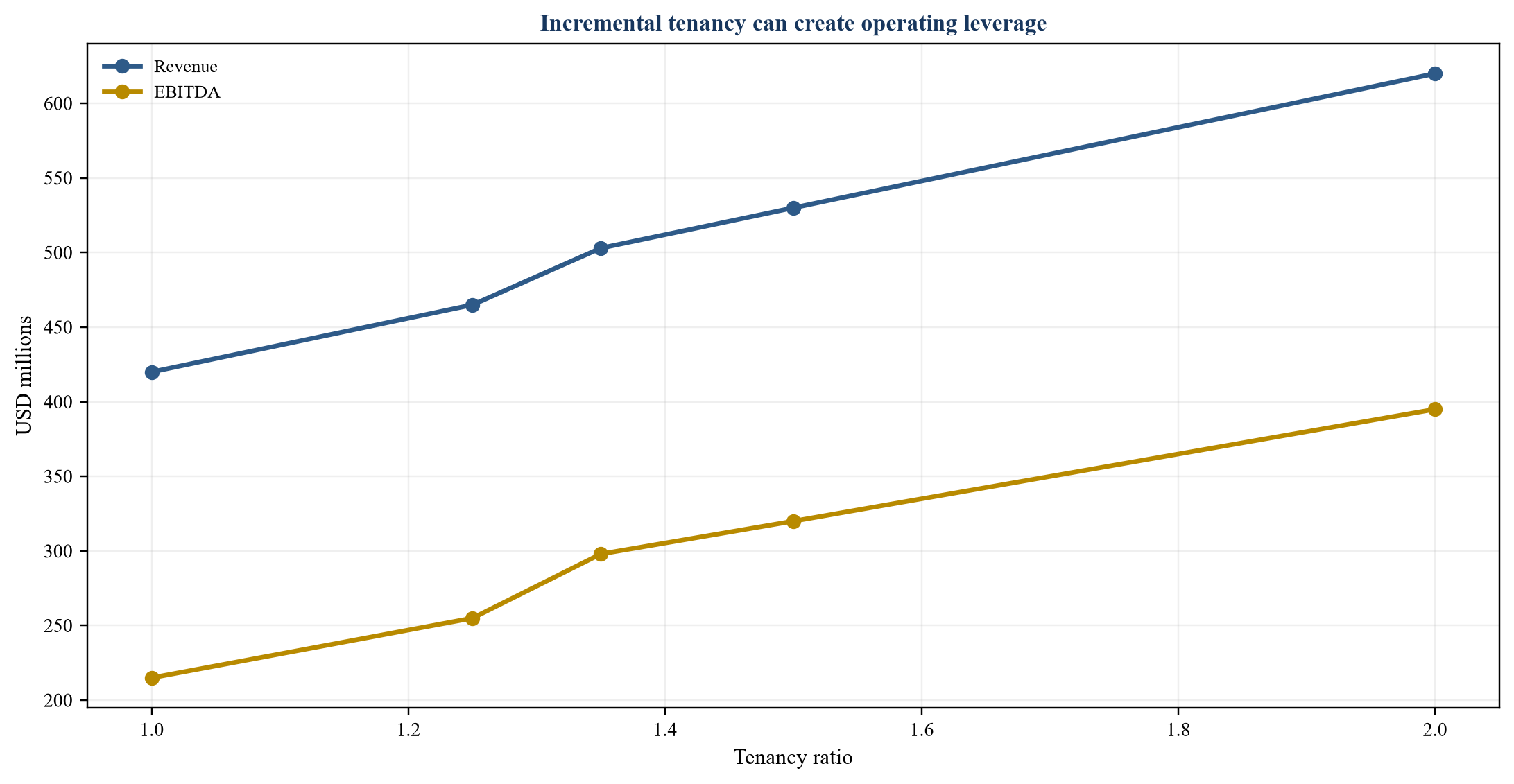
USD millions; all values are illustrative management assumptions.
11. Separate new tenancy from amendments
Additional equipment, spectrum and power at an existing tenant can produce revenue without increasing tenant count. Track new colocations, technology amendments, indexation, churn, consolidation and new-site revenue separately. The analysis should distinguish observed site, contract, operating, regulatory and financial evidence from management assumptions and connect each material judgment to network continuity, customer access, capital efficiency, financing and value. Organic growth should distinguish contractual escalation from genuine demand and capital-intensive delivery. The work should test central and correlated downside cases for anchor rent, escalation, ground rights, tenancy, colocation delivery, churn, power, operating cost, maintenance, build-to-suit capex, interest rates, currency, tax and regulatory remedies. Exceptions require a named owner, source, due date and decision consequence. Unsupported revenue, savings, multiple expansion or refinancing remains outside the base case until enforceable evidence supports it. Evidence should remain traceable to site, structure, ground interest, tenant, contract, technology, cost centre and forecast year. The operator and TowerCo models should reconcile to the same physical and legal register.
12. Protect fair third-party access
Anchor rights, reserved capacity or discriminatory processes can prevent an independent TowerCo from attracting competing tenants. Review access workflow, priority rights, information barriers, pricing, service levels, dispute mechanisms and regulatory obligations. The analysis should distinguish observed site, contract, operating, regulatory and financial evidence from management assumptions and connect each material judgment to network continuity, customer access, capital efficiency, financing and value. The commercial model should preserve neutral access while protecting network security and legitimate anchor needs. The work should test central and correlated downside cases for anchor rent, escalation, ground rights, tenancy, colocation delivery, churn, power, operating cost, maintenance, build-to-suit capex, interest rates, currency, tax and regulatory remedies. Exceptions require a named owner, source, due date and decision consequence. Unsupported revenue, savings, multiple expansion or refinancing remains outside the base case until enforceable evidence supports it. Management should define the earliest warning indicator, intervention trigger and executable remedy. Reporting should preserve the approved baseline, contract change and realised cash so growth, indexation and timing shifts remain distinguishable.
13. Model fixed-cost operating leverage
Tower site costs are often relatively stable over short periods, so additional tenancy can generate high incremental contribution. Separate ground rent, power, fuel, maintenance, monitoring, security, tax, insurance and central overhead by site and responsibility. The analysis should distinguish observed site, contract, operating, regulatory and financial evidence from management assumptions and connect each material judgment to network continuity, customer access, capital efficiency, financing and value. The model should show which costs vary with tenants, equipment load, grid availability and service levels. The work should test central and correlated downside cases for anchor rent, escalation, ground rights, tenancy, colocation delivery, churn, power, operating cost, maintenance, build-to-suit capex, interest rates, currency, tax and regulatory remedies. Exceptions require a named owner, source, due date and decision consequence. Unsupported revenue, savings, multiple expansion or refinancing remains outside the base case until enforceable evidence supports it. The section output should identify the governing contract, site evidence, cash-flow line, risk owner, approval right and network consequence. This creates a traceable bridge from perimeter diligence to valuation, separation and post-close control.
14. Allocate power and energy risk
Grid reliability, diesel, batteries, renewable systems and pass-through rules can materially change margins and service quality. Measure metering, consumption, losses, tariffs, backup obligations, fuel control, battery replacement and energy-capex recovery. The analysis should distinguish observed site, contract, operating, regulatory and financial evidence from management assumptions and connect each material judgment to network continuity, customer access, capital efficiency, financing and value. Power economics should be contractually auditable and consistent with environmental and resilience requirements. The work should test central and correlated downside cases for anchor rent, escalation, ground rights, tenancy, colocation delivery, churn, power, operating cost, maintenance, build-to-suit capex, interest rates, currency, tax and regulatory remedies. Exceptions require a named owner, source, due date and decision consequence. Unsupported revenue, savings, multiple expansion or refinancing remains outside the base case until enforceable evidence supports it. Evidence should remain traceable to site, structure, ground interest, tenant, contract, technology, cost centre and forecast year. The operator and TowerCo models should reconcile to the same physical and legal register.
15. Distinguish maintenance from growth capex
Routine asset preservation, structural reinforcement, new tenant equipment, build-to-suit sites and ground-right purchases have different returns. Classify capex by maintenance, compliance, revenue generation, expansion, energy and acquisition. The analysis should distinguish observed site, contract, operating, regulatory and financial evidence from management assumptions and connect each material judgment to network continuity, customer access, capital efficiency, financing and value. Valuation and financing should use cash returns after required maintenance rather than EBITDA alone. The work should test central and correlated downside cases for anchor rent, escalation, ground rights, tenancy, colocation delivery, churn, power, operating cost, maintenance, build-to-suit capex, interest rates, currency, tax and regulatory remedies. Exceptions require a named owner, source, due date and decision consequence. Unsupported revenue, savings, multiple expansion or refinancing remains outside the base case until enforceable evidence supports it. Management should define the earliest warning indicator, intervention trigger and executable remedy. Reporting should preserve the approved baseline, contract change and realised cash so growth, indexation and timing shifts remain distinguishable.
16. Price build-to-suit commitments
The anchor may require a TowerCo to fund new sites under a multi-year rollout, transferring delivery and utilisation risk. Define order process, forecast status, cancellation, site acquisition, permits, acceptance, lease commencement, pricing and minimum volume. The analysis should distinguish observed site, contract, operating, regulatory and financial evidence from management assumptions and connect each material judgment to network continuity, customer access, capital efficiency, financing and value. The model should distinguish committed orders from aspirational network plans and test cash before rent starts. The work should test central and correlated downside cases for anchor rent, escalation, ground rights, tenancy, colocation delivery, churn, power, operating cost, maintenance, build-to-suit capex, interest rates, currency, tax and regulatory remedies. Exceptions require a named owner, source, due date and decision consequence. Unsupported revenue, savings, multiple expansion or refinancing remains outside the base case until enforceable evidence supports it. The section output should identify the governing contract, site evidence, cash-flow line, risk owner, approval right and network consequence. This creates a traceable bridge from perimeter diligence to valuation, separation and post-close control.
17. Preserve decommissioning flexibility
Network consolidation, spectrum refarming, sharing and new radio architecture can reduce the need for some sites. Define annual termination allowances, swap pools, duplicate-site treatment, notice periods, make-whole payments and restoration. The analysis should distinguish observed site, contract, operating, regulatory and financial evidence from management assumptions and connect each material judgment to network continuity, customer access, capital efficiency, financing and value. The seller should value flexibility against proceeds; the buyer should model churn and stranded site costs. The work should test central and correlated downside cases for anchor rent, escalation, ground rights, tenancy, colocation delivery, churn, power, operating cost, maintenance, build-to-suit capex, interest rates, currency, tax and regulatory remedies. Exceptions require a named owner, source, due date and decision consequence. Unsupported revenue, savings, multiple expansion or refinancing remains outside the base case until enforceable evidence supports it. Evidence should remain traceable to site, structure, ground interest, tenant, contract, technology, cost centre and forecast year. The operator and TowerCo models should reconcile to the same physical and legal register.
18. Address customer concentration
An anchor tenant can dominate revenue, cash collection and strategic dependency even after third-party growth. Measure revenue, lease expiry, credit, churn and amendment concentration by customer, group and market. The analysis should distinguish observed site, contract, operating, regulatory and financial evidence from management assumptions and connect each material judgment to network continuity, customer access, capital efficiency, financing and value. Financing should stress anchor downgrade, consolidation, network sharing and delayed rollout. The work should test central and correlated downside cases for anchor rent, escalation, ground rights, tenancy, colocation delivery, churn, power, operating cost, maintenance, build-to-suit capex, interest rates, currency, tax and regulatory remedies. Exceptions require a named owner, source, due date and decision consequence. Unsupported revenue, savings, multiple expansion or refinancing remains outside the base case until enforceable evidence supports it. Management should define the earliest warning indicator, intervention trigger and executable remedy. Reporting should preserve the approved baseline, contract change and realised cash so growth, indexation and timing shifts remain distinguishable.
19. Test competition and regulatory risk
Tower consolidation can reduce alternative sites and affect mobile operator costs, entry and network deployment. Assess merger control, passive infrastructure regulation, access duties, site overlap, remedy risk and foreign-investment review. The analysis should distinguish observed site, contract, operating, regulatory and financial evidence from management assumptions and connect each material judgment to network continuity, customer access, capital efficiency, financing and value. Transaction timing, valuation and separability should incorporate credible remedy scenarios. The work should test central and correlated downside cases for anchor rent, escalation, ground rights, tenancy, colocation delivery, churn, power, operating cost, maintenance, build-to-suit capex, interest rates, currency, tax and regulatory remedies. Exceptions require a named owner, source, due date and decision consequence. Unsupported revenue, savings, multiple expansion or refinancing remains outside the base case until enforceable evidence supports it. The section output should identify the governing contract, site evidence, cash-flow line, risk owner, approval right and network consequence. This creates a traceable bridge from perimeter diligence to valuation, separation and post-close control.
20. Design the operating model
A carved-out TowerCo requires independent people, systems, procurement, field operations, finance, safety and customer management. Map retained, transferred and newly built capabilities and identify services supplied under transition arrangements. The analysis should distinguish observed site, contract, operating, regulatory and financial evidence from management assumptions and connect each material judgment to network continuity, customer access, capital efficiency, financing and value. The end-state cost base should replace temporary support before the transition agreement expires. The work should test central and correlated downside cases for anchor rent, escalation, ground rights, tenancy, colocation delivery, churn, power, operating cost, maintenance, build-to-suit capex, interest rates, currency, tax and regulatory remedies. Exceptions require a named owner, source, due date and decision consequence. Unsupported revenue, savings, multiple expansion or refinancing remains outside the base case until enforceable evidence supports it. Evidence should remain traceable to site, structure, ground interest, tenant, contract, technology, cost centre and forecast year. The operator and TowerCo models should reconcile to the same physical and legal register.
21. Build the separation roadmap
Site records, contracts, systems and field processes are often embedded in the operator's network organisation. Sequence legal transfer, consents, employee moves, data migration, service desk, maintenance, billing, treasury and control testing. The analysis should distinguish observed site, contract, operating, regulatory and financial evidence from management assumptions and connect each material judgment to network continuity, customer access, capital efficiency, financing and value. Each workstream should have an acceptance standard, owner, dependency and contingency. The work should test central and correlated downside cases for anchor rent, escalation, ground rights, tenancy, colocation delivery, churn, power, operating cost, maintenance, build-to-suit capex, interest rates, currency, tax and regulatory remedies. Exceptions require a named owner, source, due date and decision consequence. Unsupported revenue, savings, multiple expansion or refinancing remains outside the base case until enforceable evidence supports it. Management should define the earliest warning indicator, intervention trigger and executable remedy. Reporting should preserve the approved baseline, contract change and realised cash so growth, indexation and timing shifts remain distinguishable.
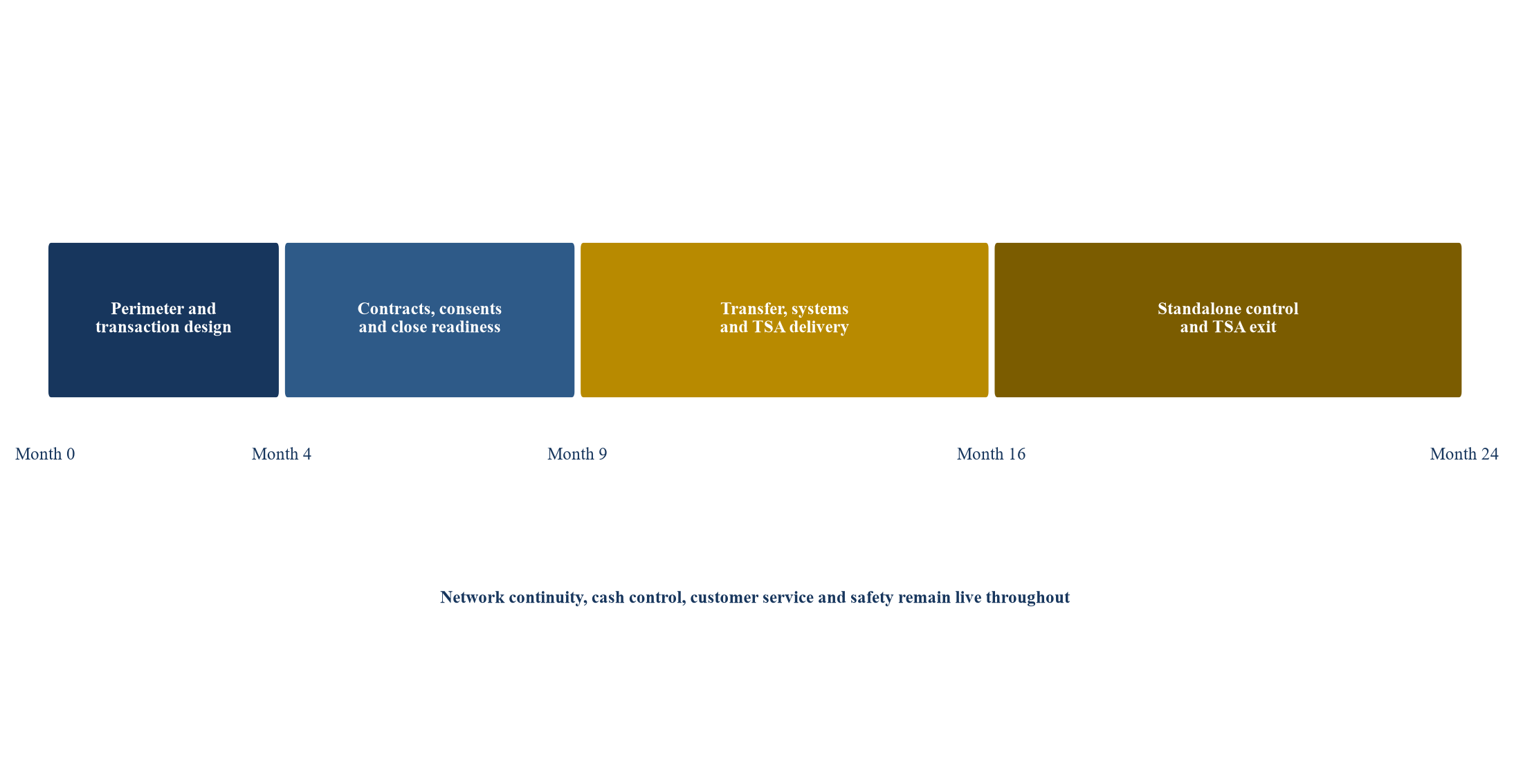
Illustrative sequence from perimeter confirmation to independent operations.
22. Control transition-service agreements
Broad or underpriced transition services can obscure standalone cost and delay independence. Define service catalogue, volume, price, service level, security, change control, exit milestones and extension charges. The analysis should distinguish observed site, contract, operating, regulatory and financial evidence from management assumptions and connect each material judgment to network continuity, customer access, capital efficiency, financing and value. The buyer should fund the replacement capability; the seller should protect operational continuity and a firm exit. The work should test central and correlated downside cases for anchor rent, escalation, ground rights, tenancy, colocation delivery, churn, power, operating cost, maintenance, build-to-suit capex, interest rates, currency, tax and regulatory remedies. Exceptions require a named owner, source, due date and decision consequence. Unsupported revenue, savings, multiple expansion or refinancing remains outside the base case until enforceable evidence supports it. The section output should identify the governing contract, site evidence, cash-flow line, risk owner, approval right and network consequence. This creates a traceable bridge from perimeter diligence to valuation, separation and post-close control.
23. Resolve accounting and tax treatment
A legal sale can produce different consolidation, lease, gain-recognition, deferred-tax and cash-flow outcomes depending on control and retained use. Assess the entity structure, sale criteria, lease definition, right-of-use assets, liabilities, retained interest, tax basis and withholding. The analysis should distinguish observed site, contract, operating, regulatory and financial evidence from management assumptions and connect each material judgment to network continuity, customer access, capital efficiency, financing and value. The board should view proceeds, leverage and ongoing lease economics through both accounting and cash lenses. The work should test central and correlated downside cases for anchor rent, escalation, ground rights, tenancy, colocation delivery, churn, power, operating cost, maintenance, build-to-suit capex, interest rates, currency, tax and regulatory remedies. Exceptions require a named owner, source, due date and decision consequence. Unsupported revenue, savings, multiple expansion or refinancing remains outside the base case until enforceable evidence supports it. Evidence should remain traceable to site, structure, ground interest, tenant, contract, technology, cost centre and forecast year. The operator and TowerCo models should reconcile to the same physical and legal register.
24. Build the hypothetical TowerCo
The hypothetical portfolio contains 10,000 sites with USD 420 million of anchor revenue, USD 63 million of third-party tenancy revenue and USD 503 million of total revenue. Assumed other revenue is USD 20 million, site costs are USD 170 million and overhead is USD 35 million. The analysis should distinguish observed site, contract, operating, regulatory and financial evidence from management assumptions and connect each material judgment to network continuity, customer access, capital efficiency, financing and value. The central case produces USD 298 million of EBITDA; the correlated downside produces USD 212 million. Every value is an illustrative management assumption. The work should test central and correlated downside cases for anchor rent, escalation, ground rights, tenancy, colocation delivery, churn, power, operating cost, maintenance, build-to-suit capex, interest rates, currency, tax and regulatory remedies. Exceptions require a named owner, source, due date and decision consequence. Unsupported revenue, savings, multiple expansion or refinancing remains outside the base case until enforceable evidence supports it. Management should define the earliest warning indicator, intervention trigger and executable remedy. Reporting should preserve the approved baseline, contract change and realised cash so growth, indexation and timing shifts remain distinguishable.
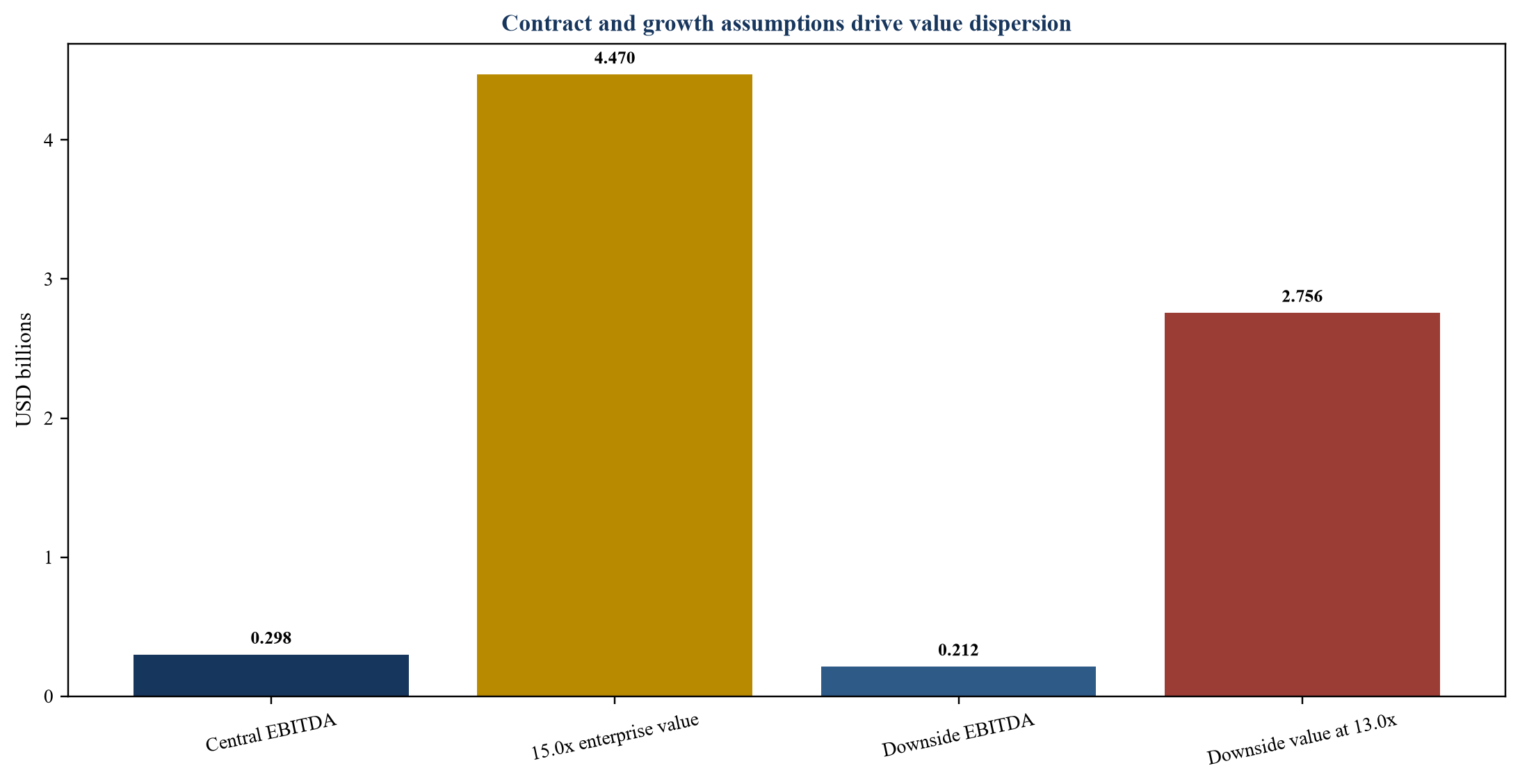
USD billions; all values and the 15.0x multiple are illustrative management assumptions.
| Measure | Central case | Correlated downside | Decision meaning |
|---|---|---|---|
| Sites | 10,000 | 10,000 | Verified perimeter |
| Anchor revenue per site | 42,000 | 38,000 | Master lease economics |
| Tenancy ratio | 1.35 | 1.25 | Colocation depth |
| Incremental revenue per tenant | 18,000 | 16,000 | Third-party pricing |
| Other revenue | 20 | 15 | Services and amendments |
| Total revenue | 503 | 435 | Cash-generating base |
| Site cash costs | 170 | 185 | Ground, power and maintenance |
| Central overhead | 35 | 38 | Standalone platform cost |
| EBITDA | 298 | 212 | Pre-financing result |
USD millions except sites, tenancy and per-unit values; every value is an illustrative management assumption.
25. Value the platform
A valuation multiple should reflect contract durability, ground rights, concentration, growth, capex, leverage, regulation and country risk. Bridge site-level revenue to EBITDA, maintenance capex, cash taxes, working capital, financing and distributable cash. The analysis should distinguish observed site, contract, operating, regulatory and financial evidence from management assumptions and connect each material judgment to network continuity, customer access, capital efficiency, financing and value. Use comparable-company, transaction and discounted-cash-flow evidence with consistent lease and accounting treatment. The work should test central and correlated downside cases for anchor rent, escalation, ground rights, tenancy, colocation delivery, churn, power, operating cost, maintenance, build-to-suit capex, interest rates, currency, tax and regulatory remedies. Exceptions require a named owner, source, due date and decision consequence. Unsupported revenue, savings, multiple expansion or refinancing remains outside the base case until enforceable evidence supports it. The section output should identify the governing contract, site evidence, cash-flow line, risk owner, approval right and network consequence. This creates a traceable bridge from perimeter diligence to valuation, separation and post-close control.
26. Reconcile operator and TowerCo value
The TowerCo's contracted revenue is the operator's future occupancy cost, so combined value cannot be assessed from sale proceeds alone. Compare proceeds, tax, stranded cost, debt reduction, retained stake and capital release with lease payments, flexibility loss and network investment. The analysis should distinguish observed site, contract, operating, regulatory and financial evidence from management assumptions and connect each material judgment to network continuity, customer access, capital efficiency, financing and value. Approve the transaction only when both sides' economics reconcile under the same scenarios. The work should test central and correlated downside cases for anchor rent, escalation, ground rights, tenancy, colocation delivery, churn, power, operating cost, maintenance, build-to-suit capex, interest rates, currency, tax and regulatory remedies. Exceptions require a named owner, source, due date and decision consequence. Unsupported revenue, savings, multiple expansion or refinancing remains outside the base case until enforceable evidence supports it. Evidence should remain traceable to site, structure, ground interest, tenant, contract, technology, cost centre and forecast year. The operator and TowerCo models should reconcile to the same physical and legal register.
| Value component | Operator view | TowerCo view | Diligence evidence |
|---|---|---|---|
| Upfront proceeds | Liquidity and debt reduction | Acquisition funding | Funds flow and tax |
| Anchor lease | Long-term network occupancy cost | Base contracted revenue | Site schedules and MLA |
| Colocation | Possible interference and competition | Growth and operating leverage | Pipeline and access rights |
| Capex | Reduced passive-asset funding | Maintenance and growth investment | Classification and returns |
| Flexibility | Exit, swap and modernisation need | Churn and stranded cost | Termination clauses |
| Retained stake | Future value participation | Governance constraint | Reserved matters and exit |
The same contract creates an asset for one party and a commitment for the other.
27. Design the financing
Tower leverage relies on recurring lease cash flow but remains exposed to concentration, indexation, ground rights and capex. Size debt, amortisation, reserves, hedging, covenant headroom and distributions against central and correlated downside cases. The analysis should distinguish observed site, contract, operating, regulatory and financial evidence from management assumptions and connect each material judgment to network continuity, customer access, capital efficiency, financing and value. Debt tenor should remain inside the effective contract and ground-right duration. The work should test central and correlated downside cases for anchor rent, escalation, ground rights, tenancy, colocation delivery, churn, power, operating cost, maintenance, build-to-suit capex, interest rates, currency, tax and regulatory remedies. Exceptions require a named owner, source, due date and decision consequence. Unsupported revenue, savings, multiple expansion or refinancing remains outside the base case until enforceable evidence supports it. Management should define the earliest warning indicator, intervention trigger and executable remedy. Reporting should preserve the approved baseline, contract change and realised cash so growth, indexation and timing shifts remain distinguishable.
28. Establish governance and reserved matters
A retained minority stake or joint control can preserve exposure while creating conflict between network and infrastructure objectives. Define board rights, budgets, capex, leverage, related-party contracts, new business, distributions, conflicts, deadlock and exit. The analysis should distinguish observed site, contract, operating, regulatory and financial evidence from management assumptions and connect each material judgment to network continuity, customer access, capital efficiency, financing and value. Governance should protect legitimate interests without preventing independent commercial execution. The work should test central and correlated downside cases for anchor rent, escalation, ground rights, tenancy, colocation delivery, churn, power, operating cost, maintenance, build-to-suit capex, interest rates, currency, tax and regulatory remedies. Exceptions require a named owner, source, due date and decision consequence. Unsupported revenue, savings, multiple expansion or refinancing remains outside the base case until enforceable evidence supports it. The section output should identify the governing contract, site evidence, cash-flow line, risk owner, approval right and network consequence. This creates a traceable bridge from perimeter diligence to valuation, separation and post-close control.
29. Set post-close performance measures
A completed transaction still needs evidence that the platform is independent, the network is protected and promised growth is real. Track site availability, service incidents, billing, cash collection, tenancy, amendments, churn, colocation delivery, capex returns and TSA exit. The analysis should distinguish observed site, contract, operating, regulatory and financial evidence from management assumptions and connect each material judgment to network continuity, customer access, capital efficiency, financing and value. Metrics should reconcile operational records to contracts, invoices, bank cash and board reporting. The work should test central and correlated downside cases for anchor rent, escalation, ground rights, tenancy, colocation delivery, churn, power, operating cost, maintenance, build-to-suit capex, interest rates, currency, tax and regulatory remedies. Exceptions require a named owner, source, due date and decision consequence. Unsupported revenue, savings, multiple expansion or refinancing remains outside the base case until enforceable evidence supports it. Evidence should remain traceable to site, structure, ground interest, tenant, contract, technology, cost centre and forecast year. The operator and TowerCo models should reconcile to the same physical and legal register.
30. Define the investment and transaction case
A financeable tower carve-out combines verified assets, durable ground rights, balanced anchor terms, neutral access, credible colocation and disciplined capital allocation. Present the perimeter, value bridge, lease burden, standalone model, financing, separation, regulation, governance and downside protections. The analysis should distinguish observed site, contract, operating, regulatory and financial evidence from management assumptions and connect each material judgment to network continuity, customer access, capital efficiency, financing and value. Completion conditions should close identified gaps before proceeds are treated as value created. The work should test central and correlated downside cases for anchor rent, escalation, ground rights, tenancy, colocation delivery, churn, power, operating cost, maintenance, build-to-suit capex, interest rates, currency, tax and regulatory remedies. Exceptions require a named owner, source, due date and decision consequence. Unsupported revenue, savings, multiple expansion or refinancing remains outside the base case until enforceable evidence supports it. Management should define the earliest warning indicator, intervention trigger and executable remedy. Reporting should preserve the approved baseline, contract change and realised cash so growth, indexation and timing shifts remain distinguishable.
Sources
- GSMA. Passive Infrastructure Providers, updated 17 October 2025. Read the primary source
- US Securities and Exchange Commission. American Tower Corporation 2025 Form 10-K. Read the primary source
- US Securities and Exchange Commission. SBA Communications Corporation 2025 Form 10-K. Read the primary source
- US Securities and Exchange Commission. Crown Castle Inc. 2025 Form 10-K. Read the primary source
- US Securities and Exchange Commission. Verizon Communications Inc. 2025 Form 10-K. Read the primary source
- Cellnex Telecom. FY 2025 results, 27 February 2026. Read the primary source
- Vodafone Group. Annual Report 2025. Read the primary source
- Vodafone Group. Annual Report 2025, lease commitments to Vantage Towers. Read the primary source
- Deutsche Telekom. Partnership with DigitalBridge and Brookfield for GD Towers, 14 July 2022. Read the primary source
- Deutsche Telekom. Annual Report 2025. Read the primary source
- Orange. Integrated Annual Report 2024-2025. Read the primary source
- UK Competition and Markets Authority. Cellnex and CK Hutchison UK towers merger inquiry. Read the primary source
- UK Competition and Markets Authority. Cellnex and CK Hutchison final report. Read the primary source
- UK Competition and Markets Authority. Tower site sale to address concerns in telecoms merger. Read the primary source
- European Commission. Case M.9674 Vodafone Italia and TIM and INWIT JV decision. Read the primary source
- IFRS Foundation. IFRS 16 Leases. Read the primary source
- IFRS Foundation. IAS 36 Impairment of Assets. Read the primary source
- IFRS Foundation. Post-implementation Review of IFRS 16: feedback summary from users of financial statements, January 2026. Read the primary source
- IFRS Foundation. Lease Liability in a Sale and Leaseback amendments, September 2022. Read the primary source
- Deutsche Telekom. Completion of the GD Towers majority sale, 1 February 2023. Read the primary source
