

1. Define the 72-hour control objective
Preserve lawful authority, cash, critical delivery and stakeholder confidence when a founder suddenly cannot act.
The succession team should reconcile governing documents, delegations, critical processes, obligations, relationships and disruption scenarios. Each conclusion records the accountable body, source, timing, candidate or owner, evidence, dependency, control and unresolved exception. The immediate output is an emergency succession charter.
Management continuity must be proved through operating outcomes while ownership choices remain explicit. Reviewers test capability, authority, relationships, stakeholder confidence and downside response against native records and observed performance. Company strategy, role requirements, family objectives and governing law control every conclusion.
Material gaps require an owner, corrective action, test, advice and decision date. Consequences should flow through leadership capacity, customer delivery, cash, financing, value, control, fairness and transaction timing. Residual risk remains visible until authority is operable, stakeholders are protected and the relevant governing bodies approve the next gate.
2. Define activation triggers
Specify incapacity, disappearance, detention, medical emergency, death and communication-loss thresholds with authorised confirmation.
The succession team should reconcile legal advice, medical or official evidence, documents, policy and board authority. Each conclusion records the accountable body, source, timing, candidate or owner, evidence, dependency, control and unresolved exception. The immediate output is an activation trigger matrix.
Management continuity must be proved through operating outcomes while ownership choices remain explicit. Reviewers test capability, authority, relationships, stakeholder confidence and downside response against native records and observed performance. Company strategy, role requirements, family objectives and governing law control every conclusion.
Material gaps require an owner, corrective action, test, advice and decision date. Consequences should flow through leadership capacity, customer delivery, cash, financing, value, control, fairness and transaction timing. Residual risk remains visible until authority is operable, stakeholders are protected and the relevant governing bodies approve the next gate.
3. Name the incident lead
Appoint a capable coordinator with authority to convene, record, escalate and integrate legal, operational and family workstreams.
The succession team should reconcile delegations, board rules, succession policy, contact tree and competence evidence. Each conclusion records the accountable body, source, timing, candidate or owner, evidence, dependency, control and unresolved exception. The immediate output is an incident command appointment.
Management continuity must be proved through operating outcomes while ownership choices remain explicit. Reviewers test capability, authority, relationships, stakeholder confidence and downside response against native records and observed performance. Company strategy, role requirements, family objectives and governing law control every conclusion.
Material gaps require an owner, corrective action, test, advice and decision date. Consequences should flow through leadership capacity, customer delivery, cash, financing, value, control, fairness and transaction timing. Residual risk remains visible until authority is operable, stakeholders are protected and the relevant governing bodies approve the next gate.
4. Establish the emergency room
Create a secure cadence, decision log, situation report and controlled document channel for the first 72 hours.
The succession team should reconcile contact list, collaboration tools, security controls, templates and owner availability. Each conclusion records the accountable body, source, timing, candidate or owner, evidence, dependency, control and unresolved exception. The immediate output is an emergency governance room.
Management continuity must be proved through operating outcomes while ownership choices remain explicit. Reviewers test capability, authority, relationships, stakeholder confidence and downside response against native records and observed performance. Company strategy, role requirements, family objectives and governing law control every conclusion.
Material gaps require an owner, corrective action, test, advice and decision date. Consequences should flow through leadership capacity, customer delivery, cash, financing, value, control, fairness and transaction timing. Residual risk remains visible until authority is operable, stakeholders are protected and the relevant governing bodies approve the next gate.
5. Verify legal status and facts
Confirm what is known, who can certify it and which conclusions remain pending before changing authority.
The succession team should reconcile official records, medical advice, counsel, witnesses and timestamped communications. Each conclusion records the accountable body, source, timing, candidate or owner, evidence, dependency, control and unresolved exception. The immediate output is a verified incident fact pattern.
Management continuity must be proved through operating outcomes while ownership choices remain explicit. Reviewers test capability, authority, relationships, stakeholder confidence and downside response against native records and observed performance. Company strategy, role requirements, family objectives and governing law control every conclusion.
Material gaps require an owner, corrective action, test, advice and decision date. Consequences should flow through leadership capacity, customer delivery, cash, financing, value, control, fairness and transaction timing. Residual risk remains visible until authority is operable, stakeholders are protected and the relevant governing bodies approve the next gate.
6. Map current authority
Identify directors, officers, attorneys, signatories, trustees, protectors, partners and delegated managers who can act now.
The succession team should reconcile registers, resolutions, powers, mandates, contracts and institution records. Each conclusion records the accountable body, source, timing, candidate or owner, evidence, dependency, control and unresolved exception. The immediate output is an emergency authority map.
Management continuity must be proved through operating outcomes while ownership choices remain explicit. Reviewers test capability, authority, relationships, stakeholder confidence and downside response against native records and observed performance. Company strategy, role requirements, family objectives and governing law control every conclusion.
Material gaps require an owner, corrective action, test, advice and decision date. Consequences should flow through leadership capacity, customer delivery, cash, financing, value, control, fairness and transaction timing. Residual risk remains visible until authority is operable, stakeholders are protected and the relevant governing bodies approve the next gate.
7. Test board continuity
Confirm quorum, chairing, notice, alternate directors, conflicts, written resolutions and appointment powers.
The succession team should reconcile articles, shareholder agreements, company law, board calendar and counsel advice. Each conclusion records the accountable body, source, timing, candidate or owner, evidence, dependency, control and unresolved exception. The immediate output is a board continuity certificate.
Management continuity must be proved through operating outcomes while ownership choices remain explicit. Reviewers test capability, authority, relationships, stakeholder confidence and downside response against native records and observed performance. Company strategy, role requirements, family objectives and governing law control every conclusion.
Material gaps require an owner, corrective action, test, advice and decision date. Consequences should flow through leadership capacity, customer delivery, cash, financing, value, control, fairness and transaction timing. Residual risk remains visible until authority is operable, stakeholders are protected and the relevant governing bodies approve the next gate.
8. Activate interim leadership
Install a time-limited acting structure with role boundaries, reporting, removal and handback rules.
The succession team should reconcile succession plan, delegations, employment terms, board decision and candidate readiness. Each conclusion records the accountable body, source, timing, candidate or owner, evidence, dependency, control and unresolved exception. The immediate output is an interim leadership mandate.
Management continuity must be proved through operating outcomes while ownership choices remain explicit. Reviewers test capability, authority, relationships, stakeholder confidence and downside response against native records and observed performance. Company strategy, role requirements, family objectives and governing law control every conclusion.
Material gaps require an owner, corrective action, test, advice and decision date. Consequences should flow through leadership capacity, customer delivery, cash, financing, value, control, fairness and transaction timing. Residual risk remains visible until authority is operable, stakeholders are protected and the relevant governing bodies approve the next gate.
Table 1. Emergency authority map
| Domain | Immediate authority | Evidence |
|---|---|---|
| board | quorum and appointment | articles and resolutions |
| management | acting mandate | delegation |
| banking | approved signatories | bank mandate |
| ownership | trigger mechanism | governing instrument |
Illustrative programme design; company-specific facts and authorised advice govern.
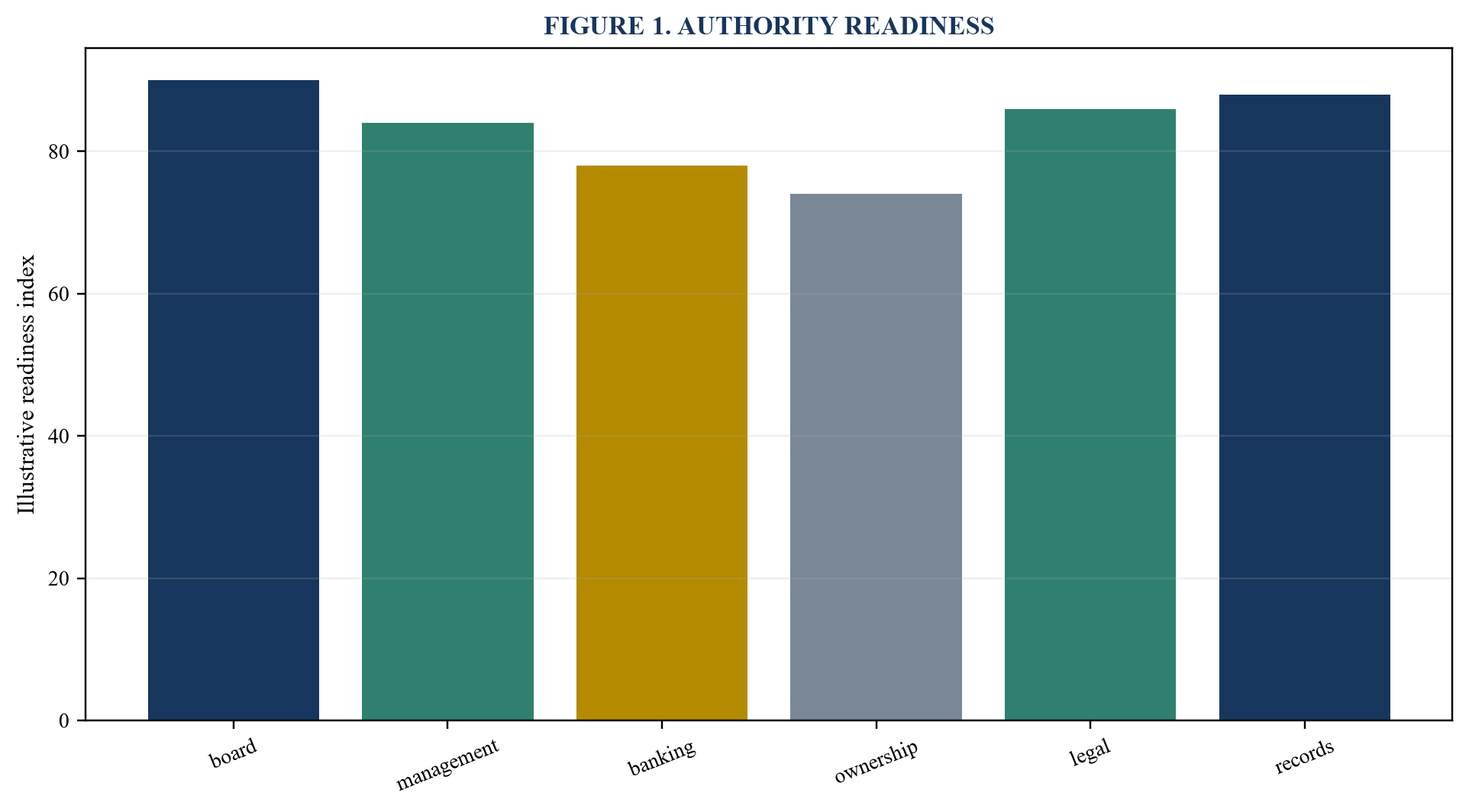
Values are illustrative readiness indices and require company-specific evidence.
9. Protect banking access
Verify signatories, transaction limits, dual controls, token access, emergency contacts and institution requirements.
The succession team should reconcile bank mandates, facilities, treasury procedures, KYC files and relationship records. Each conclusion records the accountable body, source, timing, candidate or owner, evidence, dependency, control and unresolved exception. The immediate output is a banking continuity pack.
Management continuity must be proved through operating outcomes while ownership choices remain explicit. Reviewers test capability, authority, relationships, stakeholder confidence and downside response against native records and observed performance. Company strategy, role requirements, family objectives and governing law control every conclusion.
Material gaps require an owner, corrective action, test, advice and decision date. Consequences should flow through leadership capacity, customer delivery, cash, financing, value, control, fairness and transaction timing. Residual risk remains visible until authority is operable, stakeholders are protected and the relevant governing bodies approve the next gate.
10. Secure the cash position
Produce immediate cash, collections, payroll, debt service, tax, supplier and restricted-fund visibility.
The succession team should reconcile bank data, receivables, payables, payroll, facilities, forecasts and covenants. Each conclusion records the accountable body, source, timing, candidate or owner, evidence, dependency, control and unresolved exception. The immediate output is a 13-week emergency cash view.
Management continuity must be proved through operating outcomes while ownership choices remain explicit. Reviewers test capability, authority, relationships, stakeholder confidence and downside response against native records and observed performance. Company strategy, role requirements, family objectives and governing law control every conclusion.
Material gaps require an owner, corrective action, test, advice and decision date. Consequences should flow through leadership capacity, customer delivery, cash, financing, value, control, fairness and transaction timing. Residual risk remains visible until authority is operable, stakeholders are protected and the relevant governing bodies approve the next gate.
11. Prioritise payments
Rank payroll, safety, critical suppliers, debt, tax and customer obligations under lawful authority and liquidity limits.
The succession team should reconcile cash forecast, contracts, law, operational priorities and approvals. Each conclusion records the accountable body, source, timing, candidate or owner, evidence, dependency, control and unresolved exception. The immediate output is a controlled payment waterfall.
Management continuity must be proved through operating outcomes while ownership choices remain explicit. Reviewers test capability, authority, relationships, stakeholder confidence and downside response against native records and observed performance. Company strategy, role requirements, family objectives and governing law control every conclusion.
Material gaps require an owner, corrective action, test, advice and decision date. Consequences should flow through leadership capacity, customer delivery, cash, financing, value, control, fairness and transaction timing. Residual risk remains visible until authority is operable, stakeholders are protected and the relevant governing bodies approve the next gate.
12. Preserve revenue and collections
Keep invoicing, acceptance, milestone evidence, collections and customer escalation functioning without founder intervention.
The succession team should reconcile contracts, delivery records, billing systems, account ownership and customer contacts. Each conclusion records the accountable body, source, timing, candidate or owner, evidence, dependency, control and unresolved exception. The immediate output is a revenue continuity plan.
Management continuity must be proved through operating outcomes while ownership choices remain explicit. Reviewers test capability, authority, relationships, stakeholder confidence and downside response against native records and observed performance. Company strategy, role requirements, family objectives and governing law control every conclusion.
Material gaps require an owner, corrective action, test, advice and decision date. Consequences should flow through leadership capacity, customer delivery, cash, financing, value, control, fairness and transaction timing. Residual risk remains visible until authority is operable, stakeholders are protected and the relevant governing bodies approve the next gate.
13. Protect customer delivery
Identify critical commitments, single-point dependencies, quality gates and authorised exceptions for priority accounts.
The succession team should reconcile customer contracts, project plans, service levels, resources and incident data. Each conclusion records the accountable body, source, timing, candidate or owner, evidence, dependency, control and unresolved exception. The immediate output is a customer delivery triage.
Management continuity must be proved through operating outcomes while ownership choices remain explicit. Reviewers test capability, authority, relationships, stakeholder confidence and downside response against native records and observed performance. Company strategy, role requirements, family objectives and governing law control every conclusion.
Material gaps require an owner, corrective action, test, advice and decision date. Consequences should flow through leadership capacity, customer delivery, cash, financing, value, control, fairness and transaction timing. Residual risk remains visible until authority is operable, stakeholders are protected and the relevant governing bodies approve the next gate.
14. Stabilise suppliers and partners
Secure essential inputs, credit, logistics, licences and subcontractors through controlled communication and payment.
The succession team should reconcile supplier register, contracts, dependencies, cash plan and relationship owners. Each conclusion records the accountable body, source, timing, candidate or owner, evidence, dependency, control and unresolved exception. The immediate output is a critical supplier plan.
Management continuity must be proved through operating outcomes while ownership choices remain explicit. Reviewers test capability, authority, relationships, stakeholder confidence and downside response against native records and observed performance. Company strategy, role requirements, family objectives and governing law control every conclusion.
Material gaps require an owner, corrective action, test, advice and decision date. Consequences should flow through leadership capacity, customer delivery, cash, financing, value, control, fairness and transaction timing. Residual risk remains visible until authority is operable, stakeholders are protected and the relevant governing bodies approve the next gate.
15. Control employee communication
Provide factual, role-based messages on leadership, payroll, safety, reporting and confidentiality.
The succession team should reconcile verified facts, HR policy, legal advice, manager cascade and Q&A. Each conclusion records the accountable body, source, timing, candidate or owner, evidence, dependency, control and unresolved exception. The immediate output is an employee communication brief.
Management continuity must be proved through operating outcomes while ownership choices remain explicit. Reviewers test capability, authority, relationships, stakeholder confidence and downside response against native records and observed performance. Company strategy, role requirements, family objectives and governing law control every conclusion.
Material gaps require an owner, corrective action, test, advice and decision date. Consequences should flow through leadership capacity, customer delivery, cash, financing, value, control, fairness and transaction timing. Residual risk remains visible until authority is operable, stakeholders are protected and the relevant governing bodies approve the next gate.
16. Retain key personnel
Identify flight risk, critical knowledge, authority gaps and proportionate retention measures.
The succession team should reconcile role map, contracts, reward data, succession cover and board approval. Each conclusion records the accountable body, source, timing, candidate or owner, evidence, dependency, control and unresolved exception. The immediate output is a critical-person retention plan.
Management continuity must be proved through operating outcomes while ownership choices remain explicit. Reviewers test capability, authority, relationships, stakeholder confidence and downside response against native records and observed performance. Company strategy, role requirements, family objectives and governing law control every conclusion.
Material gaps require an owner, corrective action, test, advice and decision date. Consequences should flow through leadership capacity, customer delivery, cash, financing, value, control, fairness and transaction timing. Residual risk remains visible until authority is operable, stakeholders are protected and the relevant governing bodies approve the next gate.
Table 2. First-day operating priorities
| Priority | Core evidence | Decision |
|---|---|---|
| cash | bank and 13-week view | payment control |
| people | payroll and critical roles | retention |
| customers | delivery and collections | triage |
| suppliers | critical dependencies | stabilise |
Illustrative programme design; company-specific facts and authorised advice govern.
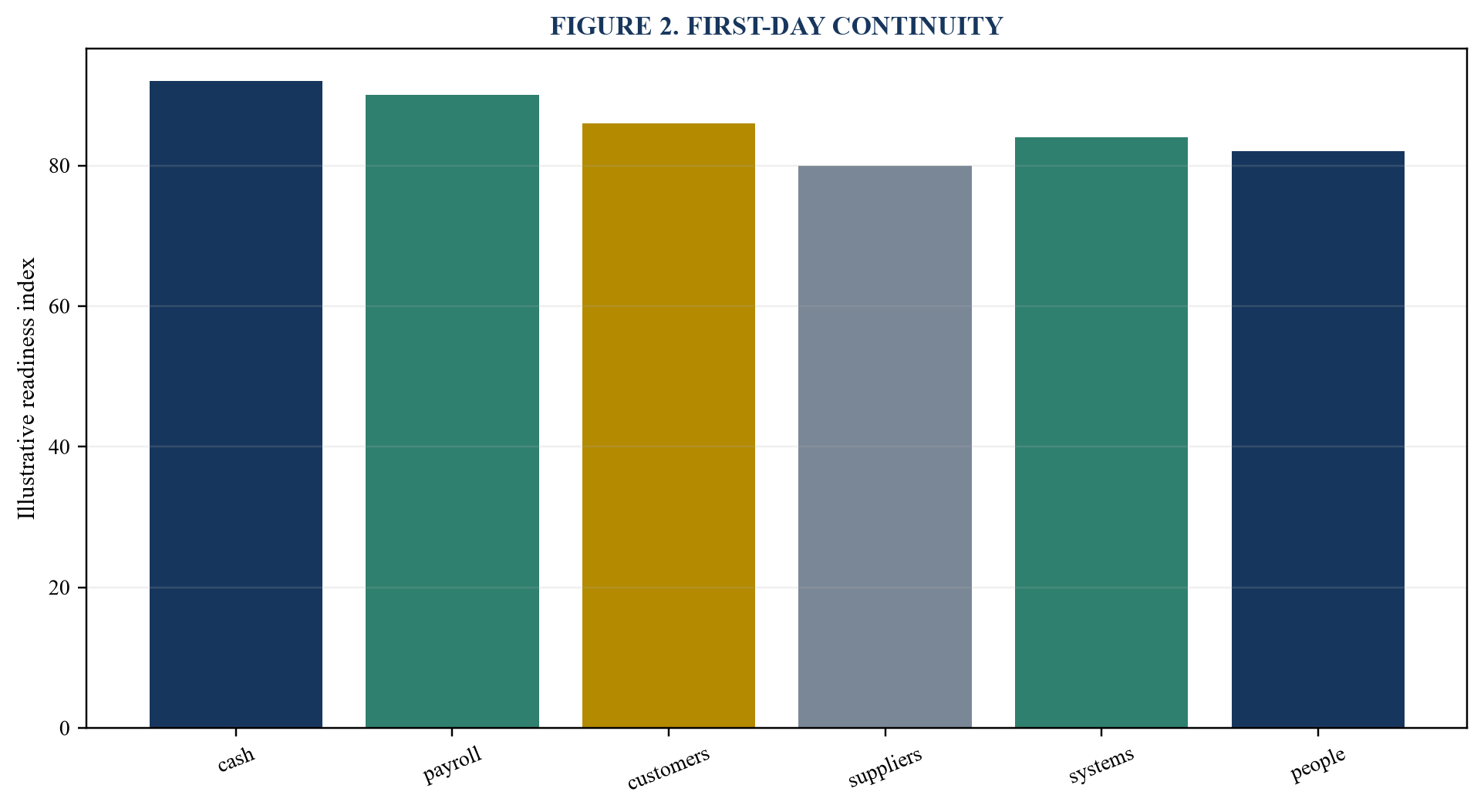
Values are illustrative readiness indices and require company-specific evidence.
17. Protect confidential information
Restrict medical, family, legal, transaction and personal data to authorised recipients and secure systems.
The succession team should reconcile data map, privacy law, privilege, access controls and incident protocol. Each conclusion records the accountable body, source, timing, candidate or owner, evidence, dependency, control and unresolved exception. The immediate output is a confidential information plan.
Management continuity must be proved through operating outcomes while ownership choices remain explicit. Reviewers test capability, authority, relationships, stakeholder confidence and downside response against native records and observed performance. Company strategy, role requirements, family objectives and governing law control every conclusion.
Material gaps require an owner, corrective action, test, advice and decision date. Consequences should flow through leadership capacity, customer delivery, cash, financing, value, control, fairness and transaction timing. Residual risk remains visible until authority is operable, stakeholders are protected and the relevant governing bodies approve the next gate.
18. Secure physical and digital access
Review premises, devices, credentials, certificates, administrator rights, backups and emergency recovery without bypassing controls.
The succession team should reconcile asset register, identity systems, cyber procedures, custody and authorised support. Each conclusion records the accountable body, source, timing, candidate or owner, evidence, dependency, control and unresolved exception. The immediate output is an access continuity protocol.
Management continuity must be proved through operating outcomes while ownership choices remain explicit. Reviewers test capability, authority, relationships, stakeholder confidence and downside response against native records and observed performance. Company strategy, role requirements, family objectives and governing law control every conclusion.
Material gaps require an owner, corrective action, test, advice and decision date. Consequences should flow through leadership capacity, customer delivery, cash, financing, value, control, fairness and transaction timing. Residual risk remains visible until authority is operable, stakeholders are protected and the relevant governing bodies approve the next gate.
19. Preserve books and records
Lock down accounting, contracts, approvals, registers, correspondence and evidence needed for later review.
The succession team should reconcile systems, repositories, retention policy, audit trail and custodians. Each conclusion records the accountable body, source, timing, candidate or owner, evidence, dependency, control and unresolved exception. The immediate output is a records preservation notice.
Management continuity must be proved through operating outcomes while ownership choices remain explicit. Reviewers test capability, authority, relationships, stakeholder confidence and downside response against native records and observed performance. Company strategy, role requirements, family objectives and governing law control every conclusion.
Material gaps require an owner, corrective action, test, advice and decision date. Consequences should flow through leadership capacity, customer delivery, cash, financing, value, control, fairness and transaction timing. Residual risk remains visible until authority is operable, stakeholders are protected and the relevant governing bodies approve the next gate.
20. Notify insurers where required
Review key-person, life, disability, D&O, business interruption and cyber notice conditions without prejudicing coverage.
The succession team should reconcile policies, brokers, incident facts, deadlines and counsel input. Each conclusion records the accountable body, source, timing, candidate or owner, evidence, dependency, control and unresolved exception. The immediate output is an insurance notification schedule.
Management continuity must be proved through operating outcomes while ownership choices remain explicit. Reviewers test capability, authority, relationships, stakeholder confidence and downside response against native records and observed performance. Company strategy, role requirements, family objectives and governing law control every conclusion.
Material gaps require an owner, corrective action, test, advice and decision date. Consequences should flow through leadership capacity, customer delivery, cash, financing, value, control, fairness and transaction timing. Residual risk remains visible until authority is operable, stakeholders are protected and the relevant governing bodies approve the next gate.
21. Test financing covenants and defaults
Identify key-person events, representation issues, consent needs, reporting deadlines and liquidity consequences.
The succession team should reconcile facility agreements, security, covenants, waivers, forecasts and lender contacts. Each conclusion records the accountable body, source, timing, candidate or owner, evidence, dependency, control and unresolved exception. The immediate output is a financing event matrix.
Management continuity must be proved through operating outcomes while ownership choices remain explicit. Reviewers test capability, authority, relationships, stakeholder confidence and downside response against native records and observed performance. Company strategy, role requirements, family objectives and governing law control every conclusion.
Material gaps require an owner, corrective action, test, advice and decision date. Consequences should flow through leadership capacity, customer delivery, cash, financing, value, control, fairness and transaction timing. Residual risk remains visible until authority is operable, stakeholders are protected and the relevant governing bodies approve the next gate.
22. Manage lender communication
Provide verified facts, continuity actions, cash evidence and requested consents through an authorised channel.
The succession team should reconcile facility terms, board mandate, situation report, forecast and advisers. Each conclusion records the accountable body, source, timing, candidate or owner, evidence, dependency, control and unresolved exception. The immediate output is a lender communication pack.
Management continuity must be proved through operating outcomes while ownership choices remain explicit. Reviewers test capability, authority, relationships, stakeholder confidence and downside response against native records and observed performance. Company strategy, role requirements, family objectives and governing law control every conclusion.
Material gaps require an owner, corrective action, test, advice and decision date. Consequences should flow through leadership capacity, customer delivery, cash, financing, value, control, fairness and transaction timing. Residual risk remains visible until authority is operable, stakeholders are protected and the relevant governing bodies approve the next gate.
23. Protect regulated permissions
Identify licences, approved persons, responsible officers, notifications and conditions affected by leadership disruption.
The succession team should reconcile licences, regulator rules, personnel records, legal advice and reporting calendar. Each conclusion records the accountable body, source, timing, candidate or owner, evidence, dependency, control and unresolved exception. The immediate output is a regulatory continuity schedule.
Management continuity must be proved through operating outcomes while ownership choices remain explicit. Reviewers test capability, authority, relationships, stakeholder confidence and downside response against native records and observed performance. Company strategy, role requirements, family objectives and governing law control every conclusion.
Material gaps require an owner, corrective action, test, advice and decision date. Consequences should flow through leadership capacity, customer delivery, cash, financing, value, control, fairness and transaction timing. Residual risk remains visible until authority is operable, stakeholders are protected and the relevant governing bodies approve the next gate.
24. Stabilise transaction processes
Assess live M&A, financing, litigation, procurement and investment approvals for authority, confidentiality and timetable risk.
The succession team should reconcile deal list, mandates, approvals, data rooms, counterparties and counsel. Each conclusion records the accountable body, source, timing, candidate or owner, evidence, dependency, control and unresolved exception. The immediate output is a transaction continuity register.
Management continuity must be proved through operating outcomes while ownership choices remain explicit. Reviewers test capability, authority, relationships, stakeholder confidence and downside response against native records and observed performance. Company strategy, role requirements, family objectives and governing law control every conclusion.
Material gaps require an owner, corrective action, test, advice and decision date. Consequences should flow through leadership capacity, customer delivery, cash, financing, value, control, fairness and transaction timing. Residual risk remains visible until authority is operable, stakeholders are protected and the relevant governing bodies approve the next gate.
Table 3. Stakeholder notification frame
| Stakeholder | Trigger | Control |
|---|---|---|
| lenders | key-person or consent event | verified pack |
| regulators | approved-person impact | timely filing |
| customers | delivery risk | account plan |
| employees | leadership uncertainty | manager cascade |
Illustrative programme design; company-specific facts and authorised advice govern.
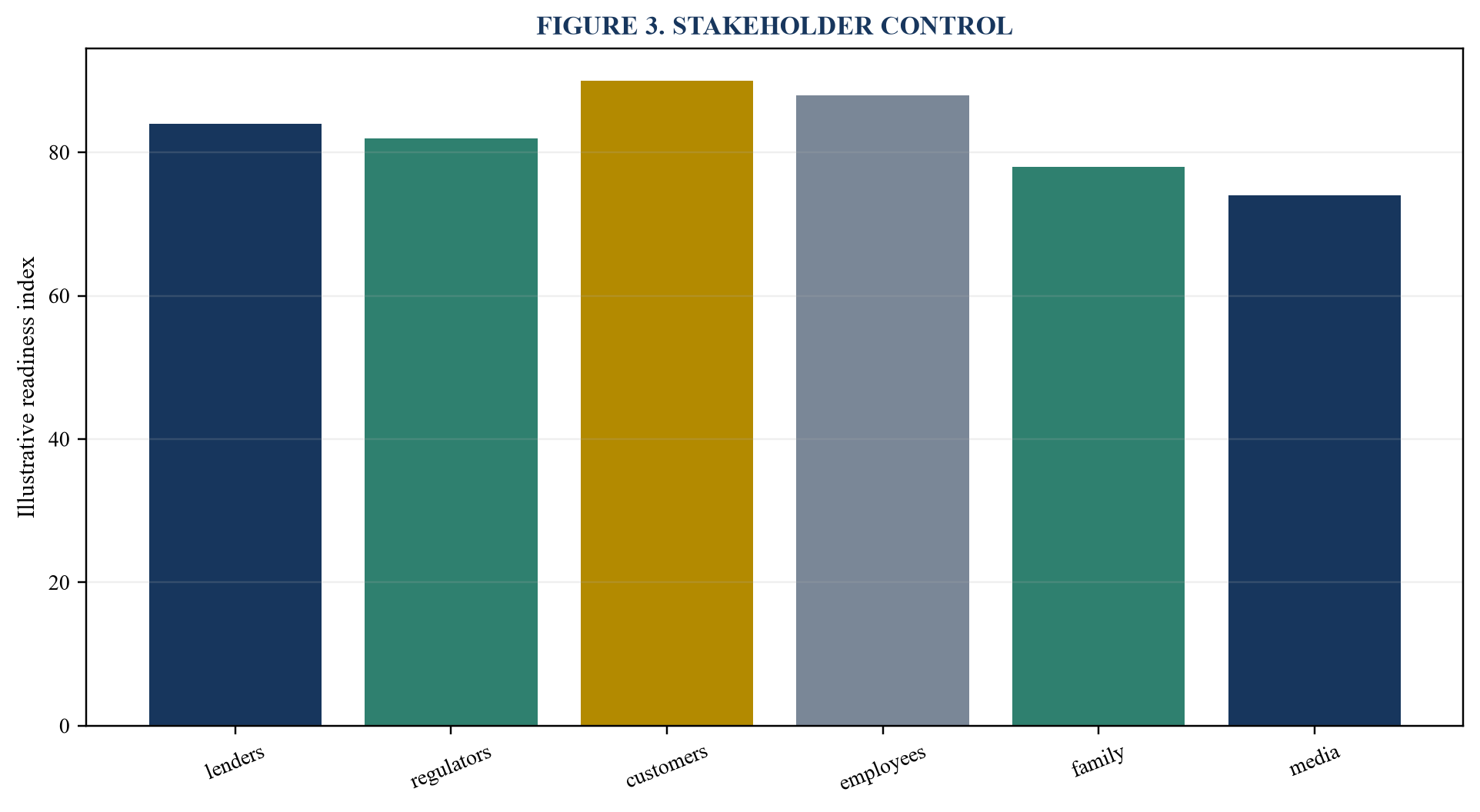
Values are illustrative readiness indices and require company-specific evidence.
25. Control public and media statements
Use one authorised spokesperson, verified facts, legal review and monitoring across external channels.
The succession team should reconcile communications policy, incident facts, stakeholder map and approvals. Each conclusion records the accountable body, source, timing, candidate or owner, evidence, dependency, control and unresolved exception. The immediate output is an external communications protocol.
Management continuity must be proved through operating outcomes while ownership choices remain explicit. Reviewers test capability, authority, relationships, stakeholder confidence and downside response against native records and observed performance. Company strategy, role requirements, family objectives and governing law control every conclusion.
Material gaps require an owner, corrective action, test, advice and decision date. Consequences should flow through leadership capacity, customer delivery, cash, financing, value, control, fairness and transaction timing. Residual risk remains visible until authority is operable, stakeholders are protected and the relevant governing bodies approve the next gate.
26. Coordinate the family interface
Separate family welfare, ownership decisions and operating management while maintaining an authorised information route.
The succession team should reconcile family constitution, ownership map, privacy, council roles and company authority. Each conclusion records the accountable body, source, timing, candidate or owner, evidence, dependency, control and unresolved exception. The immediate output is a family-company interface plan.
Management continuity must be proved through operating outcomes while ownership choices remain explicit. Reviewers test capability, authority, relationships, stakeholder confidence and downside response against native records and observed performance. Company strategy, role requirements, family objectives and governing law control every conclusion.
Material gaps require an owner, corrective action, test, advice and decision date. Consequences should flow through leadership capacity, customer delivery, cash, financing, value, control, fairness and transaction timing. Residual risk remains visible until authority is operable, stakeholders are protected and the relevant governing bodies approve the next gate.
27. Activate ownership procedures
Follow valid share, trust, foundation, estate and shareholder mechanisms triggered by incapacity or death.
The succession team should reconcile governing instruments, registers, trigger evidence, valuation and legal advice. Each conclusion records the accountable body, source, timing, candidate or owner, evidence, dependency, control and unresolved exception. The immediate output is an ownership activation map.
Management continuity must be proved through operating outcomes while ownership choices remain explicit. Reviewers test capability, authority, relationships, stakeholder confidence and downside response against native records and observed performance. Company strategy, role requirements, family objectives and governing law control every conclusion.
Material gaps require an owner, corrective action, test, advice and decision date. Consequences should flow through leadership capacity, customer delivery, cash, financing, value, control, fairness and transaction timing. Residual risk remains visible until authority is operable, stakeholders are protected and the relevant governing bodies approve the next gate.
28. Protect against unauthorised transfers
Monitor changes to shares, assets, mandates, related-party dealings and unusual payments during the control gap.
The succession team should reconcile registers, transaction monitoring, dual approval, alerts and audit evidence. Each conclusion records the accountable body, source, timing, candidate or owner, evidence, dependency, control and unresolved exception. The immediate output is an emergency asset-protection control.
Management continuity must be proved through operating outcomes while ownership choices remain explicit. Reviewers test capability, authority, relationships, stakeholder confidence and downside response against native records and observed performance. Company strategy, role requirements, family objectives and governing law control every conclusion.
Material gaps require an owner, corrective action, test, advice and decision date. Consequences should flow through leadership capacity, customer delivery, cash, financing, value, control, fairness and transaction timing. Residual risk remains visible until authority is operable, stakeholders are protected and the relevant governing bodies approve the next gate.
29. Map founder-only dependencies
Identify personal relationships, tacit knowledge, guarantees, passwords, licences and decisions that lack institutional cover.
The succession team should reconcile interviews, systems, contracts, contact data and process observation. Each conclusion records the accountable body, source, timing, candidate or owner, evidence, dependency, control and unresolved exception. The immediate output is a founder-dependency register.
Management continuity must be proved through operating outcomes while ownership choices remain explicit. Reviewers test capability, authority, relationships, stakeholder confidence and downside response against native records and observed performance. Company strategy, role requirements, family objectives and governing law control every conclusion.
Material gaps require an owner, corrective action, test, advice and decision date. Consequences should flow through leadership capacity, customer delivery, cash, financing, value, control, fairness and transaction timing. Residual risk remains visible until authority is operable, stakeholders are protected and the relevant governing bodies approve the next gate.
30. Transfer critical knowledge
Capture priority decisions, relationship context, project status, obligations and next actions from available records and deputies.
The succession team should reconcile board packs, diaries, messages, CRM, project files and deputies. Each conclusion records the accountable body, source, timing, candidate or owner, evidence, dependency, control and unresolved exception. The immediate output is a critical knowledge brief.
Management continuity must be proved through operating outcomes while ownership choices remain explicit. Reviewers test capability, authority, relationships, stakeholder confidence and downside response against native records and observed performance. Company strategy, role requirements, family objectives and governing law control every conclusion.
Material gaps require an owner, corrective action, test, advice and decision date. Consequences should flow through leadership capacity, customer delivery, cash, financing, value, control, fairness and transaction timing. Residual risk remains visible until authority is operable, stakeholders are protected and the relevant governing bodies approve the next gate.
31. Set decision thresholds
Distinguish reversible operating decisions, protected strategic matters and actions requiring shareholder, court or lender authority.
The succession team should reconcile delegations, reserved matters, law, contracts and risk appetite. Each conclusion records the accountable body, source, timing, candidate or owner, evidence, dependency, control and unresolved exception. The immediate output is an emergency decision-rights matrix.
Management continuity must be proved through operating outcomes while ownership choices remain explicit. Reviewers test capability, authority, relationships, stakeholder confidence and downside response against native records and observed performance. Company strategy, role requirements, family objectives and governing law control every conclusion.
Material gaps require an owner, corrective action, test, advice and decision date. Consequences should flow through leadership capacity, customer delivery, cash, financing, value, control, fairness and transaction timing. Residual risk remains visible until authority is operable, stakeholders are protected and the relevant governing bodies approve the next gate.
32. Run the 24-hour gate
Confirm authority, cash, payroll, safety, priority delivery, communications, data security and immediate notices.
The succession team should reconcile incident log, authority map, cash view, operational reports and counsel checks. Each conclusion records the accountable body, source, timing, candidate or owner, evidence, dependency, control and unresolved exception. The immediate output is a first-day control certificate.
Management continuity must be proved through operating outcomes while ownership choices remain explicit. Reviewers test capability, authority, relationships, stakeholder confidence and downside response against native records and observed performance. Company strategy, role requirements, family objectives and governing law control every conclusion.
Material gaps require an owner, corrective action, test, advice and decision date. Consequences should flow through leadership capacity, customer delivery, cash, financing, value, control, fairness and transaction timing. Residual risk remains visible until authority is operable, stakeholders are protected and the relevant governing bodies approve the next gate.
Table 4. Seventy-two-hour gates
| Gate | Required outcome | Evidence |
|---|---|---|
| 24 hours | control established | authority certificate |
| 48 hours | operations stabilised | stakeholder record |
| 72 hours | interim model sustainable | continuity certificate |
| 30 days | transition path approved | stabilisation plan |
Illustrative programme design; company-specific facts and authorised advice govern.
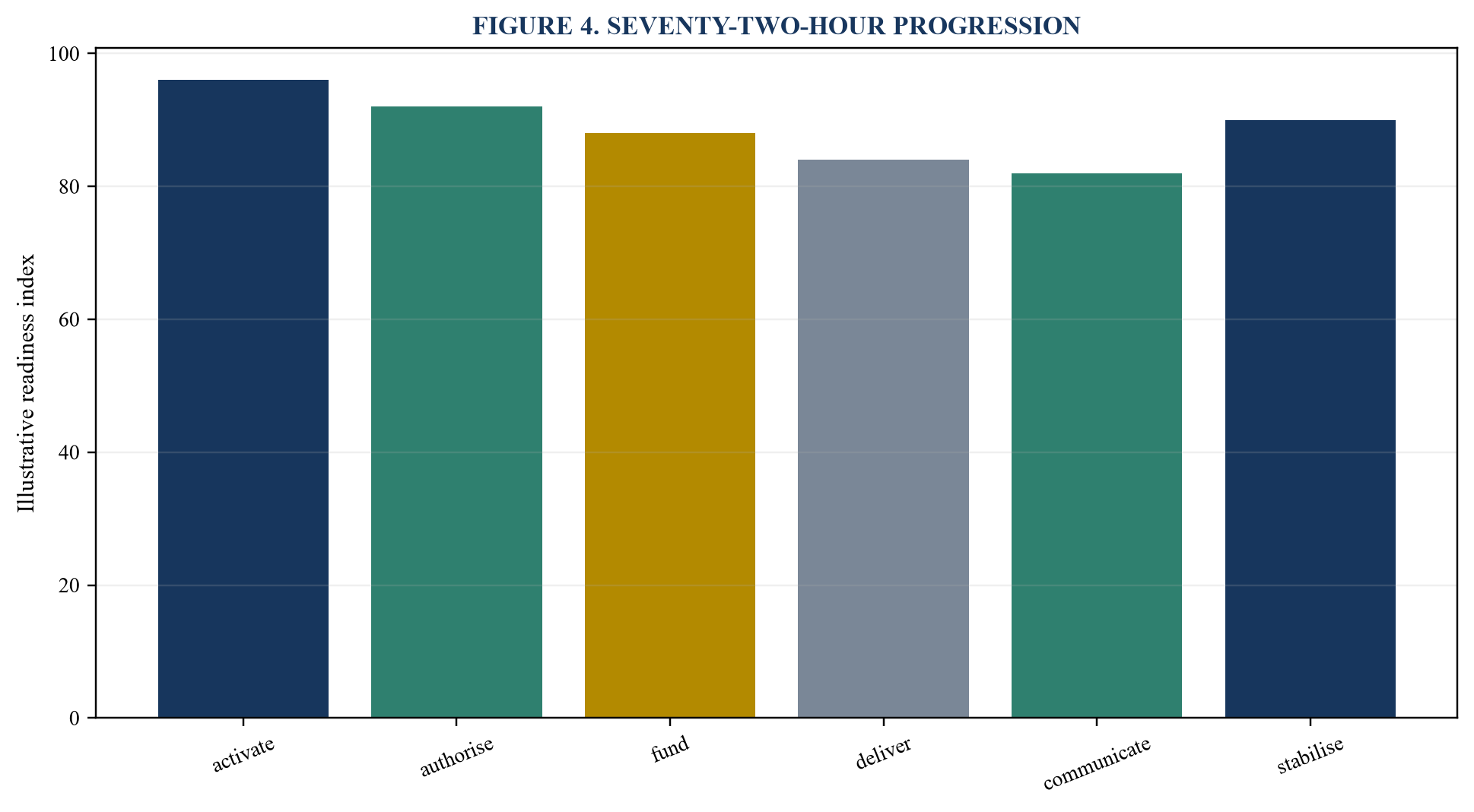
Values are illustrative readiness indices and require company-specific evidence.
33. Run the 48-hour gate
Confirm acting leadership, customer and supplier continuity, lender posture, regulatory actions and key-person stability.
The succession team should reconcile board record, stakeholder updates, covenant analysis and workforce evidence. Each conclusion records the accountable body, source, timing, candidate or owner, evidence, dependency, control and unresolved exception. The immediate output is a second-day stability certificate.
Management continuity must be proved through operating outcomes while ownership choices remain explicit. Reviewers test capability, authority, relationships, stakeholder confidence and downside response against native records and observed performance. Company strategy, role requirements, family objectives and governing law control every conclusion.
Material gaps require an owner, corrective action, test, advice and decision date. Consequences should flow through leadership capacity, customer delivery, cash, financing, value, control, fairness and transaction timing. Residual risk remains visible until authority is operable, stakeholders are protected and the relevant governing bodies approve the next gate.
34. Run the 72-hour gate
Confirm sustainable interim governance, funded operations, active risk controls, ownership pathway and next review cycle.
The succession team should reconcile integrated situation report, forecasts, approvals, exception log and advisers. Each conclusion records the accountable body, source, timing, candidate or owner, evidence, dependency, control and unresolved exception. The immediate output is a third-day continuity certificate.
Management continuity must be proved through operating outcomes while ownership choices remain explicit. Reviewers test capability, authority, relationships, stakeholder confidence and downside response against native records and observed performance. Company strategy, role requirements, family objectives and governing law control every conclusion.
Material gaps require an owner, corrective action, test, advice and decision date. Consequences should flow through leadership capacity, customer delivery, cash, financing, value, control, fairness and transaction timing. Residual risk remains visible until authority is operable, stakeholders are protected and the relevant governing bodies approve the next gate.
35. Escalate unresolved authority gaps
Seek urgent shareholder, trustee, lender, regulator, arbitral or court action where documents cannot supply lawful authority.
The succession team should reconcile gap analysis, forum rules, evidence, urgency, counsel and proposed relief. Each conclusion records the accountable body, source, timing, candidate or owner, evidence, dependency, control and unresolved exception. The immediate output is an authority escalation brief.
Management continuity must be proved through operating outcomes while ownership choices remain explicit. Reviewers test capability, authority, relationships, stakeholder confidence and downside response against native records and observed performance. Company strategy, role requirements, family objectives and governing law control every conclusion.
Material gaps require an owner, corrective action, test, advice and decision date. Consequences should flow through leadership capacity, customer delivery, cash, financing, value, control, fairness and transaction timing. Residual risk remains visible until authority is operable, stakeholders are protected and the relevant governing bodies approve the next gate.
36. Plan the next thirty days
Convert emergency response into leadership assessment, cash management, governance, ownership and stakeholder workplans.
The succession team should reconcile 72-hour findings, business plan, family objectives, forecasts and adviser scopes. Each conclusion records the accountable body, source, timing, candidate or owner, evidence, dependency, control and unresolved exception. The immediate output is a thirty-day stabilisation plan.
Management continuity must be proved through operating outcomes while ownership choices remain explicit. Reviewers test capability, authority, relationships, stakeholder confidence and downside response against native records and observed performance. Company strategy, role requirements, family objectives and governing law control every conclusion.
Material gaps require an owner, corrective action, test, advice and decision date. Consequences should flow through leadership capacity, customer delivery, cash, financing, value, control, fairness and transaction timing. Residual risk remains visible until authority is operable, stakeholders are protected and the relevant governing bodies approve the next gate.
37. Design handback or permanent transition
Define evidence, approvals, timing and communications for founder return or appointment of permanent leadership.
The succession team should reconcile medical or legal status, performance evidence, succession process and governing documents. Each conclusion records the accountable body, source, timing, candidate or owner, evidence, dependency, control and unresolved exception. The immediate output is a leadership transition protocol.
Management continuity must be proved through operating outcomes while ownership choices remain explicit. Reviewers test capability, authority, relationships, stakeholder confidence and downside response against native records and observed performance. Company strategy, role requirements, family objectives and governing law control every conclusion.
Material gaps require an owner, corrective action, test, advice and decision date. Consequences should flow through leadership capacity, customer delivery, cash, financing, value, control, fairness and transaction timing. Residual risk remains visible until authority is operable, stakeholders are protected and the relevant governing bodies approve the next gate.
38. Test the plan through simulation
Exercise absence, incapacity, death, cyber lockout, bank freeze and customer shock scenarios with observed response times.
The succession team should reconcile scenario scripts, participants, systems, decision logs and remediation owners. Each conclusion records the accountable body, source, timing, candidate or owner, evidence, dependency, control and unresolved exception. The immediate output is an emergency succession exercise report.
Management continuity must be proved through operating outcomes while ownership choices remain explicit. Reviewers test capability, authority, relationships, stakeholder confidence and downside response against native records and observed performance. Company strategy, role requirements, family objectives and governing law control every conclusion.
Material gaps require an owner, corrective action, test, advice and decision date. Consequences should flow through leadership capacity, customer delivery, cash, financing, value, control, fairness and transaction timing. Residual risk remains visible until authority is operable, stakeholders are protected and the relevant governing bodies approve the next gate.
39. Remediate structural weaknesses
Update delegations, mandates, board composition, insurance, systems, documentation and succession cover after testing.
The succession team should reconcile exercise findings, legal review, cost, dependencies and approvals. Each conclusion records the accountable body, source, timing, candidate or owner, evidence, dependency, control and unresolved exception. The immediate output is a succession resilience programme.
Management continuity must be proved through operating outcomes while ownership choices remain explicit. Reviewers test capability, authority, relationships, stakeholder confidence and downside response against native records and observed performance. Company strategy, role requirements, family objectives and governing law control every conclusion.
Material gaps require an owner, corrective action, test, advice and decision date. Consequences should flow through leadership capacity, customer delivery, cash, financing, value, control, fairness and transaction timing. Residual risk remains visible until authority is operable, stakeholders are protected and the relevant governing bodies approve the next gate.
40. Issue the emergency succession conclusion
Present activation, authority, cash, delivery, stakeholder, ownership, risk, approval and remediation conclusions.
The succession team should reconcile verified facts, decision logs, models, simulations, advice and consents. Each conclusion records the accountable body, source, timing, candidate or owner, evidence, dependency, control and unresolved exception. The immediate output is a board emergency succession paper.
Management continuity must be proved through operating outcomes while ownership choices remain explicit. Reviewers test capability, authority, relationships, stakeholder confidence and downside response against native records and observed performance. Company strategy, role requirements, family objectives and governing law control every conclusion.
Material gaps require an owner, corrective action, test, advice and decision date. Consequences should flow through leadership capacity, customer delivery, cash, financing, value, control, fairness and transaction timing. Residual risk remains visible until authority is operable, stakeholders are protected and the relevant governing bodies approve the next gate.
Table 5. Emergency succession certificate
| Dimension | Required conclusion | Decision use |
|---|---|---|
| authority | lawful actors identified | control |
| liquidity | critical obligations funded | survival |
| delivery | priority commitments protected | confidence |
| transition | next leadership path approved | continuity |
Illustrative programme design; company-specific facts and authorised advice govern.
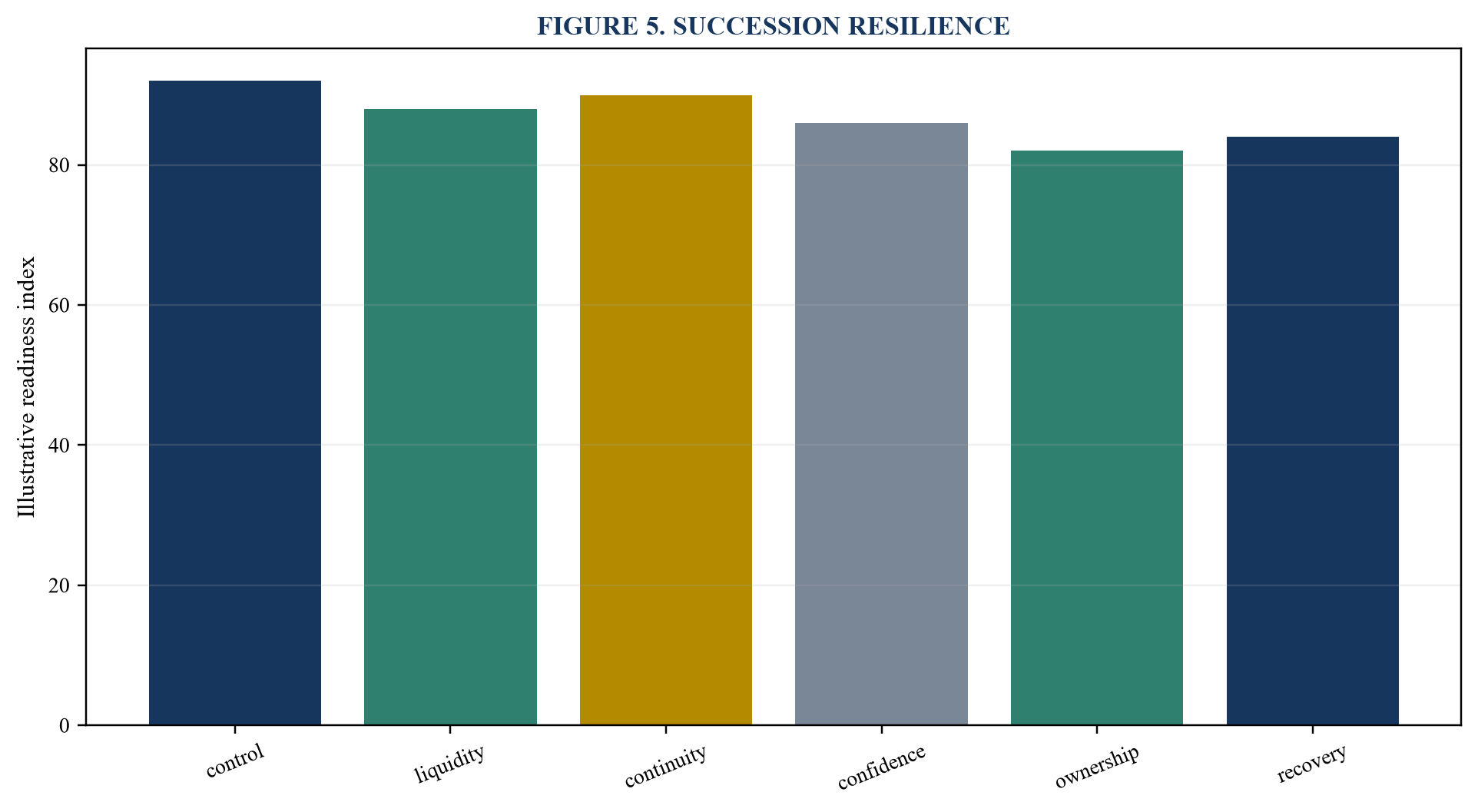
Values are illustrative readiness indices and require company-specific evidence.
References
- International Organization for Standardization, ISO 22301 Business Continuity Management Systems, https://www.iso.org/standard/75106.html
- International Organization for Standardization, ISO 22313 Guidance on ISO 22301, https://www.iso.org/standard/75107.html
- International Organization for Standardization, ISO TS 22317 Business Impact Analysis, https://www.iso.org/standard/79000.html
- International Organization for Standardization, ISO 22320 Emergency Management, https://www.iso.org/standard/67851.html
- International Organization for Standardization, ISO 31000 Risk Management Guidelines, https://www.iso.org/iso-31000-risk-management.html
- International Finance Corporation, Family Business Governance Handbook, https://www.ifc.org/en/insights-reports/2011/ifc-family-business-governance-handbook
- International Finance Corporation, Family Business Governance, https://www.ifc.org/en/what-we-do/sector-expertise/corporate-governance/family-business-governance
- OECD, G20 OECD Principles of Corporate Governance 2023, https://doi.org/10.1787/ed750b30-en
- Financial Reporting Council, Wates Corporate Governance Principles for Large Private Companies, https://www.frc.org.uk/library/standards-codes-policy/corporate-governance/the-wates-corporate-governance-principles-for-large-private-companies/
- UK Government, Companies Act 2006 Part 10 Directors, https://www.legislation.gov.uk/ukpga/2006/46/part/10
- UK Government, Companies Act 2006 Part 13 Resolutions and Meetings, https://www.legislation.gov.uk/ukpga/2006/46/part/13
- United Arab Emirates, Federal Decree-Law No. 32 of 2021 on Commercial Companies, https://uaelegislation.gov.ae/en/legislations/1542
- United Arab Emirates, Federal Decree-Law No. 37 of 2022 Concerning Family Businesses, https://uaelegislation.gov.ae/en/legislations/1608
- Dubai International Financial Centre, Family Arrangements Regulations 2023, https://assets.difc.com/v1/media/edge/images/dubaiintern0078-difcexperie96c5-production-3253/media/project/difcexperiences/difc/difcwebsite/documents/familydocs/family_arrangements_regulations_updated_april23.pdf
- Abu Dhabi Global Market, Companies Regulations, https://www.adgm.com/legal-framework/rules-and-regulations
- US National Institute of Standards and Technology, Contingency Planning Guide for Federal Information Systems SP 800-34 Rev 1, https://csrc.nist.gov/pubs/sp/800/34/r1/upd1/final
- US National Institute of Standards and Technology, Cybersecurity Framework 2.0, https://www.nist.gov/cyberframework
- Cybersecurity and Infrastructure Security Agency, Incident Response Plan Basics, https://www.cisa.gov/resources-tools/resources/incident-response-plan-basics
- Financial Conduct Authority, Operational Resilience, https://www.fca.org.uk/firms/operational-resilience
- Bank of England Prudential Regulation Authority, Operational Resilience, https://www.bankofengland.co.uk/prudential-regulation/publication/2021/march/operational-resilience-impact-tolerances-for-important-business-services-sop
- Basel Committee on Banking Supervision, Principles for Operational Resilience, https://www.bis.org/bcbs/publ/d516.htm
- Federal Financial Institutions Examination Council, Business Continuity Management, https://ithandbook.ffiec.gov/it-booklets/business-continuity-management/
- International Labour Organization, Protection of Workers Personal Data, https://www.ilo.org/publications/protection-workers-personal-data
- IFRS Foundation, IAS 10 Events after the Reporting Period, https://www.ifrs.org/issued-standards/list-of-standards/ias-10-events-after-the-reporting-period/
- IFRS Foundation, IAS 24 Related Party Disclosures, https://www.ifrs.org/issued-standards/list-of-standards/ias-24-related-party-disclosures/
- International Association of Insurance Supervisors, Insurance Core Principles, https://www.iaisweb.org/activities-topics/standard-setting/audiences-and-comframe/
