

1. The warehouse solves a timing problem while creating a fiduciary and economic problem
Emerging managers often raise capital while building an investable pipeline. A seller may require certainty before the fund has admitted investors, drawn commitments or opened operating accounts. Waiting can lose the asset and weaken the manager's claim to proprietary origination. Buying early can demonstrate execution and seed a portfolio. It also places a transaction into an affiliate or sponsor-controlled vehicle before the future fund has a governance body, investor advisory committee or complete constitutional documents.
A warehouse is a temporary holding arrangement for one or more assets expected to move into a fund or co-investment structure after specified conditions. The warehouse can be funded by the general partner, management company, founders, an anchor investor, a family office, a bank or another private-capital provider. Its form can be a special-purpose company, limited partnership, trust, nominee or contractual acquisition arrangement. The label does not determine the legal, regulatory, accounting or economic outcome.
The central conflict is simple. The sponsor usually selects the asset, negotiates the acquisition, controls the warehouse and expects to manage the future fund. It may also earn fees, carry, reimbursement or a bridge return when the asset transfers. Future limited partners have not participated in the original decision. They need evidence that the asset fits the disclosed strategy, the transfer price is fair, expenses are properly allocated, performance is presented accurately and the fund retains a real ability to decline.
The Investment Limited Partners Association states that suitable investment opportunities should first be allocated to the fund when they fit its strategy and it has available commitments. It also recommends advance disclosure of co-investment allocation frameworks, differentiated economics, follow-ons, expenses and conflicts [1]. A pre-first-close warehouse sits one step earlier because the intended fund may not yet have capital or investors. The same alignment principles remain relevant and should be documented before acquisition.
The warehouse must therefore answer five questions. Who owns and controls the asset before first close? What obligation, option or discretion does the future fund have to acquire it? At what price and after which independent checks can the transfer occur? How are fees, expenses, interim cash flows and gains or losses allocated? What happens if the first close is late, smaller than expected or never occurs?
The recommended design is a conditional bridge. The warehouse acquires only assets within a written strategy and exposure limit. Its documents anticipate a possible fund transfer without guaranteeing it. A conflict-cleared body reviews eligibility and valuation. The transfer price protects future investors from paying for sponsor-created appreciation while ensuring the warehouse provider receives an agreed, capped risk return. A long-stop mechanism supports retention, syndication, sale or orderly wind-down if the fund does not buy.
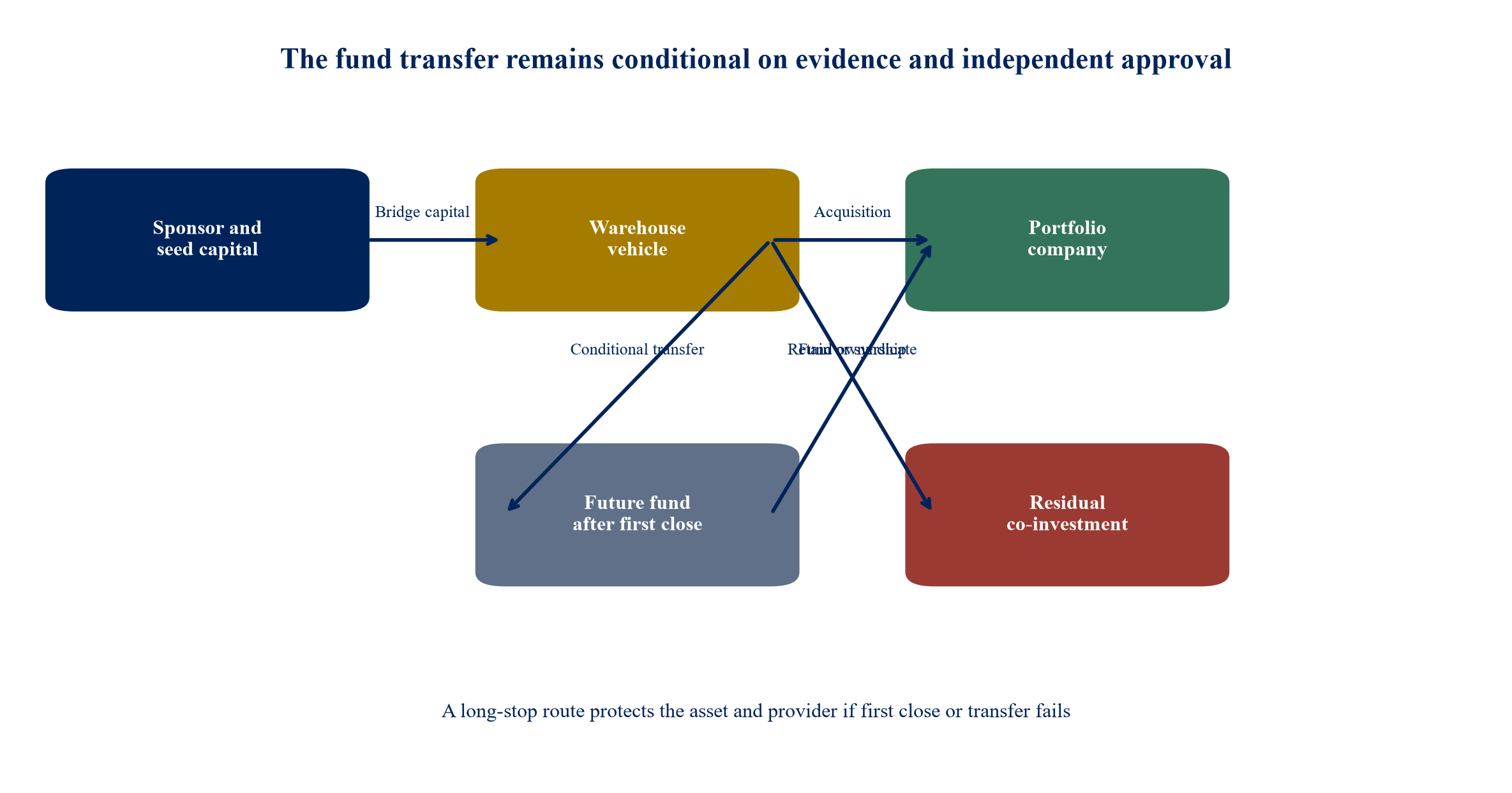
The structure is author-designed. Parties, rights and cash flows are illustrative and require jurisdiction-specific documentation.
The structure should be capable of being explained in one page to a prospective limited partner. That page identifies the warehouse capital, asset, acquisition date, sponsor interest, proposed transfer mechanics, independent approval, interim economics, expenses, conflicts and fallback. Complexity that cannot be explained clearly usually indicates unresolved allocation or control risk.
2. The first-close decision begins with a warehouse charter
The manager should approve a warehouse charter before signing a purchase agreement. The charter defines the strategy, asset eligibility, geographic and sector limits, maximum exposure, permitted instruments, leverage, duration, funding sources, governance, valuation, transfer test, expense allocation, information rights, follow-on funding and long-stop outcome. It should be consistent with the fund's developing private-placement memorandum and limited-partnership agreement.
Eligibility should be specific enough to prevent retrospective strategy changes. It can cover sector, stage, geography, security type, ownership range, target return, concentration, prohibited activities, sanctions, environmental and social exclusions, and legal or regulatory constraints. The warehouse should not become a place for assets that would fail the future fund's mandate. A written exception process should identify who approves a deviation and how it will be disclosed.
Capacity requires two limits. The first caps warehouse exposure relative to the target fund. The second caps the amount that the fund may acquire relative to commitments actually admitted at first close. A USD 28 million asset can fit a USD 120 million target fund while overwhelming a USD 35 million first close. The binding measure at transfer should use actual commitments, undrawn capacity, reserves and concentration limits.
The charter should state whether the fund has an option, a right of first offer, a forward obligation or no commitment. A binding obligation can improve bridge-bankability while creating concerns about who validly committed the unborn or unclosed fund. A pure option protects investor discretion while leaving the warehouse provider exposed. A conditional purchase agreement can require transfer only after fund formation, minimum commitments, investment-committee approval, valuation, investor disclosure and legal capacity.
Governance should separate origination from transfer approval. The deal team can recommend the asset. A conflicts committee, independent fund director, advisory body or appropriately constituted investment committee should evaluate strategy fit, valuation, terms, expenses and investor fairness. Individuals with economic interests in the warehouse should disclose them and recuse where appropriate. The approval record should state evidence, alternatives and reasons.
The charter should control changes between acquisition and transfer. Material amendments to the portfolio company's security, valuation, business plan, leverage, governance or exit rights should trigger renewed review. Follow-on capital should follow the same allocation policy. The warehouse provider should not improve its position immediately before transfer through undocumented fees, seniority or related-party transactions.
Table 1. Warehouse charter and minimum evidence
| Charter item | Required decision | Minimum evidence | Failure response |
|---|---|---|---|
| Strategy and eligibility | Does the asset fit the stated fund mandate? | Written strategy test, diligence memorandum, exclusions check | Retain outside fund, syndicate or sell |
| Exposure and concentration | How much can the warehouse and first-close fund hold? | Target and actual commitment model, reserve policy, concentration test | Partial transfer or delayed syndication |
| Transfer obligation | Option, conditional agreement or binding commitment | Legal authority, conditions, approval route, investor disclosure | No fund obligation until all conditions are met |
| Valuation and price | Which price protects both capital provider and future LPs? | Independent value, funded-cost ledger, waterfall examples | Use lower permissible price or decline transfer |
| Expenses and interim cash | Who bears diligence, financing, tax and operating cash flows? | Expense policy, invoices, bank statements, allocation schedule | Reallocate, reimburse or disclose exception |
| Governance and conflicts | Who decides when sponsor interests overlap? | Conflict register, recusals, minutes, independent approval | Escalate to LPAC or equivalent; suspend transfer |
| Long-stop outcome | What occurs if first close or transfer fails? | Retention capital, syndication plan, sale process and dates | Execute predetermined fallback |
The framework is author-designed. Final requirements depend on the fund, asset, investors, manager and governing law.
The charter is a control document rather than a marketing promise. Its provisions should appear consistently in warehouse documents, fund disclosure, side letters, investment-committee mandates, valuation policy and operations procedures. Inconsistency creates both execution and disclosure risk.
3. Funding routes allocate risk differently before the fund exists
Sponsor balance-sheet funding offers the cleanest control and the strongest visible alignment. The sponsor bears acquisition risk until transfer and can allow the fund to evaluate the asset without pressure from an external maturity. The practical limit is capital. An emerging manager may have committed resources to team, regulatory capital, formation and operating expenses. Concentrating personal or management-company liquidity in one deal can threaten the platform if the fundraise slips.
Seed-investor equity places acquisition risk with a capital provider that may also consider an anchor commitment. The provider can receive a capped preferred return, participation, co-investment access, fund economics or a combination. Each benefit should be valued and disclosed. Linking warehouse support to preferential fund terms can influence fundraising and create differential treatment. The arrangement should state whether seed rights survive if the provider does not commit to the fund.
Warehouse debt creates a fixed cost, maturity and enforcement path. Security may cover the asset, vehicle shares, bank accounts, sponsor support or future transfer proceeds. The lender will examine asset value, legal title, transferability, first-close probability and fallback. A loan whose only repayment source is the future fund is fragile. The vehicle needs enough time and options to retain or sell the asset without a distressed transfer.
A deal-by-deal special-purpose vehicle can fund the asset through investors who knowingly underwrite that single transaction. At first close, the fund may buy all or part of the position, invest alongside it or leave it unchanged. The structure reduces reliance on one provider and can reveal investor appetite. It raises allocation, fee, expense and follow-on questions, especially when SPV investors are also prospective fund limited partners.
A forward-purchase arrangement can defer part of the acquisition price until the fund is able to close. The seller carries credit and timing risk and may require security, a higher price, vetoes or termination rights. The future fund should avoid an unconditional obligation entered into by a party without authority to bind it. Conditions should address fund formation, commitments, approvals, regulatory capacity and transfer consent.
A hybrid can combine sponsor equity, seed capital, vendor deferral and a short debt tranche. The layers should have a clear priority and single cash waterfall. Over-engineering can make the eventual fund transfer expensive or impossible. The manager should model each layer's repayment, return, security, consent and tax outcome.
Table 2. Pre-first-close funding routes and alignment effects
| Route | Main strength | Main constraint | Alignment issue | Appropriate safeguard |
|---|---|---|---|---|
| Sponsor balance sheet | Strong visible risk retention and flexibility | Limited capital and platform concentration | Sponsor may seek an aggressive transfer price | Independent value and lower-of pricing |
| Seed-investor equity | Risk capital and potential anchor relationship | Preferential rights can complicate fundraising | Seed economics may be paid by future LPs | Full term disclosure and benefit valuation |
| Warehouse debt | Known price and limited equity dilution | Fixed maturity, enforcement and refinancing risk | Pressure to force transfer before independent approval | Long-stop buffer and alternative repayment source |
| Deal-by-deal SPV | Asset-specific underwriting and investor choice | More investors, documents and allocations | SPV may compete with or cherry-pick from fund | Written opportunity and follow-on policy |
| Vendor deferral | Reduces immediate cash need | Seller credit risk and retained influence | Deferred price may conceal higher acquisition cost | Transparent total consideration and security |
| Hybrid structure | Diversifies funding sources | Priority and consent complexity | Costs can migrate between vehicle and fund | Integrated sources, uses and waterfall |
Assessments are indicative. Transaction documents and regulation determine actual rights and risks.
Funding should be sized from a downside calendar. The model should assume delayed first close, lower commitments, additional diligence, follow-on needs, financing fees and an exit below cost. A commitment letter from a prospective LP does not equal callable fund capital until documents, conditions and admission are complete. Bridge providers should receive clear reporting and avoid rights that predetermine the future fund's investment decision.
4. Opportunity allocation must be written before outcomes are known
Allocation conflicts become most visible when an asset has appreciated. The sponsor may wish to keep the best economics in an affiliate or allocate appreciation to warehouse investors. If the asset has declined, the sponsor may have an incentive to move it into the fund. A policy created after performance is known cannot demonstrate fair ex ante treatment.
The allocation policy should define when an opportunity belongs to the proposed fund, another existing fund, an affiliate, a personal account, an SPV or a third-party syndicate. Relevant factors can include strategy, available capital, concentration, geography, stage, follow-on obligations, timing, legal restrictions and investor-specific exclusions. The policy should also govern opportunities that exceed fund capacity.
ILPA recommends disclosure of co-investment allocation frameworks through fund documents and regulatory filings, including prioritisation, differentiated economics, follow-ons, fees and conflicts [1]. The SEC's examination staff has highlighted deficiencies involving allocations among clients, investments in the same portfolio company, co-investment vehicles, preferential liquidity, fees and expenses [2][3]. The SEC's 2023 private-fund adviser rules were vacated with effect from 5 June 2024, and later technical amendments reflect that vacatur [4]. Managers should therefore anchor US analysis in the Advisers Act, applicable rules, fiduciary obligations, disclosure, contractual duties and current jurisdiction-specific advice rather than rely on the vacated package.
The FCA requires a full-scope UK alternative investment fund manager to act in the interests of the AIF or its investors, treat investors fairly and disclose preferential treatment in the fund's instrument [5]. Its conflicts rules require appropriate steps to identify, prevent or manage conflicts between the manager, funds, investors and other clients [6]. EU AIFMD provisions similarly address fair treatment and conflict arrangements [7][8]. These rules support a verifiable allocation method and documented exceptions.
Allocation should be time-stamped. At initial screening, the manager records eligible vehicles and capacity. At investment-committee approval, it records the selected allocation and reason. At signing, it freezes the intended treatment subject to stated changes. At first close, it tests actual fund capacity and investor restrictions. Any departure receives conflict review and is disclosed.
Follow-on funding needs their own rule. The warehouse may need rescue or growth capital before transfer. Existing SPV investors may have pre-emption. The future fund may wish to preserve value. The policy should state priority, pricing, dilution and whether follow-on participation changes the transfer price. A sponsor should not use the fund solely to protect a deteriorating warehouse position.
The manager should keep an allocation ledger for all relevant opportunities, including declined transactions. The ledger records source, date, strategy fit, vehicle eligibility, capacity, decision, approver and reason. This evidence supports consistency and makes exceptions reviewable.
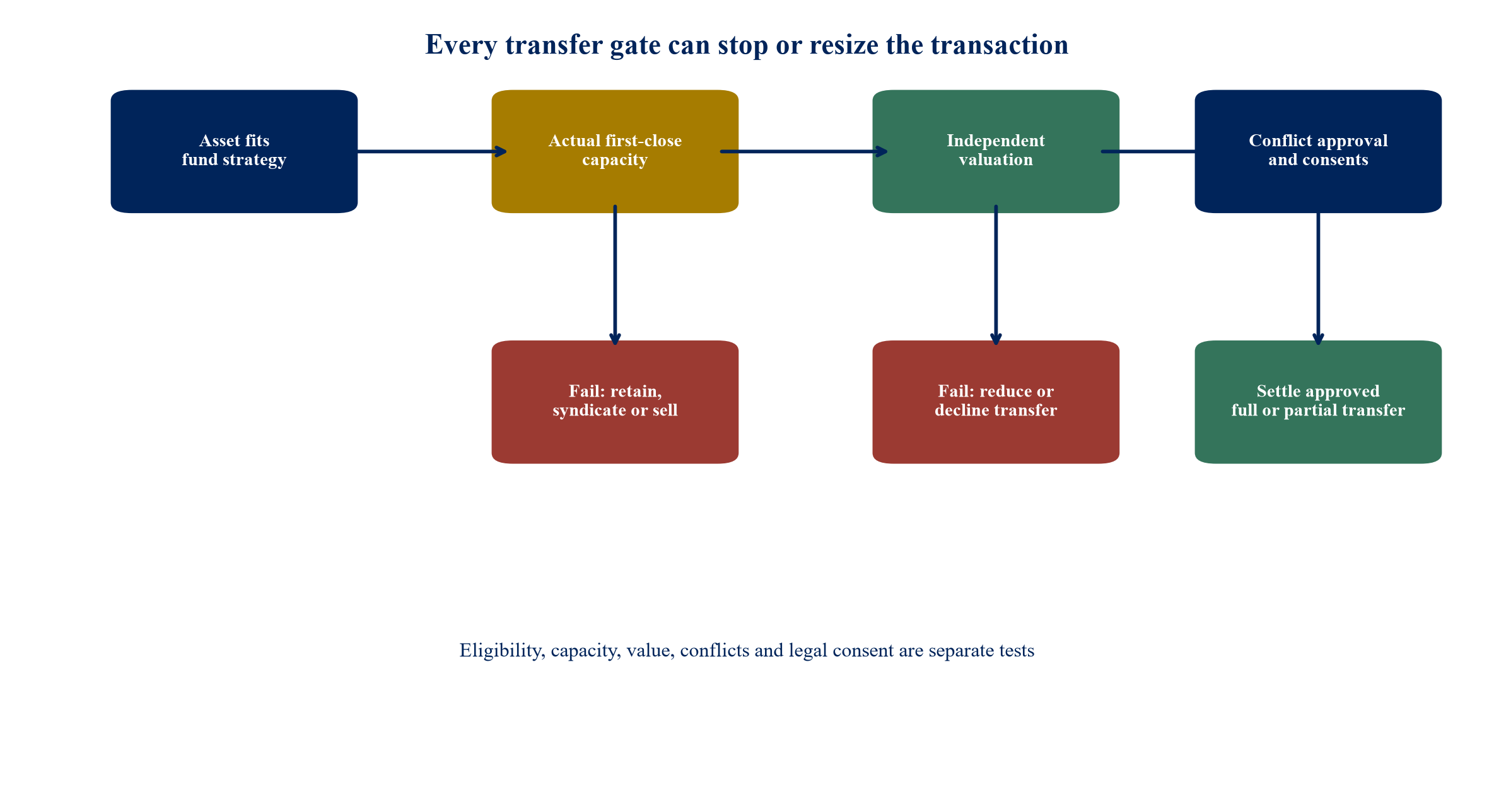
The decision tree is author-designed. Each gate requires evidence under the final fund and warehouse documents.
5. Transfer pricing should protect future investors without confiscating bridge risk
The transfer price determines who receives pre-first-close gains and who bears losses. At cost, the fund obtains any appreciation and the warehouse provider receives only its financing economics. At fair value, the warehouse provider can capture market appreciation created before limited partners committed. At the higher of cost and fair value, the fund bears downside asymmetrically. A formula must be agreed before the asset's outcome is observable.
A defensible baseline is the lower of independent fair value and funded cost plus documented third-party costs and a capped, disclosed bridge return. This allocates positive asset revaluation to the fund while compensating the provider for time and risk. It leaves asset decline with the warehouse provider unless future investors expressly approve another treatment. The precise outcome depends on bargaining, law, fund disclosure and investor consent.
Funded cost should be defined. It can include purchase consideration, taxes, legal diligence, financing charges, portfolio-company funding and directly attributable expenses. It should exclude management overhead, fundraising costs, success fees paid to affiliates and costs outside the asset. Interim dividends, interest, fees or other cash received by the warehouse should reduce the transfer amount or be credited in the waterfall.
The bridge return should be separated from asset price. It can accrue on net funded capital from settlement to transfer and stop at a long-stop date. A compounding rate, arrangement fee, exit fee and participation can produce a much higher effective cost than the headline rate. The fund model should calculate the annualised and absolute amount under several delays.
Fair value requires a defined valuation date, basis, methods, data and governance. IFRS 13 defines fair value as an exit price in an orderly transaction between market participants at the measurement date [9]. Private-fund legal and reporting requirements can use other bases. The valuation policy should specify which applies. The International Private Equity and Venture Capital Valuation Guidelines provide industry guidance for private-capital valuation [10].
The FCA's AIFM rules require valuation procedures and pricing methods to be disclosed and provide for functional independence or an external valuer [11]. EU delegated rules require written valuation policies, periodic review and controls over values influenced by related parties or parties with a financial interest [8]. Cayman private-fund legislation addresses valuation and independent verification where appropriate [12]. The warehouse transfer should meet the applicable regime and the fund's constitutional terms.
An independent valuation is valuable when the sponsor controls both sides, although independence alone does not cure a conflicted allocation. The valuer should receive a clear scope, access to current information and disclosure of transaction terms. The conflicts body should assess strategy fit, capacity and fairness in addition to price. Valuation uncertainty should be shown as a range.
Table 3. Asset-transfer price framework and economic treatment
| Method | Warehouse-provider outcome | Future-LP outcome | Core risk | Governance response |
|---|---|---|---|---|
| Historical acquisition cost | Receives cost; financing return must be separate | Receives all pre-transfer appreciation and downside at cost | Cost may ignore deterioration or interim cash | Apply lower-of fair value and cost; credit receipts |
| Independent fair value | Receives current asset value | Enters at assessed market value | Sponsor may benefit from appreciation it selected and controlled | Independent valuation, conflict approval and disclosure |
| Cost plus capped return | Receives defined bridge compensation | Receives appreciation above the cap | Downside can remain hidden if price floor equals cost | Make fair value an explicit ceiling |
| Lower of fair value or cost plus return | Bears asset downside; receives capped time return | Protected from paying above value; retains excess appreciation | Provider may require higher cap or stronger fallback | Agree formula before acquisition and model delays |
| LP-approved negotiated price | Outcome follows informed approval | Investors choose with disclosed facts | Consent quality and unequal influence | Full information, recusal and appropriate approval threshold |
The methods are illustrative. Parties must select and disclose a method consistent with governing documents and law.
The transfer should occur through a closing statement. It reconciles purchase price, funding draws, expenses, interim receipts, taxes, bridge return, fair-value ceiling, assumed liabilities and cash. The warehouse and fund boards or authorised bodies approve the same statement. Auditors and administrators receive it for books and records.
6. Conflicts extend beyond transfer price
The sponsor can face conflicts as warehouse owner, fund manager, investment decision-maker, fundraiser and recipient of fees or carry. A seed investor can be warehouse provider, anchor LP, co-investor and member of an advisory body. Service providers may be selected by an affiliate. These overlapping roles should be mapped before approval.
Opportunity allocation is one conflict. Expense allocation is another. Acquisition diligence may benefit the warehouse, future fund and portfolio company. Fund-formation counsel may work on both vehicles. Broken-deal costs can arise if the fund declines. A policy should assign each cost by purpose and benefit, with shared costs allocated on a documented basis. The SEC has brought enforcement action involving undisclosed disproportionate expense allocation in a co-investment context [13].
Interim governance creates further conflicts. The sponsor may appoint directors and approve budgets while expecting a transfer. It might defer adverse information, accelerate revenue, delay expenses or change terms to support valuation. A controlled reporting process should capture board materials, performance, customer developments, financing and legal events from acquisition through transfer.
Track-record presentation can mislead when attribution is unclear. The manager should state who owned the asset, which entity bore risk, when the fund acquired it, which cash flows are included, whether results are gross or net, and how warehouse financing affected returns. A future fund should not show performance before it owned the asset as though that period belonged fully to its investors. Applicable marketing rules and advice govern final presentation.
Preferential rights can arise through warehouse support. A provider may obtain fee discounts, co-investment priority, advisory rights, capacity, liquidity or economics in the manager. These terms can influence allocation and fundraising. The FCA and AIFMD frameworks require disclosure of preferential treatment in relevant circumstances [5][7]. ILPA also calls for disclosure of side-letter co-investment arrangements and differentiated economics [1].
Conflicts governance should use four layers. First, disclose roles, interests and benefits. Second, apply a written policy before outcomes are known. Third, separate conflicted individuals from approval. Fourth, obtain independent or investor approval when the documents and circumstances require it. Disclosure supports an informed decision and should be paired with substantive controls.
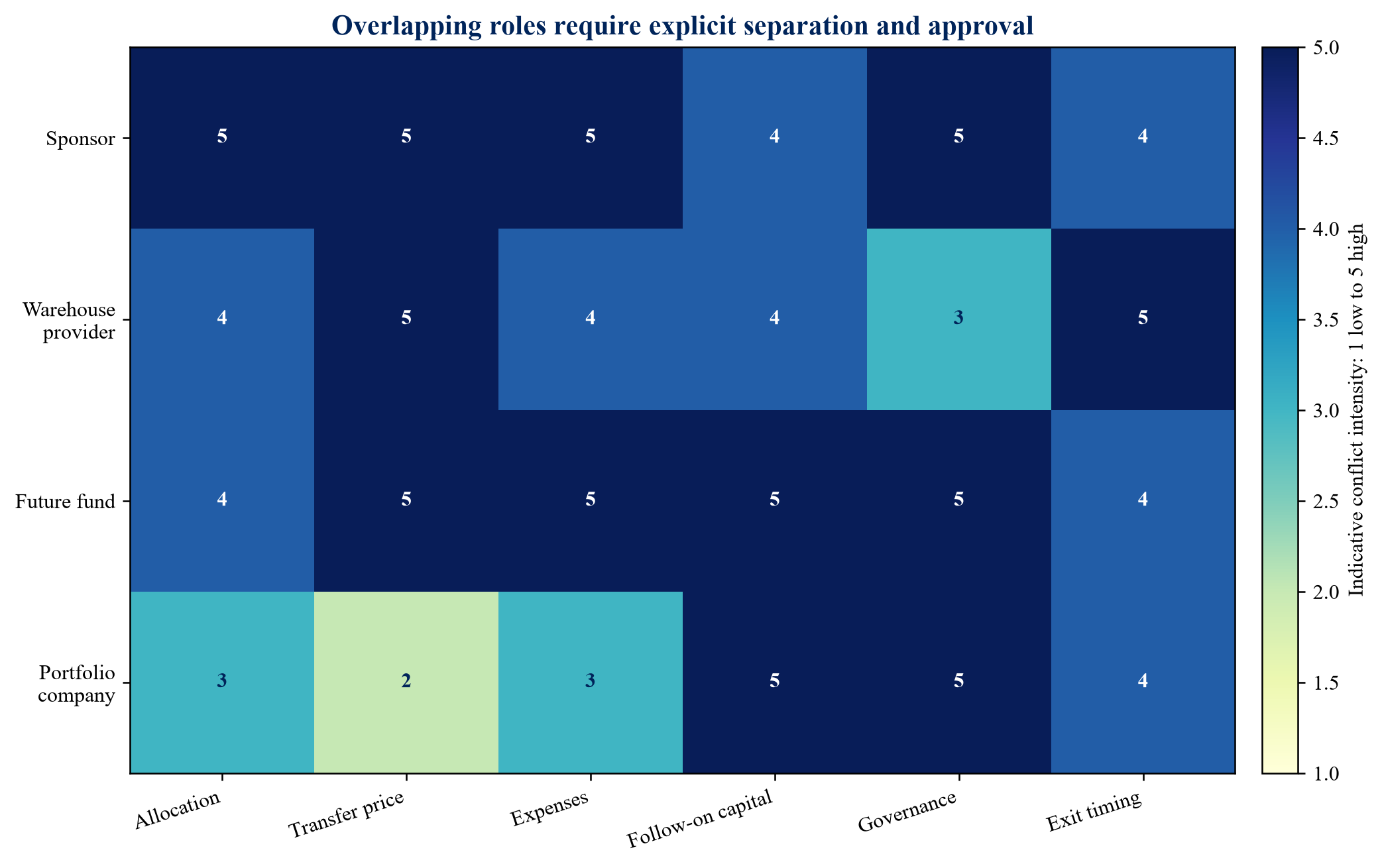
The matrix is author-designed. Higher scores indicate areas requiring stronger separation, evidence and approval.
The minutes should record why the transfer serves the fund. They should address strategy, price, capacity, concentration, diligence, interim performance, follow-on need, expenses, related-party benefits, alternatives and downside. A generic statement that the transaction is fair provides weak evidence.
7. First-close economics must be rebuilt from cash available after admission
Target fund size is not transfer capacity. At first close, admitted commitments may be subject to capital-call notice, equalisation, management fees, organisational expenses, reserves, parallel vehicles, investor exclusions and borrowing limits. The model should calculate cash available for investment on the intended transfer date.
Suppose the fund reaches a USD 60 million first close. A 25 percent initial draw would generate USD 15 million before fees and reserves. A USD 28 million warehouse asset cannot transfer in full unless the fund calls more capital, uses a subscription line, stages the purchase or syndicates part. A large initial draw may be permitted while surprising investors and reducing capacity for the rest of the portfolio.
The model should show commitments by investor and vehicle, call percentage, notice period, default reserve, management fee, formation expenses, hedging, tax, working capital and follow-on reserve. It should also account for investors excused from the asset or jurisdiction. The fund's concentration and diversification tests use actual post-transfer NAV and commitments.
Subscription lines can bridge timing after investors make enforceable commitments. BIS describes such lines as lending collateralised by committed but undrawn investor capital and notes their use in reducing call frequency while retaining investment flexibility [14]. A pre-first-close warehouse lacks that collateral pool. Once the fund closes, any line must comply with its documents, lender conditions and investor reporting.
Equalisation is relevant when later investors join. The LPA can require subsequent investors to contribute amounts that place them in an economic position comparable with earlier investors, including interest or an equalisation amount. The method should address the warehouse asset, interim cash flows and bridge cost. Early investors should not fund the full asset for an extended period without the agreed equalisation.
Management fees and carry should start on the basis defined in the LPA. Charging management fees on target commitments before admission, or on acquisition value inconsistent with disclosure, can distort economics. The warehouse provider's return should not be hidden in asset cost or portfolio-company expenses. Carried interest should reflect the fund's actual acquisition basis and cash flows.
The first close also needs a minimum viable portfolio plan. If the warehouse asset consumes half the initial investable capacity, the fund may breach concentration objectives or lack reserves for follow-ons. A partial transfer, co-investment sleeve or delayed purchase can preserve diversification. The manager should show prospective LPs the post-transfer portfolio and unfunded plan.
8. A hypothetical USD 28 million warehouse demonstrates the decision mechanics
Consider an emerging manager targeting a USD 120 million closed-end growth and buyout fund. It identifies an investment requiring USD 28 million at signing. The expected first close is 150 days later. The acquisition is funded with USD 20 million from a seed investor, USD 5 million from the sponsor and USD 3 million of vendor-deferred consideration. Every amount and term in this case is an author assumption.
The warehouse provider receives an assumed 10 percent simple annual bridge return on net cash funded, capped at 180 days, with no participation in appreciation. The sponsor receives no separate return beyond reimbursement of actual third-party cost. Interim cash distributions reduce funded cost. The transfer price is the lower of independent fair value and funded cost plus the capped bridge return and documented costs. The fund can decline after conflict-cleared review.
At day 150, net funded cash is assumed at USD 25 million after a USD 0.6 million interim distribution. Documented transaction and holding costs are USD 0.6 million. The bridge return on USD 20 million for 150 days is approximately USD 0.82 million. The resulting cost-plus ceiling is USD 26.42 million. Vendor-deferred consideration of USD 3 million remains payable and is included in total assumed exposure where applicable.
The fund achieves a USD 60 million first close. It plans to call 50 percent of commitments, producing USD 30 million. Formation and initial management costs use USD 2 million, working and default reserves use USD 2 million, and follow-on reserves use USD 4 million. Only USD 22 million is available for the initial asset. A full cash transfer at USD 26.42 million would exceed this capacity.
The base solution transfers USD 22 million of the warehouse position to the fund and leaves USD 4.42 million with a disclosed co-investment vehicle. Ownership and governance rights are divided pro rata or through clearly documented classes. The seed provider can retain or syndicate the residual without receiving priority over the fund in follow-ons or exit, except as disclosed in the original terms.
Table 4. Hypothetical first-close sources, uses and transfer outcomes
| Item | Base case | Downside case | Severe case |
|---|---|---|---|
| Independent fair value at day 150 | 32.0 | 25.0 | 19.0 |
| Cost-plus bridge ceiling | 26.42 | 26.42 | 26.42 |
| Permitted lower-of transfer value | 26.42 | 25.0 | 19.0 |
| First-close commitments | 60.0 | 48.0 | 36.0 |
| Planned initial call | 30.0 | 24.0 | 18.0 |
| Costs and reserves | 8.0 | 7.0 | 6.0 |
| Cash available for warehouse transfer | 22.0 | 17.0 | 12.0 |
| Residual requiring co-investment, retention or sale | 4.42 | 8.0 | 7.0 |
Every amount, return, timing and valuation is an author assumption without market calibration. USD millions.
In the base value case, independent fair value is USD 32 million. The lower-of formula caps the fund transfer at USD 26.42 million. The fund receives the pre-transfer appreciation above that amount. Capacity limits transfer to USD 22 million, so a residual vehicle holds USD 4.42 million at the same implied price and aligned terms.
In the downside case, fair value is USD 25 million and first-close commitments reach only USD 48 million. The lower-of formula reduces the permitted value to USD 25 million. After a 50 percent call and USD 7 million of costs and reserves, USD 17 million is available. The residual USD 8 million remains in the warehouse or is syndicated. The bridge provider bears the value shortfall relative to cost plus return.
In the severe case, fair value is USD 19 million and commitments reach USD 36 million. The fund can deploy only USD 12 million after costs and reserves. The conflicts committee may conclude that a partial purchase still fits the strategy, or it may decline because concentration, performance or diligence has changed. The warehouse provider and sponsor must then execute the fallback without charging the fund for the loss.
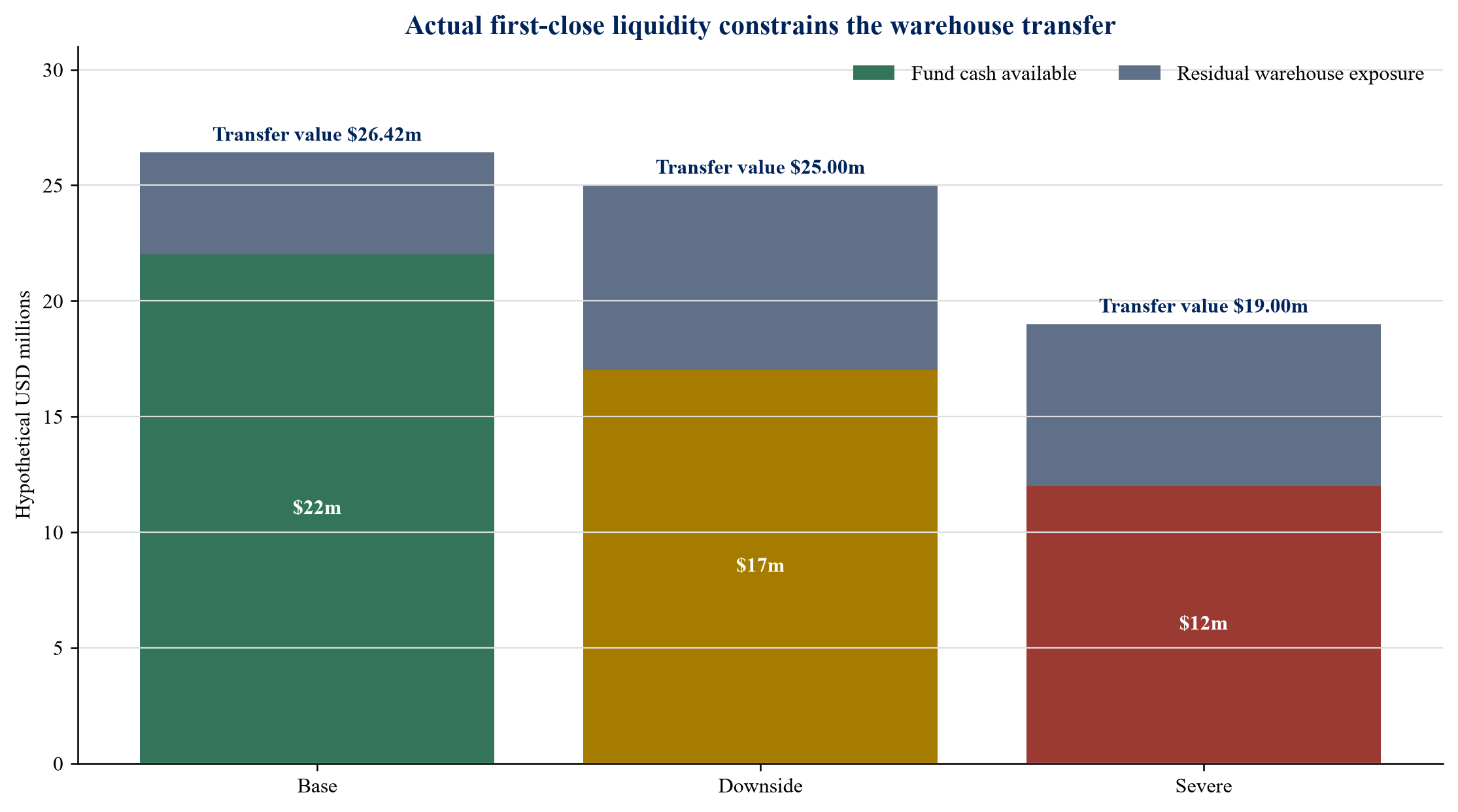
All values are author assumptions. The chart shows how asset value and actual first-close liquidity jointly constrain transfer.
The case shows why the target fund size cannot underwrite the warehouse. Actual first-close liquidity, fair value and exposure limits determine the transfer. A lower-of price protects future investors. Partial transfer and residual syndication prevent the asset from exhausting the portfolio. The warehouse provider receives a transparent time return when value permits and bears genuine asset and fundraising risk.
9. Legal and regulatory perimeter should be established before acquisition
The manager should identify the warehouse vehicle, fund domicile, manager licence, marketing jurisdictions, investor types and asset jurisdictions. Fund-management, arranging, dealing, custody, advice, financial-promotion, lending and securities laws can apply. A warehouse that pools third-party capital may itself be a collective investment vehicle or regulated product.
In the Dubai International Financial Centre, the Dubai Financial Services Authority's collective investment framework and fund rules govern relevant managers and funds. Its 2026 Consultation Paper 173 proposes significant updates, so managers should confirm final rules and effective dates for a transaction [15]. In Abu Dhabi Global Market, FSRA materials require applicants to explain co-investment, conflict, valuation and fair-allocation arrangements [16]. Neither jurisdiction should be treated as a generic special-purpose-vehicle solution without regulatory analysis.
UK structures can use limited partnerships, including qualifying private fund limited partnerships, subject to partnership and financial-services law [17]. The AIFM's duties, disclosures, valuation and conflicts regime depend on scope and status [5][6][11]. EU fundraising may engage AIFMD, national private-placement rules and current AIFMD II implementation. The consolidated directive retains requirements concerning fair treatment, conflicts and disclosure [7].
US advisers should assess registration, fiduciary duties, custody, marketing, principal or cross transactions, allocation, disclosure and recordkeeping under the Advisers Act and applicable state or federal law. The SEC's examination questions ask advisers to evaluate whether limited opportunities are allocated consistently with objectives, restrictions, disclosures and fiduciary duties, with changes supported by documented approvals [18]. The 2024 vacatur of the 2023 private-fund rules should be reflected accurately [4].
Cayman private funds are subject to registration and operational requirements under the Private Funds Act and CIMA rules, including valuation arrangements [12]. Other common domiciles have their own fund, manager, anti-money-laundering, beneficial-ownership, substance and reporting requirements. Counsel should verify the current framework for the exact structure.
Acquiring the asset can require seller consent, change-of-control approval, competition or foreign-investment review, licence transfer, financing consent and shareholder waiver. The later transfer to the fund may require the same or additional approvals. The acquisition documents should permit a transfer to the intended fund or affiliate and define liability during the interim period.
Tax analysis should cover acquisition vehicle residence, permanent establishment, interest, dividends, capital gains, withholding, indirect tax, transfer pricing, stamp or transfer duties, management fees and the eventual asset transfer. A sale from the warehouse to the fund can be taxable even when the beneficial sponsor is unchanged. The cost of transfer must be modelled before the initial acquisition.
10. Accounting, valuation and performance records should follow the asset from day one
The warehouse should maintain institutional books from acquisition. It needs bank accounts, general ledger, cap table, acquisition closing statement, valuation records, portfolio reporting, expense ledger, related-party register, tax records and document repository. Rebuilding the record at first close creates errors and weakens auditability.
Accounting advisers should assess consolidation under IFRS 10, which bases consolidation on control and applies to structured entities [19]. Sponsor decision rights, exposure to variable returns and the ability to affect those returns matter. A warehouse can be legally separate while consolidated by the sponsor or another party. IFRS 12 can require disclosures about interests in other entities [20].
The asset's measurement depends on the reporting framework and entity status. IFRS 13 provides the fair-value framework when another standard requires or permits fair value [9]. IFRS 9 can apply to financial assets [21]. An investment entity can have specific measurement treatment under IFRS 10. The future fund should establish accounting policy before transfer and reconcile the warehouse carrying amount to its entry value.
The administrator should preserve a complete cash-flow series. Purchase consideration, fees, interim funding, dividends, interest, distributions and transfer proceeds need exact dates. Performance calculations should distinguish warehouse ownership from fund ownership. The fund's track record should disclose the transfer and basis consistently with applicable marketing rules and investor documents.
Valuation should be refreshed when material information changes and at the transfer date. A stale financing round or sponsor model is insufficient when performance, markets or capital structure have changed. Independent valuation should address the unit of account, security rights, dilution, currency, market conditions and observable transactions.
Data controls should reconcile source records to investor reporting. Deal-room documents, board materials, bank statements and portfolio-company reports should be permissioned and versioned. If automated extraction or artificial intelligence assists with document classification or variance analysis, accountable professionals must validate the output. Confidential information requires approved systems, access controls and retention policies.
11. Failure planning is part of warehouse underwriting
The fund may not reach first close by the expected date. Commitments may be smaller, conditional or concentrated. The asset may deteriorate, require follow-on funding or become ineligible. Regulatory approval may be delayed. The warehouse provider can face a maturity while the sponsor lacks cash. These outcomes should be treated as underwriting cases.
The long-stop plan should identify four exits. The first is retention by the sponsor or seed investor with sufficient operating and follow-on capital. The second is syndication to investors that underwrite the asset directly. The third is sale to an external buyer through an orderly process. The fourth is a negotiated extension or restructuring of warehouse finance. Each route needs rights, documents, time and decision owners.
Debt maturity should extend beyond the expected first close by a meaningful buffer. The facility should permit partial repayment, syndication and asset sale. Enforcement should be proportionate and avoid forcing the future fund to buy. Sponsor guarantees and recourse should be clear. A lender should understand that prospective LP indications are not collateral unless they become legally enforceable commitments within an eligible facility.
Operational continuity also matters. The warehouse must fund portfolio-company obligations, board oversight, tax, insurance, reporting and compliance. A delayed fundraise should not damage the underlying asset. The model should include twelve months of holding cost and an adverse follow-on need.
Reputational risk should be addressed through transparent communication. Prospective investors need prompt disclosure of material deterioration, changed terms, valuation and conflicts. A manager that hides a weak warehouse asset to protect fundraising can damage the wider franchise. Declining a transfer can demonstrate governance when the decision is properly supported.
Table 5. Early-warning indicators and required responses
| Indicator | Risk indicated | Immediate response | Escalated response |
|---|---|---|---|
| First-close date slips beyond 60 days of plan | Financing cost and maturity risk are rising | Refresh fundraising evidence and cash runway | Activate syndication or extension process |
| First-close commitments fall below transfer threshold | Fund cannot absorb the asset safely | Recalculate call, reserves and concentration | Partial transfer, retain or sell residual |
| Fair value falls below funded cost | Warehouse provider faces asset loss | Independent revaluation and diligence update | Decline or reprice transfer; execute fallback |
| Portfolio company requests unplanned capital | Initial underwriting or liquidity has changed | Assess need, priority and allocation | Approve follow-on under conflict policy or protect downside |
| Expense allocation departs from policy | Future LPs may bear sponsor or affiliate costs | Reconcile invoices and beneficiaries | Reimburse, disclose and obtain approval |
| Transfer consent or regulatory approval is delayed | Legal completion may miss debt maturity | Update conditions and timetable | Extend finance or pursue alternate buyer |
Thresholds are illustrative. The warehouse documents and risk appetite should define binding triggers.
12. Technology can create an auditable allocation and transfer record
An emerging manager can operate institutional controls without a large team by structuring the workflow. A warehouse register should contain each opportunity, eligibility test, allocation decision, funding source, ownership, valuation, expenses, interim cash, approvals, conflicts, transfer conditions and long-stop date. Each field links to source evidence.
A rules engine can test strategy, exposure, concentration, restricted investors, geography, security type and follow-on reserves. It should flag exceptions for human approval. The calculation should be transparent enough that an administrator, auditor or LPAC can reproduce it.
The funded-cost ledger should ingest bank transactions and approved invoices. It separates purchase consideration, financing, asset expenses, fund formation and manager overhead. Interim receipts reduce the appropriate balance. The transfer-price model then applies the independent fair-value ceiling and bridge-return cap.
Artificial intelligence can assist with contract comparison, consent extraction, diligence indexing, expense coding and variance detection. It can identify inconsistencies between the warehouse charter, fund documents and transfer agreement. Human legal, accounting, valuation and investment judgement remains responsible for conclusions. The system should retain source links, reviewer identity, dates and overrides.
The investor portal should present the relevant record without disclosing confidential information beyond need. Prospective LPs can receive the acquisition memorandum, interim performance, valuation summary, conflicts, expenses, transfer formula and first-close impact. Existing warehouse providers receive their contractual reporting. Access should follow confidentiality, data-protection and securities-law restrictions.
The highest-value output is an exception dashboard. It identifies a late first close, expiring financing, missing consent, valuation movement, exposure breach, follow-on need or undisclosed cost. Management and the governing body can act before the issue becomes a forced transfer.
13. A 100-day implementation plan can make the first warehouse institutional
Days 1 to 15 establish scope and authority. The sponsor confirms fund strategy, target size, expected first close, regulatory perimeter and decision makers. Counsel maps the warehouse and fund entities. The manager approves the warehouse charter, allocation policy, conflicts register and valuation approach before signing.
Days 16 to 35 complete asset and funding diligence. The investment team prepares the same institutional memorandum expected for the future fund. Legal, financial, commercial, tax and operational diligence identify risks and transfer consents. Potential warehouse providers receive a clear term request and long-stop plan. The model tests delayed and failed first-close cases.
Days 36 to 50 document and acquire. The warehouse vehicle, funding, security, shareholder arrangements, acquisition documents, bank accounts and reporting are completed. The closing statement records every source and use. Governance appointments and conflicts are documented. The asset begins institutional reporting immediately.
Days 51 to 75 prepare fund transfer readiness. The manager finalises fund disclosure, LPA provisions, side-letter policy, administrator process and valuation controls. Prospective LP materials explain the warehouse and distinguish historical ownership. Interim performance, expenses, cash flows and material changes are captured. The first-close model uses actual commitment progress.
Days 76 to 90 run independent review. The valuer updates fair value. The conflicts body assesses eligibility, concentration, diligence, price, expenses, follow-ons, investor restrictions and alternatives. Interested parties recuse. The decision and conditions are minuted. Any required LP or LPAC process follows the final documents.
Days 91 to 100 close or activate the fallback. The fund admits investors and confirms callable capital. The administrator calculates available cash after costs and reserves. A partial or full transfer settles through the approved statement. Residual exposure remains in the warehouse or is syndicated under aligned terms. If conditions fail, the manager implements the long-stop route and informs relevant stakeholders.
The implementation plan should be proportionate to the manager and transaction. Its purpose is to create a traceable decision before economic outcomes influence judgement. Strong evidence can help an emerging manager demonstrate institutional capability to prospective investors.
14. Conclusion
A co-investment warehouse can allow an emerging manager to secure a time-sensitive asset before first close. It also concentrates conflicts at the moment when the fund has the least developed governance. The sponsor selects and controls an asset that it may later sell to investors it is still recruiting. The warehouse provider may receive fund rights or economics. Valuation and allocation outcomes become visible before transfer.
The solution is a conditional, evidence-led structure. A warehouse charter defines eligibility, exposure, funding, governance, valuation, expenses, follow-ons and long-stop outcomes before acquisition. Opportunity allocation is time-stamped. The future fund retains a genuine approval process. The transfer price is determined by a pre-agreed method, supported by independent valuation and conflict review. Expenses and interim cash are reconciled transparently.
The hypothetical case shows the interaction between value and capacity. A USD 28 million investment can fit a USD 120 million target fund while exceeding the cash available from a USD 60 million first close. A lower-of transfer formula limits the price to funded cost plus a capped bridge return or independent fair value. Partial transfer and residual co-investment preserve reserves and diversification. Downside remains with the warehouse provider unless future investors knowingly approve another allocation.
The warehouse should be underwritten to survive a failed fundraise. Retention capital, syndication, sale and financing extension should be executable without forcing the fund to buy. Institutional books, valuation records, conflict minutes and investor disclosure follow the asset from day one. This discipline allows execution speed to coexist with fair treatment, credible governance and a durable emerging-manager franchise.
References
- Institutional Limited Partners Association. ILPA Principles 3.0. 2019. https://ilpa.org/wp-content/uploads/2019/06/ILPA-Principles-3.0_2019.pdf
- U.S. Securities and Exchange Commission Division of Examinations. Observations from Examinations of Investment Advisers Managing Private Funds. 2020. https://www.sec.gov/files/ocie-risk-alert-private-funds
- U.S. Securities and Exchange Commission Division of Examinations. Observations From Examinations of Private Fund Advisers. 2022. https://www.sec.gov/compliance/risk-alerts/observations-examinations-private-fund-advisers
- U.S. Securities and Exchange Commission. Private Fund Advisers; Documentation of Registered Investment Adviser Compliance Reviews. 2024. https://www.sec.gov/rules-regulations/2024/11/s7-03-22
- Financial Conduct Authority. COBS 2.1.4, AIFMs' best-interests rules. https://handbook.fca.org.uk/handbook/COBS/2/1.html
- Financial Conduct Authority. SYSC 10, Conflicts of interest. https://handbook.fca.org.uk/handbook/SYSC/10/
- European Union. Directive 2011/61/EU on Alternative Investment Fund Managers, consolidated version. https://eur-lex.europa.eu/eli/dir/2011/61/2025-01-17/eng
- European Union. Commission Delegated Regulation (EU) No 231/2013. https://eur-lex.europa.eu/eli/reg/2013/231/oj/eng
- IFRS Foundation. IFRS 13 Fair Value Measurement. https://www.ifrs.org/issued-standards/list-of-standards/ifrs-13-fair-value-measurement/
- International Private Equity and Venture Capital Valuation Board. International Private Equity and Venture Capital Valuation Guidelines. https://www.privateequityvaluation.com/valuation-guidelines
- Financial Conduct Authority. FUND 3, Requirements for alternative investment fund managers. https://handbook.fca.org.uk/handbook/FUND/3/
- Cayman Islands Monetary Authority. Private Funds Act and regulatory framework. https://www.cima.ky/private-funds
- U.S. Securities and Exchange Commission. SEC Charges Private Equity Adviser for Failing to Disclose Disproportionate Expense Allocations to Fund. 2022. https://www.sec.gov/newsroom/press-releases/2022-107
- Bank for International Settlements. Private markets: a primer. 2021. https://www.bis.org/publ/qtrpdf/r_qt2112e.htm
- Dubai Financial Services Authority. Consultation Paper No. 173: Proposed updates to the Collective Investment Fund framework. 2026. https://www.dfsa.ae/news/dfsa-proposes-significant-updates-its-collective-investment-fund-framework
- Abu Dhabi Global Market Financial Services Regulatory Authority. Asset Management Supplement. https://assets.adgm.com/download/assets/fsra-ams-asset-management-supplement.pdf/53b01ffc5b9d11ef89751670beaad6b9
- UK Government. Register a limited partnership and Private Fund Limited Partnership guidance. https://www.gov.uk/government/publications/limited-partnership-act/register-a-limited-partnership
- U.S. Securities and Exchange Commission. Questions Advisers Should Ask While Establishing or Reviewing Their Compliance Programs. https://www.sec.gov/exams/adviser_compliance_questions
- IFRS Foundation. IFRS 10 Consolidated Financial Statements. https://www.ifrs.org/issued-standards/list-of-standards/ifrs-10-consolidated-financial-statements/
- IFRS Foundation. IFRS 12 Disclosure of Interests in Other Entities. https://www.ifrs.org/issued-standards/list-of-standards/ifrs-12-disclosure-of-interests-in-other-entities/
- IFRS Foundation. IFRS 9 Financial Instruments. https://www.ifrs.org/issued-standards/list-of-standards/ifrs-9-financial-instruments/
- Financial Action Task Force. International Standards on Combating Money Laundering and the Financing of Terrorism and Proliferation. https://www.fatf-gafi.org/en/publications/Fatfrecommendations/Fatf-recommendations.html
