

1. The workforce question in a distressed acquisition
A buyer needs an operating business at completion. Establishing which employment obligations accompany the acquisition is one part of that question. Establishing whether the people who perform indispensable tasks can and will perform them through the transition is another. The proposed framework joins the two assessments in a funded completion plan, while preserving their different evidence requirements.
An employment contract can establish rights and obligations without demonstrating that a particular process has adequate coverage. A skills matrix can identify an operating dependency without determining who owes an employee unpaid wages. Treating either document as a complete workforce diligence answer leaves material questions unresolved. We propose two linked records: an obligations ledger controlled by employment counsel and finance, and a capability map controlled by operational management with employee participation.
The obligations ledger follows the relevant employing entities, transaction perimeter, insolvency process, accrued claims and payment dates. The capability map follows tasks, authorisations, documented procedures, available substitutes and the time required to restore service if coverage is lost. The financing model then includes the cash consequences of both records. It should preserve distinctions between amounts already earned, potential claims, ordinary future payroll and separately agreed retention or transition expenditure.
This is an acquisition-analysis proposal. It does not recommend decisions about an individual employee, establish a legal allocation of liabilities or estimate market retention rates. Transaction-specific advisers must determine legal requirements. Numerical examples are author-designed teaching cases without empirical calibration. Their purpose is to make funding and dependency assumptions reviewable.
2. Start with the legal and operating perimeter
The buyer should reconcile the employee population to the entities and activities being acquired. Begin with the employer named in the contract, the entity paying wages and the business receiving the person's services. Differences between those records require explanation. Shared-service arrangements, secondments and group payroll can make an organisational chart an incomplete description of the proposed transfer.
Record the contemplated transaction form and its relevant dates. A purchase of shares, a transfer of a business and a sale of selected assets require their own legal analysis. The insolvency procedure and timing can affect the result. Counsel should identify the applicable rules before finance assigns a liability to the buyer or seller in the model. An asset-purchase description in a financial presentation is insufficient evidence that employment obligations disappear.
UK government guidance explains that employee protections differ in insolvent-business transfers. It distinguishes rescue transfers from closure and says that, in a TUPE-protected transfer, the new employer must pay amounts remaining after relevant payments from the National Insurance Fund. The acquisition model should therefore avoid a blanket assumption that insolvency removes all historical employee amounts. The actual treatment requires review of the applicable procedure, statutory coverage and particular claim. [1]
The analytical consequence is to give every material amount a documented allocation status. Proposed categories are legally confirmed buyer obligation, legally confirmed seller obligation, conditional allocation and unresolved. These are working-file statuses, with a source, reviewer and date. The model should show the buyer's cash requirement under unresolved allocations that could materially affect the acquisition decision.
3. Reconcile obligations before negotiating incentives
Prepare a reconciliation from the payroll ledger to amounts paid through the bank. Include the period to which each amount relates and its expected settlement date. Differences should be investigated with payroll and finance before they become a single acquisition adjustment. An accrued balance may contain several periods, currencies or categories with different legal and cash consequences.
The diligence request should cover ordinary wages, accrued leave, contractual variable pay, deductions, employer contributions, expense reimbursements and other benefits relevant to the actual workforce. Claims and disputes need a separate schedule because their valuation and timing may be uncertain. Inclusion on a request list is a proposed diligence step; it does not establish that every item exists or transfers in a given transaction.
Identify whether an amount appears elsewhere in the purchase-price bridge. Payroll accruals may already sit within a working-capital calculation, while the same amount may also appear in a debt-like schedule or completion funding estimate. Finance should trace each obligation once through the agreed economic treatment. A liability can require both a price adjustment and an actual cash payment, but the model must show why those entries have different purposes rather than subtracting the same economic cost twice.
Retention spending should have its own approval and schedule. Amounts already earned remain subject to the employee's rights and the applicable process. The proposed operating plan must not condition payment of earned wages on accepting a new retention arrangement. A buyer should distinguish settling existing obligations from agreeing future service, knowledge-transfer milestones or other lawful transition terms.
Table 1. Proposed obligations ledger
| Field | Evidence | Model use |
|---|---|---|
| Employing entity | Contract and payroll record | Legal perimeter |
| Amount and period | Ledger and payment reconciliation | Opening obligation |
| Allocation | Counsel-reviewed treatment | Buyer cash requirement |
| Payment date | Terms and agreed process | Weekly liquidity |
| Price treatment | Purchase agreement | Double-count check |
Proposed diligence fields; no actual liabilities or legal allocations are represented.
4. Accounting classification and cash responsibility
The IFRS Foundation's IAS 19 overview distinguishes short-term, post-employment, other long-term and termination benefits. It links liability recognition to employee service and describes specific recognition timing for termination benefits. Share-based payments fall outside this standard's scope. These accounting distinctions support a structured reconciliation, subject to the detailed requirements and professional review. [5]
An accounting provision does not by itself establish who must pay an amount after a transaction. The buyer needs a bridge among the seller's accounting balance, legal responsibility under the relevant structure, the negotiated purchase-price treatment and the payment date. Each column answers a different question. The bridge should retain the original balance and adjustments so a reviewer can reconstruct the conclusion.
For uncertain claims, a range in the acquisition funding model should be identified as a scenario. It should not silently replace the accounting measurement or legal advice. Record the evidence supporting the range, what would resolve it and the consequences if resolution occurs after completion. The investment committee can then decide whether to seek more evidence, negotiate a protection or provide additional liquidity.
Future payroll also deserves explicit treatment. A forecast that assumes a workforce remains available must fund the wages and associated costs of that workforce. If an operating plan proposes reductions, the service and cash assumptions must reflect the timetable, consultation requirements and transition consequences. Savings should begin when the supporting operational and legal steps are assumed complete, with those assumptions visible.
5. Build capability coverage around tasks
The proposed capability map starts with the activities required to trade safely and meet customer commitments. Examples include approving a technical release, commissioning equipment, operating a control system, completing payroll and authorising payments. These are illustrative task categories; management must identify the actual activities and evidence their relevance to the acquisition.
For each activity, document the minimum coverage needed, the qualifications or authorisations involved, the people currently able to perform it and the evidence of demonstrated competence. The purpose is to assess operational coverage. Personal characteristics unrelated to performing the task should not be used to infer reliability, willingness to remain or capability.
An apparent substitute may have limited availability. A qualified engineer assigned to another critical project cannot be counted as full backup for both roles during the same period. A contractor may require onboarding, access or customer approval before becoming usable. The map should therefore show dates and capacity, together with dependencies that could affect simultaneous coverage.
Knowledge transfer should be tested through performance of a defined task. A document upload or handover meeting confirms that an activity occurred; it does not demonstrate that the recipient can execute the process. We propose observed exercises, supervised completion and recorded acceptance criteria appropriate to the task. Safety-critical or regulated work requires the relevant professional controls and authorisations.
6. Separate employee information from commercial scoring
Acas describes employee liability information for a TUPE transfer, including employment particulars, relevant collective agreements and specified claims or disciplinary information. Its guidance gives a general requirement to provide the information at least 28 days before transfer and stresses accuracy, updates and secure provision. The transaction team should confirm the applicable requirements with advisers, including any exceptions relevant to its circumstances. [2]
Information collected for legal compliance should remain within its authorised purpose and access arrangements. A commercial capability exercise should not automatically ingest the entire employee liability file. We propose a task-level planning dataset with the minimum information needed to assess coverage, while counsel and authorised HR personnel retain the more sensitive employment records.
Where management proposes a risk of departure, identify the evidence and distinguish a confirmed decision from an assumption. A model can test the consequences of a vacancy without asserting that a particular person intends to leave. Hypothetical vacancy cases are useful precisely because the investment committee can assess operational resilience without presenting unsupported judgments about employees as facts.
An automated ranking should not decide employee treatment in this framework. Tools may assist with document organisation or identifying missing task documentation, subject to lawful access and human review. Any substantive employment decision requires the appropriate authorised process. The paper makes no claim that an algorithm can reliably predict individual departures or substitute for consultation.
7. Retention design within the relevant legal process
A retention proposal should state the operating need, the service period, the proposed payment and the conditions under which it becomes due. It should also identify the approving authority and funding source. The proposal remains subject to employee agreement and applicable law; an acquisition model cannot create an enforceable commitment by assuming one exists.
US Bankruptcy Code section 503 contains restrictions affecting insider retention and severance payments and certain other transfers outside the ordinary course. Its requirements are specific to their statutory scope and relevant facts. Transaction counsel should review any proposed programme before the model treats it as executable. Renaming a payment should not be presented as a means of resolving the underlying legal issue. [3]
The economic comparison should include credible alternatives: supervised transition, additional coverage, documented process transfer or another operating arrangement. Cost each option over the same period and examine whether it actually supplies the required capability. A low-cost option that becomes available after the critical delivery date may have little value for the immediate decision.
The team should also distinguish expected benefit from a funded downside. A programme may appear attractive under assumed probabilities while still requiring cash before the resulting operating benefit arrives. The next sections develop these as separate calculations. Neither calculation establishes the likelihood of employee departure in an actual business.
Table 2. Proposed capability evidence map
| Question | Evidence | Decision |
|---|---|---|
| What task must run? | Operating schedule | Critical period |
| Who can perform it? | Demonstrated competence | Current coverage |
| Is backup usable? | Availability and approval | Fallback readiness |
| Has knowledge transferred? | Supervised task test | Acceptance |
| What if coverage fails? | Reconciled cash exposure | Scenario and funding |
Role-based operational review; avoid personal characteristics unrelated to task performance.
8. A hypothetical capability-loss calculation
Consider a hypothetical business with three disjoint operating cells: control engineering, customer commissioning and specialist maintenance. All amounts are in GBP millions. The cells have assumed weekly contribution exposure of 0.18, 0.12 and 0.06 respectively. Contribution here means revenue less non-payroll variable costs. Ordinary payroll remains in the underlying operating budget throughout the example, so it is not deducted again when calculating disruption loss.
The baseline case assumes one possible interruption per cell during the modelling horizon. The assumed probabilities are 35%, 30% and 20%, with interruption durations of six, four and three weeks. These are hypothetical author inputs. They are not estimates from an employer dataset and do not describe the conduct or intentions of any employee. Multiplying each cell's weekly contribution by its interruption duration and probability gives expected loss of 0.378, 0.144 and 0.036, totalling 0.558.
A proposed transition programme costs 0.24 in the example. Its hypothetical post-programme interruption probabilities are 15%, 12% and 8%, with durations of three, two and one weeks. The corresponding expected losses are 0.081, 0.0288 and 0.0048. Total expected loss becomes 0.1146. The assumed reduction is therefore 0.4434; after the programme cost, the model produces a net expected benefit of 0.2034.
This result follows from the inputs. It provides no evidence that spending 0.24 would deliver those improvements in a real business. A transaction team should test which interventions could plausibly alter interruption frequency or recovery time, what evidence supports the change and how the outcome would be measured. The programme could be economically unattractive under smaller improvements or higher expenditure.
The calculation assumes the operating exposures do not overlap. It also excludes effects outside the three cells and assigns no residual value to training or documentation. If two cells support the same customer revenue, adding both losses could double-count the exposure. Where a common authorisation or system underpins several activities, the buyer should model joint states against a reconciled business forecast.
Table 3. Hypothetical expected interruption loss
| GBP million | Baseline | Programme |
|---|---|---|
| Control engineering | 0.3780 | 0.0810 |
| Customer commissioning | 0.1440 | 0.0288 |
| Specialist maintenance | 0.0360 | 0.0048 |
| Total | 0.5580 | 0.1146 |
Author calculations using section 8 assumptions; disjoint cells and no empirical calibration.
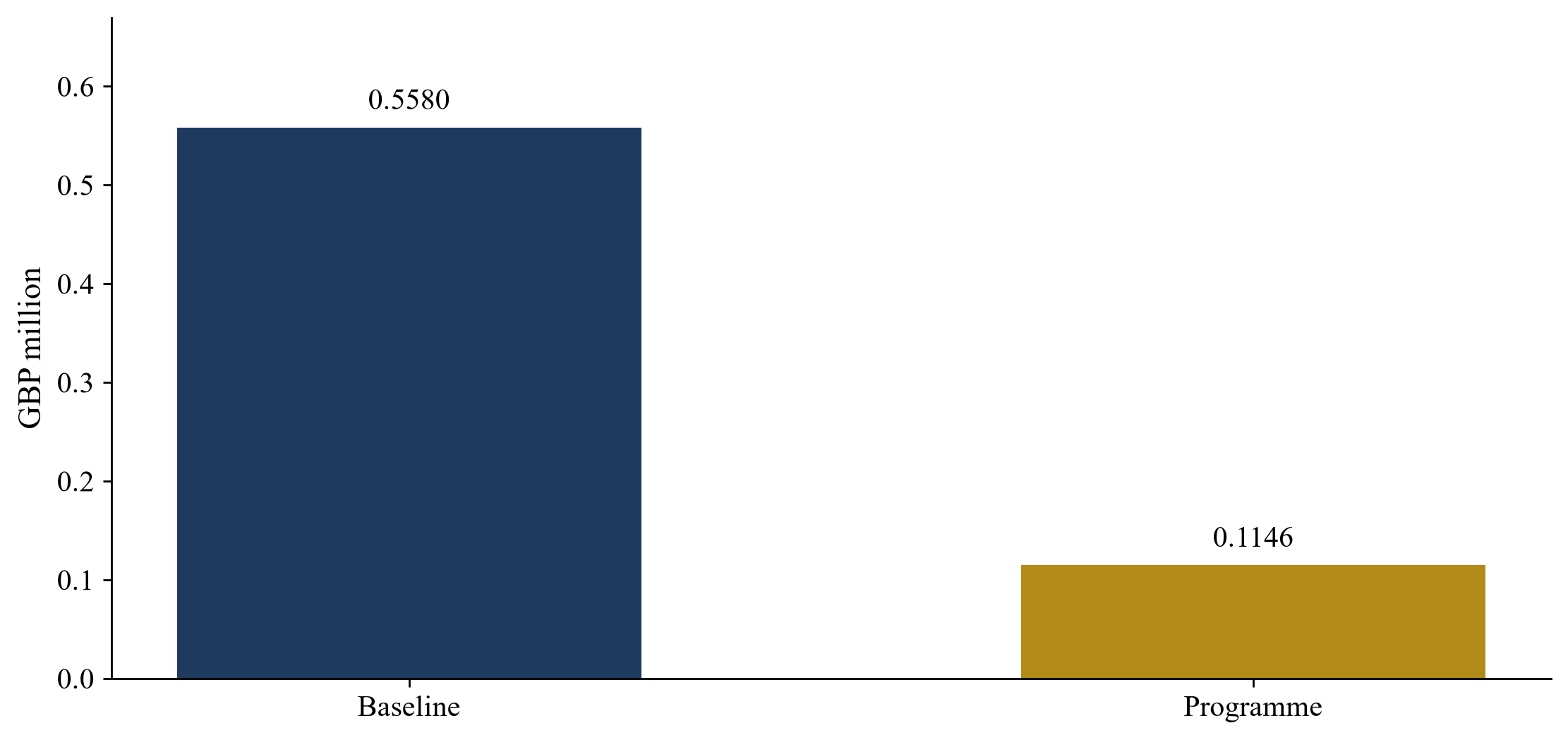
Author assumptions; reduction in expected loss is not an observed programme outcome.
9. Challenge the benefit before approving the programme
The programme's break-even benefit in the example is 0.24. Under the stated assumptions it reduces expected loss by 0.4434, leaving a margin of 0.2034 before any excluded effects. A useful review asks how much of the projected reduction needs to be realised to cover expenditure. Dividing cost by projected reduction gives approximately 54.13%. This is an arithmetic threshold within the example, not a forecast of programme effectiveness.
The threshold should be tested against specific operating evidence. If the programme principally creates backup coverage, the question is whether the backup can perform the task at the required time. If it provides supervised knowledge transfer, the question is whether the recipient can execute the process to an agreed standard. If it includes a lawful retention arrangement, the question is what service commitment is actually agreed and how the business would respond if coverage still becomes unavailable.
Consider a deliberately simplified sensitivity in which only half the projected reduction is achieved while cost remains 0.24. The benefit becomes 0.2217 and the net effect becomes negative 0.0183. This calculation demonstrates how a seemingly attractive programme depends on the assumed improvement. It should not be interpreted as assigning a 50% chance of success or as a statistically estimated outcome.
Programme costs also need completeness. Include agreed payments, external support, training capacity, documentation effort and implementation costs to the extent they are incremental. Ordinary payroll already in the operating forecast should remain there. Where existing staff spend time training substitutes, show the capacity consequence even if there is no additional salary payment. A project can consume scarce capacity without generating a separate invoice.
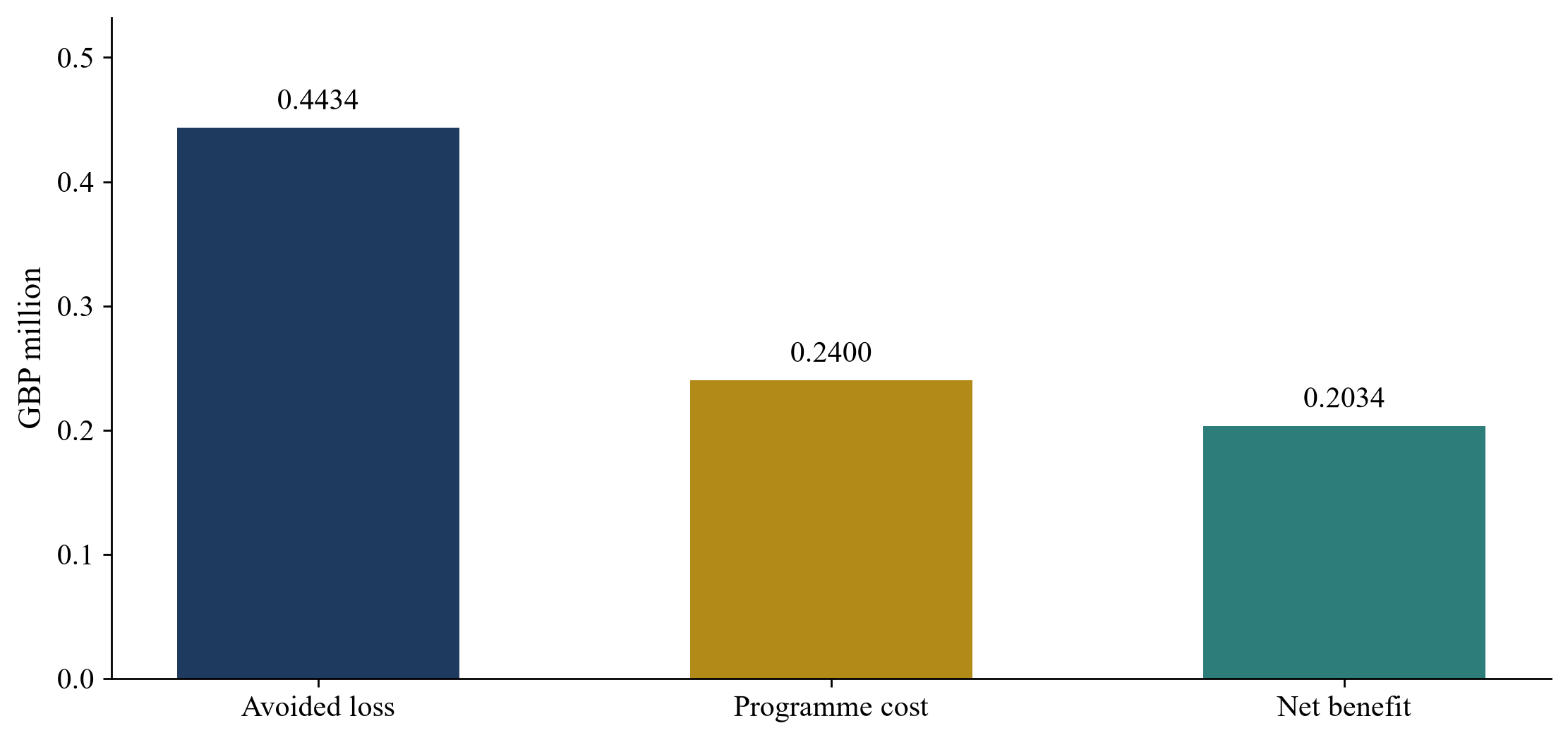
Expected arithmetic from section 8; actual effectiveness and cost require evidence.
10. A thirteen-week funding test
The liquidity example uses a separate deterministic downside. It begins with unrestricted cash of 0.50 and ordinary net operating cash generation of 0.06 each week for thirteen weeks. The weekly baseline is assumed to include normal payroll and other routine operating payments. A buyer-paid arrears amount of 0.30 is assumed due in week one purely for modelling. This assumption is not a legal conclusion about any jurisdiction or transaction.
Programme cash payments of 0.12 occur in weeks one and five. Additional disruption reduces cash by 0.18 in week two, 0.18 in week three and 0.12 in week four. These deterministic amounts are imposed to test timing. They do not derive from the probability-weighted expected-loss calculation and should not be added to it as though both were realised costs.
Closing cash is 0.14 in week one and 0.02 in week two. It turns negative in week three, reaches negative 0.16 in week four and reaches its lowest point, negative 0.22, in week five when the second programme payment occurs. Cash subsequently recovers to 0.26 at the end of week thirteen under the assumed weekly operating generation.
The positive ending balance conceals an earlier funding shortfall. To maintain a minimum cash reserve of 0.10 throughout this example, the model requires 0.32 of additional cash available before the shortfall develops. This is the reserve minus the lowest unfunded balance. Funding conditions, fees, repayment and interest are excluded; an actual financing model must include them.
The investment committee should receive both the economic comparison and the dated cash schedule. It can then distinguish an intervention that appears beneficial under assumptions from one that is executable with available liquidity. A financing proposal should specify when funds become accessible and the obligations that must be met before drawdown. A commitment conditional on a later completion event cannot support an earlier payment without another arrangement.
Table 4. Hypothetical cash schedule inputs
| Item | GBP million | Timing |
|---|---|---|
| Opening cash | 0.50 | Before week 1 |
| Ordinary net generation | 0.06 | Each week |
| Assumed buyer-paid arrears | 0.30 | Week 1 |
| Programme payments | 0.12 each | Weeks 1 and 5 |
| Disruption cash loss | 0.18 / 0.18 / 0.12 | Weeks 2 / 3 / 4 |
| Minimum reserve | 0.10 | Every week |
Deterministic downside distinct from the expected-loss calculation; financing costs excluded.
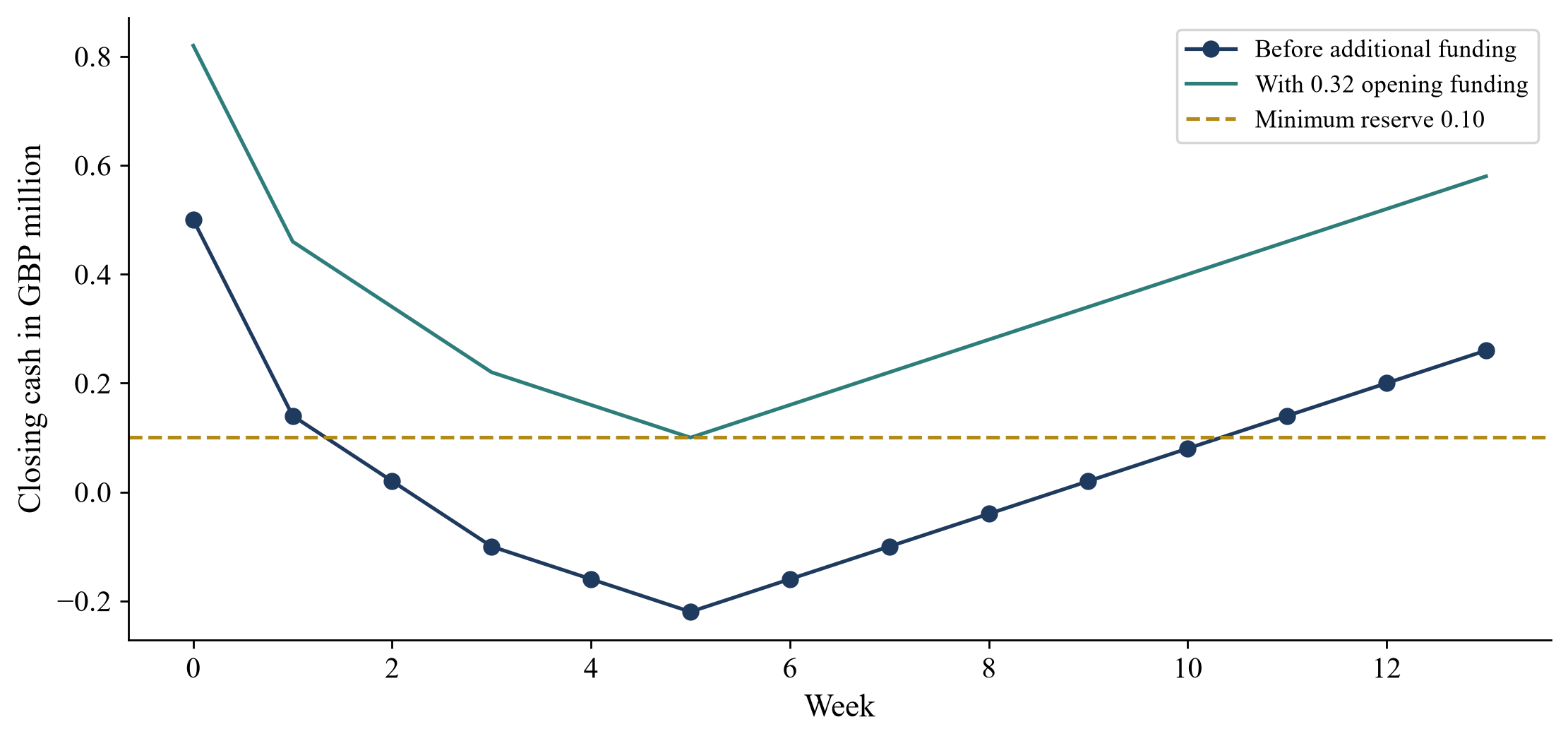
Deterministic downside; additional funding assumed available at the start. No financing fees or interest.
11. Bring claims and transition spending into the price bridge
The workforce analysis should connect to the sources-and-uses statement and purchase agreement. Identify consideration paid to the seller separately from liabilities assumed, direct payments to employees or relevant bodies, programme expenditure and ordinary operating funding. These classifications should follow the documented transaction treatment. Their purpose is to let reviewers trace each amount to the obligation or operating assumption that created it.
Where a claim remains unresolved, the parties may consider an adjustment, retention, escrow or another negotiated arrangement with counsel. The model should assess the timing and collectibility of any protection. An indemnity claim that may be paid much later provides limited evidence of cash available for next week's payroll. The proposed funding schedule should show the payment obligation when it arises and any recovery only when supportable.
A buyer should examine whether the seller or estate can deliver the records required to administer obligations after completion. Missing payroll histories, benefit terms or contribution records can create uncertainty even if a price adjustment has been agreed. The completion checklist should identify which data is necessary to operate lawfully and accurately on the first payroll date and which historical questions can remain under a governed resolution process.
Proposed workforce savings should be reconciled to the service plan before appearing in acquisition valuation. Show the activities discontinued, the capacity retained, the expected implementation date and any transitional duplication. If a valuation assumes uninterrupted customer delivery, the operating model must support that assumption with sufficient capability. The paper does not prescribe a staffing outcome; it provides a way to expose the dependencies behind the financial forecast.
12. Consultation, communication and closing readiness
The communication plan should distinguish decisions already taken, proposals under consideration and matters requiring consultation or agreement. Employees should receive accurate information through the appropriate authorised process. A transaction team should avoid presenting a modelling assumption as a settled employment outcome. Finance, operational management, HR and counsel need a shared record of what has actually been approved and communicated.
The US Department of Labor identifies advance-notice requirements under WARN for qualifying plant closures and mass layoffs and provides compliance resources. Applicability, exceptions and any additional state requirements require transaction-specific legal review. A distressed timetable should therefore include a notice-and-consultation workstream instead of assuming that financial urgency disposes of the issue. [4]
Completion readiness should include the ability to run the first payroll accurately, communicate the responsible employer and provide a route for questions or corrections. Test authorised bank access and payment files, reconcile opening balances and identify who can resolve exceptions. These are proposed operating controls, not evidence that any particular business currently lacks them.
For critical activities, obtain confirmation of available coverage on the relevant dates, including lawful access and required authorisations. Where a dependency remains unresolved, record its operating consequence and fallback. The investment decision should explicitly address the residual exposure through funding, conditions or another agreed response. A completed checklist is useful only where its supporting evidence demonstrates the required capability.
13. Overlapping dependencies and the limits of addition
The numerical example treats the three operating cells as separate sources of contribution. A real diligence exercise should test that premise before adding their losses. A shared specialist, authorisation or system can connect several activities. The resulting exposure belongs to the affected business process and period, even when several people describe the same consequence in separate interviews.
Consider an additional hypothetical project that generates contribution of 0.20 per week and requires both a technical approval and a commissioning team. Assume that either missing input stops all project contribution for the same two-week period. The loss when both are unavailable is 0.40. Adding two separately reported exposures of 0.40 would produce 0.80 and double-count the same project cash flow. The model needs mutually exclusive operating states and a single reconciliation to project contribution.
Under a further hypothetical assumption that the two interruptions have probabilities of 20% and 30% and are independent, the probability of at least one interruption is 44%. Expected two-week contribution loss would then be 0.176. Independence is a modelling assumption, not a conclusion that follows from different job titles. A shared employer event or common access problem could make the assumption unsuitable.
If their dependence cannot be estimated, show separate joint states instead of presenting an unjustified probability. With the same marginal probabilities, the probability of at least one interruption lies between 30% and 50%. Those bounds would imply expected loss between 0.12 and 0.20 under the stated two-week loss amount. They illustrate uncertainty arising from dependence; they do not establish probabilities for an actual workforce.
The decision implication concerns the intervention. Two retention agreements may protect the same project and still leave a shared system inaccessible. A backup plan may require a single additional authorisation rather than two replacements. Map the complete task sequence, identify its binding dependency and test whether the proposed expenditure changes the relevant operating state. Record any remaining dependency alongside the claimed benefit.
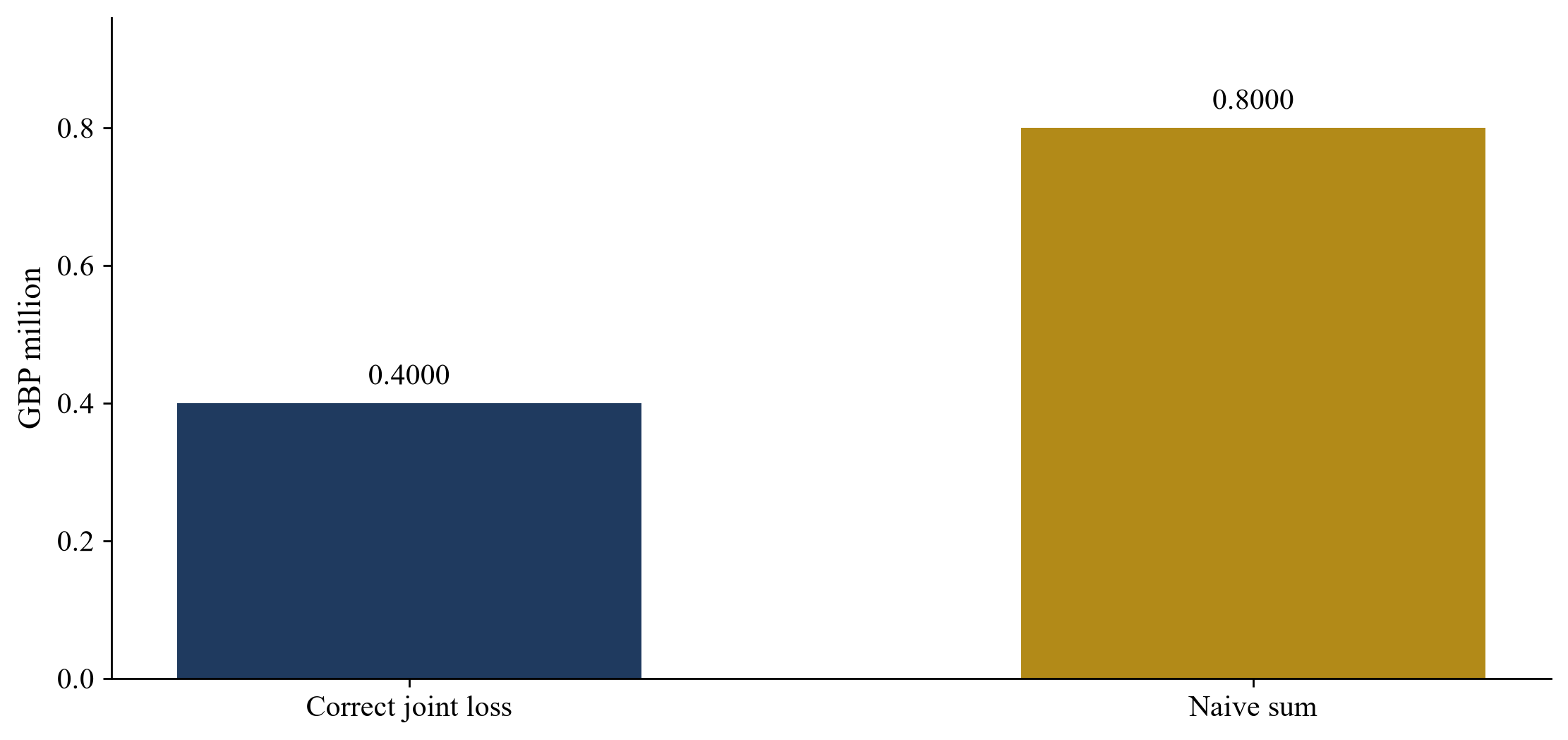
Hypothetical two-week project interruption from section 13; both tasks support the same contribution.
14. Evidence quality and the value of another diligence step
Short transaction timetables require choices about which uncertainties to investigate first. We propose ranking diligence work by the decision it could change, the time needed to obtain evidence and the cost of acting without that evidence. A large unresolved amount deserves attention, but a smaller uncertainty can also be decisive if it blocks the first payroll or a regulated operating activity.
For every material assumption, record its current basis. An executed agreement, reconciled payroll extract and employee confirmation provide different kinds of support. A statement from management should remain attributable to management. The review should distinguish whether the uncertainty concerns the existence of an obligation, the amount, the liable entity, the payment date or the operational consequence of a vacancy. A single confidence score conceals these differences.
A useful diligence request specifies the evidence that would change the model. For example, an outstanding contribution balance may need reconciliation with the relevant administrator; a claimed backup capability may need a supervised operating test. The request should identify the reviewer and decision deadline. A large collection of documents has limited value if no one can explain which forecast or completion condition each document supports.
Consider a hypothetical decision between proceeding with an acquisition at a stated price and withdrawing. Additional information has economic value only to the extent that it could change the decision or its terms. Spending to refine an immaterial payroll estimate may have less value than resolving whether a critical authorisation remains available at completion. This is a proposed prioritisation principle, with no universal monetary threshold.
Record the treatment when information cannot arrive before the bid deadline. The committee can retain a downside assumption, seek a contractual condition, fund the exposure or decide that the uncertainty exceeds its authority. The paper does not prescribe which choice is correct. It requires the chosen response and its evidence to remain visible in the investment record.
15. Engineering and project businesses
For an engineering acquisition, the proposed diligence unit is the contracted deliverable and its acceptance requirements. Identify the people authorised and competent to prepare, check and approve each material deliverable. Reconcile that coverage to the project schedule. A headcount total gives limited information about whether an imminent milestone can be completed and accepted.
The capability map should distinguish producing work from approving it. A team may have enough delivery capacity while lacking the person or external authority required to sign a release. Where approval depends on an individual's qualification, customer acceptance or statutory authorisation, verify the actual requirement with the responsible specialists. Do not assume that changing ownership transfers every approval or permits an unapproved substitute.
For each relevant project, connect a capability interruption to the contractual and cash consequences. Proposed fields include deferred milestone receipts, incremental completion costs, remedial work and any exposure requiring legal review. Avoid counting the entire contract value as a loss when the scenario concerns only a delay. Separate contribution forgone from cash received later and from costs needed to restore performance.
Knowledge-transfer work can focus on current design decisions, configuration records, unresolved technical issues and customer acceptance criteria. The buyer should request enough context for a qualified recipient to understand why the existing approach was chosen. Copying an archive without a usable index or explanation may leave the recipient unable to locate the material needed for the next decision.
These are proposed questions for an engineering transaction. Their relevance depends on the acquired activities. The same worksheet should not impose an engineering approval model on a business whose service can be performed through another operating structure. The governing principle is to identify what must happen for delivery and cash collection, then verify the capabilities required at that time.
16. Software and technology businesses
In a software acquisition, begin with the activities required to maintain the service being sold. Proposed areas include production access, release management, incident response, security operations and customer-specific integrations. The diligence team should establish the actual operating architecture before assigning criticality to a role. The analysis concerns demonstrated coverage of tasks rather than assumptions about seniority or title.
For each relevant activity, test whether access is controlled by the acquired organisation and can be used by authorised personnel after completion. A documented process may still depend on a personal account, external contractor or retained group system. Resolve ownership and permission questions through the appropriate contractual and technical review. Do not treat possession of a password or a copied repository as proof of lawful operational control.
Knowledge transfer should include a supervised exercise appropriate to the service. A recipient might demonstrate a deployment, recover a test environment or explain an open incident under controlled conditions. Production changes require their normal safeguards. The acquisition timetable should not create a reason to test recovery by disrupting customer systems or exposing sensitive information.
Where the business uses machine-learning systems, proposed diligence questions include ownership of training and evaluation records, access to model services, monitoring responsibilities and the ability to investigate a material failure. These are operational questions. The framework makes no assumption that the use of AI creates additional value or that a particular employee's undocumented knowledge can be replaced automatically.
The financial model should connect each credible interruption to the relevant revenue or cost mechanism. A delayed feature release, a service outage and an inability to meet a contracted support obligation have different consequences. The scenario should identify which customers or products are affected and avoid adding several descriptions of the same loss. Retained capability should be evidenced through usable coverage and agreed service, with uncertainty disclosed where it remains.
17. Infrastructure and regulated operations
An infrastructure acquisition should identify the activities required for safe and authorised operation before considering workforce changes in the valuation case. Relevant tasks may involve control-room coverage, maintenance, emergency response or operational certification. These are examples for investigation; management and qualified specialists must establish the requirements for the specific asset and jurisdiction.
The proposed coverage record should include shift requirements and the availability of authorised substitutes. A person counted as backup may already be required on another shift or site. Travel, rest requirements and site access can constrain availability. Record those constraints from the actual operating rules and agreements, rather than applying an assumed uniform standard across assets.
A vacancy scenario should distinguish an operating restriction from a complete loss of service. Where specialists conclude that output must be reduced or operations stopped, use that conclusion and its timing in the cash model. Commercial management should not override a safety or authorisation requirement to preserve a forecast. Any restart assumption needs the associated resources, approvals and timetable.
Maintenance knowledge can also affect the acquisition plan. The buyer should request the condition records, outstanding work orders and explanations needed for competent personnel to assess the asset. An undocumented operating practice should be investigated through the relevant technical process. The paper does not treat a departing employee as responsible for a documentation gap; the purpose is to identify the business's evidence and continuity requirements.
The capital plan should retain expenditure required to maintain operating capability. A proposed reduction in maintenance or training cost needs a technical basis and a consistent service assumption. Where evidence is insufficient, show the uncertainty rather than assigning an unsupported saving. This connects the workforce review to asset availability, contractual delivery and investment needs without presenting a generic staffing ratio as an operating standard.
18. Cross-border execution and currency exposure
A cross-border transaction needs an entity-by-entity employment analysis. The UK and US sources discussed earlier illustrate specific legal issues; they do not provide a universal rule for the GCC, India or other markets. Local counsel should determine the relevant employment, insolvency, consultation and transfer requirements. Where people work across borders, record the employer, work location and applicable arrangements for review.
The operating schedule should identify any permissions that affect the availability of staff after completion. Possible questions include whether existing work authorisations remain usable, whether a change requires a new process and whether a proposed temporary arrangement is permitted. The paper does not answer those questions for an unspecified jurisdiction. It recommends that the financial timetable use verified conclusions from the responsible advisers.
Currency exposure should remain visible in payroll and benefit schedules. Record the currency of the obligation and the currency of available cash. Translation into a reporting currency does not remove the need to make payment in the required currency. Where a funding scenario uses an exchange-rate assumption, state its date and purpose, and test the relevant sensitivity without presenting a model rate as a guaranteed execution price.
Group benefits and shared services require attention to the acquired perimeter. Identify which arrangements continue, which depend on seller support and which need replacement. The buyer should document the agreed transition period, service level and funding. A group policy described in a data room does not establish that the acquired business can continue participating after control changes.
The combined model should retain local schedules while consolidating their cash consequences. A global total may conceal a funding shortfall in an entity that cannot access another entity's cash. Proposed transfers between entities require legal, tax and financing review. The investment committee should see liquidity where it must be available, together with any restrictions on moving it.
19. Implementation from diligence to the first payroll
The first workstream should establish the workforce perimeter and reconcile the opening obligations. Counsel and authorised HR personnel should determine the legal questions, while finance traces balances and payment dates. The resulting record should identify unresolved items and the decision deadline for each. This provides the basis for choosing the next evidence request and avoids treating an incomplete register as a confirmed liability total.
The second workstream should test the capabilities required through the transition. Operational owners identify the critical tasks, demonstrate current coverage and assess any proposed substitutes. The project schedule should show when knowledge transfer or authorisation must be completed. Where the programme relies on employee agreement or external approval, record that dependency explicitly.
Before signing, reconcile the two workstreams to the financial model. The committee should receive the opening obligations, proposed transition expenditure, operating assumptions and dated funding requirement. Material unresolved issues should be connected to a specific decision or negotiated condition. Record who has authority to accept the remaining exposure and what subsequent evidence would require reconsideration.
Before completion, test the first payroll process with the appropriate controls. Confirm employee records, approved amounts, payment dates, bank access and the route for resolving exceptions. A test should use lawful, controlled handling of data and should not make an unintended payment. The payroll owner should retain evidence of the checks and any corrections required before release.
At completion, confirm the availability of the operating capabilities scheduled for that date. The record should show what was actually verified, what remains conditional and which fallback has been activated where necessary. A pre-signing statement should not be reused as current evidence if availability or contractual arrangements have changed. The completion decision should use the latest approved information.
Table 5. Proposed implementation controls
| Exposure | Owner role | Evidence | Response |
|---|---|---|---|
| Obligation unresolved | Counsel and finance | Reviewed allocation | Scenario or condition |
| Payroll unavailable | Payroll and treasury | Controlled payment test | Resolve before payroll |
| Task uncovered | Operations | Available authorised coverage | Funded fallback |
| Programme unapproved | HR and counsel | Lawful agreed terms | Exclude assumed benefit |
| Cash below reserve | Finance | Dated funded forecast | Additional commitment |
Proposed responsibilities; transaction governance must establish actual authority and deadlines.
20. Review the first thirteen weeks
After completion, compare actual obligations settled and operating outcomes with the original forecast. Preserve the signed-off baseline so that changes remain explainable. Where an amount differs, identify whether the cause was missing information, an incorrect assumption, a new event or an implementation delay. These categories help the team decide whether to change the process, update the model or investigate a specific exception.
For the capability programme, measure the outcome at the task level. Record whether required coverage was available, whether a substitute completed the agreed exercise and whether the documentation was usable. A payment made or meeting held is evidence of activity. The claimed operating benefit needs its own evidence and should remain unproven until the relevant task can be performed under the agreed conditions.
Track programme expenditure against approval and timing. A cost increase may be justified by new evidence, but it should be authorised through the agreed process. Update the weekly cash forecast when payments move or disruption lasts longer than assumed. The original programme's expected benefit should not be used to justify every subsequent expenditure without considering its incremental purpose and funding.
Employee questions and payroll corrections need an accessible resolution route. The operating plan should assign responsibility for responding, maintaining appropriate records and escalating matters requiring legal or specialist review. The paper makes no claim that a particular communication programme changes retention rates. Accurate administration and accountable follow-up are proposed controls whose implementation can be observed directly.
At the end of the review period, document which assumptions were supported, contradicted or remain unresolved. A single acquisition cannot validate a general relationship between expenditure and workforce continuity. It can provide evidence about the execution of its own programme. That evidence should inform future diligence questions while preserving the limitations of the sample and the particular transaction context.
21. Limitations and conclusion
This paper proposes a way to connect employment obligations and operating capability to acquisition decisions. Its legal discussion is bounded by the cited public sources and requires transaction-specific advice. It does not determine the treatment of an actual employee claim, recommend a staffing decision or provide an accounting opinion. The numerical inputs are hypothetical and have no empirical calibration.
The expected-loss model is deliberately narrow. It assumes one interruption per cell within the horizon, constant contribution exposure and specified interruption durations. The independent-cell calculation does not represent a network of shared dependencies. The separate overlap example shows how the answer changes when two tasks support the same project. Actual modelling should follow the business's dependencies and available evidence.
The weekly cash example also omits financing costs, taxes outside the baseline and other transaction-specific items. Its negative balance identifies a funding requirement under its assumptions; it does not demonstrate that funding can be obtained. A real financing decision requires committed sources, draw conditions, repayment and the wider cash needs of the acquired business. Those requirements should be included before using a model to support completion.
Further empirical work could examine whether documented task coverage and tested substitutes are associated with shorter disruption after distressed acquisitions. Such a study would need consistent definitions, event dates and information on other causes of interruption. It would also need lawful access to data and a design capable of addressing selection and confounding. This paper claims no such validation.
The practical recommendation is to maintain a traceable connection between the obligation, the required capability and its funding. Determine who owes each material amount, establish what must be performed to trade, and test whether the business has the authorised people and cash to perform it. Preserve unresolved questions in the decision record. This gives the buyer a reviewable basis for negotiating the transaction and managing its first operating period.
References
- GOV.UK. Business transfers, takeovers and TUPE: Insolvent businesses. Accessed 5 September 2026. https://www.gov.uk/transfers-takeovers/insolvent-businesses
- Acas. Employee liability information. Updated 23 February 2026. https://www.acas.org.uk/tupe/advice-for-employers-and-employees/employee-liability-information
- United States Code. Title 11, section 503. Allowance of administrative expenses, including subsection (c). https://www.law.cornell.edu/uscode/text/11/503
- US Department of Labor. WARN Act Compliance Assistance. Accessed 5 September 2026. https://www.dol.gov/agencies/eta/layoffs/warn
- IFRS Foundation. IAS 19 Employee Benefits, standard overview. Accessed 5 September 2026. https://www.ifrs.org/issued-standards/list-of-standards/ias-19-employee-benefits/
