

1. Establish authority and the workforce objective
The transaction team should confirm powers, constraints, mandates and specialist responsibilities. Evidence should come from constitutions, finance documents, orders, minutes and advice. The controlling question is who may approve, disclose, negotiate and bind each employer. The answer should be dated, attributed and linked to the legal entity, asset, liability or operating dependency it describes [1][2][3][4].
The controlled output is an authority and responsibility memorandum. It should state the source, calculation method, owner, exceptions, required approvals and the next irreversible deadline. This allows a board, officeholder, creditor or buyer to reproduce the conclusion when facts change.
The principal risk is that an unauthorised person may initiate an irreversible workforce step. The team should quantify the effect on liquidity, stand-alone earnings, creditor recoveries, operating continuity and completion probability. A material exception should update the perimeter and funding plan.
2. Map employing entities and jurisdictions
This workstream requires the company and its advisers to identify every employer, branch, payroll, work location, secondment and agency arrangement, using group charts, payroll, contracts, tax and immigration records. The practical test is which entity owes each obligation and which law applies. Analysis should use one cut-off date so that cash, claims, contracts, people and transaction documents reconcile [1][5][6][7].
Decision-makers should maintain an employer and jurisdiction map. It should distinguish legal ownership from economic allocation, current evidence from forecast assumptions and committed funding from indications. Qualified advisers retain responsibility for legal, insolvency, tax, pensions, accounting and regulatory judgements.
Execution can fail when group totals may conceal liabilities outside the sale perimeter. Each dependency needs a control, evidence threshold, escalation route and decision time. The transaction remains viable only while the funded separation plan can absorb a credible delay or shortfall.
3. Put payroll on the liquidity clock
The readiness team should date payroll, contributions, premiums, taxes, consultation milestones and funding calls. The evidence base includes bank data, payroll files, invoices, tax accounts and trustee correspondence. The central question is what must be paid or secured, by whom and when. Conclusions should remain at entity and dependency level because the failing group may have pooled cash, shared rights and cross-guarantees [1][8][9][10].
The required deliverable is a workforce liquidity schedule. It should connect the proposed sale documents to the stand-alone operating model and the residual estate. Every material assumption should show its source and sensitivity.
The downside is that missed payroll or cover may cause departures before completion. Management should test the base case and a combined downside against minimum cash, customer continuity and the completion timetable. Unsupported benefits should not be treated as available funding.
4. Select the transaction route
The seller should compare share, asset, business, administration, liquidation, restructuring and newco routes. Relevant evidence includes structure papers, legal advice, employee records and bidder proposals. The decision asks how each route changes transfer, claims, pensions and conditions. A reliable answer links financial analysis to title, transfer mechanics, operating capability and the applicable approval process [1][2][5][11].
The decision pack should contain a route decision memorandum. It should show calculation dates, owners, dependencies and the documents that implement the conclusion. This creates a defensible record for later scrutiny and post-completion reconciliation.
A material failure occurs when the preferred structure may create unquantified liabilities. The response should identify a funded cure, alternative perimeter or fallback route. Continuing without one can reduce going-concern value and creditor recovery.
5. Build the worker population
The transaction team should reconcile employees, directors, workers, contractors, agency staff and secondees. Evidence should come from HRIS, payroll, contracts, invoices, access logs and time sheets. The controlling question is who is in scope, on what status, at which location and in which role. The answer should be dated, attributed and linked to the legal entity, asset, liability or operating dependency it describes [5][12][13][14].
The controlled output is a worker-level population file. It should state the source, calculation method, owner, exceptions, required approvals and the next irreversible deadline. This allows a board, officeholder, creditor or buyer to reproduce the conclusion when facts change.
The principal risk is that essential people may be omitted, duplicated or misclassified. The team should quantify the effect on liquidity, stand-alone earnings, creditor recoveries, operating continuity and completion probability. A material exception should update the perimeter and funding plan.
Table 1. Worker population reconciliation
| Population | Evidence | Control |
|---|---|---|
| employees | HRIS, payroll and contracts | employer and continuity agree |
| shared roles | time and operating maps | allocation reflects activity |
| contingent labour | invoices and access logs | status is tested |
| critical roles | process ownership | day-one coverage is funded |
Values and scores are analytical scenarios; transaction evidence should replace model values.
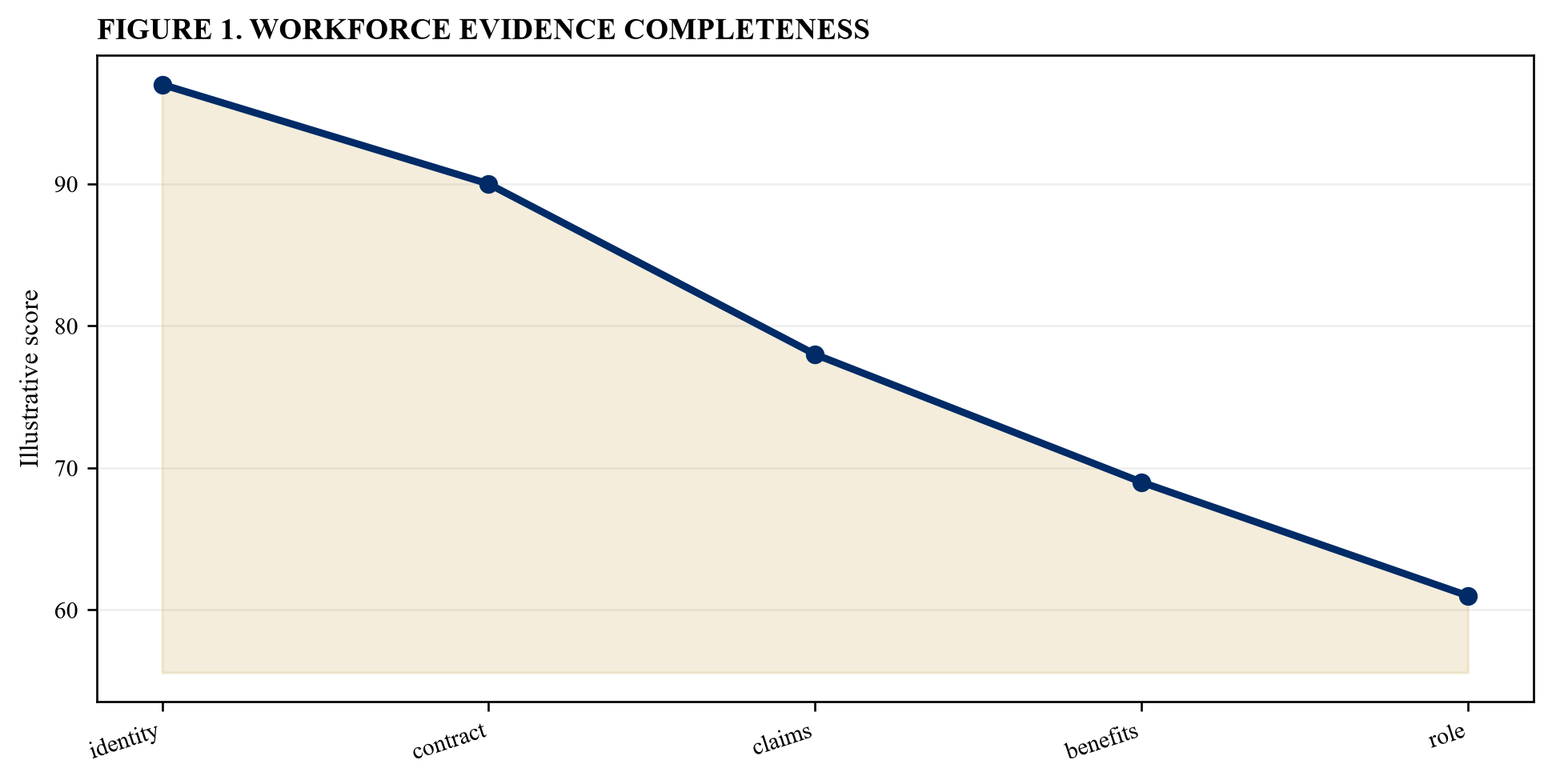
Illustrative analytical scenario; transaction evidence should replace model values.
6. Reconcile the operating perimeter
This workstream requires the company and its advisers to link roles to customers, sites, systems, licences, controls and day-one processes, using role profiles, process maps, access rights, delegations and interviews. The practical test is which people and capabilities must move or remain available. Analysis should use one cut-off date so that cash, claims, contracts, people and transaction documents reconcile [15][16][17][18].
Decision-makers should maintain a role-to-capability map. It should distinguish legal ownership from economic allocation, current evidence from forecast assumptions and committed funding from indications. Qualified advisers retain responsibility for legal, insolvency, tax, pensions, accounting and regulatory judgements.
Execution can fail when headcount may transfer without authority, knowledge or coverage. Each dependency needs a control, evidence threshold, escalation route and decision time. The transaction remains viable only while the funded separation plan can absorb a credible delay or shortfall.
7. Verify contracts and continuity
The readiness team should record start, continuity, status, grade, hours, location, notice and amendments. The evidence base includes contracts, letters, variations, handbooks, agreements and payroll. The central question is which contractual terms and continuity rights govern each person. Conclusions should remain at entity and dependency level because the failing group may have pooled cash, shared rights and cross-guarantees [5][6][12][18].
The required deliverable is a contract and continuity register. It should connect the proposed sale documents to the stand-alone operating model and the residual estate. Every material assumption should show its source and sensitivity.
The downside is that unsigned changes or wrong dates can distort claims. Management should test the base case and a combined downside against minimum cash, customer continuity and the completion timetable. Unsupported benefits should not be treated as available funding.
8. Control employee information
The seller should define required data, lawful disclosure, access, redaction and update controls. Relevant evidence includes privacy notices, processing records, data maps and disclosure logs. The decision asks what may be disclosed, to whom, when and with what assurance. A reliable answer links financial analysis to title, transfer mechanics, operating capability and the applicable approval process [19][20][21][22].
The decision pack should contain a controlled employee data room. It should show calculation dates, owners, dependencies and the documents that implement the conclusion. This creates a defensible record for later scrutiny and post-completion reconciliation.
A material failure occurs when late, incomplete or unlawful disclosure can impair diligence. The response should identify a funded cure, alternative perimeter or fallback route. Continuing without one can reduce going-concern value and creditor recovery.
9. Quantify wage and payroll arrears
The transaction team should reconcile pay, overtime, allowances, expenses, deductions, taxes and contributions. Evidence should come from payroll, banks, time records, tax accounts and ledgers. The controlling question is what is earned, paid, withheld, disputed or claimable. The answer should be dated, attributed and linked to the legal entity, asset, liability or operating dependency it describes [8][9][23][24].
The controlled output is a worker-level arrears schedule. It should state the source, calculation method, owner, exceptions, required approvals and the next irreversible deadline. This allows a board, officeholder, creditor or buyer to reproduce the conclusion when facts change.
The principal risk is that the ledger may understate earned or withheld amounts. The team should quantify the effect on liquidity, stand-alone earnings, creditor recoveries, operating continuity and completion probability. A material exception should update the perimeter and funding plan.
10. Map the employee-claim waterfall
This workstream requires the company and its advisers to classify protected, preferential, unsecured, administrative and state-funded elements, using claims, insolvency law, payroll, orders and practitioner records. The practical test is what each worker may recover from each obligor. Analysis should use one cut-off date so that cash, claims, contracts, people and transaction documents reconcile [1][2][8][9].
Decision-makers should maintain an employee-claim waterfall. It should distinguish legal ownership from economic allocation, current evidence from forecast assumptions and committed funding from indications. Qualified advisers retain responsibility for legal, insolvency, tax, pensions, accounting and regulatory judgements.
Execution can fail when one obligation may be omitted, duplicated or mis-prioritised. Each dependency needs a control, evidence threshold, escalation route and decision time. The transaction remains viable only while the funded separation plan can absorb a credible delay or shortfall.
Table 2. Illustrative employee-claim waterfall
| Claim class | Gross | Expected recovery | Funding gap |
|---|---|---|---|
| wages and deductions | 4.8 | 2.9 | 1.9 |
| holiday and commission | 3.2 | 1.4 | 1.8 |
| notice and redundancy | 7.1 | 3.6 | 3.5 |
| benefit and contribution gaps | 2.4 | 0.5 | 1.9 |
Values and scores are analytical scenarios; transaction evidence should replace model values.
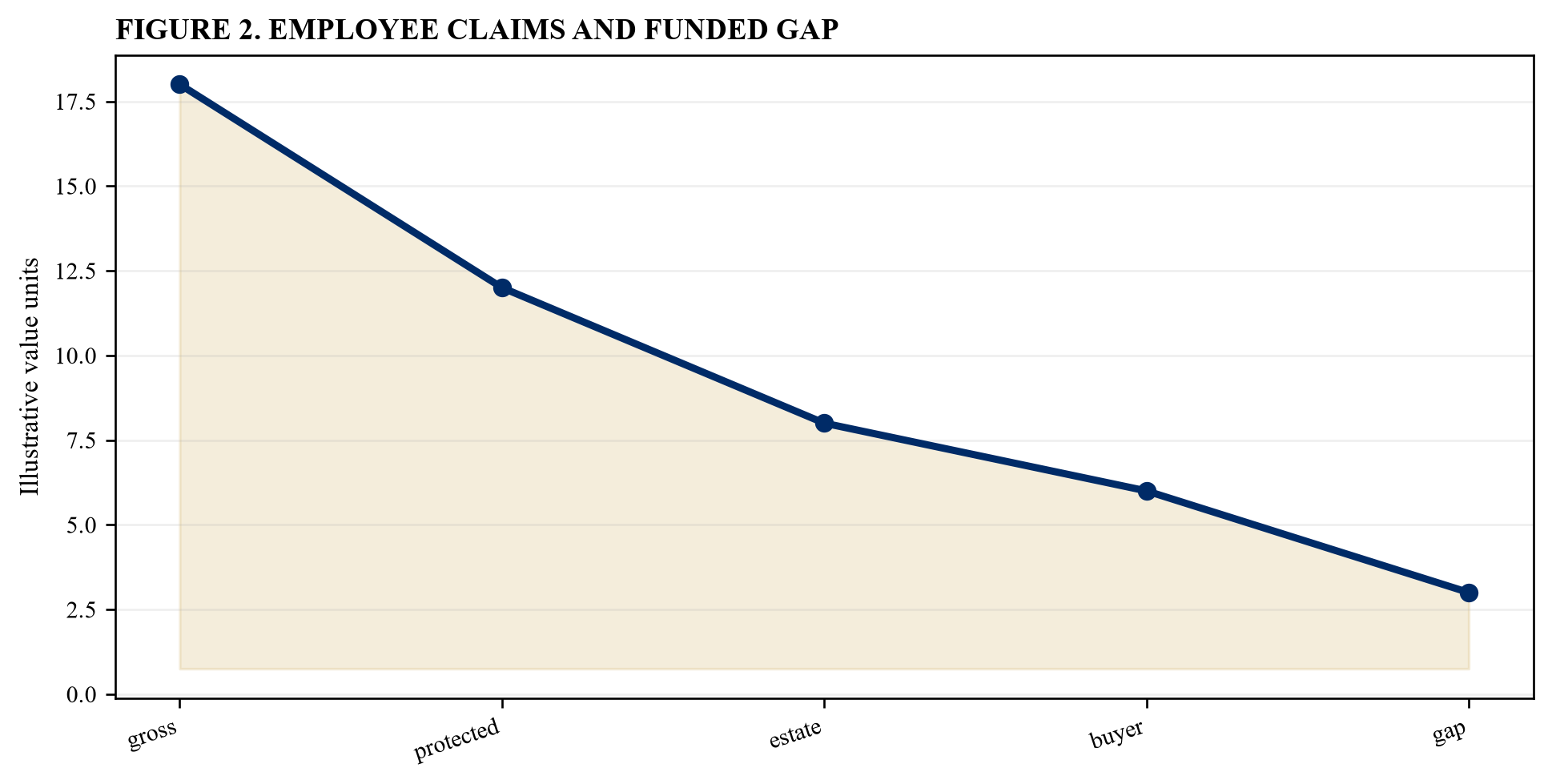
Illustrative analytical scenario; transaction evidence should replace model values.
11. Measure holiday commission and variable pay
The readiness team should calculate leave, commission, bonus, overtime and discretionary awards at cut-off. The evidence base includes contracts, plans, sales records, leave systems and approvals. The central question is which amounts are accrued, contingent or transaction-triggered. Conclusions should remain at entity and dependency level because the failing group may have pooled cash, shared rights and cross-guarantees [12][18][23][25].
The required deliverable is a variable-pay and leave provision. It should connect the proposed sale documents to the stand-alone operating model and the residual estate. Every material assumption should show its source and sensitivity.
The downside is that unrecorded accruals can create immediate cash needs. Management should test the base case and a combined downside against minimum cash, customer continuity and the completion timetable. Unsupported benefits should not be treated as available funding.
12. Model redundancy and notice
The seller should compare statutory, contractual and enhanced redundancy and notice outcomes. Relevant evidence includes service, age, pay, policies, collective terms and proposals. The decision asks what cost and timing follows each perimeter and route. A reliable answer links financial analysis to title, transfer mechanics, operating capability and the applicable approval process [8][12][25][26].
The decision pack should contain a redundancy and notice model. It should show calculation dates, owners, dependencies and the documents that implement the conclusion. This creates a defensible record for later scrutiny and post-completion reconciliation.
A material failure occurs when headline savings may ignore notice and consultation. The response should identify a funded cure, alternative perimeter or fallback route. Continuing without one can reduce going-concern value and creditor recovery.
13. Test transfer rules
The transaction team should determine whether an economic entity retains identity and what transfers by law. Evidence should come from business-perimeter evidence, roles, contracts, customers and assets. The controlling question is whether automatic transfer applies and to whom. The answer should be dated, attributed and linked to the legal entity, asset, liability or operating dependency it describes [5][6][27][28].
The controlled output is a transfer analysis linked to sale documents. It should state the source, calculation method, owner, exceptions, required approvals and the next irreversible deadline. This allows a board, officeholder, creditor or buyer to reproduce the conclusion when facts change.
The principal risk is that transaction labels may conflict with operating facts. The team should quantify the effect on liquidity, stand-alone earnings, creditor recoveries, operating continuity and completion probability. A material exception should update the perimeter and funding plan.
14. Apply insolvency exceptions carefully
This workstream requires the company and its advisers to classify the procedure and test available transfer-rule modifications, using court documents, strategy, route and employee proposals. The practical test is which obligations transfer, receive state support or may be varied. Analysis should use one cut-off date so that cash, claims, contracts, people and transaction documents reconcile [5][8][9][27].
Decision-makers should maintain an insolvency-transfer memorandum. It should distinguish legal ownership from economic allocation, current evidence from forecast assumptions and committed funding from indications. Qualified advisers retain responsibility for legal, insolvency, tax, pensions, accounting and regulatory judgements.
Execution can fail when an exception may be applied outside its scope. Each dependency needs a control, evidence threshold, escalation route and decision time. The transaction remains viable only while the funded separation plan can absorb a credible delay or shortfall.
15. Plan information and consultation
The readiness team should map affected workers, representatives, unions, councils and prescribed information. The evidence base includes locations, recognition records, proposals, dates and advice. The central question is who must be informed or consulted by which employer and when. Conclusions should remain at entity and dependency level because the failing group may have pooled cash, shared rights and cross-guarantees [6][18][26][29].
The required deliverable is a consultation plan and archive. It should connect the proposed sale documents to the stand-alone operating model and the residual estate. Every material assumption should show its source and sensitivity.
The downside is that late consultation may delay completion and create awards. Management should test the base case and a combined downside against minimum cash, customer continuity and the completion timetable. Unsupported benefits should not be treated as available funding.
16. Coordinate collective redundancy
The seller should integrate establishment, threshold, notice and government notification analysis. Relevant evidence includes sites, headcount, dates, representatives and statutory forms. The decision asks whether planned dismissals trigger collective duties. A reliable answer links financial analysis to title, transfer mechanics, operating capability and the applicable approval process [25][26][29][30].
The decision pack should contain a collective-redundancy critical path. It should show calculation dates, owners, dependencies and the documents that implement the conclusion. This creates a defensible record for later scrutiny and post-completion reconciliation.
A material failure occurs when seller and buyer may each assume the other owns the duty. The response should identify a funded cure, alternative perimeter or fallback route. Continuing without one can reduce going-concern value and creditor recovery.
17. Control dismissals and permitted changes
The transaction team should test reasons, organisational changes, harmonisation and objections. Evidence should come from business cases, role design, consultation and selection records. The controlling question is which measures are lawful, necessary, documented and funded. The answer should be dated, attributed and linked to the legal entity, asset, liability or operating dependency it describes [5][6][18][27].
The controlled output is a measures and dismissal log. It should state the source, calculation method, owner, exceptions, required approvals and the next irreversible deadline. This allows a board, officeholder, creditor or buyer to reproduce the conclusion when facts change.
The principal risk is that transfer-driven changes may be void or compensable. The team should quantify the effect on liquidity, stand-alone earnings, creditor recoveries, operating continuity and completion probability. A material exception should update the perimeter and funding plan.
18. Map unions and collective agreements
This workstream requires the company and its advisers to identify recognition, bargaining units, collective terms and forums, using agreements, records, calendars and correspondence. The practical test is which rights and negotiation processes affect implementation. Analysis should use one cut-off date so that cash, claims, contracts, people and transaction documents reconcile [6][18][29][31].
Decision-makers should maintain a labour-relations map. It should distinguish legal ownership from economic allocation, current evidence from forecast assumptions and committed funding from indications. Qualified advisers retain responsibility for legal, insolvency, tax, pensions, accounting and regulatory judgements.
Execution can fail when hidden collective obligations can interrupt operations. Each dependency needs a control, evidence threshold, escalation route and decision time. The transaction remains viable only while the funded separation plan can absorb a credible delay or shortfall.
19. Protect critical knowledge
The readiness team should identify single points of failure across customers, technology, safety and controls. The evidence base includes process maps, succession, access, leave and incident records. The central question is which people and knowledge must remain through stabilisation. Conclusions should remain at entity and dependency level because the failing group may have pooled cash, shared rights and cross-guarantees [15][16][17][32].
The required deliverable is a critical-role continuity plan. It should connect the proposed sale documents to the stand-alone operating model and the residual estate. Every material assumption should show its source and sensitivity.
The downside is that a few departures can eliminate going-concern value. Management should test the base case and a combined downside against minimum cash, customer continuity and the completion timetable. Unsupported benefits should not be treated as available funding.
20. Design retention selectively
The seller should link awards and conditions to named continuity outcomes. Relevant evidence includes role analysis, market data, cash forecasts and milestones. The decision asks which employees need intervention and what they must deliver. A reliable answer links financial analysis to title, transfer mechanics, operating capability and the applicable approval process [15][23][32][33].
The decision pack should contain a funded retention plan. It should show calculation dates, owners, dependencies and the documents that implement the conclusion. This creates a defensible record for later scrutiny and post-completion reconciliation.
A material failure occurs when broad awards may consume cash without protecting outcomes. The response should identify a funded cure, alternative perimeter or fallback route. Continuing without one can reduce going-concern value and creditor recovery.
21. Reconcile incentives and equity
The transaction team should inventory options, shares, carried interest, phantom plans and bonuses. Evidence should come from rules, cap tables, grants, valuations and leaver terms. The controlling question is what vests, lapses, accelerates, transfers or settles in cash. The answer should be dated, attributed and linked to the legal entity, asset, liability or operating dependency it describes [12][33][34][35].
The controlled output is an incentive-event schedule. It should state the source, calculation method, owner, exceptions, required approvals and the next irreversible deadline. This allows a board, officeholder, creditor or buyer to reproduce the conclusion when facts change.
The principal risk is that control changes can cause unexpected cash, tax or dilution. The team should quantify the effect on liquidity, stand-alone earnings, creditor recoveries, operating continuity and completion probability. A material exception should update the perimeter and funding plan.
22. Secure immigration and right to work
This workstream requires the company and its advisers to map sponsorship, visas, permits, locations and reporting duties, using right-to-work files, sponsor systems, visas and assignments. The practical test is who may lawfully work for the buyer and from what date. Analysis should use one cut-off date so that cash, claims, contracts, people and transaction documents reconcile [36][37][38][39].
Decision-makers should maintain an immigration continuity plan. It should distinguish legal ownership from economic allocation, current evidence from forecast assumptions and committed funding from indications. Qualified advisers retain responsibility for legal, insolvency, tax, pensions, accounting and regulatory judgements.
Execution can fail when critical staff may lose authority to work after transfer. Each dependency needs a control, evidence threshold, escalation route and decision time. The transaction remains viable only while the funded separation plan can absorb a credible delay or shortfall.
23. Preserve health and welfare benefits
The readiness team should inventory medical, life, disability, compensation and leave cover. The evidence base includes policies, insurer contracts, census, claims and renewals. The central question is what ends, transfers, continues or needs replacement. Conclusions should remain at entity and dependency level because the failing group may have pooled cash, shared rights and cross-guarantees [40][41][42][43].
The required deliverable is a benefit-continuity schedule. It should connect the proposed sale documents to the stand-alone operating model and the residual estate. Every material assumption should show its source and sensitivity.
The downside is that cover gaps can harm employees and operations. Management should test the base case and a combined downside against minimum cash, customer continuity and the completion timetable. Unsupported benefits should not be treated as available funding.
24. Reconcile defined-contribution plans
The seller should verify enrolment, rates, deductions, payments, platforms and records. Relevant evidence includes rules, payroll, provider statements and contribution files. The decision asks what is unpaid, what transfers and how contributions continue. A reliable answer links financial analysis to title, transfer mechanics, operating capability and the applicable approval process [9][44][45][46].
The decision pack should contain a contribution reconciliation. It should show calculation dates, owners, dependencies and the documents that implement the conclusion. This creates a defensible record for later scrutiny and post-completion reconciliation.
A material failure occurs when deductions may be taken without reaching the plan. The response should identify a funded cure, alternative perimeter or fallback route. Continuing without one can reduce going-concern value and creditor recovery.
25. Measure defined-benefit exposure
The transaction team should bridge accounting, funding, recovery, insolvency, employer-debt and buyout measures. Evidence should come from valuations, accounts, trustee records, covenant and guarantees. The controlling question is which measure answers each transaction decision. The answer should be dated, attributed and linked to the legal entity, asset, liability or operating dependency it describes [47][48][49][50].
The controlled output is a pension-exposure bridge. It should state the source, calculation method, owner, exceptions, required approvals and the next irreversible deadline. This allows a board, officeholder, creditor or buyer to reproduce the conclusion when facts change.
The principal risk is that one deficit measure may be mistaken for transaction cash cost. The team should quantify the effect on liquidity, stand-alone earnings, creditor recoveries, operating continuity and completion probability. A material exception should update the perimeter and funding plan.
Table 3. Illustrative pension-exposure bridge
| Measure | Base | Downside | Use |
|---|---|---|---|
| accounting deficit | 42 | 49 | reporting |
| funding deficit | 58 | 71 | trustee funding |
| employer debt | 86 | 104 | structure |
| agreed mitigation | 24 | 33 | funding |
Values and scores are analytical scenarios; transaction evidence should replace model values.
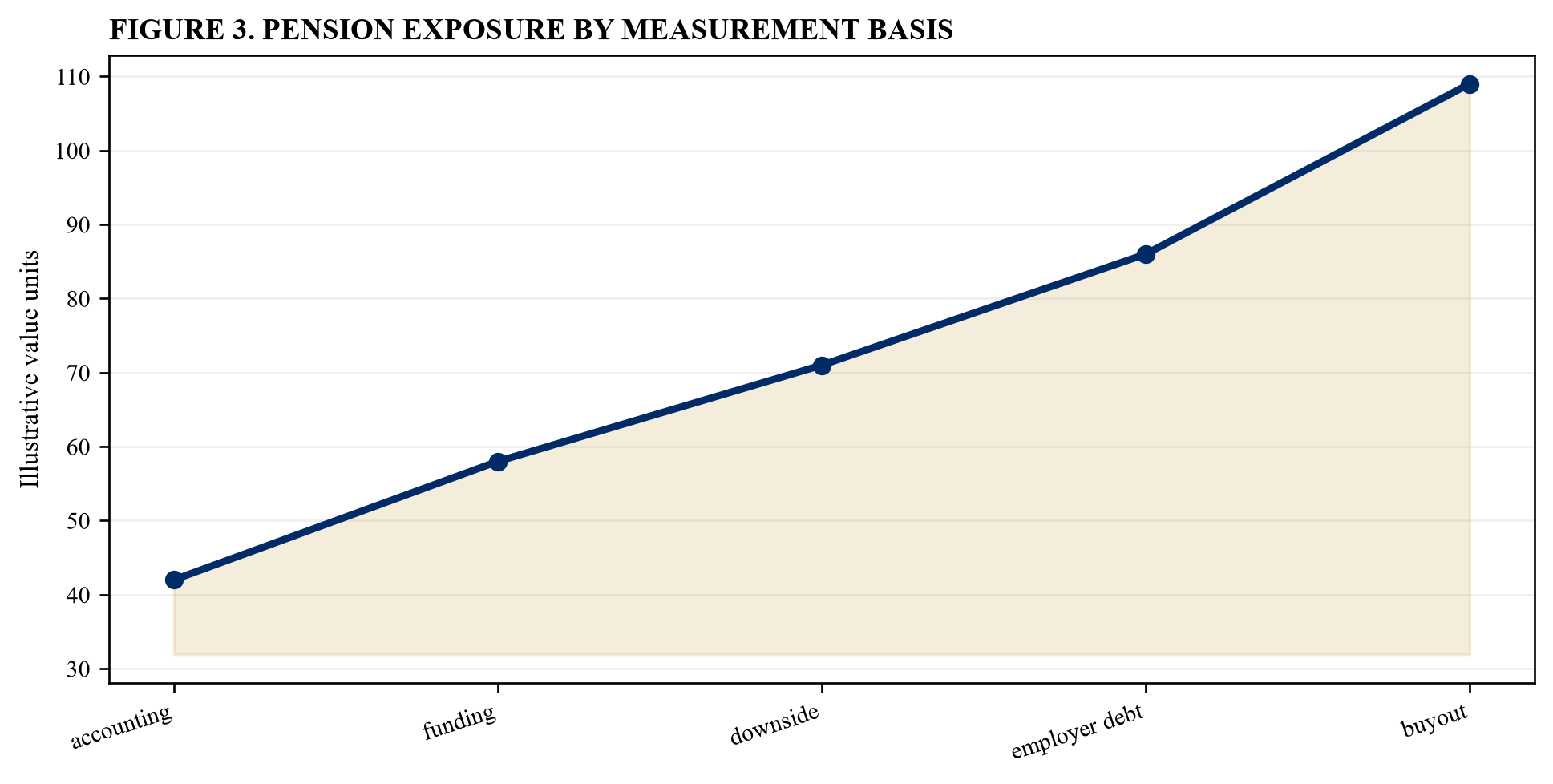
Illustrative analytical scenario; transaction evidence should replace model values.
26. Assess the employer covenant
This workstream requires the company and its advisers to evaluate cash, assets, guarantees, group support and transaction effects, using plans, security, forecasts, valuations and downside cases. The practical test is how scheme support changes before and after the sale. Analysis should use one cut-off date so that cash, claims, contracts, people and transaction documents reconcile [49][51][52][53].
Decision-makers should maintain a covenant assessment. It should distinguish legal ownership from economic allocation, current evidence from forecast assumptions and committed funding from indications. Qualified advisers retain responsibility for legal, insolvency, tax, pensions, accounting and regulatory judgements.
Execution can fail when the sale may weaken pension recourse despite rescuing operations. Each dependency needs a control, evidence threshold, escalation route and decision time. The transaction remains viable only while the funded separation plan can absorb a credible delay or shortfall.
27. Engage trustees and regulators
The readiness team should sequence information, mitigation, event analysis, clearance and decisions. The evidence base includes timetables, covenant evidence, guidance and advice. The central question is what protection is required before an irreversible step. Conclusions should remain at entity and dependency level because the failing group may have pooled cash, shared rights and cross-guarantees [51][52][53][54].
The required deliverable is an engagement plan. It should connect the proposed sale documents to the stand-alone operating model and the residual estate. Every material assumption should show its source and sensitivity.
The downside is that late engagement may make mitigation unaffordable. Management should test the base case and a combined downside against minimum cash, customer continuity and the completion timetable. Unsupported benefits should not be treated as available funding.
28. Model protection-fund and insolvency outcomes
The seller should estimate member and scheme outcomes across transaction alternatives. Relevant evidence includes scheme data, funding, employer debt, assets and eligibility. The decision asks how each route affects recoveries and feasibility. A reliable answer links financial analysis to title, transfer mechanics, operating capability and the applicable approval process [47][50][54][55].
The decision pack should contain a stakeholder outcome comparison. It should show calculation dates, owners, dependencies and the documents that implement the conclusion. This creates a defensible record for later scrutiny and post-completion reconciliation.
A material failure occurs when accounting values may substitute for the relevant insolvency basis. The response should identify a funded cure, alternative perimeter or fallback route. Continuing without one can reduce going-concern value and creditor recovery.
29. Test United States ERISA and PBGC exposure
The transaction team should map sponsorship, controlled groups, termination and reportable events. Evidence should come from plans, filings, actuarial reports, structures and guidance. The controlling question is which obligations or notices arise from the transaction. The answer should be dated, attributed and linked to the legal entity, asset, liability or operating dependency it describes [56][57][58][59].
The controlled output is an ERISA and PBGC memorandum. It should state the source, calculation method, owner, exceptions, required approvals and the next irreversible deadline. This allows a board, officeholder, creditor or buyer to reproduce the conclusion when facts change.
The principal risk is that liability may attach beyond the immediate employer. The team should quantify the effect on liquidity, stand-alone earnings, creditor recoveries, operating continuity and completion probability. A material exception should update the perimeter and funding plan.
30. Quantify multiemployer withdrawal liability
This workstream requires the company and its advisers to identify contributions, withdrawal triggers, estimates and asset-sale conditions, using agreements, history, notices, estimates and buyer commitments. The practical test is whether withdrawal occurs and an exception is feasible. Analysis should use one cut-off date so that cash, claims, contracts, people and transaction documents reconcile [60][61][62][63].
Decision-makers should maintain a withdrawal-liability model. It should distinguish legal ownership from economic allocation, current evidence from forecast assumptions and committed funding from indications. Qualified advisers retain responsibility for legal, insolvency, tax, pensions, accounting and regulatory judgements.
Execution can fail when an unpriced assessment can alter bid value materially. Each dependency needs a control, evidence threshold, escalation route and decision time. The transaction remains viable only while the funded separation plan can absorb a credible delay or shortfall.
31. Integrate WARN and continuation coverage
The readiness team should analyse closing and layoff notice, sale-date responsibility and health continuation. The evidence base includes sites, headcount, dates, notices, plans and documents. The central question is which party must notify or continue cover and when. Conclusions should remain at entity and dependency level because the failing group may have pooled cash, shared rights and cross-guarantees [64][65][66][67].
The required deliverable is a WARN and coverage timetable. It should connect the proposed sale documents to the stand-alone operating model and the residual estate. Every material assumption should show its source and sensitivity.
The downside is that bankruptcy may be assumed to remove duties that remain. Management should test the base case and a combined downside against minimum cash, customer continuity and the completion timetable. Unsupported benefits should not be treated as available funding.
32. Control mobile and cross-border workers
The seller should identify work location, expatriate terms, social security and tax residence. Relevant evidence includes assignments, travel, payroll, tax files and contracts. The decision asks which obligations follow each mobile worker. A reliable answer links financial analysis to title, transfer mechanics, operating capability and the applicable approval process [37][38][39][68].
The decision pack should contain a cross-border worker matrix. It should show calculation dates, owners, dependencies and the documents that implement the conclusion. This creates a defensible record for later scrutiny and post-completion reconciliation.
A material failure occurs when entity analysis may miss location-based obligations. The response should identify a funded cure, alternative perimeter or fallback route. Continuing without one can reduce going-concern value and creditor recovery.
33. Model payroll tax and social security
The transaction team should reconcile withholding, employer charges, benefits and registrations. Evidence should come from payroll, tax accounts, filings, records and terms. The controlling question is what must be paid, registered, withheld or reported. The answer should be dated, attributed and linked to the legal entity, asset, liability or operating dependency it describes [23][34][68][69].
The controlled output is a payroll-tax funds-flow schedule. It should state the source, calculation method, owner, exceptions, required approvals and the next irreversible deadline. This allows a board, officeholder, creditor or buyer to reproduce the conclusion when facts change.
The principal risk is that models may show net liabilities while cash needs are gross. The team should quantify the effect on liquidity, stand-alone earnings, creditor recoveries, operating continuity and completion probability. A material exception should update the perimeter and funding plan.
34. Translate exposure into accounting and valuation
This workstream requires the company and its advisers to reconcile benefits, termination, provisions, disposal and acquisition assumptions, using actuarial reports, payroll models, advice, forecasts and accounts. The practical test is how obligations affect earnings, net debt, working capital and price. Analysis should use one cut-off date so that cash, claims, contracts, people and transaction documents reconcile [70][71][72][73].
Decision-makers should maintain an accounting-to-valuation bridge. It should distinguish legal ownership from economic allocation, current evidence from forecast assumptions and committed funding from indications. Qualified advisers retain responsibility for legal, insolvency, tax, pensions, accounting and regulatory judgements.
Execution can fail when mixed measurement bases can distort bid comparison. Each dependency needs a control, evidence threshold, escalation route and decision time. The transaction remains viable only while the funded separation plan can absorb a credible delay or shortfall.
35. Allocate risk in transaction documents
The readiness team should convert exposures into schedules, adjustments, assumptions, indemnities and conditions. The evidence base includes diligence, models, advice, bids, disclosure and funding. The central question is who bears each obligation and how it is measured. Conclusions should remain at entity and dependency level because the failing group may have pooled cash, shared rights and cross-guarantees [1][5][11][73].
The required deliverable is a risk-allocation matrix. It should connect the proposed sale documents to the stand-alone operating model and the residual estate. Every material assumption should show its source and sensitivity.
The downside is that generic drafting may conflict with the economic model. Management should test the base case and a combined downside against minimum cash, customer continuity and the completion timetable. Unsupported benefits should not be treated as available funding.
36. Build workforce sources and uses
The seller should fund arrears, claims, redundancy, retention, benefits, mitigation, fees and contingency. Relevant evidence includes claims, payroll, actuarial work, negotiations and financing. The decision asks how much cash is needed, when and by whom. A reliable answer links financial analysis to title, transfer mechanics, operating capability and the applicable approval process [8][9][49][70].
The decision pack should contain a dated sources-and-uses model. It should show calculation dates, owners, dependencies and the documents that implement the conclusion. This creates a defensible record for later scrutiny and post-completion reconciliation.
A material failure occurs when purchase price may be funded while obligations remain unfunded. The response should identify a funded cure, alternative perimeter or fallback route. Continuing without one can reduce going-concern value and creditor recovery.
37. Compare bids on a common basis
The transaction team should normalise price for obligations, costs, mitigation, timing and continuity risk. Evidence should come from binding bids, models, diligence and financing evidence. The controlling question is which executable proposal improves the stakeholder outcome. The answer should be dated, attributed and linked to the legal entity, asset, liability or operating dependency it describes [1][2][11][52].
The controlled output is a common-basis bid scorecard. It should state the source, calculation method, owner, exceptions, required approvals and the next irreversible deadline. This allows a board, officeholder, creditor or buyer to reproduce the conclusion when facts change.
The principal risk is that the highest headline price may produce lower recovery. The team should quantify the effect on liquidity, stand-alone earnings, creditor recoveries, operating continuity and completion probability. A material exception should update the perimeter and funding plan.
Table 4. Illustrative bid comparison
| Measure | Bid A | Bid B | Bid C |
|---|---|---|---|
| consideration | 118 | 111 | 103 |
| employee funding | -13 | -8 | -5 |
| pension mitigation | -28 | -19 | -12 |
| risk-adjusted value | 69 | 75 | 73 |
Values and scores are analytical scenarios; transaction evidence should replace model values.
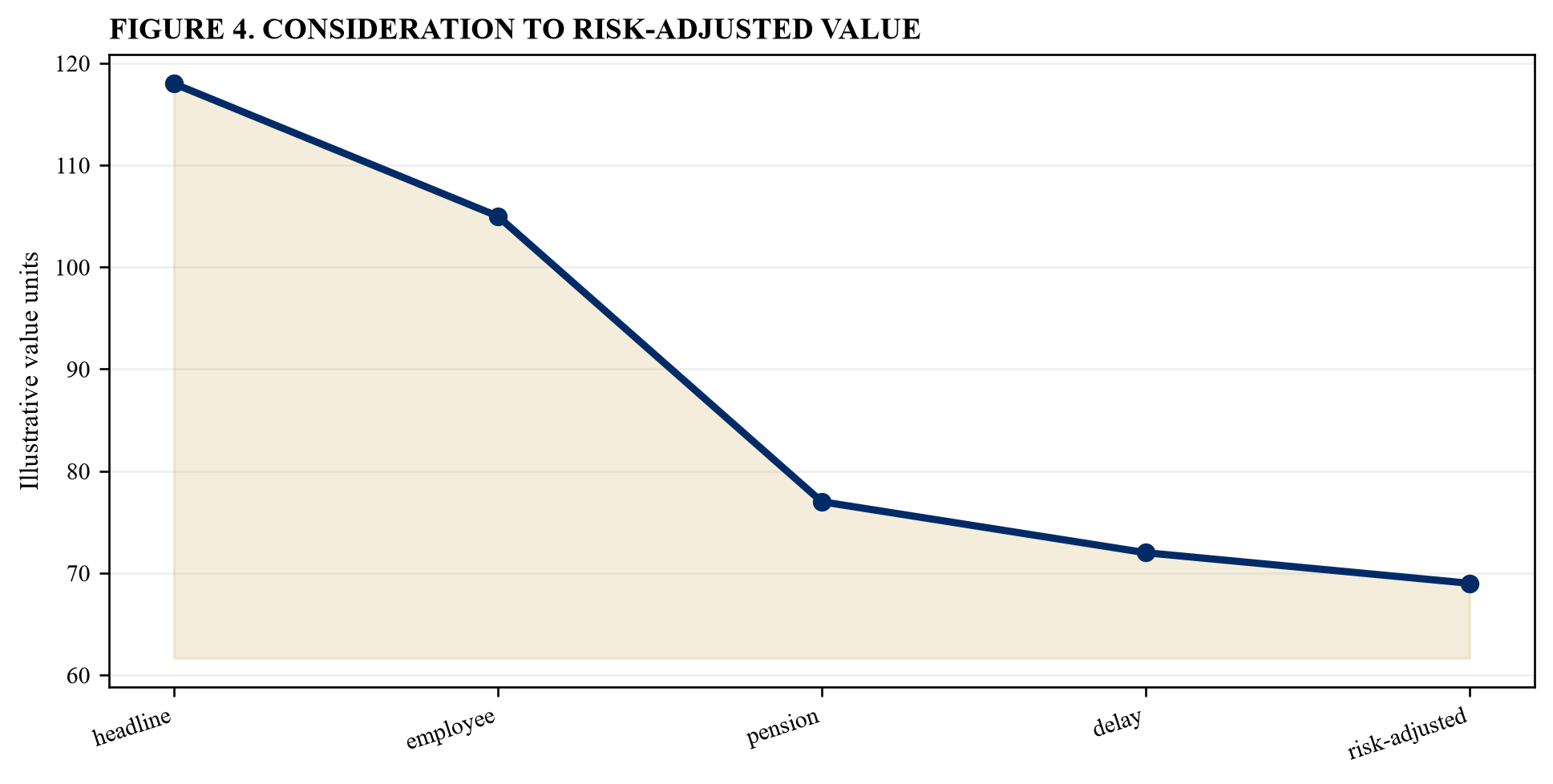
Illustrative analytical scenario; transaction evidence should replace model values.
38. Govern completion and the first hundred days
This workstream requires the company and its advisers to sequence consultation, payroll, benefits, administration, records and communications, using checklists, funds flow, service agreements and archives. The practical test is whether continuity and post-close obligations are owned and funded. Analysis should use one cut-off date so that cash, claims, contracts, people and transaction documents reconcile [15][16][40][51].
Decision-makers should maintain a completion control book. It should distinguish legal ownership from economic allocation, current evidence from forecast assumptions and committed funding from indications. Qualified advisers retain responsibility for legal, insolvency, tax, pensions, accounting and regulatory judgements.
Execution can fail when value may leak through missed payroll, gaps or departures. Each dependency needs a control, evidence threshold, escalation route and decision time. The transaction remains viable only while the funded separation plan can absorb a credible delay or shortfall.
Table 5. Implementation sequence
| Horizon | Decision | Evidence |
|---|---|---|
| 48 hours | authority and payroll | mandates and cash |
| days 3 to 10 | route and consultation | analysis and schedules |
| to completion | funded allocation | documents and funds flow |
| day 1 to 100 | continuity | records and governance |
Values and scores are analytical scenarios; transaction evidence should replace model values.
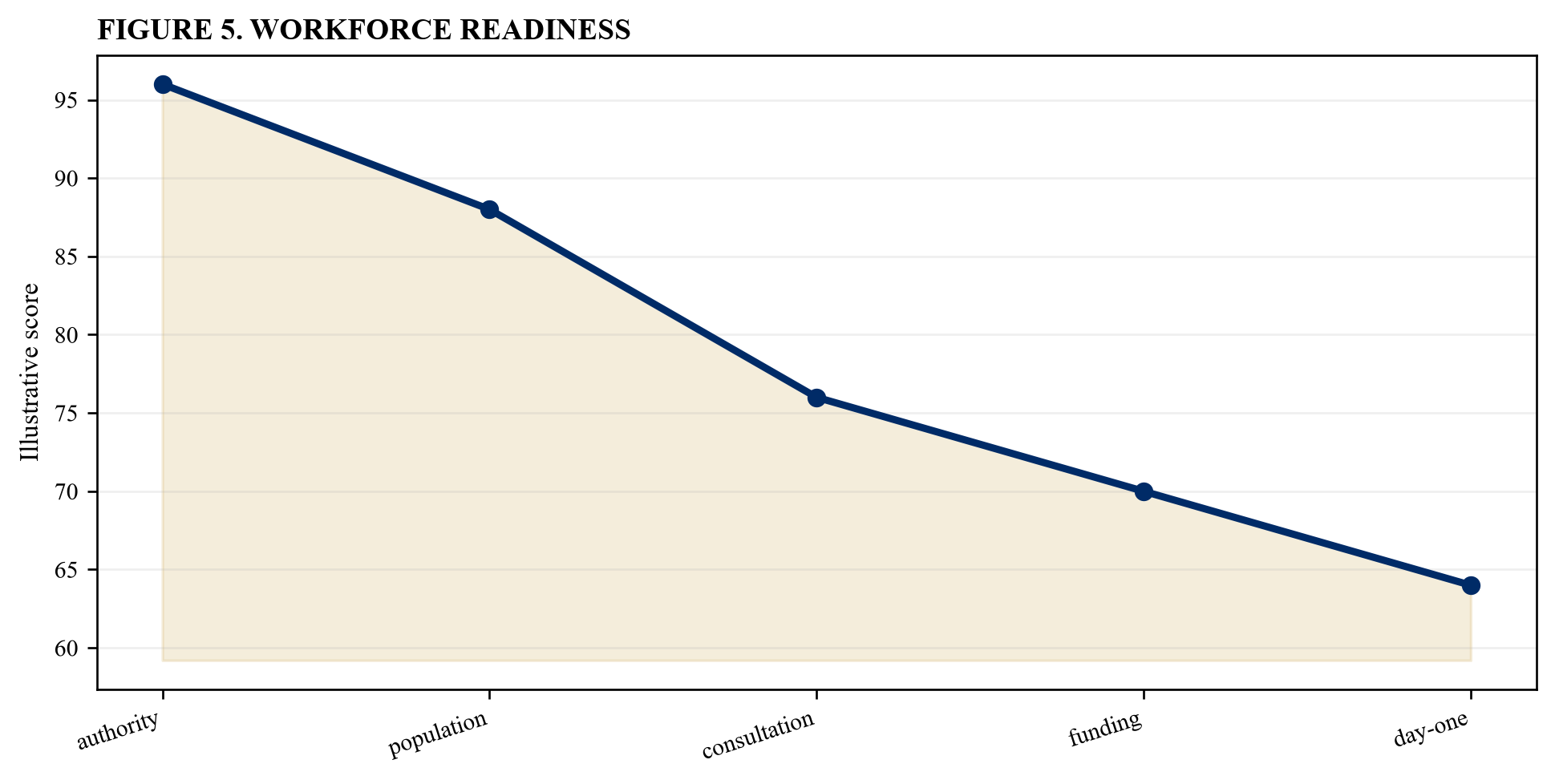
Illustrative analytical scenario; transaction evidence should replace model values.
References
- UK Parliament, Insolvency Act 1986, https://www.legislation.gov.uk/ukpga/1986/45/contents
- UK Parliament, Insolvency Rules 2016, https://www.legislation.gov.uk/uksi/2016/1024/contents
- UK Parliament, Companies Act 2006, https://www.legislation.gov.uk/ukpga/2006/46/contents
- UNCITRAL, Model Law on Cross-Border Insolvency, https://uncitral.un.org/en/texts/insolvency/modellaw/cross-border_insolvency
- UK Parliament, Transfer of Undertakings Regulations 2006, https://www.legislation.gov.uk/uksi/2006/246/contents
- UK Government, Transfers of Employment Contracts, https://www.gov.uk/transfers-takeovers/transfers-of-employment-contracts
- ILO, Termination of Employment Convention 158, https://normlex.ilo.org/dyn/nrmlx_en/f?p=NORMLEXPUB:12100:0::NO::P12100_ILO_CODE:C158
- UK Government, Rights if an Employer is Insolvent, https://www.gov.uk/your-rights-if-your-employer-is-insolvent
- UK Government, Pension Claim Guidance for Insolvency Practitioners, https://www.gov.uk/guidance/pension-claim-guidance-for-insolvency-practitioners
- UK Government, Rates and Allowances, https://www.gov.uk/government/publications/rates-and-allowances-national-insurance-contributions
- US Code, Bankruptcy Code Section 363, https://uscode.house.gov/view.xhtml?req=granuleid:USC-prelim-title11-section363
- UK Government, Employment Contracts and Conditions, https://www.gov.uk/employment-contracts-and-conditions
- UK Government, Employment Status, https://www.gov.uk/employment-status
- US Department of Labor, Worker Misclassification, https://www.dol.gov/agencies/whd/flsa/misclassification
- ISO, ISO 22301, https://www.iso.org/standard/75106.html
- NIST, Cybersecurity Framework 2.0, https://www.nist.gov/cyberframework
- UK Government, Corporate Financial Distress Guidance, https://www.gov.uk/government/publications/the-sourcing-and-consultancy-playbooks/corporate-financial-distress-guidance-note-html
- Acas, TUPE, https://www.acas.org.uk/tupe
- UK Government, Employee Information during Transfers, https://www.gov.uk/transfers-takeovers/information-about-employees-during-transfers
- ICO, Data Sharing Code, https://ico.org.uk/for-organisations/uk-gdpr-guidance-and-resources/data-sharing/data-sharing-a-code-of-practice/
- European Union, GDPR, https://eur-lex.europa.eu/eli/reg/2016/679/oj
- ICO, Employment Information, https://ico.org.uk/for-organisations/uk-gdpr-guidance-and-resources/employment/
- UK Government, PAYE for Employers, https://www.gov.uk/paye-for-employers
- ILO, Protection of Workers Claims Convention 173, https://normlex.ilo.org/dyn/nrmlx_en/f?p=NORMLEXPUB:12100:0::NO::P12100_ILO_CODE:C173
- UK Government, Redundancy Rights, https://www.gov.uk/redundancy-your-rights
- UK Government, Redundancy Consultation, https://www.gov.uk/redundancy-your-rights/consultation
- UK Government, Transfers and Insolvent Businesses, https://www.gov.uk/transfers-takeovers/insolvent-businesses
- European Union, Directive 2001/23/EC, https://eur-lex.europa.eu/legal-content/EN/TXT/?uri=CELEX:32001L0023
- European Union, Directive 2002/14/EC, https://eur-lex.europa.eu/legal-content/EN/TXT/?uri=CELEX:32002L0014
- European Union, Directive 98/59/EC, https://eur-lex.europa.eu/legal-content/EN/TXT/?uri=CELEX:31998L0059
- European Union, Directive 2009/38/EC, https://eur-lex.europa.eu/legal-content/EN/TXT/?uri=CELEX:32009L0038
- UK Government, Employment Income Manual, https://www.gov.uk/hmrc-internal-manuals/employment-income-manual
- UK Government, Employee Share Schemes, https://www.gov.uk/tax-employee-share-schemes
- HMRC, Employment Related Securities Manual, https://www.gov.uk/hmrc-internal-manuals/employment-related-securities
- IFRS Foundation, IFRS 2, https://www.ifrs.org/issued-standards/list-of-standards/ifrs-2-share-based-payment/
- UK Government, Right to Work Checks, https://www.gov.uk/check-job-applicant-right-to-work
- UK Government, Sponsor Guidance, https://www.gov.uk/government/collections/sponsorship-information-for-employers-and-educators
- European Commission, Social Security Coordination, https://employment-social-affairs.ec.europa.eu/policies-and-activities/moving-working-europe/eu-social-security-coordination_en
- OECD, Model Tax Convention, https://www.oecd.org/tax/treaties/model-tax-convention-on-income-and-on-capital-condensed-version-20745419.htm
- US Department of Labor, Health Plans, https://www.dol.gov/general/topic/health-plans
- US Department of Labor, COBRA, https://www.dol.gov/agencies/ebsa/laws-and-regulations/laws/cobra
- UK Government, Employers Liability Insurance, https://www.gov.uk/employers-liability-insurance
- European Union, Directive 2008/94/EC, https://eur-lex.europa.eu/legal-content/EN/TXT/?uri=CELEX:32008L0094
- UK Government, Workplace Pensions, https://www.gov.uk/workplace-pensions-employers
- The Pensions Regulator, Employers, https://www.thepensionsregulator.gov.uk/en/employers
- US Department of Labor, Benefit Plan Reporting Guide, https://www.dol.gov/agencies/ebsa/about-ebsa/our-activities/resource-center/publications/reporting-and-disclosure-guide-for-employee-benefit-plans
- UK Parliament, Pensions Act 1995, https://www.legislation.gov.uk/ukpga/1995/26/contents
- UK Parliament, Pensions Act 2004, https://www.legislation.gov.uk/ukpga/2004/35/contents
- The Pensions Regulator, Corporate Transactions Flowchart, https://www.thepensionsregulator.gov.uk/-/media/thepensionsregulator/files/import/pdf/transcript-corporate-transactions-flowchart.ashx
- Pension Protection Fund, Section 179 Guidance, https://www.ppf.co.uk/section-179-valuation-guidance
- The Pensions Regulator, Material Detriment Test, https://www.thepensionsregulator.gov.uk/en/document-library/scheme-management-detailed-guidance/administration-detailed-guidance/material-detriment-test
- The Pensions Regulator, Clearance, https://www.thepensionsregulator.gov.uk/en/document-library/scheme-management-detailed-guidance/communications-and-reporting-detailed-guidance/clearance
- The Pensions Regulator, Anti-avoidance Powers, https://www.thepensionsregulator.gov.uk/about-us/how-we-regulate-and-enforce/anti-avoidance-powers
- UK Parliament, Pension Schemes Act 2021, https://www.legislation.gov.uk/ukpga/2021/1/contents
- Pension Protection Fund, Insolvency Practitioners, https://www.ppf.co.uk/insolvency-practitioners
- US Department of Labor, Employer Bankruptcy and Benefits, https://www.dol.gov/sites/default/files/ebsa/about-ebsa/our-activities/resource-center/fact-sheets/your-employers-bankruptcy.pdf
- PBGC, Plan Terminations, https://www.pbgc.gov/employers-practitioners/plan-terminations
- PBGC, Less Common Notices, https://www.pbgc.gov/employers-practitioners/hub/less-common-notices-applications
- US Code, ERISA, https://uscode.house.gov/view.xhtml?path=/prelim@title29/chapter18
- PBGC, Withdrawal Liability, https://www.pbgc.gov/employers-practitioners/multiemployer/withdrawal-liability
- PBGC, Asset Sale Exception, https://www.pbgc.gov/guidance/asset-sale-exception
- US Code, ERISA Section 4204, https://uscode.house.gov/view.xhtml?req=granuleid:USC-prelim-title29-section1384
- PBGC, Multiemployer Plans, https://www.pbgc.gov/employers-practitioners/multiemployer
- US Department of Labor, WARN Advisor, https://webapps.dol.gov/elaws/eta/warn/faqs.asp
- US Department of Labor, WARN Act, https://www.dol.gov/agencies/eta/layoffs/warn
- US Code, Bankruptcy Code Section 507, https://uscode.house.gov/view.xhtml?req=granuleid:USC-prelim-title11-section507
- US Department of Labor, COBRA Guide, https://www.dol.gov/agencies/ebsa/about-ebsa/our-activities/resource-center/publications/an-employees-guide-to-health-benefits-under-cobra
- OECD, Taxing Wages, https://www.oecd.org/tax/tax-policy/taxing-wages-brochure.pdf
- UK Government, Employment Law and Insolvency, https://www.gov.uk/guidance/technical-guidance-for-official-receivers/58-employment-law-and-insolvency
- IFRS Foundation, IAS 19, https://www.ifrs.org/issued-standards/list-of-standards/ias-19-employee-benefits/
- IFRS Foundation, IAS 37, https://www.ifrs.org/issued-standards/list-of-standards/ias-37-provisions-contingent-liabilities-and-contingent-assets/
- IFRS Foundation, IFRS 5, https://www.ifrs.org/issued-standards/list-of-standards/ifrs-5-non-current-assets-held-for-sale-and-discontinued-operations/
- IFRS Foundation, IFRS 3, https://www.ifrs.org/issued-standards/list-of-standards/ifrs-3-business-combinations/
