

Introduction
Europe's launcher market combines industrial economics, national capability, institutional procurement and security policy. The assets are interdependent: propulsion, stages, avionics, test facilities, launch sites, range services, mission integration and skilled teams must work as one delivery system. Consolidation can remove duplication across that system. It can also create a single point of failure or a supplier with insufficient competitive pressure.
The board decision is therefore broader than comparing headline enterprise values. It asks which structure can deliver required missions at an affordable cost while retaining enough technical and institutional diversity to recover from failure. The answer requires verified evidence at vehicle, mission class, contract, supplier and site level. This paper converts that evidence into a transaction and governance framework.
1. Define the decision
The decision perimeter should identify the providers, programmes, launch classes, sites and public customers under review. Four structures deserve explicit comparison: full acquisition, legal merger, industrial alliance with shared services, and continued independence supported by competitive procurement. Each structure changes control, capital allocation, incentives and the number of credible launch paths.
The sponsor should state the objective before modelling. A commercial buyer may seek scale, technology or backlog. A state shareholder may seek assured access and industrial capability. An institutional customer may seek competition and schedule resilience. These objectives can coexist, but their benefits belong in different ledgers. A clear objective prevents a public-policy benefit from being counted as private-company cash flow.
2. Map the value perimeter
Company value includes transferable contracts, intellectual property, people, facilities, working capital and liabilities. Programme value includes reusable engineering, qualified hardware, test evidence, supply rights and the remaining expenditure needed to reach an accepted mission. Strategic value includes assured access, rapid response, protected downstream missions and the option to sustain an alternative technical path.
The diligence team should map legal ownership and economic control for each element. Shared intellectual property, government-furnished equipment, geographically returned workshare and public assets can limit transferability. Value should be attributed only where the transaction gives the buyer enforceable rights and a practical route to use them.
3. Reconstruct the European launch architecture
The architecture should be rebuilt from primary evidence rather than programme labels. ESA describes Ariane 6 and Vega-C as the operational European launch families and records launches from Europe's Spaceport. The European Launcher Challenge introduces additional providers through institutional service contracts and capacity demonstrations. National programmes, commercial spaceports and allied launch access add further layers. [1][2][3][7]
For each provider, record vehicle configuration, payload class, target orbits, propulsion, production location, launch site, range dependence, institutional sponsor and current operating status. The map should distinguish operational capability, demonstrated capability, licensed capability and proposed capability. Those states carry different probabilities, capital needs and transaction protections.
4. Separate mission classes and customer needs
A heavy launcher, a medium launcher and a dedicated small launcher do not provide identical services. Payload mass, fairing volume, orbit, rideshare flexibility, responsiveness, security, integration cycle and launch-site constraints determine substitutability. A merger analysis that groups all kilograms to orbit into one market can overstate both synergy and competitive overlap.
The commercial model should segment sovereign, civil, defence and commercial missions by service need. A small responsive mission may justify a higher price per kilogram. A constellation customer may prioritise schedule, batch size and total deployment cost. The strategic ledger should identify which mission classes retain two credible European routes after the proposed structure.
5. Measure achieved cadence
Cadence is an observed production-and-operations result. Count accepted orbital missions by configuration and calendar period, then reconcile postponed, scrubbed and failed attempts. Planned launch slots, licensed capacity and management targets remain separate. ESA's launch records provide a public starting point for missions from Europe's Spaceport; company telemetry, acceptance records and range data are required for transaction diligence. [2][7]
The buyer should test whether cadence depends on temporary inventory, extraordinary labour or a favourable mission mix. A repeatable cadence requires qualified suppliers, engine and stage throughput, payload readiness, site windows, range staffing and cash. The lowest-capacity link determines sustainable output.
6. Underwrite configuration-specific reliability
Reliability should be measured for the configuration being acquired. Earlier vehicles, subscale demonstrators, ground tests and flights using materially different propulsion or avionics provide supporting evidence rather than a pooled success rate. Record mission objective, payload acceptance, anomaly, corrective action and return-to-flight evidence for every event.
Failure correlation matters in consolidation. Common motors, software, suppliers or test facilities can transmit one defect across multiple vehicles. The diligence model should estimate the recovery period, cash requirement and mission displacement following a common-mode failure. Strategic redundancy has limited value when nominally separate providers share the same critical failure path.
7. Classify institutional demand
Institutional demand ranges from policy intent to an awarded and funded launch order. Classify each opportunity as a binding order, funded call-off, framework capacity, exercisable option, announced intention or pipeline. Verify the contracting entity, funding, mission, payload readiness, delivery date, termination rights and acceptance terms.
The European Launcher Challenge illustrates why the distinction matters. ESA describes service and capacity-upgrade components and a competitive process. Participation, selection and programme allocation do not automatically create collected revenue for a provider. Base-case backlog should include only enforceable and executable orders, with other opportunities carried as probability-weighted scenarios. [1][3]
8. Test commercial backlog
Commercial backlog should be tested contract by contract. The buyer needs signed terms, customer credit, deposits, cancellation provisions, payload maturity, mission compatibility, price-adjustment rights and evidence of customer financing. A reservation without a ready payload or funded programme can occupy a manifest without producing dependable cash.
Concentration should be measured by customer, constellation and mission window. Several contracts linked to one financing plan or one satellite platform can fail together. The valuation should use contribution after launch delivery cost and expected delay, not gross announced contract value.
9. Distinguish frameworks and funded orders
A framework creates a route to place future orders. It may establish eligibility, prices, technical conditions and a maximum value. Economic backlog arises from guaranteed minimums and funded call-offs that the provider can deliver. The uncalled ceiling remains an opportunity subject to competition, budget and mission readiness.
The same treatment applies to letters of support, grants and industrial-policy commitments. A grant can finance development without paying for a launch service. A ministerial subscription can support a programme without specifying the eventual provider economics. The model should follow enforceable cash rights and associated delivery obligations.
10. Normalize mission pricing
Headline mission prices are rarely comparable. Normalize for payload mass and orbit, dedicated or rideshare service, integration, dispensers, range and site charges, insurance allocation, schedule priority, mission assurance, data services and customer-funded modifications. Separate recurring service revenue from pass-through hardware and development work.
Price escalation, foreign exchange and delay provisions can materially change realised revenue. Public institutional prices may reflect policy and workshare objectives. Commercial discounts may purchase early flight heritage. The model should reconcile signed price to expected cash and identify the consideration required to compensate for each mission's risk.
11. Build unit economics
Mission contribution should include vehicle hardware, propulsion, direct labour, test, integration, site and range fees, mission assurance, logistics, insurance and expected rework. Allocated fixed engineering and corporate support should be shown separately so that management cannot create an apparent margin by moving costs between programmes.
The cost ledger should reconcile purchase orders, bills of material, routings, payroll, site agreements and mission closeout. Learning-curve assumptions need evidence from repeated builds. A merger can improve purchasing and utilisation, but transition, dual-running and redesign costs can defer the benefit.
12. Model fixed-cost absorption
Launcher businesses carry substantial fixed cost in engineering, factories, test facilities, mission control and launch infrastructure. Unit cost falls only when additional missions use available capacity without triggering a new fixed-cost step. The model should therefore show cost by cadence band and constraint.
Consolidation may allow one facility to absorb more volume, yet political workshare, security or recovery requirements may prevent closure of the second site. Treat avoidable cost, retained strategic capacity and integration cost as separate lines. A claimed synergy is not capturable when the buyer must keep the underlying capability.
13. Measure duplicated industrial capacity
Map duplicated design teams, factories, test stands, suppliers, launch integration and mission operations. For each overlap, identify ownership, utilisation, closure cost, contractual commitments, regional funding conditions, security requirements and recovery value. Some duplication is waste; some is the mechanism that preserves a second source.
The synergy case should include only actions the buyer has authority and political permission to execute. Savings tied to removing geographically returned workshare or publicly funded assets may be unavailable. The strategic ledger should score the recovery time lost when a duplicated capability is removed.
14. Value common infrastructure
Shared propulsion, upper stages, avionics, test data, procurement and launch-site services can create scale without eliminating providers. ESA notes that Ariane 6 and Vega-C share solid-motor heritage, illustrating the industrial logic of common components. Commonality can lower cost and improve supplier utilisation. It can also create correlated failure exposure. [8][9]
Value common infrastructure through verified avoided expenditure, purchasing economics and higher utilisation. Deduct separation, interface, governance and common-mode-risk costs. An alliance can capture selected infrastructure benefits while preserving independent system authorities and commercial teams.
15. Underwrite remaining development
Every programme should have an engineering-based estimate to complete. Break remaining work into design closure, qualification, hardware, software, ground systems, launch-site integration, licensing, mission assurance, demonstration flights, contingency and working capital. Link each work package to evidence, owner, dependency and acceptance event.
Percentage-complete statements are insufficient for valuation. The buyer should reconstruct estimate-to-complete from open requirements, test failures, supplier commitments and schedule risk. Shared technology does not remove programme-specific qualification unless the responsible authority accepts the evidence.
16. Test supply-chain concentration
The supplier map should identify single-source engines, motors, tanks, electronics, energetic materials, software, test services and logistics. Record capacity, lead time, qualification status, ownership, export constraints and financial health. Consolidation can improve purchasing leverage while increasing dependence on a smaller set of common suppliers.
For each critical item, model failure impact and recovery time. A qualified second source, strategic inventory or redesign plan can preserve resilience. Inventory value should reflect shelf life, configuration compatibility and inspection requirements rather than nominal purchase cost.
17. Assess spaceport and range access
A launcher requires enforceable access to a compatible site and range. Review launch-site agreements, priority rules, permitted configurations, integration facilities, safety zones, range services, airspace and maritime coordination, weather, environmental constraints, fees and termination. Licensed or advertised site capacity does not prove that a provider controls usable windows.
Consolidation can improve manifest coordination and infrastructure utilisation. It can also concentrate the portfolio at one range. The strategic ledger should test alternative sites, transportability, requalification time and the consequences of a prolonged site outage.
18. Map sovereign and defence demand
Sovereign demand has economic value when it is attached to funded missions, service obligations or measurable avoided delay. ESA and EU documents identify autonomous and resilient access to space as strategic objectives. Defence and civil customers may also require security, mission assurance, geographic control and rapid scheduling. [4][5][10][11]
The buyer should map each requirement to a contract, procurement plan or validated customer need. General policy importance belongs in the strategic ledger. It enters financial value only through identifiable cash flow, protected downstream value or an enforceable support mechanism.
19. Measure strategic redundancy
Strategic redundancy is the ability to complete essential missions after a credible disruption. Count independent end-to-end launch paths, then discount paths that share critical propulsion, software, suppliers, sites or decision authorities. Measure recovery time, payload compatibility and the cost of maintaining readiness.
The board should set a resilience floor before comparing values. Examples include two independent paths for a defined mission class, a maximum recovery period, or assured capacity for a stated institutional manifest. The floor should be evidence-based and funded. Redundancy without readiness is nominal.
20. Evaluate competition effects
A transaction can change price, innovation, capacity, procurement choice and access for rival payload customers. Define plausible relevant markets by payload class, orbit, service model, geography and institutional restrictions. Test shares, entry barriers, switching, buyer power and the role of potential competition.
The European Commission's merger framework and current horizontal guidelines provide the legal context. Counsel and economists should assess whether remedies such as open access, supply commitments, ring-fenced teams or asset divestiture preserve effective competition. Remedy cost belongs in the valuation and integration case. [12][13]
21. Review procurement dependence
Institutional procurement can determine cadence and cash conversion. Review award rules, geographic return, eligibility, security, mission allocation, pricing, termination and audit rights. A merged provider may gain scale while losing the policy rationale for parallel awards or competitive demonstrations.
The diligence case should model procurement behaviour under each structure. A full merger may lower duplicated cost and reduce contestability. An alliance may retain separate bids but attract scrutiny if teams share commercially sensitive information. Continued independence may require explicit anchor demand to remain financeable.
22. Review state aid and public funding
Map grants, subscriptions, repayable advances, guarantees, facilities, customer prepayments and other public support by programme and legal entity. Identify conditions, milestones, repayment, change-of-control, clawback, location and workshare obligations. Funding should not be counted twice as both cash received and a value uplift.
The buyer should assess whether consolidation changes eligibility or creates a recovery obligation. European state-aid and foreign-subsidy rules may affect the transaction or future support. Public-funding continuity should be a closing condition where it is material. [14][15]
23. Address merger control
The filing analysis should begin early because launch transactions can involve EU and national merger regimes, joint-control questions and referrals. The parties should identify turnover, control rights, overlaps, vertical links and potential competition. The timetable should include information requests, remedy design and a long-stop date.
Clean-team protocols are essential where active competitors exchange backlog, pricing, supplier or technical data. Integration planning should preserve independent commercial conduct until clearance. The purchase agreement should allocate filing obligations, remedy risk and termination consequences.
24. Review investment screening and security
Launch assets can trigger national investment-screening and security reviews. Map ownership, voting, board rights, sensitive contracts, facilities, technology, data and personnel by jurisdiction. A transaction structure that is acceptable commercially may require governance restrictions, security arrangements or operational separation.
The risk register should identify every approval, authority, submission, dependency and expected review path. Security mitigation can reduce synergy by limiting system integration or information access. Those constraints belong in the base transaction model when they are foreseeable.
25. Assess IP data and export controls
Verify ownership and permitted use of designs, software, telemetry, manufacturing data, test results, licences and background intellectual property. Collaborative European programmes can contain government, agency, supplier and partner rights. The buyer needs freedom to operate, modify, manufacture and support the intended configurations.
Export classifications, technical-assistance restrictions and third-country content can constrain integration and customer access. Use controlled data rooms, clean teams and jurisdiction-specific counsel. A synergy that requires prohibited transfer should be excluded until a lawful route is evidenced.
26. Model workforce retention
Launcher value depends on scarce engineering and operational knowledge. Identify system authorities, propulsion specialists, safety leaders, software owners, manufacturing experts, mission managers and security-cleared personnel. Map succession, documentation quality, location and retention risk.
Consolidation can create role uncertainty and remove the independent challenge that protects technical decisions. The integration design should preserve clear engineering authority, flight-safety independence and escalation. Retention cost, duplicated transition teams and knowledge-transfer time belong in the deal model.
27. Compare buy merge alliance and preserve
The four structures should be scored against the same cash-flow and resilience assumptions. Acquisition gives one owner control over capital and integration. A legal merger can combine portfolios but creates the greatest organisational and regulatory complexity. An alliance can pool infrastructure, procurement or technology while maintaining separate providers. Preserve-and-procure maintains maximum formal independence and may carry the highest duplicated cost.
The analysis should identify which synergies require common ownership and which can be captured contractually. It should also identify which resilience benefits require separate engineering, supply and operational paths rather than separate corporate names.
28. Value synergies conservatively
Build synergy from named actions, baseline cost, responsible owner, timing, one-off expenditure, tax, probability and operational dependency. Separate procurement, facility, engineering, launch-site, working-capital and revenue synergies. Apply a capture discount for political, contractual, regulatory and execution constraints.
Strategic benefits need the same discipline. Value avoided delay or protected downstream mission economics where a defensible cash-flow link exists. Carry broader sovereignty and policy benefits in the strategic score, not as an unsupported premium in enterprise value.
29. Construct the hypothetical case
The hypothetical portfolio contains four European providers. Alpha operates a medium-to-heavy launcher with four annual missions and ten-mission capacity. Beta operates a light launcher with three annual missions and eight-mission capacity. Gamma has completed one orbital demonstration. Delta is developing a reusable small launcher and has not completed an orbital mission.
The providers report EUR 3.20 billion of stated backlog: EUR 1.25 billion of funded institutional orders, EUR 850 million of firm commercial orders, EUR 650 million of frameworks and options, and EUR 450 million of memoranda or pipeline. Applying illustrative weights of 90%, 75%, 30% and 10% produces EUR 2.00 billion of economic backlog. The figures describe no identified company.
30. Stress cadence demand and cost
The base case assumes combined annual cadence rises from seven to fourteen missions as production and site utilisation improve. The downside reaches ten missions after a two-year delay. The severe case falls to six missions following a common-supplier defect and institutional postponement. Fixed-cost absorption and liquidity deteriorate rapidly below ten missions.
Demand stress reduces economic backlog by 25%. Cost stress increases completion capital by 30% and delays synergy by two years. The board should examine the combined case because technical, demand and financing risks can be correlated. Funding should cover the trough without relying on uncalled frameworks.
30A. Test the counterfactual
Every consolidation case needs a credible counterfactual. The relevant alternative may be continued independent funding, an orderly wind-down, a procurement-backed alliance or the failure of one provider. Compare public and private capital required, missions delivered, recovery paths, competition and residual technology under each outcome. A merger can appear attractive against an unfunded stand-alone plan and unattractive against a well-designed alliance.
The counterfactual should use the same evidence date, inflation, discount rate, mission demand and technical assumptions as the transaction case. Record which costs would be incurred by governments, customers, suppliers and shareholders. This prevents a cost transferred to the public customer from being described as a transaction saving and makes the total economic choice visible.
31. Structure transaction and governance
The structure should match the evidence. Closing conditions can address merger control, investment screening, funding continuity, licences and critical contracts. Milestone consideration can link price to flight, qualification, funded orders or cost reduction. Escrow and indemnities can allocate known compliance, grant and programme liabilities.
Governance should define capital allocation, engineering authority, safety independence, data access, procurement conduct and the protection of alternative technical paths. An alliance requires enforceable service levels, cost allocation, IP rules, deadlock and exit provisions. A merger requires an explicit resilience plan before facilities or teams are combined.
32. Plan integration or alliance
The Day-One plan should protect missions, customers, suppliers, regulators, cash and technical decision rights. Sequence changes around launch campaigns and qualification events. Maintain configuration control and independent safety gates. Confirm insurance, security and range access through the transition.
The first hundred days should validate the synergy baseline, lock the combined manifest, reconcile completion capital and establish a resilience dashboard. Any facility closure or supplier consolidation should require evidence that the resilience floor remains satisfied. Alliance governance should include audit rights and a mechanism for resolving shared-capacity conflicts.
32A. Establish post-close measurement
Post-close measurement should track accepted missions, schedule variance, backlog conversion, cash collection, unit cost, completion expenditure, supplier concentration and recovery readiness. The dashboard should show financial performance and strategic resilience together. A synergy milestone is complete only when the associated cost is removed without breaching the resilience floor.
Independent assurance is appropriate for safety-critical or policy-sensitive commitments. The board should receive exception reports for common-mode defects, capacity conflicts, funding shortfalls, customer cancellations and regulatory conditions. A periodic capability exercise can test whether the alternative launch path remains operational rather than existing only in documentation.
33. Define the decision
The board should approve a structure only when the financial case survives downside testing and the post-transaction system meets the stated resilience floor. The decision record should show evidence, assumptions, unresolved matters, mitigations and owners. It should distinguish stand-alone value, capturable synergy, strategic option value and non-financial policy score.
The preferred structure can change as evidence changes. A provider that demonstrates cadence or converts framework capacity into funded orders may justify acquisition. A portfolio with high common-mode exposure may require preserved independent architecture. A modular alliance can be the appropriate interim structure when technology and demand remain uncertain.
34. Translate the choice into a mandate
A transaction mandate should specify the capability problem, target perimeter, decision criteria and evidence standard. The adviser should begin with a market and mission map, then screen providers for technical fit, cadence, contracts, capital need, supply dependence and regulatory feasibility. Initial valuation ranges should remain conditional until the principal diligence claims are supported. Outreach should protect the sponsor's strategic dependency and maximum willingness to pay.
The mandate should run financial, technical, commercial, regulatory and resilience workstreams in parallel. Technical findings change completion capital and schedule. Contract findings change economic backlog. Competition and security findings change structure and timing. A weekly claim register should identify the document, source, verifier, evidence date, open issue and affected valuation line for every material proposition. This creates one decision record across advisers and management.
The sponsor should use stage gates. Gate one confirms the mission need and alternative routes. Gate two verifies target capability and legal control. Gate three establishes economic backlog, unit cost and completion capital. Gate four compares transaction structures and regulatory paths. Gate five agrees price, risk allocation and protected capabilities. Gate six confirms funding, approvals and Day-One readiness. A failed gate should trigger redesign, repricing or withdrawal.
The negotiation plan should distinguish value that exists today from value created by the buyer. Sellers can receive value for transferable contracts, proven technology and deliverable missions. Buyer-funded integration, access to institutional demand and portfolio optimisation remain buyer synergy. Milestone consideration can bridge evidence gaps without paying full value before technical or commercial proof. The mandate succeeds when it preserves decision flexibility and converts strategic objectives into enforceable transaction terms.
35. Apply a disciplined recommendation standard
The recommendation should answer five questions. First, which missions and capabilities must Europe retain? Second, which providers can deliver them with verified evidence and funded completion plans? Third, which industrial costs can be removed without creating unacceptable common-mode exposure? Fourth, which structure can obtain regulatory clearance and preserve procurement integrity? Fifth, how much capital is required through the downside case?
The answer should identify the preferred structure and the conditions that would change it. A full merger can be recommended when overlap is high, alternative capability remains credible, remedies are workable and synergies survive downside testing. An alliance can be recommended when shared infrastructure creates value while independent system authority remains strategically important. Preservation can be recommended when the cost of failure or loss of competition exceeds the verified savings and public customers are prepared to fund readiness.
Decision-makers should require a quantified comparison across a common time horizon. Discount rates, inflation, exchange rates, mission prices, failure assumptions and terminal values should be consistent. Public support should be mapped to the entity that receives it and the obligation it funds. A provider's strategic importance does not remove the need to reconcile its cash requirement, and an apparently low-cost structure does not remove the need to fund recovery capability.
The recommendation should also identify actions available without a transaction. These can include common standards, shared non-sensitive test infrastructure, coordinated institutional manifests, supplier-capacity agreements, reciprocal site access and milestone-based public procurement. Such measures can improve economics and readiness while evidence develops. They require competition, security and IP safeguards appropriate to the participants.
The implementation plan should state the first irreversible action and the evidence required before it occurs. Facility closures, team combinations, supplier exits and IP migrations can be difficult to reverse. Deferring those actions until missions, regulatory conditions and alternative capacity are secured can protect option value during integration.
Final approval should be based on current evidence, documented assumptions and a funded implementation plan. The board should reject a valuation that converts policy aspiration into contracted revenue, combines incompatible flight histories or assumes closure of capability that governments require to preserve. It should also reject a resilience claim that depends on unfunded facilities, unqualified hardware or the same critical supplier. A disciplined recommendation makes both the financial cost and the strategic consequence explicit.
Conclusion
European launcher consolidation is a capital-allocation and system-resilience decision. Scale can remove avoidable duplication and fund better execution. Independent paths can protect access when a vehicle, supplier or site fails. The correct balance depends on mission-class overlap, achieved cadence, contract quality, common-mode risk and the public customer's willingness to fund resilience.
An evidence-weighted dual ledger makes the choice auditable. Financial value is built from deliverable missions, completion capital and capturable synergy. Strategic value is built from independent end-to-end paths, recovery time, security and procurement competition. Acquisition, merger, alliance and preservation can then be compared on a common basis, with transaction terms and governance designed around the residual risk.
Appendix A. Provider and mission map
For each provider, record legal entity, owners, vehicle configuration, payload class, orbit, propulsion, flight history, annual cadence, manufacturing site, test facilities, launch site, range, licences, critical suppliers, institutional sponsor and contracted missions. Mark each item as operational, demonstrated, licensed, contracted, planned or unsupported.
Create a mission-substitutability matrix. Test mass, volume, orbit, inclination, responsiveness, integration, security, mission assurance and schedule. Identify the missions that retain two credible European paths under each transaction structure.
Appendix A1. Evidence hierarchy
Use an evidence hierarchy for every material claim. Executed contracts, regulator records, accepted test reports, telemetry, audited accounts, invoices and collected cash are stronger than management presentations, announcements or market commentary. Record the period, perimeter and definitions so that evidence from different vehicles or entities is not combined incorrectly.
Contradictory evidence should remain visible in the decision pack. Assign an owner and resolution date, describe the valuation effect and identify the contractual protection if the matter remains open at signing. The absence of evidence should reduce probability or value rather than being converted into a favourable assumption.
Appendix B. Backlog and economics checklist
Obtain every contract, call-off, option, framework, amendment, deposit, cancellation, payload schedule and customer confirmation. Reconcile stated backlog to funded executable orders and expected contribution. Review price, escalation, delay, acceptance, refund and termination.
Build mission-level cost from hardware, labour, test, integration, site, range, insurance, logistics and rework. Reconcile fixed cost by facility and cadence band. Identify step costs, closure costs, strategic capacity and working-capital timing.
Appendix C. Technical and resilience checklist
Reconstruct configuration-specific flights, tests, anomalies, corrective actions and qualification evidence. Map common components, software, suppliers, facilities and sites. Estimate recovery time for vehicle failure, common-supplier defect, site outage and cyber or security event.
Define the resilience floor, measurement date and accountable owner. Verify the readiness, funding and payload compatibility of each claimed alternative path.
Appendix D. Regulatory and public-funding checklist
Map merger filings, investment screening, security approvals, export controls, licences, environmental permissions, insurance, grants, subscriptions, repayable advances and change-of-control conditions. Record authority, legal entity, deadline, evidence and consequence.
Keep clean-team records for competitively sensitive data. Quantify remedy, mitigation and public-funding continuity in the transaction model.
Appendix E. Transaction and governance checklist
Separate stand-alone value, synergy, option value and policy score. Link price mechanics to evidence. Define closing conditions, milestone consideration, escrow, indemnities, funding commitments, retention, engineering authority and integration sequencing.
For an alliance, define scope, service levels, cost allocation, IP, data, capacity priority, competition safeguards, audit, deadlock and exit. For a merger, define the protected capabilities and approval required before consolidation.
Appendix E1. Board paper minimum contents
The board paper should include the decision sought, strategic objective, transaction perimeter, alternatives, counterfactual, valuation range, funding, synergy case, resilience score, technical evidence, backlog evidence, competition analysis, security path, public-funding conditions, key risks, protections and implementation plan. Append the claim register and model sensitivities.
Each approval condition should have a named owner, evidence requirement and deadline. Minutes should record the resilience floor and the circumstances in which management must return to the board. Post-close reporting should compare actual missions, cost, cash and capability with the approved case.
Appendix F. Decision figures and tables
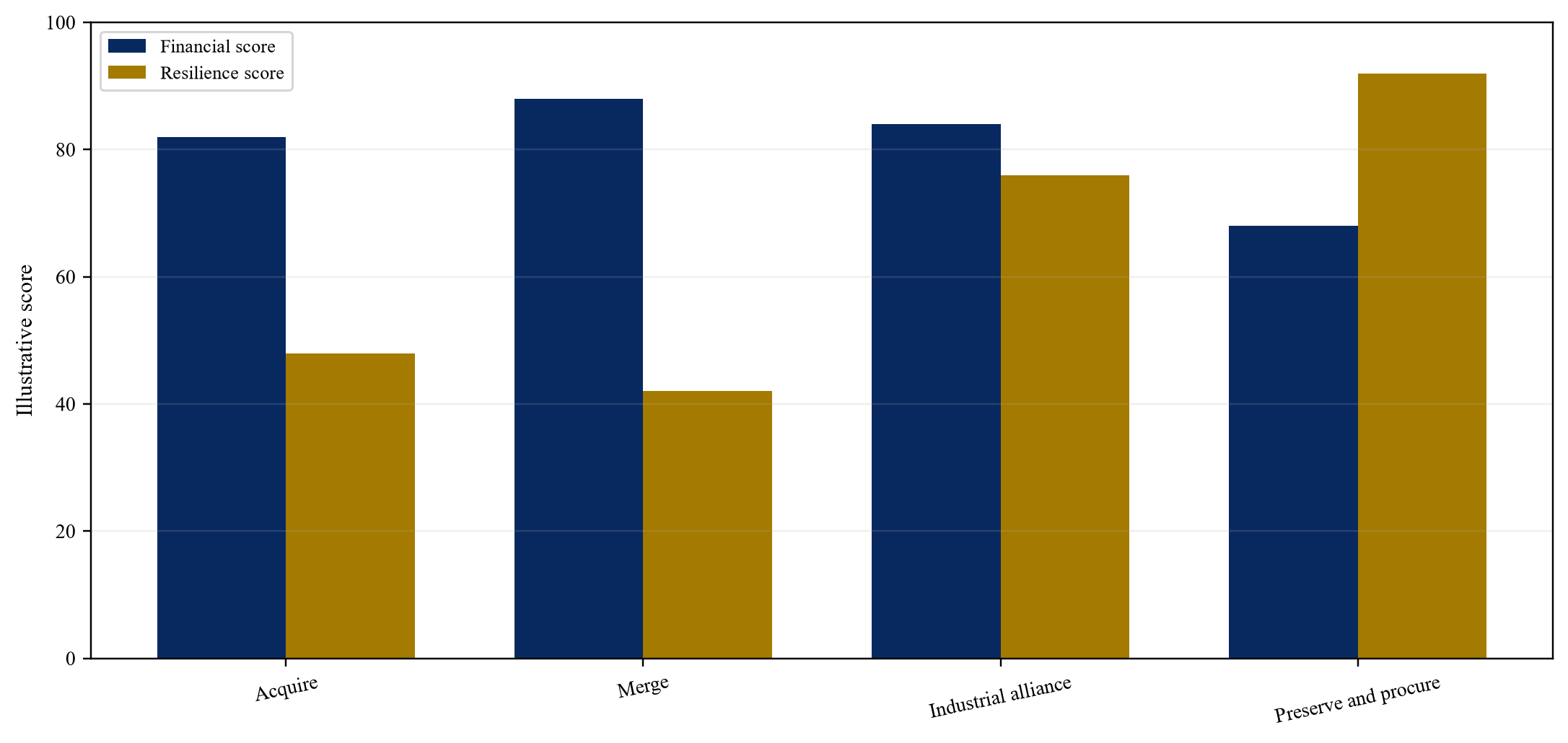
Proposed governance framework.
| Provider | Status | Annual cadence | Capacity | Principal role |
|---|---|---|---|---|
| Alpha | operational | 4 | 10 | medium and heavy institutional missions |
| Beta | operational | 3 | 8 | light and rideshare missions |
| Gamma | demonstration | 1 | 6 | dedicated small launch |
| Delta | development | 0 | 8 | reusable responsive launch |
Wholly hypothetical.
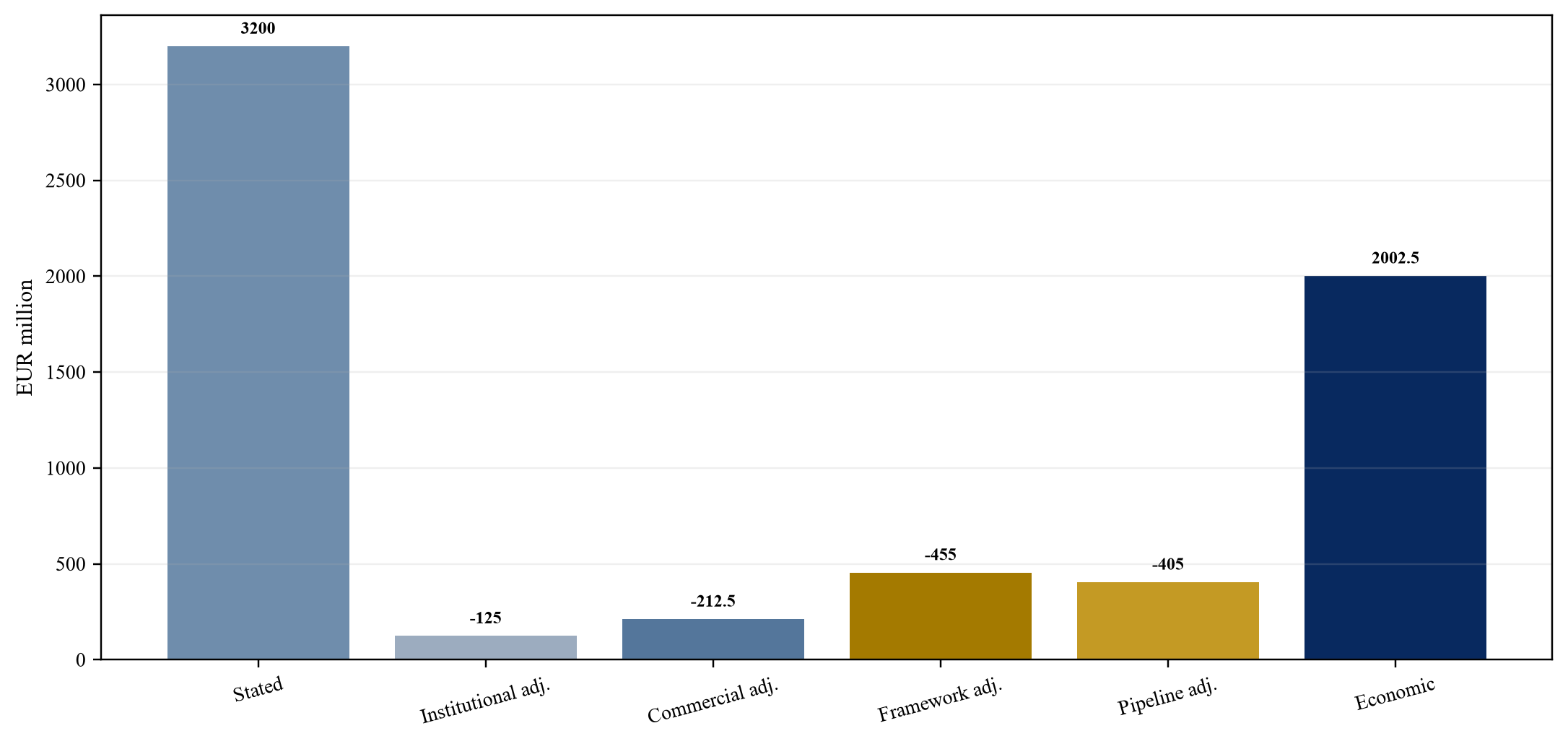
Wholly hypothetical; EUR million.
| Category | Stated value | Weight | Economic value |
|---|---|---|---|
| funded institutional orders | 1250 | 90% | 1125.0 |
| firm commercial orders | 850 | 75% | 637.5 |
| frameworks and options | 650 | 30% | 195.0 |
| memoranda and pipeline | 450 | 10% | 45.0 |
Proposed evidence treatment.
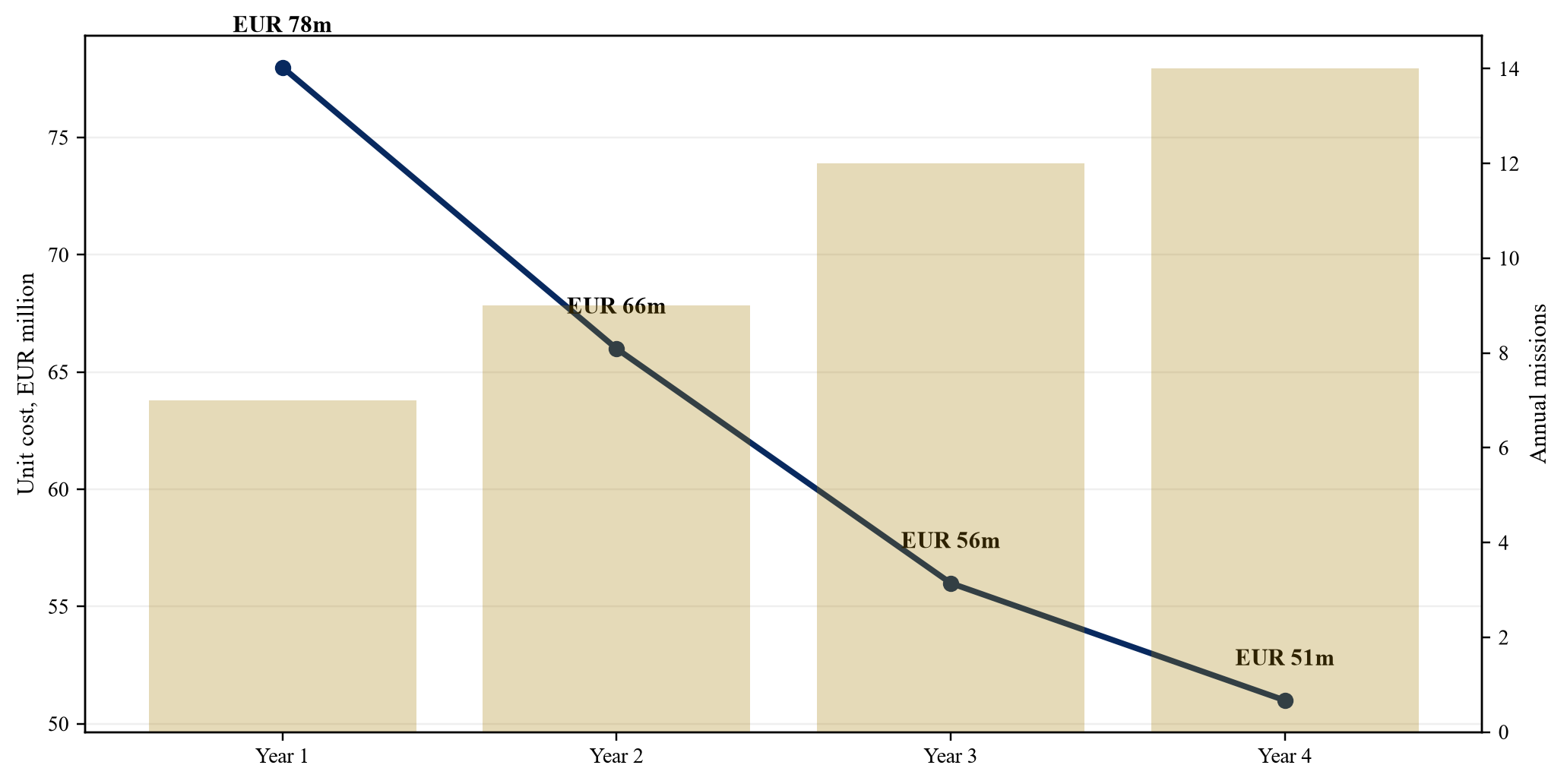
Wholly hypothetical; combined missions and EUR million per mission.
| Item | Stand-alone portfolio | Full merger | Alliance |
|---|---|---|---|
| revenue | 1260 | 1260 | 1260 |
| recurring delivery cost | 780 | 735 | 750 |
| fixed engineering and sites | 310 | 245 | 265 |
| strategic capacity retained | 0 | 55 | 35 |
| operating contribution | 170 | 225 | 210 |
Wholly hypothetical; EUR million.
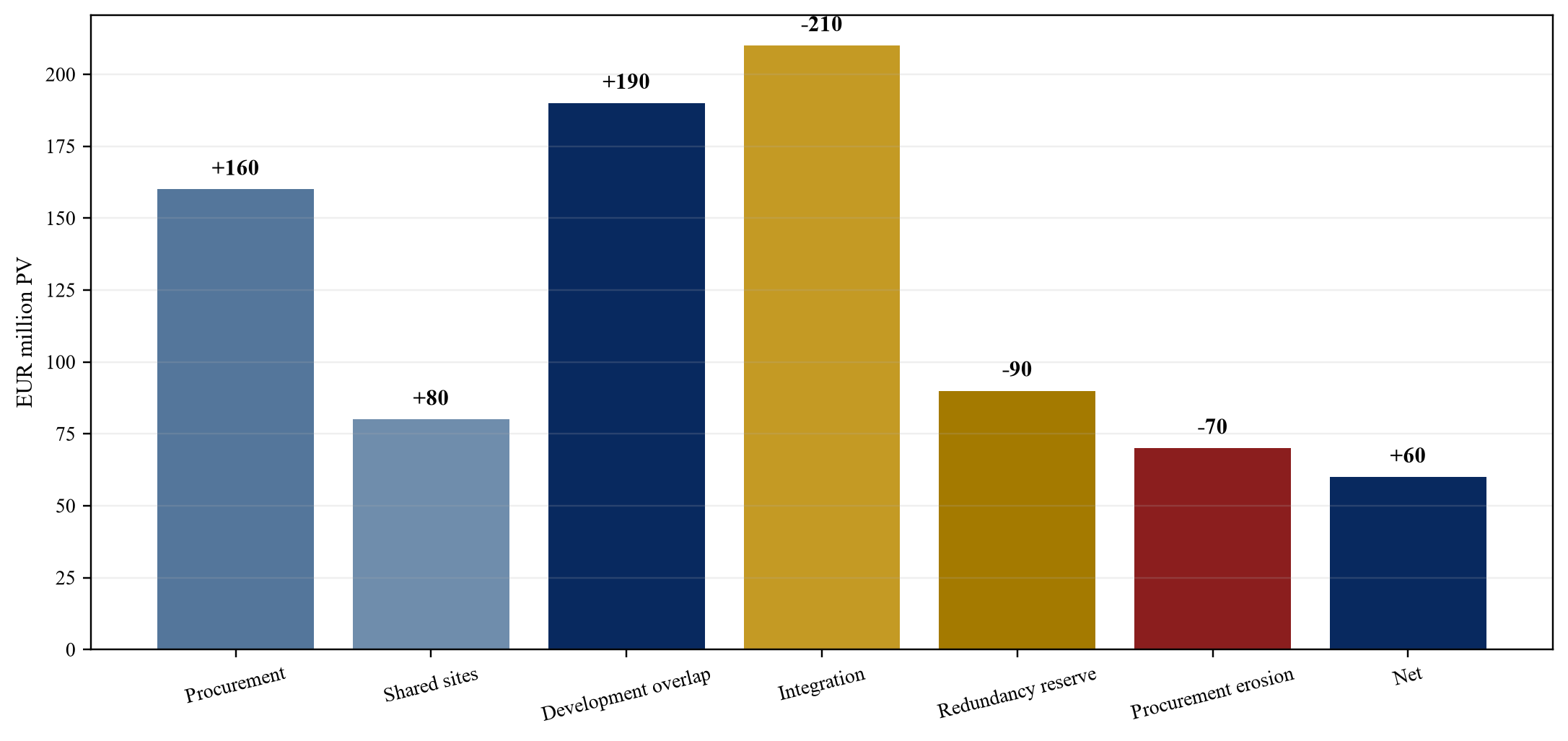
Wholly hypothetical; EUR million present value.
| Claim | Required evidence | Failure test |
|---|---|---|
| second launch path | qualified vehicle site and range | common supplier or site outage |
| responsive capacity | reserved hardware and windows | mobilisation and payload readiness |
| independent technology | separate critical design and software | common-mode defect |
| sovereign control | enforceable governance and access | foreign restriction or priority conflict |
| recovery capability | funded people spares and procedures | time to accepted mission |
Proposed resilience test.
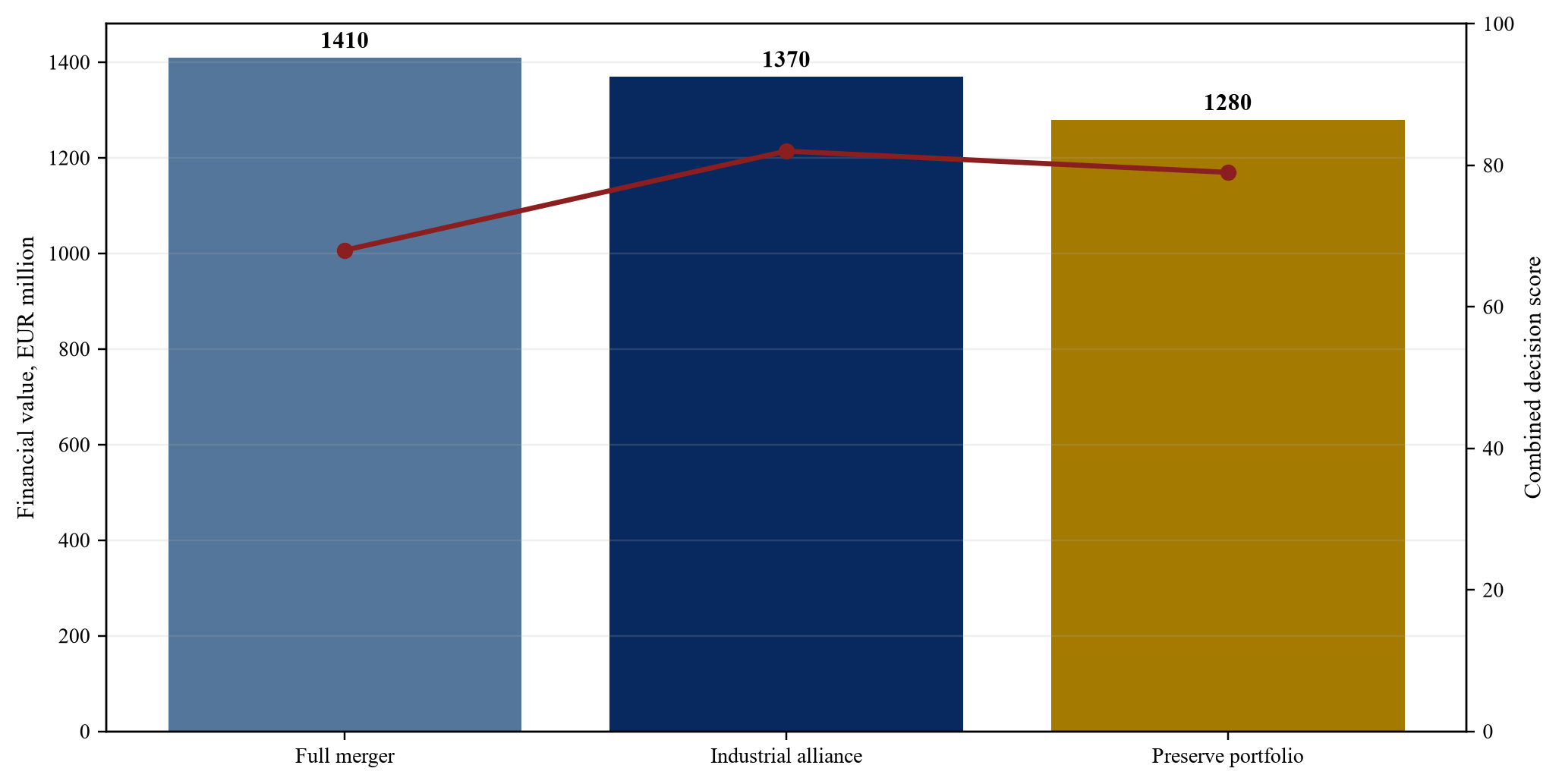
Wholly hypothetical; EUR million financial value and combined score.
| Area | Principal question | Evidence |
|---|---|---|
| merger control | does the structure reduce effective competition | market definition economics and filings |
| investment screening | do control rights affect sensitive capability | ownership governance and authority analysis |
| public funding | do grants or subscriptions survive control change | instruments consents and conditions |
| export control | can technology and data be combined lawfully | classifications licences and access plan |
| procurement | will institutional demand change after consolidation | rules awards customer confirmation |
Proposed transaction review.
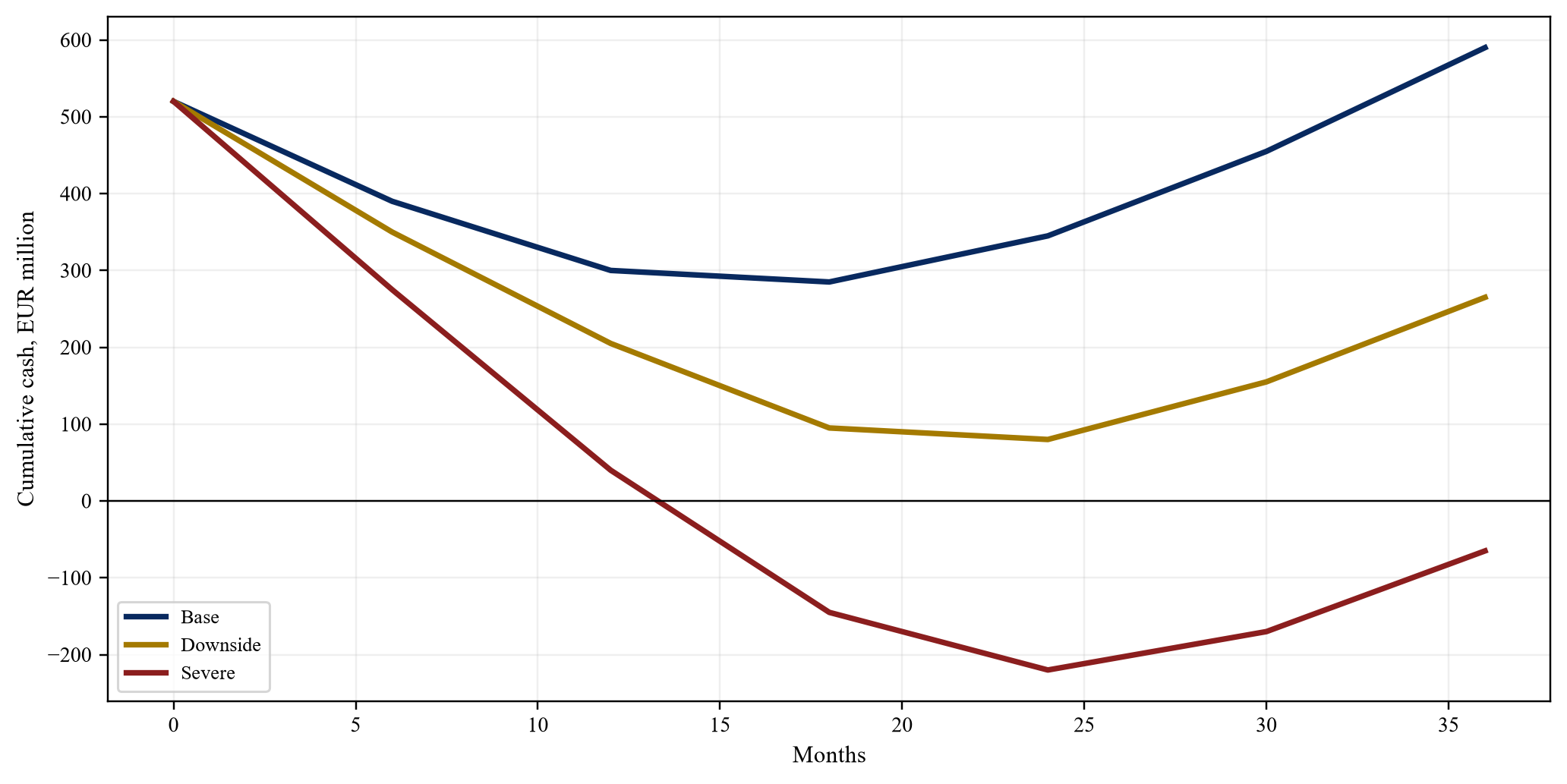
Wholly hypothetical cumulative cash; EUR million.
| Structure | Value mechanism | Principal risk | Core protection |
|---|---|---|---|
| acquisition | control and integration | overpayment and loss of independence | milestones and protected capabilities |
| legal merger | scale and portfolio breadth | competition and common-mode concentration | remedies and resilience covenant |
| alliance | selected shared infrastructure | governance and information leakage | scope clean teams audit and exit |
| preserve and procure | competitive choice | duplicated cost and weak funding | anchor demand and performance gates |
Proposed allocation of control and resilience.
| Criterion | Required conclusion | Owner |
|---|---|---|
| financial value | downside value and funding are acceptable | chief financial officer |
| mission delivery | cadence and capacity are evidenced | chief operating officer |
| technical resilience | independent paths meet the floor | chief engineer |
| competition | clearance and remedies are deliverable | general counsel |
| sovereign access | funded requirements and governance are clear | deal sponsor |
| integration | Day-One continuity and capability protection are funded | integration lead |
Proposed approval record.
Sources
- European Space Agency, European Launcher Challenge. Read the primary source
- European Space Agency, Launches from Europe's Spaceport from 2012. Read the primary source
- European Space Agency, Submit your proposal to the European Launcher Challenge. Read the primary source
- European Space Agency, CM25 Strengthen European autonomy and resilience. Read the primary source
- European Commission, EU Space Act. Read the primary source
- EUR-Lex, Proposal for an EU Space Act COM 2025 335. Read the primary source
- European Space Agency, Ariane 6. Read the primary source
- European Space Agency, Vega-C. Read the primary source
- European Space Agency, Vega launch vehicle. Read the primary source
- European Commission, EU Space Strategy for Security and Defence. Read the primary source
- EUR-Lex, Regulation EU 2021/696 establishing the Union Space Programme and EUSPA. Read the primary source
- European Commission, EU merger control. Read the primary source
- European Commission, Guidelines on horizontal mergers. Read the primary source
- European Commission, State aid overview. Read the primary source
- EUR-Lex, Regulation EU 2022/2560 on foreign subsidies distorting the internal market. Read the primary source
- European Commission, Foreign direct investment screening. Read the primary source
- EUR-Lex, Regulation EU 2019/452 establishing a framework for screening foreign direct investments. Read the primary source
- European Commission, Public procurement rules. Read the primary source
- EUR-Lex, Directive 2009/81/EC on defence and sensitive security procurement. Read the primary source
- European Space Agency, Space Transportation. Read the primary source
- European Space Agency, Boost Commercial Space Transportation Services and Support. Read the primary source
- European Union Agency for the Space Programme, GOVSATCOM. Read the primary source
- European Commission, IRIS2 secure connectivity. Read the primary source
- IFRS Foundation, IFRS 13 Fair Value Measurement. Read the primary source
- IFRS Foundation, IAS 36 Impairment of Assets. Read the primary source
- IFRS Foundation, IAS 38 Intangible Assets. Read the primary source
- European Court of Auditors, EU space programmes Galileo and Copernicus. Read the primary source
- European Commission, Space industrial ecosystem. Read the primary source
- European Space Agency, Europe's Spaceport. Read the primary source
- European Space Agency, Future Launchers Preparatory Programme. Read the primary source
