

1. Define the exclusion decision before reducing seller recourse
The board decision is whether the acquisition can sign with a protection package that remains coherent after the W&I policy exclusions are read alongside the acquisition agreement. The decision is broader than whether a carrier has offered a policy. It asks which unknown warranty breaches are insured, which identified matters sit outside that cover, how those matters are funded, and whether each response remains collectible and executable after closing.
The transaction team should define the maximum acceptable uninsured perimeter before negotiating away seller liability. That perimeter includes the policy retention, losses above the policy limit, excluded subjects, known circumstances, matters outside the warranty package, time-barred claims and any gap between the policy and the acquisition agreement. A headline limit can obscure those exposures. The committee therefore needs a category-by-category map rather than a single insurance number.
The map should answer six questions for every material issue. What is known? What evidence supports that knowledge? How can loss arise? Can the exposure be quantified? Can conduct or remediation reduce it? Which instrument carries the remaining risk? The last question should have one named answer. A risk described as covered elsewhere or managed commercially has no usable allocation until the responsible instrument, counterparty, amount, duration and enforcement route are recorded.
This framing changes the purpose of the exclusion schedule. It becomes a transaction design document rather than a late-stage list produced by the insurance workstream. Each exclusion is connected to pricing, contractual protection, funding, closing conditions and integration. The board can then decide whether the total package supports the proposed price and seller-recourse structure.
2. Read W&I cover within its legal and evidential limits
The UK Insurance Act 2015 requires a business insured to make a fair presentation of the risk before entering an insurance contract. The presentation must disclose material circumstances known or that ought to be known, or provide sufficient information to put a prudent insurer on notice that further enquiry is needed. The disclosure must be reasonably clear and accessible. [1] Applicable duties depend on governing law and policy wording, so transaction counsel should advise on the live placement.
W&I underwriting commonly relies on the acquisition agreement, disclosure materials, diligence reports, management answers and transaction data room. These materials establish the facts presented to the insurer and the scope of work performed. An insurer can decide that a matter is outside its appetite, insufficiently diligenced, expressly disclosed, already known or otherwise excluded. The executed wording governs the result. Broker summaries, preliminary indications and verbal expectations should not substitute for that wording.
The exclusion map should distinguish three concepts. A warranty exclusion removes or limits cover for a subject. A known-matter exclusion addresses facts already identified. An underwriting condition requires work or evidence before a position is confirmed. These concepts can overlap, yet their transaction responses differ. An underwriting condition may be cured before signing. A known tax assessment may require a specific indemnity or tax policy. A broad cyber exclusion may alter the valuation of an entire risk category.
The team should record the reason for each exclusion and the information on which it was based. That record supports negotiation, identifies possible cures and prevents the same matter being treated differently across the policy, disclosure letter and acquisition agreement.
3. Classify risk by knowledge and loss mechanism
The first classification separates unknown breach risk from identified exposure. Unknown breach risk exists where the seller gives a warranty, diligence has not identified a breach and the policy may respond if the warranty later proves false. An identified exposure exists where the team knows facts capable of producing loss, even if the final amount or outcome is uncertain.
Knowledge is not binary. A matter can be suspected, evidenced, asserted by a third party, quantified within a range or legally crystallised. The map should record that maturity. A regulator's information request is different from a final penalty. Malware detected and contained is different from evidence of continuing compromise. Soil sampling that identifies contamination is different from an agreed remediation obligation. A tax filing position with contrary advice is different from an assessed liability.
The second classification identifies the loss mechanism. Tax loss can arise from assessment, interest, penalty, denial of relief or transaction restructuring. Cyber loss can arise from business interruption, restoration, notification, third-party claims, regulatory action or lost contracts. Environmental loss can arise from remediation, migration, permitting, shutdown, third-party damage or diminished site value. Contingent loss can arise from litigation, anti-bribery enforcement, sanctions, licence failure or contract termination.
The response should follow the mechanism. A fixed escrow may suit a bounded cash claim. A remediation covenant may suit an exposure that can be reduced through defined work. A contingent value right may suit an outcome that changes asset value. A specialist policy may suit a legally analysed event with defined trigger and loss. Classification creates the connection between facts and capital.
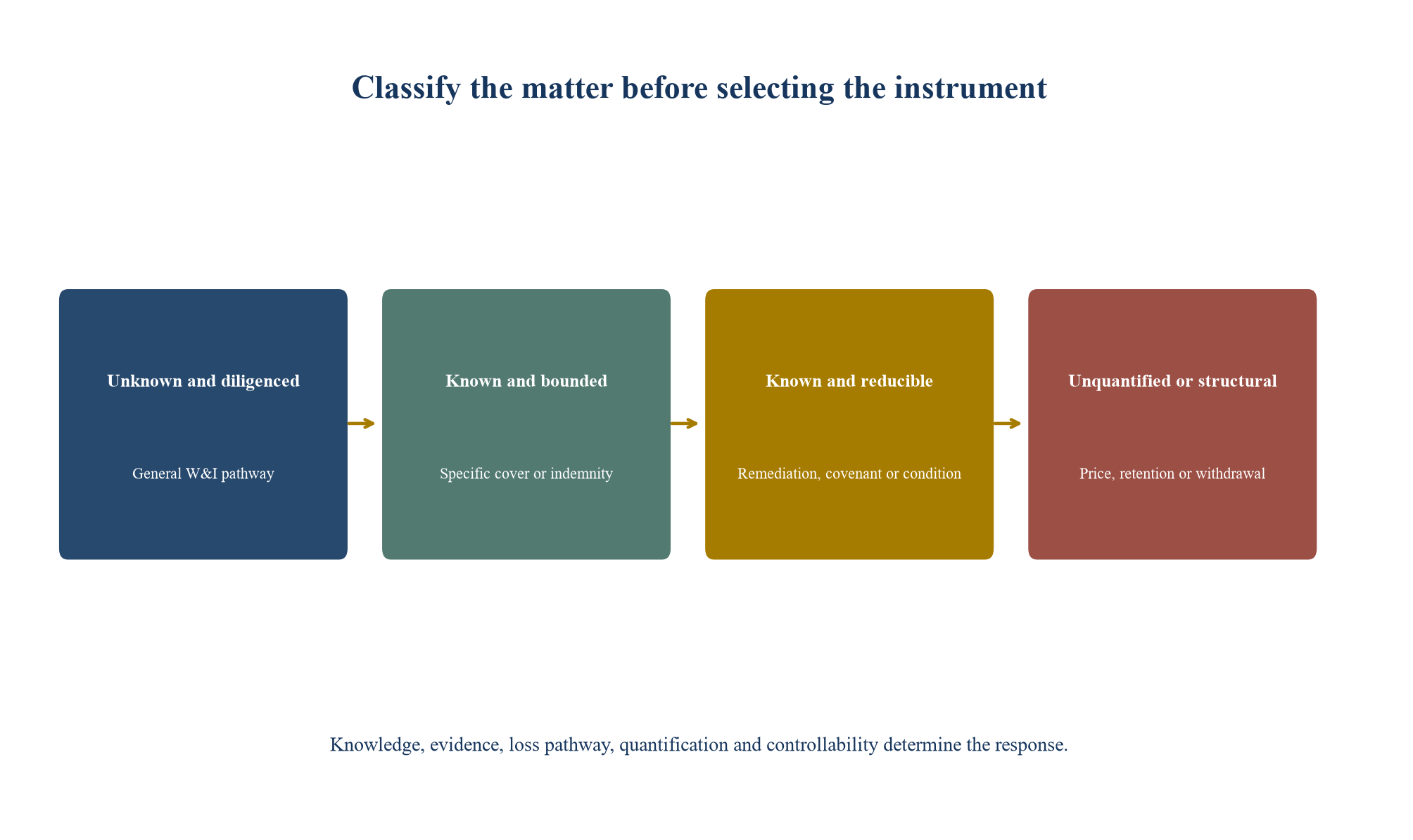
Original framework. Classification and response require current transaction evidence, policy wording and professional advice.
4. Build one risk-to-response register
The register is the central control. It should connect every material diligence finding and proposed policy exclusion to a transaction response. It should also identify the party authorised to accept the residual exposure.
| Classification | Evidence state | Principal question | Candidate response | Approval test |
|---|---|---|---|---|
| Unknown warranty breach | Completed diligence supports no known issue | Does final wording affirm the intended warranty? | General W&I cover within limit and retention | Policy and acquisition agreement reconciled |
| Known, bounded exposure | Facts and loss range are sufficiently defined | Is the trigger suitable for specialist cover or seller recourse? | Tax or contingent policy, specific indemnity or escrow | Amount, duration and enforcement are credible |
| Known, reducible exposure | Remediation actions and deadlines are defined | Can action reduce probability or severity before value transfers? | Condition, covenant, holdback, remediation reserve | Owner, budget and evidence of completion exist |
| Known, valuation-sensitive exposure | Outcome changes future cash flow or asset value | Can price move with the outcome? | Price adjustment, earn-out or contingent value mechanism | Formula and information rights are executable |
| Structural or unquantified exposure | Evidence cannot support a defensible range | Should the buyer retain, reprice, restructure or withdraw? | Buyer retention, perimeter change, deferred closing or withdrawal | Board accepts downside and liquidity consequences |
Responses are illustrative. Live allocation depends on facts, law, policy wording, counterparties and commercial terms.
Each register entry should contain the source fact, affected entity, jurisdiction, warranty, exclusion wording, estimated gross exposure, probability basis, timing, mitigation, response instrument, funded amount, counterparty, security, duration, owner and approval. Values should be ranges where precision is unsupported. Legal conclusions should be attributed to the relevant adviser.
The register should prevent double counting. A single cyber event can appear in privacy, contract, business interruption and regulatory workstreams. The risk owner should identify shared causes and correlated losses. The same discipline applies to environmental matters that affect remediation cost, permit continuity and asset value.
The register should also expose gaps between advisers. Tax counsel may define a legal risk, the accountant may model cash exposure and the insurer may propose an exclusion. The deal team owns the synthesis. No adviser should be assumed to have approved the complete commercial allocation unless its mandate says so.
5. Separate general cover from affirmative cover
General policy wording can appear broad while exclusions, definitions and knowledge provisions narrow the practical outcome. The team should therefore identify the warranties intended to be covered and test them against every applicable limitation. An affirmative statement of cover can provide greater clarity for a material subject, subject to its precise wording.
Affirmative cover should be documented at the level of the risk, warranty and loss. A note that cyber is covered can remain ambiguous if the policy excludes fines, remediation costs, forward-looking business interruption or matters disclosed in a penetration test. The matrix should record the affirmative provision, relevant definitions, sublimit, retention, time limit and any special condition.
The same approach applies to tax. A general tax warranty may protect against an unknown historic filing error while an identified transfer-pricing position is excluded. Specialist tax insurance can sometimes address a defined tax treatment, subject to underwriting and wording. Lloyd's introduced or revised transactional-liability risk codes for tax and contingent or contested risks from 2026, evidencing the distinct treatment of these classes in market reporting. [10] A code does not establish availability or terms for a particular deal.
Where affirmative cover cannot be obtained, the team should decide whether the subject requires a different instrument or explicit retention. The exclusion map should record that decision before seller recourse is reduced.
6. Design the tax exclusion pathway
Tax exposures are often entity-specific, period-specific and jurisdiction-specific. The team should separate unknown historic breaches from identified positions. Unknown non-compliance discovered after closing may fall within the negotiated tax warranty or tax covenant and policy. An identified assessment, uncertain treatment, transaction step or relief dependency requires its own analysis.
The tax file should state the legal issue, taxable person, periods, authority, procedural status, principal amount, interest, penalties, probability basis, payment timing, security and appeal route. It should also distinguish cash tax from accounting provision and deferred-tax effects. The buyer should understand whether the exposure follows the acquired entity, remains with the seller or changes through the transaction structure.
Candidate responses include a specific tax indemnity, escrow, price reduction, pre-closing restructuring, covenant to conduct a dispute, specialist tax insurance or buyer retention. A seller indemnity should address control of correspondence, settlement, information access, tax benefits, recovery and time limits. An escrow should be sized to the plausible cash requirement and release path. Specialist insurance should be assessed against the exact insured event, exclusions and conduct obligations.
Environmental tax incentives and reliefs can introduce additional dependencies. HMRC guidance on land remediation relief states conditions including the relationship between the claimant, the polluter and acquisition of contaminated land. [6] The buyer should verify eligibility rather than model relief as certain. Tax due diligence should reconcile the commercial model with legal advice, filings and correspondence.
7. Design the cyber exclusion pathway
Cyber risk combines technical condition, legal compliance, operational dependency and third-party liability. The exclusion map should begin with the actual systems, data, incidents and contractual commitments of the acquired business. Policy labels alone do not establish the exposure.
The diligence scope should address governance, asset inventory, identity and access, privileged accounts, vulnerability management, endpoint coverage, backups, incident history, data flows, third-party dependencies, software development, resilience testing and remediation. The NCSC's Cyber Assessment Framework organises cyber outcomes around managing security risk, protecting against attack, detecting events and minimising impact. [7] It can support a structured review, while transaction-specific testing remains necessary.
An identified incident should be mapped to containment, eradication, restoration, notification, third-party claims, regulatory engagement and customer consequences. An unresolved control weakness should be mapped to a remediation plan, cost, owner and deadline. The SEC's cybersecurity disclosure rules require specified public companies to disclose material cybersecurity incidents and information about risk management, strategy and governance, illustrating the governance and materiality questions that can arise around cyber facts. [4]
Candidate responses include remediation before signing, a closing condition, escrow, price adjustment, specific seller indemnity, standalone cyber cover, affirmative W&I wording or buyer retention. The buyer should test whether exclusions in the cyber programme and W&I policy create a gap. It should also preserve incident and diligence evidence without weakening privilege or violating data-protection restrictions.
8. Design the environmental exclusion pathway
Environmental exposure is tied to sites, operations, substances, permits, historic ownership and migration pathways. A desktop report can identify potential sources, while intrusive investigation may be needed to establish condition. The buyer should connect the scope of work to the liability regime and intended use of the asset.
In England and Wales, statutory guidance under Part 2A of the Environmental Protection Act 1990 addresses the identification and remediation of contaminated land. [5] In the United States, the Environmental Protection Agency's All Appropriate Inquiries framework concerns specified due-diligence standards relevant to landowner-liability protections. [8] These regimes are not interchangeable. Local counsel and environmental specialists should define the applicable pathway.
The environmental file should state the site, contaminant or hazard, source, pathway, receptor, regulatory status, investigation limits, remediation standard, cost range, schedule, operating interruption, permit implications and third-party effects. It should separate known contamination from unknown historical breach risk. It should also distinguish statutory liability from contractual allocation.
Candidate responses include seller remediation, a condition to closing, specific indemnity, escrow, environmental impairment insurance, price adjustment, site carve-out, long-stop date or buyer acceptance with funded reserve. A covenant should specify the standard, evidence and decision rights for completion. An escrow should align with the plausible duration and escalation of cost. Environmental insurance should be reviewed for known-condition treatment, gradual pollution, discovery, clean-up standard and business interruption.
9. Design the contingent and regulatory pathway
Contingent matters include litigation, regulatory investigations, licence dependencies, anti-bribery concerns, sanctions, product liability, intellectual-property disputes and other events whose outcome remains uncertain. The core task is to define the event, procedural posture, possible remedies, timing and conduct rights.
The DOJ and SEC FCPA Resource Guide discusses successor liability and the role of pre-acquisition due diligence and post-acquisition integration in mergers and acquisitions. [9] The relevance of that guidance depends on jurisdiction and facts. The broader execution lesson is that a buyer should connect identified compliance risks to transaction protection and a funded integration plan.
Specific contingent-risk insurance can be considered where the event, legal analysis and loss are sufficiently defined for underwriting. Availability, exclusions, attachment and pricing depend on the matter. Other responses include a specific indemnity, escrow, purchase-price adjustment, contingent payment, seller-retained proceeding, closing condition or perimeter carve-out.
The conduct clause matters. The party funding or insuring the risk may require control, consultation, consent or cooperation. Those rights must fit the business's need to protect licences, customer relationships and reputation. A theoretically valuable indemnity can destroy operating value if enforcement prevents sensible settlement. The register should therefore record financial protection and conduct governance separately.
10. Quantify the full uninsured perimeter
The uninsured perimeter should be measured across the complete protection stack. It includes retention, excluded matters, policy sublimits, losses above limits, uncovered damages, timing gaps, uncollectible seller recourse and funded obligations that can exceed escrow. The team should avoid adding gross maximums without considering overlap, probability or correlation. It should also avoid reducing risk to a single expected value.
The decision model should use scenarios. Base, adverse and severe cases can show cash amount, timing, operational interruption and value effect. Each assumption should have a source, owner and date. Sensitivities should include delay, remediation cost escalation, legal cost, tax interest, customer loss and insurance recovery timing.
The committee should distinguish funded and unfunded exposure. A USD 10 million seller indemnity supported by an escrow is different from an unsecured promise. A policy limit is different from available liquidity if claim payment follows a long investigation. A price reduction transfers value immediately, while a contingent payment changes value only if its mechanism operates.
The model should show the buyer's peak liquidity need before recovery. That measure can drive debt headroom, acquisition financing and integration reserves. It also helps compare instruments that have similar nominal amounts but different timing.
11. Establish the hypothetical transaction case
The hypothetical buyer proposes to acquire a cross-border industrial-services and software group for enterprise value of USD 410.0 million and equity purchase price of USD 305.0 million. The proposed W&I policy limit is USD 40.0 million. Retention is USD 3.0 million. Assumed premium, insurance tax and underwriting cost is USD 1.0 million. These values are scenario inputs and do not represent market pricing.
Diligence identifies a USD 52.0 million gross risk perimeter. The tax category is USD 18.0 million and includes an uncertain historic position and related interest. Cyber is USD 12.0 million and includes remediation, possible interruption and third-party exposure. Environmental is USD 15.0 million and includes site investigation, remediation and permit risk. Regulatory and other contingent matters are USD 7.0 million.
The buyer does not treat the USD 52.0 million as expected loss. It is a decision perimeter that combines differently measured exposures. Each category has its own evidence and scenario range. The figure allows the committee to test whether every identified matter has a transaction response.
The proposed allocation directs USD 12.0 million of tax risk to a specific indemnity or tax policy and USD 3.0 million to price or escrow, leaving USD 3.0 million accepted. Cyber receives USD 5.0 million of remediation or escrow and USD 4.0 million of specific or affirmative cover, leaving USD 3.0 million accepted. Environmental receives USD 9.0 million of escrow or indemnity and USD 4.0 million of remediation funding, leaving USD 2.0 million accepted. Regulatory or contingent risk receives USD 4.0 million of dedicated cover, leaving USD 3.0 million accepted. Correlation and overlap reduce the consolidated residual from the simple category sum to USD 8.0 million in the hypothetical board model.
| Risk category | Initial perimeter | Dedicated insurance or indemnity | Escrow, price or remediation | Standalone residual before overlap | Principal decision evidence |
|---|---|---|---|---|---|
| Tax | 18.0 | 12.0 | 3.0 | 3.0 | Tax opinion, authority record, scenario model |
| Cyber | 12.0 | 4.0 | 5.0 | 3.0 | Technical review, incident record, restoration test |
| Environmental | 15.0 | 9.0 | 4.0 | 2.0 | Site investigation, cost plan, permit analysis |
| Regulatory and contingent | 7.0 | 4.0 | 0.0 | 3.0 | Counsel analysis, proceeding status, conduct plan |
| Total | 52.0 | 29.0 | 12.0 | 11.0 | Consolidated board model records USD 8.0m after overlap |
All values are scenario assumptions in USD millions. They do not represent expected loss, market benchmarks or available insurance terms.
12. Allocate the USD 52 million perimeter
The allocation process starts with gross exposure and then assigns enforceable responses. A response receives credit only when its amount, trigger, duration, security and ownership are defined. An indicative insurer discussion or draft seller promise receives no funded credit at the signing gate.
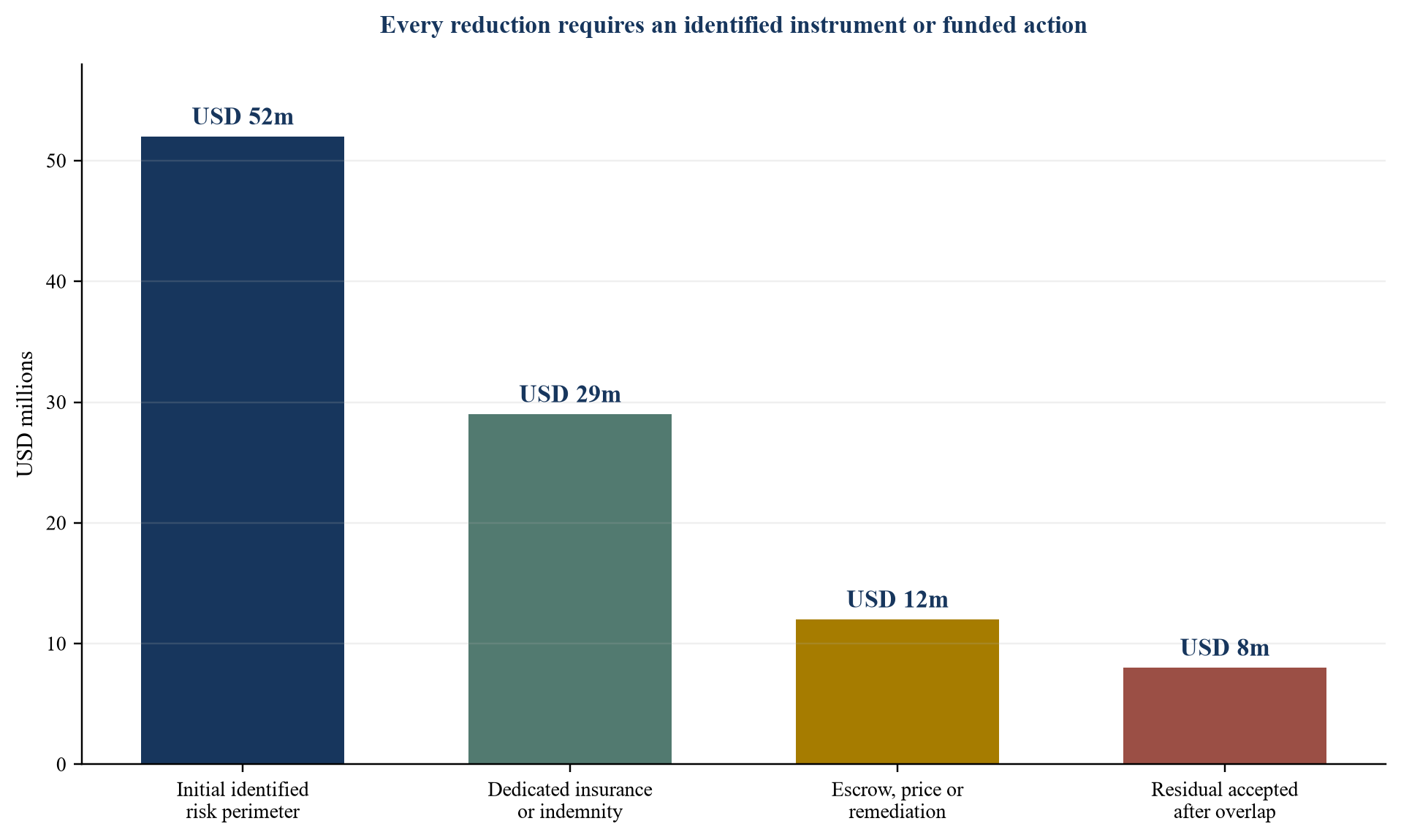
Values are scenario assumptions and do not represent market observations or available insurance capacity.
The USD 29.0 million dedicated-protection amount does not mean one policy pays that amount. It aggregates the hypothetical face values assigned to specific insurance or indemnity responses across categories. The USD 12.0 million operational and pricing amount combines cash held, value transferred or work funded. The committee should see those components separately in the detailed register.
The USD 8.0 million consolidated residual is a modelling output after overlap. It is the amount the buyer accepts in the board scenario, subject to stated assumptions. The buyer should compare it with liquidity, debt covenants and investment-return sensitivities. It should also test a severe case in which multiple exposures occur together and recovery is delayed.
No category is removed from governance after allocation. An insured risk still requires notice compliance. An escrowed risk still requires control of claims and release. A remediation programme still requires evidence and contingency. The exclusion map remains active through closing and integration.
13. Test collectability and counterparty strength
Protection has value only if it can be collected when loss occurs. The committee should test insurer identity, capacity, policyholder, governing law, dispute forum, notice route and claims process. It should also test seller credit, escrow bank, guarantee terms and any limitation on set-off or recovery.
For insurance, the executed policy is the primary document. The buyer should confirm that premium is paid, inception conditions are satisfied and the correct entities and interests are insured. It should understand retention erosion, aggregation, defence costs, subrogation, other-insurance provisions and the treatment of tax gross-up. Specialist advice is required.
For seller recourse, security structure matters. An escrow can provide ring-fenced cash, subject to release conditions and bank terms. A parent guarantee depends on the guarantor and enforceability. Deferred consideration can create leverage but may become disputed. A covenant from a thin special-purpose seller can have little practical value.
The map should use a collectability haircut where recovery is uncertain. The haircut is a management scenario, not a legal conclusion. It should be supported by counterparty evidence and refreshed if the seller distributes proceeds or the insurer changes. The board paper should show both nominal protection and risk-adjusted protection.
14. Reconcile the policy and acquisition agreement
The policy and acquisition agreement should be reconciled warranty by warranty. The team should compare definitions, knowledge qualifiers, materiality, loss, tax treatment, limitation periods, damages, mitigation, third-party claims, fraud, disclosure and governing law. Differences can create coverage gaps even when the same commercial subject appears in both documents.
| Control area | Acquisition agreement question | Policy question | Required output |
|---|---|---|---|
| Warranty scope | Which entities, periods and statements are warranted? | Which warranties are insured, amended or excluded? | Clause-level mapping and variance log |
| Knowledge and disclosure | Whose knowledge qualifies the warranty and what is disclosed? | Which knowledge and disclosed information affect cover? | Named knowledge group and evidence record |
| Loss | Which losses are recoverable from the seller? | How does the policy define loss and excluded damages? | Scenario-tested loss bridge |
| Time | What are the contractual claim periods? | What are policy periods, notices and discovery rules? | Coordinated calendar and claims protocol |
| Conduct | Who controls third-party claims, tax proceedings and settlement? | What consent, cooperation or mitigation duties apply? | One operational conduct matrix |
| Recovery | How do escrow, indemnity and price mechanisms interact? | How do other insurance and subrogation apply? | Recovery waterfall and no-double-recovery control |
Terms are illustrative and require transaction-specific legal and insurance advice.
The reconciliation should occur at least at binding bid, signing and completion. Late agreement changes can alter warranties or disclosure after underwriting. The buyer should define which amendments require insurer confirmation and preserve that confirmation.
The exclusion schedule should use the same risk identifiers as the diligence register. This allows a reviewer to move from source evidence to legal allocation and policy treatment. It also reduces the chance that similar issues are described differently and escape reconciliation.
15. Use a heat map for evidence and consequence
The heat map should plot evidence uncertainty against loss or transaction consequence. A known matter with strong evidence and bounded loss may be easier to allocate than a smaller matter supported by weak evidence. The map should therefore guide diligence and decision priority rather than imply probability precision.
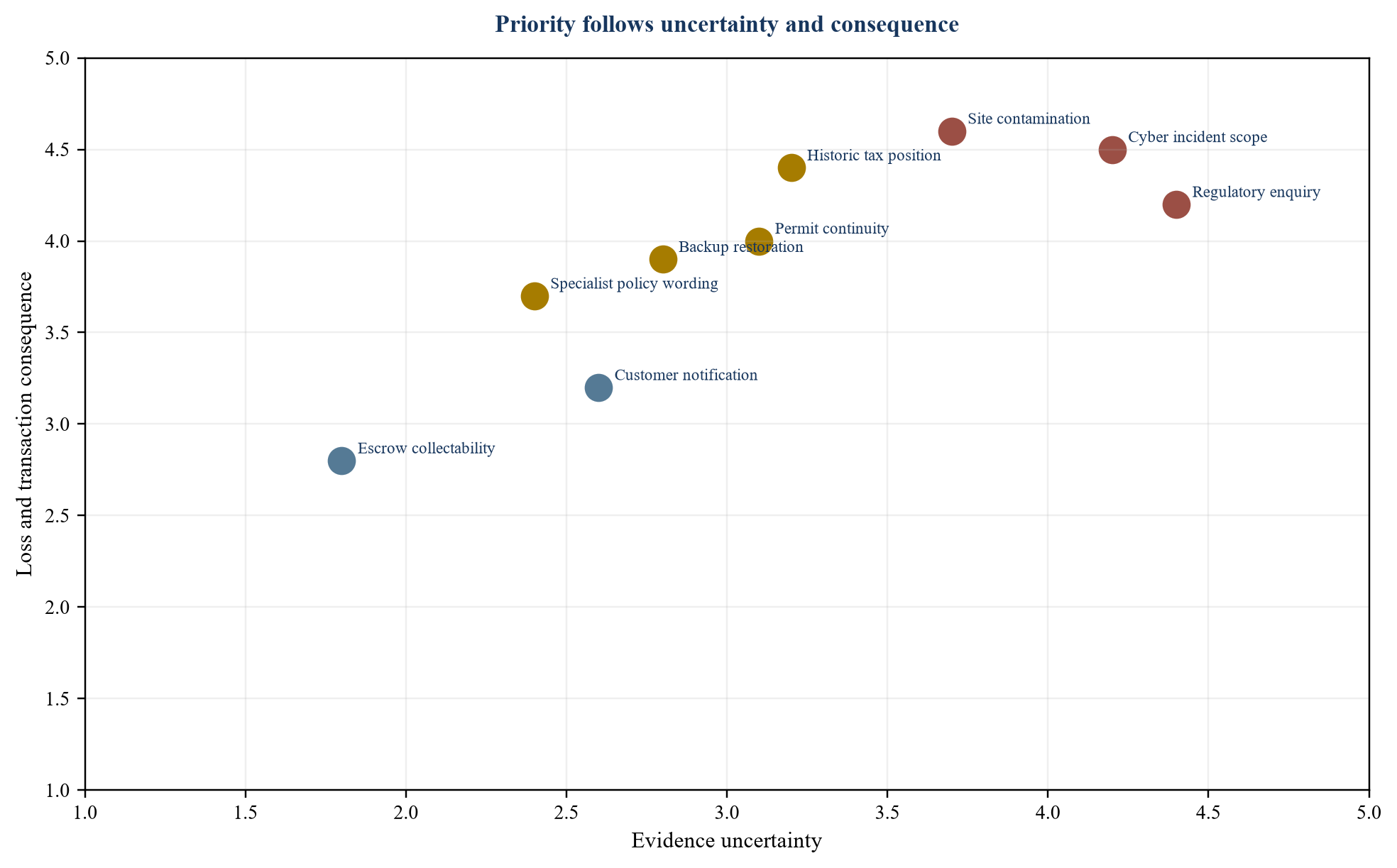
Positions are scenario judgements and do not represent observed market data.
In the hypothetical case, cyber incident scope, site contamination and the regulatory enquiry require senior attention. The historic tax position has greater consequence than evidence uncertainty. Backup restoration has a potentially material operational effect that can be tested before closing. Each plotted point should link to the detailed register.
The heat map should change as evidence improves. If testing demonstrates recovery, cyber uncertainty can fall. If intrusive investigation expands the contaminated area, environmental consequence can rise. The movement provides a useful governance record when supported by source evidence.
16. Convert exclusions into closing actions
An exclusion should produce an action. The action can seek to remove the exclusion, reduce the underlying risk, transfer loss to another instrument or change transaction economics. Each action needs an owner and latest safe date.
Removal can require further diligence, additional disclosure, specialist advice, policy clarification or improved evidence. Risk reduction can require remediation, consent, payment, filing, system isolation or operational change. Transfer can require a specific policy, indemnity, escrow or guarantee. Economic change can require price, deferred consideration, earn-out or a carve-out.
The team should distinguish actions required before signing, between signing and closing, and after closing. A post-closing covenant should not be credited as if completed. A closing condition should have objective evidence and waiver authority. An escrow should be established through executed documents and funded at completion.
The decision record should also show the fallback if an action fails. The fallback can preserve seller recourse, increase retention, change price, defer closing, remove an asset or stop the transaction. A fallback that cannot be exercised after a deadline is not a live control.
17. Govern known-risk insurance as a separate workstream
Specialist tax, environmental and contingent-risk policies require their own underwriting, advice and negotiation. They should be integrated with the main transaction timetable while retaining separate scope, evidence and ownership.
The buyer should define the insured event, known facts, legal analysis, loss measure, exclusions, attachment, limit, duration, conduct and claim process. It should test whether the policy covers principal, interest, penalties, defence cost, gross-up and consequential loss as relevant. The availability of any element depends on the live market and facts.
The specialist policy should also be reconciled with W&I cover and seller recourse. Other-insurance and subrogation provisions can affect recovery. An exclusion in one policy should not be assumed to be included in another. The acquisition agreement should preserve necessary information, cooperation and conduct rights.
The committee should receive a separate decision summary for each specialist policy. It should state which part of the risk perimeter is being transferred, what remains, when cover attaches and what must occur after closing. This avoids presenting a specialist placement as a complete solution to a wider operating problem.
18. Use technology with accountable review
Technology can support document indexing, issue extraction, clause comparison, evidence linking, scenario modelling and version control. It can also repeat an error across the entire register. Material conclusions therefore require accountable professional review.
An extraction system can identify exclusion language across drafts, yet counsel should confirm meaning and interaction. A model can flag tax references, cyber incidents or environmental terms, yet specialists should validate the evidence population and conclusion. Optical character recognition can make reports searchable, yet tables, handwritten notes and poor scans can be misread.
The technology control record should state the source population, date, tool or method, validation sample, reviewer, exceptions and approval. Sensitive transaction data should be handled within authorised environments. Access, retention, cross-border transfer, privilege and confidentiality should be governed.
The most useful automation is traceability. A risk identifier should link the diligence finding, source document, policy exclusion, contract clause, quantified scenario, response instrument and approval. The system should show changes between drafts and notify owners when a policy change reopens a transaction decision.
19. Establish decision gates and authority
The exclusion map should operate through four gates. The classification gate confirms that material findings have risk identifiers, evidence owners and preliminary responses. The binding-bid gate tests whether the proposed price and seller recourse remain viable under expected exclusions. The signing gate confirms executed or executable protection. The completion gate confirms inception, funding, conditions and handover.
Authority should match the decision. Counsel can advise on legal wording. A broker can advise on placement. Technical specialists can assess condition. The deal committee accepts commercial residual risk. The board or delegated authority may need to approve price, uninsured exposure or a change in acquisition perimeter.
Each gate pack should show open exclusions, gross and residual exposure, instrument status, collectability, latest safe dates and fallback. The pack should distinguish quoted, negotiated, bound, funded and effective. Those statuses have different decision value.
The minutes should record material dissent and conditions. If the committee accepts a risk because remediation is planned, the owner, budget and deadline should enter the post-completion plan. If the committee relies on a seller indemnity, the security and enforcement route should be recorded.
20. Implement the exclusion map in five phases
| Phase | Core outputs | Decision test | Escalation if incomplete |
|---|---|---|---|
| Classification | Risk taxonomy, identifiers, evidence standards and owners | Are unknown and identified matters separated? | Expand diligence and preserve seller recourse |
| Quantification | Scenario ranges, timing, correlation and liquidity model | Can the committee understand gross and residual exposure? | Use ranges, commission specialist work or reprice |
| Response design | Policy matrix, indemnities, escrow, price and remediation | Does every material exclusion have one funded response? | Retain recourse, alter structure or defer commitment |
| Execution | Bound wording, executed protection, funded accounts and conditions | Are responses collectible and effective on schedule? | Hold signing or completion and activate fallback |
| Handover | Claims file, notice calendar, remediation plan and governance | Can the buyer operate every protection after closing? | Retain deal-team ownership until control transfer is complete |
Timing is indicative and should follow the transaction, diligence, insurance and regulatory timetable.
Phase one creates the taxonomy and one register. Phase two quantifies exposure without false precision. Phase three selects instruments and reconciles them with the acquisition agreement. Phase four executes and funds the package. Phase five transfers claims, remediation and monitoring to accountable owners.
The operating rhythm should include a weekly exclusion review and a daily review during final policy negotiation. The agenda should cover new findings, policy changes, seller-protection changes, quantification, actions due and decisions required. Material changes should enter the register on the day they are identified.
Measures should include the percentage of material findings classified, exclusions without an approved response, protection still indicative, unfunded escrow, overdue remediation, policy-to-contract variances and residual exposure against board limit. These measures describe execution. The number of diligence documents or insurer questions does not establish readiness.
The implementation model should also separate exposure measurement from accounting treatment. A diligence range, negotiated escrow, insurance limit and financial-statement provision can describe different concepts. The deal team should ask the finance function and reporting advisers to determine the applicable recognition, measurement and disclosure treatment. The investment model should preserve a bridge among cash scenarios, purchase-price mechanisms, insurance recoveries and accounting entries so that the committee does not treat one number as interchangeable with another.
Correlation requires explicit attention. A cyber incident can interrupt operations, trigger customer claims, create regulatory exposure and weaken the forecast used to support acquisition debt. Environmental contamination can require cash remediation, restrict a permit and reduce the value of real property. The consolidated model should identify shared causes and avoid both double counting and artificial diversification. Stress cases should test simultaneous events, delayed recovery and management distraction during integration.
The team should maintain a change log. Each change in evidence, policy wording, acquisition terms, quantified exposure or response status should record the date, owner, rationale and approval effect. A change that increases residual exposure above delegated authority should return to the relevant committee. A change that improves protection should still be verified against executed documents before the model is updated.
The post-completion owner should receive a calendar of notice dates, policy expiries, escrow releases, limitation periods, remediation milestones, regulatory submissions and seller obligations. The calendar should identify the evidence required at each event. Missed notice or release dates can reduce the practical value of protection even when the original negotiation was sound.
The buyer should rehearse a claim and a remediation escalation before closing. The rehearsal should identify who discovers the event, who preserves evidence, who gives notice, who controls communications, who approves spend and who reports to the board. The exercise can reveal conflicts among policy conditions, seller conduct rights and operating priorities. Any conflict should be resolved in the documents or accepted explicitly.
The complete record should remain accessible to authorised decision makers throughout integration.
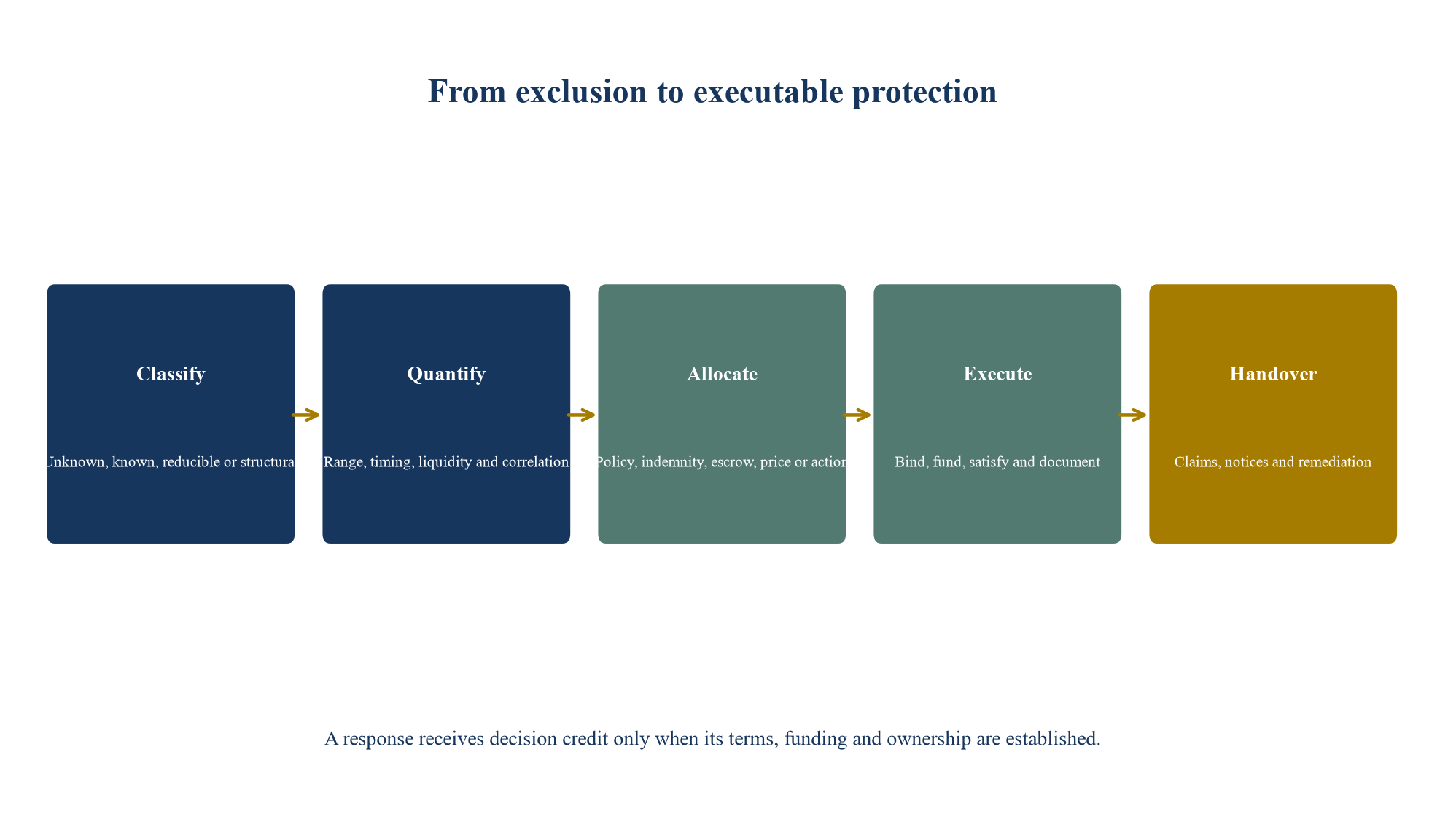
Original framework. Each step requires transaction-specific evidence, documentation and approval.
21. Conclusion
W&I insurance is one component of an acquisition protection system. The exclusion map makes the boundary visible. It separates unknown warranty breach risk from identified exposures and links each known matter to a specific contractual, insurance, pricing, funding or operational response.
The hypothetical case begins with a USD 52.0 million identified-risk perimeter across tax, cyber, environmental and contingent matters. Dedicated insurance or indemnity is assigned USD 29.0 million. Escrow, price and remediation responses are assigned USD 12.0 million. After overlap, the board model records USD 8.0 million of accepted residual exposure. These amounts are scenario assumptions and do not predict outcomes.
The method is practical. Classify the matter. Define the loss mechanism. Quantify range, timing and liquidity. Select an instrument. Test collectability. Reconcile the policy and acquisition agreement. Execute before decision credit is given. Transfer claims and remediation responsibilities after closing.
An exclusion should never disappear into a schedule. It should remain connected to value, capital and accountability until the exposure is transferred, reduced, funded or accepted by the authorised decision maker.
Sources
- United Kingdom, Insurance Act 2015, Part 2 duty of fair presentation and remedies, Read the primary source
- Financial Conduct Authority, Product Intervention and Product Governance Sourcebook, Chapter 4 insurance product governance and distribution, Read the primary source
- Financial Conduct Authority, Insurance Conduct of Business Sourcebook overview, Read the primary source
- United States Securities and Exchange Commission, Cybersecurity Risk Management, Strategy, Governance, and Incident Disclosure, Release Nos. 33-11216 and 34-97989, Read the primary source
- Department for Environment, Food and Rural Affairs, Environmental Protection Act 1990 Part 2A contaminated land statutory guidance, Read the primary source
- HM Revenue and Customs, Land Remediation Relief: General: Who Can Claim?, CIRD60135, Read the primary source
- UK National Cyber Security Centre, Cyber Assessment Framework principles and guidance, Read the primary source
- United States Environmental Protection Agency, Brownfields All Appropriate Inquiries, Read the primary source
- United States Department of Justice and Securities and Exchange Commission, A Resource Guide to the U.S. Foreign Corrupt Practices Act, Second Edition, Read the primary source
- Lloyd's, Transactional liability W&I, tax and contingent-risk codes, Market Bulletin dated 16 June 2025, Read the primary source
- European Union, Directive (EU) 2016/97 on insurance distribution, Read the primary source
- Information Commissioner's Office, Data sharing due diligence in mergers and acquisitions, Read the primary source
- AIG, M&A Claims Reports, Read the primary source
- AIG, Representations and Warranties Insurance, Read the primary source
- European Union, Commission Delegated Regulation (EU) 2017/2358 on product oversight and governance requirements for insurance undertakings and distributors, Read the primary source
