

1. Define the minimum-return mandate
The transaction team should state the purchase price, capital structure, hold period, minimum return, liquidity floor and acceptable market exposure. The required output is a signed return mandate. Use dated source data and link every material conclusion to retained operating, financial, market and contractual evidence [1][2].
Translate the assumption into monthly revenue, margin, working capital, capital investment, tax, free cash flow, debt, liquidity and equity value. Identify the accountable owner, baseline, measurement method, required investment, delivery date and evidence threshold. Reconcile the operating plan, accounting records, financing model, valuation analysis and board case.
The principal risk is that the model can optimise a headline return before defining its controllable sources. Quantify the effect on sustainable free cash flow, covenant headroom, minimum liquidity, debt paydown, refinancing, exit value and equity returns. Show base, flat-multiple, compressed-multiple, delayed-delivery and refinancing cases with explicit management responses.
Retain the source, model version, reviewer, valuation challenge, finance approval and investment committee response. Compare approved initiatives, cash, debt and value with realised outcomes; remove unsupported benefits; and assign every exception an owner and deadline.
2. Reconstruct the entry valuation
The transaction team should bridge enterprise value, equity value, debt, cash, leases, minorities, pensions and other claims. The required output is a verified entry-value bridge. Use dated source data and link every material conclusion to retained operating, financial, market and contractual evidence [3][4].
Translate the assumption into monthly revenue, margin, working capital, capital investment, tax, free cash flow, debt, liquidity and equity value. Identify the accountable owner, baseline, measurement method, required investment, delivery date and evidence threshold. Reconcile the operating plan, accounting records, financing model, valuation analysis and board case.
The principal risk is that an incomplete bridge can distort the starting multiple and equity cheque. Quantify the effect on sustainable free cash flow, covenant headroom, minimum liquidity, debt paydown, refinancing, exit value and equity returns. Show base, flat-multiple, compressed-multiple, delayed-delivery and refinancing cases with explicit management responses.
Retain the source, model version, reviewer, valuation challenge, finance approval and investment committee response. Compare approved initiatives, cash, debt and value with realised outcomes; remove unsupported benefits; and assign every exception an owner and deadline.
3. Normalise entry earnings
The transaction team should reconcile reported, adjusted, covenant and sustainable earnings to retained source evidence. The required output is a governed earnings baseline. Use dated source data and link every material conclusion to retained operating, financial, market and contractual evidence [5][6].
Translate the assumption into monthly revenue, margin, working capital, capital investment, tax, free cash flow, debt, liquidity and equity value. Identify the accountable owner, baseline, measurement method, required investment, delivery date and evidence threshold. Reconcile the operating plan, accounting records, financing model, valuation analysis and board case.
The principal risk is that unsupported adjustments can manufacture both entry value and debt capacity. Quantify the effect on sustainable free cash flow, covenant headroom, minimum liquidity, debt paydown, refinancing, exit value and equity returns. Show base, flat-multiple, compressed-multiple, delayed-delivery and refinancing cases with explicit management responses.
Retain the source, model version, reviewer, valuation challenge, finance approval and investment committee response. Compare approved initiatives, cash, debt and value with realised outcomes; remove unsupported benefits; and assign every exception an owner and deadline.
4. Reconcile earnings to cash
The transaction team should deduct tax, working capital, capital expenditure, leases, restructuring and other fixed cash. The required output is a sustainable free-cash-flow bridge. Use dated source data and link every material conclusion to retained operating, financial, market and contractual evidence [7][8].
Translate the assumption into monthly revenue, margin, working capital, capital investment, tax, free cash flow, debt, liquidity and equity value. Identify the accountable owner, baseline, measurement method, required investment, delivery date and evidence threshold. Reconcile the operating plan, accounting records, financing model, valuation analysis and board case.
The principal risk is that earnings growth can fail to produce debt paydown. Quantify the effect on sustainable free cash flow, covenant headroom, minimum liquidity, debt paydown, refinancing, exit value and equity returns. Show base, flat-multiple, compressed-multiple, delayed-delivery and refinancing cases with explicit management responses.
Retain the source, model version, reviewer, valuation challenge, finance approval and investment committee response. Compare approved initiatives, cash, debt and value with realised outcomes; remove unsupported benefits; and assign every exception an owner and deadline.
5. Define the exit perimeter
The transaction team should state the assets, liabilities, cash, debt, leases, minorities and separation assumptions expected at exit. The required output is an exit-perimeter certificate. Use dated source data and link every material conclusion to retained operating, financial, market and contractual evidence [3][9].
Translate the assumption into monthly revenue, margin, working capital, capital investment, tax, free cash flow, debt, liquidity and equity value. Identify the accountable owner, baseline, measurement method, required investment, delivery date and evidence threshold. Reconcile the operating plan, accounting records, financing model, valuation analysis and board case.
The principal risk is that entry and exit values can use inconsistent enterprise-value definitions. Quantify the effect on sustainable free cash flow, covenant headroom, minimum liquidity, debt paydown, refinancing, exit value and equity returns. Show base, flat-multiple, compressed-multiple, delayed-delivery and refinancing cases with explicit management responses.
Retain the source, model version, reviewer, valuation challenge, finance approval and investment committee response. Compare approved initiatives, cash, debt and value with realised outcomes; remove unsupported benefits; and assign every exception an owner and deadline.
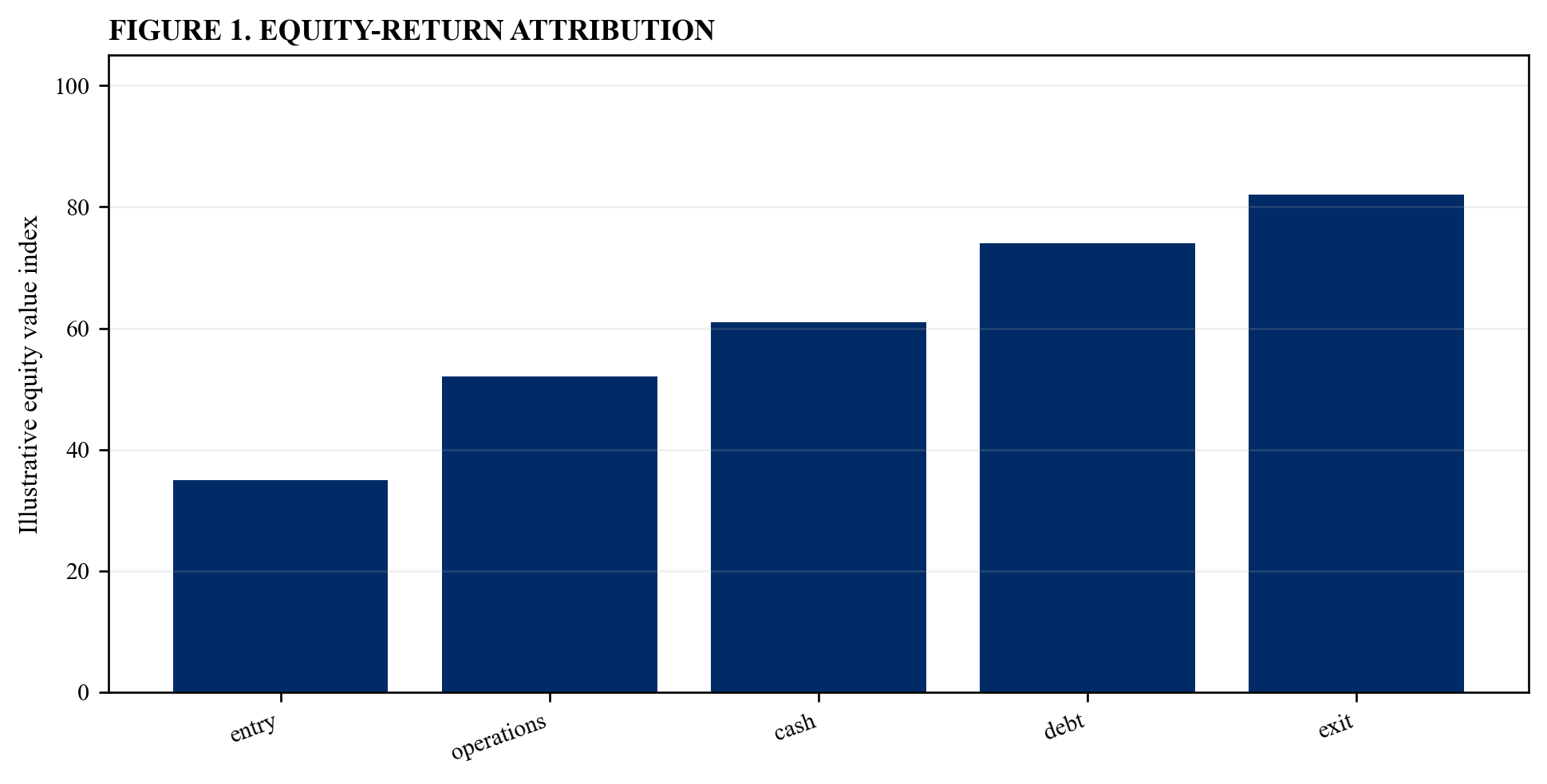
Illustrative analytical scenario; verified operating, market and transaction evidence should replace index values.
6. Decompose the return bridge
The transaction team should separate revenue, margin, cash conversion, debt paydown, acquisitions, disposals, multiple and timing effects. The required output is a complete equity-return attribution. Use dated source data and link every material conclusion to retained operating, financial, market and contractual evidence [4][10].
Translate the assumption into monthly revenue, margin, working capital, capital investment, tax, free cash flow, debt, liquidity and equity value. Identify the accountable owner, baseline, measurement method, required investment, delivery date and evidence threshold. Reconcile the operating plan, accounting records, financing model, valuation analysis and board case.
The principal risk is that market movement can be presented as operating value creation. Quantify the effect on sustainable free cash flow, covenant headroom, minimum liquidity, debt paydown, refinancing, exit value and equity returns. Show base, flat-multiple, compressed-multiple, delayed-delivery and refinancing cases with explicit management responses.
Retain the source, model version, reviewer, valuation challenge, finance approval and investment committee response. Compare approved initiatives, cash, debt and value with realised outcomes; remove unsupported benefits; and assign every exception an owner and deadline.
7. Set the no-expansion case
The transaction team should hold the exit multiple at or below entry and retain transaction costs and financing assumptions. The required output is a market-neutral return case. Use dated source data and link every material conclusion to retained operating, financial, market and contractual evidence [4][11].
Translate the assumption into monthly revenue, margin, working capital, capital investment, tax, free cash flow, debt, liquidity and equity value. Identify the accountable owner, baseline, measurement method, required investment, delivery date and evidence threshold. Reconcile the operating plan, accounting records, financing model, valuation analysis and board case.
The principal risk is that the investment thesis can rely on multiple expansion by default. Quantify the effect on sustainable free cash flow, covenant headroom, minimum liquidity, debt paydown, refinancing, exit value and equity returns. Show base, flat-multiple, compressed-multiple, delayed-delivery and refinancing cases with explicit management responses.
Retain the source, model version, reviewer, valuation challenge, finance approval and investment committee response. Compare approved initiatives, cash, debt and value with realised outcomes; remove unsupported benefits; and assign every exception an owner and deadline.
8. Set the compression case
The transaction team should apply lower comparable valuations, weaker growth, higher discount rates and an execution discount. The required output is a compressed-multiple case. Use dated source data and link every material conclusion to retained operating, financial, market and contractual evidence [1][12].
Translate the assumption into monthly revenue, margin, working capital, capital investment, tax, free cash flow, debt, liquidity and equity value. Identify the accountable owner, baseline, measurement method, required investment, delivery date and evidence threshold. Reconcile the operating plan, accounting records, financing model, valuation analysis and board case.
The principal risk is that terminal value can fall faster than debt is repaid. Quantify the effect on sustainable free cash flow, covenant headroom, minimum liquidity, debt paydown, refinancing, exit value and equity returns. Show base, flat-multiple, compressed-multiple, delayed-delivery and refinancing cases with explicit management responses.
Retain the source, model version, reviewer, valuation challenge, finance approval and investment committee response. Compare approved initiatives, cash, debt and value with realised outcomes; remove unsupported benefits; and assign every exception an owner and deadline.
Table 1. Return-attribution bridge
| Driver | Evidence | Control test |
|---|---|---|
| revenue | initiative ledger | cash supported |
| margin | cost baseline | sustainable |
| debt paydown | cash roll-forward | funded |
| multiple | market evidence | downside visible |
Illustrative control framework; verified transaction evidence and executed documents govern.
9. Map revenue initiatives
The transaction team should separate price, volume, mix, retention, cross-sell, channel, geography and product actions. The required output is a revenue initiative register. Use dated source data and link every material conclusion to retained operating, financial, market and contractual evidence [13][14].
Translate the assumption into monthly revenue, margin, working capital, capital investment, tax, free cash flow, debt, liquidity and equity value. Identify the accountable owner, baseline, measurement method, required investment, delivery date and evidence threshold. Reconcile the operating plan, accounting records, financing model, valuation analysis and board case.
The principal risk is that aggregate growth can conceal incompatible operating assumptions. Quantify the effect on sustainable free cash flow, covenant headroom, minimum liquidity, debt paydown, refinancing, exit value and equity returns. Show base, flat-multiple, compressed-multiple, delayed-delivery and refinancing cases with explicit management responses.
Retain the source, model version, reviewer, valuation challenge, finance approval and investment committee response. Compare approved initiatives, cash, debt and value with realised outcomes; remove unsupported benefits; and assign every exception an owner and deadline.
10. Evidence pricing power
The transaction team should test realised price, discount, elasticity, churn, contract rights and customer value. The required output is a price-realisation case. Use dated source data and link every material conclusion to retained operating, financial, market and contractual evidence [13][15].
Translate the assumption into monthly revenue, margin, working capital, capital investment, tax, free cash flow, debt, liquidity and equity value. Identify the accountable owner, baseline, measurement method, required investment, delivery date and evidence threshold. Reconcile the operating plan, accounting records, financing model, valuation analysis and board case.
The principal risk is that forecast price can increase while retention and volume weaken. Quantify the effect on sustainable free cash flow, covenant headroom, minimum liquidity, debt paydown, refinancing, exit value and equity returns. Show base, flat-multiple, compressed-multiple, delayed-delivery and refinancing cases with explicit management responses.
Retain the source, model version, reviewer, valuation challenge, finance approval and investment committee response. Compare approved initiatives, cash, debt and value with realised outcomes; remove unsupported benefits; and assign every exception an owner and deadline.
11. Evidence volume growth
The transaction team should connect pipeline, conversion, capacity, delivery, customer concentration and unit economics. The required output is a volume evidence chain. Use dated source data and link every material conclusion to retained operating, financial, market and contractual evidence [13][16].
Translate the assumption into monthly revenue, margin, working capital, capital investment, tax, free cash flow, debt, liquidity and equity value. Identify the accountable owner, baseline, measurement method, required investment, delivery date and evidence threshold. Reconcile the operating plan, accounting records, financing model, valuation analysis and board case.
The principal risk is that forecast volume can exceed commercial and operating capacity. Quantify the effect on sustainable free cash flow, covenant headroom, minimum liquidity, debt paydown, refinancing, exit value and equity returns. Show base, flat-multiple, compressed-multiple, delayed-delivery and refinancing cases with explicit management responses.
Retain the source, model version, reviewer, valuation challenge, finance approval and investment committee response. Compare approved initiatives, cash, debt and value with realised outcomes; remove unsupported benefits; and assign every exception an owner and deadline.
12. Evidence retention
The transaction team should reconcile customers, contracts, cohorts, renewal, contraction, churn and service effort. The required output is a retention-quality ledger. Use dated source data and link every material conclusion to retained operating, financial, market and contractual evidence [14][17].
Translate the assumption into monthly revenue, margin, working capital, capital investment, tax, free cash flow, debt, liquidity and equity value. Identify the accountable owner, baseline, measurement method, required investment, delivery date and evidence threshold. Reconcile the operating plan, accounting records, financing model, valuation analysis and board case.
The principal risk is that growth can depend on replacing customers faster than they leave. Quantify the effect on sustainable free cash flow, covenant headroom, minimum liquidity, debt paydown, refinancing, exit value and equity returns. Show base, flat-multiple, compressed-multiple, delayed-delivery and refinancing cases with explicit management responses.
Retain the source, model version, reviewer, valuation challenge, finance approval and investment committee response. Compare approved initiatives, cash, debt and value with realised outcomes; remove unsupported benefits; and assign every exception an owner and deadline.
13. Map gross-margin initiatives
The transaction team should separate sourcing, labour, productivity, utilisation, mix, pricing and delivery quality. The required output is a gross-margin register. Use dated source data and link every material conclusion to retained operating, financial, market and contractual evidence [5][18].
Translate the assumption into monthly revenue, margin, working capital, capital investment, tax, free cash flow, debt, liquidity and equity value. Identify the accountable owner, baseline, measurement method, required investment, delivery date and evidence threshold. Reconcile the operating plan, accounting records, financing model, valuation analysis and board case.
The principal risk is that margin gains can depend on temporary cuts or accounting classification. Quantify the effect on sustainable free cash flow, covenant headroom, minimum liquidity, debt paydown, refinancing, exit value and equity returns. Show base, flat-multiple, compressed-multiple, delayed-delivery and refinancing cases with explicit management responses.
Retain the source, model version, reviewer, valuation challenge, finance approval and investment committee response. Compare approved initiatives, cash, debt and value with realised outcomes; remove unsupported benefits; and assign every exception an owner and deadline.
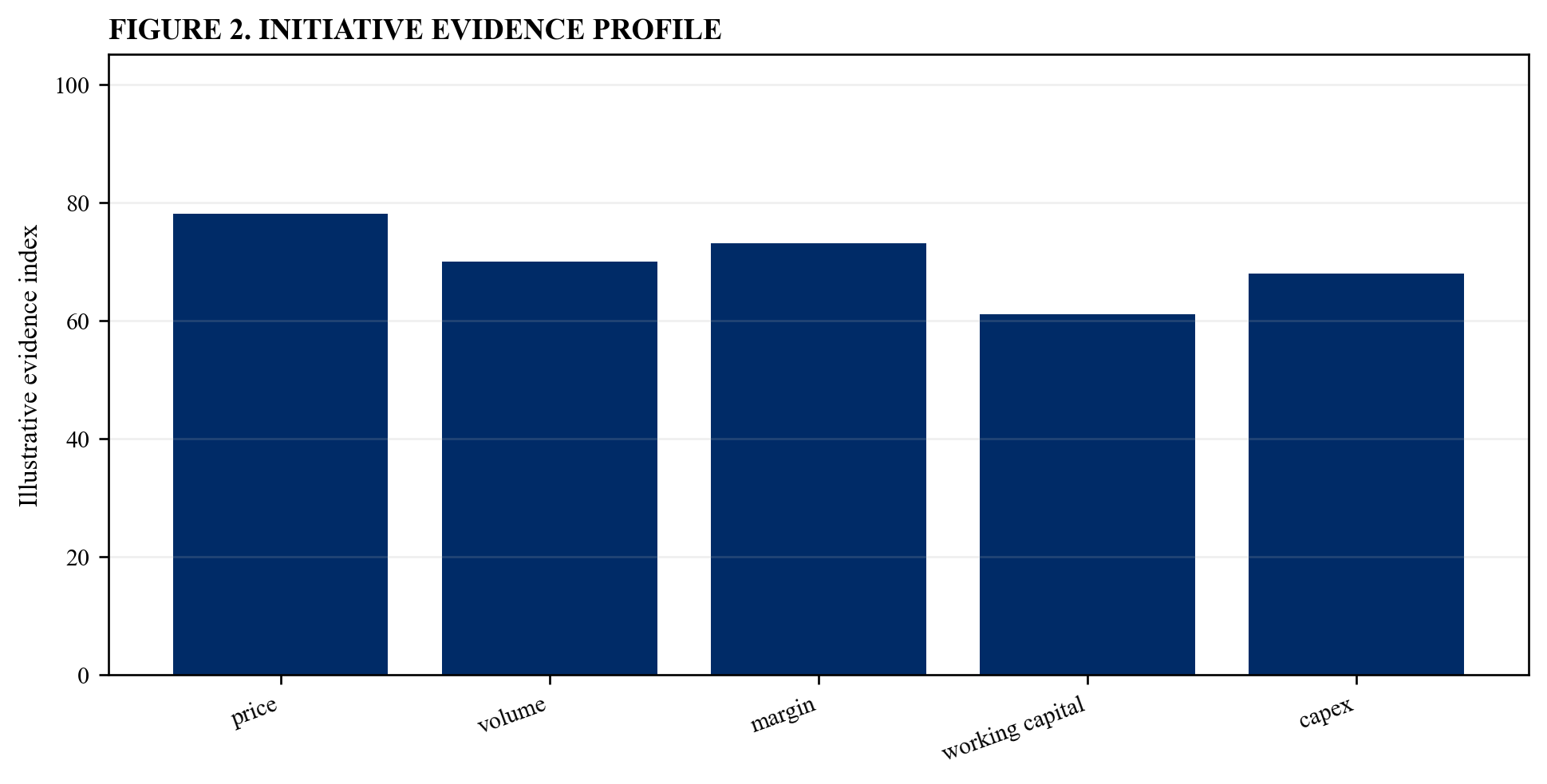
Illustrative analytical scenario; verified operating, market and transaction evidence should replace index values.
14. Map overhead initiatives
The transaction team should identify spans, layers, facilities, procurement, systems, shared services and governance effects. The required output is an overhead transformation plan. Use dated source data and link every material conclusion to retained operating, financial, market and contractual evidence [18][19].
Translate the assumption into monthly revenue, margin, working capital, capital investment, tax, free cash flow, debt, liquidity and equity value. Identify the accountable owner, baseline, measurement method, required investment, delivery date and evidence threshold. Reconcile the operating plan, accounting records, financing model, valuation analysis and board case.
The principal risk is that cost reduction can impair revenue delivery or control. Quantify the effect on sustainable free cash flow, covenant headroom, minimum liquidity, debt paydown, refinancing, exit value and equity returns. Show base, flat-multiple, compressed-multiple, delayed-delivery and refinancing cases with explicit management responses.
Retain the source, model version, reviewer, valuation challenge, finance approval and investment committee response. Compare approved initiatives, cash, debt and value with realised outcomes; remove unsupported benefits; and assign every exception an owner and deadline.
15. Separate recurring and one-off savings
The transaction team should require run-rate evidence, implementation cost, timing, recurrence and reversal risk. The required output is a savings evidence ledger. Use dated source data and link every material conclusion to retained operating, financial, market and contractual evidence [5][20].
Translate the assumption into monthly revenue, margin, working capital, capital investment, tax, free cash flow, debt, liquidity and equity value. Identify the accountable owner, baseline, measurement method, required investment, delivery date and evidence threshold. Reconcile the operating plan, accounting records, financing model, valuation analysis and board case.
The principal risk is that one-off actions can be capitalised into a permanent exit value. Quantify the effect on sustainable free cash flow, covenant headroom, minimum liquidity, debt paydown, refinancing, exit value and equity returns. Show base, flat-multiple, compressed-multiple, delayed-delivery and refinancing cases with explicit management responses.
Retain the source, model version, reviewer, valuation challenge, finance approval and investment committee response. Compare approved initiatives, cash, debt and value with realised outcomes; remove unsupported benefits; and assign every exception an owner and deadline.
16. Price the transformation
The transaction team should schedule people, systems, advisers, capex, working capital, retention and contingency cash. The required output is a transformation uses schedule. Use dated source data and link every material conclusion to retained operating, financial, market and contractual evidence [7][19].
Translate the assumption into monthly revenue, margin, working capital, capital investment, tax, free cash flow, debt, liquidity and equity value. Identify the accountable owner, baseline, measurement method, required investment, delivery date and evidence threshold. Reconcile the operating plan, accounting records, financing model, valuation analysis and board case.
The principal risk is that value initiatives can consume more cash than the return bridge records. Quantify the effect on sustainable free cash flow, covenant headroom, minimum liquidity, debt paydown, refinancing, exit value and equity returns. Show base, flat-multiple, compressed-multiple, delayed-delivery and refinancing cases with explicit management responses.
Retain the source, model version, reviewer, valuation challenge, finance approval and investment committee response. Compare approved initiatives, cash, debt and value with realised outcomes; remove unsupported benefits; and assign every exception an owner and deadline.
Table 2. Initiative evidence matrix
| Initiative | Required proof | Decision |
|---|---|---|
| price | realised cohort data | retention protected |
| volume | pipeline and capacity | delivery funded |
| cost | run-rate evidence | service preserved |
| working capital | operating ledger | repeatable |
Illustrative control framework; verified transaction evidence and executed documents govern.
17. Map working-capital value
The transaction team should reconcile receivables, inventory, payables, deferred revenue, seasonality and supplier finance. The required output is a working-capital control plan. Use dated source data and link every material conclusion to retained operating, financial, market and contractual evidence [7][21].
Translate the assumption into monthly revenue, margin, working capital, capital investment, tax, free cash flow, debt, liquidity and equity value. Identify the accountable owner, baseline, measurement method, required investment, delivery date and evidence threshold. Reconcile the operating plan, accounting records, financing model, valuation analysis and board case.
The principal risk is that temporary balance-sheet extraction can be mistaken for recurring cash generation. Quantify the effect on sustainable free cash flow, covenant headroom, minimum liquidity, debt paydown, refinancing, exit value and equity returns. Show base, flat-multiple, compressed-multiple, delayed-delivery and refinancing cases with explicit management responses.
Retain the source, model version, reviewer, valuation challenge, finance approval and investment committee response. Compare approved initiatives, cash, debt and value with realised outcomes; remove unsupported benefits; and assign every exception an owner and deadline.
18. Protect maintenance investment
The transaction team should separate maintenance, replacement, compliance, resilience and growth capital expenditure. The required output is a sustaining-investment schedule. Use dated source data and link every material conclusion to retained operating, financial, market and contractual evidence [8][22].
Translate the assumption into monthly revenue, margin, working capital, capital investment, tax, free cash flow, debt, liquidity and equity value. Identify the accountable owner, baseline, measurement method, required investment, delivery date and evidence threshold. Reconcile the operating plan, accounting records, financing model, valuation analysis and board case.
The principal risk is that debt paydown can be achieved by deferring value-preserving investment. Quantify the effect on sustainable free cash flow, covenant headroom, minimum liquidity, debt paydown, refinancing, exit value and equity returns. Show base, flat-multiple, compressed-multiple, delayed-delivery and refinancing cases with explicit management responses.
Retain the source, model version, reviewer, valuation challenge, finance approval and investment committee response. Compare approved initiatives, cash, debt and value with realised outcomes; remove unsupported benefits; and assign every exception an owner and deadline.
19. Model cash taxes
The transaction team should reconcile jurisdiction, taxable profit, interest limits, losses, deferred tax and transaction structure. The required output is a cash-tax schedule. Use dated source data and link every material conclusion to retained operating, financial, market and contractual evidence [23][24].
Translate the assumption into monthly revenue, margin, working capital, capital investment, tax, free cash flow, debt, liquidity and equity value. Identify the accountable owner, baseline, measurement method, required investment, delivery date and evidence threshold. Reconcile the operating plan, accounting records, financing model, valuation analysis and board case.
The principal risk is that accounting tax and modelled tax can understate cash leakage. Quantify the effect on sustainable free cash flow, covenant headroom, minimum liquidity, debt paydown, refinancing, exit value and equity returns. Show base, flat-multiple, compressed-multiple, delayed-delivery and refinancing cases with explicit management responses.
Retain the source, model version, reviewer, valuation challenge, finance approval and investment committee response. Compare approved initiatives, cash, debt and value with realised outcomes; remove unsupported benefits; and assign every exception an owner and deadline.
20. Model lease and fixed charges
The transaction team should include lease cash, pensions, guarantees, earn-outs and other recurring obligations. The required output is a fixed-charge bridge. Use dated source data and link every material conclusion to retained operating, financial, market and contractual evidence [8][25].
Translate the assumption into monthly revenue, margin, working capital, capital investment, tax, free cash flow, debt, liquidity and equity value. Identify the accountable owner, baseline, measurement method, required investment, delivery date and evidence threshold. Reconcile the operating plan, accounting records, financing model, valuation analysis and board case.
The principal risk is that debt paydown can exclude economically senior cash claims. Quantify the effect on sustainable free cash flow, covenant headroom, minimum liquidity, debt paydown, refinancing, exit value and equity returns. Show base, flat-multiple, compressed-multiple, delayed-delivery and refinancing cases with explicit management responses.
Retain the source, model version, reviewer, valuation challenge, finance approval and investment committee response. Compare approved initiatives, cash, debt and value with realised outcomes; remove unsupported benefits; and assign every exception an owner and deadline.
21. Build the operating base case
The transaction team should combine verified initiatives, required investment, delivery timing and cash conversion. The required output is an owner-led operating plan. Use dated source data and link every material conclusion to retained operating, financial, market and contractual evidence [10][19].
Translate the assumption into monthly revenue, margin, working capital, capital investment, tax, free cash flow, debt, liquidity and equity value. Identify the accountable owner, baseline, measurement method, required investment, delivery date and evidence threshold. Reconcile the operating plan, accounting records, financing model, valuation analysis and board case.
The principal risk is that management targets can enter the model without initiative evidence. Quantify the effect on sustainable free cash flow, covenant headroom, minimum liquidity, debt paydown, refinancing, exit value and equity returns. Show base, flat-multiple, compressed-multiple, delayed-delivery and refinancing cases with explicit management responses.
Retain the source, model version, reviewer, valuation challenge, finance approval and investment committee response. Compare approved initiatives, cash, debt and value with realised outcomes; remove unsupported benefits; and assign every exception an owner and deadline.
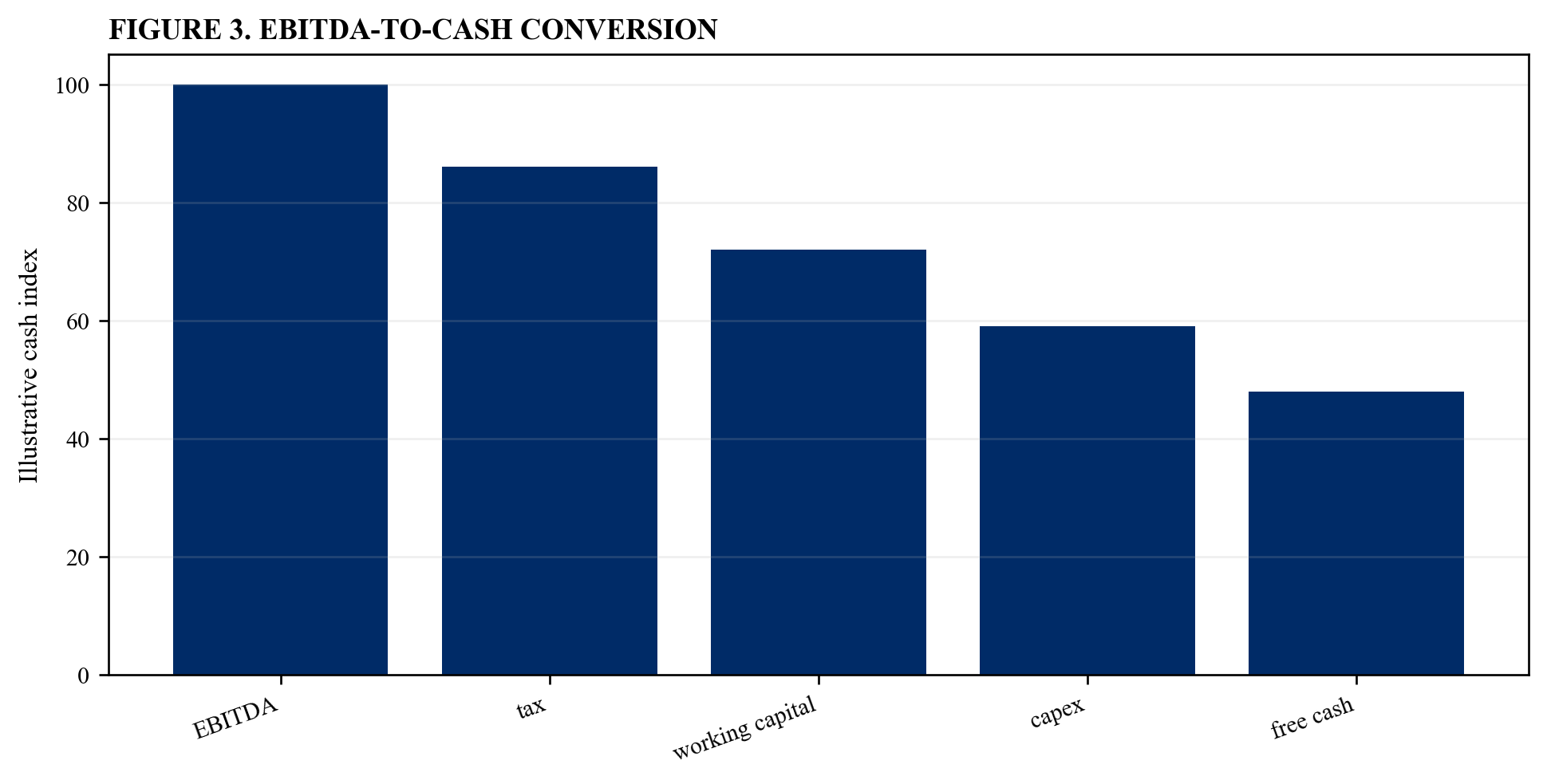
Illustrative analytical scenario; verified operating, market and transaction evidence should replace index values.
22. Build the delayed-delivery case
The transaction team should defer revenue and savings, retain implementation cash and recalculate liquidity and covenants. The required output is a delivery-delay case. Use dated source data and link every material conclusion to retained operating, financial, market and contractual evidence [1][19].
Translate the assumption into monthly revenue, margin, working capital, capital investment, tax, free cash flow, debt, liquidity and equity value. Identify the accountable owner, baseline, measurement method, required investment, delivery date and evidence threshold. Reconcile the operating plan, accounting records, financing model, valuation analysis and board case.
The principal risk is that timing slippage can reduce both debt paydown and terminal earnings. Quantify the effect on sustainable free cash flow, covenant headroom, minimum liquidity, debt paydown, refinancing, exit value and equity returns. Show base, flat-multiple, compressed-multiple, delayed-delivery and refinancing cases with explicit management responses.
Retain the source, model version, reviewer, valuation challenge, finance approval and investment committee response. Compare approved initiatives, cash, debt and value with realised outcomes; remove unsupported benefits; and assign every exception an owner and deadline.
23. Build the margin-reversal case
The transaction team should reverse temporary savings, add service failures and restore required operating capacity. The required output is a margin-quality downside. Use dated source data and link every material conclusion to retained operating, financial, market and contractual evidence [5][18].
Translate the assumption into monthly revenue, margin, working capital, capital investment, tax, free cash flow, debt, liquidity and equity value. Identify the accountable owner, baseline, measurement method, required investment, delivery date and evidence threshold. Reconcile the operating plan, accounting records, financing model, valuation analysis and board case.
The principal risk is that unsustainable cuts can inflate the exit earnings base. Quantify the effect on sustainable free cash flow, covenant headroom, minimum liquidity, debt paydown, refinancing, exit value and equity returns. Show base, flat-multiple, compressed-multiple, delayed-delivery and refinancing cases with explicit management responses.
Retain the source, model version, reviewer, valuation challenge, finance approval and investment committee response. Compare approved initiatives, cash, debt and value with realised outcomes; remove unsupported benefits; and assign every exception an owner and deadline.
24. Build the cash-conversion case
The transaction team should apply slower collections, inventory absorption, supplier normalisation and higher capex. The required output is a cash-conversion downside. Use dated source data and link every material conclusion to retained operating, financial, market and contractual evidence [7][21].
Translate the assumption into monthly revenue, margin, working capital, capital investment, tax, free cash flow, debt, liquidity and equity value. Identify the accountable owner, baseline, measurement method, required investment, delivery date and evidence threshold. Reconcile the operating plan, accounting records, financing model, valuation analysis and board case.
The principal risk is that equity value can depend on accounting earnings with limited distributable cash. Quantify the effect on sustainable free cash flow, covenant headroom, minimum liquidity, debt paydown, refinancing, exit value and equity returns. Show base, flat-multiple, compressed-multiple, delayed-delivery and refinancing cases with explicit management responses.
Retain the source, model version, reviewer, valuation challenge, finance approval and investment committee response. Compare approved initiatives, cash, debt and value with realised outcomes; remove unsupported benefits; and assign every exception an owner and deadline.
Table 3. Cash-conversion bridge
| Cash item | Forecast basis | Control |
|---|---|---|
| tax | jurisdiction schedule | tax review |
| working capital | driver model | treasury owner |
| capex | asset plan | technical approval |
| fixed charges | executed obligation | finance owner |
Illustrative control framework; verified transaction evidence and executed documents govern.
25. Build the refinancing case
The transaction team should model base rates, margins, maturity, amortisation, leverage appetite, fees and hedging. The required output is a refinancing downside. Use dated source data and link every material conclusion to retained operating, financial, market and contractual evidence [1][2].
Translate the assumption into monthly revenue, margin, working capital, capital investment, tax, free cash flow, debt, liquidity and equity value. Identify the accountable owner, baseline, measurement method, required investment, delivery date and evidence threshold. Reconcile the operating plan, accounting records, financing model, valuation analysis and board case.
The principal risk is that a longer hold can require expensive or unavailable refinancing. Quantify the effect on sustainable free cash flow, covenant headroom, minimum liquidity, debt paydown, refinancing, exit value and equity returns. Show base, flat-multiple, compressed-multiple, delayed-delivery and refinancing cases with explicit management responses.
Retain the source, model version, reviewer, valuation challenge, finance approval and investment committee response. Compare approved initiatives, cash, debt and value with realised outcomes; remove unsupported benefits; and assign every exception an owner and deadline.
26. Calculate debt paydown
The transaction team should roll opening debt, cash interest, amortisation, optional repayment, fees and facility movements monthly. The required output is a debt roll-forward. Use dated source data and link every material conclusion to retained operating, financial, market and contractual evidence [1][7].
Translate the assumption into monthly revenue, margin, working capital, capital investment, tax, free cash flow, debt, liquidity and equity value. Identify the accountable owner, baseline, measurement method, required investment, delivery date and evidence threshold. Reconcile the operating plan, accounting records, financing model, valuation analysis and board case.
The principal risk is that headline paydown can exceed cash available after mandatory uses. Quantify the effect on sustainable free cash flow, covenant headroom, minimum liquidity, debt paydown, refinancing, exit value and equity returns. Show base, flat-multiple, compressed-multiple, delayed-delivery and refinancing cases with explicit management responses.
Retain the source, model version, reviewer, valuation challenge, finance approval and investment committee response. Compare approved initiatives, cash, debt and value with realised outcomes; remove unsupported benefits; and assign every exception an owner and deadline.
27. Separate organic and acquired value
The transaction team should attribute earnings, cash, debt and multiple effects between the platform and bolt-ons. The required output is an organic-acquired value bridge. Use dated source data and link every material conclusion to retained operating, financial, market and contractual evidence [3][10].
Translate the assumption into monthly revenue, margin, working capital, capital investment, tax, free cash flow, debt, liquidity and equity value. Identify the accountable owner, baseline, measurement method, required investment, delivery date and evidence threshold. Reconcile the operating plan, accounting records, financing model, valuation analysis and board case.
The principal risk is that purchase spending can be reported as operating growth. Quantify the effect on sustainable free cash flow, covenant headroom, minimum liquidity, debt paydown, refinancing, exit value and equity returns. Show base, flat-multiple, compressed-multiple, delayed-delivery and refinancing cases with explicit management responses.
Retain the source, model version, reviewer, valuation challenge, finance approval and investment committee response. Compare approved initiatives, cash, debt and value with realised outcomes; remove unsupported benefits; and assign every exception an owner and deadline.
28. Separate disposal effects
The transaction team should record proceeds, stranded costs, tax, debt repayment and lost earnings for each divestment. The required output is a disposal value bridge. Use dated source data and link every material conclusion to retained operating, financial, market and contractual evidence [3][23].
Translate the assumption into monthly revenue, margin, working capital, capital investment, tax, free cash flow, debt, liquidity and equity value. Identify the accountable owner, baseline, measurement method, required investment, delivery date and evidence threshold. Reconcile the operating plan, accounting records, financing model, valuation analysis and board case.
The principal risk is that gross proceeds can overstate equity value created. Quantify the effect on sustainable free cash flow, covenant headroom, minimum liquidity, debt paydown, refinancing, exit value and equity returns. Show base, flat-multiple, compressed-multiple, delayed-delivery and refinancing cases with explicit management responses.
Retain the source, model version, reviewer, valuation challenge, finance approval and investment committee response. Compare approved initiatives, cash, debt and value with realised outcomes; remove unsupported benefits; and assign every exception an owner and deadline.
29. Set comparable-company evidence
The transaction team should define business model, growth, margin, geography, scale, leverage and liquidity criteria. The required output is a governed comparable set. Use dated source data and link every material conclusion to retained operating, financial, market and contractual evidence [4][12].
Translate the assumption into monthly revenue, margin, working capital, capital investment, tax, free cash flow, debt, liquidity and equity value. Identify the accountable owner, baseline, measurement method, required investment, delivery date and evidence threshold. Reconcile the operating plan, accounting records, financing model, valuation analysis and board case.
The principal risk is that a favourable peer group can preserve an unjustified exit multiple. Quantify the effect on sustainable free cash flow, covenant headroom, minimum liquidity, debt paydown, refinancing, exit value and equity returns. Show base, flat-multiple, compressed-multiple, delayed-delivery and refinancing cases with explicit management responses.
Retain the source, model version, reviewer, valuation challenge, finance approval and investment committee response. Compare approved initiatives, cash, debt and value with realised outcomes; remove unsupported benefits; and assign every exception an owner and deadline.
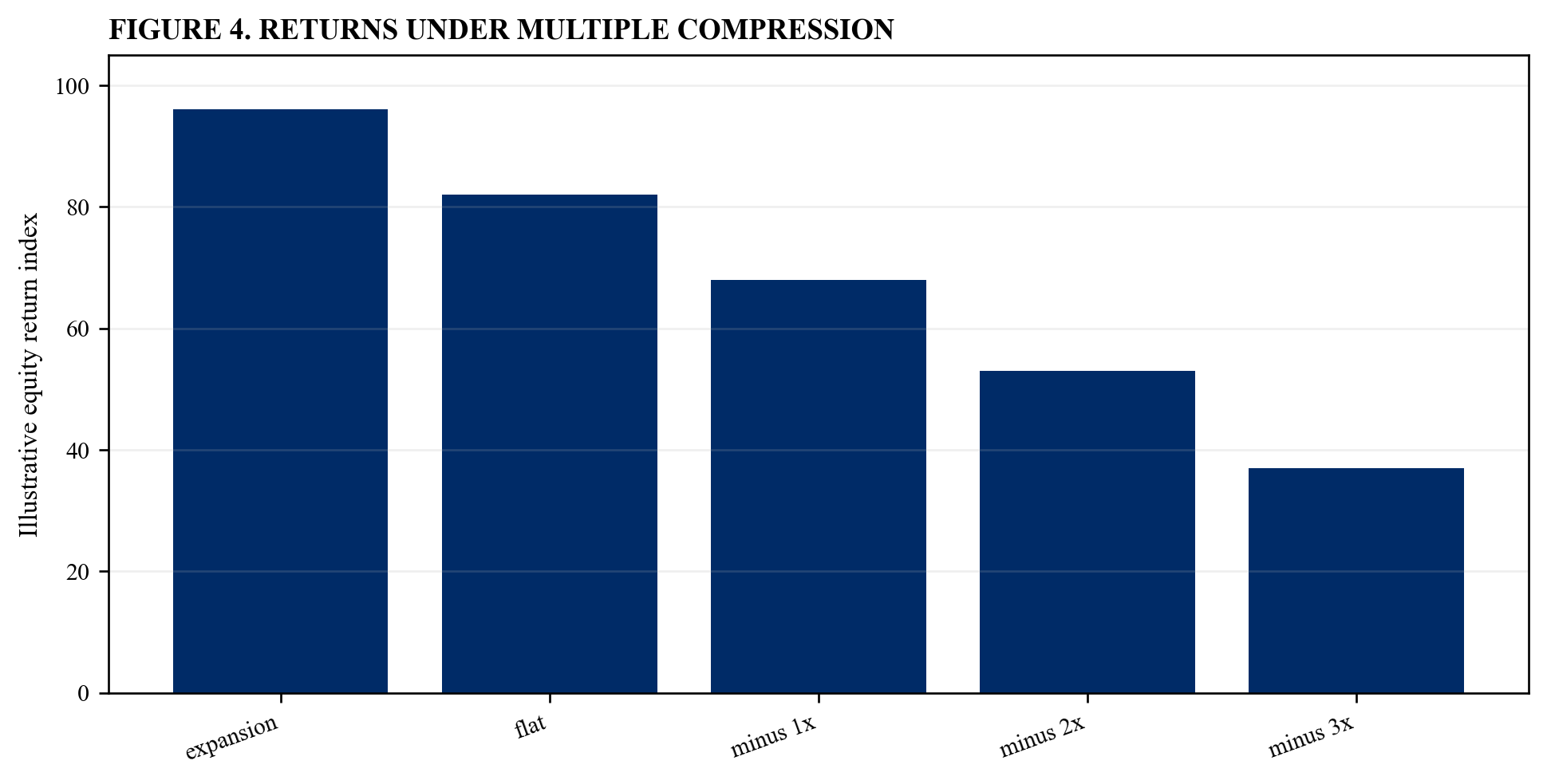
Illustrative analytical scenario; verified operating, market and transaction evidence should replace index values.
30. Set transaction evidence
The transaction team should review timing, control, synergies, financing, market conditions and information quality for precedent deals. The required output is a precedent-transaction matrix. Use dated source data and link every material conclusion to retained operating, financial, market and contractual evidence [4][26].
Translate the assumption into monthly revenue, margin, working capital, capital investment, tax, free cash flow, debt, liquidity and equity value. Identify the accountable owner, baseline, measurement method, required investment, delivery date and evidence threshold. Reconcile the operating plan, accounting records, financing model, valuation analysis and board case.
The principal risk is that historic deals can embed market conditions absent at exit. Quantify the effect on sustainable free cash flow, covenant headroom, minimum liquidity, debt paydown, refinancing, exit value and equity returns. Show base, flat-multiple, compressed-multiple, delayed-delivery and refinancing cases with explicit management responses.
Retain the source, model version, reviewer, valuation challenge, finance approval and investment committee response. Compare approved initiatives, cash, debt and value with realised outcomes; remove unsupported benefits; and assign every exception an owner and deadline.
31. Build the income approach
The transaction team should forecast cash flows, terminal growth, discount rate, reinvestment and scenario probabilities. The required output is a corroborating income valuation. Use dated source data and link every material conclusion to retained operating, financial, market and contractual evidence [4][9].
Translate the assumption into monthly revenue, margin, working capital, capital investment, tax, free cash flow, debt, liquidity and equity value. Identify the accountable owner, baseline, measurement method, required investment, delivery date and evidence threshold. Reconcile the operating plan, accounting records, financing model, valuation analysis and board case.
The principal risk is that a single market multiple can conceal cash-flow and risk assumptions. Quantify the effect on sustainable free cash flow, covenant headroom, minimum liquidity, debt paydown, refinancing, exit value and equity returns. Show base, flat-multiple, compressed-multiple, delayed-delivery and refinancing cases with explicit management responses.
Retain the source, model version, reviewer, valuation challenge, finance approval and investment committee response. Compare approved initiatives, cash, debt and value with realised outcomes; remove unsupported benefits; and assign every exception an owner and deadline.
32. Calibrate at entry
The transaction team should reconcile the transaction price with market and income approaches and retained diligence evidence. The required output is an entry calibration file. Use dated source data and link every material conclusion to retained operating, financial, market and contractual evidence [4][12].
Translate the assumption into monthly revenue, margin, working capital, capital investment, tax, free cash flow, debt, liquidity and equity value. Identify the accountable owner, baseline, measurement method, required investment, delivery date and evidence threshold. Reconcile the operating plan, accounting records, financing model, valuation analysis and board case.
The principal risk is that valuation methods can drift during the hold without explanation. Quantify the effect on sustainable free cash flow, covenant headroom, minimum liquidity, debt paydown, refinancing, exit value and equity returns. Show base, flat-multiple, compressed-multiple, delayed-delivery and refinancing cases with explicit management responses.
Retain the source, model version, reviewer, valuation challenge, finance approval and investment committee response. Compare approved initiatives, cash, debt and value with realised outcomes; remove unsupported benefits; and assign every exception an owner and deadline.
Table 4. Exit valuation evidence
| Method | Key input | Challenge |
|---|---|---|
| market | comparable multiple | peer relevance |
| transaction | precedent price | cycle and control |
| income | cash and discount rate | terminal discipline |
| calibration | entry price | method consistency |
Illustrative control framework; verified transaction evidence and executed documents govern.
33. Define ad hoc revaluation triggers
The transaction team should set thresholds for comparable moves, performance changes, financing events and operational shocks. The required output is a valuation trigger protocol. Use dated source data and link every material conclusion to retained operating, financial, market and contractual evidence [12][20].
Translate the assumption into monthly revenue, margin, working capital, capital investment, tax, free cash flow, debt, liquidity and equity value. Identify the accountable owner, baseline, measurement method, required investment, delivery date and evidence threshold. Reconcile the operating plan, accounting records, financing model, valuation analysis and board case.
The principal risk is that stale internal values can delay corrective action. Quantify the effect on sustainable free cash flow, covenant headroom, minimum liquidity, debt paydown, refinancing, exit value and equity returns. Show base, flat-multiple, compressed-multiple, delayed-delivery and refinancing cases with explicit management responses.
Retain the source, model version, reviewer, valuation challenge, finance approval and investment committee response. Compare approved initiatives, cash, debt and value with realised outcomes; remove unsupported benefits; and assign every exception an owner and deadline.
34. Run the exit-multiple matrix
The transaction team should calculate equity value and returns across earnings, multiple, debt and timing combinations. The required output is a return sensitivity matrix. Use dated source data and link every material conclusion to retained operating, financial, market and contractual evidence [4][11].
Translate the assumption into monthly revenue, margin, working capital, capital investment, tax, free cash flow, debt, liquidity and equity value. Identify the accountable owner, baseline, measurement method, required investment, delivery date and evidence threshold. Reconcile the operating plan, accounting records, financing model, valuation analysis and board case.
The principal risk is that a single exit case can conceal asymmetric downside. Quantify the effect on sustainable free cash flow, covenant headroom, minimum liquidity, debt paydown, refinancing, exit value and equity returns. Show base, flat-multiple, compressed-multiple, delayed-delivery and refinancing cases with explicit management responses.
Retain the source, model version, reviewer, valuation challenge, finance approval and investment committee response. Compare approved initiatives, cash, debt and value with realised outcomes; remove unsupported benefits; and assign every exception an owner and deadline.
35. Run reverse stress tests
The transaction team should solve for the operating, cash and multiple outcomes that breach minimum return, liquidity or debt thresholds. The required output is a reverse-stress boundary. Use dated source data and link every material conclusion to retained operating, financial, market and contractual evidence [1][2].
Translate the assumption into monthly revenue, margin, working capital, capital investment, tax, free cash flow, debt, liquidity and equity value. Identify the accountable owner, baseline, measurement method, required investment, delivery date and evidence threshold. Reconcile the operating plan, accounting records, financing model, valuation analysis and board case.
The principal risk is that management can lack early warning of thesis failure. Quantify the effect on sustainable free cash flow, covenant headroom, minimum liquidity, debt paydown, refinancing, exit value and equity returns. Show base, flat-multiple, compressed-multiple, delayed-delivery and refinancing cases with explicit management responses.
Retain the source, model version, reviewer, valuation challenge, finance approval and investment committee response. Compare approved initiatives, cash, debt and value with realised outcomes; remove unsupported benefits; and assign every exception an owner and deadline.
36. Define management triggers
The transaction team should set green, amber and red thresholds for initiatives, cash, leverage, valuation and refinancing. The required output is a value-creation trigger map. Use dated source data and link every material conclusion to retained operating, financial, market and contractual evidence [19][20].
Translate the assumption into monthly revenue, margin, working capital, capital investment, tax, free cash flow, debt, liquidity and equity value. Identify the accountable owner, baseline, measurement method, required investment, delivery date and evidence threshold. Reconcile the operating plan, accounting records, financing model, valuation analysis and board case.
The principal risk is that corrective action can start after recovery options narrow. Quantify the effect on sustainable free cash flow, covenant headroom, minimum liquidity, debt paydown, refinancing, exit value and equity returns. Show base, flat-multiple, compressed-multiple, delayed-delivery and refinancing cases with explicit management responses.
Retain the source, model version, reviewer, valuation challenge, finance approval and investment committee response. Compare approved initiatives, cash, debt and value with realised outcomes; remove unsupported benefits; and assign every exception an owner and deadline.
37. Govern valuation independence
The transaction team should identify conflicts, committee authority, third-party review, challenge and record retention. The required output is an independent valuation protocol. Use dated source data and link every material conclusion to retained operating, financial, market and contractual evidence [12][20].
Translate the assumption into monthly revenue, margin, working capital, capital investment, tax, free cash flow, debt, liquidity and equity value. Identify the accountable owner, baseline, measurement method, required investment, delivery date and evidence threshold. Reconcile the operating plan, accounting records, financing model, valuation analysis and board case.
The principal risk is that incentives can favour delayed recognition of multiple compression. Quantify the effect on sustainable free cash flow, covenant headroom, minimum liquidity, debt paydown, refinancing, exit value and equity returns. Show base, flat-multiple, compressed-multiple, delayed-delivery and refinancing cases with explicit management responses.
Retain the source, model version, reviewer, valuation challenge, finance approval and investment committee response. Compare approved initiatives, cash, debt and value with realised outcomes; remove unsupported benefits; and assign every exception an owner and deadline.
38. Back-test the investment case
The transaction team should compare approved initiatives, cash, debt, valuation and timing with realised outcomes. The required output is a return variance file. Use dated source data and link every material conclusion to retained operating, financial, market and contractual evidence [12][19].
Translate the assumption into monthly revenue, margin, working capital, capital investment, tax, free cash flow, debt, liquidity and equity value. Identify the accountable owner, baseline, measurement method, required investment, delivery date and evidence threshold. Reconcile the operating plan, accounting records, financing model, valuation analysis and board case.
The principal risk is that optimistic assumptions can persist across portfolio decisions. Quantify the effect on sustainable free cash flow, covenant headroom, minimum liquidity, debt paydown, refinancing, exit value and equity returns. Show base, flat-multiple, compressed-multiple, delayed-delivery and refinancing cases with explicit management responses.
Retain the source, model version, reviewer, valuation challenge, finance approval and investment committee response. Compare approved initiatives, cash, debt and value with realised outcomes; remove unsupported benefits; and assign every exception an owner and deadline.
39. Prepare the exit evidence pack
The transaction team should present sustainable earnings, cash conversion, initiative delivery, debt, risks and valuation methods. The required output is a buyer-and-lender-ready dossier. Use dated source data and link every material conclusion to retained operating, financial, market and contractual evidence [4][26].
Translate the assumption into monthly revenue, margin, working capital, capital investment, tax, free cash flow, debt, liquidity and equity value. Identify the accountable owner, baseline, measurement method, required investment, delivery date and evidence threshold. Reconcile the operating plan, accounting records, financing model, valuation analysis and board case.
The principal risk is that weak evidence can increase the buyer discount at exit. Quantify the effect on sustainable free cash flow, covenant headroom, minimum liquidity, debt paydown, refinancing, exit value and equity returns. Show base, flat-multiple, compressed-multiple, delayed-delivery and refinancing cases with explicit management responses.
Retain the source, model version, reviewer, valuation challenge, finance approval and investment committee response. Compare approved initiatives, cash, debt and value with realised outcomes; remove unsupported benefits; and assign every exception an owner and deadline.
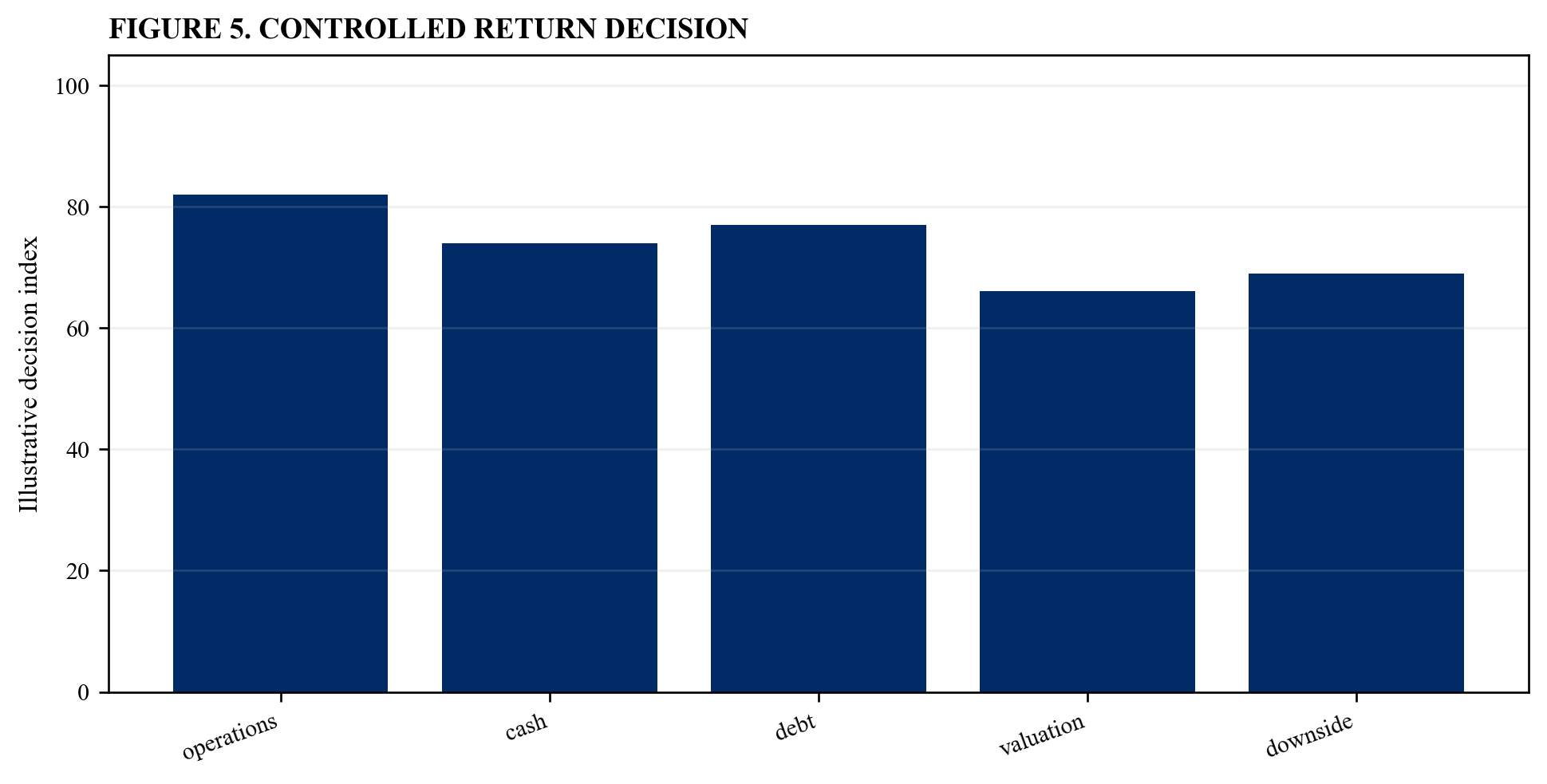
Illustrative analytical scenario; verified operating, market and transaction evidence should replace index values.
40. Issue the return certificate
The transaction team should approve the controllable value bridge, downside resilience, market exposure, liquidity and repayment path. The required output is a retained investment committee certificate. Use dated source data and link every material conclusion to retained operating, financial, market and contractual evidence [10][20].
Translate the assumption into monthly revenue, margin, working capital, capital investment, tax, free cash flow, debt, liquidity and equity value. Identify the accountable owner, baseline, measurement method, required investment, delivery date and evidence threshold. Reconcile the operating plan, accounting records, financing model, valuation analysis and board case.
The principal risk is that the committee can approve returns whose largest driver remains outside management control. Quantify the effect on sustainable free cash flow, covenant headroom, minimum liquidity, debt paydown, refinancing, exit value and equity returns. Show base, flat-multiple, compressed-multiple, delayed-delivery and refinancing cases with explicit management responses.
Retain the source, model version, reviewer, valuation challenge, finance approval and investment committee response. Compare approved initiatives, cash, debt and value with realised outcomes; remove unsupported benefits; and assign every exception an owner and deadline.
Table 5. Return certificate
| Conclusion | Evidence | Approval test |
|---|---|---|
| operations | initiative delivery | cash realised |
| debt | monthly roll-forward | repayment funded |
| valuation | method triangulation | compression survives |
| returns | scenario matrix | minimum cleared |
Illustrative control framework; verified transaction evidence and executed documents govern.
References
- Bank of England, Financial Stability Report July 2026, https://www.bankofengland.co.uk/financial-stability-report/2026/july-2026
- European Central Bank, Guidance on leveraged transactions, https://www.bankingsupervision.europa.eu/ecb/pub/pdf/ssm.leveraged_transactions_guidance_201705.en.pdf
- IFRS Foundation, IFRS 3 Business Combinations, https://www.ifrs.org/issued-standards/list-of-standards/ifrs-3-business-combinations/
- International Valuation Standards Council, International Valuation Standards, https://www.ivsc.org/standards/
- IFRS Foundation, IFRS 18 Presentation and Disclosure in Financial Statements, https://www.ifrs.org/issued-standards/list-of-standards/ifrs-18-presentation-and-disclosure-in-financial-statements/
- European Banking Authority, Guidelines on leveraged transactions, https://www.eba.europa.eu/sites/default/files/documents/10180/1696305/1dba7657-6ccb-462a-b9f8-8df8686b9807/Final%20Guidelines%20on%20Leveraged%20Transactions.pdf
- IFRS Foundation, IAS 7 Statement of Cash Flows, https://www.ifrs.org/issued-standards/list-of-standards/ias-7-statement-of-cash-flows/
- IFRS Foundation, IFRS 16 Leases, https://www.ifrs.org/issued-standards/list-of-standards/ifrs-16-leases/
- IFRS Foundation, IAS 36 Impairment of Assets, https://www.ifrs.org/issued-standards/list-of-standards/ias-36-impairment-of-assets/
- OECD, G20 OECD Principles of Corporate Governance 2023, https://www.oecd.org/corporate/principles-corporate-governance/
- European Banking Authority, Guidelines on loan origination and monitoring, https://www.eba.europa.eu/regulation-and-policy/credit-risk/guidelines-on-loan-origination-and-monitoring
- UK Financial Conduct Authority, Private market valuation practices, https://www.fca.org.uk/publications/multi-firm-reviews/private-market-valuation-practices
- IFRS Foundation, IFRS 15 Revenue from Contracts with Customers, https://www.ifrs.org/issued-standards/list-of-standards/ifrs-15-revenue-from-contracts-with-customers/
- UK Competition and Markets Authority, Consumer protection law guidance, https://www.gov.uk/government/collections/consumer-protection-law-guidance-for-businesses
- UK Financial Conduct Authority, Consumer Duty, https://www.fca.org.uk/firms/consumer-duty
- International Organization for Standardization, ISO 9001 Quality management, https://www.iso.org/iso-9001-quality-management.html
- IFRS Foundation, IFRS 8 Operating Segments, https://www.ifrs.org/issued-standards/list-of-standards/ifrs-8-operating-segments/
- International Labour Organization, Productivity and working conditions, https://www.ilo.org/topics-and-sectors/productivity-and-working-conditions
- International Organization for Standardization, ISO 31000 Risk management, https://www.iso.org/iso-31000-risk-management.html
- UK Financial Conduct Authority, Growth of private markets requires continued focus on valuations, https://www.fca.org.uk/news/press-releases/growth-private-markets-requires-continued-focus-valuations
- IFRS Foundation, IAS 2 Inventories, https://www.ifrs.org/issued-standards/list-of-standards/ias-2-inventories/
- IFRS Foundation, IAS 16 Property Plant and Equipment, https://www.ifrs.org/issued-standards/list-of-standards/ias-16-property-plant-and-equipment/
- OECD, Base erosion and profit shifting, https://www.oecd.org/tax/beps/
- IFRS Foundation, IAS 12 Income Taxes, https://www.ifrs.org/issued-standards/list-of-standards/ias-12-income-taxes/
- IFRS Foundation, IAS 19 Employee Benefits, https://www.ifrs.org/issued-standards/list-of-standards/ias-19-employee-benefits/
- UK Competition and Markets Authority, Merger assessment guidelines, https://www.gov.uk/government/publications/merger-assessment-guidelines
