

1. Define the purpose and horizon
The venture should state the venture thesis, duration, strategic milestones, capital cycle and conditions under which continued ownership remains rational. The required output is an ownership-horizon memorandum. Record the relevant right, obligor, beneficiary, trigger, evidence, approval, timetable and consequence [1][2].
Test the documents against ownership records, financing terms, valuation evidence, operating dependencies and applicable law. Identify every consent, notice, funding source, information requirement and action needed to convert the right into cash or a completed transfer. Preserve assumptions and limitations.
The principal risk is that a perpetual-looking structure can outlive the commercial thesis or a parent's capacity to support it. Quantify the effect on value, liquidity, control, creditors, customers, employees, tax, timing and enforceability. Compare each route under consistent enterprise value, debt, working capital, transaction cost, approval and downside assumptions.
Translate the conclusion into constitutional documents, shareholder agreement, option deed, finance documents, information rights, process rules, security, transition plan and board calendar. Refresh it when ownership, performance, regulation, funding, valuation, market conditions or strategic purpose changes.
2. Map the complete option set
The venture should compare internal transfer, third-party sale, tag, drag, put, call, IPO, asset sale, demerger and wind-down. The required output is an exit-option map. Record the relevant right, obligor, beneficiary, trigger, evidence, approval, timetable and consequence [3][4].
Test the documents against ownership records, financing terms, valuation evidence, operating dependencies and applicable law. Identify every consent, notice, funding source, information requirement and action needed to convert the right into cash or a completed transfer. Preserve assumptions and limitations.
The principal risk is that one contractual route can fail when markets, regulation, funding or partner appetite change. Quantify the effect on value, liquidity, control, creditors, customers, employees, tax, timing and enforceability. Compare each route under consistent enterprise value, debt, working capital, transaction cost, approval and downside assumptions.
Translate the conclusion into constitutional documents, shareholder agreement, option deed, finance documents, information rights, process rules, security, transition plan and board calendar. Refresh it when ownership, performance, regulation, funding, valuation, market conditions or strategic purpose changes.
Table 1. Exit-option map
| Route | Primary objective | Execution dependency |
|---|---|---|
| internal transfer | partner liquidity | funding |
| trade sale | strategic value | buyer and approvals |
| IPO | market liquidity | readiness and market |
| wind-down | orderly cessation | creditor and asset plan |
Illustrative analytical structure; verified transaction and jurisdiction evidence governs.
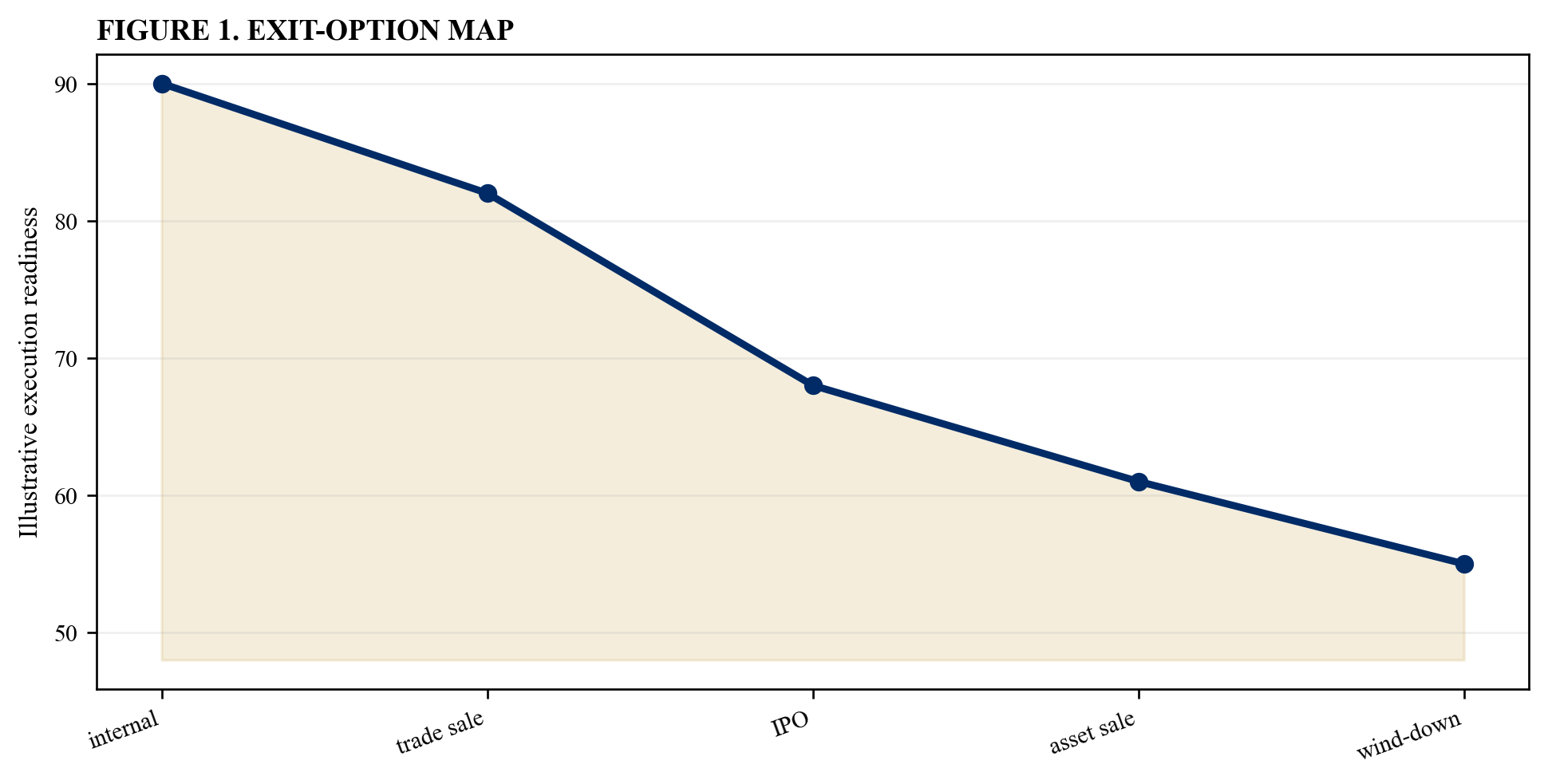
Illustrative analytical scenario; verified venture evidence should replace values.
3. Separate voluntary and compulsory exits
The venture should distinguish elective liquidity from default, deadlock, illegality, insolvency, change-of-control and strategic-trigger remedies. The required output is a trigger taxonomy. Record the relevant right, obligor, beneficiary, trigger, evidence, approval, timetable and consequence [3][5].
Test the documents against ownership records, financing terms, valuation evidence, operating dependencies and applicable law. Identify every consent, notice, funding source, information requirement and action needed to convert the right into cash or a completed transfer. Preserve assumptions and limitations.
The principal risk is that a punitive remedy can be applied to a commercial divergence or a voluntary right can bypass accountability. Quantify the effect on value, liquidity, control, creditors, customers, employees, tax, timing and enforceability. Compare each route under consistent enterprise value, debt, working capital, transaction cost, approval and downside assumptions.
Translate the conclusion into constitutional documents, shareholder agreement, option deed, finance documents, information rights, process rules, security, transition plan and board calendar. Refresh it when ownership, performance, regulation, funding, valuation, market conditions or strategic purpose changes.
4. Define permitted transferees
The venture should set eligibility for affiliates, competitors, sanctioned parties, financial sponsors, sovereign investors and strategic buyers. The required output is a transferee standard. Record the relevant right, obligor, beneficiary, trigger, evidence, approval, timetable and consequence [6][7].
Test the documents against ownership records, financing terms, valuation evidence, operating dependencies and applicable law. Identify every consent, notice, funding source, information requirement and action needed to convert the right into cash or a completed transfer. Preserve assumptions and limitations.
The principal risk is that an exit can introduce an unacceptable counterparty into a sensitive venture. Quantify the effect on value, liquidity, control, creditors, customers, employees, tax, timing and enforceability. Compare each route under consistent enterprise value, debt, working capital, transaction cost, approval and downside assumptions.
Translate the conclusion into constitutional documents, shareholder agreement, option deed, finance documents, information rights, process rules, security, transition plan and board calendar. Refresh it when ownership, performance, regulation, funding, valuation, market conditions or strategic purpose changes.
5. Control voluntary transfers
The venture should specify notice, information, pre-emption, valuation, timetable, approvals and completion mechanics. The required output is a transfer protocol. Record the relevant right, obligor, beneficiary, trigger, evidence, approval, timetable and consequence [3][8].
Test the documents against ownership records, financing terms, valuation evidence, operating dependencies and applicable law. Identify every consent, notice, funding source, information requirement and action needed to convert the right into cash or a completed transfer. Preserve assumptions and limitations.
The principal risk is that an open-ended transfer process can trap the seller or destabilise customers and operations. Quantify the effect on value, liquidity, control, creditors, customers, employees, tax, timing and enforceability. Compare each route under consistent enterprise value, debt, working capital, transaction cost, approval and downside assumptions.
Translate the conclusion into constitutional documents, shareholder agreement, option deed, finance documents, information rights, process rules, security, transition plan and board calendar. Refresh it when ownership, performance, regulation, funding, valuation, market conditions or strategic purpose changes.
6. Design pre-emption rights
The venture should define price evidence, identical terms, funding proof, election periods, partial acceptance and third-party sale windows. The required output is a right-of-first-offer or refusal schedule. Record the relevant right, obligor, beneficiary, trigger, evidence, approval, timetable and consequence [3][9].
Test the documents against ownership records, financing terms, valuation evidence, operating dependencies and applicable law. Identify every consent, notice, funding source, information requirement and action needed to convert the right into cash or a completed transfer. Preserve assumptions and limitations.
The principal risk is that a pre-emption process can be gamed with bundled consideration, non-cash terms or unrealistic deadlines. Quantify the effect on value, liquidity, control, creditors, customers, employees, tax, timing and enforceability. Compare each route under consistent enterprise value, debt, working capital, transaction cost, approval and downside assumptions.
Translate the conclusion into constitutional documents, shareholder agreement, option deed, finance documents, information rights, process rules, security, transition plan and board calendar. Refresh it when ownership, performance, regulation, funding, valuation, market conditions or strategic purpose changes.
7. Protect minorities with tag rights
The venture should allow eligible minority holders to participate in a control sale on equivalent economic terms. The required output is a tag-along mechanism. Record the relevant right, obligor, beneficiary, trigger, evidence, approval, timetable and consequence [3][10].
Test the documents against ownership records, financing terms, valuation evidence, operating dependencies and applicable law. Identify every consent, notice, funding source, information requirement and action needed to convert the right into cash or a completed transfer. Preserve assumptions and limitations.
The principal risk is that a minority can remain with a new controller it did not select or receive inferior consideration. Quantify the effect on value, liquidity, control, creditors, customers, employees, tax, timing and enforceability. Compare each route under consistent enterprise value, debt, working capital, transaction cost, approval and downside assumptions.
Translate the conclusion into constitutional documents, shareholder agreement, option deed, finance documents, information rights, process rules, security, transition plan and board calendar. Refresh it when ownership, performance, regulation, funding, valuation, market conditions or strategic purpose changes.
8. Enable whole-company sales with drag rights
The venture should define thresholds, process safeguards, minimum terms, warranties, liability caps and allocation. The required output is a drag-along mechanism. Record the relevant right, obligor, beneficiary, trigger, evidence, approval, timetable and consequence [3][11].
Test the documents against ownership records, financing terms, valuation evidence, operating dependencies and applicable law. Identify every consent, notice, funding source, information requirement and action needed to convert the right into cash or a completed transfer. Preserve assumptions and limitations.
The principal risk is that a holdout can block a value-maximising sale or a majority can compel an unfair one. Quantify the effect on value, liquidity, control, creditors, customers, employees, tax, timing and enforceability. Compare each route under consistent enterprise value, debt, working capital, transaction cost, approval and downside assumptions.
Translate the conclusion into constitutional documents, shareholder agreement, option deed, finance documents, information rights, process rules, security, transition plan and board calendar. Refresh it when ownership, performance, regulation, funding, valuation, market conditions or strategic purpose changes.
9. Define put-option triggers
The venture should identify time, performance, breach, deadlock, change-of-control, regulatory and strategic events that justify seller liquidity. The required output is a put-trigger schedule. Record the relevant right, obligor, beneficiary, trigger, evidence, approval, timetable and consequence [12][13].
Test the documents against ownership records, financing terms, valuation evidence, operating dependencies and applicable law. Identify every consent, notice, funding source, information requirement and action needed to convert the right into cash or a completed transfer. Preserve assumptions and limitations.
The principal risk is that a broad trigger can create an unpriceable contingent liability for the buyer. Quantify the effect on value, liquidity, control, creditors, customers, employees, tax, timing and enforceability. Compare each route under consistent enterprise value, debt, working capital, transaction cost, approval and downside assumptions.
Translate the conclusion into constitutional documents, shareholder agreement, option deed, finance documents, information rights, process rules, security, transition plan and board calendar. Refresh it when ownership, performance, regulation, funding, valuation, market conditions or strategic purpose changes.
10. Define call-option triggers
The venture should identify default, sanctions, illegality, competing activity, funding failure and agreed strategic events. The required output is a call-trigger schedule. Record the relevant right, obligor, beneficiary, trigger, evidence, approval, timetable and consequence [12][14].
Test the documents against ownership records, financing terms, valuation evidence, operating dependencies and applicable law. Identify every consent, notice, funding source, information requirement and action needed to convert the right into cash or a completed transfer. Preserve assumptions and limitations.
The principal risk is that a call can become an opportunistic expropriation mechanism without objective evidence and due process. Quantify the effect on value, liquidity, control, creditors, customers, employees, tax, timing and enforceability. Compare each route under consistent enterprise value, debt, working capital, transaction cost, approval and downside assumptions.
Translate the conclusion into constitutional documents, shareholder agreement, option deed, finance documents, information rights, process rules, security, transition plan and board calendar. Refresh it when ownership, performance, regulation, funding, valuation, market conditions or strategic purpose changes.
11. Calibrate good- and bad-leaver economics
The venture should tie discounts or premiums to defined conduct, causation, cure and proportionality. The required output is a leaver-pricing matrix. Record the relevant right, obligor, beneficiary, trigger, evidence, approval, timetable and consequence [5][15].
Test the documents against ownership records, financing terms, valuation evidence, operating dependencies and applicable law. Identify every consent, notice, funding source, information requirement and action needed to convert the right into cash or a completed transfer. Preserve assumptions and limitations.
The principal risk is that an excessive discount can operate as an unenforceable penalty or destroy fairness. Quantify the effect on value, liquidity, control, creditors, customers, employees, tax, timing and enforceability. Compare each route under consistent enterprise value, debt, working capital, transaction cost, approval and downside assumptions.
Translate the conclusion into constitutional documents, shareholder agreement, option deed, finance documents, information rights, process rules, security, transition plan and board calendar. Refresh it when ownership, performance, regulation, funding, valuation, market conditions or strategic purpose changes.
12. Fix the valuation date
The venture should select trigger, notice, determination or completion date and address leakage between them. The required output is a valuation-date rule. Record the relevant right, obligor, beneficiary, trigger, evidence, approval, timetable and consequence [16][17].
Test the documents against ownership records, financing terms, valuation evidence, operating dependencies and applicable law. Identify every consent, notice, funding source, information requirement and action needed to convert the right into cash or a completed transfer. Preserve assumptions and limitations.
The principal risk is that value can move materially while an option is disputed or financed. Quantify the effect on value, liquidity, control, creditors, customers, employees, tax, timing and enforceability. Compare each route under consistent enterprise value, debt, working capital, transaction cost, approval and downside assumptions.
Translate the conclusion into constitutional documents, shareholder agreement, option deed, finance documents, information rights, process rules, security, transition plan and board calendar. Refresh it when ownership, performance, regulation, funding, valuation, market conditions or strategic purpose changes.
13. Choose the valuation standard
The venture should define market value, fair value, investment value, formula value or another agreed premise. The required output is a valuation-basis memorandum. Record the relevant right, obligor, beneficiary, trigger, evidence, approval, timetable and consequence [16][18].
Test the documents against ownership records, financing terms, valuation evidence, operating dependencies and applicable law. Identify every consent, notice, funding source, information requirement and action needed to convert the right into cash or a completed transfer. Preserve assumptions and limitations.
The principal risk is that the same financial evidence can produce different answers under different bases and assumptions. Quantify the effect on value, liquidity, control, creditors, customers, employees, tax, timing and enforceability. Compare each route under consistent enterprise value, debt, working capital, transaction cost, approval and downside assumptions.
Translate the conclusion into constitutional documents, shareholder agreement, option deed, finance documents, information rights, process rules, security, transition plan and board calendar. Refresh it when ownership, performance, regulation, funding, valuation, market conditions or strategic purpose changes.
14. Define enterprise-to-equity adjustments
The venture should govern cash, debt, working capital, provisions, related-party balances, tax and contingent liabilities. The required output is an equity-value bridge. Record the relevant right, obligor, beneficiary, trigger, evidence, approval, timetable and consequence [16][19].
Test the documents against ownership records, financing terms, valuation evidence, operating dependencies and applicable law. Identify every consent, notice, funding source, information requirement and action needed to convert the right into cash or a completed transfer. Preserve assumptions and limitations.
The principal risk is that a headline multiple can conceal the items that determine actual settlement value. Quantify the effect on value, liquidity, control, creditors, customers, employees, tax, timing and enforceability. Compare each route under consistent enterprise value, debt, working capital, transaction cost, approval and downside assumptions.
Translate the conclusion into constitutional documents, shareholder agreement, option deed, finance documents, information rights, process rules, security, transition plan and board calendar. Refresh it when ownership, performance, regulation, funding, valuation, market conditions or strategic purpose changes.
Table 2. Illustrative valuation bridge
| Item | AED million | Treatment |
|---|---|---|
| enterprise value | 500 | starting value |
| net debt | (120) | deduct |
| working-capital shortfall | (15) | deduct |
| equity value | 365 | settlement base |
Illustrative analytical structure; verified transaction and jurisdiction evidence governs.
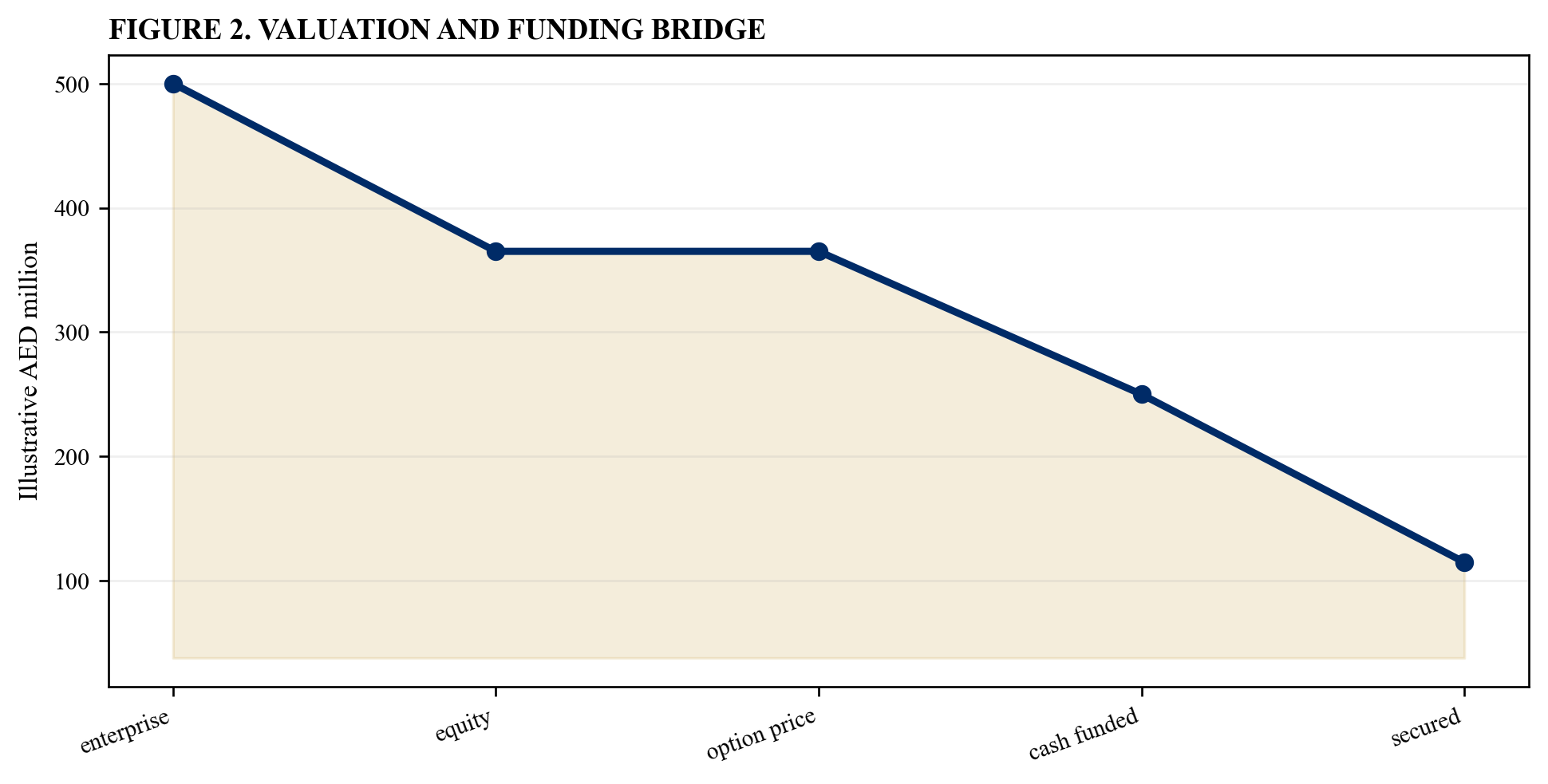
Illustrative analytical scenario; verified venture evidence should replace values.
15. Control minority and marketability adjustments
The venture should state whether discounts, control premiums, synergies and buyer-specific value are included. The required output is an adjustment schedule. Record the relevant right, obligor, beneficiary, trigger, evidence, approval, timetable and consequence [16][20].
Test the documents against ownership records, financing terms, valuation evidence, operating dependencies and applicable law. Identify every consent, notice, funding source, information requirement and action needed to convert the right into cash or a completed transfer. Preserve assumptions and limitations.
The principal risk is that undefined valuation adjustments can shift option economics by a material amount. Quantify the effect on value, liquidity, control, creditors, customers, employees, tax, timing and enforceability. Compare each route under consistent enterprise value, debt, working capital, transaction cost, approval and downside assumptions.
Translate the conclusion into constitutional documents, shareholder agreement, option deed, finance documents, information rights, process rules, security, transition plan and board calendar. Refresh it when ownership, performance, regulation, funding, valuation, market conditions or strategic purpose changes.
16. Appoint independent valuers
The venture should define qualifications, conflicts, information, methodology, timetable, reliance and finality. The required output is a valuation appointment protocol. Record the relevant right, obligor, beneficiary, trigger, evidence, approval, timetable and consequence [16][21].
Test the documents against ownership records, financing terms, valuation evidence, operating dependencies and applicable law. Identify every consent, notice, funding source, information requirement and action needed to convert the right into cash or a completed transfer. Preserve assumptions and limitations.
The principal risk is that a valuation right can stall because experts, scope or access have not been agreed. Quantify the effect on value, liquidity, control, creditors, customers, employees, tax, timing and enforceability. Compare each route under consistent enterprise value, debt, working capital, transaction cost, approval and downside assumptions.
Translate the conclusion into constitutional documents, shareholder agreement, option deed, finance documents, information rights, process rules, security, transition plan and board calendar. Refresh it when ownership, performance, regulation, funding, valuation, market conditions or strategic purpose changes.
17. Resolve valuation disputes
The venture should use two-valuers, a third expert, averaging, baseball arbitration or expert determination with clear thresholds. The required output is a valuation-dispute process. Record the relevant right, obligor, beneficiary, trigger, evidence, approval, timetable and consequence [21][22].
Test the documents against ownership records, financing terms, valuation evidence, operating dependencies and applicable law. Identify every consent, notice, funding source, information requirement and action needed to convert the right into cash or a completed transfer. Preserve assumptions and limitations.
The principal risk is that minor methodological differences can consume the entire exit timetable. Quantify the effect on value, liquidity, control, creditors, customers, employees, tax, timing and enforceability. Compare each route under consistent enterprise value, debt, working capital, transaction cost, approval and downside assumptions.
Translate the conclusion into constitutional documents, shareholder agreement, option deed, finance documents, information rights, process rules, security, transition plan and board calendar. Refresh it when ownership, performance, regulation, funding, valuation, market conditions or strategic purpose changes.
18. Prove funding capacity
The venture should test cash, committed facilities, sponsor support, dividend restrictions, solvency and regulatory capital. The required output is an option funding certificate. Record the relevant right, obligor, beneficiary, trigger, evidence, approval, timetable and consequence [23][24].
Test the documents against ownership records, financing terms, valuation evidence, operating dependencies and applicable law. Identify every consent, notice, funding source, information requirement and action needed to convert the right into cash or a completed transfer. Preserve assumptions and limitations.
The principal risk is that a put can be economically valuable and practically worthless when the obligor cannot pay. Quantify the effect on value, liquidity, control, creditors, customers, employees, tax, timing and enforceability. Compare each route under consistent enterprise value, debt, working capital, transaction cost, approval and downside assumptions.
Translate the conclusion into constitutional documents, shareholder agreement, option deed, finance documents, information rights, process rules, security, transition plan and board calendar. Refresh it when ownership, performance, regulation, funding, valuation, market conditions or strategic purpose changes.
19. Structure settlement
The venture should compare cash at completion, instalments, escrow, bank guarantee, standby letter of credit, security and vendor finance. The required output is a settlement-security package. Record the relevant right, obligor, beneficiary, trigger, evidence, approval, timetable and consequence [25][26].
Test the documents against ownership records, financing terms, valuation evidence, operating dependencies and applicable law. Identify every consent, notice, funding source, information requirement and action needed to convert the right into cash or a completed transfer. Preserve assumptions and limitations.
The principal risk is that deferred consideration can replace ownership exposure with unsecured credit exposure. Quantify the effect on value, liquidity, control, creditors, customers, employees, tax, timing and enforceability. Compare each route under consistent enterprise value, debt, working capital, transaction cost, approval and downside assumptions.
Translate the conclusion into constitutional documents, shareholder agreement, option deed, finance documents, information rights, process rules, security, transition plan and board calendar. Refresh it when ownership, performance, regulation, funding, valuation, market conditions or strategic purpose changes.
20. Control payment default
The venture should define interest, acceleration, security enforcement, voting suspension, step-in and alternative sale rights. The required output is a payment-default waterfall. Record the relevant right, obligor, beneficiary, trigger, evidence, approval, timetable and consequence [5][25].
Test the documents against ownership records, financing terms, valuation evidence, operating dependencies and applicable law. Identify every consent, notice, funding source, information requirement and action needed to convert the right into cash or a completed transfer. Preserve assumptions and limitations.
The principal risk is that a failed settlement can leave ownership, control and cash rights in an unstable hybrid state. Quantify the effect on value, liquidity, control, creditors, customers, employees, tax, timing and enforceability. Compare each route under consistent enterprise value, debt, working capital, transaction cost, approval and downside assumptions.
Translate the conclusion into constitutional documents, shareholder agreement, option deed, finance documents, information rights, process rules, security, transition plan and board calendar. Refresh it when ownership, performance, regulation, funding, valuation, market conditions or strategic purpose changes.
21. Preserve distributions and prevent leakage
The venture should govern dividends, fees, related-party transactions, asset transfers and extraordinary expenditure during exit. The required output is a leakage covenant. Record the relevant right, obligor, beneficiary, trigger, evidence, approval, timetable and consequence [27][28].
Test the documents against ownership records, financing terms, valuation evidence, operating dependencies and applicable law. Identify every consent, notice, funding source, information requirement and action needed to convert the right into cash or a completed transfer. Preserve assumptions and limitations.
The principal risk is that value can be extracted between valuation and completion. Quantify the effect on value, liquidity, control, creditors, customers, employees, tax, timing and enforceability. Compare each route under consistent enterprise value, debt, working capital, transaction cost, approval and downside assumptions.
Translate the conclusion into constitutional documents, shareholder agreement, option deed, finance documents, information rights, process rules, security, transition plan and board calendar. Refresh it when ownership, performance, regulation, funding, valuation, market conditions or strategic purpose changes.
22. Prepare for a trade sale
The venture should maintain buyer universe, separation perimeter, diligence materials, management access and sale governance. The required output is a trade-sale readiness plan. Record the relevant right, obligor, beneficiary, trigger, evidence, approval, timetable and consequence [29][30].
Test the documents against ownership records, financing terms, valuation evidence, operating dependencies and applicable law. Identify every consent, notice, funding source, information requirement and action needed to convert the right into cash or a completed transfer. Preserve assumptions and limitations.
The principal risk is that a credible strategic buyer can withdraw when ownership, data or operating dependencies are unclear. Quantify the effect on value, liquidity, control, creditors, customers, employees, tax, timing and enforceability. Compare each route under consistent enterprise value, debt, working capital, transaction cost, approval and downside assumptions.
Translate the conclusion into constitutional documents, shareholder agreement, option deed, finance documents, information rights, process rules, security, transition plan and board calendar. Refresh it when ownership, performance, regulation, funding, valuation, market conditions or strategic purpose changes.
Table 3. Sale-readiness funnel
| Stage | Evidence gate | Decision |
|---|---|---|
| prepare | separation perimeter | launch |
| market | buyer interest | shortlist |
| diligence | verified data | binding bids |
| approve | funds and consents | sign and close |
Illustrative analytical structure; verified transaction and jurisdiction evidence governs.
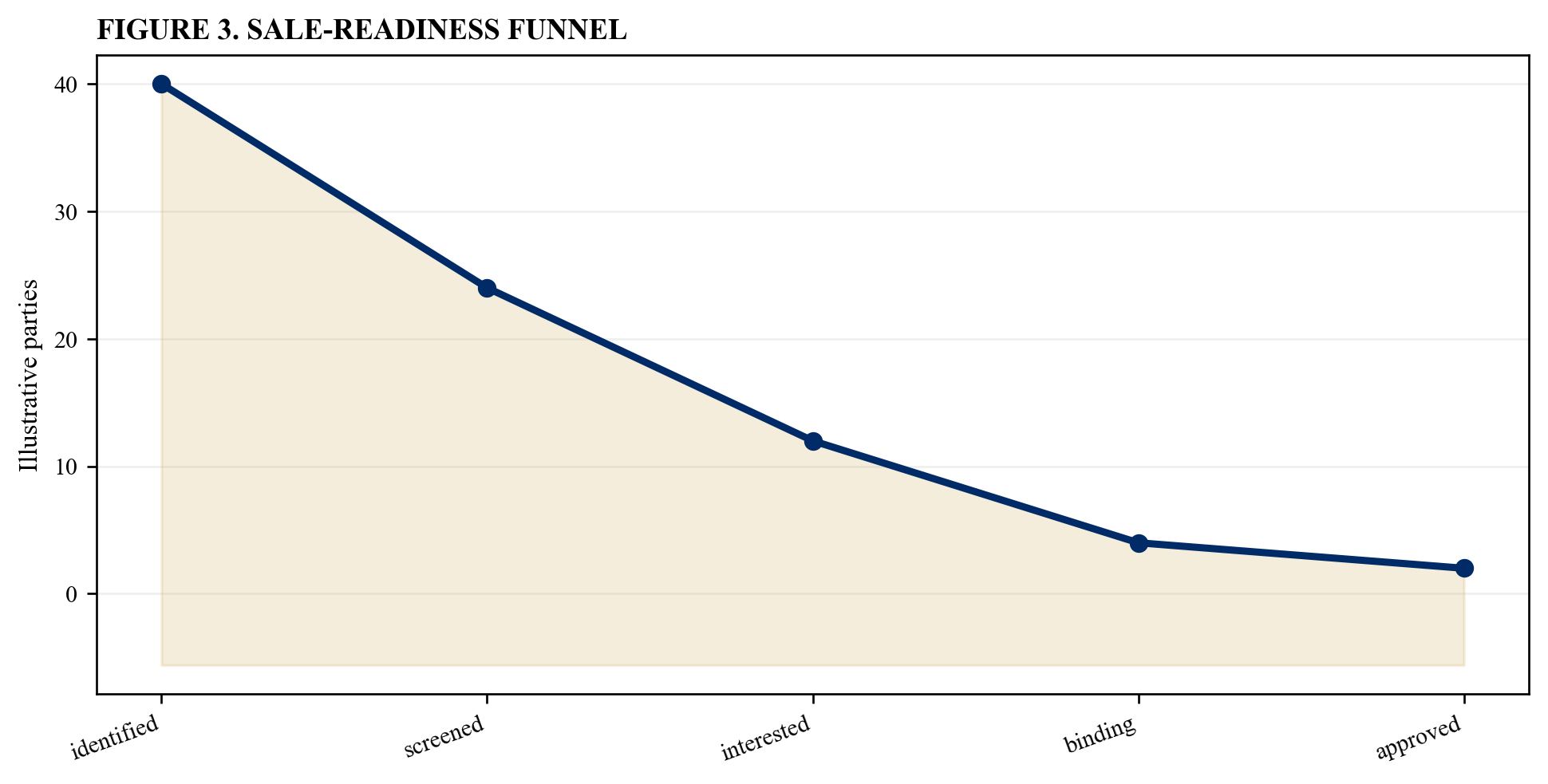
Illustrative analytical scenario; verified venture evidence should replace values.
23. Allocate sale-process authority
The venture should define who appoints advisers, approves materials, contacts buyers, negotiates and accepts terms. The required output is a sale-process decision matrix. Record the relevant right, obligor, beneficiary, trigger, evidence, approval, timetable and consequence [2][11].
Test the documents against ownership records, financing terms, valuation evidence, operating dependencies and applicable law. Identify every consent, notice, funding source, information requirement and action needed to convert the right into cash or a completed transfer. Preserve assumptions and limitations.
The principal risk is that partners can undermine price through inconsistent messages or competing processes. Quantify the effect on value, liquidity, control, creditors, customers, employees, tax, timing and enforceability. Compare each route under consistent enterprise value, debt, working capital, transaction cost, approval and downside assumptions.
Translate the conclusion into constitutional documents, shareholder agreement, option deed, finance documents, information rights, process rules, security, transition plan and board calendar. Refresh it when ownership, performance, regulation, funding, valuation, market conditions or strategic purpose changes.
24. Protect competition-sensitive information
The venture should use clean teams, staged access, aggregation and purpose limits during buyer diligence. The required output is a clean-team protocol. Record the relevant right, obligor, beneficiary, trigger, evidence, approval, timetable and consequence [31][32].
Test the documents against ownership records, financing terms, valuation evidence, operating dependencies and applicable law. Identify every consent, notice, funding source, information requirement and action needed to convert the right into cash or a completed transfer. Preserve assumptions and limitations.
The principal risk is that a failed sale can leave a competitor with sensitive prices, customers and strategy. Quantify the effect on value, liquidity, control, creditors, customers, employees, tax, timing and enforceability. Compare each route under consistent enterprise value, debt, working capital, transaction cost, approval and downside assumptions.
Translate the conclusion into constitutional documents, shareholder agreement, option deed, finance documents, information rights, process rules, security, transition plan and board calendar. Refresh it when ownership, performance, regulation, funding, valuation, market conditions or strategic purpose changes.
25. Map regulatory approvals
The venture should identify competition, foreign investment, sector, licensing, national-security and change-of-control consents. The required output is an approvals critical path. Record the relevant right, obligor, beneficiary, trigger, evidence, approval, timetable and consequence [33][34].
Test the documents against ownership records, financing terms, valuation evidence, operating dependencies and applicable law. Identify every consent, notice, funding source, information requirement and action needed to convert the right into cash or a completed transfer. Preserve assumptions and limitations.
The principal risk is that a signed exit can fail or lose value during an unplanned approval process. Quantify the effect on value, liquidity, control, creditors, customers, employees, tax, timing and enforceability. Compare each route under consistent enterprise value, debt, working capital, transaction cost, approval and downside assumptions.
Translate the conclusion into constitutional documents, shareholder agreement, option deed, finance documents, information rights, process rules, security, transition plan and board calendar. Refresh it when ownership, performance, regulation, funding, valuation, market conditions or strategic purpose changes.
26. Build IPO readiness
The venture should align governance, audited reporting, controls, equity story, capital structure, management and disclosure. The required output is an IPO readiness roadmap. Record the relevant right, obligor, beneficiary, trigger, evidence, approval, timetable and consequence [35][36].
Test the documents against ownership records, financing terms, valuation evidence, operating dependencies and applicable law. Identify every consent, notice, funding source, information requirement and action needed to convert the right into cash or a completed transfer. Preserve assumptions and limitations.
The principal risk is that a flotation option can remain aspirational because the venture cannot meet market requirements. Quantify the effect on value, liquidity, control, creditors, customers, employees, tax, timing and enforceability. Compare each route under consistent enterprise value, debt, working capital, transaction cost, approval and downside assumptions.
Translate the conclusion into constitutional documents, shareholder agreement, option deed, finance documents, information rights, process rules, security, transition plan and board calendar. Refresh it when ownership, performance, regulation, funding, valuation, market conditions or strategic purpose changes.
27. Define IPO participation and sell-down
The venture should set primary versus secondary shares, lock-ups, allocation, voting, board transition and post-listing liquidity. The required output is an IPO participation schedule. Record the relevant right, obligor, beneficiary, trigger, evidence, approval, timetable and consequence [35][37].
Test the documents against ownership records, financing terms, valuation evidence, operating dependencies and applicable law. Identify every consent, notice, funding source, information requirement and action needed to convert the right into cash or a completed transfer. Preserve assumptions and limitations.
The principal risk is that partners can disagree over capital raising, monetisation and continuing control late in the process. Quantify the effect on value, liquidity, control, creditors, customers, employees, tax, timing and enforceability. Compare each route under consistent enterprise value, debt, working capital, transaction cost, approval and downside assumptions.
Translate the conclusion into constitutional documents, shareholder agreement, option deed, finance documents, information rights, process rules, security, transition plan and board calendar. Refresh it when ownership, performance, regulation, funding, valuation, market conditions or strategic purpose changes.
28. Control warranties and seller liability
The venture should allocate disclosure, knowledge, caps, baskets, time limits, tax covenants and insurance. The required output is a liability-allocation framework. Record the relevant right, obligor, beneficiary, trigger, evidence, approval, timetable and consequence [29][38].
Test the documents against ownership records, financing terms, valuation evidence, operating dependencies and applicable law. Identify every consent, notice, funding source, information requirement and action needed to convert the right into cash or a completed transfer. Preserve assumptions and limitations.
The principal risk is that a shareholder can be forced to give business warranties disproportionate to its knowledge or proceeds. Quantify the effect on value, liquidity, control, creditors, customers, employees, tax, timing and enforceability. Compare each route under consistent enterprise value, debt, working capital, transaction cost, approval and downside assumptions.
Translate the conclusion into constitutional documents, shareholder agreement, option deed, finance documents, information rights, process rules, security, transition plan and board calendar. Refresh it when ownership, performance, regulation, funding, valuation, market conditions or strategic purpose changes.
29. Plan tax before trigger
The venture should model share versus asset sale, option premium, deemed disposal, withholding, stamp, indirect tax and losses. The required output is an exit-tax bridge. Record the relevant right, obligor, beneficiary, trigger, evidence, approval, timetable and consequence [39][40].
Test the documents against ownership records, financing terms, valuation evidence, operating dependencies and applicable law. Identify every consent, notice, funding source, information requirement and action needed to convert the right into cash or a completed transfer. Preserve assumptions and limitations.
The principal risk is that tax can alter route value, settlement funding and distributable proceeds. Quantify the effect on value, liquidity, control, creditors, customers, employees, tax, timing and enforceability. Compare each route under consistent enterprise value, debt, working capital, transaction cost, approval and downside assumptions.
Translate the conclusion into constitutional documents, shareholder agreement, option deed, finance documents, information rights, process rules, security, transition plan and board calendar. Refresh it when ownership, performance, regulation, funding, valuation, market conditions or strategic purpose changes.
30. Preserve debt and covenant compliance
The venture should test change-of-control, mandatory prepayment, permitted disposal, security release and hedging close-out. The required output is a financing-consent schedule. Record the relevant right, obligor, beneficiary, trigger, evidence, approval, timetable and consequence [23][25].
Test the documents against ownership records, financing terms, valuation evidence, operating dependencies and applicable law. Identify every consent, notice, funding source, information requirement and action needed to convert the right into cash or a completed transfer. Preserve assumptions and limitations.
The principal risk is that equity liquidity can trigger debt acceleration or destroy funding needed for completion. Quantify the effect on value, liquidity, control, creditors, customers, employees, tax, timing and enforceability. Compare each route under consistent enterprise value, debt, working capital, transaction cost, approval and downside assumptions.
Translate the conclusion into constitutional documents, shareholder agreement, option deed, finance documents, information rights, process rules, security, transition plan and board calendar. Refresh it when ownership, performance, regulation, funding, valuation, market conditions or strategic purpose changes.
31. Separate operations safely
The venture should map people, customers, suppliers, premises, systems, data, IP, licences, treasury and shared services. The required output is a separation blueprint. Record the relevant right, obligor, beneficiary, trigger, evidence, approval, timetable and consequence [8][29].
Test the documents against ownership records, financing terms, valuation evidence, operating dependencies and applicable law. Identify every consent, notice, funding source, information requirement and action needed to convert the right into cash or a completed transfer. Preserve assumptions and limitations.
The principal risk is that ownership can transfer while the business remains operationally inseparable from a parent. Quantify the effect on value, liquidity, control, creditors, customers, employees, tax, timing and enforceability. Compare each route under consistent enterprise value, debt, working capital, transaction cost, approval and downside assumptions.
Translate the conclusion into constitutional documents, shareholder agreement, option deed, finance documents, information rights, process rules, security, transition plan and board calendar. Refresh it when ownership, performance, regulation, funding, valuation, market conditions or strategic purpose changes.
32. Protect customers and contracts
The venture should identify assignment, consent, termination, pricing, service continuity and communications obligations. The required output is a contract-continuity plan. Record the relevant right, obligor, beneficiary, trigger, evidence, approval, timetable and consequence [29][33].
Test the documents against ownership records, financing terms, valuation evidence, operating dependencies and applicable law. Identify every consent, notice, funding source, information requirement and action needed to convert the right into cash or a completed transfer. Preserve assumptions and limitations.
The principal risk is that a change of ownership can erode the revenue base used in valuation. Quantify the effect on value, liquidity, control, creditors, customers, employees, tax, timing and enforceability. Compare each route under consistent enterprise value, debt, working capital, transaction cost, approval and downside assumptions.
Translate the conclusion into constitutional documents, shareholder agreement, option deed, finance documents, information rights, process rules, security, transition plan and board calendar. Refresh it when ownership, performance, regulation, funding, valuation, market conditions or strategic purpose changes.
33. Protect people and incentives
The venture should manage retention, consultation, transfer, compensation, confidentiality and leadership succession. The required output is a workforce transition plan. Record the relevant right, obligor, beneficiary, trigger, evidence, approval, timetable and consequence [2][30].
Test the documents against ownership records, financing terms, valuation evidence, operating dependencies and applicable law. Identify every consent, notice, funding source, information requirement and action needed to convert the right into cash or a completed transfer. Preserve assumptions and limitations.
The principal risk is that key talent can leave during a contested or prolonged exit. Quantify the effect on value, liquidity, control, creditors, customers, employees, tax, timing and enforceability. Compare each route under consistent enterprise value, debt, working capital, transaction cost, approval and downside assumptions.
Translate the conclusion into constitutional documents, shareholder agreement, option deed, finance documents, information rights, process rules, security, transition plan and board calendar. Refresh it when ownership, performance, regulation, funding, valuation, market conditions or strategic purpose changes.
34. Preserve intellectual property and data
The venture should define ownership, licences, transition use, portability, deletion, cyber controls and ongoing restrictions. The required output is an IP-and-data separation schedule. Record the relevant right, obligor, beneficiary, trigger, evidence, approval, timetable and consequence [28][32].
Test the documents against ownership records, financing terms, valuation evidence, operating dependencies and applicable law. Identify every consent, notice, funding source, information requirement and action needed to convert the right into cash or a completed transfer. Preserve assumptions and limitations.
The principal risk is that the exiting party can lose essential rights or retain access that damages the venture. Quantify the effect on value, liquidity, control, creditors, customers, employees, tax, timing and enforceability. Compare each route under consistent enterprise value, debt, working capital, transaction cost, approval and downside assumptions.
Translate the conclusion into constitutional documents, shareholder agreement, option deed, finance documents, information rights, process rules, security, transition plan and board calendar. Refresh it when ownership, performance, regulation, funding, valuation, market conditions or strategic purpose changes.
35. Design orderly wind-down
The venture should sequence cessation, asset realisation, creditor payment, employee actions, contract close-out and dissolution. The required output is a wind-down operating plan. Record the relevant right, obligor, beneficiary, trigger, evidence, approval, timetable and consequence [3][8].
Test the documents against ownership records, financing terms, valuation evidence, operating dependencies and applicable law. Identify every consent, notice, funding source, information requirement and action needed to convert the right into cash or a completed transfer. Preserve assumptions and limitations.
The principal risk is that a dissolution clause can ignore the work required to protect stakeholders and residual value. Quantify the effect on value, liquidity, control, creditors, customers, employees, tax, timing and enforceability. Compare each route under consistent enterprise value, debt, working capital, transaction cost, approval and downside assumptions.
Translate the conclusion into constitutional documents, shareholder agreement, option deed, finance documents, information rights, process rules, security, transition plan and board calendar. Refresh it when ownership, performance, regulation, funding, valuation, market conditions or strategic purpose changes.
36. Set the wind-down waterfall
The venture should rank secured creditors, statutory claims, employees, tax, unsecured creditors, shareholder instruments and surplus. The required output is a wind-down value waterfall. Record the relevant right, obligor, beneficiary, trigger, evidence, approval, timetable and consequence [24][40].
Test the documents against ownership records, financing terms, valuation evidence, operating dependencies and applicable law. Identify every consent, notice, funding source, information requirement and action needed to convert the right into cash or a completed transfer. Preserve assumptions and limitations.
The principal risk is that partners can assume residual proceeds that belong to creditors or senior instruments. Quantify the effect on value, liquidity, control, creditors, customers, employees, tax, timing and enforceability. Compare each route under consistent enterprise value, debt, working capital, transaction cost, approval and downside assumptions.
Translate the conclusion into constitutional documents, shareholder agreement, option deed, finance documents, information rights, process rules, security, transition plan and board calendar. Refresh it when ownership, performance, regulation, funding, valuation, market conditions or strategic purpose changes.
Table 4. Wind-down waterfall
| Priority | Claim | Control |
|---|---|---|
| 1 | secured and statutory | reserve |
| 2 | employees and tax | verify |
| 3 | unsecured creditors | admit |
| 4 | shareholders | residual only |
Illustrative analytical structure; verified transaction and jurisdiction evidence governs.
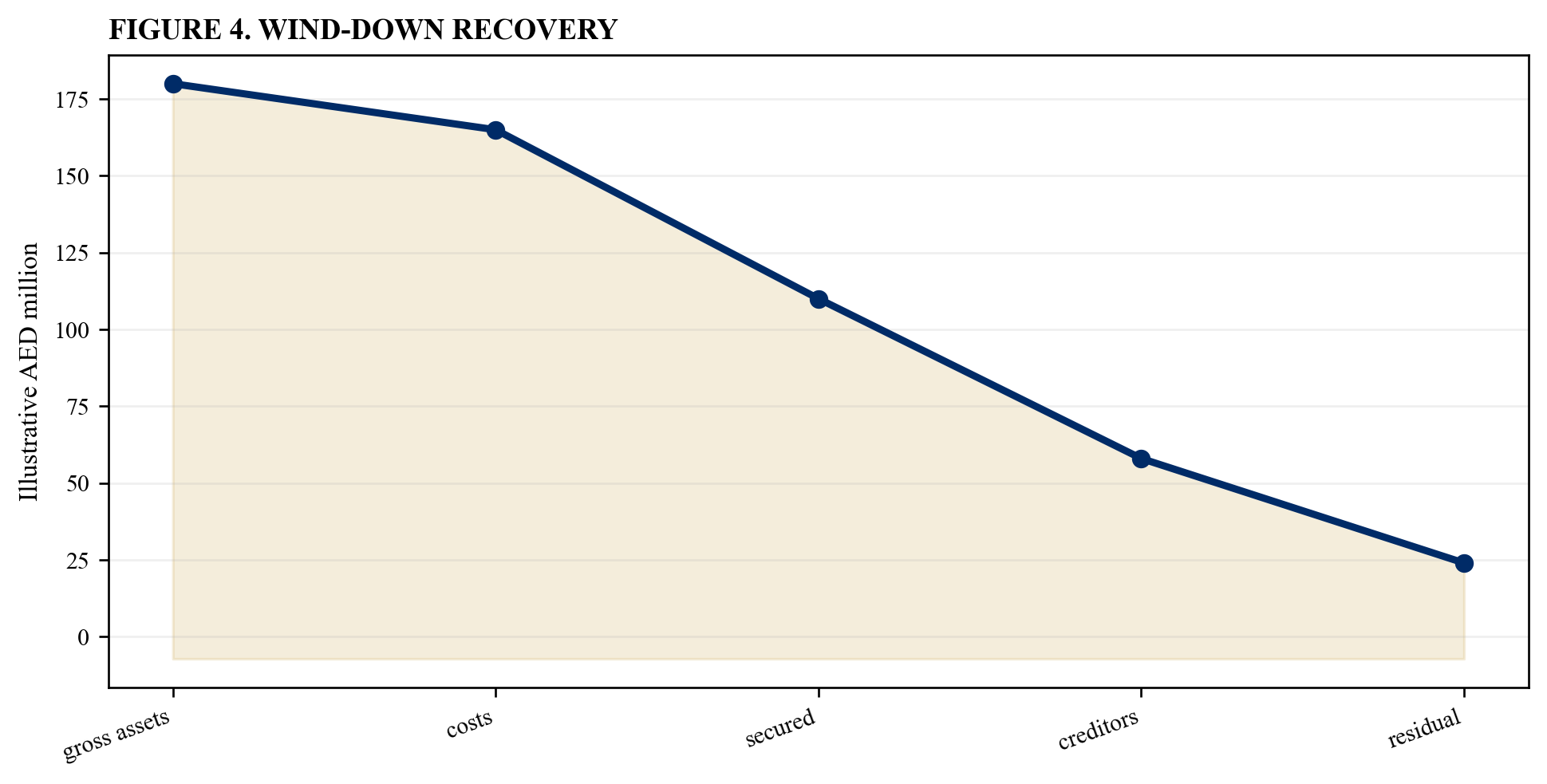
Illustrative analytical scenario; verified venture evidence should replace values.
37. Address insolvency boundaries
The venture should define director duties, filing triggers, transaction restrictions and the point at which shareholder instructions stop. The required output is an insolvency escalation protocol. Record the relevant right, obligor, beneficiary, trigger, evidence, approval, timetable and consequence [24][26].
Test the documents against ownership records, financing terms, valuation evidence, operating dependencies and applicable law. Identify every consent, notice, funding source, information requirement and action needed to convert the right into cash or a completed transfer. Preserve assumptions and limitations.
The principal risk is that an exit remedy can conflict with creditor interests and mandatory law. Quantify the effect on value, liquidity, control, creditors, customers, employees, tax, timing and enforceability. Compare each route under consistent enterprise value, debt, working capital, transaction cost, approval and downside assumptions.
Translate the conclusion into constitutional documents, shareholder agreement, option deed, finance documents, information rights, process rules, security, transition plan and board calendar. Refresh it when ownership, performance, regulation, funding, valuation, market conditions or strategic purpose changes.
38. Retain post-exit obligations
The venture should specify confidentiality, non-use, non-solicitation, transition support, records, tax cooperation and claims. The required output is a survival schedule. Record the relevant right, obligor, beneficiary, trigger, evidence, approval, timetable and consequence [5][28].
Test the documents against ownership records, financing terms, valuation evidence, operating dependencies and applicable law. Identify every consent, notice, funding source, information requirement and action needed to convert the right into cash or a completed transfer. Preserve assumptions and limitations.
The principal risk is that completion can occur while essential information and cooperation rights disappear. Quantify the effect on value, liquidity, control, creditors, customers, employees, tax, timing and enforceability. Compare each route under consistent enterprise value, debt, working capital, transaction cost, approval and downside assumptions.
Translate the conclusion into constitutional documents, shareholder agreement, option deed, finance documents, information rights, process rules, security, transition plan and board calendar. Refresh it when ownership, performance, regulation, funding, valuation, market conditions or strategic purpose changes.
39. Test each route under scenarios
The venture should model strong sale, weak market, deadlock, regulatory delay, funding failure, default and insolvency. The required output is an exit scenario model. Record the relevant right, obligor, beneficiary, trigger, evidence, approval, timetable and consequence [12][16].
Test the documents against ownership records, financing terms, valuation evidence, operating dependencies and applicable law. Identify every consent, notice, funding source, information requirement and action needed to convert the right into cash or a completed transfer. Preserve assumptions and limitations.
The principal risk is that a mechanism can work only under the base case for which it was drafted. Quantify the effect on value, liquidity, control, creditors, customers, employees, tax, timing and enforceability. Compare each route under consistent enterprise value, debt, working capital, transaction cost, approval and downside assumptions.
Translate the conclusion into constitutional documents, shareholder agreement, option deed, finance documents, information rights, process rules, security, transition plan and board calendar. Refresh it when ownership, performance, regulation, funding, valuation, market conditions or strategic purpose changes.
40. Issue the exit-readiness certificate
The venture should reconcile triggers, route, valuation, funding, approvals, separation, stakeholder protection and residual obligations. The required output is an auditable exit-readiness certificate. Record the relevant right, obligor, beneficiary, trigger, evidence, approval, timetable and consequence [1][3].
Test the documents against ownership records, financing terms, valuation evidence, operating dependencies and applicable law. Identify every consent, notice, funding source, information requirement and action needed to convert the right into cash or a completed transfer. Preserve assumptions and limitations.
The principal risk is that the parties can retain nominal optionality without a complete path to cash and control transfer. Quantify the effect on value, liquidity, control, creditors, customers, employees, tax, timing and enforceability. Compare each route under consistent enterprise value, debt, working capital, transaction cost, approval and downside assumptions.
Translate the conclusion into constitutional documents, shareholder agreement, option deed, finance documents, information rights, process rules, security, transition plan and board calendar. Refresh it when ownership, performance, regulation, funding, valuation, market conditions or strategic purpose changes.
Table 5. Exit-readiness certificate
| Conclusion | Evidence | Owner |
|---|---|---|
| trigger | objective record | company secretary |
| valuation | expert method | finance |
| funding | committed source | treasury |
| execution | approvals and separation | board |
Illustrative analytical structure; verified transaction and jurisdiction evidence governs.
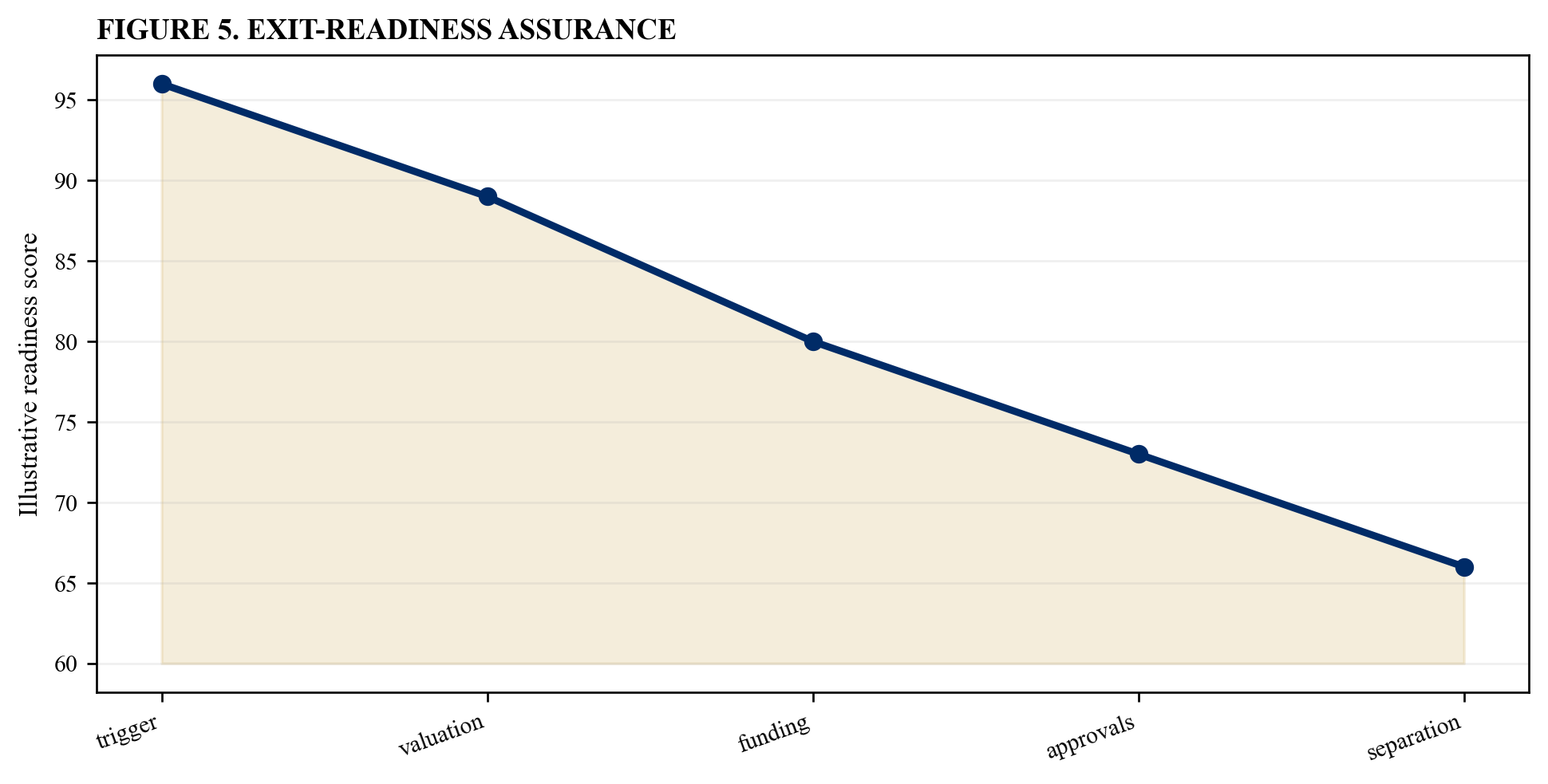
Illustrative analytical scenario; verified venture evidence should replace values.
References
- OECD, G20/OECD Principles of Corporate Governance 2023, https://www.oecd.org/en/publications/g20-oecd-principles-of-corporate-governance-2023_ed750b30-en.html
- International Finance Corporation, Corporate Governance Methodology, https://www.ifc.org/en/what-we-do/sector-expertise/corporate-governance/cg-methodology-tools
- UK Government, Joint Venture Guidance, https://assets.publishing.service.gov.uk/media/5a7b9d82ed915d1311060652/06_joint_venture_guidance.pdf
- UK Department for Business and Trade, How to Set Up Joint Ventures Abroad, https://www.business.gov.uk/export-from-uk/learn/categories/prepare-sell-new-country/routes-to-market/set-joint-ventures-abroad/
- UNCITRAL, Model Law on International Commercial Arbitration, https://uncitral.un.org/en/texts/arbitration/modellaw/commercial_arbitration
- Financial Action Task Force, Guidance on Beneficial Ownership of Legal Persons, https://www.fatf-gafi.org/en/publications/Fatfrecommendations/Guidance-Beneficial-Ownership-Legal-Persons.html
- United Nations Security Council, Consolidated Sanctions List, https://main.un.org/securitycouncil/en/content/un-sc-consolidated-list
- UK Government, Model Articles for Private Companies Limited by Shares, https://www.gov.uk/government/publications/model-articles-for-private-companies-limited-by-shares/model-articles-for-private-companies-limited-by-shares
- International Chamber of Commerce, Model Contracts and Clauses, https://iccwbo.org/business-solutions/model-contracts-clauses/
- OECD, Protection and Facilitation of Minority Shareholders, https://www.oecd.org/corporate/
- UK Takeover Panel, The Takeover Code, https://www.thetakeoverpanel.org.uk/the-code/download-code
- International Valuation Standards Council, International Valuation Standards, https://ivsc.org/standards/
- IFRS Foundation, IFRS 9 Financial Instruments, https://www.ifrs.org/issued-standards/list-of-standards/ifrs-9-financial-instruments/
- IFRS Foundation, IAS 32 Financial Instruments Presentation, https://www.ifrs.org/issued-standards/list-of-standards/ias-32-financial-instruments-presentation/
- UNIDROIT, Principles of International Commercial Contracts 2016, https://www.unidroit.org/instruments/commercial-contracts/unidroit-principles-2016/
- International Valuation Standards Council, Business and Business Interests, https://ivsc.org/standards/
- IFRS Foundation, IFRS 13 Fair Value Measurement, https://www.ifrs.org/issued-standards/list-of-standards/ifrs-13-fair-value-measurement/
- IFRS Foundation, Conceptual Framework for Financial Reporting, https://www.ifrs.org/issued-standards/list-of-standards/conceptual-framework/
- IFRS Foundation, IFRS 3 Business Combinations, https://www.ifrs.org/issued-standards/list-of-standards/ifrs-3-business-combinations/
- International Valuation Standards Council, Bases of Value, https://ivsc.org/standards/
- International Chamber of Commerce, Expert Rules, https://iccwbo.org/dispute-resolution/dispute-resolution-services/expertise/
- International Chamber of Commerce, Arbitration Rules, https://iccwbo.org/dispute-resolution/dispute-resolution-services/arbitration/rules-procedure/2021-arbitration-rules/
- Loan Market Association, Recommended Forms and Guidance, https://www.lma.eu.com/documents-guidelines/documents
- UNCITRAL, Legislative Guide on Insolvency Law, https://uncitral.un.org/en/texts/insolvency/legislativeguides/insolvency_law
- International Chamber of Commerce, Uniform Rules for Demand Guarantees URDG 758, https://iccwbo.org/business-solutions/icc-rules-standards-and-guidance/
- World Bank, Principles for Effective Insolvency and Creditor Debtor Regimes, https://www.worldbank.org/en/topic/financialsector/brief/the-world-bank-principles-for-effective-insolvency-and-creditor-rights
- IFRS Foundation, IAS 24 Related Party Disclosures, https://www.ifrs.org/issued-standards/list-of-standards/ias-24-related-party-disclosures/
- World Intellectual Property Organization, IP Due Diligence Readiness, https://www.wipo.int/en/web/ip-business-moments/ip-due-diligence
- UK Government, Selling a Business, https://www.gov.uk/browse/business/sell-transfer-your-business
- International Organization for Standardization, ISO 31000 Risk Management, https://www.iso.org/iso-31000-risk-management.html
- UK Competition and Markets Authority, Joint Venture Business Advice, https://www.gov.uk/government/publications/joint-ventures-and-competition-law-dos-and-donts/joint-venture-business-advice
- National Institute of Standards and Technology, Cybersecurity Framework 2.0, https://www.nist.gov/cyberframework
- European Commission, EU Merger Control, https://competition-policy.ec.europa.eu/mergers/overview_en
- UK Government, National Security and Investment Act Guidance, https://www.gov.uk/government/collections/national-security-and-investment-act
- US Securities and Exchange Commission, Investor Bulletin Investing in an IPO, https://www.sec.gov/files/ipo-investorbulletin.pdf
- Abu Dhabi Global Market, Approved Prospectuses, https://www.adgm.com/financial-services-regulatory-authority/listing-authority/approved-prospectuses/
- UK Financial Conduct Authority, Listing Rules, https://www.handbook.fca.org.uk/handbook/UKLR/
- UK Government, Companies Act 2006, https://www.legislation.gov.uk/ukpga/2006/46/contents
- OECD, Model Tax Convention on Income and on Capital, https://www.oecd.org/en/topics/sub-issues/tax-treaties/oecd-model-tax-convention-on-income-and-on-capital.html
- OECD, Transfer Pricing Guidelines 2022, https://www.oecd.org/en/publications/oecd-transfer-pricing-guidelines-for-multinational-enterprises-and-tax-administrations-2022_0e655865-en.html
