

1. Define family purpose and transaction objective
Translate legacy, control, liquidity, stewardship and transaction objectives into an approved ownership mandate.
The governance review should reconcile family interviews, ownership records, strategic alternatives, liquidity needs and stakeholder duties. Each conclusion records the governing instrument, accountable authority, affected rights, dependency, required evidence, decision route and unresolved exception. The immediate output is an ownership-purpose charter.
Design must be tested through executable decisions. Reviewers trace authority to source instruments, confirm that records are complete, simulate the required sequence and assess whether the enterprise can continue when a founder or family representative is unavailable. Company facts, ownership objectives, jurisdiction and transaction structure govern every conclusion.
Material gaps require an accountable owner, corrective instrument, professional advice, evidence requirement and decision date. Consequences should flow through control, liquidity, financing, valuation, diligence, consent timing, disclosure and transaction protection. Residual risk remains visible until the legal documents and operating practice align or authorised decision-makers approve a different route.
2. Map legal and beneficial ownership
Reconcile every direct, indirect, nominee, trust, foundation and economic interest across jurisdictions.
The governance review should reconcile registers, constitutional documents, declarations, family trees, beneficial-ownership filings and tax records. Each conclusion records the governing instrument, accountable authority, affected rights, dependency, required evidence, decision route and unresolved exception. The immediate output is a verified ownership map.
Design must be tested through executable decisions. Reviewers trace authority to source instruments, confirm that records are complete, simulate the required sequence and assess whether the enterprise can continue when a founder or family representative is unavailable. Company facts, ownership objectives, jurisdiction and transaction structure govern every conclusion.
Material gaps require an accountable owner, corrective instrument, professional advice, evidence requirement and decision date. Consequences should flow through control, liquidity, financing, valuation, diligence, consent timing, disclosure and transaction protection. Residual risk remains visible until the legal documents and operating practice align or authorised decision-makers approve a different route.
3. Reconcile the family constitution with binding documents
Test each constitutional principle against articles, shareholder agreements, wills, trusts, foundations and applicable law.
The governance review should reconcile constitution clauses, legal instruments, board records, side arrangements and counsel analysis. Each conclusion records the governing instrument, accountable authority, affected rights, dependency, required evidence, decision route and unresolved exception. The immediate output is a constitution-to-law enforceability matrix.
Design must be tested through executable decisions. Reviewers trace authority to source instruments, confirm that records are complete, simulate the required sequence and assess whether the enterprise can continue when a founder or family representative is unavailable. Company facts, ownership objectives, jurisdiction and transaction structure govern every conclusion.
Material gaps require an accountable owner, corrective instrument, professional advice, evidence requirement and decision date. Consequences should flow through control, liquidity, financing, valuation, diligence, consent timing, disclosure and transaction protection. Residual risk remains visible until the legal documents and operating practice align or authorised decision-makers approve a different route.
4. Define the family and enterprise boundary
Specify who participates in family governance, owns capital, works in the enterprise, receives information or represents a branch.
The governance review should reconcile family definitions, kinship records, ownership classes, employment policies and participation criteria. Each conclusion records the governing instrument, accountable authority, affected rights, dependency, required evidence, decision route and unresolved exception. The immediate output is a controlled family-enterprise perimeter.
Design must be tested through executable decisions. Reviewers trace authority to source instruments, confirm that records are complete, simulate the required sequence and assess whether the enterprise can continue when a founder or family representative is unavailable. Company facts, ownership objectives, jurisdiction and transaction structure govern every conclusion.
Material gaps require an accountable owner, corrective instrument, professional advice, evidence requirement and decision date. Consequences should flow through control, liquidity, financing, valuation, diligence, consent timing, disclosure and transaction protection. Residual risk remains visible until the legal documents and operating practice align or authorised decision-makers approve a different route.
5. Establish the family-governance institutions
Assign distinct purposes to the family assembly, family council, owners' council, board and management.
The governance review should reconcile institutional charters, memberships, calendars, delegations and reporting lines. Each conclusion records the governing instrument, accountable authority, affected rights, dependency, required evidence, decision route and unresolved exception. The immediate output is an integrated governance architecture.
Design must be tested through executable decisions. Reviewers trace authority to source instruments, confirm that records are complete, simulate the required sequence and assess whether the enterprise can continue when a founder or family representative is unavailable. Company facts, ownership objectives, jurisdiction and transaction structure govern every conclusion.
Material gaps require an accountable owner, corrective instrument, professional advice, evidence requirement and decision date. Consequences should flow through control, liquidity, financing, valuation, diligence, consent timing, disclosure and transaction protection. Residual risk remains visible until the legal documents and operating practice align or authorised decision-makers approve a different route.
6. Design the shareholder assembly
Set notice, agenda, quorum, voting, information and record requirements for valid owner decisions.
The governance review should reconcile law, articles, shareholder agreements, ownership register, meeting rules and minutes. Each conclusion records the governing instrument, accountable authority, affected rights, dependency, required evidence, decision route and unresolved exception. The immediate output is an operable shareholder-decision protocol.
Design must be tested through executable decisions. Reviewers trace authority to source instruments, confirm that records are complete, simulate the required sequence and assess whether the enterprise can continue when a founder or family representative is unavailable. Company facts, ownership objectives, jurisdiction and transaction structure govern every conclusion.
Material gaps require an accountable owner, corrective instrument, professional advice, evidence requirement and decision date. Consequences should flow through control, liquidity, financing, valuation, diligence, consent timing, disclosure and transaction protection. Residual risk remains visible until the legal documents and operating practice align or authorised decision-makers approve a different route.
7. Build an effective board
Select family, executive and independent directors against strategy, risk, capability and transaction needs.
The governance review should reconcile board skills matrix, independence criteria, nomination process, duties and evaluation evidence. Each conclusion records the governing instrument, accountable authority, affected rights, dependency, required evidence, decision route and unresolved exception. The immediate output is a transaction-capable board design.
Design must be tested through executable decisions. Reviewers trace authority to source instruments, confirm that records are complete, simulate the required sequence and assess whether the enterprise can continue when a founder or family representative is unavailable. Company facts, ownership objectives, jurisdiction and transaction structure govern every conclusion.
Material gaps require an accountable owner, corrective instrument, professional advice, evidence requirement and decision date. Consequences should flow through control, liquidity, financing, valuation, diligence, consent timing, disclosure and transaction protection. Residual risk remains visible until the legal documents and operating practice align or authorised decision-makers approve a different route.
8. Define reserved matters
Allocate strategic, financing, capital, people, related-party and transaction decisions to the correct authority.
The governance review should reconcile law, articles, shareholder agreement, lender terms, delegations and risk appetite. Each conclusion records the governing instrument, accountable authority, affected rights, dependency, required evidence, decision route and unresolved exception. The immediate output is a reserved-matters schedule.
Design must be tested through executable decisions. Reviewers trace authority to source instruments, confirm that records are complete, simulate the required sequence and assess whether the enterprise can continue when a founder or family representative is unavailable. Company facts, ownership objectives, jurisdiction and transaction structure govern every conclusion.
Material gaps require an accountable owner, corrective instrument, professional advice, evidence requirement and decision date. Consequences should flow through control, liquidity, financing, valuation, diligence, consent timing, disclosure and transaction protection. Residual risk remains visible until the legal documents and operating practice align or authorised decision-makers approve a different route.
Table 1. Decision-rights architecture
| Decision domain | Primary authority | Required evidence |
|---|---|---|
| family purpose | family assembly | approved family mandate |
| corporate strategy | board | board paper and duties analysis |
| operations | management | delegation and performance record |
| ownership transfer | shareholders | valid consent and transfer documents |
Illustrative programme design; company-specific facts and authorised advice govern.
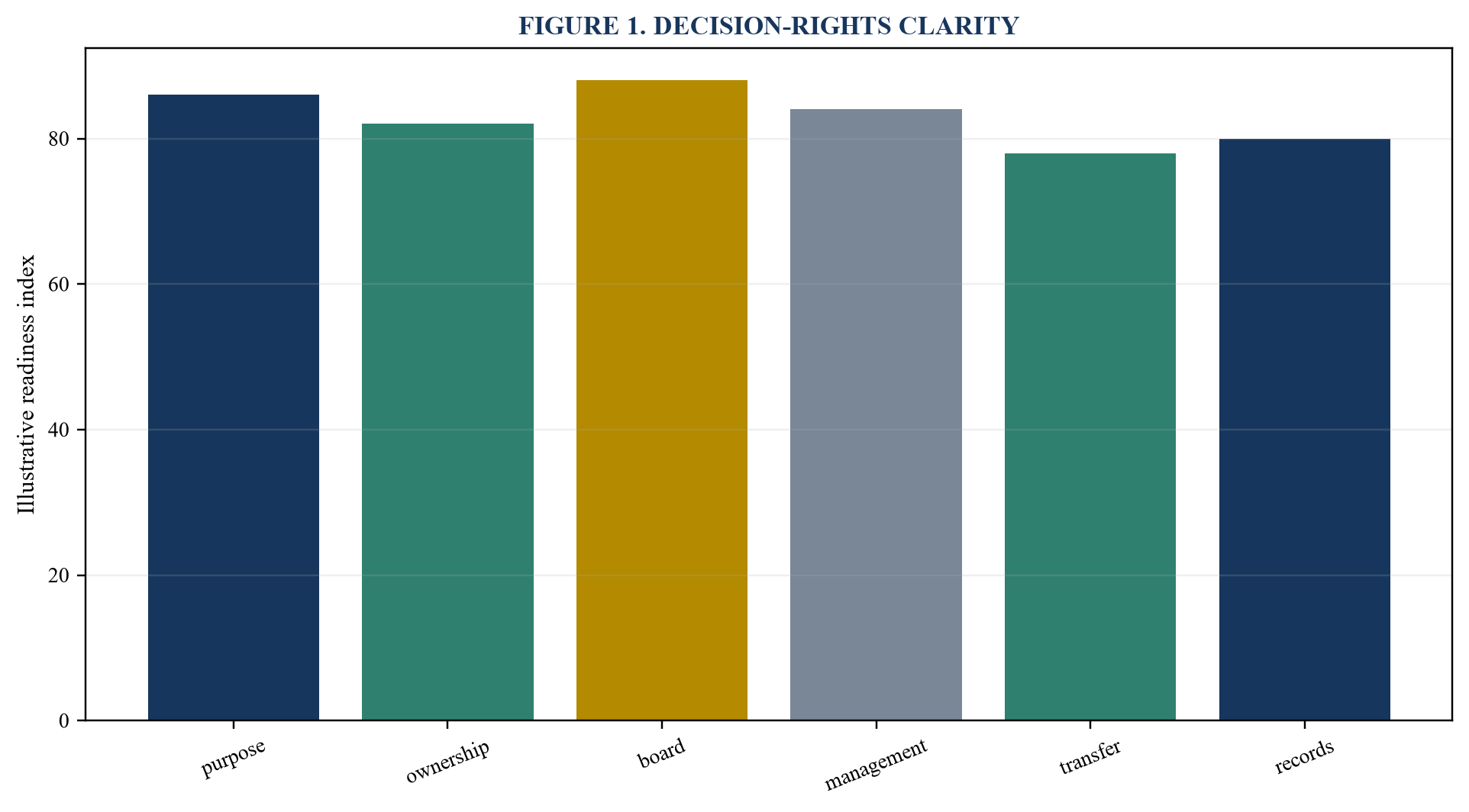
Values are illustrative readiness indices and require company-specific evidence.
9. Create executable delegations
Convert authority into thresholds, signatories, substitutes, escalation times and evidence requirements.
The governance review should reconcile delegation matrix, bank mandates, powers of attorney, policies, system roles and approval logs. Each conclusion records the governing instrument, accountable authority, affected rights, dependency, required evidence, decision route and unresolved exception. The immediate output is an authority-and-signature map.
Design must be tested through executable decisions. Reviewers trace authority to source instruments, confirm that records are complete, simulate the required sequence and assess whether the enterprise can continue when a founder or family representative is unavailable. Company facts, ownership objectives, jurisdiction and transaction structure govern every conclusion.
Material gaps require an accountable owner, corrective instrument, professional advice, evidence requirement and decision date. Consequences should flow through control, liquidity, financing, valuation, diligence, consent timing, disclosure and transaction protection. Residual risk remains visible until the legal documents and operating practice align or authorised decision-makers approve a different route.
10. Control conflicts of interest
Identify family, director, shareholder and management conflicts and establish disclosure, recusal and independent review.
The governance review should reconcile interest registers, related-party data, board rules, procurement records and transaction histories. Each conclusion records the governing instrument, accountable authority, affected rights, dependency, required evidence, decision route and unresolved exception. The immediate output is a conflict-control protocol.
Design must be tested through executable decisions. Reviewers trace authority to source instruments, confirm that records are complete, simulate the required sequence and assess whether the enterprise can continue when a founder or family representative is unavailable. Company facts, ownership objectives, jurisdiction and transaction structure govern every conclusion.
Material gaps require an accountable owner, corrective instrument, professional advice, evidence requirement and decision date. Consequences should flow through control, liquidity, financing, valuation, diligence, consent timing, disclosure and transaction protection. Residual risk remains visible until the legal documents and operating practice align or authorised decision-makers approve a different route.
11. Design information rights
Define timely access to financial, strategic, risk and transaction information by role and legitimate purpose.
The governance review should reconcile articles, agreements, board packs, owner reports, privacy rules and confidentiality undertakings. Each conclusion records the governing instrument, accountable authority, affected rights, dependency, required evidence, decision route and unresolved exception. The immediate output is a tiered information-rights framework.
Design must be tested through executable decisions. Reviewers trace authority to source instruments, confirm that records are complete, simulate the required sequence and assess whether the enterprise can continue when a founder or family representative is unavailable. Company facts, ownership objectives, jurisdiction and transaction structure govern every conclusion.
Material gaps require an accountable owner, corrective instrument, professional advice, evidence requirement and decision date. Consequences should flow through control, liquidity, financing, valuation, diligence, consent timing, disclosure and transaction protection. Residual risk remains visible until the legal documents and operating practice align or authorised decision-makers approve a different route.
12. Set dividend and family-liquidity policy
Balance reinvestment, leverage, distributions, redemptions and branch liquidity through explicit rules and stress tests.
The governance review should reconcile cash forecasts, capital plans, covenants, tax advice, owner needs and historic distributions. Each conclusion records the governing instrument, accountable authority, affected rights, dependency, required evidence, decision route and unresolved exception. The immediate output is a governed liquidity and distribution policy.
Design must be tested through executable decisions. Reviewers trace authority to source instruments, confirm that records are complete, simulate the required sequence and assess whether the enterprise can continue when a founder or family representative is unavailable. Company facts, ownership objectives, jurisdiction and transaction structure govern every conclusion.
Material gaps require an accountable owner, corrective instrument, professional advice, evidence requirement and decision date. Consequences should flow through control, liquidity, financing, valuation, diligence, consent timing, disclosure and transaction protection. Residual risk remains visible until the legal documents and operating practice align or authorised decision-makers approve a different route.
13. Make transfer restrictions executable
Test permitted transfers, lock-ins, rights of first refusal, pre-emption, tag, drag and prohibited-holder rules.
The governance review should reconcile articles, shareholder agreement, family charter, register rules and legal opinions. Each conclusion records the governing instrument, accountable authority, affected rights, dependency, required evidence, decision route and unresolved exception. The immediate output is a transfer-control decision tree.
Design must be tested through executable decisions. Reviewers trace authority to source instruments, confirm that records are complete, simulate the required sequence and assess whether the enterprise can continue when a founder or family representative is unavailable. Company facts, ownership objectives, jurisdiction and transaction structure govern every conclusion.
Material gaps require an accountable owner, corrective instrument, professional advice, evidence requirement and decision date. Consequences should flow through control, liquidity, financing, valuation, diligence, consent timing, disclosure and transaction protection. Residual risk remains visible until the legal documents and operating practice align or authorised decision-makers approve a different route.
14. Design pre-emption and matching mechanics
Specify notice, price, timetable, funding proof, allocation and completion steps for internal transfers.
The governance review should reconcile constitutional documents, ownership data, financing capacity and dispute history. Each conclusion records the governing instrument, accountable authority, affected rights, dependency, required evidence, decision route and unresolved exception. The immediate output is an executable pre-emption protocol.
Design must be tested through executable decisions. Reviewers trace authority to source instruments, confirm that records are complete, simulate the required sequence and assess whether the enterprise can continue when a founder or family representative is unavailable. Company facts, ownership objectives, jurisdiction and transaction structure govern every conclusion.
Material gaps require an accountable owner, corrective instrument, professional advice, evidence requirement and decision date. Consequences should flow through control, liquidity, financing, valuation, diligence, consent timing, disclosure and transaction protection. Residual risk remains visible until the legal documents and operating practice align or authorised decision-makers approve a different route.
15. Establish valuation mechanics
Define independent-expert appointment, valuation date, standard of value, adjustments, information and challenge rights.
The governance review should reconcile transaction precedents, financial records, capital structure, valuation policy and legal documents. Each conclusion records the governing instrument, accountable authority, affected rights, dependency, required evidence, decision route and unresolved exception. The immediate output is a valuation-mechanics schedule.
Design must be tested through executable decisions. Reviewers trace authority to source instruments, confirm that records are complete, simulate the required sequence and assess whether the enterprise can continue when a founder or family representative is unavailable. Company facts, ownership objectives, jurisdiction and transaction structure govern every conclusion.
Material gaps require an accountable owner, corrective instrument, professional advice, evidence requirement and decision date. Consequences should flow through control, liquidity, financing, valuation, diligence, consent timing, disclosure and transaction protection. Residual risk remains visible until the legal documents and operating practice align or authorised decision-makers approve a different route.
16. Map succession triggers
Cover retirement, resignation, incapacity, death, divorce, insolvency, misconduct and voluntary transfer.
The governance review should reconcile personal and corporate instruments, insurance, contingency plans and governing law. Each conclusion records the governing instrument, accountable authority, affected rights, dependency, required evidence, decision route and unresolved exception. The immediate output is a succession-trigger register.
Design must be tested through executable decisions. Reviewers trace authority to source instruments, confirm that records are complete, simulate the required sequence and assess whether the enterprise can continue when a founder or family representative is unavailable. Company facts, ownership objectives, jurisdiction and transaction structure govern every conclusion.
Material gaps require an accountable owner, corrective instrument, professional advice, evidence requirement and decision date. Consequences should flow through control, liquidity, financing, valuation, diligence, consent timing, disclosure and transaction protection. Residual risk remains visible until the legal documents and operating practice align or authorised decision-makers approve a different route.
Table 2. Succession trigger controls
| Trigger | Immediate control | Continuity evidence |
|---|---|---|
| retirement | successor authority | approved transition plan |
| incapacity | substitute decision rights | effective legal instruments |
| death | estate and voting route | verified ownership continuity |
| deadlock | staged resolution | documented escalation path |
Illustrative programme design; company-specific facts and authorised advice govern.
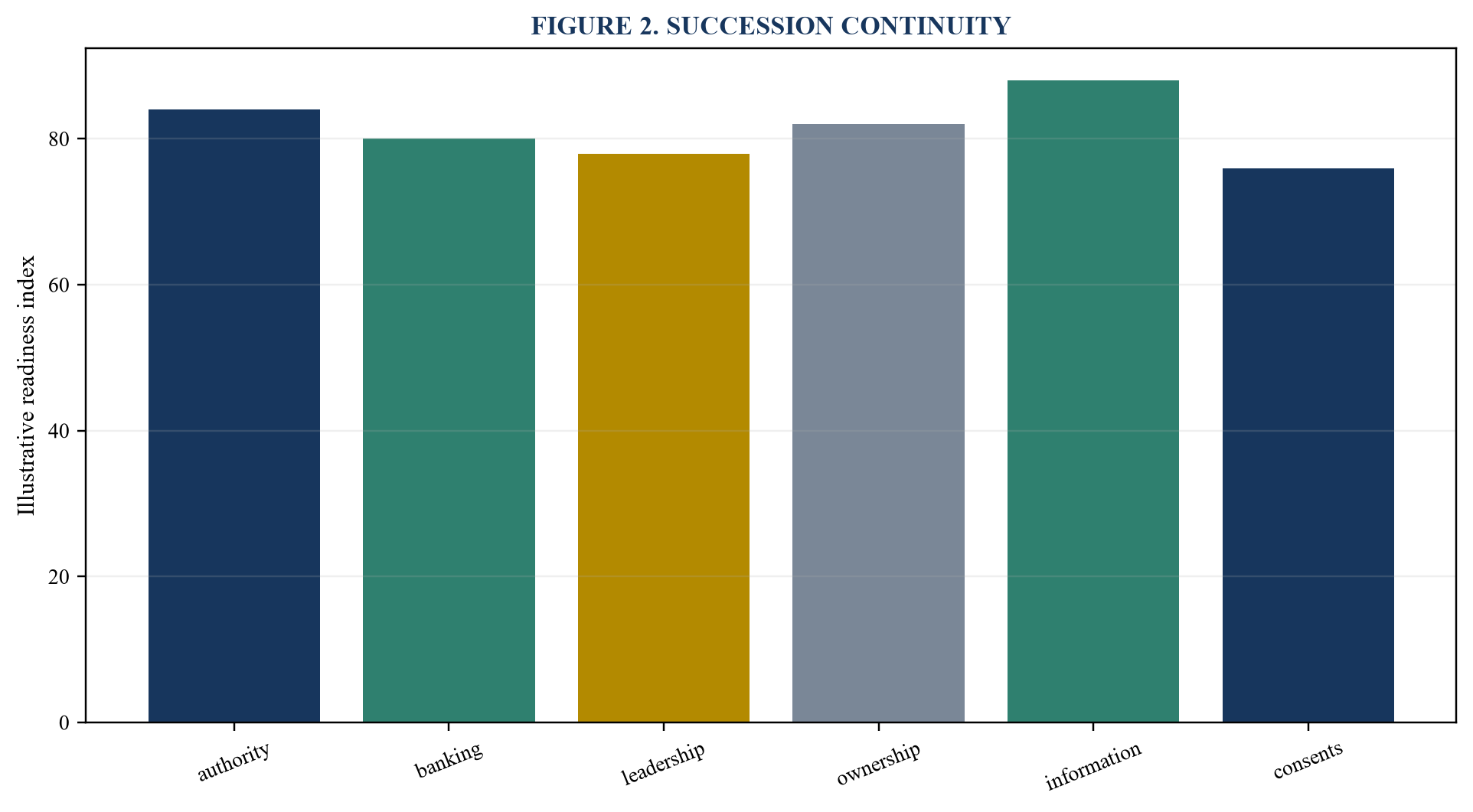
Values are illustrative readiness indices and require company-specific evidence.
17. Prepare for incapacity and death
Maintain continuity of voting, board authority, banking, management and ownership administration during personal events.
The governance review should reconcile wills, lasting authorities, foundation or trust documents, probate routes and emergency mandates. Each conclusion records the governing instrument, accountable authority, affected rights, dependency, required evidence, decision route and unresolved exception. The immediate output is an incapacity-and-estate continuity plan.
Design must be tested through executable decisions. Reviewers trace authority to source instruments, confirm that records are complete, simulate the required sequence and assess whether the enterprise can continue when a founder or family representative is unavailable. Company facts, ownership objectives, jurisdiction and transaction structure govern every conclusion.
Material gaps require an accountable owner, corrective instrument, professional advice, evidence requirement and decision date. Consequences should flow through control, liquidity, financing, valuation, diligence, consent timing, disclosure and transaction protection. Residual risk remains visible until the legal documents and operating practice align or authorised decision-makers approve a different route.
18. Govern family employment
Set merit-based entry, reporting, remuneration, performance, development, promotion and exit standards.
The governance review should reconcile role specifications, remuneration data, appraisal records, market benchmarks and conflict policy. Each conclusion records the governing instrument, accountable authority, affected rights, dependency, required evidence, decision route and unresolved exception. The immediate output is a family-employment policy.
Design must be tested through executable decisions. Reviewers trace authority to source instruments, confirm that records are complete, simulate the required sequence and assess whether the enterprise can continue when a founder or family representative is unavailable. Company facts, ownership objectives, jurisdiction and transaction structure govern every conclusion.
Material gaps require an accountable owner, corrective instrument, professional advice, evidence requirement and decision date. Consequences should flow through control, liquidity, financing, valuation, diligence, consent timing, disclosure and transaction protection. Residual risk remains visible until the legal documents and operating practice align or authorised decision-makers approve a different route.
19. Institutionalise management selection
Separate ownership privilege from executive appointment and define succession, assessment and removal decisions.
The governance review should reconcile organisation design, competency profiles, performance evidence, nominations and board minutes. Each conclusion records the governing instrument, accountable authority, affected rights, dependency, required evidence, decision route and unresolved exception. The immediate output is a merit-led leadership protocol.
Design must be tested through executable decisions. Reviewers trace authority to source instruments, confirm that records are complete, simulate the required sequence and assess whether the enterprise can continue when a founder or family representative is unavailable. Company facts, ownership objectives, jurisdiction and transaction structure govern every conclusion.
Material gaps require an accountable owner, corrective instrument, professional advice, evidence requirement and decision date. Consequences should flow through control, liquidity, financing, valuation, diligence, consent timing, disclosure and transaction protection. Residual risk remains visible until the legal documents and operating practice align or authorised decision-makers approve a different route.
20. Reduce key-person dependency
Transfer relationships, authority, knowledge, credentials and decision capacity from concentrated individuals.
The governance review should reconcile relationship maps, process records, access rights, role charters and succession plans. Each conclusion records the governing instrument, accountable authority, affected rights, dependency, required evidence, decision route and unresolved exception. The immediate output is a management-continuity programme.
Design must be tested through executable decisions. Reviewers trace authority to source instruments, confirm that records are complete, simulate the required sequence and assess whether the enterprise can continue when a founder or family representative is unavailable. Company facts, ownership objectives, jurisdiction and transaction structure govern every conclusion.
Material gaps require an accountable owner, corrective instrument, professional advice, evidence requirement and decision date. Consequences should flow through control, liquidity, financing, valuation, diligence, consent timing, disclosure and transaction protection. Residual risk remains visible until the legal documents and operating practice align or authorised decision-makers approve a different route.
21. Separate family-council and board work
Route family cohesion, education and legacy matters away from corporate strategy, oversight and fiduciary decisions.
The governance review should reconcile charters, agendas, issue logs, reserved matters and board duties. Each conclusion records the governing instrument, accountable authority, affected rights, dependency, required evidence, decision route and unresolved exception. The immediate output is a family-board interface map.
Design must be tested through executable decisions. Reviewers trace authority to source instruments, confirm that records are complete, simulate the required sequence and assess whether the enterprise can continue when a founder or family representative is unavailable. Company facts, ownership objectives, jurisdiction and transaction structure govern every conclusion.
Material gaps require an accountable owner, corrective instrument, professional advice, evidence requirement and decision date. Consequences should flow through control, liquidity, financing, valuation, diligence, consent timing, disclosure and transaction protection. Residual risk remains visible until the legal documents and operating practice align or authorised decision-makers approve a different route.
22. Represent family branches fairly
Create objective representation, rotation, nomination and communication rules without disabling company governance.
The governance review should reconcile family tree, ownership data, branch agreements, skills needs and minority rights. Each conclusion records the governing instrument, accountable authority, affected rights, dependency, required evidence, decision route and unresolved exception. The immediate output is a branch-representation framework.
Design must be tested through executable decisions. Reviewers trace authority to source instruments, confirm that records are complete, simulate the required sequence and assess whether the enterprise can continue when a founder or family representative is unavailable. Company facts, ownership objectives, jurisdiction and transaction structure govern every conclusion.
Material gaps require an accountable owner, corrective instrument, professional advice, evidence requirement and decision date. Consequences should flow through control, liquidity, financing, valuation, diligence, consent timing, disclosure and transaction protection. Residual risk remains visible until the legal documents and operating practice align or authorised decision-makers approve a different route.
23. Protect minority shareholders
Operationalise equal treatment, information, participation, related-party safeguards, liquidity and exit rights.
The governance review should reconcile law, constitutional documents, valuations, board practice and shareholder records. Each conclusion records the governing instrument, accountable authority, affected rights, dependency, required evidence, decision route and unresolved exception. The immediate output is a minority-protection register.
Design must be tested through executable decisions. Reviewers trace authority to source instruments, confirm that records are complete, simulate the required sequence and assess whether the enterprise can continue when a founder or family representative is unavailable. Company facts, ownership objectives, jurisdiction and transaction structure govern every conclusion.
Material gaps require an accountable owner, corrective instrument, professional advice, evidence requirement and decision date. Consequences should flow through control, liquidity, financing, valuation, diligence, consent timing, disclosure and transaction protection. Residual risk remains visible until the legal documents and operating practice align or authorised decision-makers approve a different route.
24. Resolve deadlock and disputes
Sequence negotiation, independent chair, mediation, expert determination, arbitration, buy-sell and court remedies.
The governance review should reconcile deadlock clauses, dispute history, authority thresholds, valuation mechanics and governing law. Each conclusion records the governing instrument, accountable authority, affected rights, dependency, required evidence, decision route and unresolved exception. The immediate output is a staged dispute-resolution ladder.
Design must be tested through executable decisions. Reviewers trace authority to source instruments, confirm that records are complete, simulate the required sequence and assess whether the enterprise can continue when a founder or family representative is unavailable. Company facts, ownership objectives, jurisdiction and transaction structure govern every conclusion.
Material gaps require an accountable owner, corrective instrument, professional advice, evidence requirement and decision date. Consequences should flow through control, liquidity, financing, valuation, diligence, consent timing, disclosure and transaction protection. Residual risk remains visible until the legal documents and operating practice align or authorised decision-makers approve a different route.
Table 3. Minority and dispute safeguards
| Risk | Preventive control | Resolution route |
|---|---|---|
| information asymmetry | tiered owner reporting | independent review |
| related-party value transfer | recusal and benchmarking | challenge and remedy |
| illiquidity | transfer and valuation rules | structured exit |
| decision deadlock | clear thresholds | mediation to buy-sell |
Illustrative programme design; company-specific facts and authorised advice govern.
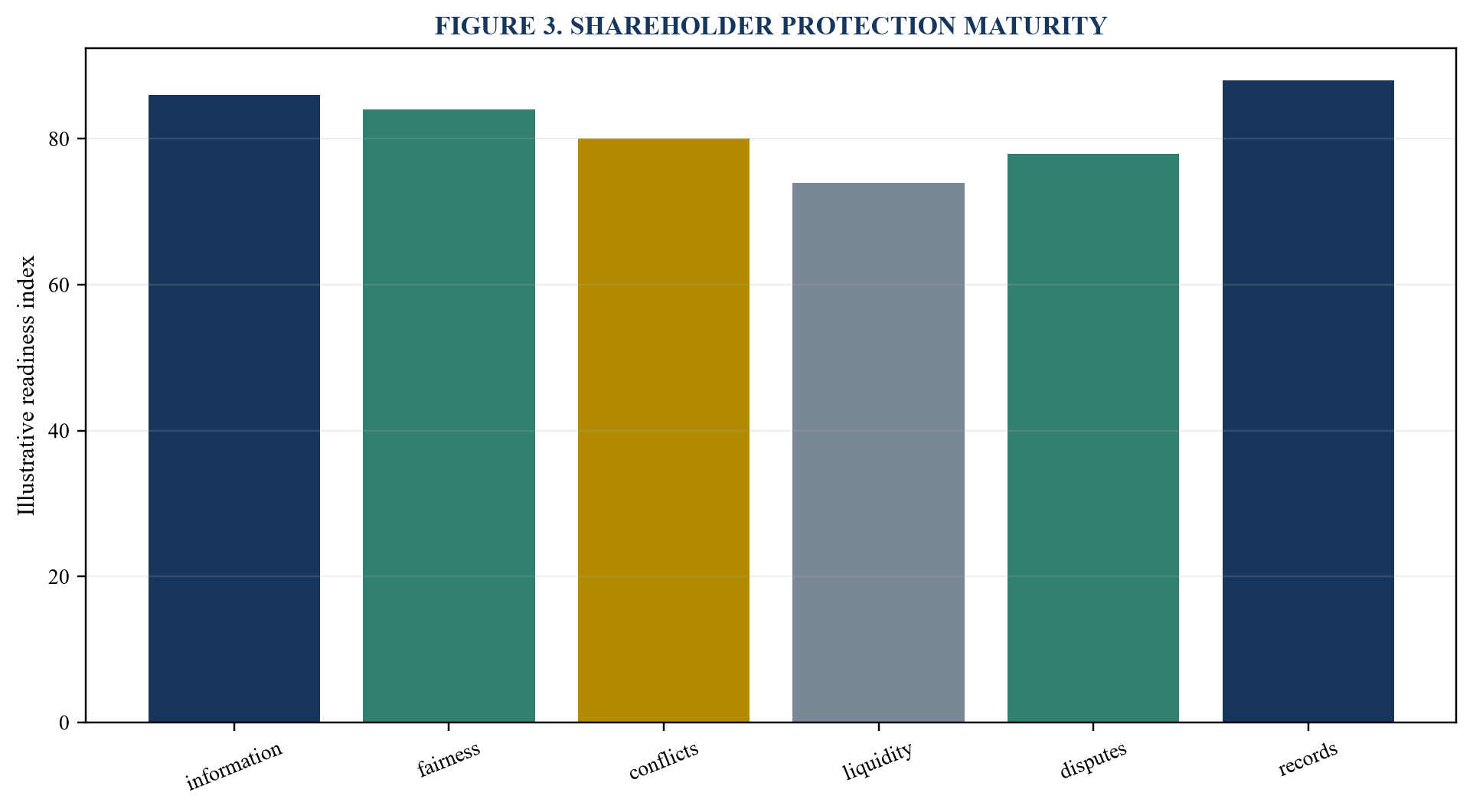
Values are illustrative readiness indices and require company-specific evidence.
25. Align governance with financing
Ensure borrowing, security, guarantees, distributions and covenant decisions can be approved and performed on time.
The governance review should reconcile facility terms, ownership documents, delegations, security registers and cash forecasts. Each conclusion records the governing instrument, accountable authority, affected rights, dependency, required evidence, decision route and unresolved exception. The immediate output is a financeability governance test.
Design must be tested through executable decisions. Reviewers trace authority to source instruments, confirm that records are complete, simulate the required sequence and assess whether the enterprise can continue when a founder or family representative is unavailable. Company facts, ownership objectives, jurisdiction and transaction structure govern every conclusion.
Material gaps require an accountable owner, corrective instrument, professional advice, evidence requirement and decision date. Consequences should flow through control, liquidity, financing, valuation, diligence, consent timing, disclosure and transaction protection. Residual risk remains visible until the legal documents and operating practice align or authorised decision-makers approve a different route.
26. Prepare for external investors and lenders
Translate family controls into credible board, reporting, consent, protection and enforcement arrangements.
The governance review should reconcile investor requirements, lender diligence, reporting systems, conflicts and constitutional rights. Each conclusion records the governing instrument, accountable authority, affected rights, dependency, required evidence, decision route and unresolved exception. The immediate output is an institutional-capital readiness pack.
Design must be tested through executable decisions. Reviewers trace authority to source instruments, confirm that records are complete, simulate the required sequence and assess whether the enterprise can continue when a founder or family representative is unavailable. Company facts, ownership objectives, jurisdiction and transaction structure govern every conclusion.
Material gaps require an accountable owner, corrective instrument, professional advice, evidence requirement and decision date. Consequences should flow through control, liquidity, financing, valuation, diligence, consent timing, disclosure and transaction protection. Residual risk remains visible until the legal documents and operating practice align or authorised decision-makers approve a different route.
27. Create a sale mandate
Define seller authority, perimeter, objectives, advisers, disclosure, negotiation limits and approval gates.
The governance review should reconcile ownership mandate, reserved matters, valuation cases, tax analysis and transaction plan. Each conclusion records the governing instrument, accountable authority, affected rights, dependency, required evidence, decision route and unresolved exception. The immediate output is a controlled sale-authority charter.
Design must be tested through executable decisions. Reviewers trace authority to source instruments, confirm that records are complete, simulate the required sequence and assess whether the enterprise can continue when a founder or family representative is unavailable. Company facts, ownership objectives, jurisdiction and transaction structure govern every conclusion.
Material gaps require an accountable owner, corrective instrument, professional advice, evidence requirement and decision date. Consequences should flow through control, liquidity, financing, valuation, diligence, consent timing, disclosure and transaction protection. Residual risk remains visible until the legal documents and operating practice align or authorised decision-makers approve a different route.
28. Make governance diligence-ready
Prove ownership, authority, board validity, conflicts, succession, transferability and transaction consent.
The governance review should reconcile registers, minutes, agreements, policies, filings, legal opinions and exception logs. Each conclusion records the governing instrument, accountable authority, affected rights, dependency, required evidence, decision route and unresolved exception. The immediate output is a governance evidence room.
Design must be tested through executable decisions. Reviewers trace authority to source instruments, confirm that records are complete, simulate the required sequence and assess whether the enterprise can continue when a founder or family representative is unavailable. Company facts, ownership objectives, jurisdiction and transaction structure govern every conclusion.
Material gaps require an accountable owner, corrective instrument, professional advice, evidence requirement and decision date. Consequences should flow through control, liquidity, financing, valuation, diligence, consent timing, disclosure and transaction protection. Residual risk remains visible until the legal documents and operating practice align or authorised decision-makers approve a different route.
29. Control related-party transactions
Identify benefits, pricing, approvals, recusals, disclosures, settlements and continuing arrangements.
The governance review should reconcile party register, contracts, invoices, benchmarks, board minutes and accounting records. Each conclusion records the governing instrument, accountable authority, affected rights, dependency, required evidence, decision route and unresolved exception. The immediate output is a related-party transaction ledger.
Design must be tested through executable decisions. Reviewers trace authority to source instruments, confirm that records are complete, simulate the required sequence and assess whether the enterprise can continue when a founder or family representative is unavailable. Company facts, ownership objectives, jurisdiction and transaction structure govern every conclusion.
Material gaps require an accountable owner, corrective instrument, professional advice, evidence requirement and decision date. Consequences should flow through control, liquidity, financing, valuation, diligence, consent timing, disclosure and transaction protection. Residual risk remains visible until the legal documents and operating practice align or authorised decision-makers approve a different route.
30. Reconcile tax and residency consequences
Map residence, domicile, substance, controlled entities, inheritance, gains, distributions and reporting duties.
The governance review should reconcile tax filings, travel and residence evidence, entity records, advice and transaction scenarios. Each conclusion records the governing instrument, accountable authority, affected rights, dependency, required evidence, decision route and unresolved exception. The immediate output is a tax-and-residency decision map.
Design must be tested through executable decisions. Reviewers trace authority to source instruments, confirm that records are complete, simulate the required sequence and assess whether the enterprise can continue when a founder or family representative is unavailable. Company facts, ownership objectives, jurisdiction and transaction structure govern every conclusion.
Material gaps require an accountable owner, corrective instrument, professional advice, evidence requirement and decision date. Consequences should flow through control, liquidity, financing, valuation, diligence, consent timing, disclosure and transaction protection. Residual risk remains visible until the legal documents and operating practice align or authorised decision-makers approve a different route.
31. Choose ownership vehicles deliberately
Compare direct holding, companies, partnerships, trusts and foundations against control, succession and transaction needs.
The governance review should reconcile asset map, jurisdictions, family objectives, legal and tax advice and administrative capacity. Each conclusion records the governing instrument, accountable authority, affected rights, dependency, required evidence, decision route and unresolved exception. The immediate output is an ownership-vehicle options paper.
Design must be tested through executable decisions. Reviewers trace authority to source instruments, confirm that records are complete, simulate the required sequence and assess whether the enterprise can continue when a founder or family representative is unavailable. Company facts, ownership objectives, jurisdiction and transaction structure govern every conclusion.
Material gaps require an accountable owner, corrective instrument, professional advice, evidence requirement and decision date. Consequences should flow through control, liquidity, financing, valuation, diligence, consent timing, disclosure and transaction protection. Residual risk remains visible until the legal documents and operating practice align or authorised decision-makers approve a different route.
32. Clean the cap table and registers
Resolve missing issuances, inconsistent classes, nominees, pledges, options, restrictions and beneficial ownership.
The governance review should reconcile statutory registers, certificates, resolutions, filings, agreements and bank records. Each conclusion records the governing instrument, accountable authority, affected rights, dependency, required evidence, decision route and unresolved exception. The immediate output is a verified transaction cap table.
Design must be tested through executable decisions. Reviewers trace authority to source instruments, confirm that records are complete, simulate the required sequence and assess whether the enterprise can continue when a founder or family representative is unavailable. Company facts, ownership objectives, jurisdiction and transaction structure govern every conclusion.
Material gaps require an accountable owner, corrective instrument, professional advice, evidence requirement and decision date. Consequences should flow through control, liquidity, financing, valuation, diligence, consent timing, disclosure and transaction protection. Residual risk remains visible until the legal documents and operating practice align or authorised decision-makers approve a different route.
Table 4. Transaction governance gate
| Gate | Required proof | Failure signal |
|---|---|---|
| ownership | clean legal and beneficial title | unresolved nominee or estate issue |
| authority | valid board and owner approvals | conflicting documents |
| transferability | executable rights and consents | unfunded or circular mechanism |
| continuity | management and banking remain operable | single-person dependency |
Illustrative programme design; company-specific facts and authorised advice govern.
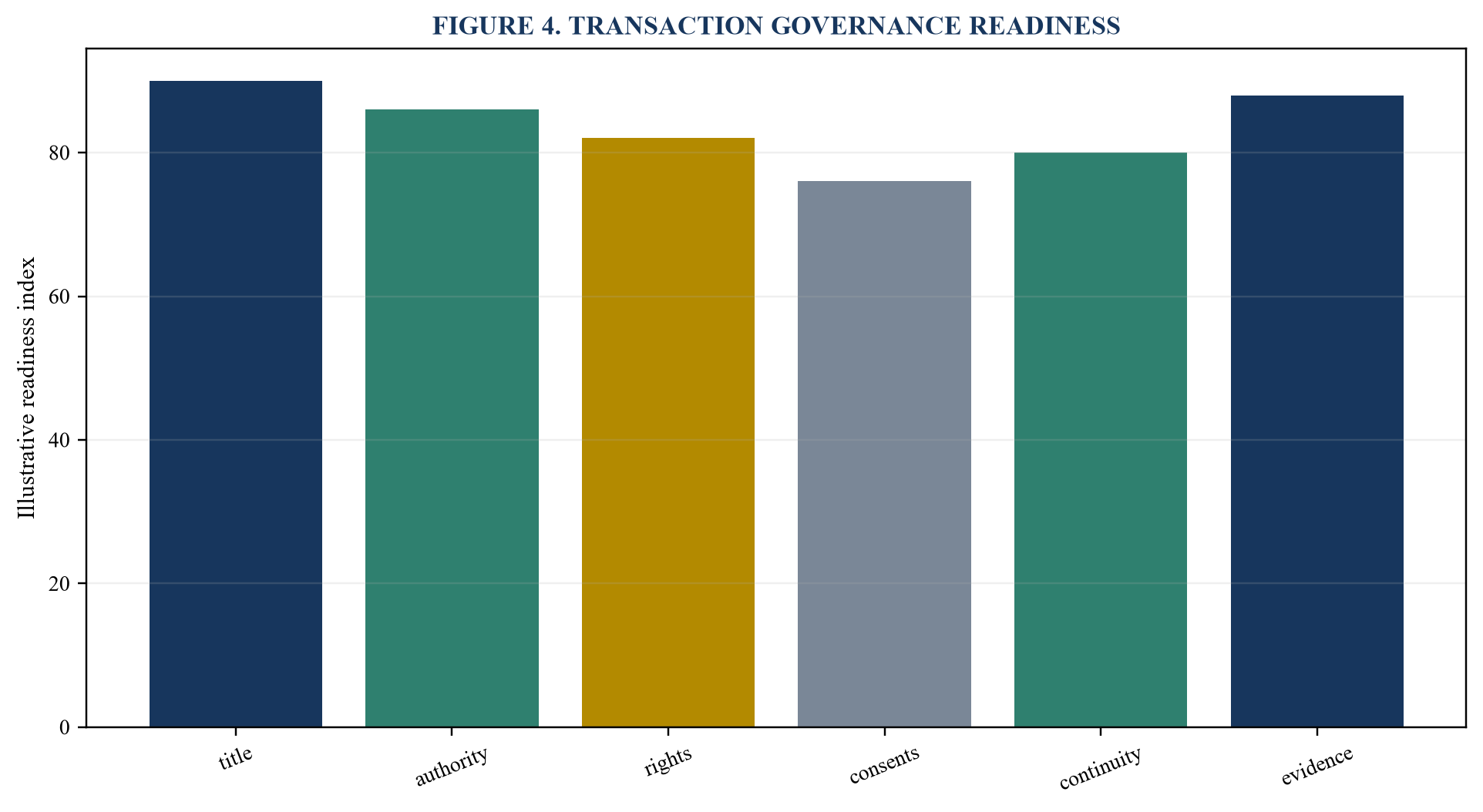
Values are illustrative readiness indices and require company-specific evidence.
33. Establish document authority
Identify the governing hierarchy and resolve inconsistencies across law, articles, agreements, charters and private instruments.
The governance review should reconcile complete document inventory, amendment history, opinions and executed approvals. Each conclusion records the governing instrument, accountable authority, affected rights, dependency, required evidence, decision route and unresolved exception. The immediate output is a governance document hierarchy.
Design must be tested through executable decisions. Reviewers trace authority to source instruments, confirm that records are complete, simulate the required sequence and assess whether the enterprise can continue when a founder or family representative is unavailable. Company facts, ownership objectives, jurisdiction and transaction structure govern every conclusion.
Material gaps require an accountable owner, corrective instrument, professional advice, evidence requirement and decision date. Consequences should flow through control, liquidity, financing, valuation, diligence, consent timing, disclosure and transaction protection. Residual risk remains visible until the legal documents and operating practice align or authorised decision-makers approve a different route.
34. Protect confidential family information
Control privacy, cyber security, access, retention and disclosure across family and transaction systems.
The governance review should reconcile data map, access logs, policies, contracts, incident records and technical tests. Each conclusion records the governing instrument, accountable authority, affected rights, dependency, required evidence, decision route and unresolved exception. The immediate output is a family-information control plan.
Design must be tested through executable decisions. Reviewers trace authority to source instruments, confirm that records are complete, simulate the required sequence and assess whether the enterprise can continue when a founder or family representative is unavailable. Company facts, ownership objectives, jurisdiction and transaction structure govern every conclusion.
Material gaps require an accountable owner, corrective instrument, professional advice, evidence requirement and decision date. Consequences should flow through control, liquidity, financing, valuation, diligence, consent timing, disclosure and transaction protection. Residual risk remains visible until the legal documents and operating practice align or authorised decision-makers approve a different route.
35. Run governance crisis simulations
Test death, incapacity, deadlock, cyber incident, covenant breach, unsolicited approach and urgent sale scenarios.
The governance review should reconcile scenario scripts, delegations, contacts, legal routes, recovery plans and observed decisions. Each conclusion records the governing instrument, accountable authority, affected rights, dependency, required evidence, decision route and unresolved exception. The immediate output is a governance resilience test.
Design must be tested through executable decisions. Reviewers trace authority to source instruments, confirm that records are complete, simulate the required sequence and assess whether the enterprise can continue when a founder or family representative is unavailable. Company facts, ownership objectives, jurisdiction and transaction structure govern every conclusion.
Material gaps require an accountable owner, corrective instrument, professional advice, evidence requirement and decision date. Consequences should flow through control, liquidity, financing, valuation, diligence, consent timing, disclosure and transaction protection. Residual risk remains visible until the legal documents and operating practice align or authorised decision-makers approve a different route.
36. Map transaction consents
Sequence shareholder, board, lender, regulator, trustee, foundation, counterparty and court approvals.
The governance review should reconcile consent clauses, regulatory rules, financing documents, timetable and accountable owners. Each conclusion records the governing instrument, accountable authority, affected rights, dependency, required evidence, decision route and unresolved exception. The immediate output is a transaction-consent critical path.
Design must be tested through executable decisions. Reviewers trace authority to source instruments, confirm that records are complete, simulate the required sequence and assess whether the enterprise can continue when a founder or family representative is unavailable. Company facts, ownership objectives, jurisdiction and transaction structure govern every conclusion.
Material gaps require an accountable owner, corrective instrument, professional advice, evidence requirement and decision date. Consequences should flow through control, liquidity, financing, valuation, diligence, consent timing, disclosure and transaction protection. Residual risk remains visible until the legal documents and operating practice align or authorised decision-makers approve a different route.
37. Create the transferable-control playbook
Translate governance into step-by-step instructions for financing, minority investment, sale and generational transfer.
The governance review should reconcile decision trees, authority maps, documents, evidence, advisers and transaction scenarios. Each conclusion records the governing instrument, accountable authority, affected rights, dependency, required evidence, decision route and unresolved exception. The immediate output is a controlled transfer playbook.
Design must be tested through executable decisions. Reviewers trace authority to source instruments, confirm that records are complete, simulate the required sequence and assess whether the enterprise can continue when a founder or family representative is unavailable. Company facts, ownership objectives, jurisdiction and transaction structure govern every conclusion.
Material gaps require an accountable owner, corrective instrument, professional advice, evidence requirement and decision date. Consequences should flow through control, liquidity, financing, valuation, diligence, consent timing, disclosure and transaction protection. Residual risk remains visible until the legal documents and operating practice align or authorised decision-makers approve a different route.
38. Govern transition after a transaction
Set interim authority, retained rights, management roles, information, integration, earn-out and exit arrangements.
The governance review should reconcile transaction documents, transition plan, governance schedule, incentives and reporting. Each conclusion records the governing instrument, accountable authority, affected rights, dependency, required evidence, decision route and unresolved exception. The immediate output is a post-transaction governance blueprint.
Design must be tested through executable decisions. Reviewers trace authority to source instruments, confirm that records are complete, simulate the required sequence and assess whether the enterprise can continue when a founder or family representative is unavailable. Company facts, ownership objectives, jurisdiction and transaction structure govern every conclusion.
Material gaps require an accountable owner, corrective instrument, professional advice, evidence requirement and decision date. Consequences should flow through control, liquidity, financing, valuation, diligence, consent timing, disclosure and transaction protection. Residual risk remains visible until the legal documents and operating practice align or authorised decision-makers approve a different route.
39. Test governance annually
Review legal change, ownership events, documents, authorities, systems, competence, conflicts and simulations.
The governance review should reconcile annual confirmations, registers, minutes, audit results, exceptions and remediation evidence. Each conclusion records the governing instrument, accountable authority, affected rights, dependency, required evidence, decision route and unresolved exception. The immediate output is an annual governance assurance report.
Design must be tested through executable decisions. Reviewers trace authority to source instruments, confirm that records are complete, simulate the required sequence and assess whether the enterprise can continue when a founder or family representative is unavailable. Company facts, ownership objectives, jurisdiction and transaction structure govern every conclusion.
Material gaps require an accountable owner, corrective instrument, professional advice, evidence requirement and decision date. Consequences should flow through control, liquidity, financing, valuation, diligence, consent timing, disclosure and transaction protection. Residual risk remains visible until the legal documents and operating practice align or authorised decision-makers approve a different route.
40. Issue the transferable-control conclusion
Present enforceability, operational readiness, residual risks, transaction dependencies and authorised remediation.
The governance review should reconcile ownership map, document matrix, tests, legal advice, valuation mechanics and board decisions. Each conclusion records the governing instrument, accountable authority, affected rights, dependency, required evidence, decision route and unresolved exception. The immediate output is a board-ready transferable-control report.
Design must be tested through executable decisions. Reviewers trace authority to source instruments, confirm that records are complete, simulate the required sequence and assess whether the enterprise can continue when a founder or family representative is unavailable. Company facts, ownership objectives, jurisdiction and transaction structure govern every conclusion.
Material gaps require an accountable owner, corrective instrument, professional advice, evidence requirement and decision date. Consequences should flow through control, liquidity, financing, valuation, diligence, consent timing, disclosure and transaction protection. Residual risk remains visible until the legal documents and operating practice align or authorised decision-makers approve a different route.
Table 5. Transferable-control certificate
| Dimension | Required conclusion | Decision use |
|---|---|---|
| lawful | instruments align with governing law | enforceability |
| operable | rights can be exercised on time | continuity |
| financeable | capital providers can rely on controls | funding |
| transferable | sale or succession can complete | transaction authority |
Illustrative programme design; company-specific facts and authorised advice govern.
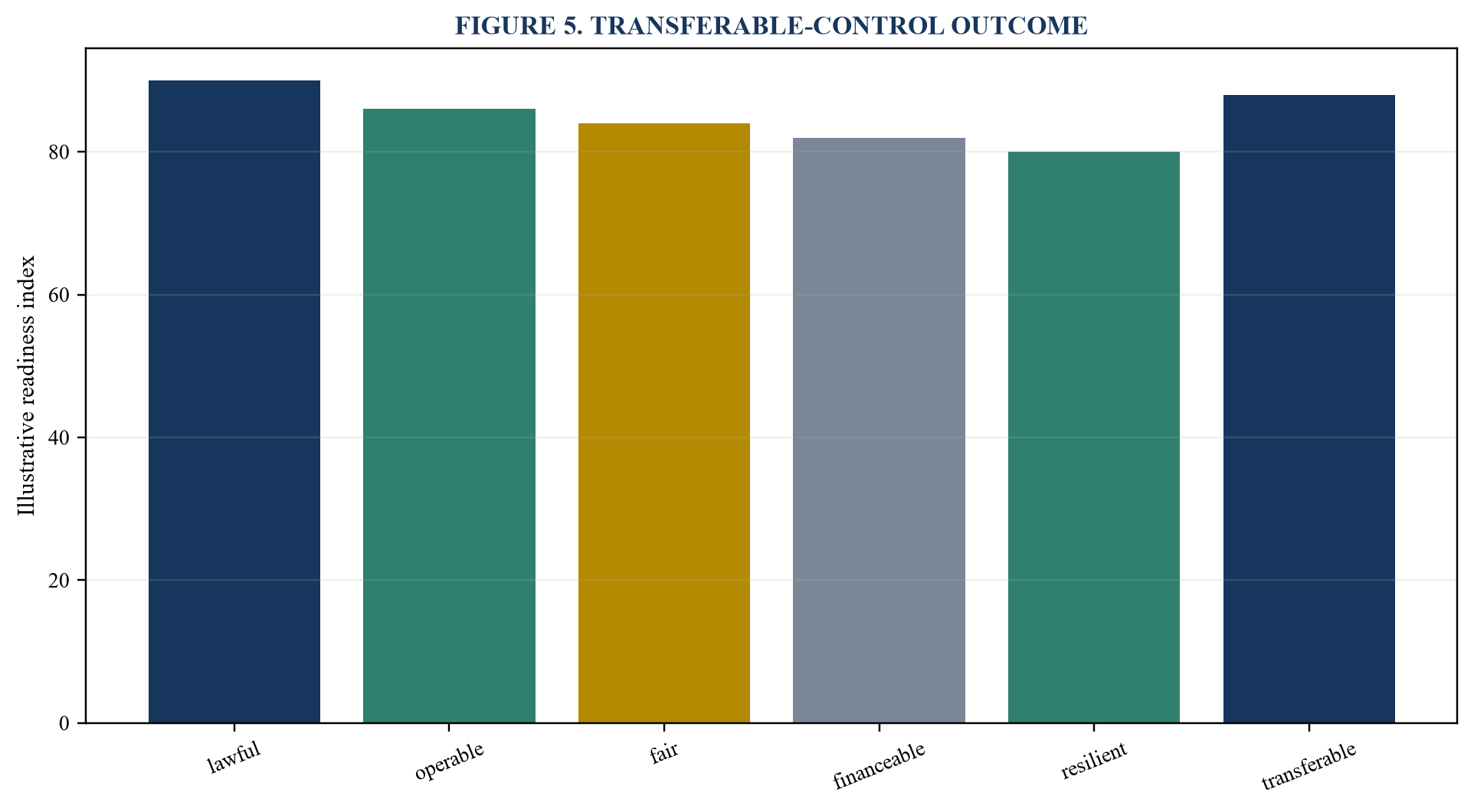
Values are illustrative readiness indices and require company-specific evidence.
References
- United Arab Emirates, Federal Decree-Law No. 37 of 2022 Concerning Family Businesses, https://uaelegislation.gov.ae/en/legislations/1608
- UAE Ministry of Economy and Tourism, Companies Legislation including Federal Decree-Law No. 32 of 2021, https://www.moet.gov.ae/en/companies-legislations
- Dubai International Financial Centre, Family Arrangements Regulations 2023, https://assets.difc.com/v1/media/edge/images/dubaiintern0078-difcexperie96c5-production-3253/media/project/difcexperiences/difc/difcwebsite/documents/familydocs/family_arrangements_regulations_updated_april23.pdf
- Dubai International Financial Centre, Private and Family Wealth Laws and Resources, https://www.difc.com/business/difc-private-and-family-wealth-offering
- Dubai International Financial Centre, Companies Law and Regulations, https://www.difc.com/business/laws-and-regulations/legal-database
- Abu Dhabi Global Market, Foundations Regime, https://www.adgm.com/media/announcements/abu-dhabi-global-market-launches-1st-foundations-regime-in-the-uae
- International Finance Corporation, Family Business Governance Handbook, https://www.ifc.org/en/insights-reports/2011/ifc-family-business-governance-handbook
- OECD, G20 OECD Principles of Corporate Governance 2023, https://doi.org/10.1787/ed750b30-en
- OECD, Responsibilities of the Board, G20 OECD Principles of Corporate Governance 2023, https://www.oecd.org/en/publications/g20-oecd-principles-of-corporate-governance-2023_ed750b30-en/full-report/component-8.html
- UK Government, Companies Act 2006, https://www.legislation.gov.uk/ukpga/2006/46/contents
- UK Government, Model Articles of Association for Limited Companies, https://www.gov.uk/guidance/model-articles-of-association-for-limited-companies
- UK Takeover Panel, The Takeover Code, https://www.thetakeoverpanel.org.uk/the-code/download-code
- IFRS Foundation, IFRS 10 Consolidated Financial Statements, https://www.ifrs.org/issued-standards/list-of-standards/ifrs-10-consolidated-financial-statements/
- IFRS Foundation, IAS 24 Related Party Disclosures, https://www.ifrs.org/issued-standards/list-of-standards/ias-24-related-party-disclosures/
- IFRS Foundation, IFRS 3 Business Combinations, https://www.ifrs.org/issued-standards/list-of-standards/ifrs-3-business-combinations/
- IFRS Foundation, IAS 32 Financial Instruments Presentation, https://www.ifrs.org/issued-standards/list-of-standards/ias-32-financial-instruments-presentation/
- IFRS Foundation, IFRS 9 Financial Instruments, https://www.ifrs.org/issued-standards/list-of-standards/ifrs-9-financial-instruments/
- IFRS Foundation, IFRS 13 Fair Value Measurement, https://www.ifrs.org/issued-standards/list-of-standards/ifrs-13-fair-value-measurement/
- International Organization for Standardization, ISO 31000 Risk Management Guidelines, https://www.iso.org/iso-31000-risk-management.html
- National Institute of Standards and Technology, Cybersecurity Framework 2.0, https://doi.org/10.6028/NIST.CSWP.29
- US Department of Justice, Evaluation of Corporate Compliance Programs, September 2024, https://www.justice.gov/criminal/criminal-fraud/page/file/937501
- UK Competition and Markets Authority, Merger Assessment Guidelines, https://www.gov.uk/government/publications/merger-assessment-guidelines/merger-assessment-guidelines-html-version
- US Federal Trade Commission, HSR Notification Forms Instructions and Guidance, https://www.ftc.gov/enforcement/premerger-notification-program/hsr-notification-forms-instructions-guidance
- European Union, General Data Protection Regulation, https://eur-lex.europa.eu/eli/reg/2016/679/oj
- United Arab Emirates, Federal Decree-Law No. 45 of 2021 Concerning the Protection of Personal Data, https://uaelegislation.gov.ae/en/legislations/1972
- International Auditing and Assurance Standards Board, ISA 500 Audit Evidence, https://www.iaasb.org/publications/international-standard-auditing-isa-500-audit-evidence
