

1. Begin with the family purpose
A foundation is an instrument for a defined purpose. The design brief should state the family problem before selecting a jurisdiction or drafting constitutional documents. Relevant problems can include continuity of ownership, governance of a family enterprise, controlled support for descendants, preservation of strategic assets, philanthropy, management of incapacity, conflict resolution, separation of voting and economic interests, or continuity across residence changes.
The purpose should be operational. A statement such as preserving family wealth provides little direction. Management needs to understand which assets are intended to remain together, who may decide, who may benefit, when distributions may occur, whether capital can be pledged, which activities are prohibited, how family branches are represented, how disputes are resolved and how the structure can adapt after death, divorce, incapacity, sanctions, migration or business sale.
The foundation should also be tested against alternatives. Direct ownership, a holding company, a trust, partnership, will, shareholder agreement, family constitution, insurance arrangement or several coordinated vehicles may serve parts of the objective. A foundation can hold shares in a family enterprise while personal liquidity, pensions, regulated investment vehicles and certain operating risks remain elsewhere. The complete architecture can therefore include several legal forms.
The private bank should document the intended service. The family may require custody, discretionary management, advisory portfolios, private markets, secured credit, treasury, foreign exchange, consolidated reporting, payments and family-governance support. Each service needs an authorised client, permitted activity, account route, decision owner, evidence file and recovery path.
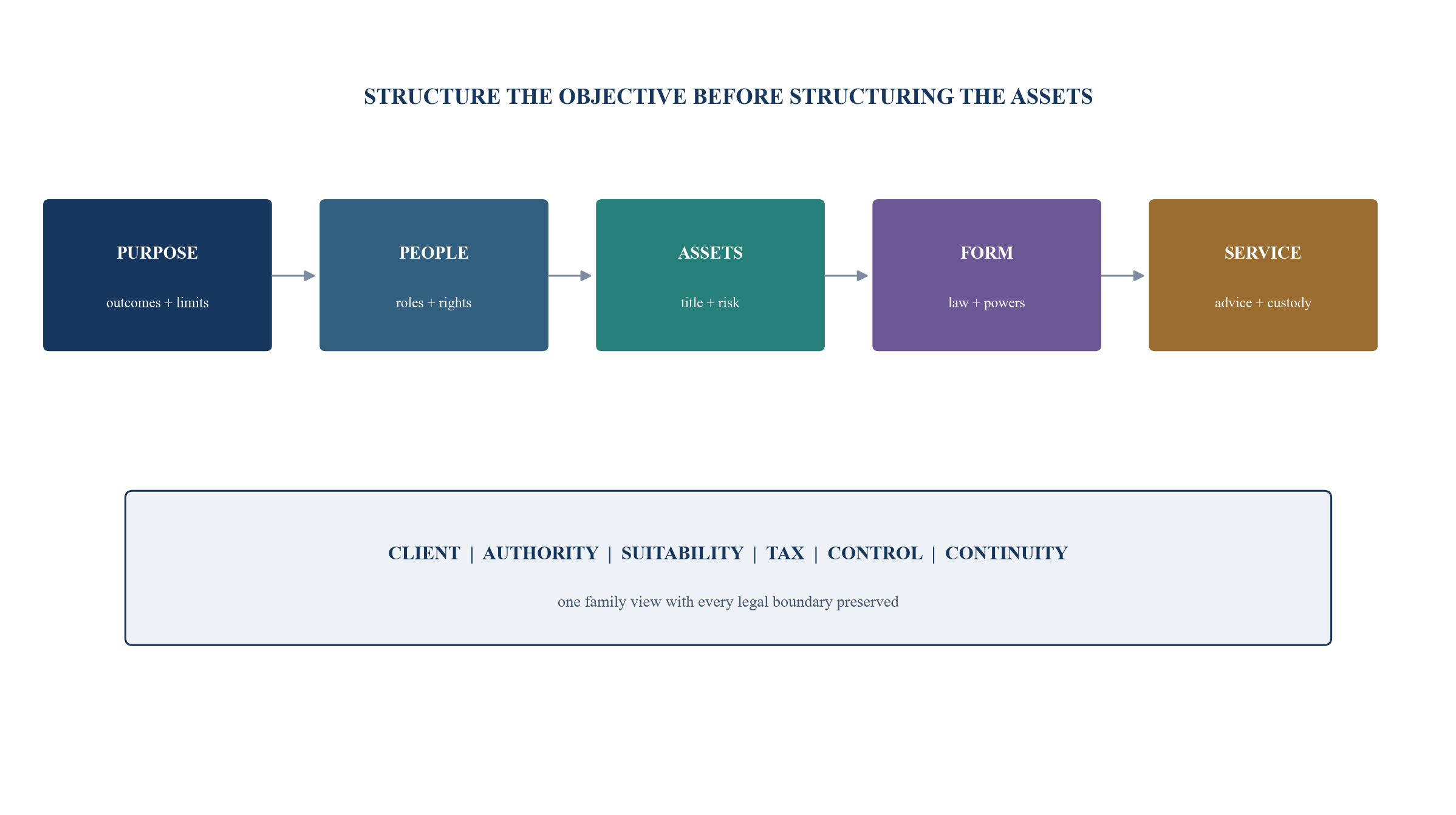
Author framework. Legal form follows the purpose, people, assets, powers and intended service.
2. Separate the legal client from the family relationship
The private bank can serve a family while holding several distinct client relationships. A foundation account belongs to the foundation. Personal accounts belong to individuals. A holding-company account belongs to that company. A trust account follows the trustee or applicable account-holder analysis. An operating-company facility belongs to the borrower and requires its own authority, purpose and credit analysis.
This distinction should remain visible in client systems, agreements, advice, orders, fees, statements, complaints and tax reporting. A group relationship identifier can connect the family network for permitted service and risk oversight. It should not merge ownership, authority or fiduciary duties. Consolidated reporting should disclose its informational nature and source limitations where it combines assets held under different mandates.
The foundation's roles require separate identification. The founder may establish the structure and retain defined rights. Council members administer it. A guardian may supervise or protect its purposes in the circumstances required by the regime or documents. Beneficiaries may have fixed, discretionary, contingent or information rights. Other natural persons may exercise ultimate effective control. A family office, investment adviser, company service provider or authorised signatory may perform delegated functions without owning the assets.
FATF's 2024 guidance emphasises adequate, accurate and up-to-date beneficial-ownership information for legal arrangements and equivalent roles. The exact treatment of a foundation depends on the applicable law and local implementation. The bank's file should therefore record each person's legal capacity, source document, powers, restrictions, relationship to other parties, identification status and review trigger.
Table 1. Foundation client-and-role control map
| Party or layer | Principal evidence | Banking decision |
|---|---|---|
| foundation | registration, charter, by-laws or regulations, purpose, powers, good standing | account holder, service scope and legal capacity |
| founder or founders | identity, source of wealth, retained rights, contributions and tax residence | origin of assets, influence and change triggers |
| council or governing body | appointment, acceptance, powers, quorum, conflicts and resolutions | authority to open, invest, borrow, pledge and distribute |
| guardian or supervisory role | appointment, consent powers, information rights and removal provisions | additional approval or oversight required for decisions |
| beneficiaries or classes | identity or class definition, rights, contingencies, distributions and residence | due diligence, suitability relevance and reporting |
| controllers and authorised persons | ultimate control, delegation, mandates, signatures and system access | transaction authority and monitoring |
| family office and advisers | engagement, regulated status, scope, conflicts, fees and data access | delegation, reliance, advice ownership and supervision |
| underlying entities and assets | title, ownership chain, contracts, liabilities and valuations | custody, product, credit, reporting and concentration risk |
Role labels and legal consequences depend on the selected regime and constitutional documents.
3. Map powers before opening accounts
Constitutional documents should be converted into an operational powers matrix. The bank needs to know who can appoint and remove council members, amend the charter or by-laws, add or remove beneficiaries, approve investments, change managers, open accounts, borrow, pledge assets, guarantee liabilities, make distributions, obtain information, migrate the foundation, merge it or wind it up.
The matrix should distinguish unilateral powers, joint powers, reserved matters, negative consents and duties to consult. It should state whether a power is personal, fiduciary, delegable, time-limited, conditional or exercisable after an event. It should also connect every power to the document and provision that creates it. A scanned signature list alone cannot establish the full authority architecture.
Banking workflows should enforce the matrix. An investment order may require a council resolution and investment-manager authority. A pledge may require an express power, a conflict review, guardian consent and evidence that the transaction serves the foundation's purposes. A distribution may require a valid beneficiary decision, liquidity analysis, sanctions screening and tax-reporting data. A residence change can alter reporting or advice even when authority is unchanged.
Authority should be reviewed after changes to the founder, council, guardian, beneficiaries, family circumstances, constitutional documents, service providers, asset base or governing law. The relationship manager should see the current conclusion and expiry date while legal and operations retain the supporting evidence.
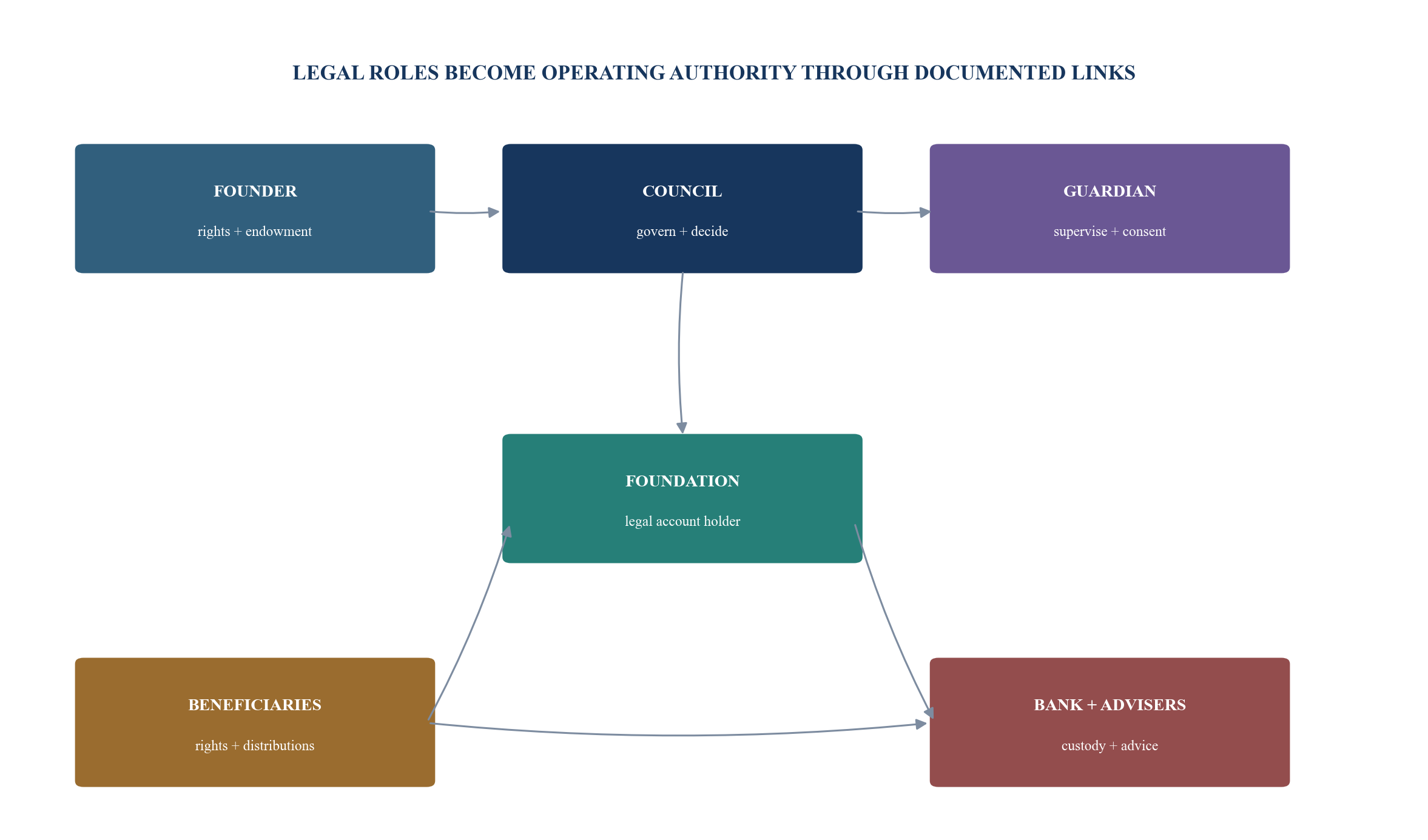
Author framework. Every arrow represents a documented power, duty, consent or information right.
4. Choose jurisdiction and legal form through evidence
Jurisdiction selection should follow the complete case rather than a registration fee or familiar label. The analysis should cover legal personality, permissible purposes, founder rights, council composition, guardian requirements, beneficiary rights, confidentiality and access to information, court jurisdiction, migration, merger, winding up, accounting, audit, beneficial ownership, licensed service providers, asset protection, insolvency and recognition where assets or family members are located.
DIFC's framework includes foundations within a broader private and family wealth offering, together with family offices, holding companies and special-purpose vehicles. Its Family Arrangements Regulations address family businesses, wealth preservation, succession and the manner in which advisers and service providers support families. ADGM describes separate legal personality, founder-control features, confidentiality with regulatory access, court oversight and migration. Its May 2026 amendments changed elements of the Foundations Regulations and restricted purposes falling within its definition of non-profit organisations. Current implementation should therefore use the amended text and official guidance.
Jersey's current consolidated law provides a statutory foundation with incorporation, charter and regulations, council, qualified-member and guardian provisions. Guernsey has a separate foundations law and treats foundation formation, management and administration as regulated fiduciary activity. The Cayman Islands' 2025 Revision maintains a foundation-company form within companies legislation. These examples demonstrate material differences in legal architecture, terminology and service-provider perimeter.
The bank should require jurisdiction-specific opinions for capacity, authority, enforceability, security, insolvency, reporting and relevant tax questions. Recognition should be examined where custody accounts, real estate, operating companies, family members or litigation are located. A foundation validly incorporated in one centre does not settle every question elsewhere.
Table 2. Jurisdiction and legal-form decision matrix
| Dimension | Evidence to obtain | Decision question |
|---|---|---|
| purpose and permitted activity | law, charter, restrictions, commercial and philanthropic boundaries | can the intended family objective be performed lawfully? |
| personality and asset title | incorporation, ownership capacity, firewall and recognition analysis | who owns assets and enters contracts? |
| governance | founder rights, council, guardian, beneficiary and court powers | who decides, supervises and resolves failure? |
| privacy and transparency | public and private registers, authority access, beneficial ownership and filings | which information is held, disclosed and refreshed? |
| service-provider perimeter | registered office, qualified member, CSP, fiduciary licensing and audit | which local professionals are mandatory or regulated? |
| mobility and continuity | migration, merger, amendment, replacement and winding-up rules | can the structure adapt or exit without losing control? |
| tax and reporting | entity classification, residence, CRS, distributions and asset-location advice | which filings, self-certifications and reporting follow? |
| banking operability | account capacity, custody, security, product and data requirements | can the bank deliver the intended service in practice? |
This qualitative matrix is a diligence agenda and does not rank or recommend a jurisdiction.
5. Design one family view with separate legal books
Integrated service requires two connected views. The legal-book view preserves the foundation, personal, company, trust and other account holders separately. The family view shows aggregate exposure, liquidity, objectives, concentrations, distributions, liabilities and service dependencies where the clients have authorised the combination and data use.
The family view should never create authority. A founder may view information without power to transact. A council member may act for the foundation without authority over personal accounts. A beneficiary may receive a distribution without a right to direct investments. A family-office employee may prepare analysis without providing regulated advice or holding signature authority. Systems should display these differences.
Data-sharing permissions should be documented by entity and person. The file should identify controllers, processors, recipients, purposes, legal bases, access groups, retention, international transfers and revocation. Consolidated reports should identify valuation dates, currencies, sources, missing assets and whether the view is for information, investment advice, credit assessment or governance.
Family-level risk management can still be valuable. It can reveal concentrated operating-company exposure, duplicated funds, currency mismatch, excessive leverage, cross-collateralisation, liquidity shortages before distributions or tax payments, and dependence on one custodian or decision maker. Actions must then be authorised through the relevant legal account.
6. Rebuild suitability for the foundation mandate
A foundation's investment mandate should follow its purposes, powers, liabilities, distribution policy, beneficiary horizon, liquidity needs, risk capacity, restrictions and governance. An individual founder's knowledge, preferences and willingness to accept risk can inform the context. They do not automatically become the legal client's objectives.
The bank should identify the accountable decision maker and the people whose knowledge and experience are relevant under the applicable service and law. It should distinguish investment advice to the foundation from family-governance discussion, tax coordination, product information and personal advice to founders or beneficiaries. Conflicts can arise where one person occupies several roles or where the bank serves parties with different interests.
The investment policy should address strategic allocation, liquidity tiers, distributions, private assets, operating-company concentration, currency, leverage, guarantees, ESG or mission constraints, prohibited assets, valuation, rebalancing, manager selection and review triggers. It should state who approves amendments and how exceptions are handled.
The advice file should link the recommendation to the foundation mandate, current powers, asset and liability data, product evidence, total cost, alternatives, conflicts, custody, liquidity and decision record. A later change to beneficiaries, expected distributions, governing body or family enterprise can require a suitability refresh.
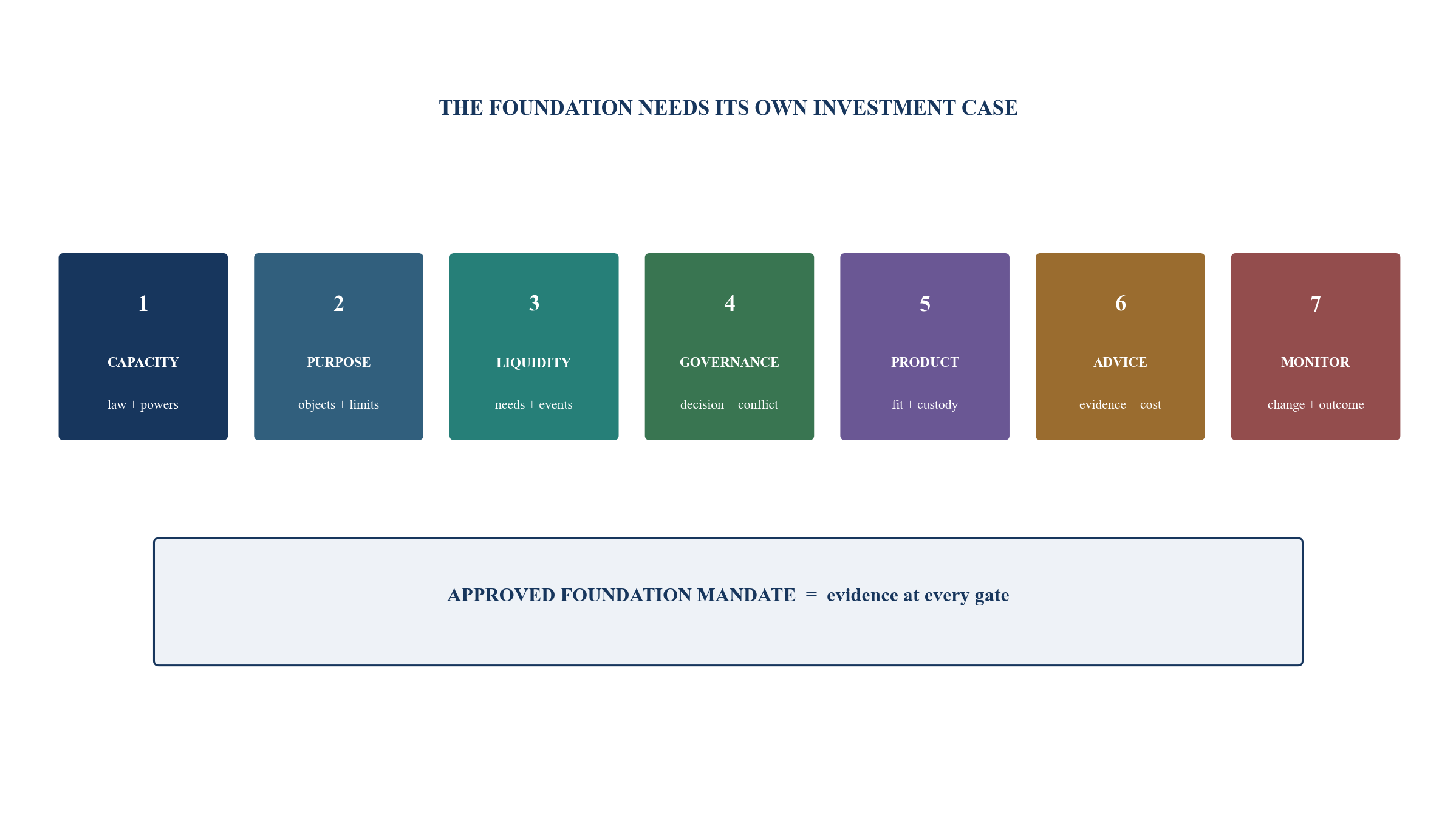
Author framework. The client mandate is rebuilt from the foundation's own purpose and evidence.
7. Build the product shelf around powers and purpose
The approved shelf should combine legal capacity, constitutional powers, investment policy, client classification, product approval, distribution permission, custody capability, liquidity, valuation, tax reporting, conflicts and monitoring. A product held in the founder's personal account may be unavailable or inappropriate for the foundation.
Private-market assets require special analysis. Subscription documents, capital calls, transfer restrictions, side letters, valuation, tax reporting and beneficiary liquidity needs can extend beyond the current council's term. A foundation that owns a family enterprise may already carry substantial illiquid concentration. Adding private funds, private credit or direct deals can reduce the capacity to make distributions or support operating needs.
The shelf should distinguish direct ownership, fund or platform exposure, feeder vehicles, nominee arrangements, managed accounts and structured products. Each route changes legal title, fees, reporting, custody, counterparty exposure and exit. The bank should establish who receives product information, who approves, who signs, whose knowledge matters and who monitors the holding.
Mission-related or philanthropic purposes need additional controls. The team should distinguish an investment intended to earn a risk-adjusted return from a grant, programme-related expenditure or benefit. ADGM's 2026 amendments restricting specified non-profit purposes show why current legal scope must be confirmed rather than assumed from an older structure guide.
8. Treat custody and asset transfer as separate projects
Transferring assets into a foundation can change title, control, reporting, tax, security interests and succession outcomes. The bank should identify each asset, present owner, acquisition history, valuation, liabilities, restrictions, consents, governing law, custodian, income, tax basis and intended transfer instrument.
Some assets cannot be transferred readily. Fund interests may require manager consent. Private-company shares may be restricted by articles or shareholder agreements. Real estate follows local registration and financing rules. Intellectual property, aircraft, yachts, insurance policies, carried interests, digital assets and partnership interests can require specialised analysis. A pledged asset can require lender consent or replacement security.
Custody diligence should establish whether the foundation can hold each asset through the proposed account, how it is valued, who instructs, how income and corporate actions are processed, which sub-custodians or nominees are used, and what happens after council change, death, incapacity, dispute, sanctions, custodian failure or migration.
The transfer plan should have explicit gates. The foundation should exist and have capacity. Governance and authority should be operative. Legal and tax advice should cover the actual asset and parties. Required consent and valuation should be obtained. The bank should complete due diligence before receipt. The post-transfer records should reconcile legal title, custody, accounting and family reporting.
Table 3. Asset-transfer readiness workflow
| Stage | Required evidence | Stop condition |
|---|---|---|
| define intended endowment | asset list, owner, purpose, value, income and liabilities | asset or objective is unclear |
| confirm foundation capacity | law, charter, by-laws, powers and governing-body approval | foundation lacks power or approval |
| assess transfer route | instrument, consent, tax, creditor, regulatory and registration analysis | transfer is prohibited or unresolved |
| complete due diligence | source of wealth and funds, ownership, valuation, sanctions and adverse information | bank cannot complete required checks |
| establish custody | account, title, nominee, valuation, settlement and reporting route | asset cannot be held or serviced safely |
| execute and reconcile | signed documents, payment, registry, custodian and accounting records | title or consideration does not reconcile |
| monitor after transfer | valuations, income, restrictions, distributions and change events | material change invalidates the approved case |
Every asset requires its own legal, tax, consent, valuation and operational conclusion.
9. Integrate beneficial ownership and source of wealth
Foundation structures require a role-based due-diligence model. FATF's guidance on legal arrangements identifies settlors or equivalent founders, trustees or equivalent governing persons, protectors or equivalent supervisory roles, beneficiaries or classes and other natural persons exercising ultimate effective control. A foundation can be a legal person in its jurisdiction while performing functions similar to a trust. Applicable definitions and local implementation must be used.
The bank should identify and verify the foundation, founders, council, guardian, beneficiaries and other controllers as required. It should understand the purpose, source of wealth, source of each contribution, expected activity, asset geography, distributions, counterparties, service providers and reasons for the selected jurisdiction. Where a founder or contributor is an entity, the analysis should reach relevant natural persons and establish the economic source.
Complexity should be explainable. Multiple entities can serve legitimate objectives, including governance, liability separation, co-ownership and investment access. Complexity without a clear economic and family purpose can increase financial-crime, tax, sanctions, fraud and reputational risk. FINMA's current materials emphasise the risks of complex structures, high-risk countries, source of assets and business relationships that lack clear purpose.
Monitoring should operate at transaction and network level. A payment may be ordinary for one account while inconsistent with the foundation's purpose or distribution policy. Alerts should cover unexpected contributors, transfers to non-beneficiaries, rapid pass-through flows, operating-company transactions without expertise, high-risk geographies, unexplained loans, related-party guarantees, changes in controllers and activity inconsistent with constitutional powers.
10. Make tax reporting an operating control
Tax analysis belongs to qualified advisers for the actual family, structure and assets. The bank still needs operational data to classify accounts, obtain self-certifications, identify relevant controlling persons, report financial accounts and process distributions or income correctly.
The OECD Common Reporting Standard connects entity accounts with account-holder classification and, where relevant, controlling persons. Its implementation materials link the concept to domestic anti-money-laundering procedures. Foundations that are functionally similar to trusts can require equivalent role-based analysis under relevant reporting frameworks. The exact result depends on whether the entity is a financial institution, active or passive non-financial entity, the nature of its assets and management, and local implementation.
The file should capture the foundation's tax residence or residences, classification, tax identification information, founders, council, guardian, beneficiaries or classes, controlling persons, distributions and changes in circumstances as required. Personal residence, citizenship or domicile can differ from the foundation's status and from the location of assets or service providers.
Operational controls should generate refreshes after amendments, new contributors, beneficiary changes, distributions, migration, investment-manager changes, substantial asset shifts or conflicting information. Tax outcomes should never be assumed from legal personality, registration location or a marketing description of the regime.
11. Design credit without crossing legal boundaries
A family relationship can include personal borrowing, foundation credit, operating-company facilities and portfolio-backed lending. Each borrower, guarantor, pledgor and beneficiary of proceeds should be identified separately. The bank should establish capacity, corporate benefit or foundation purpose, authority, conflicts, security ownership, use of proceeds, cash-flow source, covenant package and enforcement route.
A foundation may have power to borrow or pledge assets. That power does not establish that every facility serves its purposes or protects beneficiaries. A loan for a founder's personal need can create a related-party transaction, distribution, tax, governance or fiduciary issue. A guarantee for an operating company can expose foundation assets to business risk and change beneficiary liquidity.
Credit analysis should examine the legal enforceability of security over custodial assets, private-company shares, fund interests, real estate and other property. It should also model asset volatility, liquidity, valuation frequency, capital calls, currency, concentration, transfer restrictions, sanctions and the effect of death, incapacity, council change or dispute.
The relationship team should not present family-level net worth as a substitute for borrower-level repayment and security analysis. Family support should be documented through enforceable commitments or excluded from the base case. Cross-default and cross-collateral arrangements should be transparent to every affected legal client.
12. Price the complete service
Foundation service economics combine advice, investment management, custody, transaction execution, credit, reporting, administration, legal coordination, financial-crime controls, data and governance support. Revenue should be connected to the entity providing the service and the legal client paying for it. The family view should also show the complete cost across bank, product and external providers where available.
An apparently attractive relationship can consume substantial specialist capacity. Initial work can include structural diligence, account-holder analysis, source-of-wealth reconstruction, asset transfer, legal opinions, tax coordination, product exceptions, consolidated reporting and bespoke credit. Continuing work can include council changes, distributions, private-asset valuation, beneficiary events, monitoring and reporting.
The bank should distinguish one-time implementation, recurring service and event-driven work. Fee waivers or bundling should retain a transparent rationale. External product income, retrocessions, lending margin, foreign-exchange spread and custody fees should be assessed under applicable law and conflicts policy.
The following waterfall is a hypothetical management example for method demonstration. It describes no market price, client or expected result.
Table 4. Hypothetical annual family-foundation service waterfall
| Component | Hypothetical annual amount | Economic owner or evidence question |
|---|---|---|
| foundation advisory and management fee | USD 420,000 | which entity contracts, advises and carries suitability responsibility |
| custody, reporting and administration fee | USD 120,000 | who safeguards, reconciles, reports and services the legal accounts |
| product and transaction income | USD 165,000 | who approves, distributes, executes and monitors the holdings |
| credit and treasury revenue | USD 210,000 | which entity funds, prices and controls balance-sheet risk |
| direct relationship and investment cost | (USD 275,000) | client service, investment work, travel and governance support |
| legal, control and operating cost | (USD 245,000) | diligence, monitoring, data, operations, tax reporting and providers |
| capital, liquidity and risk charge | (USD 145,000) | credit, liquidity, concentration, operational and reputational risk |
| illustrative pre-tax contribution | USD 250,000 | reconciled outcome before entity-specific tax and approved allocations |
Every amount is a hypothetical management assumption; no market rate or client outcome is implied.
13. Give the relationship manager one evidence card
The relationship manager needs a concise, current view of the family and foundation without receiving unilateral authority to interpret the law. The evidence card should identify the legal client, purpose, jurisdiction, registration, constitutional documents, founders, council, guardian, beneficiaries, controllers, signatories, advisers, powers, restricted activities, accounts, custody, investment mandate, credit, reporting, data permissions and review dates.
The card should connect to controlled records rather than become an informal summary. Each conclusion needs a source, owner, effective date and expiry or change trigger. The system should prevent activity outside the current authority matrix and route uncertain questions to legal, compliance, tax, investment, credit or operations owners.
The family view should display which accounts are included and why. Staff should see whether a report is informational, whether advice is entity-specific, who can receive data, who can approve transactions, and which conflicts or disputes restrict communication. Family members can hold different rights and interests.
Training should use role and event scenarios: founder death, council replacement, beneficiary distribution, divorce, incapacity, residence change, business sale, sanctions alert, private-fund capital call, pledge request, tax-classification change and migration of the foundation. The correct action should follow the documents and approved workflow.
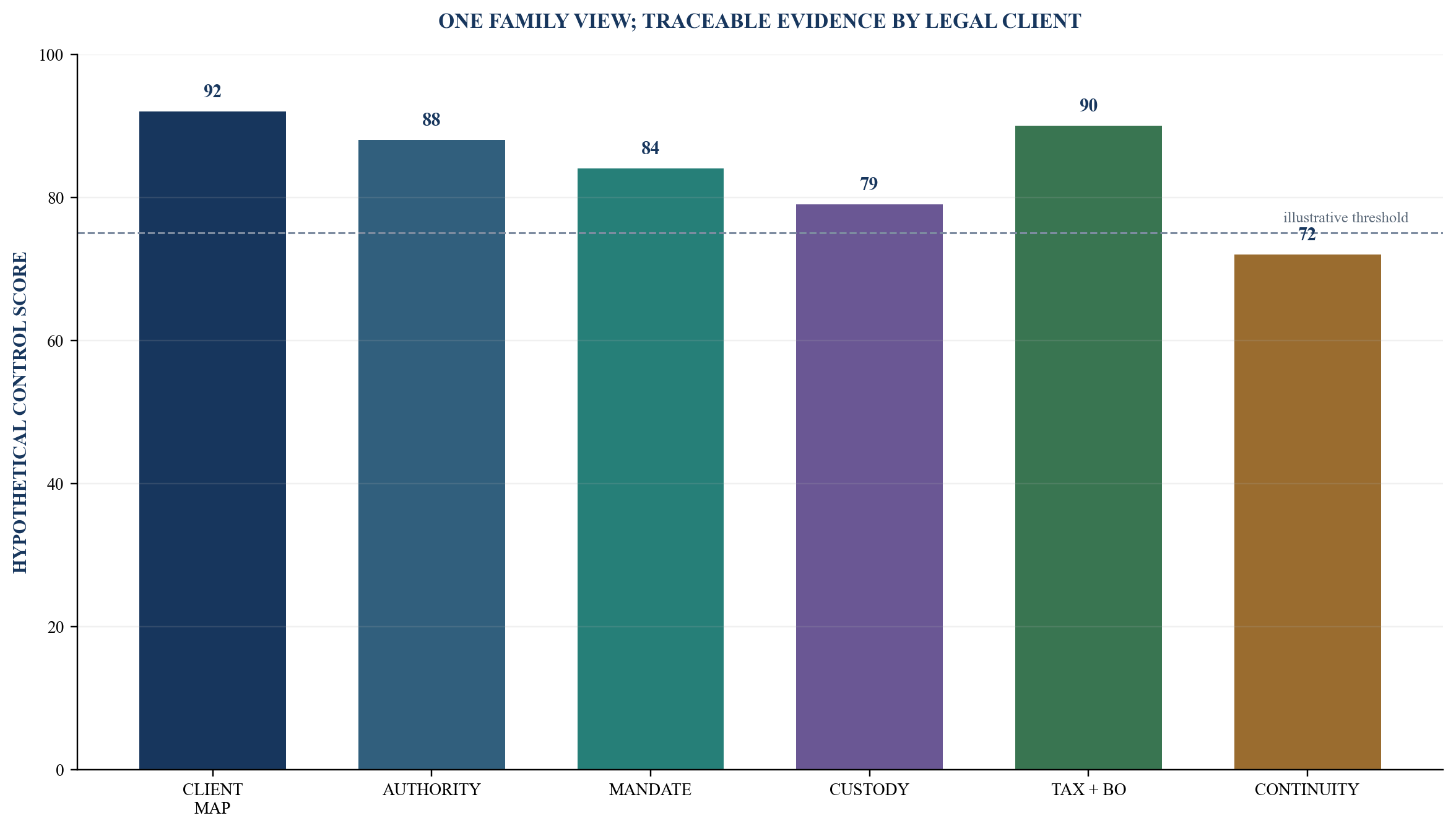
Author framework. Scores are hypothetical and require institution-specific thresholds and underlying evidence.
14. Govern distributions and beneficiary events
Distributions should follow constitutional powers, governing-body decisions, beneficiary status, purpose, liquidity, tax information, sanctions screening and account authority. The bank should distinguish a distribution, reimbursement, loan, payment for services, purchase of an asset, charitable grant and direct payment to a third party.
The workflow should establish who proposed the payment, who benefits, which provision permits it, which approvals apply, whether a conflict exists, how the amount was determined, which account pays, and which reporting follows. Repeated payments outside the stated family policy can signal governance drift or a change in purpose.
Beneficiary events should trigger proportionate review. A person may be added, removed, become entitled, receive a first distribution, change residence, become a politically exposed person, face sanctions, reach a specified age, die, become incapacitated or enter a dispute. The legal and reporting effect depends on the documents and applicable rules.
The investment team should incorporate expected distributions into liquidity planning. A long-duration private-market portfolio can be inconsistent with near-term beneficiary needs or mandatory payments. The governing body should retain a documented approach to reserves, exceptional support and equitable treatment across family branches where relevant.
15. Manage conflicts across family roles
Family-foundation structures concentrate roles. A founder may also be a council member, beneficiary, investment adviser, business owner and borrower. A private bank may provide investment products, custody, credit, foreign exchange and advice. External lawyers, tax advisers, fiduciaries and family-office staff can have continuing commercial relationships.
The conflict register should identify personal interests, related-party transactions, remuneration, product income, credit exposure, information asymmetry and disputes. It should state who assesses each conflict, who may participate, which independent approval or advice is required, what is disclosed and whether the transaction can proceed.
Serving several family members creates separate client duties. One branch may prefer business reinvestment while another seeks distributions. A founder may want retained control while future beneficiaries seek independent governance. Confidential personal accounts should not be disclosed through a family report without authority.
The bank should establish engagement boundaries before a dispute. It should know which legal clients it represents, whose instructions it accepts, how information is segregated, when independent advisers are required, and whether it can continue serving parties with diverging interests.
16. Stress the family network
The operating model should be tested through events that affect several entities. Scenarios include founder death, simultaneous incapacity, council deadlock, guardian removal, disputed beneficiary status, operating-company failure, large distribution, custody outage, cyber incident, sanctions designation, service-provider exit, tax reclassification and foundation migration.
Each scenario should identify legal authority, decision quorum, access to records, cash, custody, open orders, credit, collateral, communications, data, regulatory reporting and recovery. An investment portfolio can remain sound while the family loses the ability to instruct or access liquidity.
Continuity plans should include successor appointments, emergency signatories where lawful, locally accessible documents, alternate providers, communication protocols, distribution reserves, manual procedures and court or dispute routes. Every fallback should respect the foundation's law and documents.
The following cases are hypothetical management scenarios. They demonstrate the method and describe no actual family, asset or recommended structure.
Table 5. Hypothetical family-foundation cases
| Case | Service need | Principal design issue | Illustrative controlled route |
|---|---|---|---|
| founder-owned industrial group with USD 140 million of enterprise value | continuity of voting control, family liquidity and secured treasury | concentrated illiquid asset, several family branches and business credit | foundation holds governance stake; separate operating borrower; distribution reserve; entity-specific advice and security approvals |
| internationally mobile family with USD 75 million of financial assets | investment continuity, education support and multicurrency distributions | several residences, beneficiaries and account locations | foundation mandate with jurisdiction-specific advice; global custody; role-based reporting; event-driven residence and beneficiary reviews |
| entrepreneur after a USD 220 million sale | staged liquidity, private markets, philanthropy and next-generation governance | rapid endowment, product pressure and evolving family purpose | phased transfers; enhanced diligence; liquidity tiers; independent governance; separate investment and philanthropic decisions |
All facts, values and controlled routes are hypothetical assumptions used solely to demonstrate the framework.
17. Use seven approval gates
Gate one approves the family purpose, intended outcomes, parties and scope. Gate two confirms the jurisdiction, legal form, constitutional documents, service providers and recognition analysis. Gate three validates the client-and-role map, beneficial ownership, source of wealth and tax classifications. Gate four approves authority, accounts, data permissions and the family reporting architecture. Gate five approves investment, product, custody, credit and fee arrangements. Gate six completes asset transfer, operations, monitoring, continuity and dispute controls. Gate seven authorises a limited launch with named thresholds and review dates.
Each gate should have an accountable owner, evidence pack, decision, conditions and expiry. A material issue in one gate should remain visible across the programme. A registration certificate cannot cure missing authority, incomplete source-of-wealth evidence or an unsuitable mandate.
The limited launch can restrict assets, services, products, credit, distributions and users. Management should compare actual authority, client experience, service cost, control performance and investment outcomes with the approved case before expanding.
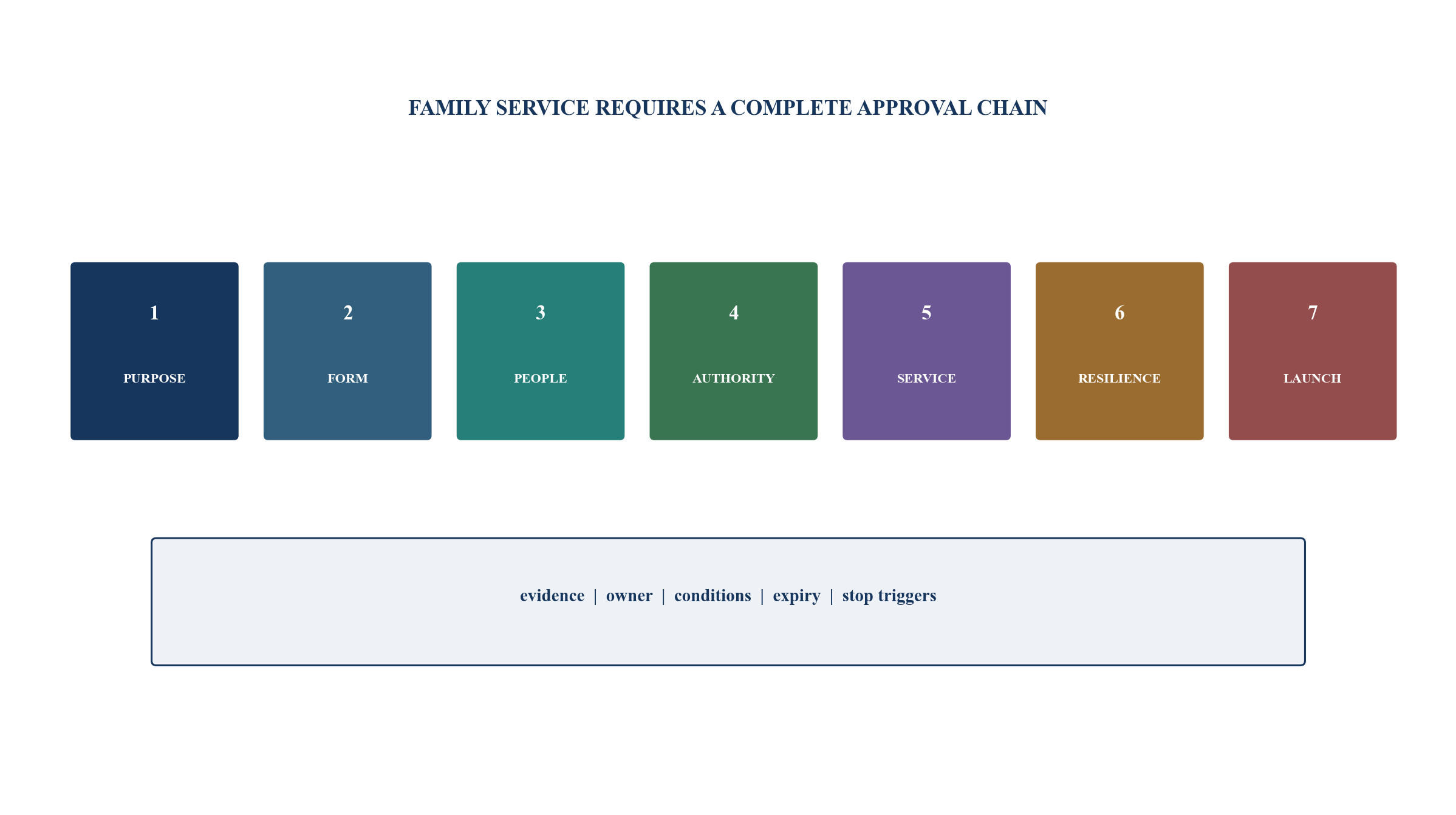
Author framework. Each gate records evidence and preserves unresolved issues across the programme.
18. Implement through a 180-day sequence
Days 0 to 30 should define the family purpose, services, family map, existing entities, assets, liabilities, accounts, providers and known disputes. The team should establish governance, evidence standards and a single programme register. Management should identify any activity that lacks a clear legal client or authority.
Days 31 to 60 should compare legal forms and jurisdictions, obtain current advice, map constitutional powers, identify all relevant parties, complete due-diligence planning and design the target account architecture. The family should confirm what information can be combined and who may receive it.
Days 61 to 90 should complete source-of-wealth and account-holder analysis, investment policy, product shelf, custody routes, credit perimeter, tax-reporting data, conflicts and fee model. Systems should retain foundation, individual, company, trust and other account dimensions.
Days 91 to 120 should configure authority controls, reporting, data access, beneficiary and distribution workflows, product gates, credit approvals, monitoring, continuity and training. Testing should cover ordinary service and failure scenarios.
Days 121 to 150 should open a limited set of accounts, transfer approved assets in controlled stages and operate with named council members, staff, advisers and providers. Every order, fee, payment, distribution, exception and complaint should receive enhanced review.
Days 151 to 180 should reconcile title, custody, accounting, reporting and authority; close material issues; approve the continuing model; and establish periodic reviews. Expansion should follow evidence. New family members, entities, assets, products, jurisdictions or service providers should return through the relevant gates.
19. Build a board and family-governance scorecard
The board needs a view of client outcomes, legal capacity, authority, financial crime, investments, credit, economics and resilience. Aggregate family assets and revenue cannot reveal where a transaction lacks authority, a beneficiary event is overdue, an asset cannot be valued or a service depends on one person.
Leading indicators include expired constitutional documents, missing beneficial-ownership data, unresolved source-of-wealth questions, council vacancies, unclear signatories, unapproved products, overdue valuations, exceptions, disputed beneficiaries, unexpected distributions, tax-classification changes, data breaches and failed continuity tests.
Outcome measures include delivery against the foundation's purposes, understandable governance, appropriate liquidity, suitable implementation, complete fees, accurate reporting, timely distributions, controlled credit, complaint resolution and successful succession or recovery events.
Thresholds should define action and authority. A breach may pause onboarding, block an order, delay an asset transfer, require independent advice, change a provider, restrict credit or trigger an exit. Every action should have an owner and due date.
Table 6. Board scorecard for family-foundation service
| Domain | Board question | Decision evidence |
|---|---|---|
| purpose and client outcome | does the service support the documented family and foundation objectives? | mandate, decisions, distributions, service measures and complaints |
| legal form and authority | can every action be traced to a valid power and authorised person? | law, constitutional documents, resolutions, delegations and system controls |
| financial crime and reporting | are founders, controllers, beneficiaries, source of wealth and classifications current? | due diligence, monitoring, self-certifications, filings and assurance |
| investments and custody | are products, liquidity, valuation, title and custody controlled? | policy, approvals, reconciliations, valuations and recovery tests |
| credit and related parties | are borrower, benefit, authority, security and conflicts explicit? | facility documents, purpose analysis, security, covenants and approvals |
| economics and conflicts | are client cost, revenue, remuneration and conflicts complete? | fees, product income, ledgers, disclosures and conflict decisions |
| resilience and governance | can the service continue through succession, dispute or provider failure? | role succession, dependency maps, exercises, actions and internal audit |
Thresholds and risk appetite require institution-specific approval; no numerical target is assumed.
20. Keep the structure continuously governed
A family foundation changes as people, assets, purposes, laws and family circumstances change. The institution needs periodic reviews and event-driven reassessment. Material triggers include founder death or incapacity, council or guardian change, new beneficiaries, residence changes, constitutional amendments, new contributions, business sale, large distribution, borrowing, pledge, dispute, sanctions event, tax-classification change, migration or service-provider failure.
The durable operating principle is traceability. Management should be able to show which legal client owns the asset, which person has which role, which power applies, who decided, which advice was given, which account acted, how fees were charged, what reporting followed and how the family objective was served.
One accountable relationship owner can coordinate the network. Legal, compliance, fiduciary, investment, credit, tax, operations and provider decisions retain their professional ownership. The relationship model becomes viable when the client experiences continuity and every legal boundary remains visible.
The governing question is concise: can the bank reproduce the complete family-foundation service from purpose and incorporation through asset transfer, advice, custody, credit, distributions, reporting, succession and recovery? A complete answer supports durable service. Missing links require remediation before the structure or relationship expands.
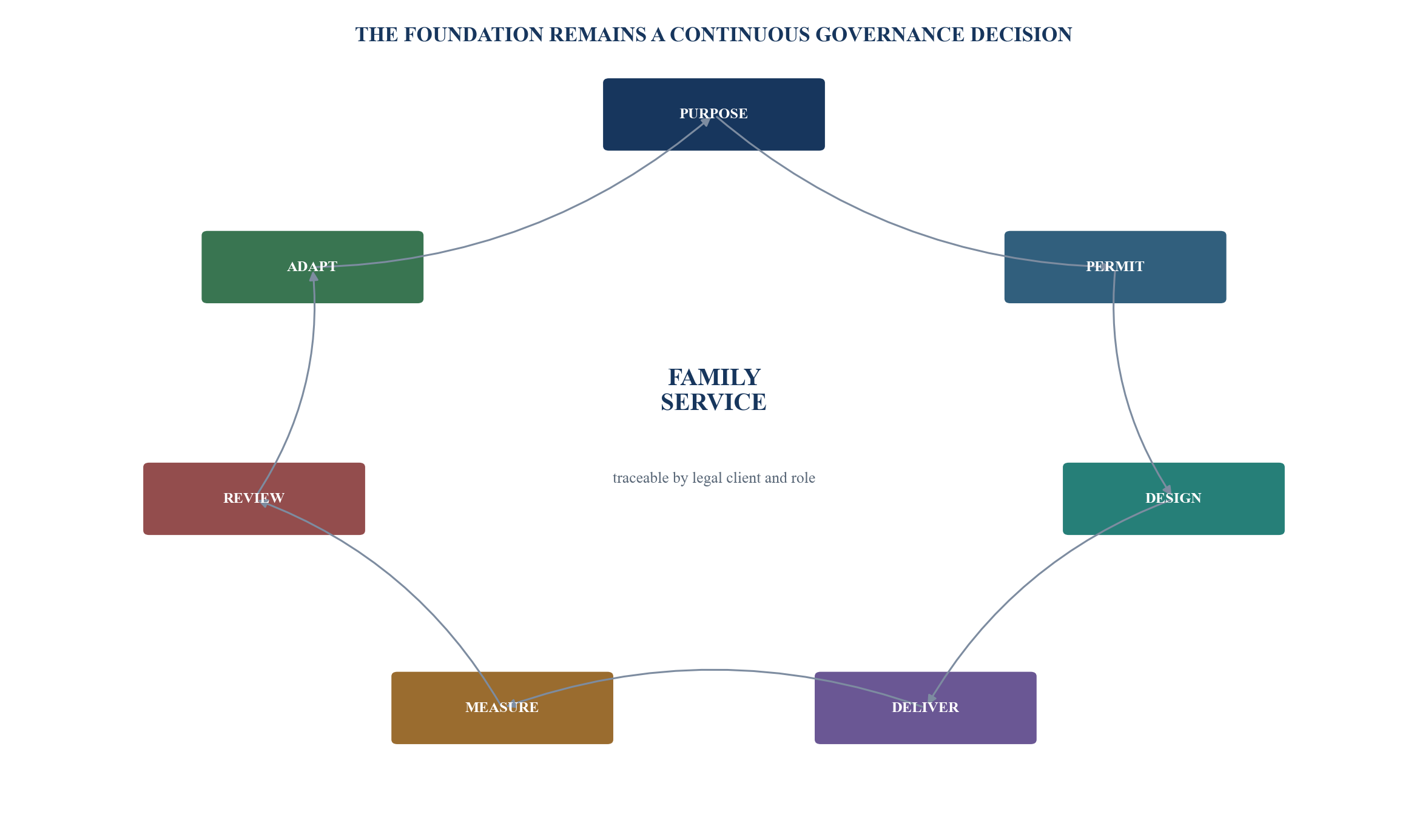
Author framework. A change in people, purpose, assets, law or provider returns the service through controlled review.
References
- Dubai International Financial Centre, Family Businesses, https://www.difc.com/business/establish-a-business/family-businesses
- Dubai International Financial Centre, DIFC Private and Family Wealth Offering, https://www.difc.com/business/difc-private-and-family-wealth-offering
- Dubai International Financial Centre, Foundations Law, DIFC Law No. 3 of 2018, Consolidated Version, https://assets.difc.com/v1/media/edge/images/dubaiintern0078-difcexperie96c5-production-3253/media/project/difcexperiences/difc/difcwebsite/documents/past-laws/foundations_law_difc_law_no_3_of_2018_consolidated_nov_2018.pdf
- Dubai International Financial Centre, Family Arrangements Regulations, https://assets.difc.com/v1/media/edge/images/dubaiintern0078-difcexperie96c5-production-3253/media/project/difcexperiences/difc/difcwebsite/documents/familydocs/family_arrangements_regulations_updated_april23.pdf
- Dubai International Financial Centre, Announcement of the Family Arrangements Regulations, 31 January 2023, https://www.difc.com/whats-on/news/difc-announces-enactment-new-difc-family-arrangements-regulations
- Abu Dhabi Global Market, Setting Up FAQs: Foundations Regime, https://www.adgm.com/faqs/setting-up
- Abu Dhabi Global Market, Non-exempt SPVs and Foundations, https://www.adgm.com/operating-in-adgm/company-service-providers/non-exempt-spvs-and-foundations
- Abu Dhabi Global Market, Company Service Provider Framework, https://www.adgm.com/operating-in-adgm/company-service-providers
- Abu Dhabi Global Market, Registration Authority Publishes Amendments to the Commercial Legislation, 1 May 2026, https://www.adgm.com/media/announcements/adgm-registration-authority-publishes-amendments-to-the-commercial-legislation
- Abu Dhabi Global Market, Legal Regulations and Rules, https://www.adgm.com/legal-framework/rules-and-regulations
- Jersey Legal Information Board, Foundations (Jersey) Law 2009, current consolidated version, https://www.jerseylaw.je/laws/current/l_23_2009
- Jersey Legal Information Board, Foundations (Winding up) (Jersey) Regulations 2009, current consolidated version, https://www.jerseylaw.je/laws/current/ro_121_2009
- Guernsey Financial Services Commission, Foundations (Guernsey) Law 2012, consolidated text, https://www.gfsc.gg/sites/default/files/Foundations-%28Guernsey%29-Law-2012-%28Consolidated-text%29.pdf
- Guernsey Financial Services Commission, Fiduciary Sector, https://www.gfsc.gg/industry-sectors/fiduciary
- Cayman Islands Government, Foundation Companies Act (2025 Revision), https://gov.ky/w/foundation-companies-act-2025-revision-lg7-s7
- Cayman Islands Legislation, Legislation by Subject: Foundation Companies, https://legislation.gov.ky/cms/legislation/index/by-subject.html
- Financial Action Task Force, Guidance on Beneficial Ownership and Transparency of Legal Arrangements, 11 March 2024, https://www.fatf-gafi.org/content/fatf-gafi/en/publications/Fatfrecommendations/Guidance-Beneficial-Ownership-Transparency-Legal-Arrangements.html
- Financial Action Task Force, The FATF Recommendations, updated 2025, https://www.fatf-gafi.org/en/publications/Fatfrecommendations/Fatf-recommendations.html
- Financial Action Task Force, FATF Glossary, https://www.fatf-gafi.org/en/pages/fatf-glossary.html
- Organisation for Economic Co-operation and Development, Standard for Automatic Exchange of Financial Information in Tax Matters: Implementation Handbook, Second Edition, https://www.oecd.org/en/publications/standard-for-automatic-exchange-of-financial-information-in-tax-matters-implementation-handbook-second-edition_841e9512-en.html
- Organisation for Economic Co-operation and Development, Tax Transparency Resource Centre: Common Reporting Standard, https://www.oecd.org/ctp/exchange-of-tax-information/common-reporting-standard-status-message-xml-schema-user-guide-for-tax-administrations.htm
- Organisation for Economic Co-operation and Development, Amendments to the Common Reporting Standard, https://www.oecd.org/en/publications/international-standards-for-automatic-exchange-of-information-in-tax-matters_896d79d1-en/full-report/component-11.html
- European Banking Authority, Revised Guidelines on money laundering and terrorist financing risk factors, 1 March 2021, https://www.eba.europa.eu/publications-and-media/press-releases/eba-publishes-final-revised-guidelines-money-laundering-and
- Swiss Financial Market Supervisory Authority, Focus on high-risk clients in combating money laundering, updated 8 April 2025, https://www.finma.ch/en/documentation/dossier/dossier-geldwaeschereibekaempfung/augenmerk-auf-hochrisikokundinnen-und--kunden-in-der-geldwaeschereibekaempfung/
- Swiss Financial Market Supervisory Authority, Money laundering and sanctions, https://www.finma.ch/en/documentation/dossier/dossier-geldwaeschereibekaempfung/geldwaescherei-und-sanktionen/
About the Author
Chennakeshav Adya is an independent researcher and Managing Partner of Matchpoint Partners. His work examines strategy, capital formation, valuation, transactions and operating execution across private and public markets.
