

1. Faster M&A begins with visible authority
Transaction speed is often described as the ability to analyse quickly. In a family group, the binding constraint can be the path by which a recommendation becomes an authorised decision. A capable deal team may complete commercial analysis, valuation and financing work while remaining uncertain about who can approve exclusivity, increase price, accept a liability allocation or authorise signing. The resulting delay is institutional rather than analytical.
An investment committee should convert the group's governing documents into an operating system for transactions. It defines the decisions management may take, the matters the committee may recommend or approve, the matters reserved for a legal board or shareholders and the circumstances requiring a family-governance forum. It also defines which entity is acting. A family name can describe several holding companies, trusts, branches, operating companies and investment vehicles. Authority attaches to legal persons and governing instruments, not to the group label.
The committee should serve a clear corporate purpose. Its task is to allocate capital and control transaction risk for the relevant company or fund within the authority delegated to it. It should not become a substitute family council, an informal shareholder meeting or a parallel executive team. The board remains accountable for matters that law, constitution or policy reserves to it. OECD principles state that boards oversee major acquisitions and divestitures and retain responsibility for committee-supported decisions.
Speed follows when the decision path is known before a live opportunity arrives. The team can collect the correct evidence, involve the correct people and schedule the correct gates. A late surprise becomes less likely because the transaction calendar contains governance, financing and regulatory dependencies from the start.
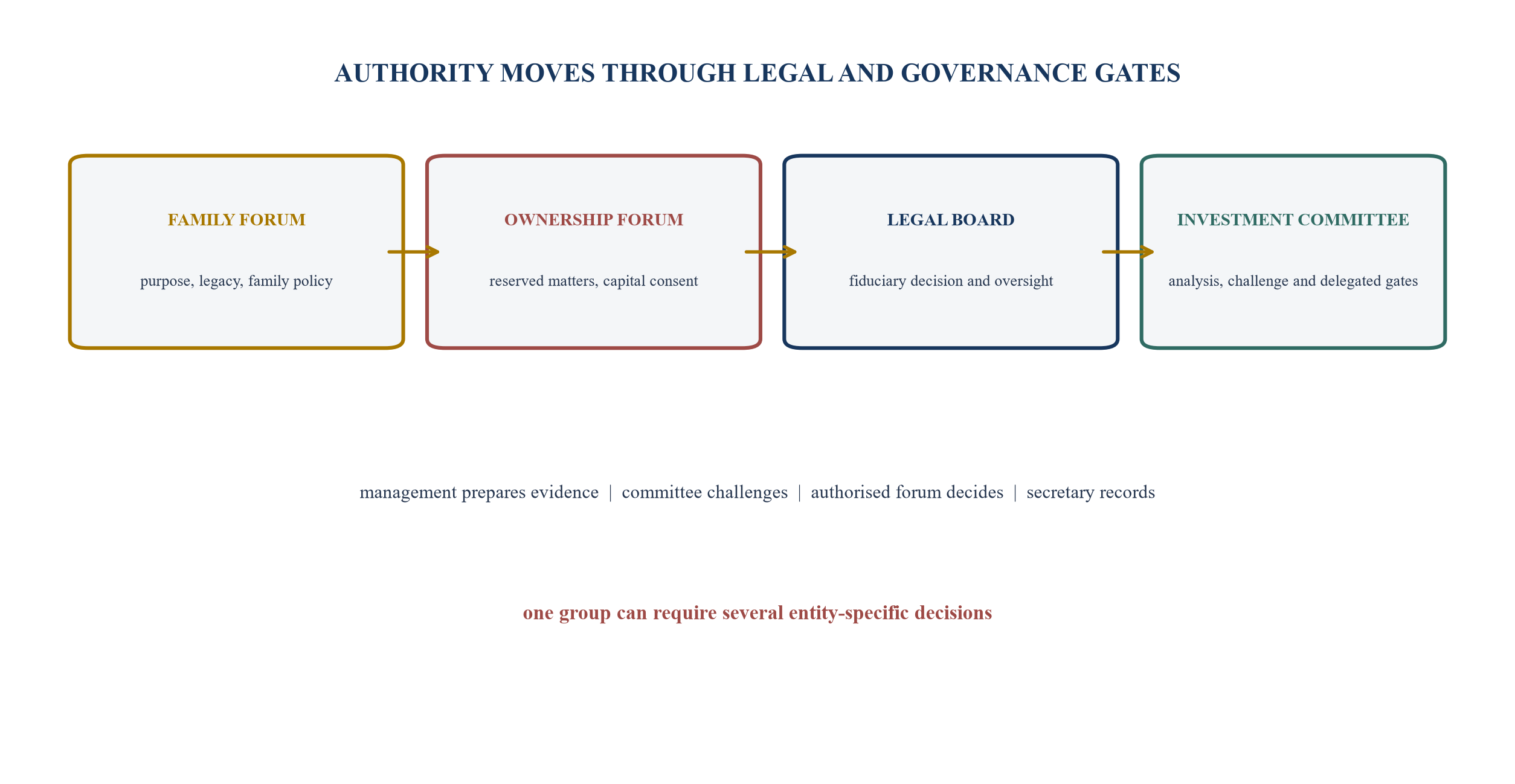
Exact authority must follow the relevant legal entities and governing documents.
2. Separate family, ownership, board and management roles
Family governance addresses matters that arise from family ownership: values, participation, succession, employment, distributions, liquidity, education and conflict resolution. The UAE family-business law recognises a family charter as a written document governing family affairs connected with the business and the relationship between the family and the business. That charter can guide behaviour and expectations. Corporate acts still need approval by the competent organ of the relevant legal entity.
The ownership forum exercises rights assigned to shareholders, partners, beneficiaries or members. These can include election of directors, amendments to constitutional documents, new equity, disposals, related-party transactions and material acquisitions above a threshold. The exact rights depend on entity form, jurisdiction and contractual arrangements. A family shareholder cannot assume that influence across the group creates authority to bind every subsidiary.
The legal board owes duties to the company for which it acts. It approves strategy, supervises management, manages conflicts and decides matters reserved by law or constitution. Directors who represent a family branch or nominating shareholder still need to exercise judgement for the relevant company. The OECD principles emphasise that loyalty relates to the company and all shareholders, including where a company is controlled by another group company.
Management originates opportunities, tests strategy, commissions diligence, negotiates within authority and recommends action. Management should know which decisions it owns. It should also know the points at which it must pause. A chief executive who can spend a diligence budget may lack authority to issue a binding offer, grant exclusivity or change a financing commitment. A written map reduces both excessive escalation and unauthorised action.
3. Translate governing documents into one authority map
The investment-committee charter should be derived from a document hierarchy. Relevant materials can include law, regulatory rules, company constitution, shareholders' agreement, trust or foundation instruments, family charter, board charter, committee mandates, delegated-authority policy, financing agreements and transaction-specific resolutions. When documents conflict or use different thresholds, qualified counsel should determine the controlling requirement.
The operating map should state the decision, acting entity, proposer, reviewer, approver, consulted parties, information standard, quorum, voting rule, conflict treatment, expiry and escalation route. It should also state whether authority permits approval, recommendation or acknowledgement. These verbs matter. A committee authorised to recommend acquisitions cannot convert a recommendation into corporate approval through practice.
Authority should be linked to economic exposure. A holding-company acquisition financed by a subsidiary guarantee can require decisions in both entities. A joint venture may trigger consent rights at the venture and parent levels. A purchase funded by family capital may require ownership approval even when the operating board supports the strategy. The map should trace the full chain rather than focus only on the buyer named in the sale agreement.
Annual review is essential. Constitutions change, lenders receive new consent rights, directors rotate and regulatory thresholds move. Each live transaction should include a short authority confirmation from the company secretary and qualified counsel. The confirmation should be updated when structure, consideration, financing or target perimeter changes.
Table 1. Decision-rights register for a family-group acquisition
| decision | management | investment committee | legal board | ownership or family forum | evidence required |
|---|---|---|---|---|---|
| approve acquisition thesis | propose | challenge and recommend | approve strategy | note if family policy is affected | strategy case, boundaries, capital envelope |
| authorise initial diligence spend | approve within delegated budget | approve above management limit | approve above committee limit | none unless reserved | opportunity note, budget, conflicts check |
| submit non-binding offer | negotiate within range | approve range and conditions | approve if constitution reserves | consent if threshold triggered | valuation range, financing path, regulatory screen |
| grant exclusivity | recommend | approve within delegation | approve material lock-up | note material family constraint | timetable, break rights, diligence plan |
| change headline value | recommend | approve within tolerance | approve above tolerance | approve if reserved threshold crossed | value bridge, funding, downside case |
| sign and close | prepare documents | recommend readiness | approve and authorise signatories | approve reserved matters | final papers, funds, regulatory and closing certificates |
Thresholds are illustrative management assumptions and require entity-specific legal verification.
4. Use stage gates that match irreversible commitments
A transaction should move through gates because commitments become progressively harder to reverse. The first gate approves the thesis and search perimeter. The second authorises initial engagement and a bounded diligence budget. The third approves an indicative proposal. The fourth authorises exclusivity and full diligence. The fifth approves final value, financing and transaction protections. The sixth authorises signing. The seventh confirms closing conditions and integration readiness.
Each gate should answer a different decision question. Repeating the same investment paper at every meeting creates volume without clarity. Thesis approval asks whether the strategic objective is valid. Indicative-offer approval asks whether the current evidence supports a price range and conditions. Signing approval asks whether the board accepts the final economics, risks, obligations and residual uncertainty. Closing confirmation asks whether conditions, funds, approvals and Day One controls are satisfied.
The gate calendar should be agreed with the transaction timetable. Committee meeting dates, board circulation periods and shareholder notice requirements can become critical-path items. The process should permit urgent meetings and written resolutions where legally valid, while preserving access to complete information and an auditable decision record.
A failed gate should produce one of four outcomes: reject, defer, approve with conditions or return for a defined evidence test. Ambiguous requests such as "improve the case" create delay. A condition should name the owner, evidence required, decision authority and deadline. Rejected opportunities should record the reason so that the group does not reopen the same question without changed evidence.
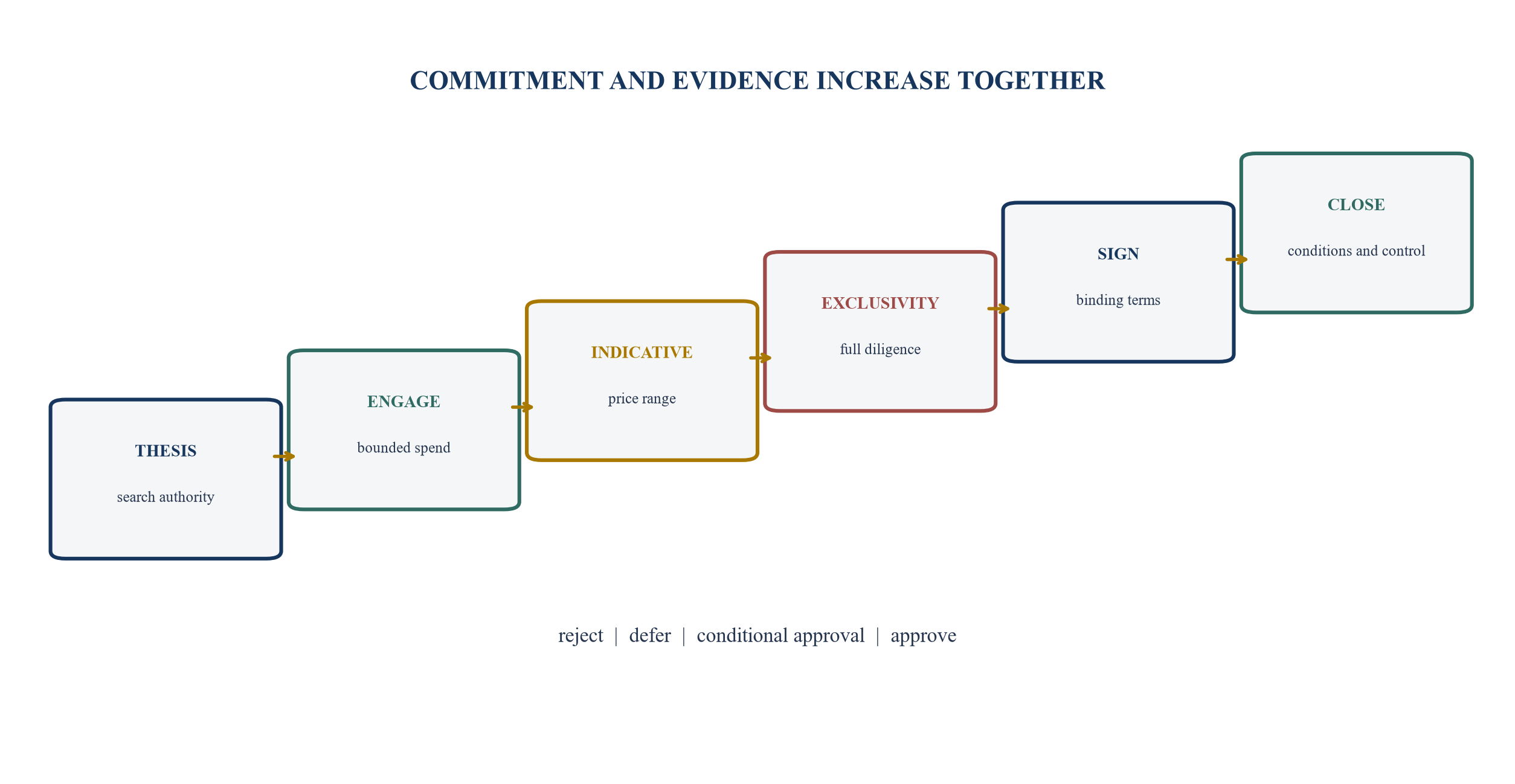
Every gate should state the decision question, evidence standard and authorised forum.
5. Define reserved matters and materiality before the deal
Reserved matters protect owners and boards from commitments beyond delegated authority. They can include acquisitions, disposals, borrowing, guarantees, new businesses, changes to capital, related-party transactions, litigation settlements and appointments. A family group often has several schedules of reserved matters across holding companies, operating subsidiaries and financing documents. The committee needs a consolidated view.
Thresholds should measure the exposures that matter. Purchase price alone can understate commitment when a transaction includes assumed debt, earnouts, deferred consideration, guarantees, minimum funding, capital expenditure or integration obligations. A threshold can also be qualitative. Entry into a regulated sector, use of the family name, exposure to a new jurisdiction or acquisition from a related party may require escalation regardless of value.
Aggregation rules prevent artificial fragmentation. Several related purchases from the same seller, acquisitions under one strategic programme or successive increases in an investment may need to be considered together. The policy should define the measurement period, currency conversion, enterprise-value treatment and treatment of contingent consideration.
The committee secretary should test reserved matters when the opportunity is opened, at indicative proposal, before exclusivity and before signing. A change log should show whether revised structure, value or financing crosses a new gate. This avoids discovering at signing that an additional shareholder, lender or regulator must approve the transaction.
Table 2. Illustrative reserved-matter tests
| exposure | measurement question | possible escalation trigger | common blind spot | control |
|---|---|---|---|---|
| total consideration | what cash, shares, debt and contingent amounts can become payable? | amount above delegated capital limit | earnout excluded from headline value | maximum-consideration bridge |
| funding and guarantees | which entities borrow, guarantee or secure obligations? | new debt or cross-group support | subsidiary exposure omitted | entity-by-entity financing map |
| strategic perimeter | does the deal enter a new sector, market or licence regime? | activity outside approved strategy | small price treated as low risk | qualitative reserved-matter screen |
| ownership and control | what voting, veto and exit rights are acquired? | control, joint control or minority protection | economic stake confused with control | rights and governance schedule |
| related party | does a family member or connected entity have an interest? | any material direct or indirect interest | benefit held through another vehicle | conflict declaration and independent review |
| integration commitment | what additional capital and operational support are required? | total programme exceeds approval | purchase price approved without Day One cost | acquisition-plus-integration envelope |
The tests organise analysis; they do not replace governing documents or legal advice.
6. Make information rights part of the charter
Committee authority without information access creates nominal governance. Members need timely, complete and decision-relevant material. The charter should permit access to management, transaction advisers, diligence findings, financing proposals, forecasts, material contracts, regulatory analysis and integration plans, subject to confidentiality and privilege controls.
Information should be distributed according to role and conflict status. A family principal with an interest in the seller may be excluded from parts of the process. A director of a competing group company may require restricted access. A financing entity may need exposure and covenant information without receiving competitively sensitive target data. The secretary should maintain the access matrix.
The committee should have authority to request additional work and engage independent advice within a defined budget. That authority should be proportionate. Unlimited requests can extend diligence without improving the decision. Every request should state the decision it informs, materiality, owner and due date. The chair should close requests that no longer affect value, protection or readiness.
Late papers undermine informed judgement. The operating policy should specify circulation periods, minimum contents and the treatment of late changes. A redline or decision-change page can focus attention on developments since the prior gate. Members should acknowledge when insufficient time or evidence prevents approval. Deferral can be the correct decision when the record is incomplete.
7. Route conflicts before they contaminate the decision
Family groups have legitimate overlapping relationships: common ownership, employment, board seats, loans, real estate, supply contracts and philanthropic interests. These relationships can create actual, potential or perceived conflicts in an acquisition. The control objective is to identify the interest, determine its materiality, restrict participation where required and preserve independent corporate judgement.
Conflict declarations should cover direct and indirect interests of members and relevant connected persons or entities. The declaration should occur when an opportunity is identified and refresh when structure or counterparties change. A generic annual form is insufficient for transaction-specific interests. Members should disclose facts without deciding alone whether the interest is material.
Qualified counsel and the chair should route the matter under applicable law and policy. Possible responses include disclosure only, access restriction, abstention, recusal, independent committee review, fairness or valuation advice, board approval by disinterested members or shareholder approval. The record should state who was absent from deliberation and voting. UAE, Saudi, Bahrain, Qatar, Kuwait, OECD and other official governance frameworks emphasise conflict disclosure and independent treatment.
Conflicts can also arise on the target side. A family member may own a supplier that benefits from the acquisition. Management incentives may reward completion rather than value. An adviser may have a financing or seller relationship. The committee should maintain a transaction conflict register covering decision makers, management and advisers.
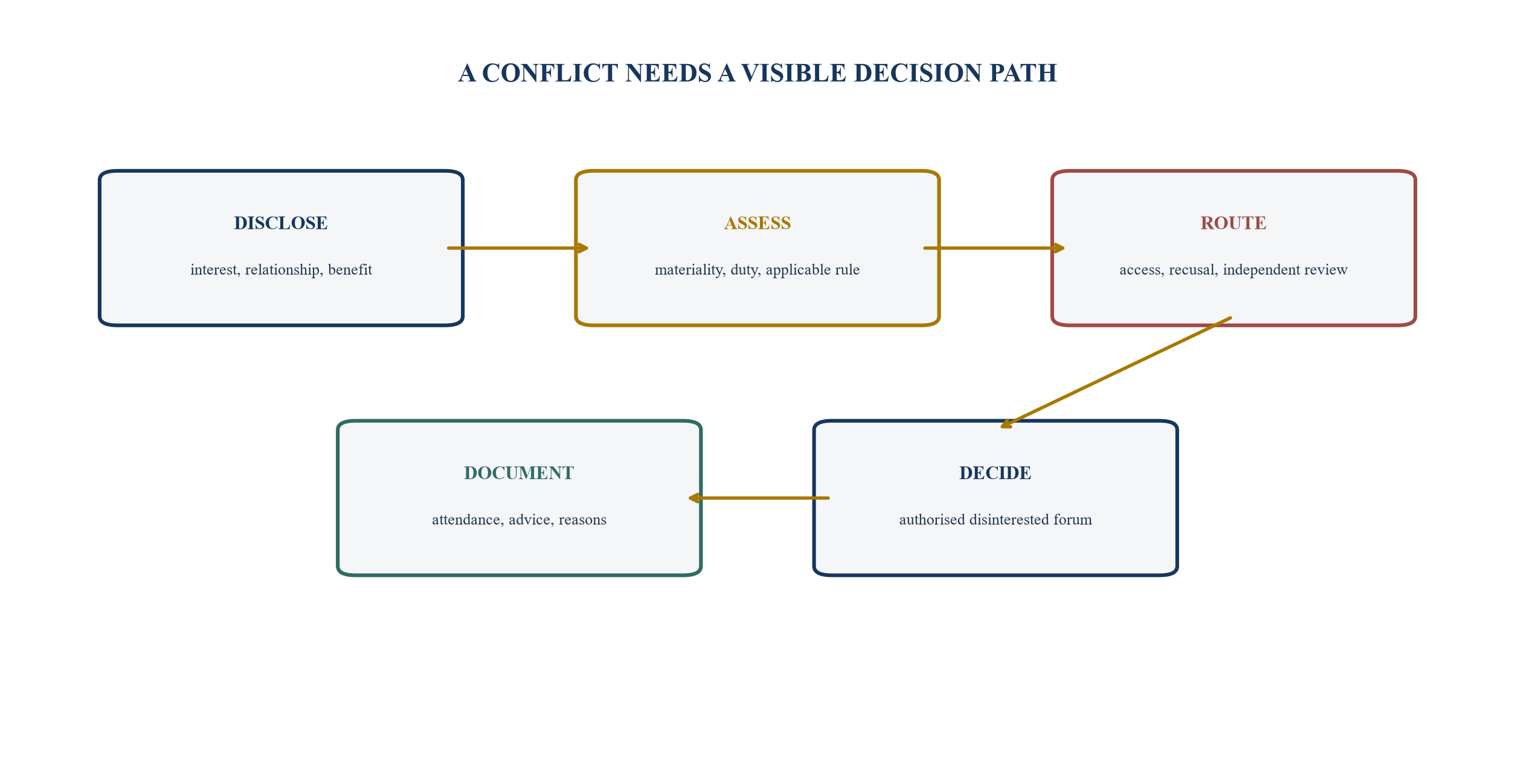
The response depends on the relevant law, governing documents and facts.
8. Design composition, quorum and voting for credible challenge
Committee composition should match the capital decision. Members need strategy, finance, operations, risk and transaction judgement. A family principal can provide ownership context and long-term orientation. Executives can explain the operating thesis. Independent members can challenge assumptions and strengthen decisions affected by family or management interests. The committee should remain small enough to convene quickly.
Membership should be linked to role rather than courtesy. Each voting member should have defined qualifications, tenure and removal arrangements. Observers and advisers can contribute without holding a vote. The charter should state whether alternates are permitted and whether remote attendance or written resolutions are valid.
Quorum should protect both competence and independence. A quorum consisting solely of family principals may lack the required financial or operational challenge. A quorum that requires every named member can make urgent action impossible. The rule can require a minimum number plus specified roles, such as the chair, one financially experienced member and one non-conflicted director.
Voting rules should address ties, abstentions and conditional approvals. Silence should not count as consent. A chair's casting vote may be inappropriate for material acquisitions. The committee should record dissent and the evidence requested by dissenting members. The board benefits from knowing whether a recommendation was unanimous, divided or constrained by recusals.
Table 3. Committee design choices and transaction consequences
| design element | recommended question | weak design | transaction consequence | evidence of control |
|---|---|---|---|---|
| membership | which capabilities and independent perspectives are required? | seats allocated only by family branch | limited challenge and political bargaining | role descriptions and skills matrix |
| quorum | which roles must be present for a valid decision? | simple headcount only | meeting valid despite missing competence | quorum checklist in minutes |
| voting | what majority applies at each gate? | consensus without formal vote | unclear approval and delayed reopening | recorded resolution and vote |
| recusal | how does conflict change quorum and information access? | conflicted member remains decisive | challenge to process integrity | conflict register and attendance record |
| delegation | which gates can the committee approve? | broad oral authority | unauthorised commitments | board-approved written mandate |
| expiry | when does an approval lapse or require refresh? | approval remains open indefinitely | stale facts support later action | expiry date and change triggers |
Entity law and constitutional documents can impose additional requirements.
9. Give the chair and secretary operational authority
The chair owns decision quality and meeting discipline. Before circulation, the chair confirms that the paper asks a specific question, identifies the acting entity and states the requested authority. During the meeting, the chair separates evidence from advocacy, tests conflicts, gives dissent room and closes with an explicit resolution. After the meeting, the chair confirms conditions and accountability.
The secretary maintains the institutional record. This role can be performed by a company secretary, governance officer or appropriately qualified legal professional. The secretary tracks governing authority, meeting notices, quorum, attendance, conflicts, papers, resolutions, conditions, expiry dates and actions. The record should be entity-specific and protect privilege and confidentiality.
The chair and secretary should control agenda admission. A transaction should not enter a decision meeting with an undefined recommendation. Informational briefings can be useful, though they should be labelled as such. A status update should not become informal approval. Members need to know whether management is seeking guidance, a gate decision or a formal corporate resolution.
Between meetings, the chair can manage evidence requests and determine whether a change requires reconvening. The chair should not rewrite delegated limits. A higher price, different target perimeter, new guarantee, adverse diligence finding or regulatory remedy can trigger a new gate even when the timetable is compressed.
10. Anchor every opportunity in an approved acquisition thesis
Fast governance depends on prior strategic choices. The board should approve where the group intends to invest, the capabilities sought, the acceptable risk profile, the capital envelope and the integration philosophy. This gives the committee a bounded mandate. It also helps management reject attractive businesses that do not solve the approved strategic problem.
The thesis should state the value mechanism. Revenue growth can depend on cross-selling, geographic access, pricing, new products or customer retention. Cost value can depend on procurement, capacity, process redesign or shared infrastructure. Capability value can depend on people, technology, licences, data or intellectual property. Each mechanism needs evidence and an accountable owner.
Family considerations should be explicit where relevant. The family may restrict sectors, leverage, partners, use of its name, workforce actions or geographic exposure. These policies can be legitimate. Keeping them outside the investment paper creates late vetoes and wasted work. The family forum should translate enduring preferences into a board-approved policy or reserved matter.
The committee should test thesis drift at every gate. A target initially screened for capability may become a financial turnaround. A majority acquisition may become a joint venture. An integration-led return may become dependent on multiple expansion. The revised proposition may still be attractive, but it requires a conscious decision under the correct mandate.
11. Build a decision funnel rather than a meeting calendar
The transaction funnel should distinguish coverage, screened opportunities, authorised diligence, indicative proposals, exclusivity, signed transactions and completed acquisitions. Each stage requires evidence and authority. Counting management meetings as deals creates a misleading pipeline and burdens the committee with premature material.
Management should own early screening within a defined policy. It can test strategic fit, ownership, scale, transaction path and access before requesting committee time. The committee should focus on capital allocation, uncertainty and commitments. A one-page opening note can authorise a bounded work programme without implying that the acquisition is likely to proceed.
Stage conversion should be measured. A high rejection rate at first committee review may show weak thesis translation. Repeated deferrals can indicate incomplete papers or unclear authority. Long periods between exclusivity and signing may reveal diligence, financing or governance bottlenecks. Metrics should diagnose the system rather than reward transaction volume.
The board should receive a portfolio view of live opportunities, capital at risk, decision dates, conflicts, regulatory paths and integration capacity. This prevents one attractive transaction from consuming attention while another reaches an irreversible deadline. It also allows the board to compare opportunities using consistent evidence.
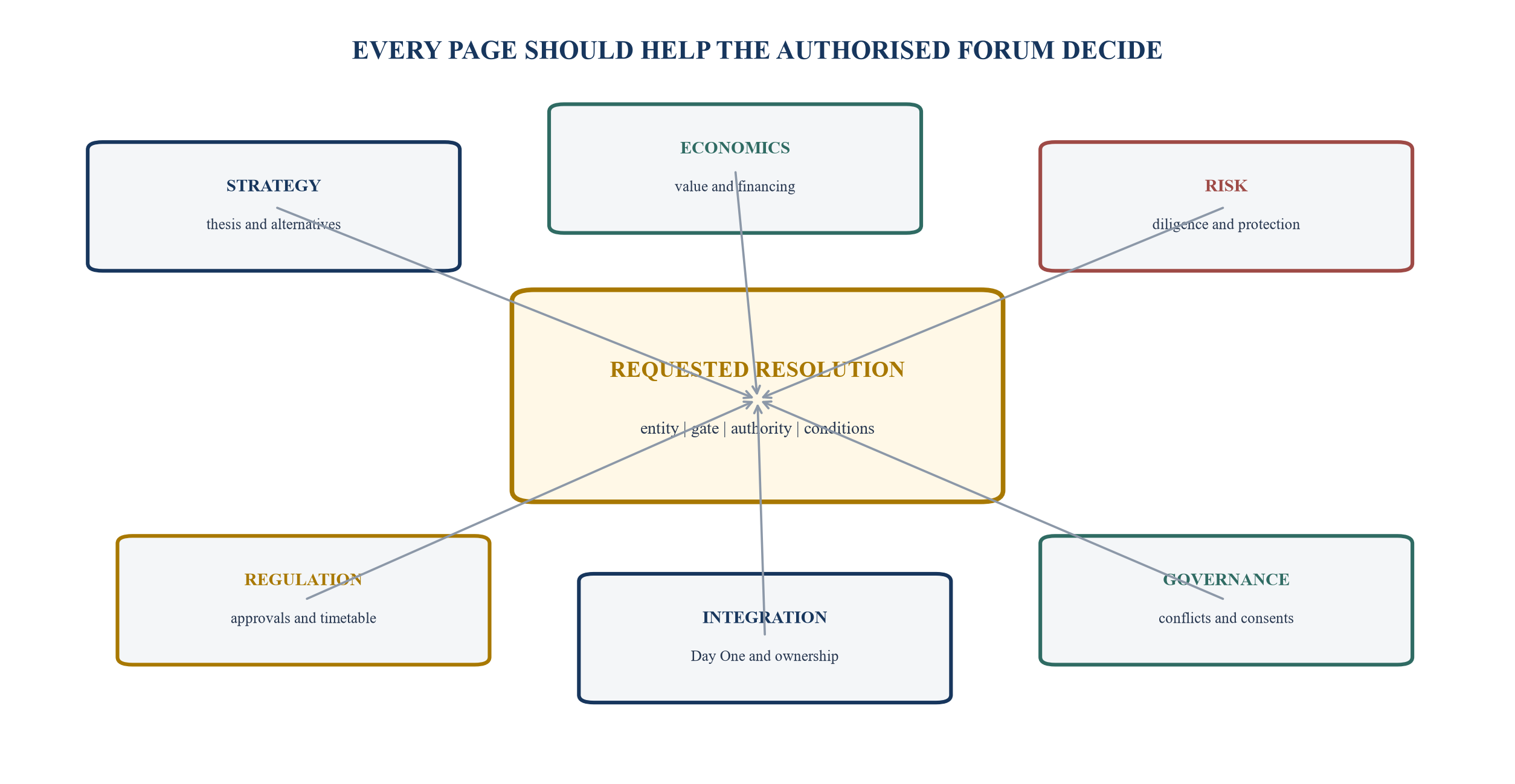
The pack should focus on evidence that changes value, protection, timing or readiness.
12. Standardise the investment paper around the decision
The paper should begin with the exact resolution requested. It should name the buyer, target perimeter, transaction form, consideration range, financing path, gate and approving body. The executive summary should state the recommendation, principal evidence, unresolved matters, conditions and expiry. Members should not have to infer the decision from a long narrative.
The strategy section should connect target facts to the approved thesis and alternatives. The economics section should bridge enterprise value to equity value, funding, returns and downside. The diligence section should show material findings, evidence confidence and transaction response. The regulatory section should identify notification, consent, foreign-investment, sector and competition dependencies. The integration section should identify Day One controls, leadership and value owners.
Decision-changing information deserves prominence. A new customer loss, financing condition, conflict, licence issue or integration dependency should appear in a change page. Stable background can remain in appendices. The committee needs a current decision record, not a cumulative data room.
Management assumptions should be visible. Forecasts, synergy estimates and probability assessments should state their basis, owner, sensitivity and validation plan. A scenario should not be presented as an observed fact. The committee should understand what must be true for the recommendation to create value.
Table 4. Minimum contents of a gate-specific investment paper
| module | decision question | minimum evidence | accountable owner | gate consequence |
|---|---|---|---|---|
| requested resolution | what is being authorised for which entity? | authority citation, amount, conditions, expiry | sponsor and secretary | prevents ambiguous consent |
| strategic case | why is acquisition the preferred route? | thesis fit, alternatives, target evidence | business sponsor | validates corporate purpose |
| valuation and returns | what value and downside does the group accept? | bridge, scenarios, sensitivities, funding | finance lead | defines price tolerance |
| diligence and protection | which exposures remain and who owns them? | finding, evidence, cash-flow effect, response | workstream leads | connects risk to terms or action |
| regulation and timetable | what constrains signing, closing or control? | notifications, consents, standstill, long-stop | legal and regulatory lead | protects executable sequencing |
| integration readiness | how will control and value transfer after closing? | Day One plan, leadership, systems and synergy owners | integration lead | tests implementation capacity |
Content depth should be proportionate to the commitment at the relevant gate.
13. Separate valuation judgement from negotiation authority
The committee should approve a value range and the assumptions supporting it. Negotiators need enough discretion to move efficiently inside that range. They also need explicit limits on headline price, contingent consideration, working-capital mechanics, leakage, financing, warranties, indemnities and other economic terms.
Price authority should use a total-value bridge. An apparent increase in price can be offset by lower assumed debt, better working capital, reduced integration cost or stronger protection. The reverse is also true. Negotiators should report movements in enterprise value, equity value, funding need and downside exposure rather than one headline number.
The committee can define a negotiating corridor with stop conditions. A corridor might permit management to adjust consideration within a range provided the strategic perimeter, financing envelope, return threshold and principal protections remain intact. A stop condition can require reconvening after a material diligence event, loss of committed financing, adverse regulatory remedy or change in control rights.
Valuation should remain independent from completion incentives. Management and advisers can have legitimate motivation to close. The committee should test forecasts, comparable evidence, integration assumptions and downside with members who are not rewarded solely for completion. External advice can support judgement; it does not transfer accountability.
14. Approve financing as part of the acquisition decision
An acquisition and its financing form one capital-allocation decision. The committee should see sources and uses, entity-level borrowing, security, guarantees, covenants, maturity, currency, hedging, refinancing and liquidity after closing. Funding availability at signing does not establish resilience through integration.
Family groups can fund transactions through holding-company cash, operating-company dividends, bank debt, private credit, shareholder loans, equity or asset-backed structures. Each source changes control, tax, cash mobility, covenant and downside. The investment paper should show which legal entity bears each obligation and how cash moves through the group.
Financing conditions should be aligned with the transaction timetable. The board should know whether commitments are binding, conditional or indicative; whether a regulatory delay affects availability; and whether price flex, market disruption or syndication risk remains. Guarantees and security provided by non-acquiring entities can trigger separate corporate approvals and conflicts.
The downside case should test revenue delay, synergy under-delivery, integration spend, interest rate, currency, working capital and covenant headroom. A family group's long horizon does not remove liquidity risk. Patient ownership needs a financing structure capable of carrying the asset through uncertainty.
15. Put regulatory decisions on the same critical path
Competition, foreign-investment, sector, securities and licensing rules can determine whether the parties may sign, close, integrate or exchange information. The committee should receive an initial regulatory screen before indicative terms and a developed filing plan before signing. The plan should identify jurisdictions, triggers, evidence owners, timing assumptions, remedies and long-stop implications.
The UAE Ministry of Economy and Tourism describes economic-concentration review under the federal competition framework. Saudi Arabia's General Authority for Competition publishes economic-concentration review guidelines. The United States Federal Trade Commission administers premerger notification and waiting-period requirements. The European Commission, UK Takeover Panel and Competition Bureau Canada provide further official process guidance. These regimes differ, so the transaction team should avoid transferring one jurisdiction's timetable or authority to another.
Regulatory analysis should influence value and structure. A potential divestiture can reduce synergies. A prolonged standstill can increase financing cost and employee uncertainty. Information restrictions can affect integration planning. A required local partner or licence condition can change control economics. The committee should approve the transaction with visibility over these pathways.
The regulatory workstream should maintain a decision log rather than a static checklist. New target facts, market definitions, competitive overlaps or political considerations may change the path. The committee should identify who can accept a remedy, extend the long-stop date or abandon the transaction.
Table 5. Regulatory decision calendar
| milestone | committee question | evidence | authority needed | timing control |
|---|---|---|---|---|
| initial screen | which regimes can apply and why? | entity, control, revenue, assets, sector and market map | authorise specialist analysis | complete before indicative proposal |
| filing strategy | which party files and what evidence is required? | jurisdiction memo, data plan, stakeholder map | approve filing resources | align with exclusivity and signing |
| signing terms | what conditions, covenants and long-stop date allocate risk? | draft conditions, efforts standard, termination rights | board approval | prevent unapproved regulatory risk |
| information exchange | what can be shared before clearance? | clean-team and data-access protocol | legal approval | preserve competition compliance |
| remedy response | what concessions are economically acceptable? | remedy scenarios and value bridge | reserved board or shareholder authority | define limits before negotiation |
| closing confirmation | have all conditions and approvals been satisfied? | certificates, approvals and funds evidence | authorised closing forum | prohibit premature control transfer |
Dates and requirements require transaction-specific advice in every relevant jurisdiction.
16. Use delegation to accelerate bounded decisions
Delegation works when the board defines the objective, limit, evidence and reporting requirement. A committee can approve diligence spend, indicative ranges or negotiation movements within an envelope. Management can execute actions inside the committee's decision. Matters outside the envelope return to the correct forum.
The delegation should be written and entity-specific. It should state whether subdelegation is permitted, how decisions are documented, when authority expires and which events trigger automatic escalation. Oral understandings weaken the corporate record and can create different interpretations among family branches.
Urgent authority should be designed in advance. A small emergency panel can respond to auction deadlines or final negotiations, provided its mandate, composition, quorum and limits are clear. The panel should report promptly to the full committee and board. Emergency procedure should preserve conflict controls and informed judgement.
The board should review how delegation performs. Excessive escalation can indicate thresholds that are too low or unclear. Unauthorised commitments can indicate weak training or controls. Repeated use of emergency authority may show poor planning. The aim is a stable path for ordinary decisions and a controlled exception for genuine urgency.
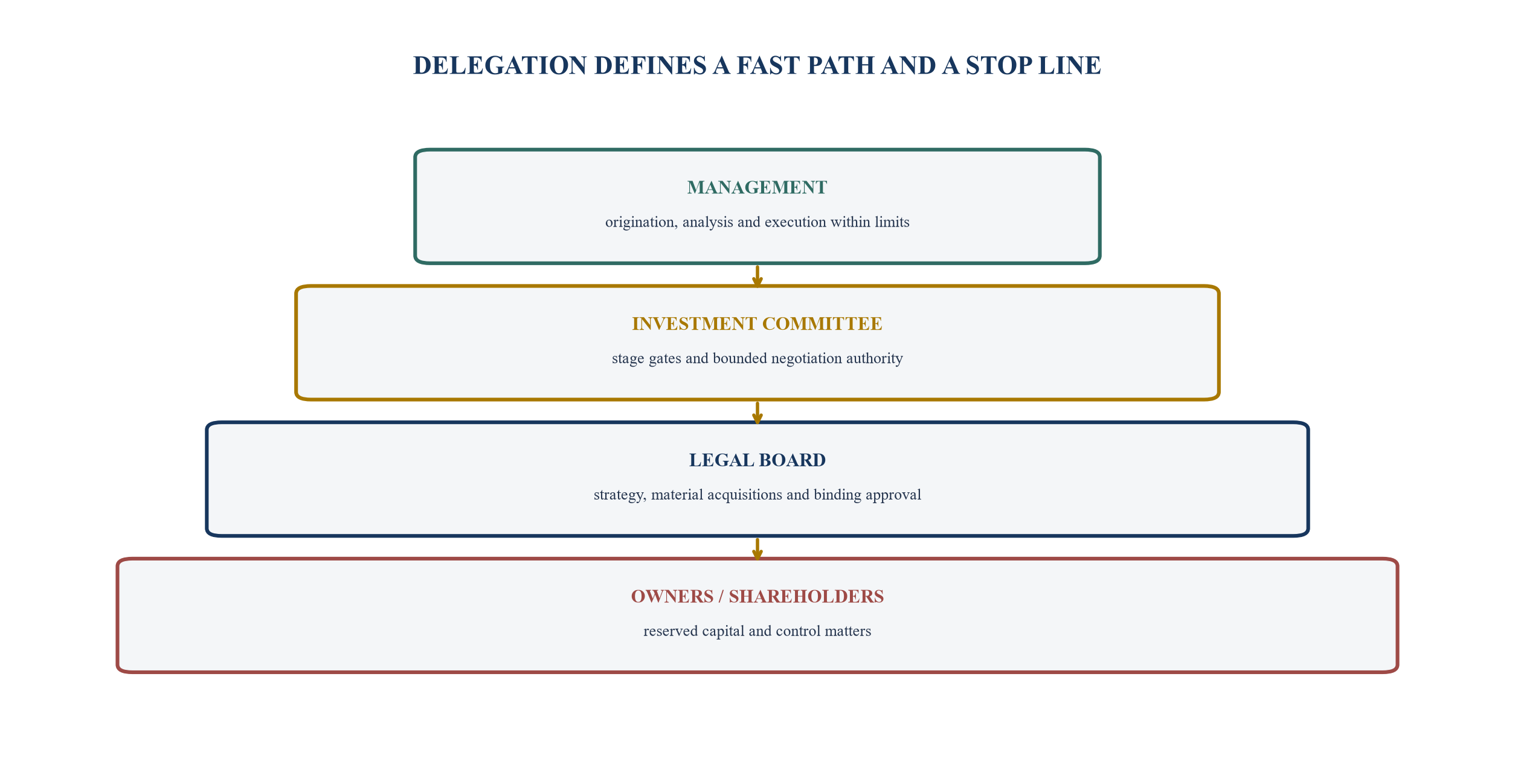
Movement beyond any limit requires escalation to the authorised forum.
17. Protect confidentiality and independent judgement
Family groups can contain overlapping management teams, boards and investments. A live transaction may be sensitive to the target, listed securities, lenders, joint-venture partners, employees and regulators. The committee should approve a need-to-know perimeter at the start and update it as participants change.
The access protocol should cover code names, secure repositories, personal devices, messaging, printing, forwarding, advisers and oral discussions. It should identify inside-information and market-abuse obligations where relevant. The UK Takeover Code includes announcement and secrecy requirements for applicable offers. Other jurisdictions and exchanges impose their own rules.
Clean teams may be required where competitively sensitive information is exchanged before closing. The committee should understand how restrictions affect diligence and integration planning. The operating business should not use target information to change competitive conduct. The legal workstream should approve permitted access and use.
Minutes should record decisions without unnecessarily reproducing privileged advice or sensitive target data. The secretary should coordinate with counsel on privilege and retention. Family status does not create a general right to transaction information. Access follows legal duty, authorised role and legitimate purpose.
18. Protect minority and entity-level interests
A group-level strategy can create unequal consequences across entities. One subsidiary may guarantee acquisition debt while another receives the target's assets. A holding company may obtain strategic control while minority shareholders bear dilution or integration risk. Directors need to identify whose interests they are deciding for.
Related-party review should test value, terms, alternatives and benefit allocation. Independent directors, committees, valuations or shareholder approvals may be required. Official governance frameworks in the GCC, OECD principles and SEBI rules illustrate the importance of identifying related parties, abstaining where required and providing relevant information to independent decision makers.
The committee paper should map economic benefit and burden by entity. It should show consideration, funding, guarantees, service arrangements, asset transfers, tax effects and post-close governance. A consolidated group return can conceal an unfair entity-level allocation.
The board should document corporate benefit and the process used to reach its conclusion. Qualified legal, tax and valuation advisers should assess local requirements. A faster decision that ignores entity-level duties creates execution and challenge risk. Properly scoped independent review can increase speed because it creates a credible approval path.
19. Measure decision quality, speed and accountability
The committee needs metrics that distinguish productive speed from rushed approval. Useful measures include time from complete paper to decision, percentage of gates decided at first meeting, number of late material changes, conditions outstanding after approval, conflict exceptions, unauthorised commitments and days lost to governance scheduling.
Outcome metrics should connect decisions to evidence. The committee can compare approved investment cases with actual revenue, margin, cash, integration cost, regulatory conditions and leadership retention. This is a learning loop rather than a retrospective search for blame. Forecast error can reveal weak assumptions, missing data or execution problems.
The committee should also track rejected and deferred opportunities. A high rejection rate can reflect disciplined capital allocation or poor origination. Repeated deferral for the same information gap may reveal a weak paper standard. Deals that return after expiry should show what changed.
Annual evaluation should cover mandate clarity, composition, independence, information quality, meeting effectiveness, challenge, minutes, delegation and board reporting. The board retains responsibility for the committee's work. It should update the charter when operating evidence shows a better decision path.
Table 6. Board scorecard for the investment committee
| measure | definition | decision insight | warning signal | accountable owner |
|---|---|---|---|---|
| complete-paper decision time | days from compliant circulation to resolution | governance responsiveness | long delay despite complete evidence | chair and secretary |
| first-meeting decision rate | gates approved, rejected or conditionally resolved at first valid meeting | paper and mandate quality | repeated deferral without precise request | sponsor and chair |
| authority exceptions | commitments or changes outside approved limits | delegation control | oral approvals or retrospective ratification | chief executive and secretary |
| late material changes | decision-changing facts received after circulation cutoff | evidence readiness | pricing or risk surprise near signing | transaction lead |
| condition closure | approval conditions completed by owner and deadline | execution discipline | conditions remain open at signing or closing | named condition owners |
| case-to-actual bridge | variance between approved case and observed performance | institutional learning | repeated optimism without model change | finance and integration leads |
Targets should be calibrated to the group's transaction volume, complexity and governance model.
20. Apply the framework to a hypothetical family-group acquisition
Consider a hypothetical family group evaluating the acquisition of a regional industrial-services company. The target operates through four legal entities and serves customers in three GCC markets. The buyer expects recurring maintenance revenue, technical talent and cross-selling. All values, dates, probabilities and outcomes in this example are hypothetical management assumptions.
The opportunity enters the funnel after management confirms thesis fit. The investment committee authorises a USD 250,000 diligence envelope and permits a non-binding proposal within an enterprise-value range of USD 70 million to USD 80 million. The board reserves any binding commitment, financing guarantee or price above the range. Shareholder consent is required if total committed capital exceeds USD 90 million.
During diligence, the team identifies a related-party property lease with a family member of the seller, customer concentration, a change-of-control consent and the need for a competition filing. The committee routes the lease to independent commercial and legal review. It conditions exclusivity on customer access, lease alternatives and a complete regulatory timetable. The conflicted observer receives restricted papers and does not join the deliberation.
The negotiated enterprise value reaches USD 79 million. Assumed debt, integration funding and a possible earnout increase maximum committed capital to USD 94 million. The authority register shows that shareholder approval is required even though headline value remains inside the committee range. The board approves the transaction subject to shareholder consent, committed financing, regulatory clearance and final customer evidence.
The final decision paper shows a downside case, clean-team protocol, financing headroom, integration leadership and a regulatory long-stop date. Shareholders approve the reserved matter. The board authorises named signatories. Before closing, the committee verifies conditions and reports readiness to the board. The transaction closes only after the authorised forum confirms funds, approvals and Day One controls.
The governance calendar is built backwards from the proposed signing date. Management reserves committee and board dates before diligence begins, while the secretary confirms notice periods and the mechanism for shareholder consent. The financing team identifies the date by which credit approval and executable commitments are required. The regulatory team identifies the information needed to validate filing thresholds and prepare the notification. This sequencing makes missing decisions visible while there is still time to address them.
The committee's first paper contains a bounded request. It authorises management to spend, obtain information and negotiate a non-binding proposal within defined limits. It does not imply approval of the acquisition. At the next gate, the paper explains what changed: enterprise value remains inside the corridor, total committed capital crosses the shareholder threshold, the lease creates a conflict route and customer evidence remains incomplete. The decision becomes conditional because each condition is material to value or authority.
The independent review of the property lease compares market rent, term, renewal rights, change-of-control consequences and alternatives. The commercial team separates the target's operating dependence on the facility from the seller-family relationship. The board receives the conclusion and the evidence supporting it, while the conflicted participant remains outside the relevant discussion and vote. This preserves both informed input and independent judgement.
The transaction model also allocates burdens across entities. The acquiring holding company pays consideration and raises debt. An operating subsidiary provides limited support and receives defined service rights after closing. The paper explains corporate benefit, covenant implications and cash movement for each participant. Any guarantee outside the approved financing map requires a fresh decision by the relevant board.
Before signing, the secretary reconciles the resolution against the final sale agreement, financing documents and disclosure schedules. The reconciliation confirms the correct buyer, maximum consideration, authorised signatories, conditions, guarantees and expiry. A material mismatch returns to the authorised forum. After signing, the condition tracker assigns every consent, filing, funding item and Day One control to an owner with evidence of completion.
After closing, the committee receives a short decision-to-outcome bridge. It records final consideration, financing, regulatory conditions, Day One exceptions and changes to the approved integration case. This creates institutional memory for the next transaction. The committee can distinguish forecast error, negotiated change, regulatory impact and execution variance instead of treating the final outcome as a single success or failure.
The board uses that evidence to refine thresholds, papers, delegations and future transaction calendars.
The example demonstrates how visible authority reduces rework. The deal team knows when to escalate, the conflicted interest receives a controlled route and the shareholder decision occurs when total exposure crosses the threshold. The framework does not predict whether the acquisition creates value. It shows how a family group can make a timely decision on a complete and accountable record.
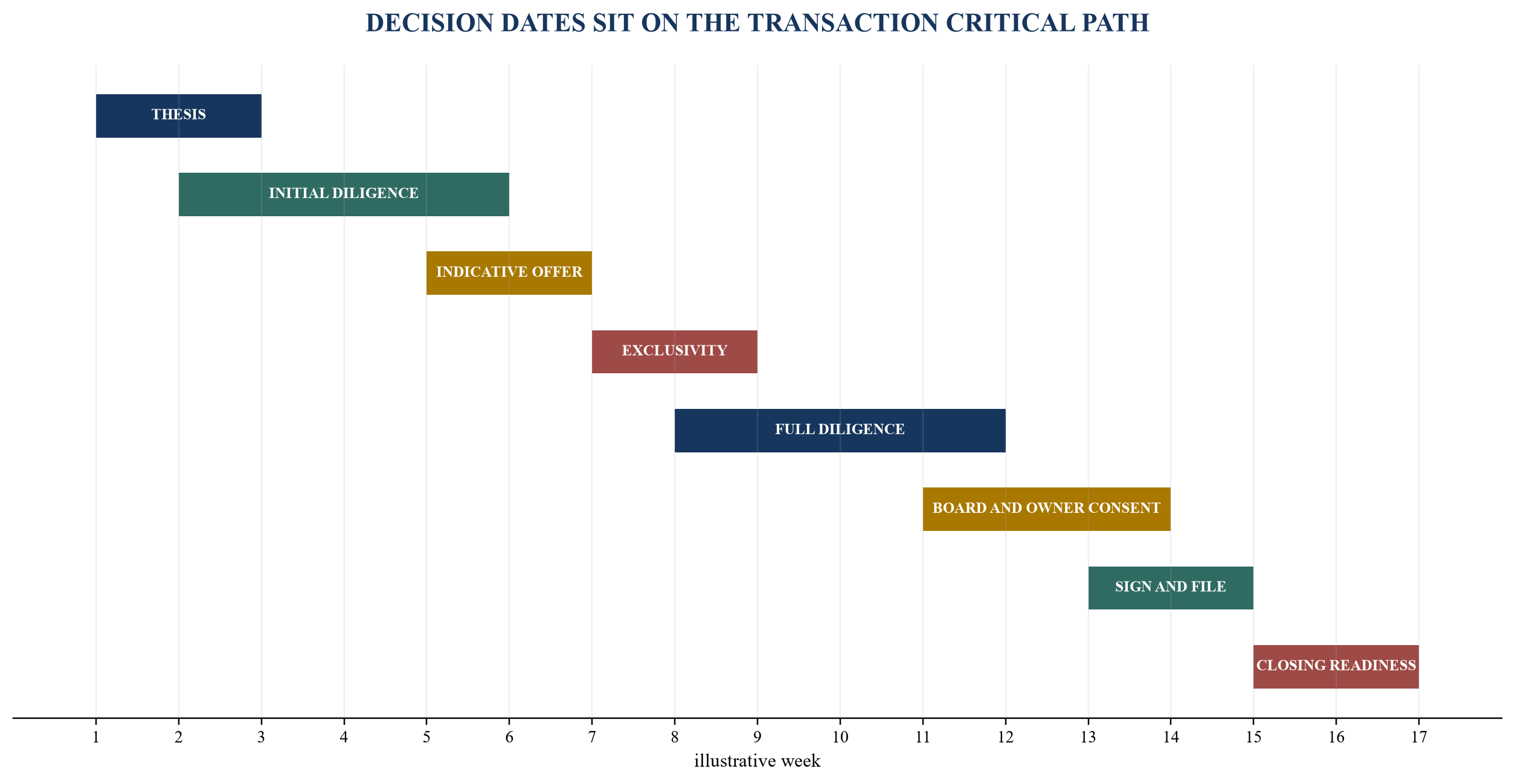
Timing and outcomes are hypothetical management assumptions.
21. Implement the committee in 90 days
The first 30 days should establish the legal and governance baseline. Counsel and the company secretary map relevant entities, governing documents, reserved matters, conflicts, lender consents and existing delegations. The board approves the committee's purpose, membership, reporting line and interim mandate. Management selects a bounded set of live and historical transactions to test the design.
Days 31 to 60 should build the operating system. The team creates the authority register, gate definitions, paper template, conflict declaration, access matrix, meeting calendar, minute form, condition tracker and escalation protocol. Members receive training on entity-specific duties, confidentiality, competition constraints and the difference between recommendation and approval.
Days 61 to 90 should run complete decision cycles. The committee uses the new pack on at least one opportunity and one retrospective case. The board reviews whether papers arrived on time, quorum and recusal worked, conditions were explicit and decisions remained inside authority. Weak thresholds, duplicated forums and unclear roles are corrected.
The board gate should require six conclusions. The committee has a valid written mandate. Every decision links to the correct legal entity. Reserved matters and financing consents are mapped. Conflicts have a documented route. Each transaction stage has a distinct evidence standard and authority. Committee decisions and recommendations reach the board through an auditable record.
The mature committee should make fewer ambiguous decisions and create faster, better-prepared escalation. Its contribution is visible when management can execute within clear limits, boards receive complete decision material, family owners exercise reserved rights at the correct moment and the organisation learns from outcomes. Governance then becomes a source of transaction readiness.
Sources and further reading
- United Arab Emirates Legislations, Federal Decree by Law No. 37 of 2022 Concerning Family Businesses Official source
- United Arab Emirates Legislations, Family Businesses Law Official Download Official source
- Dubai Chambers, Dubai Centre for Family Businesses Corporate Governance Toolkit Official source
- United Arab Emirates Ministry of Economy and Tourism, Economic Concentration Official source
- United Arab Emirates Ministry of Economy and Tourism, Regulation of Competition Official source
- United Arab Emirates Ministry of Economy and Tourism, Federal Decree-Law No. 36 of 2023 Regulating Competition Official source
- United Arab Emirates Ministry of Economy and Tourism, Cabinet Decision No. 3 of 2025 on Economic Concentration Thresholds Official source
- Saudi Arabia Capital Market Authority, Corporate Governance Regulations Official source
- Saudi Arabia General Authority for Competition, Economic Concentration Review Guidelines Official source
- Central Bank of Bahrain, High-Level Controls Module for Investment Firms Official source
- Central Bank of Bahrain, Fit and Proper Requirements for Boards and Management Official source
- Central Bank of Bahrain, Laws and Regulations Official source
- Qatar Financial Markets Authority, Governance Code for Listed Companies 2025 Official source
- Qatar Financial Markets Authority, Legislation Decisions Official source
- Kuwait Capital Markets Authority, Circular on Board Committee Meetings and Minutes Official source
- Kuwait Capital Markets Authority, Resolution No. 56 of 2026 on Corporate Governance Official source
- International Finance Corporation, Family Business Governance Handbook Official source
- International Finance Corporation, Family Business Governance Official source
- Organisation for Economic Co-operation and Development, G20/OECD Principles of Corporate Governance 2023 Official source
- Organisation for Economic Co-operation and Development, Responsibilities of the Board Official source
- Organisation for Economic Co-operation and Development, Disclosure and Transparency Official source
- UK Takeover Panel, The Takeover Code Official source
- UK Takeover Panel, Rule 2.2 When an Announcement Is Required Official source
- United States Federal Trade Commission, Premerger Notification Program Official source
- European Commission, Merger Procedures Official source
- Accounting and Corporate Regulatory Authority Singapore, Company Directors' Duties and Key Obligations Official source
- Securities and Exchange Board of India, Disclosure Obligations for Related Party Transactions Official source
- Australian Securities and Investments Commission, Your Company and the Law Official source
- Competition Bureau Canada, Overview of the Merger Review Process Official source
- Competition Bureau Canada, Merger Review Process Guidelines Official source
