

1. Introduction
A family office is an organisation before it is an investment portfolio. It holds authority, information, relationships and memory on behalf of a family. As the platform grows, its operating design determines whether decisions remain coherent across entities, generations, asset classes and jurisdictions.
Growth can expose several gaps. Ownership records may sit with different providers. Bank and custody statements may use different classifications. Private funds create commitments that are invisible in a market-value report. Direct investments require board oversight and follow-on capital. Family businesses, property and personal assets can compete for liquidity. Tax applications and filings can depend on facts maintained by several parties. A founder may retain practical authority that is absent from committee terms or succession documents.
The UAE ecosystem gives families a broad structuring and operating choice. DIFC reported more than 500 wealth and asset-management firms at the end of 2025, alongside 1,289 family-related entities and 1,115 foundations.[1] Its Family Wealth Centre provides a platform addressing governance, succession and multi-generational wealth.[2] ADGM describes separate routes for a single-family office, a regulated multi-family office and structuring through foundations, special-purpose vehicles and trusts.[3] The federal family-business framework addresses ownership, governance, succession and dispute mechanisms for eligible registered family businesses.[4]
Choice increases the need for architecture. A legal structure answers ownership and legal-governance questions. An investment policy answers allocation and risk questions. An operating system connects those instruments to decisions, cash, data, controls and people.
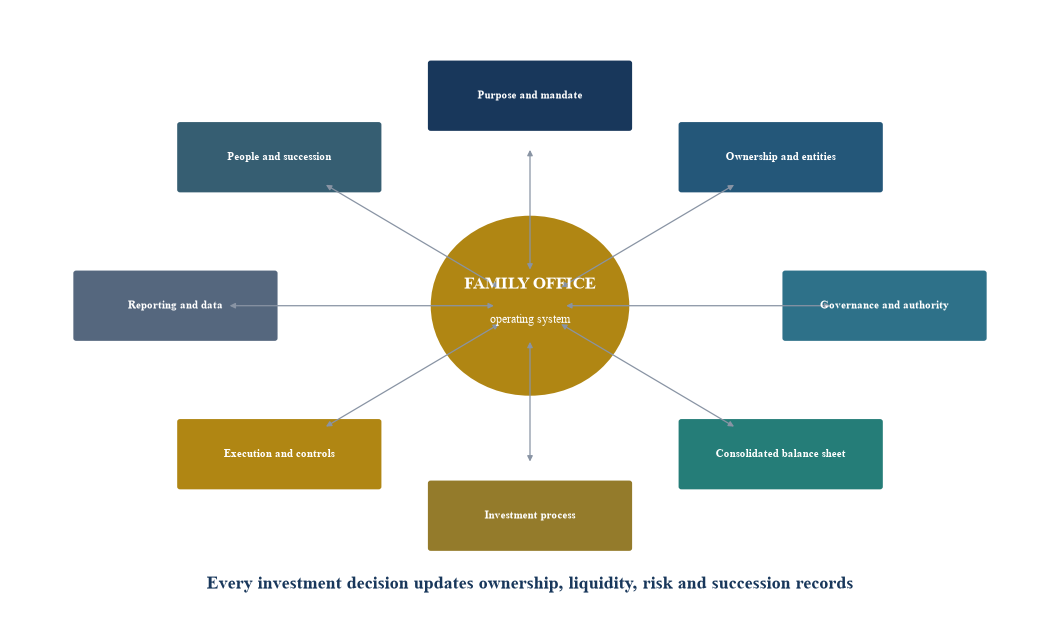
Author framework. Legal, regulatory and tax design requires advice based on the family's actual facts.
2. Read the UAE operating environment accurately
Official ecosystem data describe scale and available frameworks. They do not prove the suitability of a particular jurisdiction, vehicle or adviser. The family office should preserve that boundary in its decision record.
DIFC's Annual Report 2025 states that the centre was home to more than 500 wealth and asset-management firms, reflecting 22 per cent annual growth. It reports a 61 per cent increase in family-related entities to 1,289 and a 66 per cent increase in foundations to 1,115.[1] These figures describe the DIFC ecosystem at the report date. They provide evidence of institutional depth and peer activity rather than an investment recommendation.
The DIFC Family Wealth Centre describes its role as supporting family businesses and ultra-high-net-worth individuals across governance, succession and multi-family-office needs.[2] DIFC Family Arrangements Regulations provide a framework relevant to registered family entities and family offices within their scope.[5] Applicable obligations should be confirmed from current law, regulations and advice.
ADGM's published family-office route distinguishes a single-family office, which it describes as managing one family's affairs, from a multi-family office serving several families and requiring financial-services permission. It also describes foundations, special-purpose vehicles and trusts as structuring options.[3] The page states a minimum family net-assets threshold of USD 10 million for its single-family-office route. Current eligibility, application, fees and ongoing duties should be verified at the time of implementation.
The UAE Ministry of Economy and Tourism describes registration and governance mechanisms under the family-business framework, including ownership-transfer restrictions, succession plans, family charters, family councils, family offices and investment committees for eligible businesses.[4] The official Family Business Charter template addresses separation of ownership and management, standing committees and internal audit.[6]
Federal Tax Authority materials add a tax-governance layer. The FTA guide explains the conditions under which a qualifying family foundation can apply for fiscally transparent treatment and the related registration and compliance consequences.[7] The FTA also issued a public clarification on family wealth-management structures.[8] A family office should translate advice into an entity-level tax responsibility record instead of relying on the name of a vehicle.
Table 1. UAE operating evidence and family-office use
| Official evidence | What it establishes | Operating-system use | Verification required |
|---|---|---|---|
| DIFC Annual Report 2025 | reported scale and growth of the DIFC private-wealth ecosystem | provider mapping, peer context and jurisdiction shortlist | current entities, permissions, services and costs |
| DIFC Family Wealth Centre | dedicated ecosystem for family governance, succession and wealth | education, adviser ecosystem and governance resources | programme, eligibility and current terms |
| DIFC Family Arrangements Regulations | formal framework for family entities and family offices in scope | legal-governance and entity-design workstream | current text and family-specific legal advice |
| ADGM family-office routes | published routes for single-family, multi-family and structuring solutions | jurisdiction and operating-model options | eligibility, licence, permission and ongoing obligations |
| UAE family-business framework | federal mechanisms for ownership, governance and succession of eligible businesses | connect family enterprise to family council and investment governance | registration eligibility and enforceable documents |
| FTA family-foundation guide | corporate-tax treatment and application process for qualifying structures | entity tax register, applications, filings and evidence | current tax law, decisions, facts and adviser conclusion |
Each source has its own legal scope, date and application requirements.
3. Start with family purpose and a mandate
The operating system begins with an agreed purpose. The purpose can include capital preservation, family-business continuity, intergenerational growth, entrepreneurship, philanthropy, education and lifestyle. Tensions among these goals should be recorded and governed.
A family mandate translates purpose into authority. It identifies the family members and branches covered, assets within scope, excluded personal matters, decision horizon, confidentiality standard and relationship to operating companies, trusts, foundations and charitable activities. It also identifies decisions retained by the family and those delegated to the office.
The mandate should define success through several measures. Investment performance is one. Liquidity coverage, risk concentration, tax and legal compliance, operational incidents, succession readiness, education and service quality can also matter. A measure needs an owner, definition, frequency and data source.
The family charter and investment policy play different roles. A family charter can address values, family participation, ownership, governance, conduct and succession. The investment policy governs capital objectives, risk, liquidity, asset classes, limits, delegation and monitoring. Legal documents establish binding rights. The operating system maps the documents and prevents one from being treated as a substitute for another.
4. Map ownership, control and economic exposure
The entity map is the foundation of consolidated reporting. It records every material foundation, trust, holding company, special-purpose vehicle, partnership, operating company, fund vehicle, property company and personal account within scope.
Each record includes legal name, jurisdiction, identifier, owner, beneficiary, controller, directors, signatories, administrator, registered agent, auditor, bank, tax status, financial year, reporting currency and document location. It distinguishes legal ownership, beneficial interest, voting control and economic exposure.
The map includes relationships. An operating company may be owned through several holdings. A property can secure debt elsewhere. A private fund can sit within a foundation while capital calls are funded from a different entity. Guarantees, pledges, shareholder loans and related-party balances connect the structure.
Every relationship needs a source document and review date. Organograms without ownership percentages, rights and evidence are insufficient. The family office should record planned restructurings separately from completed legal state.
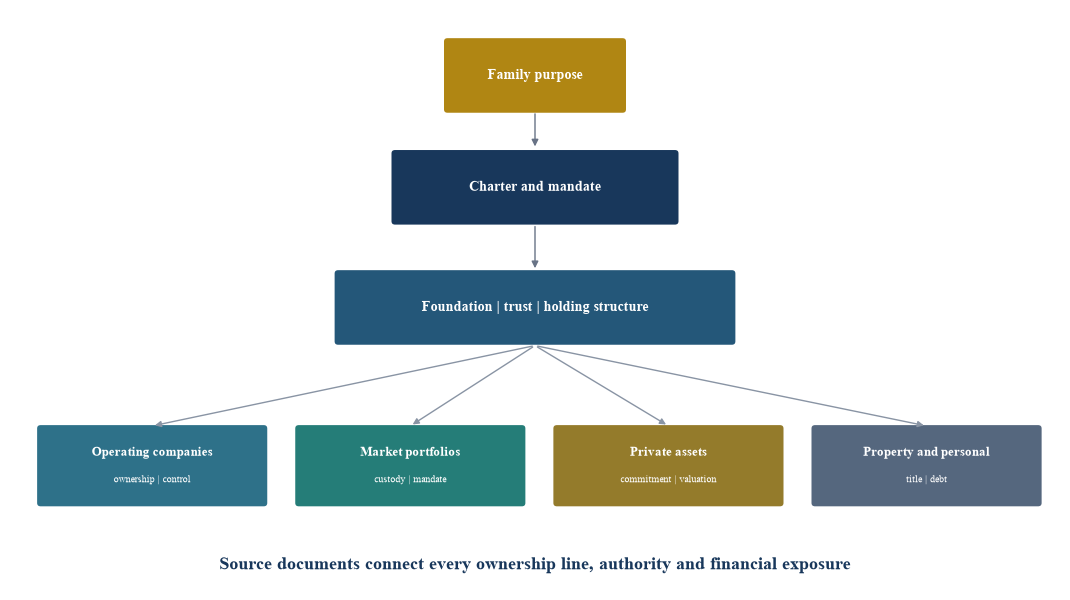
Author framework. The diagram is generic and does not recommend a legal structure.
5. Separate family, ownership, investment and operating decisions
Governance becomes clearer when decisions are classified. Family decisions address purpose, values, participation, distributions, education and succession. Ownership decisions address shareholders, beneficiaries, voting, transfers, boards and reserved matters. Investment decisions address allocation, transactions, managers, risk and exits. Operating decisions address people, systems, providers, payments, records and controls.
The family council represents the agreed family constituency. A holding-company or foundation board carries legal duties within its structure. The investment committee approves decisions within a delegated mandate. The chief investment officer develops portfolio recommendations and oversees execution. The office's operations lead maintains cash, data, providers and controls. External counsel, tax advisers, accountants and investment specialists provide defined professional work.
One individual can hold several roles. The authority matrix should still show which capacity applies. A founder acting as family chair, director and investment-committee member needs separate records of each decision and legal authority.
Reserved matters should be specific. Examples include changing the mandate, selling a core family business, borrowing above a threshold, pledging assets, admitting beneficiaries, altering a foundation, entering a new jurisdiction, making a concentrated investment or changing the chief investment officer. Thresholds should reflect the family's scale and documents.
Table 2. Family-office decision-rights matrix
| Decision class | Primary forum | Management responsibility | Evidence retained |
|---|---|---|---|
| Family purpose and participation | family council | family-office leadership prepares options and implications | charter, minutes, consent and communication record |
| Ownership and entity change | board, council or other authorised body | legal and tax teams prepare structure and execution plan | advice, resolutions, filings, registers and closing documents |
| Strategic asset allocation | investment committee with required family approval | chief investment officer prepares policy and scenarios | policy, capital-market assumptions, liquidity and risk analysis |
| Individual investment | investment committee or delegated authority | investment team completes diligence and recommendation | memo, evidence index, model, conflicts and approval |
| Funding and payments | authorised signatories under controls | operations verifies cash, beneficiary and approval | instruction, dual approval, bank evidence and reconciliation |
| Portfolio monitoring | investment committee | investment and operations teams maintain dashboard and exceptions | valuations, manager reports, covenant and action log |
| Provider appointment | board, committee or office authority | operations runs diligence, scope and fee review | proposal, contract, conflicts, service levels and review date |
| Succession or incapacity | forums defined by legal and family documents | designated officers activate continuity plan | authority evidence, access transition and decision record |
Actual authority follows governing documents, law and approved delegation.
6. Build one consolidated balance sheet
A family office cannot govern what it cannot aggregate. The consolidated balance sheet records assets, liabilities, commitments, guarantees and contingent exposures across the entity perimeter.
Assets should be classified by economic exposure and liquidity. Operating businesses, listed securities, bonds, cash, private funds, direct private companies, real estate, credit, commodities, art and other personal assets have different valuation and liquidity characteristics. The system records ownership entity, currency, valuation date, source, methodology, confidence and restrictions.
Liabilities include bank debt, mortgages, capital-call facilities, shareholder loans, guarantees and other obligations. The office should identify recourse, collateral, maturity, rate, covenant, currency and refinancing route. Net worth is incomplete when guarantees and commitments are missing.
Private-market commitments require a separate schedule. It records committed capital, funded amount, remaining commitment, recallable distributions, expected calls, manager notice terms and stressed call assumptions. Direct investments require approved but unfunded follow-on capital.
Look-through exposure should be captured where available. A family can own several funds and direct investments with the same underlying geography, sector, sponsor or financing sensitivity. The consolidated view retains uncertainty when look-through data are incomplete.
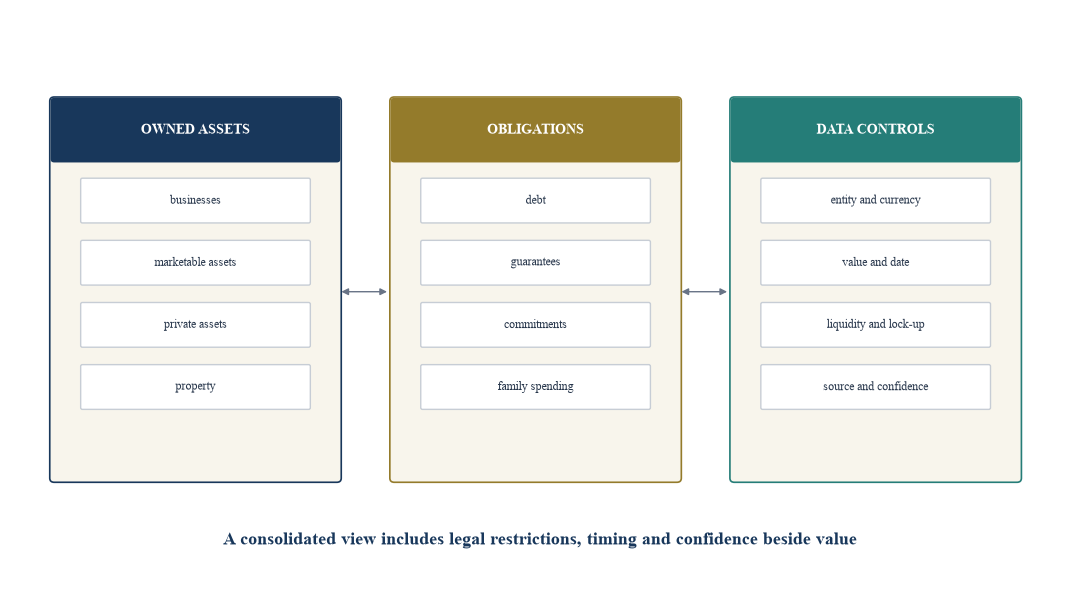
Author framework. Values and liquidity require dated, source-specific evidence.
7. Design the investment policy around the whole family system
The investment policy states the portfolio's job. It defines objectives, horizon, risk, liquidity, eligible assets, strategic ranges, concentration, currency, leverage, responsible-investment considerations, delegation and review.
The return objective should connect to uses of capital. Family distributions, operating-company funding, philanthropy, tax, office cost and inflation can create a required return. A high nominal target without a risk and liquidity budget can drive unintended concentration.
Risk includes permanent loss, volatility, leverage, illiquidity, currency, counterparty, operational and reputational exposure. The policy should identify which risks the family is willing and able to bear. Family-business wealth can already create a large sector and country concentration before the financial portfolio is considered.
Strategic ranges should accommodate uncertainty while remaining binding. A policy can define public markets, fixed income, private equity, venture, private credit, real assets, real estate and cash. It also records whether the operating business is included in allocation and risk reporting.
Liquidity policy states the minimum reserve and eligible sources. Commitment policy sets limits for remaining unfunded capital, annual pacing and manager concentration. Leverage policy identifies permitted purpose, collateral, maturity and approval.
Table 3. Investment-policy design for a scaling family office
| Policy element | Required definition | Evidence | Governance question |
|---|---|---|---|
| Objective | preservation, growth, income, enterprise, philanthropy and legacy | family mandate and required-use model | what is the portfolio required to fund? |
| Risk | permanent loss, volatility, illiquidity, leverage, currency and concentration | consolidated balance sheet and scenarios | which losses can the family absorb without changing its plans? |
| Liquidity | reserve, time buckets, eligible sources and stress coverage | cash-flow ladder and commitment schedule | can all obligations be funded through stress? |
| Allocation | asset classes, strategic ranges, tactical authority and benchmarks | capital assumptions and implementation map | which exposures diversify existing family wealth? |
| Concentration | issuer, manager, sector, country, currency, strategy and counterparty | look-through exposure ledger | which shared dependency dominates the family balance sheet? |
| Private markets | pacing, remaining commitments, co-investment and valuation | manager records and cash-flow model | how much locked capital can be governed and serviced? |
| Leverage | allowed uses, maximums, collateral, maturity and covenants | facility and asset-level debt schedule | which borrowing supports resilience or creates fragility? |
| Delegation | committee, chief investment officer, manager and adviser authority | charter, terms and limits | who may decide, execute and make exceptions? |
Policy parameters require family-specific modelling and approval.
8. Run one investment process across asset classes
A common process allows different investments to receive proportionate governance. It begins with a documented thesis and ends with monitoring and learning.
Origination records source, relationship, conflicts, deadline and initial fit. Screening tests mandate, size, liquidity, jurisdiction, reputation, resource need and obvious exclusions. Approved opportunities enter diligence with an owner and work plan.
Diligence covers commercial, financial, legal, tax, operational, technology, sustainability and reputational matters according to risk. Fund diligence adds manager, team, strategy, track record, economics, valuation, operations and terms. Direct investments add company governance, rights, financing and exit. Property and credit require their own technical and security work.
The investment memo should state the decision requested, evidence, thesis, downside, valuation, structure, liquidity, conflicts, unresolved items and monitoring plan. It separates verified facts, adviser opinions and management assumptions. The model and memo use the same numbers and dates.
Approval records the vote, conditions, dissent, delegated execution authority and expiry. Closing confirms that documents, funding, ownership, tax, compliance and reporting match the approved decision. Monitoring begins with the signed terms and closing file.
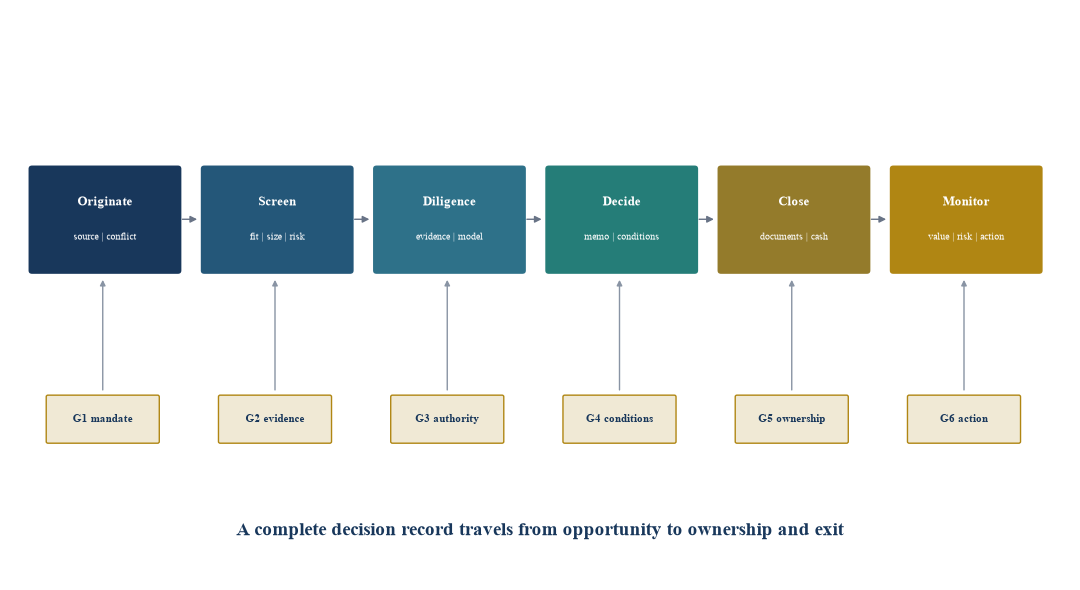
Author framework. Diligence depth and approval authority scale with materiality and risk.
Table 4. Proportionate investment gates
| Gate | Minimum evidence | Approval test | Record after approval |
|---|---|---|---|
| Mandate fit | objective, asset, jurisdiction, size, liquidity and conflict | opportunity is inside policy or exception route is explicit | screen and assigned owner |
| Diligence completeness | evidence index, specialist work, model and open issues | material claims are supported and gaps have decision treatment | diligence report and exception log |
| Downside and liquidity | scenarios, loss path, calls, financing and exit | family system can absorb the downside and funding need | scenario version and liquidity impact |
| Terms and governance | price, rights, covenants, reporting, conflicts and remedies | structure supports the thesis and monitoring | approved term parameters |
| Closing readiness | documents, entities, tax, compliance, cash and conditions | executed transaction matches committee authority | closing book and ownership update |
| Monitoring readiness | data, frequency, thresholds, owner and escalation | office can govern the asset after funding | monitoring calendar and action triggers |
Requirements expand with size, complexity, illiquidity and downside.
9. Govern liquidity as a family-wide resource
Liquidity is an operating system because several constituencies use it. The office should build a rolling ladder covering committed investments, operating-company needs, debt service, tax, family spending, philanthropy, office costs and contingencies.
The first layer is immediately available cash in the correct entity and currency. The second layer is highly liquid marketable assets subject to settlement and policy haircuts. The third layer is committed facilities after conditions, covenants and collateral. Expected distributions and asset sales sit in lower-confidence layers.
The ladder uses base and stress cases. Stress can delay private distributions, accelerate calls, reduce market values, increase collateral needs, postpone exits and create operating-company support requests. Correlated needs matter because family wealth often shares the same economic cycle.
Inter-entity funding cannot be assumed. Legal, tax, governance, minority-rights and banking constraints can prevent cash movement. The system identifies the actual paying entity and approved route for each obligation.
Payment controls protect the ladder. Beneficiary verification, call-back, dual approval, bank-account validation, sanctions and fraud controls, segregation of duties and daily reconciliation apply according to risk. Urgency does not remove documentation.
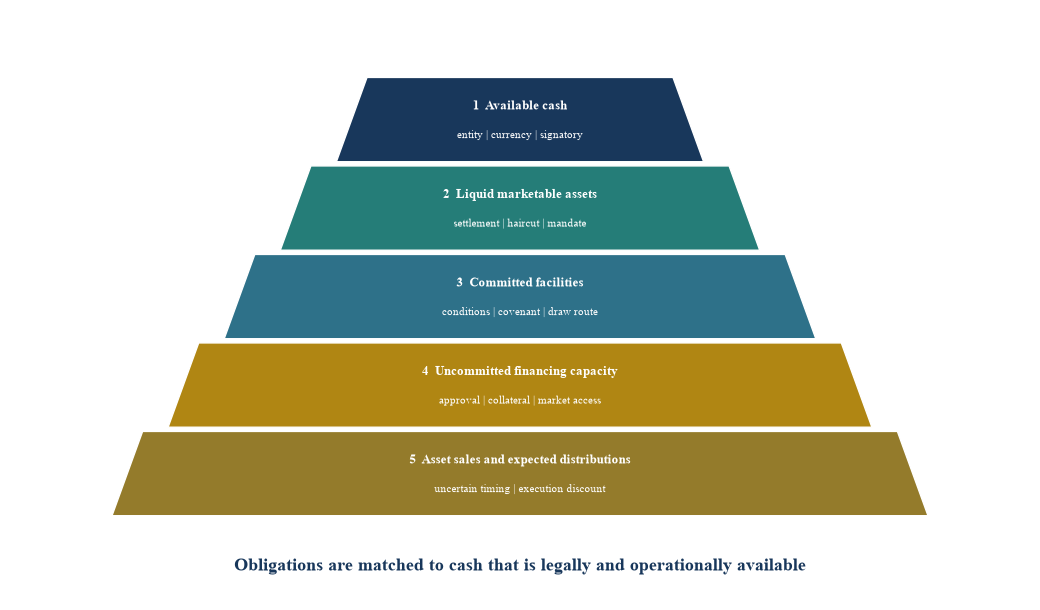
Author framework. Haircuts and time buckets are approved management assumptions.
10. Create an institutional reporting and data model
The data model connects entity, account, asset, transaction, valuation, commitment, document, counterparty and decision records. Stable identifiers prevent the same holding from appearing differently across reports.
Every value has a date, currency, source and status. Listed values can use controlled market sources. Private values need methodology, manager or board approval, reporting period and subsequent events. Property values identify valuer and basis. Family-business values distinguish accounting book value, transaction estimate and formal valuation.
Performance reporting should show money-weighted and time-weighted measures where appropriate, alongside contribution, withdrawal, currency and benchmark. Private assets require paid-in, distributed and remaining value, with valuation confidence. A family office should avoid aggregating incomparable figures into one precise return without method disclosure.
Document control connects investments to contracts, approvals, tax advice, ownership and correspondence. Critical originals and access credentials need secure custody and continuity. Data access follows role and need.
The monthly executive dashboard should remain short. It presents net asset value by confidence, liquidity, commitments, allocation, concentration, performance, upcoming decisions, exceptions and compliance dates. Detailed schedules remain available for review.
Table 5. Family-office reporting pack
| Frequency | Core report | Decision use | Data owner |
|---|---|---|---|
| Daily | cash, payments, market exceptions and urgent notices | funding, fraud prevention and incident response | finance and operations |
| Weekly | liquidity, capital calls, transaction pipeline and open actions | execution priority and short-term cash planning | chief operating officer and investment team |
| Monthly | consolidated balance sheet, allocation, performance, commitments and exceptions | chief investment officer review and family-office management | investment reporting |
| Quarterly | investment-committee pack, scenarios, private valuations, covenants and manager review | allocation, hold, follow-on, exit and watchlist decisions | investment committee secretary |
| Annual | audited records, policy, providers, tax, legal entities, insurance and succession | board and family-governance review | accountable function owners |
| Event-driven | ownership, control, key person, breach, cyber, litigation, default or material valuation | immediate escalation and remedy | designated incident owner |
Frequency should reflect asset risk, document requirements and family preferences.
11. Manage providers as an integrated network
Family offices rely on banks, custodians, asset managers, administrators, lawyers, tax advisers, accountants, insurers, property managers, valuers and technology vendors. Provider quality cannot compensate for an unclear internal owner.
The provider register records entity, service, contract, fees, conflicts, data access, service levels, renewal, termination, insurance, key contacts and last review. It identifies overlapping and missing responsibilities. The family office retains the final responsibility assigned by its own documents and applicable law.
Selection begins with requirements and conflicts. Diligence covers capability, permission, jurisdiction, financial condition, security, continuity, personnel and references. The contract defines scope, deliverable, data ownership, confidentiality, liability, subcontracting, incident reporting and exit assistance.
Performance review uses evidence. Timeliness, error, responsiveness, exception closure, fee, value and continuity are recorded. Relationship importance remains relevant and should be visible alongside performance.
12. Build people, succession and continuity into normal operations
The office needs an organisation chart, role profiles, authority, objectives, conflicts, backup and development plan. Family members working in the office should have the same clarity of role and performance expected from non-family professionals, adapted to the family's governance choices.
Succession covers family leaders, directors, protectors, guardians, council members, investment-committee members, chief executives, chief investment officers and key providers. The plan identifies nomination, eligibility, appointment, emergency authority, handover and removal.
Key-person dependency often sits in information. A founder or long-serving adviser can hold the history behind an asset, relationship or structure. The office should convert that history into decision records, contact maps, document indexes and action calendars while respecting confidentiality.
Continuity plans cover incapacity, death, resignation, cyber incident, provider failure, bank disruption, office loss and geopolitical event. The team tests access, signatories, payments, communications and restoration. A plan that has not been exercised remains a design assumption.
13. Demonstrate the method with a hypothetical platform
Consider a hypothetical UAE family office overseeing assets with a management-estimated gross value of AED 3.0 billion. The illustrative balance sheet includes AED 1.2 billion in operating businesses, AED 700 million in marketable securities, AED 500 million in property, AED 350 million in private funds and direct investments, and AED 250 million in cash and short-duration instruments. It has AED 180 million of debt and AED 140 million of unfunded commitments. Every amount is a management assumption for demonstration.
The family has two branches and three adult next-generation members. The founder currently chairs the family council, holding-company board and investment committee. Several assets sit in different companies with separate bank relationships. The office receives quarterly manager reports and maintains investment data in several files.
The operating-system audit finds three priorities. First, ownership and authority need a controlled entity map and role-specific succession. Second, the liquidity ladder should incorporate commitments, debt, family distributions and possible operating-company support. Third, private valuations and performance need common dates, methods and confidence labels.
The family approves an investment policy that recognises the operating companies as an existing concentration. It establishes committee authority, a liquidity minimum, manager and single-asset limits, private-market pacing, leverage rules and reporting. It assigns legal and tax advisers to review the structure and FTA treatment based on actual facts.
The twelve-week programme produces a single decision system. It does not change ownership or investments unless separately approved. The family retains strategic judgement while the office gains a reproducible record for execution and succession.
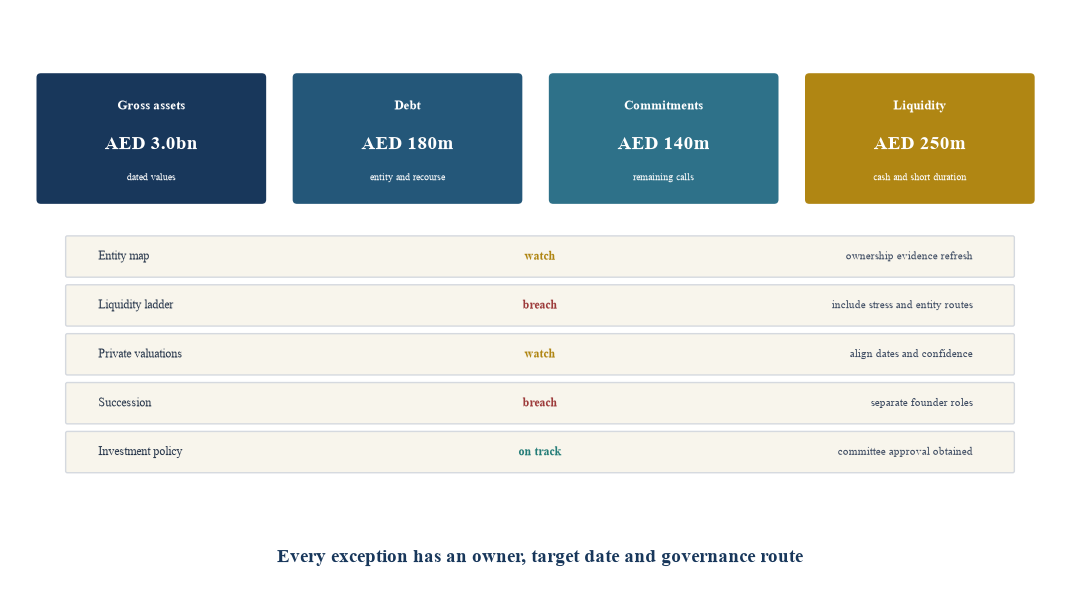
Every value and status is a management assumption created solely to demonstrate the method.
14. Implement the operating system in twelve weeks
Weeks one and two establish the mandate and perimeter. The family identifies purpose, decision forums, included assets, confidentiality and success measures. The office inventories entities, accounts, advisers and current governance documents.
Weeks three and four complete ownership and authority mapping. Legal and tax advisers verify material relationships and current status. The family documents family, ownership, investment and operating decisions in an authority matrix.
Weeks five and six build the consolidated balance sheet and liquidity ladder. Assets, liabilities, commitments, guarantees, currencies, values and sources receive identifiers. Base and stress funding needs are modelled by entity.
Weeks seven and eight approve the investment architecture. The office drafts the investment policy, concentration and liquidity rules, investment funnel, memo, diligence standard and conflicts process. The committee tests the process on one existing investment.
Weeks nine and ten implement data, reporting and controls. The team creates the monthly dashboard, document index, payment controls, provider register, compliance calendar and exception log. Access follows approved roles.
Weeks eleven and twelve establish continuity and launch. The family confirms succession, deputy coverage, emergency access and communication. The board and committee approve the controlled operating version, review unresolved items and schedule quarterly refreshes.
Table 6. Twelve-week family-office operating-system implementation
| Weeks | Workstream | Deliverable | Approval gate |
|---|---|---|---|
| 1 to 2 | purpose and perimeter | mandate, family map, asset scope and current-document register | family confirms purpose, scope and confidentiality |
| 3 to 4 | ownership and governance | verified entity map, authority matrix and reserved matters | legal state and decision rights are accepted |
| 5 to 6 | balance sheet and liquidity | assets, debt, commitments, guarantees and stress ladder | obligations reconcile to available funding routes |
| 7 to 8 | investment process | policy, risk limits, funnel, memo, diligence and conflicts | committee process passes an existing-asset pilot |
| 9 to 10 | data and operations | dashboard, document system, provider register and controls | data sources, owners and exceptions are visible |
| 11 to 12 | people and launch | succession, continuity test, training and controlled version | authorised forums approve launch and refresh calendar |
Timing depends on entity complexity, evidence availability and required legal or tax work.
15. Limitations and conclusion
Family offices differ in purpose, size, generations, citizenship, residence, assets and structures. The framework should be tailored. DIFC, ADGM, federal family-business and FTA materials have different scopes and conditions. Qualified advisers should determine the application of current law, regulation and tax to the family.
Valuations can be uncertain. Private assets, operating businesses, property and personal assets may use different dates and methods. The consolidated report should preserve the source, method and confidence rather than imply uniform precision.
Confidentiality can limit aggregation and access. The family can use role-based views, secure systems and specialist reviews. The board and authorised decision makers still need sufficient information for their duties.
The hypothetical platform contains management assumptions solely for method demonstration. It does not describe a family, client, market portfolio or recommended allocation.
The Family Office Operating System connects the family's purpose to execution. It establishes a current view of ownership and wealth, separates decision rights, links investments to liquidity and policy, records evidence, controls payments, manages providers and prepares people for succession.
Institutional governance is repeatability with judgement. The family retains its values, relationships and entrepreneurial perspective. The operating system gives those strengths an accountable structure that can scale across assets, advisers and generations.
References
- [1] Dubai International Financial Centre, Annual Report 2025, April 2026. https://assets.difc.com/v1/media/edge/images/dubaiintern0078-difcexperie96c5-production-3253/media/project/difcexperiences/difc/difcwebsite/documents/media-section/publications/annual-review/annual-report-2025.pdf
- [2] Dubai International Financial Centre, DIFC Family Wealth Centre, accessed 12 August 2026. https://www.difc.com/ecosystem/difc-family-wealth-centre
- [3] Abu Dhabi Global Market, Family Offices, accessed 12 August 2026. https://www.adgm.com/business-areas/family-offices
- [4] UAE Ministry of Economy and Tourism, Family Business, accessed 12 August 2026. https://www.moet.gov.ae/en/web/guest/family-business
- [5] Dubai International Financial Centre, Family Arrangements Regulations 2023. https://assets.difc.com/v1/media/edge/images/dubaiintern0078-difcexperie96c5-production-3253/media/project/difcexperiences/difc/difcwebsite/documents/familydocs/family_arrangements_regulations_updated_april23.pdf
- [6] UAE Ministry of Economy and Tourism, Family Business Charter, 2024. https://www.moet.gov.ae/documents/20121/0/%D9%85%D9%8A%D8%AB%D8%%D9%82%2B%D8%%D9%84%D8%%D8%%D9%83%D8%%2B%D8%%D9%84%D8%%D8%%D9%8A%D9%94%D9%84%D9%8A%D8%%2B2024.pdf/510d46cd-8c28-3299-583e-6d27d164062f
- [7] UAE Federal Tax Authority, Corporate Tax Guide: Taxation of Family Foundations, May 2025. https://tax.gov.ae/Datafolder/Files/Pdf/2025/Family-Foundations-Guide-27-05-2025.pdf
- [8] UAE Federal Tax Authority, Public Clarification CTP008: Corporate Tax Treatment of Family Wealth Management Structures, September 2025. https://tax.gov.ae/en/content/ctp008.corporate.tax.treatment.of.family.wealth.management.structures.aspx
- [9] UAE Legislation, Federal Decree by Law No. 37 of 2022 Concerning the Family Businesses. https://uaelegislation.gov.ae/en/legislations/1608
- [10] Abu Dhabi Global Market, Registration Authority Publishes Amendments to Commercial Legislation, 1 May 2026. https://www.adgm.com/media/announcements/adgm-registration-authority-publishes-amendments-to-the-commercial-legislation
- [11] Abu Dhabi Global Market, 2025 Performance and Family-Office Framework Developments, April 2026. https://www.adgm.com/media/announcements/adgm-celebrates-decade-of-operations-with-36-surge-in-aum-51-increase-in-workforce-and-over-12000-licences-in-2025
- [12] UAE Ministry of Economy and Tourism, Companies Legislation, accessed 12 August 2026. https://www.moet.gov.ae/en/companies-legislations
- [13] UAE Federal Tax Authority, Family Foundations as an Unincorporated Partnership Application, 10 March 2025. https://tax.gov.ae/en/media.centre/news/federal.tax.authority.launches.family.foundations.as.an.unincorporated.partnership.application.via.emaratax.digital.platform.aspx
- [14] UAE Ministry of Finance, Corporate Tax in the UAE, accessed 12 August 2026. https://mof.gov.ae/en/public-finance/tax/corporate-tax/
About the Author
Chennakeshav Adya is an independent researcher and Managing Partner of Matchpoint Partners. His research focuses on investment strategy, capital formation, transaction execution, governance and operating-model design across the Gulf and international markets.
