

1. Introduction
A private-market allocation can appear comfortable on a net-worth statement while creating immediate cash pressure. Fund values are reported quarterly. Capital calls arrive on contractual notice. Distributions depend on exits, refinancing, operating cash flow and manager decisions. The dates rarely align.
Family offices face an additional layer of competition for liquidity. Family distributions, tax, debt service, philanthropy, property expenditure, new direct investments and operating-company support can all draw from the same bank accounts or liquid portfolio. A fund commitment may sit in one entity while the practical funding reserve sits in another. Guarantees, currency conversion, transfer restrictions and approval rights can make apparent liquidity unavailable at the required date.
The distribution drought makes these structural weaknesses visible. MSCI states that private-equity distributions have stayed near decade lows for four consecutive years. Its data show that closed-end private-equity funds returned only 12 per cent of starting asset value in 2025, compared with a 20-year average of approximately 23 per cent.[1] MSCI's June 2026 private-capital review reported an 8 per cent distribution rate and 35 per cent contribution rate for Q1 2026.[2] These are global pooled observations. They do not predict the cash flow of a specific fund or family portfolio.
The operating question is direct: can the family office meet every approved obligation on time under a realistic drought case without selling strategic assets under pressure or weakening long-term governance?
This paper answers that question through a liquidity operating system. The system connects contractual obligations, scenario forecasts, cash sources, decision rights and evidence. It replaces the assumption that distributions will fund calls with an explicit, dated funding plan.
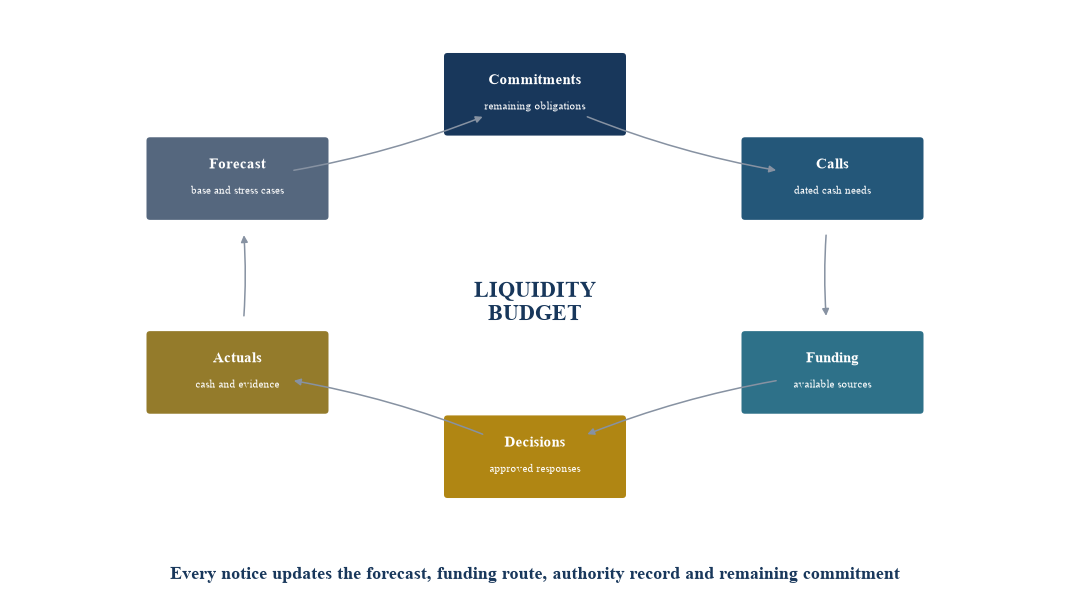
Author framework. Each forecast cycle should reconcile actual notices, cash movements and current evidence.
2. Read the distribution evidence without turning it into a forecast
Market evidence establishes the need for a stronger budget. It does not provide the family office with a usable cash forecast by itself.
MSCI's Private Capital Universe covers more than 15,000 closed-end funds in its Q4 2025 benchmark summary.[3] Contributions and distributions moved into balance during 2025, while the overall distribution rate remained 13 per cent, unchanged from 2024. The private-equity subset remained weaker: MSCI reported a 12 per cent distribution rate for 2025 and described that level as just over half the long-term average.[1]
The Q1 2026 cash-flow picture weakened. MSCI's June 2026 presentation reports an 8 per cent distribution rate and a 35 per cent contribution rate for global private equity.[2] The observation covers a single quarter and should not be annualised mechanically. It demonstrates that calls and distributions can diverge sharply at the portfolio level.
ILPA's 2025 Capital Call and Distribution Template was designed to improve consistency and transparency in notices.[4] Its guidance provides fields for transaction purpose, due dates, components and payment details. Standardised notices help operations; they do not remove the need for a family-specific commitment register, cash calendar and authority process.
ILPA's 2025-2026 LP sentiment work identifies the exit environment and liquidity mechanisms as leading LP concerns.[5] Respondents expressed a preference for conventional exits and long-term value discipline over liquidity created solely to improve near-term metrics. A family office should therefore distinguish liquidity necessity from investment merit and avoid forcing a portfolio sale simply because a historical distribution forecast failed.
IFRS 13 defines fair value as an exit price in an orderly transaction between market participants at the measurement date.[6] A reported value is not a promise of cash, a secondary bid or a borrowing base. Liquidity planning should retain the valuation source and date while modelling separate timing, discount, transfer and execution assumptions.
Table 1. Current evidence and its use in a family-office liquidity budget
| Evidence | Observed point | Budget use | Boundary |
|---|---|---|---|
| MSCI distribution-drought analysis | private-equity distributions were 12 per cent of starting asset value in 2025, just over half the 20-year average | calibrate a conservative distribution case | does not forecast a specific fund |
| MSCI Q1 2026 cash-flow review | distribution rate 8 per cent; contribution rate 35 per cent | test call and distribution divergence | one-quarter pooled data should not be annualised mechanically |
| ILPA call and distribution template | standardised notice fields and transaction components | notice intake, reconciliation and payment control | actual LPA and notice terms remain controlling evidence |
| ILPA LP sentiment survey | liquidity mechanisms and exit environment are leading concerns | require a decision record for liquidity solutions | sentiment is aggregated and not an investment recommendation |
| IFRS 13 | fair value is a measurement-date exit price in an orderly transaction | retain valuation source and confidence | fair value is not immediately available cash |
| Secondary-market evidence | 2025 market volume reached record levels across LP-led and GP-led transactions | maintain an assessed sale route | price, consent, execution time and portfolio quality vary |
Market evidence informs scenarios. Fund-level notices, agreements and current adviser conclusions govern actual obligations.
3. Define the cash perimeter before building the forecast
The liquidity budget begins with legal and operational availability. Cash should be attributed to the entity that owns it, the account where it sits, the currency in which it can be used and the authority required to move it.
The perimeter includes unrestricted cash, short-duration instruments, listed securities, committed but undrawn credit lines, expected operating-company dividends, contractual receivables and other approved sources. It records settlement periods, market and currency risk, borrowing conditions, transfer restrictions, tax consequences and required consents.
Restricted cash remains separate. Escrow balances, regulatory capital, pledged deposits, operating working capital, trust assets and cash subject to minority or lender rights may appear on a consolidated statement while remaining unavailable for a fund call. The budget also separates cash owned personally from cash owned by companies, trusts, foundations or special-purpose vehicles.
The same perimeter applies to obligations. Each capital call, debt payment, tax amount, family distribution, operating-company support request, property expenditure and philanthropy commitment must identify the liable entity. A consolidated forecast that ignores legal ownership can recommend a transfer that is delayed, taxable, prohibited or inconsistent with governance documents.
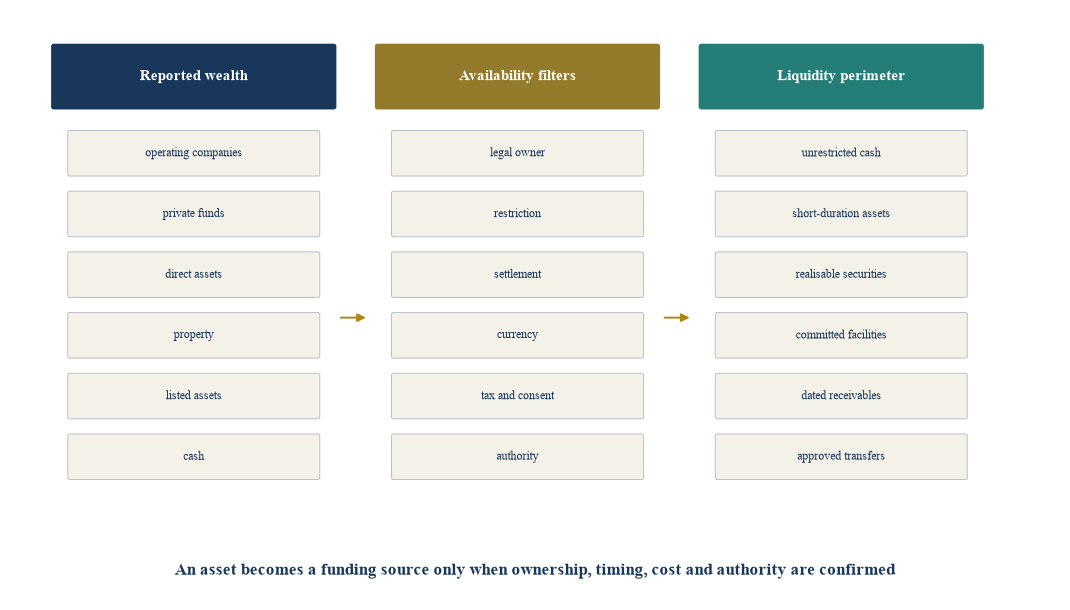
Author framework. Legal, tax, financing and governance advice is required for actual transfers and funding routes.
4. Put every obligation on one calendar
The budget should record obligations before estimating distributions. Contractual and essential payments receive priority over discretionary commitments and opportunities.
Private-market obligations include remaining commitments, recallable distributions, recycling provisions, fund-level expenses, foreign-exchange requirements and approved follow-on capital for direct investments. A notice can include more than a purchase of an investment. Management fees, expenses, bridge repayment, equalisation and other components should be classified from the actual notice.
Family-office obligations extend beyond investments. Tax, debt service, payroll, insurance, property maintenance, family distributions, education, philanthropy and operating-company support can have different dates and authority. Contingent items such as guarantees, litigation, cyber events or emergency business funding belong in a separate stress register with probability, severity, trigger and decision owner.
The calendar uses a common frequency. Daily detail is appropriate for the next 30 days, weekly detail for the next quarter and monthly detail thereafter. A two-year view is often useful for private-market pacing, while the exact horizon should reflect the portfolio and family mandate.
Table 2. Family-office liquidity obligation taxonomy
| Obligation class | Examples | Timing evidence | Budget treatment |
|---|---|---|---|
| Contractual private markets | capital calls, expenses, recallable distributions | fund agreement and current notice | exact due date plus remaining-commitment update |
| Debt and financing | interest, principal, margin or collateral requirements | facility agreement and lender statement | scheduled payment and covenant headroom |
| Tax and regulatory | corporate tax, personal tax, filings, regulatory capital | adviser schedule and authority notice | dated base amount plus uncertainty reserve |
| Family commitments | approved distributions, education, household and family projects | family budget and authorised decision | approved amount; discretionary portion identified |
| Operating companies | working capital, capex, acquisition or rescue funding | board-approved plan and current forecast | separate investment decision and funding cap |
| Property and real assets | debt, service charges, maintenance and development capex | contracts and asset budget | asset-specific calendar and contingency |
| Philanthropy | grants, endowment funding and programme commitments | foundation or board approval | contractual and discretionary portions separated |
| Contingencies | guarantees, litigation, cyber, key-person or geopolitical events | risk register and trigger evidence | probability-weighted view plus severe case |
Priority and authority should be defined by the family's approved documents and actual legal obligations.
5. Build a commitment register that can survive a notice
The commitment register is the private-market subledger of the liquidity budget. It should reconcile to manager statements, signed documents, custody records and cash movements.
Each record identifies the fund, manager, vintage, strategy, legal investor, commitment currency, original commitment, contributed capital, remaining commitment, recallable distributions and any recycling or reinvestment rights. It records the normal notice period, payment instructions, side-letter provisions, expected fund term and the source date of each field.
The forecast fields remain separate from contractual fields. Expected calls, expected distributions, confidence and scenario assumptions are management estimates. A manager estimate should retain the date, source, stated assumptions and any history of forecast variance. Blank data remain unavailable rather than zero.
Currency deserves explicit treatment. A family office can hold a USD-denominated commitment in one entity and AED liquidity in another. The budget should record the hedge policy, conversion route, settlement time, banking limit and stress rate. The AED's peg to the US dollar reduces ordinary spot volatility between those currencies, while banking availability, transfer timing and non-USD commitments remain relevant.
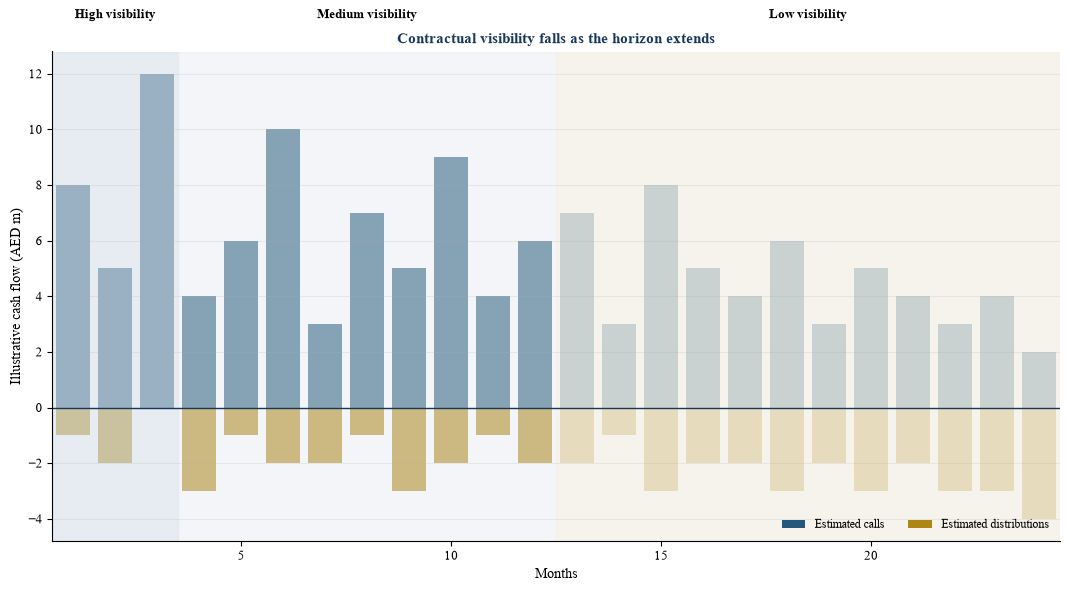
Author framework. Expected calls and distributions remain management estimates until a contractual notice or receipt exists.
Table 3. Minimum private-market commitment record
| Field group | Required fields | Source | Control |
|---|---|---|---|
| Identity | fund, manager, vintage, strategy, investor entity and currency | signed documents and entity register | unique identifiers and document links |
| Contract | original commitment, remaining commitment, recallable amount and recycling rights | LPA, subscription and side letter | legal review and amendment history |
| Notice | notice date, due date, purpose, amount, bank instructions and approval | current capital-call notice | independent instruction verification |
| Cash flow | contributions, distributions, fees and recallable distributions | bank, custodian and manager statement | cash and statement reconciliation |
| Forecast | expected calls, expected distributions, date, confidence and scenario | manager communication and management model | forecast variance retained |
| Funding | account, currency, liquidity tier and backup source | treasury record | availability and authority confirmed |
| Governance | decision owner, approvers, conflicts and exceptions | authority matrix | approval record and exception closure |
Forecast fields should be dated and clearly separated from contractual or manager-reported fields.
6. Forecast distributions as scenarios rather than income
Distribution forecasts should begin with fund-specific evidence. Relevant information includes portfolio-company age, realised and unrealised value, manager exit commentary, asset quality, fund term, continuation activity and the history of forecast accuracy. Portfolio-level market data then informs the range.
The base case can reflect current manager guidance adjusted for observed bias and execution timing. The drought case delays likely exits, reduces partial realisations and removes weakly evidenced distributions. The severe case assumes that only contractual or highly visible receipts arrive during the critical horizon. Each case retains the evidence date and next review trigger.
Calls should be stressed in the opposite direction. Managers can call capital faster than expected when deployment opportunities emerge, subscription facilities mature, portfolio companies require follow-on funding or expenses increase. The stress should respect the legal maximum remaining commitment and model clustering across managers.
The budget should avoid netting calls and distributions from the same manager before cash settles. A notice and a distribution can cross in transit, differ in currency or belong to different entities. Gross flows preserve operational readiness.
Table 4. Scenario design for a family-office private-market budget
| Input | Base case | Distribution-drought case | Severe case |
|---|---|---|---|
| Distribution timing | current manager estimate adjusted for history | delayed and limited to stronger evidence | contractual or highly visible receipts only |
| Distribution amount | evidence-weighted manager range | lower end of supported range | material haircut to non-contractual estimates |
| Capital calls | manager estimate plus known notices | accelerated deployment and clustered calls | high but legally feasible call sequence |
| Liquid-asset value | current observable value | market and execution haircut | larger haircut plus settlement delay |
| Operating-company support | approved plan | identified downside need | capped emergency support under board authority |
| Family and tax obligations | approved budget | essential items plus reserve | contractual and essential items only |
| Financing | current committed capacity | availability after covenant and collateral review | only legally committed and drawable capacity |
| Governance reserve | ordinary operating buffer | elevated contingency buffer | board-approved minimum protected reserve |
Assumptions are illustrative design parameters. The family office should calibrate them from its own funds, documents and evidence.
7. Measure runway, coverage and concentration
The core output is a dated liquidity runway. It shows opening available liquidity, gross inflows, gross obligations, protected reserves and closing headroom by week or month.
Coverage should be measured at several horizons. Thirty-day coverage tests immediate operational readiness. Ninety-day coverage tests notice clustering and settlement. Twelve-month coverage tests annual family, tax and debt obligations. Twenty-four-month coverage tests private-market pacing and the effect of prolonged distribution weakness.
The budget also measures concentration. A family office may have enough total liquidity while depending on one bank, one listed security, one operating-company dividend or one secondary transaction. Funding concentration should be reported by entity, currency, bank, asset, settlement period and decision authority.
A liquidity coverage ratio can be useful when defined precisely. One version divides legally and operationally available sources after haircuts by approved obligations plus the protected reserve over the chosen horizon. The numerator should exclude uncommitted financing, hoped-for asset sales and distributions without sufficient evidence.
8. Build an approved liquidity ladder
The liquidity ladder ranks funding sources by certainty, speed, economic cost, strategic cost and required authority.
Tier one contains unrestricted cash and maturing short-duration instruments already owned by the liable entity. Tier two contains diversified listed securities that can be sold within approved risk and tax parameters. Tier three contains inter-entity transfers, operating-company distributions and committed credit lines that have been legally, financially and operationally validated. Tier four contains secondary sales, asset-backed financing, property refinancing or other transactions requiring diligence and execution. Tier five contains strategic asset sales and changes to family distributions or commitments that require the highest governance authority.
The ladder is not a mechanical instruction to exhaust cash first. Cash can protect payroll, tax and crisis response. Selling listed assets can alter strategic allocation. Borrowing can add recourse, covenants and refinancing risk. A secondary sale can crystallise a discount and surrender future value. The investment committee and relevant boards should approve the sequencing within defined limits.
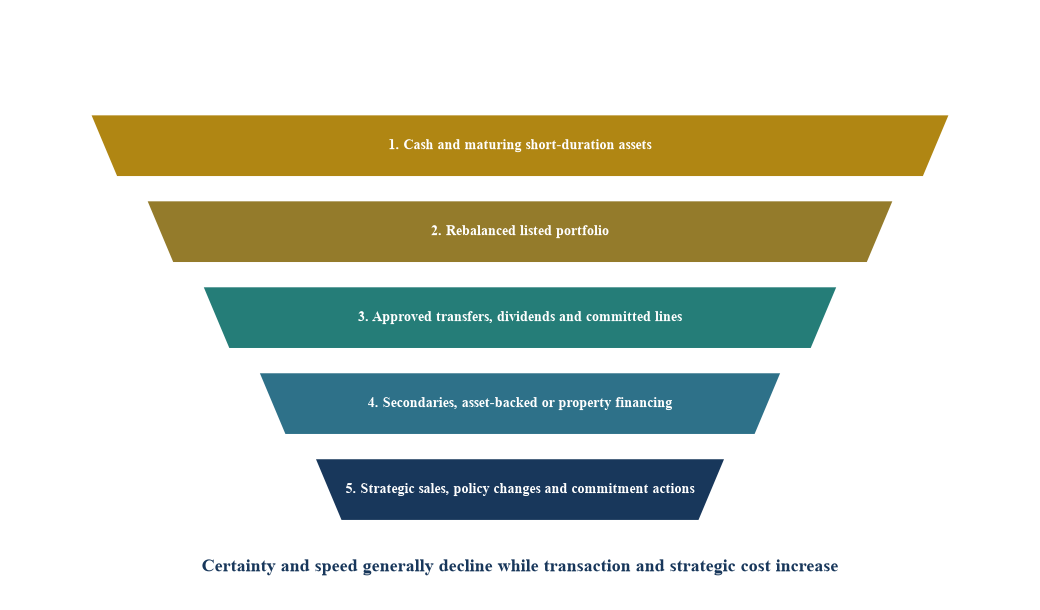
Author framework. Each tier requires current legal availability, pricing, authority and execution evidence.
9. Turn every capital call into a controlled workflow
A capital call is both an investment obligation and a payment instruction. The workflow should protect against missed deadlines, fraud, duplicate payment and incorrect accounting.
The intake team records the notice date, due date, fund, investor entity, amount, currency, stated purpose and bank instructions. The record is matched to the commitment register and current agreement. Remaining commitment and recallable distributions are recalculated.
Payment instructions should be verified independently through an approved contact route, especially when bank details change. The operations team confirms beneficiary, funding account, currency, settlement path and available authority. Investment personnel review unusual purposes or amounts. Legal or tax advisers become involved when the notice conflicts with documents or raises entity-specific consequences.
Approval follows the authority matrix and dual-control requirements. The executed payment is matched to bank evidence, the manager's receipt and the subsequent statement. Exceptions remain open until resolved. The forecast and remaining commitment are updated from actual cash.
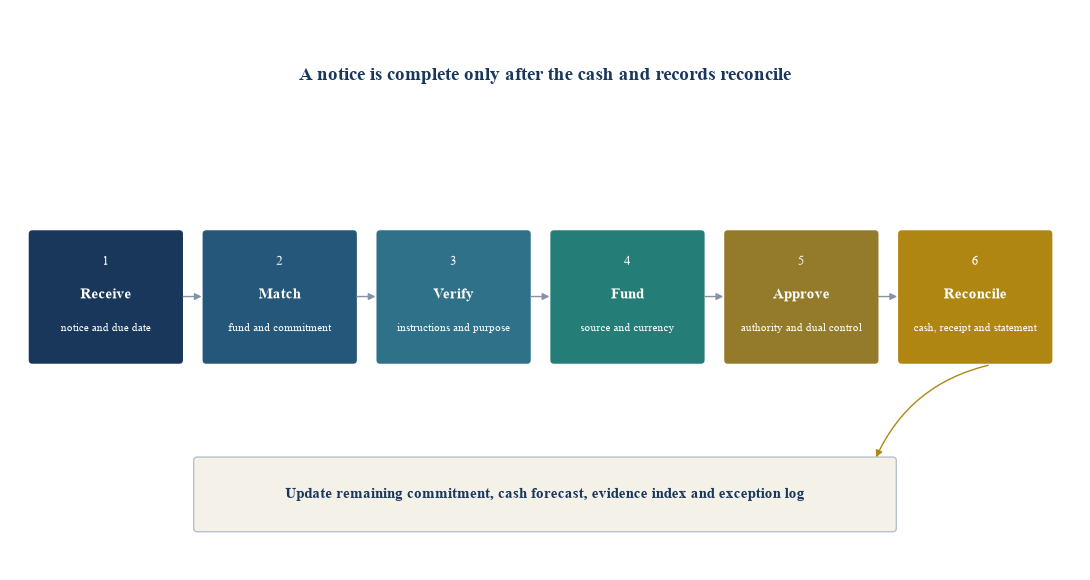
Author framework. Actual approval and verification requirements follow the family's documents, bank controls and applicable law.
10. Use liquid securities with a risk budget
Listed assets are often the fastest scalable source after cash. Their use should be planned before a stressed market creates forced selling.
The policy identifies a minimum liquid portfolio, assets permitted for sale, tax lots, concentration constraints, settlement periods and the authority to rebalance. The budget applies an execution haircut and separates price risk from availability. A concentrated listed holding, pledged asset or strategic stake should not receive the same liquidity credit as a diversified, unencumbered portfolio.
Selling liquid assets can increase the private-market percentage mechanically. The investment committee should therefore review both the cash result and the post-sale allocation. A distribution drought can create a denominator effect in which private assets remain valued at lagged marks while listed assets fall or are sold. The family office should record the measurement dates and avoid treating the resulting allocation as a deliberate strategic position.
11. Treat secondaries as a transaction, not a cash equivalent
The secondary market can convert private-market interests into cash and reshape future commitments. It also introduces pricing, consent, information, tax, confidentiality and execution risk.
Current market evidence confirms depth. Lazard reported USD 233 billion of global secondary volume in 2025, split between USD 117 billion of LP-led transactions and USD 116 billion of GP-led transactions.[7] McKinsey reported USD 240 billion of 2025 volume and linked the record activity to the continued search for liquidity.[8] These figures come from market-advisory research and use their own definitions.
An LP-led sale should begin with objectives. The family may need immediate cash, future commitment relief, manager concentration reduction, vintage rebalancing or administrative simplification. The sale perimeter can include individual fund interests, a diversified portfolio or a structured solution. The decision record should compare price, unfunded transfer, retained distributions, closing probability, timing, consent and tax.
A secondary sale should not be valued solely against the latest reported NAV. The NAV has a measurement date and valuation basis. The bid reflects current information, buyer return requirements, fund quality, remaining duration, unfunded commitments and transfer terms. A discount can still create a better family-level outcome when it avoids a more damaging forced sale or restores strategic liquidity. That conclusion requires an approved whole-portfolio analysis.
12. Assess financing through repayment capacity and governance
Borrowing can bridge timing. It can also transform a liquidity problem into leverage and refinancing risk.
Potential routes include committed bank facilities, lending against liquid securities, property-backed borrowing, shareholder loans and other asset-backed structures. Availability depends on borrower identity, collateral, covenants, recourse, concentration, valuation, currency, banking relationship and documentation. An undrawn facility is a usable source only after current conditions precedent and draw mechanics are confirmed.
Fund-level NAV facilities require separate analysis because the fund manager controls the borrowing and portfolio collateral. ILPA's NAV-Based Facilities Guidance emphasises transparency, LP engagement, purpose, economics, conflicts and governance.[9] A family office should identify how fund-level borrowing affects distributions, remaining value, priority, risk and performance reporting. The presence of a facility does not create family-office liquidity unless the resulting cash is actually distributed.
Family-level financing should have a documented repayment source independent of hoped-for distributions. The decision pack records use of proceeds, maturity, interest, fees, covenants, collateral, recourse, downside coverage, refinancing route and authority. Borrowing to fund recurring calls while distributions remain weak can compound risk if commitment pacing remains unchanged.
Table 5. Funding-route assessment under a distribution drought
| Route | Speed and certainty | Economic and strategic cost | Required decision evidence |
|---|---|---|---|
| Cash and short-duration assets | high when unrestricted and correctly owned | lost reserve and reinvestment opportunity | entity availability, minimum reserve and approval |
| Listed-portfolio rebalance | generally high after authority and settlement | market impact, tax and allocation change | executable value, tax lots and post-sale allocation |
| Inter-entity transfer or dividend | variable | tax, minority, creditor and governance effects | legal capacity, solvency, tax and board approval |
| Committed credit line | high only when drawable | interest, fees, covenants, collateral and refinancing | conditions precedent, headroom and repayment source |
| LP-led secondary sale | medium to low | bid discount, future upside and transaction cost | bids, transfer terms, unfunded relief and whole-portfolio impact |
| Property or asset-backed finance | medium | leverage, recourse, valuation and execution | lender terms, collateral, covenants and stress coverage |
| Strategic asset sale | low under a controlled process | potential permanent loss of strategic value | valuation, alternatives, sale readiness and highest authority |
Actual pricing, availability, tax and legal effects require current transaction evidence and specialist advice.
13. Demonstrate the method with a hypothetical family office
Consider a hypothetical UAE family office with management-estimated gross assets of AED 2.6 billion. The illustrative balance sheet contains AED 1.2 billion of operating businesses, AED 420 million of listed and short-duration assets, AED 380 million of property, AED 420 million of private-fund NAV and AED 180 million of direct private investments. It has AED 140 million of debt and AED 210 million of remaining private-fund commitments.
The available-liquidity perimeter contains AED 55 million of unrestricted cash, AED 105 million of short-duration assets and AED 260 million of listed securities before haircuts. The family also has an undrawn facility, but current draw availability remains subject to documented conditions and is excluded from tier-one liquidity.
Over 24 months, the base case assumes AED 84 million of capital calls and AED 42 million of distributions. The drought case assumes AED 126 million of calls and AED 12 million of distributions. Other essential family, tax, debt and operating obligations total AED 72 million in the drought case. Every amount is a management assumption created solely to demonstrate the framework.
The drought case therefore requires AED 198 million of gross outflows and receives AED 12 million from private markets. Opening cash and short-duration assets provide AED 160 million. The initial funding gap is AED 26 million before the protected governance reserve. A planned listed-asset rebalance supplies the next source. The family does not count the undrawn facility until draw conditions, cost and repayment capacity are approved.
The investment committee freezes new discretionary fund commitments during the remediation period. It requests updated manager forecasts, begins a secondary-market diagnostic for selected mature interests and establishes monthly coverage triggers. The family council separately reviews discretionary family distributions. The operating-company boards retain authority over any dividend or support transaction.
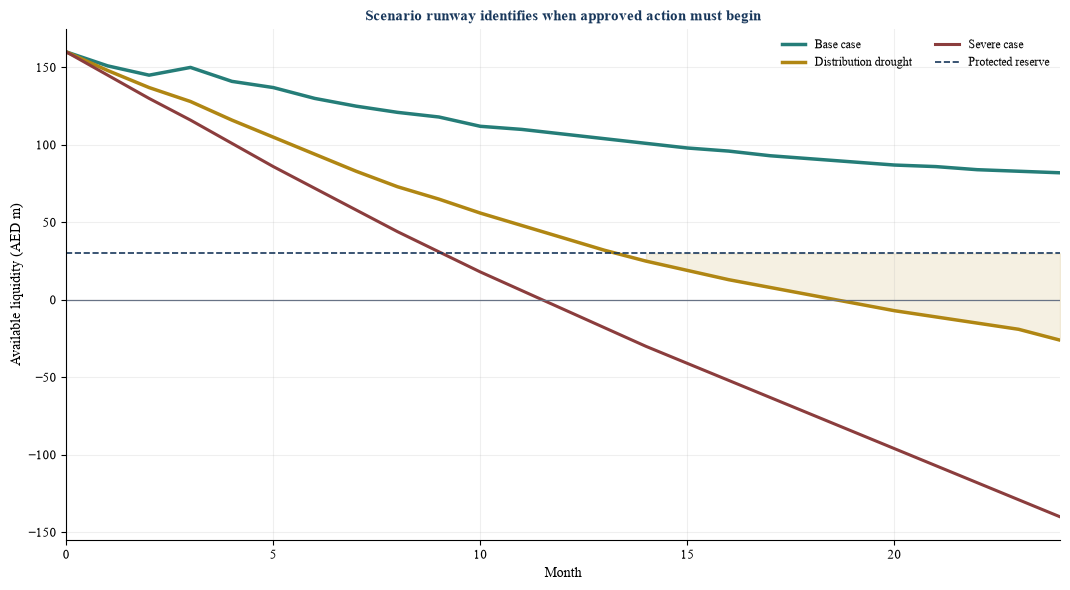
Every value is a management assumption created solely to demonstrate the method. The exhibit is not a recommendation or forecast.
14. Govern escalation before liquidity is exhausted
Triggers should create decisions early enough for controlled execution. A 12-month coverage ratio below an approved threshold can suspend new commitments. A 90-day forecast breach can require the chief investment officer and finance lead to present funding actions. A projected reserve breach can escalate to the investment committee, relevant boards and family council according to authority.
The dashboard should show available liquidity by tier, 30-day and 90-day obligations, 12-month and 24-month coverage, remaining commitments, forecast calls, forecast distributions, variance, currency, concentration, open notices, facility headroom and actions. Every red status needs an owner and due date.
The decision record should separate immediate cash protection from strategic allocation. Pausing commitments, selling a fund interest, borrowing or changing family distributions affects different rights and stakeholders. Each action follows the correct forum and retains the supporting model, advice, conflicts and approval.
15. Implement the liquidity budget in twelve weeks
Weeks one and two establish the perimeter. The family office inventories accounts, liquid assets, entities, obligations, commitments, facilities and governing authorities. It identifies restricted balances and missing evidence.
Weeks three and four reconcile the commitment register. The team matches signed agreements, side letters, manager statements, bank movements and notices. It identifies recallable amounts, currencies, notice terms and forecast owners.
Weeks five and six build the integrated calendar and scenario model. Calls, distributions, debt, tax, family, property and operating-company needs enter a dated forecast. The investment committee approves base, drought and severe assumptions.
Weeks seven and eight establish the liquidity ladder and transaction readiness. The team confirms cash ownership, securities settlement, facility draw conditions, inter-entity authority and secondary-sale data readiness.
Weeks nine and ten implement the notice workflow, dashboard and triggers. Bank-instruction verification, dual approval, reconciliation, exception handling and forecast updates are tested using a completed notice.
Weeks eleven and twelve run a drought simulation. The family council, boards and investment committee exercise the escalation sequence, approve the controlled budget and assign quarterly policy review.
Table 6. Twelve-week family-office liquidity-budget implementation
| Weeks | Workstream | Deliverable | Approval gate |
|---|---|---|---|
| 1 to 2 | cash perimeter and authority | account, entity, restriction and authority map | available and restricted liquidity accepted |
| 3 to 4 | commitment reconciliation | controlled fund register and evidence index | remaining commitments reconcile to source records |
| 5 to 6 | integrated forecast | base, drought and severe cash calendar | assumptions and protected reserve approved |
| 7 to 8 | funding readiness | liquidity ladder, facility review and secondary data set | each route has cost, timing and authority evidence |
| 9 to 10 | operations and reporting | call workflow, dashboard, triggers and exception log | completed-notice pilot reconciles |
| 11 to 12 | simulation and launch | drought exercise, action plan and controlled version | authorised forums approve launch and refresh cycle |
Timing depends on portfolio complexity, evidence availability, legal entities and transaction work.
16. Limitations and conclusion
Private-market cash flows are uncertain. Managers can accelerate or delay investment, refinance assets, sell companies, use continuation vehicles or retain proceeds. Forecasts should preserve ranges, source dates and confidence rather than imply precision.
Reported NAV can change after the measurement date. Secondary bids can differ from NAV and may change before closing. Listed-asset values, currencies, financing terms and tax consequences can also change. The budget should refresh material inputs and show the effect of uncertainty.
Legal entities matter. Cash and obligations may belong to different companies, foundations, trusts, partnerships or individuals. Transfers, dividends, guarantees and borrowing require current legal, tax, solvency, regulatory and governance analysis based on actual facts.
The hypothetical example contains management assumptions solely for method demonstration. It does not describe a family, client, target allocation, expected return, financing recommendation or transaction.
A distribution drought turns liquidity into an operating discipline. The family office must know every obligation, retain current commitment evidence, forecast gross calls and distributions separately, protect an approved reserve and prepare funding routes before they become urgent.
The Family-Office Liquidity Budget connects net worth to cash reality. It gives the family a dated view of runway, a controlled capital-call process, an approved escalation path and a record of decisions. That architecture allows long-term private-market exposure to remain governed through periods when distributions arrive slowly and calls continue.
References
- [1] MSCI, The Distribution Drought in Private Equity Persists, 11 June 2026. https://www.msci.com/data-and-analytics/private-asset-solutions/visualizations/the-distribution-drought-in-private-equity-persists
- [2] MSCI, Private Capital in Focus: US and Europe, Q3 June 2026. https://www.msci.com/downloads/web/msci-com/discover-msci/events/event-assets/2026/june/private-capital-in-focus/Private%20Capital%20in%20Focus%20USEurope%20-%20Q3%20June%202026.pdf
- [3] MSCI, Private Capital Benchmarks Summary Q4 2025, 19 May 2026. https://www.msci.com/research-and-insights/paper/msci-private-capital-benchmarks-summary-q4-2025
- [4] Institutional Limited Partners Association, Capital Call and Distribution Template Version 2.0 and Guidance, September 2025. https://ilpa.org/resources-tools/resource-library/ilpa-capital-call-distribution-template-v-2-0/
- [5] Institutional Limited Partners Association, LP Sentiment Survey 2025-2026: Third Release, 29 June 2026. https://ilpa.org/resources-tools/resource-library/data-deck-top-takeaways-third-sentiment-survey-release/
- [6] IFRS Foundation, IFRS 13 Fair Value Measurement, accessed 12 August 2026. https://www.ifrs.org/issued-standards/list-of-standards/ifrs-13-fair-value-measurement/
- [7] Lazard, 2025 Secondary Market Report, 2026. https://www.lazard.com/research-insights/lazard-2025-secondary-market-report/
- [8] McKinsey and Company, Global Private Markets Report 2026: Private Equity. https://www.mckinsey.com/industries/private-capital/our-insights/global-private-markets-report/private-equity
- [9] Institutional Limited Partners Association, NAV-Based Facilities Guidance for Limited Partners, 2024. https://ilpa.org/industry-guidance/principles-best-practices/nav-based-facilities-guidance-roadmap/
- [10] MSCI, Private Markets for Wealth: Insights from 11,000+ Funds, 15 July 2025. https://www.msci.com/research-and-insights/paper/private-markets-for-wealth-insights-from-11000-funds
- [11] Dubai International Financial Centre, Annual Report 2025, April 2026. https://assets.difc.com/v1/media/edge/images/dubaiintern0078-difcexperie96c5-production-3253/media/project/difcexperiences/difc/difcwebsite/documents/media-section/publications/annual-review/annual-report-2025.pdf
- [12] Abu Dhabi Global Market, Family Offices, accessed 12 August 2026. https://www.adgm.com/business-areas/family-offices
About the Author
Chennakeshav Adya is an independent researcher and Managing Partner of Matchpoint Partners. His research focuses on investment strategy, capital formation, transaction execution, governance and operating-model design across the Gulf and international markets.
