

1. Introduction
A family can own an investment office without owning an investment process. It may have talented people, several banks, private-market relationships and a quarterly investment committee while still lacking a complete mandate, consolidated risk view, liquidity architecture, documented delegation and provider accountability.
The chief investment officer decision exposes that gap. Hiring a CIO appears to be a recruitment choice. Appointing an outsourced CIO appears to be a procurement choice. Both are operating-model choices. They determine who converts family purpose into an investment policy, who constructs and changes the portfolio, who performs diligence, who can commit capital, who controls cash, who measures results, who challenges conflicts and who remains accountable when people or providers change.
The UAE family-office ecosystem is expanding. DIFC's 2025 Annual Report states that its private-wealth ecosystem included more than 500 wealth and asset-management firms, 1,289 family-related entities and 1,115 foundations.[1] ADGM provides distinct routes for single-family offices and multi-family offices. Its public materials state that a single-family office does not require a financial-services permission but carries a controlled licence activity, while a multi-family office serving more than one family requires financial-services permission.[2] The exact legal and regulatory analysis depends on the entity, activities, clients and facts.
The operating environment is also becoming more demanding. UBS surveyed 307 family offices across more than 30 markets for its 2026 report. The participating offices managed an average of USD 1.3 billion and 77 per cent of the families had an active operating business. Sixty per cent used investment committees, 68 per cent had formal performance measurement and more than half used structured budgets. Fewer than half had formal governance with board-level oversight and only 35 per cent had a defined succession plan for the family office itself.[3] These are survey observations from UBS clients. They do not describe every family office or prescribe an operating model.
This paper provides a disciplined way to make the choice. It uses the terms build, buy and outsource as shorthand:
- Build means creating an internal chief investment office with employees, systems and controlled processes.
- Buy means procuring an established discretionary or advisory investment capability from an external provider.
- Outsource means delegating defined investment activities and, where authorised, implementation decisions under contract.
- Hybrid means retaining selected leadership, governance and specialist activities while delegating others.
The objective is an investment function that is fit for the family's mandate, evidence and authority. The output is a controlled architecture rather than a job description or provider shortlist.
2. Read the current evidence as an operating-model signal
Current evidence supports three conclusions. Family offices are institutionalising. Outsourcing is already part of the sector. Governance frequently develops at a different pace from investment complexity.
UBS's 2025 Global Family Office Report states that family offices are typically lean and decide what to keep in-house based primarily on expertise, privacy and operational control. Its report says costs are a lesser consideration than those three factors in many outsourcing decisions.[4] That observation matters because an apparently cheaper model can be unsuitable when the family requires control of confidential operating-company information, direct-deal judgement or daily principal access.
CFA Institute described a continuum of implementation models in its Investment Governance for Fiduciaries research. An owner can insource implementation, use consultants for selected matters, appoint implemented consulting, or delegate day-to-day portfolio management to an outsourced CIO.[5] The governing body should choose the path in light of its resources, objectives, complexity and ability to oversee the chosen arrangement.
CFA Institute's 2026 asset-allocation curriculum identifies effective governance as the allocation of decisions to people or bodies with the necessary skill, capacity, time and position. It also calls for objectives, an investment policy, strategic-allocation approval, reporting and periodic governance audit.[6] This provides a useful design principle: the family should assign authority only after confirming the recipient's capability and the oversight evidence that will exist.
The GIPS standards' guidance for outsourced CIO strategies addresses composite construction and performance presentation for firms managing OCIO portfolios.[7] Its existence shows that an OCIO relationship requires careful performance definition and comparability. A provider's firm-wide assets, model portfolio or selected client result should not be treated automatically as the family's expected result.
CFA Institute's 2026 work on the total portfolio approach describes an integrated, goal-driven model in which investments compete for capital based on their contribution to the whole portfolio. The work also emphasises board and investment-committee engagement, dashboards, governance capability and strategic investment skill.[8] A family office seeking such integration must determine whether it can create the required internal authority, data and collaboration or acquire them through a governed external arrangement.
Finally, ILPA's principles identify alignment of interest, governance and transparency as foundations of effective private-equity relationships.[9] The same disciplines apply to an investment-function provider. Fees, affiliated products, decision authority, information rights, valuation, liquidity, conflicts and termination require explicit treatment.
Table 1. Evidence map for the family-office investment-function decision
| Evidence | Current observation | Design implication | Boundary |
|---|---|---|---|
| DIFC Annual Report 2025 | 1,289 family-related entities and 1,115 foundations in DIFC | expanding structures increase demand for governance, reporting and cross-entity coordination | ecosystem counts do not measure the quality of individual offices |
| ADGM family-office materials | single-family and multi-family office routes have different regulatory characteristics | legal entity and permitted activities should be confirmed before role and provider design | public guidance does not replace current legal advice |
| UBS Global Family Office Report 2026 | 60 per cent used investment committees; 68 per cent had formal performance measurement; fewer than half had formal board-level governance | institutional tools need an explicit authority and accountability architecture | UBS client survey; not a population census |
| UBS Global Family Office Report 2025 | expertise, privacy and control are leading insource considerations | the decision model should score confidentiality, specialist judgement and control | reported preferences do not set a universal threshold |
| CFA Institute investment-governance work | implementation ranges from insourced through specialist advice to OCIO | hybrid designs are legitimate when authority is explicit | fiduciary examples require adaptation to family facts |
| CFA Institute total-portfolio guidance | integrated decision-making needs governance, data, culture, technology and CIO skill | operating readiness should be tested before adopting an integrated approach | evidence from institutional asset owners is directional for family offices |
| ILPA Principles | alignment, governance and transparency are core relationship disciplines | contracts and oversight should expose fees, conflicts and information rights | private-equity guidance should be adapted by activity |
Published evidence frames the design. The family's documents, portfolio, providers and operating facts determine the actual model.
3. Write the owner mandate before choosing the operator
An investment function begins with an owner mandate. The mandate states what the capital is for, which people and entities it serves, what must be protected, which decisions the family reserves and how performance will be judged.
Family purpose can contain several objectives: preserving purchasing power, funding family distributions, supporting operating companies, creating entrepreneurial capital, providing philanthropy, transferring wealth, backing future generations and pursuing impact. These objectives can conflict. The investment function needs a hierarchy, time horizons and a method for resolving trade-offs.
The mandate should identify the economic balance sheet. It includes investment portfolios, operating businesses, property, debt, guarantees, committed capital, family obligations, tax, philanthropy and contingent exposures. An internal or external CIO cannot construct a coherent portfolio from a custody account alone when most family risk sits elsewhere.
The mandate also establishes constraints. These can include liquidity floors, concentration limits, prohibited investments, leverage policy, currencies, jurisdictions, Sharia requirements, responsible-investment preferences, related-party rules, direct-deal limits, manager exposure and information sensitivity.
Decision rights belong in the mandate. The family council may own purpose and distributions. A holding-company board may own operating-company capital. An investment committee may approve policy and large allocations. A CIO may rebalance within ranges. An external manager may transact within an investment-management agreement. Finance may control payment. The design should avoid a single person originating, approving, paying and reconciling the same transaction.
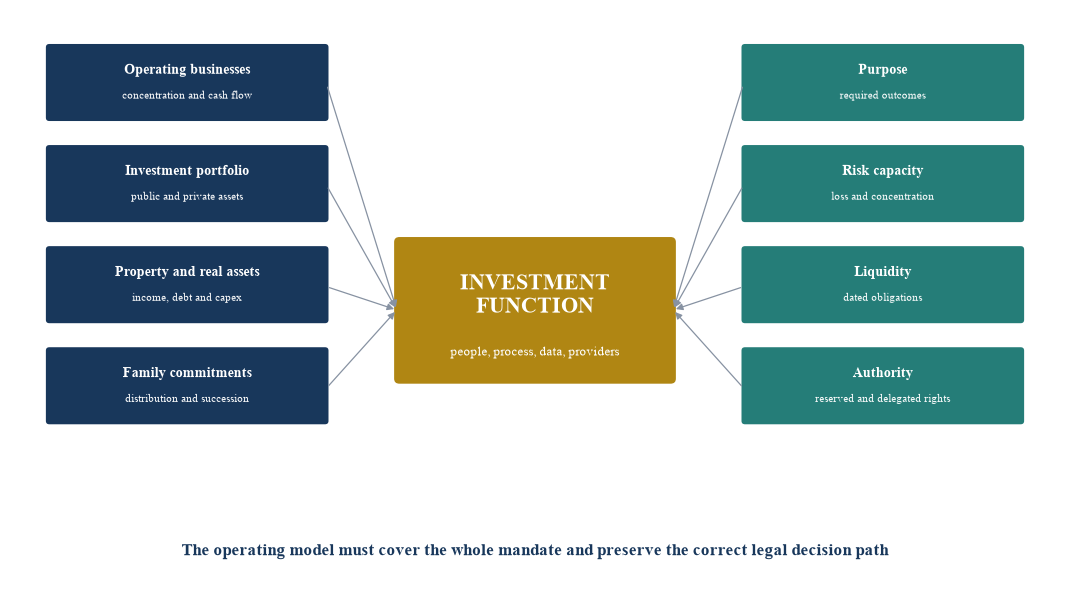
Author framework. Legal ownership, valuation, liquidity, liabilities and authority require current evidence for the actual family.
4. Inventory the work before designing the organisation
The label CIO can hide a wide range of jobs. One family expects strategic asset allocation and manager oversight. Another expects proprietary deal origination, operating-company strategy, treasury, financing and family governance. A third expects a senior relationship lead while banks and managers deliver most investments.
The activity inventory records each recurring and event-driven activity, complexity, confidentiality, required skill, decision authority, service deadline, current owner and failure consequence.
Strategy activities include purpose translation, economic balance-sheet analysis, investment beliefs, policy, allocation, liquidity, currency, leverage, concentration and scenario work. Portfolio activities include manager research, mandate design, direct-investment underwriting, co-investments, portfolio construction, rebalancing and exits. Operations include onboarding, cash, calls, settlements, custody, valuation, accounting and document control. Governance includes agendas, papers, minutes, conflicts, approvals, exceptions and policy review.
The inventory should distinguish demand that requires permanent capacity from episodic demand. A direct acquisition may need intensive sector, commercial, legal and transaction support for eight weeks. Building a permanent team for that peak can create idle capacity. Relying entirely on external advisers for daily portfolio and liquidity decisions can create delay and fragmented accountability.
Table 2. Investment-function activity inventory
| Activity domain | Recurring work | Event-driven work | Capability test |
|---|---|---|---|
| Mandate and policy | objectives, constraints, policy ranges and governance calendar | purpose change, succession, new entity or major liquidity event | can the owner translate family requirements into controlled investment authority? |
| Portfolio strategy | allocation, liquidity, risk, currency and scenario review | regime change, concentration event or strategic rebalance | is there a consolidated, timely and decision-useful portfolio view? |
| Manager portfolio | sourcing, diligence, monitoring, fee and exposure review | termination, key-person event, secondary sale or restructuring | can the team compare managers and execute changes independently? |
| Direct and co-investment | pipeline, screening, monitoring and valuation | acquisition, financing, exit, rescue or litigation | is there sector, transaction and operating capability at the required speed? |
| Treasury and operations | cash, settlement, custody, capital calls and reconciliation | fraud alert, bank change, collateral call or control failure | are duties separated and exceptions closed with evidence? |
| Reporting and data | performance, exposure, look-through, tax and entity records | restatement, valuation challenge or data migration | can every decision metric be traced to a source and measurement date? |
| Governance | committee cycle, papers, minutes, conflicts and limits | urgent approval, breach, principal incapacity or dispute | are decisions made by the right body within a tested authority framework? |
| Provider oversight | service levels, fees, security, conflicts and assurance | provider failure, breach, termination or transition | can the family independently challenge and replace the provider? |
The family should add volumes, service levels, current owners, evidence and failure consequences for its actual operations.
5. Use a four-model continuum
The practical model set contains more than a binary choice.
Principal-led coordination places the family principal or a trusted executive at the centre. Banks, asset managers, accountants, lawyers and advisers deliver separate components. This model can work for a relatively simple portfolio with a highly engaged principal and strong finance controls. It becomes fragile when the principal is the only integrator or when decision volume exceeds available time.
An in-house chief investment office employs investment leadership and supporting capabilities. It can create close alignment, control sensitive information, build institutional memory and respond quickly to family-specific needs. It also creates fixed cost, talent concentration, recruitment risk, retention requirements and the need to build technology, operations and independent challenge.
A discretionary outsourced CIO provides portfolio strategy and implementation under an agreed mandate. It can offer immediate team depth, research infrastructure, manager access, risk systems and operational scale. The family must govern fees, affiliation, pooled solutions, conflicts, data, customisation, key personnel, performance definition, termination and asset portability.
A hybrid office retains an internal head of investments or CIO and delegates defined sleeves or capabilities. Examples include external manager research, public-market implementation, risk analytics, consolidated reporting, private-market operations or specialist direct-deal work. Hybrid designs can match variable demand and preserve owner knowledge. They also require precise interfaces and one accountable integrator.
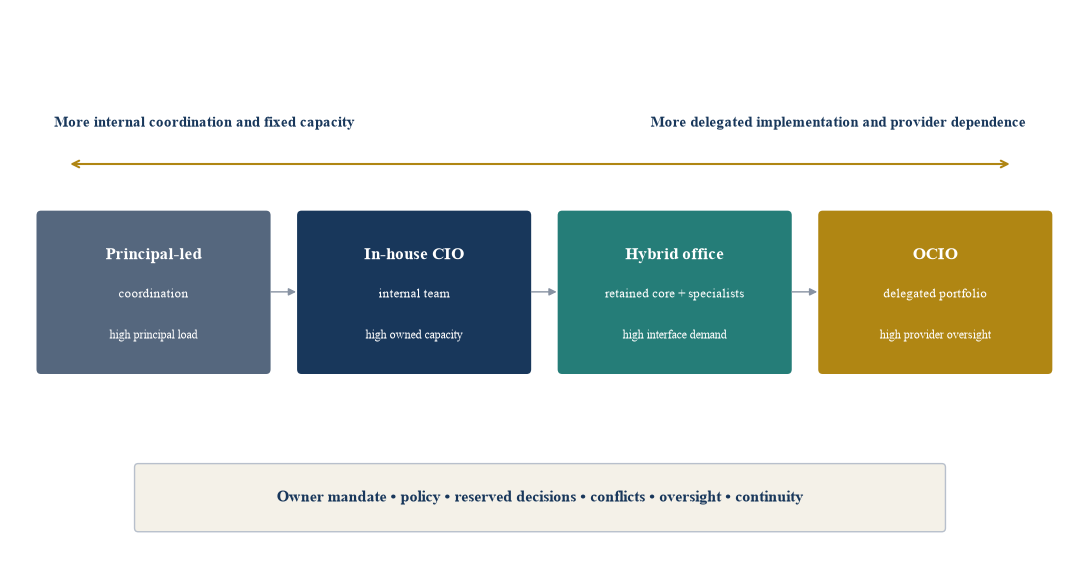
Author framework. Models can be phased or combined. Retained governance and provider oversight remain required throughout.
6. Score the model against observable requirements
The decision scorecard should use evidence rather than preference. Each criterion needs a definition, source and decision threshold.
Mandate complexity measures the number of entities, objectives, currencies, asset classes, direct holdings, liabilities and decision forums. Decision frequency measures how often the office must act and how quickly. Differentiated edge asks whether proprietary access, sector knowledge or active ownership can reasonably add value. Confidentiality assesses the sensitivity of business, family and transaction data.
Talent feasibility covers the availability, recruitment time, compensation, retention and succession of the full team rather than the CIO alone. Technology readiness covers portfolio data, look-through, risk, documents, cyber, workflow and integration. Governance capacity tests whether the family can set policy, challenge decisions and oversee a provider or internal executive. Transition risk measures the difficulty of moving assets, data, authority and relationships.
The scorecard compares feasible models and records reasons and dependencies. A model can score highly for control or institutional infrastructure while remaining weak on implementation readiness, open architecture or direct-deal customisation.
Table 3. Build-buy-outsource decision scorecard
| Criterion | Evidence question | In-house fit signal | OCIO fit signal | Hybrid fit signal |
|---|---|---|---|---|
| Mandate distinctiveness | how much of the portfolio and decision agenda requires family-specific judgement? | repeated proprietary or direct decisions | largely institutional portfolio implementation | distinct strategic core plus scalable external sleeves |
| Control and confidentiality | which information and decisions must remain inside the family boundary? | extensive sensitive information and close principal interaction | contract and secure data access can meet needs | sensitive core retained; defined data shared |
| Decision speed | how often are decisions required and what is the service deadline? | continuous high-frequency family-specific demand | provider can meet documented service levels | internal triage with delegated execution |
| Talent depth | can the family recruit, retain and succeed the complete team? | credible multi-role build and succession plan | immediate provider team and redundancy | strong internal integrator plus external depth |
| Portfolio complexity | do direct deals, private markets, operating companies and liabilities require integrated judgement? | sufficient internal specialists and data | provider has verified relevant capability | specialists assigned by domain with one integrator |
| Independence and conflicts | can advice and implementation be evaluated without product bias? | internal incentives and external managers are controlled | open architecture, fee transparency and conflict controls are evidenced | independent retained challenge over delegated sleeves |
| Technology and operations | can the model produce controlled data, execution and reporting? | funded implementation roadmap | proven integration, assurance and data portability | shared architecture and interface ownership |
| Economics and scalability | what is the full steady-state and transition cost at realistic demand? | stable workload supports fixed capacity | variable scale and platform economics are attractive | fixed strategic core with variable specialist capacity |
| Continuity | what happens after a key-person or provider event? | bench, succession and documented process | provider redundancy and tested transition rights | internal memory plus replaceable external modules |
Scores and weights should be approved for the actual family. A high score means stronger fit with the stated requirement.
7. Preserve an owner-side governance core
Delegation transfers activity and authority within limits. It does not remove the family's need to govern its capital.
The owner-side core should maintain the mandate, policy, economic balance sheet, liquidity requirements, strategic objectives, reserved decisions, conflicts register, provider contracts and evidence archive. It should understand the portfolio well enough to challenge recommendations and recognise deviations.
The family council or equivalent owner forum sets purpose, family-benefit policies and reserved matters. Entity boards exercise their legal duties. The investment committee translates the mandate into policy, approves strategic allocation and major actions, monitors risk and holds the CIO or provider accountable. Finance and operations control cash, books and reconciliation. Legal, tax and compliance advisers address their defined domains.
The CIO should have a written delegation. It can include allocation bands, manager limits, rebalancing, hedging, liquidity, counterparty, direct-deal and private-market authority. Every limit has measurement, evidence, escalation and breach treatment. Emergency authority should state the event, permitted action, communication deadline and ratification path.
Provider oversight requires more than quarterly performance. The family should monitor mandate adherence, risk, liquidity, fees, conflicts, personnel, operations, cybersecurity, data quality, service levels and open actions. The oversight body needs independent data where material.
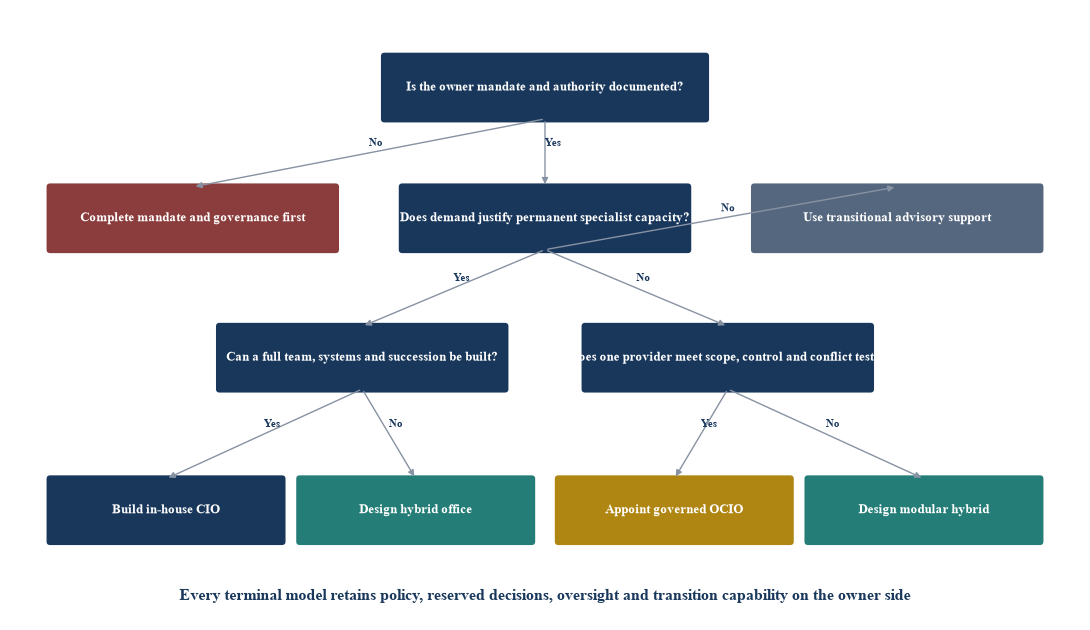
Author framework. The tree identifies a starting model for diligence; it does not make the appointment decision.
8. Design the target operating model around decisions and evidence
The target operating model should connect six layers.
The owner layer contains family purpose, reserved matters and entity authority. The governance layer contains boards, family council and investment committee. The investment layer contains CIO leadership, portfolio strategy, manager oversight and direct investments. The enablement layer contains risk, data, operations, finance, legal, tax and compliance. The provider layer contains custodians, banks, managers, administrators, consultants and specialists. The evidence layer contains source records, approvals, positions, cash, performance, contracts, minutes and exceptions.
Each activity has one accountable owner. Multiple parties can advise or execute, while accountability remains singular. Interfaces state the input, output, format, deadline, quality control and escalation. A monthly exposure report, for example, identifies the system of record, valuation date, look-through coverage, treatment of missing data, reviewer and correction process.
Technology supports the architecture. The required capabilities can include entity and account master data, portfolio accounting, document management, general ledger integration, risk analytics, performance, private-market commitments, workflow, approvals, cyber controls and reporting. The family should identify which system controls each data domain and how information leaves a provider if the relationship ends.
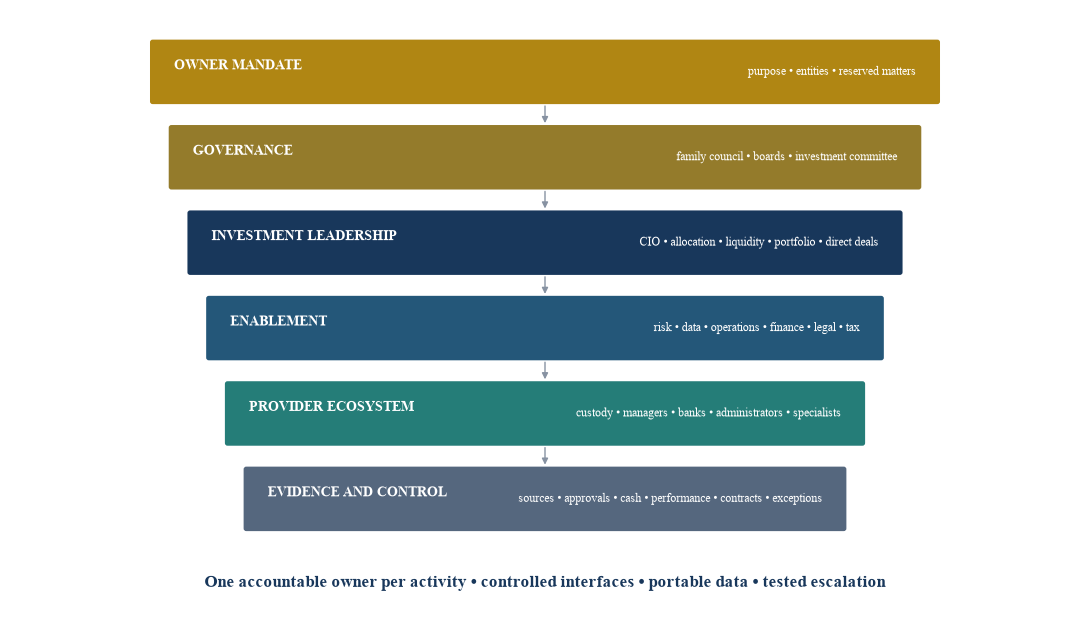
Author framework. Activities and regulatory responsibilities must be adapted to the actual legal structure and permissions.
Table 4. Illustrative retained and delegated decision-rights matrix
| Decision | Family or board | Investment committee | Internal CIO | External provider | Control evidence |
|---|---|---|---|---|---|
| Family purpose and beneficiary policy | approve | advise | advise | inform | approved family or entity record |
| Investment beliefs and policy | reserve material provisions | recommend and approve within authority | draft and implement | provide analysis | controlled policy and version history |
| Strategic allocation | reserve specified changes | approve | recommend | recommend or implement within mandate | asset-allocation paper and approval |
| Rebalancing within bands | monitor through policy | oversee | approve or execute | execute where delegated | pre-trade rule, ticket and post-trade report |
| Manager appointment | reserve above threshold | approve | recommend and monitor | recommend or appoint within authority | diligence, conflicts, fees and approval |
| Direct investment | reserve above threshold | approve | originate, underwrite and monitor | specialist support as contracted | investment memorandum and transaction file |
| Liquidity and borrowing | reserve leverage policy and major facilities | approve actions within authority | forecast and recommend | provide portfolio liquidity analysis | cash model, terms, stress and approval |
| Cash movement | set banking authority | no payment execution | confirm purpose within segregation | no unilateral family-account access unless expressly controlled | dual approval, callback and reconciliation |
| Performance and risk | receive and challenge | oversee | accountable for complete view | calculate and explain delegated results | independent sources, methodology and exceptions |
| Provider appointment or termination | reserve material relationships | recommend or approve | manage process | support transition duty | diligence, contract, exit plan and data return |
Actual authority follows governing documents, applicable law, regulatory permissions and approved delegations.
9. Compare full economics and capacity
The cost comparison uses a common service perimeter. A CIO salary and an OCIO fee represent only parts of their respective models.
The in-house model can require a CIO, portfolio specialists, analysts, operations, finance, risk, data and administrative support. Some roles can sit elsewhere in the family enterprise. The cost model includes cash compensation, incentives, recruitment, benefits, retention, office, travel, data, research, software, custody, administration, insurance, audit, cyber, legal and specialist advice. It also includes key-person disruption and the time required to reach steady state.
The outsourced model includes advisory or discretionary fees, underlying manager and fund fees, custody, administration, transaction cost, transition cost, performance fees where applicable, foreign-exchange spreads and product economics. The family should identify affiliated funds, revenue sharing, rebates, placement economics and benefits received by the provider.
The comparison should model three to five years, include transition and exit, and use demand scenarios. It should avoid attributing an investment return premium to either model without credible evidence specific to the mandate.
10. Diligence an outsourced CIO as a critical operating provider
The provider review begins with scope. The family should specify whether the provider advises, exercises discretion, executes, selects managers, allocates to affiliated products, performs consolidated reporting, manages private-market commitments, supports direct deals or coordinates other advisers.
Investment diligence covers philosophy, portfolio construction, asset allocation, manager research, risk, liquidity, private assets, customisation and decision records. Performance diligence covers composite definition, inclusion rules, dispersion, fees, currency, benchmarks and organisational change. GIPS compliance claims and verification should be read precisely.[7]
Conflict diligence maps every source of compensation and influence. The family should understand affiliated products, proprietary funds, placement fees, manager rebates, banking relationships, securities lending, cash products, transaction execution and allocation among clients. The contract should state disclosure, consent and remediation.
Operational diligence covers legal entity, regulatory permissions, financial condition, insurance, business continuity, cyber, data privacy, subcontractors, controls, error policy, custody interaction, trade authority, record retention and incident notification. Key personnel, succession and capacity receive explicit treatment.
Exit diligence begins before appointment. The family should own or have durable access to its data, documents, transaction history, cost basis, performance records, manager files and approvals. The agreement should define termination notice, transition assistance, asset portability, data format, fees, unresolved transactions and continuing confidentiality.
Table 5. OCIO and specialist-provider diligence requirements
| Domain | Required evidence | Decision test | Contract or oversight output |
|---|---|---|---|
| Scope and authority | service catalogue, mandate, discretion, approvals and exclusions | does the provider's authority match the family's governing framework? | schedule of retained and delegated activities |
| Investment process | beliefs, research, portfolio construction, liquidity and risk records | is the process repeatable, relevant and sufficiently customisable? | mandate, ranges, benchmarks and exception process |
| Performance | composite definition, gross and net results, dispersion, fees and track-record changes | is the presentation comparable to the proposed mandate? | reporting methodology and performance service level |
| Fees and conflicts | full fee stack, affiliation, rebates, product economics and allocation policy | can the family identify and govern every material incentive? | fee schedule, disclosure, consent and offset provisions |
| People and capacity | named team, workload, turnover, succession and specialist access | will the proposed people deliver the promised service? | key-person, substitution and capacity commitments |
| Operations and cyber | controls, assurance, incidents, continuity, subcontractors and data map | can assets, data and decisions remain controlled through disruption? | security, notification, audit and remediation rights |
| Legal and regulatory | entity, permissions, complaints, litigation, insurance and governing law | is the service lawfully and contractually deliverable to the family? | representations, liability, indemnity and compliance obligations |
| Exit and portability | termination, transition, records, asset transfer and unresolved trades | can the family change providers without losing control or history? | exit plan, data return, assistance and transition fee cap |
The review should be performed against current documents, permissions, people, systems and client-specific terms.
11. Build an internal CIO as an institution, not a single hire
An internal build requires a role architecture. The CIO owns portfolio integration, policy implementation, governance advice and accountability for the investment process.
The organisation can begin with a small core and contracted specialists. The first hires should reflect the activity inventory. A public-markets and manager-heavy portfolio may need portfolio, risk and operations capability. A direct-investment portfolio may need sector, transaction, portfolio-company and finance capability. A large private-fund programme may need commitments, diligence, monitoring and cash-flow operations.
Recruitment tests technical skill, judgement, integrity, communication, family-enterprise fit and governance discipline. Compensation aligns with the mandate and time horizon. Metrics can include policy adherence, risk, liquidity, decision quality, implementation, reporting, team and provider economics.
Succession begins on day one. Investment theses, manager knowledge, models, contacts, approvals, calendars and exceptions should belong to the office. Delegations and bank authorities need an incapacity procedure. The investment committee should know who acts during a vacancy and which decisions pause.
12. Make the hybrid interface explicit
Hybrid models frequently fit family offices because demand is uneven and specialist. Their primary risk is a gap between parties.
The internal integrator can be the CIO, head of investments, chief of staff with investment capability or another authorised executive. This person maintains the whole-portfolio view, governance calendar, decision pipeline and provider map. External parties have defined modules and service levels.
Every interface should state who originates, recommends, challenges, approves, executes, pays, records and monitors. Overlap should be deliberate. Independent challenge can justify two roles. Duplicated manager research, inconsistent classifications or competing performance calculations usually create cost and confusion.
13. Transition through controlled releases
The transition should protect decisions, cash, assets, data and relationships.
Phase one freezes the mandate and maps the current state. The office inventories entities, accounts, assets, liabilities, commitments, providers, contracts, authorities, data and open decisions. Missing evidence becomes an issue log.
Phase two approves the model and target architecture. The family selects the retained core, delegated services, committee design, decision rights, systems and transition owner. It defines success measures and a budget.
Phase three conducts recruitment or provider selection. The process uses the same service perimeter and scorecard. References, background checks, regulatory checks, operational diligence, contracts and conflicts are completed before authority moves.
Phase four migrates data, reporting and selected authority. The family operates positions, performance, cash, commitments and reporting in parallel and reconciles outputs before the new model becomes the system of record.
Phase five transfers implementation in bounded tranches. Liquid assets, private-market records, direct investments and governance processes can move at different times. Each tranche has entry criteria, rollback, sign-off and post-transition review.
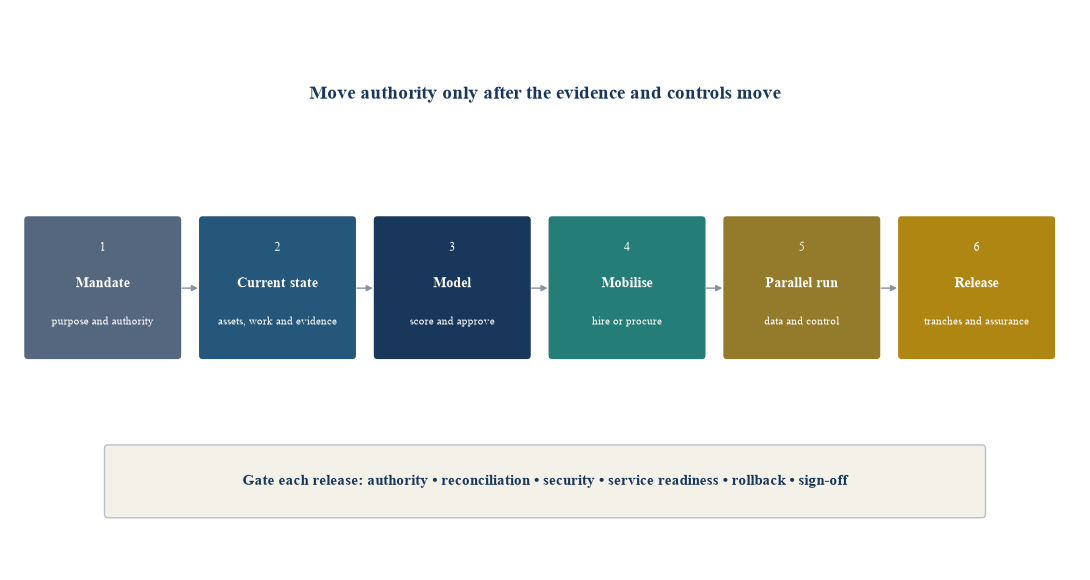
Author framework. Timing varies with recruitment, regulation, contracts, asset portability, data quality and transaction activity.
14. Measure the function as a controlled service
Investment performance is necessary and insufficient as an operating measure. Results can reflect market exposure, illiquidity, leverage, currency, cash timing and valuation. The dashboard should separate portfolio outcomes from operating execution.
Portfolio measures include return, benchmark, risk, drawdown, liquidity, concentration, currency, leverage, private-market pacing and operating-company exposure. Methodology, dates and coverage accompany the numbers.
Decision measures include cycle time, decisions due, approvals, policy exceptions, implementation slippage and thesis review. Operational measures include unreconciled cash, stale valuations, missing documents, failed settlements, capital-call readiness and data completeness. Provider measures include service levels, personnel, fees, conflicts, incidents and remediation.
Governance measures include committee attendance, paper timeliness, conflicts, action closure, policy review and succession readiness. These measures should encourage quality and control. A target for faster decisions should not reward incomplete diligence.
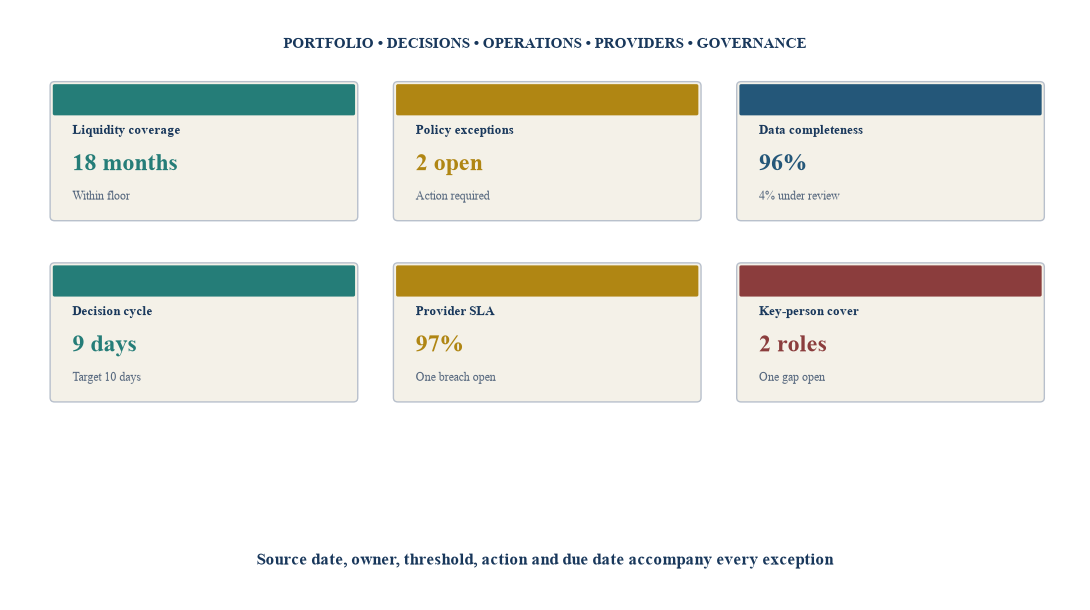
Every displayed value is an illustrative management assumption used solely to show dashboard structure.
15. Demonstrate the framework with a hypothetical UAE family office
Consider a hypothetical UAE family with management-estimated gross assets of AED 4.8 billion. The illustrative balance sheet contains an AED 2.4 billion operating business, AED 850 million of global public investments, AED 620 million of private funds, AED 430 million of direct investments, AED 380 million of property and AED 120 million of cash and short-duration assets. Liabilities and guarantees total AED 520 million. Remaining private-market commitments total AED 260 million.
The family has two generations involved, four investment-holding entities and three operating geographies. Its investment committee meets quarterly. The chair and finance director handle urgent decisions between meetings. Banks manage liquid portfolios, while the principal and two executives source direct deals. Performance reporting arrives from separate providers and does not contain a controlled total-family view.
Every value and circumstance in this example is a management assumption created solely to demonstrate the method. It does not describe a client, target portfolio or recommended organisation.
The inventory identifies continuous demand for allocation, liquidity, manager oversight, direct-deal triage, governance and provider coordination, plus episodic transaction work. The family scores confidentiality, operating-business integration and principal access highly. It also records a limited local pipeline for a complete eight-person team within six months.
The scorecard initially favours a hybrid model. The family proposes to recruit an internal CIO and portfolio analyst, retain existing finance and operations controls, appoint an external provider for global public-market implementation and risk analytics, and use transaction specialists for direct deals. The investment committee retains strategic allocation, major manager appointments, direct investments and leverage decisions. The CIO receives rebalancing authority within policy bands and becomes accountable for the consolidated view.
The family does not approve the model from the illustrative score alone. It commissions current legal and regulatory advice, validates employment economics, runs a provider process, tests data migration and confirms that its governance bodies can perform the retained work. Final authority depends on those gates.
16. Implement the chosen model in 100 days
The first 20 days establish the mandate, current state, evidence gaps, decision rights and transition governance, with one sponsor and one accountable programme lead.
Days 21 to 40 complete the model scorecard and target architecture. The family approves the retained core, provider modules, role descriptions, committee calendar, data domains, controls, budget and success measures.
Days 41 to 65 conduct recruitment or procurement. Diligence covers people, capability, performance, fees, conflicts, operations, cyber, regulation, contracts and exit. The office maps data and prepares parallel reporting.
Days 66 to 85 configure systems, controls and governance. Authorities, policies, bank controls, reporting, issue management, meeting papers and service levels are tested. Positions, cash, commitments and performance reconcile.
Days 86 to 100 release bounded activities, monitor early service, close exceptions and obtain governance sign-off. Long-lead recruitment, regulatory steps, contracting or asset transfer can extend the timetable. The 100-day sequence is an implementation frame rather than a promise of completion.
Table 6. One-hundred-day investment-function implementation
| Days | Workstream | Controlled deliverable | Gate |
|---|---|---|---|
| 1 to 20 | mandate and current state | purpose, balance sheet, activity inventory, authority map and issue log | authorised sponsor accepts scope and evidence gaps |
| 21 to 40 | model and architecture | scorecard, target operating model, retained core, provider modules and budget | governing body approves model and decision rights |
| 41 to 65 | people and provider diligence | candidate or provider evidence, conflicts, economics, contracts and references | appointment criteria and risk actions satisfied |
| 66 to 75 | data and systems | controlled data map, migration, interfaces and parallel outputs | positions, cash, commitments and performance reconcile |
| 76 to 85 | governance and controls | policies, delegations, service levels, committee papers and tested escalation | authority and operating-readiness review passes |
| 86 to 95 | bounded release | selected activities move with monitoring and rollback | tranche owner signs implementation evidence |
| 96 to 100 | assurance and stabilisation | open actions, dashboard, post-release review and next-wave plan | governing body accepts service and outstanding risk plan |
Timing is illustrative. Recruitment, regulation, contracts, data and asset transfers can require longer periods.
17. Limitations and conclusion
Family offices differ materially in purpose, governance, asset mix, legal structures, principal involvement, confidentiality, geography and talent market. Published surveys describe samples and should not become staffing thresholds.
Provider capability and regulation can change. A family should verify current legal entities, permissions, people, financial condition, contracts, systems and client-specific terms. Public descriptions do not establish that a service is available or suitable.
Cost models depend on scope, asset mix, geography, staffing, systems and negotiated terms. Performance attribution across operating models is difficult because mandates and market periods differ. The framework does not assume that an internal or external model produces higher returns.
The hypothetical example contains management assumptions solely for method demonstration. It does not describe a family or advise a structure, allocation, provider, hire or transaction.
The CIO decision is a choice about how the family will govern investment work. A robust process starts with the mandate and economic balance sheet, inventories required activity, preserves an owner-side governance core, scores feasible operating models and moves authority through controlled releases.
An in-house CIO can create alignment and institutional memory when the family can build the full capability. An OCIO can provide depth and infrastructure when scope, incentives, performance, data and exit are governed. A hybrid office can combine owner knowledge with specialist scale when interfaces and accountability are explicit.
The correct architecture remains observable. Every material decision has an authorised owner. Every delegated activity has a service level and evidence. Every provider can be challenged and replaced. Every portfolio view connects to the family's purpose, balance sheet, liquidity and risks. That is the standard for the next family-office investment function.
References
- [1] Dubai International Financial Centre, Annual Report 2025, April 2026. https://assets.difc.com/v1/media/edge/images/dubaiintern0078-difcexperie96c5-production-3253/media/project/difcexperiences/difc/difcwebsite/documents/media-section/publications/annual-review/annual-report-2025.pdf
- [2] Abu Dhabi Global Market, Family Offices, accessed 12 August 2026. https://www.adgm.com/business-areas/family-offices
- [3] UBS, Global Family Office Report 2026, 28 May 2026. https://www.ubs.com/global/en/media/display-page-ndp/en-20260528-global-family-office-report-2026.html
- [4] UBS, Global Family Office Report 2025, 21 May 2025. https://www.ubs.com/global/en/media/display-page-ndp/en-20250521-global-family-office-report-2025.html
- [5] CFA Institute Research Foundation, Investment Governance for Fiduciaries, 19 April 2019. https://rpc.cfainstitute.org/research/foundation/2019/investment-governance-for-fiduciaries
- [6] CFA Institute, Overview of Asset Allocation, 2026 Curriculum. https://www.cfainstitute.org/insights/professional-learning/refresher-readings/2026/overview-asset-allocation
- [7] CFA Institute Global Investment Performance Standards, Guidance Statement for OCIO Strategies, effective 1 January 2025. https://www.gipsstandards.org/standards/guidance/guidance-statements/
- [8] CFA Institute Research and Policy Center, The Total Portfolio Approach: A Practical Guide for Navigating the Transition to TPA, 2026. https://rpc.cfainstitute.org/research/reports/2026/total-portfolio-approach
- [9] Institutional Limited Partners Association, ILPA Principles 3.0. https://ilpa.org/industry-guidance/principles-best-practices/ilpa-principles/
- [10] CFA Institute, Investment Committees: Governance and Design Choices, 23 June 2026. https://rpc.cfainstitute.org/research/foundation/2026/investment-committees-governance-design-choices
- [11] CFA Institute, Seven Trends Reshaping Family Office Careers Today, 3 November 2025. https://www.cfainstitute.org/insights/articles/family-office-careers-trends
- [12] CFA Institute, Governance Strategies for Modern Family Offices, 2026. https://www.cfainstitute.org/insights/events/2026/governance-strategies-for-modern-family-offices
About the Author
Chennakeshav Adya is an independent researcher and Managing Partner of Matchpoint Partners. His research focuses on investment strategy, capital formation, transaction execution, governance and operating-model design across the Gulf and international markets.
