

1. Define the buy-and-build mandate
The transaction team should state the sector, geography, target profile, leverage policy, minimum return, integration capacity and stop conditions. The required output is a signed acquisition-capacity mandate. Use dated source data and link every material conclusion to retained platform, target, lender, financial and contractual evidence [1][2].
Translate the assumption into monthly sources, uses, working capital, integration cash, liquidity, leverage, debt service and covenant effects. Identify the accountable owner, executed definition, measurement method, dependency, decision date and evidence threshold. Reconcile the transaction model, facility documents, lender correspondence, operating forecast and funds flow.
The principal risk is that the platform can pursue volume before defining economic and execution limits. Quantify the effect on signing capacity, funding certainty, minimum liquidity, covenant headroom, refinancing, debt paydown and equity value. Show base, delayed-synergy, acquisition-gap, integration-stress and refinancing cases with explicit management responses.
Retain the source, model version, reviewer, legal interpretation, finance approval and investment committee response. Compare approved acquisition assumptions with realised cash and integration outcomes; remove unsupported capacity; and assign every exception an owner and deadline.
2. Map the legal borrower group
The transaction team should reconcile obligors, guarantors, security providers, restricted subsidiaries, holding companies and acquisition vehicles. The required output is a verified financing perimeter. Use dated source data and link every material conclusion to retained platform, target, lender, financial and contractual evidence [2][3].
Translate the assumption into monthly sources, uses, working capital, integration cash, liquidity, leverage, debt service and covenant effects. Identify the accountable owner, executed definition, measurement method, dependency, decision date and evidence threshold. Reconcile the transaction model, facility documents, lender correspondence, operating forecast and funds flow.
The principal risk is that cash or assets can sit outside the lender group. Quantify the effect on signing capacity, funding certainty, minimum liquidity, covenant headroom, refinancing, debt paydown and equity value. Show base, delayed-synergy, acquisition-gap, integration-stress and refinancing cases with explicit management responses.
Retain the source, model version, reviewer, legal interpretation, finance approval and investment committee response. Compare approved acquisition assumptions with realised cash and integration outcomes; remove unsupported capacity; and assign every exception an owner and deadline.
3. Reconstruct committed facilities
The transaction team should map drawn debt, revolving commitments, delayed draws, ancillary lines, hedging and guarantees by legal entity. The required output is a committed-capacity ledger. Use dated source data and link every material conclusion to retained platform, target, lender, financial and contractual evidence [1][4].
Translate the assumption into monthly sources, uses, working capital, integration cash, liquidity, leverage, debt service and covenant effects. Identify the accountable owner, executed definition, measurement method, dependency, decision date and evidence threshold. Reconcile the transaction model, facility documents, lender correspondence, operating forecast and funds flow.
The principal risk is that headline facility size can overstate immediately drawable acquisition cash. Quantify the effect on signing capacity, funding certainty, minimum liquidity, covenant headroom, refinancing, debt paydown and equity value. Show base, delayed-synergy, acquisition-gap, integration-stress and refinancing cases with explicit management responses.
Retain the source, model version, reviewer, legal interpretation, finance approval and investment committee response. Compare approved acquisition assumptions with realised cash and integration outcomes; remove unsupported capacity; and assign every exception an owner and deadline.
4. Reconstruct uncommitted capacity
The transaction team should identify accordion, incremental, sidecar, private-credit and equity options with their consent and market dependencies. The required output is an uncommitted-capacity register. Use dated source data and link every material conclusion to retained platform, target, lender, financial and contractual evidence [1][5].
Translate the assumption into monthly sources, uses, working capital, integration cash, liquidity, leverage, debt service and covenant effects. Identify the accountable owner, executed definition, measurement method, dependency, decision date and evidence threshold. Reconcile the transaction model, facility documents, lender correspondence, operating forecast and funds flow.
The principal risk is that modelled capacity can depend on lenders that have made no commitment. Quantify the effect on signing capacity, funding certainty, minimum liquidity, covenant headroom, refinancing, debt paydown and equity value. Show base, delayed-synergy, acquisition-gap, integration-stress and refinancing cases with explicit management responses.
Retain the source, model version, reviewer, legal interpretation, finance approval and investment committee response. Compare approved acquisition assumptions with realised cash and integration outcomes; remove unsupported capacity; and assign every exception an owner and deadline.
5. Map accordion mechanics
The transaction team should document caps, ratio debt, free-and-clear baskets, currency, ranking, maturity, amortisation and borrower eligibility. The required output is an accordion term map. Use dated source data and link every material conclusion to retained platform, target, lender, financial and contractual evidence [2][6].
Translate the assumption into monthly sources, uses, working capital, integration cash, liquidity, leverage, debt service and covenant effects. Identify the accountable owner, executed definition, measurement method, dependency, decision date and evidence threshold. Reconcile the transaction model, facility documents, lender correspondence, operating forecast and funds flow.
The principal risk is that a general incremental clause can be unusable for the proposed structure. Quantify the effect on signing capacity, funding certainty, minimum liquidity, covenant headroom, refinancing, debt paydown and equity value. Show base, delayed-synergy, acquisition-gap, integration-stress and refinancing cases with explicit management responses.
Retain the source, model version, reviewer, legal interpretation, finance approval and investment committee response. Compare approved acquisition assumptions with realised cash and integration outcomes; remove unsupported capacity; and assign every exception an owner and deadline.
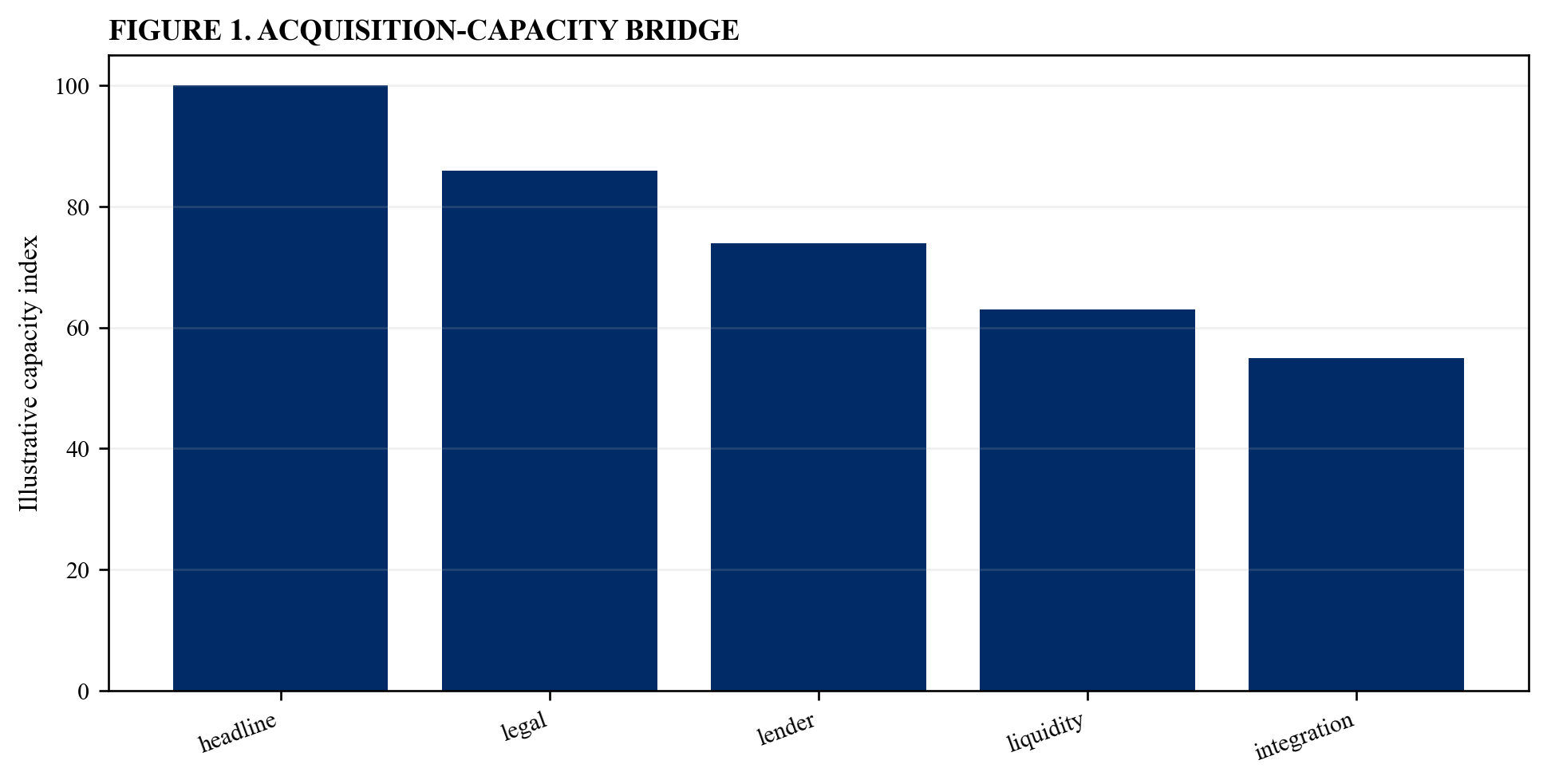
Illustrative analytical scenario; verified platform, target and financing evidence should replace index values.
6. Test lender participation
The transaction team should identify eligible lenders, consent thresholds, allocation rights, syndication conditions and relationship limits. The required output is a lender-capacity map. Use dated source data and link every material conclusion to retained platform, target, lender, financial and contractual evidence [1][7].
Translate the assumption into monthly sources, uses, working capital, integration cash, liquidity, leverage, debt service and covenant effects. Identify the accountable owner, executed definition, measurement method, dependency, decision date and evidence threshold. Reconcile the transaction model, facility documents, lender correspondence, operating forecast and funds flow.
The principal risk is that facility mechanics can permit a draw while the market declines to fund it. Quantify the effect on signing capacity, funding certainty, minimum liquidity, covenant headroom, refinancing, debt paydown and equity value. Show base, delayed-synergy, acquisition-gap, integration-stress and refinancing cases with explicit management responses.
Retain the source, model version, reviewer, legal interpretation, finance approval and investment committee response. Compare approved acquisition assumptions with realised cash and integration outcomes; remove unsupported capacity; and assign every exception an owner and deadline.
7. Test pricing protection
The transaction team should calculate margin, original issue discount, fees, most-favoured-nation protection, flex and hedging cost. The required output is an all-in funding-cost bridge. Use dated source data and link every material conclusion to retained platform, target, lender, financial and contractual evidence [6][8].
Translate the assumption into monthly sources, uses, working capital, integration cash, liquidity, leverage, debt service and covenant effects. Identify the accountable owner, executed definition, measurement method, dependency, decision date and evidence threshold. Reconcile the transaction model, facility documents, lender correspondence, operating forecast and funds flow.
The principal risk is that incremental debt can reprice existing facilities or erode returns. Quantify the effect on signing capacity, funding certainty, minimum liquidity, covenant headroom, refinancing, debt paydown and equity value. Show base, delayed-synergy, acquisition-gap, integration-stress and refinancing cases with explicit management responses.
Retain the source, model version, reviewer, legal interpretation, finance approval and investment committee response. Compare approved acquisition assumptions with realised cash and integration outcomes; remove unsupported capacity; and assign every exception an owner and deadline.
8. Map delayed-draw terms
The transaction team should document commitment period, draw window, purpose, conditions, ticking fees, cancellation, maturity and amortisation. The required output is a delayed-draw availability calendar. Use dated source data and link every material conclusion to retained platform, target, lender, financial and contractual evidence [2][4].
Translate the assumption into monthly sources, uses, working capital, integration cash, liquidity, leverage, debt service and covenant effects. Identify the accountable owner, executed definition, measurement method, dependency, decision date and evidence threshold. Reconcile the transaction model, facility documents, lender correspondence, operating forecast and funds flow.
The principal risk is that committed capital can expire before the acquisition completes. Quantify the effect on signing capacity, funding certainty, minimum liquidity, covenant headroom, refinancing, debt paydown and equity value. Show base, delayed-synergy, acquisition-gap, integration-stress and refinancing cases with explicit management responses.
Retain the source, model version, reviewer, legal interpretation, finance approval and investment committee response. Compare approved acquisition assumptions with realised cash and integration outcomes; remove unsupported capacity; and assign every exception an owner and deadline.
Table 1. Facility-capacity map
| Capacity | Evidence | Decision test |
|---|---|---|
| committed | executed facility | drawable |
| delayed draw | availability terms | window open |
| accordion | document mechanics | lender found |
| equity | approved source | funds certain |
Illustrative control framework; verified transaction evidence and executed documents govern.
9. Map permitted-acquisition conditions
The transaction team should translate acquisition baskets, business tests, jurisdiction, ownership, no-default, representations and pro-forma compliance. The required output is a permitted-acquisition checklist. Use dated source data and link every material conclusion to retained platform, target, lender, financial and contractual evidence [2][9].
Translate the assumption into monthly sources, uses, working capital, integration cash, liquidity, leverage, debt service and covenant effects. Identify the accountable owner, executed definition, measurement method, dependency, decision date and evidence threshold. Reconcile the transaction model, facility documents, lender correspondence, operating forecast and funds flow.
The principal risk is that a strategically attractive target can fail the debt-document tests. Quantify the effect on signing capacity, funding certainty, minimum liquidity, covenant headroom, refinancing, debt paydown and equity value. Show base, delayed-synergy, acquisition-gap, integration-stress and refinancing cases with explicit management responses.
Retain the source, model version, reviewer, legal interpretation, finance approval and investment committee response. Compare approved acquisition assumptions with realised cash and integration outcomes; remove unsupported capacity; and assign every exception an owner and deadline.
10. Define the signing gate
The transaction team should require strategic rationale, valuation range, funding route, diligence plan, antitrust path and downside envelope. The required output is a signing certificate. Use dated source data and link every material conclusion to retained platform, target, lender, financial and contractual evidence [10][11].
Translate the assumption into monthly sources, uses, working capital, integration cash, liquidity, leverage, debt service and covenant effects. Identify the accountable owner, executed definition, measurement method, dependency, decision date and evidence threshold. Reconcile the transaction model, facility documents, lender correspondence, operating forecast and funds flow.
The principal risk is that binding obligations can be created before financing and execution risk is bounded. Quantify the effect on signing capacity, funding certainty, minimum liquidity, covenant headroom, refinancing, debt paydown and equity value. Show base, delayed-synergy, acquisition-gap, integration-stress and refinancing cases with explicit management responses.
Retain the source, model version, reviewer, legal interpretation, finance approval and investment committee response. Compare approved acquisition assumptions with realised cash and integration outcomes; remove unsupported capacity; and assign every exception an owner and deadline.
11. Define the funding gate
The transaction team should require executed commitments, funds flow, conditions precedent, pro-forma covenant compliance and minimum liquidity. The required output is a funding certificate. Use dated source data and link every material conclusion to retained platform, target, lender, financial and contractual evidence [1][2].
Translate the assumption into monthly sources, uses, working capital, integration cash, liquidity, leverage, debt service and covenant effects. Identify the accountable owner, executed definition, measurement method, dependency, decision date and evidence threshold. Reconcile the transaction model, facility documents, lender correspondence, operating forecast and funds flow.
The principal risk is that the platform can sign with a plausible facility and reach closing without drawable cash. Quantify the effect on signing capacity, funding certainty, minimum liquidity, covenant headroom, refinancing, debt paydown and equity value. Show base, delayed-synergy, acquisition-gap, integration-stress and refinancing cases with explicit management responses.
Retain the source, model version, reviewer, legal interpretation, finance approval and investment committee response. Compare approved acquisition assumptions with realised cash and integration outcomes; remove unsupported capacity; and assign every exception an owner and deadline.
12. Define the completion gate
The transaction team should verify approvals, consideration, refinancing, security, hedging, leakage, working capital and completion accounts. The required output is a completion-control pack. Use dated source data and link every material conclusion to retained platform, target, lender, financial and contractual evidence [3][12].
Translate the assumption into monthly sources, uses, working capital, integration cash, liquidity, leverage, debt service and covenant effects. Identify the accountable owner, executed definition, measurement method, dependency, decision date and evidence threshold. Reconcile the transaction model, facility documents, lender correspondence, operating forecast and funds flow.
The principal risk is that last-minute cash and documentation changes can consume headroom. Quantify the effect on signing capacity, funding certainty, minimum liquidity, covenant headroom, refinancing, debt paydown and equity value. Show base, delayed-synergy, acquisition-gap, integration-stress and refinancing cases with explicit management responses.
Retain the source, model version, reviewer, legal interpretation, finance approval and investment committee response. Compare approved acquisition assumptions with realised cash and integration outcomes; remove unsupported capacity; and assign every exception an owner and deadline.
13. Define the Day-One gate
The transaction team should confirm control, bank access, payroll, suppliers, tax, insurance, systems, cyber and decision authority. The required output is a Day-One readiness certificate. Use dated source data and link every material conclusion to retained platform, target, lender, financial and contractual evidence [13][14].
Translate the assumption into monthly sources, uses, working capital, integration cash, liquidity, leverage, debt service and covenant effects. Identify the accountable owner, executed definition, measurement method, dependency, decision date and evidence threshold. Reconcile the transaction model, facility documents, lender correspondence, operating forecast and funds flow.
The principal risk is that legal completion can precede operational control. Quantify the effect on signing capacity, funding certainty, minimum liquidity, covenant headroom, refinancing, debt paydown and equity value. Show base, delayed-synergy, acquisition-gap, integration-stress and refinancing cases with explicit management responses.
Retain the source, model version, reviewer, legal interpretation, finance approval and investment committee response. Compare approved acquisition assumptions with realised cash and integration outcomes; remove unsupported capacity; and assign every exception an owner and deadline.
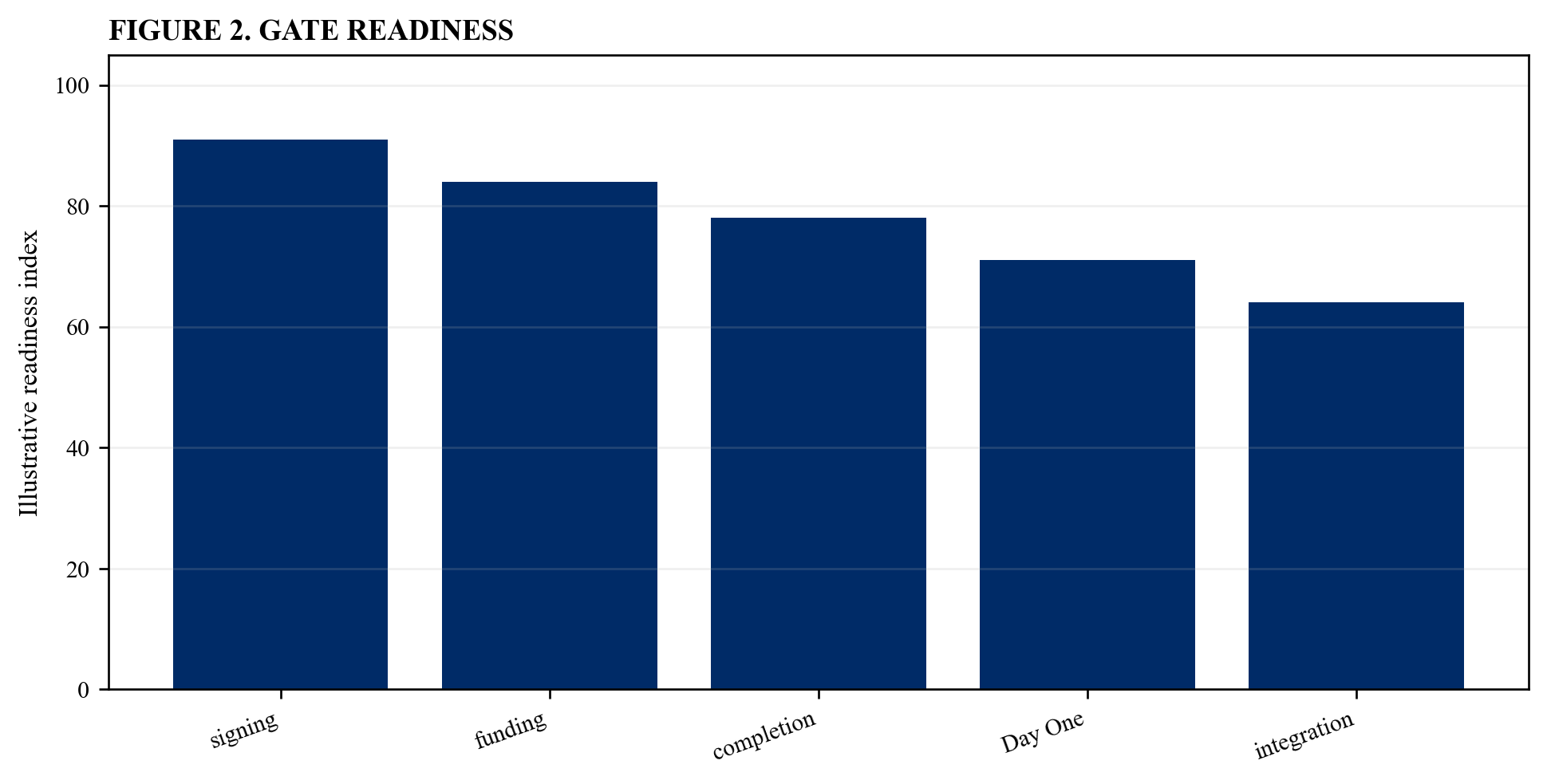
Illustrative analytical scenario; verified platform, target and financing evidence should replace index values.
14. Define the integration gate
The transaction team should approve the operating model, accountable leaders, synergy evidence, costs, timetable, risks and management bandwidth. The required output is an integration-capacity certificate. Use dated source data and link every material conclusion to retained platform, target, lender, financial and contractual evidence [15][16].
Translate the assumption into monthly sources, uses, working capital, integration cash, liquidity, leverage, debt service and covenant effects. Identify the accountable owner, executed definition, measurement method, dependency, decision date and evidence threshold. Reconcile the transaction model, facility documents, lender correspondence, operating forecast and funds flow.
The principal risk is that the platform can finance acquisitions faster than it can absorb them. Quantify the effect on signing capacity, funding certainty, minimum liquidity, covenant headroom, refinancing, debt paydown and equity value. Show base, delayed-synergy, acquisition-gap, integration-stress and refinancing cases with explicit management responses.
Retain the source, model version, reviewer, legal interpretation, finance approval and investment committee response. Compare approved acquisition assumptions with realised cash and integration outcomes; remove unsupported capacity; and assign every exception an owner and deadline.
15. Build the target cash bridge
The transaction team should reconcile target EBITDA to cash tax, working capital, capex, leases, exceptional items and standalone financing. The required output is a target free-cash-flow bridge. Use dated source data and link every material conclusion to retained platform, target, lender, financial and contractual evidence [17][18].
Translate the assumption into monthly sources, uses, working capital, integration cash, liquidity, leverage, debt service and covenant effects. Identify the accountable owner, executed definition, measurement method, dependency, decision date and evidence threshold. Reconcile the transaction model, facility documents, lender correspondence, operating forecast and funds flow.
The principal risk is that headline earnings can overstate debt service contribution. Quantify the effect on signing capacity, funding certainty, minimum liquidity, covenant headroom, refinancing, debt paydown and equity value. Show base, delayed-synergy, acquisition-gap, integration-stress and refinancing cases with explicit management responses.
Retain the source, model version, reviewer, legal interpretation, finance approval and investment committee response. Compare approved acquisition assumptions with realised cash and integration outcomes; remove unsupported capacity; and assign every exception an owner and deadline.
16. Build the total uses schedule
The transaction team should include purchase consideration, refinanced debt, fees, tax, retention, restructuring, integration, capex and liquidity. The required output is a complete acquisition uses statement. Use dated source data and link every material conclusion to retained platform, target, lender, financial and contractual evidence [3][12].
Translate the assumption into monthly sources, uses, working capital, integration cash, liquidity, leverage, debt service and covenant effects. Identify the accountable owner, executed definition, measurement method, dependency, decision date and evidence threshold. Reconcile the transaction model, facility documents, lender correspondence, operating forecast and funds flow.
The principal risk is that transaction uses can exceed the negotiated price materially. Quantify the effect on signing capacity, funding certainty, minimum liquidity, covenant headroom, refinancing, debt paydown and equity value. Show base, delayed-synergy, acquisition-gap, integration-stress and refinancing cases with explicit management responses.
Retain the source, model version, reviewer, legal interpretation, finance approval and investment committee response. Compare approved acquisition assumptions with realised cash and integration outcomes; remove unsupported capacity; and assign every exception an owner and deadline.
Table 2. Acquisition uses
| Use | Forecast basis | Control |
|---|---|---|
| consideration | executed terms | funds flow |
| refinancing | payoff letter | closing owner |
| integration | workplan | cost owner |
| liquidity | downside runway | treasury floor |
Illustrative control framework; verified transaction evidence and executed documents govern.
17. Build the sources schedule
The transaction team should separate cash, revolver, delayed draw, incremental debt, seller instruments, rollover and new equity. The required output is a legally matched sources statement. Use dated source data and link every material conclusion to retained platform, target, lender, financial and contractual evidence [2][3].
Translate the assumption into monthly sources, uses, working capital, integration cash, liquidity, leverage, debt service and covenant effects. Identify the accountable owner, executed definition, measurement method, dependency, decision date and evidence threshold. Reconcile the transaction model, facility documents, lender correspondence, operating forecast and funds flow.
The principal risk is that sources can carry incompatible conditions or timing. Quantify the effect on signing capacity, funding certainty, minimum liquidity, covenant headroom, refinancing, debt paydown and equity value. Show base, delayed-synergy, acquisition-gap, integration-stress and refinancing cases with explicit management responses.
Retain the source, model version, reviewer, legal interpretation, finance approval and investment committee response. Compare approved acquisition assumptions with realised cash and integration outcomes; remove unsupported capacity; and assign every exception an owner and deadline.
18. Reconcile funds flow timing
The transaction team should sequence deposits, equity, debt draws, refinancing, consideration, fees, tax and trapped-cash movements. The required output is a minute-by-minute funds flow. Use dated source data and link every material conclusion to retained platform, target, lender, financial and contractual evidence [3][19].
Translate the assumption into monthly sources, uses, working capital, integration cash, liquidity, leverage, debt service and covenant effects. Identify the accountable owner, executed definition, measurement method, dependency, decision date and evidence threshold. Reconcile the transaction model, facility documents, lender correspondence, operating forecast and funds flow.
The principal risk is that timing gaps can cause settlement failure despite sufficient total sources. Quantify the effect on signing capacity, funding certainty, minimum liquidity, covenant headroom, refinancing, debt paydown and equity value. Show base, delayed-synergy, acquisition-gap, integration-stress and refinancing cases with explicit management responses.
Retain the source, model version, reviewer, legal interpretation, finance approval and investment committee response. Compare approved acquisition assumptions with realised cash and integration outcomes; remove unsupported capacity; and assign every exception an owner and deadline.
19. Model working-capital absorption
The transaction team should forecast target seasonality, purchase-account effects, supplier terms, customer collection and integration disruption. The required output is a combined working-capital case. Use dated source data and link every material conclusion to retained platform, target, lender, financial and contractual evidence [17][20].
Translate the assumption into monthly sources, uses, working capital, integration cash, liquidity, leverage, debt service and covenant effects. Identify the accountable owner, executed definition, measurement method, dependency, decision date and evidence threshold. Reconcile the transaction model, facility documents, lender correspondence, operating forecast and funds flow.
The principal risk is that bolt-ons can consume platform liquidity immediately after close. Quantify the effect on signing capacity, funding certainty, minimum liquidity, covenant headroom, refinancing, debt paydown and equity value. Show base, delayed-synergy, acquisition-gap, integration-stress and refinancing cases with explicit management responses.
Retain the source, model version, reviewer, legal interpretation, finance approval and investment committee response. Compare approved acquisition assumptions with realised cash and integration outcomes; remove unsupported capacity; and assign every exception an owner and deadline.
20. Model integration cash
The transaction team should schedule systems, people, advisers, facilities, branding, contracts, redundancy, retention and contingency spend. The required output is an integration-cash register. Use dated source data and link every material conclusion to retained platform, target, lender, financial and contractual evidence [15][21].
Translate the assumption into monthly sources, uses, working capital, integration cash, liquidity, leverage, debt service and covenant effects. Identify the accountable owner, executed definition, measurement method, dependency, decision date and evidence threshold. Reconcile the transaction model, facility documents, lender correspondence, operating forecast and funds flow.
The principal risk is that synergy forecasts can omit the cash needed to deliver them. Quantify the effect on signing capacity, funding certainty, minimum liquidity, covenant headroom, refinancing, debt paydown and equity value. Show base, delayed-synergy, acquisition-gap, integration-stress and refinancing cases with explicit management responses.
Retain the source, model version, reviewer, legal interpretation, finance approval and investment committee response. Compare approved acquisition assumptions with realised cash and integration outcomes; remove unsupported capacity; and assign every exception an owner and deadline.
21. Model synergy timing
The transaction team should separate contracted, implemented, realised and cash-converted benefits with owners and evidence. The required output is a synergy evidence ledger. Use dated source data and link every material conclusion to retained platform, target, lender, financial and contractual evidence [15][22].
Translate the assumption into monthly sources, uses, working capital, integration cash, liquidity, leverage, debt service and covenant effects. Identify the accountable owner, executed definition, measurement method, dependency, decision date and evidence threshold. Reconcile the transaction model, facility documents, lender correspondence, operating forecast and funds flow.
The principal risk is that pro-forma leverage can rely on benefits that arrive after covenant pressure. Quantify the effect on signing capacity, funding certainty, minimum liquidity, covenant headroom, refinancing, debt paydown and equity value. Show base, delayed-synergy, acquisition-gap, integration-stress and refinancing cases with explicit management responses.
Retain the source, model version, reviewer, legal interpretation, finance approval and investment committee response. Compare approved acquisition assumptions with realised cash and integration outcomes; remove unsupported capacity; and assign every exception an owner and deadline.
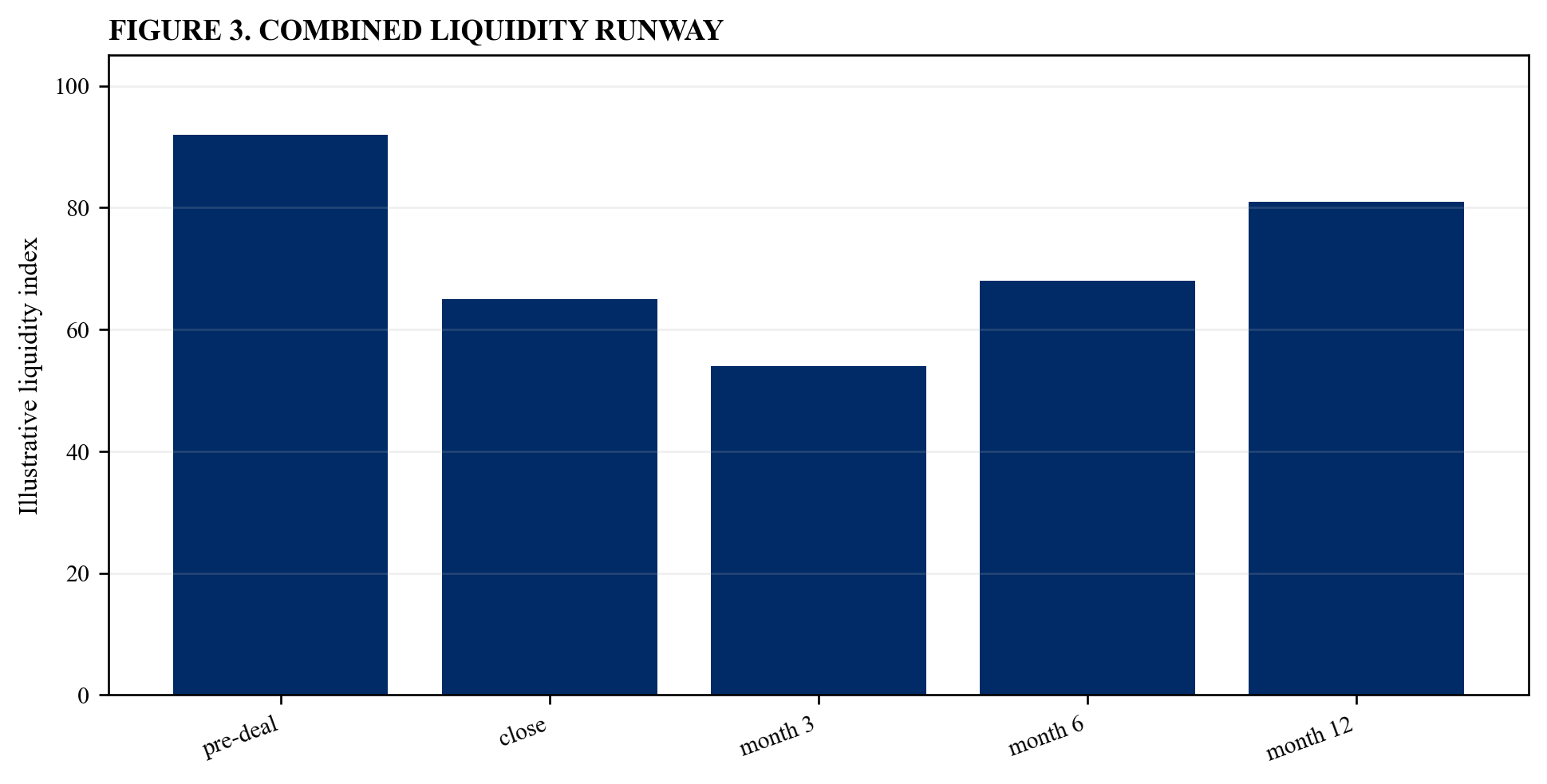
Illustrative analytical scenario; verified platform, target and financing evidence should replace index values.
22. Aggregate the platform forecast
The transaction team should combine platform, targets, eliminations, purchase accounting, financing and integration monthly. The required output is a consolidated acquisition model. Use dated source data and link every material conclusion to retained platform, target, lender, financial and contractual evidence [12][17].
Translate the assumption into monthly sources, uses, working capital, integration cash, liquidity, leverage, debt service and covenant effects. Identify the accountable owner, executed definition, measurement method, dependency, decision date and evidence threshold. Reconcile the transaction model, facility documents, lender correspondence, operating forecast and funds flow.
The principal risk is that separate deal models can miss cumulative cash and covenant effects. Quantify the effect on signing capacity, funding certainty, minimum liquidity, covenant headroom, refinancing, debt paydown and equity value. Show base, delayed-synergy, acquisition-gap, integration-stress and refinancing cases with explicit management responses.
Retain the source, model version, reviewer, legal interpretation, finance approval and investment committee response. Compare approved acquisition assumptions with realised cash and integration outcomes; remove unsupported capacity; and assign every exception an owner and deadline.
23. Calculate pro-forma leverage
The transaction team should apply executed definitions, permitted adjustments, caps, baskets and testing dates to each acquisition. The required output is a covenant leverage bridge. Use dated source data and link every material conclusion to retained platform, target, lender, financial and contractual evidence [1][2].
Translate the assumption into monthly sources, uses, working capital, integration cash, liquidity, leverage, debt service and covenant effects. Identify the accountable owner, executed definition, measurement method, dependency, decision date and evidence threshold. Reconcile the transaction model, facility documents, lender correspondence, operating forecast and funds flow.
The principal risk is that investment committee leverage can diverge from lender leverage. Quantify the effect on signing capacity, funding certainty, minimum liquidity, covenant headroom, refinancing, debt paydown and equity value. Show base, delayed-synergy, acquisition-gap, integration-stress and refinancing cases with explicit management responses.
Retain the source, model version, reviewer, legal interpretation, finance approval and investment committee response. Compare approved acquisition assumptions with realised cash and integration outcomes; remove unsupported capacity; and assign every exception an owner and deadline.
24. Calculate fixed-charge coverage
The transaction team should test interest, amortisation, leases, tax, capex and other fixed cash after each close. The required output is a debt-service certificate. Use dated source data and link every material conclusion to retained platform, target, lender, financial and contractual evidence [1][18].
Translate the assumption into monthly sources, uses, working capital, integration cash, liquidity, leverage, debt service and covenant effects. Identify the accountable owner, executed definition, measurement method, dependency, decision date and evidence threshold. Reconcile the transaction model, facility documents, lender correspondence, operating forecast and funds flow.
The principal risk is that a target can be leverage-accretive and cash-dilutive. Quantify the effect on signing capacity, funding certainty, minimum liquidity, covenant headroom, refinancing, debt paydown and equity value. Show base, delayed-synergy, acquisition-gap, integration-stress and refinancing cases with explicit management responses.
Retain the source, model version, reviewer, legal interpretation, finance approval and investment committee response. Compare approved acquisition assumptions with realised cash and integration outcomes; remove unsupported capacity; and assign every exception an owner and deadline.
Table 3. Integration gates
| Gate | Minimum evidence | Authority |
|---|---|---|
| signing | strategy and funding route | investment committee |
| funding | commitments and covenants | finance |
| Day One | operational control | executive owner |
| integration | milestones and capacity | board |
Illustrative control framework; verified transaction evidence and executed documents govern.
25. Forecast minimum liquidity
The transaction team should combine sources, uses, operations, integration, downside, facility availability and contingency by month. The required output is a liquidity runway. Use dated source data and link every material conclusion to retained platform, target, lender, financial and contractual evidence [1][4].
Translate the assumption into monthly sources, uses, working capital, integration cash, liquidity, leverage, debt service and covenant effects. Identify the accountable owner, executed definition, measurement method, dependency, decision date and evidence threshold. Reconcile the transaction model, facility documents, lender correspondence, operating forecast and funds flow.
The principal risk is that annual models can miss concentrated post-close funding gaps. Quantify the effect on signing capacity, funding certainty, minimum liquidity, covenant headroom, refinancing, debt paydown and equity value. Show base, delayed-synergy, acquisition-gap, integration-stress and refinancing cases with explicit management responses.
Retain the source, model version, reviewer, legal interpretation, finance approval and investment committee response. Compare approved acquisition assumptions with realised cash and integration outcomes; remove unsupported capacity; and assign every exception an owner and deadline.
26. Test acquisition sequencing
The transaction team should compare target order, signing overlap, approval timing, integration load and facility consumption. The required output is an acquisition-sequencing map. Use dated source data and link every material conclusion to retained platform, target, lender, financial and contractual evidence [11][16].
Translate the assumption into monthly sources, uses, working capital, integration cash, liquidity, leverage, debt service and covenant effects. Identify the accountable owner, executed definition, measurement method, dependency, decision date and evidence threshold. Reconcile the transaction model, facility documents, lender correspondence, operating forecast and funds flow.
The principal risk is that parallel deals can compete for the same people, cash and lender capacity. Quantify the effect on signing capacity, funding certainty, minimum liquidity, covenant headroom, refinancing, debt paydown and equity value. Show base, delayed-synergy, acquisition-gap, integration-stress and refinancing cases with explicit management responses.
Retain the source, model version, reviewer, legal interpretation, finance approval and investment committee response. Compare approved acquisition assumptions with realised cash and integration outcomes; remove unsupported capacity; and assign every exception an owner and deadline.
27. Build the base case
The transaction team should use verified performance, funding commitments, integration costs, synergy timing and working capital. The required output is an evidence-led acquisition case. Use dated source data and link every material conclusion to retained platform, target, lender, financial and contractual evidence [1][15].
Translate the assumption into monthly sources, uses, working capital, integration cash, liquidity, leverage, debt service and covenant effects. Identify the accountable owner, executed definition, measurement method, dependency, decision date and evidence threshold. Reconcile the transaction model, facility documents, lender correspondence, operating forecast and funds flow.
The principal risk is that headline pipeline assumptions can replace executable transactions. Quantify the effect on signing capacity, funding certainty, minimum liquidity, covenant headroom, refinancing, debt paydown and equity value. Show base, delayed-synergy, acquisition-gap, integration-stress and refinancing cases with explicit management responses.
Retain the source, model version, reviewer, legal interpretation, finance approval and investment committee response. Compare approved acquisition assumptions with realised cash and integration outcomes; remove unsupported capacity; and assign every exception an owner and deadline.
28. Build the delayed-synergy case
The transaction team should defer benefits, retain duplicate costs and recalculate cash, covenants and refinancing. The required output is a synergy-delay case. Use dated source data and link every material conclusion to retained platform, target, lender, financial and contractual evidence [15][22].
Translate the assumption into monthly sources, uses, working capital, integration cash, liquidity, leverage, debt service and covenant effects. Identify the accountable owner, executed definition, measurement method, dependency, decision date and evidence threshold. Reconcile the transaction model, facility documents, lender correspondence, operating forecast and funds flow.
The principal risk is that the platform can breach liquidity before operating value arrives. Quantify the effect on signing capacity, funding certainty, minimum liquidity, covenant headroom, refinancing, debt paydown and equity value. Show base, delayed-synergy, acquisition-gap, integration-stress and refinancing cases with explicit management responses.
Retain the source, model version, reviewer, legal interpretation, finance approval and investment committee response. Compare approved acquisition assumptions with realised cash and integration outcomes; remove unsupported capacity; and assign every exception an owner and deadline.
29. Build the acquisition-gap case
The transaction team should model signed consideration without expected accordion, refinancing or equity capacity. The required output is a funding-gap case. Use dated source data and link every material conclusion to retained platform, target, lender, financial and contractual evidence [1][7].
Translate the assumption into monthly sources, uses, working capital, integration cash, liquidity, leverage, debt service and covenant effects. Identify the accountable owner, executed definition, measurement method, dependency, decision date and evidence threshold. Reconcile the transaction model, facility documents, lender correspondence, operating forecast and funds flow.
The principal risk is that uncommitted capital can disappear after transaction costs are incurred. Quantify the effect on signing capacity, funding certainty, minimum liquidity, covenant headroom, refinancing, debt paydown and equity value. Show base, delayed-synergy, acquisition-gap, integration-stress and refinancing cases with explicit management responses.
Retain the source, model version, reviewer, legal interpretation, finance approval and investment committee response. Compare approved acquisition assumptions with realised cash and integration outcomes; remove unsupported capacity; and assign every exception an owner and deadline.
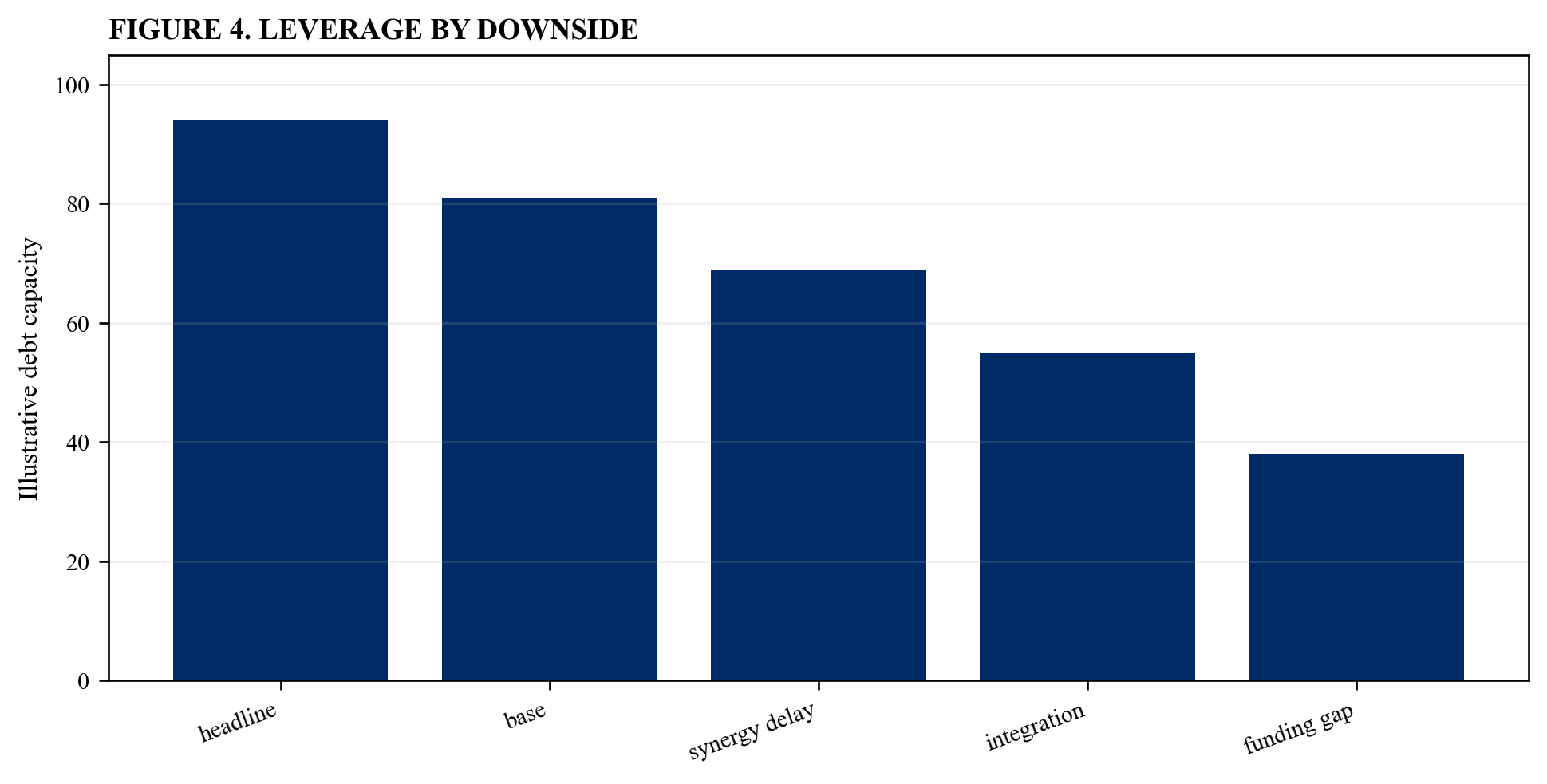
Illustrative analytical scenario; verified platform, target and financing evidence should replace index values.
30. Build the integration-stress case
The transaction team should apply customer loss, staff turnover, systems delay, cyber events and management overload. The required output is an integration downside. Use dated source data and link every material conclusion to retained platform, target, lender, financial and contractual evidence [14][16].
Translate the assumption into monthly sources, uses, working capital, integration cash, liquidity, leverage, debt service and covenant effects. Identify the accountable owner, executed definition, measurement method, dependency, decision date and evidence threshold. Reconcile the transaction model, facility documents, lender correspondence, operating forecast and funds flow.
The principal risk is that execution stress can affect both platform and target cash flow. Quantify the effect on signing capacity, funding certainty, minimum liquidity, covenant headroom, refinancing, debt paydown and equity value. Show base, delayed-synergy, acquisition-gap, integration-stress and refinancing cases with explicit management responses.
Retain the source, model version, reviewer, legal interpretation, finance approval and investment committee response. Compare approved acquisition assumptions with realised cash and integration outcomes; remove unsupported capacity; and assign every exception an owner and deadline.
31. Build the refinancing case
The transaction team should model maturity walls, base rates, margins, leverage tolerance, exit timing and market closure. The required output is a refinancing case. Use dated source data and link every material conclusion to retained platform, target, lender, financial and contractual evidence [1][8].
Translate the assumption into monthly sources, uses, working capital, integration cash, liquidity, leverage, debt service and covenant effects. Identify the accountable owner, executed definition, measurement method, dependency, decision date and evidence threshold. Reconcile the transaction model, facility documents, lender correspondence, operating forecast and funds flow.
The principal risk is that repeat acquisitions can shorten the runway to a concentrated maturity. Quantify the effect on signing capacity, funding certainty, minimum liquidity, covenant headroom, refinancing, debt paydown and equity value. Show base, delayed-synergy, acquisition-gap, integration-stress and refinancing cases with explicit management responses.
Retain the source, model version, reviewer, legal interpretation, finance approval and investment committee response. Compare approved acquisition assumptions with realised cash and integration outcomes; remove unsupported capacity; and assign every exception an owner and deadline.
32. Set acquisition capacity
The transaction team should limit signing and funding by the lowest of legal, lender, liquidity, covenant, integration and equity capacity. The required output is a dynamic capacity limit. Use dated source data and link every material conclusion to retained platform, target, lender, financial and contractual evidence [2][16].
Translate the assumption into monthly sources, uses, working capital, integration cash, liquidity, leverage, debt service and covenant effects. Identify the accountable owner, executed definition, measurement method, dependency, decision date and evidence threshold. Reconcile the transaction model, facility documents, lender correspondence, operating forecast and funds flow.
The principal risk is that a single headline debt number can ignore the binding constraint. Quantify the effect on signing capacity, funding certainty, minimum liquidity, covenant headroom, refinancing, debt paydown and equity value. Show base, delayed-synergy, acquisition-gap, integration-stress and refinancing cases with explicit management responses.
Retain the source, model version, reviewer, legal interpretation, finance approval and investment committee response. Compare approved acquisition assumptions with realised cash and integration outcomes; remove unsupported capacity; and assign every exception an owner and deadline.
Table 4. Capacity constraints
| Constraint | Measure | Response |
|---|---|---|
| legal | document permission | amend or restructure |
| lender | committed appetite | resize or syndicate |
| liquidity | monthly floor | add equity or defer |
| integration | delivery capacity | sequence targets |
Illustrative control framework; verified transaction evidence and executed documents govern.
33. Design stop/go triggers
The transaction team should set green, amber and red thresholds for liquidity, leverage, integration, performance and lender status. The required output is a gate-trigger matrix. Use dated source data and link every material conclusion to retained platform, target, lender, financial and contractual evidence [16][23].
Translate the assumption into monthly sources, uses, working capital, integration cash, liquidity, leverage, debt service and covenant effects. Identify the accountable owner, executed definition, measurement method, dependency, decision date and evidence threshold. Reconcile the transaction model, facility documents, lender correspondence, operating forecast and funds flow.
The principal risk is that pipeline momentum can override deteriorating evidence. Quantify the effect on signing capacity, funding certainty, minimum liquidity, covenant headroom, refinancing, debt paydown and equity value. Show base, delayed-synergy, acquisition-gap, integration-stress and refinancing cases with explicit management responses.
Retain the source, model version, reviewer, legal interpretation, finance approval and investment committee response. Compare approved acquisition assumptions with realised cash and integration outcomes; remove unsupported capacity; and assign every exception an owner and deadline.
34. Negotiate lender flexibility
The transaction team should align acquisition baskets, incremental capacity, cure rights, reporting and integration timing with the plan. The required output is a negotiated flexibility map. Use dated source data and link every material conclusion to retained platform, target, lender, financial and contractual evidence [2][6].
Translate the assumption into monthly sources, uses, working capital, integration cash, liquidity, leverage, debt service and covenant effects. Identify the accountable owner, executed definition, measurement method, dependency, decision date and evidence threshold. Reconcile the transaction model, facility documents, lender correspondence, operating forecast and funds flow.
The principal risk is that generic flexibility can fail the actual acquisition programme. Quantify the effect on signing capacity, funding certainty, minimum liquidity, covenant headroom, refinancing, debt paydown and equity value. Show base, delayed-synergy, acquisition-gap, integration-stress and refinancing cases with explicit management responses.
Retain the source, model version, reviewer, legal interpretation, finance approval and investment committee response. Compare approved acquisition assumptions with realised cash and integration outcomes; remove unsupported capacity; and assign every exception an owner and deadline.
35. Negotiate purchase protection
The transaction team should translate funding and integration risk into conditions, price, earn-out, rollover, escrow, termination and long-stop terms. The required output is a transaction-protection map. Use dated source data and link every material conclusion to retained platform, target, lender, financial and contractual evidence [10][12].
Translate the assumption into monthly sources, uses, working capital, integration cash, liquidity, leverage, debt service and covenant effects. Identify the accountable owner, executed definition, measurement method, dependency, decision date and evidence threshold. Reconcile the transaction model, facility documents, lender correspondence, operating forecast and funds flow.
The principal risk is that the buyer can bear financing risk without corresponding contractual protection. Quantify the effect on signing capacity, funding certainty, minimum liquidity, covenant headroom, refinancing, debt paydown and equity value. Show base, delayed-synergy, acquisition-gap, integration-stress and refinancing cases with explicit management responses.
Retain the source, model version, reviewer, legal interpretation, finance approval and investment committee response. Compare approved acquisition assumptions with realised cash and integration outcomes; remove unsupported capacity; and assign every exception an owner and deadline.
36. Govern add-back eligibility
The transaction team should separate realised, contracted and forecast synergies under internal and executed debt definitions. The required output is an add-back eligibility ledger. Use dated source data and link every material conclusion to retained platform, target, lender, financial and contractual evidence [1][2].
Translate the assumption into monthly sources, uses, working capital, integration cash, liquidity, leverage, debt service and covenant effects. Identify the accountable owner, executed definition, measurement method, dependency, decision date and evidence threshold. Reconcile the transaction model, facility documents, lender correspondence, operating forecast and funds flow.
The principal risk is that unsupported adjustments can manufacture acquisition capacity. Quantify the effect on signing capacity, funding certainty, minimum liquidity, covenant headroom, refinancing, debt paydown and equity value. Show base, delayed-synergy, acquisition-gap, integration-stress and refinancing cases with explicit management responses.
Retain the source, model version, reviewer, legal interpretation, finance approval and investment committee response. Compare approved acquisition assumptions with realised cash and integration outcomes; remove unsupported capacity; and assign every exception an owner and deadline.
37. Monitor post-close delivery
The transaction team should track revenue, cash, working capital, costs, synergies, incidents, covenants and integration milestones monthly. The required output is a bolt-on control dashboard. Use dated source data and link every material conclusion to retained platform, target, lender, financial and contractual evidence [15][23].
Translate the assumption into monthly sources, uses, working capital, integration cash, liquidity, leverage, debt service and covenant effects. Identify the accountable owner, executed definition, measurement method, dependency, decision date and evidence threshold. Reconcile the transaction model, facility documents, lender correspondence, operating forecast and funds flow.
The principal risk is that new deals can start before prior acquisitions meet their case. Quantify the effect on signing capacity, funding certainty, minimum liquidity, covenant headroom, refinancing, debt paydown and equity value. Show base, delayed-synergy, acquisition-gap, integration-stress and refinancing cases with explicit management responses.
Retain the source, model version, reviewer, legal interpretation, finance approval and investment committee response. Compare approved acquisition assumptions with realised cash and integration outcomes; remove unsupported capacity; and assign every exception an owner and deadline.
38. Back-test every acquisition
The transaction team should compare approved and realised price, funding, cash, synergies, leverage, integration and returns. The required output is an acquisition variance file. Use dated source data and link every material conclusion to retained platform, target, lender, financial and contractual evidence [16][24].
Translate the assumption into monthly sources, uses, working capital, integration cash, liquidity, leverage, debt service and covenant effects. Identify the accountable owner, executed definition, measurement method, dependency, decision date and evidence threshold. Reconcile the transaction model, facility documents, lender correspondence, operating forecast and funds flow.
The principal risk is that the platform can repeat optimistic assumptions without learning. Quantify the effect on signing capacity, funding certainty, minimum liquidity, covenant headroom, refinancing, debt paydown and equity value. Show base, delayed-synergy, acquisition-gap, integration-stress and refinancing cases with explicit management responses.
Retain the source, model version, reviewer, legal interpretation, finance approval and investment committee response. Compare approved acquisition assumptions with realised cash and integration outcomes; remove unsupported capacity; and assign every exception an owner and deadline.
39. Prepare the lender evidence pack
The transaction team should present transaction terms, diligence, pro-forma model, integration plan, downside, liquidity and covenant calculations. The required output is a lender-ready acquisition memorandum. Use dated source data and link every material conclusion to retained platform, target, lender, financial and contractual evidence [1][7].
Translate the assumption into monthly sources, uses, working capital, integration cash, liquidity, leverage, debt service and covenant effects. Identify the accountable owner, executed definition, measurement method, dependency, decision date and evidence threshold. Reconcile the transaction model, facility documents, lender correspondence, operating forecast and funds flow.
The principal risk is that late or inconsistent evidence can reduce funding certainty. Quantify the effect on signing capacity, funding certainty, minimum liquidity, covenant headroom, refinancing, debt paydown and equity value. Show base, delayed-synergy, acquisition-gap, integration-stress and refinancing cases with explicit management responses.
Retain the source, model version, reviewer, legal interpretation, finance approval and investment committee response. Compare approved acquisition assumptions with realised cash and integration outcomes; remove unsupported capacity; and assign every exception an owner and deadline.
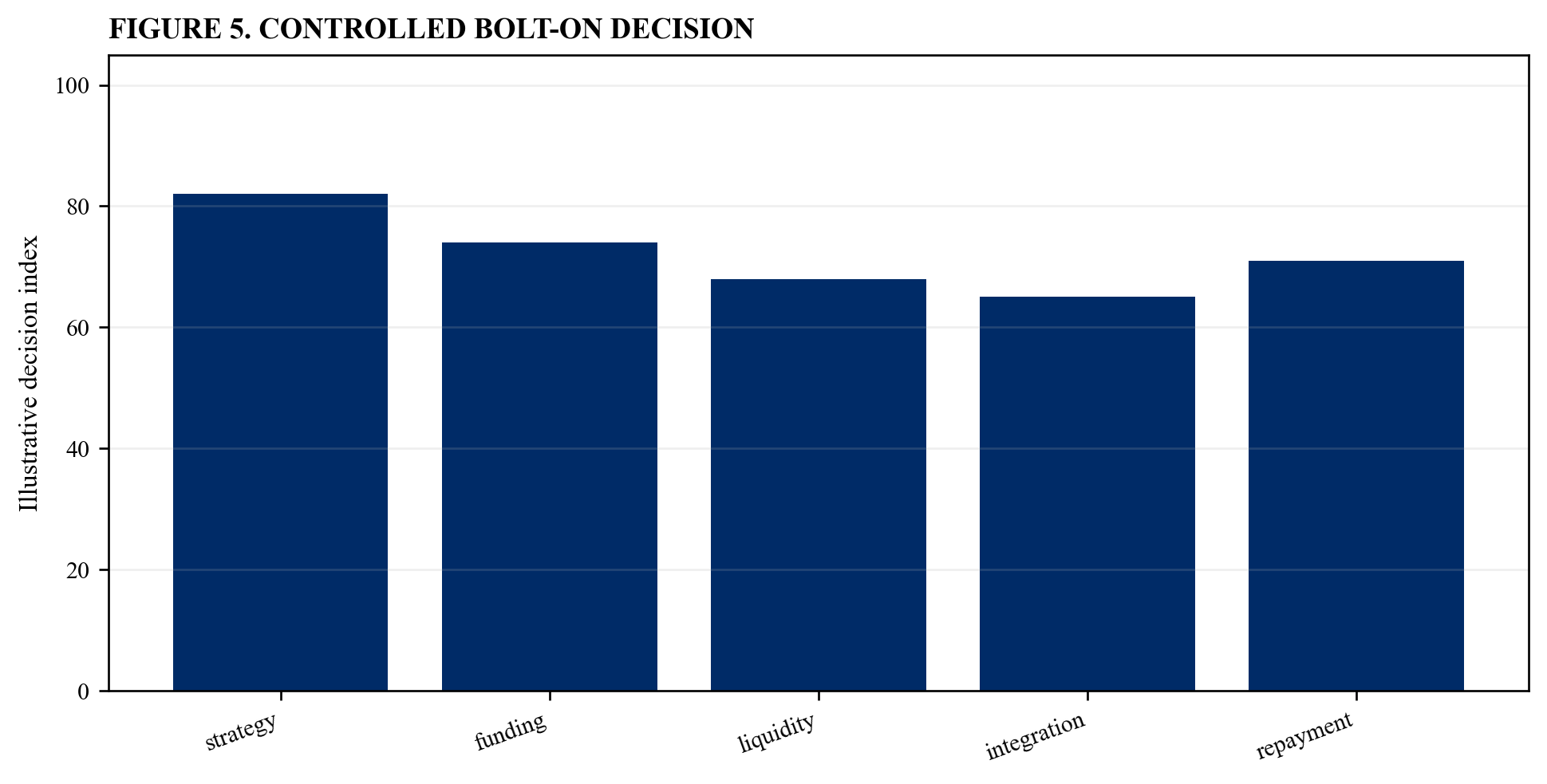
Illustrative analytical scenario; verified platform, target and financing evidence should replace index values.
40. Issue the investment committee certificate
The transaction team should approve strategy, price, funding, liquidity, covenants, integration capacity, downside and repayment. The required output is a retained bolt-on certificate. Use dated source data and link every material conclusion to retained platform, target, lender, financial and contractual evidence [23][25].
Translate the assumption into monthly sources, uses, working capital, integration cash, liquidity, leverage, debt service and covenant effects. Identify the accountable owner, executed definition, measurement method, dependency, decision date and evidence threshold. Reconcile the transaction model, facility documents, lender correspondence, operating forecast and funds flow.
The principal risk is that the committee can approve a target without certifying the capital and capacity to absorb it. Quantify the effect on signing capacity, funding certainty, minimum liquidity, covenant headroom, refinancing, debt paydown and equity value. Show base, delayed-synergy, acquisition-gap, integration-stress and refinancing cases with explicit management responses.
Retain the source, model version, reviewer, legal interpretation, finance approval and investment committee response. Compare approved acquisition assumptions with realised cash and integration outcomes; remove unsupported capacity; and assign every exception an owner and deadline.
Table 5. Bolt-on certificate
| Conclusion | Evidence | Approval test |
|---|---|---|
| strategic fit | signed rationale | value path credible |
| funding | sources and conditions | cash certain |
| integration | capacity and milestones | delivery controlled |
| repayment | downside cash flow | debt service credible |
Illustrative control framework; verified transaction evidence and executed documents govern.
References
- European Central Bank, Guidance on leveraged transactions, https://www.bankingsupervision.europa.eu/ecb/pub/pdf/ssm.leveraged_transactions_guidance_201705.en.pdf
- European Banking Authority, Guidelines on leveraged transactions, https://www.eba.europa.eu/sites/default/files/documents/10180/1696305/1dba7657-6ccb-462a-b9f8-8df8686b9807/Final%20Guidelines%20on%20Leveraged%20Transactions.pdf
- IFRS Foundation, IFRS 3 Business Combinations, https://www.ifrs.org/issued-standards/list-of-standards/ifrs-3-business-combinations/
- IFRS Foundation, IFRS 7 Financial Instruments Disclosures, https://www.ifrs.org/issued-standards/list-of-standards/ifrs-7-financial-instruments-disclosures/
- Bank of England, Financial Stability Report July 2026, https://www.bankofengland.co.uk/financial-stability-report/2026/july-2026
- European Banking Authority, Guidelines on loan origination and monitoring, https://www.eba.europa.eu/regulation-and-policy/credit-risk/guidelines-on-loan-origination-and-monitoring
- European Central Bank, Leveraged finance, https://www.bankingsupervision.europa.eu/activities/leveraged-finance/html/index.en.html
- Bank of England, Monetary Policy Report, https://www.bankofengland.co.uk/monetary-policy-report
- UK Government, Companies Act 2006, https://www.legislation.gov.uk/ukpga/2006/46/contents
- UK Competition and Markets Authority, Merger assessment guidelines, https://www.gov.uk/government/publications/merger-assessment-guidelines
- UK Competition and Markets Authority, Merger remedies guidance, https://www.gov.uk/government/publications/merger-remedies
- IFRS Foundation, IFRS 13 Fair Value Measurement, https://www.ifrs.org/issued-standards/list-of-standards/ifrs-13-fair-value-measurement/
- IFRS Foundation, IFRS 10 Consolidated Financial Statements, https://www.ifrs.org/issued-standards/list-of-standards/ifrs-10-consolidated-financial-statements/
- National Institute of Standards and Technology, Cybersecurity Framework 2.0, https://www.nist.gov/cyberframework
- IFRS Foundation, Business combinations disclosures goodwill and impairment, https://www.ifrs.org/projects/work-plan/business-combinations-disclosures-goodwill-and-impairment/
- OECD, G20 OECD Principles of Corporate Governance 2023, https://www.oecd.org/corporate/principles-corporate-governance/
- IFRS Foundation, IAS 7 Statement of Cash Flows, https://www.ifrs.org/issued-standards/list-of-standards/ias-7-statement-of-cash-flows/
- IFRS Foundation, IFRS 16 Leases, https://www.ifrs.org/issued-standards/list-of-standards/ifrs-16-leases/
- Bank for International Settlements, Principles for operational resilience, https://www.bis.org/bcbs/publ/d516.htm
- IFRS Foundation, IAS 2 Inventories, https://www.ifrs.org/issued-standards/list-of-standards/ias-2-inventories/
- IFRS Foundation, IAS 37 Provisions Contingent Liabilities and Contingent Assets, https://www.ifrs.org/issued-standards/list-of-standards/ias-37-provisions-contingent-liabilities-and-contingent-assets/
- IFRS Foundation, IASB proposals to improve reporting of acquisitions, https://www.ifrs.org/news-and-events/news/2024/03/iasb-consults-on-proposals-to-improve-reporting-of-acquisitions/
- International Organization for Standardization, ISO 31000 Risk management, https://www.iso.org/iso-31000-risk-management.html
- International Valuation Standards Council, International Valuation Standards, https://www.ivsc.org/standards/
- IFRS Foundation, IAS 36 Impairment of Assets, https://www.ifrs.org/issued-standards/list-of-standards/ias-36-impairment-of-assets/
- Financial Action Task Force, Recommendations, https://www.fatf-gafi.org/en/publications/Fatfrecommendations/Fatf-recommendations.html
