

1 Define the buyer selection decision
A seller may know the name of every prominent operator in its sector and still have no evidence that any of them will bid. A public acquisition strategy can indicate an area of interest. It may cover a geography, capability or asset size that differs from the business on offer. A strong balance sheet can support investment generally while a board has allocated this year's capital elsewhere. A history of acquisitions can demonstrate access to a deal team and also reveal a preference for targets that integrate differently. The list should therefore be treated as a set of hypotheses about buyer fit, each requiring evidence.
The decision is practical: which parties should receive the seller's scarce management time and sensitive information, in what order, and on what terms? A buyer universe is useful only when it supports those choices. The adviser should record the proposed transaction perimeter, buyer-specific strategic rationale, visible capacity, likely decision route and disclosure risk for each candidate. The owner should approve invitations and exclusions before contact. Counsel should review confidentiality, competition, shareholder and other legal matters under the actual facts. The buyer's ability to acquire is only one part of the decision; information exposure and execution capacity matter as well.
This paper distinguishes a company that appears to fit from a company that has advanced toward a bid. The first judgment can use public evidence and bounded inference. The second requires observed process conduct, such as a reply from an authorised team, a confidential information request with a defined purpose, an internal approval path and ultimately a written proposal. The classification can change as facts arrive. It should not be converted into a probability of success without a dataset that permits validation.
The research question is which observable acquisition, integration and financial signals precede engagement by a strategic buyer. The proposed private GCC mandate cohort in the accompanying research brief has not been assembled. Accordingly, the paper offers a protocol and a study design rather than an estimated coefficient, response rate or ranking model. An owner can use the protocol now to expose missing evidence and control outreach; a future study would be needed to test predictive accuracy.
2 Separate prior research from local evidence
Mitchell and Shaver studied US medical-sector acquisitions from 1978 to 1995. They linked product-line scope to acquisition incidence and to the overlap between a buyer's existing lines and acquired lines [1]. Their setting shows why integration capability belongs in buyer selection. It does not establish a conversion rule for a GCC private-company sale. Gorbenko and Malenko examined US public-company takeover auctions from 2000 to 2008, using information on participating bidders rather than winners alone [2]. Their analysis found substantial variation in strategic bidders' valuations across targets, and warned against equating a winning premium with every prospective buyer's value. The implication is methodological: buyer identity and target-specific fit matter more than a generic label of “strategic.”
Recent integration research reaches a similar caution by a different route. A multi-national study in Long Range Planning examines how tacit and explicit knowledge and organisational design shape integration capabilities [3]. The paper concerns outcomes after acquisition, not whether a named buyer will answer an approach. Hoffmann and Vladimirov's 2025 model shows that payment structure and bidder-specific complementarity can affect a seller's choice between a negotiated process and a broader auction [4]. It is a theoretical result within stated assumptions. These studies support questions to ask and variables to record. They do not substitute for an observed buyer's current mandate.
Public GCC company sources provide a different kind of evidence. TAQA's 2025 integrated-report summary describes its agreement to acquire GS Inima, the intended water-platform rationale and conditions to closing [5]. BinDawood Holding's 2025 annual report describes acquisitions across retail, distribution and manufacturing and identifies specific integration themes [6]. Those disclosures show how a buyer articulates fit, and in BinDawood's case how it reports completed acquisitions. They say nothing about either company's willingness to bid for an unrelated seller. Every potential buyer deserves its own current evidence check.
The regulatory sources are also bounded. Saudi merger and acquisition regulations describe public-offer obligations and the interaction with competition-law approval [7]. The Saudi General Authority for Competition has issued economic-concentration review guidance [8]. The DFSA's 2026 thematic review addresses conflicts of interest among authorised firms in the DIFC [9]. These instruments should inform a jurisdiction-specific counsel workstream. The paper does not assume that the same filing, timing, conflict or disclosure rule applies to all GCC private transactions.
3 Specify the stages before measuring engagement
An adviser can report “ten buyers engaged” while counting ten very different events. One company may have received a teaser; another may have held a management meeting; a third may have submitted a priced offer. The seller should define stages in advance. A candidate is a company with a buyer-specific thesis. A permitted contact is one the owner has approved after disclosure review. A responsive party has acknowledged the opportunity through an authorised channel. An information participant has signed applicable confidentiality terms and received an approved package. A qualified proposal is written and states a transaction perimeter, price basis, payment form, financing route, major conditions and a timetable.
These are author-developed operating definitions, not legal labels. A non-binding letter can still be commercially significant; its legal effect depends on the document and governing law. An information participant may be learning about the market rather than preparing a bid. A response from a junior employee may show organisational access, but not approval authority. The stages should therefore record who acted, what document was received and what remains unresolved. The adviser should preserve the denominator at each stage, including approved parties that were never contacted and contacted parties that declined.
Figure 1 is an evidence progression. It deliberately has no implied conversion percentages. An owner might decline to approach a competitor despite an apparent fit because disclosure risk is high. A buyer might reach the diligence stage and still be unable to fund or integrate the target. The purpose of the figure is to show where a claim about “buyer interest” gains or loses substance. A process report should show both the number of parties at a stage and the evidence that justified classifying each one there.
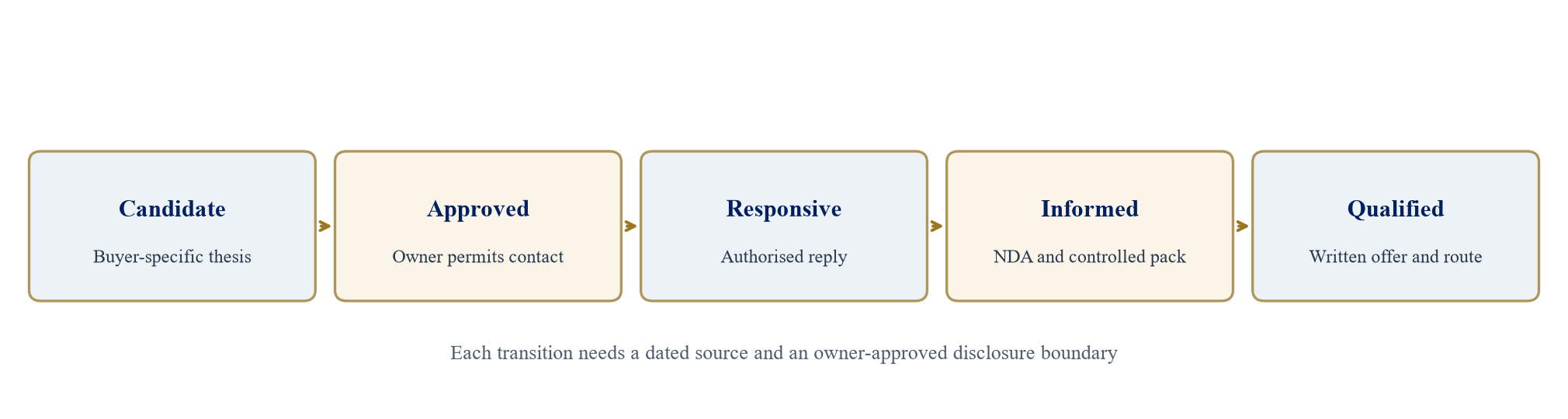
Author-developed evidence stages; widths do not represent conversion rates or probabilities.
4 Begin with a transaction thesis specific to the buyer
A credible strategic rationale names the asset the buyer would acquire and the mechanism by which ownership might create value. The seller should ask whether the buyer could use the target's customer relationships, licences, distribution network, technology, capacity or management capability within an existing business. The word “synergy” is insufficient by itself. A thesis should identify which operating unit could own the asset, which overlap or complementarity matters, which commercial contract or regulatory permission would transfer, and who would bear the integration work. It should identify a reason the buyer might prefer acquisition to partnership, organic build or a different target.
The first pass can use annual reports, investor presentations and completed deal disclosures. TAQA's statement about GS Inima identifies a water value-chain and international-growth rationale [5]. BinDawood's annual report connects particular acquisitions to distribution, pharmacy, bakery and digital activities [6]. These are evidence of publicly stated priorities at those dates. They are not a perpetual acquisition mandate. A seller should check later filings and direct responses before granting access to a confidential process. An adviser should date every source because a strategy or balance sheet can change before outreach.
A thesis should also be falsifiable. “The buyer likes growth” cannot be tested against the opportunity. “The buyer seeks regional water-services concessions with operational overlap and has described an international water-platform acquisition” is more precise, though still only a hypothesis for another target. The adviser can ask what would make the buyer reject this company: asset type, country exposure, contract duration, regulatory obligations, capital intensity or integration burden. This negative case stops the universe from expanding merely because a buyer has a familiar name.
Strategic relevance should be judged against the target's actual sale perimeter. If the owner is offering a minority stake with founder control, an acquirer whose disclosed strategy requires full consolidation may be a poor immediate prospect. If assets sit in multiple jurisdictions, a buyer focused on one operating licence may ask for a carve-out. If the target's value relies on management continuity, the buyer's integration model matters. These constraints should be documented before a teaser gives the impression that the seller can offer a different business.
5 Build an evidence register instead of a famous-name list
The buyer universe should carry evidence and uncertainty in the same row. Table 1 proposes a register that an owner can audit. Each field should point to a dated source or an observed interaction, with the distinction between public and private information preserved. A blank field is an open question. It should not silently become a favourable score. The adviser should also record the reason for excluding a candidate, including competitors whose access to sensitive information would impose a risk the seller does not wish to take.
Financial capacity requires special care. Reported cash, revenue or credit availability is not a commitment to a particular acquisition. Debt covenants, capital budgets, board approvals, funding currency, competing projects and regulatory constraints can alter the usable amount. A buyer may raise acquisition finance only after seeing a target. Conversely, a large company can have the resources to bid and decline because the asset does not fit. Public accounts establish a starting point; a proposal must eventually explain the actual source and conditions of payment.
The integration field should ask for a route, not a slogan. An annual report may show that the buyer has integrated a prior acquisition; it does not prove capacity for a larger or technologically different target. The adviser can map the target's operating model against the buyer's current organisation and identify questions: who owns the integration, what systems are compatible, which customers require consent and what management retention is essential? These questions become more detailed after the buyer signs confidentiality terms. Before then, the seller should avoid disclosing material that a competitor could use even if no bid follows.
Table 1. Buyer evidence register for seller approval
| Field | Minimum evidence to record | What remains unproven | Owner decision |
|---|---|---|---|
| Strategic thesis | Named operating unit and dated public priority | Current interest in this target | Approve or reject contact rationale |
| Transaction fit | Target perimeter against disclosed deal pattern | Willingness to buy this stake or asset | Confirm the offered perimeter |
| Financial route | Published accounts and stated capital policy | Transaction-specific funding | Set funding questions for later stage |
| Integration route | Prior relevant acquisitions and operating overlap | Team availability and execution plan | Limit early disclosure if sensitive |
| Decision authority | Identified corporate development or board route | Actual approval for this bid | Require authorised process contact |
| Regulatory route | Jurisdictions, sector and concentration flags | Filing thresholds and outcome | Instruct transaction-specific counsel |
| Confidentiality risk | Competitive overlap and information sensitivity | Effect of access if no transaction | Approve a staged information pack |
Author-developed fields. A source date and decision owner should accompany every entry in a live mandate.
6 Distinguish acquisition history from available capacity
Acquisition experience can signal a practiced transaction process. It can also consume the people, funding and attention needed for another deal. The seller should not assume a linear relationship between deal count and appetite. Prior acquisitions should be described by size, asset type, geography, timing, consideration and reported integration status. An adviser can ask whether the buyer has completed transactions similar enough to inform this decision. Similarity should cover the operational challenge, not merely the industry label.
Mitchell and Shaver's historical medical-sector evidence links product-line scope with acquisition incidence and target choice [1]. The result suggests a variable worth checking, not an automatic preference for diversified buyers. The later integration-capability study distinguishes explicit organisational processes from tacit learning and notes that different designs can turn experience into capability in different ways [3]. A seller should ask what capability the buyer demonstrably has for this particular asset, and whether the proposed combination places new demands on it.
BinDawood Holding's 2025 annual report offers a public example of multiple acquisitions with distinct integration rationales [6]. Its pharmacy footprint, toy distribution, bakery manufacturing and digital assets are not interchangeable. The seller should not infer that a company that bought a distributor will pursue a software platform or that a buyer's announced ambition guarantees integration success. A deal history becomes more useful when the adviser can connect it to the target's operating dependencies, customer channels and management requirements.
The timing of past deals matters. A buyer that closed an acquisition recently may be integrating it, refinancing it or facing a performance review. The seller can ask the buyer, once contact is authorised, whether its current capital allocation and management capacity include another acquisition. A buyer's answer should be recorded as a dated statement, with remaining approvals noted. That evidence has a different status from a website claim about being “active in M&A.”
7 Test finance as a pathway rather than a balance-sheet number
An acquisition can be paid from balance-sheet cash, a committed facility, new debt, new equity, asset-sale proceeds or a combination. Each route has its own approvals and conditions. The seller's screening question is whether a plausible route exists at the proposed scale. A later bid-quality question is whether the buyer has documented the route for this transaction. These stages should not be conflated. A public company's published liquidity and borrowing position may be informative, but they do not reserve funds for the seller's business.
The research on strategic and financial bidders also warns against treating buyer type as a universal financing advantage. Gorbenko and Malenko found target-specific variation in valuations and financing-related differences in their US sample [2]. A separate theoretical study models the timing and payment method of acquisitions when buyers face financial constraints [10]. Neither paper identifies the financing status of a named GCC buyer today. The adviser must obtain current transaction evidence through the buyer's own approval and funding process.
The financing register should separate cash already held by the bidder, acquisition debt that remains to be arranged, and consideration contingent on future performance. It should name the payer and obligor, currency, funding source, internal sponsor, investment committee or board route, lenders where applicable, conditions precedent and dates. Counsel should review financing language in any actual offer. The owner should not treat a business development officer's confidence as equivalent to a board approval or a lender commitment.
Financing also affects outreach timing. A buyer may need enough information to seek approval before it can state a firm price, while the seller may wish to withhold sensitive data until the buyer demonstrates serious intent. A staged information package can help, but it cannot eliminate the trade-off. The adviser should tell the owner what evidence the buyer needs, what it has already received and which commitments can be requested before deeper access. That record makes the sequence reviewable if the buyer later withdraws.
8 Turn strategic fit into an integration workplan
A target can look attractive on a market map and be difficult to integrate. It may depend on a founder, a single operating licence, a government contract, a small group of engineers or a customer relationship that cannot be transferred on the buyer's assumed terms. The buyer's valuation can depend on solving those issues. The seller should therefore map the strategic thesis into specific operating tasks before treating a proposed synergy as credible. An adviser can organise the questions; management and specialists should supply the evidence.
Figure 2 links the claimed rationale to the people and systems required to deliver it. A distribution thesis may need warehouse capacity, channel agreements and inventory data. A technology thesis may need data rights, cybersecurity review, product integration and retention of key staff. A regulated-services thesis may depend on licence continuity and customer consents. These are examples of due-diligence questions, not statements about any named company. The buyer should identify the owner of each workstream and the point at which it becomes a price or contract condition.
Public buyer disclosures show why this translation matters. TAQA presents the GS Inima agreement as part of a water-platform strategy and describes the acquired activities and closing conditions [5]. BinDawood discusses how particular acquisitions fit its distribution and operating footprint [6]. Those sources state the companies' rationales; they do not disclose every integration budget, internal approval or realised synergy. A seller can use such disclosures to formulate informed questions and then ask the buyer for a transaction-specific plan after a confidentiality gate.
The integration test also exposes a buyer that wants information without a credible ownership route. If a candidate cannot identify the business unit that would own the target, the strategic sponsor, the intended customer proposition or the integration resources, the adviser should keep it at an exploratory stage. The record should not call it a qualified bidder. Conversely, a buyer with an unusual thesis may deserve attention if it provides a concrete operating plan and internal authority, even when it was absent from the first list.
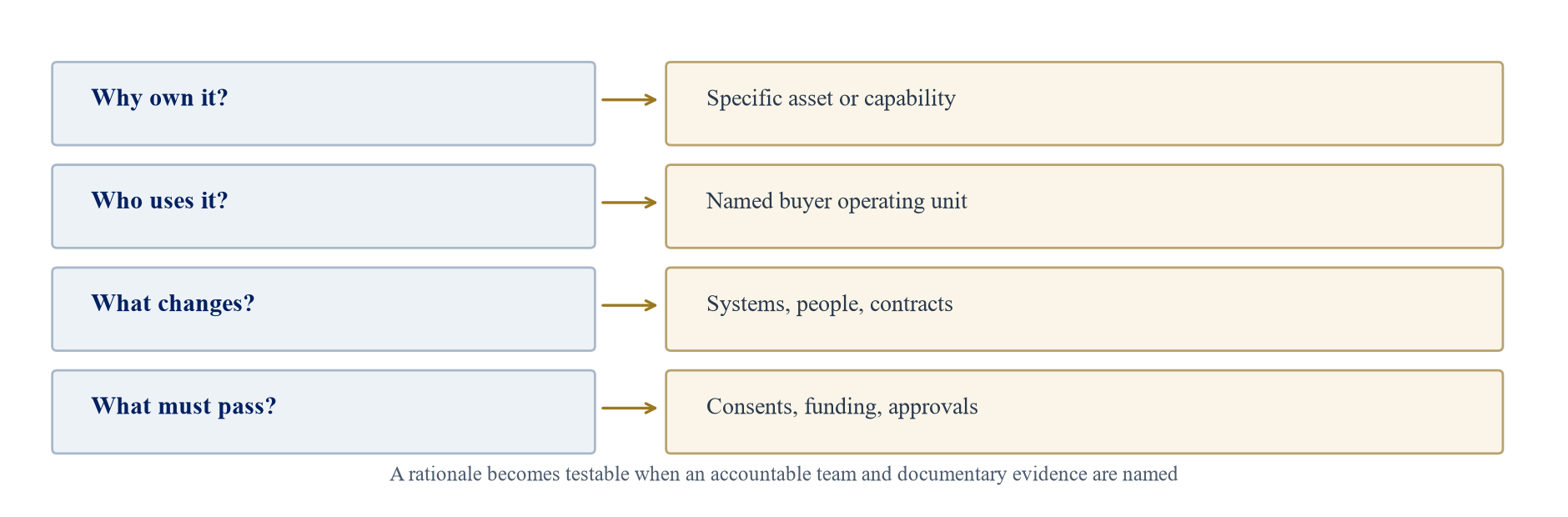
Author-developed question map. It is not a forecast of synergy or completion.
9 Locate the people who can move the proposal
An interested executive is valuable; it is not proof that the organisation has approved a transaction. A strategic acquisition may need a business-unit sponsor, corporate-development team, finance sign-off, legal review, risk assessment and board or shareholder approval. The sequence differs by company and jurisdiction. The adviser should ask the contact which body can approve a non-binding indication, who can authorise diligence and who can approve a definitive agreement. It should record the answer with a date and revisit it as the proposal advances.
An approach can fail because it reaches the wrong person, even when the underlying fit is strong. The adviser should use lawful, reputable channels and avoid a broad, indiscriminate email campaign. A warm introduction may establish access, but the test remains whether the contact can route the opportunity to a decision maker. A reply that requests a teaser is a response. A scheduled investment-committee review or a written explanation of the approval steps offers stronger evidence. No stage should be described as a committed bid before the organisation provides one.
The seller also needs a route for conflicts and information barriers. A buyer may be a direct competitor or may hold a minority interest in another company in the sector. The adviser may have other roles or relationships. The DFSA's thematic review concerns regulated firms in the DIFC and describes expectations for documented, proportionate conflicts controls [9]. The applicable obligations depend on the actual adviser, entity and mandate. The owner should ask counsel and compliance specialists to determine the right controls, including clean teams, restricted data or exclusion of a party.
The practical output is a contact and authority log separate from the buyer-fit thesis. It records who was approached, by whom, under what approval, what was said, what material was sent, and which approvals the recipient said were needed. It avoids inflating a polite conversation into a corporate decision. It also gives the seller a way to follow up professionally without exposing confidential information to an executive who has no present mandate to evaluate it.
10 Make outreach a consented information decision
The seller should decide which facts can be shared before the first approach. A short anonymised teaser might describe a sector, region and financial profile without identifying the company. Even that can reveal identity in a narrow market. The adviser should review whether customers, employees, competitors or suppliers could infer the target. A more detailed memorandum may require a signed confidentiality agreement and a review of buyer conflicts. Sensitive customer data, pricing, source code, tender information and regulated personal data may need later-stage access controls.
The decision to contact a company should weigh expected informational value against exposure. A buyer with high strategic relevance may also be a direct competitor. A less obvious adjacent buyer may offer a safer first approach and a clearer route to integration. These judgments require facts about the seller's business and the buyer's position; no universal list can settle them. The owner should approve tiers, and the adviser should document why a party received a particular package or was excluded.
Saudi rules for public offers include confidentiality and announcement provisions under their defined scope [7]. The Saudi competition authority's review guidance raises separate questions about economic concentration [8]. Other GCC jurisdictions have their own requirements. A private seller should not assume that a public-offer rule applies unchanged to its sale, or that an NDA alone resolves competition and data concerns. Transaction-specific counsel should set the disclosure protocol, filing analysis and permissible exchange of competitively sensitive information.
The first response should be classified by what the recipient actually does. A request for a generic sector briefing is different from a request for target-specific financials under confidentiality. A buyer may seek an information advantage while exploring its own strategy. The adviser can offer a structured next step: confirm the corporate sponsor, clarify the transaction perimeter, execute confidentiality terms, and ask what information would permit an initial written indication. The seller can then see whether the buyer invests effort proportionate to the information it requests.
11 Examine what the buyer can uniquely value
Strategic buyers can differ in their ability to use the same asset. One may already have customers who need the target's product; another may own a compatible distribution network; a third may need a new licence or a team that cannot easily be built. The seller should describe these routes to value as buyer-specific hypotheses. The buyer itself must confirm its commercial assumptions. A seller-side synergy number built without the buyer's cost base, integration plan or approval route can create false precision and encourage an unrealistic price expectation.
Gorbenko and Malenko's US auction study found heterogeneous strategic-bidder valuations and target-specific differences relative to financial bidders [2]. Its inference depends on the paper's sample and estimation assumptions. It does not mean that the strategic buyer with the most visible overlap will necessarily bid, or that a financial buyer is a weak alternative. The seller should preserve a buyer universe that includes plausible financial and partnership options when appropriate, while this paper concentrates on strategic acquirers. A strategic thesis is valuable because it identifies questions, not because it determines a maximum bid.
The work should separate sources of value. Revenue opportunity may depend on customers adopting a combined product; cost savings may require systems migration or branch consolidation; capability access may depend on retaining people; control of a licence or contract may face transfer restrictions. The seller should ask which items are within the buyer's control and which need third-party consent. The response can influence the information pack and the proposed deal structure. It can also reveal that the buyer wants a commercial agreement rather than ownership.
A buyer may have a strong strategic rationale and still decline because acquisition is the wrong route. It might prefer to license technology, distribute the product, form a joint venture or wait until a contract renews. The adviser should not call such a response a failed bid if no acquisition proposal was requested or authorised. It should record the alternative and whether the owner wishes to consider it separately. The objective is a better decision on the actual opportunity, not the highest possible count of companies marked as “interested.”
12 Read engagement from costly actions with care
Actions that consume a buyer's time can be more informative than polite expressions of interest. A buyer that names a deal lead, signs confidentiality terms, assigns diligence owners and schedules an internal review has moved further than one that replies with a generic statement. Yet none of those actions proves it will submit an offer. Diligence can uncover reasons to withdraw. The seller should classify actions according to their documentary content and stage, not attach an unsupported probability to them.
An initial screen can ask for a short buyer-specific note: what asset is attractive, what transaction perimeter the buyer would consider, who would own it and what information is needed for an indicative offer. A serious candidate may still be unable to answer every question before seeing confidential material. The adviser can then agree a staged path. A party unwilling to identify any sponsor or decision route after several discussions should remain exploratory. The decision to continue should reflect disclosure cost and the availability of alternatives.
The public takeover record illustrates both entry and attrition. In a 2025 US proxy, selected bidders received a virtual data room, management presentations and process letters, while several selected parties withdrew before the requested next-stage proposal [11]. That filing shows that access and engagement can precede withdrawal in a named public-company process. Its facts should not be used as a private GCC conversion benchmark. An owner should instead keep contemporaneous records of its own process and ask why each party advanced or exited.
The adviser should report engagement in plain terms. “Two authorised teams requested further diligence” is more useful than “two strategic buyers are highly likely to bid.” The former can be verified from correspondence and access logs. The latter requires a forecasting method and validation data that this paper does not possess. Where the buyer gives a stated reason for withdrawing, record it as the buyer's explanation, subject to confidentiality and verification. Do not attribute motive from silence.
13 Compare candidates without inventing probabilities
Table 2 works through three fictional buyer candidates for a hypothetical GCC services company. Candidate A operates an adjacent service line and has published relevant acquisitions. Candidate B is a much larger regional group with ample published resources but no clearly identified business-unit sponsor for this asset. Candidate C is smaller, has a specific customer-channel fit and responds with a named team, but would need external acquisition finance. These descriptions are author-created. They are not observations about actual companies or a ranking of their likelihood to bid.
The exercise shows why one-dimensional screening fails. A has an evident rationale but may have competing integration work. B has balance-sheet breadth but uncertain ownership of the thesis. C has a concrete operational route but a financing dependency. The adviser should use the distinctions to choose the next question for each candidate. A should be asked about management capacity and deal timing; B about the internal sponsor and perimeter; C about finance conditions and lender access. A single weighted score would conceal those different uncertainties.
The owner can decide to contact all three, approach one before the others or exclude one because of competitive disclosure risk. The actual choice depends on the seller's sensitivity, timing and transaction objectives. Table 2 uses categories such as “documented,” “stated,” and “unresolved” to keep evidence status visible. It does not use a numerical score, because no empirical calibration has established what a point would mean. A score may be convenient for a board pack, but its weights should be explicit preferences and never described as a bid probability.
Table 2. Three fictional strategic-buyer hypotheses
| Question | Candidate A | Candidate B | Candidate C |
|---|---|---|---|
| Buyer-specific rationale | Adjacent service line; prior relevant acquisition disclosed | Broad regional strategy; asset owner unclear | Customer-channel overlap; named operating use |
| Acquisition capacity | Published precedent; current capacity unresolved | Published financial scale; capital allocation unresolved | External finance likely; terms unresolved |
| Integration path | Existing team possible; workload unknown | Operating sponsor still to identify | Named commercial lead; systems work needed |
| Early evidence sought | Current priority and integration owner | Business-unit sponsor and deal perimeter | Funding map and lender conditions |
| Disclosure control | Stage customer-level data | Hold sensitive data pending sponsor | NDA and limited financial pack |
| Present classification | Plausible candidate | Exploratory candidate | Responsive candidate |
Entirely illustrative candidates; no entry is a measured probability or a statement about a named company.
14 Keep a buyer's questions tied to the decision
A buyer can ask many diligence questions without progressing toward a price. The seller should understand the purpose of each request. A question about recurring revenue may test quality of earnings; one about customer contracts may test transferability; one about employee retention may test integration cost. The adviser should map material questions to the buyer's stated transaction thesis. If the requests move into information outside that thesis, the owner can ask why the data are needed before releasing them.
The buyer should also show what would change after receiving an answer. A request for a complete data room before any indication of perimeter or decision route may put the seller at an informational disadvantage. A more measured path can release a reconciled financial baseline and a limited legal summary, then require a written preliminary offer before granular customer or technology material. The exact sequence should be designed with counsel and adapted to market conditions. A hard rule that every buyer must bid before seeing evidence could also eliminate capable bidders who need information to obtain internal approval.
Questions can expose a real obstacle to an apparent fit. A buyer interested in a service platform may discover that the target's largest contract requires consent to a change of control. A regional group may be unable to consolidate a minority stake under its governance model. A buyer that wants a national licence may find it cannot transfer. The seller should record the issue and distinguish between an answer that changes price, a condition to signing and a condition to closing. That distinction prevents a late surprise from being described only as a “re-trade.”
Responses should be version-controlled. The company should know which management forecast, contract summary and customer concentration data each buyer received. If an error is corrected, the adviser should document the correction and the parties affected under the agreed protocol. The buyer's later proposal can then be compared with the information version it used. This is also a check on whether two offers are genuinely comparable or rest on different definitions of the business.
15 Sequence outreach around information value
The first outreach tier should test the most specific plausible theses at an acceptable disclosure cost. A second tier can widen the process if early responses show that the transaction perimeter, valuation expectations or timing need adjustment. The owner may also prefer a broad initial process when many buyers are genuinely qualified and disclosure risks are manageable. There is no universal optimal tier count. Auction theory and empirical work show that bidder heterogeneity, entry and payment structure can change the economics of process design [2, 4]. Those studies do not prescribe a timetable for a particular GCC sale.
Figure 3 presents a decision sequence. The owner first approves the asset perimeter and information boundary. The adviser then approaches a documented first tier. The response is assessed against authority, thesis and requested next step. A credible path leads to a controlled information stage and a request for written terms. Weak responses can lead to a revised thesis or a broader tier. A competitor with unacceptable information risk can remain excluded even if the buyer appears able to pay. Each branch requires a recorded owner decision.
The adviser should set review dates based on the buyer's stated approval process and the seller's resources. A public-company buyer may require committee cycles. A family-owned buyer may move through different governance channels. Neither pattern is inherently faster. The seller should ask who has authority to use a deadline, what information the buyer needs before that deadline, and what a missed date means. An arbitrary compressed timetable can turn a strong prospect into a non-participant without improving competition.
The strategy should remain reversible. If first-tier feedback reveals that the target's proposed perimeter is too wide, the owner can decide to re-scope before extending outreach. If buyers repeatedly ask about the same contract risk, management can improve the evidence pack. If response quality is high, the owner can preserve process tension while preparing comparable bid instructions. These adjustments should be recorded as decisions made on observed feedback, not portrayed as a pre-validated optimisation algorithm.
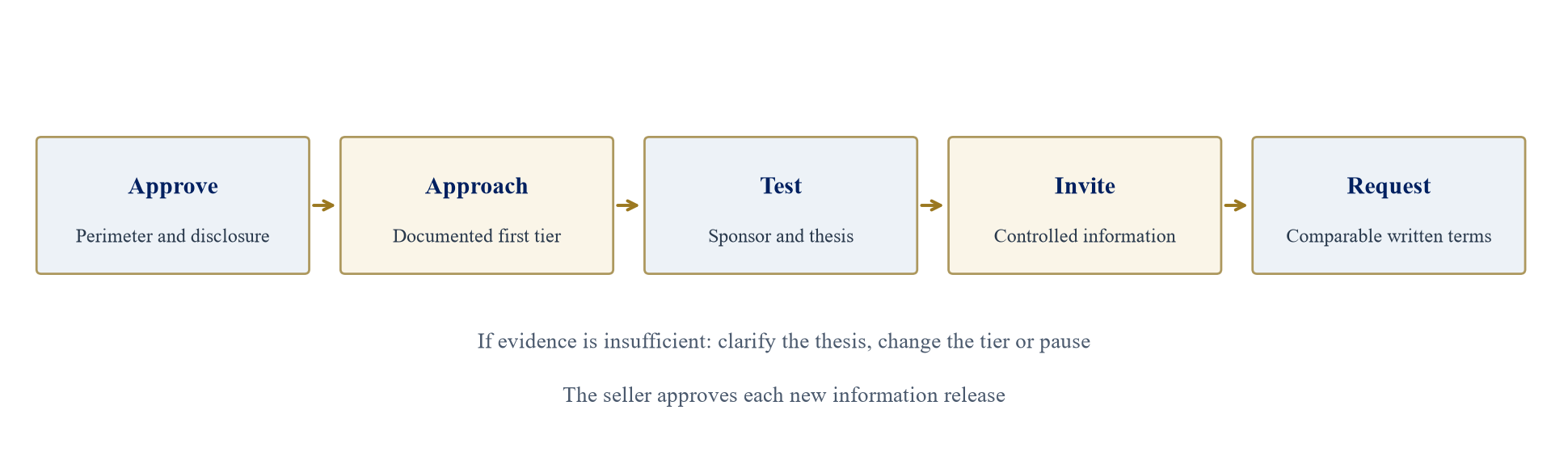
Author-developed process sequence; no duration or conversion assumption is embedded.
16 Ask for a proposal that can be compared
The buyer-selection exercise reaches its first serious test when an interested party can state written terms. The request should define the transaction perimeter, accounting basis and expected contents of an indication of interest. It should ask for enterprise or equity price, debt and cash assumptions, deferred or contingent consideration, intended financing, governance and management arrangements, remaining diligence, regulatory and customer approvals, exclusivity request and timetable. The seller may adapt the list to a minority or asset transaction. Counsel should review the request and the status of responses.
A bid with a high headline price and unspecified assumptions may require more work than a narrower proposal with a clear funding path. That does not mean the seller must choose the latter. It means that the adviser should show the unresolved terms beside the price. A buyer with a credible strategic thesis can become less compelling when its approval chain or financing conditions remain open. Another buyer can become more compelling by defining those conditions even if it submits a lower initial number. The owner should compare terms under a common accounting bridge and retain the alternatives.
The 2025 US Streamline Health proxy shows that bidders can have access to information, management presentations and process letters yet withdraw before the next requested proposal [11]. A separate 2025 VOXX proxy records final-round letters and draft agreement work in a named public process [12]. These filings show stages and documents. They do not establish a standard for all private transactions. The adviser should use the actual buyer's evidence and the seller's objectives to decide whether to continue, ask for improvement or stop.
A signed confidentiality agreement should remain effective even if a bid does not arrive. The seller should check the return or destruction of information and the treatment of copies, permitted recipients and competitively sensitive material under the agreed terms. The process should also keep a record of which buyer received each material version. That record is part of a defensible sale decision and a safeguard if the owner later chooses another bidder or withdraws the company from sale.
17 Read GCC disclosures as case evidence
TAQA's 2025 report identifies the proposed GS Inima transaction as an international water-platform expansion and describes the businesses and concessions involved [5]. That disclosure can support an analyst's statement about TAQA's publicly articulated strategy at the report date. It cannot establish that TAQA has a standing appetite for a seller's distinct asset or that its balance sheet is committed to another acquisition. A seller working in water services might use the report to build a precise hypothesis and should then seek current, authorised confirmation before sharing confidential information.
BinDawood's annual report states that it completed the Toy Triangle acquisition and describes distribution and product links; it also discusses pharmacy, bakery and technology assets [6]. Those passages show different strategic rationales within one group. They can help an adviser ask which business unit would own a proposed target and what integration work would follow. They cannot be converted into a general rule that every adjacent retail or distribution company is a likely buyer. The annual report is a company disclosure with its own framing and reporting period.
Saudi offer and economic-concentration materials remind a seller that a strategic buyer may face approvals beyond its internal investment committee [7, 8]. The exact route depends on transaction form, parties, sector and current rules. A cross-border acquisition could also involve another jurisdiction's competition, foreign-investment or sector-specific requirements. The adviser should mark these as issues for counsel and obtain an actual approval map before promising a close date. The paper does not provide a legal opinion or a universal GCC filing checklist.
These case sources are deliberately few and transparent. They illustrate observable public signals and the limits of each signal. A future private-mandate study would need a much broader, consented dataset including companies that were approached and did not bid. Studying only announced deals would select on success and overstate the apparent value of signals found in buyers who completed transactions. That selection problem is central to the proposed research design.
18 Resist the illusion of a predictive score
An adviser may be tempted to assign points for acquisition history, cash, sector overlap and management response, then call the total a buyer-probability score. The categories can be useful for organizing a discussion. The numerical interpretation requires observed outcomes, a defined sampling frame, consistent treatment of non-responses and validation outside the sample used to fit the model. No such private GCC dataset is available for this paper. A point total should therefore remain an explicit management preference or an internal triage rule, with no predictive claim.
The strongest apparent signal may be affected by selection. A buyer that signs an NDA has already passed a contact and confidentiality screen. A company with visible acquisition history is easier to identify and may receive more invitations. A target with a particularly attractive asset may draw both more strategic responses and more ambitious adviser preparation. Correlation in a future cohort would need to account for those factors before suggesting a causal effect. A record of who was considered but not contacted is as important as a record of who eventually bid.
Time changes the meaning of signals. An annual report can be current in one quarter and stale after an acquisition, refinancing or management change. A buyer's first meeting can be enthusiastic and its investment committee cautious. An adviser should date every source, record a confidence level based on evidence type and revisit the thesis at each gate. “Publicly disclosed,” “buyer-stated,” “documented in a proposal” and “verified by an external party” describe different evidentiary states. They should not be merged into a single score.
The board paper can be concise without being reductive. It should show each candidate's rationale, source date, approval path, funding questions, integration concerns, disclosure risk and actual stage. It should identify what new evidence would change the recommendation. That is more useful than a precise-looking decimal probability unsupported by observations. The owner can still make a judgment under uncertainty, provided the assumptions and alternatives remain visible.
19 Design the study that could test these signals
An empirical test would require consented records from completed and abandoned sell-side mandates, including buyers considered but not invited, buyers invited but not responsive, information participants, written bidders and final outcomes. The unit should be a buyer-mandate pair with stable confidential identifiers. Each buyer's signal values should be captured as they existed before outreach. Recording a buyer's acquisition history or financial condition only after it bids would introduce look-ahead bias. The study should also preserve dates of information release and each response.
The primary outcome could be a qualified written proposal under a pre-registered definition. Secondary outcomes might include progression to confirmatory diligence, financing evidence, revised offer, signed agreement and closing. These outcomes should be separated. A buyer can submit a genuine proposal and fail to close because of a seller-side issue. A completed transaction can emerge after a negotiation that began without a formal auction. Price level, payment form and owner proceeds require their own definitions. The study should not treat the number of contacts as a proxy for seller value.
Covariates should include seller sector, size, transaction perimeter, ownership, geography, financial trajectory, process type, market conditions and buyer relationship before outreach. The source of each signal should be recorded. Table 3 gives a minimum field set. Statistical design would need to address repeated buyers, mandates with multiple bidders and adviser selection. Training and validation should be separated by time or mandate to avoid leakage. Even strong out-of-sample association would not prove that selecting a buyer on a signal caused it to bid; causal language would require a defensible identification strategy.
The study also has a confidentiality problem. Private deal records contain buyer identities, sensitive financials, bid terms and potentially personal information. Owners, advisers and bidders may need to consent, and an appropriate lawful processing basis and secure protocol would be required. Publications should aggregate results and suppress cells that identify parties. No cohort has been assembled for this paper. The table is a proposed research specification; no coefficients, conversion rates or accuracy statistics are reported.
Table 3. Minimum fields for a consented buyer-mandate study
| Field group | Pre-outreach record | Later observed outcome | Main bias to examine |
|---|---|---|---|
| Buyer identity and type | Stable confidential key; operating activities | Contact and response stage | Easier-to-find buyers invited more often |
| Strategic fit | Dated thesis and target-specific overlap | Written rationale in buyer response | Attractive targets draw stronger theses |
| Acquisition record | Dated completed deals and similarity | Internal sponsor and integration plan | Public deals omit unsuccessful attempts |
| Financial position | Published accounts and capital policy date | Transaction-specific funding evidence | Conditions change during the process |
| Process exposure | Owner approval, outreach and material version | NDA, diligence and proposal dates | Different buyers see different information |
| Sale result | Transaction perimeter and seller baseline | Signed terms, completion and owner proceeds | Seller issues affect closing independently |
Proposed research design only; no observations or model estimates are presented.
20 Leave the owner with a buyer decision record
A defensible buyer universe answers five questions for each proposed contact. Why might this company own the offered asset? What public or private evidence supports that thesis, and when was it obtained? Who inside the buyer can advance a transaction? What financing, integration, regulatory and disclosure issues remain? What observed action has the buyer taken in this process? The adviser should be able to answer from source files and correspondence rather than memory or a list of famous company names.
The seller should approve the outreach tier and information boundary, then review the evidence as it changes. A response may strengthen the thesis by naming an operating sponsor and a specific route to value. It may weaken it by revealing a preference for a different geography, transaction form or timetable. Those changes are useful findings even when no bid results. The adviser should present a recommendation and an alternative, with the cost of additional outreach and disclosure made explicit.
When written offers arrive, the owner should compare price, payment, financing, diligence, approvals, management treatment and execution timing on a common basis. The buyer-selection record helps explain why certain parties were approached and how their early signals related to later conduct. It should not be retrofitted to make the winner look inevitable. The named research and public GCC disclosures justify careful questions; they do not validate a shortcut that predicts a bid from public information alone.
The practical deliverable is a portable decision file: approved buyer hypotheses, dated sources, contact authority, confidentiality record, released information versions, buyer responses, written proposals and unresolved conditions. That file remains useful if the seller pauses, changes advisers or returns to market. It enables the board to assess the quality of the process without claiming that an adviser can guarantee a particular bidder, price or closing outcome.
References
- Mitchell, W. and Shaver, J. M. “Who Buys What? How Integration Capability Affects Acquisition Incidence and Target Choice.” Strategic Organization 1(2), 2003. Accessed 6 October 2026. https://journals.sagepub.com/doi/10.1177/1476127003001002305
- Gorbenko, A. S. and Malenko, A. “Strategic and Financial Bidders in Takeover Auctions.” Journal of Finance 69(6), 2014. Author-hosted paper. Accessed 6 October 2026. https://www.mit.edu/~amalenko/stratfin.pdf
- “Acquisition Integration Capabilities and Organizational Design.” Long Range Planning 57(6), 2024, article 102479. Accessed 6 October 2026. https://doi.org/10.1016/j.lrp.2024.102479
- Hoffmann, F. and Vladimirov, V. “Auctions versus Negotiations: The Role of the Payment Structure.” Journal of Finance 80(3), 2025. Accessed 6 October 2026. https://onlinelibrary.wiley.com/doi/10.1111/jofi.13446
- Abu Dhabi National Energy Company PJSC (TAQA). Integrated Report 2025, executive summary, GS Inima acquisition discussion. Accessed 6 October 2026. https://apigateway.adx.ae/adx/cdn/1.0/content/download/4759635
- BinDawood Holding. Annual Report 2025, acquisitions and strategy discussion. Accessed 6 October 2026. https://www.bindawoodholding.com/annual-report-2025/
- Capital Market Authority, Saudi Arabia. Merger and Acquisition Regulations, Articles 5, 7 and 8, as published. Accessed 6 October 2026. https://cma.gov.sa/en/RulesRegulations/Regulations/Documents/Merger%20and%20Acquisition%20Regulations.pdf
- General Authority for Competition, Saudi Arabia. Economic Concentration Review Guidelines. Accessed 6 October 2026. https://gacbep.gac.gov.sa/cms/b9376edc-79a1-4573-a36d-4f3effaba838.pdf
- Dubai Financial Services Authority. “New DFSA Thematic Review: Conflicts of Interest across DIFC Firms.” 9 January 2026. Accessed 6 October 2026. https://www.dfsa.ae/news/new-dfsa-thematic-review-conflict-interest-across-difc-firms
- “The Timing and Method of Payment in Mergers when Acquirers Are Financially Constrained.” MIT Sloan publication record and paper. Accessed 6 October 2026. https://dspace.mit.edu/entities/publication/c0d70beb-f66d-45ab-851d-b95b9c7b3e2b
- US Securities and Exchange Commission. Streamline Health Solutions preliminary merger proxy, 2025, background of the merger. Accessed 6 October 2026. https://www.sec.gov/Archives/edgar/data/1008586/000143774925021552/strm20250616_prem14a.htm
- US Securities and Exchange Commission. VOXX International preliminary merger proxy, 2025, final-round letters and draft agreement process. Accessed 6 October 2026. https://www.sec.gov/Archives/edgar/data/807707/000110465925015692/tm252893-4_prer14a.htm
About the Author
Chennakeshav (CK) is a corporate finance and investment banking executive with 25+ years of global experience in deal origination, structuring and execution across M&A, growth capital and corporate strategy. He has led value-creation mandates for founders, corporates and funds — bridging the boardroom view to hands-on execution and close.
His career spans Morgan Stanley, HSBC, Lloyds Banking Group, EWEC, ADQ portfolio companies and Emirates Growth Fund, across TMT, real estate, fintech, deeptech, cleantech, infrastructure and energy. He has partnered with C-suite leaders, private equity and venture funds, sovereign wealth funds and family offices to finance complex fund raises and scale-up ventures, and has led M&A due diligence, post-merger integration and business-transformation initiatives to create value.
At Matchpoint Partners he is Managing Partner, leading the firm's corporate finance, M&A and capital-raising practice. He holds an MBA from London Business School, an engineering degree from VTU and a Master of Laws (LLM, in progress) from UCL London.
An active start-up mentor, CK mentors at Techstars, DIFC FinTech Hive, Startup Grind, Founder Institute and IN5, serves as Entrepreneur Mentor in Residence (EMiR) at London Business School, and judges the Entrepreneurship World Cup.
