

1. Define consolidation readiness precisely
A vertical is ready for M&A when a credible buyer can acquire a specific business, obtain the necessary approvals, retain the economic assets and integrate them at an acceptable cost and risk. Market growth and licence growth are useful context. Transaction readiness requires a narrower body of evidence.
Five conditions matter. The target must own or control something the buyer values. The asset must survive a change of control. Customer and partner relationships must remain in force or be capable of valid transfer. The combined operating model must comply with each applicable regulatory perimeter. The value created must exceed the purchase price, integration spending, delay, leakage and downside risk.
The asset can be regulated access, distribution, merchants, customers, proprietary technology, data rights, talent, workflow depth, geography or a combination. Each claimed asset should be traced to a legal entity, contract, system, employee, permission and cash flow.
This definition prevents a common error: treating a crowded market as an automatically consolidating market. Fragmentation can produce targets. It can also reflect different licences, customer groups, economics and technology that do not combine cleanly.
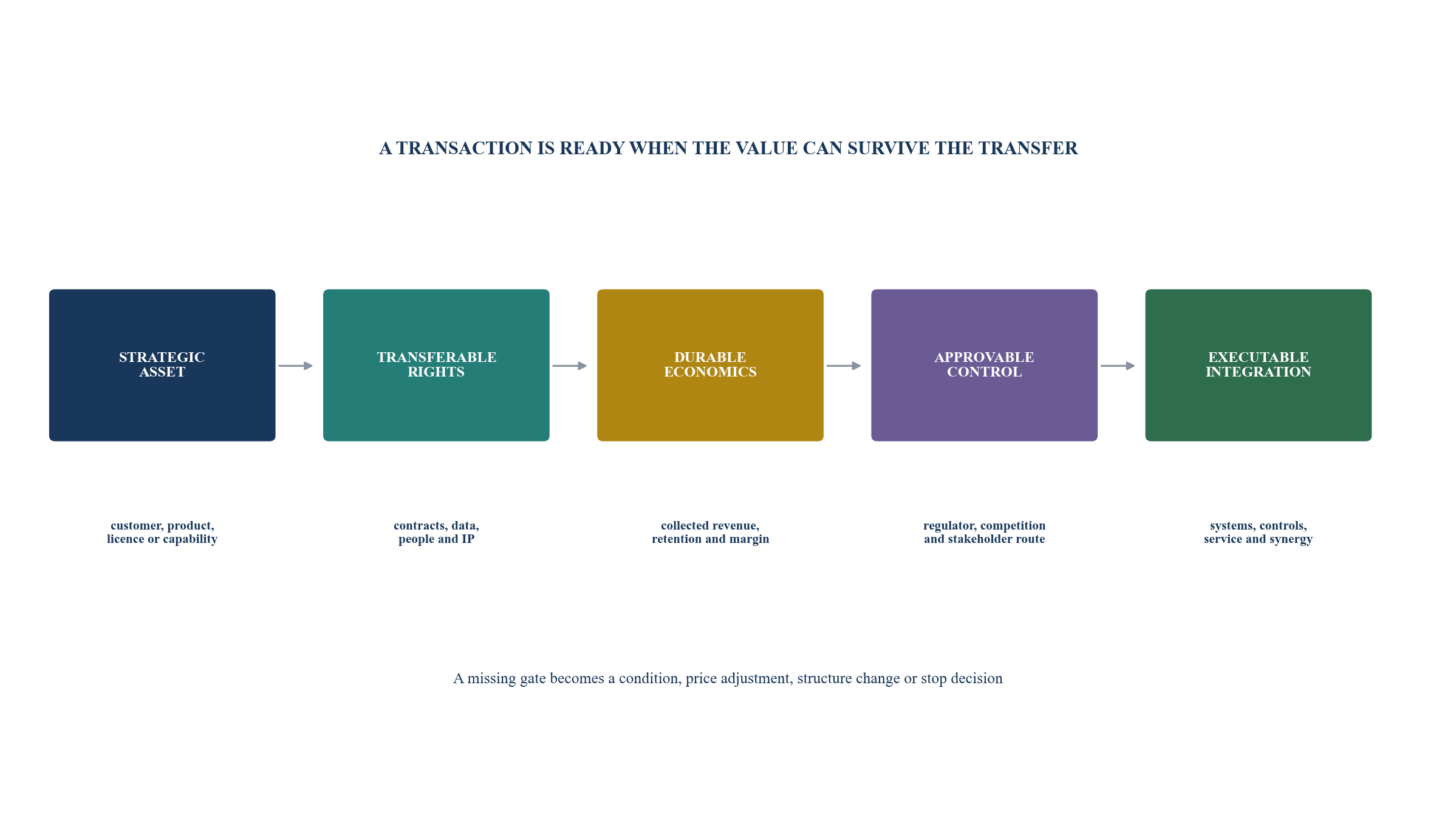
Author framework. Every gate requires transaction-specific evidence.
2. Read the licence surge as a pipeline, not a forecast
The CBUAE's 2025 annual report states that more than 60 fintech companies were licensed or granted in-principle approval during the year. It reports 36 fully licensed firms as of January 2026, compared with 18 in 2024. The companies covered open finance, buy-now-pay-later, digital wallets, merchant acquiring, payment aggregation and stablecoin-related activities.[1]
The same report's supervised-licensee table recorded 48 fintech companies at the end of 2025, compared with 37 in 2024, using a category that included stored-value facilities, retail-payment service providers and payment-token services. Definitions and dates therefore matter when market counts are compared.
The DFSA reported 182 new licensed or registered firms in 2025, 16 per cent more than in 2024, taking the total DIFC regulated population to 1,050. That figure spans banking, capital markets, wealth, insurance and fintech and is not a count of acquisition-ready fintech targets.[2]
ADGM's FSRA reported that Financial Services Permissions grew 22 per cent and in-principle approvals grew 32 per cent during 2025.[3] VARA's public register distinguishes full licences from in-principle approvals and explains that an in-principle holder may not operate or serve clients until it receives a full licence.[4]
These figures establish ecosystem growth. They do not disclose company revenue, cash, ownership, customer concentration, technology quality or seller intent. An acquisition pipeline should begin with the regulator register and then narrow through verified commercial and transaction criteria.
3. Use disclosed transactions to identify proven strategic routes
Network International's acquisition of DPO Group provides a documented capability-and-geography transaction. Network stated that it paid US$291.3 million for an online-payments platform serving more than 60,000 SME and enterprise merchants across 21 African countries. The company expected the combination to broaden online-payment exposure and add direct-to-merchant capabilities.[5]
Network International and Magnati completed their strategic merger in October 2025 under a Brookfield-led consortium. Their announcement described a combined platform spanning digital payments, data-driven insights, financial security, lending and insurance across 56 markets.[6] The disclosed rationale combined scale, product breadth and geography.
Al Ansari Financial Services announced an agreement to acquire BFC Group Holdings for US$200 million. The disclosure described a combined network of more than 410 branches across the UAE, Bahrain, Kuwait and India and approximately 6,000 employees.[7] The transaction illustrates consolidation in remittance and exchange through physical distribution, regulated operating capability and regional reach.
International Holding Company announced the acquisition of a 70 per cent stake in Peko Holdings in December 2025. The disclosed platform integrates bill payment, payroll, travel, invoicing, corporate cards, compliance and administrative workflows for businesses.[8] The case illustrates a capability platform rather than a single-product payment asset.
These examples do not prove that other firms in the same vertical are ready. They show four valid acquisition theses: scale, digital capability, geographic expansion and workflow aggregation.
4. Map the verticals by value source and constraint
Payments and merchant acquiring can offer transaction scale, scheme and bank relationships, merchant distribution, fraud data and adjacent services. Integration can be technically and operationally intensive because uptime, settlement, safeguarding, chargebacks, security and merchant service continue through the transaction.
Remittance and exchange can offer trusted distribution, licences, corridors, liquidity management and recurring customer behaviour. Value depends on corridor economics, source and destination regulation, banking partners, physical network cost, digital migration and financial-crime controls.
Open-finance infrastructure can offer bank connectivity, consent, data standardisation, decisioning and embedded workflows. Its value depends on production coverage, permission, data quality, customer outcomes, recurring enterprise contracts and liability allocation.
Regulatory technology can reduce monitoring, onboarding, reporting and investigation cost. An attractive target needs validated performance, explainable methods, current rules coverage, integration depth and sustainable contracts. A compliance product does not transfer the regulated firm's accountability.
Wealth technology can offer portfolio infrastructure, client experience, reporting and adviser productivity. Customer and asset transfer, suitability, custody, data migration and relationship retention can govern the transaction timetable.
Digital lending and buy-now-pay-later can offer distribution and underwriting data. Credit performance, funding, collections, consumer protection and vintage behaviour determine whether apparent growth represents value.
Insurance technology, virtual-asset infrastructure and business-finance platforms each have distinct permissions, economics and risk. The acquirer should analyse the exact regulated activity and contracted workflow rather than applying a generic fintech label.
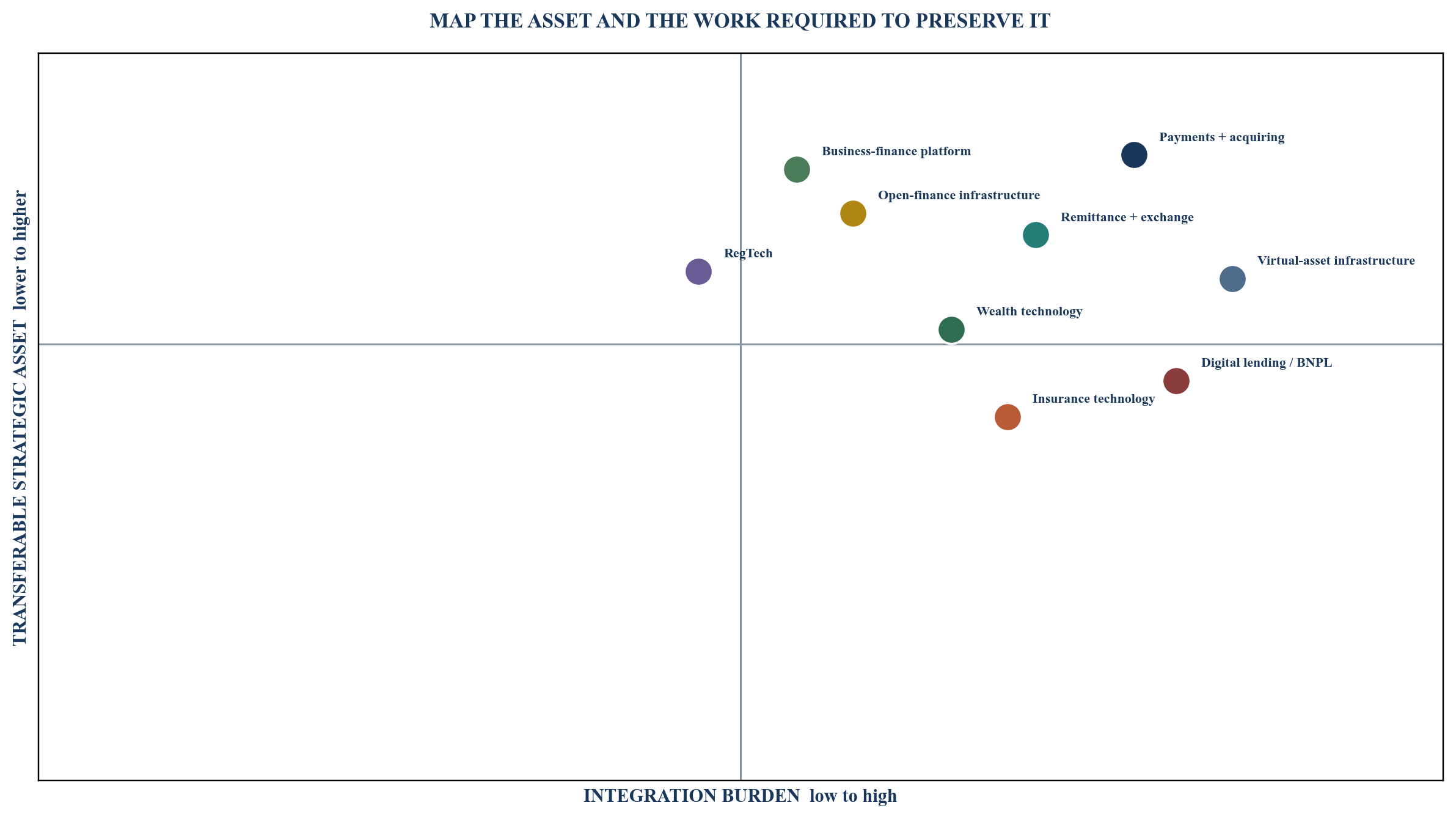
Author framework. Position indicates the dominant strategic asset and integration burden; it is not a market-size estimate.
Table 1. Vertical evidence matrix
| Vertical | Potential strategic asset | Primary diligence evidence | Common value leakage |
|---|---|---|---|
| Payments and acquiring | merchants, processing volume, scheme access, fraud data, product breadth | licence, processor and scheme contracts, settled volume, take rate, loss, uptime, merchant cohorts | repricing, merchant attrition, duplicate platforms, settlement or security remediation |
| Remittance and exchange | corridor access, distribution, recurring customers, treasury capability | permissions, bank partners, corridor margin, branch economics, digital adoption, financial-crime outcomes | correspondent loss, corridor restriction, lease cost, compliance remediation |
| Open finance | connectivity, consent, data translation, decision workflow | production connections, consent completion, usable data, enterprise contracts, service levels | free access assumptions, weak coverage, liability, expensive bespoke integration |
| Regulatory technology | monitoring, identity, reporting, case management | model validation, false positives, rules coverage, integrations, recurring revenue | model rework, customer-specific code, stale rules, key-person dependence |
| Wealth technology | assets, advisers, client workflow, reporting | client and asset cohorts, custody, suitability, permissions, platform service levels | adviser departures, client consent, asset outflow, migration defects |
| Lending and BNPL | distribution, underwriting data, merchant access, receivables | vintage loss, collections, funding, approval rates, complaints, unit economics | credit deterioration, funding repricing, regulation, adverse selection |
| Insurance technology | distribution, underwriting workflow, policy administration | licence boundary, carrier agreements, policy cohorts, claims, commissions, renewal | carrier concentration, commission change, claims or conduct exposure |
| Virtual-asset infrastructure | custody, exchange, brokerage, compliance or tokenisation capability | current licence, client assets, custody controls, liquidity, market integrity, cyber security | approval conditions, asset loss, liquidity concentration, technology remediation |
| Business-finance platform | embedded workflow, SME distribution, cross-sell and data | active businesses, paid modules, collections, partner contracts, product margin | bundled free features, support cost, permission mismatch, weak adoption |
Readiness is transaction-specific. The table identifies evidence to test and does not rank named companies.
5. Score readiness before approaching a target
A useful screen measures the evidence behind a transaction, not management enthusiasm. Seven dimensions provide a practical starting point: strategic asset, customer durability, unit economics, regulatory transfer, technology separability, control maturity and integration feasibility.
Each score should cite a source. A score supported only by management assertion remains provisional. A high-level market estimate cannot substitute for customer invoices, collections and cohorts. A licence announcement cannot substitute for the current public register and decision conditions.
The screen should also identify the buyer. A bank, payment processor, insurer, exchange group, software company, private-equity platform and diversified holding company can value the same target differently because their distribution, permissions, capital and integration capabilities differ.
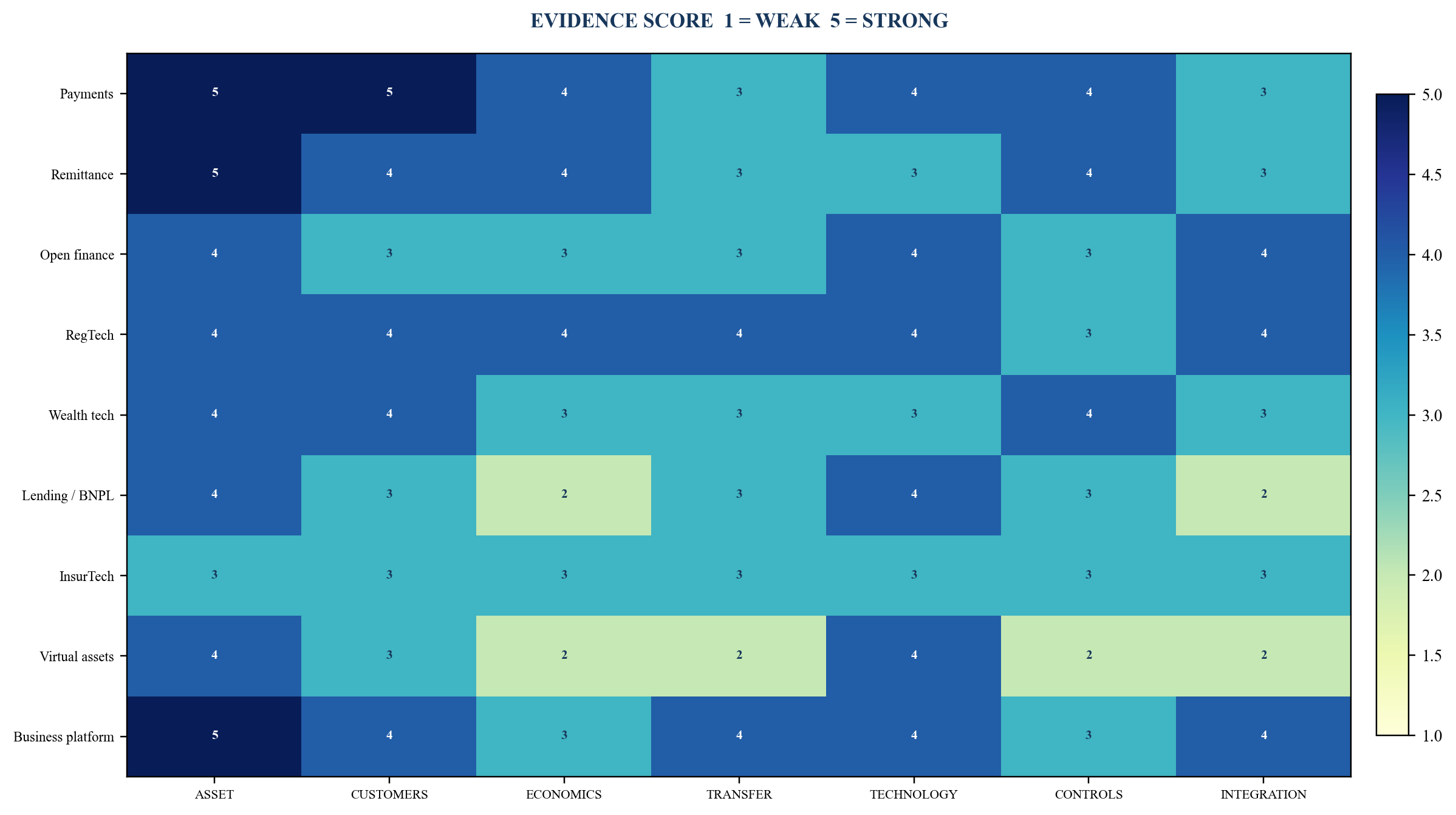
Hypothetical author scores demonstrate the method. They are not market findings or recommendations.
6. Match buyer archetype to acquisition thesis
Strategic buyers can acquire product, customers, licences, technology or geography. They can often realise distribution and infrastructure synergies that a financial buyer cannot realise immediately.
Private-equity and growth-equity sponsors can create a platform and add capabilities through subsequent acquisitions. The platform needs governance, integration resources, capital and a clear rule for which systems and licences survive.
Banks and regulated financial institutions can use acquisition to accelerate capability while remaining responsible for risk. CBUAE rules require prior approval before a licensed financial institution merges with or acquires another institution. Its major-acquisition regulation asks banks to analyse consideration, funding, prudential impact, market share, customers, governance, controls, systems and people.[9]
Technology groups and diversified holding companies can embed financial workflows into broader business ecosystems. Their investment case should state which regulated activities remain with a licensed partner or target and which data and customer journeys cross group boundaries.
Table 2. Buyer archetype and transaction thesis
| Buyer | Credible thesis | Required capability | Primary failure mode |
|---|---|---|---|
| Bank or licensed financial institution | acquire distribution, technology, data workflow or adjacent permission | prudential capacity, regulator engagement, control integration and product ownership | technology acquired without operating adoption or regulatory alignment |
| Payment platform | add merchants, channels, geography, processing or value-added services | uninterrupted settlement, scheme integration, security and merchant retention | platform migration disrupts service or triggers repricing and attrition |
| Insurer or wealth platform | add distribution, advice workflow, administration or client experience | customer transfer, suitability, custody or carrier coordination | relationship and asset leakage during migration |
| Private-equity platform | combine complementary businesses and professionalise operations | integration office, governance, funding and management depth | multiple assets remain separate and synergies do not convert to cash |
| Technology or commerce platform | embed payments, credit, payroll, compliance or financial operations | clear licence boundary, partner governance, data control and product ownership | regulated activity or liability sits outside the planned perimeter |
| Regional financial group | add corridors, market access, products and customers | multi-jurisdiction approval, treasury, capital and local management | fragmented entities, duplicated control and unmanageable complexity |
Every route remains subject to current law, regulator approval and transaction-specific evidence.
7. Design the regulatory route before signing
Regulatory approval is part of the transaction architecture. It should enter the timetable, conditions precedent, long-stop date, interim covenants, information rights and termination provisions.
CBUAE Article 125 states that a licensed financial institution shall not merge with or acquire another institution, or transfer liabilities, without prior Central Bank approval.[10] The exact approvals for a fintech transaction depend on the entities, activities and current rules.
DFSA law allows rules governing controllers, including prior approval or notification when a person becomes a controller or increases control. DFSA guidance states that a domestic authorised firm requires prior written approval for a change in control, while a branch follows a notification route under the applicable rules.[11]
Other permissions can involve ADGM FSRA, VARA, the Securities and Commodities Authority or sector authorities. The transaction team should identify each regulator, filing, decision-maker, information requirement and sequence.
A licence should not be valued as a freely transferable object. The target entity, controllers, approved people, capital, conditions, systems, premises and activities form part of the regulatory assessment.
8. Run competition analysis with the commercial model
The UAE's Cabinet Resolution No. 3 of 2025 applies economic-concentration notification thresholds where total annual UAE sales in the relevant market exceed AED300 million or the parties' combined share exceeds 40 per cent of transactions in that market. The resolution took effect in March 2025.[12]
The Ministry of Economy states that it examines whether a proposed acquisition or merger can lead to dominance and can approve, conditionally approve or reject a transaction. Its published process should be incorporated into planning with current counsel.[13]
Market definition matters. The European Commission has previously distinguished card issuing, processing and merchant acquiring while leaving some digital-wallet and online-payment boundaries open depending on the case. The United Kingdom Competition and Markets Authority has examined payment-software and investment-technology transactions in depth.
The practical lesson is to define products, customers, channels, geography, switching and data before synergies are finalised. A synergy that assumes forced customer migration or removal of a competing product can create competition and retention risk.
9. Build a value-creation bridge from verified cash
The bridge begins with stand-alone EBITDA supported by audited accounts, management accounts, invoices, cash collection and normalisation evidence. Revenue synergies follow only when the buyer has a specific route to a customer, product, price and activation date.
Cost synergies require a removable contract, role, system or facility. A duplicated compliance function may remain necessary because separate regulated entities survive. A platform can appear redundant and still require years of migration.
Integration cost includes technology, security, data, advisers, retention, redundancy, brand, contract consents, regulatory work and operational contingency. Delay should be modelled as cash and lost value.
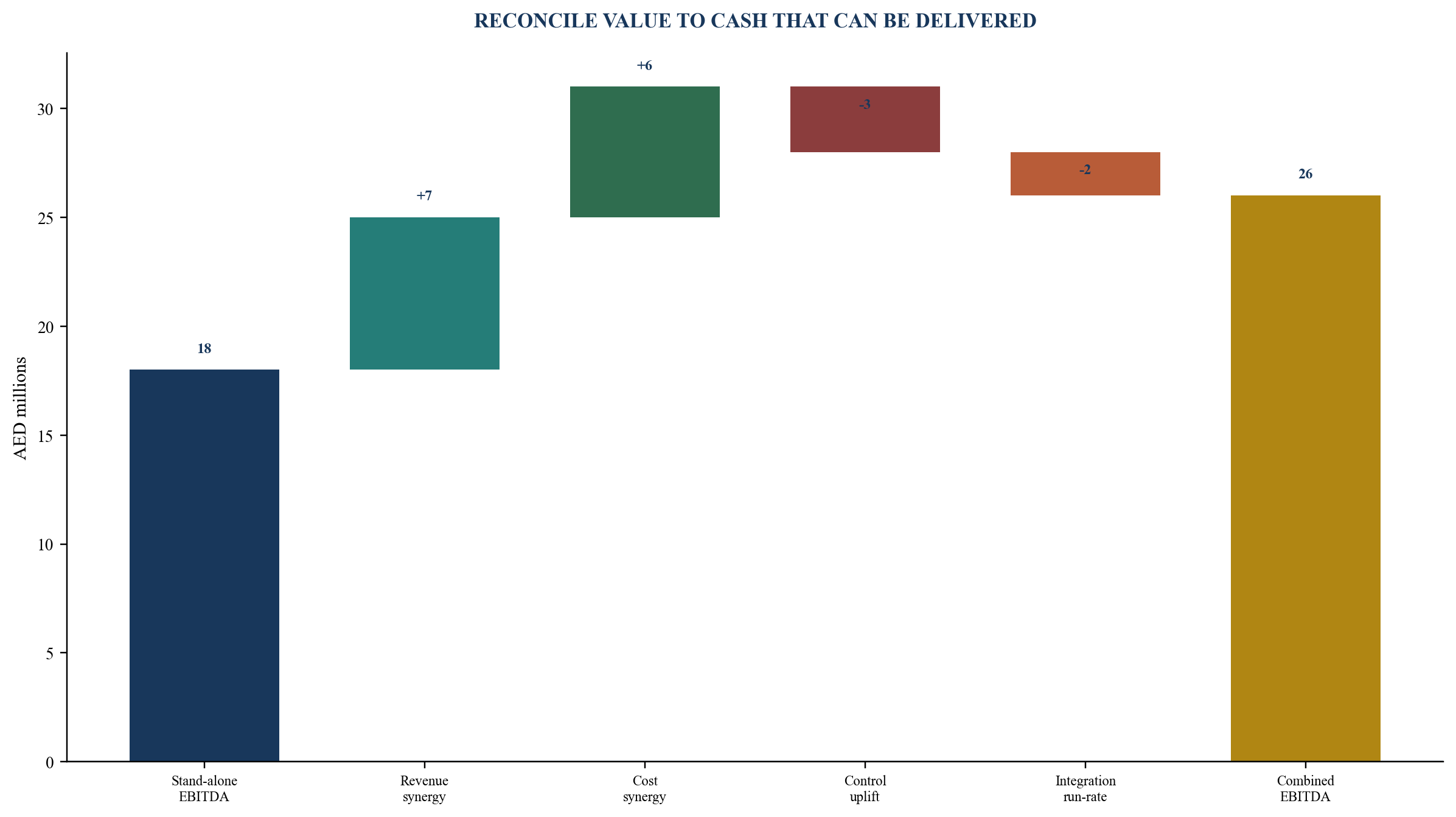
Every amount is a hypothetical management assumption in AED millions for method illustration.
10. Diligence customer economics by cohort
Fintech revenue can include subscription, processing, interchange, commission, spread, interest, implementation, data, referral and partner payments. Each stream should be reconciled to the licence and accounting policy.
Gross volume is not revenue. Contracted value is not collection. Registered customers are not active customers. The acquisition model should show the path from customer or merchant activity to recognised revenue, direct cost, loss, support and contribution margin.
Cohorts reveal retention, expansion, concentration and payback. The buyer should identify accounts connected to a founder, reseller, bank or other change-sensitive relationship.
Table 3. Fintech acquisition diligence file
| Workstream | Core evidence | Decision question |
|---|---|---|
| Regulatory | licence, public-register extract, conditions, regulator correspondence, approved people, capital and filings | can the intended owner and operating model receive approval and continue every activity? |
| Commercial | contracts, invoices, collections, cohorts, pipeline, pricing, concentration, complaints and churn | which customers and revenue survive the transaction and integration? |
| Product and technology | architecture, code and IP ownership, roadmap, service levels, incidents, dependencies and technical debt | which platform survives and what must be rebuilt or migrated? |
| Data and cyber security | data map, legal basis, consents, vendors, testing, incidents, access and recovery | can data and services transfer securely and lawfully? |
| Finance | audited statements, management accounts, revenue policy, cash, working capital, tax and forecast | what is verified stand-alone cash and what funding is required? |
| Risk and compliance | financial-crime controls, monitoring, sanctions, fraud, safeguarding, audits and remediation | what liability and control uplift enters price and integration? |
| People | organisation, approved roles, contracts, incentives, visas, dependencies and succession | which people preserve customers, licence and technology? |
| Transaction | ownership, options, debt, consents, litigation, warranties, insurance and separation | can clean title and operating control pass on the planned date? |
The exact file depends on the business and jurisdiction.
11. Test technology and data separability
A fintech can depend on group code, cloud accounts, data licences, shared employees, a founder's credentials or undocumented integrations. Legal ownership and technical operability should be tested together.
The buyer should inventory applications, environments, repositories, infrastructure, certificates, domains, models, libraries, vendors, devices, monitoring, recovery and data. Every critical component needs an owner, contract, licence and transition path.
Architecture diligence should identify which platform becomes the target state. Running both systems can protect continuity and defer synergy. Immediate migration can release cost and create operational risk. The decision should be tied to customer, regulator, data and recovery evidence.
Data value requires lawful collection and permitted use. A dataset collected for one activity or partner arrangement may not support the buyer's intended model. Consent, confidentiality, localisation, retention and model rights need current legal review.
12. Preserve regulated people and control memory
Key employees can hold regulatory approval, customer knowledge, scheme expertise, model understanding or incident memory. Their departure can reduce value before the transaction closes.
Retention planning should identify the roles needed for approval, signing, Day One, migration and steady state. Incentives should be aligned with defined delivery and conduct outcomes.
The DFSA's 2026 thematic review of fintech compliance arrangements reported that 53 per cent of reviewed firms operated with three or fewer compliance staff and identified key-person risk.[14] The finding supports specific diligence on staffing, independence, competence, workload and succession.
A buyer should avoid assuming that its group function can immediately replace target roles. The licensed entity can require local accountability, access and expertise during the transition.
13. Select the transaction structure that preserves value
A full share acquisition preserves the entity and contracts but carries its liabilities. An asset acquisition can select assets and liabilities but may require new licences, contract transfers and operational rebuilding.
A majority investment can retain founders and create a path to control. Governance, reserved matters, funding, information rights, exit and deadlock should match the regulatory and economic plan.
An earn-out can bridge valuation uncertainty. Metrics should be auditable and resistant to buyer-controlled accounting or integration decisions. Revenue without margin or conduct thresholds can reward poor quality.
A staged acquisition, option or strategic partnership can generate evidence before full control. The parties still need clear data, exclusivity, customer, IP, approval and termination rules.
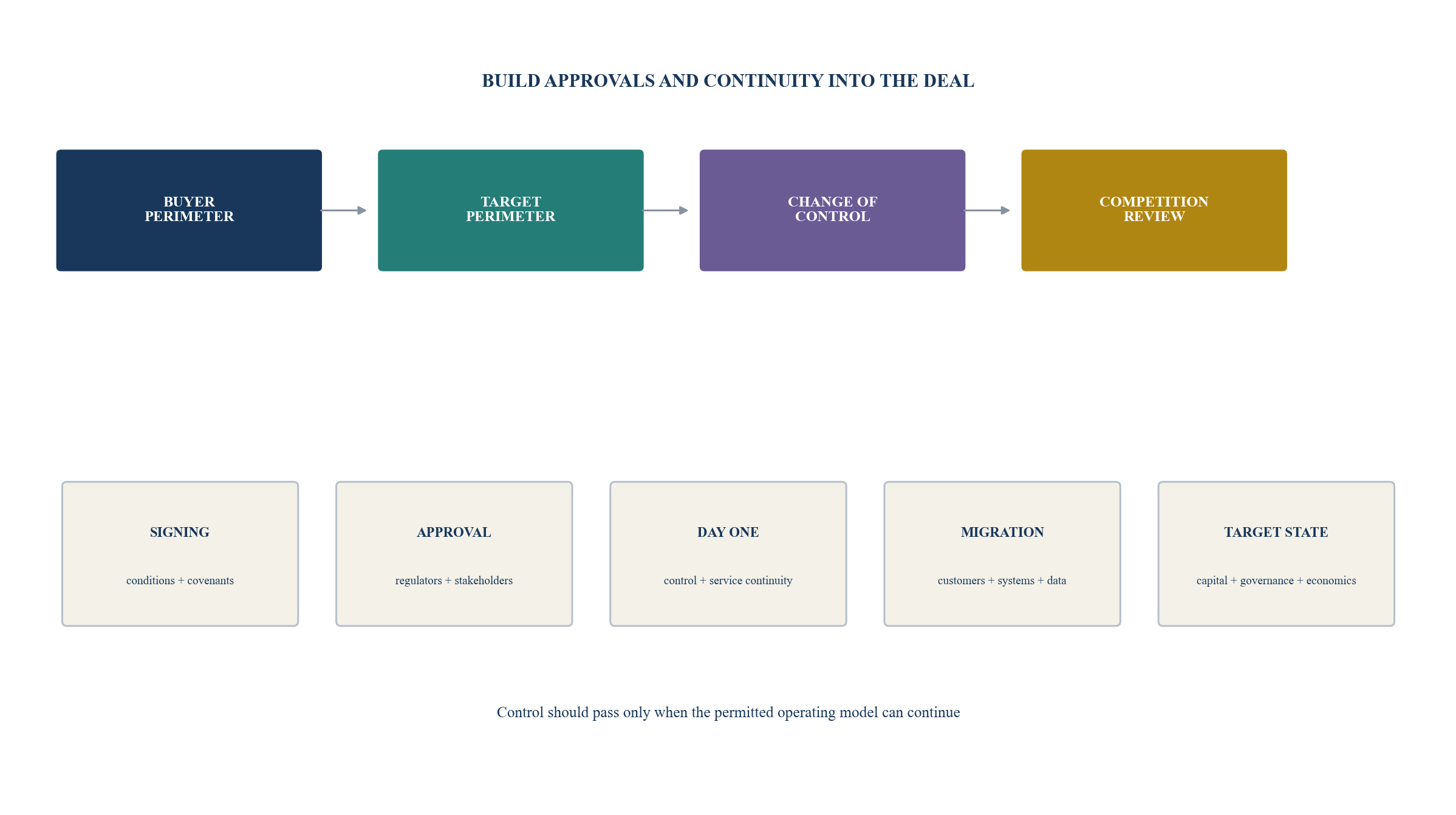
Author framework. Sequencing and approvals require current professional advice.
14. Value the target through scenarios
A valuation range should reconcile revenue quality, growth, margin, capital need and risk. Comparable-company and transaction multiples require consistent dates, currencies, accounting, growth and business models.
The model should show stand-alone value, buyer-specific synergy value and transaction value separately. The seller can negotiate for part of expected synergy. The buyer remains responsible for delivery risk.
Regulatory capital, safeguarding, restricted cash and funding should be separated from freely distributable cash. Debt-like items, working capital and contingent liabilities need explicit treatment in the equity bridge.
15. Work a hypothetical platform acquisition
Consider a hypothetical UAE business-finance platform serving SMEs through invoicing, bill payment, payroll, corporate cards and compliance workflows. It has audited revenue, enterprise partners and recurring customer activity. All figures below are management assumptions for illustration.
The buyer expects to add distribution, remove duplicated platform cost and fund compliance, security and migration. The investment committee should test the case under delays, customer leakage, smaller synergies and higher remediation.
Table 4. Hypothetical platform acquisition case
| Metric | Stand-alone | Buyer case | Evidence gate |
|---|---|---|---|
| Revenue | 72 | 72 at close; 92 in year three | audited revenue, collections, contracts and activation plan |
| EBITDA | 18 | 26 run-rate after integration | normalisation, retained customers, executable cost and revenue synergies |
| Purchase enterprise value | 180 | 180 | valuation range, competitive process and approval |
| Revenue synergy | 0 | 7 annual run-rate | named buyer channels, product fit, customer conversion and timing |
| Gross cost synergy | 0 | 6 annual run-rate | removable systems, vendors, premises and roles |
| Incremental control cost | 0 | 3 annual run-rate | regulator, risk, security, audit and operating-model plan |
| Other integration run-rate | 0 | 2 annual run-rate | service, platform and retained transition capability |
| One-time integration cash | 0 | 28 | workstream budget, contingency and delivery schedule |
| Combined EBITDA run-rate | 18 | 26 | verified bridge and owner for each initiative |
| Illustrative EV / combined EBITDA | 10.0x | 6.9x before one-time cost | denominator, timing and cash reconciliation |
All values are hypothetical management assumptions in AED millions unless stated otherwise.
16. Stress the assumptions that can break the deal
Customer retention, approval timing, integration cost, revenue synergy and control remediation are often linked. A delay can extend duplicate cost and create employee or customer uncertainty. A rushed migration can increase service incidents and churn.
The downside should preserve mandatory control spending. Cutting compliance, security or service to protect the financial model can worsen the transaction outcome.
Table 5. Hypothetical acquisition sensitivity
| Scenario | Revenue synergy | Cost synergy | Added control and run-rate cost | One-time integration cash | Combined EBITDA | Interpretation |
|---|---|---|---|---|---|---|
| Base | 7 | 6 | 5 | 28 | 26 | planned commercial and operating delivery |
| Approval delay | 5 | 4 | 6 | 34 | 21 | duplicated systems and slower product launch |
| Customer leakage | 3 | 5 | 5 | 30 | 21 | weaker retained revenue and migration friction |
| Technology remediation | 5 | 3 | 7 | 45 | 19 | platform work delays synergy and raises operating cost |
| Combined downside | 1 | 2 | 8 | 52 | 13 | value case requires price, structure or stop decision |
| Upside | 10 | 7 | 5 | 27 | 30 | requires documented distribution and controlled execution |
All values are hypothetical management assumptions for method illustration.
17. Make integration a pre-signing workstream
The integration thesis should exist before the definitive agreement. The buyer needs a Day One control model, service-continuity plan, customer and partner communication route, target technology architecture and synergy register.
Each synergy needs an owner, dependency, cash date and evidence. Each risk needs an accountable executive, indicator and escalation path. The board should receive a reconciled view of approval, customers, people, technology, controls and cash.
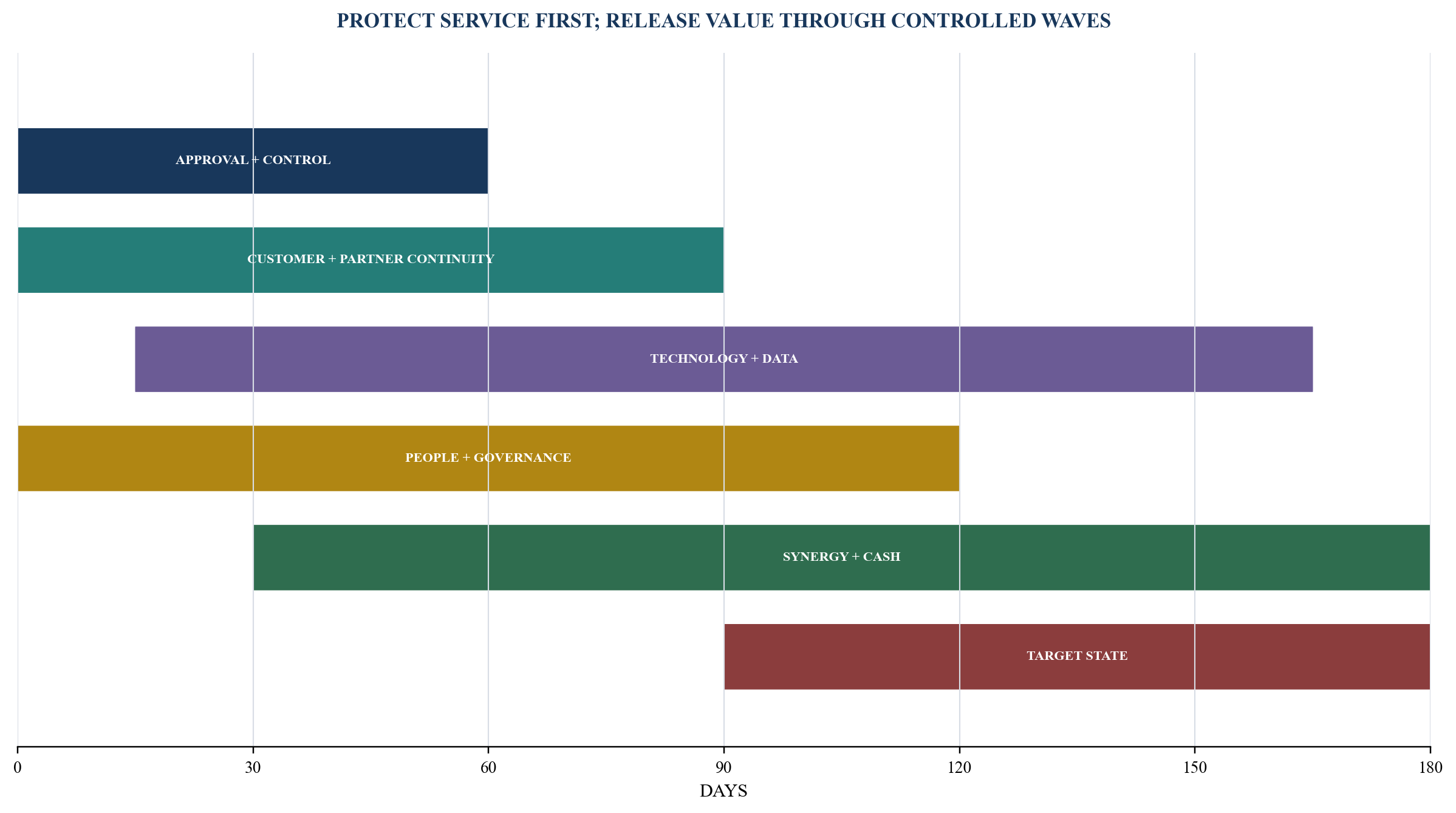
Author framework. Timing should be adapted to approvals, transaction structure and operating risk.
Table 6. 180-day integration plan
| Period | Priority | Required output | Board evidence |
|---|---|---|---|
| Signing to close | approvals, retention, continuity, clean-team planning and baseline | approval map, interim covenants, people plan, service risks and verified synergy register | closing-readiness dashboard and unresolved condition log |
| Day One to 30 | governance, incident authority, liquidity, safeguarding, customer and partner continuity | delegations, committees, escalation, cash control and communication plan | service, cash, complaints, fraud, staff and approval indicators |
| Days 31 to 60 | product, data, platform and customer segmentation | target architecture, migration cohorts, consent and contract actions | tested migration plan and cohort baseline |
| Days 61 to 90 | first controlled migrations and cost actions | pilot results, issue remediation and confirmed vendor or role changes | customer outcome, service, risk and realised-cash evidence |
| Days 91 to 150 | scaled migration, cross-sell and operating-model transition | wave delivery, control validation and synergy conversion | reconciled revenue, cost, capital and risk bridge |
| Days 151 to 180 | target-state governance and value reset | remaining roadmap, operating budget, accountability and lessons | board-approved target state and refreshed investment case |
Owners and timing should be agreed before signing and refreshed after approval conditions are known.
18. Build exit optionality into the platform
A platform can create exit options through scale, clean governance, standardised controls, integrated data and transferable customer economics. It can destroy optionality through unresolved entities, bespoke systems, contingent liabilities and unverified synergies.
The target state should support strategic sale, sponsor-to-sponsor transfer, minority capital or public-market preparation where appropriate. The transaction team should maintain evidence that a future buyer can understand.
Exit readiness includes audited financials, current permissions, ownership of IP, reconciled customer cohorts, documented controls, scalable management and a credible separation or integration boundary.
19. Apply international competition lessons
The European Commission cleared the acquisition of Railsr by Equals under its simplified merger procedure in 2025. The public decision describes Railsr as an embedded-finance platform and Equals as a business money-flow and card-products platform.[15]
The United Kingdom CMA cleared PayPal's acquisition of iZettle after an in-depth review of mobile point-of-sale and emerging omni-channel payment services.[16] It also reviewed Bottomline's acquisition of Experian's payment-gateway business and ultimately cleared the transaction after Phase 2.[17]
The CMA's FNZ and GBST case demonstrates that investment-platform technology can generate serious competition questions and remedy complexity.[18] The lesson for UAE buyers is procedural and commercial: define overlap, customer alternatives, switching, data, interoperability and remedies early.
International cases do not determine the UAE outcome. They provide structured questions that improve transaction planning.
20. Use a board gate that can say stop
The investment committee should receive one reconciled paper. It should identify the exact target entity, current ownership, regulatory status, customer and cash baseline, purchase price, funding, approvals, synergy bridge, integration budget, management plan, downside and exit.
The decision can be proceed, proceed with conditions, change structure, reprice, gather evidence or stop. A conditional decision should name the evidence required, accountable person and deadline.
The board should avoid approving a strategic narrative while leaving the operating model unresolved. The transaction becomes credible when value, control and execution point to the same target state.
Conclusion
The UAE's growing fintech population creates a deeper field of possible partnerships and transactions. Publicly disclosed deals show established consolidation routes in payments, acquiring, remittance, geographic expansion and integrated business-finance platforms.
Payments and remittance currently provide the clearest disclosed evidence of scale combinations. Business-finance platforms, open-finance infrastructure and regulatory technology can support selective capability acquisitions when recurring revenue, permissions, data and integration are verified. Lending, insurance, wealth and virtual-asset transactions require especially careful analysis of regulated activity, customer transfer, capital, conduct and downside.
The investible question is specific: what asset is being acquired, can it survive the transfer, which approvals govern control, which customers and cash remain, and how will the buyer integrate without interrupting the regulated service?
A disciplined buyer answers those questions before price becomes commitment. The result is a consolidation map based on executable value rather than sector momentum alone.
References
- Central Bank of the UAE, Annual Report 2025, https://www.centralbank.ae/media/4qbn11cl/annual-report-2025-en.pdf
- Dubai Financial Services Authority, Annual Report 2025 announcement, https://www.dfsa.ae/news/dfsa-annual-report-2025-dfsa-records-third-consecutive-year-double-digit-registration-growth-dubai-advances-highest-ever-global
- Abu Dhabi Global Market, FSRA Annual Report 2025 announcement, https://www.adgm.com/media/announcements/adgm-fsra-publishes-its-2025-annual-report
- Virtual Assets Regulatory Authority, Public Register, https://www.vara.ae/en/licenses-and-register/public-register/
- Network International, completion of DPO Group acquisition, 29 September 2021, https://www.network.ae/en/about-us/press-and-media/news/network-international-announces-new-strategic-vision-to-accelerate-mea-growth-and-completes-the-acquisition-of-dpo-group
- Network International, completion of merger with Magnati, 1 October 2025, https://www.network.ae/en/about-us/press-and-media/news/network-international-and-magnati-merge-to-create-the-leading-fintech-across-the-middle-east-africa
- Emirates News Agency, Al Ansari Financial Services agreement to acquire BFC Group Holdings, 30 July 2024, https://www.wam.ae/en/article/b4f7ngh-ansari-signs-agreement-acquire-bfc-group-holdings
- Emirates News Agency, IHC acquisition of 70 per cent of Peko Holdings, 23 December 2025, https://www.wam.ae/en/article/15xr1cr-ihc-strengthens-digital-services-portfolio-with
- Central Bank of the UAE Rulebook, Major Acquisitions Regulation, https://rulebook.centralbank.ae/en/rulebook/major-acquisitions-regulation
- Central Bank of the UAE Rulebook, Article 125 Merger and Acquisition, https://rulebook.centralbank.ae/en/rulebook/article-125-merger-and-acquisition
- Dubai Financial Services Authority, controller and change-of-control guidance, https://www.dfsa.ae/download_file/view/183/475
- UAE Legislation, Cabinet Resolution No. 3 of 2025, https://uaelegislation.gov.ae/en/legislations/2788
- UAE Ministry of Economy, Economic Concentration, https://www.moec.gov.ae/en/economic-concentration
- Dubai Financial Services Authority, Thematic Review of Compliance Arrangements in fintech firms, 10 April 2026, https://www.dfsa.ae/news/dfsa-publishes-thematic-review-report-compliance-arrangements-fintech-firms
- European Commission, Case M.11861 Railsr / Equals, https://ec.europa.eu/competition/mergers/cases1/202506/M_11861_10477085_117_3.pdf
- United Kingdom Competition and Markets Authority, PayPal / iZettle merger inquiry, https://www.gov.uk/cma-cases/paypal-holdings-inc-izettle-ab-merger-inquiry
- United Kingdom Competition and Markets Authority, Bottomline / Experian Payment Gateway merger inquiry, https://www.gov.uk/cma-cases/bottomline-technologies-de-inc-experian-limited-merger-inquiry
- United Kingdom Competition and Markets Authority, FNZ / GBST merger inquiry, https://www.gov.uk/cma-cases/fnz-gbst-merger-inquiry
