

1. Define approval as a legal state
An approval is evidence about a particular legal entity and regulated activity at a particular date. It should be read from the regulator's decision, licence, public register and conditions rather than from a company announcement.
The core questions are precise. Which authority issued it? Which entity holds it? Which activities are covered? Which customers can be served? Can the firm hold or control client assets? Which geographic and marketing boundaries apply? What conditions, limits and expiry dates remain?
An investor should then identify what the approval permits today. Some states allow incorporation or operational setup. Some allow restricted testing. Some establish registration without permission for every financial activity. A full licence can still contain conditions or endorsements.
The word “approved” should therefore be replaced in diligence by an exact regulatory state. That state becomes one input to product, revenue, capital and risk analysis.
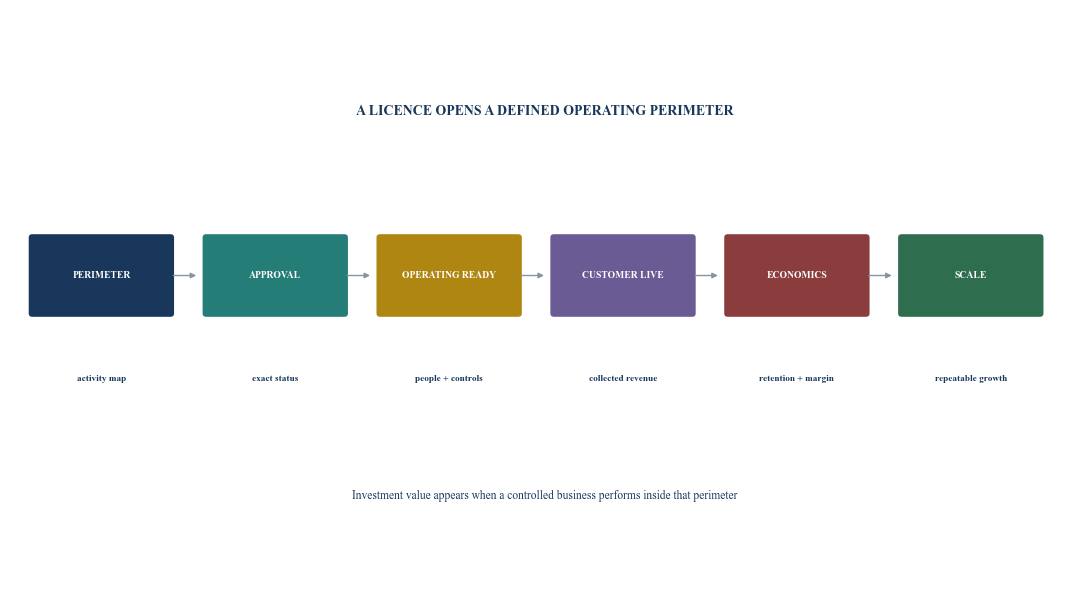
Author framework. Each gate requires evidence for the licensed entity and its actual activity.
2. Read the UAE licensing surge accurately
The CBUAE's 2025 annual report states that more than 60 fintech companies were licensed or granted in-principle approval during the year. It reports 36 fully licensed entities as of January 2026, compared with 18 in 2024.[1]
Those companies span open finance, buy-now-pay-later services, digital wallets, merchant acquiring, payment aggregation, stablecoin-related activities and other emerging services. The range creates several distinct business and risk models within the headline count.
The DFSA reported 182 new licensed and registered firms in 2025, 16 per cent more than 2024, bringing the total regulated population in DIFC to 1,050. Its authorisation applications rose 25 per cent during the year.[2] These numbers cover banking, capital markets, wealth, insurance and fintech and should not be treated as a fintech-only cohort.
ADGM's FSRA reported 94 Financial Services Permissions granted in 2025, up 22 per cent, and a 32 per cent rise in in-principle approvals.[3] The public figures establish growth across the ADGM financial-services ecosystem; company-level operating and financial evidence remains necessary.
VARA's public register identifies licensed virtual-asset service providers and firms with in-principle approval. As at the research date, it displayed 52 results across those states. VARA explains that an in-principle approval is conditional and strictly prohibits operations, virtual-asset activity and client service until a full licence is obtained.[4]
3. Map the regulatory perimeter before the market
The UAE has federal, financial-free-zone and activity-specific regulatory perimeters. The business model, place of activity, customer, product and asset determine the relevant authority and permissions.
The CBUAE's in-force financial law lists activities including credit, funding, open finance, exchange and transfers, virtual-asset payment services, stored value, retail payments, digital money, insurance and promotion of licensed financial activities.[5]
The DFSA regulates financial services conducted in or from DIFC. The FSRA regulates financial services in ADGM. VARA regulates virtual-asset activities in or from Dubai outside DIFC. Securities and commodities activities can involve the federal capital-markets perimeter.
A group can hold more than one permission through separate entities. Investors should trace revenue, employees, technology, client contracts, bank accounts and intellectual property to the entity that is legally able to perform the activity.
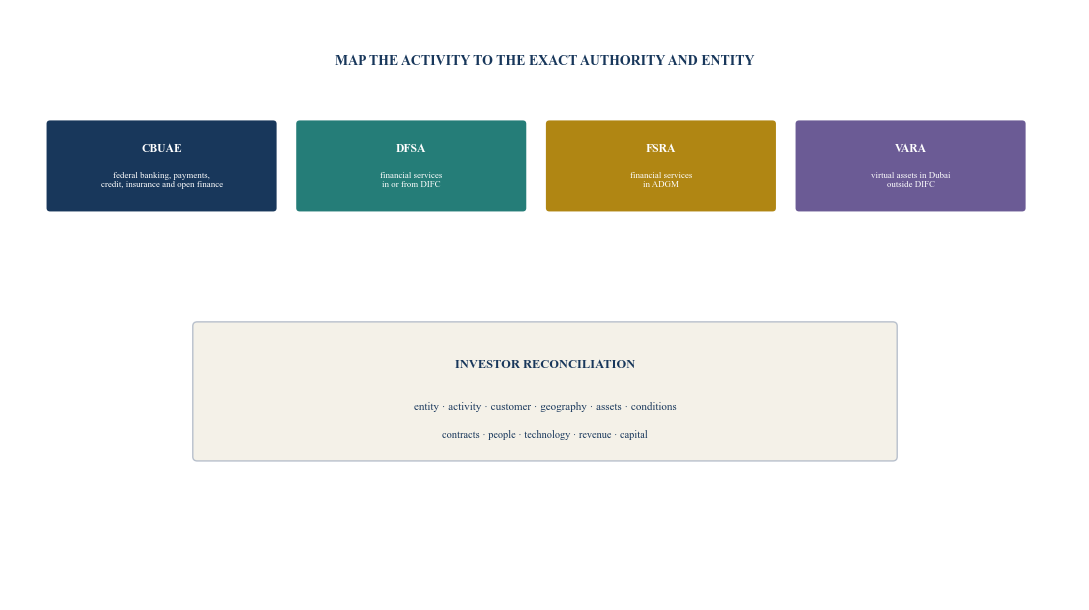
Author framework based on cited public materials. The correct perimeter depends on the specific facts and current law.
Table 1. Regulatory states in fintech diligence
| State | Typical legal meaning | Operating implication | Investor evidence |
|---|---|---|---|
| Pre-application or sandbox enquiry | regulator or innovation team is considering eligibility or providing preliminary engagement | no general right to conduct regulated business | correspondence, eligibility, activity map and next filing |
| Approval to incorporate or setup | conditional permission to establish an entity and complete operational requirements | operations may remain prohibited | decision letter, conditions, capital, hires and completion plan |
| In-principle approval | regulator is prepared to proceed subject to specified conditions | activity may remain restricted or prohibited until completion | condition schedule, long-stop, remaining cost and dependency |
| Restricted testing licence | defined test under customer, transaction, time or activity limits | revenue and customer exposure can be capped | test plan, disclosures, restrictions, results and exit path |
| Registration | entity or role is entered on a register | scope depends on the specific registration and law | current register, category, status and permitted functions |
| Full activity-specific licence | named entity may perform specified activities subject to conditions | launch requires operating readiness and continuing compliance | licence, endorsements, conditions, approved persons and policies |
| Variation or passport | existing permission is extended or recognised for additional scope | scale depends on completion and local rules | approval, effective date, territorial scope and customer limits |
Terminology and legal effect vary by authority. Current register and decision documents control.
4. Separate sandbox evidence from scale evidence
A sandbox tests defined propositions in a controlled environment. It can demonstrate technology, customer journey, controls and regulator engagement. It does not establish unrestricted authorisation or a repeatable commercial model.
The DFSA describes its Innovation Testing Licence as a restricted financial-services licence. Holders test under a plan, limited period and activity restrictions, with customer and transaction limits. At the end, the firm applies to remove restrictions or withdraws.[6]
One DFSA public-register example limits a payments test to 100 clients in the first phase and 275 clients in the second and restricts activity to UAE-incorporated clients. These firm-specific conditions illustrate why an investor must read the register rather than generalise from the programme.[7]
The investment case should identify which evidence the test can produce and which remains untested. Enterprise sales cycles, unrestricted customer acquisition, fraud at scale, operational resilience and sustainable margin can remain unknown.
5. Build a licensing funnel instead of a licence count
An ecosystem headline can combine applicants, sandbox firms, in-principle approvals, registered firms and full licensees. The investor should reconstruct the relevant funnel for the vertical and period.
The funnel begins with qualified projects, progresses through application and conditional approval, and reaches an effective permission only after conditions are satisfied. Operational launch requires people, systems, policies, vendors and bank or scheme connections.
Commercial activation is narrower again. The firm must onboard customers, deliver the permitted service, collect revenue and retain the account. Each transition should have a denominator and an elapsed time.
Regulator aggregate figures are useful for market direction. They cannot be used to estimate a company's probability of approval or revenue without a defined cohort and evidence.
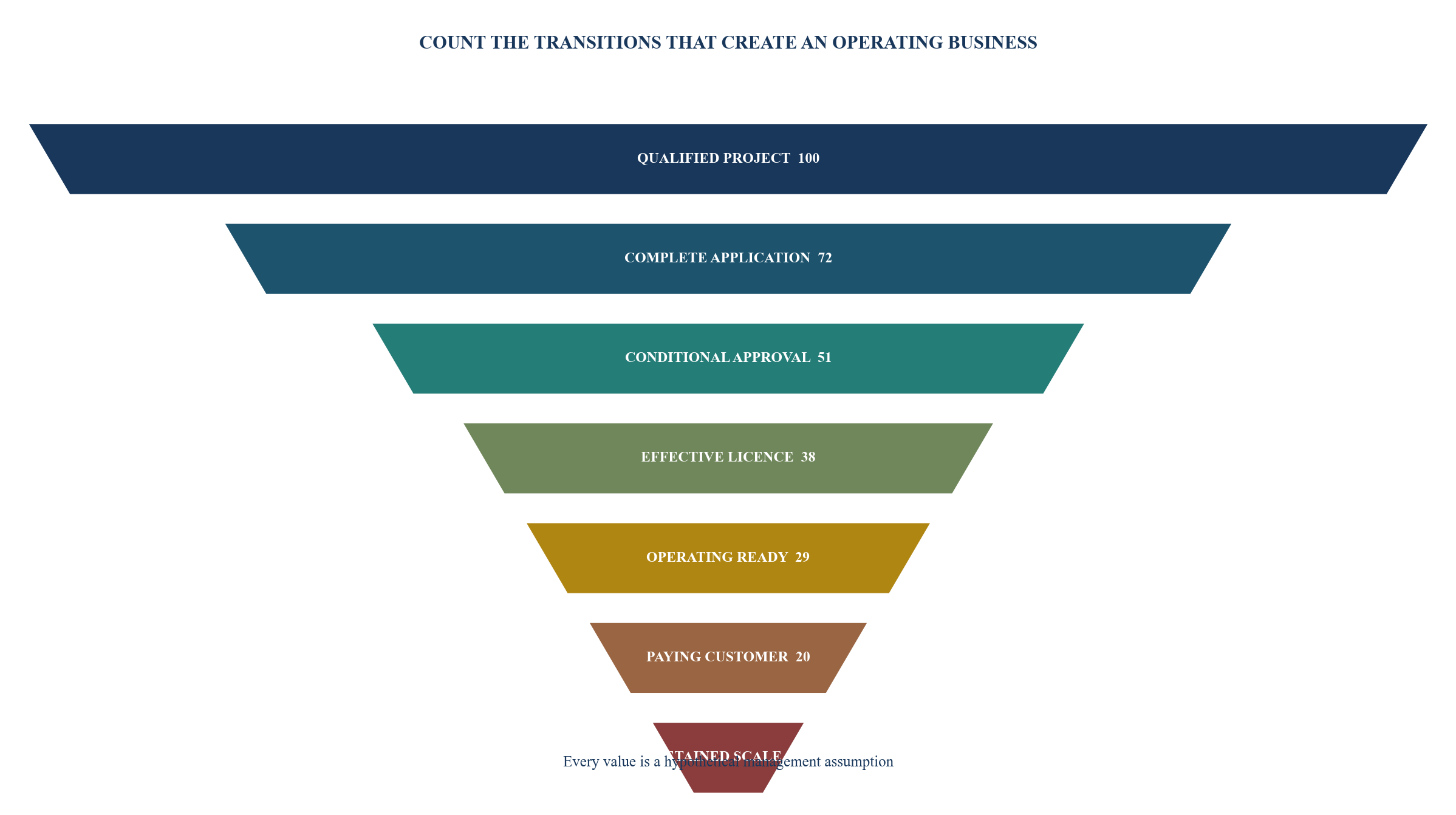
Hypothetical index demonstrates the funnel. It is not a regulator or company statistic.
6. Translate every condition into work and cash
An in-principle approval can require capital, senior hires, policies, technology, insurance, premises, outsourcing controls, banking relationships and evidence before a full licence is effective.
The closing plan should turn every condition into an owner, deliverable, cost, dependency and date. The forecast should include the period between regulatory approval and commercial launch.
External dependencies can be material. A sponsor bank, safeguarding account, payment scheme, identity service, cloud environment, auditor or insurer may have its own diligence and implementation timetable.
Investor funding can be staged against conditions that management can complete. A company should retain enough cash for regulator questions and vendor delays without launching prematurely.
7. Install governance before growth
Regulated scale depends on accountable people and current governance. The exact roles vary by licence and authority but can include board members, senior executive, finance, risk, compliance, money-laundering reporting, data protection, internal audit and technology leadership.
Approved-person status should be checked directly. A candidate in process should not be presented as appointed. Employment, residency, time commitment, independence and group reporting need to support the licensed entity.
The board should own risk appetite, product approval, outsourcing, security, financial crime, complaints, prudential capital, liquidity and wind-down. Committees should have evidence of challenge and follow-up.
Founder control can be valuable during product development and create key-person risk in a supervised entity. Delegations, succession and incident authority should be established before material customer growth.
8. Build the operating-control architecture
A licence application often contains a target operating model. The company must turn that model into people, procedures, systems, evidence and management information.
Customer onboarding should connect eligibility, identity, sanctions, risk rating, terms, suitability or affordability where relevant, product activation and monitoring. Payments or client assets require specific reconciliation, safeguarding and access controls.
Outsourcing does not transfer regulatory accountability. Contracts, data location, audit rights, business continuity, subcontracting, concentration and exit should be controlled.
The operating model should generate evidence for internal management and regulatory reporting from the same underlying records. Manual spreadsheets can support an early phase and become a control risk as volumes rise.
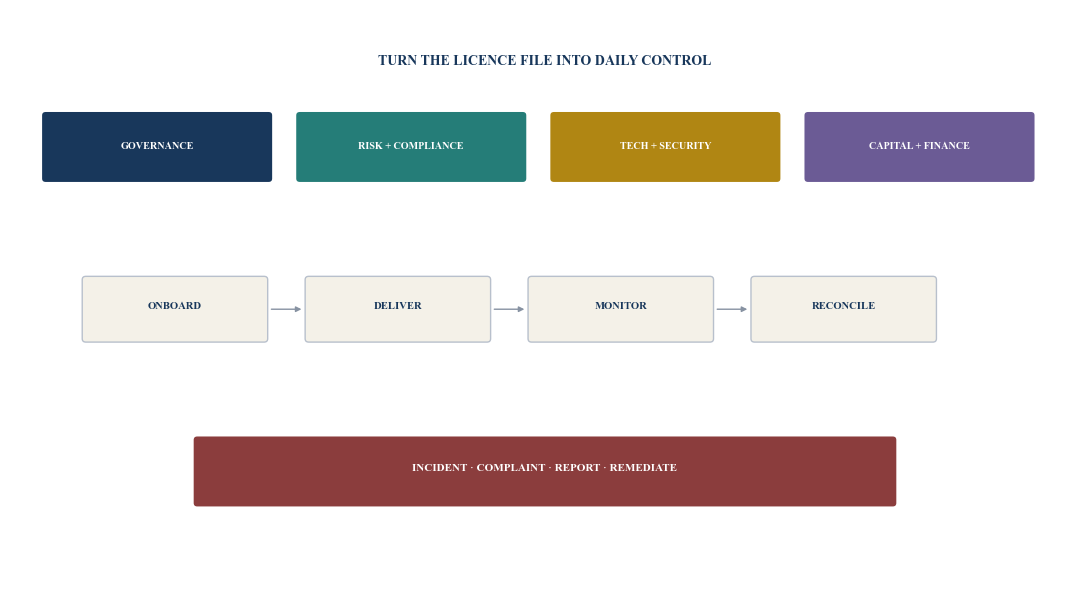
Author framework. The exact controls depend on the licensed activity and jurisdiction.
9. Prove operational readiness
Operational readiness should be tested through complete customer journeys, reconciliations, exception cases, reporting and recovery. A successful interface demonstration is insufficient.
The readiness file should include access rights, maker-checker controls, system configuration, data flow, security testing, incident response, customer communications, complaints, finance, prudential reporting and regulatory submissions.
Dry runs should include failed identity, sanctions alert, duplicate payment, incorrect fee, vendor outage, data breach, customer complaint and end-of-day reconciliation. Owners should close findings before volume increases.
Regulatory permission can be effective before a commercial partner is ready. The launch date should use the latest critical dependency rather than the licence date alone.
10. Construct the regulatory capital stack
The company's funding requirement includes more than operating burn. Paid-up capital, liquid capital, regulatory reserves, safeguarding arrangements, guarantees, professional indemnity insurance and wind-down funding can restrict cash use.
Every capital requirement should be traced to the licence, law, regulator decision or management risk plan. The model should distinguish equity cash, restricted cash, eligible regulatory capital and operating liquidity.
Growth can increase the requirement. Transaction volume, client assets, credit exposure, insurance premium, operational risk or expense can affect prudential thresholds depending on the regime.
The financing plan should preserve headroom. A firm operating exactly at a minimum can be vulnerable to losses, foreign exchange, new hires or growth.
11. Underwrite bank, scheme and infrastructure access
A licence can make the firm eligible to seek accounts or scheme access. It does not compel a bank, payment network, custodian, insurer or data holder to contract.
Counterparties conduct their own due diligence on ownership, source of funds, business model, financial crime, security, volume, geography and customers. Onboarding can take longer than the regulatory process.
The company should map every critical partner, current status, conditions, cost, service level, concentration and alternate route. A letter of intent should remain separate from an executed production agreement.
Sponsor dependence can create bargaining and continuity risk. The revenue model should include partner charges, reserves, collateral and termination exposure.
12. Connect the licence to a payable use case
A broad fintech proposition should be decomposed into one permitted customer workflow. The investor needs to see what the user does, what the company performs, which regulated activity is involved and who pays.
The workflow can include a digital wallet, merchant acquiring, payment aggregation, credit, investment, insurance, virtual assets, open finance or infrastructure. Each has different customer economics and risks.
Revenue should belong to the licensed entity that performs the service or be supported by an arm's-length intercompany agreement. A group forecast can obscure where regulated margin, cost and capital sit.
Pricing should reflect the complete service. Introductory promotions and waived fees should not be annualised as normal revenue.
13. Measure activation after permission
The post-licence funnel begins with eligible leads and ends with a customer who completes onboarding, funds or activates the service, generates collected revenue and returns.
Metrics should be segmented by channel, product, customer and cohort. Account creation can overstate adoption when identity, risk approval or funding remains incomplete.
Activation time matters. A product with high conversion and a long compliance review can require more support and working capital than the headline rate suggests.
The board should track declined and abandoned customers as well as approved customers. Reasons can reveal product mismatch, financial-crime exposure, weak usability or an unsuitable acquisition channel.
14. Reconstruct unit economics
Unit economics should start with recognised and collected revenue. Variable costs can include network, scheme, banking, identity, data, cloud, fraud, chargeback, customer support, insurance and regulatory levies.
Contribution margin should be calculated by product and cohort. A company can show positive gross margin while excluding significant fraud, support or partner cost.
Customer acquisition cost includes paid media, sales, onboarding subsidies, referral fees and the implementation time required to activate a regulated customer.
Lifetime value depends on gross profit and retention. A licence can improve trust and partner access while competition increases price pressure and customer choice.
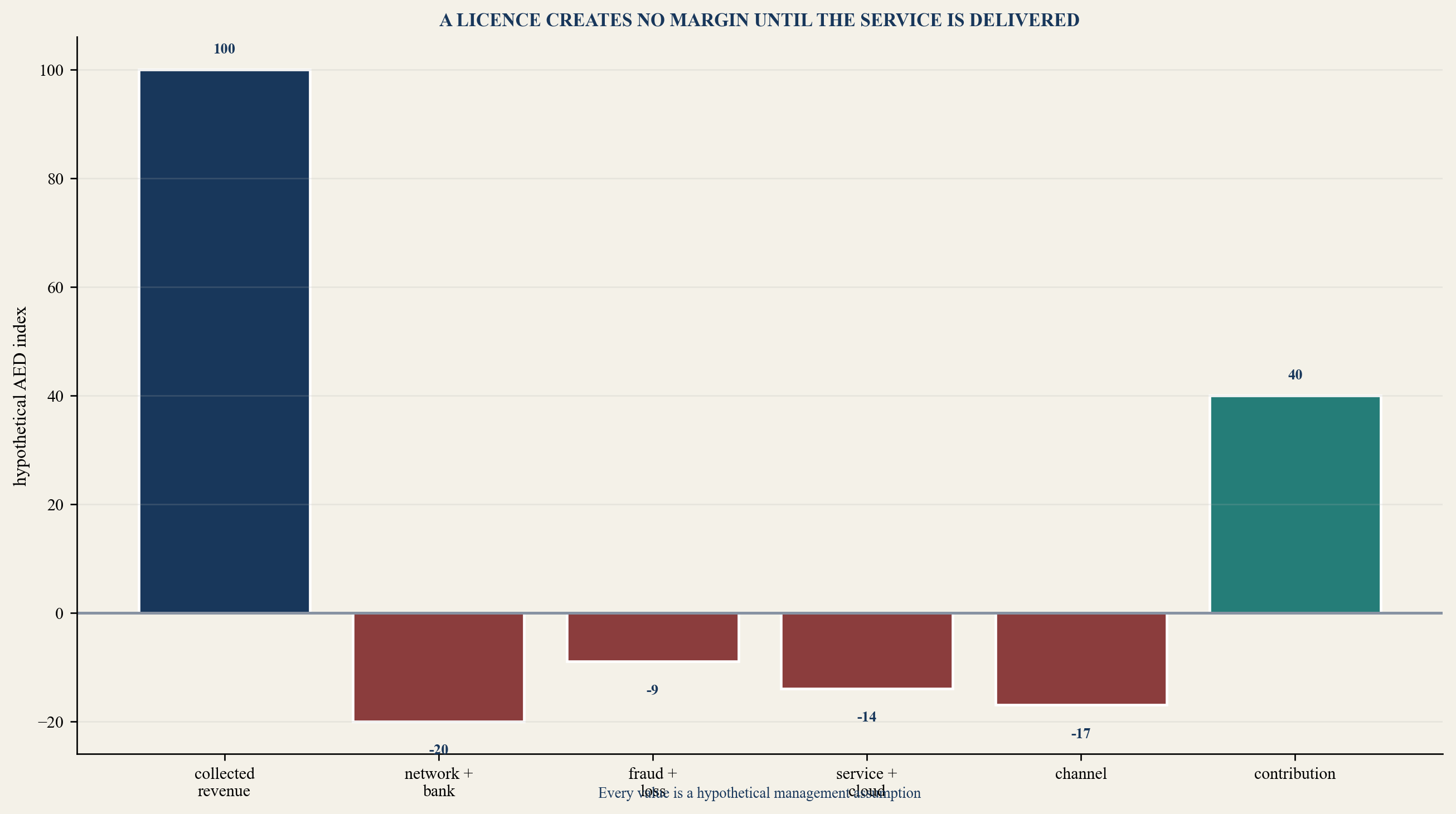
Hypothetical management values demonstrate the calculation and do not represent an actual company.
15. Assess regulatory operating leverage
Compliance and control costs have fixed and variable components. Board, approved people, audit, policies, licences, reporting and security create a base cost before material revenue.
Scale can spread that cost across customers. Product expansion can add new permissions, monitoring, training, disclosures and capital.
Automation can reduce manual review when controls remain explainable, tested and supervised. Automated onboarding or surveillance should have performance, override, audit and incident evidence.
The investor should compare cost per active customer, cost per transaction and control incidents through growth. Falling cost accompanied by rising unresolved exceptions is not operating leverage.
16. Score investment readiness
An approved fintech should be assessed across regulatory, operating, commercial and financial evidence. High licensing quality cannot compensate for absent demand, and rapid growth cannot compensate for an activity outside permission.
Table 2. Post-approval fintech investor scorecard
| Dimension | Strong evidence | Warning signal | Investment test |
|---|---|---|---|
| Approval | effective licence, current register and conditions satisfied | announcement or in-principle status presented as operating permission | direct regulator-source verification |
| Perimeter | activity and revenue mapped to entity and licence | group product exceeds authorised scope | counsel-reviewed activity map |
| People | approved, resident and capable control roles | critical appointments remain pending | role, approval, employment and succession file |
| Operations | tested end-to-end journeys and reconciliations | policy documents without production evidence | readiness test and exception closure |
| Partners | executed production agreements and alternatives | dependence on one non-binding relationship | service, cost, concentration and exit evidence |
| Customers | activated, paying and retained cohorts | registrations or free pilots | collected revenue and cohort retention |
| Margin | complete delivery and loss cost | gross margin excludes network, fraud or support | contribution by product and cohort |
| Capital | regulatory and operating cash reconciled | minimum capital treated as runway | restricted, eligible and usable cash bridge |
| Conduct | complaints, financial crime and customer outcomes controlled | growth outpaces monitoring and remediation | incident and outcome trend |
| Scale | repeatable distribution and governance capacity | forecast depends on permission or partner not obtained | milestone-funded expansion plan |
Each score requires evidence for the exact entity, licence, product and period.
17. Assemble the diligence file
The investment data room should reconcile licence, company, product, customer and cash evidence. Public-register data should be captured with its access date and checked before closing.
The legal entity file should reconcile ownership, approved controllers, intellectual property, staff, vendors, customer contracts, revenue and bank accounts. Intercompany services and charges should be explicit.
Regulatory correspondence can contain sensitive information and should be reviewed through controlled access. Management summaries should be reconciled to source documents.
Table 3. Licensed-fintech investment diligence file
| File | Minimum evidence | Reconciliation | Decision use |
|---|---|---|---|
| Regulatory | application, decision, licence, register, conditions, approved people and correspondence | claimed status to current regulator source | legal ability and remaining conditions |
| Corporate | cap table, controllers, board, subsidiaries, options and related parties | ownership to filings and regulator approvals | control, dilution and change-of-control risk |
| Operating | policies, systems, vendors, access, testing, incidents and recovery | licence commitments to production controls | readiness and scalability |
| Financial crime | risk assessment, onboarding, screening, monitoring, reports and training | customer risk to alerts and decisions | compliance capacity and exposure |
| Customers | terms, contracts, onboarding, activity, invoices, collection and complaints | acquisition to active and retained cohorts | demand, conduct and economics |
| Partners | bank, scheme, custodian, insurer, data and cloud agreements | proposition to executable access | dependence, cost and continuity |
| Finance | capital, restricted cash, revenue, cost, losses, tax, cash and forecast | books to bank, contracts and regulatory returns | funding need and runway |
| Technology | architecture, ownership, security, data, models and change control | product claim to tested performance | resilience, defensibility and liability |
Personal and regulatory-confidential information should be minimised and handled under controlled procedures.
18. Test a hypothetical licensed payment platform
The following example demonstrates the method. Every number is a hypothetical management assumption. It does not describe an actual company, approval, licence, customer, transaction or investment return.
Assume a UAE platform has obtained an effective activity-specific payment permission and has completed senior appointments. It serves medium-sized merchants with collections, reconciliation and settlement reporting through a sponsor-bank arrangement.
The investor funds technology completion, bank integration, security, operating capital, customer acquisition and a prudential reserve. The base case excludes services outside the current licence.
Table 4. Hypothetical post-licence fintech scale-up case
| Metric | Year 1 | Year 2 | Year 3 |
|---|---|---|---|
| Active merchant customers at year end | 180 | 620 | 1,450 |
| Gross payment value | AED 0.9 billion | AED 4.2 billion | AED 11.5 billion |
| Net recognised revenue | AED 7.0 million | AED 27.5 million | AED 68.0 million |
| Contribution margin after network, fraud and support | 34% | 45% | 52% |
| Gross annual revenue retention | 84% | 89% | 92% |
| Net annual revenue retention | 96% | 109% | 118% |
| Blended acquisition cost per merchant | AED 31,000 | AED 25,000 | AED 20,000 |
| Months to contribution payback | 23 | 15 | 10 |
| Operating and compliance cash expense | AED 18.0 million | AED 29.0 million | AED 45.0 million |
| Regulatory, safeguarding and wind-down cash reserve | AED 8.0 million | AED 12.0 million | AED 19.0 million |
| Year-end operating cash burn or generation | AED 15.6 million burn | AED 16.6 million burn | AED 9.6 million burn |
| Initial equity required including headroom | AED 43.0 million | included | included |
Every number is a hypothetical management assumption created solely to demonstrate the method.
The case shows the difference between payment volume and company revenue. Gross payment value increases rapidly while the company earns a smaller net amount and pays network, bank, fraud and support costs.
The funding requirement includes restricted and prudential cash. Investors should monitor usable runway separately from headline cash at bank.
19. Stress the connected assumptions
Licensing, operations and commerce interact. A condition delay can defer launch while people and technology costs continue. A bank delay can make an effective licence commercially unusable.
Rapid acquisition can increase fraud, support, complaints and reconciliation work. A higher payment volume can require more reserve or collateral without creating enough contribution margin.
The downside model should change time, revenue, cost, regulatory cash and follow-on funding together.
Table 5. Post-licence fintech sensitivity matrix
| Stress | Hypothetical change | Economic transmission | Required response |
|---|---|---|---|
| Condition delay | effective launch slips nine months | fixed cost, expired pipeline and additional financing | milestone funding, staffing sequence and long-stop |
| Sponsor-bank delay | production integration slips six months | no settlement route and deferred revenue | alternate bank, narrow launch and cash reserve |
| Merchant activation | 40% fewer customers activate | lower revenue and higher acquisition payback | channel review, onboarding repair and cost reset |
| Price pressure | net yield falls 25% | gross-profit compression | segment pricing, product mix and partner renegotiation |
| Fraud and disputes | loss and support cost doubles | lower contribution and regulatory scrutiny | limits, controls, reserves and independent review |
| Customer concentration | largest channel reaches 48% of revenue | bargaining and termination exposure | channel diversification and minimum commitments |
| Capital requirement | restricted cash rises AED 10 million | reduced operating runway | equity buffer, lower volume and capital planning |
| Licence variation | new product approval is delayed 12 months | expansion revenue unavailable | base-case discipline and separate option value |
Every scenario is a hypothetical management assumption and should be replaced with verified company evidence.
20. Release capital against post-approval milestones
The financing round should specify what capital buys. Milestones can include conditions satisfied, licence effective, bank integration, systems accepted, first customer, collected revenue, retention and contribution margin.
Tranched equity can protect investors and leave the company vulnerable if external approvals are the only trigger. The funding agreement should include objective evidence, reasonable cure and sufficient operating headroom.
Strategic investors can provide bank, scheme, distribution or data access. Their terms can also restrict counterparties, geography or exit.
Venture debt becomes more suitable after recurring revenue, retention and cash visibility improve. Regulatory capital and customer funds should not be treated as debt-service liquidity.
21. Plan market expansion as a new perimeter decision
A UAE permission can support a credible regional base. It does not automatically authorise customer acquisition or regulated activity in another country.
Expansion can use local licensing, partnership, branch, subsidiary, passport or unregulated technology supply depending on facts. Each route changes revenue, control, capital and liability.
International programmes provide operating benchmarks. The FCA reported a 49 per cent increase in applications to its Regulatory Sandbox and Innovation Pathways during 2025 and launched a Scale-up Unit.[8] The HKMA reported 385 sandbox pilot trials by the end of 2025.[9]
Australia's Enhanced Regulatory Sandbox permits eligible testing for up to 24 months with product, exposure, disclosure and conduct conditions.[10] Switzerland's fintech licence permits up to CHF 100 million of public deposits under defined restrictions and requires FINMA review of the intended activity.[11]
These routes show that innovation support remains bounded by activity and customer protection. A company's international plan should be costed jurisdiction by jurisdiction.
22. Build exit readiness
Potential acquirers can include banks, payment groups, insurers, exchanges, enterprise software companies, fintech infrastructure providers and international platforms.
The buyer will examine whether the licence and approved control structure can survive a change of control. Regulatory approval may be required before ownership changes.
Strategic value can reside in customer distribution, regulated permissions, payment or banking access, technology, data, talent and recurring revenue. Each asset should be legally owned and operationally transferable.
Exit readiness requires a clean cap table, current register, reconciled regulatory returns, documented software rights, assignable contracts, security evidence, customer cohorts and low unresolved remediation.
23. Execute through 180 days
An investor can move from regulatory verification to a funded scale plan through parallel legal, operating, commercial, technology and finance workstreams.
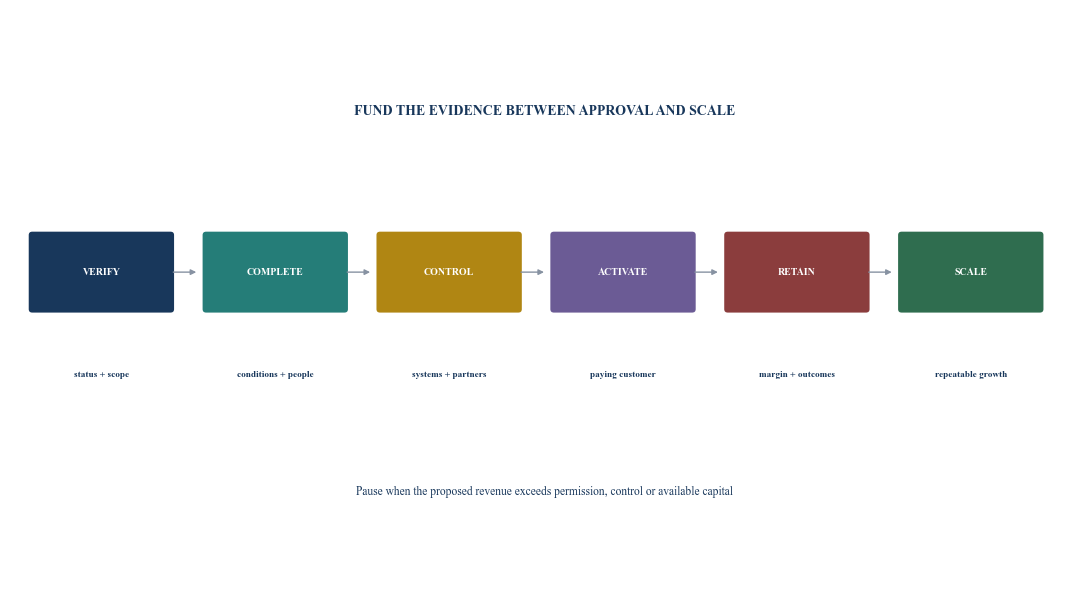
Author framework. Investment advances only when the exact licence supports a controlled and economic service.
Table 6. 180-day post-approval fintech execution plan
| Days | Workstream | Principal output | Gate |
|---|---|---|---|
| 1 to 20 | regulatory verification | current register, licence, conditions, activity map and approved people | exact operating perimeter confirmed |
| 21 to 45 | condition completion | owners, submissions, hires, capital, insurance and partner dependencies | effective-permission path accepted |
| 46 to 75 | operating readiness | systems, onboarding, financial crime, reconciliation, reporting and recovery tests | controlled launch authorised |
| 76 to 105 | customer activation | channel, contracts, onboarding, first service, invoices and collection | paid use case verified |
| 106 to 130 | economics and outcomes | contribution, fraud, support, complaints, retention and regulatory cash | base case fundable |
| 131 to 150 | scale design | product scope, automation, people, partners, capital and geographic perimeter | growth plan approved |
| 151 to 170 | financing and transaction | valuation, terms, milestones, approvals, governance and reserves | executable package established |
| 171 to 180 | committee | evidence record, downside, funding, ownership and decision | invest, acquire, defer or decline |
Sequencing is indicative and should reflect the regulator's conditions and company circumstances.
24. Set the decision and governance model
The investment committee should approve the exact regulatory entity, licence, conditions, customer, activity, operating model, partners, capital, product, distribution, economics, downside and post-close governance.
Board reporting should include conditions, regulatory communications, capital headroom, liquidity, onboarding, active customers, payment or asset volumes, collected revenue, contribution, fraud, financial-crime alerts, complaints, outages, reconciliations, partner service and audit findings.
The transaction should pause when approval cannot be verified, conditions lack owners or funding, key people remain absent, partner access is non-binding, revenue falls outside scope, restricted cash is counted as runway, or customer growth exceeds operational control.
The licensing surge creates more opportunities for investors and more need for discrimination. Regulatory momentum increases the population to assess; company evidence determines which firms can scale.
25. Limitations and conclusion
Regulatory populations, permissions, status, conditions and public registers can change. The cited aggregate figures cover different authorities, categories and reporting periods and should not be added into a single unique-firm count.
A firm can hold permissions from more than one authority or through more than one entity. A reported new firm can be a traditional financial institution, fintech, insurance entity or other regulated participant depending on the source.
Every company value and result in the worked example is a hypothetical management assumption. It does not represent a regulator forecast or an actual licensed firm.
The UAE's licensing momentum expands the range of financial-services platforms available for venture, growth and strategic investment. The quality of an opportunity depends on the legal and operational detail beneath the headline.
Investors should verify the approval state, complete the conditions, install the operating model, secure critical partners, activate paying customers, measure retained contribution and fund regulatory capital separately. That sequence converts a permission into a scalable financial-services business.
26. Monitor continuing permission
Authorisation is maintained through continuing compliance. Changes in ownership, controllers, senior people, activities, products, outsourcing, premises, financial position and customer proposition can require prior approval or notification.
The company should maintain a regulatory obligations register that assigns every return, notification, renewal, capital test and policy review to an accountable owner. Evidence should show submission, review and closure.
Regulatory capital should be monitored through forecast as well as historic reporting. A loss, dividend, foreign-exchange movement or growth commitment can reduce headroom before the next formal return.
The board should record the effect of each strategic decision on permission. A new token, credit feature, investment tool or payment flow can change the activity map even when the customer interface appears similar.
27. Price supervision and remediation
The cost of regulation continues after licensing. Supervision fees, audits, assurance, compliance testing, security reviews, insurance, reporting and specialist people should remain visible in the forecast.
Findings require owners, due dates and evidence. A control gap can create direct remediation expense, management distraction, product delay, customer restitution or capital requirements.
Investors should distinguish an ordinary improvement programme from a material unresolved breach. The file should identify regulator communications, internal audits, external reviews, complaints and financial-crime matters without disclosing unnecessary personal data.
Budgeting should include a response reserve for operational incidents and regulatory change. A fintech with a narrow cash runway can be forced to choose between remediation and growth.
28. Prepare for product and licence variation
New products should move through an internal approval process before development and marketing commitments. The process should map customer outcome, regulated activity, permissions, disclosures, data, financial crime, operations, capital, tax and accounting.
The company should engage qualified counsel and the relevant authority where a variation or new approval may be required. The forecast should identify the earliest permitted launch date and keep uncertain expansion revenue outside the base case.
Product options can be valued separately. A payment platform may have a credible future credit or open-finance service while its current valuation rests on the licensed payment business.
The investor's reserved capital can be released after the variation, operating readiness and customer evidence are established. This preserves upside without funding a regulatory assumption as though it were current revenue.
29. Align valuation with regulatory state
Valuation should use the cash flows and risks of the current permitted business. A licence can reduce market-entry uncertainty and create strategic value, subject to conditions, transferability and the company's ability to operate it.
In-principle approval, restricted testing and full authorisation should not receive the same treatment. The probability, cost and time to reach an effective and scalable state should enter the valuation explicitly.
Comparable-company multiples require reconciliation for revenue recognition, customer funds, transaction volume, gross versus net presentation, regulatory capital, geography and growth. Gross payment value is not a substitute for revenue.
Milestone pricing can bridge uncertainty. An investor can value the effective licensed business today and provide contingent value or additional capital after permission, revenue or retention milestones.
References
- [1] Central Bank of the UAE, Annual Report 2025, section 12.8.3 Advancing the UAE's Fintech Agenda. https://www.centralbank.ae/media/4qbn11cl/annual-report-2025-en.pdf
- [2] Dubai Financial Services Authority, Annual Report 2025 announcement, 25 June 2026. https://www.dfsa.ae/news/dfsa-annual-report-2025-dfsa-records-third-consecutive-year-double-digit-registration-growth-dubai-advances-highest-ever-global
- [3] Abu Dhabi Global Market Financial Services Regulatory Authority, Annual Report 2025, 13 July 2026. https://www.adgm.com/publications/fsra-annual-report
- [4] Virtual Assets Regulatory Authority, Public Register, accessed 13 August 2026. https://www.vara.ae/en/licenses-and-register/public-register/
- [5] Central Bank of the UAE Rulebook, Article 61 Licensed Financial Activities, in force from 16 September 2025. https://rulebook.centralbank.ae/en/rulebook/article-61-licensed-financial-activities
- [6] Dubai Financial Services Authority, Innovation Testing Licence Explainer Guide announcement, 1 May 2025. https://www.dfsa.ae/news/dfsa-launches-innovation-testing-licence-explainer-guide-boost-innovation-difc
- [7] Dubai Financial Services Authority, CoGoLinks DIFC Limited public-register entry, licence dated 1 September 2025. https://www.dfsa.ae/public-register/firms/cogolinks-difc-limited
- [8] Financial Conduct Authority, Innovation Insights 2025, published 2026. https://www.fca.org.uk/publications/corporate-documents/innovation-insights-2025
- [9] Hong Kong Monetary Authority, Annual Report 2025, Banking Stability chapter. https://www.hkma.gov.hk/media/eng/publication-and-research/annual-report/2025/15_Banking_Stability.pdf
- [10] Australian Securities and Investments Commission, Enhanced Regulatory Sandbox, official guidance accessed 13 August 2026. https://www.asic.gov.au/for-business-and-companies/innovation-hub/enhanced-regulatory-sandbox-ers/
- [11] Swiss Financial Market Supervisory Authority, FinTech Licence, guidance updated 24 April 2025. https://www.finma.ch/en/authorisation/fintech/fintech-bewilligung/
- [12] Virtual Assets Regulatory Authority, Licence Applications, official process page accessed 13 August 2026. https://www.vara.ae/en/licenses-and-register/licence-applications/
- [13] Dubai Financial Services Authority, DFSA Connect, 13 October 2025. https://www.dfsa.ae/news/dfsa-connect-new-digital-services-streamline-regulatory-approvals-processes-enabling-firms-set-and-grow-their-businesses-more-se
- [14] Abu Dhabi Global Market, FSRA Business Plan 2025 to 2026. https://assets.adgm.com/download/assets/FSRA%2BBusiness%2BPlan%2B2025%2B-%2B2026.pdf/60b2624c1e7e11f093d71a0ac1bcf369
About the Author
Chennakeshav Adya is an independent researcher and Managing Partner of Matchpoint Partners. His research focuses on investment strategy, capital formation, transaction execution, governance and operating-model design across international markets.
