

1. Define the exit objective before selecting a route
An exit can serve several objectives: founder liquidity, employee liquidity, venture-fund distributions, strategic combination, growth capital, acquisition currency, market profile or governance transition. These objectives can coexist and can point toward different routes.
A primary issuance gives new capital to the company. A secondary sale transfers existing shares and gives proceeds to the selling shareholder. A strategic transaction can include both equity purchase and primary funding. An IPO can combine primary and secondary shares, subject to the applicable structure, approvals and investor demand.
The board should state the required outcome in cash, ownership, control, capital and time. It should identify shareholders that need liquidity, the amount the business needs to fund its plan, the control rights that can transfer and the continuing role expected from founders and management.
This definition prevents valuation headlines from obscuring the actual transaction. A high headline valuation with a small permitted sell-down, long lock-up and contingent consideration can deliver less present liquidity than a lower all-cash offer. A secondary transaction can solve a fund-liquidity need while preserving the operating plan. An IPO can raise growth capital while requiring the company to build and maintain public-market infrastructure.
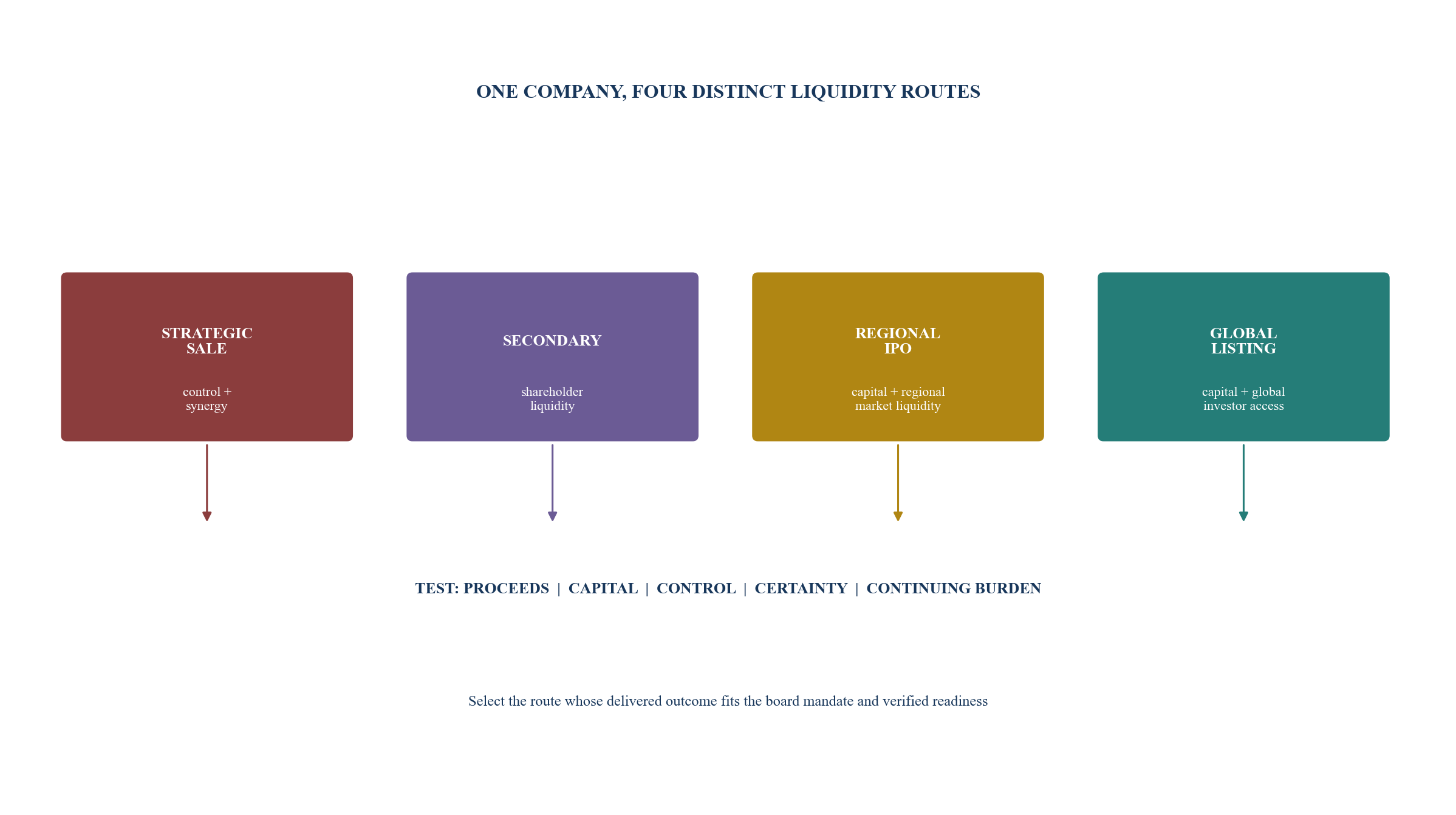
Author framework. Route selection begins with the required economic and control outcome.
2. Treat the route as an allocation of value and risk
Each route allocates value, execution risk and future upside differently. A strategic buyer can pay for revenue, technology, licences, distribution, data, talent or cost synergies that a financial investor cannot realise. That strategic premium becomes credible only when the buyer can obtain the rights, approvals and integration capability needed to capture it.
A secondary buyer generally values the stand-alone company and the rights attached to the purchased shares. It may accept a minority position, information rights and a longer holding period. The seller gains liquidity, while the company may receive no cash. Tabby's October 2025 announcement illustrates this distinction: existing investors sold shares, no new Tabby shares were issued and the company received no proceeds.[1]
A public offering converts part of the ownership into tradable securities and can create a future financing platform. The realised result depends on offer size, primary and secondary mix, price, allocation, free float, lock-ups and post-listing trading. Public valuation remains exposed to market conditions and company performance after admission.
The global-listing route adds a venue-selection decision. Investor depth, analyst coverage, sector comparables, currency, index eligibility, settlement, legal structure, reporting basis and governance expectations all matter. Wider access can create value when the company fits the market. Misalignment can create a thinly traded security and a continuing cost base without the expected liquidity.
Table 1. Exit objective and route scorecard
| Decision question | Strategic sale | Secondary | Regional IPO | Global listing |
|---|---|---|---|---|
| Who receives cash? | selling shareholders; company if primary capital is included | selling shareholders; company only if paired with new issuance | company and/or selling shareholders under the offer structure | company and/or selling shareholders under the offer structure |
| Control outcome | often control transfer | commonly minority ownership change | dispersed public ownership with retained control possible | dispersed public ownership with retained control possible |
| Principal value driver | buyer-specific synergy and scarcity | stand-alone growth, rights and future exit | regional relevance, earnings, growth and market demand | global comparables, scale, growth and institutional demand |
| Liquidity form | negotiated cash, securities and contingent value | negotiated cash for selected holders | market liquidity after admission, subject to free float and trading | market liquidity after admission, subject to free float and trading |
| Continuing burden | warranties, indemnities, covenants and integration | investor rights, transfer terms and future exit alignment | disclosure, governance, investor relations and market conduct | disclosure, governance, investor relations and multi-jurisdiction execution |
| Key completion risk | buyer diligence, financing, competition and sector approvals | price, buyer rights, transfer restrictions and shareholder consents | readiness, regulator, prospectus, demand, pricing and market window | structure, eligibility, regulator, demand, settlement and market window |
The board should score each item using verified company evidence and current professional advice.
3. Build a common decision unit
Routes should be compared through a common economic unit: probability-adjusted net value delivered to each stakeholder by a defined date, together with retained ownership and obligations.
For a selling shareholder, the calculation begins with cash at completion. It adds the present value of deferred or contingent payments and retained equity under explicit assumptions. It deducts transaction expense, tax under professional advice, escrow, holdback, dilution and the value impact of lock-ups or restrictions.
For the company, the calculation includes primary proceeds, transaction expense borne by the company, balance-sheet effects, required investment in readiness and continuing annual cost. It also includes strategic consequences such as buyer integration, public disclosure, acquisition currency and access to later capital.
Completion probability should be decomposed. Commercial agreement, financing, shareholder approval, regulatory approval, prospectus or registration clearance, market demand and operational readiness are separate gates. Multiplying unsupported probabilities creates false precision. The board should state the evidence and owner behind each assumption.
4. Understand what a strategic buyer can pay for
A strategic sale can monetise value outside a stand-alone financial model. A buyer may obtain customers, geographic access, licences, distribution, technology, data rights, supply, talent or time-to-market. Each source of value needs a route to capture.
Uber's acquisition disclosure provides an observable Gulf example. Uber stated that it completed the Careem acquisition after approvals in major markets and disclosed maximum aggregate consideration of approximately USD 3.1 billion, comprising up to approximately USD 1.7 billion of convertible notes and USD 1.4 billion in cash, subject to adjustments and holdbacks.[2] The filing also records that Careem and Uber continued to operate their regional services and independent brands at completion.
The example shows several transaction variables: mixed consideration, regulatory sequencing, geographic scope, holdbacks and post-completion operating design. The headline price does not describe the timing or form of shareholder value on its own.
A buyer map should identify the asset each candidate can use. A regional incumbent may value customer density and local permissions. A global buyer may value access and operating capability. A portfolio company may value product adjacency. A sovereign-linked or infrastructure buyer may value strategic capacity and long-term development.
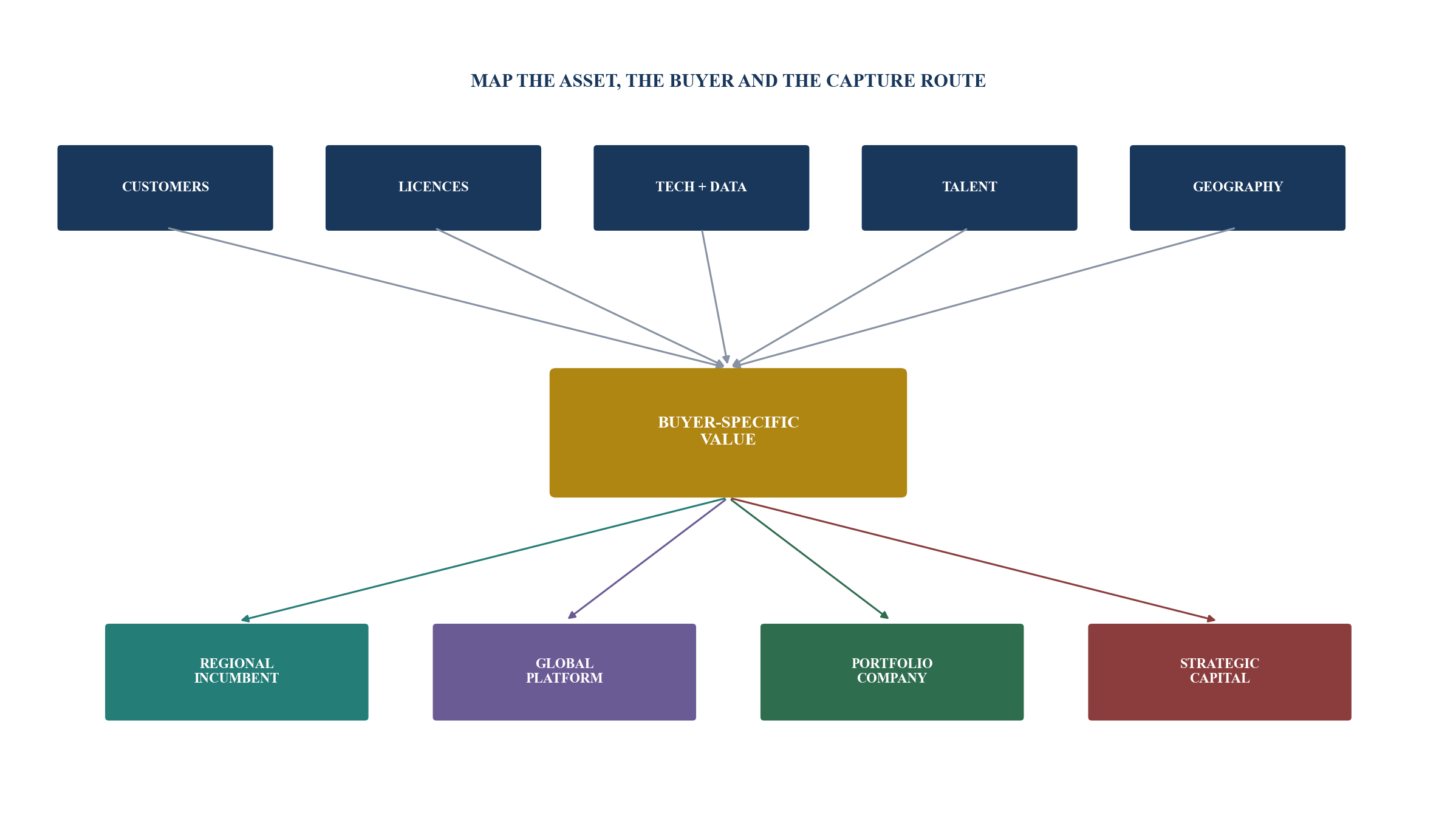
Author framework. Buyer interest requires a verifiable asset and a credible capture mechanism.
5. Make secondary liquidity a deliberate capital-allocation tool
A secondary transaction can rebalance the shareholder register without changing the company's issued share capital. It can provide partial liquidity to founders, employees or early funds, introduce a later-stage investor and establish an observed transaction price.
The company should decide why the transaction supports the operating plan. A controlled programme can relieve concentrated personal risk, address fund-life pressure, retain key people and bring a shareholder that can support a future financing or listing. An undisciplined process can create valuation conflict, information asymmetry and an investor-rights burden.
Transfer restrictions, rights of first refusal, pre-emption, tag-along, drag-along, board approvals and regulatory consents need current legal review. The price may differ from a primary financing because the buyer receives different rights, the company receives no capital, and the seller may have a specific liquidity need.
The board should document permitted sellers, maximum volume, eligible buyers, information rights, price-setting method, transaction costs and communications. Employee sellers need clear treatment and equal-access considerations. The cap table and beneficial ownership record should reconcile immediately after completion.
6. Separate a regional IPO from a generic IPO idea
A regional offering should be evaluated through the company’s economic relationship with the market. Revenue, customers, suppliers, regulation, brand, workforce, ownership and future acquisitions can create a natural regional investor case.
The talabat listing provides a disclosed example of scale. DFM reported that the December 2024 offering raised approximately AED 7.5 billion through the sale of 20 per cent of total issued capital, at an approximately AED 37.3 billion market capitalisation. DFM described local, regional and international demand and identified cornerstone participation.[3]
ADX describes Main Market and Growth Market options, issuer services and access to a large and internationally represented investor base.[4] Its official materials also describe book-building, digital subscription and governance preparation for growth companies.[5]
Saudi Exchange offers Main Market and Nomu routes. Its Q2 2025 capital-market report recorded three Main Market additions and ten Nomu additions during the quarter, with 256 Main Market and 123 Nomu listed companies at quarter end.[6] Venue data should be refreshed at the board decision date.
Regional alignment does not establish listing readiness. The issuer still needs audited financial information, governance, internal controls, prospectus work, legal structure, investor relations, a credible equity story and sufficient management capacity for continuing obligations.
Table 2. Transaction architecture by route
| Architecture item | Strategic sale | Secondary | Regional IPO | Global listing |
|---|---|---|---|---|
| Primary capital | optional | optional parallel issuance | possible | possible |
| Shareholder liquidity | negotiated at completion and later milestones | selected sellers at completion | secondary component and later market sales subject to restrictions | secondary component and later market sales subject to restrictions |
| Price formation | bilateral or auction negotiation | bilateral or organised tender | book-building and allocation | book-building and allocation |
| Due diligence audience | buyer, lenders, insurers and regulators | investor and relevant consents | regulator, exchange, banks, auditors, counsel and investors | regulator, exchange, banks, auditors, counsel and global investors |
| Main document | sale agreement and disclosure schedules | transfer or purchase agreement and rights documents | prospectus or offering document and underwriting documents | registration or prospectus documents and underwriting documents |
| Post-event structure | integrated, controlled subsidiary or retained stake | private company with revised cap table | listed company with continuing obligations | listed company with continuing obligations across the selected framework |
Exact structures and requirements depend on current law, regulation, exchange rules and transaction documents.
7. Treat a global listing as a product-market-fit decision
A global venue can be attractive when the company has material operations, customers, investors, comparables or strategic ambitions in that market. Sector-specialist research, institutional capital and acquisition currency can strengthen the case. These benefits require sufficient scale, free float, trading interest and a sustainable disclosure story.
The SEC states that a company undertaking a registered public offering must file a registration statement and may sell the covered securities after effectiveness. It also states that the company becomes subject to public reporting requirements.[7] The SEC identifies audited financial statements, business, financial condition, risks and management as core registration-statement content.[8]
NYSE's official IPO guide states that companies may spend six to twenty-four months or more preparing before formally commencing the transaction. It describes a typical formal IPO process of sixteen to twenty weeks or more, depending on readiness, complexity and market conditions.[9]
London Stock Exchange publishes admission and disclosure standards effective September 2025, alongside market-specific guidance.[10] Hong Kong's Technology Enterprises Channel, launched in 2025, provides a specialist engagement route for relevant biotechnology and specialist-technology applicants under its rules.[11]
The venue screen should compare eligibility, reporting basis, governance, prospectus or registration route, sponsor or underwriter role, investor depth, sector coverage, free float, settlement, currency, continuing disclosure, cost and management location. Qualified advisers should confirm every applicable requirement.
Table 3. Board venue-screen register
| Dimension | Evidence required | Board question |
|---|---|---|
| Eligibility | current exchange and regulator criteria mapped to issuer facts | can the issuer qualify under a clear route? |
| Investor fit | institution and analyst map, comparable issuers and tested feedback | is there a durable investor audience for this company? |
| Financial reporting | reporting basis, audit history, track record and timetable | can the financial package withstand public review? |
| Structure | issuer domicile, operating subsidiaries, licences and ownership | can the chosen structure list and preserve operating permissions? |
| Governance | board, committees, independence, controls and remuneration | can the company operate under the continuing framework? |
| Liquidity | free float, offer size, shareholder mix and market-making arrangements | can the security support credible price discovery and trading? |
| Capital plan | primary uses, secondary sell-down and follow-on capacity | does the venue solve the company's capital objective? |
| Continuing cost | reporting, legal, audit, IR, systems, insurance and management time | is the continuing burden funded and owned? |
Entries should be completed using current regulator and exchange materials and qualified professional advice.
8. Screen exit readiness through evidence
Exit readiness is a chain. The company needs a defensible strategy, repeatable earnings or growth evidence, clean ownership, controlled reporting, transferable rights, capable governance and an executable transaction process. A weak link can delay every route.
Financial readiness includes audited statements, management reporting, revenue recognition, working capital, forecasts, tax positions and a bridge from operational metrics to the ledger. Buyers and public investors need a consistent story across historical results, current trading and the plan.
Commercial readiness includes customer economics, concentration, retention, pipeline, pricing, market evidence and competitive position. Contract evidence should support revenue, margins, renewals, change-of-control treatment and service commitments.
Corporate readiness includes cap-table reconciliation, shareholder rights, options, beneficial ownership, board approvals, related parties and material disputes. Technology and data readiness includes intellectual-property ownership, licences, source-code control, cyber-security, privacy, resilience and third-party dependencies.
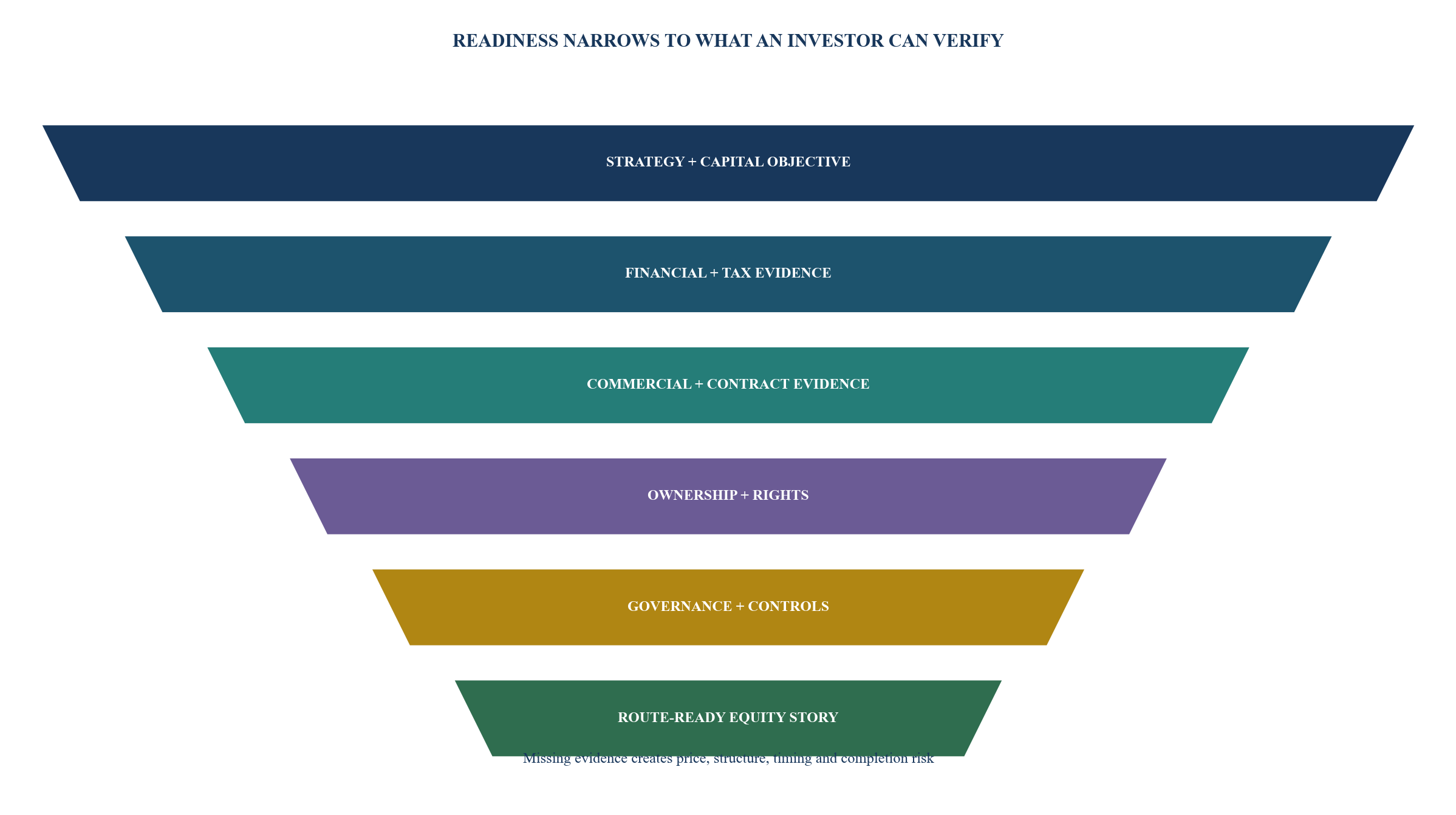
Author framework. Every gate needs an owner, evidence location and remediation date.
9. Build the equity story from reconciled facts
An equity story explains why the company can create cash and strategic value after the transaction. It connects market structure, customer need, competitive advantage, operating model, financial performance, management, capital use and risk.
The strategic-buyer version should explain the asset and integration thesis. The secondary-investor version should explain stand-alone growth, rights, governance and the future liquidity route. The public-market version should support recurring disclosure and comparison with listed peers.
Every operational metric should have a definition, owner and system of record. Revenue, bookings, gross merchandise value, annual recurring revenue, retention, order volume or users can mean different things across companies. The paper trail should reconcile the metric to contracts and financial statements.
Forecasts should be driver based. Customer additions, usage, price, retention, margin, investment and working capital create the financial plan. A management case should remain distinguishable from contracted or observed evidence. Downside cases should retain necessary compliance, service and investment costs.
10. Compare value after every adjustment
Enterprise value and equity value are starting points. Net proceeds depend on debt, cash, working-capital adjustments, leakage, transaction bonuses, options, preferences, tax, fees, warranties, indemnities, escrow and deferred consideration.
An IPO comparison also needs primary-versus-secondary allocation, dilution, underwriting and advisory expense, permitted sell-down, lock-up, cornerstone or anchor structure and continuing ownership. Future market value is uncertain and should be shown separately from cash delivered at completion.
A secondary transaction requires a security-level waterfall. Preference, conversion, participation, accrued dividends, option exercise and transaction costs can change proceeds by class. A strategic sale may trigger management incentives, retention awards and earn-outs.
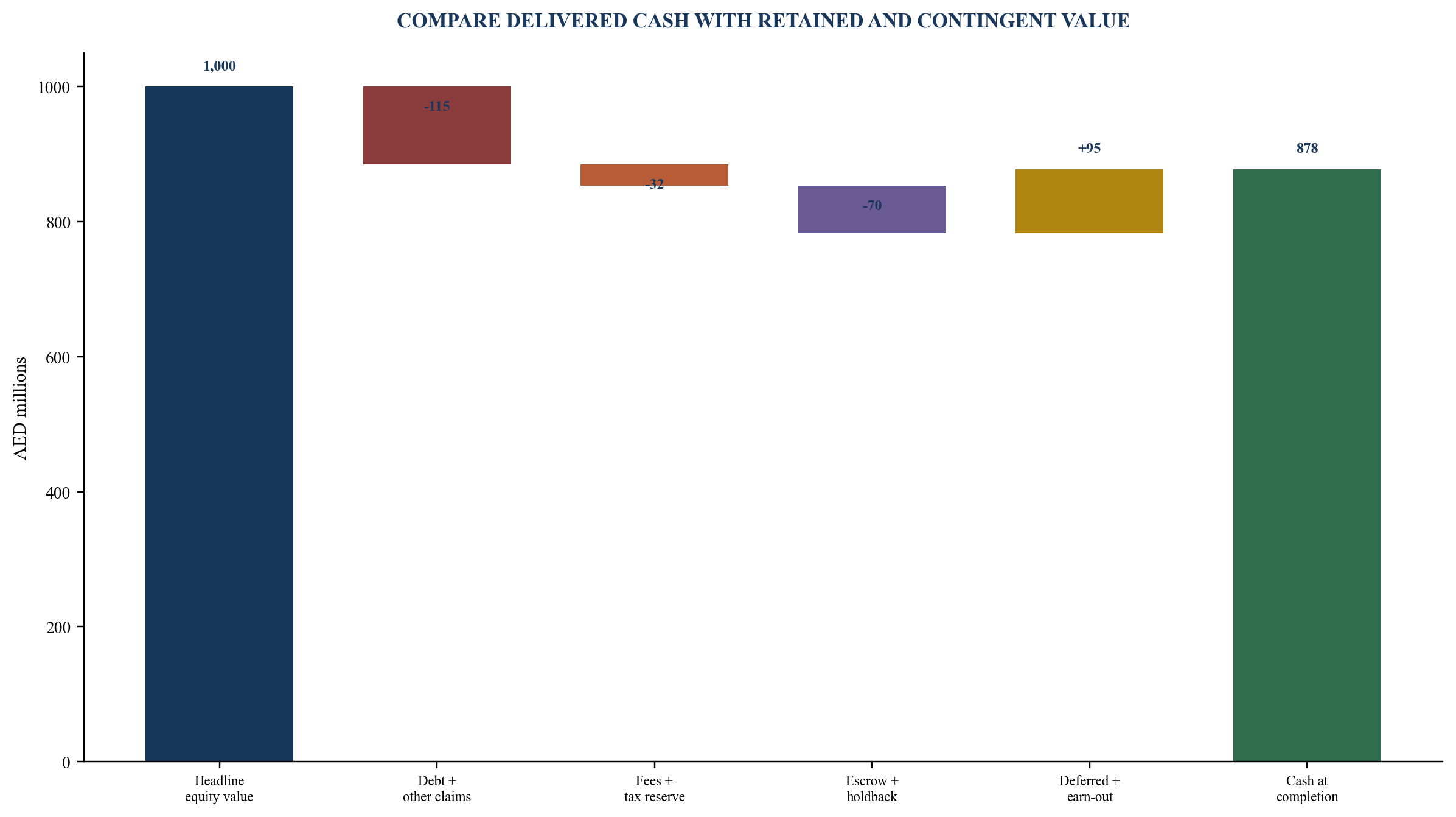
Every amount is a hypothetical management assumption in AED millions for method illustration.
11. Work a hypothetical founder and fund case
Consider a hypothetical Gulf software company with founders, employees, an early venture fund and growth investors. The company seeks AED 180 million of growth capital. The early fund seeks at least AED 120 million of liquidity within eighteen months. Founders want to retain operating influence and realise limited liquidity.
Every value, percentage, probability and timing assumption below is a hypothetical management assumption. The example shows how route outcomes can be compared; it does not forecast an actual company or transaction.
Table 4. Hypothetical route comparison for a Gulf software company
| Measure | Strategic sale | Secondary plus primary | Regional IPO | Global listing |
|---|---|---|---|---|
| Headline equity value, AEDm | 1,350 | 1,150 | 1,300 | 1,500 |
| New company capital, AEDm | 0 | 180 | 180 | 220 |
| Cash to existing holders at completion, AEDm | 1,080 | 170 | 195 | 180 |
| Founders' retained ownership after transaction | 8% | 36% | 31% | 29% |
| Management-estimated completion probability | 70% | 82% | 62% | 42% |
| Management-estimated months to completion | 9 | 6 | 14 | 20 |
| Estimated transaction cost borne by company, AEDm | 18 | 9 | 34 | 58 |
| Estimated annual continuing public-company cost, AEDm | 0 | 0 | 12 | 22 |
| Principal condition | competition and buyer approvals | rights, consents and financing | readiness, demand and regulator | structure, eligibility, readiness and demand |
All values and probabilities are hypothetical management assumptions for method illustration.
The strategic sale delivers the largest immediate shareholder liquidity in the assumption set and transfers control. The secondary-plus-primary route meets the company-capital and fund-liquidity objectives while retaining a private structure. The IPO routes provide capital and future market access, with less immediate liquidity and continuing obligations.
Probability adjustment does not replace judgment. The board should test the consequence of delay, failure and information leakage. It should also assess how each process affects customers, employees, regulators, financing and management attention.
12. Measure market-window and financing risk
Public offerings depend on a market window. Comparable-company performance, volatility, investor flows, sector news, competing offerings and geopolitical conditions can affect demand and price. A company can be operationally ready while the transaction window is closed.
Strategic transactions also carry financing risk. A buyer may rely on debt, equity issuance or investment-committee approval. The sale agreement should allocate financing and completion risk with current legal advice.
Secondary transactions can fail through price disagreement or rights complexity. A new investor may request preferences, vetoes, anti-dilution, redemption or information rights that affect the future exit.
The execution plan should preserve liquidity. A delayed exit can require bridge capital, covenant waivers or reduced investment. The board needs a funded stand-alone plan through the expected process and a downside period.
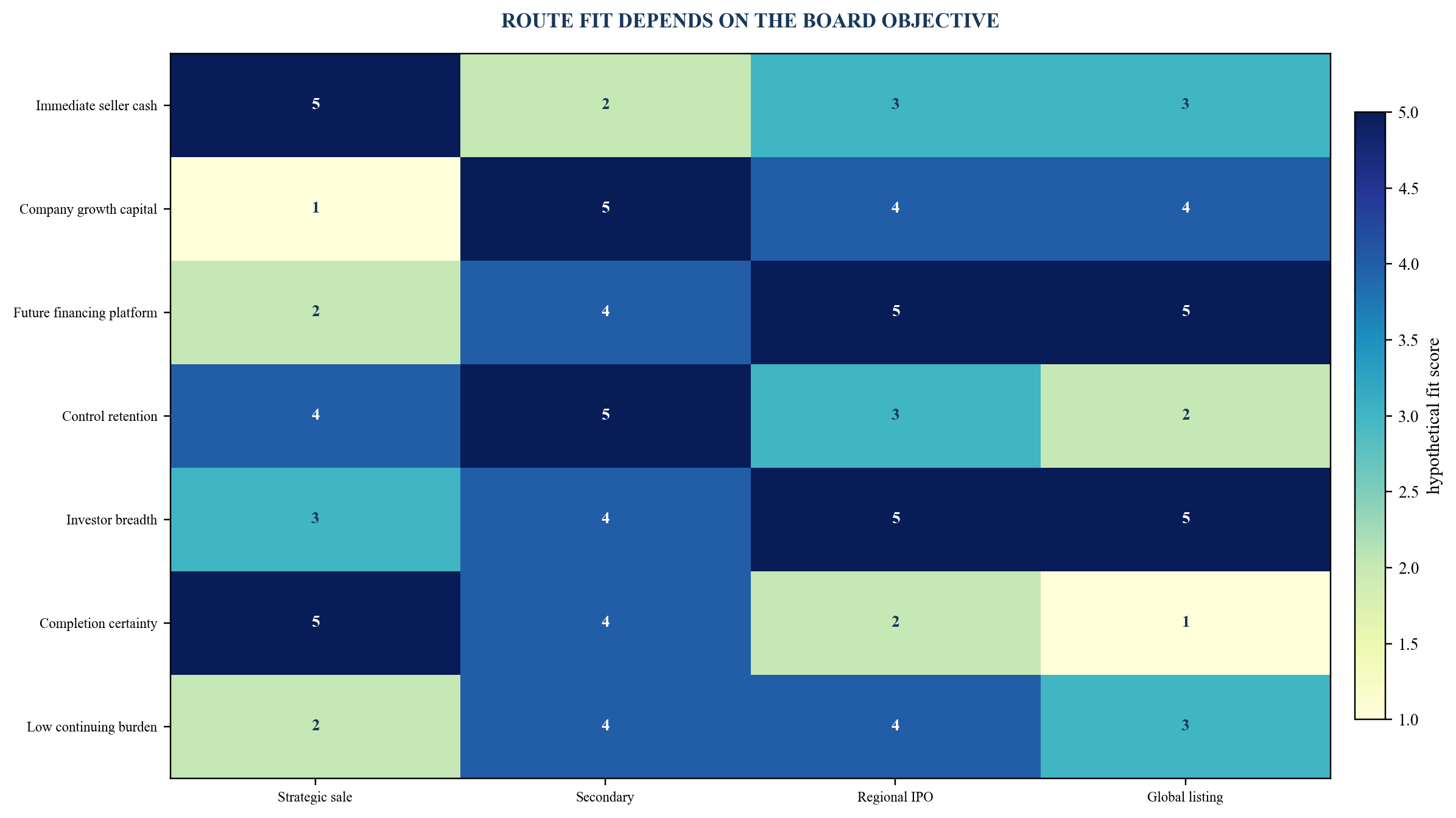
Scores are hypothetical management assumptions from one to five; five indicates stronger alignment with the stated objective.
13. Use dual-track only when both tracks are credible
A dual-track process can develop a strategic sale and IPO in parallel. It can preserve optionality, establish a timetable and reveal how private buyers and public investors value the company.
It also duplicates work and increases confidentiality, capacity and coordination risk. Management can face buyer diligence, prospectus drafting, auditor work, investor education and daily operations at the same time.
The two tracks should share a single verified data room, financial model and equity story. Route-specific materials can then explain buyer synergies or public-market comparables without creating inconsistent facts.
The board should establish switch points. These can include minimum strategic value, acceptable consideration, regulatory confidence, public-market valuation range, investor demand, readiness milestones and available cash runway. A dual track without explicit gates can continue long after one route has lost credibility.
14. Map regulation and approvals early
Transaction law follows the facts. Competition, foreign investment, sector licences, public-offer rules, listing requirements, sanctions, data, employment, tax and shareholder approvals can apply across several jurisdictions.
The DFSA describes listing on its Official List and admission to trading on an authorised market institution as two stages. Its official materials identify prospectus, sponsor and eligibility work under the applicable framework.[12] SCA provides public-joint-stock-company registration and offering-related regulatory services for relevant UAE transactions.[13]
The SEC distinguishes registered offerings and continuing reporting. European Union prospectus rules establish prospectus requirements for public offers and regulated-market admission, subject to scope and exemptions.[14] The European Commission states that the Listing Act amended prospectus requirements and introduced streamlined forms for eligible issuers.[15]
A legal-entity map should connect every operating licence, contract, employee, asset, intellectual-property right, data flow, debt instrument and shareholder to the proposed issuer or buyer perimeter. Any pre-exit reorganisation needs tax, accounting, regulatory, creditor and contractual analysis.
15. Protect the business during the process
Exit work creates information and management risk. Confidential materials should follow access, watermarking, clean-team and retention controls appropriate to the process. Commercially sensitive data can require staged access.
The company needs a communications protocol for employees, customers, suppliers, investors and media. Public-offer communications are regulated. DFM publishes an IPO communications guide and reminds issuers that disclosure obligations continue on listing.[16]
Management incentives should support the transaction and the stand-alone plan. Retention, transaction bonuses and equity treatment need board approval, documentation and tax advice. The programme should maintain customer service, reporting and cyber-security while senior teams are occupied.
The board should monitor process cost, management time, employee attrition, customer concerns, financing headroom and operating performance. A value-maximising process can lose value if the company misses its plan.
16. Build one controlled diligence room
The diligence room should be organised by evidence owner and route. Corporate, finance, tax, commercial, operations, technology, people, legal, regulatory, insurance and sustainability workstreams should use current documents and a question log.
The disclosure process matters. A strategic buyer receives representations and schedules through negotiated documents. Public investors receive a prospectus or registration statement governed by applicable law. Material information should be consistent across management presentations, financial statements, diligence answers and transaction documents.
Red flags should be resolved or priced. Missing intellectual-property assignments, inconsistent customer metrics, unrecorded related parties, weak revenue evidence, tax exposures, licence restrictions and option errors can change value and timing.
Table 5. Exit-readiness diligence register
| Workstream | Core evidence | Route-specific test |
|---|---|---|
| Ownership and governance | incorporation, cap table, beneficial ownership, options, rights, minutes and delegations | confirm sale, transfer, issuance and listing approvals |
| Financial reporting | audited statements, monthly close, policies, ledger, forecasts and cash | reproduce earnings, debt, cash, working capital and route adjustments |
| Commercial | contracts, cohorts, pipeline, pricing, concentration and market evidence | verify change-of-control, disclosure and investor-story claims |
| Tax and structure | filings, assessments, transfer pricing, withholding, residence and reorganisation | model transaction and continuing tax with qualified advisers |
| Technology and data | IP chain, licences, architecture, security, privacy, resilience and vendors | confirm transferability and public disclosure of material dependence |
| People | contracts, incentives, options, retention, disputes and succession | model vesting, change-of-control, lock-up and public remuneration effects |
| Regulation and legal | licences, approvals, litigation, compliance and jurisdiction map | identify regulator, competition, foreign-ownership and listing gates |
| Public-company readiness | board, committees, controls, disclosure, IR, calendar and systems | demonstrate continuing operation from the first reporting period |
The final scope depends on company facts, route and jurisdictions.
17. Price the post-transaction operating model
A strategic buyer needs an integration thesis. Day One authority, customer continuity, licences, people, systems, data and reporting require owners. Synergy should be separated into revenue, cost, capital and risk, with implementation cost and timing.
A secondary transaction changes governance. Board seats, reserved matters, information, future financing, transfer and exit rights need an operating calendar. The company should avoid rights that block the agreed strategy or future institutional capital.
A listed company needs disclosure controls, close discipline, investor relations, board and committee calendars, insider controls, dealing policies, governance reporting and market communications. These activities need people, systems and budget before admission.
The transaction model should include the first two years of continuing cost. Public-company expense may include audit, legal, reporting, exchange and regulator fees, investor relations, directors, insurance, systems and additional finance capacity. Every estimate should be refreshed against the selected venue and company scope.
18. Establish a route-independent 180-day programme
The first phase defines objectives, reconciles ownership and stabilises reporting. The second phase tests the equity story, buyer map, investor map and venue screen. The third phase remediates material gaps and prepares the controlled diligence room.
Only then should the company commit to full execution expense. Early adviser dialogue can identify eligibility and timing issues. Formal mandates should have scope, deliverables, decision gates and conflicts controls.
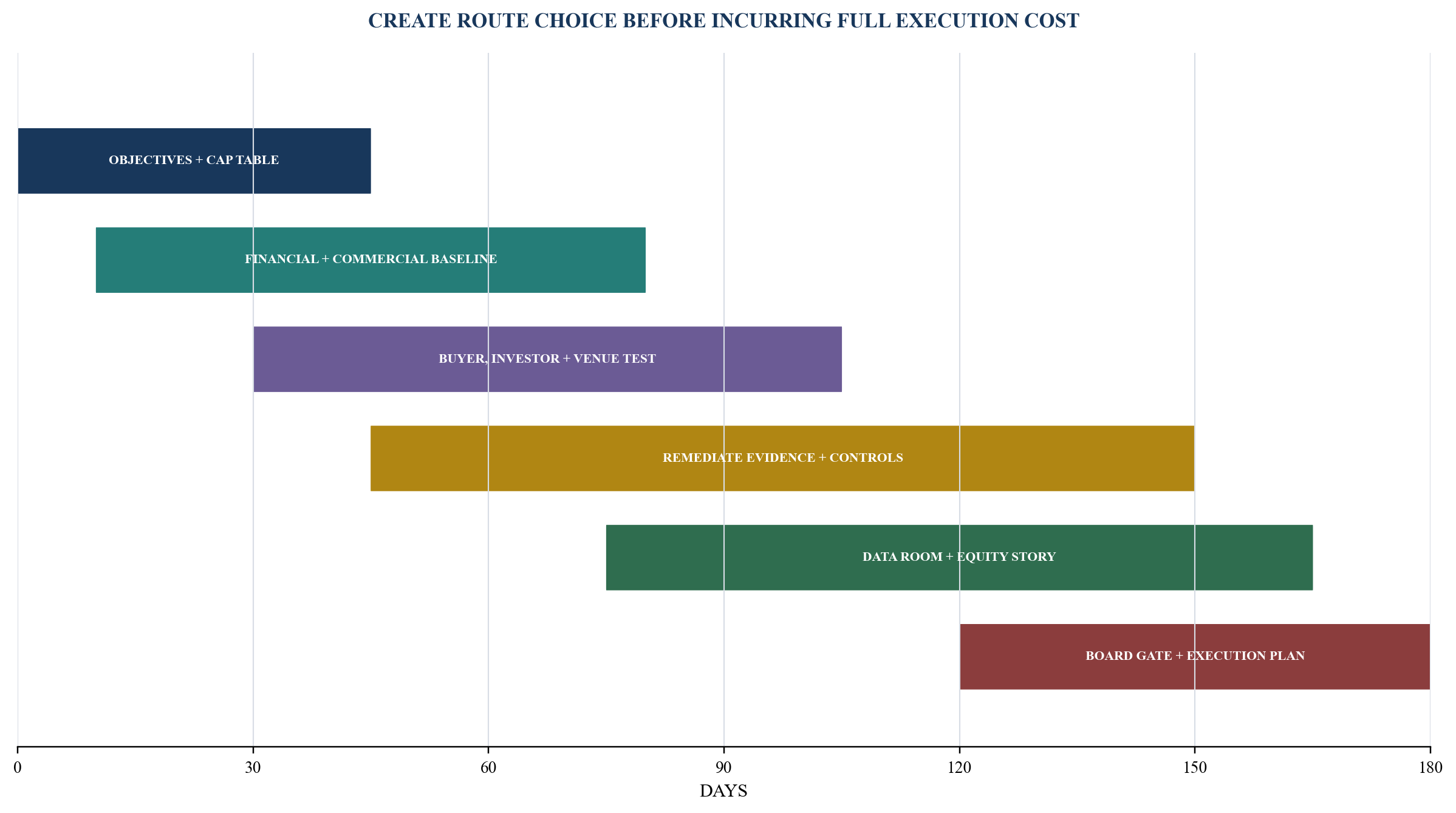
Author framework. Timing should be adapted to company evidence and route complexity.
19. Put a board gate ahead of launch
The board paper should state the objective, route, expected proceeds, primary capital, shareholder liquidity, retained ownership, control, key conditions, timetable, cost, cash runway and credible fallback.
It should show evidence quality. Observed facts, contracted values, professional-adviser conclusions and hypothetical management assumptions belong in separate fields. The board can then see where further work could change the decision.
Table 6. Board exit-route gate
| Gate | Evidence | Board response |
|---|---|---|
| Objective fit | stakeholder proceeds, company capital, ownership and control model | approve objective or redefine mandate |
| Value | route valuation, security waterfall, adjustments and probability cases | set reservation value and structure limits |
| Readiness | financial, commercial, corporate, technology, people and governance report | remediate, disclose, price or pause |
| Market and counterparty | buyer funding, investor feedback, comparables, venue and window | launch, delay or change route |
| Regulation | jurisdiction and approval map confirmed by qualified advisers | approve conditions and timetable |
| Resilience | stand-alone plan, liquidity runway, customer and employee protection | fund the process and downside period |
| Execution | advisers, responsibilities, data room, communications and decision calendar | authorise controlled launch |
Thresholds should be approved for the company and refreshed before launch.
The board can authorise one route, a bounded dual track, a preparatory phase or a pause. The resolution should identify delegated authority, price and structure limits, information controls and reporting frequency.
20. Preserve choice through operating performance
The best exit leverage comes from a business that can continue to create value without a transaction. Customers renew, cash remains controlled, reporting closes on time and management executes the plan.
Route preparation should improve the company. A reconciled cap table, stronger controls, clearer customer economics, transferable intellectual property, better governance and a funded plan are useful across a sale, secondary or listing.
The board should update route fit as facts change. A new strategic buyer, stronger regional market, weaker global comparable set, fund-life deadline, licence change or capital need can alter the ranking. The framework makes that update explicit.
Conclusion
The Gulf exit stack offers four distinct outcomes. A strategic sale can monetise buyer-specific value and transfer control. A secondary can provide targeted shareholder liquidity while keeping the company private. A regional IPO can connect capital and ownership to the company’s economic market. A global listing can access a wider investor universe when the issuer has sufficient scale, fit and readiness.
The board decision should compare probability-adjusted net proceeds, new company capital, retained ownership, control, timing, completion conditions and continuing burden. Headline valuation is one input.
Exit readiness is an operating discipline. Reconciled ownership, reliable reporting, verified commercial metrics, transferable rights, current regulation, capable governance and a controlled diligence room preserve choice and improve execution.
References
- Tabby, Tabby announces completion of secondary share sale, 28 October 2025, https://tabby.ai/en-AE/newsroom/secondary-share-sale?categoryId=blog-1756131374867-zcw1jq6
- United States Securities and Exchange Commission, Uber Technologies Form 8-K, Uber Completes Acquisition of Careem, 2 January 2020, https://www.sec.gov/Archives/edgar/data/1543151/000155278120000051/e20009_uber-8k.htm
- Dubai Financial Market, talabat Debuts on Dubai Financial Market, 10 December 2024, https://feeds.dfm.ae/documents/2024/Dec/10/d77e9dd5-98d1-4112-9542-5fcfb794cf33/talabat%20Debuts%20on%20Dubai%20Financial%20Market%20in%20Largest%20Global%20Tech%20IPO%20This%20Year%20-%20EN.pdf
- Abu Dhabi Securities Exchange, Issuing with ADX, https://www.adx.ae/Issuers/Why%20List/Overview
- Abu Dhabi Securities Exchange, Navigating the Path to Capital: A Guide for Startups and SMEs on the ADX Growth Market, 8 May 2026, https://www.adx.ae/about-adx/knowledge-center/adx-op-eds/adx-growth-market-entrepreneur-questions-and-answers
- Saudi Exchange, Capital Market Overview Report, Second Quarter 2025, https://www.saudiexchange.sa/wps/wcm/connect/fb308aba-71a3-41e5-a596-f2bc2f863ec1/Q225CMR%2B%281%29.pdf?MOD=AJPERES
- United States Securities and Exchange Commission, Going Public, https://www.sec.gov/resources-small-businesses/going-public
- United States Securities and Exchange Commission, What is a Registration Statement?, https://www.sec.gov/resources-small-businesses/going-public/what-registration-statement
- New York Stock Exchange, NYSE IPO Guide, https://www.nyse.com/ipo
- London Stock Exchange, Admission and Disclosure Standards, effective September 2025, https://docs.londonstockexchange.com/sites/default/files/documents/admission-and-disclosure-standards_0.pdf
- Hong Kong Exchanges and Clearing, Technology Enterprises Channel, updated 17 October 2025, https://www.hkex.com.hk/listing/rules-and-resources/guidance/ipo/technology-enterprises-channel?sc_lang=en
- Dubai Financial Services Authority, Markets Brief: Getting Ready to List, https://www.dfsa.ae/application/files/9115/8425/5315/Markets_Brief_-_Issue_16_Getting_ready_to_list_FINAL.pdf
- Securities and Commodities Authority, Registration of a Public Joint Stock Company, https://www.sca.gov.ae/en/services/services-catalogue/registration-of-public-joint-stock-company.aspx
- European Union, Regulation (EU) 2017/1129 on the prospectus to be published when securities are offered to the public or admitted to trading, consolidated text, https://eur-lex.europa.eu/eli/reg/2017/1129/2024-01-09/eng
- European Commission, Listing Act prospectus amendments, Commission Delegated Regulation C(2026) 1372, https://eur-lex.europa.eu/legal-content/EN/TXT/?uri=pi_com%3AC%282026%291372
- Dubai Financial Market, DFM Guide on IPO Communications, https://api.dfm.ae/docs/default-source/default-document-library/dfm-guide-on-ipo-communications.pdf?sfvrsn=e151b18e_0
About the Author
Chennakeshav Adya is an independent researcher and Managing Partner of Matchpoint Partners. His work examines strategy, capital formation, valuation, transactions and operating execution across private and public markets.
