

1. Treat completion as the start of stabilisation
A distressed acquisition can close before the acquired company is stable. Ownership may move in a few hours while cash collection, supplier confidence, staff authority and customer service remain exposed. The first thirty days therefore need a defined operating system. The buyer must establish who can decide, what cash is genuinely available, which obligations keep the business trading and which customer promises must be protected. These actions convert legal control into practical control.
The stabilisation period should begin with a small set of outcomes. The company must know its unrestricted cash every day, approve payments through a controlled hierarchy, deliver critical customer commitments, retain essential people, protect key systems and produce a credible forward view. Longer-term transformation can begin only after these foundations become reliable. An ambitious hundred-day programme without an effective day-one control environment can consume scarce management attention while near-term liquidity deteriorates.
This paper proposes a thirty-day framework linking cash, authority and confidence. It integrates an evidence map, a daily liquidity model, a stakeholder continuity plan, a risk-control matrix and a sequenced implementation roadmap. It is designed for adaptation by the buyer, directors, insolvency specialists, lenders and professional advisers. Actual duties, approvals and transaction mechanics depend on the jurisdiction, process and acquisition documents.
The framework deliberately joins financial and operating evidence. Cash cannot be interpreted without the customer delivery and supplier commitments that create it. Service performance cannot be interpreted without the funding and authority required to sustain it. Confidence is an outcome of consistent delivery, clear governance and credible information. Treating these dimensions together creates a more useful stabilisation record than three independent workstreams.
2. Define the stabilisation perimeter before completion
The acquisition perimeter does not automatically describe the operating perimeter. Assets may transfer while licences, contracts, data, bank mandates, employees or shared services remain outside the buyer's control. The team should map each critical business service to the resources required to deliver it and record whether each resource transfers, continues temporarily or needs replacement. This map must be completed before the first payment run whenever the process timetable permits.
The perimeter review begins with customer outcomes. For an industrial-services company, these may include dispatching field teams, maintaining safety controls, procuring parts, completing work, certifying delivery, invoicing and collecting cash. Each outcome depends on named people, applications, equipment, premises, data, suppliers and authorities. A generic asset list does not reveal whether the business can complete an end-to-end transaction.
The team should identify excluded assets and dependencies explicitly. A missing domain name, vendor consent, fleet insurance endorsement or administrator credential can interrupt service even when the headline assets have transferred. Each gap needs an owner, an interim workaround, a deadline and a decision consequence. If the gap prevents safe or lawful operation, it should remain a completion condition or require a transaction-specific contingency approved by qualified advisers.
3. Establish lawful authority and a decision hierarchy
Distress compresses decisions and increases the cost of ambiguity. The buyer should issue a day-one authority matrix covering bank access, purchase commitments, customer credits, contract changes, hiring, dismissals, communications, litigation and access to systems. Every material decision needs a named accountable executive, a monetary or risk threshold and an escalation path. Delegations should be recorded in the acquired entity's governance documents and reconciled with bank mandates and system permissions.
The matrix should distinguish board authority, executive authority and operating authority. A site manager may need to authorise an emergency safety purchase while a revised customer contract requires legal and commercial approval. Finance should prevent unauthorised cash movement without blocking essential operations. Temporary controls can be more restrictive during the first week, provided that the company creates a rapid route for urgent exceptions.
The authority record should also state who may communicate with employees, customers, suppliers, lenders and regulators. Conflicting messages can reduce confidence faster than a delayed message. A single transaction command centre can coordinate facts, approvals and stakeholder sequencing. Its mandate should be narrow, time-bound and visible to the operating leadership so that emergency governance does not become a parallel organisation.
Table 1. Opening-balance evidence map
| Area | Minimum evidence | First decision |
|---|---|---|
| Cash | Bank statements, online balances, restrictions and reconciliation | Confirm unrestricted opening cash |
| Receivables | Invoice, acceptance, dispute, assignment and collection owner | Set receipt date and action |
| Payables | Invoice, goods received, criticality, due date and security | Approve, negotiate or defer |
| People | Payroll population, terms, deductions and funding file | Protect payroll and essential roles |
| Operations | Customer commitment, resource requirement and delivery status | Fund or redesign delivery |
| Systems | Asset, owner, administrator, dependency and recovery evidence | Secure access and backup |
Proposed management record. Actual evidence and decisions depend on the transaction, jurisdiction and specialist advice.
4. Build the opening balance evidence pack
The opening cash number must be proved rather than inherited from the seller's ledger. The finance team should obtain bank statements, online balances, bank reconciliations, blocked-account terms, card and payment-provider balances, cash-in-transit records and details of any security or set-off rights. Restricted or disputed cash should be separated from funds available for ordinary operations. The time of each balance matters because distress can produce rapid movements around completion.
The pack should reconcile receivables, payables, payroll, taxes, customer deposits, supplier advances and outstanding purchase commitments. A nominal receivable may be disputed, assigned, subject to set-off or impossible to collect without completing further work. A supplier balance may omit goods received, subcontractor claims or cash-on-delivery requirements. The team needs an operationally informed cash view rather than a simple extract from the general ledger.
Each material balance should carry an evidence grade. Bank-confirmed and contract-supported items have a different status from management estimates. Unknowns should remain visible and receive owners. This approach prevents false precision and focuses diligence after completion. The evidence pack becomes the baseline for daily cash reporting, purchase decisions and the first board review.
The opening position also needs a cut-off protocol. Receipts and payments around completion should be assigned to the correct entity and reflected in the purchase agreement's mechanics. Duplicate payment, missing cash and disagreement over collected receivables can otherwise consume the first week. Finance, legal and transaction teams should reconcile the cut-off against bank value dates, invoices, contractual ownership and any completion accounts or locked-box provisions.
Table 2. Thirty-day cash-control fields
| Field | Required content | Control owner |
|---|---|---|
| Opening cash | Bank-confirmed unrestricted balance by entity | Treasury |
| Receipt | Customer, invoice, date, amount, status and collection action | Commercial and finance |
| Payment | Beneficiary, purpose, due date, criticality and authority | Finance and operations |
| Variance | Forecast, actual, explanation and corrective action | Cash forecast owner |
| Trigger | Threshold, decision, evidence and escalation deadline | CFO and board |
Proposed control design. Payment priority and directors duties require transaction-specific professional advice.
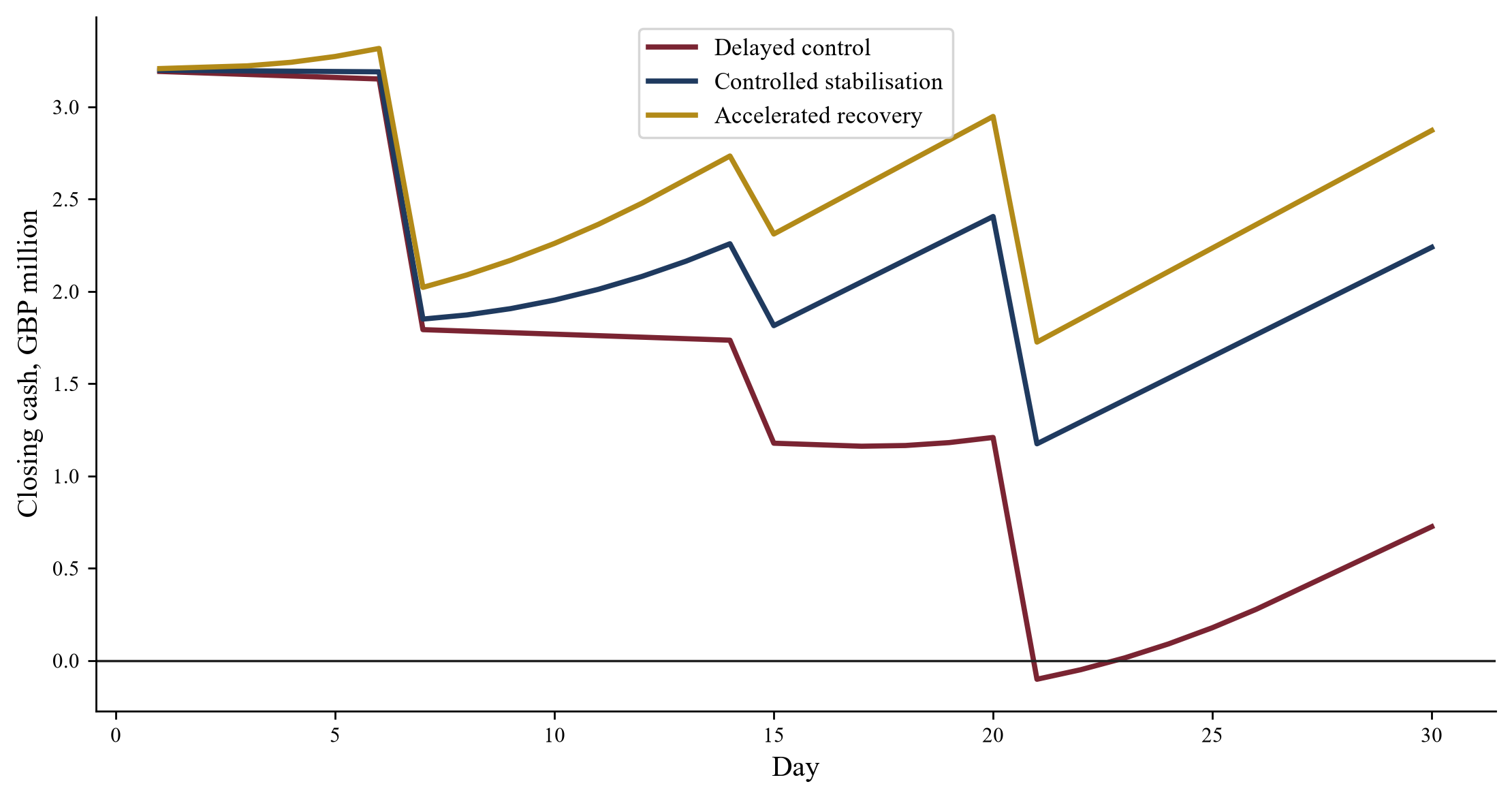
Author assumptions only. The lines are analytical cases without empirical calibration or assigned probability.
5. Convert the thirteen-week forecast into a thirty-day command tool
A thirteen-week cash-flow forecast remains useful, but the first month requires daily resolution. Payroll dates, rent, taxes, insurance, supplier releases and customer receipts can create intraday pressure that weekly columns conceal. The team should build a daily direct cash flow for at least thirty days and retain the weekly forecast for the wider horizon. Both views should reconcile to the same opening balance and bank evidence.
Receipts should be modelled by named customer, invoice, expected date and collection owner. Payments should be listed by legal entity, beneficiary, purpose, due date, criticality and approval status. The model should distinguish contractual due dates from proposed payment dates. Delaying a payment may preserve cash while damaging supply, triggering termination or creating personal and statutory risk. Qualified advisers should determine the applicable duties and priorities.
The forecast becomes a command tool when every variance produces an action. A missed receipt needs a collection call, revised probability, service review and possible customer escalation. A supplier demand for prepayment needs an operational consequence and negotiation owner. The daily meeting should approve actions and update the evidence, rather than merely discuss a changing number.
Model governance is part of cash control. The team should lock formulas, identify inputs, retain versions and require an independent review of material changes. The forecast owner should reconcile yesterday's expected closing cash to today's bank-confirmed opening cash. Unexplained differences should be investigated before new discretionary payments are approved. This discipline converts the forecast from a presentation into a reliable operating ledger.
6. Ring-fence cash and control payments
The acquired company needs bank and payment controls that the buyer can operate immediately. The team should establish authorised signatories, dual approval, payment limits, beneficiary controls, emergency procedures and independent bank reconciliation. Access belonging to former owners or seller-group employees should be revoked or bounded. New credentials and audit logs should be tested before the first payment file is released.
Payment decisions should follow a documented hierarchy connected to continuity. Payroll, safety-critical suppliers, utilities, insurance, taxes and customer delivery may require priority, subject to legal advice and the company's obligations. A payment committee can review the thirty-day forecast, the operational consequence of non-payment and the evidence supporting each request. It should avoid blanket freezes that preserve the bank balance while stopping revenue generation.
Cash control also includes collections. Customer receipts should reach verified company accounts, and sales teams should use approved payment instructions. Changes in bank details are a fraud risk during a visible transaction. The company should confirm instructions through trusted channels and monitor unusual payment requests. Daily reconciliation links each bank movement to the forecast and exposes leakage quickly.
A short liquidity reserve can protect execution from forecast error. Its size should reflect payroll, critical supplier exposure, collection concentration and the time needed to obtain further funding. The reserve should have an explicit release authority and should not be counted twice as both operating cash and contingency. A board-approved minimum-cash trigger makes the escalation point visible before payments become impossible.
7. Protect the revenue engine
The buyer should identify the small group of customer commitments that drive cash, reputation or strategic value. These may include a major project milestone, a recurring service run, a regulatory deliverable or a renewal decision. Each commitment needs an owner, delivery status, resource map, contractual consequence and customer contact plan. The aim is to prevent operational noise from obscuring the revenue events that determine survival.
The order-to-cash chain should be tested end to end. The company must be able to accept an order, allocate resources, deliver, obtain customer acceptance, issue a valid invoice, resolve disputes and collect into a controlled account. A broken link can leave reported revenue without cash. Daily reporting should therefore show delivery blockers, uninvoiced completed work, disputed invoices, promised payment dates and actual receipts.
Commercial concessions need discipline. Customers may seek price reductions or broader protections when they detect distress. A controlled concession can preserve a valuable relationship, while uncoordinated discounts can destroy cash. The authority matrix should define who may amend terms, and each concession should record its expected cash and relationship effect. Legal review is necessary where the transaction changes contractual rights or representations.
8. Rebuild customer confidence with evidence
Customers usually want evidence that the new owner can continue delivery. The communication should explain the operating facts that matter to them: ownership, continuity contacts, service arrangements, invoicing details, support routes and any required consent. It should avoid unsupported reassurance. A specific continuity plan, named executive and verified delivery milestone are more credible than a broad statement that business continues as usual.
Customer segmentation determines the sequence. Strategic accounts, customers with termination rights, customers holding large deposits and customers approaching renewal may require direct executive engagement. Smaller accounts can receive a coordinated written notice and service channel. The company should track questions, concerns, concessions and churn signals in a single log. Repeated concerns may reveal an operating weakness that needs correction.
Confidence grows through performance. The first thirty days should include visible proof points such as an on-time delivery, resolved backlog, accurate invoice or restored response time. Each proof point should be measured and communicated appropriately. The buyer should also prepare a response for incidents, acknowledging the issue, explaining the corrective action and providing the next update time without disclosing confidential transaction information.
9. Stabilise critical suppliers
Suppliers may shorten terms, demand deposits, suspend shipments or withdraw service when distress becomes visible. Government guidance identifies the loss of trade credit and trade credit insurance as factors that can intensify financial distress [1]. The buyer needs a critical-supplier map that links each supplier to customer service, inventory, alternatives, outstanding balances, contractual rights and the cash needed to maintain supply.
Priority should reflect operational consequence and replaceability. A low-spend software licence or specialist component can be more critical than a large commodity supplier. The team should contact essential suppliers with a verified account of the transaction, a forward purchasing plan and a clear payment proposal. Commitments should match the cash forecast. Promising accelerated payment without approved funding transfers the crisis into the following week.
Supplier stabilisation can use several lawful, agreed tools: partial payment against release, direct settlement for new supply, shorter order cycles, escrow, consignment, substitute sourcing or revised credit support. Each structure changes risk and control. Legal, tax, insolvency and financing specialists should validate the terms. The operating team should record the service protected, cash consumed, duration and exit route.
The buyer should watch second-tier dependencies. A direct supplier may appear stable while relying on a specialist subcontractor, carrier, utility connection or software provider that has suspended support. Procurement should ask critical suppliers to identify the dependencies that could prevent delivery during the next thirty days. Where concentration is material, the roadmap should establish inventory buffers, alternative routes or direct engagement.
10. Secure payroll and essential people
Employees assess a distressed transaction through payroll certainty, leadership visibility, workload and career prospects. The buyer should prove the payroll population, bank file, funding requirement, tax and benefit obligations, approvers and processing calendar. A parallel calculation or controlled sample test can expose missing employees, incorrect rates or legacy deductions. Payroll funding should appear as a named event in the daily cash model.
The company should identify roles whose departure would stop customer service, safety, cash collection, system administration or legal compliance. Retention decisions should be role-based and supported by the authority matrix. Financial incentives may help, but role clarity, credible leadership, workload management and a visible future operating model also affect retention. Any arrangement must follow applicable employment, tax and insolvency advice.
Business transfers can engage employment protections and information or consultation obligations. UK Government guidance explains that TUPE may apply to qualifying transfers and that affected employees may have rights [8]. The transaction team must obtain jurisdiction-specific advice and execute the required process. The stabilisation plan should never treat employment compliance as a communications task alone.
11. Keep safety and regulated obligations outside the cash contest
Distress can create pressure to defer maintenance, training, inspections or specialist coverage. The first-day plan should identify obligations whose failure can harm people, stop operations, invalidate insurance or breach a regulatory requirement. These items need protected owners, evidence and escalation. Finance should understand the consequence of withholding payment, and operating leaders should demonstrate that each request is necessary and correctly priced.
The company should verify permits, licences, competent persons, incident reporting, insurance and critical maintenance status. The acquisition may change a named licensee, responsible person or insured entity. A document that existed under the seller may not automatically protect the buyer. Counsel and technical specialists should confirm the position before reliance.
Safety and compliance indicators should enter the daily command pack when risk is immediate. The pack can show overdue inspections, critical defects, staffing gaps, reportable incidents and actions due. A red item should have a decision time and an accountable executive. Commercial urgency does not lower the required standard; it increases the need for visible control.
12. Take control of systems, identities and cyber risk
The buyer should inventory the systems and digital assets that support critical services, including cloud tenants, domains, certificates, code repositories, integration keys, backups and vendor portals. The NCSC advises organisations to document critical assets and their dependencies and notes that acquisitions add complexity [4]. The inventory should connect each asset to an operating outcome, owner, administrator, recovery method and access status.
Privileged access requires immediate attention. Shared accounts, former-owner credentials and unknown third-party access weaken control. The company should create named administrator accounts, enforce strong authentication, retain logs, review high-risk access and define emergency recovery. Changes must be sequenced carefully because an untested credential reset can stop operations.
The first thirty days should include backup verification, vulnerability triage and incident response contacts. A backup is useful only if the company can access and restore it. The team should confirm who owns the data, where copies reside and which parties can approve restoration. A transaction-specific cyber plan should balance containment with service continuity.
13. Govern data transfer and continued sharing
The acquired company may continue to share customer, employee and supplier data with the seller or service providers. The ICO's M&A guidance calls for organisations to establish what data transfers, identify the original purposes and lawful basis, document the sharing and maintain security [3]. The legal analysis remains specific to the facts, roles and jurisdictions.
The team should create a data map covering systems, datasets, fields, purposes, recipients, retention, locations and access. It should distinguish transferred records from continuing shared access. Data should be limited to what the service requires. A full copy may simplify technology while increasing privacy, security and reconciliation exposure.
Every temporary sharing arrangement needs an exit. The company should define when access ends, which records return, what is retained lawfully and how deletion or revocation will be evidenced. The operational roadmap should align data exit with system replacement and supplier termination. Closing a contract without closing credentials, interfaces and retained copies leaves an unresolved control gap.
14. Create one source of operational truth
The first month should run from a compact integrated control book. It should contain the daily cash forecast, customer commitments, critical suppliers, people dependencies, system access, risk actions and decision log. Each item needs a single identifier, owner, evidence status, due date and escalation. Linking the registers prevents one team from marking an issue complete while another still depends on it.
The control book should separate fact, author or management assumption, and open question in ordinary language. Evidence should be referenced to a contract, bank statement, system report, confirmation or meeting record. The team should avoid decorative dashboards that conceal missing evidence. A small number of reconciled measures is more useful than a large pack whose sources cannot be traced.
Data quality should be measured through exceptions. The team can track unreconciled bank movements, receivables without a collection owner, purchase requests without operational justification, contracts without accessible copies and critical systems without named administrators. A falling exception count provides evidence that control is improving. An apparently complete dashboard with unresolved source gaps should not pass a gate.
Version discipline matters. The command centre should identify the current file, lock calculation logic and preserve decisions. Access should reflect confidentiality and role. Distressed situations are sensitive; information should be shared with the people who need it through approved channels. The board pack can summarise the same source rather than creating a separate and conflicting dataset.
15. Run a daily control room
The control room should meet at a fixed time with cash, operations, commercial, people, technology, legal and transaction leadership. Its purpose is to make bounded decisions from current evidence. A typical agenda covers opening cash, receipts, payments, critical service incidents, customer commitments, supplier threats, staff gaps, system risks and actions due in the next forty-eight hours.
Each red issue requires a decision owner and deadline. The meeting should record what was decided, the evidence considered, the authority relied on and the next review point. Issues that require board, lender, regulator or office-holder approval should be escalated through the defined route. The meeting should remain short enough to leave leaders time to execute the actions.
The frequency can reduce as control improves. During the first three days, intraday cash and incident calls may be necessary. By the third or fourth week, a stable company may move to a daily finance huddle and twice-weekly integrated review. The change should follow evidence: accurate forecasts, controlled payments, reliable service and declining unresolved risks.
The room also needs a clear stopping rule. Once permanent management routines can produce the same evidence and decisions, the emergency forum should close. Continuing it indefinitely can blur accountability and exhaust senior staff. Open transaction actions should transfer to named governance bodies with agreed reporting, while the board retains visibility over material residual risk.
16. Days 1 to 3: establish control
The first seventy-two hours focus on authority, cash and continuity. The buyer confirms directors and delegated authorities, secures banking and payment access, reconciles unrestricted cash, protects payroll and identifies payments needed to keep critical services operating. Customer and supplier communications begin in the sequence approved before completion. System administrators and physical access are verified.
The team should perform an end-to-end transaction test. It can select a real or controlled order and follow it through scheduling, delivery, acceptance, invoicing and receipt instructions. The test exposes missing permissions and dependencies more quickly than a high-level status meeting. Any workaround should have an owner, control and expiry date.
By the end of day three, the board should receive an opening control certificate. It should state available cash, the thirty-day forecast, material unknowns, critical customer and supplier status, payroll readiness, safety position, cyber access and the decisions required. The certificate is an evidence-based snapshot rather than a guarantee of performance.
17. Days 4 to 7: prove the operating rhythm
The second phase converts emergency access into a repeatable routine. Finance runs the first controlled payment cycle and reconciles actual cash against forecast. Commercial teams validate collection dates with customers. Operations confirm delivery plans and capacity. Procurement records critical supplier agreements. Technology closes the most urgent identity and backup gaps.
Management should identify the root causes behind each recurring exception. A missed invoice may reflect poor acceptance evidence rather than slow customer behaviour. An urgent supplier payment may reveal inadequate purchase authority or inventory planning. Solving the underlying process reduces the number of daily interventions and releases management capacity.
The day-seven review tests whether the company can operate for another week without exceptional support. It assesses cash headroom, forecast accuracy, customer delivery, supplier coverage, payroll, staff retention and critical systems. Weaknesses become funded workstreams with milestones. The board also approves the next set of stakeholder messages based on observed performance.
18. Days 8 to 14: recover working capital
Once basic control is reliable, the company can release trapped cash. The team should review uninvoiced work, disputed invoices, overdue receivables, unneeded purchase orders, excess inventory, customer deposits and supplier terms. Each action needs an operational and contractual assessment. Aggressive collection or cancellation can damage a relationship or stop delivery if executed without context.
The cash bridge should separate recurring improvement from one-off release. Collecting a historic receivable improves liquidity once; reducing the delivery-to-invoice cycle changes the operating model. The board needs both views. A stabilisation programme that depends only on exceptional collections may postpone the next shortage.
The company should also test the revenue forecast. Orders inherited at completion may be loss-making, under-resourced or unsupported by a valid customer commitment. Finance and operations should review margin, cash timing, completion cost and contractual exposure together. The objective is to prioritise work that protects cash and customer value without creating unrecognised future loss.
19. Days 15 to 21: rebuild the forward plan
The third week should produce an integrated base case for the next thirteen weeks and the first year. It combines customer demand, capacity, gross margin, working capital, essential investment and financing. Assumptions should be owned and traceable. The plan should show which stabilisation actions have already changed the run rate and which benefits remain contingent.
Management can then distinguish viable core operations from activities requiring restructuring, investment or exit. The analysis should include customer and supplier concentration, contractual obligations, people capacity and system constraints. A financial contribution shown without the cash and resource required to sustain it can mislead the decision.
The board should connect this plan to financing. Minimum cash, downside headroom, borrowing availability and covenant or consent requirements need explicit treatment. Financing proposals require lender evidence and specialist advice. The thirty-day model in this paper is an analytical example and does not determine a suitable facility for a real company.
The financing narrative should reconcile sources and uses. It should explain how much capital supports inherited obligations, near-term stabilisation, working capital, essential investment and contingency. It should also show the operational milestones that reduce risk. Lenders and investors can then assess a funded execution plan rather than a single liquidity figure detached from the business.
20. Days 22 to 30: transition from crisis to accountable management
The final phase of the first month should transfer ownership from the transaction command centre to the permanent management system. Each temporary control needs one of three outcomes: embed, replace or close. The company should document standard meeting cycles, authorities, reports, reconciliations, risk owners and escalation routes. Outstanding transaction dependencies move into a governed programme.
The board should assess whether customer service, supplier continuity, payroll, systems and cash forecasting have become sufficiently reliable. Evidence may include forecast variance, delivery performance, invoice cycle time, supplier coverage and closure of access risks. Measures should be defined against the company's actual baseline. A favourable trend does not establish stability if absolute performance remains unsafe.
Day thirty ends with a stabilisation report and a ninety-day roadmap. The report records achieved controls, open risks, cash outlook, stakeholder confidence, operating performance and decisions. The roadmap should focus on value creation and structural resilience while preserving the control foundations built during the first month.
21. Structure stakeholder communications as a control
Communication should be owned, sequenced and evidence-based. The stakeholder map identifies what each audience needs to know, who communicates, when, through which channel and what response must be captured. Employees, customers, suppliers, lenders, regulators, landlords and advisers may receive different information because their rights and operational needs differ.
Messages should explain confirmed facts, actions and contact routes. Material uncertainties should be expressed clearly in ordinary language. The company should maintain approved questions and answers and a record of commitments made. A confident statement that exceeds the evidence can create legal and trust risk. Silence can allow rumours to become the operating narrative.
The log should turn feedback into action. A customer request for additional assurance may reveal a contract or delivery gap. A supplier's refusal of credit may change the cash forecast. An employee question may expose unclear authority. The command centre should route each issue to the correct owner and update the control book.
Table 3. Hypothetical model assumptions
| Input | Assumption | Timing |
|---|---|---|
| Opening unrestricted cash | GBP 3.20m | Day 1 |
| Baseline customer receipts | GBP 0.38m per day before case factor | Daily |
| Essential supplier demand | GBP 0.23m per day before coverage factor | Daily |
| Other operating outflow | GBP 0.10m per day | Daily |
| Payroll | GBP 1.35m | Days 7 and 21 |
| Tax and rent | GBP 0.55m | Day 15 |
All values are author assumptions. The model excludes purchase price, financing cost, tax advice, insolvency priorities and transaction probability.
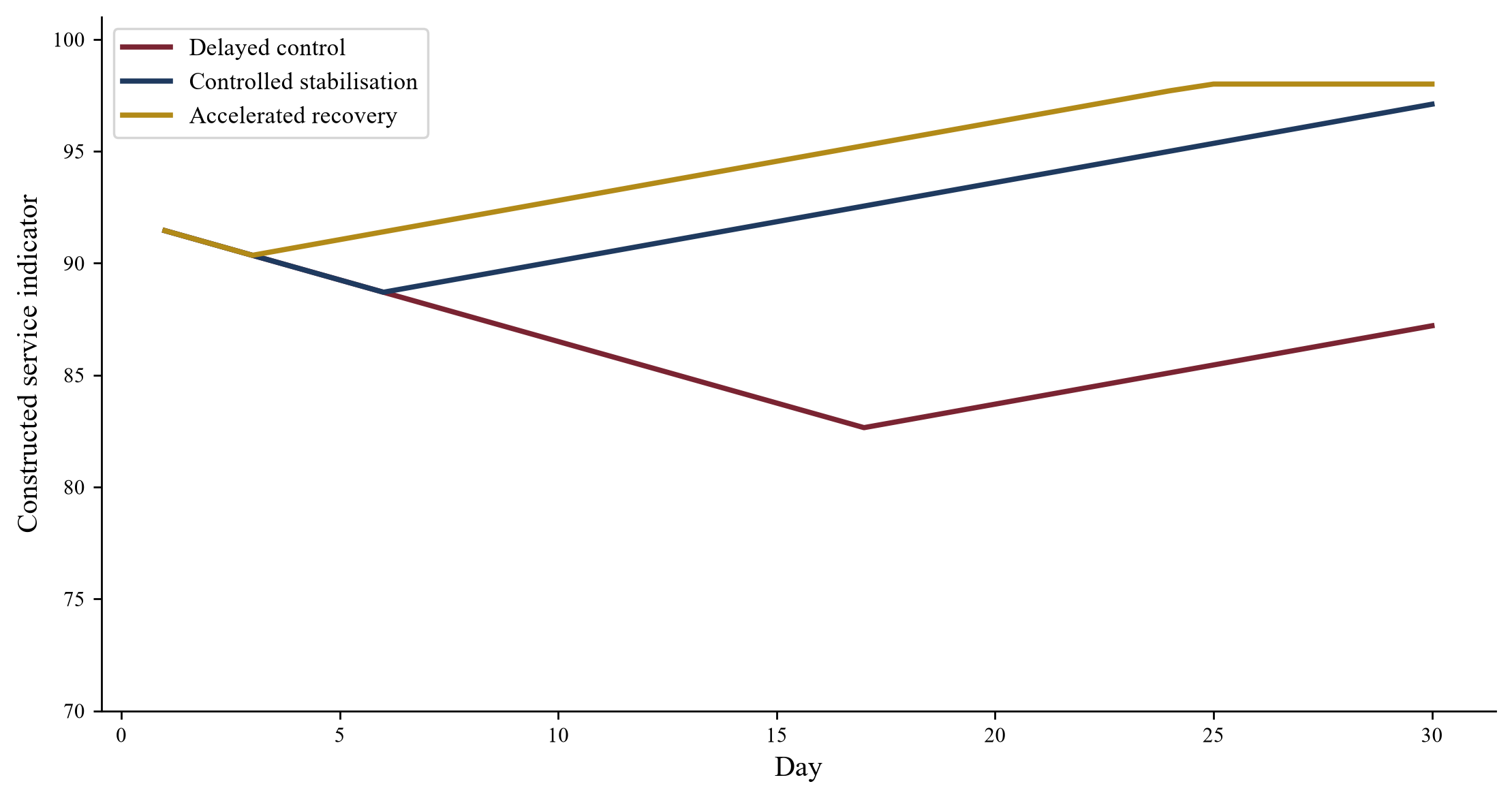
Constructed author measure for comparative planning. It is not an observed service level or validated performance index.
22. Establish the hypothetical case model
The original model in this paper represents a hypothetical industrial-services acquisition over thirty days. It begins with GBP 3.20 million of unrestricted cash. Daily baseline receipts are GBP 0.38 million before scenario factors. Essential supplier outflow is GBP 0.23 million per day, other operating outflow is GBP 0.10 million per day, payroll of GBP 1.35 million occurs on days seven and twenty-one, and GBP 0.55 million of tax and rent falls on day fifteen.
Three cases change receipt conversion, supplier payment coverage, stabilisation investment and the start of recovery. Delayed control assumes seventy percent of baseline receipts, payment of seventy-five percent of essential supplier demand, minimal retention spending and recovery beginning on day eighteen. Controlled stabilisation assumes eighty-six percent of receipts, ninety-five percent supplier coverage, GBP 0.30 million of stabilisation spending and recovery from day seven. Accelerated recovery assumes ninety-three percent of receipts, full supplier coverage, GBP 0.48 million of stabilisation spending and recovery from day four.
All inputs are author assumptions. They are not forecasts, benchmarks or evidence about a transaction. The service indicator is a constructed planning measure without empirical calibration. The model excludes financing cost, tax advice, insolvency priorities, purchase price, opening working-capital adjustments and transaction probability. Its purpose is to demonstrate the interaction between collections, supplier continuity and stabilisation timing.
Table 4. Hypothetical thirty-day case results
| Case | Minimum cash | Day-30 cash | Supplier arrears | Day-30 service |
|---|---|---|---|---|
| Delayed control | -0.10 | 0.72 | 1.73 | 87.2 |
| Controlled stabilisation | 1.17 | 2.24 | 0.35 | 97.1 |
| Accelerated recovery | 1.73 | 2.87 | 0.00 | 98.0 |
GBP million except service indicator. Results follow directly from author assumptions; no likelihood is assigned.
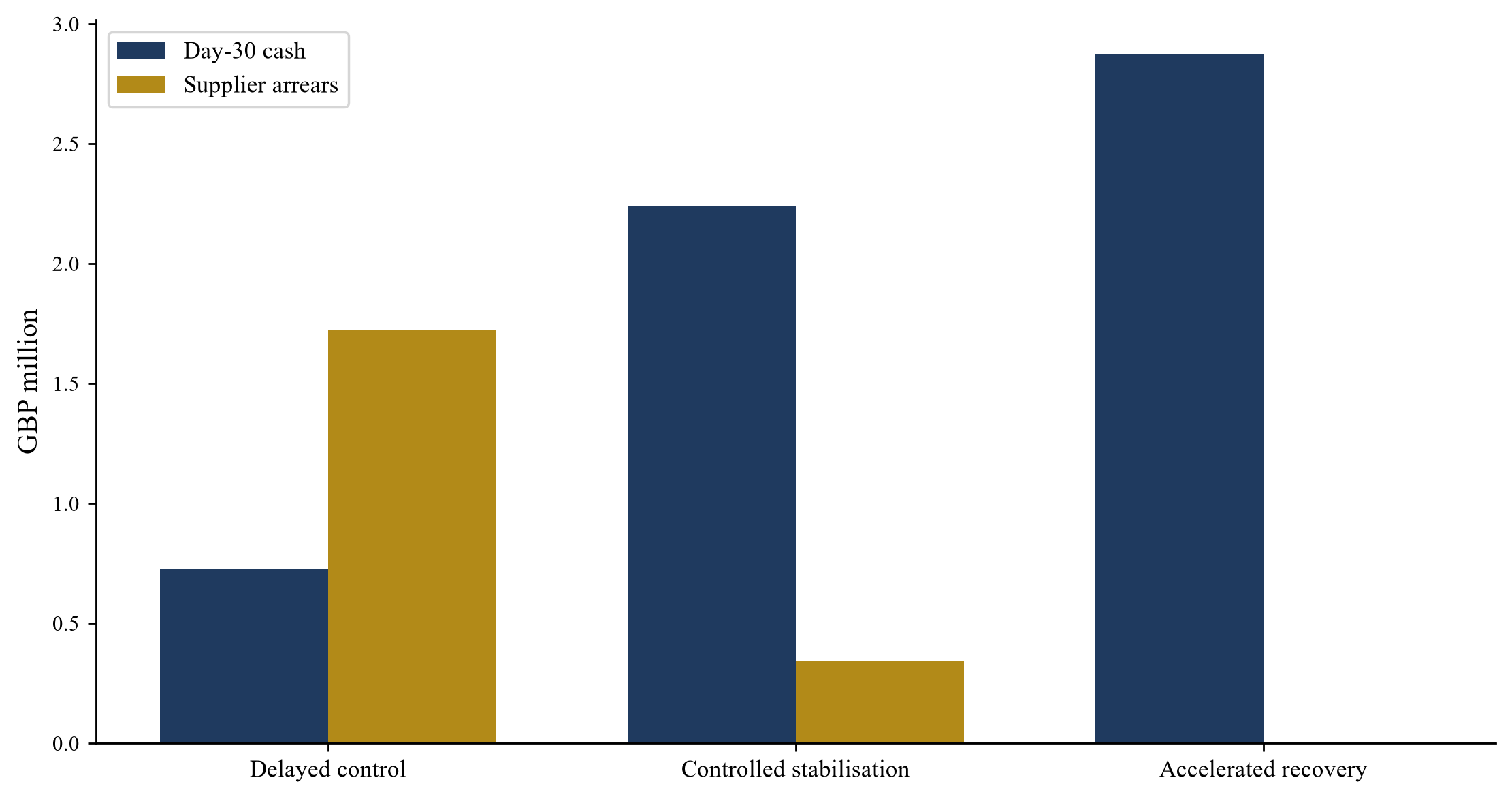
Author assumptions. Supplier arrears show unpaid essential-supplier demand and are not a legal classification.
23. Interpret the three cases
The delayed-control case preserves some near-term cash by underpaying essential suppliers, yet it also weakens service and collections. The accumulating overdue balance is visible outside cash. This is important because a positive bank balance can coexist with a deteriorating operating position. The apparent liquidity benefit may represent transferred risk rather than sustainable improvement.
Controlled stabilisation spends more on retention and pays a larger share of essential supplier demand. Earlier recovery improves collections and service. The case demonstrates why the payment decision cannot be reduced to minimising outflow. A payment that unlocks delivery and collection can protect liquidity, while an indiscriminate freeze can reduce it.
Accelerated recovery uses the largest stabilisation budget and the strongest supplier coverage. Its stronger receipt conversion may produce the best ending cash despite higher controlled spending. The result follows directly from the assumptions and carries no probability. A real decision requires verified customer, margin, supplier and funding evidence.
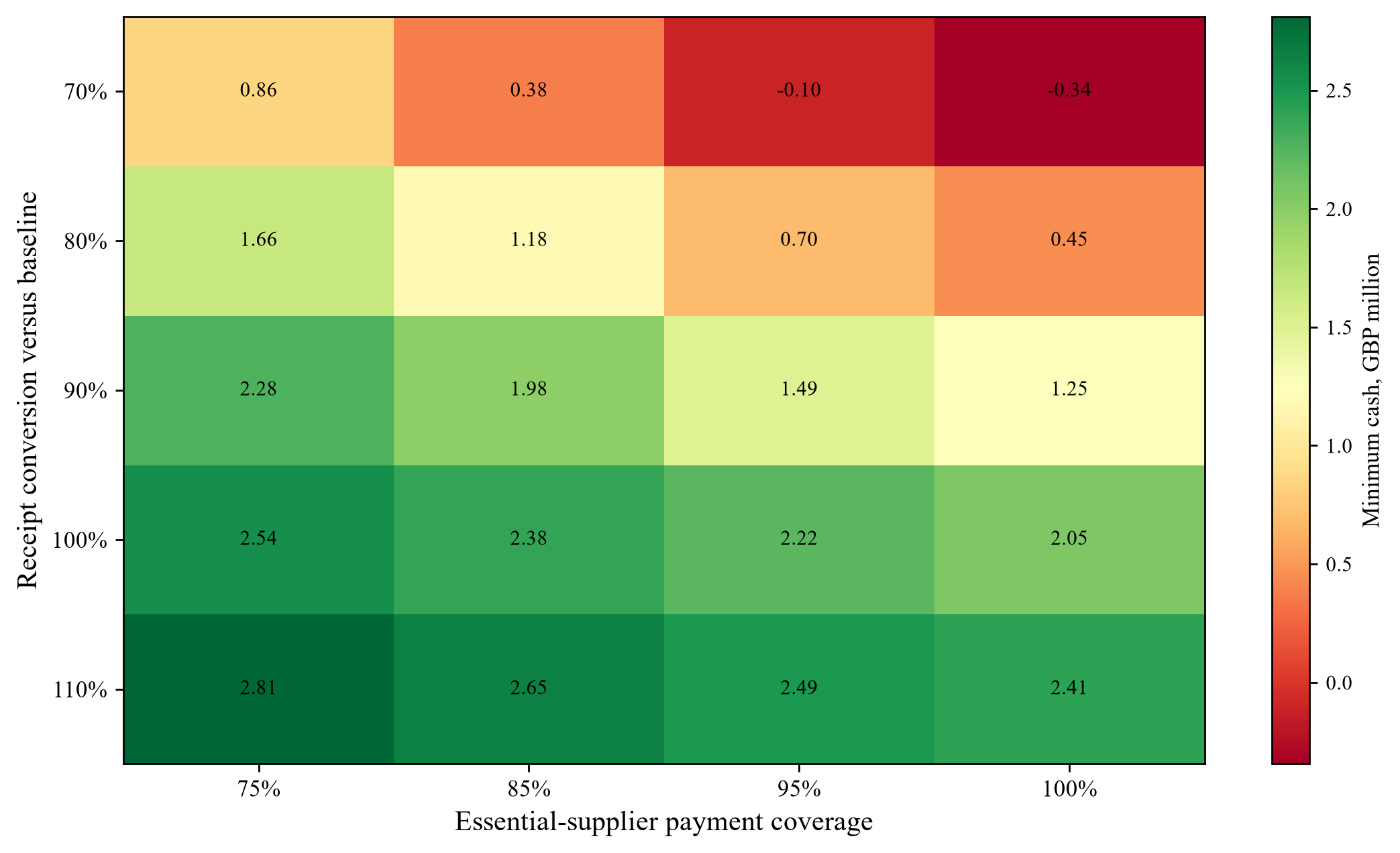
Author assumptions. Each cell varies receipt conversion and supplier coverage; no probability is assigned.
24. Use sensitivity to define liquidity triggers
The sensitivity grid varies receipt conversion from seventy to one hundred and ten percent of baseline and supplier coverage from seventy-five to one hundred percent. It reports minimum and ending cash. The grid helps the board identify combinations that consume headroom and determine which evidence matters most. It does not forecast the likelihood of a cell.
Management should connect the model to triggers. A missed strategic receipt, loss of a critical supplier or payroll increase can require a revised payment plan, lender engagement or operating action. The trigger should state the threshold, decision owner, required evidence and response time. Waiting for the bank balance to cross zero leaves too little room.
Sensitivity also supports diligence after completion. If the model responds strongly to receipt conversion, customer confirmation and dispute resolution deserve greater attention. If supplier coverage drives continuity, procurement and alternative sourcing become priorities. The analysis allocates management effort as well as cash.
Table 5. Proposed risk-control matrix
| Failure mode | Leading indicator | Control | Evidence |
|---|---|---|---|
| Cash leakage | Unreconciled movement or new beneficiary | Dual approval and daily bank reconciliation | Bank log and signed variance |
| Customer loss | Escalation, delayed order or termination query | Account plan and executive contact | Commitment log and delivery proof |
| Supplier stop | Terms withdrawn or shipment held | Criticality map and funded agreement | Supplier confirmation and release |
| Payroll failure | Population, file or funding mismatch | Independent test and protected funding event | Approved payroll reconciliation |
| System lockout | Unknown administrator or shared credential | Named access, backup and recovery test | Access log and restore evidence |
| Essential-person exit | Resignation or coverage gap | Role-based retention and succession action | Accepted plan and handover |
Proposed management controls. The accountable company and qualified advisers determine actual duties and risk treatment.
25. Maintain a risk-control matrix
The risk-control matrix links a failure mode to its leading indicator, preventive control, response, owner and evidence. Key risks include unauthorised cash movement, missed payroll, supplier stoppage, customer termination, unsafe operation, system lockout, data breach and loss of essential staff. The matrix should be short enough for daily use and detailed enough to support accountability.
Controls should be testable. “Monitor cash” is weak. “Reconcile every controlled bank account to the approved forecast by 09:00, with differences above the stated threshold escalated to the CFO” defines an action and evidence. Each control also needs a fallback. Dual bank approval is ineffective if both approvers are unavailable.
The matrix should record residual risk in transaction-specific terms. Generic red, amber and green labels can hide the decision consequence. A red supplier risk should state which customer delivery fails, when and for what cash requirement. The board can then choose among payment, substitution, renegotiation or acceptance with a clear view of effect.
26. Build the implementation roadmap around gates
The roadmap should use evidence gates rather than dates alone. The completion gate requires authority, bank access, opening cash proof, payroll readiness, critical service coverage and approved communications. The day-three gate requires an operating transaction test and a reconciled thirty-day forecast. The day-seven gate requires a controlled payment cycle and verified stakeholder coverage.
The day-fourteen gate tests working-capital actions and service recovery. The day-twenty-one gate approves the integrated thirteen-week and annual base case. The day-thirty gate transfers controls to permanent management and approves the ninety-day programme. A missed gate should produce a decision: remediate, fund, redesign or escalate.
Dependencies should be visible across gates. A new bank mandate may depend on corporate filings, identity checks and director availability. A supplier agreement may depend on funding. A customer assurance may depend on insurance. The programme manager should own the integrated dependency map while functional leaders own delivery.
27. Design the first board pack for decisions
The board pack should begin with decisions and liquidity. It can show opening and closing cash, thirty-day and thirteen-week headroom, forecast variance, receipts at risk, essential payments, financing availability and triggers. The operating section should cover critical customer commitments, supplier coverage, payroll, safety, people and systems. Each exception needs an owner and decision date.
The pack should state data provenance and limitations. Bank-confirmed cash differs from a management estimate of customer receipts. A constructed service indicator differs from observed performance. The board should be able to trace material numbers to the control book and supporting evidence. Reconciliation builds confidence and reduces debate over competing versions.
The board should see the cash consequence of operational decisions. A delayed customer milestone, accelerated supplier payment, retention award or emergency system purchase needs to be reflected in the forecast and decision record. Linking the operational and financial sections of the pack allows directors to understand the trade-off, approve the action and monitor the promised result.
The minutes should record the evidence considered, conflicts, specialist advice and decisions. Directors' duties and insolvency considerations depend on facts and jurisdiction, so the board should obtain qualified advice. This paper provides a management framework and does not provide legal, tax, accounting or insolvency advice.
28. Convert stabilisation into value creation
The first thirty days create value by preserving options. Reliable cash, customer service, supplier coverage, people and systems give the buyer time to make informed portfolio, financing and transformation decisions. The control book also reveals process weaknesses that may have contributed to distress: slow invoicing, concentrated authority, poor contract data, weak purchasing or unmanaged access.
The next programme should retain the evidence discipline while shifting attention toward growth, margin, working capital, asset productivity and strategic positioning. Each value-creation initiative needs a baseline, owner, cash requirement, milestone and downside case. Benefits should remain separate from the liquidity needed to achieve them.
The acquisition decision should therefore include the first-month plan before completion. The buyer should know who takes control, what cash is required, which customers and suppliers need protection, how systems and data become secure and what evidence releases each gate. A distressed asset becomes an operating business through disciplined execution, and the first thirty days determine whether the buyer reaches that position with confidence intact.
References
- UK Government. Corporate Financial Distress Guidance Note. Updated 15 June 2026; accessed 5 September 2026. https://www.gov.uk/government/publications/the-sourcing-and-consultancy-playbooks/corporate-financial-distress-guidance-note-html
- The Insolvency Service. Company insolvencies, July 2026. Published 14 August 2026; accessed 5 September 2026. https://www.gov.uk/government/statistics/company-insolvencies-july-2026
- Information Commissioner's Office. Due diligence when sharing data following mergers and acquisitions. Accessed 5 September 2026. https://ico.org.uk/for-organisations/uk-gdpr-guidance-and-resources/data-sharing/data-sharing-a-code-of-practice/due-diligence/
- National Cyber Security Centre. Identifying the critical assets in your organisation. Accessed 5 September 2026. https://www.ncsc.gov.uk/collection/board-toolkit/principle-a-risk-management/identifying-the-critical-assets-in-your-organisation
- Financial Conduct Authority. Operational resilience: insights and observations for firms. Accessed 5 September 2026. https://www.fca.org.uk/firms/operational-resilience/insights-observations
- UK Government. The Sourcing Playbook. Updated 2026; accessed 5 September 2026. https://www.gov.uk/government/publications/the-sourcing-and-consultancy-playbooks/the-sourcing-playbook-html
- The Insolvency Service. Director information hub: Administration. Accessed 5 September 2026. https://www.gov.uk/guidance/director-information-hub-administration
- UK Government. Business transfers, takeovers and TUPE. Accessed 5 September 2026. https://www.gov.uk/transfers-takeovers
