

1. Define the grid asset precisely
A data centre consumes electricity to deliver digital service. Its servers, accelerators, storage, network, cooling and electrical systems operate within physical and contractual limits. Some activities can be rescheduled, slowed, transferred or supported from another energy source. Other activities require continuous power with tightly controlled performance.
The International Energy Agency defines demand flexibility as the ability to adjust the timing or amount of electricity use in response to system needs.[1] Applying that concept to a data centre requires more than identifying megawatts. The grid needs a service that can be called, measured and relied upon. The data-centre operator needs a service that protects hardware, customer commitments, cybersecurity and operating continuity.
The financeable product is therefore a dated load adjustment at a defined electrical boundary. It has a direction, response time, magnitude, duration, notification period, availability window, recovery pattern and performance standard. It also has a party authorised to commit the resource and parties responsible for delivery, measurement, settlement and remediation.
Installed capacity is an engineering limit. Facility load is an operating condition. Flexible load is the portion that can change under defined circumstances. Contracted flexibility is the portion accepted into a programme or bilateral agreement. Delivered flexibility is the verified response to a dispatch or price signal. These quantities should never be treated as interchangeable.
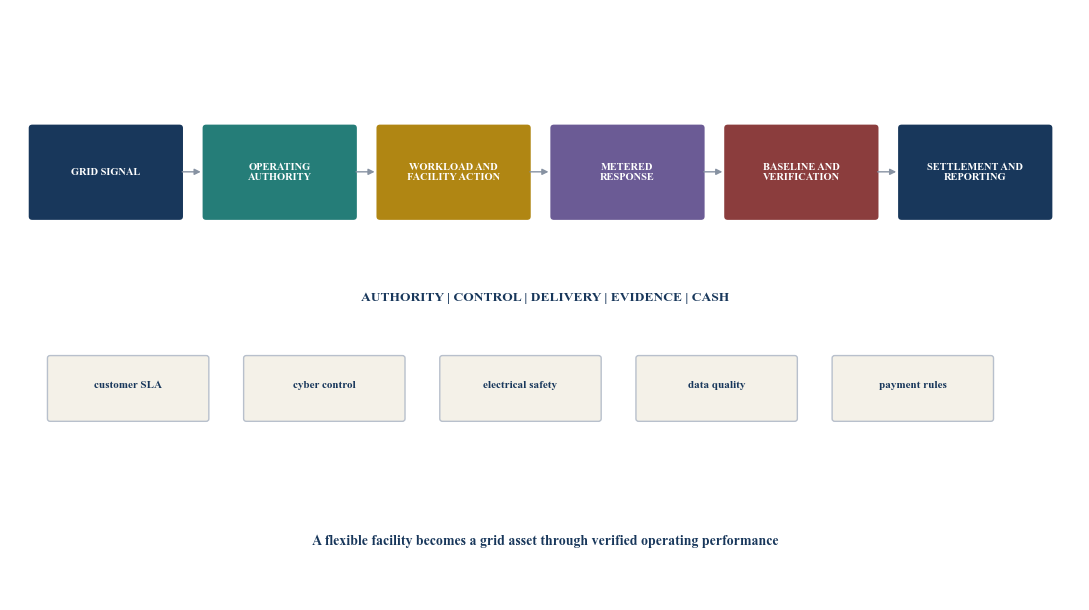
Author framework. A dependable grid service requires every operating and evidence link to function.
2. Start with the workload, not the meter
Electricity flexibility begins in the compute schedule. Batch training, model tuning, data processing, simulation, rendering, backup, indexing and some internal analytics may have different deadlines and geographic constraints from latency-sensitive inference, payments, communications, healthcare or other continuous services.
The operator should classify each workload by start deadline, completion deadline, interruption tolerance, checkpoint capability, restart cost, data residency, network requirement, hardware dependency, customer obligation and geographic mobility. A workload described as deferrable may remain operationally fixed because a customer controls the schedule, data cannot move, accelerators are unavailable elsewhere or an interrupted job loses substantial progress.
The United States Department of Energy's data-centre flexibility taxonomy identifies temporal and geographic workload management, response speed, notification time, price and contractual dispatch, and the division of control between facility owners and computing customers.[5] That division is fundamental. A landlord or colocation operator may control cooling and backup systems while tenants control servers. A hyperscaler may control workloads across several regions while a grid contract applies to one meter.
The flexibility inventory should link each workload action to its electrical consequence. A compute reduction may reduce server load immediately while cooling power falls later. Moving work to another site can lower one grid's demand while increasing another's. Battery discharge can reduce metered grid demand without changing compute. Onsite generation changes the supply source and introduces fuel, emissions, permitting and maintenance obligations.
Table 1. Flexible-compute resource inventory
| Resource | Operating action | Evidence required | Principal constraint | Contracted quantity |
|---|---|---|---|---|
| Batch compute | delay or reschedule eligible jobs | queue data, deadlines, checkpoint tests | completion and customer deadlines | verified MW by window |
| Compute throttling | reduce accelerator or server power | hardware controls and performance tests | thermal cycling and job duration | MW for stated duration |
| Geographic transfer | route eligible workload to another site | capacity, network, residency and cost evidence | receiving-site power and data rules | net MW across sites |
| Cooling thermal inertia | adjust cooling set points or plant sequence | thermal model and live test | temperature and humidity envelope | metered MW with recovery profile |
| Battery storage | discharge behind the meter | state of charge, controls and warranty | duration, degradation and recharge | MW and MWh at boundary |
| Onsite generation | start compliant generation | permits, fuel, emissions and test record | start reliability and operating limits | dependable net MW |
| Network and storage | defer non-critical tasks | service and replication tests | latency, resilience and data integrity | verified MW by task class |
| Planned maintenance | align maintenance with system need | approved maintenance calendar | equipment and customer availability | event-specific MW |
Flexibility should be supported by current technical tests, workload authority and customer-contract review.
3. Separate the flexibility products
One contract cannot treat every form of flexibility as the same service. Planned load shifting can operate with day-ahead notice. Fast curtailment may require automated response within minutes. Emergency interruption can carry infrequent but severe operating consequences. Upward flexibility increases demand during periods of surplus supply. Geographic transfer changes the electrical location of demand. Storage and onsite generation alter the facility's net withdrawal without necessarily changing compute.
Each product should specify direction, notice, response time, ramp, minimum and maximum duration, recovery interval, maximum events, event spacing and seasonal availability. It should state whether participation is voluntary, price-responsive, contracted, reliability-triggered or mandatory under applicable rules.
Great Britain's Demand Flexibility Service moved to year-round operation in November 2024. NESO describes a service that rewards changes in electricity use and publishes service requirements, utilisation and procurement data.[8][9] Singapore's Energy Market Authority operates separate Demand Response and Interruptible Load programmes. Its October 2024 determination retained different purposes and adjusted participation rules after a regulatory sandbox.[10]
These programmes show why product identity matters. A commercial demand-response event, an interruptible reliability service and a bilateral non-firm connection have different triggers, liabilities and economics. Gulf projects should define the product before assigning value to it.
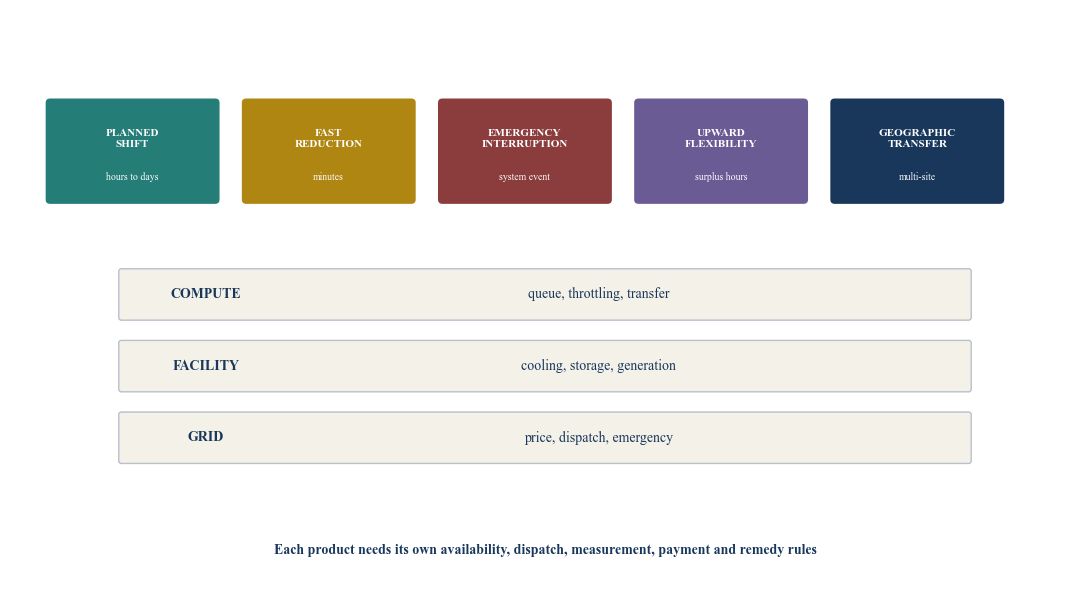
Author framework. Products differ by notice, control, duration, consequence and settlement.
4. Locate the electrical boundary
The contract should identify the meter, voltage level, connection point and settlement interval. It should distinguish gross facility demand, onsite generation, storage charging and discharge, renewable production, tenant submetering and auxiliary loads.
A grid operator may require change at the connection boundary. A customer may offer change at a server hall or individual tenant meter. These quantities diverge when cooling, uninterruptible power supplies, transformers, batteries and generators change simultaneously. Losses and auxiliary consumption should be treated consistently.
The baseline should represent what consumption would reasonably have occurred without the event. It may use historical intervals, a matched-day method, forecast schedule, declared baseline or other approved methodology. The method should address weather, occupancy, workload growth, maintenance, outages, onsite resources and strategic pre-event consumption.
Baseline error creates financial and reliability risk. An inflated baseline can create payment without genuine system benefit. A low baseline can underpay a valid response. A rapidly growing data centre may lack stable history. A new campus may require a forecast baseline supported by workload and facility data.
Metering rules should specify accuracy, time synchronisation, telemetry, data retention, estimation, correction, audit and cybersecurity. Settlement should follow the approved electrical boundary and baseline, with transparent treatment of missing or corrected data.
5. Establish operating authority
The party signing the grid contract needs authority to deliver the response. This may require rights over facility controls, tenant workloads, batteries, generators, cooling equipment and network routing. It may also require consent from lenders, insurers, landlords, customers and technology vendors.
Authority should be mapped from the grid signal to the final control action. The system operator may dispatch an aggregator. The aggregator may instruct the data-centre operator. The operator may need approval from a network operations centre, tenant or workload orchestrator. A fully automated path can improve response while increasing cyber and change-management requirements.
Service-level agreements should identify which commitments can be adjusted and which remain protected. The demand-response agreement should not assume that all installed computing capacity is controlled by the facility owner. The DOE taxonomy expressly recognises third-party ownership and the separation between facility operations and AI-processing management.[5]
Financing documents should address participation rights and revenue. Project lenders may restrict material contracts, asset use, additional liabilities or changes to insurance. Customer contracts may allocate rebates or prohibit actions that degrade service. A grid-services contract may create set-off, penalty or termination exposure that affects cash flow.
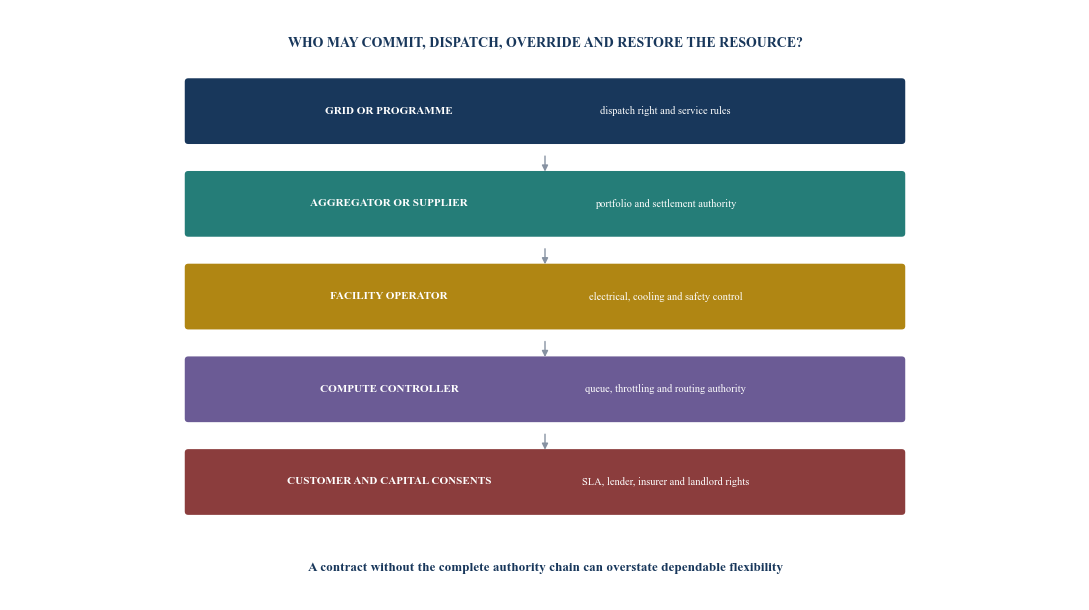
Author framework. Control rights should be evidenced before flexible capacity is committed.
6. Design the event lifecycle
A reliable event has preparation, dispatch, delivery, recovery and review. Preparation confirms available capacity, customer restrictions, equipment health, battery state, generator status, staffing, cyber posture and weather. Dispatch identifies product, start, duration, target, location and priority. Delivery records control actions and metered response. Recovery returns workloads and facility systems without creating a new system peak or equipment stress.
Rebound demand requires explicit treatment. Deferred compute still needs energy. Batteries need recharge. Cooling set points may need restoration. A response that reduces 20 MW for one hour and creates a 25 MW rebound immediately afterwards can provide less system value than the event meter suggests.
The contract should define event cancellation, extension, early release and force majeure. It should state how concurrent failures, grid outages, customer emergencies, cyber incidents, equipment alarms and safety overrides affect performance. Human override should remain available for safety and service protection, with clear notification and evidence.
Testing should cover the complete path. A communications test does not prove load response. A battery test does not prove compute flexibility. A controlled dispatch should measure the boundary response, response time, persistence, recovery and customer effects under representative conditions.
7. Contract availability before utilisation
Availability is the right to call a resource. Utilisation is the delivered response. These can be paid separately. An availability payment compensates the operator for reserving flexibility and maintaining readiness. A utilisation payment compensates actual delivery. Performance adjustments can reward accuracy or reduce payment for shortfall.
Availability should be reported by interval and product. A 40 MW resource may offer only 10 MW during a customer launch, high ambient temperature, maintenance window or low battery state. The operator should submit current availability rather than a static annual quantity.
The contract should specify nomination timing, minimum availability, derating, planned outages, unplanned unavailability, testing and evidence. It should also address how frequently the buyer can dispatch the resource. Unlimited dispatch can make the service incompatible with compute deadlines, battery warranty or fuel arrangements.
Capacity should receive full value only when availability and performance evidence support it. A project model should separate contracted capacity, expected dispatch, delivered response and realised settlement.
Table 2. Demand-response contract term sheet
| Term | Required definition | Evidence | Principal protection |
|---|---|---|---|
| Product | planned shift, fast reduction, interruption, upward service or transfer | approved service specification | prevents incompatible obligations |
| Electrical boundary | meter, voltage, interval and resource treatment | single-line diagram and metering approval | aligns delivery with settlement |
| Availability | windows, nomination, derating and outage rules | operating plan and telemetry | pays only dependable readiness |
| Dispatch | signal, authority, notice, ramp and override | tested communication and control path | creates an executable instruction |
| Delivery | target, tolerance, duration and recovery | revenue-quality meter and event log | defines measurable performance |
| Baseline | method, adjustment, audit and correction | approved historical or forecast data | limits artificial or disputed response |
| Payment | availability, utilisation, bonus and deductions | settlement formula and worked examples | connects service to transparent cash |
| Event limits | frequency, duration, spacing and seasons | workload and equipment tests | protects operations and asset life |
| Customer protection | SLA exclusions, consent and priority | contract matrix and operating rules | preserves digital-service obligations |
| Liability | caps, exclusions, indemnities and consequential loss | legal and insurance review | contains asymmetric downside |
| Data and cyber | access, use, retention and incident response | architecture and security assessment | protects operational and customer data |
| Termination | cause, convenience, change in law and transition | contract and financing review | preserves an orderly exit |
Terms require adaptation to the applicable electricity market, licence, customer contracts and project documents.
8. Measure performance conservatively
Performance can be expressed as delivered load change divided by instructed load change, subject to the approved baseline and interval. A single percentage is incomplete. The buyer also needs response time, ramp, duration, recovery and data quality.
The baseline should be reproducible. Input data, exclusions, adjustments and calculation code should be retained. The parties should agree how to treat a facility still ramping occupancy, a new tenant, an outage, unusual weather, prior events and deliberate pre-positioning.
The Abu Dhabi Demand Response Regulations effective from January 2024 establish roles, responsibilities, evaluation, measurement and verification for demand-response resources.[12] The regulations define demand response as an adjustment of customer electricity consumption in response to economic, commercial or reliability signals. They also establish responsibilities across programme owners, procurement and system participants.
Measurement should distinguish gross action from net response. A facility may throttle compute by 12 MW, increase cooling by 1 MW and discharge a battery by 5 MW. The grid meter sees a 16 MW reduction relative to the baseline. The operational report should explain each component because its persistence, recovery and repeatability differ.
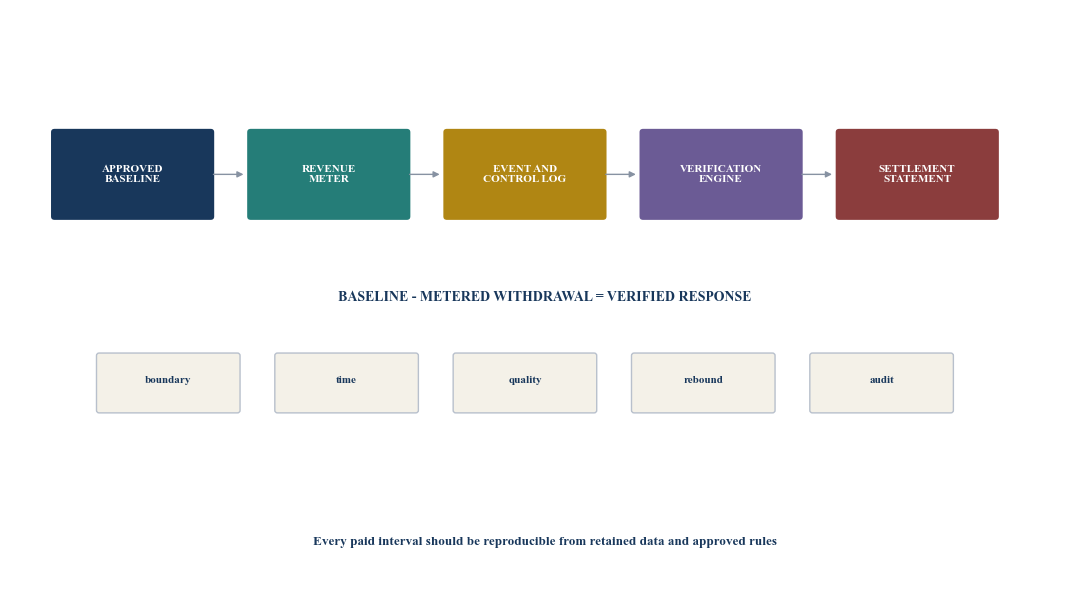
Author framework. Settlement should reconcile the approved baseline, meter and event evidence.
9. Protect digital-service performance
Demand response should sit within the data centre's operating hierarchy. Life safety, electrical protection, cybersecurity, data integrity, customer commitments and hardware limits require defined priority. Grid-service delivery should not depend on informal operator judgement during an event.
The service-level analysis should identify latency, availability, throughput, completion and recovery implications. It should distinguish facility uptime from application performance. A building may remain energised while customers experience slower completion or reduced capacity.
Customer contracts should be reviewed for workload control, planned maintenance, degradation, data location, subcontracting, force majeure, audit, credits, termination and liability. Consent may be required. The commercial model should allocate flexibility revenue, operating cost and service-credit exposure between owner, operator and tenant.
Workload orchestrators should use approved job classes. Emergency events should have a protected minimum compute floor. A restoration plan should control queue release and power rebound. Incident reporting should reconcile grid delivery and customer impact.
10. Treat cooling as a separate resource
Cooling can provide flexibility through chilled-water storage, thermal inertia, temperature set-point changes, equipment sequencing and pre-cooling. Its response depends on ambient conditions, facility design, occupancy, airflow and equipment state.
The safe envelope should be established through engineering analysis and controlled testing. Temperature and humidity at the server inlet matter more than a central set point. A cooling reduction that raises fan power, creates hotspots or consumes thermal headroom needed for a later event may provide limited repeatability.
Cooling flexibility should have its own capacity, duration, recovery and seasonal profile. It should not be added to compute flexibility unless the effects are independently measured and free from double counting. Cooling controls should preserve manufacturer requirements, warranties and operating standards.
11. Integrate storage and onsite supply
Battery storage can reduce grid withdrawal rapidly and support power quality. Its financeability depends on usable energy, state of charge, degradation, warranty, reserve obligations, charging power and competing uses. A battery reserved for uninterruptible power may have limited grid-service availability.
Onsite generation can support load reduction at the meter. It introduces fuel availability, emissions, noise, permits, maintenance, start reliability and minimum-run constraints. Emergency generators may face restrictions on non-emergency operation. Contracting should follow current law and permits.
The settlement method should avoid double payment across grid programmes, tariffs, renewable claims and customer arrangements. Storage charging after an event and generator fuel costs belong in the net value calculation.
12. Learn from international programme design
International examples provide tested design questions. They do not create automatic eligibility in another jurisdiction.
The IEA identifies system-efficiency, asset-utilisation and integration benefits from demand flexibility.[1][2] United States DOE materials describe large-load rate-design questions, data-centre flexibility characteristics and the need to allocate grid costs and stranded-asset risk fairly.[4][5] FERC's 2025 and 2026 large-load actions include transparent rules and flexible transmission-service questions for major loads.[6][7]
Great Britain's NESO publishes service rules and utilisation data for a year-round Demand Flexibility Service.[8][9] Singapore maintains distinct demand-response and interruptible-load programmes and revised participation features after a sandbox.[10][11] Abu Dhabi has a formal regulatory framework and an operating pilot.[12][13]
The useful comparison concerns product definition, eligibility, aggregation, baseline, telemetry, event rules, payment, performance, consumer protection and cost allocation.
Table 3. Selected international demand-flexibility design evidence
| Market | Official evidence | Relevant design feature | Gulf transaction question |
|---|---|---|---|
| Abu Dhabi | Demand Response Regulations and 2024 pilot results | formal roles, measurement and verification, programme development | how will a data centre qualify, contract and settle under current rules? |
| Great Britain | NESO Demand Flexibility Service | year-round procurement, published requirements and utilisation data | which product, baseline and aggregator route fits the facility? |
| Singapore | EMA Demand Response and Interruptible Load programmes | separate economic and reliability products with compliance thresholds | should planned response and interruption have different contracts? |
| United States | DOE large-load and flexibility materials | rate design, cost allocation, workload taxonomy and onsite resources | how does flexibility change connection cost and service firmness? |
| United States regional grids | FERC large-load actions and ERCOT materials | non-firm service, large-load integration and curtailment concepts | can a defined non-firm product accelerate connection without overstating value? |
| Global | IEA demand-flexibility analysis | system efficiency, asset use and digital enablement | which local system need creates measurable economic value? |
Each source applies within its own institutional, legal and market purpose; project eligibility requires current local confirmation.
13. Use the Abu Dhabi pilot as operating evidence
Abu Dhabi's Department of Energy reported that the first 2024 demand-response phase reduced average peak demand by 106 MW across ten events and achieved a maximum reduction of 210 MW. The Department reported 80% reliability based on 137 MW of contracted capacity and participation from commercial, industrial and residential consumers.[13]
These published results provide relevant regional evidence that organised load response can be dispatched and measured. They do not establish data-centre performance, future programme prices, a particular participant's eligibility or an investable revenue stream.
The Department launched an expanded second phase for 2025 and stated a target of 200 MW of demand-response capacity by 2030.[13] A data-centre proposal should therefore engage with current programme owners, procurement entities, utilities and regulators. Historical pilot terms should not be assumed to remain current.
The facility should present a verified resource rather than a headline claim. The submission should include the electrical boundary, resource inventory, control authority, test results, protected loads, event limits, metering, baseline proposal, cyber controls and implementation schedule.
14. Build a bilateral contract when a programme is insufficient
A bilateral arrangement may connect a data-centre customer, utility, system entity, aggregator or energy supplier. It can support a non-firm connection, staged energisation, network constraint management, capacity reservation, tariff discount, interruptible service or dedicated supply.
The contract should identify the system problem it solves. A local network constraint may require response at a specific node and time. A generation adequacy product may require system-wide response during scarcity. A renewable-integration product may reward upward consumption during surplus production.
The buyer should avoid paying for flexibility that the customer's normal tariff or connection agreement already requires. The seller should avoid open-ended interruption that undermines customer service or asset value. The agreement should reconcile with the connection agreement, supply contract, market rules, permits and financing documents.
15. Convert service into investable cash flow
Gross flexibility revenue can include availability, utilisation, performance and other approved payments. Net value deducts aggregator fees, metering and control cost, battery degradation, fuel, additional maintenance, energy rebound, customer credits, workload transfer cost, tax and insurance.
Connection value may exceed direct revenue. A credible flexible-service commitment can support earlier or larger grid access where permitted. That benefit should be valued as a dated scenario, based on executed rights and current system evidence. It should not be recorded as cash merely because flexibility is technically possible.
Revenue concentration matters. A short pilot, discretionary dispatch arrangement or changeable tariff does not support the same leverage as a long-term contract with clear payment and termination rights. Lenders should assess counterparty, term, change in law, curtailment, performance deductions and termination.
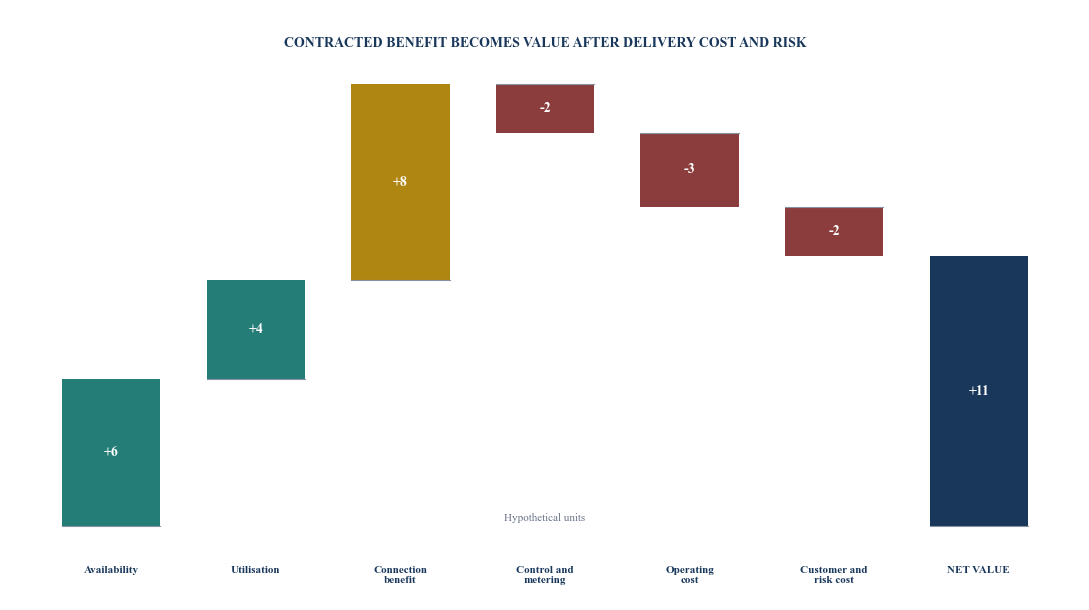
Author framework. Figures are illustrative categories; transaction values require current evidence.
16. Test a hypothetical portfolio
Consider a hypothetical 100 MW data-centre campus. Management assumes that 30 MW of installed workload and facility capability may be technically adjustable under some conditions. After customer, timing, equipment and control constraints, management assumes 18 MW can be offered during defined evening windows.
The example assumes separate planned-shift, fast-reduction and emergency products. It uses hypothetical availability prices, utilisation prices, event hours, delivery rates, operating costs and capital expenditure. The values demonstrate calculation discipline. They are not market forecasts or reported programme terms.
Annual gross revenue for each product equals contracted MW multiplied by the relevant availability payment plus delivered MWh multiplied by the utilisation payment. Delivered MWh equals dispatched MW multiplied by event hours and the delivery rate. Net value deducts identified operating and risk costs.
Table 4. Hypothetical flexible-compute portfolio
| Product | Contracted MW | Availability window | Hypothetical events | Delivery assumption | Annual gross value | Principal limit |
|---|---|---|---|---|---|---|
| Planned shift | 8 | 1,000 hours | 25 events of 2 hours | 92% | USD 0.62m | workload completion deadlines |
| Fast reduction | 6 | 700 hours | 18 events of 1 hour | 88% | USD 0.58m | control and thermal response |
| Emergency interruption | 4 | 1,500 hours | 4 events of 2 hours | 95% | USD 0.49m | customer and continuity exposure |
| Total contracted | 18 | product-specific | product-specific | product-specific | USD 1.69m | no simultaneous double counting |
| Operating and programme cost | n/a | n/a | n/a | n/a | USD (0.46m) | controls, metering, transfer and wear |
| Hypothetical net annual value | n/a | n/a | n/a | n/a | USD 1.23m | before tax, financing and residual risk |
Every number is a hypothetical management assumption for method demonstration; amounts are stated in USD-equivalent units and do not represent market prices.
17. Stress delivery and value
The base case should be tested for baseline error, lower availability, missed dispatch, reduced duration, delayed telemetry, higher rebound energy, customer restrictions and programme change. Connection benefits should be tested for delay and reduction.
Performance risk can be nonlinear. A facility delivering 85% of instruction may receive a proportionate reduction under one contract and fail the event under another. Repeated failure can remove availability revenue or terminate participation.
Correlation also matters. Extreme heat can increase grid need while reducing cooling flexibility. A regional network event can constrain both the offering and receiving sites for geographic transfer. A cyber incident can remove remote control precisely when response is required.
Table 5. Hypothetical stress matrix
| Case | Available MW | Delivery rate | Annual net value | Connection timing effect | Decision implication |
|---|---|---|---|---|---|
| Base | 18 | 91% blended | USD 1.23m | earlier access assumed under executed terms | proceed only after contract and test evidence |
| Customer restriction | 12 | 92% | USD 0.74m | partial | revise workload authority and product mix |
| High-heat constraint | 14 | 84% | USD 0.69m | uncertain | reduce cooling reliance and test seasonal capacity |
| Baseline dispute | 18 | 91% physical | USD 0.48m settled | unchanged | resolve methodology and audit before financing |
| Repeated shortfall | 10 | 72% | USD 0.12m | lost | remove unproven capacity and cure controls |
| Programme termination | 0 | n/a | USD (0.18m) residual cost | none | ensure base project remains viable without revenue |
Values are hypothetical management assumptions; the matrix demonstrates sensitivity rather than a forecast.
18. Allocate downside and liability
The contract should allocate failure caused by grid communications, aggregator error, facility control, customer override, equipment fault, cyber incident, force majeure and unlawful dispatch. It should define consequential loss, service credits, data loss, hardware damage and third-party claims.
Grid-service revenue can be small relative to digital-service liability. A broad indemnity or uncapped customer exposure can overwhelm the economic benefit. Contract review should compare maximum flexibility revenue with credible downside.
Insurance should be reviewed for participation, control changes, battery cycling, generator operation, cyber events and business interruption. The operator should confirm that automated dispatch does not invalidate operating or warranty requirements.
Termination should protect system and customer continuity. The agreement should address data return, control disablement, final settlement, equipment ownership and transition. Change-in-law and programme-change provisions require particular attention in emerging markets.
19. Govern cybersecurity and data
Demand response connects external signals to critical electrical and computing systems. The architecture should minimise access, segment networks, authenticate commands, log actions, restrict privileges and provide safe fallback.
The grid or aggregator may require telemetry that reveals facility load, occupancy, operational patterns or customer activity. Data rights should specify purpose, resolution, retention, sharing, security, incident response and audit. Customer information should remain protected under applicable contracts and law.
Automated control should use approved commands and bounded operating envelopes. A dispatch should never allow unrestricted access to building management, power or workload systems. Manual confirmation may be appropriate for high-consequence products, subject to response-time requirements.
20. Implement through a gated programme
The implementation sequence should begin with authority and evidence. The project should appoint an accountable executive, facility lead, compute lead, energy-market lead, cyber lead and commercial owner. It should establish one data room and one version-controlled resource register.
The first month maps meters, loads, workloads, controls, contracts and regulatory routes. The second month tests candidate actions and develops the baseline, product and risk design. The third month completes counterpart engagement, legal terms, telemetry and settlement. The fourth month conducts an end-to-end dispatch test and brings only verified capacity into service.
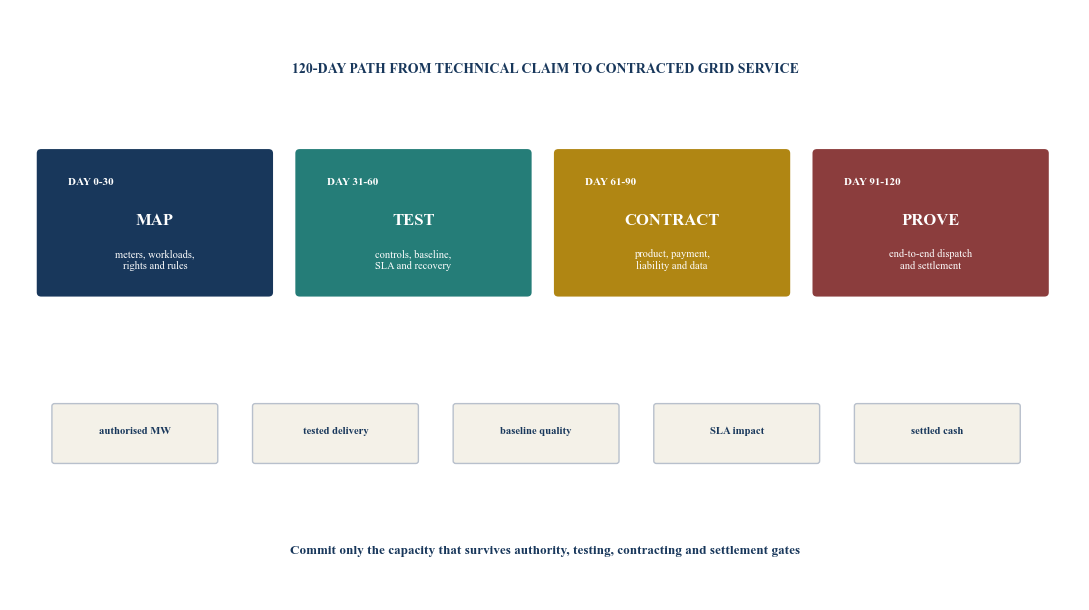
Author framework. Governance should track evidence, service readiness and realised performance.
Table 6. 120-day execution plan
| Days | Workstream | Required output | Gate |
|---|---|---|---|
| 0 to 10 | governance | executive owner, workplan and controlled data room | accountabilities approved |
| 11 to 20 | electrical boundary | meters, single-line diagram and resource map | settlement boundary confirmed |
| 21 to 30 | workload authority | job classes, customer terms and control rights | authorised flexibility identified |
| 31 to 40 | technical testing | compute, cooling, storage and recovery tests | dependable capacity measured |
| 41 to 50 | baseline and telemetry | methodology, data quality and cyber design | measurement path accepted |
| 51 to 60 | product design | availability, dispatch, duration and event limits | service matches operating envelope |
| 61 to 70 | market and counterpart | programme, aggregator and bilateral route | current eligibility confirmed |
| 71 to 80 | commercial terms | payment, deductions, costs and value case | net economics pass committee threshold |
| 81 to 90 | legal and finance | liability, insurance, lender and customer consents | obligations and rights are executable |
| 91 to 100 | integration | communications, controls and reporting | technical dry run passes |
| 101 to 110 | dispatch test | instructed event, recovery and evidence | delivered response meets standard |
| 111 to 120 | launch | approved capacity and performance dashboard | first service interval authorised |
Timing is an author framework and should be adapted to project, programme and approval requirements.
21. Set the investment decision
The investment committee should receive a resource register, authority matrix, test record, contract term sheet, baseline methodology, revenue model, downside analysis, cybersecurity assessment and implementation dashboard.
The base data-centre investment should remain viable without speculative flexibility revenue. Contracted revenue should receive value according to evidence, counterparty, duration, change rights, delivery history and termination. Potential connection acceleration should be valued only when current and enforceable terms support it.
Capital for controls, storage or additional infrastructure should be tied to a defined service and verified route to settlement. The project should avoid buying equipment solely against an assumed future market.
The committee should approve a maximum committed MW by product, event limits, minimum net value, liability ceiling, capital budget and performance gate. Management should report authorised, nominated, dispatched, delivered and settled capacity separately.
22. Limitations and conclusion
Data-centre technology, workload patterns, electricity regulation, grid needs, programme terms, tariffs, metering, cyber requirements and customer contracts can change. Decisions require current evidence from the applicable regulator, system entity, utility, programme owner, customers, technology vendors, lenders, insurers and qualified advisers.
IEA materials provide global analytical context.[1][2][3] DOE, FERC and ERCOT materials apply within their stated United States purposes.[4][5][6][7][14] NESO materials describe Great Britain's service.[8][9] EMA materials describe Singapore's programmes.[10][11] Abu Dhabi Department of Energy materials describe the Emirate's regulations and published pilot results.[12][13]
Every quantity, payment, cost, price, performance value, probability, date and financial result in the worked example is a hypothetical management assumption. No data-centre customer, grid contract, programme price, connection right or realised performance is claimed.
Flexible compute can become a grid asset when the product is precise, the operating authority is complete, customer service is protected, the electrical response is tested, the baseline is credible, the contract is enforceable and settlement follows reproducible evidence.
The commercial opportunity arises from disciplined integration. Compute, facility systems, grid operations and capital documents must describe the same resource. The resulting contract can support measurable system service and investable cash while preserving the data centre's primary digital purpose.
References
- [1] International Energy Agency, The Value of Demand Flexibility, 2025. https://www.iea.org/reports/the-value-of-demand-flexibility
- [2] International Energy Agency, The Value of Demand Flexibility: Executive Summary, 2025. https://www.iea.org/reports/the-value-of-demand-flexibility/executive-summary
- [3] International Energy Agency, Energy and AI, 10 April 2025. https://www.iea.org/reports/energy-and-ai
- [4] United States Department of Energy, Electricity Rate Designs for Large Loads: Evolving Practices and Opportunities, 17 January 2025. https://www.energy.gov/policy/articles/electricity-rate-designs-large-loads-evolving-practices-and-opportunities
- [5] United States Department of Energy, Recommendations on Powering Artificial Intelligence and Data Center Infrastructure, July 2024. https://www.energy.gov/sites/default/files/2024-08/Powering%20AI%20and%20Data%20Center%20Infrastructure%20Recommendations%20July%202024_1.pdf
- [6] Federal Energy Regulatory Commission, FERC Directs Nation's Largest Grid Operator to Create New Rules to Embrace Innovation and Protect Consumers, 18 December 2025. https://www.ferc.gov/news-events/news/fact-sheet-ferc-directs-nations-largest-grid-operator-create-new-rules-embrace
- [7] Federal Energy Regulatory Commission, FERC Launches Targeted Action to Speed Large Load Integration, 18 June 2026. https://www.ferc.gov/news-events/news/ferc-launches-aggressive-targeted-action-speed-large-load-integration
- [8] National Energy System Operator, Demand Flexibility Service, official service materials accessed 13 August 2026. https://www.neso.energy/industry-information/balancing-services/demand-flexibility-service-dfs
- [9] National Energy System Operator, Demand Flexibility Service Data Portal, official data accessed 13 August 2026. https://www.neso.energy/data-portal/demand-flexibility
- [10] Energy Market Authority of Singapore, Regulatory Enhancements to the Demand Response and Interruptible Load Programmes, 21 October 2024. https://www.ema.gov.sg/content/dam/corporate/partnerships/consultations/outcomes-of-dr-and-il-regulatory-sandbox-and-proposed-programme-enhancements/decision/EMA-Consultations-Final-Determination-Regulatory-Enhancements-to-DR-IL-Programmes-20241021.pdf
- [11] Energy Market Authority of Singapore, Enhancing the Demand Response and Interruptible Load Programmes, 3 November 2022. https://www.ema.gov.sg/content/dam/corporate/our-energy-story/energy-demand/factsheet-demand-response-interruptible-load_20221103.pdf
- [12] Abu Dhabi Department of Energy, Demand Response Regulations, effective 1 January 2024. https://www.doe.gov.ae/-/media/Project/DOE/Department-Of-Energy/Media-Center-Publications/Demand-Response-Regulations.pdf
- [13] Abu Dhabi Department of Energy, Launches Phase Two of the 2025 Demand Response Project, 16 January 2025. https://www.doe.gov.ae/en/Media-Centre/News/Abu-Dhabi-Department-of-Energy-Launches-Phase-Two-of-the-2025-Demand-Response-Project
- [14] Electric Reliability Council of Texas, Voluntary Curtailment Program for Large Flexible Customers, 6 December 2022. https://www.ercot.com/news/release/2022-12-06-ercot-creates-voluntary
About the Author
Chennakeshav Adya is an independent researcher and Managing Partner of Matchpoint Partners. His research focuses on investment strategy, capital formation, transaction execution, governance and operating-model design across the Gulf and international markets.
