

1. Treat equipment delivery as a financeable critical path
Power-intensive infrastructure earns cash only after a complete electrical system operates. A data centre needs dependable transformation and distribution. A new generation plant needs turbines, generators, transformers, control systems, fuel systems and grid connection. A transmission project needs transformers, cables, switchgear, protection, communications and civil works.
The International Energy Agency's 2025 transmission supply-chain survey found procurement periods of two to three years for cables and up to four years for large power transformers. Average lead times for cables and large transformers had almost doubled since 2021.[1] NERC's 2025 Summer Reliability Assessment reported average transformer lead times of around 120 weeks in 2024 and a range of 80 to 210 weeks for large transformers.[3]
Turbine markets have also tightened. Siemens Energy reported 194 gas-turbine sales in fiscal 2025 and a Gas Services order backlog of EUR 54 billion.[8] GE Vernova reported approximately USD 150 billion of total backlog for 2025 and described data centres as a significant driver of future gas-turbine demand.[9][10] Backlog figures represent each manufacturer's published reporting definition and do not establish a delivery date for a particular buyer.
Financing should follow the actual delivery path. The committee needs to know which equipment controls first power, which actions secure it, when capital leaves, when title and risk transfer, which dependencies can delay it and which protections survive supplier or project stress.
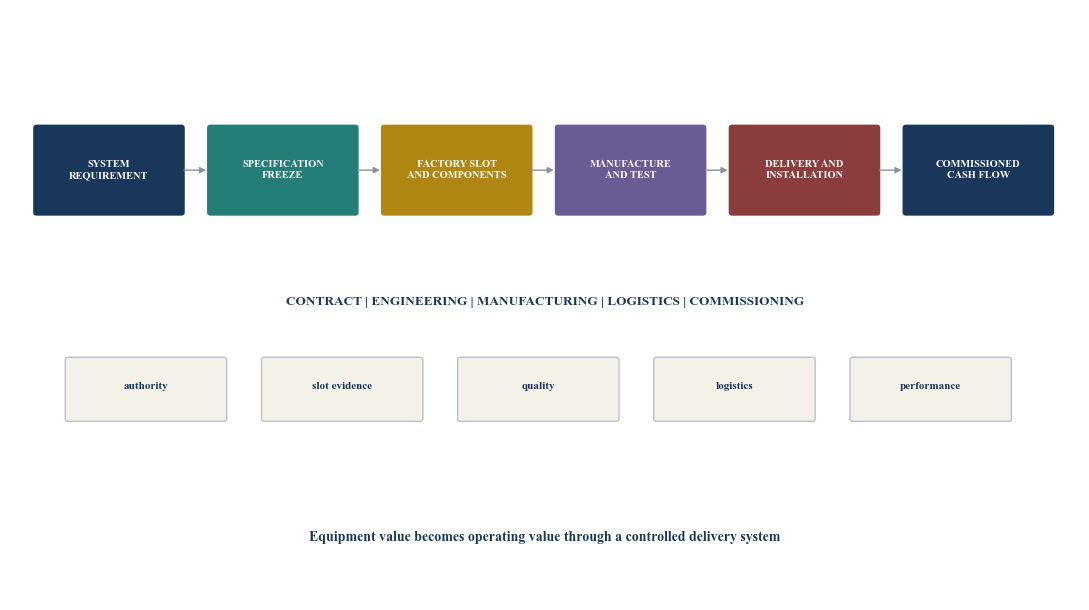
Author framework. Each stage requires current technical, contractual and financial evidence.
2. Define the financeable equipment perimeter
The financeable object extends beyond the main transformer or turbine. It can include engineering, drawings, software, protection, auxiliary systems, controls, generator, cooling, enclosures, bushings, tap changers, excitation, switchgear, spare parts, tools, transport frames, storage, installation supervision, testing, training and long-term service.
The functional requirement should be translated into a controlled bill of supply. Interfaces need named owners. A transformer requires compatibility with system voltage, frequency, impedance, vector group, insulation, protection, losses, cooling, footprint and transport limits. A turbine package requires compatibility with output, ambient conditions, fuel, emissions, heat-rate, start profile, grid code, balance of plant and service regime.
The transaction perimeter should identify the buyer, project company, supplier, factory, subcontractors, logistics providers, installers, operator, utility and lenders. It should also identify who owns designs, components, work in progress and completed equipment at every stage.
Finance should cover only an evidenced perimeter. Undefined balance-of-plant scope can leave an expensive core machine unable to operate. A low equipment price can be offset by interfaces, civil works, fuel treatment, grid-code modifications, spares, warranty limits or service obligations.
3. Prove the production slot
A supplier quotation can state price and expected delivery while remaining subject to capacity, specification and contract. A reservation can expire. An accepted order can remain conditional on deposit, credit support, export approval, technical data or notice to proceed.
Production-slot evidence should identify the factory, product platform, capacity window, critical component allocation, engineering start, test-bay window and delivery sequence. The investor should reconcile supplier correspondence, contract schedules, payment evidence, drawings, manufacturing plans and independent inspection.
The evidence should reach beyond the prime contractor where possible. Large transformers rely on grain-oriented electrical steel, copper or aluminium, insulation, bushings, tap changers and specialised transport. Turbines rely on forgings, castings, blades, combustion systems, generators, controls and qualified repair capacity. A prime production slot can still move when a critical component or test bay is unavailable.
Evidence has a date. Factory allocation can change after late specification decisions, missed payments or buyer delay. The project should maintain written confirmation tied to the current design and payment status.
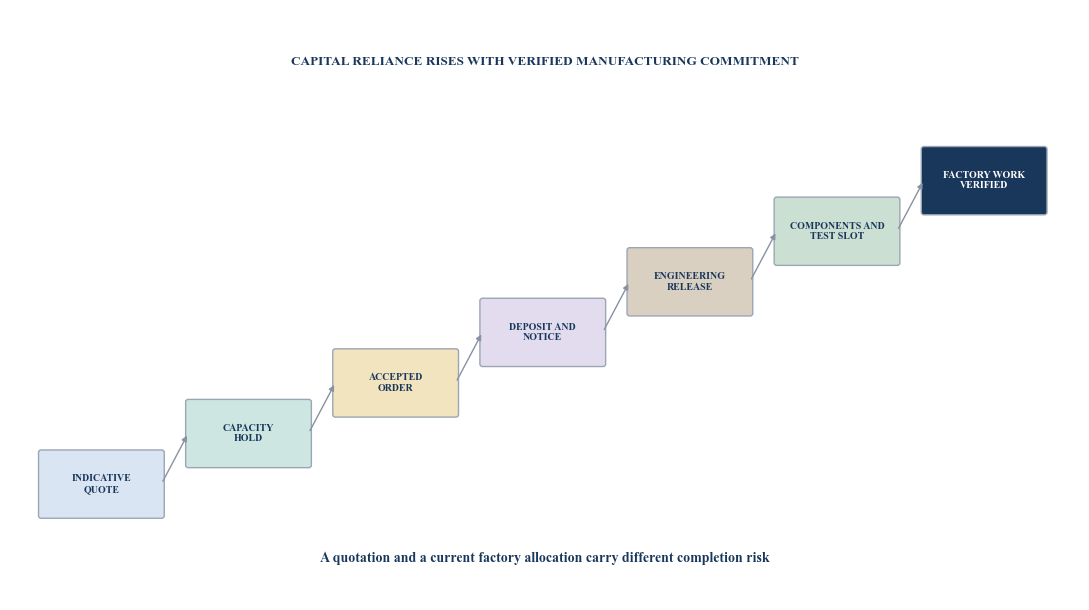
Author framework. Financing reliance increases with accepted, current and independently verifiable evidence.
Table 1. Long-lead equipment diligence file
| Diligence field | Primary evidence | Principal risk | Decision test |
|---|---|---|---|
| Functional requirement | approved system design and load case | equipment cannot perform required service | does the duty match the complete operating case? |
| Technical specification | frozen data sheets and interface register | redesign consumes slot and contingency | are every critical parameter and owner approved? |
| Production slot | supplier confirmation and factory plan | delivery date remains indicative | is the slot tied to this buyer, design and payment? |
| Critical components | bill of material and procurement status | upstream item delays main machine | which components control manufacture and test? |
| Price and escalation | executed commercial schedule | commodity, labour or currency exposure | which amounts can change and under what formula? |
| Milestone payments | contract, invoices and certificates | cash leaves before value is verified | does each payment follow independent evidence? |
| Title and security | contract, identification and filings | lender cannot recover work in progress | when and where does enforceable title transfer? |
| Quality and testing | inspection plan and acceptance procedure | latent defects or failed tests | who witnesses, rejects and requires remediation? |
| Logistics | route survey, permits, carrier and insurance | equipment cannot reach or enter site | is the complete route executable on the required date? |
| Installation and commissioning | method, resources and grid requirements | delivered machine remains inoperable | are interfaces, specialists and test power available? |
| Warranty and service | warranty, security and service plan | remedy is slow, capped or inaccessible | does protection support the operating requirement? |
| Compliance | export, sanctions, origin and local approvals | delivery or use becomes unlawful | have qualified advisers cleared the current transaction? |
Required evidence depends on the equipment, supplier, contract, project and jurisdiction.
4. Freeze the specification without freezing optionality
Custom engineering can improve system performance while increasing manufacturing time and switching cost. Standard platforms can improve availability and serviceability while requiring site or system adaptation. The decision should compare complete delivered service.
Specification governance needs an approved baseline, interface register, change-control process and commercial consequence. Every proposed change should state the technical need, schedule effect, price effect, factory effect, warranty effect and alternative.
Standardisation can increase purchasing power across a portfolio. It can create common spares, training and service. Ofgem's 2026 supply-chain work in Great Britain identifies demand visibility and procurement practices as material to manufacturer confidence.[5] The United States Department of Energy reports more than 80,000 distribution-transformer varieties and describes standardisation as a potential way to improve interoperability and production time.[2]
Optionality should be engineered in advance. Alternative approved materials, accessories, cooling configurations, transport arrangements and factories can reduce dependence on a single path. A late attempt to substitute equipment can trigger new studies, permits, foundations, protection design and customer approval.
5. Connect factory capacity to project capacity
Manufacturer expansion supports future supply while carrying its own delivery schedule. Siemens Energy announced a EUR 220 million expansion of its Nuremberg transformer factory, targeting approximately 50 percent additional capacity with new areas expected in 2028.[11] Hitachi Energy announced multiple transformer investments, including an additional USD 250 million through 2027 and a Thailand expansion expected to increase local production capacity by 60 percent by the end of 2027.[12][13]
These announcements demonstrate investment response. They do not establish allocation for an individual buyer. New buildings require equipment, staff, qualification and ramp. Existing factories can improve throughput through automation, standardisation, shifts, debottlenecking and supply-chain agreements.
The buyer should distinguish supplier-wide announced capacity, product-family capacity, factory capacity, test capacity and its own allocated slot. A supplier can report a large backlog and still provide a credible date for a defined platform, or report expansion while a specific test bay remains constrained.
Concentration should be mapped. Several bidders can rely on the same component producer or sub-supplier. Alternative brands can rely on the same port, specialised transporter or installation workforce.
6. Build an evidence-led payment architecture
Long-lead equipment often requires deposits and progress payments before delivery. Those payments fund engineering, materials, components and manufacturing. They also create buyer exposure to delay, quality failure, supplier stress and project cancellation.
Each payment should correspond to verified value. A deposit can follow an accepted order, capacity allocation and appropriate security. Engineering payments can follow approved deliverables. Material payments can follow identifiable, compliant components. Manufacturing payments can follow inspection of completed work. Shipment payment can follow factory acceptance, documentation, title and transport readiness.
Security can include advance-payment guarantees, performance bonds, parent guarantees, letters of credit, retention, escrow, direct agreements and insurance. The instrument should be checked for issuer, jurisdiction, expiry, conditions, reduction, assignment and enforceability.
Title language should match physical identification and local law. A contract clause that transfers title to generic work in progress may provide limited recovery. Serial numbers, segregation, marking, inventory records, inspection rights and filings can strengthen control where legally effective.
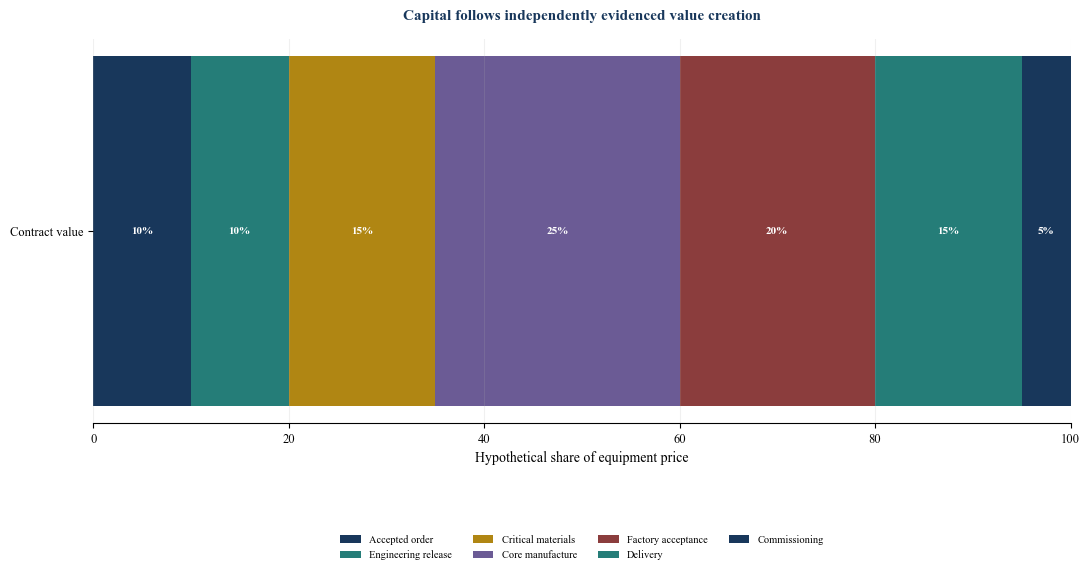
Percentages are hypothetical management assumptions created solely to demonstrate gated funding.
Table 2. Milestone payment and control matrix
| Milestone | Evidence before payment | Principal protection | Stop condition |
|---|---|---|---|
| Capacity reservation | binding hold, factory and expiry | refundable fee or suitable guarantee | allocation remains conditional or unidentified |
| Contract deposit | executed contract and notice | advance-payment guarantee | security is missing, mismatched or expires early |
| Engineering release | approved drawings and interface register | change control and schedule remedy | critical specification remains open |
| Critical materials | supplier evidence and identification | title, segregation and inspection | origin, quality or allocation is unclear |
| Manufacturing progress | independent progress certificate | direct inspection and cure rights | delay exceeds funded recovery plan |
| Factory acceptance | passed tests and complete dossier | retention and performance security | material test failure remains unresolved |
| Shipment | title, permits, route and insurance | cargo cover and controlled documents | site or route is not ready |
| Delivery | condition report and secure storage | custody, preservation and warranty | damage or missing items prevent installation |
| Commissioning | completed performance tests | final retention and warranty start | output, efficiency or grid compliance fails |
Controls require transaction-specific legal, technical, insurance and credit review.
7. Underwrite supplier and counterparty capacity
The supplier credit case includes financial strength, backlog quality, cash conversion, warranty exposure, factory execution, labour, components and service capability. A strong group balance sheet can coexist with an overloaded product line. A specialised supplier can have excellent execution and limited liquidity.
The buyer should understand whether the contracting party owns the factory, relies on an affiliate or subcontracts material scope. Parent support should be explicit. Guarantees should state the supported obligations and remain effective through the relevant period.
Backlog requires interpretation. It can include cancellable orders, service obligations, framework volumes and projects awaiting conditions. The investor should use published definitions and transaction evidence. Manufacturer statements can support market context and should not replace direct confirmation.
Counterparty risk also exists on the project side. Suppliers can suspend or reallocate capacity after missed payments, late data or delayed site readiness. The completion plan should fund buyer obligations and preserve decision rights.
8. Finance equipment before the full project closes
Early equipment commitments can preserve schedule while land, permits, grid agreements, customer contracts and long-term financing remain incomplete. This creates an interface between development capital and project finance.
An early-equipment facility can finance deposits and verified manufacturing milestones. Repayment can come from financial close, equity, asset sale or operating finance. Lenders need a defined project path, sponsor support, equipment rights, supplier agreements, assignment, insurance, valuation and completion liquidity.
The equipment can have limited standalone recovery. Transformers are frequently engineered for a specific system. Large turbines require site-specific balance of plant, permits, fuel, installation and service. Resale can involve delay, redesign, transport and warranty consent.
Credit should therefore depend on both collateral and completion. The base case needs a funded path to delivery and operation. A recovery case should use realistic time, cost, buyer universe, modifications and legal control.
9. Use portfolio procurement and advanced funding
Portfolio buyers can aggregate demand, standardise equipment, reserve manufacturing capacity and sequence projects. This can improve supplier visibility and reduce repeated procurement. It can also create take-or-pay, allocation and rebalancing risk.
Great Britain's Ofgem introduced an Advanced Procurement Mechanism in March 2025 to allow transmission owners to book supply-chain capacity earlier within the price-control framework.[4] The mechanism provides a regulatory example of financing before individual project readiness. Its legal and regulatory treatment is specific to Great Britain.
A commercial portfolio framework should define minimum volume, call-off process, allocation priority, specification families, price adjustment, cancellation, substitution, transfer, delivery windows and unused capacity. It should prevent a delayed project from consuming a slot needed by a ready project.
Financing can sit at portfolio, utility, project or equipment-vehicle level. The allocation of cost and security should follow the party controlling the slot and receiving the benefit.
10. Compare geographic procurement responses
The equipment constraint is global, while institutional responses differ. North American sources emphasise transformer lead times, standardisation, domestic manufacturing and reliability. Great Britain is using advanced procurement and supply-chain reporting within a regulated network model.
Singapore's Energy Market Authority launched a 2026 request for proposal for new hydrogen-ready combined-cycle gas-turbine generation to be operational in 2031 and 2032, including units of at least 600 megawatts.[14] The timetable demonstrates central coordination between demand planning, generation procurement and equipment delivery.
India's Central Electricity Authority publishes project-level transmission delivery reporting, including transformation capacity, material receipt, construction progress and reasons for delay.[15] This type of physical-progress disclosure can support portfolio monitoring.
The UAE Ministry of Energy and Infrastructure describes national grid investment and a unified monitoring centre across the four utilities.[16][17] These materials provide system context. A project still needs its own utility, equipment and contract evidence.
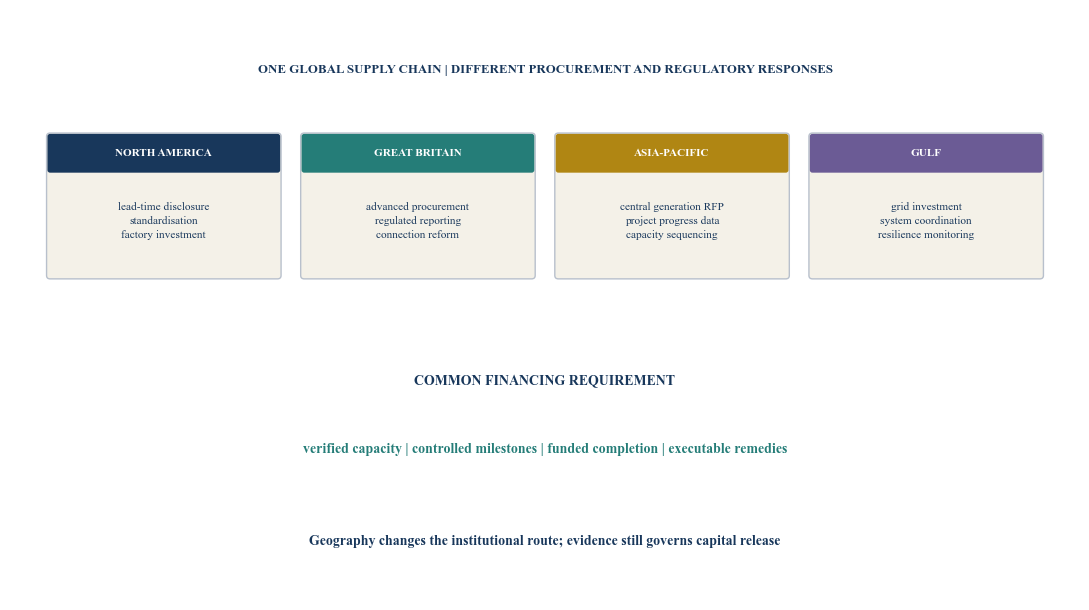
Author synthesis of selected official approaches. Each jurisdiction has distinct laws, institutions and market structures.
Table 3. Selected geographic procurement context
| Geography | Published context | Illustrative financing implication | Required project evidence |
|---|---|---|---|
| North America | long transformer lead times and factory investment | early reservation, standardisation and supplier diligence | factory, component, testing and delivery proof |
| Great Britain | advanced procurement within regulated transmission | capacity can be booked before individual project delivery | regulatory allowance, portfolio allocation and reporting |
| Singapore | central RFP for future CCGT capacity | generation and equipment timetable can be coordinated centrally | award, permits, fuel, turbine slot and completion funding |
| India | project-level transmission progress reporting | finance can follow visible materials and construction milestones | contract, delivered equipment, site progress and commissioning |
| Gulf | grid investment, generation expansion and national coordination | equipment can support large integrated infrastructure programmes | utility interface, import, logistics, local permits and service |
| Global OEM market | large backlogs and manufacturing expansion | supplier strength and allocation require separate review | buyer-specific accepted order and current production status |
This comparison summarises cited official materials and does not state a complete legal or market position.
11. Control price, currency and escalation
Equipment price can be fixed, indexed, provisional or subject to change after specification. Escalation can reference metals, labour, energy, logistics, foreign exchange or published indices. Duties, tariffs, taxes and localisation requirements can change delivered cost.
The model should separate base price, options, spares, service, logistics, civil interfaces, taxes, security cost, owner contingency and financing. It should identify the currency and date of every cash flow.
Hedging should match the payment schedule and contractual reset rules. A hedge can create collateral or liquidity requirements. A delayed milestone can leave a hedge misaligned with the underlying payment.
Price protection should be tested with schedule protection. A fixed price offers limited benefit if an uncapped delay postpones project revenue. Liquidated damages, caps, exclusions and force-majeure provisions require qualified review.
12. Treat logistics as engineered scope
Large transformers and turbines can exceed ordinary road, rail, port and lifting limits. Delivery requires route surveys, bridge and road analysis, port capacity, permits, escorts, cranes, specialised trailers, weather windows and site access.
The equipment dimensions and weight can change during engineering. The route should be revalidated against the final transport configuration. Temporary works can require land rights and approvals.
Incoterms allocate specified delivery obligations and risk within their defined use. They do not replace a complete logistics plan. Insurance should address cargo, delay in start-up, storage, handling, installation and testing where appropriate.
Preservation is part of logistics. Equipment stored before installation can require controlled humidity, heaters, inspections, oil management, rotation, security and manufacturer procedures. Warranty periods should align with realistic installation and commissioning.
13. Integrate installation, commissioning and service
Factory completion is an intermediate milestone. The site needs foundations, buildings, fuel, grid interface, cabling, auxiliaries, cooling, protection, controls, communications and qualified teams.
Commissioning should define mechanical completion, energisation, first fire, synchronisation, reliability run, performance test and acceptance. Test conditions should specify ambient adjustment, fuel quality, measurement tolerance, output, heat rate, losses, sound, vibration and emissions as relevant.
Service planning begins before operation. Turbine economics can depend on inspections, parts, outages, upgrades and long-term service agreements. Transformer service can depend on oil testing, monitoring, bushings, tap changers, spares and repair capability.
The financier should understand which failure modes require factory support, which can be repaired locally and how long critical spares take. Service concentration can persist long after equipment delivery.
14. Protect quality, provenance and cybersecurity
Quality plans should state applicable standards, approved suppliers, hold points, witness points, test procedures, document requirements and non-conformance control. Independent technical advisers should have direct access where appropriate.
Provenance matters for quality, sanctions, export control, tariffs, local content and security. The bill of material should identify critical components and origin to the degree required by the transaction and law.
Digital controls and remote service create cybersecurity dependencies. FERC's 2025 supply-chain action directed reliability-standard revisions concerning supply-chain risk management for applicable United States bulk-power entities.[6] Its jurisdiction and requirements should not be applied automatically elsewhere.
The project should inventory software, firmware, remote access, updates, credentials, data flows and support obligations. Cyber review should connect procurement, commissioning and operations.
15. Allocate delay, cancellation and change risk
Delay can originate with buyer data, supplier engineering, sub-suppliers, factory labour, testing, export approvals, logistics, permits, site readiness or grid availability. The contract should distinguish responsibility and evidence.
Cancellation terms can escalate as committed cost increases. The buyer should know the amount at risk at every date and whether the equipment or slot can transfer to another project. The supplier should know whether buyer credit and project readiness support the reservation.
Change provisions should address price, date, cancellation, capacity and warranty. A buyer-directed change should not automatically excuse unrelated delay. A supplier change should require technical equivalence and approval.
Direct agreements can provide notice, cure, step-in, assignment and continued performance for lenders. Their practical value depends on supplier consent, financing documents, law and the project's ability to complete.
16. Demonstrate a hypothetical procurement case
Consider a hypothetical 600-megawatt generation and data-infrastructure power programme. Route A waits for full project close before placing a turbine and transformer order. Route B uses sponsor-backed early-equipment finance to secure defined slots after technical and commercial diligence.
Route A commits no early equipment cash and reaches financial close in month twelve. Its hypothetical first-power date is month sixty. Route B pays a secured deposit in month three, releases engineering in month six and reaches financial close in month twelve. Its hypothetical first-power date is month forty-eight.
Route B requires AED 420 million of early commitments, of which AED 300 million is financed. Hypothetical interest, fees, security and owner cost add AED 38 million. Earlier customer and capacity cash has a hypothetical present value advantage of AED 210 million. Reduced idle-site and escalation cost adds AED 74 million. A risk reserve of AED 62 million covers cancellation, rework and delay scenarios.
The hypothetical net advantage is AED 184 million before project-specific tax, accounting and valuation review. Every amount, date, rate, probability and result is a hypothetical management assumption created solely to demonstrate the framework.
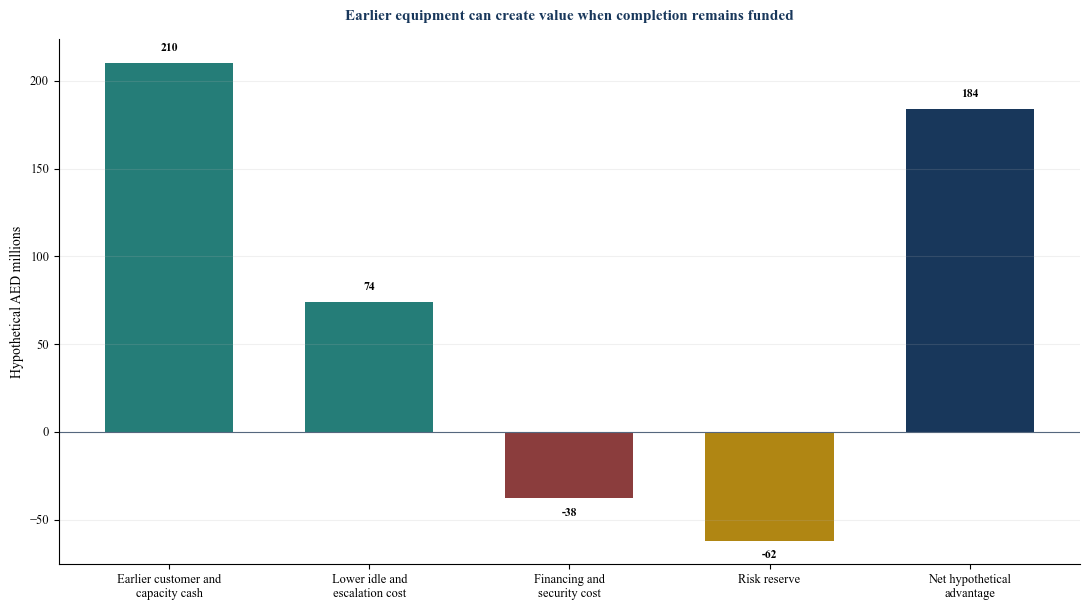
Every value is a hypothetical management assumption in AED millions created solely to demonstrate the method.
Table 4. Hypothetical procurement-route comparison
| Measure | Route A: order after close | Route B: early-equipment finance | Decision relevance |
|---|---|---|---|
| Early equipment commitment | AED 0 | AED 420m | capital placed before full project close |
| Early-equipment facility | AED 0 | AED 300m | dedicated funded procurement |
| Financial close | month 12 | month 12 | common long-term financing date |
| Hypothetical first power | month 60 | month 48 | twelve-month timing difference |
| Equipment evidence | quotation until close | accepted order, slot and gated milestones | delivery confidence differs |
| Earlier customer and capacity cash PV | baseline | AED 210m advantage | dated operating cash benefit |
| Lower idle-site and escalation PV | baseline | AED 74m advantage | avoided carry and price exposure |
| Finance and security cost | baseline | AED 38m deduction | cost of early commitment |
| Completion risk reserve | baseline | AED 62m deduction | cancellation, rework and delay |
| Hypothetical net advantage | baseline | AED 184m | scenario result before professional review |
Every value and date is a hypothetical management assumption created solely to demonstrate the framework.
17. Stress the complete equipment path
The base case should be stressed through connected events. A slot-loss case delays manufacturing and can reprice the order. A component case delays factory completion. A test-failure case requires rework and consumes the test bay. A logistics case leaves completed equipment at the factory, port or storage site.
A project-delay case can create cancellation exposure, storage, preservation and warranty burn. A supplier-stress case can stop work while the buyer attempts to enforce security or recover components. A foreign-exchange case changes deposits and hedging liquidity.
The model should show project cash, equipment cash, debt draw, equity need, security expiry, customer cash and completion headroom by date. It should identify the earliest funding shortfall and the decision available before it occurs.
Mitigations should be executable. They can include alternative components, technical redesign, slot transfer, portfolio reallocation, supplier support, additional security, bridge finance, temporary generation, phased capacity or a different site. Each action requires time, authority, cost and technical approval.
Table 5. Long-lead equipment stress matrix
| Stress | Immediate effect | Cash and value transmission | Required evidence and response |
|---|---|---|---|
| Production slot moves | delivery date slips | revenue delay, carry and possible repricing | written factory cause, revised plan and funded liquidity |
| Critical component delay | manufacture cannot progress | milestone and test sequence shift | sub-supplier status and approved alternative |
| Factory test failure | rework and retest required | payment hold, delay and remediation cost | witnessed result and agreed cure plan |
| Supplier financial stress | work or warranty support weakens | recovery and completion funding increase | security, title, direct rights and replacement route |
| Buyer project delay | site is not ready for equipment | storage, preservation and cancellation cost | integrated project schedule and funded holding plan |
| Logistics failure | equipment cannot reach site | idle equipment and installation delay | final route, permits, carrier and contingency |
| Currency or tariff move | delivered price changes | capital requirement and hedge cash change | current exposure and aligned hedge plan |
| Specification change | design and interfaces reopen | slot, price, permits and foundations move | authorised change case and full consequence |
| Commissioning failure | commercial operation delayed | customer cash and performance security affected | test evidence, root cause and repair resources |
| Service bottleneck | outage or repair duration rises | availability and life-cycle cost worsen | spares, specialists, service agreement and alternatives |
Scenario magnitudes and mitigations require current transaction, supplier, technical and legal evidence.
18. Operate through one equipment-control dashboard
The dashboard should connect contract, engineering, factory, components, quality, logistics, site, commissioning, service and cash. Every metric needs a definition, source, date, owner and response threshold.
Core fields include specification-freeze status, factory, slot confirmation date, engineering release, critical-component status, manufacturing percentage, test-bay date, inspection findings, paid amount, secured amount, title status, guarantee expiry, shipment date, route readiness, site readiness, commissioning date and remaining liquidity.
Forecast dates should preserve their movement history. The committee should distinguish supplier contract date, factory forecast, independent adviser view and management assumption.
Exceptions should produce decisions. A slipping component date can require an alternative approval before the main schedule moves. A guarantee expiry can require extension before payment. A site delay can trigger storage and preservation before shipment.
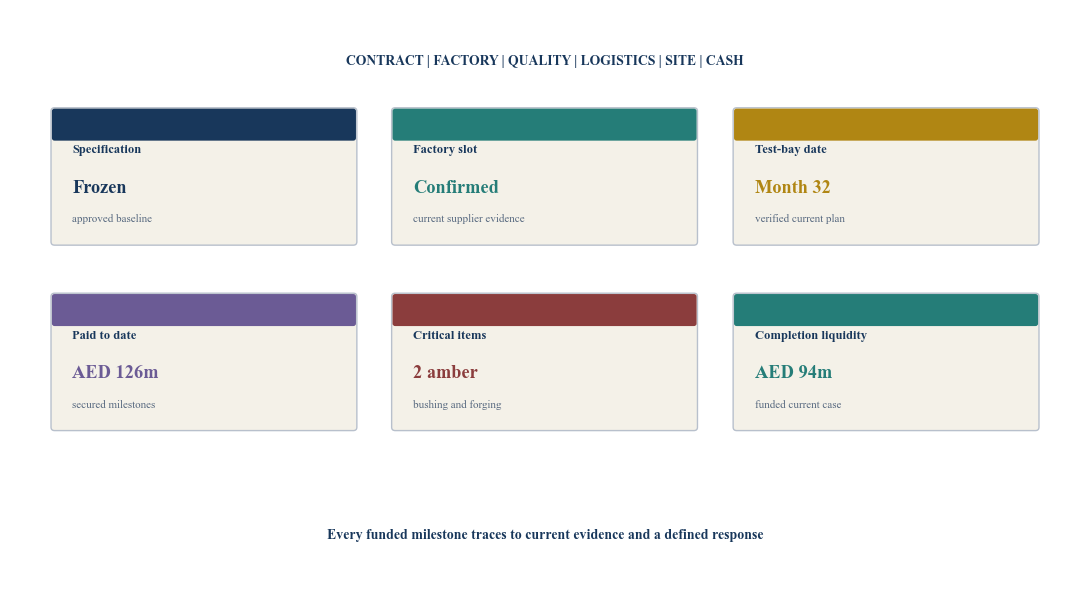
Every displayed value is a hypothetical management assumption created solely to demonstrate dashboard design.
19. Implement the framework in 120 days
Days one to twenty define the power requirement, project configuration, equipment perimeter, procurement authority, geographic constraints, adviser roles and decision rights. The team preserves and indexes supplier and project records.
Days twenty-one to forty freeze the functional specification, interface register and qualified supplier list. It maps factories, critical components, test capacity, logistics, service and applicable compliance.
Days forty-one to sixty obtain and reconcile supplier proposals. The team tests production-slot evidence, price, milestones, security, title, warranty, service, cancellation and alternative routes.
Days sixty-one to eighty build the integrated schedule, equipment cash model, completion plan, recovery case and connected downside scenarios. Technical, legal, tax, insurance, export and credit advisers complete their scoped reviews.
Days eighty-one to one hundred negotiate the equipment contract, direct agreement, security, inspection, logistics, storage and early-finance documents. The operating team conducts a funds-flow and exception-response dry run.
Days one hundred and one to one hundred and twenty approve, commit or decline. The first dashboard becomes active. Every subsequent payment remains conditional on current evidence, valid security, project readiness and funded completion.
Table 6. One-hundred-and-twenty-day long-lead equipment programme
| Days | Workstream | Controlled deliverable | Gate |
|---|---|---|---|
| 1 to 10 | mandate and requirement | power, service and equipment perimeter | committee confirms decision scope |
| 11 to 20 | authority and records | parties, advisers, data room and approvals | each claim has accountable ownership |
| 21 to 30 | specification | functional baseline and interfaces | critical parameters are approved |
| 31 to 40 | market and factories | supplier, slot, component and service map | qualified routes remain technically feasible |
| 41 to 50 | proposal reconciliation | comparable price, scope, date and obligations | commercial offers share one basis |
| 51 to 60 | slot diligence | factory allocation and payment evidence | reliance follows verified commitment |
| 61 to 70 | schedule and logistics | manufacture-to-commissioning critical path | site and factory paths reconcile |
| 71 to 80 | finance and stress | cash, security, recovery and completion cases | downside remains funded and actionable |
| 81 to 90 | contract protections | milestones, title, quality, delay and warranty | risk allocation supports approved case |
| 91 to 100 | execution readiness | direct rights, funds flow and dashboard | operational dry run passes |
| 101 to 110 | commit or decline | authorised procurement decision | evidence and security remain current |
| 111 to 120 | adoption | first monitored milestone and next gate | committee accepts control reporting |
Timing depends on project maturity, equipment, supplier, approvals, law and financing scope.
20. Limitations and conclusion
Equipment markets, factory capacity, component availability, prices, currencies, trade measures, export controls, regulation and project schedules can change during procurement. Project decisions require current evidence from suppliers, factories, sub-suppliers, utilities, contractors, insurers and qualified advisers.
IEA findings describe surveyed global transmission supply-chain conditions.[1] DOE, NERC and FERC materials apply within their stated United States purposes.[2][3][6] Ofgem decisions and consultations apply to Great Britain.[4][5] Singapore, Indian and UAE materials apply within their respective institutional purposes.[14][15][16][17] Manufacturer reporting presents corporate and market information under each company's definitions.[8][9][10][11][12][13]
Every capacity, cost, value, date, rate, probability, payment percentage and result in the worked example is a hypothetical management assumption. No supplier allocation, project, transaction, market price or realised outcome is claimed.
Long-lead equipment can justify early capital when the production slot is real, the design is controlled, payments follow verified value, protections are enforceable, logistics and commissioning are executable, and the project has funded completion liquidity.
The resulting discipline turns a headline shortage into a sequence of investment decisions. Capital follows evidence from requirement through factory, delivery and operating performance. Geography changes the institutional route and regulatory context. The control principles remain grounded in verified capacity, dated milestones and executable remedies.
References
- [1] International Energy Agency, Building the Future Transmission Grid: Executive Summary, 25 February 2025. https://www.iea.org/reports/building-the-future-transmission-grid/executive-summary
- [2] United States Department of Energy, Supply Chain and Market Analysis, official materials accessed 13 August 2026. https://www.energy.gov/oe/supply-chain-and-market-analysis
- [3] North American Electric Reliability Corporation, 2025 Summer Reliability Assessment, May 2025. https://www.nerc.com/globalassets/programs/rapa/ra/nerc_sra_2025.pdf
- [4] Ofgem, Electricity Transmission Advanced Procurement Mechanism, 20 March 2025. https://www.ofgem.gov.uk/decision/electricity-transmission-advanced-procurement-mechanism
- [5] Ofgem, Growing Great Britain's Electricity Network Supply Chains, 25 March 2026. https://www.ofgem.gov.uk/call-for-input/growing-great-britains-electricity-network-supply-chains-ofgem-position-and-call-evidence
- [6] United States Federal Energy Regulatory Commission, FERC Takes Action to Enhance Reliability of the U.S. Electric Grid, 18 September 2025. https://www.ferc.gov/news-events/news/ferc-takes-action-enhance-reliability-us-electric-grid
- [7] North American Electric Reliability Corporation, 2025 Long-Term Reliability Assessment, January 2026. https://www.nerc.com/globalassets/our-work/assessments/nerc_ltra_2025.pdf
- [8] Siemens Energy, Q4 FY2025 Shareholder Letter, 14 November 2025. https://assets.siemens-energy.com/dam/9478ef65-c3f9-49de-97b0-b3aa00d5712d/2025-11-14--Shareholder-Letter-Q4-FY2025-EN_final-pdf_Original%20file.pdf
- [9] GE Vernova, 2025 Annual Report, 2026. https://www.gevernova.com/sites/default/files/gevernova_2025_annual_report.pdf
- [10] GE Vernova, 2025 Annual Report CEO Letter, 2026. https://www.gevernova.com/investors/annual-report/ceo-letter
- [11] Siemens Energy, Siemens Energy Invests EUR 220 Million in German Transformer Factory, 5 September 2025. https://www.siemens-energy.com/global/en/home/press-releases/siemens-energy-invests--220-million.html
- [12] Hitachi Energy, Additional USD 250 Million Investment to Address Global Transformer Shortage, 10 March 2025. https://www.hitachienergy.com/uk-ie/en/news-and-events/press-releases/2025/03/hitachi-energy-invests-additional-250-million-usd-to-address-global-transformer-shortage
- [13] Hitachi Energy, Transformer Operations Expansion in Thailand, 28 August 2025. https://www.hitachienergy.com/us/en/news-and-events/press-releases/2025/08/hitachi-energy-invests-455-million-thb-14-million-usd-to-expand-transformer-operations-in-thailand-to-meet-accelerating-demand
- [14] Energy Market Authority of Singapore, RFP for New Electricity Generation Capacity, 29 April 2026. https://www.ema.gov.sg/content/dam/corporate/news/media-releases/2026/20260429-EMA-Media%20Release-EMA-Launches-Request-for-Proposal-for-New-Electricity-Generation-Capacity.pdf.coredownload.pdf
- [15] Central Electricity Authority of India, Transmission Lines and Transformation Capacity Targeted for FY 2025-26, February 2026. https://cea.nic.in/wp-content/uploads/transmission/2026/02/RFD_Report_Feb_2026.pdf
- [16] UAE Ministry of Energy and Infrastructure, Minister Highlights UAE Approach to Diversify Energy Mix at ADIPEC, 4 November 2025. https://www.moei.gov.ae/en/media-center/news/4/11/2025/minister-of-energy-and-infrastructure-highlights-uaes-approach-to-diversify-energy-mix-at-adipec
- [17] UAE Ministry of Energy and Infrastructure, Emirates Monitoring Center Inaugurated to Strengthen National Power Grid Resilience, 9 July 2026. https://www.moei.gov.ae/en/media-center/news/9/7/2026/ministry-of-energy-and-infrastructure-inaugurates-emirates-monitoring-center-to-strengthen-national
About the Author
Chennakeshav Adya is an independent researcher and Managing Partner of Matchpoint Partners. His research focuses on investment strategy, capital formation, transaction execution, governance and operating-model design across the Gulf and international markets.
