

1. Begin with the food-platform margin identity
A food platform should be valued through the economic chain that creates a sale and converts it into cash. Consolidated revenue and EBITDA can conceal the operating variables that move first when a platform expands, acquires a brand or adds a channel. The core identity starts with net selling price after discount, loyalty, refund and indirect-tax effects. It then deducts ingredient cost, packaging, direct production labour, waste, fulfilment, channel commission, payment cost and site or production occupancy. The result should be reconciled to reported gross profit and store or channel contribution.
The identity must be built by product, format, location and channel. A restaurant meal, delivered order, retail product, catering contract and wholesale case can carry the same brand while producing different economics. Delivery may add commission, packaging and refund cost. Retail may require listing fees, promotions, returns and distributor margin. Business-to-business supply may deliver larger volume with longer credit and specification obligations. A blended gross margin can therefore improve while cash conversion deteriorates.
Diligence should establish which data are recorded at transaction level, which are estimated and which are allocated. Recipe quantities, purchase prices, yields, discounts, sales mix, labour hours, waste, inventory movements and channel fees should connect through stable identifiers. Sampling should cover high-volume products, low-margin products, new launches, peak periods and reported month ends. Reconciliation differences should remain visible until resolved.
The acquisition thesis should state the margin mechanism in operational language. Procurement savings require addressable spend, comparable specifications, negotiating leverage and executable supplier changes. Production savings require capacity, logistics and food-safety validation. Revenue synergies require customer permission, channel access and incremental contribution after cannibalisation. The model should treat each mechanism separately and show when it becomes cash.
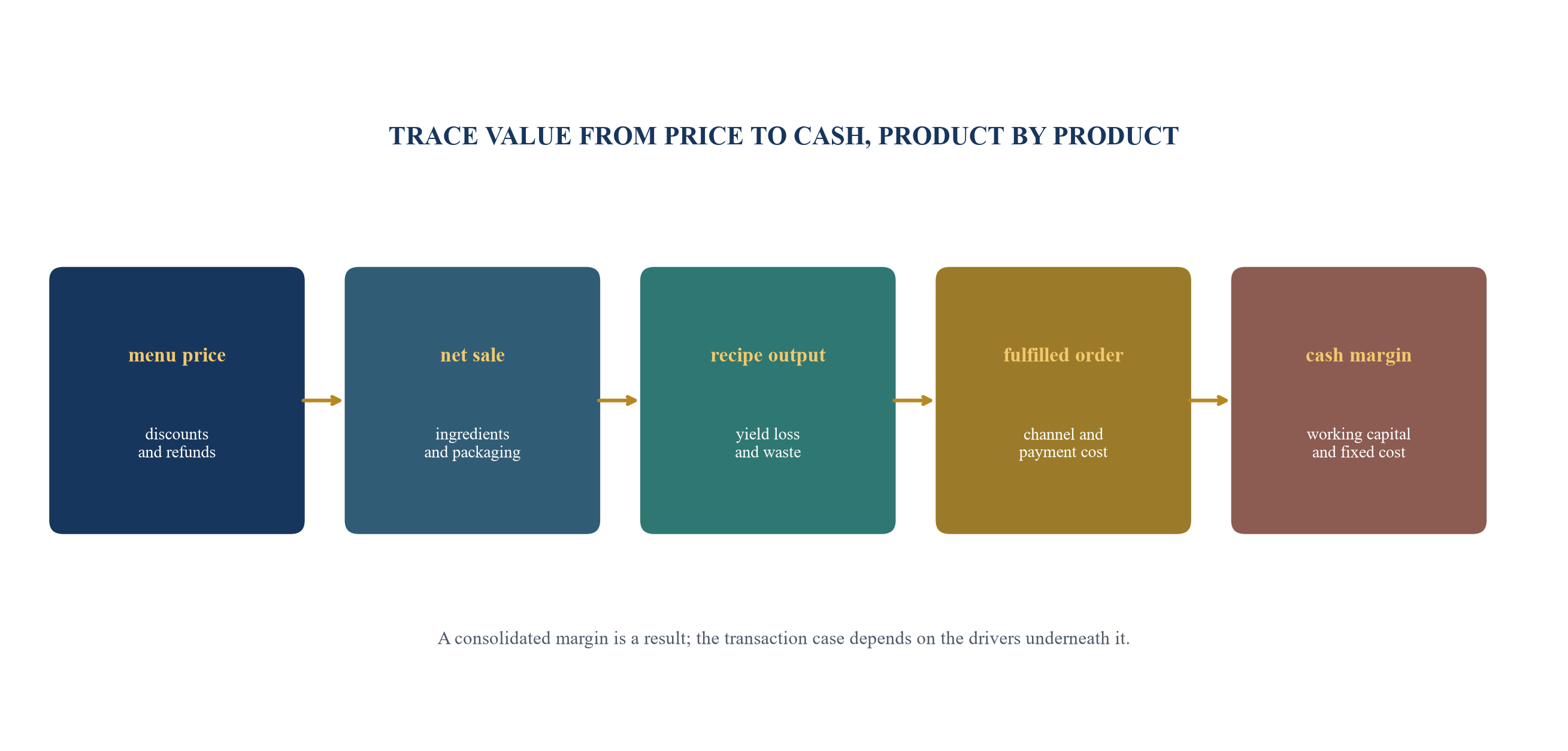
Each stage requires a verified operational and accounting bridge before value is attributed.
2. Define the platform and transaction perimeter
Food groups often operate through several legal entities, brands, licences, kitchens, factories, warehouses, franchise arrangements, delivery accounts and concession contracts. The transaction perimeter should identify which entities, assets, contracts, people, data, permits and liabilities transfer. A brand acquisition without a production licence, recipe rights or channel account may not deliver the operating business assumed in the valuation.
The perimeter map should follow each material product from supplier to customer. It should identify the contracting buyer, importer of record, manufacturer, warehouse operator, brand owner, franchisor, retailer, delivery-platform account holder, invoicing entity and collection account. Intercompany flows require price, volume, settlement and transfer-pricing evidence. Related-party suppliers or landlords should be separated from third-party market terms.
Carve-outs require particular discipline. Shared procurement, information systems, finance, quality assurance, human resources, kitchens, logistics and licences may remain with the seller. Transitional services should specify scope, service level, data access, price, duration, exit plan and liability. The buyer's Day One design should address any function that protects food safety, product availability, revenue recognition or cash collection.
The perimeter should also distinguish ownership from control. Franchisees, concession operators and third-party kitchens may generate reported system sales while the target recognises only fees, royalties or product sales. Delivery-platform customer data may be subject to contractual restrictions. Recipes, trademarks, customer lists and software may sit in a different entity. Diligence and purchase documentation should resolve these rights before they are included in enterprise value.
Table 1. Food-platform transaction perimeter
| Component | Evidence required | Margin question | Transaction risk |
|---|---|---|---|
| brand and recipes | registrations, licences, recipe controls and usage rights | who controls price, specification and product change? | excluded intellectual property or restricted use |
| sourcing and import | supplier contracts, permits, incoterms and currency | where do landed cost and rebates arise? | change-of-control, continuity or foreign-exchange exposure |
| production | licences, capacity, yield, quality and maintenance records | which site creates conversion value? | stranded capacity or missing approval |
| channels | contracts, commission schedules, customer data and settlement | which channel owns the customer and the cash? | restricted transfer, fee reset or data loss |
| sites and leases | lease, concession, fit-out and restoration obligations | what occupancy cost belongs to each site? | consent, rent step-up or closure liability |
| people and systems | employment, access, interfaces and service dependencies | who operates the margin controls on Day One? | key-person loss or control interruption |
The operating role, legal owner and cash recipient should be established separately.
3. Put competition and regulatory timing on the critical path
GCC transactions require country-specific competition analysis at the start of the timetable. The UAE's 2025 threshold decision applies economic-concentration notification where combined annual sales in the relevant UAE market exceed AED 300 million or combined market share exceeds 40 per cent.[1] Ministry materials describe a review period of 90 working days that may be extended by 45 days, together with a standstill expectation while the application is considered.[2] The Ministry's current legislation page also lists the 2026 executive regulation.[3] Counsel should verify the latest law, market definition, filing requirement and timing for the actual parties.
Saudi Arabia's current Economic Concentration Review Guidelines define relevant changes of control and set transaction-specific sales tests. For acquisitions, the published matrix includes worldwide sales of the parties above SAR 200 million, target worldwide sales above SAR 40 million, and Saudi sales of all parties above SAR 40 million with target contribution.[4] The guidelines contain detailed rules on parties and control. The deal team should obtain local advice rather than transpose a UAE analysis.
Food platforms can raise competition questions at several levels: sourcing of a concentrated ingredient, access to distribution, branded product categories, delivery channels, retail shelf space, central kitchens, catering contracts or local catchments around physical sites. The relevant market may be narrower than the management reporting segment. Data requests should support product, customer, geography and channel analysis.
The transaction plan should integrate filing strategy, clean-team rules, information exchange, gun-jumping controls, long-stop date, conditions precedent, interim covenants and remedy risk. Procurement synergy planning before clearance should use aggregated or clean-team information and retain independent conduct. Any proposed supplier consolidation, exclusivity, channel restriction or pricing coordination requires competition review before implementation.
4. Rebuild revenue by product, customer and channel
Revenue quality affects both valuation and working capital. The buyer should reconstruct gross billings, discounts, refunds, loyalty awards, delivery fees, commissions, taxes, returns and settlement deductions. IFRS 15 requires revenue to depict transfer of promised goods or services in the amount of consideration expected in exchange.[13] The diligence model should reconcile operational order data to the accounting treatment rather than assume every gross transaction is revenue.
Principal-versus-agent questions are material for delivery, marketplaces, franchise systems and concessions. A platform may control a product before transfer and report gross revenue, or arrange for another party and report a fee. The accounting conclusion requires contract and control analysis. For transaction purposes, both gross merchandise value and accounting revenue should be separated from net contribution and cash received.
Customer concentration should be measured by legal counterparty, parent group, channel and end market. Business-to-business catering or private-label supply may create contractual volume with renewal, tender, rebate, service-credit and credit-risk provisions. Retail sell-in can overstate demand when returns, promotions or distributor inventory rise. Delivery growth may be purchased through discounts that reduce repeat economics.
Cohort analysis should follow acquisition source, first order, repeat rate, frequency, basket, discount and contribution. The buyer should test whether claimed cross-selling or brand expansion reaches a customer who can legally and practically be contacted. Channel agreements may restrict data use or marketing. Revenue synergies should start from customer permission and incremental contribution after fulfilment cost, cannibalisation and working capital.
5. Construct the ingredient cost bridge
Ingredient cost should be rebuilt from purchase order to usable recipe input. The bridge begins with quoted unit price and adjusts for volume tiers, rebates, freight, insurance, duty, inspection, currency, wastage in handling, yield loss and supplier credit. Standard cost, invoice cost and landed cash cost can differ materially. The acquisition model should show all three and reconcile them to cost of sales.
Purchase-price variance should be analysed by ingredient, specification, supplier, currency and month. Mix variance should be separated from price variance. A lower average cost can result from switching to a cheaper ingredient, changing portion size or selling more low-cost products. These changes may affect quality, customer demand and brand positioning. Diligence should identify the operating action behind the accounting movement.
Rebates require contract-level evidence. Volume rebates, growth incentives, marketing support, listing allowances and retrospective credits may depend on thresholds or continued purchasing. Their accounting period and cash receipt should be tested. A buyer that intends to consolidate suppliers may lose a target's rebate or shift volume across thresholds. A synergy model should reflect the combined contract mechanics rather than multiply historic rebate percentages.
Foreign exchange and commodity exposure should be linked to order lead time, pricing cadence and customer pass-through. An imported ingredient purchased in foreign currency may be ordered months before menu repricing. Hedging supports the case only where mandate, instrument, counterparty, basis, settlement and effectiveness are verified. Management's intention to hedge is not cash protection.
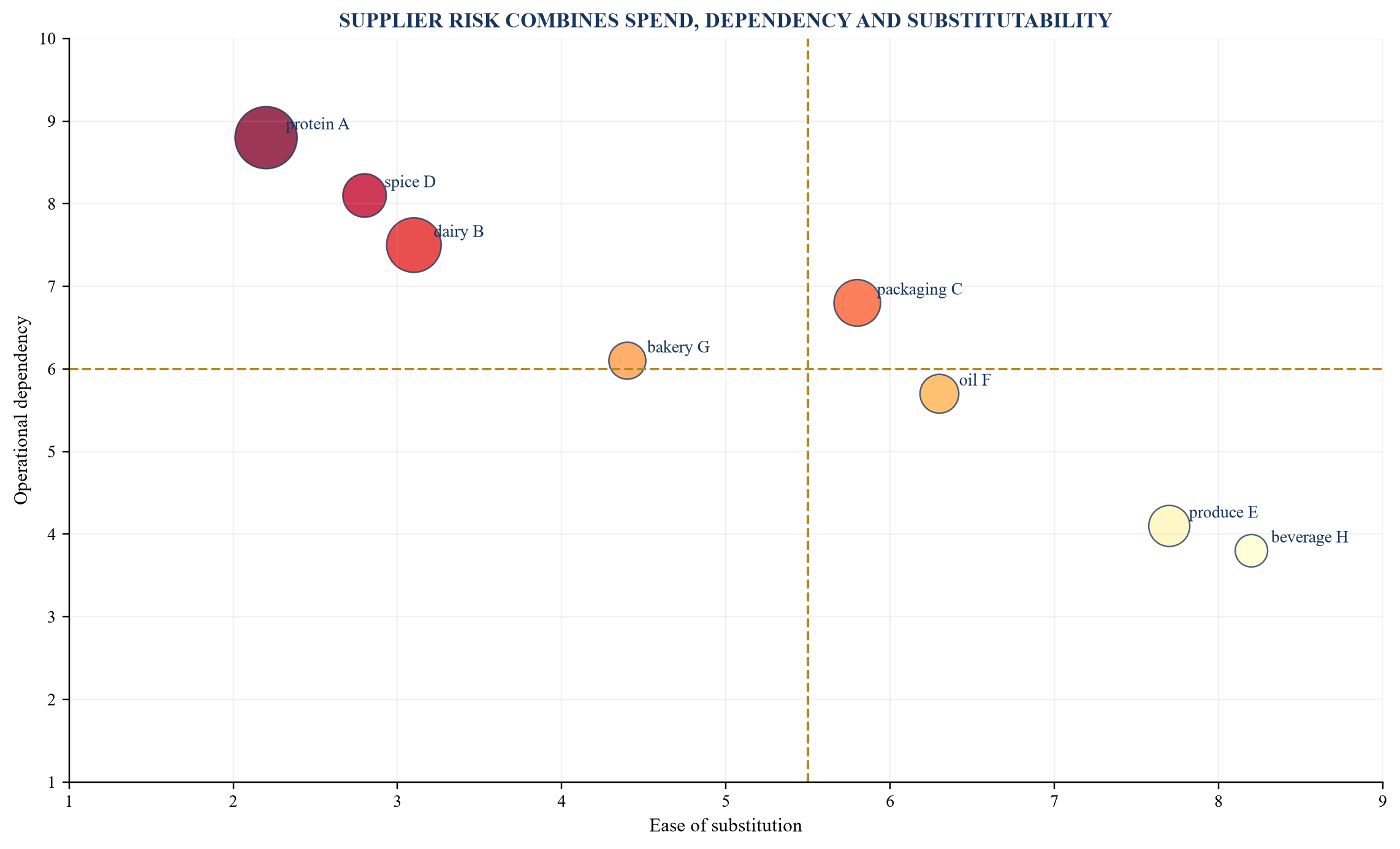
Bubble size represents hypothetical annual spend; position combines dependency and substitutability.
Table 2. Ingredient-cost diligence and protection tests
| Cost component | Diligence evidence | Normalisation test | Deal protection |
|---|---|---|---|
| base purchase price | contract, order, invoice and specification | separate price, volume and mix | supplier schedule and price mechanism |
| landed cost | freight, duty, insurance, inspection and handling | reconcile incoterm and route | define assumed logistics perimeter |
| rebates | contract, threshold, accrual and cash receipt | test earn-out period and reversals | exclude unsupported accruals from earnings |
| yield and quality | batch input, output, rejection and test data | compare standard to actual usable input | warranty for records and quality events |
| currency | order date, payment date, hedge and repricing | measure exposure by cash timing | allocate pre-close positions and settlements |
| supplier credit | invoice, due date, payment and finance arrangement | identify stretch and supplier finance | set normal working-capital methodology |
Savings should be supported by comparable specification, executable timing and retained continuity.
6. Treat supplier concentration as an operating dependency
Supplier concentration is more than a percentage of spend. The buyer should measure dependence by ingredient uniqueness, approved specification, lead time, country of origin, import route, certification, production capacity, tooling, recipe role and switching time. A modest-spend spice blend can stop production when it defines a product and has no qualified substitute. A large commodity purchase may be replaceable through several approved sources.
The supplier map should identify legal entity, beneficial owner, related party, manufacturing site, distributor, currency, payment terms, minimum order, exclusivity, volume commitment, rebate, change-of-control provision and termination right. Concentration should be calculated on supplier group and manufacturing source. Two distributors may rely on the same producer or route.
Import exposure matters in the Gulf. FAO stated in 2026 that Gulf countries rely on imports for 70 to 90 per cent of staple food supply and highlighted real-time monitoring and stockpile coordination during maritime disruption.[5] This regional fact supports deeper route and contingency analysis; it does not establish the exposure of a specific target. The buyer should test product-level origin, port, shipping route, buffer stock and alternative source.
Supplier diligence should include performance evidence: on-time-in-full delivery, rejection, quality incident, price change, claim recovery and emergency response. Critical suppliers may require direct confirmation and management meetings. The integration plan should preserve supply during renegotiation. Immediate volume consolidation can create a single point of failure or breach existing commitments. Continuity and savings should be planned in one workstream.
7. Reconstruct recipe economics and production yield
A recipe is simultaneously intellectual property, quality standard, inventory bill of materials and margin equation. Diligence should obtain the controlled recipe version, approved ingredients, standard quantity, expected yield, portion standard, allergen data, preparation method and authorised substitutes. The recipe used in the valuation model should match the version used in production and point-of-sale systems.
Standard recipe cost should be compared with actual batch consumption. Variance may arise from portioning, trim, cooking loss, substitution, staff practice, equipment, batch size or unrecorded waste. The buyer should test high-volume and high-value products across sites and shifts. A central-kitchen yield cannot be assumed for a decentralised kitchen without process and equipment changes.
Menu engineering should connect popularity and contribution without treating customer acceptance as fixed. A price increase, portion reduction or ingredient change can alter demand and brand perception. Product-level elasticity should be estimated from observed tests where available and described as a modelling assumption where evidence is absent. The model should show downside from lower volume or higher discount.
Recipe harmonisation across acquired brands requires governance. Common ingredients can increase buying power and simplify inventory, while forced standardisation can damage differentiation. The decision should consider quality, customer promise, regulatory label, allergen, nutritional claim, equipment and training. Any saving should include testing, re-labelling, implementation cost and possible sales impact.
8. Measure waste as a controlled economic process
Waste should be measured at receipt, storage, preparation, production, display, return and disposal. FAO's Food Loss Index focuses on losses from production up to retail, while UNEP-led measurement addresses retail and consumption; FAO also recommends stage-specific data collection.[6] The transaction team should define its own operational taxonomy so quantities, causes and financial values can be compared across the target.
Recorded waste often understates economic loss. Systems may capture disposed finished product while missing trim variance, over-portioning, spoilage embedded in inventory adjustments, rejected delivery, temperature excursion, promotional overproduction or customer refund. Quantity and value should be recorded separately. The value should include ingredient, packaging and incremental production cost; lost selling price should be presented separately to avoid overstating recoverable value.
The buyer should reconcile theoretical usage from sales and recipes to actual ingredient consumption and stock movement. The gap should be explained by yield, staff meal, sample, transfer, waste, count variance and suspected loss. A sudden improvement at month end can indicate count or cut-off pressure. Physical observations and surprise counts should test whether system categories reflect practice.
Waste synergies require a baseline by cause and an operational intervention. Forecasting, order cadence, batch size, shelf-life alerts, portion tools, temperature monitoring and donation or secondary-use routes may reduce specific losses. A generic percentage reduction without site, product, owner and implementation evidence should remain outside committed value.
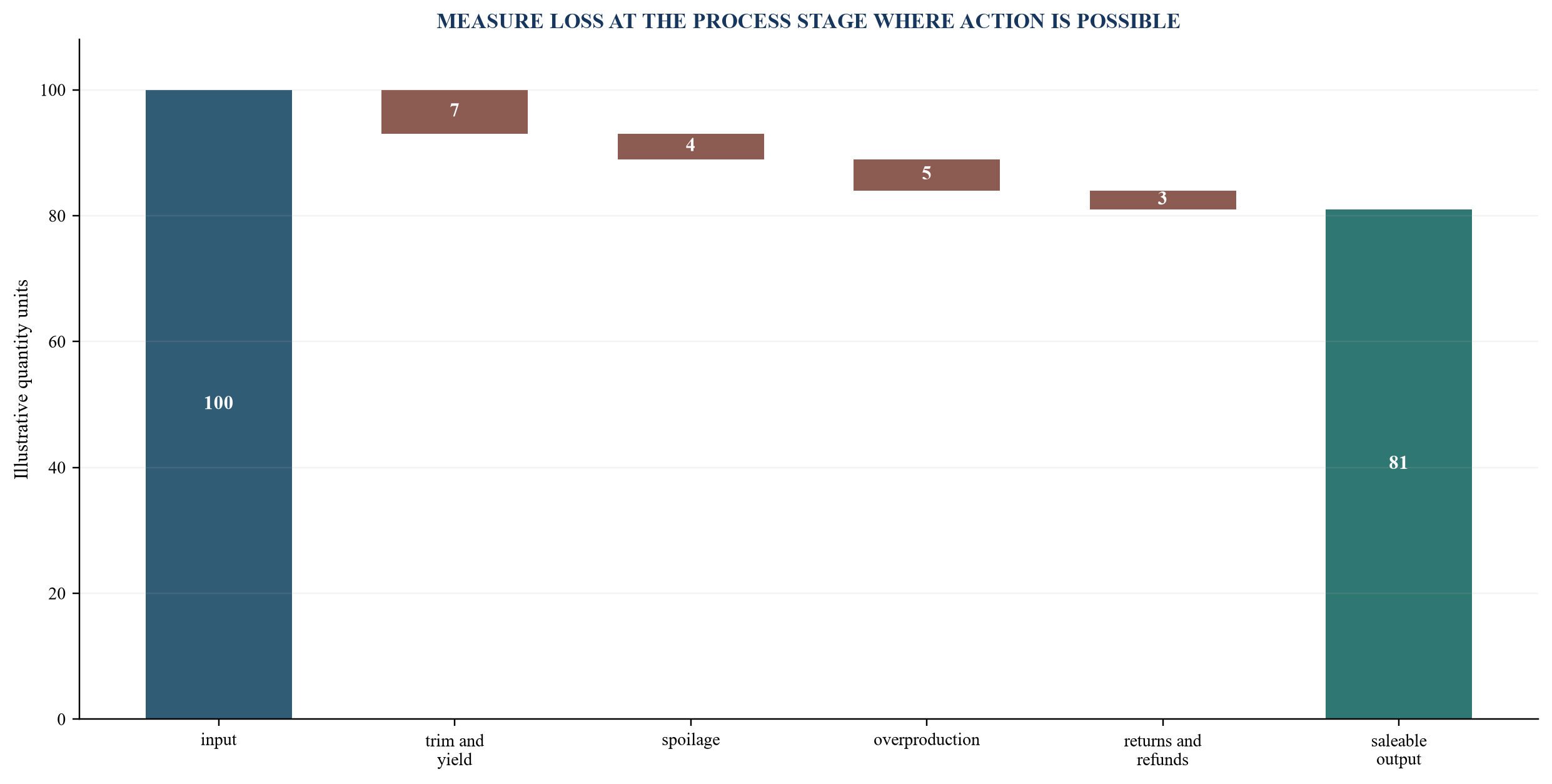
Values are hypothetical units and separate physical conversion from commercial and control losses.
9. Test inventory existence, shelf life and net realisable value
IAS 2 measures inventory at the lower of cost and net realisable value and includes purchase, conversion and other costs incurred to bring inventory to its present location and condition.[12] Transaction diligence should connect this accounting principle to physical lots, shelf life, demand and route to sale. A book balance can contain stock that exists but cannot be sold at carrying value.
The buyer should observe counts at representative kitchens, factories and warehouses, reconcile movements around the count date and inspect lot, expiry, temperature and condition. Inventory held by distributors, co-packers or concession sites requires third-party confirmation and contract analysis. Goods in transit require incoterm, shipping and receipt evidence. Negative inventory and persistent manual adjustments indicate control weaknesses.
Ageing should use remaining shelf life and expected consumption, not only days since receipt. A product with 30 days remaining may be current for a daily high-volume line and impaired for a seasonal item. Net realisable value should deduct costs necessary to complete and sell, including rework, relabelling, promotion, disposal or channel discount where relevant. IAS 2's definition and write-down requirements provide the accounting anchor; the actual calculation requires target evidence.[12]
Transaction mechanisms should state the inventory policy used for closing working capital. Obsolete, expired, recalled, damaged, consigned, disputed-title and excess stock should be identified separately. The buyer should avoid paying twice for inventory through enterprise value and a closing balance adjustment. Counting procedures, independent access, cut-off and dispute resolution should be agreed before closing.
10. Normalise working capital without rewarding stretch
Food-platform working capital combines inventory, supplier terms, customer credit, delivery-platform settlement, taxes, payroll timing and seasonal demand. A target can report strong cash conversion by delaying suppliers, drawing supplier finance, collecting customer deposits or reducing safety stock temporarily. The normal level should support the business as operated under agreed service and growth assumptions.
The monthly model should cover at least a full seasonal cycle and identify Ramadan, holidays, tourism, school calendars, promotions, new openings and closures. Inventory days should be analysed by category and shelf life. Payables should be separated by contractual due date, actual payment date, disputed amount, related party, supplier finance and overdue status. Receivables should be separated by customer, channel, ageing, dispute and expected credit loss.
IAS 7 requires operating cash flow information and was amended, with IFRS 7, to add disclosures about supplier finance arrangements.[14][15] These standards support diligence questions about whether liabilities presented as trade payables have financing characteristics, how cash flows are classified and how liquidity concentration arises. The purchase agreement should define treatment after accounting and legal review.
The normal working-capital target should use consistent accounting policies, scope and cut-off. It should exclude cash, debt and debt-like items according to agreed definitions. Mechanisms should address aged payables, unpaid capital expenditure, employee accruals, taxes, customer deposits, gift cards, loyalty obligations, rebates and delivery-platform settlements. A headline average without component rules invites disputes and value leakage.
Table 3. Working-capital normalisation framework
| Balance | Core test | Normalisation issue | Possible transaction treatment |
|---|---|---|---|
| inventory | existence, shelf life, cost and net realisable value | seasonal build, excess or temporary depletion | component target plus exclusion policy |
| trade receivables | validity, ageing, dispute and collection | channel settlement and customer concentration | reserve, specific exclusion or indemnity |
| trade payables | contract due date and payment practice | stretch, disputes and supplier finance | normalise terms and classify debt-like items |
| rebates | contractual entitlement and cash timing | threshold dependency and unsupported accrual | include only evidenced operating accrual |
| customer liabilities | fulfilment obligation and redemption | deposits, gift cards and loyalty | define working capital or debt-like treatment |
| taxes and payroll | period, due date and compliance | overdue or exceptional liability | specific debt-like adjustment or indemnity |
The closing mechanism should distinguish operating working capital from debt-like and exceptional balances.
11. Build a channel-margin cube
The same product can produce different contribution through dine-in, takeaway, delivery, retail, wholesale, catering and franchise channels. A channel-margin cube should combine product or brand, location or customer, and channel. It should show net revenue, ingredient and packaging cost, direct labour, fulfilment, commission, payment fee, promotion, refund, bad debt, working-capital days and attributable fixed cost.
Delivery requires order-level reconciliation. The team should test menu price, discount sponsor, commission rate, delivery fee, refund, service penalty, advertising charge, settlement lag and cash receipt. Contract schedules may vary by brand, city, exclusivity and volume. A platform statement should reconcile to orders and bank deposits. The buyer should identify who owns the customer relationship and what data can transfer.
Retail and distributor channels require sell-in and sell-through analysis. Listing fees, promotional funding, returns, expiry, damaged goods, distributor margin and credit period can reduce cash contribution. Large orders before a reporting date should be tested against subsequent sales and returns. Private-label or business-to-business contracts require specification, service level, tender renewal and price-adjustment review.
Physical sites should be analysed at mature, ramp-up and closure stages. New sites can dilute current contribution while supporting future value. The transaction model should separate committed openings from aspirational pipeline and include fit-out, pre-opening, rent-free period, working capital and ramp losses. Channel expansion is valuable when unit economics remain positive after all incremental costs and cash timing.
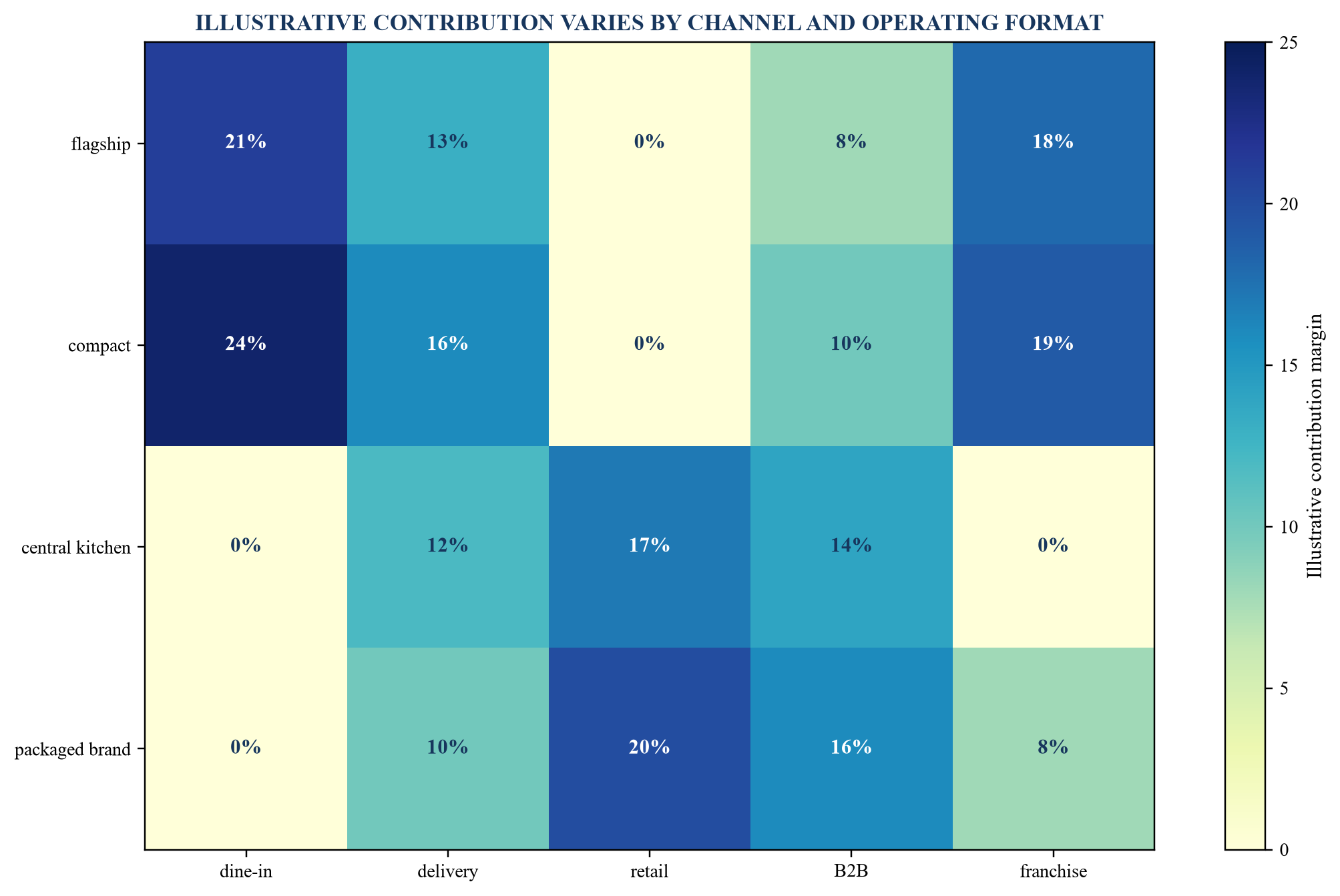
Contribution percentages are hypothetical and show why sales mix should be valued by channel and format.
12. Diligence customer, franchise and concession contracts
Food-platform value can depend on a small set of contracts that do not appear as balance-sheet assets. Mall concessions, airport locations, hotel arrangements, school or hospital catering, master franchises, delivery agreements, distributors and retail listings can determine access to customers. The buyer should build a contract register with counterparty, entity, scope, territory, term, renewal, pricing, exclusivity, volume, service level, change of control and termination.
Franchise systems require a separate economic bridge. System sales, company revenue, royalties, product margin, marketing contributions and support cost should not be blended. The buyer should test franchisee concentration, arrears, disputes, store condition, compliance, territory, development commitments and termination rights. Revenue growth from franchise openings should include the franchisee's capital capacity and required support.
Concession and catering contracts may include minimum guarantees, turnover rent, service penalties, mobilisation costs, employee-transfer obligations and asset handback. Profitability should be measured over the contract life, including bid and mobilisation cost. A profitable current period can follow an earlier cash outflow or precede a restoration liability. Renewal probability should be supported by tender status and service performance.
Change-of-control consent should be placed on the closing path. Silence in a summary schedule does not establish transferability. The team should read the executed agreement, amendments and correspondence. Where customer concentration is material, the buyer may require consent, confirmation, retention arrangements, purchase-price protection or a closing condition. Commercial contact should follow an approved protocol that protects confidentiality and competition compliance.
13. Analyse leases and site-level obligations
Food platforms can carry long-duration site commitments, fit-outs, restoration obligations and variable rent. IFRS 16 generally requires a lessee to recognise a right-of-use asset and lease liability for leases longer than 12 months unless the underlying asset is low value.[16] The accounting presentation does not replace a cash and contract analysis. The buyer should reconstruct fixed, stepped, indexed, turnover and service payments by site.
Site-level economics should include occupancy cash, common-area charges, utilities, local fees, maintenance, fit-out amortisation for management purposes, closure cost and required refurbishment. Lease-adjusted EBITDA and reported EBITDA should be reconciled consistently across the target and buyer. Valuation multiples can be misleading when one company presents occupancy through depreciation and interest and another through operating expense.
The lease register should identify landlord, legal tenant, location, area, term, break, renewal, security deposit, guarantee, assignment, change of control, use restriction, exclusivity, reinstatement and default. Side letters and concession arrangements should be included. A site may be economically attractive yet non-transferable or subject to rent reset on assignment.
Portfolio decisions should distinguish keep, invest, renegotiate, relocate and close. Closure analysis should include lease exit, employee cost, asset impairment, inventory disposal, customer migration and brand effect. Synergy models that consolidate sites should recognise these cash costs and the time required for consent, fit-out, production transfer and food-safety approval.
14. Make food safety and traceability a value-preservation workstream
Food safety is a transaction-critical operating system. Saudi Food and Drug Authority materials require food businesses to maintain traceability, identify suppliers and apply a one-step-forward, one-step-back approach with records for raw materials, processes, points of sale and distribution.[8] Codex General Principles of Food Hygiene describe good hygiene practices and hazard analysis and critical control point systems, including management commitment, monitoring, corrective action and records.[10]
Diligence should review licences, inspection history, hazard plans, critical limits, supplier approval, laboratory results, allergen control, temperature records, sanitation, pest control, recall tests, complaints, incidents and corrective actions. The objective is to determine whether product can be traced rapidly from source through production and customer channel. A certificate without operating records is insufficient.
The buyer should map liability and insurance for contamination, recall, business interruption, product withdrawal and regulatory action. Open incidents, near misses and complaint trends require root-cause analysis. Product and public-liability policies should be reviewed for insured entity, territory, product, exclusion, deductible, limit, notification and change of control.
Integration creates risk when recipes, suppliers, systems, labels, kitchens or staff change. The Day One plan should preserve approved suppliers, specifications, critical controls and record access until changes pass a controlled validation. Cross-selling should not move product into a channel or geography without label, allergen, shelf-life, licence and recall readiness. The integration office should include a food-safety owner with authority to stop implementation.
15. Test labour, production capacity and operating resilience
Food platforms depend on skilled managers, chefs, quality teams, production staff, procurement, maintenance, delivery coordinators and site employees. The buyer should map roles, entity, location, contract, visa or work authorisation, shift, compensation, incentive, overtime, leave, turnover, vacancy and succession. Key-person risk should be measured by operating dependency rather than title.
Labour productivity requires a consistent denominator. Orders per labour hour, production units per hour, sales per scheduled hour and contribution per labour hour answer different questions. The model should separate fixed core staffing, volume-driven hours, opening and training cost. Understaffing can temporarily improve labour percentage while reducing service, safety and retention.
Capacity diligence should measure the bottleneck. A central kitchen may have available floor area while constrained by blast chilling, packaging, cold storage, quality release or dispatch windows. Site kitchens may be limited by equipment, ventilation, permitted use or peak-hour workflow. Claimed spare capacity should be demonstrated through product-specific throughput, shift pattern, maintenance and quality records.
Resilience planning should cover power, water, refrigeration, critical equipment, systems, transport, supplier disruption and product recall. Alternative sites and suppliers require approved specifications and executable logistics. The acquisition model should include maintenance backlog and required capital expenditure. Production consolidation should enter synergies after the receiving site demonstrates capacity, food-safety validation and customer acceptance.
16. Use technology and AI as controlled decision support
Technology can improve forecasting, procurement, production planning, dynamic menus, waste detection, labour scheduling, pricing and customer retention. The transaction team should identify each system's owner, contract, data rights, interfaces, model, user access, cyber controls, uptime, change management and transferability. A platform presentation is not evidence that the target owns the software or can transfer the data.
AI-supported demand forecasting may combine sales, seasonality, promotions, weather, events and inventory. Its value should be tested through forecast error, stockout, waste, service and cash outcomes against a clear baseline. Training and test periods should be separated. Manual overrides and exceptional events should be logged. A model that improves average accuracy can still fail on the high-volume periods that determine working capital.
Automated pricing and promotion require governance. The buyer should review objectives, constraints, approval, customer fairness, competition, privacy and outcome monitoring. Procurement tools should preserve specification, supplier qualification and conflicts controls. Computer vision or sensor systems may support portion and waste measurement, while accountable operators remain responsible for safety and release decisions.
AI synergies should be recorded as operational programmes with data prerequisites, integration cost, adoption, control and measurable cash impact. The model should distinguish existing target capability, buyer capability and new development. Benefits should be reduced for implementation delay, coverage gaps and ongoing operating cost. Data protection, cybersecurity and vendor concentration should be addressed before systems or datasets are combined.
17. Convert synergy claims into a controlled ledger
A synergy ledger should be the single source of truth from diligence through integration. Each item should have a description, baseline, owner, action, timing, recurring benefit, one-time cost, capital requirement, dependency, risk, evidence and status. Procurement, recipe, waste, labour, occupancy, technology, overhead and revenue items should use consistent definitions and avoid overlap.
Procurement savings should be calculated from addressable spend and executable price or rebate change. Volume that cannot switch because of specification, capacity, contract or continuity should be excluded. Waste savings should use physical quantities and unit cost. Labour savings should show roles, shifts, service impact and implementation cost. Revenue synergies should use incremental contribution after discount, fulfilment, commission, cannibalisation and working capital.
The ledger should bridge accounting and cash. A negotiated price reduction may affect inventory cost, cost of sales and cash at different times. Closing a kitchen can create severance, write-off and lease exit before savings. A channel launch can require listing fees, marketing and inventory before revenue. The valuation model should discount the cash sequence and retain contingency.
Double counting is a common failure. Recipe harmonisation, procurement consolidation and waste reduction may affect the same ingredient baseline. Central production and labour reduction may overlap. The ledger should lock the baseline and assign each value unit once. Finance should reconcile realised benefit to actual volume, price, mix and cost while operations confirms the action occurred.
Table 4. Synergy-ledger control fields
| Field | Required content | Verification question | Escalation trigger |
|---|---|---|---|
| baseline | volume, price, mix, waste, labour or fixed-cost source | does it reconcile to diligence and budget? | unexplained difference or changed scope |
| action | supplier negotiation, recipe change, process or closure | is the action executable and approved? | consent, capacity or safety dependency missing |
| owner and timing | named accountable person and milestones | who delivers value and by when? | no owner, late milestone or unclear authority |
| cash bridge | recurring benefit, one-time cost, capex and working capital | when does value become cash? | benefit recorded before enabling spend |
| evidence | contract, invoice, operational KPI and finance reconciliation | can realised value be independently tested? | unsupported management assertion |
| risk and status | dependency, probability, decision and current state | is downside reflected in valuation? | red risk without mitigation or reserve |
A benefit enters committed value only after its baseline, action, timing and evidence are complete.
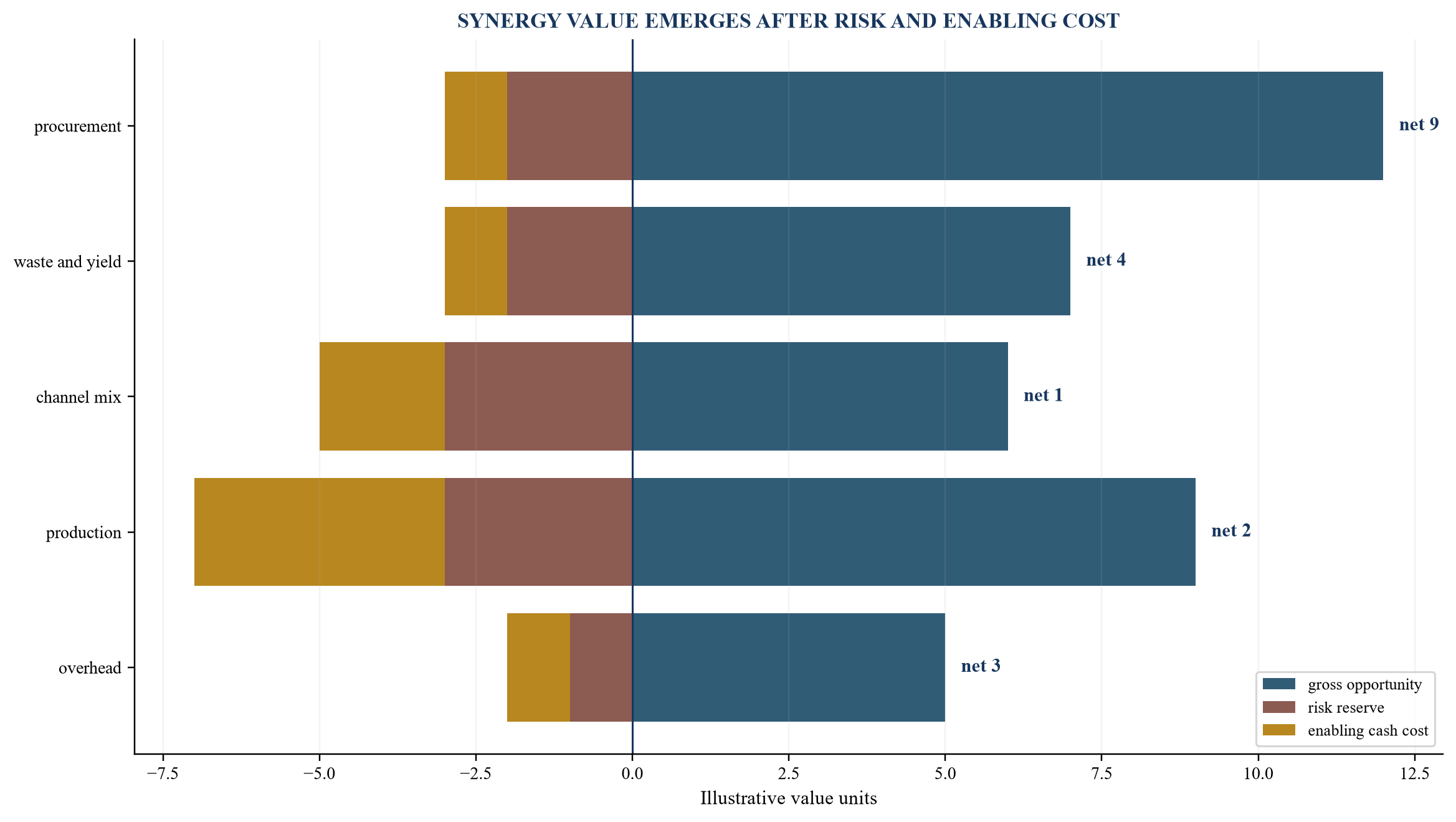
Values are hypothetical; gross opportunity is reduced for execution risk, timing and enabling cash cost.
18. Translate diligence into price and contractual protection
Transaction protection should match the identified risk. A lower sustainable margin may require valuation adjustment. Uncertain closing balances may require a completion-account mechanism. A specific tax, legal, food-safety or contract exposure may require an indemnity, escrow, retention or condition. A future operating outcome may support contingent consideration when the metric, control and dispute process are clear.
The earnings bridge should distinguish reported, accounting-policy, one-off, run-rate and buyer-synergy adjustments. Buyer synergies generally belong to the buyer unless competition for the asset changes price. Target actions completed before closing may support run-rate value when evidence shows the action, sustainable volume and cash effect. Forecast initiatives should not be presented as historical earnings.
The purchase agreement should define cash, debt, debt-like items and working capital with food-platform examples. It should address supplier finance, overdue payables, customer deposits, gift cards, loyalty, rebates, taxes, payroll, unpaid capital expenditure, lease items, inventory exclusions, recall liabilities and transaction bonuses. Illustrative closing statements can expose ambiguity before signing.
Representations and warranties should reflect the data relied upon. Relevant areas may include financial records, material contracts, suppliers, customers, licences, food safety, recalls, inventory, intellectual property, data, employment, leases and compliance. Disclosure should be reviewed against the actual diligence finding. Insurance, seller covenant strength, jurisdiction and limitation periods affect practical recovery.
19. Protect the margin system through integration
Integration should preserve daily control before pursuing change. Day One priorities include supplier orders, production schedules, food-safety records, point-of-sale, delivery accounts, inventory, payroll, bank collection, customer communication and decision authority. Every critical activity should have an owner, fallback and escalation route.
The first 30 days should validate the diligence baselines. Finance should reconcile sales, discounts, ingredient consumption, waste, inventory, payables, channel settlements and cash. Operations should confirm recipes, yields, supplier performance, capacity and food-safety controls. Differences should update the synergy ledger and working-capital outlook promptly.
The 100-day plan should sequence initiatives by dependency. Supplier negotiations may begin early while volume migration follows qualification. Recipe or packaging change requires testing and label approval. Central production requires capacity and logistics. Channel cross-selling requires contracts, data rights, inventory and customer proposition. Site consolidation requires lease and employee actions.
Governance should combine commercial, procurement, operations, food safety, finance, legal, technology and human resources. The integration office should track decision, action, risk, synergy and cash. A rapid intervention is appropriate when stockout, quality incident, account diversion, supplier refusal, system failure or unexplained margin erosion appears. The board should receive a concise value dashboard with traceable underlying evidence.
20. Make the investment decision through an evidence-led memorandum
The investment memorandum should present the platform as an operating and cash system. It should include perimeter, competition timetable, revenue by channel, ingredient bridge, supplier map, recipe and yield analysis, waste, inventory, working capital, leases, food safety, people, capacity, technology, synergies, purchase-price mechanism and integration plan.
Valuation should reconcile reported earnings to sustainable cash. IFRS 3 requires recognition and measurement of acquired assets and liabilities and goodwill in a business combination.[11] IFRS 13 defines fair value using market-participant assumptions in an orderly transaction.[18] IAS 36 requires recoverable-amount assessment for goodwill and specified intangible assets.[17] These accounting principles inform the post-close context. The transaction decision still requires a coherent commercial model and downside analysis.
Downside cases should combine ingredient inflation, foreign exchange, supplier disruption, lower yield, higher waste, channel commission, slower customer collection, reduced supplier terms, site underperformance and delayed synergy. Correlations matter. A supply disruption can increase cost, require safety stock and reduce sales at the same time. The model should show liquidity and covenant headroom as well as valuation return.
Approval should remain conditional until critical evidence and closing protections are complete. A compelling brand cannot substitute for supplier continuity, food safety, accurate inventory and executable cash conversion. A procurement synergy cannot substitute for a legal filing or transfer consent. The committee should know which assumptions are verified, which are contractual and which remain hypothetical.
Table 5. Food-platform M&A investment-committee gates
| Gate | Evidence required | Decision question | Failure response |
|---|---|---|---|
| perimeter and clearance | entity map, contracts, licences and competition advice | can the intended business transfer and close lawfully? | restructure scope, timing or condition |
| sustainable margin | product and channel bridge with supplier and recipe evidence | is reported profit repeatable in cash? | reduce earnings or apply reserve |
| working capital | monthly components, terms, ageing and closing definitions | does the price mechanism fund normal operation? | revise target and debt-like definitions |
| safety and continuity | traceability, incident, supplier, capacity and resilience evidence | can the platform operate safely through change? | condition, remediate or reject |
| synergies | controlled ledger with owner, cost, timing and dependencies | is value executable without double count? | risk-adjust or exclude from price |
| integration and downside | Day One plan, liquidity stress and escalation authority | can management protect value after control transfers? | add resources, protection or decline |
Approval should link each source of value to evidence, protection and accountable execution.
The core principle is traceable margin. Food-platform M&A creates durable value when every material claim can be followed from supplier and recipe through product, channel, working capital and cash. Procurement power, scale and technology become valuable only after continuity, food safety, customer economics and execution costs are protected.
References
- United Arab Emirates Cabinet. Cabinet Decision No. 3 of 2025 on the Thresholds Related to the Implementation of Federal Decree-Law No. 36 of 2023 Regulating Competition. 20 January 2025. https://www.moet.gov.ae/documents/20121/0/Cabinet%2BDecision%2BNo.%2B%283%29%2Bof%2B2025%2BOn%2Bthe%2BThresholds%2BRelated%2Bto%2Bthe%2BImplementation%2Bof%2BFederal%2BDecree-Law%2BNo.%2B%2836%29%2Bof%2B2023%2BRegulati.pdf/0f228724-8dd5-9b9c-0ed8-0b94d5ae0873
- Ministry of Economy and Tourism, United Arab Emirates. "Ministry of Economy Reviews Cabinet Resolution on Thresholds and Controls Associated with Competition Law." 20 February 2025. https://www.moet.gov.ae/en/-/ministry-of-economy-reviews-cabinet-resolution-on%C2%A0thresholds-and-controls-associated-with-competition-law-and-its-role-in-enhancing-oversight-of-economic-concentration-transactions-in-the-country
- Ministry of Economy and Tourism, United Arab Emirates. "Regulation of Competition Legislations." Updated July 2026. https://www.moet.gov.ae/en/web/guest/regulation-of-competition-legislations
- General Authority for Competition, Saudi Arabia. Economic Concentration Review Guidelines. 2025. https://gacbep.gac.gov.sa/cms/b9376edc-79a1-4573-a36d-4f3effaba838.pdf
- Food and Agriculture Organization of the United Nations. "Implications for World Food Security and Agriculture Arising from Disruptions of Supply Chains in the Gulf Region." 2026. https://www.fao.org/director-general/speeches/details/180th-session-of-the-council--implications-for-world-food-security-and-agriculture-arising-from-disruptions-of-supply-chains-in-the-gulf-region--including-the-closure-of-key-maritime-routes--opening-statement/en
- Food and Agriculture Organization of the United Nations. "Food Loss Measurement." https://www.fao.org/platform-food-loss-waste/food-loss/food-loss-measurement/
- Ministry of Climate Change and Environment, United Arab Emirates. A Guide to Food Security in the UAE. 2023. https://www.moccae.gov.ae/assets/15ef0bbc/A%20Guide%20to%20Food%20Security%20in%20the%20UAE.pdf.aspx
- Saudi Food and Drug Authority. Food Act and Regulation. https://beta.sfda.gov.sa/sites/default/files/2021-04/Food%20Act%20%26%20Regulation.pdf
- Food and Agriculture Organization of the United Nations. "Food Loss and Food Waste Database." https://www.fao.org/policy-support/policy-themes/food-loss-and-food-waste/-Food-Loss-and-Food-Waste-Database/en
- Codex Alimentarius Commission, FAO and WHO. General Principles of Food Hygiene, CXC 1-1969. 2023. https://www.fao.org/fao-who-codexalimentarius/sh-proxy/it/?lnk=1&url=https%3A%2F%2Fworkspace.fao.org%2Fsites%2Fcodex%2FStandards%2FCXC+1-1969%2FCXC_001e.pdf
- IFRS Foundation. "IFRS 3 Business Combinations." https://www.ifrs.org/issued-standards/list-of-standards/ifrs-3-business-combinations/
- IFRS Foundation. "IAS 2 Inventories." https://www.ifrs.org/issued-standards/list-of-standards/ias-2-inventories/
- IFRS Foundation. "IFRS 15 Revenue from Contracts with Customers." https://www.ifrs.org/issued-standards/list-of-standards/ifrs-15-revenue-from-contracts-with-customers/
- IFRS Foundation. "IAS 7 Statement of Cash Flows." https://www.ifrs.org/issued-standards/list-of-standards/ias-7-statement-of-cash-flows/
- IFRS Foundation. "IFRS 7 Financial Instruments: Disclosures." https://www.ifrs.org/issued-standards/list-of-standards/ifrs-7-financial-instruments-disclosures/
- IFRS Foundation. "IFRS 16 Leases." https://www.ifrs.org/issued-standards/list-of-standards/ifrs-16-leases/
- IFRS Foundation. "IAS 36 Impairment of Assets." https://www.ifrs.org/issued-standards/list-of-standards/ias-36-impairment-of-assets/
- IFRS Foundation. "IFRS 13 Fair Value Measurement." https://www.ifrs.org/issued-standards/list-of-standards/ifrs-13-fair-value-measurement/
- IFRS Foundation. "Business Combinations: Disclosures, Goodwill and Impairment." Updated July 2026. https://www.ifrs.org/projects/work-plan/goodwill-and-impairment/
- Food and Agriculture Organization of the United Nations. "SDG Indicator 12.3.1: Global Food Losses." https://www.fao.org/sustainable-development-goals-data-portal/data/indicators/1231-global-food-losses/en
