

1. Define the transaction decision
The board decision is whether the company can transfer leadership while preserving the technical capability that supports its value. In a financing, the question is whether the business can use new capital without remaining dependent on one individual. In an acquisition, the question is whether the buyer receives an operable technical system, defensible rights and a team that can continue development. In a planned succession, the question is whether the successor receives real authority and sufficient evidence to exercise it.
The decision should be framed before a successor is named. Management should identify the products, programmes, customer commitments and technical judgments whose failure would affect revenue, regulatory permission, safety, intellectual property or strategic value. It should then determine who currently makes those decisions, which evidence supports them and whether another qualified person can reproduce the reasoning.
The UK Corporate Governance Code requires an effective succession plan for the board and senior management and asks boards to maintain an appropriate combination of skills, experience and knowledge. The Code applies directly to companies within its scope, while its principles also offer a useful governance reference for private-company transactions. [1] The practical implication for a deep-technology company is that succession must cover capability and decision rights as well as job titles.
A transaction committee should approve the succession perimeter, the value-at-risk hypothesis, the evidence standard and the transition authority. Its membership will depend on the company and transaction. It commonly includes the chair, chief executive, technical leader, finance leader, legal counsel, product or programme leadership and a buyer or investor representative where permitted. Technical conclusions remain with suitably qualified specialists. The committee should record conflicts and protect privileged or restricted information.
2. Understand why deep technology concentrates authority
Deep-technology companies often develop around a scientific insight, specialist engineering method, regulated product, difficult manufacturing process or new combination of hardware, software and data. The path from research to repeatable commercial delivery can span experiments, failures, tacit judgment, supplier relationships and customer-specific adaptation. Formal documents may describe the design while leaving the reason for important choices in the founder's memory.
Current European evidence shows the scale and breadth of the sector. The European Innovation Council reported in 2026 that its portfolio included more than 800 supported start-ups and small and medium-sized enterprises, 350 EIC Fund investments and more than 1,000 venture and corporate co-investors. It also reported employment and revenue growth within its supported portfolio. These figures describe that programme rather than the whole market, but they illustrate why founder transitions increasingly intersect with institutional investment and cross-border capital. [3]
Technical authority can arise from five sources. The first is formal office, such as chief technology officer or principal investigator. The second is ownership of architecture or scientific decisions. The third is control of information, code, laboratory records, data or external relationships. The fourth is reputation with customers, regulators, partners and employees. The fifth is personal influence over what the organisation treats as technically credible.
These sources can sit in different people. A founder may hold board authority and customer trust while a principal engineer controls implementation. A scientific co-founder may direct research while a product leader owns release decisions. A regulatory specialist may be the only person who understands the evidence trail. Succession fails when the company transfers the title while leaving the other sources unidentified or unavailable.
3. Build the value-bearing authority population
The first work product is a complete population of technical authority. Start with the products, programmes and commitments that matter to value. Reconcile the product roadmap, system architecture, research portfolio, patents, trade secrets, source-code repositories, model and data inventories, laboratory notebooks, quality records, regulatory files, customer obligations, supplier dependencies and technical hiring plan.
Each item should have an owner, approver, consulted specialist, evidence location, current status and successor. The register should distinguish authority to propose, authority to review and authority to approve. It should also identify emergency authority, such as the ability to stop a release, reject a batch, suspend a model or notify a regulator.
The population should include negative knowledge. Failed experiments, rejected designs, unsafe operating ranges, abandoned suppliers and previously identified vulnerabilities can be as valuable as successful designs. A successor who sees only the approved solution can repeat costly failures because the decision history is absent.
NIST's Secure Software Development Framework includes documenting security requirements, tracking design decisions and collecting provenance information for software components. [7] These practices address software security, yet the underlying evidence disciplines are useful for technical succession. A company can extend them to model versions, test fixtures, materials, calibration, process recipes and system interfaces.
| Authority domain | Evidence to reconcile | Decision at risk | Proposed successor evidence |
|---|---|---|---|
| Scientific thesis | Research record, assumptions, rejected hypotheses and external validation | Continue, redirect or stop research | Independent explanation and challenge of the thesis |
| Product architecture | Design records, interfaces, dependencies and change history | Approve architecture and release scope | Reproducible design review led by the successor |
| Intellectual property | Invention records, assignments, licences and trade-secret controls | File, license, disclose or restrict | Verified ownership and documented protection decision |
| Safety and quality | Hazard analysis, validation, deviations and corrective actions | Release, suspend or remediate | Qualified approval supported by complete evidence |
| Customer commitment | Specifications, acceptance criteria, warranties and roadmap promises | Accept scope or change commitment | Customer-confirmed authority and delivery plan |
| Technical people | Role charters, critical skills, access and dependency | Hire, promote, retain or replace | Named deputies and tested operating coverage |
Original framework. The population should be adapted to the company's technology, jurisdiction and assurance obligations.
4. Map authority rather than reporting lines
An organisation chart shows managerial accountability. It rarely shows who can overrule a design, interpret an anomalous test, approve a customer exception or decide that an experiment has failed. The authority map should connect material decisions to the people and evidence that make those decisions possible.
Begin with decision statements. Examples include approving a material substitution, changing a model threshold, accepting a safety deviation, filing a patent, disclosing a trade secret to a partner, committing to a customer specification, choosing a contract manufacturer and closing a technical incident. For each statement, record the current decision maker, the formal authority, the practical authority, the required evidence and the person who could take over.
The map should expose veto rights. A founder may have no documented veto while every major technical decision still waits for the founder's agreement. A buyer can misread this pattern as collaborative culture. The actual issue is an undocumented control. The transition plan should either formalise that control for a defined period or transfer it through observable tests.
The authority map in Figure 1 is hypothetical. Line width represents the number of material decisions shared between two roles. The founder is initially connected to product, science, customers, intellectual property and safety. The proposed state moves recurring authority into accountable roles and retains the founder for a limited set of high-consequence reviews.
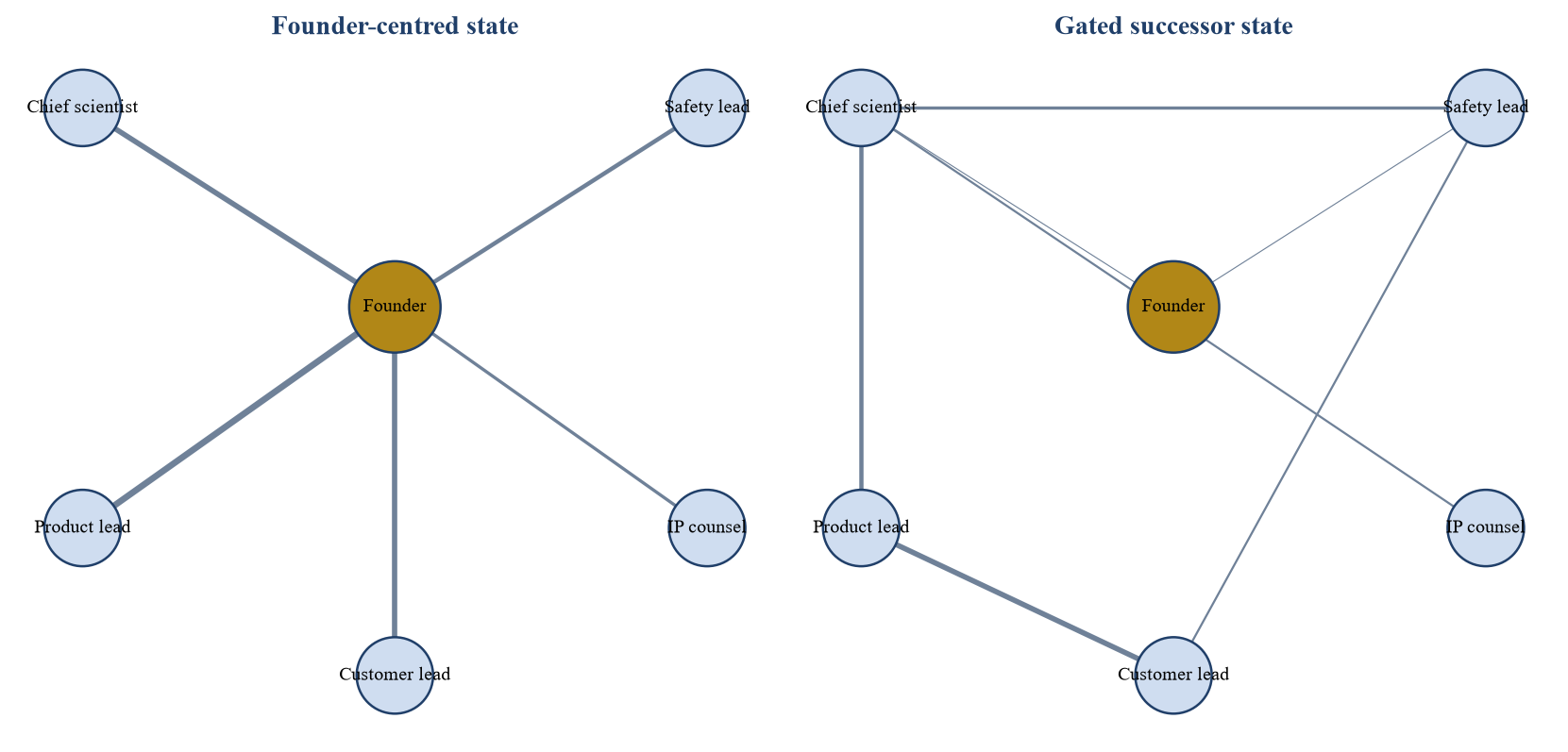
Original illustrative map. Connections and decision counts are hypothetical and describe no company.
5. Separate corporate office from scientific judgment
A founder may step down as chief executive while retaining a chief scientist or board role. That structure can preserve access to expertise, but its success depends on precise authority. Ambiguous titles allow two centres of power. Employees may seek the answer they prefer, the successor may avoid difficult decisions, and the founder may remain accountable in practice without the information or office needed to act.
Define the founder's post-transition role as a schedule of decisions. State which matters the founder approves, advises on, observes or no longer receives. Set monetary, technical and risk thresholds. Specify access rights, meeting cadence, response times, confidentiality, conflicts and how disagreement is resolved. Include an expiry or review date for every retained right.
Scientific judgment also needs a defined evidence standard. A founder's intuition may be valuable because it compresses years of experience. The company should unpack that intuition into testable questions without pretending that all tacit knowledge can be converted into a manual. Structured case reviews, paired decisions, red-team challenges and observed problem solving reveal more than a generic handover presentation.
The successor should make real decisions during the transition. A shadow role that carries no consequence does not test authority. Select bounded decisions with genuine technical and commercial relevance, provide the agreed evidence and require the successor to state the conclusion, assumptions, dissent and monitoring plan. The founder can then challenge the reasoning under a recorded protocol.
6. Define decision rights and escalation
Every material technical decision should have one accountable approver. Committees can supply evidence and challenge, while the approval should remain clear. Dual approval may be appropriate during transition for safety-critical or irreversible matters. It should be limited to named decisions and a defined period.
The escalation route should address technical disagreement. A successor may favour a faster release while the founder believes the evidence is inadequate. The escalation body needs sufficient technical competence, independence and access to evidence. Its role is to determine whether the agreed standard has been met and whether residual risk lies within authorised tolerance.
NIST's AI Risk Management Framework states that roles, responsibilities and communication lines for AI risk must be documented and clear. It also assigns executive leadership responsibility for decisions about risks associated with AI development and deployment. [6] These provisions are especially relevant when the founder has informally combined model design, product approval and executive risk acceptance.
Decision rights should extend to decommissioning. Technology value can be damaged when an inherited model, experimental process or prototype continues without an accountable owner. The transition register should specify who can suspend, supersede or retire each system and how customers or regulators are informed.
| Decision | Current authority | Transition evidence | Successor test | Release condition |
|---|---|---|---|---|
| Product architecture change | Founder and product lead | Design history, interfaces, test results and customer effect | Successor chairs independent design review | Review closes material actions |
| Safety deviation | Founder and safety lead | Hazard record, validation and residual-risk statement | Successor decides a bounded deviation | Qualified safety leader concurs |
| Patent or trade-secret choice | Founder and IP counsel | Invention record, novelty search and disclosure plan | Successor presents protection rationale | Ownership and authority verified |
| Customer technical commitment | Founder and customer lead | Contract, specification, capability and delivery evidence | Successor leads customer review | Customer recognises the authority |
| Research programme continuation | Founder and chief scientist | Hypothesis, learning record, spend and milestone evidence | Successor recommends continue, redirect or stop | Board approves capital envelope |
Original framework. Legal authority and regulatory accountability require jurisdiction-specific confirmation.
7. Measure knowledge concentration
Knowledge concentration should be measured by consequence and reproducibility. Counting documents or trained employees does not establish transfer. A critical item remains concentrated when only one person can locate the evidence, explain the decision, perform the task, diagnose failure or persuade the relevant customer or regulator.
Score each knowledge domain across six tests: consequence of absence, number of capable people, evidence completeness, recency of rehearsal, external dependence and time to recover. Keep the component scores visible. A single composite score can hide a safety-critical weakness behind well-documented routine work.
Reproducibility should be demonstrated. Give the successor an unfamiliar but representative case, access to the approved evidence and the authority to decide. Observe whether the person can identify missing information, reach a defensible conclusion and explain monitoring. The test should avoid exposing restricted data beyond authorised access.
Figure 2 shows a hypothetical heat map. The founder remains highly concentrated in customer exception design and experimental failure diagnosis. Product release and patent decisions have nominated successors but incomplete rehearsals. The map directs investment toward the few transfer actions that protect the most value.
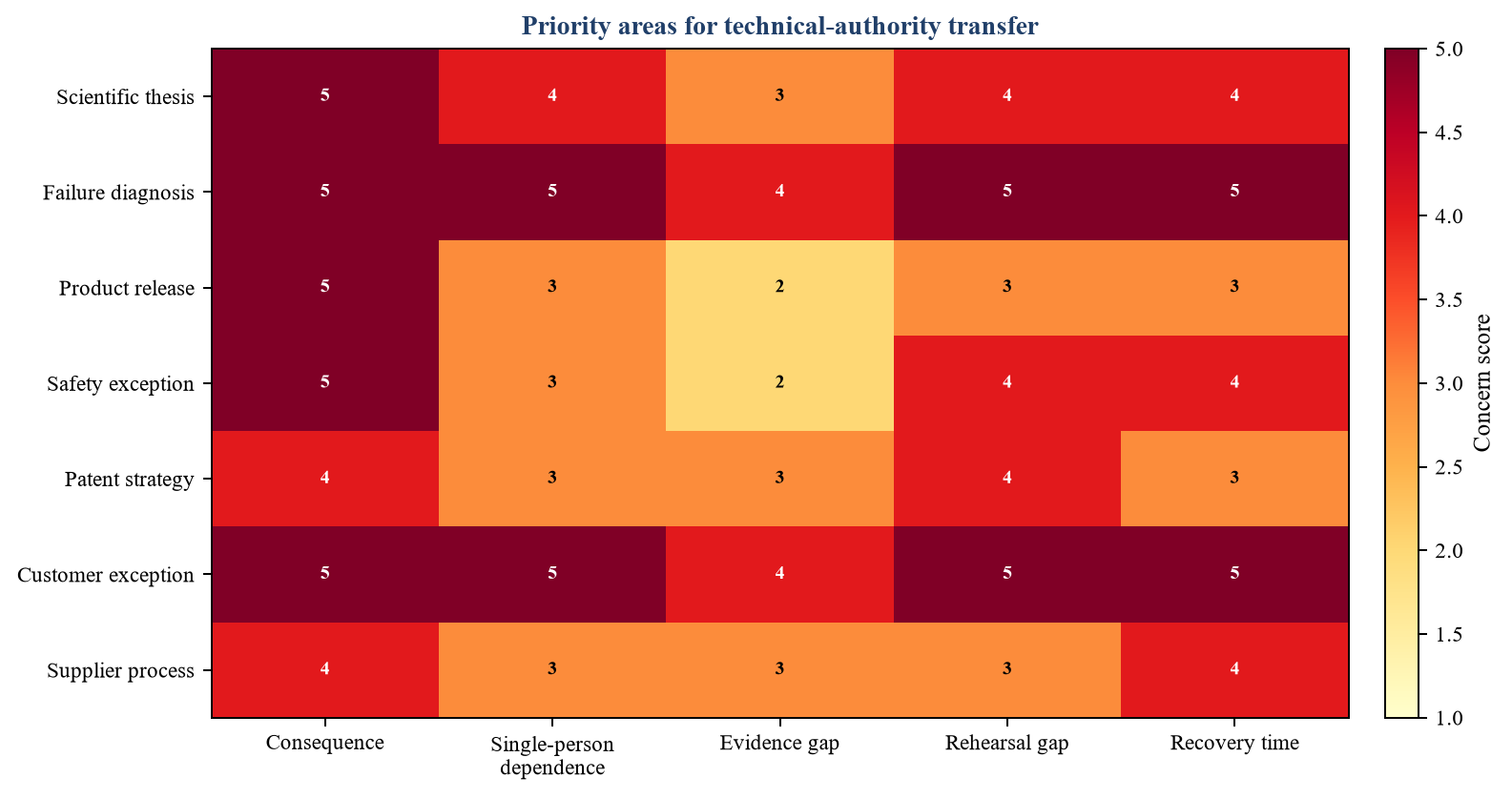
Original illustrative heat map. Scores range from one for low concern to five for high concern and are wholly hypothetical.
8. Protect intellectual property and trade secrets
Founder succession can expose uncertainty about ownership, inventorship, licences and confidentiality. The company should reconcile patents, applications, invention disclosures, assignments, employment and consultancy agreements, university or laboratory rights, open-source obligations, data rights, background intellectual property and field-of-use restrictions.
WIPO describes intellectual-property due diligence as an audit used by investors, partners or buyers to examine a venture's intangible-asset portfolio. [4] The diligence should connect each material technology claim to an owned or permitted right. A list of patent numbers is insufficient when value depends on know-how, data, manufacturing parameters, research tools or third-party licences.
Trade-secret protection requires evidence of reasonable protective measures. WIPO identifies employee departure as a high-risk situation and recommends context-specific controls over access, return of materials, confidentiality reminders and exit processes. [5] Applicable employment, privacy, competition and trade-secret law varies by jurisdiction. The transition plan should therefore be reviewed by qualified counsel and should avoid treating a broad non-compete as the primary control.
The handover should preserve both secrecy and usability. Excessive restriction can leave the successor unable to operate. Classify information by purpose and sensitivity, identify authorised recipients, log transfers, preserve provenance and confirm that external advisers or buyers can use the material for the agreed purpose. Third-party confidential information should remain segregated from company-owned trade secrets.
9. Convert the product roadmap into evidence
A roadmap often mixes scientific possibility, product intent and customer commitment. Succession can expose the difference. The founder may understand which milestones are exploratory and which are contractual, while the written plan presents all milestones with similar confidence.
Each roadmap item should identify the technical hypothesis, current maturity, dependencies, acceptance criteria, evidence owner, customer effect, capital requirement and decision date. It should distinguish research completion from engineering readiness, manufacturing readiness, regulatory permission and commercial acceptance.
The European Innovation Council's 2026 reporting describes substantial activity in scaling deep-technology companies. [3] Scaling increases the need to translate technical progress into evidence that investors, boards and commercial partners can evaluate. The company should keep programme claims tied to dated tests and defined conditions.
A successor should re-baseline the roadmap during the overlap period. The exercise is not a forecast reset designed to create room. It is an evidence review that classifies each milestone as achieved, supported, conditional, disputed or unsupported. The board should approve changes that affect financing, valuation, customer commitments or regulatory obligations.
10. Preserve customer and partner trust
Customers may buy access to a founder's expertise as well as a product. This is common where the technology is novel, mission-critical or still being adapted. A leadership announcement can therefore trigger questions about performance, support, roadmap credibility and access to decision makers.
Map customers by dependence on the founder, contractual rights, revenue, renewal date, product criticality, unresolved technical issue and relationship owner. Separate relationship dependence from product dependence. A customer may trust the team but rely on the founder for one specialist approval. Another may have little personal contact while believing the founder's continued involvement signals stability.
The transition plan should give each priority customer a named technical and commercial owner, a factual continuity statement and an escalation route. Communications should match signed agreements and securities-law or confidentiality constraints. Avoid promising that the founder will remain available beyond the documented term.
Customer recognition is an observable transfer test. The successor should lead selected design, governance or incident reviews while the founder remains available under the agreed protocol. Record whether the customer accepts the successor's authority, whether decisions close on time and whether new commitments bypass the successor.
11. Retain the technical system around the founder
Founder departure can affect other inventors and technical leaders. Empirical research using sudden founder-chief-executive deaths in public firms found a decline in citation-weighted patent output and evidence of inventor departures following the transition to professional chief executives. The setting and historical period limit direct application to any specific private company, but the findings support explicit attention to technical-team retention. [9]
Build a role-based retention population. Identify people whose departure would impair a product, experiment, customer, approval, data asset or system. Verify the dependency rather than assuming seniority equals criticality. Include engineers, scientists, technicians, quality staff, programme managers, regulatory specialists and external collaborators where contractually relevant.
Retention should combine purpose, authority, workload, development and economics. A cash award cannot cure an unclear operating model. People need to know who decides, whether the technical mission continues, how performance will be evaluated and what role they can hold after the founder leaves.
The buyer or board should monitor leading indicators: regretted departures, declined offers, access bottlenecks, unresolved decisions, missed experiments, customer escalations and unauthorised founder bypass. Compensation data is sensitive and should remain within approved access. The monitoring design should comply with employment, privacy and consultation obligations.
12. Design the founder's transition role
The founder role should be built from the authority map. Common structures include a time-limited executive role, chief scientist position, board membership, technical advisory agreement or defined consultancy. The appropriate structure depends on the transaction, the founder's capability and preference, conflicts, tax and employment status, regulatory accountability and the successor's needs.
Specify deliverables. Examples include completing named customer handovers, closing defined invention records, transferring laboratory or system access, chairing a fixed number of design reviews, documenting specified failure modes, introducing external partners and rehearsing incident response. Each deliverable should have evidence and acceptance criteria.
Set boundaries around representation and instruction. Employees and customers should know when the founder speaks for the company and when advice is non-binding. The founder should not retain informal power over hiring, spending, architecture or customer commitments outside the agreed rights.
Plan the exit from the transition role. State the expiry date, extension authority, unresolved-item process, continuing confidentiality, intellectual-property obligations, record return and communications. A role with no completion condition can delay the successor's legitimacy and create continuing key-person risk.
13. Select and test the successor
Successor selection should start with the decisions the role must make. Define the required scientific depth, systems judgment, product discipline, customer credibility, people leadership, regulatory understanding and capital-allocation capability. Some companies need one chief technology officer. Others need a chief scientist and an engineering or product executive with separate authorities.
The FRC Code emphasises a formal, rigorous and transparent appointment process and an orderly succession pipeline. [1] A private deep-technology board can apply the same discipline while tailoring it to ownership and scale. Candidate assessment should include conflicts, references, technical challenge and observed decision making.
Use cases drawn from the company's real decision types while protecting confidential information. Ask the candidate to evaluate contradictory test results, a customer request that changes architecture, a security issue, a patent-versus-secrecy choice or a delayed research programme. Assess how the candidate requests evidence, handles uncertainty, records dissent and connects technical judgment to customer and financial consequences.
An internal successor may carry context and relationships. An external successor may bring scale experience or independence. Research on succession origin finds that performance effects depend on multilevel context rather than a universal preference for insiders or outsiders. [11] The board should therefore test fit against the actual authority map and transition conditions.
14. Establish a technical authority council
A temporary technical authority council can provide challenge and continuity during the transfer. It should have a narrow charter. Its purpose is to review defined high-consequence decisions, monitor evidence completion and resolve escalated disagreements. It should not become a substitute management team.
Membership should cover the technical domains that matter to the company. Independence matters where the founder and successor disagree or where a transaction incentive could bias a milestone conclusion. External experts may help, subject to confidentiality, conflicts, export controls and professional competence.
The council should record the question, evidence reviewed, conflicts, dissent, conclusion, owner and review date. Minutes should avoid disclosing sensitive detail beyond authorised recipients. Privilege should be managed by counsel where relevant.
The council should dissolve or reduce scope as transfer gates close. A permanent body can remain appropriate for safety, ethics or regulated oversight, but its long-term role should be governed separately. Succession completion requires the normal organisation to exercise authority without routine dependence on a transitional forum.
15. Quantify value exposure without false precision
Valuation should connect founder dependence to specific cash flows, assets and options. Avoid applying an arbitrary key-person discount to enterprise value. Identify the pathways through which transition can affect revenue, margin, product timing, capital needs, intellectual property, employee retention and terminal value. Estimate ranges and show overlap.
IAS 38 describes identifiable intangible assets and distinguishes research expenditure from qualifying development expenditure. It also notes that patents, software, licences and contractual rights can meet the definition of an intangible asset. [8] Accounting recognition differs from transaction value, but the standard helps separate identifiable rights from internally generated goodwill and continuing organisational capability.
The hypothetical case begins with an enterprise value of USD 120.0 million before succession adjustments. Under an unmanaged departure scenario, product delay creates USD 8.0 million of exposure, customer and partner disruption USD 7.0 million, technical-team attrition USD 5.0 million, and intellectual-property or evidence remediation USD 4.0 million. These categories are adjusted for overlap, resulting in USD 24.0 million of net value exposure.
A gated transition reduces the net exposure to USD 5.1 million. The model assigns USD 3.6 million to retention, overlap, evidence completion and independent technical assurance. The central net value preserved after programme cost is USD 15.3 million. These values are hypothetical, sensitive to assumptions and unsuitable as valuation benchmarks.
| Value item | Unmanaged departure exposure | Gated transition exposure | Exposure reduction |
|---|---|---|---|
| Product and approval delay | 8.0 | 1.8 | 6.2 |
| Customer and partner disruption | 7.0 | 1.4 | 5.6 |
| Technical-team attrition | 5.0 | 1.1 | 3.9 |
| Intellectual-property and evidence remediation | 4.0 | 0.8 | 3.2 |
| Net exposure before programme cost | 24.0 | 5.1 | 18.9 |
| Transition programme cost | 0.0 | 3.6 | negative 3.6 |
| Net value preserved | 0.0 | 0.0 | 15.3 |
Original model. Amounts are USD millions, describe no company and require replacement with verified transaction evidence.
16. Use scenarios and explicit overlap
Risks should not be added mechanically when they affect the same cash flow. Product delay can cause customer loss and staff attrition can extend the delay. Build a pathway model that shows primary effects, dependencies, timing and recovery. Use management-approved scenarios with traceable evidence.
The downside scenario assumes an abrupt departure, incomplete ownership evidence, customer concern and loss of two critical technical leaders. The modelled enterprise value after exposure is USD 96.0 million. The central scenario uses a six-month gated transfer and produces USD 114.9 million before programme cost is considered separately. The upside scenario assumes authority has already been institutionalised and a broader leadership team improves commercial execution; the illustrative value is USD 120.8 million.
The upside should remain disciplined. Succession can create value when it removes a scaling constraint, improves capital allocation or strengthens customer coverage. That value requires evidence and should not be included merely to balance downside cases.
Transaction models should show whether exposure affects enterprise value, net debt, working capital, earn-out metrics, purchase-price adjustments or post-close funding. The same issue should not be deducted twice. Finance, valuation and accounting specialists should review the bridge.
17. Structure consideration around transfer evidence
Transaction structure can allocate founder-transition risk through deferred consideration, earn-outs, retention awards, escrow, warranties, covenants, closing conditions and post-close services. Each instrument should address a defined risk and respect applicable law, tax, accounting and employment requirements.
An earn-out based only on revenue can motivate commitments that increase technical risk. A milestone based only on technical completion can ignore customer acceptance or cash. A balanced structure may combine objective technical evidence, customer continuity and organisational transfer, with clear definitions and dispute procedures.
Avoid paying twice for the same obligation. Purchase consideration, employment compensation, restrictive covenants and consultancy fees can have different legal and accounting treatment. The transaction documents should identify the purpose, recipient, conditions, timing and remedies for each payment.
The hypothetical USD 3.6 million programme allocates USD 1.5 million to founder transfer milestones, USD 1.2 million to critical technical-team retention and USD 0.9 million to evidence completion, independent assurance and customer transition. The amounts are illustrative and assume no particular tax or accounting treatment.
| Component | Illustrative amount USD million | Evidence condition | Principal failure to avoid |
|---|---|---|---|
| Founder transfer milestones | 1.5 | Named authority gates, customer handovers and completed evidence accepted | Payment for presence without transfer |
| Technical-team retention | 1.2 | Continued service, role acceptance and critical programme coverage | Retaining titles while losing capability |
| Independent assurance and evidence | 0.6 | Verified ownership, access, validation and decision records | Self-certification of incomplete transfer |
| Customer and partner transition | 0.3 | Priority relationships recognise successor authority | Informal dependence continuing after close |
| Total programme | 3.6 | Committee acceptance under defined protocol | Uncontrolled discretion and double payment |
Original illustration. Terms, enforceability and treatment require transaction-specific professional advice.
18. Make diligence test operability
Technical diligence should test whether the buyer or company can operate after the founder leaves. Review documents and interview the people who use them. Trace a product claim from research record to design, test, release, customer obligation and cash. Trace a patent or trade secret from creation to ownership, protection and authorised use.
WIPO's current venture guidance recommends preparing ownership records, registrations, licences, employee and contractor agreements, and evidence of protection for intellectual-property diligence. [4] The company should also identify disputes, encumbrances, open-source obligations, university rights and third-party confidential information.
Ask the successor or deputy to run a real operating cycle. Examples include chairing a design review, approving a bounded release, responding to an anomalous result, explaining a regulatory submission, negotiating a technical customer issue or deciding whether to continue an experiment. Observe where founder intervention remains necessary.
Diligence conclusions should use dated evidence. Classify each issue as verified, partly verified, unresolved or contradicted. State the consequence and proposed transaction response. Avoid treating interview confidence as proof of ownership, reproducibility or customer acceptance.
19. Release authority through transition gates
Authority should move through gates tied to evidence. The first gate establishes the population and legal authority. The second verifies intellectual property, access and technical records. The third demonstrates paired decisions. The fourth tests independent successor decisions. The fifth transfers external recognition and normal governance.
Figure 3 presents a hypothetical 180-day sequence. The founder remains involved in high-consequence decisions during the early gates. The successor takes recurring authority by day 60, leads customer and product decisions by day 120, and operates under normal governance by day 180. Timing must follow evidence and applicable obligations.
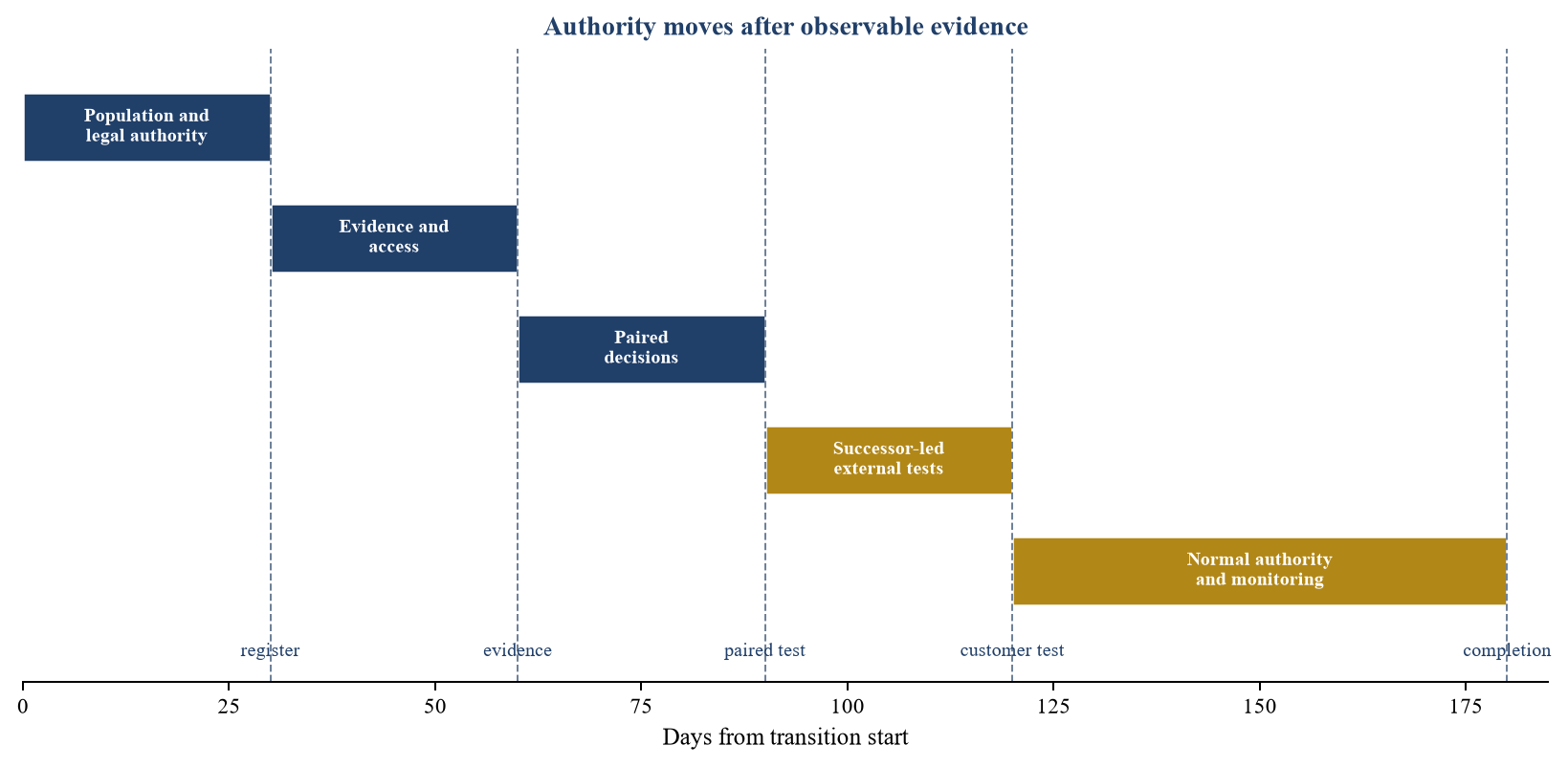
Original illustrative roadmap. Timing should be adapted to product, transaction, regulation and evidence readiness.
20. Monitor value and complete the transition
The board should monitor whether the company is becoming less dependent on the founder. Measures should connect to the authority map. Examples include successor-led decisions completed on time, evidence exceptions, customer recognition, product milestones, safety deviations, critical staff retention, access bottlenecks and founder interventions outside the agreed role.
Founder interventions require interpretation. Early intervention can be part of the designed transfer. Persistent intervention after a gate may indicate incomplete authority, weak successor capability, missing evidence or cultural resistance. Record the reason and the decision consequence.
Completion should require evidence from four areas. The successor has exercised the defined authority. The technical team operates under clear roles. Priority customers and partners recognise the operating model. Intellectual property, systems, records and external obligations are controlled. The committee should identify any residual founder dependence and decide whether to accept, mitigate, transfer or avoid it.
Research on succession and innovation reports mixed and context-dependent results. One 2023 study found a negative association between formal succession planning and innovation in its sample, while other research connects founder departure and successor characteristics to changes in innovation. [9] [10] [11] These findings do not determine an individual transaction. They reinforce the need to test how a proposed transition affects the specific people, decisions and evidence that produce value.
The transaction should close its succession work when ordinary governance can run the technical system. The lasting asset is an organisation that can explain what it knows, identify what remains uncertain, make authorised decisions and continue learning without depending on one person's availability.
21. Connect succession to signing and closing
The transaction timetable should treat founder succession as a closing workstream. The heads of terms should identify whether continued founder service, invention assignment, access transfer, customer consent or key-person retention is required. The diligence plan should then convert each requirement into evidence, responsibility and a date. Deferring the design until documentation creates pressure to accept vague obligations or untested conditions.
Signing conditions should be reserved for matters that genuinely affect the buyer's ability to own or operate the asset. Examples can include verified ownership of material intellectual property, execution of a defined founder agreement, retention of named critical personnel, delivery of controlled credentials and completion of customer or regulatory steps required by contract or law. Counsel should determine enforceability, disclosure and remedy.
Interim operating covenants require technical input. A broad restriction on changing the business can prevent necessary experiments, releases or security actions. A permissive covenant can allow the technical perimeter to change before closing. The parties should define ordinary-course research and development, permitted spending, required consultation and matters needing consent. Emergency safety or security action should have a clear route.
Completion deliverables should include more than signed agreements. Confirm repository administration, laboratory and facility access, signing keys, certificates, domain and cloud control, data permissions, regulatory portals, supplier contacts, technical insurance information and custody of original records. Sensitive credentials should move through secure procedures and should not be placed in a general data room.
The first board meeting after closing should approve the authority map, transition charter, capital envelope, reporting cadence and unresolved-item register. It should also confirm who can speak to customers, regulators, employees and external partners. The minutes should record accepted residual risks and delegated actions without reproducing protected technical detail unnecessarily.
If a required condition remains unresolved, the parties need an explicit decision. They can postpone closing, change the perimeter, hold back consideration, fund remediation, obtain an appropriate protection or accept the risk through authorised governance. The response should follow verified consequence and available remedies. Transaction urgency should not convert an unidentified technical dependency into an assumed capability.
Appendix A. Proposed diligence request list
Request the current organisation chart, delegated authorities, board and technical-committee charters, founder employment and shareholder agreements, succession plans and post-transition role proposal. Reconcile the list of material products, programmes, experiments, customer commitments, technical incidents and regulatory obligations.
Request system architecture, design history, test and validation records, source-code and model repositories, data lineage, laboratory notebooks, manufacturing process records, quality deviations, security records, supplier dependencies and access lists. Identify documents or systems that only the founder can access or interpret.
Request patents, applications, invention disclosures, assignments, employment and consultancy intellectual-property clauses, licences, university or government-funding rights, open-source records, data rights, trade-secret inventories and protection measures. Ask counsel to identify jurisdiction-specific ownership, mobility and confidentiality issues.
Request critical-role and retention analysis, current vacancies, regretted departures, succession candidates, compensation arrangements and post-close organisational proposals within authorised access. Request customer and partner dependency maps, unresolved technical commitments, change-of-control rights and proposed communications.
For each material decision, record the current authority, successor, evidence, rehearsal, external recognition, open issue and target gate. Confirm that the diligence record distinguishes verified evidence, management representation and unresolved matters.
Interview planning should avoid allowing the founder to answer every technical question. Begin with management's explanation of the operating model, then test the accountable technical and commercial owners separately. Reconcile differences to records. A consistent narrative can support confidence, while documentary and operating evidence remains necessary.
Request a list of incidents, failed releases, rejected experiments, customer exceptions and material technical disputes. Select a risk-based sample and trace the decision from detection through evidence, authority, action, communication and closure. This test can reveal whether the company operates through repeatable controls or through the founder's personal intervention.
Review the proposed 180-day plan against product and customer calendars. A handover date that falls immediately before a major regulatory submission, factory transfer, clinical milestone, safety validation or customer launch may create avoidable concentration. Sequence the transfer so the successor has participated in at least one representative operating cycle where practicable.
Appendix B. Hypothetical model assumptions
The illustration begins with enterprise value of USD 120.0 million. The unmanaged case deducts USD 8.0 million for product and approval delay, USD 7.0 million for customer and partner disruption, USD 5.0 million for technical-team attrition and USD 4.0 million for intellectual-property and evidence remediation. The stated USD 24.0 million net exposure assumes overlap has already been incorporated.
The gated case retains residual exposures of USD 1.8 million, USD 1.4 million, USD 1.1 million and USD 0.8 million. The total is USD 5.1 million. The programme cost is USD 3.6 million. Exposure reduction is USD 18.9 million, and net value preserved after programme cost is USD 15.3 million.
The downside enterprise value is USD 96.0 million after unmanaged exposure. The central enterprise value is USD 114.9 million before separately considering programme cost in the transaction bridge. The upside value of USD 120.8 million assumes institutionalised authority and a small improvement in execution. No probability is assigned to any scenario.
All figures are hypothetical. The model excludes tax, accounting classification, financing effects, working capital, transaction costs, currency, time value, litigation, regulatory remedies and many company-specific interactions. Users should replace each input with verified evidence and prevent double counting across valuation, purchase-price and funding adjustments.
Sources
- Financial Reporting Council. UK Corporate Governance Code 2024. 22 January 2024. Accessed 14 September 2026. Read the primary source
- OECD. OECD Corporate Governance Factbook 2025. 2025. Accessed 14 September 2026. Read the primary source
- European Innovation Council. EIC Impact Report 2026. 4 June 2026. Accessed 14 September 2026. Read the primary source
- World Intellectual Property Organization. How to Prepare for IP Due Diligence: The Ultimate Guide for Ventures. 2026. Accessed 14 September 2026. Read the primary source
- World Intellectual Property Organization. WIPO Guide to Trade Secrets and Innovation, Part IV: Trade Secret Management. 2024. Accessed 14 September 2026. Read the primary source
- National Institute of Standards and Technology. Artificial Intelligence Risk Management Framework 1.0, Core. 2023. Accessed 14 September 2026. Read the primary source
- National Institute of Standards and Technology. Secure Software Development Framework Version 1.1, SP 800-218. 2022. Accessed 14 September 2026. Read the primary source
- IFRS Foundation. IAS 38 Intangible Assets. Accessed 14 September 2026. Read the primary source
- Lee, J. M., Kim, J. and Bae, J. Founder CEOs and Innovation: Evidence from CEO Sudden Deaths in Public Firms. Research Policy 49(1), 2020, 103862. Read the primary source
- Ahmad, M. F. Succession Planning and Firm Innovation. Finance Research Letters 58(A), 2023, 104314. Read the primary source
- Georgakakis, D. and Ruigrok, W. CEO Succession Origin and Firm Performance: A Multilevel Study. Journal of Management Studies 54(1), 2017, 58-87. Read the primary source
- Yuan, Y., Hu, M. and Cheng, C. CEO Succession and Corporate Innovation: A Managerial Myopic Perspective. North American Journal of Economics and Finance 64, 2023, 101863. Read the primary source
