

1. Define the acquisition decision
The investment committee must decide whether the target owns a regional product with controlled local modules or a portfolio of country-specific projects. The answer affects revenue quality, margin, integration cost and expansion value. Diligence should identify what customers actually buy, which functions repeat and which activities depend on local experts or relationships.
The transaction thesis should state the markets, sectors and use cases that support paid demand. It should identify the product capabilities that can move across jurisdictions without redesign. A claim of GCC coverage requires evidence for each country and customer cohort.
2. Define AI RegTech
AI RegTech in this paper means technology that helps organisations govern AI, data and related regulatory obligations. Functions can include inventories, risk classification, impact assessment, control mapping, policy management, approvals, monitoring, incident records and regulatory evidence. The platform may use AI within those functions.
The category does not establish a uniform licence or legal status. Some providers sell software; others deliver advisory, assessment, certification support or managed compliance. The buyer should classify every service and claim before assigning product value.
3. Define the regional question
The GCC includes six sovereign jurisdictions with shared economic and cultural connections and distinct laws, regulators and operating environments. Regional demand can support efficient product distribution. Local rules, data requirements and procurement can create material differences.
The buyer should avoid treating one successful market as automatic validation of another. It should test customer need, regulatory perimeter, localisation effort, sales path and service burden in every country. Expansion value enters the base case only when supported by evidence.
4. Map the regulatory stack
The relevant stack can include AI policy, personal-data protection, cybersecurity, electronic transactions, sector regulation, cloud rules, records, consumer protection and public procurement. Financial services, health, energy and government may add sector-specific requirements. Rules and supervisory expectations can change.
Diligence should maintain a dated jurisdiction matrix prepared with qualified local advisers. The matrix should distinguish binding law, regulation, official policy, guidance, standards and customer preference. Product control mappings should preserve that distinction.
5. Separate six operating layers
The common product core includes workflow, identity, evidence and analytics. The rules layer contains jurisdictional obligations and mappings. The data layer manages hosting, transfer and retention. The integration layer connects customer systems. The access layer includes channels, procurement and relationships. The services layer provides interpretation, configuration and assurance support.
Each layer has different economics. The buyer should measure revenue, cost, ownership and transferability by layer. A blended gross margin can hide a profitable core and expensive localisation, or the reverse.
Table 1. GCC AI-RegTech operating layers and acquisition evidence
| Operating layer | Repeatable asset | Local requirement | Primary diligence evidence | Transaction issue |
|---|---|---|---|---|
| Common product core | Workflow, identity, evidence, reporting and platform security | Language, accessibility and customer configuration | Product architecture, code, telemetry, roadmap and customer use | Determine whether one governed core exists |
| Rule content | Control library, obligation model and mapping engine | Current laws, policies, regulators and sector interpretations | Versioned content, sources, review and update records | Test accuracy, ownership and maintenance cost |
| Data architecture | Tenant controls, encryption, retention and export | Hosting, transfer, residency and government-data rules | Data maps, contracts, regions, subprocessors and tests | Fund compliant deployment without fragmenting code |
| Integrations | APIs, connectors and evidence ingestion | Local identity, payments, registries and customer systems | Reuse metrics, connector code, support and implementation records | Separate reusable connectors from bespoke work |
| Market access | Brand, references, channels and procurement experience | Local licences, registrations, partnerships and relationships | Contracts, approvals, pipeline history and reference calls | Assess transferability after change of control |
| Professional services | Methods, templates and training | Legal interpretation, Arabic delivery and sector expertise | Statements of work, hours, staffing, outputs and margin | Value accountable capability as services rather than software |
Applicable requirements depend on jurisdiction, sector, customer and use; qualified local advice remains necessary.
6. Establish the UAE evidence base
The UAE National Strategy for Artificial Intelligence 2031 includes governance and effective regulation among its objectives. The UAE policy position on AI emphasises responsible governance, international cooperation, ethics, sustainability and safety. Federal and free-zone data-protection regimes can affect product design and contracting.
The buyer should identify the target's UAE legal entities, customer locations, hosting regions and relevant regulatory bases. A Dubai International Financial Centre customer can have a different data-protection context from a federal customer. Product claims should name the actual framework supported.
7. Establish the Saudi evidence base
Saudi Arabia's Saudi Data and Artificial Intelligence Authority and National Data Management Office publish data-governance, personal-data protection and AI materials. Official resources include the Personal Data Protection Law and implementing regulations, transfer rules, AI ethics principles and an AI adoption framework.
Diligence should test whether the target maintains current Saudi content and operations. It should inspect data flows, controller and processor roles, contracts, local-language materials and customer evidence. A static control library can become obsolete when official requirements or guidance change.
8. Establish the Bahrain evidence base
Bahrain launched a national AI policy and adopted a GCC ethical manual in 2025. Official materials emphasise human decision-making, safety, privacy, accountability and compliance with national information and data-protection requirements.
The buyer should examine whether Bahrain revenue uses the same product or a government-specific variant. It should identify local hosting, integration and procurement commitments. A policy reference should not be represented as a certification or regulatory approval.
9. Establish the Oman evidence base
Oman's 2025 policy for safe and ethical use of AI provides a national framework for responsible adoption. Official sources emphasise human oversight, privacy, fairness, accountability, documentation and reporting. Oman also has a Personal Data Protection Law and executive regulations.
Diligence should identify the target's Oman control mappings, customer sectors, data architecture and delivery model. Prospective expansion should remain outside verified revenue until contracts and operating capability exist.
10. Address Kuwait and Qatar
Kuwait and Qatar require the same evidence discipline. The buyer should obtain current official legal and regulatory sources and qualified local advice for the exact product and sector. A regional slide or third-party summary provides insufficient support for binding obligations.
The product should allow new jurisdictions to be added through governed content, configuration and deployment choices. The investment case should separately state current verified operations and future market-entry scenarios.
11. Classify sources
Regulatory content should identify the authority, document, publication date, effective date, language, status and affected entities. Binding law should remain distinct from policy, guidance, consultation and voluntary standards. Translations require provenance and review.
The buyer should sample controls and trace them to current primary sources. It should inspect withdrawn or amended content. Source classification is a core product control because customers can make consequential decisions from the mapping.
12. Test the common product core
One core should provide consistent identity, access, evidence, workflow, monitoring and reporting. Country modules can extend rules and data choices without creating uncontrolled forks. The architecture should show where localisation enters.
Diligence should compare deployments and code branches. It should identify customer-specific features maintained outside the main roadmap. A nominally common interface can conceal separate back ends and duplicated operations.
13. Test rule-content governance
Rule content requires owners, competence, sources, review frequency, effective dates and approvals. Changes should trigger impact analysis and customer communication. Generated summaries require human validation when they influence a compliance conclusion.
The buyer should inspect update histories and missed changes. It should compare marketed coverage with maintained content. Rule accuracy should be assessed through sample tracing and qualified review, not the number of controls.
14. Test localisation architecture
Localisation includes language, terminology, calendars, currencies, legal references, reports and workflows. Arabic support requires accurate right-to-left interfaces, fonts and reviewed translations. Customer policies may use different definitions from legislation.
The buyer should inspect actual Arabic screens and reports. It should test whether language variants remain linked to one underlying control. Separate manual documents can drift and increase service cost.
15. Test data architecture
The platform should map customer data, personal data, evidence, logs, models and subprocessors. It should support appropriate hosting, access, transfer, retention and deletion configurations. Requirements depend on jurisdiction, customer and sector.
Diligence should reconcile diagrams with cloud accounts and contracts. It should test tenant isolation, export and deletion. Country-specific infrastructure can be necessary, yet it should remain governed and economically visible.
16. Test customer integrations
Integrations can create value through repeatable evidence collection and control automation. They can also become bespoke consulting projects. The buyer should identify standard connectors, configured connectors and custom code.
Reuse should be measured across paying customers. Maintenance, security and vendor changes belong in cost to serve. A connector used by one customer should not receive platform value without a credible reuse path.
17. Test identity and authority
Regulated workflows depend on who can create, review, approve and export evidence. The platform should connect local identities and roles to governed authority. Shared accounts or manual signature images weaken accountability.
The buyer should trace approvals across countries and sectors. It should inspect delegation, joiners, movers and leavers. Integration with a national or customer identity service may create dependence that requires specific continuity planning.
18. Test regulatory claims
Marketing can use terms such as compliant, approved, certified, regulator-ready or audit-proof. Each term should have an identified basis and permitted scope. Software can support compliance while leaving the legal decision with the customer.
Diligence should compare websites, proposals, contracts, reports and customer use. Unsupported claims can create reliance and enforcement risk. Corrections should be documented and communicated.
19. Test professional boundaries
Customers may ask the provider to interpret law, approve risk, perform assurance or represent them to an authority. These activities can require legal, regulatory or professional competence. The platform should define what its staff and partners may do.
The buyer should inspect engagement terms, outputs and escalation. Revenue from expert interpretation should be allocated to services. Valuable expertise can strengthen the product when methods are governed, yet it remains capacity constrained.
20. Establish the diligence population
The population should include every market, customer, contract, deployment, module, rule library, integration, local partner and material service. Sampling should reflect revenue, risk, novelty and concentration. Management demonstrations should not define coverage.
The buyer should reconcile the population to billing, collections, product telemetry, support and source-control systems. Differences expose shelfware, unbilled work and unsupported coverage. The reconciled population becomes the basis for cohort and margin analysis.
21. Build the jurisdiction matrix
The jurisdiction matrix should connect customer use cases to relevant official sources, product controls, evidence, owners and update dates. It should distinguish common requirements from local variations. The matrix is a product and investment artefact, not a substitute for legal advice.
The buyer should test high-value mappings and recent changes. It should identify areas marked unknown or dependent on a customer decision. Coverage quality matters more than the number of jurisdictions displayed.
Table 2. Jurisdiction diligence matrix
| Market workstream | Core evidence | Localisation test | Economic question |
|---|---|---|---|
| UAE | AI strategy and policy, applicable data-protection regime, sector rules and contracts | Separate federal, free-zone and sector contexts; test hosting and transfers | Can one UAE module support multiple customer contexts without bespoke redevelopment? |
| Saudi Arabia | SDAIA and NDMO sources, PDPL materials, AI ethics and adoption framework | Test Arabic content, data flows, transfers, governance and customer evidence | Does paid revenue cover continuing regulatory-content and delivery cost? |
| Bahrain | National AI policy, GCC ethics manual, data and information requirements | Test government and private-sector variants, reports and procurement | Is the market served from the common core or a customer-specific fork? |
| Oman | National AI policy, personal-data protection materials and sector requirements | Test documentation, human oversight, hosting and local delivery | What investment is required before repeatable local sales? |
| Kuwait and Qatar | Current primary legal, regulatory, policy and sector sources | Build verified modules only after source and customer validation | Are expansion assumptions supported by pipeline, partners and a costed entry plan? |
The entries describe diligence workstreams rather than complete legal requirements; the buyer should verify current official sources and obtain qualified advice.
22. Measure product reuse
Product reuse should be measured at code, workflow, control and deployment levels. A shared repository does not establish reuse when each customer requires extensive modification. The buyer should calculate common components and local modules across active customers.
Reuse should also be tested through release operations. A common core should allow one security correction, workflow improvement or evidence feature to reach multiple customers through controlled deployment. If every release requires country-specific engineering and customer negotiation, the economic benefit of shared code can disappear even when the repository remains technically common.
Measures can include standard workflows used, controls inherited from the core, connector reuse and time to deploy. Definitions should remain stable. High reuse can support software economics when reliability and customer value are also demonstrated.
23. Measure local content cost
Local content cost includes legal research, regulatory monitoring, translation, review, customer interpretation and update communication. Some cost is fixed by jurisdiction; some varies with sectors and customers. The buyer should identify internal and external contributors.
Cost should be matched to related revenue and renewal. Founder or adviser time that is not recorded can overstate margin. The operating plan should fund current content after acquisition.
The content inventory should record jurisdictions, sectors, languages and customer overlays. The buyer should compare maintained obligations with paid use and customer outcomes. A broad library can create review cost without producing revenue. Retirement rules and customer notices should exist for unused or superseded content.
24. Measure implementation cost
Implementation can include discovery, configuration, data mapping, integrations, content selection, migration, training and acceptance. The buyer should measure hours, cloud cost, partner fees, rework and elapsed time by cohort.
Standard packages can improve contribution, while regulated or government deployments may remain complex. Deferred revenue and uncompleted commitments should enter working-capital analysis. A low initial fee can conceal a subsidised market entry.
25. Measure support cost
Support should be segmented into product, infrastructure, content, regulatory interpretation and managed operations. Ticket volume without effort and severity provides little insight. Arabic and local-business-hour coverage may require additional capacity.
The buyer should connect support to country, product version and customer depth. It should identify dependence on named people. Repeatable product fixes deserve a different treatment from continuing client-specific advisory work.
26. Measure sales efficiency
Sales efficiency depends on market maturity, procurement, trust, local presence and references. Regional customers may buy centrally or country by country. The buyer should trace leads from source to collected revenue and include partner economics.
Pipeline stages should be supported by customer actions. Government frameworks and memoranda are not equivalent to committed revenue. The model should use observed conversion and cycle evidence for each market.
27. Test channel economics
Channels can provide market access, implementation and credibility. They can also own the customer, demand exclusivity or absorb margin. The buyer should inspect contracts, pipeline attribution, delivery obligations and customer relationships.
It should calculate net collected revenue after commissions, partner services and support. A channel dependent on a founder relationship may not transfer automatically. Change-of-control and termination rights require review.
28. Test licensing and registrations
Local entities, commercial licences, sector approvals, procurement registrations and partner arrangements may affect the operating path. The requirement depends on actual activities. The buyer should obtain current advice and verify records.
Approvals should be mapped to the legal entity and responsible people. The transaction should identify consents and continuity actions. A sales presentation referring to an ecosystem programme does not establish regulatory authorisation.
29. Analyse revenue cohorts
Revenue cohorts should separate customers by country, sector, product use and services intensity. Measures should include collected recurring revenue, retention, expansion, implementation cost, support cost and contribution. Small samples require caution.
The buyer should compare customers using the common core with customers on local forks. It should identify whether deeper regulatory integration produces value or merely recurring manual work. Cohort evidence should drive valuation and product simplification.
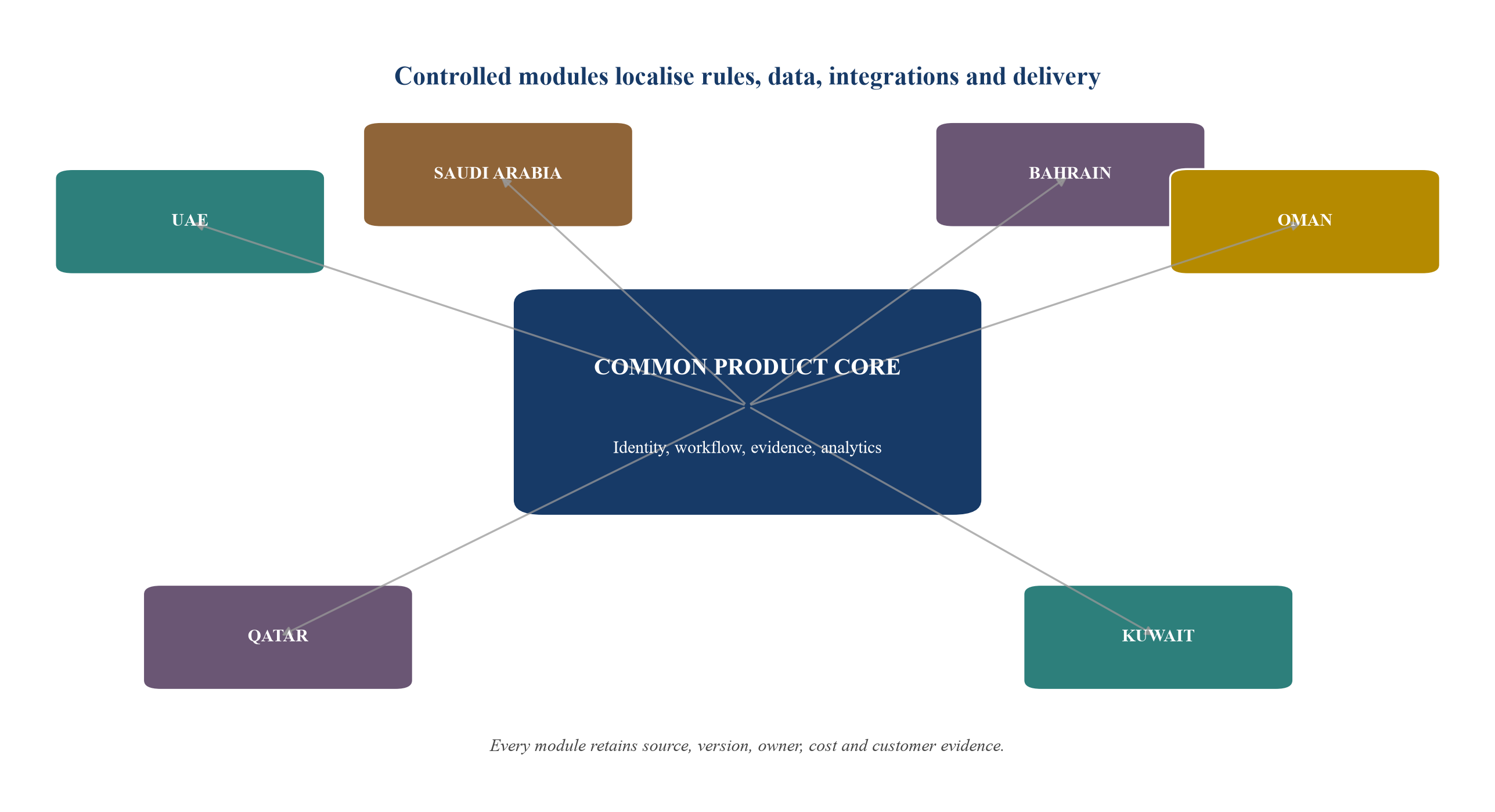
A common governed core should support controlled jurisdiction modules, data choices and delivery without uncontrolled product forks.
30. Distinguish software revenue
Software revenue should correspond to repeatable functionality delivered through a maintained product. The buyer should verify contracts, access, telemetry and renewal. Bundled service revenue should be allocated using supportable methods.
Hosted deployment and configuration do not prevent software economics. Continuing manual control operation, interpretation or evidence production can materially change contribution. The analysis should reflect actual delivery.
31. Distinguish content revenue
Regulatory content can be a valuable subscription asset when it is governed, current and reusable. It requires continuing qualified maintenance. The buyer should identify content ownership, licences and external dependencies.
Content revenue should be analysed after direct review and update cost. Proprietary mappings can support differentiation when customers use them and evidence their value. Public rules copied without a maintained method provide limited defensibility.
32. Distinguish services revenue
Services can accelerate adoption, improve outcomes and generate insight for product development. They should be recognised as services when delivery depends on professional hours, client-specific work or accountable interpretation.
The buyer should measure utilisation, realised rates, backlog and contribution. It should identify subcontractors and key people. A strong services practice can be valuable without receiving a software multiple.
33. Test retention
Retention should be calculated from customer-level contracts, invoices and collections. Multi-year government or enterprise agreements can increase visibility while creating concentration and delivery obligations. Auto-renewal does not prove product dependence.
The buyer should examine cancellations, scope reductions and delayed collections. It should compare retention by depth and country. Founder interventions that preserved accounts should be recorded as relationship dependence.
34. Test expansion
Expansion can arise from additional users, modules, entities, jurisdictions or managed services. The buyer should identify the driver and incremental cost. Moving one customer into a new country can resemble new implementation.
Expansion metrics should exclude one-time projects where appropriate. Contracted options remain separate from exercised orders. The valuation case should use observed expansion evidence rather than regional market size alone.
35. Test pricing power
Pricing should reflect customer value, alternatives, procurement and local support. The buyer should examine list prices, discounts, renewals, tenders and partner shares. Currency and tax treatment can affect net economics.
Price increases supported by broader use differ from increases offset by free services. The buyer should compare realised revenue per active module and cost to serve. Pricing power requires evidence across renewal events.
36. Analyse concentration
Early regional RegTech companies can depend on a small number of government, financial or energy customers. Concentration affects negotiation, roadmap and collections. One customer's custom requirement can become a de facto product branch.
The buyer should map revenue, receivables, pipeline, references and development effort to each major customer. Concentration adjustments should consider both loss risk and replacement cost.
37. Analyse receivables and cash
Collected cash provides a stronger commercial signal than bookings alone. The buyer should reconcile invoices, acceptance milestones, retention amounts and collections. Public-sector cycles can be long and contract specific.
The model should include working capital, tax, guarantees and partner payments. Overdue balances require customer-level evidence. Revenue recognition should follow qualified accounting advice.
Collections should be examined by contractual milestone and evidence of acceptance. Delays caused by unresolved implementation differ from ordinary payment timing. The buyer should identify disputed invoices, credit notes and informal extensions. Cash conversion by country can materially change the capital required to support expansion.
38. Analyse intellectual property
The target should own or hold transferable rights to code, content, translations, methods, integrations and training materials. Employee, contractor and partner contributions require executed agreements. Open-source and third-party licences should be reviewed.
Diligence should identify customer-funded development and restrictions. A local partner may own a translation or control library presented as target property. The transaction should exclude or condition unsupported assets.
The buyer should examine whether official publications can be reproduced, transformed or redistributed inside a commercial product. Public availability does not establish unrestricted reuse. Product value may lie in original taxonomy, mapping and workflow rather than the underlying legal text. The rights analysis should preserve that distinction.
39. Analyse cybersecurity
RegTech holds sensitive policies, controls, evidence and system maps. Security should cover tenant isolation, identity, encryption, logging, vulnerability management and incident response. Regional deployments can increase infrastructure complexity.
The buyer should inspect tests, incidents and remediation. It should compare security commitments across contracts. Integration should preserve evidence and access controls before consolidating environments.
Country-specific deployments can create inconsistent security baselines. The buyer should compare patching, monitoring, privileged access, encryption and backup across every environment. A central policy provides limited protection when local instances operate outside central tooling. Remediation sequencing should prioritise customer and regulatory impact.
40. Analyse resilience
Customers may rely on the platform for approvals and regulatory evidence. Service continuity, backup, recovery and export therefore affect trust. Country-specific infrastructure should have tested recovery arrangements.
Diligence should inspect exercises and actual outages. It should determine whether the provider can continue critical capture during disconnection. Recovery should restore data, identities, configurations and rule versions consistently.
41. Analyse privacy and data protection
The platform should identify controller, processor and other roles for each service. It should map purposes, personal data, access, retention, transfers and rights workflows. Contract language should match actual processing.
The buyer should test representative data flows in each active jurisdiction. Generic global privacy documentation may not cover local arrangements. Remediation should address product, contracts and operations together.
Privacy workflows should support requests, correction, deletion, restriction and incident handling where applicable. The buyer should verify that customer configuration matches contract and product behaviour. Marketing claims concerning residency or sovereign operation should be tested against backups, telemetry, support access and subprocessors.
42. Analyse model risk
If the product uses AI to classify obligations, map controls, score risk or draft evidence, those functions need governance. The system should record models, inputs, evaluations, approvals, limitations and human review. Generated legal conclusions create heightened risk.
Diligence should identify which outputs influence consequential decisions. It should inspect testing by language and jurisdiction. A global model may perform differently on Arabic legal text or local terminology.
The buyer should examine changes in model provider, version, prompt, retrieval content and evaluation. A generated control mapping can reduce professional effort while creating hidden review work when confidence is low. Product economics should include human validation and exception management needed for reliable customer use.
43. Analyse language quality
Arabic and English content should remain semantically aligned. Translation should preserve legal status, defined terms and effective dates. Machine translation can assist workflow while requiring review for material content.
The buyer should compare sampled controls and reports with sources. It should inspect reviewer competence and correction records. Language quality is a product capability and continuing operating cost.
Defined terms should use an approved bilingual glossary with version control. Customer terminology should remain separate from official translations and internal product labels. The combined company should track defects and downstream documents affected by each correction. This turns language management into a measurable control rather than informal editing.
44. Analyse local talent
Regional delivery can depend on regulatory experts, solution architects, Arabic product staff and relationship leaders. The buyer should map revenue, content and customers to key people. Authority and knowledge may not transfer through code.
Retention plans should reward documented handover and sustainable capability. Succession requires more than hiring. The integration plan should preserve customer continuity while reducing single-person dependence.
The talent map should distinguish regulatory interpretation, product management, implementation, security, sales and executive relationships. One person may occupy several roles in an early company. The buyer should plan separation of duties and backup coverage without disrupting delivery. Capacity assumptions should reflect training and supervised experience.
45. Analyse brand and relationships
Trust can shorten sales cycles and support reference-led expansion. The buyer should verify which brand, person or institution customers rely upon. Relationship value may weaken after acquisition or strengthen under a credible owner.
Customer and partner references should address continuity. The transaction model should avoid assuming automatic transfer. Communications and governance should protect local credibility.
46. Quantify localisation debt
Localisation debt includes ungoverned forks, manual translations, obsolete mappings, duplicated infrastructure and undocumented customer configurations. It can suppress margin and delay product releases. The buyer should create a country-by-country inventory.
Each item should have remediation cost, owner and customer impact. Some variants may require retirement; others represent valuable features that should return to the core. The valuation should fund the programme.
The buyer should quantify release delay, duplicate testing, support burden and security exposure created by each variant. This converts architectural concern into economic evidence. A consolidation programme should define a target module, migration wave, acceptance test and decommission date for every material fork.
47. Build the expansion scorecard
The expansion scorecard should assess verified customer need, regulatory clarity, product fit, data architecture, channel, talent, sales cycle, implementation cost and expected contribution. Scores should be supported by evidence and updated after market tests.
An attractive market can remain a poor immediate entry when the operating path is unclear. The scorecard should separate long-term strategic interest from funded near-term execution.
Table 3. Hypothetical GCC market-entry scorecard
| Dimension | UAE | Saudi Arabia | Bahrain | Oman | Decision use |
|---|---|---|---|---|---|
| Verified paid demand | 5 | 4 | 2 | 2 | Weight contracts and collections above market commentary |
| Common-core product fit | 4 | 4 | 4 | 4 | Test actual deployments and required code changes |
| Local content readiness | 5 | 4 | 3 | 2 | Verify primary sources, review and update ownership |
| Data and hosting readiness | 5 | 4 | 3 | 2 | Confirm architecture, contracts and sector requirements |
| Channel and delivery readiness | 4 | 4 | 2 | 2 | Verify transferable partners, talent and procurement access |
| Illustrative priority | Scale | Scale selectively | Pilot | Prepare | Revisit after evidence and economics improve |
Scores are illustrative management assumptions on a five-point scale; they are not measured market facts or recommendations.
48. Build the valuation bridge
The valuation bridge should begin with verified collected revenue and contribution. It can credit repeatable software, reusable content and demonstrated expansion. Adjustments should reflect services intensity, concentration, receivables, localisation debt, key people and market-entry investment.
Future-country scenarios belong in sensitivity analysis until supported by paid evidence. Buyer-specific synergies should remain separate. The bridge should show which value depends on conditions and integration.
Table 4. Hypothetical GCC AI-RegTech valuation bridge
| Item | Illustrative value effect | Required evidence | Treatment |
|---|---|---|---|
| Verified recurring collected revenue and contribution | USD 36.0m enterprise-value base | Contracts, collections, usage and cost allocation | Base case |
| Common-core reuse and paid control modules | +USD 5.0m | Code reuse, customer telemetry, renewals and maintained content | Conditional uplift |
| Demonstrated cross-market customer expansion | +USD 3.0m | Exercised orders, collections and deployment contribution | Conditional uplift |
| Customer, founder and channel concentration | -USD 4.5m | Customer cohorts, partner terms and succession evidence | Risk adjustment |
| Localisation debt and content remediation | -USD 3.0m | Technical inventory and costed work packages | Funded adjustment |
| Data, security and integration programme | -USD 2.5m | Independent findings and migration plan | Funded adjustment |
| Illustrative adjusted enterprise value | USD 34.0m | Completion of evidence gates | Decision output |
All values are illustrative management assumptions prepared only to demonstrate the framework; they are not market observations, a valuation opinion or a forecast.
49. Avoid double counting
Regional coverage can appear in revenue growth, strategic value, customer retention and a market-access premium. The buyer should identify each causal driver and credit it once. Content, relationships and software may contribute to the same renewal.
Historical contribution should remain separate from forecast expansion. Sensitivities should show lower conversion, higher local cost and delayed collections. This produces a decision-useful range.
50. Design transaction protection
Representations and warranties can address ownership, regulatory claims, data, security, contracts, licences, content and undisclosed incidents. Specific issues may require conditions, indemnities, escrow or price adjustment. Qualified counsel should draft transaction terms.
Contractual recovery cannot create product integrity. Operational remediation should continue. Disclosure schedules should identify material local assets and restrictions precisely.
51. Set closing conditions
Closing conditions can include partner and customer consents, licence continuity, key-person arrangements, content delivery, security remediation and complete data exports. Conditions should be objective and verified.
The buyer should distinguish a prospective improvement from correction of historical evidence. Completion records should state remaining limitations. Market-access assumptions should not substitute for required approvals.
52. Plan Day One
Day One should preserve customer service, local contacts, support hours, hosting, rule updates, incidents and contractual responsibilities. Entity changes and data transfers require controlled sequencing. Customers should know their accountable counterparty.
The plan should name owners and fallback actions. Product and content releases should continue through close. Uncontrolled rebranding or system migration can damage trust.
53. Design the target operating model
The target model should retain one product authority and clear local ownership. Central teams can govern platform, security, product and shared methods. Local teams can own sources, language, customers and required delivery within defined standards.
Decision rights should be documented. Local exceptions should have evidence, approval and expiry. Incentives should reward collected contribution and product reuse as well as bookings.
54. Integrate the product
Integration should map identity, code, data, content, infrastructure and customer commitments. The buyer should preserve local functions that support paid value while removing duplicate and unsupported forks. Migration should use representative customers and reconciliation.
Completion should depend on equivalent evidence, functionality and service. A copied dataset or code repository is insufficient when rule versions and customer configurations are lost.
55. Integrate the commercial model
Account plans should identify buyer, user, decision process, renewal, partner, implementation and collections. Cross-selling should follow verified product fit and local delivery capacity. Central targets should not create unsupported regulatory claims.
The buyer should protect existing channel economics during transition. New pricing should reflect support and localisation. Commercial reporting should distinguish bookings, revenue, collections and contribution.
56. Integrate professional services
Services should have defined methods, scopes, competence, quality review and outputs. The combined firm should decide which advice it provides and which work goes to qualified external professionals. Independence and conflicts require review.
Reusable delivery assets can return to product through governed change. Customer confidential information should remain protected. Services capacity should be included in expansion plans.
57. Monitor post-close performance
The board dashboard should connect growth with product and regulatory quality. Measures can include collected recurring revenue, gross and contribution margin, core reuse, local content age, deployment time, support effort, incidents, receivables and market-entry milestones.
Metrics should be segmented by country and customer cohort. Management estimates should be labelled. An accountable owner and action should accompany every material exception.
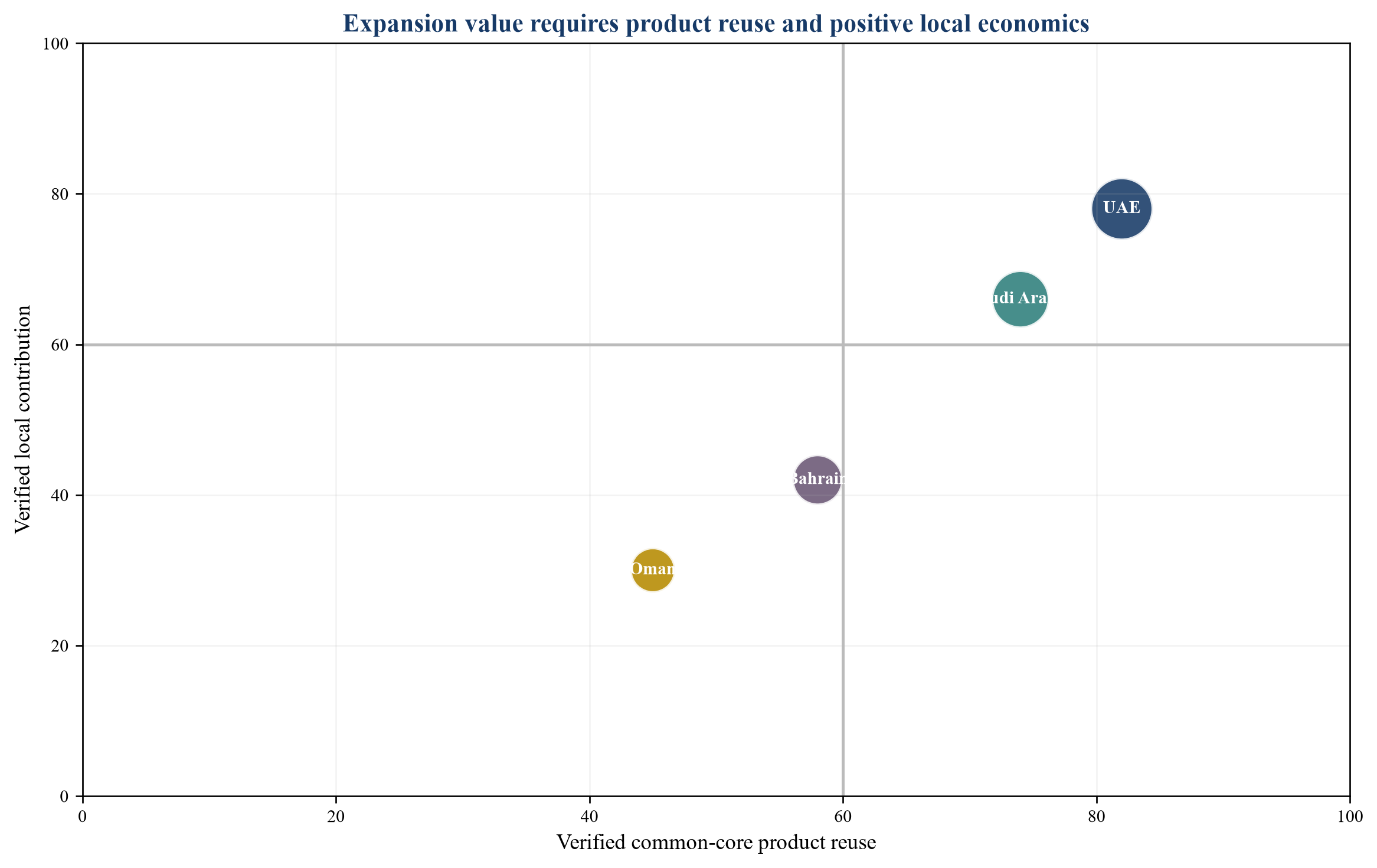
Positions are illustrative; the buyer should populate the chart with verified revenue, cost and product evidence.
58. Apply five acquisition gates
The first gate tests product reuse. The second tests current local regulatory content and data architecture. The third tests customers, cash and contribution. The fourth tests transferable access and talent. The fifth tests integration and expansion discipline.
An open gate should trigger evidence work, remediation, a condition, repricing or a stop decision. The investment committee should record owner and deadline. Intent does not close a gate.
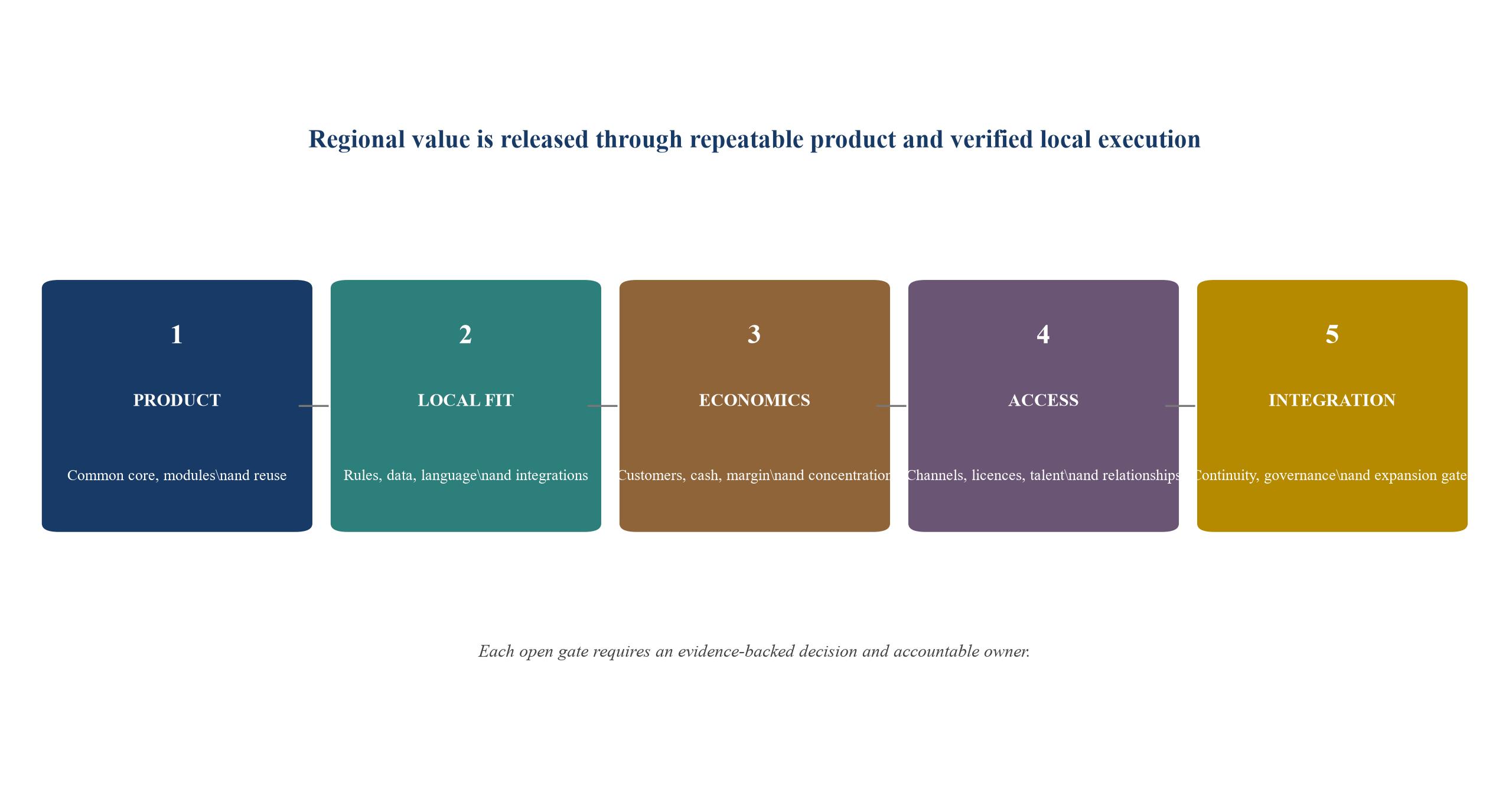
Each gate should be supported by direct evidence and connected to transaction terms and integration work.
59. Maintain the decision record
The buyer should record every material conclusion, source, assumption, exception, owner and review trigger. The record should cover product reuse, regulatory content, customer economics, access, valuation and integration.
This prevents expansion scenarios from becoming historical fact. It supports later review when rules, customers or product architecture change. The combined company can use the same discipline for each new market.
60. Conclusion
GCC AI RegTech can combine a repeatable product with valuable local capability. The investment case depends on evidence that the common core drives paid use while local rules, data, integrations and services remain controlled and economically visible.
The Local Rules, Global Product Framework gives buyers a method to separate these layers. It protects local access and customer trust while directing investment toward product reuse, verified contribution and disciplined expansion.
References
- UAE Artificial Intelligence Office. UAE National Strategy for Artificial Intelligence 2031. https://ai.gov.ae/strategy/
- UAE Artificial Intelligence Office. UAE National Strategy for Artificial Intelligence 2031, strategy document. https://ai.gov.ae/wp-content/uploads/2021/07/UAE-National-Strategy-for-Artificial-Intelligence-2031.pdf
- UAE Artificial Intelligence Office. UAE Position on Artificial Intelligence Policy. 2024. https://ai.gov.ae/wp-content/uploads/2024/10/UAE-Guiding-on-ai-policy-EN-V3.pdf
- UAE Government. Personal data protection laws. https://u.ae/en/about-the-uae/digital-uae/data/data-protection-laws
- Dubai International Financial Centre. Data Protection Law DIFC Law No. 5 of 2020. https://www.difc.com/business/laws-and-regulations/legal-database/data-protection-law-difc-law-no-5-2020
- Abu Dhabi Global Market. Data Protection Regulations 2021. https://www.adgm.com/operating-in-adgm/office-of-data-protection/legislation
- Saudi Data and Artificial Intelligence Authority. Laws and Regulations. https://sdaia.gov.sa/en/SDAIA/about/Pages/RegulationsAndPolicies.aspx
- Saudi Data and Artificial Intelligence Authority. AI Ethics Principles. https://sdaia.gov.sa/en/SDAIA/about/Documents/ai-principles.pdf
- Saudi Data and Artificial Intelligence Authority. AI Adoption Framework. https://sdaia.gov.sa/en/SDAIA/about/Files/AIAdoptionFramework.pdf
- Saudi Data and Artificial Intelligence Authority. Personal Data Protection Law materials. https://sdaia.gov.sa/en/SDAIA/about/Pages/RegulationsAndPolicies.aspx
- Saudi Data and Artificial Intelligence Authority. National Data Management Office. https://sdaia.gov.sa/en/Sectors/Ndmo/Pages/default.aspx
- Saudi Data and Artificial Intelligence Authority. AI Ethics Assessment. https://dgp.sdaia.gov.sa/wps/portal/pdp/services/AIEthicsAssessment/
- Bahrain Information and eGovernment Authority. Bahrain Launches National AI Policy and Adopts GCC Ethics Manual. July 2025. https://iga.gov.bh/en/article/bahrain-launches-national-ai-policy-and-adopts-gcc-ethics-manual
- Bahrain National Enterprise Architecture. General AI Policy for Bahrain Government. https://nea.gov.bh/Policies-Standards
- Bahrain National Enterprise Architecture. AI Ethics for GCC Countries. https://nea.gov.bh/Policies-Standards
- Kingdom of Bahrain. Personal Data Protection Authority. https://www.pdp.gov.bh/
- Oman Ministry of Transport, Communications and Information Technology. General Policy for the Safe and Ethical Use of Artificial Intelligence Systems. April 2025. https://www.mtcit.gov.om/library-3/legislations-policies-8/policies-73/general-policy-for-the-safe-and-ethical-use-of-artificial-intelligence-systems-291
- Oman Ministry of Transport, Communications and Information Technology. National Program for Artificial Intelligence and Advanced Digital Technologies. https://www.mtcit.gov.om/sectors?sector=artificial_intelligence
- Oman Ministry of Transport, Communications and Information Technology. Personal Data Protection Law, Royal Decree 6/2022. https://www.ita.gov.om/ITAPortal/MediaCenter/Document_Library.aspx
- Oman Ministry of Transport, Communications and Information Technology. Executive Regulations of the Personal Data Protection Law. https://www.ita.gov.om/ITAPortal/MediaCenter/Document_Library.aspx
- Qatar Ministry of Communications and Information Technology. Digital Agenda 2030. https://www.mcit.gov.qa/en/initiatives/digital-agenda-2030/
- Qatar National Cyber Security Agency. Personal Data Privacy Protection Law materials. https://assurance.ncsa.gov.qa/
- Kuwait Central Agency for Information Technology. Policies and frameworks. https://www.cait.gov.kw/
- Gulf Cooperation Council. Guiding Manual on the Ethics of Artificial Intelligence Use in GCC Countries. https://www.gcc-sg.org/
- National Institute of Standards and Technology. Artificial Intelligence Risk Management Framework 1.0. January 2023. https://doi.org/10.6028/NIST.AI.100-1
- National Institute of Standards and Technology. Artificial Intelligence Risk Management Framework: Generative Artificial Intelligence Profile. July 2024. https://doi.org/10.6028/NIST.AI.600-1
- Organisation for Economic Co-operation and Development. OECD AI Principles. Updated May 2024. https://oecd.ai/en/ai-principles
- International Organization for Standardization. ISO/IEC 42001:2023, Artificial intelligence management system. https://www.iso.org/standard/81230.html
- International Organization for Standardization. ISO/IEC 42005:2025, AI system impact assessment. https://www.iso.org/standard/44545.html
- International Organization for Standardization. ISO/IEC 27001:2022, Information security management systems. https://www.iso.org/standard/27001
- United Nations Educational, Scientific and Cultural Organization. Recommendation on the Ethics of Artificial Intelligence. 2021. https://www.unesco.org/en/artificial-intelligence/recommendation-ethics
- World Bank. GovTech Maturity Index. https://www.worldbank.org/en/programs/govtech/gtmi
- International Telecommunication Union. AI for Good and responsible AI resources. https://aiforgood.itu.int/
- Financial Action Task Force. Opportunities and Challenges of New Technologies for AML/CFT. July 2021. https://www.fatf-gafi.org/en/publications/Digitaltransformation/Opportunities-challenges-new-technologies-aml-cft.html
- United States Department of Justice and Federal Trade Commission. Merger Guidelines. December 2023. https://www.justice.gov/atr/2023-merger-guidelines
- European Union. Regulation (EU) 2024/1689 laying down harmonised rules on artificial intelligence. 2024. https://eur-lex.europa.eu/eli/reg/2024/1689/oj
- European Commission. AI Act regulatory framework. https://digital-strategy.ec.europa.eu/en/policies/regulatory-framework-ai
- Cloud Security Alliance. Cloud Controls Matrix. https://cloudsecurityalliance.org/research/cloud-controls-matrix
- National Institute of Standards and Technology. Cybersecurity Framework 2.0. February 2024. https://doi.org/10.6028/NIST.CSWP.29
- Committee of Sponsoring Organizations of the Treadway Commission. Enterprise Risk Management: Integrating with Strategy and Performance. https://www.coso.org/enterprise-risk-management
About the Author
Chennakeshav (CK) is a corporate finance and investment banking executive with 25+ years of global experience in deal origination, structuring and execution across M&A, growth capital and corporate strategy. He has led value-creation mandates for founders, corporates and funds — bridging the boardroom view to hands-on execution and close.
His career spans Morgan Stanley, HSBC, Lloyds Banking Group, EWEC, ADQ portfolio companies and Emirates Growth Fund, across TMT, real estate, fintech, deeptech, cleantech, infrastructure and energy. He has partnered with C-suite leaders, private equity and venture funds, sovereign wealth funds and family offices to finance complex fund raises and scale-up ventures, and has led M&A due diligence, post-merger integration and business-transformation initiatives to create value.
At Matchpoint Partners he is Managing Partner, leading the firm's corporate finance, M&A and capital-raising practice. He holds an MBA from London Business School, an engineering degree from VTU and a Master of Laws (LLM, in progress) from UCL London.
An active start-up mentor, CK mentors at Techstars, DIFC FinTech Hive, Startup Grind, Founder Institute and IN5, serves as Entrepreneur Mentor in Residence (EMiR) at London Business School, and judges the Entrepreneurship World Cup.
