

1. Define the valuation decision
The decision question is which power rights, prices and support mechanisms justify value in the transaction case. The evidence record should begin with transaction perimeter, facilities, utility accounts, supply contracts, tariff decisions, customer contracts and cash. Every item requires a source, date, legal holder, jurisdiction and reconciliation to the meter and site model. Regional policy and market development provide context. Site-specific documents still control price, duration, probability and cash-flow recognition. [1][2]
The principal failure is that a single blended power price can conceal incompatible rights, durations and risks. The model should expose the contractual dependency, economic driver and event that confirms or rejects it. Management estimates can support scenarios when they are identified as assumptions and remain separate from observed evidence.
The recommended response is to separate regulated, contracted, merchant, network, reliability and environmental value drivers. The base case should retain only evidenced rights, measured demand and costed obligations. The investment committee should see value at risk, the earliest observable indicator and the intervention available before cash or capital is released.
2. Adopt a power-structure dictionary
The decision question is how subsidised, standard-tariff, contracted, self-generated and merchant supply are defined across the portfolio. The evidence record should begin with laws, tariff schedules, licences, supply agreements, metering and settlement records. Every item requires a source, date, legal holder, jurisdiction and reconciliation to the meter and site model. Regional policy and market development provide context. Site-specific documents still control price, duration, probability and cash-flow recognition. [3][4]
The principal failure is that commercial language can label a tariff or bilateral arrangement as subsidised without proving economic support. The model should expose the contractual dependency, economic driver and event that confirms or rejects it. Management estimates can support scenarios when they are identified as assumptions and remain separate from observed evidence.
The recommended response is to approve one evidence-based classification for every meter, site and supply period. The base case should retain only evidenced rights, measured demand and costed obligations. The investment committee should see value at risk, the earliest observable indicator and the intervention available before cash or capital is released.
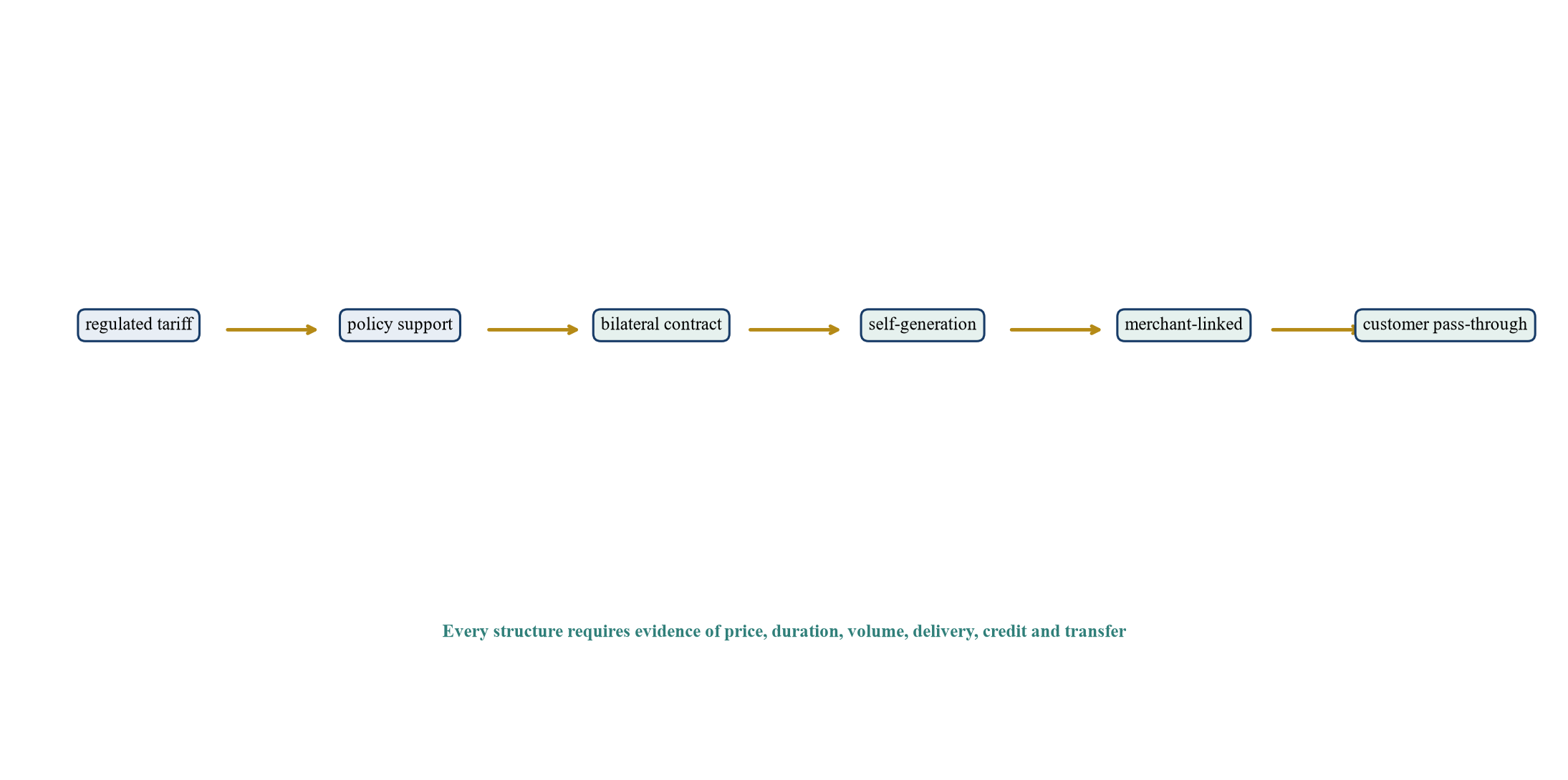
Analytical framework; governing law and executed documents control classification.
| Structure | Minimum evidence | Principal valuation issue |
|---|---|---|
| regulated tariff | published decision and eligible account | reclassification and reset |
| policy support | governing instrument and funded mechanism | duration and withdrawal |
| bilateral contract | executed price, volume and delivery terms | indexation and credit |
| self-generation | permits, fuel, dispatch and operating evidence | capital and availability |
| merchant-linked | market access and settlement evidence | volatility and liquidity |
| customer pass-through | enforceable recovery formula | timing and leakage |
Proposed definitions; governing instruments and executed documents control treatment.
3. Fix the legal and geographic perimeter
The decision question is which entities, sites, meters, grid rights, supply contracts and support entitlements transfer. The evidence record should begin with corporate records, land and lease documents, licences, utility accounts, contracts and change-of-control terms. Every item requires a source, date, legal holder, jurisdiction and reconciliation to the meter and site model. Regional policy and market development provide context. Site-specific documents still control price, duration, probability and cash-flow recognition. [5][6]
The principal failure is that an attractive price can sit outside the acquired entity or terminate on a change in owner, use or load. The model should expose the contractual dependency, economic driver and event that confirms or rejects it. Management estimates can support scenarios when they are identified as assumptions and remain separate from observed evidence.
The recommended response is to map legal holder, beneficiary, location, permitted use, transfer condition and expiry. The base case should retain only evidenced rights, measured demand and costed obligations. The investment committee should see value at risk, the earliest observable indicator and the intervention available before cash or capital is released.
4. Reconcile tariff to economic cost
The decision question is how the billed customer price relates to generation, fuel, transmission, distribution, system and policy costs. The evidence record should begin with regulatory decisions, bulk supply tariffs, network charges, customer bills and government disclosures. Every item requires a source, date, legal holder, jurisdiction and reconciliation to the meter and site model. Regional policy and market development provide context. Site-specific documents still control price, duration, probability and cash-flow recognition. [3][7]
The principal failure is that the customer tariff can differ from system cost and the difference may change with policy. The model should expose the contractual dependency, economic driver and event that confirms or rejects it. Management estimates can support scenarios when they are identified as assumptions and remain separate from observed evidence.
The recommended response is to model the observed bill separately from the underlying economic-cost and policy bridge. The base case should retain only evidenced rights, measured demand and costed obligations. The investment committee should see value at risk, the earliest observable indicator and the intervention available before cash or capital is released.
5. Verify subsidy and support eligibility
The decision question is whether a lower price arises from an enforceable entitlement, policy classification, budget transfer or discretionary arrangement. The evidence record should begin with legislation, eligibility decisions, customer classification, appropriation, compensation and renewal evidence. Every item requires a source, date, legal holder, jurisdiction and reconciliation to the meter and site model. Regional policy and market development provide context. Site-specific documents still control price, duration, probability and cash-flow recognition. [3][8]
The principal failure is that management can treat a policy benefit as a contractual right despite conditions, review or withdrawal. The model should expose the contractual dependency, economic driver and event that confirms or rejects it. Management estimates can support scenarios when they are identified as assumptions and remain separate from observed evidence.
The recommended response is to assign duration and probability from the governing instrument and funding mechanism. The base case should retain only evidenced rights, measured demand and costed obligations. The investment committee should see value at risk, the earliest observable indicator and the intervention available before cash or capital is released.
6. Test transfer and change-of-use risk
The decision question is whether acquisition, expansion, customer type, ownership or workload changes alter the price or support. The evidence record should begin with tariff rules, licences, utility correspondence, closing conditions and proposed operating plan. Every item requires a source, date, legal holder, jurisdiction and reconciliation to the meter and site model. Regional policy and market development provide context. Site-specific documents still control price, duration, probability and cash-flow recognition. [4][5]
The principal failure is that value can disappear when the site crosses a demand band or changes legal customer classification. The model should expose the contractual dependency, economic driver and event that confirms or rejects it. Management estimates can support scenarios when they are identified as assumptions and remain separate from observed evidence.
The recommended response is to price the expected post-closing use and retain reclassification downside. The base case should retain only evidenced rights, measured demand and costed obligations. The investment committee should see value at risk, the earliest observable indicator and the intervention available before cash or capital is released.
7. Diligence contracted supply
The decision question is whether a bilateral supply, sleeved arrangement or power purchase agreement delivers the required volume and service. The evidence record should begin with executed contracts, schedules, metering, settlement, credit support, curtailment, remedies and termination. Every item requires a source, date, legal holder, jurisdiction and reconciliation to the meter and site model. Regional policy and market development provide context. Site-specific documents still control price, duration, probability and cash-flow recognition. [6][9]
The principal failure is that a headline fixed price can exclude network charges, imbalance, shape, losses, taxes and replacement energy. The model should expose the contractual dependency, economic driver and event that confirms or rejects it. Management estimates can support scenarios when they are identified as assumptions and remain separate from observed evidence.
The recommended response is to rebuild the all-in delivered price and service obligation from the executed documents. The base case should retain only evidenced rights, measured demand and costed obligations. The investment committee should see value at risk, the earliest observable indicator and the intervention available before cash or capital is released.
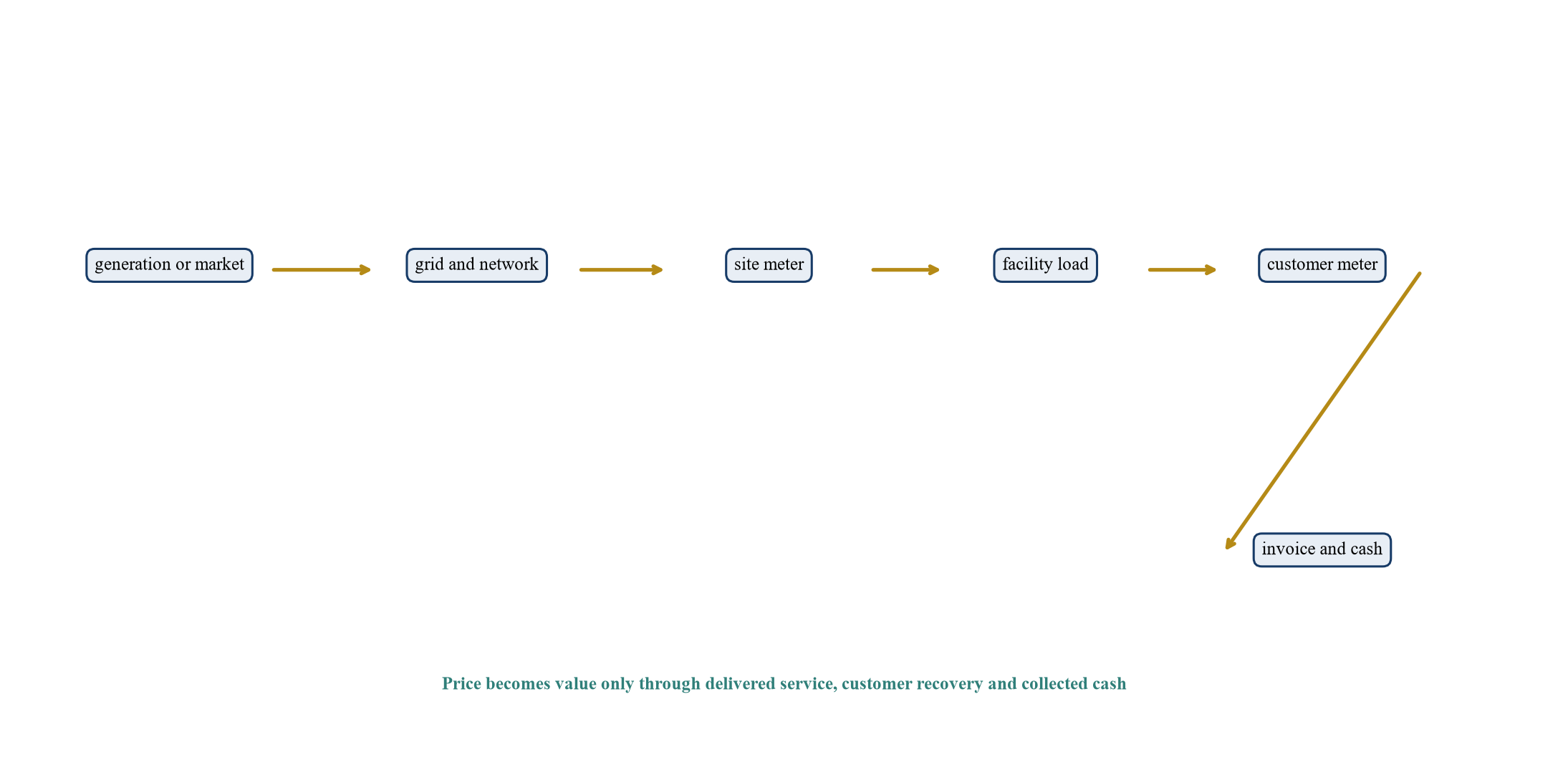
Analytical framework; actual rights and settlement routes require legal and financial verification.
| Term | Evidence question | Cash consequence |
|---|---|---|
| volume | fixed, shaped or tolerance band? | surplus and deficit cost |
| price | energy only or all-in delivered? | margin basis |
| indexation | which benchmark, date, cap and floor? | escalation |
| delivery | firm, interruptible or conditional? | customer service risk |
| take-or-pay | what minimum and make-up rights apply? | ramp-up cost |
| termination | which default, change and expiry rights apply? | replacement exposure |
Proposed checklist; executed terms determine exposure.
8. Model price indexation
The decision question is which inflation, fuel, foreign-exchange, benchmark, floor, cap and review clauses change future cost. The evidence record should begin with contract formulae, tariff decisions, historic settlements, benchmark data and reset notices. Every item requires a source, date, legal holder, jurisdiction and reconciliation to the meter and site model. Regional policy and market development provide context. Site-specific documents still control price, duration, probability and cash-flow recognition. [4][10]
The principal failure is that a fixed-price description can contain material escalation or reopeners. The model should expose the contractual dependency, economic driver and event that confirms or rejects it. Management estimates can support scenarios when they are identified as assumptions and remain separate from observed evidence.
The recommended response is to calculate every index on its contractual date and test cap, floor and correlation. The base case should retain only evidenced rights, measured demand and costed obligations. The investment committee should see value at risk, the earliest observable indicator and the intervention available before cash or capital is released.
9. Separate energy, capacity and network charges
The decision question is which charges pay for consumption, reserved capacity, peak demand, connection, losses and system use. The evidence record should begin with bills, tariff schedules, connection agreements, metering and demand profiles. Every item requires a source, date, legal holder, jurisdiction and reconciliation to the meter and site model. Regional policy and market development provide context. Site-specific documents still control price, duration, probability and cash-flow recognition. [3][7]
The principal failure is that cost per MWh can omit capacity and network obligations that persist at low utilisation. The model should expose the contractual dependency, economic driver and event that confirms or rejects it. Management estimates can support scenarios when they are identified as assumptions and remain separate from observed evidence.
The recommended response is to forecast each charge from its own driver and reconcile it to invoices. The base case should retain only evidenced rights, measured demand and costed obligations. The investment committee should see value at risk, the earliest observable indicator and the intervention available before cash or capital is released.
| Component | Driver | Evidence |
|---|---|---|
| energy | metered MWh | tariff or supply contract |
| capacity | reserved kW or peak demand | bill and network schedule |
| network | connection and system use | regulated charge |
| losses and imbalance | profile and settlement | market or contract statement |
| tax and levy | statutory base | legislation and invoice |
| environmental attribute | certified MWh | registry and retirement |
Proposed model; site invoices and contracts determine the values.
10. Test volume, shape and take-or-pay
The decision question is how hourly demand and minimum purchase obligations compare with ramp-up and customer utilisation. The evidence record should begin with meter intervals, IT-load forecasts, PUE, contract quantity, tolerance, banking and make-up rights. Every item requires a source, date, legal holder, jurisdiction and reconciliation to the meter and site model. Regional policy and market development provide context. Site-specific documents still control price, duration, probability and cash-flow recognition. [1][9]
The principal failure is that a cheap contracted block can create stranded take-or-pay cost during delayed ramp-up. The model should expose the contractual dependency, economic driver and event that confirms or rejects it. Management estimates can support scenarios when they are identified as assumptions and remain separate from observed evidence.
The recommended response is to align supply shape with facility load and model surplus, deficit and make-up treatment. The base case should retain only evidenced rights, measured demand and costed obligations. The investment committee should see value at risk, the earliest observable indicator and the intervention available before cash or capital is released.
11. Value reliability and redundancy
The decision question is how firm supply, reserve margin, outage performance, dual feeds and on-site generation support customer service. The evidence record should begin with grid codes, service levels, outage logs, network diagrams, fuel plans and test evidence. Every item requires a source, date, legal holder, jurisdiction and reconciliation to the meter and site model. Regional policy and market development provide context. Site-specific documents still control price, duration, probability and cash-flow recognition. [1][11]
The principal failure is that low-cost energy can carry weak value when interruption destroys customer credits and renewal economics. The model should expose the contractual dependency, economic driver and event that confirms or rejects it. Management estimates can support scenarios when they are identified as assumptions and remain separate from observed evidence.
The recommended response is to link reliability evidence to service revenue, remedies and replacement power. The base case should retain only evidenced rights, measured demand and costed obligations. The investment committee should see value at risk, the earliest observable indicator and the intervention available before cash or capital is released.
12. Price curtailment and interruption
The decision question is which instructions, thresholds, notice, compensation and restoration rules govern constrained supply. The evidence record should begin with grid and supply contracts, operating procedures, event history, metering and compensation records. Every item requires a source, date, legal holder, jurisdiction and reconciliation to the meter and site model. Regional policy and market development provide context. Site-specific documents still control price, duration, probability and cash-flow recognition. [9][11]
The principal failure is that nominal availability can exclude commercially important curtailment periods. The model should expose the contractual dependency, economic driver and event that confirms or rejects it. Management estimates can support scenarios when they are identified as assumptions and remain separate from observed evidence.
The recommended response is to value expected lost contribution, customer remedies and resilience cost by event. The base case should retain only evidenced rights, measured demand and costed obligations. The investment committee should see value at risk, the earliest observable indicator and the intervention available before cash or capital is released.
13. Reconcile power usage effectiveness
The decision question is how IT load, cooling, electrical losses and auxiliary demand translate billable load into facility consumption. The evidence record should begin with meter hierarchy, commissioning tests, weather data, operating logs and customer specifications. Every item requires a source, date, legal holder, jurisdiction and reconciliation to the meter and site model. Regional policy and market development provide context. Site-specific documents still control price, duration, probability and cash-flow recognition. [1][12]
The principal failure is that an assumed efficiency ratio can understate electricity demand or overstate saleable capacity. The model should expose the contractual dependency, economic driver and event that confirms or rejects it. Management estimates can support scenarios when they are identified as assumptions and remain separate from observed evidence.
The recommended response is to use measured and climate-adjusted PUE with a transparent numerator and denominator. The base case should retain only evidenced rights, measured demand and costed obligations. The investment committee should see value at risk, the earliest observable indicator and the intervention available before cash or capital is released.
14. Map customer pass-through
The decision question is which electricity and adjustment costs can be recovered from customers and on what timing. The evidence record should begin with customer contracts, price schedules, metering, invoicing, caps, floors, notice and dispute records. Every item requires a source, date, legal holder, jurisdiction and reconciliation to the meter and site model. Regional policy and market development provide context. Site-specific documents still control price, duration, probability and cash-flow recognition. [13][14]
The principal failure is that a facility can bear power inflation while customer prices remain fixed or lagged. The model should expose the contractual dependency, economic driver and event that confirms or rejects it. Management estimates can support scenarios when they are identified as assumptions and remain separate from observed evidence.
The recommended response is to model gross cost, recoverable cost, timing, leakage and customer elasticity separately. The base case should retain only evidenced rights, measured demand and costed obligations. The investment committee should see value at risk, the earliest observable indicator and the intervention available before cash or capital is released.
| Cost item | Recovery mechanism | Principal leakage |
|---|---|---|
| base electricity | fixed or metered pass-through | contracted cap |
| fuel adjustment | indexed surcharge | notice lag |
| network charge | allocation formula | utilisation mismatch |
| carbon attribute | premium or bundled service | unretired certificate |
| backup generation | event or reserved-capacity fee | disputed event |
| tax and levy | statutory change clause | excluded tax |
Proposed reconciliation; customer contracts control recovery.
15. Verify carbon and clean-energy claims
The decision question is which certificates, contractual attributes and emissions factors support customer claims and price premiums. The evidence record should begin with certificate registry, procurement contracts, retirement records, metering and disclosure controls. Every item requires a source, date, legal holder, jurisdiction and reconciliation to the meter and site model. Regional policy and market development provide context. Site-specific documents still control price, duration, probability and cash-flow recognition. [15][16]
The principal failure is that renewable language can double count attributes or confuse physical supply with certificates. The model should expose the contractual dependency, economic driver and event that confirms or rejects it. Management estimates can support scenarios when they are identified as assumptions and remain separate from observed evidence.
The recommended response is to separate electricity delivery, environmental attributes, emissions accounting and premium revenue. The base case should retain only evidenced rights, measured demand and costed obligations. The investment committee should see value at risk, the earliest observable indicator and the intervention available before cash or capital is released.
16. Build the power-cost forecast
The decision question is how load, efficiency, price, indexation, network cost, tax, support and pass-through create annual cash. The evidence record should begin with site and meter forecasts, contracts, tariff decisions, customer terms and working-capital records. Every item requires a source, date, legal holder, jurisdiction and reconciliation to the meter and site model. Regional policy and market development provide context. Site-specific documents still control price, duration, probability and cash-flow recognition. [1][4]
The principal failure is that one price assumption can hide different volume and timing drivers. The model should expose the contractual dependency, economic driver and event that confirms or rejects it. Management estimates can support scenarios when they are identified as assumptions and remain separate from observed evidence.
The recommended response is to construct a meter-to-cash model with auditable formulae and scenario switches. The base case should retain only evidenced rights, measured demand and costed obligations. The investment committee should see value at risk, the earliest observable indicator and the intervention available before cash or capital is released.
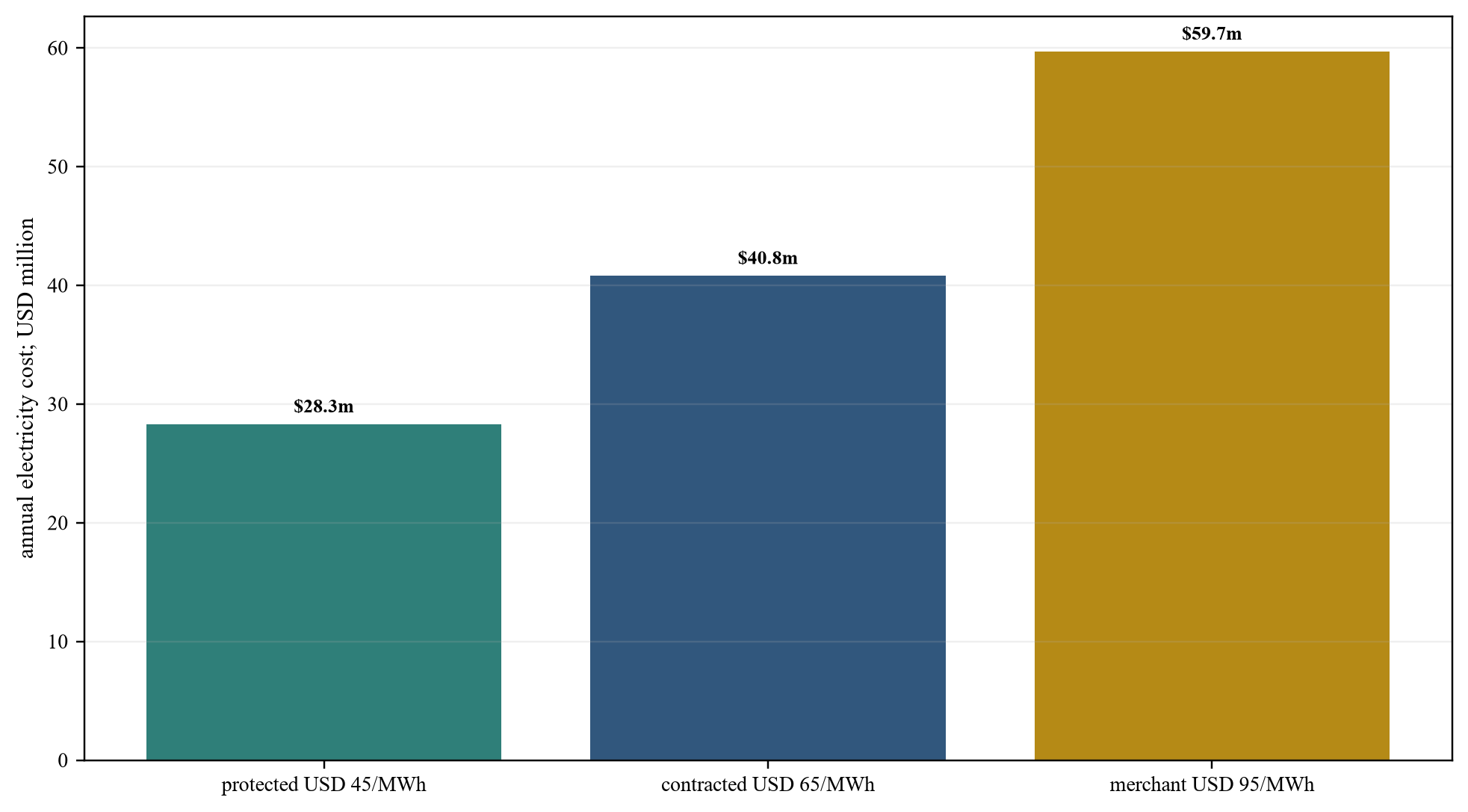
Wholly hypothetical USD millions; prices and demand do not describe an identified site.
| Metric | Assumption | Result |
|---|---|---|
| customer-usable capacity | 80 MW | 80 MW |
| billable utilisation | 70% | 56 MW |
| PUE | 1.28 | 71.68 MW facility load |
| annual facility demand | 8,760 hours | 627.9 GWh |
| contracted service price | USD 165/kW-month | USD 110.9m revenue |
| sustaining capital | annual | USD 12.0m |
Wholly hypothetical USD millions unless stated; figures do not describe an identified company.
17. Estimate sovereign-support durability
The decision question is how law, policy, fiscal capacity, strategic designation and precedent affect the continuation of support. The evidence record should begin with statutes, budgets, regulator decisions, compensation records, state-company filings and review clauses. Every item requires a source, date, legal holder, jurisdiction and reconciliation to the meter and site model. Regional policy and market development provide context. Site-specific documents still control price, duration, probability and cash-flow recognition. [3][17]
The principal failure is that a state-related counterparty or strategic policy can be mistaken for an unconditional sovereign guarantee. The model should expose the contractual dependency, economic driver and event that confirms or rejects it. Management estimates can support scenarios when they are identified as assumptions and remain separate from observed evidence.
The recommended response is to identify the exact obligor, legal mechanism, funding route, review right and remedy. The base case should retain only evidenced rights, measured demand and costed obligations. The investment committee should see value at risk, the earliest observable indicator and the intervention available before cash or capital is released.
18. Value protected-price operations
The decision question is how evidenced tariff or support duration affects operating cash and terminal value. The evidence record should begin with eligibility, billed price, economic-cost bridge, customer contracts, operating cost, capital and tax. Every item requires a source, date, legal holder, jurisdiction and reconciliation to the meter and site model. Regional policy and market development provide context. Site-specific documents still control price, duration, probability and cash-flow recognition. [3][8]
The principal failure is that a temporary price benefit can be capitalised beyond its evidenced life. The model should expose the contractual dependency, economic driver and event that confirms or rejects it. Management estimates can support scenarios when they are identified as assumptions and remain separate from observed evidence.
The recommended response is to limit protected pricing to the evidenced period and apply an explicit reversion case. The base case should retain only evidenced rights, measured demand and costed obligations. The investment committee should see value at risk, the earliest observable indicator and the intervention available before cash or capital is released.
19. Value contracted supply
The decision question is how enforceable price, volume, delivery, indexation and credit terms affect operating value. The evidence record should begin with supply contract, utility interfaces, meter data, settlements, customer cash and financing terms. Every item requires a source, date, legal holder, jurisdiction and reconciliation to the meter and site model. Regional policy and market development provide context. Site-specific documents still control price, duration, probability and cash-flow recognition. [6][9]
The principal failure is that contract value can ignore take-or-pay, credit collateral, curtailment and basis exposure. The model should expose the contractual dependency, economic driver and event that confirms or rejects it. Management estimates can support scenarios when they are identified as assumptions and remain separate from observed evidence.
The recommended response is to discount site cash after all supply obligations, collateral and replacement costs. The base case should retain only evidenced rights, measured demand and costed obligations. The investment committee should see value at risk, the earliest observable indicator and the intervention available before cash or capital is released.
20. Value merchant-linked exposure
The decision question is how spot, fuel, system and scarcity prices affect margin, liquidity and terminal assumptions. The evidence record should begin with market rules, price history, hedges, load shape, settlement and customer pass-through. Every item requires a source, date, legal holder, jurisdiction and reconciliation to the meter and site model. Regional policy and market development provide context. Site-specific documents still control price, duration, probability and cash-flow recognition. [10][18]
The principal failure is that a central merchant price can understate tails and working-capital demand. The model should expose the contractual dependency, economic driver and event that confirms or rejects it. Management estimates can support scenarios when they are identified as assumptions and remain separate from observed evidence.
The recommended response is to use hourly or shaped scenarios, coherent shocks and liquidity reserves. The base case should retain only evidenced rights, measured demand and costed obligations. The investment committee should see value at risk, the earliest observable indicator and the intervention available before cash or capital is released.
21. Normalise value per megawatt
The decision question is how transaction and public-company evidence compares after power structure, utilisation, PUE, contracts and remaining capital. The evidence record should begin with disclosed values, capacity definitions, energy arrangements, operating cash, capex and dates. Every item requires a source, date, legal holder, jurisdiction and reconciliation to the meter and site model. Regional policy and market development provide context. Site-specific documents still control price, duration, probability and cash-flow recognition. [19][20]
The principal failure is that an enterprise-value multiple can transfer another asset’s power advantage to the subject. The model should expose the contractual dependency, economic driver and event that confirms or rejects it. Management estimates can support scenarios when they are identified as assumptions and remain separate from observed evidence.
The recommended response is to compare like-for-like billable capacity and reconcile every multiple to DCF. The base case should retain only evidenced rights, measured demand and costed obligations. The investment committee should see value at risk, the earliest observable indicator and the intervention available before cash or capital is released.
22. Apply the hypothetical operating case
The decision question is how 80 MW of usable capacity converts into 56 MW of billable load and about 628 GWh of facility demand. The evidence record should begin with the illustrative meter, utilisation, PUE, price, customer and cost assumptions. Every item requires a source, date, legal holder, jurisdiction and reconciliation to the meter and site model. Regional policy and market development provide context. Site-specific documents still control price, duration, probability and cash-flow recognition. [1][2]
The principal failure is that one headline MW denominator can obscure consumption and contract economics. The model should expose the contractual dependency, economic driver and event that confirms or rejects it. Management estimates can support scenarios when they are identified as assumptions and remain separate from observed evidence.
The recommended response is to bridge usable capacity through billable load, facility demand, revenue and power cost. The base case should retain only evidenced rights, measured demand and costed obligations. The investment committee should see value at risk, the earliest observable indicator and the intervention available before cash or capital is released.
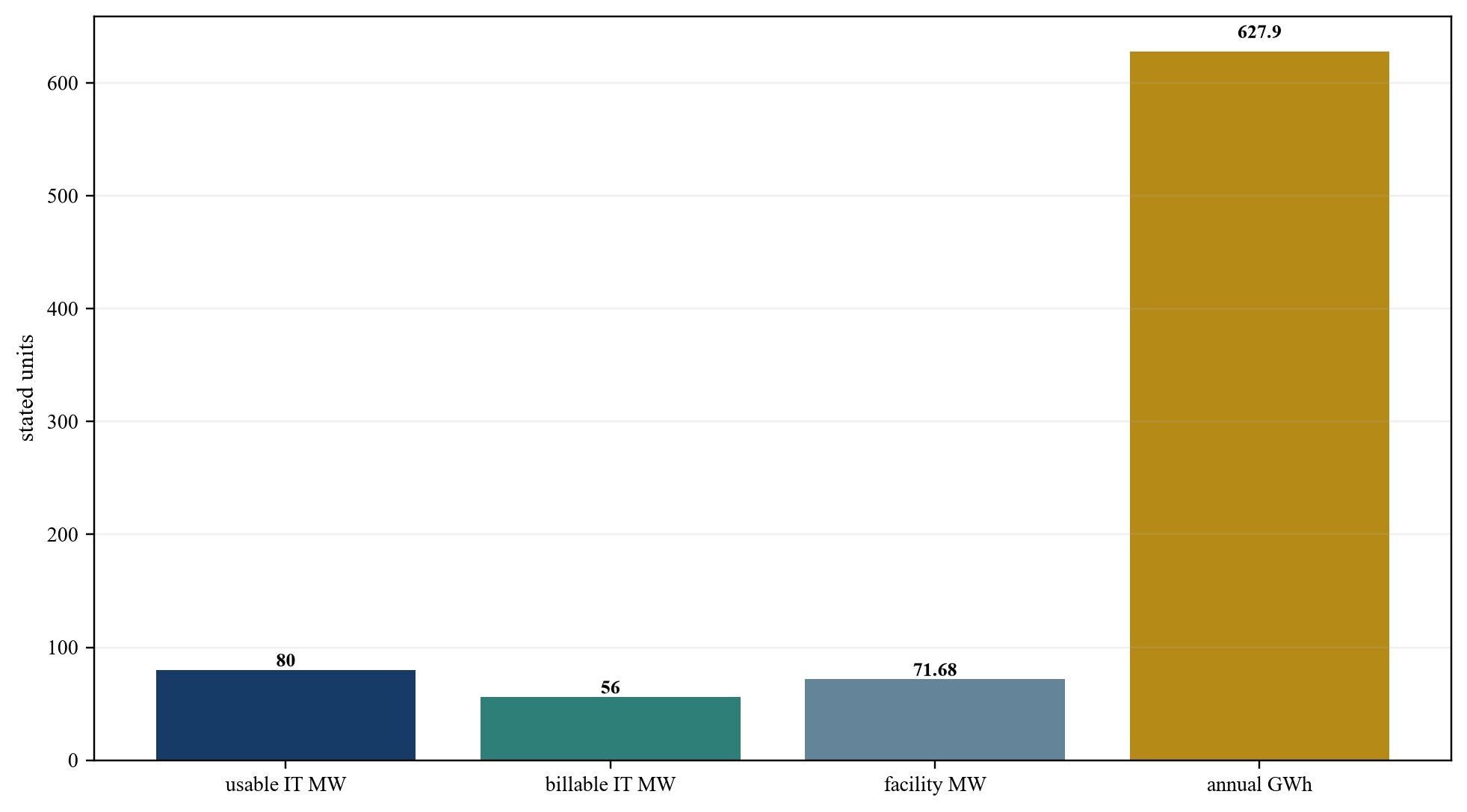
Wholly hypothetical; the case assumes 80 MW usable capacity, 70 per cent utilisation and 1.28 PUE.
23. Bridge power structure to enterprise value
The decision question is how protected, contracted and merchant cases change EBITDA, funding, risk and terminal value. The evidence record should begin with illustrative revenue, power cost, operating cost, sustaining capital, tax and discount assumptions. Every item requires a source, date, legal holder, jurisdiction and reconciliation to the meter and site model. Regional policy and market development provide context. Site-specific documents still control price, duration, probability and cash-flow recognition. [18][21]
The principal failure is that a lower price can be valued without its duration, conditions or reversal risk. The model should expose the contractual dependency, economic driver and event that confirms or rejects it. Management estimates can support scenarios when they are identified as assumptions and remain separate from observed evidence.
The recommended response is to show the complete cash-flow and valuation bridge for each structure. The base case should retain only evidenced rights, measured demand and costed obligations. The investment committee should see value at risk, the earliest observable indicator and the intervention available before cash or capital is released.
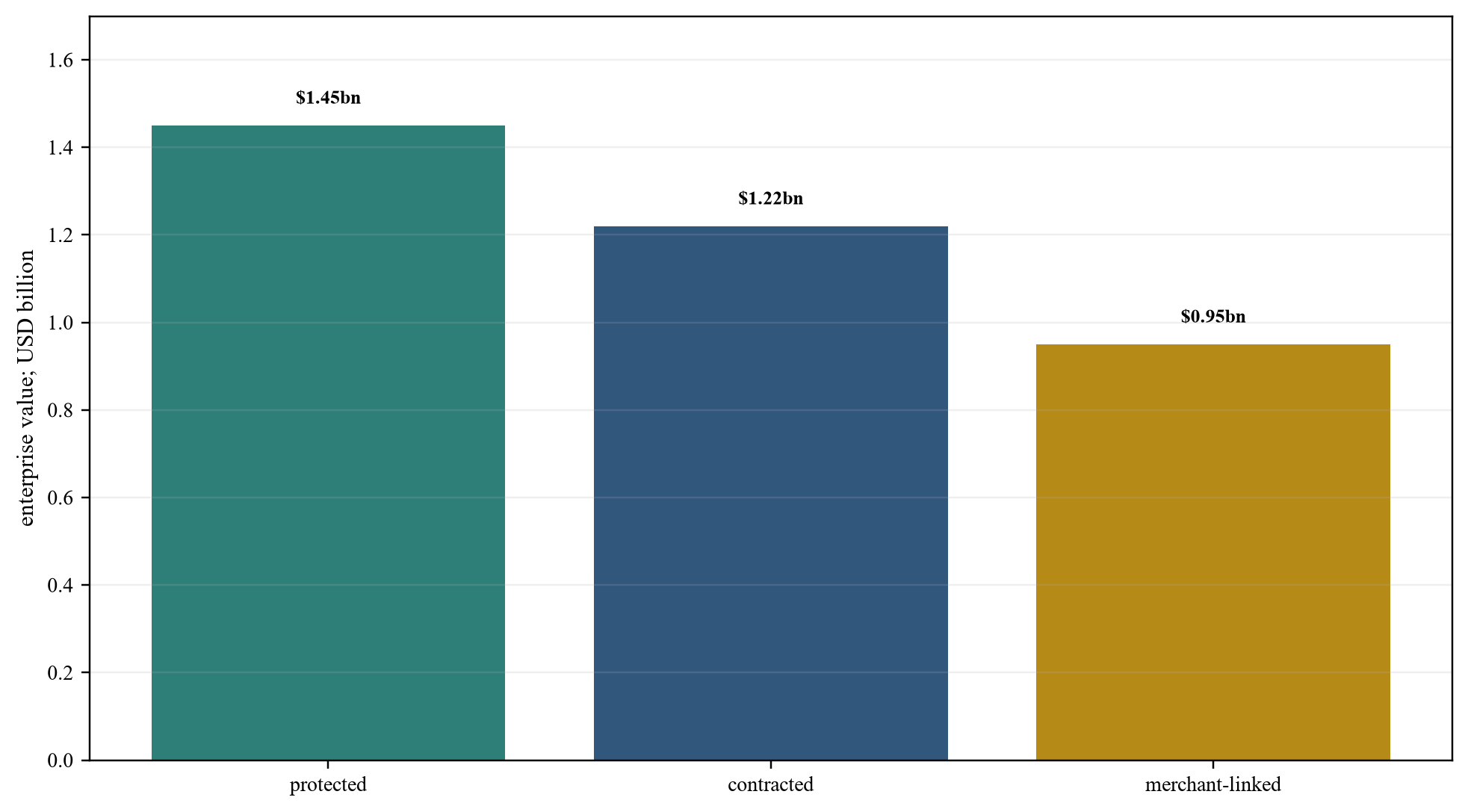
Wholly hypothetical USD billions; this is not a valuation opinion.
| Case | Power price | Annual electricity cost | Enterprise value |
|---|---|---|---|
| protected | USD 45/MWh | USD 28.3m | USD 1.45bn |
| contracted | USD 65/MWh | USD 40.8m | USD 1.22bn |
| merchant-linked | USD 95/MWh | USD 59.7m | USD 0.95bn |
| support withdrawal stress | USD 115/MWh | USD 72.2m | USD 0.73bn |
Wholly hypothetical; values are illustrative and not a valuation opinion.
24. Stress repricing, utilisation and efficiency
The decision question is which combinations of price, billable load, PUE, pass-through and curtailment drive value loss. The evidence record should begin with scenario model, contract limits, operational evidence, customer terms and financing covenants. Every item requires a source, date, legal holder, jurisdiction and reconciliation to the meter and site model. Regional policy and market development provide context. Site-specific documents still control price, duration, probability and cash-flow recognition. [1][18]
The principal failure is that single-variable sensitivities can miss compounding demand and power shocks. The model should expose the contractual dependency, economic driver and event that confirms or rejects it. Management estimates can support scenarios when they are identified as assumptions and remain separate from observed evidence.
The recommended response is to test coherent operational and market cases with explicit management actions. The base case should retain only evidenced rights, measured demand and costed obligations. The investment committee should see value at risk, the earliest observable indicator and the intervention available before cash or capital is released.
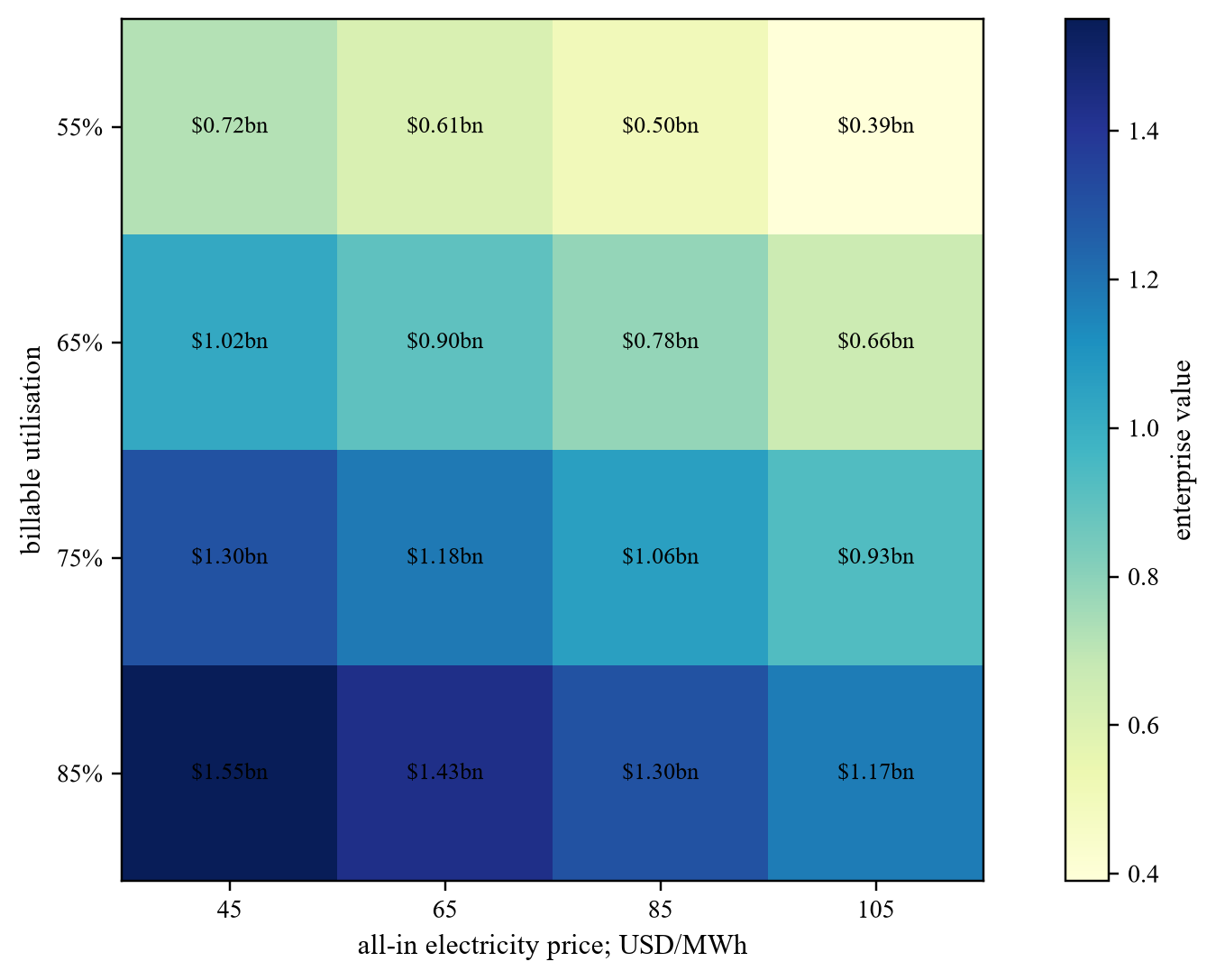
Wholly hypothetical USD billions; this is not a valuation opinion.
25. Size liquidity and hedging
The decision question is which reserves, collateral, caps, swaps, fixed blocks and pass-through mechanisms protect cash. The evidence record should begin with settlement timing, collateral terms, hedge documents, customer billing and downside forecasts. Every item requires a source, date, legal holder, jurisdiction and reconciliation to the meter and site model. Regional policy and market development provide context. Site-specific documents still control price, duration, probability and cash-flow recognition. [18][22]
The principal failure is that a profitable annual case can fail through intramonth margin calls or collection lags. The model should expose the contractual dependency, economic driver and event that confirms or rejects it. Management estimates can support scenarios when they are identified as assumptions and remain separate from observed evidence.
The recommended response is to size liquidity to the stressed settlement cycle and hedge only evidenced exposures. The base case should retain only evidenced rights, measured demand and costed obligations. The investment committee should see value at risk, the earliest observable indicator and the intervention available before cash or capital is released.
26. Match financing to power risk
The decision question is which project debt, corporate debt, covenants and draw conditions fit the supply structure. The evidence record should begin with sources and uses, operating cash, power contracts, tariff evidence, security, reserves and covenants. Every item requires a source, date, legal holder, jurisdiction and reconciliation to the meter and site model. Regional policy and market development provide context. Site-specific documents still control price, duration, probability and cash-flow recognition. [22][23]
The principal failure is that debt service can rely on a tariff advantage or support period shorter than the loan. The model should expose the contractual dependency, economic driver and event that confirms or rejects it. Management estimates can support scenarios when they are identified as assumptions and remain separate from observed evidence.
The recommended response is to align tenor, amortisation, coverage and cash traps with repricing and termination risk. The base case should retain only evidenced rights, measured demand and costed obligations. The investment committee should see value at risk, the earliest observable indicator and the intervention available before cash or capital is released.
27. Translate diligence into price and protections
The decision question is which adjustment, condition, indemnity, escrow, earn-out and covenant allocate power uncertainty. The evidence record should begin with diligence findings, utility consents, contracts, financing, remedies and operating plan. Every item requires a source, date, legal holder, jurisdiction and reconciliation to the meter and site model. Regional policy and market development provide context. Site-specific documents still control price, duration, probability and cash-flow recognition. [5][6]
The principal failure is that valuation caveats can disappear from transaction documents. The model should expose the contractual dependency, economic driver and event that confirms or rejects it. Management estimates can support scenarios when they are identified as assumptions and remain separate from observed evidence.
The recommended response is to attach every material power dependency to value, protection, owner and deadline. The base case should retain only evidenced rights, measured demand and costed obligations. The investment committee should see value at risk, the earliest observable indicator and the intervention available before cash or capital is released.
28. Reach the investment decision
The decision question is whether evidence-gated operating value, downside liquidity, protections and financing justify commitment. The evidence record should begin with perimeter, tariff and contract ledger, meter model, cash flows, scenarios, funding and board record. Every item requires a source, date, legal holder, jurisdiction and reconciliation to the meter and site model. Regional policy and market development provide context. Site-specific documents still control price, duration, probability and cash-flow recognition. [21][23]
The principal failure is that a strategic data-centre narrative can displace evidence about delivered power and collected cash. The model should expose the contractual dependency, economic driver and event that confirms or rejects it. Management estimates can support scenarios when they are identified as assumptions and remain separate from observed evidence.
The recommended response is to approve a value range tied to enforceable rights and funded downside actions. The base case should retain only evidenced rights, measured demand and costed obligations. The investment committee should see value at risk, the earliest observable indicator and the intervention available before cash or capital is released.
| Decision | Evidence required | Possible action |
|---|---|---|
| protected price | eligibility, duration and funding | limit value to evidenced term |
| contracted supply | price, volume, delivery and credit | reprice or protect |
| merchant exposure | market, hedge and liquidity evidence | reserve or cap |
| customer recovery | enforceable pass-through and timing | amend contract |
| financing | resilient cash and covenant headroom | resize or restructure |
| unresolved dependency | quantified cash and legal allocation | condition, escrow or decline |
Proposed governance; transaction-specific approvals remain necessary.
Sources
- International Energy Agency, *Energy and AI*. Read the primary source
- International Energy Agency, *Energy demand from AI*. Read the primary source
- Abu Dhabi Department of Energy, *Tariffs and charges*. Read the primary source
- Dubai Electricity and Water Authority, *Slab Tariff*. Read the primary source
- Abu Dhabi Department of Energy, *Economic Regulations*. Read the primary source
- Abu Dhabi Department of Energy, *Price Controls*. Read the primary source
- Nama Power and Water Procurement, *Planning and Economics*. Read the primary source
- Electricity and Water Authority Bahrain, *Tariffs*. Read the primary source
- Nama Electricity Supply Company, *Supply Agreement, direct connected with transmission system*. Read the primary source
- Nama Power and Water Procurement, *Power 7-Year Statement 2025 to 2031*. Read the primary source
- Gulf Cooperation Council Interconnection Authority, *GCC interconnected grid*. Read the primary source
- European Commission Joint Research Centre, *European Code of Conduct for Data Centre Energy Efficiency*. Read the primary source
- IFRS Foundation, *IFRS 15 Revenue from Contracts with Customers*. Read the primary source
- IFRS Foundation, *IAS 37 Provisions, Contingent Liabilities and Contingent Assets*. Read the primary source
- Abu Dhabi Department of Energy, *Clean Energy Certification*. Read the primary source
- International Renewable Energy Agency, *Renewable Power Generation Costs*. Read the primary source
- Dubai Electricity and Water Authority, *Consolidated Financial Statements 2025*. Read the primary source
- International Energy Agency, *Electricity Mid-Year Update 2026*. Read the primary source
- U.S. Securities and Exchange Commission, *Equinix, Inc. filings*. Read the primary source
- U.S. Securities and Exchange Commission, *Digital Realty Trust, Inc. filings*. Read the primary source
- IFRS Foundation, *IAS 36 Impairment of Assets*. Read the primary source
- IFRS Foundation, *IFRS 9 Financial Instruments*. Read the primary source
- European Banking Authority, *Guidelines on loan origination and monitoring*. Read the primary source
- Saudi Electricity Company, *Investor relations and reports*. Read the primary source
- Oman Authority for Public Services Regulation, *Electricity sector regulation*. Read the primary source
- International Energy Agency, *The Future of Electricity in the Middle East and North Africa*. Read the primary source
