

1 Define the public service and the investment decision
An education PPP begins with a public-service decision. The authority may need additional seats in a fast-growing district, replacement of unsuitable buildings, specialist provision, lower whole-life facilities cost or a stronger operating model. Those needs lead to different contracts. A design-build-finance-maintain project transfers building delivery and lifecycle obligations. A broader contract may add non-core services or school operations. A voucher or service-purchase arrangement pays for eligible students in existing private capacity. The transaction team should state which service is being procured before it models enrolment or chooses a payment formula.
The unit of analysis must also be clear. A national student forecast is too broad for a school-cluster financing decision. A single address is too narrow when families can choose among public and private schools or move within a metropolitan area. The practical unit is a service package that connects defined catchments, age cohorts, planned seats, curriculum and inclusion requirements, land and utilities, delivery schedule, operating standards and the public payment obligation.
Saudi Arabia's National Center for Privatization reported the launch of a 60-school project in Madinah with a stated investment value of SAR 5.2 billion over 23 years.[1] Its project material describes school-infrastructure PPP delivery within the Kingdom's private-sector-participation programme.[2] Those facts establish a current regional precedent for long-term education infrastructure contracting. They do not establish the correct demand, value or payment structure for another jurisdiction or project.
Record the decision in terms that can be tested. The authority should identify the required opening date, grades, initial and ultimate capacity, service hours, student eligibility, transport assumptions, special-education obligations, curriculum, asset condition at handback and the party responsible for admissions. A lender needs the same perimeter because construction completion does not create repayment capacity unless the contract produces an enforceable payment after the school becomes available.
The Saudi Private Sector Participation Law provides a legal framework for PPP contracts and permits terms generally up to 30 years, subject to its provisions and approvals.[3] Current implementing rules and transaction documents require qualified legal review.[4] Across the GCC, each project remains subject to its own procurement, education, land, data, labour and financing rules. A regional framework can organise the decision while local counsel confirms the enforceable contract.
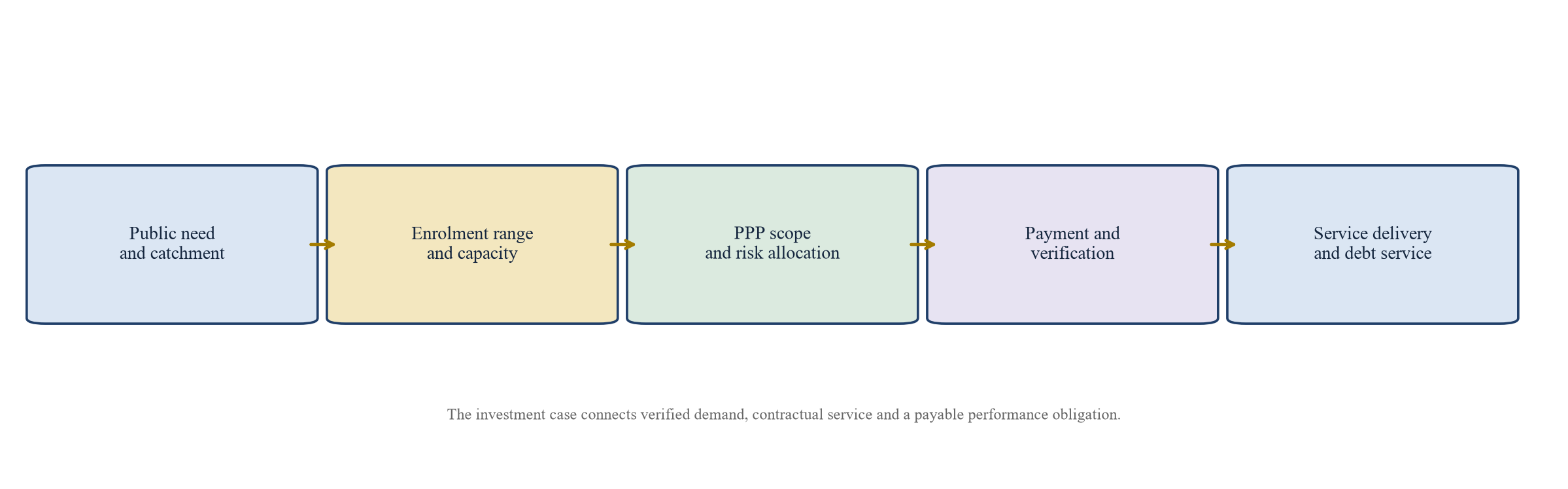
Proposed decision chain. Each stage requires an accountable owner, dated evidence and an explicit consequence.
| Decision | Evidence required | Failure condition | Transaction response |
|---|---|---|---|
| Why is capacity required | population, cohort, utilisation, condition and policy evidence | the need cannot be tied to a defined service area or period | pause procurement and rebuild the needs case |
| What service is transferred | output specification, responsibilities and interfaces | educational and asset obligations are mixed without accountable owners | redraw the service and interface schedule |
| How is the project paid | appropriation route, payment formula, indexation and deductions | payment depends on a measure the private party cannot control | reallocate risk and recalibrate the formula |
| What supports debt service | availability date, base payment, reserves and coverage | repayment relies on optimistic student volume or unverified outcomes | lower leverage or strengthen the fixed component |
| How does evidence change decisions | forecast refresh, inspection, audit and dispute route | new evidence has no contractual consequence | add review dates, thresholds and remedies |
The questions separate public-service need, demand evidence, contract scope and payment risk.
2 Separate infrastructure availability from education outcomes
Education projects combine assets, services and public policy. The school building can be available while attendance is below forecast. Facilities can meet technical standards while learning outcomes remain weak. Students can improve even when a maintenance defect exists. A single performance score would conceal these different causes and transfer risks without a clear owner.
Define four layers. The first is asset availability: safe access, classrooms, utilities, cooling, technology, hygiene, fire systems and accessible facilities. The second is service performance: cleaning, maintenance, security, catering, transport or other contracted services. The third is participation: eligible enrolment, attendance, retention and progression. The fourth is education outcome: learning, wellbeing, inclusion or another policy result. Each layer needs a baseline, measurement interval, verifier, cure period and payment treatment.
The World Bank PPP Reference Guide identifies performance-contingent payment as a defining feature and notes that the private party commonly operates through a dedicated project company.[5] Its payment-mechanism guidance distinguishes user charges, government payments, availability payments, milestone subsidies, bonuses, penalties and indexation.[6] These tools create different allocations of demand, performance and fiscal risk. The project should select a formula that follows the contracted responsibility.
An infrastructure-only private party normally cannot control admissions, curriculum, teacher deployment or household migration. Placing enrolment or learning risk on that party can make the contract unpriceable or create a premium without changing outcomes. An integrated operator may influence attendance and learning, but the authority still controls policy, standards and many admissions conditions. The contract should identify joint dependencies rather than assigning every result to the operator.
Outcome-linked payments require a stable base. Debt service, lifecycle maintenance and essential staff cannot depend entirely on a volatile annual test score. A substantial availability component supports continuity when the asset and required services are delivered. A smaller variable component can reward verified performance, subject to caps, floors, lag periods and protections for factors outside the operator's control.
The distinction also improves accountability. A building defect should trigger a timely service deduction and cure. A forecast miss should trigger capacity review. A learning shortfall should lead to diagnostic action using cohort and school evidence. Applying the same financial remedy to every variance can weaken service continuity and make disputes more likely.
3 Build an auditable enrolment evidence base
Enrolment begins with people, geography and choice. Start with population by single year of age or the narrowest available cohort, births, progression, migration, household formation and planned development. Add current school enrolment, grade capacity, utilisation, waiting lists, transfers, withdrawals, transport patterns, curriculum preferences, fees and private-school participation. Every variable should have a source, reference date, geographic level and known limitation.
Official statistics provide the anchor. Saudi Arabia's General Authority for Statistics publishes education and training indicators and population estimates.[16][17] The UAE Federal Competitiveness and Statistics Centre publishes population and general-education series, while the UAE open-data platform provides a Ministry of Education enrolment dataset classified by zone, sex, school type, stage and year.[18][19] Qatar's Ministry of Education and Higher Education publishes annual statistics covering schools, students, teachers and administrators, and reported 419,373 students across 649 public and private schools and kindergartens for the 2026 to 2027 school year.[20][21] GCC-Stat provides regional education and student databases by stage, gender, sector, nationality and other dimensions.[22]
These sources use different definitions, periods and coverage. Academic-year data may not align with calendar-year population estimates. A school address may represent a campus while students travel from several municipalities. Private-school records may classify nationality, curriculum or stage differently from public records. The evidence ledger should preserve the original definition and document every transformation.
Catchment evidence should be practical. Use travel time, road access, public transport, school-bus routes, development phasing and natural barriers rather than a simple radius. Record approved and proposed schools separately. A planned development contributes students only after occupation. A announced school removes pressure only after it opens with the relevant grades and admission policy.
Reconcile stock and flow. Current enrolment is a stock. Births, grade progression, in-migration, out-migration, transfers, repeating and dropout create flows. A coherent model should explain the movement from one academic year to the next. Large unexplained residuals indicate inconsistent sources, boundary changes or omitted behaviour.
The UNESCO Institute for Statistics describes an education management information system as the people, technology, models, rules and processes used to support planning and management. Its guidance emphasises complete, relevant, accurate, timely and accessible data.[11][12][13] The forecast should therefore carry data-quality controls as part of the transaction evidence, rather than treating source preparation as a technical prelude.
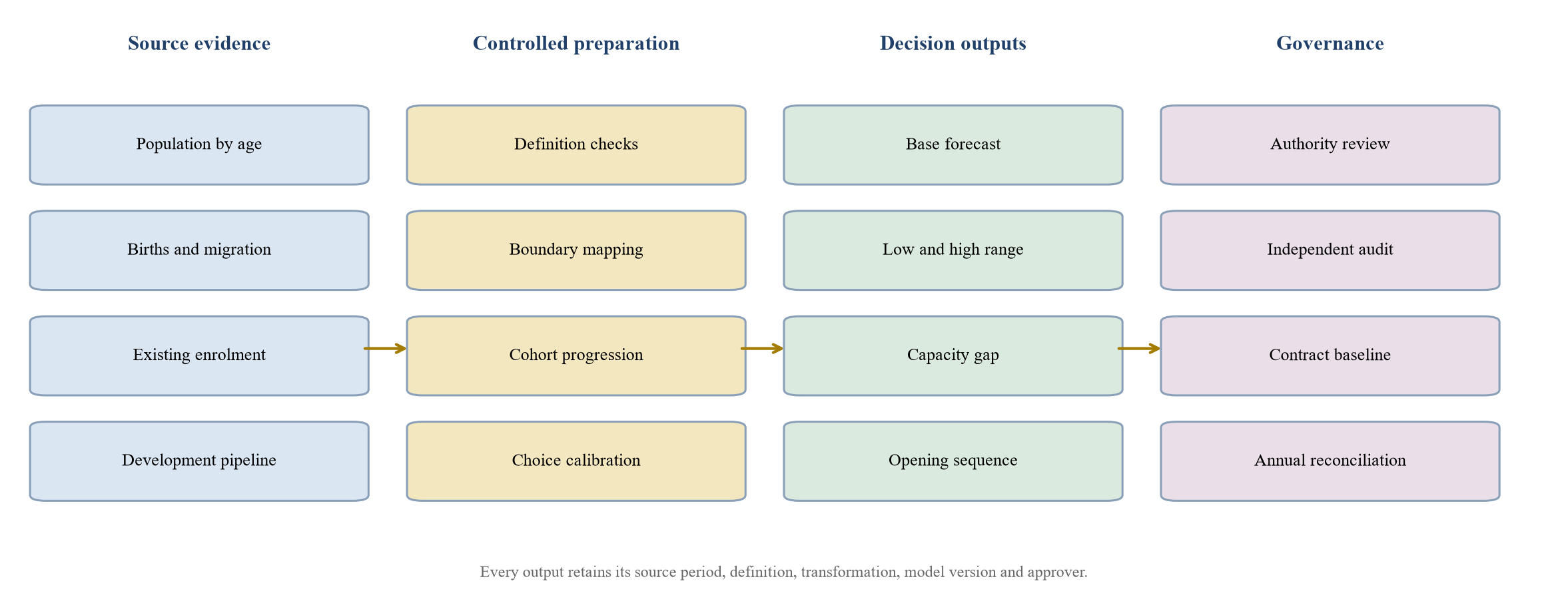
Proposed evidence flow from official records and local observations to forecast ranges and decisions.
| Evidence group | Example measure | Control | Refresh trigger |
|---|---|---|---|
| population | residents by single year of age and locality | retain official release, geography and estimate status | new census, estimate or boundary |
| cohort flow | births, grade progression, repetition and migration | reconcile start and end populations | academic-year close or policy change |
| school capacity | seats, grades, utilisation and condition | verify operating and planned capacity separately | opening, closure or refurbishment |
| school choice | public and private shares, curriculum and fees | calibrate with observed applications and transfers | fee, admission or curriculum change |
| development | dwellings, delivery dates and household assumptions | use approved phasing and occupancy evidence | delay, redesign or occupancy evidence |
| model output | base, low and high enrolment and capacity gap | version, sensitivity and approval record | forecast error or decisive input change |
The register allows a reviewer to reconstruct the forecast and test a later update.
4 Produce ranges that a transaction committee can understand
Artificial intelligence can help detect patterns, combine high-dimensional inputs and update forecasts. The transaction committee still needs an understandable model. Begin with a transparent cohort progression baseline. Apply observed progression, migration and participation assumptions to each age group. Then use statistical or machine-learning methods where they add measurable predictive value.
Separate structural drivers from short-term signals. Population age structure and committed housing influence capacity over several years. Applications, transfers, transport registrations or web enquiries may improve a near-term update. A short-term signal should not rewrite the long-range demographic path without evidence. Record which horizon each variable supports.
Use a training period, validation period and genuine holdout where the data permit. Compare the AI model with simple benchmarks such as last-year carry-forward, cohort survival and a trend model. A complex model earns influence only when its out-of-sample error, stability and decision usefulness exceed those benchmarks. Preserve poor years and policy breaks rather than selecting only stable periods.
Forecast uncertainty belongs in the decision. Produce low, base and high paths and show the drivers that move the result. The range should reflect parameter uncertainty, migration, housing delivery, participation and model error. A narrow range created by a precise algorithm can be misleading when the underlying population estimate or development schedule remains uncertain.
Explainability should fit the use. A planner may need locality, age and school-type contributions. A procurement committee needs the effect on seats, phasing and affordability. A lender needs the effect on payment, coverage and reserves. The model file should allow each reviewer to trace the decision without exposing personal student records.
The UNESCO Recommendation on the Ethics of Artificial Intelligence calls for transparency, fairness, privacy, auditability and human oversight.[14] UNESCO's education guidance warns that learner prediction raises ethical and data-protection concerns.[15] Enrolment planning should use the least sensitive data needed, test uneven errors across locations or groups and retain accountable human approval.
| Test | Question | Evidence | Decision consequence |
|---|---|---|---|
| benchmark | does the model improve on cohort and trend baselines | out-of-sample error by horizon | reject complexity without measured gain |
| calibration | do forecast ranges contain observed enrolment at the stated rate | interval coverage and residual plots | widen or recalibrate uncertainty |
| stability | does a small data change create an excessive capacity change | sensitivity and version comparison | cap decision influence and investigate |
| subgroup error | are misses concentrated by locality, stage or school type | segmented error measures | revise data, features or allocation rule |
| drift | have population, choice or development relationships changed | monitored input and residual drift | trigger controlled retraining |
| auditability | can a reviewer reproduce the approved forecast | sources, code, parameters and sign-off | withhold procurement or payment use |
Measures should be reported by relevant locality, stage and forecast horizon.
5 Translate enrolment ranges into a capacity programme
A forecast becomes useful when it changes a capacity decision. Convert students into required teaching spaces using class-size policy, grade configuration, inclusion needs, specialist rooms, timetabling and operational utilisation. Nominal seats can overstate practical capacity when laboratories, sports areas, accessibility or staff facilities constrain the programme.
Map the base, low and high paths against usable capacity by year and catchment. Identify the date when existing capacity reaches the agreed utilisation ceiling. Test whether temporary classrooms, transport, boundary changes, extensions or private-school purchases can bridge a short gap. A new PPP school is appropriate only when the need survives credible lower-cost responses and persists for enough years to support its fixed cost.
Stage capacity where uncertainty is high. A school can open with a subset of grades, reserve expansion land or use modular space that meets standards. A cluster contract can sequence sites when actual enrolment confirms demand. The flexibility has a price and should be valued against the expected cost of unused capacity or emergency expansion.
Land and access must match the forecast. A high-demand catchment does not make an unsuitable site deliverable. Verify title, permitted use, utilities, transport, safe access, environmental conditions, construction constraints and surrounding development. The opening sequence should reflect land readiness and procurement duration as well as student need.
The affordability model should preserve the full range. Capital cost, operating cost and lifecycle maintenance follow the chosen capacity. Public payments may continue for two decades or more. A decision based only on the base forecast can conceal fiscal exposure in the low case and service failure in the high case.
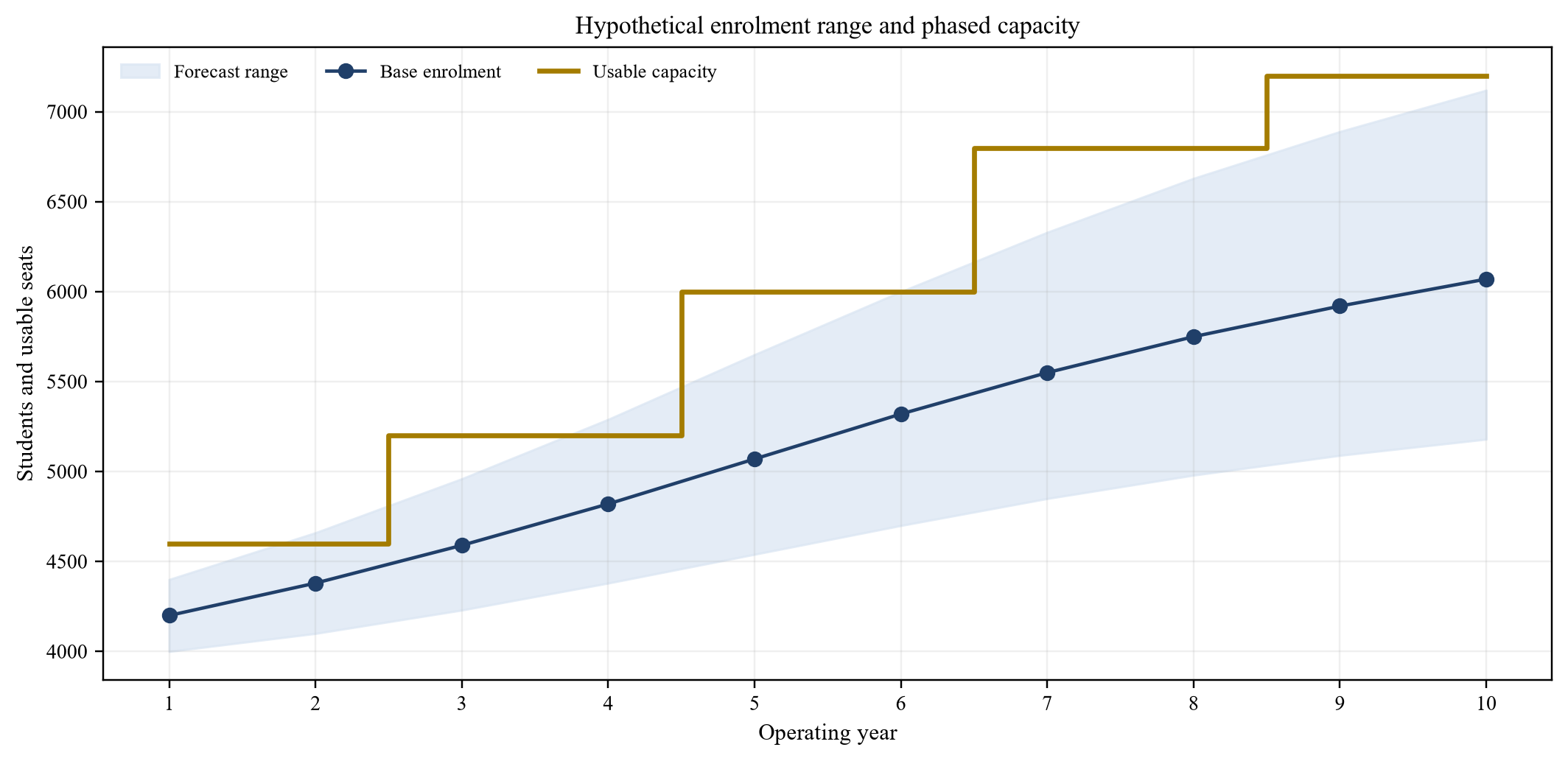
Values are modelling assumptions for an illustrative school cluster and do not represent an identified authority or project.
6 Build the project company and funding plan around the service
The financing structure should follow the contracted service and its cash flows. A project company can hold the PPP agreement, construction contracts, facilities-management agreements, insurance and debt. Sponsors provide equity and contingent support. Lenders fund eligible capital expenditure subject to conditions and progress. The authority begins periodic payments after acceptance, subject to the contract.
Define the perimeter before calculating leverage. Identify land rights, design responsibility, construction scope, technology, furniture, transport, facilities services, teaching services, lifecycle obligations and handback requirements. Costs outside the project company still affect value for money and affordability. A low project-company price can transfer unfunded interface costs back to the authority.
Match debt tenor and amortisation to the payment profile. Construction debt converts after completion and acceptance. Operating-period debt service relies on the contracted base payment, indexation, reserves and permitted deductions. Lenders should test the legal route from appropriation and invoice approval to cash receipt. A payment that is contractually due but routinely delayed creates liquidity risk.
Use reserves for defined risks. A debt-service reserve protects timing. A lifecycle reserve funds predictable major maintenance. A change-in-law or insurance mechanism addresses specific events subject to the contract. Reserves should not conceal an underpriced service or an aggressive demand assumption. Their size should reflect cash-flow timing and stress evidence.
Construction and operation interfaces deserve direct controls. The builder may complete the asset, while an operator must mobilise staff, systems, safeguarding and services before opening. Acceptance should include commissioning, licences, safety, accessibility, technology and operating readiness. Delay damages should align with the authority's lost service and the project company's financing exposure.
Funding flexibility can support phased capacity. A committed facility may have site or phase draw conditions. The borrower should demonstrate land readiness, approved design, budget, equity and remaining cost before each draw. Undrawn commitments should expire or reprice if the forecast or programme changes materially.
| Funding element | Primary repayment or protection | Required evidence | Typical control |
|---|---|---|---|
| sponsor equity | residual project value | committed funds and source verification | equity first or agreed pro rata contribution |
| construction debt | future availability payment | fixed-price scope, programme, contingency and security | certified progress and cost-to-complete test |
| operating debt | contracted base payment | acceptance, invoice route, deductions and indexation | coverage covenant and debt-service reserve |
| lifecycle reserve | scheduled asset renewal | condition plan and cost profile | funded account with permitted uses |
| expansion facility | verified additional capacity need | refreshed forecast, land, approvals and affordability | phase-specific draw conditions |
| public support | policy objective or affordability gap | legal authority, budget and measurable purpose | milestone or output-based release |
The allocation is illustrative and requires project-specific legal and credit analysis.
7 Design a blended payment mechanism
The payment mechanism converts service into cash. Begin with the payment objective. The authority may pay for asset availability, required services, occupied places, verified participation or education outcomes. Each component should correspond to a responsibility and avoid paying twice for the same result.
A practical structure has three layers. The base availability payment covers the financed asset, lifecycle maintenance and essential contracted services when the required capacity is available. A volume component can cover genuinely variable costs associated with eligible students. A capped outcome component can reward defined improvements or apply proportionate deductions for performance within the operator's control.
Calibrate the base component against bankability. The World Bank notes that availability payments are conditional on an asset or service being available to a specified quality, while usage-based payments transfer or share demand risk.[6] An education project with public admissions and volatile migration should normally avoid placing all debt service on student volume. The fixed component can decline for unavailable spaces or serious service failure without exposing the project to unrelated demand swings.
Define availability precisely. A classroom is not available if it fails safety, cooling, access or required technology standards. The contract should specify measurement, response time, rectification and the effect of partial unavailability. Deductions need caps and ratchets. Repeated or serious failures can escalate while an isolated minor defect receives a proportionate response.
The volume component should reflect marginal cost rather than total fixed cost. If catering, consumables or transport vary with student numbers, an agreed per-student or activity amount may be appropriate. The formula should define eligibility, count date, mid-year movements, duplicates, special provision and audit rights.
Outcome payments need a smaller, carefully controlled role. Results-based financing rewards agreed outputs or outcomes after verification.[9][10] In education, causation is shared and measurement can lag. Use a balanced set of leading and outcome measures, delay financial consequences until data quality is established and cap exposure to protect service continuity.
Indexation should match cost drivers. Labour, utilities and maintenance may move differently. A single consumer-price index can leave one party exposed to a cost it cannot control. The contract should specify indices, weights, floors, caps, rebasing and the treatment of discontinued series.
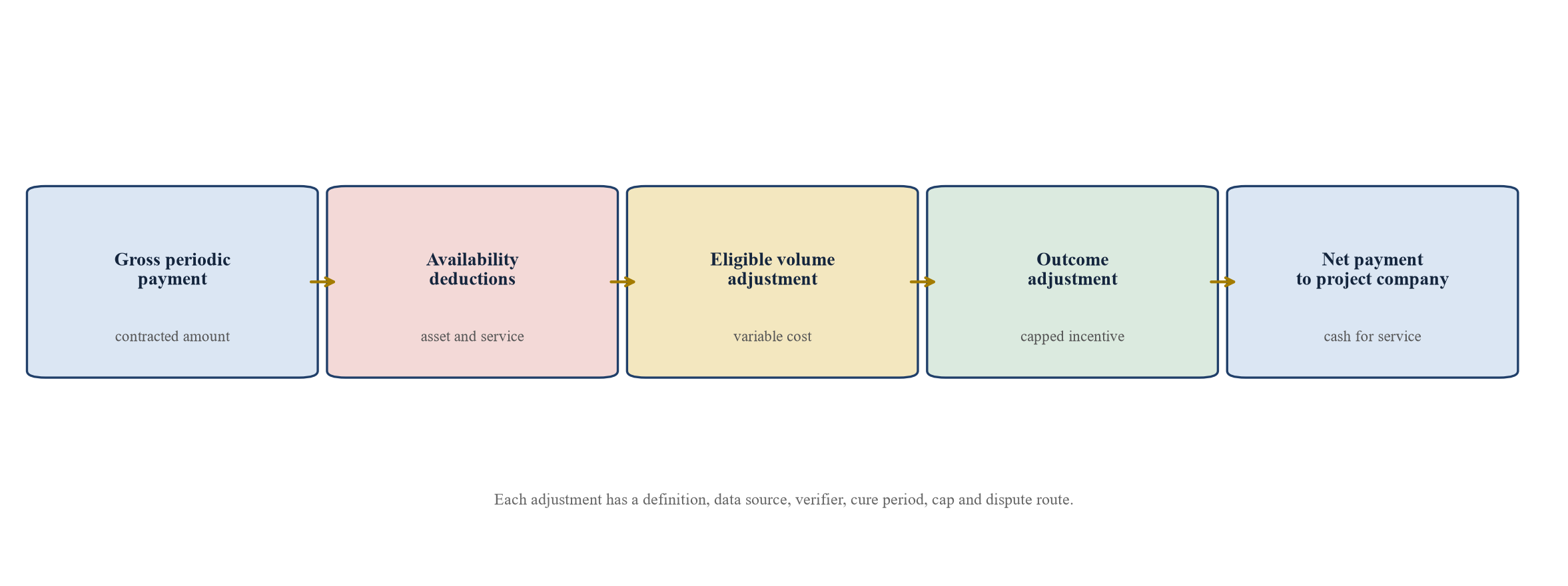
Illustrative structure. Percentages and deductions require affordability, value-for-money and lender calibration.
| Component | Example basis | Principal risk owner | Protection against distortion |
|---|---|---|---|
| availability | compliant usable capacity during required hours | project company | clear exclusions, cure periods and calibrated deductions |
| service performance | maintenance, cleaning, security and response times | relevant service provider | independent inspection and severity weighting |
| eligible volume | verified students or service units tied to variable cost | shared according to admissions control | count rules, audit and payment cap |
| participation | attendance, retention or progression | shared among authority, operator and households | adjusted baseline and contextual review |
| learning outcome | verified cohort measure | shared, with operator influence defined | multiple measures, lag, floor and capped adjustment |
| indexation | published cost indices and agreed weights | allocated by cost category | transparent formula, cap and rebasing rule |
The design connects the measure to the party that can manage it and the cash consequence.
8 Select outcomes that support the service rather than the metric
An outcome measure should express a public objective and remain close enough to contracted activity for accountability. Candidate measures include attendance, retention, progression, learning gain, wellbeing, safeguarding, inclusion, parent experience and post-school transition. The final set should be small enough to govern and broad enough to avoid a single distorted target.
Define the result chain. Inputs such as staff and technology support processes such as teaching, maintenance or student support. Processes produce intermediate results including attendance or timely intervention. Longer-term outcomes include learning and progression. A payment formula can use several points in the chain while avoiding duplicate rewards.
Use value-added or growth measures carefully. Raw attainment reflects prior learning, household circumstances, language and student selection. A baseline-adjusted measure may improve comparability, but the adjustment model introduces assumptions. Preserve the raw result, baseline, exclusions and model version. Do not allow the adjustment to hide a fall in absolute performance.
The operator should influence the measure. An infrastructure provider cannot reasonably bear curriculum outcome risk. An integrated school operator may influence attendance and learning, subject to authority policy and cohort composition. Joint measures can use a gain-share pool or require joint remediation instead of automatic deduction.
Guard against exclusion. A high-stakes metric can create incentives to avoid students who need more support, reclassify absences or narrow instruction. Monitor admissions, withdrawals, special-needs provision, language support and assessment participation. A result should not attract payment when it is achieved by reducing access or changing the measured cohort improperly.
Verification needs timing and materiality. Attendance can be reported frequently. Standardised learning outcomes may arrive annually and require moderation. Wellbeing evidence may be survey based and sensitive to response rates. The payment model should reflect each data cycle and avoid cash shocks based on late or unstable evidence.
World Bank guidance on education PPPs emphasises accountability, parental information, system capacity and rigorous evaluation.[8] Its results-based financing material distinguishes input, process, intermediate and outcome indicators and stresses verification.[10] A transaction can therefore combine reliable leading measures with a restrained, verified outcome component.
9 Create an independent evidence and verification system
The same data should not be collected separately for planning, operations, payment and policy if one governed record can serve each purpose. Build an evidence dictionary that defines student counts, availability, attendance, service incidents, learning measures, exclusions and reporting periods. Assign an owner and source system to every field.
Integrate the education management information system, project-company records, facilities-management system, finance ledger and independent-verifier evidence through controlled interfaces. Use stable identifiers where lawful and necessary. Reconcile aggregate counts across systems. A payment certificate should trace each adjustment back to a dated record and contract rule.
UNESCO's EMIS guidance calls for standard definitions, data naming conventions, quality requirements and processes to detect, correct and prevent nonconformity.[12] Its recent EMIS assessment tool treats institutional capacity and management processes as part of data-driven decision-making.[11] The PPP should fund these operating controls, since poor data can interrupt payment and weaken public accountability.
Independent verification should be risk based. Routine availability data may be system generated and sampled. Serious incidents, learning measures and contested deductions may require direct review. The verifier's appointment, competence, access, independence, timetable and liability should be documented. The authority and project company need a clear route to challenge an error without delaying every undisputed amount.
Freeze the evidence used for each payment cycle. Later corrections should create a controlled adjustment with an audit trail. Do not overwrite the original record. Preserve data, model version, approval, calculation and communication. Lenders may require access to payment certificates and material disputes while respecting student privacy.
Set data-quality thresholds. Missing records, duplicate students, unexplained movements or stale facilities data should trigger investigation. The financial treatment should distinguish data failure from service failure. A reporting breach may require a temporary hold or estimate, followed by reconciliation, while an actual service breach follows the deduction regime.
10 Stress the forecast payment and financing together
Separate stress tests can miss the interaction among demand, costs, deductions and debt. Build one model that carries the enrolment range into capacity, payment, operating cost, lifecycle funding and debt service. The committee should see which risk changes cash and which risk changes only the public-service outcome.
Test low and high enrolment. Low enrolment can create unused capacity and weaken a usage-based payment. High enrolment can require temporary provision, accelerate expansion and increase variable service costs. Where the base availability payment remains fixed, demand risk affects public value and capacity decisions even if lender coverage is stable.
Test construction delay and acceptance failure. Debt capitalises for longer, sponsor support may be consumed and the payment start moves. Test operating deductions for unavailable classrooms, utilities or maintenance. Apply realistic cure periods and caps. A scenario with every maximum deduction at once may be less useful than a sequence based on plausible incidents.
Test outcome underperformance separately. A capped variable component should reduce cash within the agreed exposure without interrupting essential service. If a modest learning miss causes default, the payment design has transferred more risk than the financing can absorb. The remedy may be a lower variable share, a lagged rolling measure or a funded performance reserve.
Inflation and refinancing also matter. Labour and utility inflation can compress service margins. Interest-rate or refinancing exposure can weaken coverage even when operational performance is stable. Test index timing, caps, hedging, reserve draw and distribution lock-up.
Set decision rules before reading the final result. Define minimum coverage, maximum deduction exposure, reserve months, forecast range, capacity utilisation and equity contingency. The model should show the action when a threshold fails: reduce debt, increase equity, rephase capacity, alter payment weights, strengthen reserves or change scope.
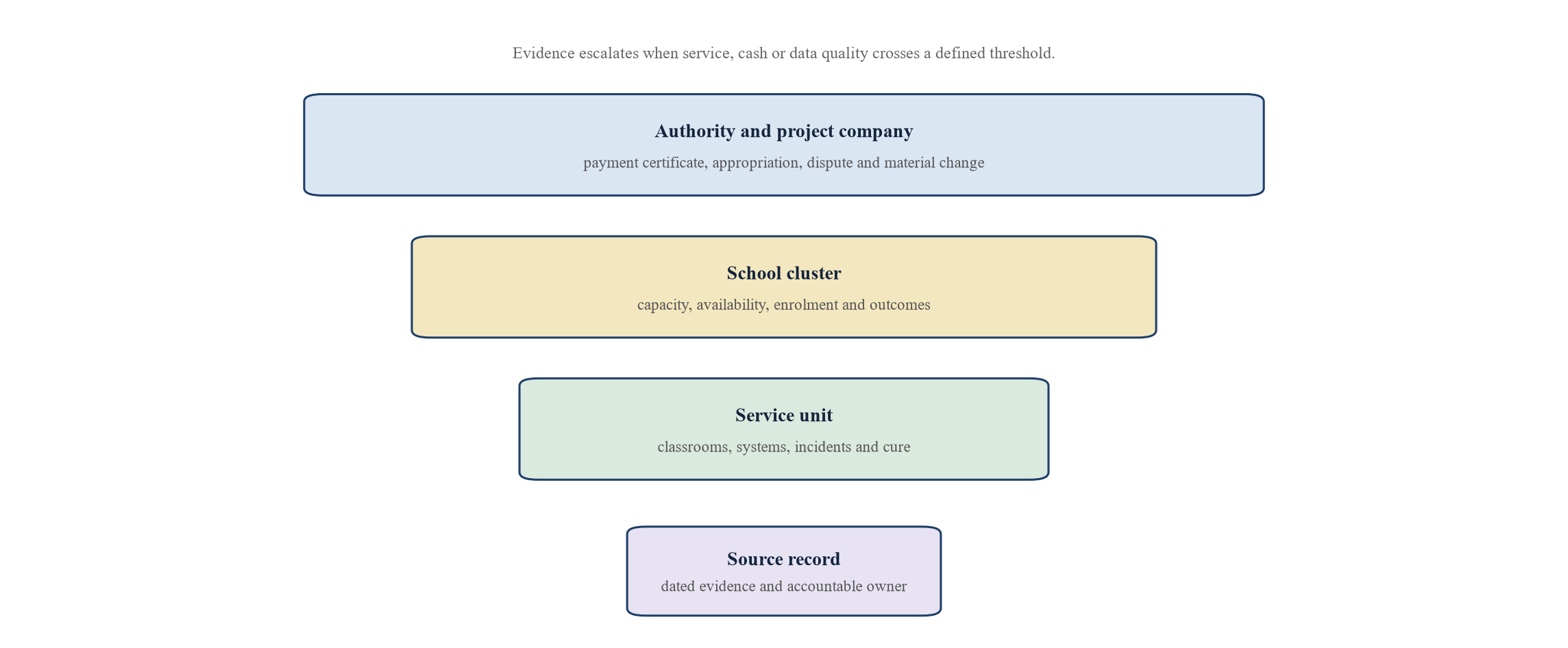
Controls escalate from school and service evidence to project-company liquidity and authority payment.
| Level | Measure | Illustrative warning signal | Response |
|---|---|---|---|
| catchment | enrolment forecast error | actual outside approved range for two counts | refresh model and capacity plan |
| school | usable capacity | below 98 percent during required hours | cure plan and availability deduction |
| service | unresolved critical incidents | event remains open beyond response time | escalation and enhanced inspection |
| outcome | adjusted performance index | below baseline floor for two cycles | diagnostic review and capped payment adjustment |
| project company | debt service coverage | projected below agreed lock-up level | stop distributions and fund remedy |
| project company | liquidity reserve | below required months of outflow | replenish before discretionary payment |
| authority | certified payment delay | undisputed amount exceeds due date | liquidity protocol and contractual remedy |
Thresholds are modelling assumptions and require project-specific calibration.
11 Work through a hypothetical GCC school cluster
Consider a hypothetical authority planning four schools in two growing metropolitan catchments. The case is a financing illustration. It does not describe an existing procurement, authority, operator or borrower. Monetary values, capacity, forecast paths, costs and payment terms are modelling assumptions.
The existing public and private estate serves 4,050 eligible students in the defined service areas. Current usable capacity is 4,300 seats, with several buildings approaching the authority's utilisation threshold. The evidence base includes population by age, historical enrolment, grade progression, housing delivery, public-private participation, transfer patterns and verified school capacity. The base forecast reaches 5,320 students by operating year six. The low case reaches 4,700 and the high case reaches 6,000.
The authority chooses a phased programme. Two schools provide 900 seats at the first service commencement date. A third phase adds 800 seats in year three, and the fourth adds 800 seats in year five. This produces the illustrative capacity path shown in Figure 3. Expansion is subject to land readiness, an updated enrolment range and affordability approval. The design preserves expansion space without obliging the authority to fund every phase at financial close.
Assume initial eligible capital cost of SAR 720 million for the first two phases. Sponsors fund 20 percent and senior debt funds 80 percent, subject to certified construction progress and a cost-to-complete test. The model assumes a separate lifecycle reserve and a six-month debt-service reserve at completion. These figures are assumptions and require current market testing.
The annual payment has a base availability component equal to 86 percent of the maximum contracted payment, a volume component of 8 percent and an outcome pool of 6 percent. The base payment begins only after acceptance and is subject to service deductions. The volume amount pays defined marginal costs for eligible students within a band. The outcome pool uses attendance, retention, inclusion and learning-gain measures with individual caps and a combined floor.
The base case produces minimum modelled debt-service coverage of 1.34 times after stabilisation. A combined stress applies a six-month delay to the third phase, enrolment at the low path, operating cost 8 percent above the base, service deductions equal to 2 percent of gross payment and half of the outcome pool. Minimum coverage falls to 1.12 times and triggers a distribution lock-up under the illustrative covenant. The reserve remains above three months of debt service.
A more severe scenario combines a twelve-month delay, prolonged cost inflation, a 5 percent availability deduction and no outcome payment. Coverage falls below 1.0 times in one period. The model indicates that the initial leverage is too high if the committee considers this scenario plausible without additional support. Possible responses include more equity, lower debt, a larger reserve, reduced phase scope, stronger delay protection or a greater fixed payment share.
The high-enrolment case creates a different problem. Payment coverage improves only where the volume component reimburses variable service cost. Physical utilisation exceeds the operational threshold before the planned fourth phase opens. The authority therefore needs a temporary-capacity or accelerated-expansion decision. Lender protection alone does not resolve the public-service constraint.
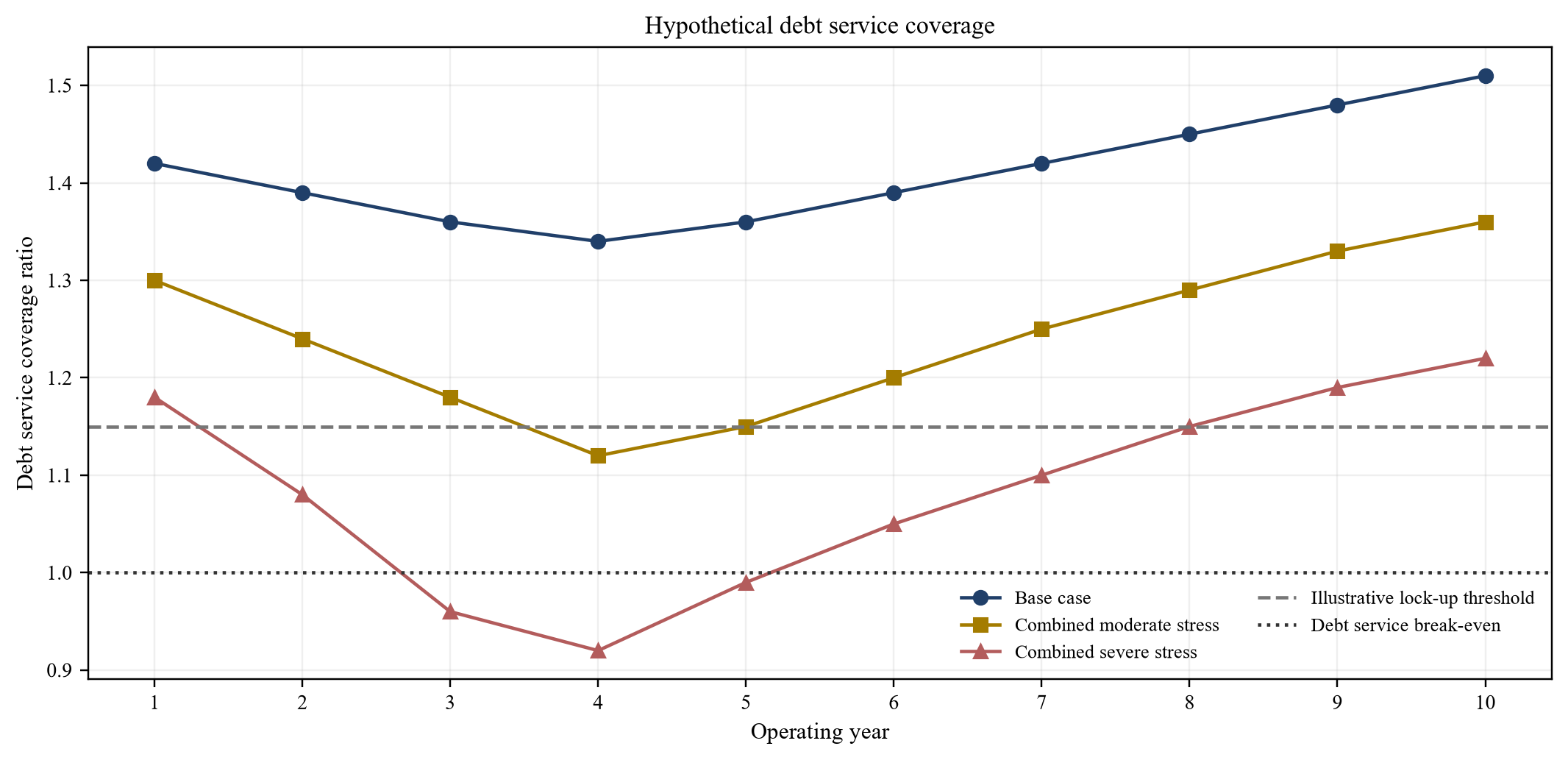
Values are modelling assumptions for an illustrative education PPP and do not represent an identified transaction.
12 Connect covenants to management action
A covenant should provide time for a response. Financial covenants alone may identify a problem after service or liquidity has weakened. Combine leading evidence, operating performance and cash measures. Each threshold needs a calculation, source, reporting date, owner and agreed consequence.
Forecast controls include actual enrolment against the approved range, application conversion, transfers and housing delivery. Capacity controls include utilisation, unavailable spaces and expansion milestones. Service controls include critical incidents, response time and repeat failure. Payment controls include certification, deductions, disputed amounts and days to cash. Financial controls include debt-service coverage, reserves, cost-to-complete and distributions.
Use cure and escalation. A forecast miss can require model refresh and a capacity review. Repeated asset unavailability can increase inspection and deductions. A projected coverage breach can stop distributions and require a remedial plan. An actual payment dispute can trigger the contractual resolution process while undisputed amounts continue.
Avoid automatic default from a model update. A forecast is decision evidence rather than an observable payment event. The covenant should respond when the update affects affordability, phase necessity or cash coverage beyond an agreed threshold. Management and the authority should retain documented judgement within the contract.
Aggregate indicators should not conceal school-level failure. Report each school and the cluster. A strong site can offset cash weakness elsewhere, but it should not erase safeguarding or availability breaches. Material incidents may require direct escalation regardless of portfolio averages.
Link distributions to evidence quality. The project company should not distribute cash when required reports are missing, a material dispute is unresolved or reserves are below the agreed level. This aligns sponsor cash extraction with continued service and lender protection.
13 Sequence diligence procurement and financial close
Start with the needs case. Confirm policy objectives, catchments, current capacity, estate condition, demand evidence and alternative delivery options. Record which assumptions are observed, estimated or subject to approval. A procurement timetable built on unresolved land or demand can create bidder cost without a financeable project.
Build a reference forecast and allow bidders to test it. Provide definitions, historical series, known developments, school capacity and data limitations through a controlled data room. State whether the authority retains demand risk and how future forecast updates affect phasing or payment. Bidders should not be asked to price an undefined risk.
Develop the output specification and payment mechanism together. Availability standards, service levels, reporting, deductions, volume bands and outcome measures should map to the financial model. Calibrate the formula under ordinary variance and combined stress. Seek market feedback without changing core risk silently between procurement stages.
During bid evaluation, separate price, financing, technical deliverability, service performance, data capability and contractual compliance. A low price supported by aggressive enrolment, weak lifecycle funding or inaccessible data is not comparable with a fully funded bid. Normalise assumptions or make the difference explicit.
Complete diligence on the project company, sponsors, builder, facilities manager, education operator and critical technology vendors. Review experience, capacity, conflicts, subcontracting, insurance, cyber controls, data rights and financial resilience. Confirm that the proposed responsibilities in the model match signed contracts.
Before financial close, freeze the base case, forecast version, output specification, payment formula, indexation, construction programme, lifecycle plan, reserve requirements and reporting dictionary. Execute direct agreements, security, step-in and cure provisions as required. The lender's technical, legal, insurance and model reviews should close against the same transaction documents.
Before each phase, refresh the forecast and affordability case using the agreed governance process. Expansion approval should remain a human committee decision supported by evidence. The project should retain the option to defer, resize or redesign a phase when demand or land evidence changes.
14 Govern AI data privacy and model change
Education data can include children, families, disability, attendance, assessment, location and behaviour. A forecast can often operate on aggregate cohort and catchment data. The project should use personal data only when lawful, necessary and proportionate. Local data-protection requirements and education-sector rules require qualified advice in each jurisdiction.
Define the model's approved purpose. A tool built for catchment capacity should not be reused to judge individual admissions, student ability or teacher performance without a separate legal, ethical and technical assessment. Purpose boundaries should appear in the data inventory, access controls and user guidance.
Minimise and separate data. Keep identifiers outside the modelling environment where practical. Use aggregated, pseudonymised or de-identified records with documented re-identification risk. Limit access by role, log use, encrypt transfers and define retention. A vendor should not receive broader student data because its platform offers additional features.
Test representativeness and error. Forecast accuracy may vary where migration, informal housing, small cohorts or private-school records are incomplete. Report error by locality and relevant group where lawful. Investigate whether a systematic underforecast would deprive an area of capacity or a systematic overforecast would lock public funds into unused assets.
Preserve human responsibility. UNESCO's AI ethics recommendation states that AI should remain auditable and traceable and should not displace ultimate human responsibility.[14] The transaction should identify who approves data, model, forecast, capacity and payment. Committee minutes should record overrides and reasons.
Control model change. Store code, data schema, parameters, training period, validation evidence and approved output. A change in algorithm, feature, boundary or source can alter the decision even when the headline forecast moves little. Classify material changes, require independent review where appropriate and retain the prior version for reproduction.
Plan for vendor exit. The authority should retain usable data, documentation and the right to operate or replace the model. Proprietary software can support the process, but the public service should not depend on an inaccessible score. Contractual exit assistance, export formats and continuity testing belong in procurement.
| Control | Evidence | Owner | Escalation condition |
|---|---|---|---|
| approved purpose | documented capacity and payment use | authority model owner | use expands beyond approved decision |
| data lineage | source, period, definition, licence and transformation | data owner | decisive field is missing, stale or untraceable |
| validation | benchmark, range coverage, subgroup error and stress | independent reviewer | performance falls outside approved tolerance |
| change control | version, reason, test and approval | model committee | material feature, method or boundary changes |
| human decision | recommendation, override, evidence and approver | transaction committee | automated output determines capacity or payment alone |
| continuity | export, documentation, access and replacement test | technology owner | vendor or service becomes unavailable |
The control applies from planning through operations and payment review.
15 Conclusion
An education PPP is financeable when public need, deliverable capacity, contractual service and payment evidence connect. The enrolment forecast informs that chain. It does not replace policy judgement, procurement discipline or independent verification.
The forecast should begin with official population and education evidence, preserve definitions and produce low, base and high paths. The capacity programme should respond through phasing and explicit alternatives. A model gains decision weight only when it improves on transparent benchmarks, reports uncertainty and remains reproducible.
The payment mechanism should distinguish asset availability, service performance, student volume and education outcomes. A stable base payment supports continuity and debt service. Variable and outcome components can create useful incentives when measures are controllable, verified, capped and protected against exclusion or gaming.
The transaction model should test forecast, cost, deduction and financing risks together. Covenants should trigger investigation, remediation, distribution control or phase review before liquidity fails. Independent evidence and a defined dispute route support both public accountability and lender confidence.
The hypothetical case illustrates how a moderate combined stress can reduce coverage to an illustrative lock-up level, while a severe combined stress can create a funding shortfall. The result does not predict a live project. It shows why leverage, reserves, payment weights and phasing must be calibrated against evidence.
The most durable control is reconciliation. Actual enrolment should update the forecast. Actual service should update payment. Actual costs and deductions should update finance. Each update should retain its source, model version, reviewer and decision. That process allows the authority, sponsors, operators and lenders to adapt while preserving responsibility for the public service.
Limitations and further research
This paper does not determine whether a particular education PPP provides value for money, complies with local law or should proceed. Project documents, land, policy, population, enrolment, construction, operating cost, finance and outcome evidence require transaction-specific verification. The illustrative case does not use a live authority's confidential data.
The relationship between school inputs and learning outcomes is complex. An observed association does not prove that one contracted service caused the result. Outcome payments should reflect this limitation. Further research could compare forecast accuracy across GCC metropolitan areas, assess the effect of private-school choice on public capacity, test payment calibration using actual deduction histories and evaluate whether phased capacity reduces whole-life public cost.
Research should also examine data coverage and fairness. Aggregate forecasts can still allocate capacity unevenly when source systems omit mobile or vulnerable populations. Independent evaluation could test subgroup error, access, admissions and service quality without exposing individual student records.
Appendices. A1 Needs and forecast evidence checklist
Confirm public-service objective, catchment, grades, curriculum, inclusion and opening date.
Record official population, births, migration, housing and current enrolment sources.
Reconcile usable capacity, approved additions, closures and building condition.
Preserve definitions, geography, academic year, transformations and limitations.
Produce benchmark, base, low and high forecasts with validation and approval.
Appendices. A2 Payment and finance checklist
Map asset availability, services, volume and outcomes to accountable parties.
Define measurement, verifier, cure, deduction, cap, indexation and dispute route.
Test construction delay, low and high demand, operating cost and deduction stress.
Confirm equity, debt, reserves, lifecycle funding and coverage thresholds.
Link expansion draws and distributions to evidence, affordability and liquidity.
Appendices. B1 Before financial close
Freeze the approved forecast, output specification and payment calculation.
Confirm land, utilities, permits, design, construction and operating interfaces.
Complete sponsor, contractor, operator, technology, insurance and data diligence.
Execute security, direct agreements, step-in, cure and information rights.
Retain the independent model review and affordability approval.
Appendices. B2 During operations
Reconcile actual enrolment with the approved range and explain material variance.
Certify availability, services, volume and outcomes from governed source records.
Pay undisputed amounts and track deductions, cures and disputes separately.
Monitor coverage, reserves, lifecycle funding, data quality and model drift.
Approve, defer or resize each capacity phase through the documented committee process.
Sources
- National Center for Privatization. Saudi Ministry of Education and National Center for Privatization launch first privatization project in the education sector. Read the primary source
- National Center for Privatization. Schools Infrastructure PPP Phase 1 First Wave Project Overview. Read the primary source
- National Center for Privatization. Private Sector Participation Law. Read the primary source
- National Center for Privatization. Laws regulations and PPP journey materials. Read the primary source
- World Bank Group. PPP Reference Guide. Read the primary source
- World Bank Group. Payment Mechanism. Read the primary source
- World Bank Group. Considerations for Government Public Private Partnership. Read the primary source
- World Bank. Designing effective public private partnerships in education. Read the primary source
- World Bank. Results Based Financing in Education. Read the primary source
- World Bank. Results Based Financing and Results in Education for All Children. Read the primary source
- UNESCO. Education Management Information Systems Progress Assessment Tool for Transformation. Read the primary source
- UNESCO Institute for Statistics. EMIS Tools and Reports. Read the primary source
- UNESCO Institute for Statistics. EMIS Buyer and User Guide. Read the primary source
- UNESCO. Recommendation on the Ethics of Artificial Intelligence. Read the primary source
- UNESCO. AI and Education Guidance for Policymakers. Read the primary source
- General Authority for Statistics Saudi Arabia. Education and Training Statistics 2024. Read the primary source
- General Authority for Statistics Saudi Arabia. Population Estimates Publication 2024. Read the primary source
- Federal Competitiveness and Statistics Centre UAE. UAE Official Statistics Education and Population. Read the primary source
- UAE Open Data. Student Enrollment in UAE. Read the primary source
- Ministry of Education and Higher Education Qatar. Education Annual Statistics. Read the primary source
- Ministry of Education and Higher Education Qatar. Preparations for the 2026 to 2027 School Year. Read the primary source
- GCC Statistical Center. GCC-Stat Education and Students Data Portal. Read the primary source
