

1 Define the financing decision before scoring locations
A franchise rollout is a sequence of investment decisions. Each outlet commits fit-out capital, deposits, pre-opening payroll, inventory, technology, licence costs and management attention before it produces stable cash. The financing decision therefore needs an explicit unit of analysis. A national brand plan is too broad for a site drawdown, while a map pin is too narrow for a credit decision. The practical unit is a site package that joins location evidence, legal rights, opening cost, operating capacity and a credible route to cash.
The transaction committee should identify what it is approving. One approval may cover an acquisition facility for an operating franchisee. Another may fund a pipeline of new sites under a committed but undrawn line. A third may finance equipment or working capital after the borrower has signed leases. These structures create different risks. A lender funding unopened sites relies on forecast demand and execution. A lender refinancing mature stores can test actual sales, margins and cash conversion. The evidence and covenant design should reflect that distinction.
Start with the commercial promise. Record the franchise format, territory, product mix, dayparts, delivery model, customer proposition and operating hours. Define which party approves locations, negotiates leases, procures equipment, trains staff, controls pricing, owns customer data and supplies technology. The franchise agreement, disclosure document and operating manual may divide these responsibilities. The financing model should follow enforceable rights and actual practice rather than a generic description of the brand.
The Ministry of Commerce states that franchise agreements and disclosure documents must be registered, and its registration service describes disclosure timing, operating-history conditions and required agreement content.[1][2] A financier should verify the current Arabic governing documents and registration status with qualified advisers. The legal review should connect disclosed financial performance, location obligations, transfer restrictions, termination rights and data protection provisions to the proposed security package and downside plan.
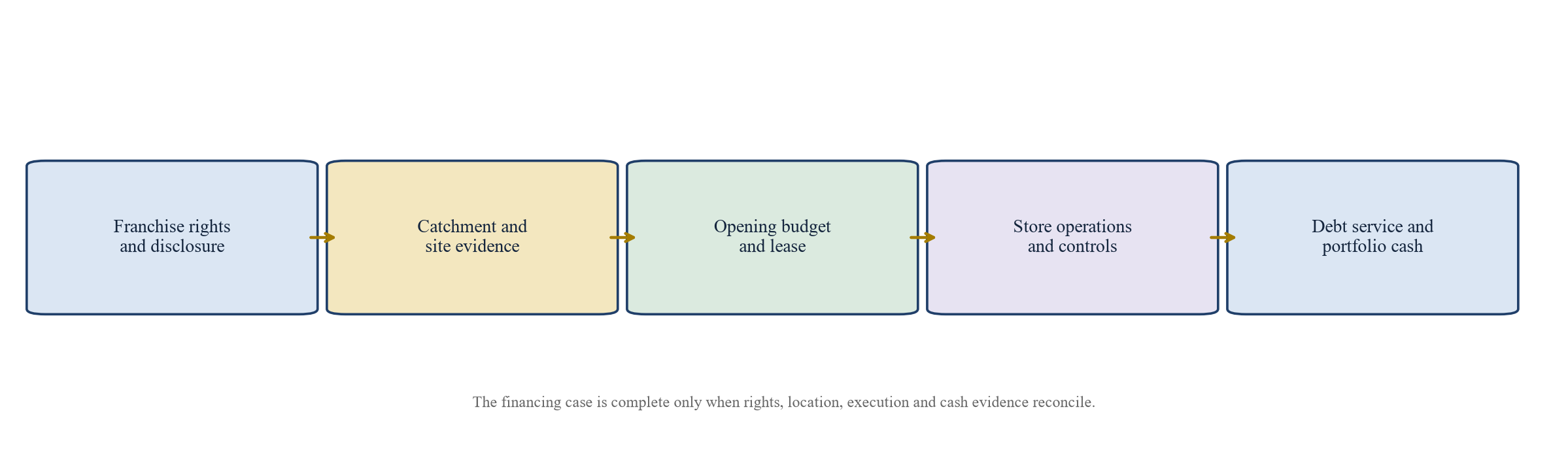
Proposed evidence chain. Every stage requires an accountable owner, dated evidence and a financing consequence.
| Decision | Evidence required | Stop condition | Financing response |
|---|---|---|---|
| What rights support the rollout | registered agreement, disclosure document, territory and term | right is unverified, expiring or non-transferable | condition precedent or shorter availability period |
| Which sites can draw | site approval, lease, licence path, capex and catchment file | site evidence is incomplete or stale | exclude site from borrowing base |
| Who delivers the opening | named operator, project plan, vendors and training | critical role or vendor has no committed capacity | require remedy before draw |
| What supports repayment | unit economics, ramp curve, working capital and portfolio cash | debt service depends on unsupported mature-store performance | reduce leverage or stage commitment |
| What happens after variance | reporting, cure plan, drawstop and enforcement route | information arrives after liquidity is impaired | shorten reporting cycle and add cash control |
The questions connect franchise rights, site readiness and lender protection.
2 Establish the legal and operating perimeter
The franchise perimeter should be documented before the site model is built. The lender needs to know which entity holds the franchise rights, leases premises, employs staff, owns equipment, contracts with delivery platforms, receives card settlements and pays royalties. A group may operate several brands through different companies. Cross-guarantees, shared services and informal cash transfers can make a store appear stronger or weaker than its legal borrower.
Map every material agreement to the financed entity and proposed security. Review the franchise term against facility maturity, renewal mechanics, territorial rights, exclusivity, change of control, assignment, default, cure and termination. If the lender could enforce against equipment or shares but lose the franchise licence, the recovery analysis must reflect the resulting loss of operating value. A termination payment, step-in arrangement or cure right should be verified in the transaction documents rather than assumed.
Location obligations also matter. The agreement may require franchisor approval, minimum openings, refurbishment, relocation or closure. A lender should understand whether refusing a weak site could breach the development schedule and whether an accelerated rollout could consume liquidity. When the contract requires a fixed number of stores, the financing model should distinguish committed openings from optional pipeline.
Disclosure is part of credit evidence. The Ministry of Commerce registration service states that a disclosure document must be provided at least fourteen days before the agreement or payment, whichever is earlier, and that financial-performance information supplied to the prospective franchisee must be included and meet regulatory conditions.[1] The lender should reconcile disclosed performance claims with source records and the borrower's own assumptions. A disclosure document reduces information asymmetry only when it is current, complete and applied to the proposed format and geography.
Data rights should be mapped at the same time. Site selection may use customer addresses, device mobility, loyalty behaviour, delivery orders, payment transactions and employee information. The Saudi Personal Data Protection Law and its implementing framework govern personal-data processing, records and transfers.[3][4] Legal and privacy teams should decide which data can be used, at what level of aggregation, for which purpose and for how long. A lender can often evaluate a catchment with aggregated, anonymised or licensed information rather than customer-level records.
3 Build a governed catchment evidence file
A catchment is a decision boundary, not a circle drawn around a proposed store. Travel time, road access, barriers, parking, public transport, delivery range, workplace density, residential patterns and customer routines shape the practical market. A five-kilometre radius can include areas that are difficult to reach and exclude customers connected by a fast corridor. The catchment method should match the store format and purchase occasion.
Use several evidence classes. Population and household statistics describe the resident base. Daytime employment and education sites indicate weekday demand. Points of interest show complementary and competing uses. Road networks, pedestrian access and parking affect conversion. Payment or order data can indicate observed category spend. Existing store records reveal how comparable catchments perform. Lease and development plans identify timing and supply risk. Each dataset should have a source, date, licence, geographic resolution, owner and known limitation.
Saudi Arabia's General Authority for Survey and Geospatial Information maintains national geospatial governance, standards and a national platform intended to facilitate secure data sharing and use.[5][6] Availability on a platform does not make every dataset appropriate for commercial underwriting. The site file should preserve permitted use, version, resolution and transformation. Where a commercial vendor supplies mobility or demographic estimates, retain its methodology, sample coverage, update frequency and contractual rights.
Geocoding error can change a decision. A store, competitor, road entrance or delivery boundary may be placed incorrectly. Validate critical coordinates against current plans, field visits and lease drawings. Record changes in road access, construction, mall occupancy and anchor tenants between model date and draw date. A site score should expire when decisive evidence becomes stale.
Separate observed variables from derived scores. Observed variables include lease rent, frontage, parking spaces, competitor coordinates and transaction counts. Derived variables include weighted demand, accessibility, cannibalisation and predicted sales. The credit file should allow a reviewer to trace the final score to source evidence and test alternative weights.
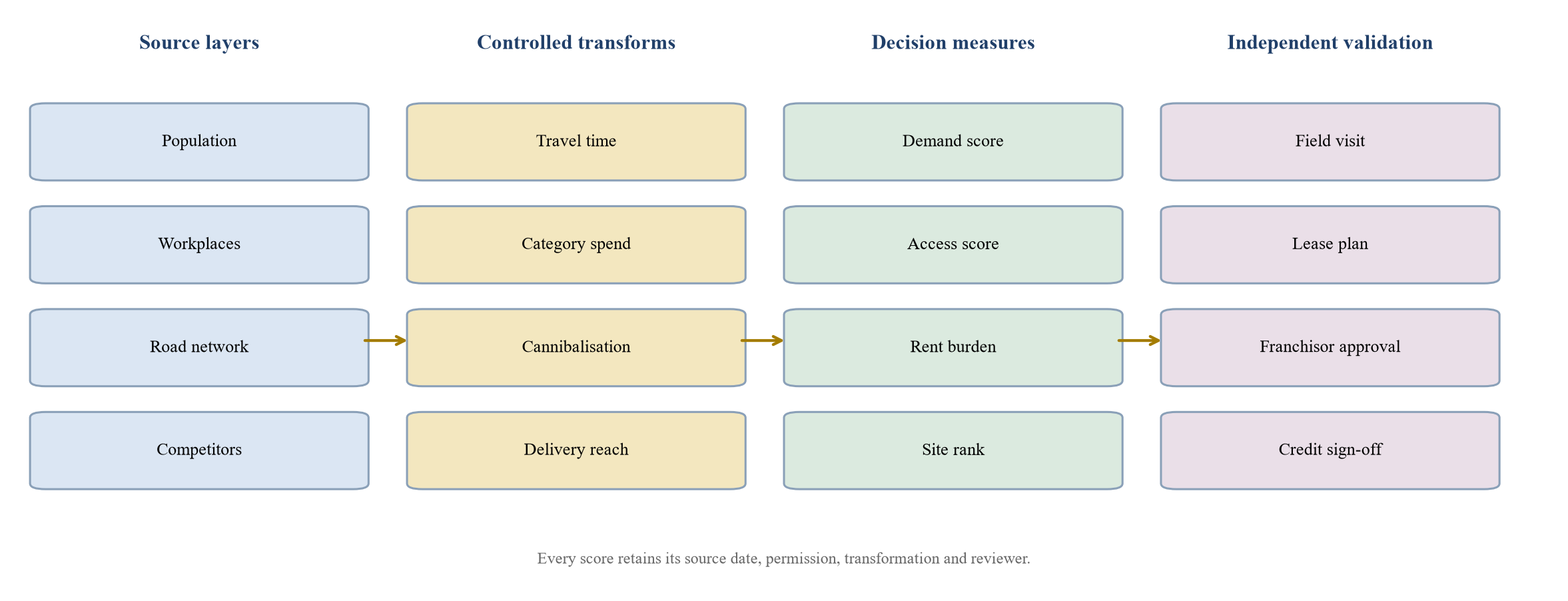
Proposed structure linking source layers, transformations, decision measures and validation.
| Evidence group | Example measure | Control | Refresh trigger |
|---|---|---|---|
| population and households | residents by age, household and nationality segment | retain official source and geographic boundary | new official release or boundary change |
| access and mobility | drive time, walk time, entrances and parking | validate routes and entrance coordinates | roadworks, development or access change |
| commerce and competition | category spend, competitors, anchors and vacancies | reconcile listings with field inspection | opening, closure or anchor change |
| premises | area, frontage, rent, service charge and fit-out condition | tie to heads of terms and lease | lease amendment or survey finding |
| customer and order evidence | ticket, frequency, delivery origin and daypart | aggregate lawfully and document coverage | channel, sample or consent change |
| model output | predicted sales, rank and downside case | version, reviewer and sensitivity record | input drift or performance miss |
The register supports repeatable underwriting and model review.
4 Convert location signals into an explainable score
A site score should organise evidence for a decision. It should not hide judgement behind a single number. Define the decision first. Screening a long list may use broad public and licensed data. Approving a lease requires deeper evidence on access, rent, works, licences and competitive supply. Releasing debt requires signed documents and a funded opening plan. Different decisions need different scorecards.
Group variables into commercial demand, accessibility, premises economics, competition, operating feasibility and risk. Set weights before reviewing the final site rank where practical. If management changes weights after seeing the answer, preserve the original and revised results with the reason. Apply caps where one favourable variable should not compensate for a fatal weakness. A location with strong population density still fails if the brand cannot secure a licence, practical access or an affordable lease.
Avoid double counting. Population, mobile-device activity, card transactions and delivery orders may describe overlapping demand. Competitor density can signal attractive demand and intense rivalry. Mall footfall can include visitors who never pass the unit. The modeller should state the economic relationship represented by each variable and test correlation among inputs.
Calibration requires comparable store outcomes. Use stores with similar format, maturity, city context, size and operating model. Reconcile sales to audited or system records and adjust for closures, relocations, remodels and unusual trading periods. A model trained mainly on mature Riyadh stores may not describe a smaller-city rollout. Document where the evidence is thin and require wider downside ranges.
Human review should remain visible. The site committee can override a score when it records the evidence, reason and approving authority. Repeated overrides in one direction indicate that the model or process needs revision. Monitor predicted and actual sales, margin and opening delay by score band. A score that does not discriminate outcomes should lose influence over financing.
| Dimension | Illustrative weight | Evidence question | Hard stop example |
|---|---|---|---|
| addressable demand | 25 percent | is the relevant customer base present at the required daypart | demand estimate depends on an unlicensed or obsolete dataset |
| access and visibility | 15 percent | can customers reach and identify the unit | entrance or parking assumption conflicts with approved plan |
| competition and cannibalisation | 15 percent | does incremental demand remain after existing stores and rivals | proposed site transfers value from a pledged mature store |
| premises economics | 20 percent | can sales support rent, fit-out and occupancy commitments | lease term or break structure conflicts with facility maturity |
| operating feasibility | 15 percent | can the borrower staff, supply, licence and open the unit | critical licence or utility path is unavailable |
| downside resilience | 10 percent | does the site retain cash under delayed ramp and lower sales | downside case requires additional debt outside the facility |
Illustrative weights. A transaction team should calibrate them to brand, format and evidence.
5 Define store cohorts before forecasting the rollout
Portfolio averages can conceal the economics of recent openings. Divide stores into cohorts using attributes that affect ramp and mature performance. Useful dimensions include opening quarter, city, format, site type, size, daypart, delivery intensity and ownership model. Keep enough observations in each cohort to avoid false precision. A cohort should answer a financing question, not merely describe the estate.
Align each store by months since opening. This separates ramp from calendar seasonality. Compare sales, transactions, average ticket, gross margin, labour, occupancy, delivery commission, store contribution and cash conversion at month one, three, six, twelve and maturity. Record closure and relocation rather than removing failed units from the dataset. Excluding weak stores creates survivorship bias and overstates the expected portfolio.
Opening dates need precise definitions. Soft opening, first invoice, full menu launch and formal opening may differ. Choose one operational definition and preserve exceptional periods. If a store trades for only part of a month, measure both calendar and trading-day performance. Ramadan, Eid, school calendars, tourism, weather and major events can affect dayparts and should be separated from structural ramp where evidence permits.
Franchisor and franchisee data may use different charts of account. Build a common unit ledger. Reconcile store sales to POS, ZATCA-compliant invoices, delivery platforms, bank settlements and general ledger. ZATCA describes e-invoicing as a structured electronic process and publishes data, technical and security requirements.[7][8] These records can strengthen unit evidence when the transaction team understands completeness, returns, discounts, taxes, timing and channel coverage.
The Saudi Central Bank publishes weekly and monthly point-of-sale statistics by activity and city.[9][10] These series can provide market context and seasonality checks. They do not establish demand for a specific brand or site. Use them as a benchmark, preserve the relevant period and avoid attributing market movement to the borrower without transaction-level evidence.
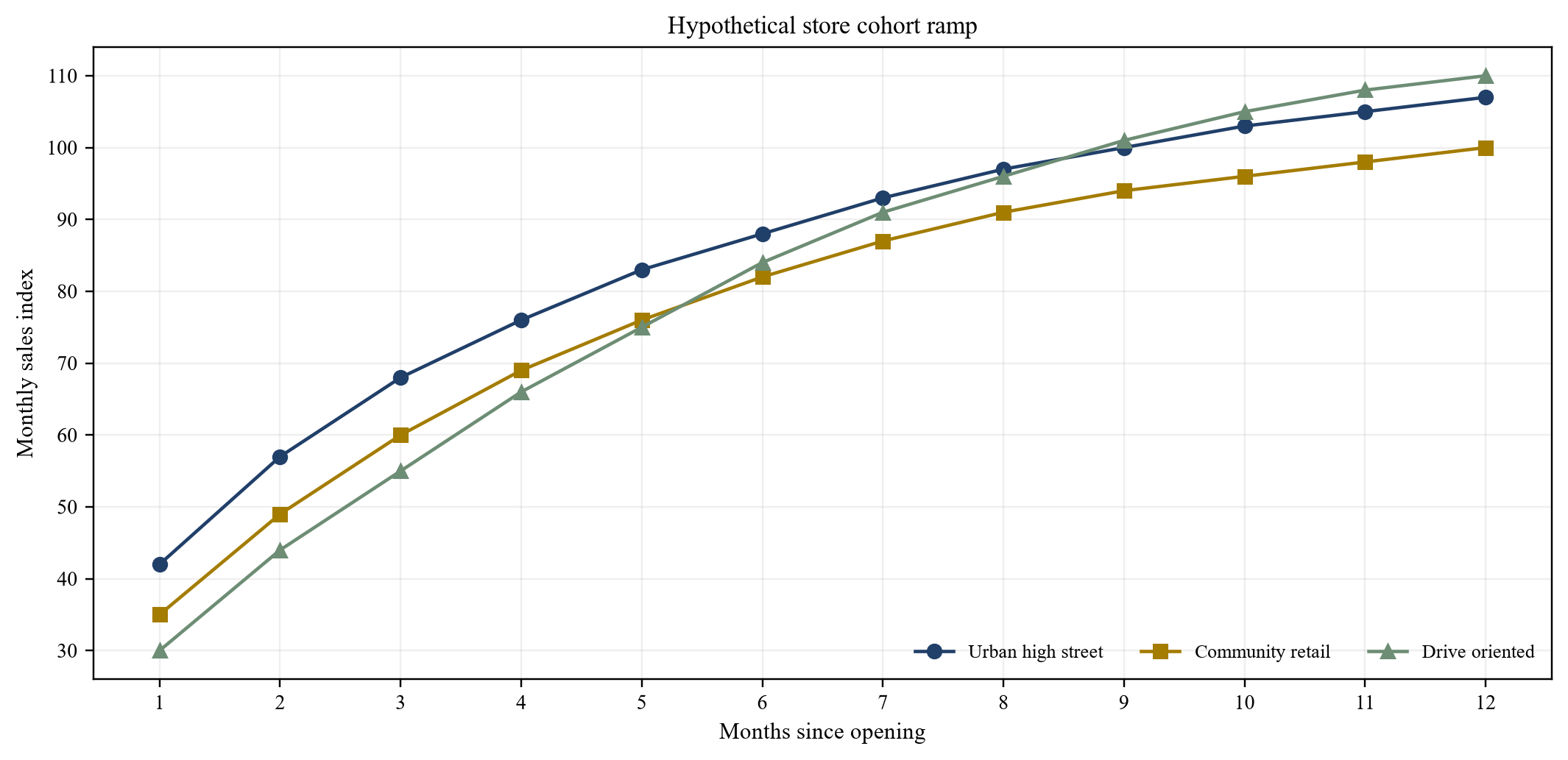
Indexed monthly sales. Values are modelling assumptions and do not represent an identified franchise system.
| Measure | Numerator | Denominator or basis | Credit use |
|---|---|---|---|
| like for like sales growth | current comparable sales less prior comparable sales | prior comparable sales for eligible stores | mature estate trend |
| transaction growth | completed customer transactions | prior period transactions | demand volume |
| store contribution | net sales less product, labour, occupancy and direct operating cost | store and period | unit cash capacity |
| opening cost variance | actual eligible opening cost less approved budget | approved opening budget | draw discipline |
| ramp attainment | actual cumulative sales | approved cohort curve | drawstop or remediation trigger |
| cash conversion | store operating cash after working capital | store contribution | debt service quality |
Measures should reconcile to the unit ledger and retain closed or transferred stores.
6 Rebuild unit economics from source transactions
Store economics should start with the customer transaction and end with cash available for debt service. Reconcile gross sales, discounts, returns, value-added tax, net sales, product cost, delivery commission, payment fees, labour, rent, utilities, maintenance, local marketing, royalty, technology charges and allocated support. Distinguish fixed, variable and stepped costs. A percentage royalty behaves differently from a fixed minimum, and delivery commissions may vary by platform and promotion.
Separate gross margin from contribution. Product gross margin can look attractive while delivery, labour and occupancy consume the cash. Allocate only costs that arise from operating the site, then show central and franchisor charges separately. The lender needs both views. Store contribution tests unit viability, while fully loaded cash tests borrower repayment.
Working capital depends on the format. Food outlets may collect cash quickly but carry perishables and supplier obligations. Education franchises may collect in advance and create deferred service obligations. Retail formats can hold seasonal inventory. Healthcare franchises may experience claims or receivable timing. Build the cash model from actual settlement, supplier and payroll terms.
Opening economics deserve a separate schedule. Include franchise fees, deposits, design, fit-out, equipment, technology, licences, recruitment, training, pre-opening rent, launch marketing, initial inventory and contingency. Identify refundable deposits and assets that retain recovery value. Record who bears cost overruns and whether the facility can fund them. An unfunded contingency becomes an early liquidity problem.
Debt service should be tested after maintenance capital, tax and realistic central cost. Use daily or weekly cash during the opening period when payment settlement, payroll and supplier dates matter. A monthly model can hide a shortfall that occurs before month-end.
7 Structure staged financing around evidence gates
A committed rollout facility can provide certainty while limiting advance funding. Divide the commitment into availability, site approval, opening and stabilisation stages. The borrower receives the right to draw when each site package meets objective conditions. The lender retains the ability to stop new drawings when portfolio performance or information quality deteriorates.
At facility signing, verify franchise rights, corporate authority, equity funding, reporting systems, approved development plan and base-case liquidity. At site approval, require a signed or agreed lease, franchisor approval, licence path, construction budget, procurement plan, catchment file and downside economics. Before the opening draw, confirm equity contribution, project progress, insurance, utilities, staffing and remaining cost. At stabilisation, compare actual performance with the agreed cohort curve.
Match funding tenor to the cash profile and asset life. Fit-out and equipment may support amortising term finance. Deposits and temporary pre-opening costs may require borrower equity. Seasonal inventory may use a revolving line. A guarantee product can share credit risk, subject to eligibility and financier approval. Kafalah states that it supports SME access to financing through guarantees to participating financiers, and its regular product describes coverage of up to 80 percent subject to its terms.[11][12] A guarantee does not replace site diligence, borrower repayment capacity or compliance with current programme rules.
The draw process should be operationally workable. Define the information format, responsible reviewer, response timetable and permitted exceptions. A lender that requires bespoke evidence for every store can create delay and cost. A standard site certificate with attached source documents makes the control repeatable. Preserve exceptions and aggregate them across the portfolio.
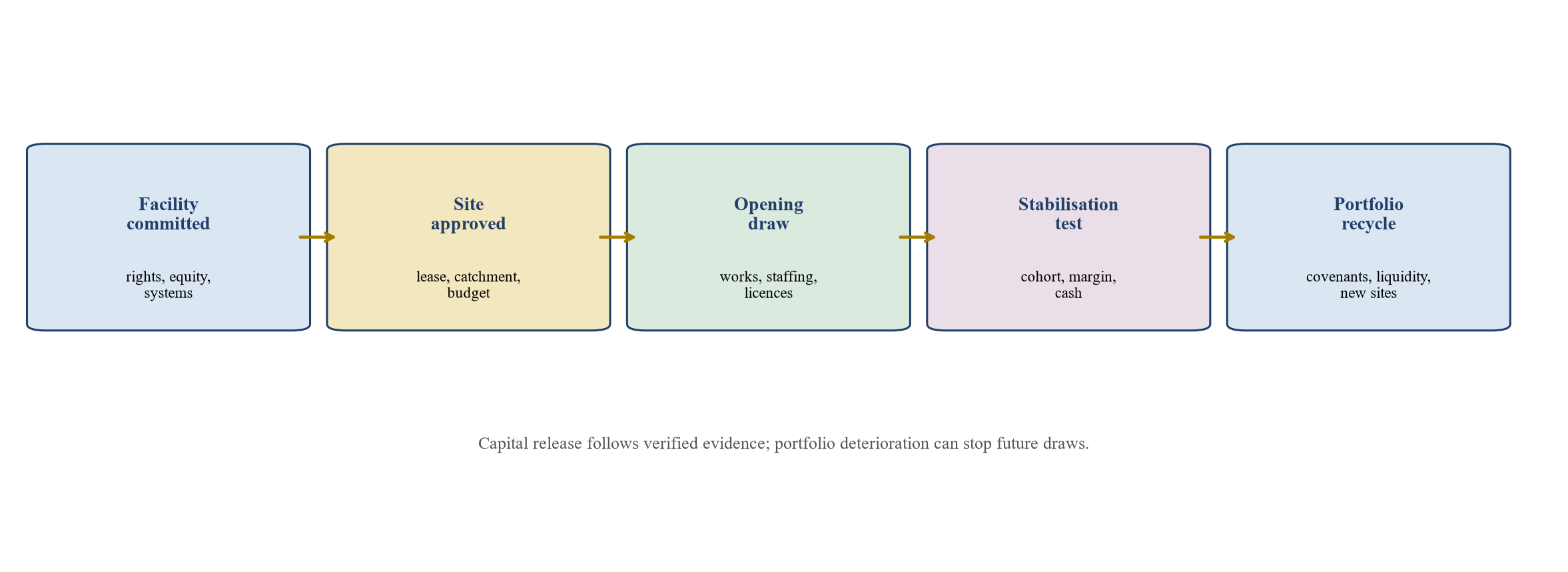
The sequence is illustrative. Terms require lender, borrower and legal agreement.
| Stage | Minimum evidence | Release | Failure response |
|---|---|---|---|
| facility effectiveness | registered rights, equity, security, systems and base liquidity | commitment becomes available | do not activate facility |
| site approval | catchment file, lease, approval, licence path and downside case | reserve site allocation | reject or revise site |
| construction draw | verified progress, invoices, insurance and cost to complete | pay eligible project cost | borrower funds overrun or draw pauses |
| opening draw | completion, staff, inventory, systems and permits | fund approved opening need | delay opening and preserve contingency |
| stabilisation | actual sales, contribution, cash and control evidence | release retention or allow next site | remediation, lower advance or drawstop |
Conditions should be objective, proportionate and linked to the use of funds.
8 Design unit level covenants that management can operate
Covenants should create timely information and disciplined action. A threshold that behaves like an unexplained model output will produce disputes and waivers. Define every measure, source system, period, treatment of new stores, permitted adjustments, reporting date and cure mechanism. Test the calculation on historical data before signing.
Use three levels. Store covenants identify local underperformance. Cohort covenants test whether recent openings follow the approved ramp. Borrower covenants protect liquidity, leverage and debt service. A new store may reasonably breach a mature-store margin threshold during ramp, so opening stores need separate measures. A mature store that declines sharply may require intervention even when group performance remains compliant.
Leading indicators can include opening delay, cost to complete, licence status, staffing, inventory availability, equipment uptime, delivery acceptance, customer complaints and data completeness. Financial indicators can include sales attainment, contribution margin, rent burden, cash conversion and debt service. Use indicators with a clear response. Management should know what action follows amber and red status.
Set thresholds from evidence and downside capacity. A covenant should leave enough time to diagnose and fund a remedy. If the threshold triggers only after cash is exhausted, it has little preventive value. Excessively tight thresholds can create recurring waivers and weaken signal quality. Back-test proposed levels against mature stores, recent openings, seasonality and stress cases.
Define cure paths. A weak site may need local marketing, revised hours, labour adjustment, menu or assortment change, lease relief, additional equity, temporary closure or permanent exit. The lender may pause new-site draws while allowing an operating cure budget. Contractual rights should distinguish information breach, performance variance and payment default.
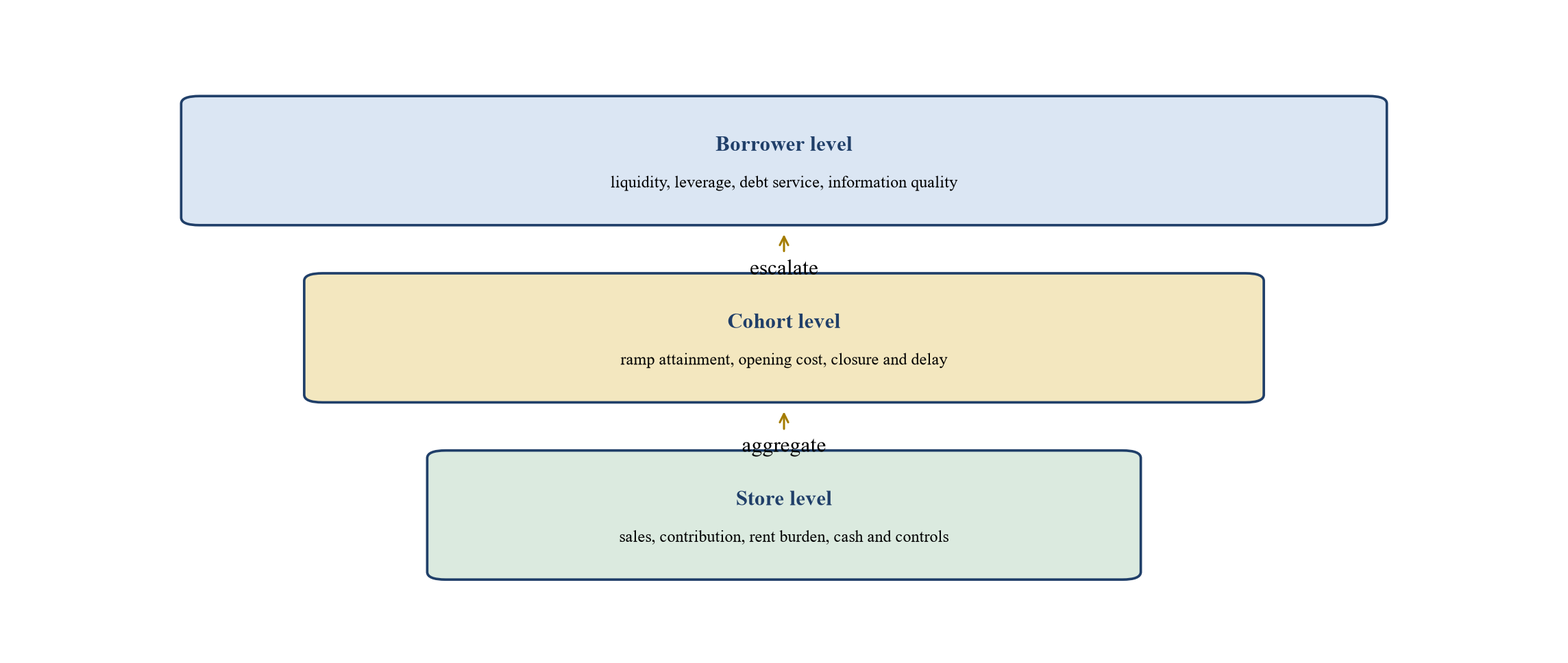
Proposed monitoring hierarchy with escalation before group liquidity failure.
| Level | Measure | Illustrative amber signal | Response |
|---|---|---|---|
| store | cumulative sales versus cohort curve | below 85 percent for two reporting periods | validate data and approve store cure plan |
| store | rent and occupancy burden | above approved downside level | engage landlord and restrict discretionary spend |
| cohort | opening cost variance | aggregate overrun above 7.5 percent | pause new approvals and reforecast cost to complete |
| cohort | opening delay | more than 30 days without approved reason | preserve contingency and revise rollout sequence |
| borrower | minimum unrestricted cash | projected breach within eight weeks | stop new draws and require funding plan |
| borrower | debt service coverage | below agreed level after permitted adjustments | apply cure, cash control or amortisation response |
| control | reporting completeness | material source reconciliation unresolved | treat output as unavailable for covenant purposes |
Thresholds are hypothetical and require transaction-specific calibration.
9 Connect reporting to cash and lender action
The reporting pack should answer four questions. What happened at each store, why did it happen, what does it change in the cash forecast, and who owns the response. A dashboard without reconciled source data can accelerate the wrong decision. Establish one controlled close process for POS, invoices, delivery platforms, bank settlements, payroll, inventory and the general ledger.
Use a calendar that reflects risk. Construction and opening costs may require weekly reporting. New stores may report weekly sales and cash for the first months. Mature stores may move to monthly reporting unless a trigger occurs. Portfolio liquidity should be forecast at least weekly through the next major payment dates. The facility agreement should specify delivery deadlines and acceptable formats.
Variance analysis should separate volume, price, mix, discount, channel, product cost, labour, occupancy and one-off items. Compare actual results with the original underwritten case and latest approved forecast. Do not overwrite the original baseline. A chain of revised forecasts can hide repeated optimism.
Data quality is itself a credit measure. Track missing stores, late feeds, unreconciled settlements, manual journals, changed definitions and restatements. A site model that relies on automated data transfer should have fallback procedures. If the lender cannot reproduce a covenant, the parties need a defined temporary calculation and correction process.
Cash control should match transaction risk. Options include controlled collection accounts, debt service reserves, blocked distributions, mandatory prepayment from asset sales and site-level cash sweeps. Each control has operational and legal consequences. Design it around settlement flows and permitted payments. Avoid structures that interrupt payroll, tax or essential suppliers without a considered enforcement plan.
Management capacity deserves explicit review. A rapid rollout can overwhelm property, project, recruitment, training, supply, finance and technology teams. Measure pipeline workload, vendor capacity and opening overlap. Limit concurrent openings when resources are constrained. A slower sequence can preserve cash and operating quality even when the committed facility remains available.
10 Stress the rollout as a portfolio
A portfolio model should connect site outcomes rather than treating every location as independent. Construction inflation, utility delays, hiring constraints, supplier disruption, consumer softness or platform changes can affect several stores together. Create combined scenarios and show the resulting draw need, covenant headroom and corrective options.
Test delayed opening, lower initial sales, slower ramp, gross-margin pressure, labour cost, rent escalation, fit-out overrun and weaker cash conversion. Use ranges grounded in comparable performance and contracts. Where the borrower has little evidence, widen the range and reduce initial leverage. Preserve the assumptions and decision owner for each stress.
Cannibalisation should be modelled across the estate. A new store can transfer sales from an existing pledged unit while increasing total brand presence. Measure customer origin, overlapping delivery zones and travel time. Forecast incremental portfolio contribution after transferred sales and duplicated central cost. If the new site reduces debt service at an existing store, the borrowing base should recognise the effect.
Closure is a financing scenario. Estimate lease exit, employee cost, inventory recovery, equipment relocation, reinstatement, franchise obligations and lost contribution. Identify which assets are reusable and how long recovery takes. A weak site may consume cash during cure and again on exit. The lender needs a funded route for both.
Scenario actions should be executable. Options include delaying optional sites, reducing format, renegotiating rent, changing channel mix, injecting equity, using contingency, selling equipment or closing a store. Assign decision dates. A response available after the cash trough does not protect repayment.
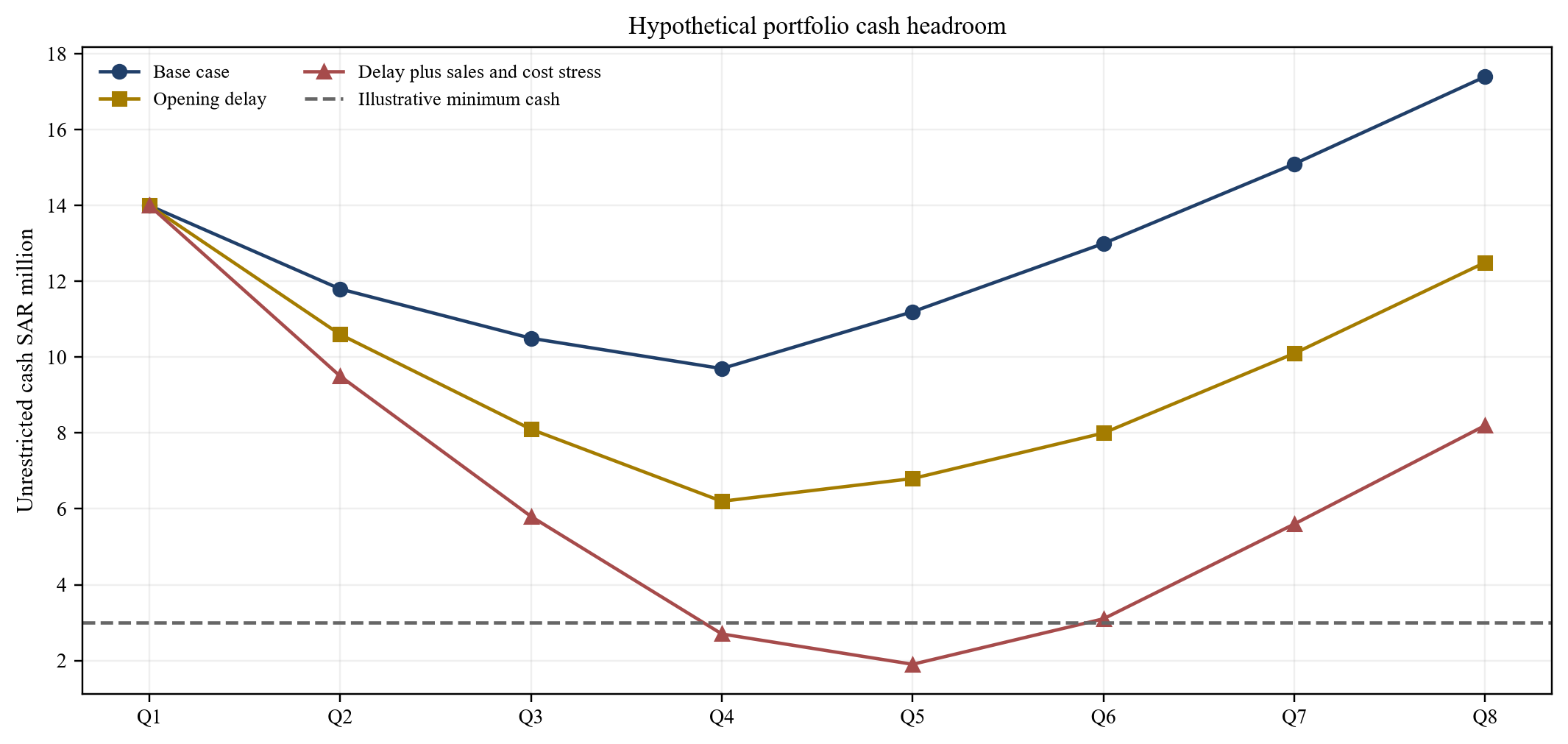
SAR millions. All values are modelling assumptions for an illustrative franchisee.
11 Work through a hypothetical Saudi franchise rollout
Consider a hypothetical Saudi operator with twelve mature outlets and rights to open eight additional stores over twenty-four months. The mature estate records SAR 96 million of annual net sales and SAR 14.4 million of store contribution before central cost. The proposed facility is SAR 28 million, with SAR 20 million for eligible fit-out and equipment and SAR 8 million for working capital and opening liquidity. The borrower contributes at least 35 percent of each site's approved opening budget from equity. All figures are assumptions created solely to demonstrate the framework.
Management identifies twenty potential locations. The first screen uses population, workplaces, travel time, competition, existing customer origins and category payment context. Six sites fail because rent or access is inconsistent with the brand format. Four remain on a watchlist because development timing is uncertain. Ten proceed to field validation, lease review and franchisor approval. The credit committee approves eight, subject to site-specific conditions.
The model divides the approved sites into urban high-street, community-retail and drive-oriented cohorts. It uses evidence from the twelve mature stores but widens downside ranges for the drive-oriented cohort because only two comparable units exist. Base-case mature monthly sales range from SAR 0.62 million to SAR 0.95 million by format. Store contribution margins range from 11 percent to 17 percent. These values remain hypothetical and are not market estimates.
Each site has an opening budget between SAR 3.2 million and SAR 5.0 million. The facility funds eligible costs after equity and retains 10 percent until opening evidence is complete. Construction draws require certified progress and an updated cost-to-complete schedule. Working-capital drawings become available when licences, systems, staff and initial inventory are ready.
Portfolio covenants include minimum cash, debt service coverage and a cap on aggregate opening-cost variance. Store monitoring compares cumulative sales with the approved cohort curve, contribution margin, rent burden and cash conversion. A site below 85 percent of cumulative sales for two periods enters an operating review. The trigger does not create an automatic payment default. It pauses approval of additional sites until the borrower provides reconciled evidence and an approved cure plan.
In the combined stress, two openings are delayed by one quarter, aggregate opening cost rises 9 percent and first-year sales reach 80 percent of the base curve. Unrestricted cash falls close to the illustrative minimum. Management delays two optional sites, funds part of the overrun with equity and renegotiates the construction sequence. The facility remains within the reduced site borrowing base. This outcome depends on early action and cannot be extrapolated to an identified borrower.
The case shows how the same evidence supports commercial and credit decisions. The catchment file determines whether a site enters the pipeline. The budget and lease define capital at risk. The cohort curve sets ramp expectations. The unit ledger tests cash. The covenant framework determines when rollout capital pauses. The portfolio model shows whether the borrower can fund cure or closure.
12 Govern models data and exceptions
Model governance should fit the consequence of the decision. A simple scorecard still needs an owner, purpose, version, data inventory, validation and change control. Record which decisions the model supports and which require separate legal, technical or commercial judgement. Prevent automated ranking from becoming an undocumented approval.
Validate source coverage and performance. Test missing data, outdated locations, duplicate points, geographic bias and sensitivity to weights. Compare predictions with actual outcomes by region, format and maturity. A model can perform well on average while failing for a specific city or site type. Report those limitations to the decision committee.
Protect confidential and personal data. Use the minimum necessary precision, restrict access and retain processing records. Aggregate outputs where the lender needs portfolio evidence rather than customer records. Review international data transfers and cloud arrangements where applicable. The SDAIA regulatory page identifies the Personal Data Protection Law, implementing regulations and related data-governance policies.[4]
Third-party data and software create dependencies. Document licences, permitted uses, renewal, service levels, methodology change and termination. Preserve an export of decisive evidence where lawful. If a vendor stops a dataset or changes its model, the lender and borrower should know which site scores and covenants are affected.
Exception governance reveals model weakness. Record site-score overrides, covenant adjustments, data substitutions and waiver decisions. Analyse frequency, direction and outcome. Repeated exceptions may indicate outdated thresholds, commercial pressure or weak evidence. The committee should revise the framework when observed results justify a change.
| Control | Evidence | Owner | Escalation condition |
|---|---|---|---|
| approved purpose | documented decision and prohibited uses | credit model owner | model used for a new decision without approval |
| data lineage | source, date, permission, transformation and coverage | data owner | decisive field is missing, stale or unauthorised |
| validation | back-test, sensitivity, segment performance and limitations | independent reviewer | performance falls outside agreed tolerance |
| change control | version, change reason, test and approval | model governance | material change reaches production without review |
| human decision | reviewer, override evidence and authority | transaction committee | override lacks evidence or repeats systematically |
| continuity | vendor exit, export, fallback and recovery | technology owner | dataset or service becomes unavailable |
Controls apply to screening, approval and monitoring models according to decision consequence.
13 Sequence diligence signing and monitoring
Start with a rights and evidence map. Confirm franchise entities, current registration, disclosure, territory, development obligations, agreements, data permissions and operating responsibilities. Build the unit ledger for existing stores before relying on management summaries. Reconcile a sample across POS, invoices, delivery platforms, bank settlements and accounts.
Next, define the site process. Agree the catchment method, minimum datasets, field validation, scoring, override control and expiry. Apply it to the current pipeline. Select comparable stores and construct cohort curves with closure and relocation included. Build site budgets, ramp cases and portfolio cash from the same assumptions.
Translate the operating model into facility mechanics. Define eligible costs, equity sequence, site conditions, draw certificates, retentions, availability, amortisation, guarantees, security and cash control. Draft covenant definitions alongside the model and test calculations with historical data. Ensure the information timetable is achievable from the borrower's systems.
Before signing, run an integrated rehearsal. Process one site from initial screen through draw request and covenant report. Trace every figure to source evidence. Confirm legal, commercial, property, operations, finance, data and technology owners. Record unresolved items with funded consequences and closing conditions.
After closing, govern the first sites closely. Review cost to complete, opening readiness, weekly cash and early trading. Compare actual results with the original cohort curve. Update the forecast without erasing the underwritten baseline. Report exceptions and management actions to the lender on the agreed timetable.
The portfolio should earn the right to expand. Strong evidence, controlled costs and cash conversion can support later draws. Weak stores, reporting gaps or cash pressure should slow the sequence. The facility can preserve committed capacity while protecting liquidity through a drawstop or lower advance rate.
14 Limitations and further research
This framework does not determine whether a particular franchise agreement, disclosure, site, data use, licence, lease, security interest, guarantee, finance product or covenant is lawful or appropriate. Those conclusions depend on current documents, regulatory status, qualified advice and the financier's approved policies. English translations of Saudi rules may be provided for convenience; the governing Arabic instrument should be verified.
Geospatial data can be incomplete, licensed, delayed or measured at a resolution unsuitable for a store decision. Mobility, payment and digital-platform data may represent selected users or channels. Population does not equal addressable demand. Association between a location variable and store sales does not establish causation. Field evidence and commercial judgement remain necessary.
The hypothetical case supplies mechanics rather than forecasts. Monetary values, margins, ramps, covenant levels and stress outcomes are assumptions. Actual performance depends on brand, sector, city, format, operator, lease, supply chain, labour, customer behaviour and financing terms. No probability of default or recovery rate is estimated.
Further research could compare observed Saudi franchise cohorts across formats and regions; evaluate which geospatial variables retain predictive value after controlling for lease and operator quality; test early-warning indicators against store closure and restructuring; examine the interaction between guarantee coverage and staged site finance; and study whether standard site evidence reduces underwriting time without weakening credit control.
15 Conclusion
Saudi franchise finance becomes more transparent when each outlet is underwritten as a defined site package and monitored as part of a portfolio. Franchise rights establish the operating perimeter. Geospatial evidence tests the catchment. Store cohorts describe ramp. Unit economics connect transactions to cash. Staged drawings and covenants link capital release to evidence that the borrower and lender can verify.
A location score supports judgement when its data, method and limitations are visible. A covenant supports action when the measure is reproducible, timed before liquidity failure and paired with a practical response. The combined framework helps the transaction committee decide which sites to fund, how much to advance, when to pause and what evidence is needed to resume.
The central discipline is reconciliation. The disclosure document, map, lease, budget, operating records, bank settlements and facility model should tell one consistent story. Where they do not, the unresolved difference belongs in pricing, structure, conditions or the decision to decline the site.
Appendix A. A1 Rights and premises
Confirm current franchise registration, governing agreement, territory, term, development obligation, transfer and termination.
Confirm franchisor site approval, lease status, permitted use, access, utilities, signage and licensing path.
Reconcile premises plans, area, frontage, entrances, parking, delivery access and fit-out condition.
Identify deposits, guarantees, rent escalation, service charge, turnover rent, break and reinstatement.
Appendix A. A2 Catchment and model
Record every source, date, licence, resolution, geographic boundary, transformation and owner.
Validate coordinates, travel routes, competitors, development status and anchor tenants through field evidence.
Preserve model version, weights, caps, sensitivity, comparable stores, prediction range and limitations.
Record committee decision, override, conditions, expiry date and refresh triggers.
Appendix B. B1 Before each draw
Confirm equity contribution, eligible cost, invoice, progress, insurance, licence, staffing and cost to complete.
Update the opening timetable, cash forecast, contingency and portfolio covenant headroom.
Verify that no site, cohort, borrower or information drawstop is active.
Retain the signed site certificate, evidence attachments, approvals and payment route.
Appendix B. B2 After opening
Reconcile POS, e-invoices, delivery platforms, bank settlements, inventory, payroll and general ledger.
Compare sales, contribution, cash and cost with the original cohort curve and latest forecast.
Record data exceptions, covenant calculations, management actions, cure funding and decision dates.
Review new-site availability only after the portfolio retains agreed liquidity and evidence quality.
Sources
- Ministry of Commerce. Franchise Registration Registration Modification Cancellation. Read the primary source
- Franchise Center. Franchise Law. Read the primary source
- Saudi Data and AI Authority. Personal Data Protection Law. Read the primary source
- Saudi Data and AI Authority. Laws Regulations and Data Governance Policies. Read the primary source
- General Authority for Survey and Geospatial Information. National Geospatial Platform and Standards. Read the primary source
- General Authority for Survey and Geospatial Information. National Geospatial Center. Read the primary source
- Zakat Tax and Customs Authority. E Invoicing Overview. Read the primary source
- Zakat Tax and Customs Authority. E Invoicing Laws and Regulations. Read the primary source
- Saudi Central Bank. Weekly Point of Sale Transactions. Read the primary source
- Saudi Central Bank. Monthly Statistical Bulletin March 2026. Read the primary source
- Kafalah. About the SME Financing Guarantee Program. Read the primary source
- Kafalah. Regular Kafalah Product. Read the primary source
- Kafalah. Frequently Asked Questions. Read the primary source
- Saudi Central Bank. Financial Stability Report 2025. Read the primary source
- Saudi Central Bank. Rules on Credit Risk Management. Read the primary source
- Saudi Central Bank. Rules Governing Credit Risk Exposure Classification and Provisioning. Read the primary source
- Saudi Central Bank. Implementing Regulation of the Finance Companies Control Law. Read the primary source
- Monsha'at. More Than 1500 Franchise Brands Operating in Saudi Arabia. Read the primary source
- Monsha'at. Reports and SME Monitor. Read the primary source
- Ministry of Commerce. Merchant Guide. Read the primary source
- Balady. User Guide for Commercial Licence Location Information. Read the primary source
- General Authority for Statistics. Annual Report and Saudi Census Programme. Read the primary source
