

1. Define the investment decision and the agent boundary
A direct-investment process should begin with the decision that the investment committee must make. The decision is rarely a simple ranking of opportunities. The committee may need to decide whether an opportunity fits the family mandate, deserves diligence expenditure, warrants an indicative proposal, should enter exclusivity, merits final approval or requires a change in portfolio exposure. Each stage has a different evidence threshold and a different cost of error.
Define the agent's permitted tasks before selecting technology. Useful tasks may include document intake, entity resolution, source classification, claim extraction, missing-item detection, comparable-company retrieval, calculation checking, scenario generation, conflict prompts, meeting-pack assembly and monitoring. An agent should not determine the family's objectives, waive a conflict, invent missing evidence, interpret law as final advice, commit capital or communicate approval to a counterparty.
The OECD AI Principles call for human agency and oversight, transparency, traceability, robustness and accountability across the AI lifecycle.[1] NIST's AI Risk Management Framework organises controls around govern, map, measure and manage and requires documented roles for human-AI configurations.[2][3] IOSCO's 2025 review of AI in capital markets similarly emphasises data provenance, cyber security, model context and risk-calibrated oversight.[4] These principles translate into a practical rule for direct investing: the family office owns the decision and the evidence chain, even when an external model or agent prepares the analysis.
Create a responsibility map for sponsor, chief investment officer, deal lead, finance, legal, tax, risk, operations, technology, external advisers and committee members. Record which person can open a review, request data, change assumptions, approve exceptions, incur cost, issue a term sheet and authorise funding. A system that automates tasks without mapping authority can accelerate the wrong action.
The first control is a stop rule. The process should stop or escalate when identity, authority, confidentiality, mandate fit, conflict status, source integrity or data-use rights cannot be established. An attractive score does not cure a missing owner, forged document, prohibited disclosure, unresolved related-party interest or unavailable approval right.
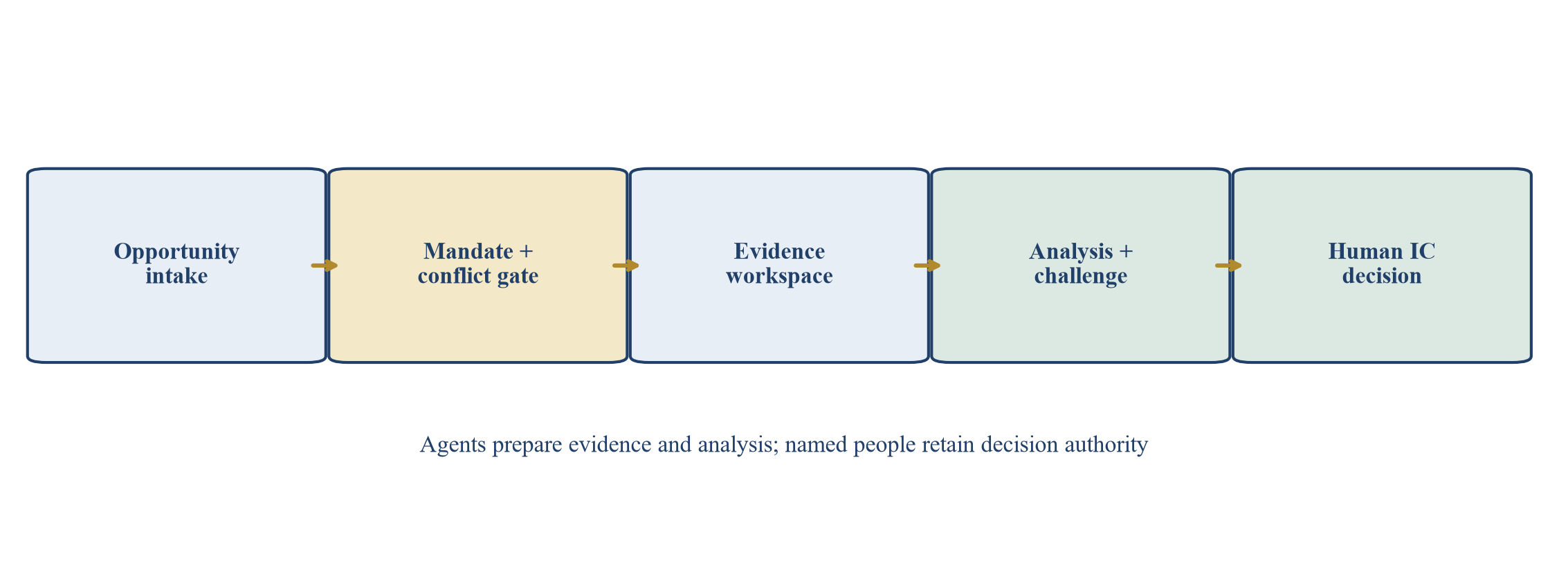
Proposed operating architecture. Each transition requires evidence, an owner and an explicit failure response.
| Decision | Agent contribution | Human owner | Stop or escalation condition |
|---|---|---|---|
| open screening | classify source and assemble intake record | authorised deal lead | identity, consent or confidentiality uncertain |
| confirm mandate fit | apply approved rules and show exceptions | chief investment officer or delegate | rule conflict, ambiguity or concentration breach |
| approve diligence spend | estimate workplan, gaps and external cost | budget holder | evidence too weak to justify cost |
| set valuation case | calculate approved methods and sensitivities | deal lead with finance challenge | unsupported driver or non-reproducible calculation |
| clear conflicts | populate register and route disclosures | legal, compliance or conflicts owner | material conflict unresolved or consent unavailable |
| approve investment | assemble packet and record conditions | constituted investment committee | quorum, authority, evidence or funding condition absent |
The family office should adapt the authority matrix to its legal structure, mandate and governance documents.
2. Translate the family mandate into executable rules
A family-office mandate often combines financial objectives with liquidity needs, ownership preferences, family values, strategic relationships, operating-business exposure and succession considerations. Those dimensions should be documented before they become software rules. Otherwise, an agent may treat a historic pattern, informal preference or influential person's recent request as a binding investment criterion.
Separate hard constraints from preferences. Hard constraints may cover legal authority, prohibited activities, maximum ticket, geography, instrument, concentration, liquidity, leverage, related-party limits and approval threshold. Preferences may include sector familiarity, co-investor quality, governance rights, strategic relevance, income profile or intended holding period. A preference can influence ranking without silently becoming an exclusion.
The UAE's federal family-business legislation requires directors to exercise care and diligence, treat partners fairly, maintain independence of opinion and place the family business's interest above personal interests.[5] The precise legal application depends on the entity and transaction, but the principles illustrate why family ownership does not remove the need for documented authority and conflict discipline. DIFC's Family Wealth Centre also places governance, succession and institutional development at the centre of family-wealth infrastructure.[6]
Convert mandate language into a rule register. Each rule should state its source, effective date, owner, scope, logic, evidence input, permitted exception, approving authority and review date. Preserve the original policy text beside the executable representation. A natural-language agent may assist with mapping, but counsel and governance owners should confirm the rule before use.
Portfolio context belongs inside the mandate test. A transaction that fits in isolation may create unacceptable exposure when combined with operating-company interests, guarantees, real estate, fund commitments, currencies or family liquidity events. The agent should read controlled portfolio data and show the exposure bridge. It should never assume the data are complete or current.
| Rule family | Example evidence | System test | Human judgement retained |
|---|---|---|---|
| legal authority | constitutional documents, delegation and reserved matters | proposed action within delegated perimeter | interpretation of ambiguous authority |
| investment scope | approved policy, sector and geography definitions | opportunity attributes match current rule | classification at sector boundaries |
| capital limits | ticket, concentration, liquidity and follow-on policy | pro forma exposure remains within limits | willingness to use scarce capacity |
| values and exclusions | approved exclusions and responsible-investment policy | controlled flags and source evidence | materiality and remediation assessment |
| ownership rights | minimum information, board, consent and exit rights | proposed terms meet stated minimum | adequacy of negotiated protections |
| related parties | family, affiliate, adviser and co-investor register | entity and relationship match | conflict treatment and consent |
A rule is executable only when its source, logic, exception path and authority are defined.
3. Build one evidence workspace for every opportunity
An agentic workflow depends on a controlled opportunity record. Email attachments, messaging applications, virtual data rooms, adviser decks, public sources and meeting notes should not remain separate evidence islands. Create an opportunity identifier that links the originating contact, issuer, seller, target, beneficial owners, advisers, co-investors, securities, documents, models, questions, approvals and communications.
Every document should retain source, sender, received time, file hash, confidentiality status, access rights, language, version and supersession state. Extracted claims should point to the exact document and page or structured field. Public information needs a capture date and URL. Verbal statements should identify the speaker, meeting and note taker and remain labelled as management representations until independently supported.
The agent should distinguish extraction from conclusion. Revenue stated in a management deck is an extracted claim. Reconciled revenue tied to audited statements, bank cash and operating records is a diligence conclusion. Expected growth is an assumption. A valuation multiple is an analytical input. These categories should not be blended in one text summary.
Version control is essential because private-market evidence changes during a process. A later model may include revised forecasts, an updated capitalisation table or a new customer schedule. Preserve the prior version, identify the change, quantify its effect and route material differences to the deal team. Silent replacement destroys the committee's ability to understand how the recommendation evolved.
Data rights should be tested at intake. Confirm whether documents may be uploaded to a third-party model, retained for training, shared across advisers, transferred across borders or used after the process ends. Apply minimisation, access controls, encryption, retention and deletion rules. Confidentiality obligations continue even when an opportunity is rejected.
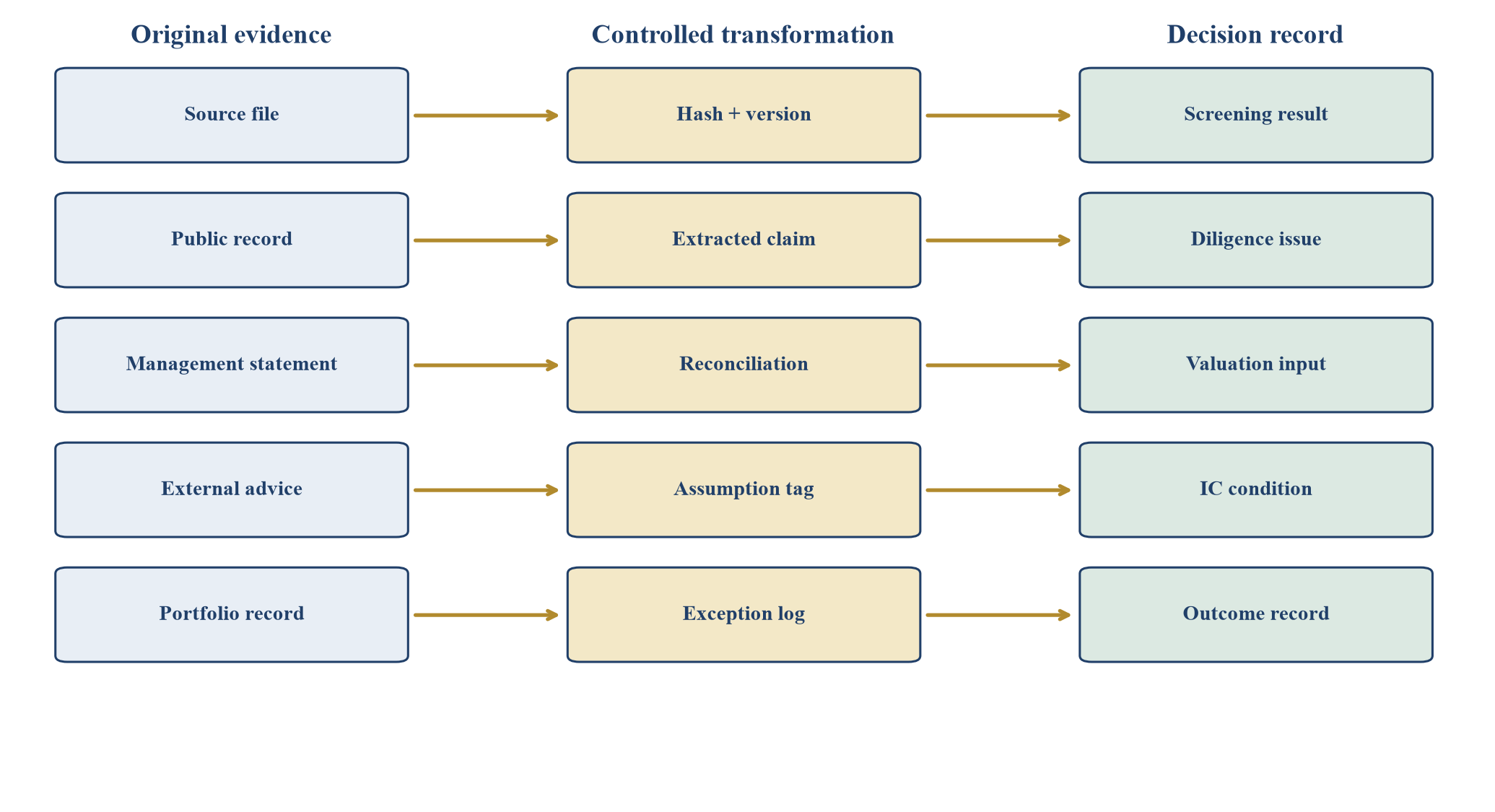
Proposed lineage architecture. Each analytical claim preserves its source, transformation, reviewer and decision use.
| Record | Required fields | Control test | Failure response |
|---|---|---|---|
| source | owner, origin, date, hash, version, rights and confidentiality | authentic, current and permitted? | quarantine, verify or exclude |
| claim | exact source location, extracted value, unit and period | extraction agrees with source? | correct and rerun dependants |
| transformation | rule, code, prompt, model version and parameters | reproducible from retained input? | block decision use |
| assumption | owner, rationale, range, scenario and approval | clearly separated from observed fact? | relabel, challenge or remove |
| review | reviewer, scope, date, exceptions and resolution | appropriate competence and independence? | escalate to qualified reviewer |
| decision | authority, materials, vote, dissent, conditions and expiry | complete and within mandate? | defer or reconvene |
Provenance should support reproduction, challenge, correction and post-investment learning.
4. Design the agent workflow as a sequence of bounded tasks
An agentic system may plan and execute several steps, call tools, retrieve information and revise outputs. That capability creates value when the workflow is bounded. The family office should define the permitted tools, data domains, actions, spending limits, communication channels and termination conditions. An agent should operate inside a sandboxed opportunity workspace rather than across unrestricted family records.
Break the workflow into stages. Intake verifies identity, authority, confidentiality and completeness. Triage applies mandate rules and detects immediate conflicts. Evidence assembly indexes documents and creates the question list. Analytical agents build market, commercial, financial, legal, tax and operational modules. A challenge agent searches for contradictions, missing evidence and sensitivity. A pack agent assembles the committee record without changing approved numbers or conclusions.
Tool permissions should follow least privilege. A retrieval agent may read approved repositories but should not send messages or edit source files. A calculation agent may run controlled models but should not alter the investment policy. A drafting agent may populate a committee template but should not mark conditions as satisfied. Any external communication, document request, adviser instruction or term-sheet transmission requires named human approval.
The orchestration layer should produce an event log. Record the task, time, input identifiers, tools called, outputs, model and rule versions, confidence or limitation, reviewer and disposition. Long reasoning traces are neither necessary nor sufficient. The useful record is the evidence and control path that allows a reviewer to reproduce the material output.
Failure should be designed. An agent may time out, retrieve the wrong entity, follow a malicious instruction embedded in a document, disclose confidential information, repeat an action or produce unsupported content. Controls should include content isolation, allowlisted tools, idempotency keys, rate limits, approval checkpoints, anomaly detection, rollback, incident response and a manual fallback.
5. Separate eligibility, attractiveness and decision readiness
Eligibility answers whether the family office may consider the transaction. Attractiveness asks whether the risk-adjusted proposition deserves capital. Readiness asks whether the evidence and execution plan justify a decision now. Combining these questions in one score creates false precision and may allow a strong commercial narrative to offset a hard mandate breach.
The eligibility gate should be deterministic where possible. Test legal authority, geography, sector, stage, ticket, instrument, concentration, exclusions, sanctions, ownership and required co-investor characteristics. Show every failed or uncertain rule. A human may approve an exception only where the governing documents permit it and the required authority is present.
Attractiveness requires structured judgement. The system may organise market size, competitive position, customer evidence, management capability, economics, cash needs, valuation, rights, downside and exit routes. Weightings should be visible and tested. Scores should include evidence quality and disagreement, not only a central estimate.
Readiness is an evidence gate. Confirm that critical questions have answers, models reconcile, legal and tax issues have owners, conflicts are treated, financing is available, terms are documented, conditions are executable and the post-close plan is resourced. A transaction may be attractive but unready because evidence, authority or execution capacity is incomplete.
The funnel should retain rejected cases and reasons. This supports calibration, bias review and future sourcing strategy. It also prevents the same rejected opportunity from re-entering under a new label without its prior record. Retention should follow lawful privacy and confidentiality rules.
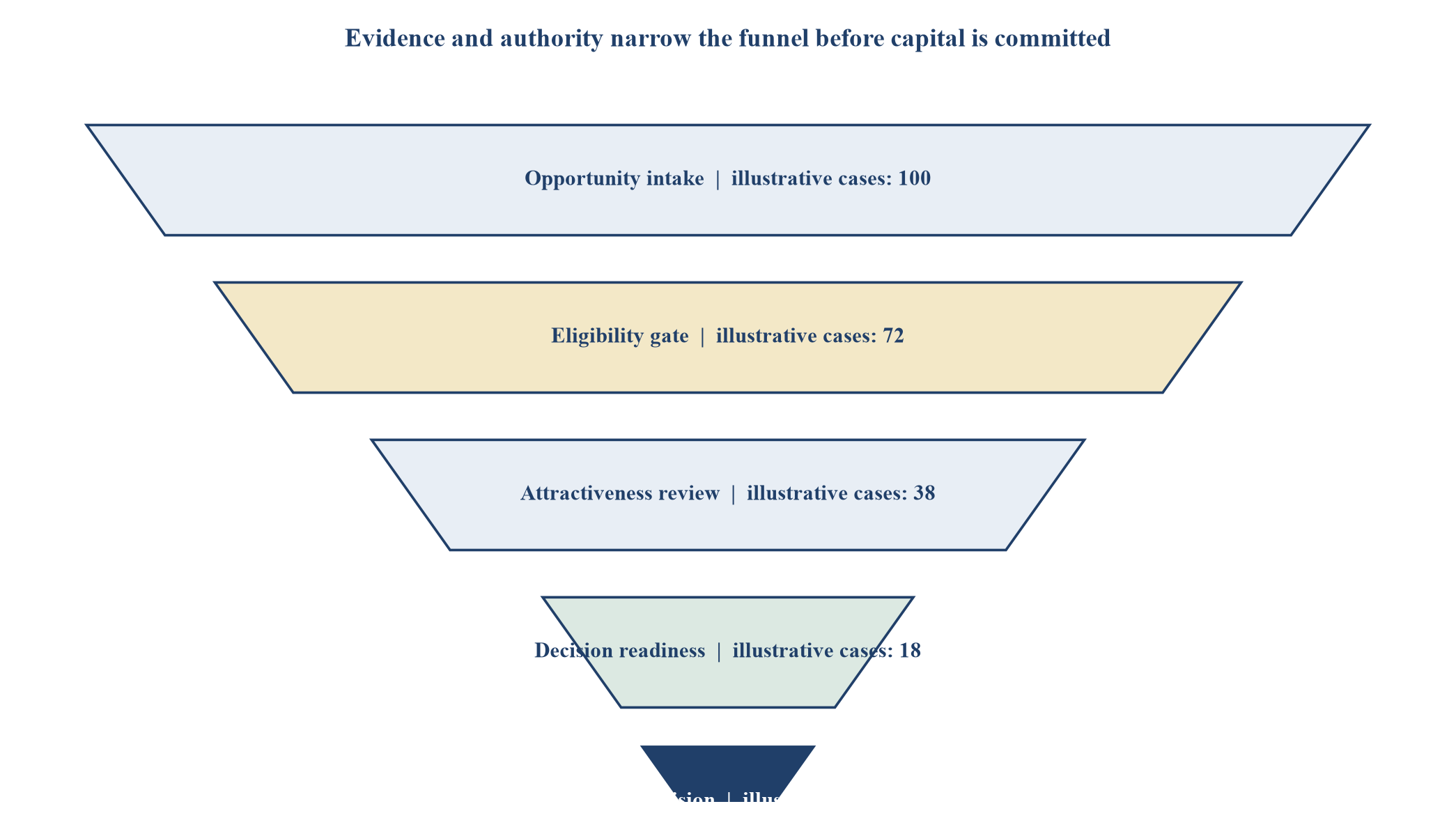
Proposed decision funnel. A favourable attractiveness assessment cannot override an eligibility failure or missing decision evidence.
6. Use a scorecard that exposes evidence and disagreement
A screening scorecard should make comparison easier without pretending that a private investment is reducible to one number. Use a small set of decision dimensions connected to the mandate and ownership thesis. Each dimension should show the central score, evidence coverage, confidence, reviewer view, material contrary evidence and the action needed before the next gate.
Commercial quality may include customer need, market structure, differentiation, pricing power, channel dependence and retention. Management may include integrity, capability, key-person dependence, governance and succession. Economics may include gross margin, contribution, cash conversion, capital intensity and sensitivity. Transaction quality may include valuation, rights, dilution, downside protection, financing and exit options.
Evidence quality should be scored separately. A strong claim supported only by a management deck has lower decision weight than a moderate claim supported by contracts, customer data, bank records and independent checks. The agent can identify source diversity and reconciliation status, while the reviewer decides whether the evidence is sufficient.
Disagreement is valuable information. Record differences between management, advisers, internal reviewers, external experts and model outputs. Do not average them away. A dispersion measure can direct diligence toward the assumptions that drive the decision. Committee papers should show the range and explain the source of disagreement.
Calibration should use historic decisions and outcomes where the sample permits. Test whether higher scores were associated with better realised outcomes, whether certain sectors or introducers received systematically different treatment, and whether rejected opportunities later performed well. Small samples and changing strategies limit inference, so findings should remain qualified.
| Dimension | Core question | Evidence examples | Escalation signal |
|---|---|---|---|
| mandate fit | does the opportunity serve an approved objective within limits? | policy, portfolio exposure and authority | exception or interpretation required |
| commercial quality | is demand durable and independently evidenced? | contracts, cohort data, customer calls and market records | growth depends on one unverified assumption |
| management and governance | can the team execute with acceptable integrity and control? | references, track record, governance documents and incentives | key-person, conduct or reporting concern |
| economics and funding | can the business produce cash through downside conditions? | reconciled accounts, unit economics, cash bridge and financing plan | unexplained cash need or fragile margin |
| terms and valuation | do price, rights and structure compensate for risk? | cap table, term sheet, comparables and scenario model | return depends on optimistic exit or weak rights |
| execution readiness | can diligence, approval, funding and ownership be completed? | workplan, advisers, conditions and post-close resources | unresolved critical path or absent owner |
Scores are decision aids. The committee should see the source coverage, uncertainty and contrary evidence behind them.
7. Test commercial evidence before accepting the narrative
Private-company materials often combine observed performance, management interpretation and forward projections. The evidence workspace should separate them. Reconcile revenue, customers, volumes, pricing, retention, backlog and pipeline to underlying records. Confirm definitions, periods, cancellations, related parties, gross-versus-net presentation and currency.
Customer evidence should test concentration, contract enforceability, renewal mechanics, implementation status, usage, collections and switching risk. Customer calls require consent and a consistent question set. The agent may summarise call notes and compare statements, but the deal team should verify material contradictions and preserve the original record.
Market analysis should define the addressable segment from product, buyer, geography, regulation, channel and price rather than cite a broad headline market. Build demand from observable units where possible. Compare management's case with independent industry, regulator, procurement, trade and competitor evidence. State uncertainty when sources are incomplete or not comparable.
Competitive claims require a reference frame. Identify direct substitutes, internal build, incumbent processes and the customer's option to do nothing. Compare functionality, integration, price, distribution, switching cost and evidence of win or loss. An agent can search and structure public information, while subject-matter experts should review technical and market conclusions.
The investment thesis should state the mechanism that converts capability into cash and value. It should identify the required actions, responsible owner, capital, timing and measurable milestone. A statement that a market is growing is not a transaction thesis. The committee needs to know how this company, with these resources and rights, can capture economic value.
8. Reconcile financial performance and model the downside
Financial diligence begins with reconciliation. Tie management accounts, audited statements, tax filings where available, bank cash, billing, payroll, debt and capitalisation records. Define recurring revenue, gross margin, EBITDA, working capital, capital expenditure and free cash flow. Adjustments need evidence, owner and reversal logic.
Build a driver model that connects customers, price, volume, churn, delivery cost, headcount, working capital, investment and financing to cash. Preserve management's case, the deal team's central case and downside cases separately. A machine-generated forecast should never overwrite the submitted plan. Changes should be visible and explained.
Valuation should use methods appropriate to the business and stage. Comparable companies, precedent transactions, discounted cash flow, venture method, asset value and scenario-weighted outcomes answer different questions. Show source dates, definitions, adjustments, liquidity, control, dilution and currency. Avoid selecting a multiple because it produces the desired result.
Model downside through causal drivers. Examples include slower customer conversion, price pressure, churn, delayed capacity, cost inflation, working-capital absorption, follow-on funding and adverse exit conditions. Correlations matter because several variables may weaken together. The family office should identify the point at which liquidity, control or willingness to fund changes.
Return analysis should bridge enterprise value to the family office's actual security. Include net debt, preference rights, option pools, future dilution, follow-on capital, distributions, taxes, fees, currency and exit timing. Report both money multiple and annualised return with the assumptions that produce them. The committee should see loss of capital and illiquidity outcomes, not only a central return.
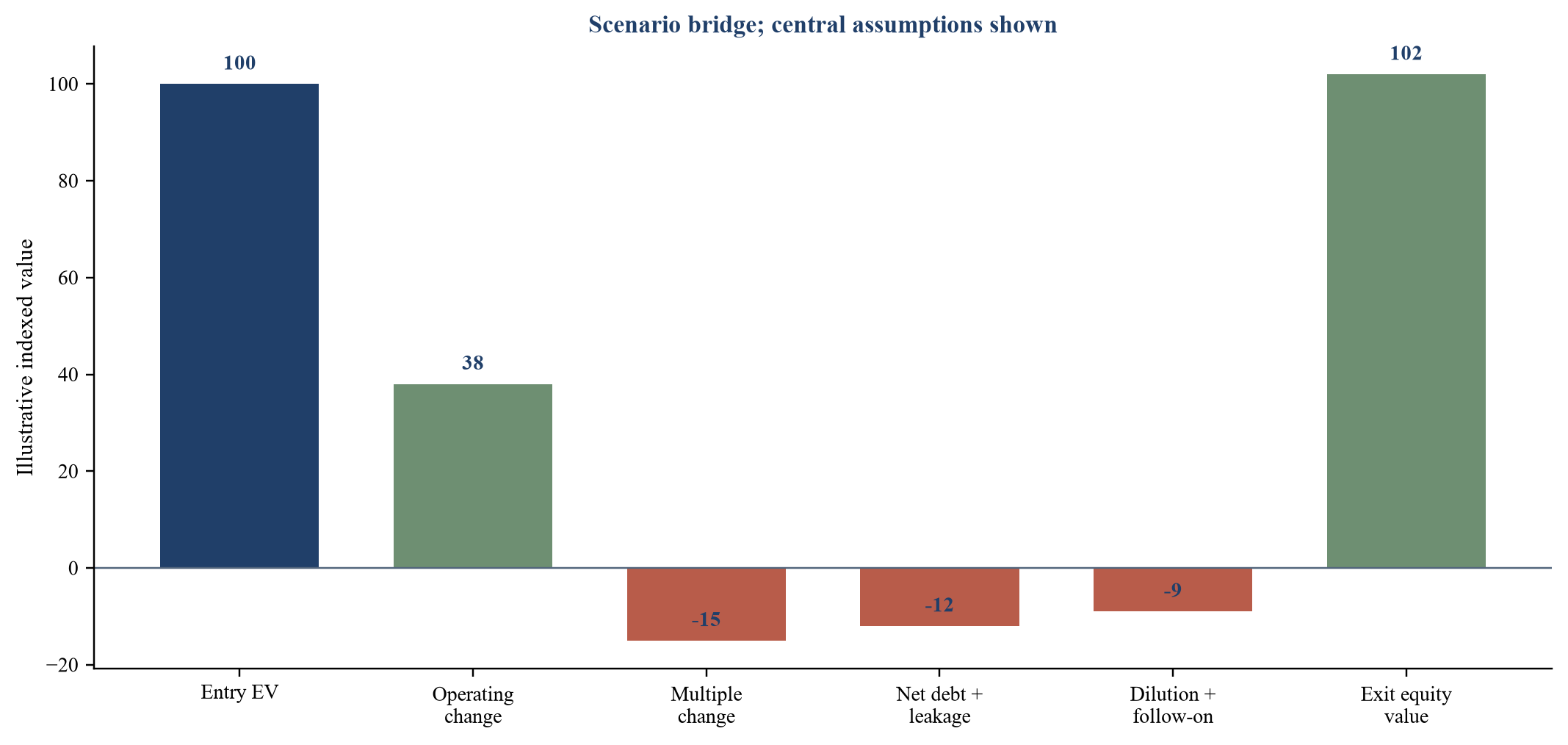
All values are hypothetical and expressed as indexed amounts for method illustration.
| Assumption | Evidence anchor | Challenge | Decision use |
|---|---|---|---|
| revenue growth | contracted base, cohort behaviour and capacity | delay conversion and reduce price or retention | funding need and value range |
| margin | product mix, delivery cost and supplier terms | test scale diseconomies and inflation | cash conversion and operating leverage |
| capital need | working capital, capex, debt service and runway | combine slower receipts with higher cost | follow-on reserve and dilution |
| exit multiple | current comparable set and transaction evidence | compress for size, liquidity and market regime | terminal value range |
| ownership | cap table, option pool, preference stack and future rounds | model dilution and senior claims | security-level proceeds |
| timing and currency | milestone plan, exit route and funding currency | delay exit and weaken conversion rate | annualised return and liquidity |
The committee should approve assumptions as ranges and understand which variables drive the bid or subscription price.
9. Treat conflicts and allocation as transaction variables
Family offices can encounter conflicts involving family members, operating companies, employees, advisers, introducers, co-investors, managers, service providers and portfolio companies. A relationship may create access and information while also affecting objectivity, allocation, fees, confidentiality or negotiation. The system should search a controlled relationship register and prompt disclosure without making a legal conclusion.
Conflict identification starts with entities and people. Resolve beneficial owners, directors, advisers, shareholders, lenders and close relationships within the lawful data perimeter. Record the nature of the relationship, economic interest, decision influence, information access and proposed treatment. False matches need a documented resolution so repeated screening does not create noise.
The treatment may include recusal, independent review, competitive process, fee disclosure, allocation policy, consent, information barrier, changed terms or rejection. The appropriate response depends on the governing documents and applicable law. A generic disclosure is inadequate when the decision maker cannot understand the conflict's nature and effect. SEC guidance on investment-adviser conflicts illustrates the importance of specific disclosure, records and continuing treatment.[7][8]
Opportunity allocation needs its own rule. A family office may invest through several vehicles, principals, funds, managed accounts or operating entities. Define how opportunities are assigned and how scarce capacity is allocated. The ILPA Due Diligence Questionnaire asks managers to explain co-investment allocation policies and examples, reflecting the importance of transparent allocation processes in private markets.[9]
The committee record should show who declared the conflict, who reviewed it, which materials were withheld, who recused, what consent was obtained and whether the economics changed. Conflict clearance expires if facts change. A new co-investor, adviser fee, related customer or portfolio-company relationship may require reassessment.
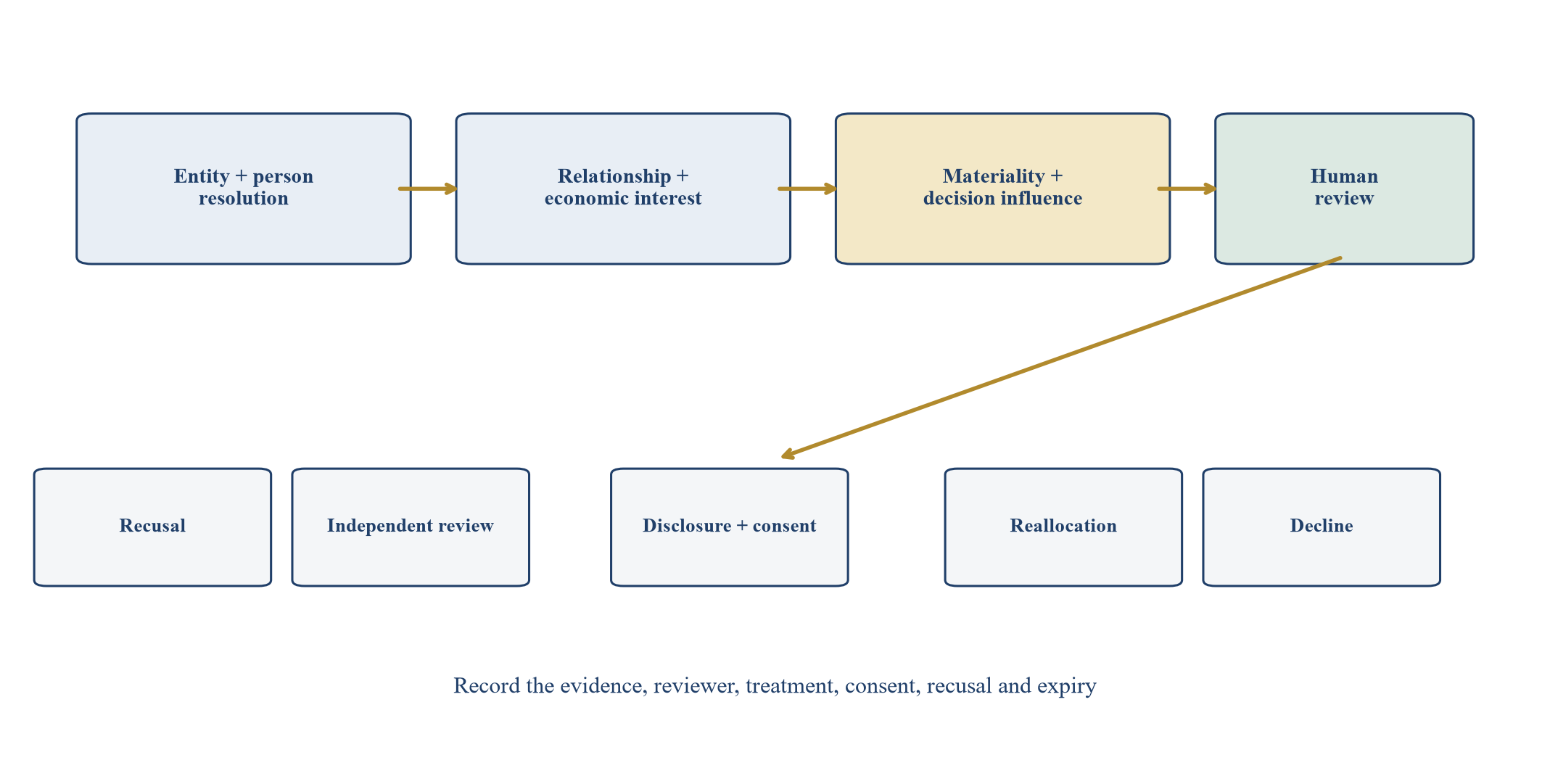
Proposed governance route. Materiality and treatment remain accountable human decisions.
10. Protect confidential information and control third parties
Direct-investment workspaces contain commercially sensitive, personal and sometimes regulated information. Data classification should precede agent access. Separate public, internal, confidential, highly restricted and legally privileged material. Apply role-based access by opportunity and function. Family data, operating-company records and unrelated portfolio information should not enter a deal workspace unless required and authorised.
Third-party AI providers require diligence. Review model hosting, data locations, subprocessors, encryption, retention, training use, deletion, incident notification, audit rights, availability, intellectual property and model-change controls. Contract terms should match the actual workflow. A vendor statement that customer data are not used for training does not answer retention, human review, logs or cross-border processing.
Prompt injection and malicious files create transaction risk. A document may contain instructions that attempt to redirect an agent, disclose data or use unapproved tools. Treat document content as evidence, never as system authority. Isolate parsing, strip active content, scan files, restrict tool calls and require approval for actions outside the workspace.
Cyber controls should address identity, access, secrets, endpoints, logging, backups, recovery and incident response. NIST's generative-AI profile highlights provenance, testing and incident disclosure, while the Cybersecurity Framework supports organisation-wide cyber governance.[10][11] The controls should apply to internal tools and advisers accessing the same data room.
Model and vendor concentration also matter. A process that depends on one provider may fail during an active transaction or lose reproducibility after a model update. Retain source evidence, exported outputs, approved calculations and a manual process for critical decisions. The investment case should remain reviewable without permanent access to the original model.
11. Make the investment committee a decision system
The investment committee should receive a decision packet rather than an automated recommendation. The packet should state the decision requested, authority, mandate result, conflicts status, evidence coverage, investment thesis, contrary evidence, valuation range, downside, terms, funding, ownership plan, conditions and unresolved matters. Each material claim should link to its evidence record.
Committee members need time and access to challenge the case. Circulation deadlines, secure access, question logs and pre-reads should be defined. Late changes require a redline and impact statement. The agent may compare versions and assemble responses, but the deal lead remains responsible for accuracy and completeness.
The meeting record should capture attendance, quorum, recusals, questions, dissent, vote, conditions, delegated actions and expiry. A conditional approval should identify the evidence required, owner, deadline and person authorised to confirm satisfaction. The system must not convert an open condition to complete solely because a document was uploaded.
Decision independence matters when the opportunity is sponsored by a family principal, trusted adviser or strategic partner. Independent members or external experts may be appropriate for material technical, valuation, legal or conflict questions. The committee should know which analysis originated from management, the deal team, an agent and an independent reviewer.
Post-investment ownership closes the loop. Translate the thesis into milestones, information rights, board agenda, liquidity plan, follow-on triggers and intervention thresholds. Compare realised evidence with the underwriting case. Record whether errors arose from missing data, assumption, model, judgement, execution or external events. Learning should update rules through an approved process rather than allow the agent to rewrite the mandate from outcomes.
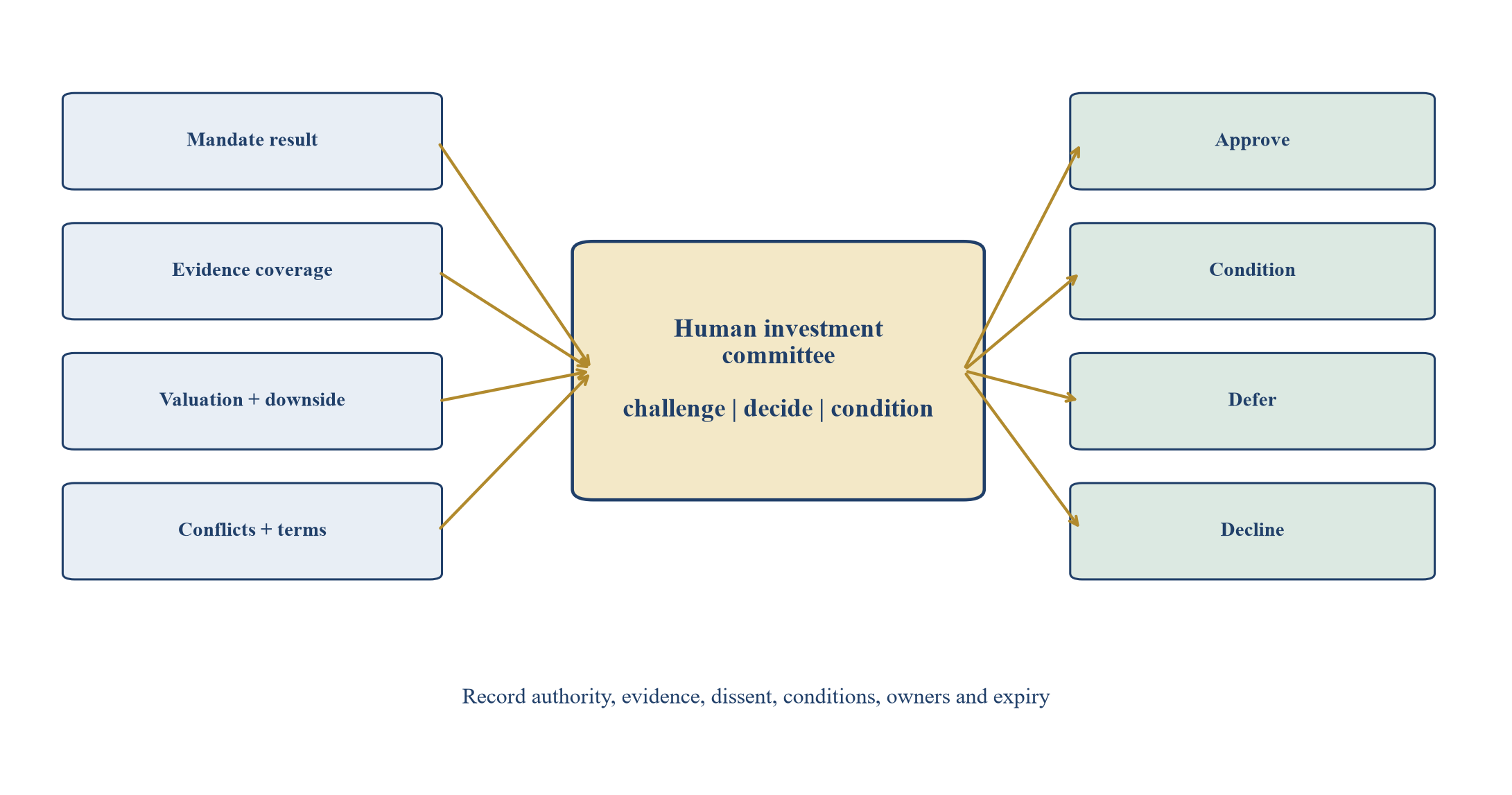
Proposed committee system. Agents support preparation and monitoring while authority remains with constituted decision makers.
| Packet component | Minimum content | Named owner | Committee challenge |
|---|---|---|---|
| decision and authority | action requested, vehicle, amount, security, authority and expiry | committee secretary | is the committee authorised and properly constituted? |
| mandate and portfolio | rule results, exceptions, exposure bridge and liquidity | chief investment officer | does the transaction fit current objectives and capacity? |
| evidence and diligence | source map, coverage, critical findings, contrary evidence and gaps | deal lead | which conclusion would change with new evidence? |
| economics and valuation | reconciled history, cases, price, terms, dilution and returns | finance reviewer | where can value or liquidity fail? |
| conflicts and compliance | relationships, sanctions, allocation, treatment, recusal and consent | conflicts owner | is the treatment adequate and documented? |
| ownership plan | conditions, milestones, board plan, reporting and follow-on policy | portfolio owner | can the office govern and fund the investment after close? |
The packet should allow a qualified reviewer to reproduce the decision from retained evidence and approved assumptions.
12. Work through a hypothetical GCC direct investment
Consider a hypothetical GCC family office reviewing a minority growth investment in a regional business-to-business software company. The company seeks USD 24 million to expand sales, complete product localisation and provide limited liquidity to early shareholders. The family office is considering a USD 10 million subscription with a board observer right and pro rata participation. Every amount, probability, score, valuation and return in this section is a modelling assumption used only to demonstrate the framework.
The mandate permits GCC technology growth investments between USD 5 million and USD 15 million, subject to a single-name limit, a minimum liquidity reserve and committee approval. The agent confirms apparent eligibility but flags two matters. A family operating company is a small customer of the target, and an adviser introducing the transaction also expects a success fee from the company. The conflicts owner requires specific disclosure, excludes the customer relationship team from commercially sensitive material and appoints an independent reviewer for the adviser's market claims.
The evidence workspace receives 386 files. Hash and entity controls identify twelve superseded files and three inconsistent capitalisation tables. Revenue in the management presentation exceeds the accounting ledger by USD 1.7 million because signed but unimplemented contracts were included. The deal team restores ledger revenue as the historic base and retains the contracts in a separate backlog schedule. This change reduces the central growth case and increases the required follow-on reserve.
The eligibility gate passes after the conflicts treatment and portfolio exposure review. The attractiveness score is favourable on customer retention, product differentiation and cash gross margin, mixed on sales efficiency and management depth, and weak on valuation evidence. Evidence coverage is 82 percent under the hypothetical scoring method. The missing items are a completed cyber test, two customer references, a tax opinion and confirmation of preference terms.
The central scenario assumes revenue grows from USD 18 million to USD 34 million over three years, cash break-even occurs in year two and the next round is not required. The downside assumes revenue reaches USD 25 million, break-even is delayed eighteen months and an additional USD 12 million round dilutes the family office. The severe case assumes customer concentration loss, a financing round at a lower valuation and no exit within seven years. These assumptions are analytical inputs and not forecasts.
At the proposed terms, the central case produces an illustrative 2.1 times gross money multiple over five years. The downside produces 1.1 times over six years, and the severe case produces 0.45 times with continuing illiquidity. The agent calculates the cases and traces every formula. Finance independently recreates the security-level proceeds and finds that an option-pool increase was omitted from the first model. The corrected central case declines to 1.9 times.
The readiness gate remains open until the cyber test, tax opinion, customer references and preference terms are complete. The investment committee provides conditional approval at a lower valuation ceiling, requires a minimum information-rights package, preserves pro rata participation, prohibits secondary liquidity above a stated amount and assigns an ownership lead. The conditions register identifies evidence, owner and expiry. No condition can be cleared by the agent alone.
The case demonstrates the role of the architecture. Agentic workflow reduces the effort required to index documents, reconcile claims, compare versions, run scenarios and assemble the packet. Human owners interpret mandate, decide conflict treatment, challenge management, set valuation assumptions, negotiate rights and approve capital. The record shows how evidence and judgement produced the decision.
13. Implement the system through a ninety-day control plan
The first thirty days establish governance. Confirm the legal entities, investment mandate, decision authorities, conflict policy, confidentiality rules, data classification, approved technology and risk appetite. Inventory opportunity sources, portfolio records, committee templates, models and external advisers. Select a limited pilot use case and prohibit external action.
Days thirty-one to sixty build the controlled workspace. Define identifiers, provenance fields, document classes, mandate rules, screening dimensions, exception logic, tool permissions, prompt-injection controls, model registry and event logs. Configure the committee packet and conditions register. Test with historic opportunities that have known records while protecting confidentiality.
Days sixty-one to ninety validate and operate. Compare agent extraction with human review, measure false matches, test rule accuracy, reproduce calculations, red-team malicious documents, verify deletion and incident processes, and conduct a full committee dry run. Independent reviewers should test whether material claims link to evidence and whether the system can be stopped or overridden.
Define operating measures before launch. Measures may include intake time, document coverage, extraction error, unresolved contradiction, rule exception, conflict escalation, model reproducibility, reviewer effort, condition ageing and post-investment forecast variance. Throughput is useful only when decision quality and control remain acceptable.
Govern changes through release management. New models, prompts, data sources, rules and tools require testing and approval proportionate to their decision impact. Run old and new versions in parallel for material changes. Preserve the version used for each committee packet. A system update should not rewrite the evidence behind a prior decision.
| Control area | First thirty days | Days thirty-one to sixty | Days sixty-one to ninety | Escalation example |
|---|---|---|---|---|
| governance | mandate, authority, policy and risk appetite | executable rules and approval workflow | committee dry run and sign-off | agent action outside authority |
| evidence | source inventory and data classification | provenance workspace and version controls | sampled reproduction and deletion test | material claim lacks source |
| model | use-case boundary and benchmark | registry, tests and calculation controls | out-of-sample and red-team review | unexplained or unstable output |
| security | approved environment and access roles | sandbox, allowlists, logging and secrets | injection, recovery and incident test | confidential data leaves perimeter |
| people | owners, reviewers and training needs | role-based training and escalation | observed pilot and competence review | reviewer cannot challenge output |
| monitoring | baseline process and quality measures | thresholds and exception reports | operating dashboard and change board | error or override rate exceeds limit |
Measures, owners and thresholds should be approved before the pilot influences a live investment decision.
14. Recognise limitations and research needs
Agentic systems can organise evidence and execute bounded workflows, but they cannot establish the truth of incomplete private-company information. Documents may be inaccurate, inconsistent, forged, stale or selectively disclosed. Public information may cover the wrong entity. Management representations require verification. Source provenance improves accountability while leaving underlying evidence risk intact.
Historic family-office decisions may be too few, heterogeneous or poorly recorded for reliable model training. Selection bias is severe because completed investments differ from rejected opportunities, and realised outcomes reflect ownership actions after approval. A model trained on historic success may learn sector fashion, network access or prior committee preference rather than durable investment quality.
Human oversight can become ceremonial. Reviewers may accept polished outputs, face time pressure or lack the expertise to challenge models. Effective oversight requires authority, time, evidence access, competence and incentives. Override rates alone do not establish control because a human may repeatedly confirm the system without independent analysis.
Family preferences and governance evolve. Succession, liquidity, operating-company needs, philanthropy, residence, tax and risk appetite can change the mandate. The system should not infer a new mandate from recent decisions. Formal governance should update objectives and rules with the appropriate family and entity authority.
Legal and regulatory treatment varies by vehicle, activity and jurisdiction. A single-family office, investment company, regulated manager, foundation, trust, holding company and operating business may face different duties. Cross-border data, sanctions, marketing, advisory, tax and beneficial-ownership issues require qualified advice. This paper supplies a management framework rather than a legal conclusion.
Further research should compare agent-assisted and conventional screening on matched cases, measure extraction and contradiction-detection error, test committee calibration, study bias in opportunity sourcing and evaluate whether provenance controls improve post-investment learning. Evidence should be gathered without compromising confidential transaction data or creating spurious causal claims.
15. Measure decision quality and portfolio learning
The family office should evaluate the system against decision quality rather than activity alone. Faster screening, more reviewed opportunities and shorter committee packs do not establish better investing. Measures should connect process performance to evidence quality, decision consistency, execution and realised outcomes while recognising that private-investment results emerge slowly and depend on external events.
Near-term measures can test extraction accuracy, source coverage, reconciliation, exception ageing, calculation reproduction and review effort. Decision measures can test whether committees received material contrary evidence, whether conditions were cleared correctly, whether conflicts were treated consistently and whether approvals remained inside the mandate. These measures reveal operating weaknesses before investment returns are observable.
Post-investment reviews should compare the approved thesis with realised revenue, margin, cash, financing, governance, valuation and strategic milestones. Attribute variance to source error, missing evidence, management representation, assumption, model, human judgement, negotiation, ownership execution or external shock. The categories should remain open to challenge because several causes can interact.
Rejected opportunities also carry information. Where lawful and practical, monitor later financing, operating and exit evidence without treating survival or headline valuation as proof that the original rejection was wrong. The relevant question is whether the decision was reasonable using the mandate, evidence and alternatives available at the time.
Changes to screening rules should pass through governance. A post-investment lesson may justify a revised question, evidence requirement, sensitivity or threshold. It should not allow an agent to optimise silently against a small and biased history. Record the proposed change, supporting cases, expected effect, reviewer, approval and effective date.
16. Govern advisers, introducers and co-investors
Direct investments often depend on external networks. Banks, advisers, lawyers, accountants, technical specialists, sponsors, founders, introducers and co-investors may provide access and expertise. They may also have fees, allocation interests, confidentiality obligations and relationships that affect the transaction. The opportunity record should identify each role, compensation source, mandate, information access and conflict.
Adviser instructions should define scope, deliverable, reliance, independence, timing, cost and escalation. An agent may coordinate requests and compare responses, but authorised people should appoint advisers and approve changes. Reports should be stored with assumptions, qualifications and permitted reliance. A conclusion copied from an adviser report without its scope can mislead the committee.
Introducer economics require transparency. Record success fees, retainers, equity interests, recurring arrangements and payments from other parties. Test whether the relationship influenced sourcing, valuation, diligence scope or allocation. The family office should decide how the fee affects total investment cost and whether independent verification is required.
Co-investor diligence covers authority, funding capacity, beneficial ownership, strategy, reputation, sanctions, decision timetable, information rights and conduct. Shared diligence can reduce cost but does not transfer accountability. The family office should know which work it performed, which work it relies on and which evidence it has the right to retain.
The execution plan should address information sharing, exclusivity, allocation, voting, governance, future funding, transfers, exits and dispute procedures. A co-investor's interests can diverge after closing because liquidity, return targets, fund life, strategic objectives or regulatory duties differ. The ownership plan should anticipate those differences instead of assuming alignment from the initial relationship.
17. Conclusion
GCC family offices can use agentic AI to increase the capacity and consistency of direct-investment screening when the workflow is anchored in an approved mandate, controlled evidence and accountable decision rights. The strongest use cases organise documents, trace claims, apply rules, surface gaps, reproduce calculations, compare scenarios and assemble committee records.
Investment authority remains with people who understand the family objective, entity obligations, portfolio context and transaction. They must interpret ambiguous evidence, treat conflicts, challenge management, set assumptions, negotiate terms and decide whether the expected return compensates for risk and illiquidity.
The practical standard is reproducibility. A qualified reviewer should be able to move from the committee decision back through conditions, analysis, assumptions, transformations and source evidence. The same architecture should carry forward into ownership so the family office can compare the original thesis with realised performance and improve its process through governed change.
Appendix A. Direct-Investment Evidence Request
A1. Identity, ownership and authority
Constitutional records, licences, group structure, beneficial ownership, directors and authorised signatories.
Capitalisation table, securities, options, convertibles, shareholder arrangements and historic issuances.
Seller, founder, adviser, introducer, lender, co-investor and related-party relationships.
Proposed instrument, use of proceeds, secondary liquidity, approvals and transaction timetable.
A2. Commercial, financial and operating evidence
Customer contracts, invoices, usage, cohorts, retention, backlog, pipeline and concentration.
Audited statements, management accounts, ledger extracts, bank cash, tax records, debt and working capital.
Product architecture, intellectual property, cyber controls, suppliers, employees and operating licences.
Forecast model, driver assumptions, hiring, capital expenditure, financing and scenario sensitivities.
A3. Governance and transaction readiness
Board and shareholder rights, reserved matters, information rights, conflicts policy and litigation.
Legal, regulatory, tax, data-protection, sanctions and jurisdiction-specific adviser reports.
Diligence question log, management responses, exceptions, conditions and completion evidence.
Post-close board plan, reporting pack, milestones, follow-on policy and intervention thresholds.
Appendix B. Committee and Operating Checklist
B1. Before committee circulation
Confirm the decision requested, authority, quorum, conflicts, recusals and expiry.
Reconcile the cap table, historic financials, valuation model, funding plan and security-level returns.
Link every material claim to retained evidence and distinguish facts, representations and assumptions.
Present contrary evidence, unresolved questions, downside cases and a named ownership plan.
B2. At approval and closing
Record attendance, questions, dissent, vote, conditions, delegated authority and communication limits.
Assign each condition an evidence requirement, owner, reviewer, deadline and escalation route.
Reconcile final documents, funds flow, ownership, rights, fees, conflicts and portfolio exposure.
Preserve the approved packet, model version, source hashes, minutes and completion certificate.
B3. After closing
Activate information rights, governance calendar, board priorities, cash monitoring and follow-on triggers.
Compare realised milestones, cash, valuation and risk with the approved investment case.
Record changes in management, ownership, conflicts, cyber exposure, financing and exit readiness.
Feed lessons into an approved process review without altering historic decision records.
Sources
- Organisation for Economic Co-operation and Development. OECD AI Principles, updated 2024. Read the primary source
- National Institute of Standards and Technology. Artificial Intelligence Risk Management Framework 1.0, 2023. Read the primary source
- National Institute of Standards and Technology. AI Risk Management Framework Core. Read the primary source
- International Organization of Securities Commissions. Artificial Intelligence in Capital Markets: Use Cases, Risks, and Challenges, 2025. Read the primary source
- United Arab Emirates Government. Federal Decree by Law No. 37 of 2022 Concerning Family Businesses. Read the primary source
- Dubai International Financial Centre. DIFC Family Wealth Centre. Read the primary source
- U.S. Securities and Exchange Commission. Standards of Conduct for Broker-Dealers and Investment Advisers: Conflicts of Interest, 2022. Read the primary source
- U.S. Securities and Exchange Commission. Frequently Asked Questions Regarding Disclosure of Certain Financial Conflicts Related to Investment Adviser Compensation. Read the primary source
- Institutional Limited Partners Association. Due Diligence Questionnaire 2.0, 2021. Read the primary source
- National Institute of Standards and Technology. Artificial Intelligence Risk Management Framework: Generative Artificial Intelligence Profile, 2024. Read the primary source
- National Institute of Standards and Technology. Cybersecurity Framework 2.0, 2024. Read the primary source
- Bank for International Settlements. Governance of AI Adoption in Central Banks, 2025. Read the primary source
- Bank for International Settlements. Artificial Intelligence and Human Capital: Challenges for Central Banks, 2025. Read the primary source
- Financial Stability Board. The Financial Stability Implications of Artificial Intelligence, 2024. Read the primary source
- International Organization of Securities Commissions. Principles for the Valuation of Collective Investment Schemes, 2013. Read the primary source
- International Organization of Securities Commissions. Good Practices in Relation to Investment Managers' Due Diligence When Investing in Structured Finance Instruments, 2009. Read the primary source
- International Finance Corporation. Corporate Governance Methodology. Read the primary source
- World Bank. Corporate Governance of State-Owned Enterprises: A Toolkit, 2014. Read the primary source
- European Union. Regulation (EU) 2024/1689 laying down harmonised rules on artificial intelligence. Read the primary source
- Financial Action Task Force. Guidance on Beneficial Ownership of Legal Persons, 2023. Read the primary source
- Dubai Financial Services Authority. The DFSA Rulebook. Read the primary source
- Abu Dhabi Global Market. Data Protection Regulations 2021. Read the primary source
