

Introduction
GCC space programmes increasingly depend on launch capacity controlled outside the region. Satellite communications, Earth observation, navigation, climate monitoring, defence, exploration and commercial constellations all require a reliable route to orbit. A financial stake in a global launch platform can offer exposure to that demand. It can also offer strategic benefits when the investment creates enforceable access, schedule priority, industrial participation or technology learning.
The two cases require separate evidence. Commercial enterprise value depends on flight heritage, contracted demand, mission margin, cadence, completion capital and cash generation. Strategic value depends on a defined mission need, a credible disruption scenario, the absence or cost of substitutes and rights that survive operational stress. A share certificate alone does not reserve a launch slot or transfer controlled technology.
This paper addresses acquisitions, minority investments, joint ventures, capacity agreements and programme partnerships. The decision method links every claimed benefit to an instrument, counterfactual, probability, cash consequence, owner and verification event.
1. Define the acquisition thesis
The investment committee should state the transaction thesis as testable claims. A commercial thesis may seek exposure to launch growth, an attractive entry valuation, platform consolidation or a future exit. A strategic thesis may seek priority capacity for GCC payloads, mission flexibility, resilience against geopolitical interruption, domestic manufacturing, talent development or integration with a regional satellite platform.
Each claim needs a value mechanism. Priority capacity can reduce expected delay. A domestic work package can create skilled employment and supplier revenue. Access to mission design can shorten payload integration. A board seat can improve information but does not by itself create operational control. The thesis register should distinguish the target's stand-alone cash flow, benefits available to every shareholder, buyer-specific synergies and public-policy outcomes.
The committee should also identify the first irreversible decision. Equity funding, advance procurement, site construction and technology transfer may have different dates and conditions. Staging those commitments allows evidence to arrive before the full capital is at risk.
2. Separate company value from programme value
A launch platform can contain an operating vehicle, a vehicle under development, propulsion and avionics assets, launch-site agreements, mission software, payload integration, government certifications and long-term customer relationships. Those assets mature at different rates. A single revenue multiple can conceal completion risk and capital intensity.
Programme value is the benefit of a particular GCC mission or industrial initiative. It may include avoided payload delay, continuity of a communications service, protected Earth-observation data, a domestic engineering work package or a funded test facility. Programme value belongs in the investment case only when the investor receives a right or economic interest that captures it.
The transaction model should keep three ledgers: stand-alone enterprise value; buyer-specific strategic value; and separately funded programme expenditure. This prevents capital expenditure or procurement commitments from being counted as free synergies.
3. Reconstruct verified flight history
The diligence team should rebuild every attempted mission and material integrated test from primary evidence. Record vehicle configuration, launch site, date, payload, target orbit, achieved result, customer acceptance, anomaly and corrective action. Evidence must remain configuration specific because a successful small launcher does not validate a larger vehicle, a different engine or a future site.
Certification and flight history affect the missions a GCC investor can actually place. The United States National Security Space Launch framework, for example, separates emerging providers from providers qualified for the most demanding missions. Its dual-lane design illustrates how mission assurance, demonstrated launch and competition can coexist. [8][9]
The investor should connect each claimed capability to the GCC mission manifest. Payload mass, volume, orbit, inclination, environmental limits, security and schedule determine whether the target is a feasible provider. General flight heritage has limited strategic value if the target configuration cannot serve the required mission.
4. Measure cadence as repeatable throughput
Cadence is the number of completed and accepted missions the full operating system can sustain. It depends on vehicle production, engine supply, test capacity, payload readiness, range access, licensing, launch-site operations, weather, mission engineering and customer decisions. A launch calendar that ignores these constraints is a sales plan rather than a capacity model.
Measure scheduled-to-actual variance, turnaround time, work in process, manufacturing cycle, engine-test throughput, launch-site occupancy and causes of delay. Separate target-controlled delay from customer, range and weather delay. Both affect cash timing, while remediation differs. Cadence receives valuation credit after repeated delivery across representative missions, sites and operating conditions.
5. Underwrite reliability and learning
Reliability should be measured at vehicle, stage and critical-system level. The sample for a new private launcher will initially be small. A buyer should therefore combine flight results with qualification margins, acceptance testing, manufacturing yield, non-conformance records, supplier escapes, telemetry and closure of anomalies. The analysis should report the size and relevance of each evidence set rather than imply statistical confidence that the sample cannot support.
Learning has financial value when it reduces cycle time, defects, rework, launch delay or required contingency. The buyer should compare planned and actual labour, material, test and launch-site use across builds. A successful first orbital mission supports a higher milestone score. Repeatable production and accepted customer missions support a separate cadence score.
Strategic access requires its own reliability chain. Recovery survival, post-flight inspection, component life, refurbishment labour, replacement parts, recertification, turnaround and successful reflight are distinct milestones. A recovered stage that cannot be economically returned to service has salvage or data value, not demonstrated access-linked-service value.
6. Classify backlog by enforceability
Backlog should be reconstructed contract by contract. Record executed value, funded amount, customer options, deposits, termination rights, launch windows, price escalation, performance conditions, assignment restrictions and change-of-control consent. Reconcile the schedule with accounting records, cash receipts and customer confirmations.
Public-company disclosure shows why definitions matter. Rocket Lab's 2025 filing separated launch-services backlog from space-systems backlog, excluded unexercised customer options and described termination rights. Such disclosure is useful evidence for market practice, while a private target's own contracts and ledger remain the valuation authority. [12]
The model should classify firm funded orders, framework ceilings, options, letters of intent and internal pipeline. Strategic demand from an investor or government should not enter target backlog until documented through an enforceable order or capacity agreement.
7. Verify government backlog
Government-linked demand can support value when an appropriation, obligation, task order or executed service contract exists. Policy intent, strategic importance and framework eligibility remain context until they create an enforceable payment or minimum commitment.
The United States Space Force's 2025 Phase 3 Lane 2 awards show a documented example: firm-fixed-price requirements contracts, named providers, anticipated values and projected mission allocations. GAO separately explains how the dual-lane structure seeks competition, mission success and assured access. The economic treatment follows the contract and assigned missions, not the policy language alone. [8][9]
For GCC demand, diligence should obtain the approved payload programme, funding, procurement route, launch-service instrument, mission window, acceptance criteria and cancellation rights. A sovereign investor should avoid capitalising its own future procurement twice; once in target backlog and again as strategic value.
8. Distinguish frameworks from funded orders
A framework can establish eligibility, pricing rules and a maximum ceiling. It does not ordinarily guarantee orders up to that ceiling. Base-case value should include guaranteed minimums and issued, funded call-offs after delivery-cost and cancellation analysis.
Institutional launch programmes often use staged qualification. ESA's European Launcher Challenge requires an orbital demonstration and provides later contributions to operational launches, while the United States NSSL structure uses differentiated lanes and mission-assurance requirements. These mechanisms provide useful structuring precedents for GCC capacity procurement. [8][9][10][11]
The investor should record strategic eligibility as an option with remaining cost, timing and probability. It should move into the operating case only after the relevant qualification and order evidence exists.
9. Test commercial customer quality
Commercial customers vary in credit, mission readiness and financing. A launch contract with a funded satellite programme and completed payload can have greater conversion probability than an agreement with an early-stage constellation still raising capital. Diligence should examine the customer's financing, spacecraft production, regulatory approvals, spectrum position, insurance and launch dependency.
The contract schedule should include customer deposits, milestones and cancellation behaviour. Customer interviews can test launch-date priority, switching alternatives and willingness to accept a different vehicle or window. Revenue scenarios should avoid assuming every customer is ready when the target is ready. A launch company can appear supply-constrained while a material portion of its manifest remains customer-constrained.
10. Map deposits and cancellation rights
Deposits provide evidence of commitment only after their legal and accounting treatment is understood. The buyer should identify whether each amount is refundable, credited against launch price, forfeitable after a date, secured, held in escrow or subject to performance conditions. Cash already spent on vehicle production can create a future delivery obligation without providing future liquidity.
Cancellation clauses should be modelled under customer delay, target delay, mission failure, licensing delay and force majeure. The economic result may include refund, termination fee, replacement flight, priority rebooking or damages cap. These outcomes affect both backlog value and working capital. The quality of a manifest is partly the quality of its cancellation economics.
11. Normalize pricing and mission mix
Headline price per launch can obscure mission-specific services. Price may include payload processing, range support, mission design, separation systems, special studies, schedule priority, responsive-launch capability, insurance or orbital transfer. Normalize each mission to a standard configuration and separately value mission-unique work.
The transaction model should therefore reconcile quoted price with the signed statement of work and the accounting ledger. It should identify whether revenue belongs to launch, integration, engineering, site services or reimbursable items. A consistent mission bridge allows the buyer to compare price, scope, cost and cash contribution across customers and vehicle configurations.
12. Build per-launch unit economics
The buyer should construct cost per accepted mission from bill of material, engine and stage production, direct labour, test, consumables, freight, integration, launch-site operations, range charges, mission-unique engineering, insurance, allocated support and expected rework. Separate recurring cost, fixed operating cost and programme development.
Margin should be reconciled at mission and cohort level. A target may report improving unit cost while shifting development labour, overhead or launch-site expense elsewhere. The model should compare management's standard cost with purchase orders, payroll, inventory movements and actual mission closeouts. Cash contribution matters because revenue recognition can precede or follow mission delivery.
13. Model fixed-cost absorption
Launch businesses carry facilities, engineering, range, safety and programme-management costs that do not move proportionally with missions. Higher cadence can improve absorption if the additional flights use available capacity and do not require another site, factory or shift structure. The model should therefore represent capacity in steps rather than assume a smooth cost curve.
At each cadence level, identify headcount, engine-test slots, stage flow, integration bays, pad occupancy, maintenance windows and supporting capital. A ten-mission plan that needs a second production line should include its completion cost and ramp loss. Fixed-cost absorption creates value after the system passes its next bottleneck.
14. Underwrite engine and vehicle supply
Supply diligence should trace propulsion, structures, avionics, valves, tanks, composite materials, separation systems and controlled components to qualified sources. Record lead times, minimum orders, sole-source exposure, export classification, quality history, tooling ownership, intellectual-property rights and change-of-control provisions.
The buyer should test whether the forecast cadence can be supported by released purchase orders and supplier capacity. A target can hold a large manifest while lacking engines or long-lead components for the scheduled year. Supplier substitution can require redesign, qualification and regulator engagement. Inventory should be assessed for configuration obsolescence and recoverability after programme changes.
15. Assess launch-site and range access
Launch-site access includes authorisation, physical capacity, range services, scheduling, payload processing, ground systems, storage, security, insurance and termination rights. A target may own launch hardware while depending on third-party infrastructure and government scheduling.
Range congestion can affect economics and strategic access. GAO reported that commercial launches at United States federal ranges had more than quadrupled since 2021 and identified infrastructure and cost-recovery challenges. ESA's 2025 spaceport arrangements address new operators, schedule conflicts and range access. Oman has publicly presented Etlaq Spaceport as a regional launch-infrastructure initiative. [4][9][13]
The GCC investor should verify whether its rights apply during congestion, national emergencies, vehicle delays and site outages. A priority clause needs an allocation mechanism, remedies, alternate site and governance process. Strategic value should reflect usable access under the stress scenario rather than nominal annual capacity.
16. Review manufacturing capacity
Factory capacity should be demonstrated through routing, cycle time, yield and work-in-process. The buyer should walk the production line and reconcile serial numbers, material status, non-conformance, labour bookings and stage completion. Prototype facilities often require different controls to support repeatable production.
Capacity should be modelled at the constraint, which may be engine test, tank production, avionics acceptance, final integration or site logistics. Overall floor area provides limited evidence. The buyer should require a funded debottlenecking plan, supplier commitment and quality controls before valuing the higher cadence case.
17. Test schedule realism
An integrated master schedule should connect engineering release, supplier delivery, manufacturing, qualification, licensing, site readiness, payload availability, range windows and customer milestones. Each critical path needs an accountable owner and evidence of duration. Schedule reserve should reflect maturity and historical variance.
The transaction model should preserve date-specific cash effects. A launch delayed across a fiscal period can change revenue recognition, milestone receipts, working capital and covenant compliance. Multiple missions relying on the same unresolved qualification test should be treated as correlated rather than independent.
18. Evaluate licences and regulatory approvals
The transaction can require launch licences, site permissions, payload approvals, spectrum and communications authorisations, export licences, foreign-investment review and national-security clearances across several jurisdictions. Diligence should map each current and planned activity to the responsible authority, licence holder, conditions, validity period and change-of-control treatment.
The UAE's regulatory framework and 2025 digital licensing platform show the region's continuing formalisation of space-sector permissions. The UAE Space Agency's July 2026 notice called for entities to regularise status under Federal Decree-Law No. 46 of 2023. These measures support a governed ecosystem and require transaction-specific compliance review. [6][7]
The completion schedule should include every approval needed for investment, technology access, mission integration and local activity. Restricted data should remain outside diligence access until lawful controls are in place.
19. Review mishaps and corrective actions
Incident diligence should cover flight failures, test events, pad damage, near misses, safety occurrences and material quality escapes. the GCC investor's home market's recent private-launch milestones demonstrate the importance of configuration-specific evidence across suborbital tests, vertical test flights and orbital missions. Transaction diligence requires the underlying technical record: telemetry, causal analysis, corrective actions, independent review, requalification and acceptance by the responsible authority. [3][5][6][7]
Regulatory closure does not by itself establish economic closure. A corrective action may increase mass, reduce payload, extend inspection, change a supplier or consume future test inventory. The buyer should update mission performance, cadence, unit cost, insurance and liquidity for every material action. Shared causes across vehicle, site and range should be treated as correlated risks.
20. Verify sovereign demand
Sovereign demand should be defined mission by mission. Record payload function, mass, orbit, required launch date, security level, mission consequence, available providers, switching time and procurement funding. This converts the broad phrase assured access into an operational requirement.
The UK Space Strategy describes assured access as the ability to place satellites into orbit reliably, securely and when needed, using domestic capability and trusted partnerships. ESA and the United States use multiple-provider strategies to support autonomy, resilience and competition. These are useful policy precedents. A GCC investor must still establish its own mission need and lawful procurement route. [8][9][10][14]
Strategic value should equal the expected economic consequence changed by the acquired right. The model can include avoided delay, protected downstream revenue, alternative-provider premium, remanifest cost and probability of disruption. National importance without a measurable counterfactual belongs in the policy narrative rather than enterprise value.
21. Review investment screening and export controls
Launch technology, propulsion, guidance, mission software and technical data can be subject to export controls and national-security restrictions. The buyer should classify hardware, software, data, services, personnel access and re-export before assuming technology transfer or integration.
Foreign-investment regimes may review ownership, control, governance, information rights and government contracting. The United States CFIUS framework, United States export-control rules and the United Kingdom National Security and Investment Act are examples of jurisdictional controls that may affect a global launch investment. [15][16][17]
Transaction documents can use information barriers, proxy arrangements, restricted committees, governance limits, local subsidiaries, closing conditions and long-stop dates. The valuation should exclude a technology or control benefit until counsel confirms a lawful path.
22. Assess intellectual-property control
The diligence team should map patents, trade secrets, source code, vehicle designs, propulsion data, manufacturing know-how, test records, mission software, trademarks and government rights. Ownership should be distinguished from a licence, restricted use right or supplier dependency. The target may own a system architecture while lacking the right to disclose or transfer essential technical data.
A GCC investor should identify the precise intellectual property required for each claimed benefit. Reserved launch capacity may require little technology transfer. Local integration may require interface data and training. Local component manufacture may require drawings, process specifications, tooling, quality systems and continuing engineering support. The transaction should seek only rights that are lawful, necessary and operationally usable.
The value model should reduce industrial-participation value where rights expire, depend on consent, exclude improvement rights or cannot be used by local personnel. Escrow and step-in mechanisms can support continuity, subject to export and security restrictions.
23. Test insurance and liability
Launch liability can arise across the launching state, operator, site, customer, payload owner and insurer. The diligence team should map treaty obligations, national law, licence conditions, contractual indemnities, insurance, waivers of claims and recourse for every proposed mission. The United Nations liability and registration conventions provide international context, while national implementation and contract terms determine transaction treatment. [23][24][25]
Insurance review should address launch failure, third-party liability, payload damage, site damage, business interruption, cyber events, directors' liability and political risk. Record limits, deductibles, exclusions, aggregation, collateral and claims history. A reserved mission right has less value if the investor bears an uninsured replacement or delay exposure.
The model should include premiums, deductibles, replacement-flight obligations and the liquidity needed after an incident. Known events should be allocated through specific protection. Future operating risk requires funded capital and continuing controls.
24. Model working capital and cash conversion
Launch cash flow depends on deposits, milestone billing, long-lead procurement, inventory build, testing, site activity, launch acceptance, refunds and replacement obligations. Annual revenue and EBITDA can conceal a large pre-launch liquidity trough. The investor should construct a mission-level cash curve from contract signature through final acceptance.
Customer advances should be reconciled with remaining performance obligations. Cash already used for development may leave the buyer responsible for completing future missions without corresponding collections. Supplier terms, inventory obsolescence and configuration changes should be reflected in the completion model.
The strategic instruments create separate cash flows. Capacity prepayments, integration funding and local work-package expenditure should be tracked independently from equity funding. Restricted cash and security arrangements should be visible. The downside case should test delayed missions, customer cancellation, additional qualification and simultaneous industrial spending.
25. Fund remaining development and completion
Remaining development capital should be estimated from engineering work packages. The estimate should cover design closure, vehicle hardware, propulsion, software, qualification, site integration, mission assurance, regulatory work, contingency and working capital. Historic expenditure is not a reliable percentage proxy for the cost to complete.
The plan should identify the next value-changing milestone, evidence required, budget, schedule, dependency and responsible owner. A GCC investor may fund corporate development, a specific vehicle, a mission integration package or local capability. Each funding stream should have clear use restrictions and governance.
Completion funding belongs in the enterprise-value bridge. The board should test whether additional capital creates pro rata value for all shareholders or delivers a buyer-specific strategic benefit. Milestone tranches, preferred instruments, warrants and co-funding can allocate risk while preserving the target's ability to operate.
26. Value government relationships carefully
Government relationships create value through institutional capabilities: certification, accepted performance, cleared facilities, procurement eligibility, lawful data access and repeat delivery. Meetings, memoranda and policy endorsements provide context. They should not be valued as contracts.
The investor should map each claimed relationship to an office, programme, authority, instrument and decision process. Concentration risk should reflect budget cycles, termination rights, political change and competing providers. Strategic relationships can also restrict ownership, information access or mission allocation.
Where the GCC investor can contribute government demand, that benefit is buyer-specific. The purchase price should not award the seller full value for revenue that depends on the buyer's future procurement, balance sheet or diplomatic relationships.
27. Value technology options separately
Technology options can include a new vehicle, reusable stage, responsive launch, orbital transfer, mobile launch, alternative propellant or regional integration capability. Each option needs a technical definition, budget, date, probability, customer need and economic consequence.
Strategic access is also an option sequence. The investor may first acquire information and governance rights, then reserve capacity, then fund mission integration, then exercise launch orders. Value should rise as the right becomes enforceable and the mission becomes funded and ready.
Industrial participation should be valued through specific work packages. Local assembly, component manufacture, test facilities, software, mission operations and training require scope, intellectual-property rights, qualification criteria, volumes and funding. A broad localisation promise without those elements should receive no quantified value.
28. Apply evidence-weighted valuation
The valuation should triangulate mission contribution, discounted cash flow, comparable companies, precedent transactions, replacement cost and strategic option value. Multiples require normalization for vehicle maturity, service mix, backlog definition, capital intensity, government concentration and accounting policy. A space-systems company with launch operations is not directly comparable to a pure launch provider.
Fair-value and impairment standards provide general principles for market-participant assumptions, cash-generating units and identifiable intangibles. Transaction teams should apply the relevant accounting framework with advisers and auditors. [24][25][26]
29. Construct the hypothetical transaction
The worked case assumes USD 3,200 million of stated backlog: USD 1,500 million of funded firm orders, USD 900 million of framework capacity, USD 500 million of customer options and USD 300 million of letters or internal pipeline. Evidence weights of 85 percent, 20 percent, 20 percent and 5 percent produce USD 1,570 million of economic backlog before delivery cost. All figures are hypothetical.
The unadjusted present value is USD 5,800 million. The bridge deducts USD 1,400 million of remaining development and completion capital and USD 900 million for schedule, reliability, site, concentration and demand risk. It adds USD 650 million of buyer-specific assured-access value and USD 450 million of verified industrial-participation value. The resulting illustrative enterprise value is USD 4,600 million.
The assured-access value assumes four defined missions over six years, a disruption probability, alternative-provider delay, remanifest cost and downstream service consequence. The industrial value assumes funded local work packages with qualification milestones and margins. Neither value exists for the seller generally; both depend on the GCC investor's assets, mission needs and programme funding.
30. Stress cadence cost and backlog
The downside case should combine lower cadence, delayed vehicle qualification, weaker backlog conversion, site congestion, customer cancellation and higher completion capital. These variables are correlated. A vehicle delay can trigger customer termination, reduce fixed-cost absorption and defer the investor's own mission.
The strategic case needs its own stress tests. If another provider can launch within the same window at a modest premium, assured-access value falls. If the required orbit or security profile has only one credible provider, value may rise while concentration risk also rises. If export restrictions block mission integration, the value can fall to zero despite an equity stake.
The board should see commercial return with and without the investor's own procurement. This reveals whether the target can stand independently or relies on the buyer to support valuation.
31. Structure consideration and protection
The transaction can separate equity from strategic rights. Equity buys participation in the company's cash flows. A capacity agreement reserves defined missions. A prepayment funds specific production. Warrants compensate the investor for underwriting risk. Milestone consideration connects price to flight, certification, backlog and cadence. A local joint venture governs industrial work.
Reserved capacity should define vehicle, orbit, annual slots, notice, priority, price, escalation, substitution, cancellation, force majeure and remedies. Industrial commitments should define work packages, qualification, intellectual property, local content, volumes and clawback. Governance rights should identify information access, conflicts and reserved matters.
This modular structure makes each benefit auditable and reduces the risk that a strategic premium is paid for non-binding intentions.
32. Plan integration before signing
A GCC investment may require operating integration without full corporate control. The Day-One plan should cover mission coordination, security, export-controlled data, board governance, procurement, programme reporting, local work packages and crisis escalation.
Technical authority and flight safety should remain clear. Commercial pressure to meet an investor mission should not bypass configuration control or mission assurance. Information barriers should be operational before sensitive diligence begins.
The first hundred days should convert promises into baselines: confirmed mission slots, interface-control documents, local supplier qualification, staffing, facility plans, budgets and regulator engagement. Each workstream needs an accountable owner and evidence date.
33. Define the acquisition decision
Approval requires a positive commercial case or an explicitly authorised strategic subsidy. The board should state the stand-alone value range, buyer-specific value, programme expenditure, expected financial return and strategic outcomes separately.
The decision record should identify which rights survive provider distress, site outage, change of control and geopolitical interruption. It should also show whether the investor can transfer, sell or retain capacity rights if the equity investment is exited.
The final recommendation should specify price, ownership, funding commitment, strategic instruments, conditions, downside liquidity and stop-loss triggers. Each quantified strategic benefit should point to a mission, counterfactual and enforceable right.
Conclusion
GCC investment in a global launch platform can create financial return, strategic access and industrial capability. These outcomes arise through different mechanisms and require different evidence. Enterprise value follows target cash flow and risk. Assured-access value follows a defined mission counterfactual and enforceable capacity rights. Industrial value follows funded work packages, technology permissions and measurable delivery.
The proposed framework keeps those value pools separate and reconnects them through a transparent transaction bridge. It tests flight heritage, backlog, cadence, unit economics, completion capital, range access, regulation and concentration before adding buyer-specific benefits.
A disciplined structure can combine equity, launch procurement, capacity reservation and industrial partnership while preserving accountability. The investment committee can then decide how much it is paying for a company, how much for a strategic service and how much for a national capability programme.
Appendix A. Flight and cadence checklist
Reconstruct every mission by configuration, site, scheduled window, actual date, payload, target orbit, achieved result, customer acceptance and anomaly. Reconcile forecast cadence with serialized hardware, engine-test capacity, supplier releases, site windows, licence scope and payload readiness.
For each GCC mission, document compatible vehicles, required integration lead time, mission-assurance standard, security constraints and alternative launch windows. Record the operational evidence date and responsible verifier. Cadence should be measured through completed missions, planned-to-actual variance, turnaround, rework, site occupancy and target-controlled delay.
Appendix B. Backlog checklist
For every agreement, record funded amount, ceiling, minimum guarantee, task order, option, deposit, cancellation right, launch window, escalation, change-of-control consent, customer readiness and expected margin. Reconcile legal rights with recognised revenue, remaining performance obligations, deferred revenue, invoices and collected cash.
Identify contracts sharing one customer budget, payload programme or regulatory approval. Show GCC investor procurement separately and remove circular value where the buyer's future spending is used to justify the price it pays today.
Appendix C. Technical and regulatory checklist
Review configuration control, qualification, telemetry, corrective actions, software, cyber security, intellectual property, export classification, launch licences, site permissions, insurance and government security. Map every sensitive dataset and controlled component before diligence access.
For each jurisdiction, record investment-screening trigger, filing party, review period, mitigation, foreign-ownership limit and closing dependency. Each red issue should result in priced remediation, a condition, a covenant or an explicit acceptance decision.
Appendix D. Financial checklist
Build mission-level revenue, cash collection, recurring cost, fixed cost, development spend, working capital and replacement obligations. Present base, downside and severe-downside liquidity with committed funding.
Add a separate strategic-value schedule showing each GCC mission, disruption probability, alternative cost, delay consequence, capacity right and expected value. Add an industrial schedule showing local work package, qualification cost, revenue, margin, employment and technology rights. Do not net programme expenditure against enterprise value without showing both sides.
Appendix E. Transaction checklist
Separate equity, reserved capacity, mission prepayments, local joint venture funding and milestone consideration. Define closing conditions, regulatory filings, representations, escrow, indemnities, governance, information barriers and integration accountability.
The board claim register should connect every material value claim to a contract, flight record, cost schedule, mission requirement or independent confirmation. It should state who verified the claim, when, what remains open and which valuation line depends on it.
The definitive agreements should define the relationship among shareholder rights, launch-service obligations and industrial commitments. A default under one instrument should not automatically terminate the others unless that result is deliberate and proportionate. The investor should identify which rights remain enforceable after a missed milestone, financing shortfall, licence suspension, launch failure, restructuring or insolvency. Security over prepayments, escrow, parent guarantees, step-in rights and source-code or technical-data escrow may be relevant where lawful and operationally useful. Their value depends on whether the investor can actually exercise them during a disruption.
Capacity rights require an operating rulebook. The documents should specify the annual planning cycle, payload interface deadline, slot confirmation process, priority hierarchy, readiness tests, rescheduling, substitute vehicle, alternate site, pricing adjustment and dispute route. The investor should understand whether priority means first choice during normal planning, protection after a provider delay or displacement of another customer during an emergency. Each formulation has a different commercial cost and strategic benefit.
Localisation commitments should be translated into a schedule of work packages. For each package, record design authority, production scope, qualification standard, required equipment, responsible entity, intellectual-property licence, export approval, workforce plan, minimum volume, target cost, acceptance process and remedy. Training without the right to use the resulting knowledge can have limited operational value. Equipment without recurring work can become stranded capacity. Minimum-volume commitments can create capability while also transferring demand risk to the GCC investor.
Governance should address conflicts between shareholder return and sovereign mission priority. A reserved matter may protect capital allocation, yet operational decisions require a defined technical authority. The board should establish how a priority mission is approved, priced and disclosed; how related-party procurement is benchmarked; and how directors handle confidential government information. Independent committees, recusal rules and documented pricing can preserve accountability.
The funding plan should match each commitment to a source. Equity funds the target's corporate plan. Mission prepayments fund identified hardware and integration. Industrial grants or programme budgets fund local capability where public objectives justify expenditure. Debt should be serviced from predictable cash flows and should not rely on an unexercised strategic option. The model should show draw conditions, restricted cash, minimum liquidity, covenant headroom and funding remedies under delay.
Exit planning should begin before signing. The investor should decide whether capacity and industrial rights survive a sale of shares, whether another GCC entity can receive them, and whether the target can terminate them after a change in control. A strategic stake with non-transferable benefits may have a smaller buyer universe and a different exit value from ordinary equity. The committee should therefore report financial exit value separately from the continuing value of mission access.
Post-close assurance should test the facts that justified the transaction. A quarterly dashboard can report flight performance, backlog conversion, completion spend, liquidity, mission-slot status, industrial work-package delivery, regulatory conditions and unresolved security issues. Each exception should identify economic effect, owner, remedy and decision date. Annual remeasurement should compare the original strategic counterfactual with current substitute providers and mission requirements. If alternative launch supply improves, the premium for access may decline; if concentration or disruption risk grows, reserved capacity may become more valuable.
The board should also define termination and reset triggers. Examples include failure to achieve a required flight milestone, loss of a material licence, inability to provide an agreed orbit, prohibited technology transfer, repeated schedule displacement, insolvency risk or failure to fund a committed work package. The response can include repricing, suspension, conversion of prepayment, exercise of a warrant, replacement service or orderly withdrawal. Clear triggers preserve capital discipline while allowing the programme to respond to new evidence.
Appendix F. Decision figures and tables
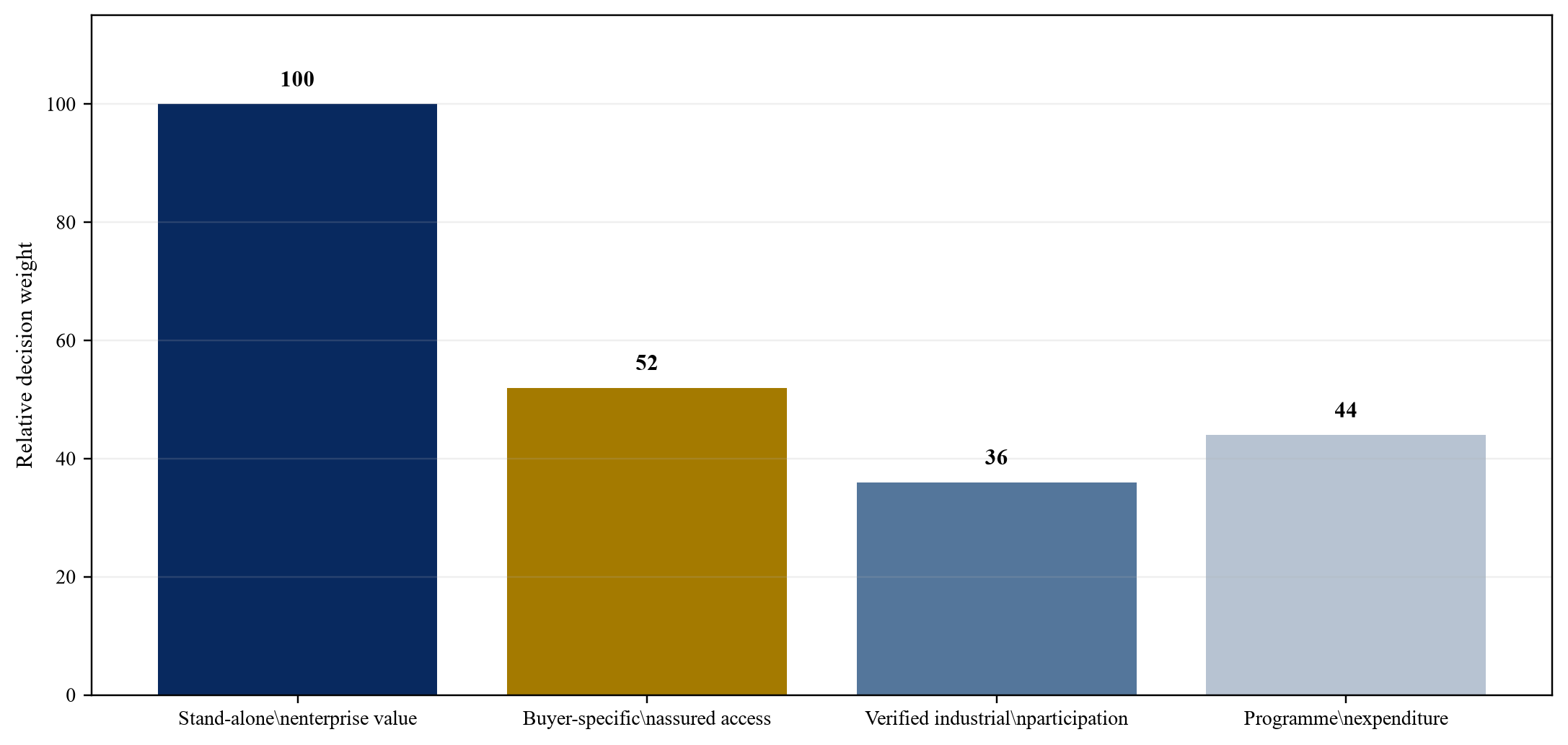
Proposed decision framework; scores are conceptual rather than empirical.
| Claim | Required evidence | Valuation treatment |
|---|---|---|
| Priority launch access | binding capacity agreement and allocation rules | expected avoided delay net of fees |
| Industrial participation | funded qualified work package | project cash flow and measurable spillover |
| Technology learning | lawful data rights training and retained capability | costed programme benefit |
| Board influence | enforceable governance rights | risk control rather than operating revenue |
| Policy alignment | approved strategy or programme | context until linked to a funded instrument |
Proposed evidence treatment.
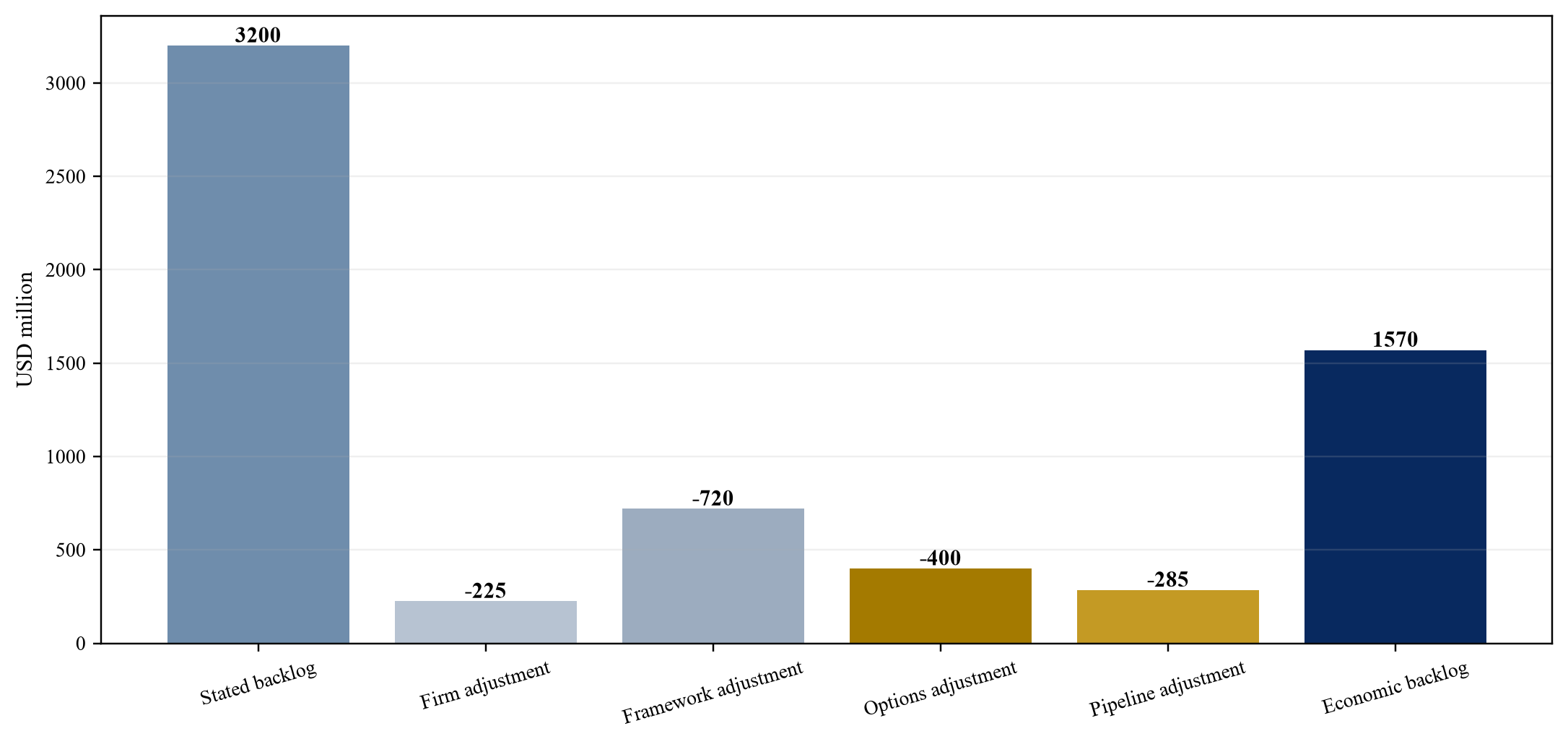
Wholly hypothetical; USD million.
| Variable | Evidence | Decision use |
|---|---|---|
| Required mission date | approved payload programme | defines delay exposure |
| Compatible providers | technical and regulatory screening | establishes substitutes |
| Alternative launch window | provider confirmation | measures remanifest delay |
| Downstream consequence | service and programme model | quantifies economic exposure |
| Acquired right | signed capacity and priority terms | determines value captured |
Proposed mission-level analysis.
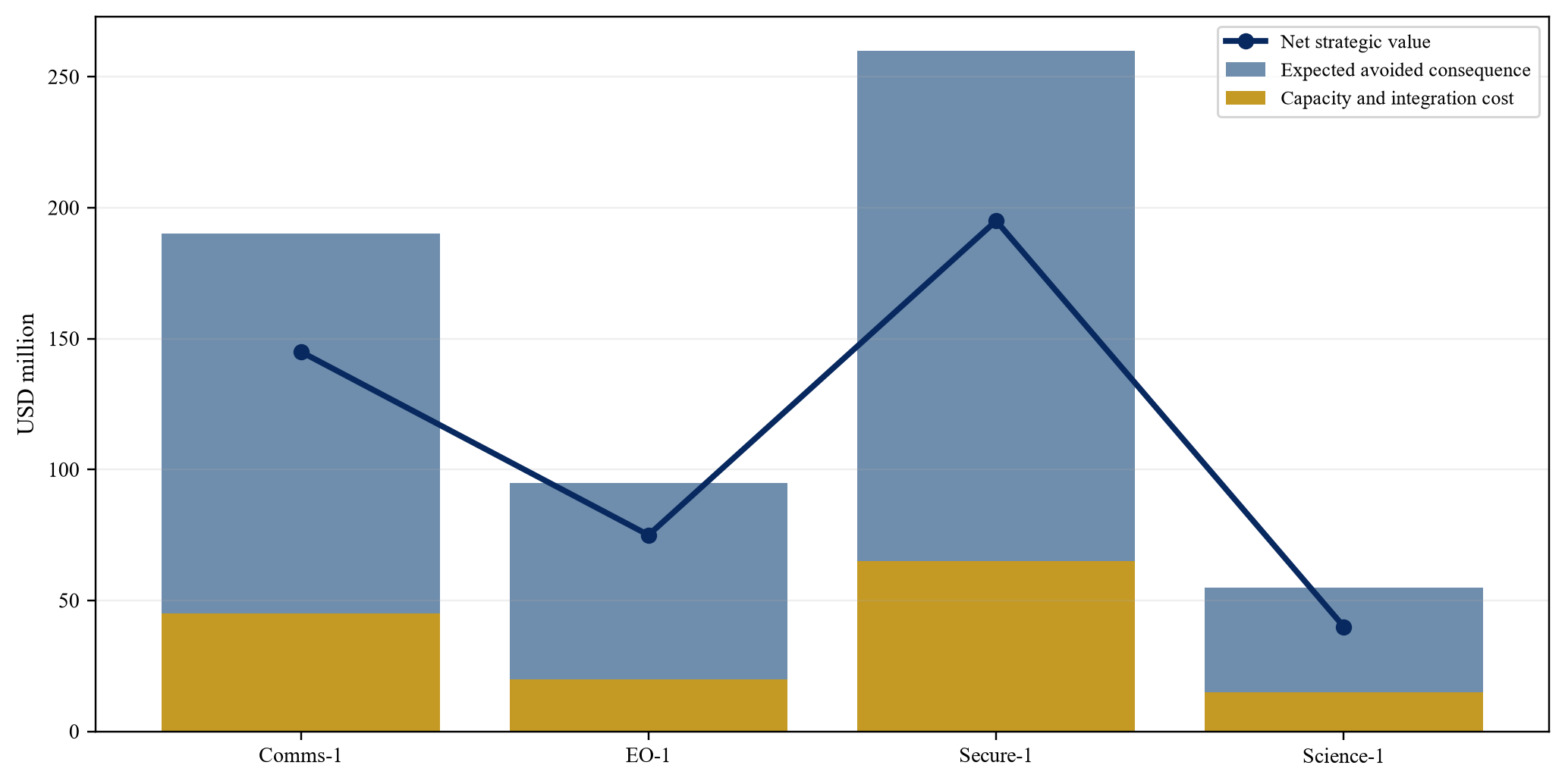
Wholly hypothetical; USD million by mission.
| Instrument | Principal right | Main diligence question |
|---|---|---|
| Equity | share of enterprise cash flow | is stand-alone return investable |
| Capacity agreement | defined launch slots and priority | does the right survive congestion and distress |
| Mission prepayment | funded production and integration | what security refund and substitution apply |
| Local joint venture | domestic work and capability | are work packages rights and volumes binding |
| Warrant or milestone | upside linked to de-risking | is the trigger objective and auditable |
Proposed separation of rights.
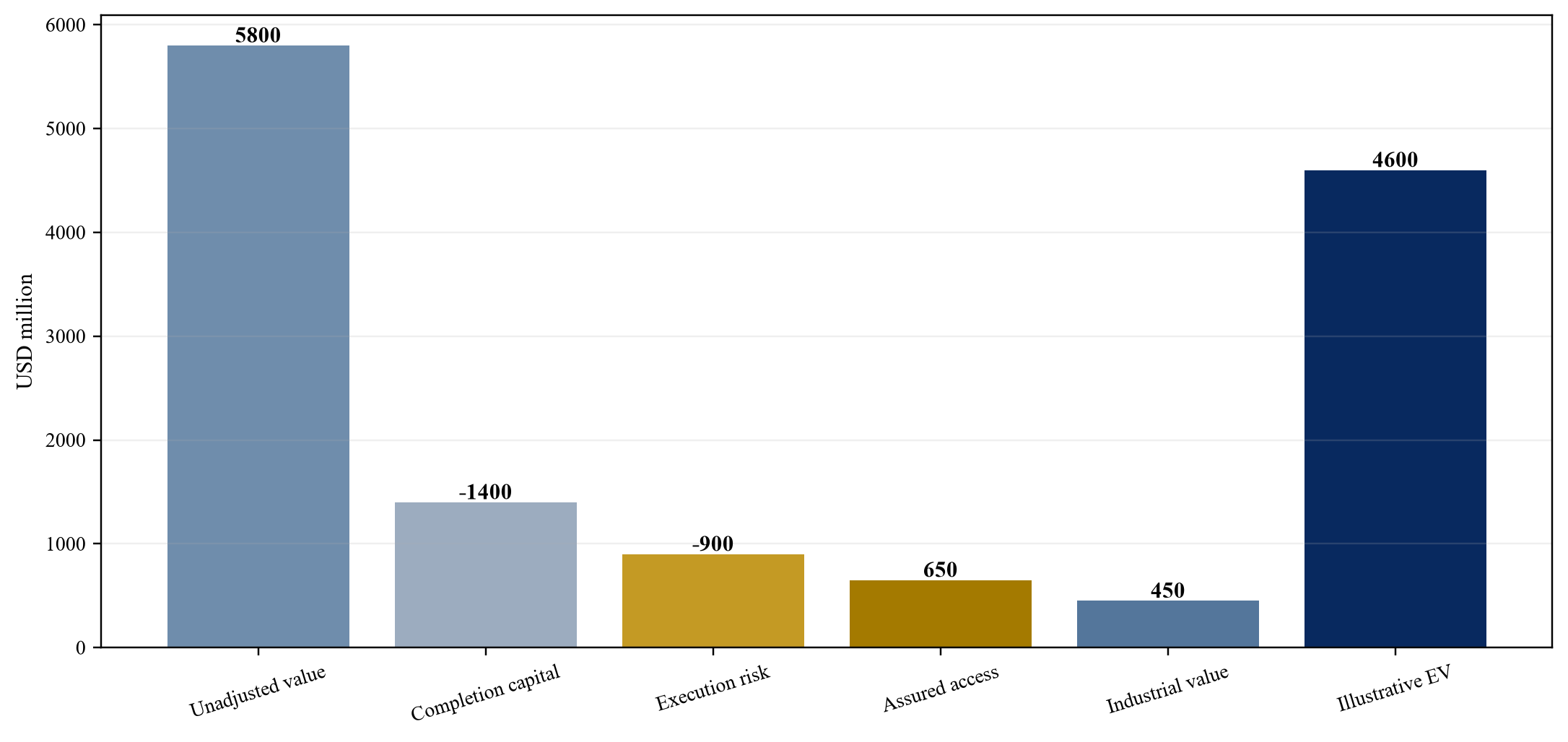
Wholly hypothetical; USD million.
| Area | Principal question | Evidence |
|---|---|---|
| Launch authorisation | can the target serve required missions | licences certification and correspondence |
| Investment screening | do ownership or governance rights trigger review | counsel analysis and filing plan |
| Export control | which people systems and data can be shared | classification licences and access matrix |
| Site and range | are required windows operationally available | agreements capacity and priority rules |
| Security | can protected missions continue after investment | facility personnel and cyber approvals |
Proposed review scope.
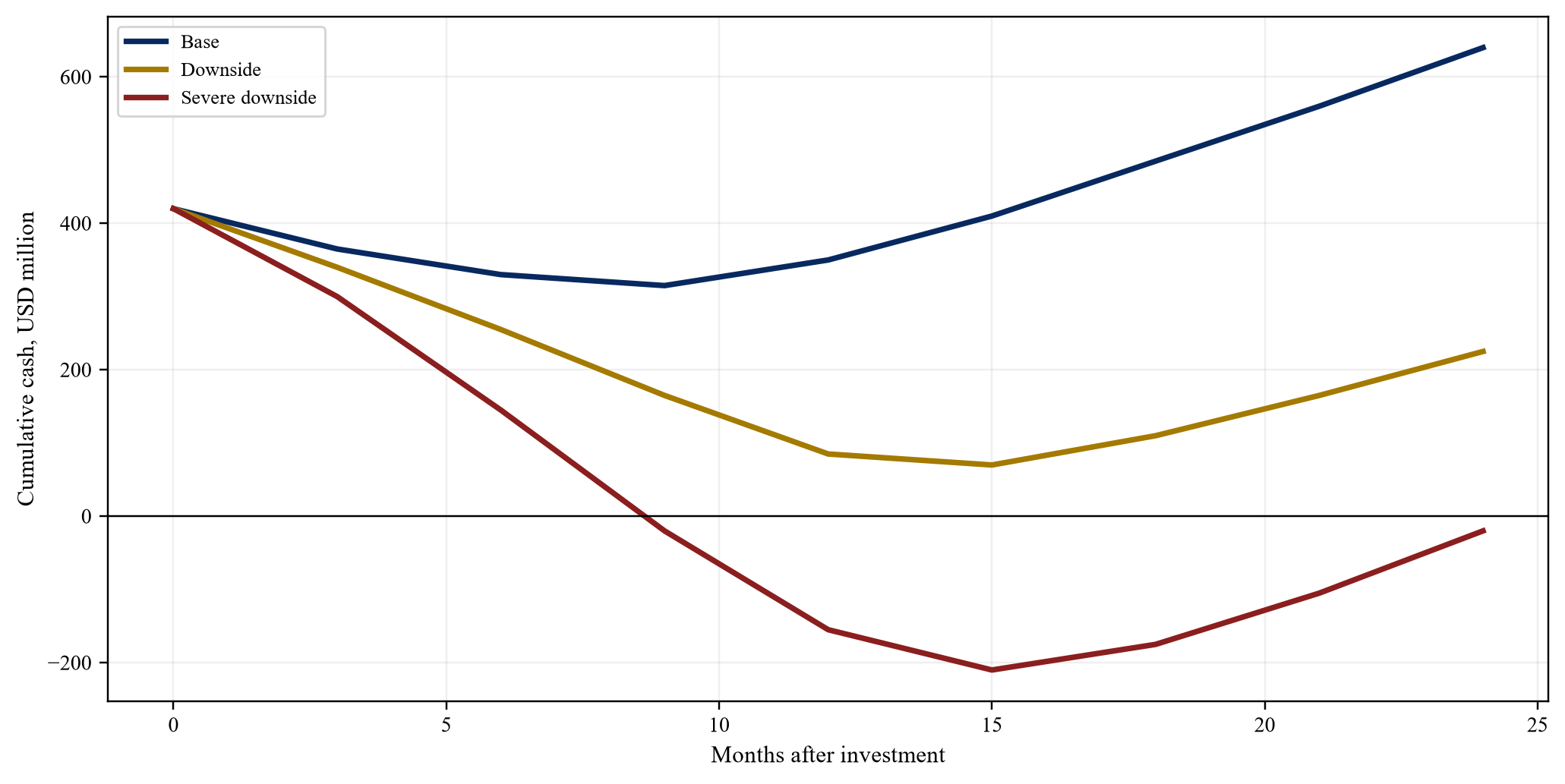
Wholly hypothetical cumulative cash after investment in USD million.
| Criterion | Investable evidence | Red flag |
|---|---|---|
| Commercial return | target cash flow supports price | return depends on buyer procurement |
| Assured access | defined missions and binding capacity rights | equity stake without allocation right |
| Industrial value | funded qualified work packages | broad localisation memorandum |
| Technology access | lawful usable rights and trained team | controlled data assumed transferable |
| Completion | funded work packages and schedule | development gap hidden in strategic premium |
| Governance | enforceable oversight and conflict process | informal influence claims |
Proposed approval framework.
| Uncertainty | Structure | Verification event |
|---|---|---|
| Flight maturity | milestone consideration | successful mission and acceptance |
| Capacity availability | service-level agreement | confirmed slot and integration readiness |
| Local work | joint-venture funding gate | supplier qualification and awarded scope |
| Export approval | closing condition | required licences and mitigation accepted |
| Backlog conversion | earnout | funded order and collected cash |
Proposed allocation of evidence risk.
| Decision item | Required conclusion | Owner |
|---|---|---|
| Stand-alone value | risk-adjusted enterprise-value range | investment lead |
| Strategic access | mission counterfactual and captured rights | programme sponsor |
| Industrial participation | funded work packages and local outcomes | industrial lead |
| Financial capacity | completion funding and downside liquidity | chief financial officer |
| Regulatory path | investment export launch and security approvals | general counsel |
| Integration | Day-One governance and information controls | integration lead |
Proposed final output.
Sources
- UAE Space Agency, National Space Strategy 2030. Read the primary source
- UAE Space Agency, National Space Fund. Read the primary source
- Saudi Space Agency, Commercialization and Investment in the Space Sector. Read the primary source
- Oman Ministry of Transport, Communications and Information Technology, Etlaq Spaceport annual conference and launch-test plan. Read the primary source
- Oman Ministry of Transport, Communications and Information Technology, Sultanate of Oman Private Sector Directory, Space Sector. Read the primary source
- UAE Space Agency, Digital platform for space licensing. Read the primary source
- UAE Space Agency, 90-day regularisation period under Federal Decree-Law No. 46 of 2023. Read the primary source
- United States Space Force, National Security Space Launch Phase 3 Lane 2 awards. Read the primary source
- U.S. Government Accountability Office, National Security Space Launch: Increased Commercial Use of Ranges Underscores Need for Improved Cost Recovery, GAO-25-107228. Read the primary source
- European Space Agency, European Launcher Challenge. Read the primary source
- European Space Agency, Submit your proposal to the European Launcher Challenge. Read the primary source
- Rocket Lab USA, 2025 Annual Report. Read the primary source
- European Space Agency, New agreements for the next decade of launches at Europe's Spaceport. Read the primary source
- UK Government, UK Space Strategy. Read the primary source
- U.S. Department of the Treasury, Committee on Foreign Investment in the United States. Read the primary source
- U.S. Department of State, International Traffic in Arms Regulations. Read the primary source
- UK Government, National Security and Investment Act guidance. Read the primary source
- U.S. Federal Aviation Administration, Commercial Space Transportation licensing and regulations. Read the primary source
- U.S. Federal Aviation Administration, The Annual Compendium of Commercial Space Transportation. Read the primary source
- NASA, Launch Services Program. Read the primary source
- European Space Agency, Europe's launchers. Read the primary source
- European Space Agency, CM25: Strengthen European autonomy and resilience. Read the primary source
- United Nations Office for Outer Space Affairs, Treaty on Principles Governing the Activities of States in the Exploration and Use of Outer Space. Read the primary source
- United Nations Office for Outer Space Affairs, Convention on International Liability for Damage Caused by Space Objects. Read the primary source
- United Nations Office for Outer Space Affairs, Convention on Registration of Objects Launched into Outer Space. Read the primary source
- IFRS Foundation, IFRS 13 Fair Value Measurement. Read the primary source
- IFRS Foundation, IAS 36 Impairment of Assets. Read the primary source
- IFRS Foundation, IAS 38 Intangible Assets. Read the primary source
- International Private Equity and Venture Capital Valuation Guidelines. Read the primary source
- UAE Space Agency, Space Economic Survey 2025 workshop. Read the primary source
