

1. Underwrite the contracted operating system rather than the asset alone
A power plant does not repay debt merely because it can generate electricity. Repayment depends on a controlled system of physical performance, contractual entitlement, invoice recognition and cash collection. Fuel or another primary-energy source must be available at the required specification and price. The plant must convert that input into dependable capacity and energy. The system operator or offtaker must dispatch, accept or compensate output according to the contract. Metering and settlement must convert performance into an invoice. The payment chain must deliver cash within the project company's liquidity horizon.
Private credit can enter this system through construction debt, acquisition financing, refinancing, a holdco instrument, a subordinated tranche, delayed-draw capital expenditure or a bridge to long-term institutional funding. The position changes the lender's access to project contracts, security, cash and remedies. A lender at the project company may receive assignments of core contracts and accounts. A holdco lender may depend on distributions that are subordinate to operating costs, senior debt, reserves and project restrictions.
The World Bank describes a power-purchase agreement as the central contract of an independent power project and emphasises tariff, purchase obligations, credit support, risk allocation, default and termination.[1] The contract remains part of a wider suite. Fuel, construction, operation, grid connection, land, insurance, financing, government support and direct agreements must allocate risks consistently.
The first underwriting record should therefore be a contract-and-cash perimeter. It identifies the borrower, asset, licences, fuel source, grid connection, offtaker, payment support, accounts, security, permitted debt and distribution path. It also identifies what sits outside the security perimeter, including shared infrastructure, sponsor services, unassigned permits or governmental decisions.
The credit thesis should be written as a causal statement. For example, contracted availability revenue supports scheduled debt service when fuel is available, dependable capacity is demonstrated, permitted outages are controlled, invoices are accepted and payment protection remains effective. Each clause in that statement becomes a diligence test and a monitoring control.
2. Fix the financing layer and creditor-control perimeter
Project finance looks primarily to project revenues for repayment and security. The Basel Framework identifies a project vehicle with few independent repayment sources, lender control over the asset and income, sufficient contingency and working-capital arrangements, protected contractual cash flow, strong counterparties and creditor rights as core specialised-lending features.[5] A private-credit investor can use these features as an analytical reference even when the investor is not a bank subject to the framework.
The financing layer determines which risks are visible and which remedies are reachable. A senior secured project loan can control revenue accounts, distributions, additional debt and material contracts. A mezzanine instrument may be structurally or contractually subordinated. An acquisition bridge can depend on a future refinancing. A holdco loan can be exposed to trapped cash without any project default.
The lender should create a rights matrix covering security, assignments, account control, information, consent, cure, step-in, enforcement and transfer. The matrix should distinguish legal availability from practical value. A right to replace an operator matters only when the licence, land, grid, fuel and offtake arrangements can continue. A share pledge has limited value when government consent is uncertain or termination is triggered by a change of control.
The control perimeter should include information continuity. Project systems, meters, contract registers and bank accounts may be operated by different parties. The lender should have timely access to agreed reports and the right to obtain underlying records after a material event. Data access should respect confidentiality, cybersecurity and operational-safety requirements. A monitoring right that depends entirely on a defaulting service provider may fail when it is most needed.
Structural leakage deserves explicit testing. Taxes, zakat, concession payments, fuel deposits, major maintenance, insurance deductibles, senior reserves and restricted cash may rank ahead of the private-credit claim. Project documents can also prohibit distributions while an event is continuing. The base case should show the legal and cash tests required before each distribution.
Intercreditor terms should allocate standstill, payment blockage, turnover, voting, enforcement, cure funding and release of security. The private-credit lender should model the period during which interest accrues but cash cannot be received. A nominal maturity before the senior facility ends can be economically longer when refinancing or distribution restrictions delay repayment.
3. Build a fuel-to-cash map with controlled evidence
The fuel-to-cash map links every material physical event to the contract, calculation, evidence, account and decision owner. It starts with allocation or reservation, then covers nomination, delivery, quality, quantity, storage, price, consumption, efficiency, availability, dispatch, metering, tariff, invoice, payment and debt service.
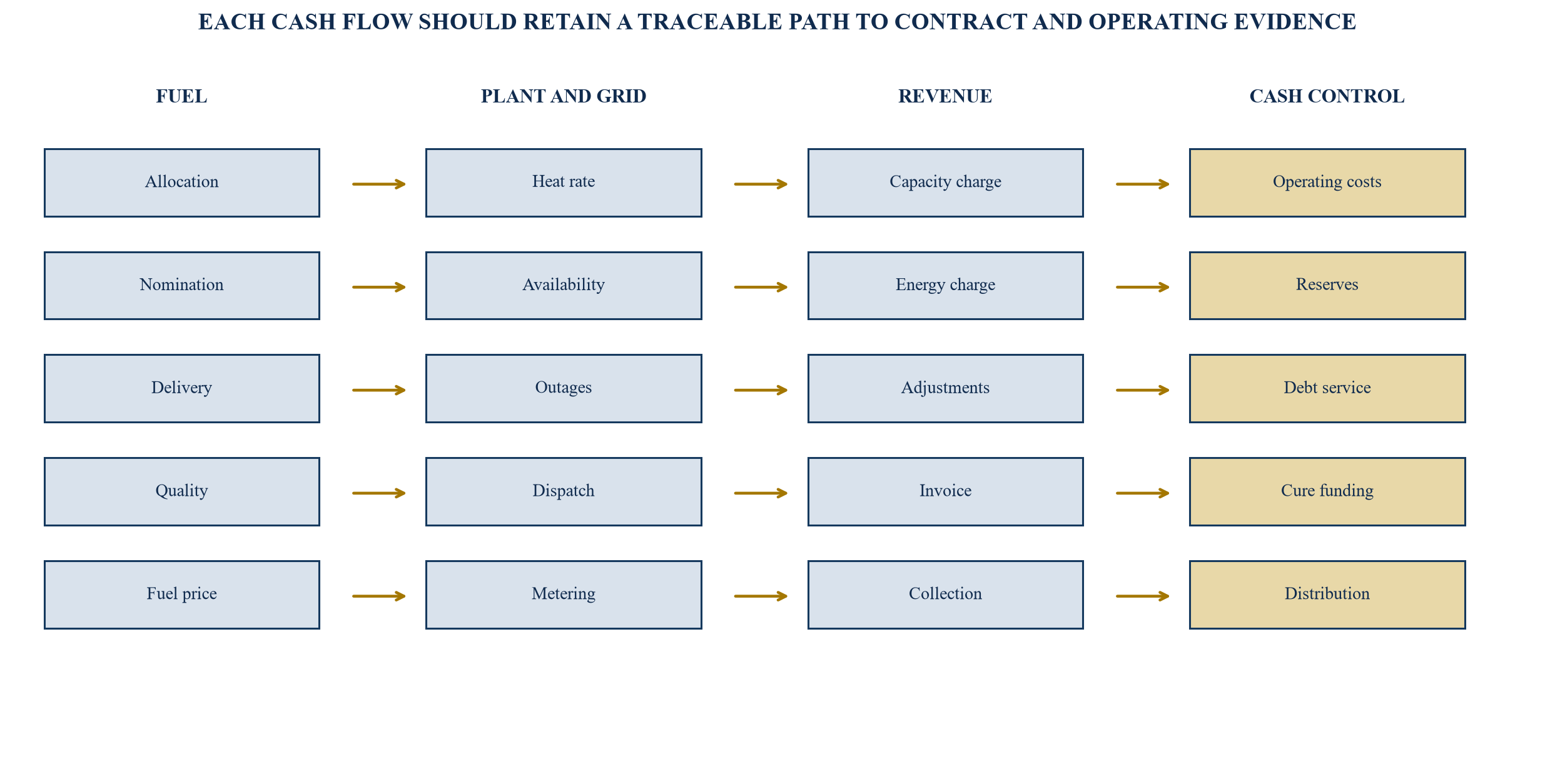
The map is a generic analytical control; actual responsibilities and contracts depend on the project and jurisdiction.
Each node should have a system of record, owner, frequency, unit, source document and reconciliation rule. Fuel quantity may appear in supplier statements, custody-transfer meters, plant records and invoices. Generation may appear in plant controls, grid meters, dispatch records and settlement statements. The lender should identify which record governs payment and which supports operational diagnosis.
Table 1. Fuel-to-cash evidence and control register
| Stage | Primary evidence | Common break | Lender control |
|---|---|---|---|
| Fuel entitlement | allocation, reservation or supply contract | allocation is conditional or shorter than debt | condition, renewal test and alternative-fuel plan |
| Delivery | nomination, meter and quality certificate | volume or specification mismatch | reconciliation and rejection procedure |
| Plant | availability, heat rate and outage record | contract test differs from operating report | agreed definitions and independent test |
| Dispatch | instruction, constraint and curtailment log | instruction cannot be matched to settlement | time-aligned dispatch register |
| Revenue | tariff model, meter and accepted invoice | adjustment or index is disputed | controlled calculation and dispute reserve |
| Cash | bank receipt, support draw and waterfall | payment arrives after debt-service date | liquidity reserve and escalation trigger |
Minimum evidence depends on technology, contract structure and jurisdiction.
Version control is essential. Tariff indices, fuel prices, exchange rates and dispatch procedures can change. The model should retain the effective date, approval and source for every parameter. Manual overrides should be visible. A reconciliation difference should become an exception with an owner and closure date rather than a silent plug.
4. Test fuel entitlement before assuming physical availability
Fuel risk begins before delivery. A project may depend on a government allocation, a supplier commitment, pipeline capacity, transport infrastructure, storage or an import chain. The legal instrument should state volume, duration, delivery point, quality, price, nomination, interruption, replacement, force majeure and remedies. The debt case should not extend beyond a fuel entitlement that can support the operating profile.
Saudi Arabia's Electricity Law assigns the long-term plan a role in determining fuel availability and energy mix and permits exceptional control of electricity resources and fuel reserves during a supply threat.[9] Its Law of Gas Supplies and Pricing addresses allocation and pricing of gas and liquids.[10] These are public legal frameworks. A specific financing still requires project-level confirmation of entitlement, price, conditions and priority.
The fuel supplier's identity can concentrate risk. The supplier may also be the offtaker or a related public entity. This can align the system but create common-cause exposure. A fuel failure may reduce availability revenue while the same public group controls payment or remedy. The lender should map legal entities, obligations, credit support and dispute routes separately.
Quantity should be modelled across base, peak, outage and stress conditions. Minimum-take obligations can create cash cost when dispatch is low. Maximum-daily quantity can constrain peak output. Planned maintenance, start-up, testing and auxiliary consumption can increase fuel use. Storage and linepack can protect short interruptions but require operating rules and working capital.
Quality can affect heat rate, output, emissions and maintenance. The contract should define specification, sampling, testing, rejection, price adjustment and substitute fuel. A project exposed to off-specification fuel needs an engineering view of safe operating limits and the economic effect of derating or damage.
Fuel continuity should be tested against the physical network. A contractual quantity can remain undeliverable when pipeline pressure, compression, berth access, transport, storage or custody-transfer equipment is constrained. The lender should review capacity reservations, maintenance windows, bottlenecks, emergency procedures and evidence from prior interruptions. The analysis should distinguish a supplier credit event from an infrastructure event because the cure, compensation and insurance response can differ.
Alternative fuel should be treated as a complete operating case. The plant may require separate storage, burners, handling, permits and inventory. Substitute fuel can change heat rate, output, emissions, maintenance and tariff recovery. A contractual obligation to use an alternative has limited credit value when the equipment, licence or commercial recovery is unavailable. Readiness should be demonstrated through design, testing, supply and financial evidence.
5. Reconcile fuel price with tariff pass-through
Fuel price risk is not removed merely because the tariff includes an energy component. The lender should compare the fuel-supply formula with the power-purchase formula line by line. Differences in index, base date, currency, calorific conversion, losses, taxes, transport, timing or efficiency standard can create retained exposure.
A pass-through can be subject to an approved heat rate. If actual efficiency deteriorates, the project may recover only the contractual allowance. Start costs, minimum stable generation, ramping, part-load operation or substitute fuel may receive different treatment. The debt model should separate reimbursable fuel from the project's efficiency and operating risk.
Timing creates working-capital exposure. Fuel may be paid in advance or within a short period while the energy invoice is accepted and paid later. A disputed tariff adjustment can extend the gap. The model should show peak cumulative funding need, not an annual average.
Indexation should be tested for publication delay, discontinuation, negative values, caps, floors and change in methodology. A replacement-index procedure needs decision rights and an interim calculation. Currency conversion should state the source rate and date. The financing should show who absorbs convertibility, transfer and settlement timing risk.
The lender should reconcile historical fuel invoices to tariff recovery and bank receipts. A theoretical pass-through deserves less reliance when repeated differences remain unresolved. The exception register should classify quantity, quality, price, timing, efficiency and settlement causes.
6. Separate capacity, availability and energy revenue
Many thermal-power structures distinguish a fixed or capacity-related payment from an energy payment. The World Bank power-generation module notes that non-renewable plants commonly use availability payments plus output payments, or take-or-pay arrangements, so that debt service can be supported by revenue linked to capacity under the project company's control.[2] The actual allocation depends on the contract.
The lender should define the exact availability test. Nameplate capacity is not necessarily dependable capacity. Contracted availability may reflect declared capability, tested capacity, scheduled outages, forced outages, ambient conditions, grid constraints and fuel responsibility. Penalties may apply to failed starts, response time, heat rate or ancillary services.
Capacity revenue can remain exposed to fuel when fuel availability is allocated to the project company. It can remain exposed to dispatch when testing or declaration procedures depend on instructions. It can remain exposed to grid availability when the contract does not compensate constraints. The model should trace each risk allocation to the payment formula.
Energy revenue often reimburses fuel and variable cost. It may also contain margin, start payment or efficiency incentive. The lender should identify whether low dispatch reduces only pass-through revenue or also reduces contribution to fixed costs. Minimum dispatch assumptions should come from contract and system evidence rather than sponsor forecasts.
Tariff deductions should be modelled by cause. A forced outage, planned outage overrun, non-compliant start, late declaration or metering failure can produce different deductions. The contract may apply annual caps, rolling calculations or cumulative performance tests. A monthly model can miss a year-end reconciliation or accumulated penalty.
Availability should also be reconciled to maintenance strategy. A project can preserve near-term availability by deferring inspection, overhaul or component replacement. The resulting cash can overstate sustainable debt capacity. The lender should compare contractual outage allowances with the original-equipment-manufacturer plan, risk-based inspection, operating history, spare-parts position and funded lifecycle schedule. The debt case should charge the maintenance required to preserve the contracted performance period.
Performance tests deserve their own evidence chain. Initial acceptance tests may establish capacity and heat rate under defined ambient and fuel conditions. Periodic tests can reset dependable capacity or demonstrate cure. The lender should confirm procedure, correction curves, instrumentation, witness rights, retest, dispute and economic consequence. A management performance report should not replace the contract test when payment depends on the latter.
7. Quantify dispatch, curtailment and grid sensitivity
Dispatch determines when a dispatchable plant is instructed to produce. Curtailment or grid constraints can reduce accepted output. GCCIA facilitates scheduled energy transfers, capacity sharing, operating reserves and settlement of unscheduled exchanges across the regional interconnection.[7] Regional trade and reserves can change operating opportunities, while project cash remains governed by its own contracts.
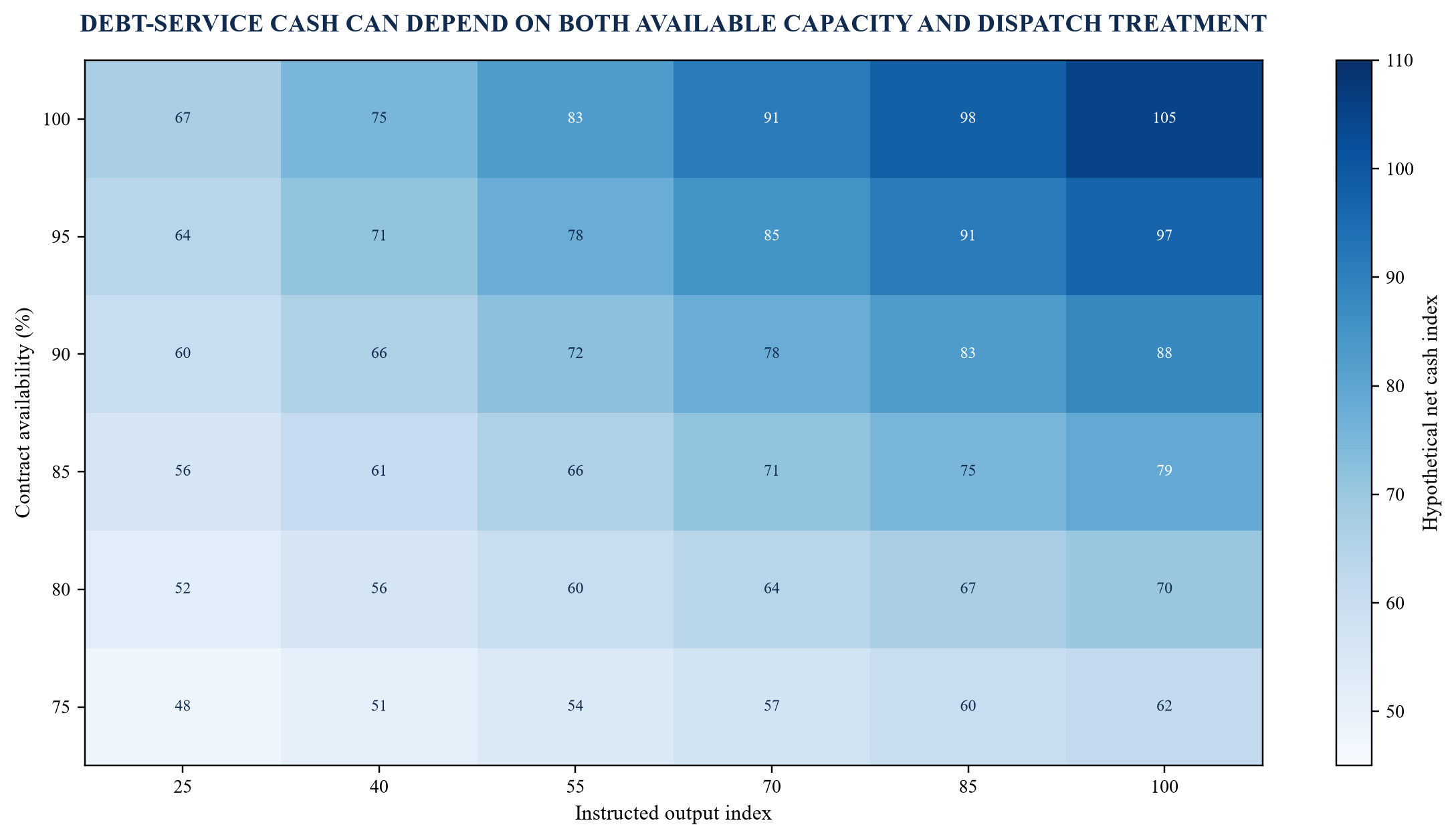
Values are illustrative indices only and do not represent an identified project or forecast.
The dispatch model should separate instructions, capability and delivered energy. Low delivery can arise from low demand, merit order, grid constraint, plant unavailability, fuel shortage or instruction non-compliance. Contract compensation differs by cause. The lender needs a causal bridge from event to tariff and cash.
Start frequency and ramping can affect fuel and maintenance. A plant dispatched for flexibility may experience more starts, part-load hours and thermal cycles than a baseload assumption. The model should connect dispatch scenarios to heat rate, variable maintenance, outage probability and lifecycle cost.
Curtailment compensation should be tested against conditions and caps. Compensation may require demonstrated availability, valid declarations, fuel availability and compliant instructions. Deemed energy can be calculated using agreed reference output and price. The calculation should be reproducible from records retained by the borrower.
Grid and interconnection risk can sit with the offtaker, transmission company or project. The interface should define testing, outages, losses, metering, protection and restoration. A shared substation or transmission asset can create dependency outside the project company's control. The financing should identify remedy and compensation.
Merit-order and market reform should be included where relevant. A contract can protect the project from current dispatch economics while amendments, expiry, refinancing or merchant exposure introduce future price and volume risk. The lender should identify the point at which contracted revenue ends, how dispatch rights change and whether debt amortises before that transition. A terminal-value assumption should not quietly carry merchant cash beyond the lender's verified market evidence.
Ancillary services can provide revenue or operating obligations. Frequency response, spinning reserve, black start and reactive power have distinct availability, metering, testing and penalty mechanics. The base debt case should include only contracted or evidenced cash and the associated maintenance cost. Optional services can remain upside until the project has approval, capability, dispatch history and settlement evidence.
8. Turn operating performance into a debt-service distribution
A single operating case hides the interaction among fuel, availability, dispatch and payment. The lender should build a scenario distribution with discrete events and correlated drivers. Examples include reduced allocation, price mismatch, forced outage, low dispatch, delayed invoice acceptance and delayed payment.
Correlation matters. Extreme heat can increase system demand while derating plant output. A fuel-system interruption can affect several plants and alter dispatch. An offtaker liquidity event can delay payment across a portfolio. A common public counterparty can connect fuel and payment risks.
The operating model should use engineering definitions. Heat rate should reconcile fuel energy input to net electrical output using consistent units. Availability should distinguish scheduled and forced outages and contract exclusions. Auxiliary load, degradation and ambient correction should follow the contract and technical evidence.
Cash flow should be modelled at the shortest interval needed to capture stress. Monthly modelling may be sufficient for debt service but should incorporate daily or hourly operating evidence where dispatch and penalties are granular. Annual averages should not conceal a liquidity shortfall before an invoice is collected.
The result should be a distribution of cash available for debt service, reserve draw and cure funding. Debt sizing can use a protected base case plus downside tests rather than a single probability claim. Recovery should also be considered because a temporary payment delay differs from permanent revenue loss.
9. Assess the offtaker as a payment system
Offtaker credit is broader than a legal entity's standalone accounts. The payment system includes tariff recovery, government budget or subsidy, customer collections, working capital, invoice approval, payment procedures, support instruments and termination obligations. The lender should map both capacity to pay and operational willingness to process valid claims.
Table 2. Offtaker and payment-support assessment
| Layer | Evidence | Principal question | Weakness signal |
|---|---|---|---|
| Contract debtor | audited accounts and payment history | can the entity meet ordinary invoices? | recurring arrears or qualification |
| Tariff and funding | tariff decision, subsidy or budget process | how is the payment obligation funded? | structural cost-recovery gap |
| Invoice process | acceptance workflow and dispute log | how quickly does a valid invoice become payable? | repeated administrative delay |
| Liquidity support | letter of credit or payment fund | is short-delay liquidity available? | instrument smaller than exposure |
| Government support | guarantee or support agreement | what obligation, trigger and remedy exist? | conditional or ambiguous promise |
| Termination | formula, funding and timing | can debt be repaid after specified termination? | exclusions, delay or currency mismatch |
Reliance requires transaction-specific legal, credit and operational diligence.
Historical payment should be reconciled invoice by invoice. The analysis should show billed amount, accepted amount, dispute, due date, receipt date, support draw and outstanding balance. Average days to pay can conceal a tail of long delays. The liquidity reserve should be calibrated to the distribution and support mechanics.
The World Bank PPI methodology identifies payment guarantees, debt guarantees and revenue guarantees as forms of indirect government support.[13] Each has a distinct obligation. A policy statement or ownership relationship should not be treated as an enforceable guarantee. Legal advice should confirm authority, conditions, waivers, currency, dispute resolution and execution.
An offtaker can remain important even when payment support exists. The support may cover undisputed invoices only. A dispute over availability, metering or tariff can delay both invoice and support. The lender should test the full claim process rather than assume immediate substitution.
Budget and tariff evidence should be read together. An offtaker may have a contractual obligation while depending on regulated tariffs, public transfers or customer collections. The lender should assess the cadence and authority of each funding source, exposure to delayed true-up, collection performance and competing system obligations. This assessment should remain distinct from a legal conclusion on sovereign support.
Operational payment practice can be as important as formal due dates. Invoice preparation, technical certification, tax documentation, acceptance, dispute, treasury instruction and bank transfer each consume time. The financing should map owners and service levels. A covenant can measure accepted but unpaid invoices separately from invoices still awaiting technical approval because the remedy and support eligibility may differ.
10. Build a counterparty matrix around common-cause failure
The project contract suite can involve the offtaker, fuel supplier, transmission company, operator, maintenance provider, EPC contractor, insurers, account bank, support provider and public authorities. Their ownership and obligations may overlap. The lender should identify which parties bear each risk and whether remedies remain available when several obligations fail together.
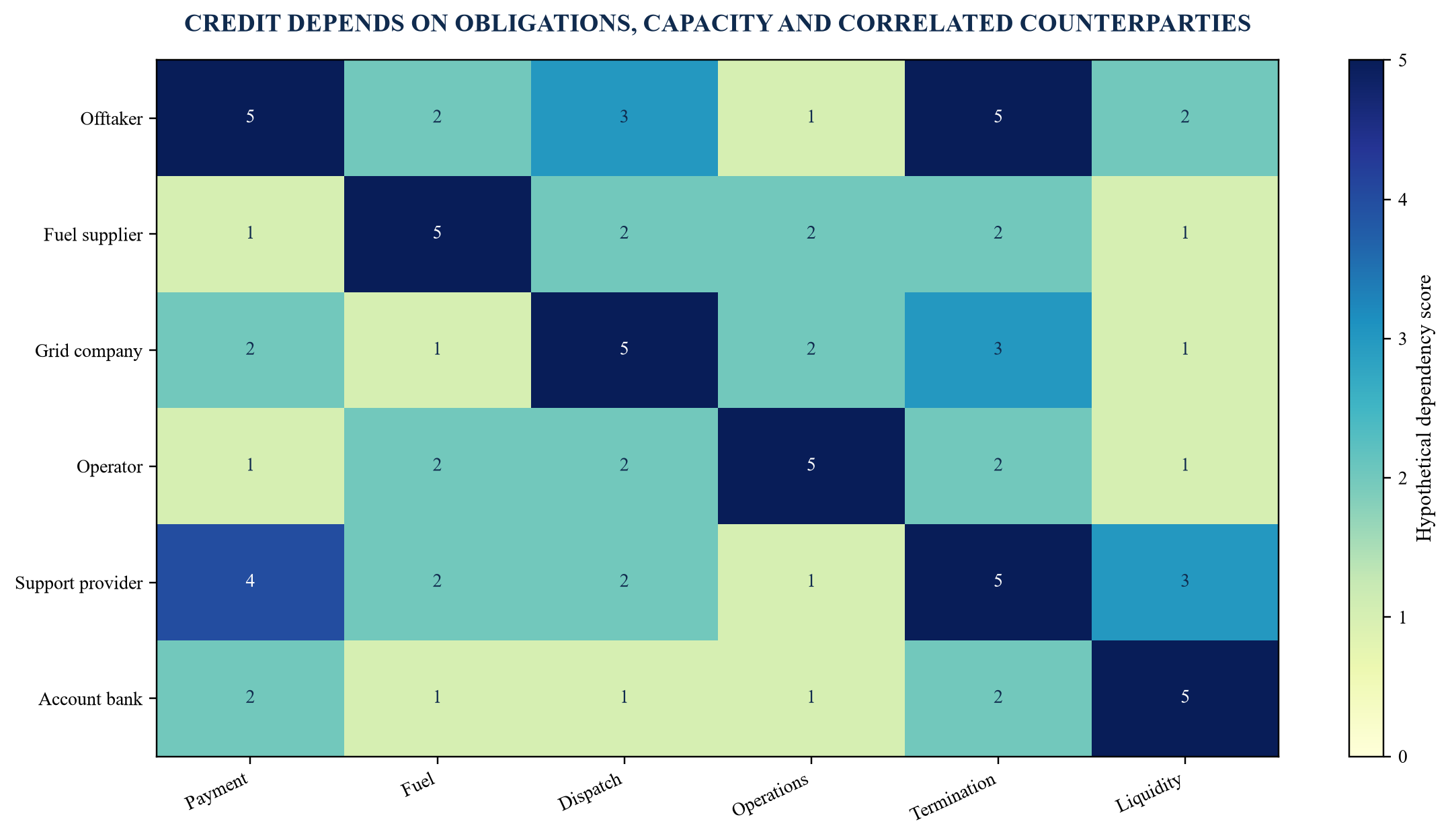
Hypothetical scores indicate relative analytical attention only; they do not represent credit ratings.
The matrix should record legal entity, role, ownership, obligation, financial capacity, security, termination consequence, replacement pathway and lender rights. A strong operator does not solve a fuel-allocation failure. A government support provider may cover payment but not technical performance. An insurer may cover physical damage but not ordinary degradation.
Common-cause analysis should examine shared governance, funding and infrastructure. If the fuel supplier and offtaker are related, the same system event can affect both input and revenue. If several project companies share a grid connection, an interface outage can affect a portfolio. If the account bank also issues the letter of credit, the support and cash account share bank exposure.
Replacement should be assessed in time as well as legal right. An operator can be replaced only after notice, consent, transition and mobilisation. A fuel source may require pipeline access or allocation. A replacement period can exceed the project's liquidity. Cure funding and reserves should reflect the realistic transition.
11. Design payment security as a timed ladder
Payment support should bridge the time between a valid invoice and cash, then protect debt after more serious default or termination. The ladder can include invoice procedures, late-payment interest, a letter of credit, payment security fund, escrow, guarantee, government support and termination compensation.
The IFC's account of the Madhya Pradesh solar-park programme describes a three-tier mechanism including a letter of credit, payment security fund and state guarantee for one procurer.[14] The example demonstrates layering. A Gulf transaction needs its own assessment of law, authority, funding, documentation and operating process.
Each layer should have an amount, currency, expiry, replenishment obligation, draw condition, notice, claim period and payment timing. The lender should model sequence. A letter of credit covering one invoice does not protect a prolonged dispute. A fund can be exhausted across multiple projects. A guarantee may require completed procedures.
Termination compensation should be modelled by cause: project default, offtaker default, political force majeure, natural force majeure and prolonged event. The formula may treat senior debt, subordinated debt, break costs, equity and insurance differently. The lender should confirm whether private credit qualifies as protected debt and whether amendments require consent.
Direct agreements should provide notice, cure and step-in around material project contracts. The cure period should be workable for payment and operational defaults. Step-in should be coordinated across PPA, fuel, land, licences, grid and operation. A cure right in one agreement can fail when another terminates first.
12. Size reserves to the event and replenishment mechanism
Reserves protect timing, not fundamental unbankability. The lender should define the event each reserve covers, target amount, permitted investment, replenishment source, release test and ranking. Common reserves include debt service, major maintenance, operating expenditure, fuel working capital, insurance deductible and dispute liquidity.
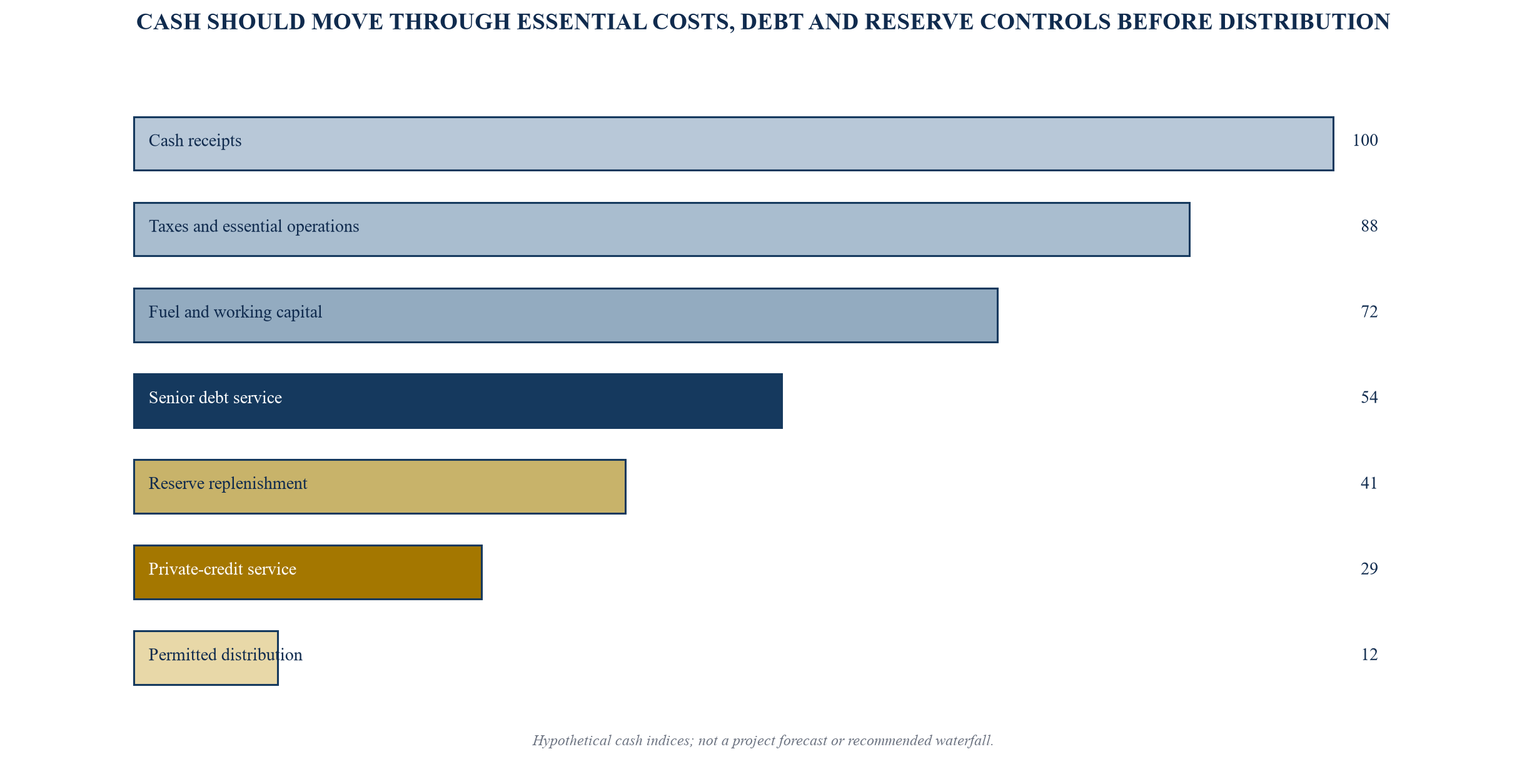
Hypothetical percentages show sequencing only; actual priorities must follow the financing documents.
Debt-service reserve sizing should reflect payment delay, operating volatility and support timing. A fixed number of months can be a minimum control. The analytical case should test the tail between invoice due date, support draw and actual recovery. The reserve should also reflect interest and fees on the private-credit instrument.
Fuel working capital can be separate because it turns with dispatch and price. Commingling it with debt-service liquidity can allow high fuel cost to consume payment protection. A facility can provide a controlled revolving tranche with borrowing-base and clean-down tests.
Major-maintenance reserves should connect to the approved outage and lifecycle plan. Funding can be periodic, front-loaded or supported by a standby facility. The model should account for maintenance during a low-dispatch period, spare parts, foreign currency, outage extension and contract deductions.
Reserve release should require more than a balance test. It can require no default, accepted invoices, current fuel entitlement, compliant availability, completed maintenance, updated forecast and adequate remaining liquidity. Release before a known outage or contract renewal can weaken protection.
13. Calibrate debt from protected cash and recovery
Debt sizing should begin with cash that survives the contract and control analysis. Gross capacity revenue is reduced for availability deductions, operating costs, taxes, lifecycle maintenance, insurance, working capital and reserve funding. Energy revenue should include only recoverable margin or cost reimbursement supported by the fuel and tariff bridge.
The lender should run base, operating downside, payment-delay, combined and termination cases. The combined case matters because a technical event can trigger a payment dispute. A low-dispatch case can reduce cash contribution while fuel minimum-take and fixed costs remain. A delayed support claim can require additional liquidity.
Coverage ratios should use the cash definition and debt service that match the instrument. A holdco facility should use distributions actually permitted and received. Capitalised interest, payment-in-kind amounts, cash sweeps, fees and bullet repayment should be included. Currency mismatch should be explicit.
Recovery analysis should identify enforcement value, replacement cost, remaining contract value, termination compensation, insurance, account balances and claims. It should deduct senior claims, taxes, cure cost, delay and enforcement expense. A plant's physical value can be lower than the debt case when land, fuel, grid or offtake rights cannot transfer.
The financing should avoid relying on a refinancing as the only repayment source unless the refinance conditions are controlled. The model should show amortisation capacity, permitted prepayment, cash sweep and extension tests. A bridge needs clear information, consent and market-readiness milestones.
Pricing should compensate for identifiable residual risk and committed capital. The return bridge can separate base rate, credit spread, illiquidity, structuring, undrawn commitment, prepayment protection and performance-linked elements. The lender should avoid using price as the sole response to a risk that can destroy repayment. Fuel entitlement, contract continuity, payment support and creditor access may require structural conditions regardless of yield.
Commitment sizing should include undrawn exposure. Construction and liquidity facilities can be drawn when risk is already increasing. The credit process should model expected and maximum draw, conditions to further utilisation, cancellation rights and funding availability. IFRS 9 accounting may require expected-credit-loss consideration for commitments, subject to the applicable facts and reporting framework.[15]
14. Tie draw conditions to construction, acquisition and operation
Conditions should correspond to the risk at each stage. Construction funding requires permits, land, contracts, fixed or controlled cost, contingency, schedule, technical review and sponsor support. Acquisition funding requires title, transfer consents, historical performance, contract continuity, change-of-control analysis and a closing funds flow. Operating refinancings require stable performance and reconciled cash.
The draw schedule should match committed cost and evidence. Equipment payments can require supplier invoice, inspection, title, shipment and insurance. Construction draws can require engineer certification and updated cost-to-complete. Completion release can require performance tests, commercial operation, accepted metering and available payment support.
Material contracts should be effective and assignable or subject to direct agreements before reliance. Conditions should address fuel allocation, PPA effectiveness, grid connection, licences, insurance and account control. Waivers should record the effect on cash, timing, security and reserve needs.
An acquisition can inherit historical claims, deferred maintenance or disputed invoices. The lender should reconcile closing adjustments, debt-like items, restricted cash, reserves, fuel inventory, working capital and contract receivables. The security and account structure should be effective immediately after completion.
Post-closing conditions should be limited and funded. A critical permit, direct agreement or support instrument should not be deferred merely for timetable convenience. If a deferred item is accepted, the facility should define deadline, interim protection, draw restriction and failure consequence.
15. Monitor contract, operating and cash deterioration together
Covenants become useful when they detect the causal chain before default. The dashboard should combine fuel, plant, dispatch, revenue, payment, liquidity and legal indicators. Each metric needs a definition, source, frequency, threshold, owner and escalation.
Table 3. Illustrative covenant and early-warning dashboard
| Domain | Metric | Evidence | Escalation response |
|---|---|---|---|
| Fuel | entitlement coverage and delivery exceptions | allocation, nomination and supplier statement | update downside and restrict distributions |
| Plant | availability, forced outage and heat rate | operator and independent engineer | remediation plan and reserve increase |
| Dispatch | instructed versus delivered output | dispatch and meter reconciliation | causal review and claim preservation |
| Revenue | accepted invoice and tariff variance | invoice and settlement statement | dispute tracker and liquidity forecast |
| Payment | overdue amount and support availability | bank receipt and support confirmation | draw support and activate cash controls |
| Liquidity | forward cash and reserve adequacy | controlled account and forecast | cash sweep, cure funding or draw stop |
| Contracts | expiry, consent and termination event | contract register and legal certificate | renewal, waiver or enforcement review |
Thresholds require project-specific calibration and legal drafting.
Operating thresholds should not copy contract defaults mechanically. A covenant can provide earlier notice. Repeated small availability misses can precede a formal annual breach. Fuel-quality exceptions can precede efficiency deterioration. Longer invoice acceptance can precede payment delay.
Information should reconcile to source systems. The monthly report can include fuel statement, availability certificate, dispatch reconciliation, invoice, payment receipt, reserve balance, maintenance plan, insurance status and legal exceptions. The lender should have audit and independent-review rights for material discrepancies.
Forecast covenants should test the next operating cycle and debt-service period. A trailing ratio can remain compliant after a new fuel constraint or outage. The borrower should update cash, maintenance and contract assumptions when a material event occurs.
Remedies should be sequenced. Information cure, enhanced reporting, distribution lock, reserve top-up, cash sweep, sponsor cure, technical remediation and enforcement address different stages. Automatic acceleration can destroy value when a controlled cure preserves the project and cash.
16. Build a covenant dashboard that connects trigger to action
The dashboard should distinguish observation, warning, breach and event of default. An observation records variance. A warning requires analysis and an action plan. A covenant breach activates negotiated protections. An event of default opens contractual remedies. This hierarchy helps preserve proportionality.
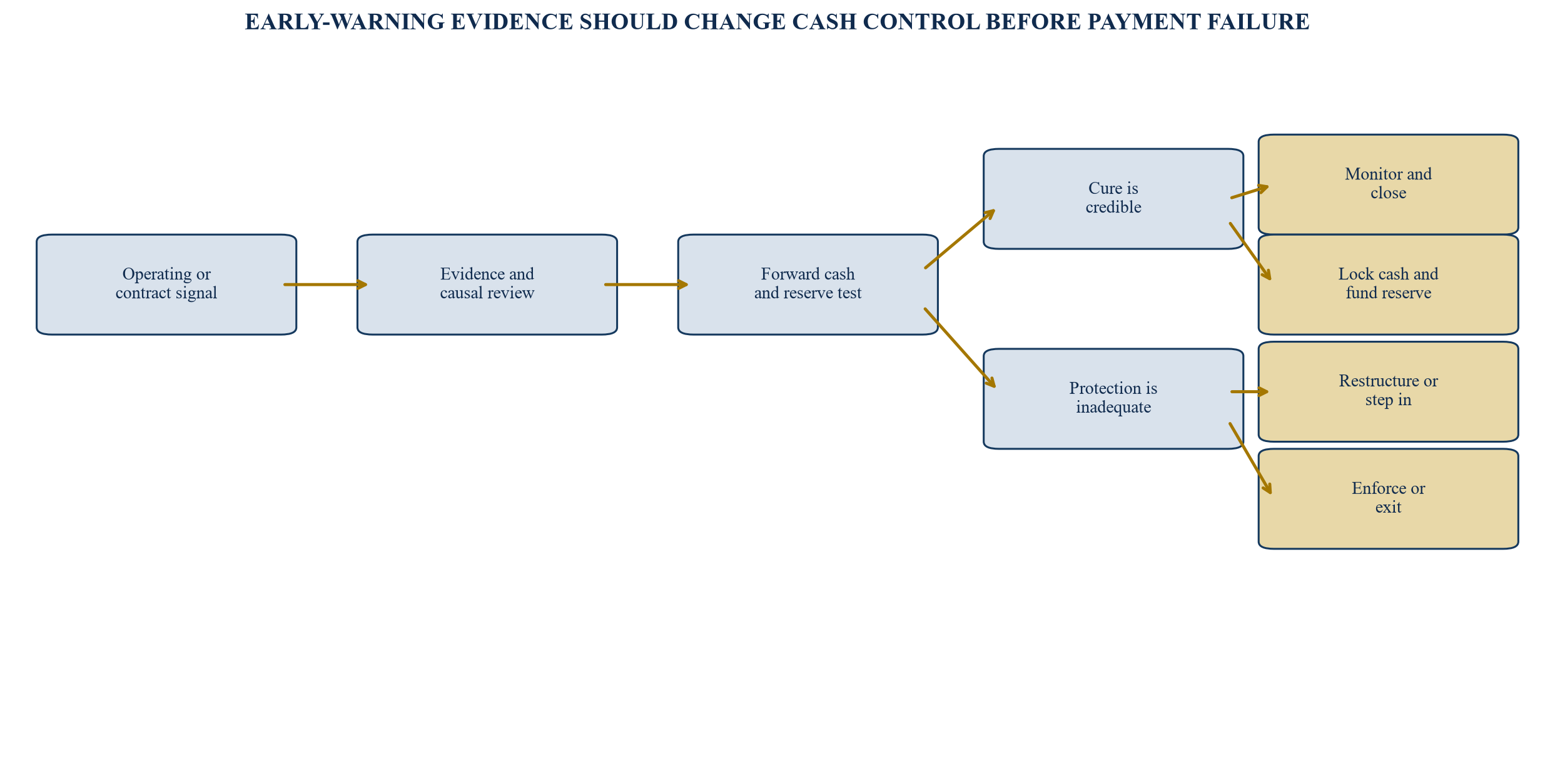
The escalation path is illustrative; actual rights depend on the finance and project documents.
Trigger design should reflect causality and control. A fuel allocation expiry can trigger a renewal plan well before delivery is affected. A heat-rate deterioration can trigger engineering review and lifecycle funding before tariff under-recovery becomes material. A payment delay can trigger support draw and distribution lock before reserve depletion.
Table 4. Covenant escalation and permitted lender response
| Stage | Evidence standard | Borrower action | Lender response |
|---|---|---|---|
| Observation | isolated variance with source evidence | explain and monitor | retain ordinary controls |
| Warning | recurring or forward-looking weakness | approved remediation and forecast | enhanced reporting and distribution test |
| Breach | defined threshold or contract failure | cure, fund and preserve claims | cash lock, reserve top-up or draw suspension |
| Default | uncured material breach or non-payment | restructuring or transfer proposal | step-in, enforcement or negotiated exit |
Legal effect and remedies require transaction-specific documentation.
The dashboard should avoid metric proliferation. A small set of causal measures is more useful than dozens of unconnected indicators. The board and lenders should see the same definitions. Management should retain detailed operational diagnostics below the financing dashboard.
Data quality should itself be a control. Missing dispatch instructions, unreconciled meter data or late bank statements can prevent a reliable conclusion. A persistent data failure should escalate because it weakens both monitoring and claim evidence.
17. Protect contract value through change, transfer and termination
Power projects operate over long periods during which law, market design, fuel policy, technology and counterparties can change. The contract suite should define change in law, change in tax, market reform, grid code, environmental standard and discriminatory action. The financing model should show the adjustment, claim and timing mechanism.
Transfer can arise through refinancing, share sale, enforcement or step-in. Consents may be required from government, offtaker, fuel supplier, grid, land authority and lenders. The private-credit instrument should be included within permitted financing and protected debt definitions where appropriate.
Termination should preserve an evidence package. The borrower should retain notices, calculations, invoices, tests, correspondence and legal positions. Compensation often depends on cause and procedural compliance. A strong economic claim can lose value when notice or mitigation obligations are missed.
The lender should model cash through termination timing. Debt may continue to accrue while compensation is determined and paid. Insurance proceeds, support claims and account balances can arrive at different times. Enforcement cost and tax can reduce recovery.
The IMF notes that PPAs and related guarantees can create contingent fiscal liabilities and that complex contracts can produce unexpected public costs.[11][12] This public-sector perspective reinforces the need for transparent allocation and sustainable payment mechanisms. A lender should assess whether support obligations remain credible through stress and policy change.
Renegotiation risk should be addressed as a process, not a binary assumption. A change in fuel policy, demand, technology cost or public affordability can create pressure to amend tariff or dispatch. The lender should identify amendment authority, required consents, economic-equilibrium or change mechanisms, dispute procedure and financing-document protections. A contractual consent right has value when information arrives early enough for the lender to assess alternatives.
Contract expiry should be planned well before the maturity tail. Renewal can require procurement, policy, technical life extension and new support. The debt case should either amortise before expiry or support a residual value with current evidence and downside. Extension value should not be assumed from the historical relationship alone.
18. Integrate environmental, social, insurance and resilience obligations
Credit strength depends on lawful and resilient operation. Environmental permits, emissions, water, waste, worker safety, community impact and climate exposure can affect availability, cost, insurance and licence. The lender should connect each material obligation to operating evidence, funding and remedy.
The IFC Performance Standards provide a risk-management framework for environmental and social matters in private-sector projects.[18] The Equator Principles provide a financial-industry framework for identifying, assessing and managing environmental and social risk in applicable project finance.[19] Applicability and required actions depend on the lender, project and transaction.
Insurance should cover construction and operating risks with suitable limits, deductibles, exclusions, reinstatement, business interruption and lender interests. A policy can exclude fuel interruption, gradual degradation, cyber events or contractual penalties. The cash model should not assume proceeds outside cover.
Climate and resilience analysis should test heat, water, flooding, storms, sea level, fuel logistics and grid conditions relevant to the site. It should distinguish physical adaptation cost from transition or policy risk. The maintenance and capital plan should fund required actions.
Decommissioning and remediation obligations can affect terminal value and reserve requirements. Land and concession terms may require asset transfer or restoration. The lender should understand how these obligations rank and whether a funded mechanism exists.
19. Govern private-credit decisions and conflicts
The credit process should separate origination, diligence, approval, monitoring and valuation. Technical, fuel, market, legal and insurance specialists should own their conclusions. The investment committee should receive a traceable bridge from evidence to cash, protection and return.
Conflicts can arise when an arranger, adviser, sponsor or affiliate has multiple roles. The lender should record fees, related parties, valuation inputs, model ownership and information limitations. An independent review may be appropriate for material technical or contractual assumptions.
The decision log should record why a risk was accepted, mitigated, priced, reserved or excluded. It should state evidence, owner, monitoring and consequence. This prevents assumptions from becoming invisible after closing.
Valuation governance should cover both initial approval and subsequent marks. The team should identify which inputs are observable, which are contractual and which are management estimates. Changes in fuel entitlement, offtaker payment, project performance, base rates, comparable spreads or recovery evidence should flow through a documented process. Independent challenge should focus on the causal source of a change and avoid smoothing that delays recognition.
IFRS 9 includes expected-credit-loss requirements for financial assets and commitments to extend credit.[15] The accounting treatment of a specific private-credit asset depends on facts and the investor's reporting framework. Credit monitoring should nevertheless retain forward-looking evidence, probability-weighted scenarios where required and documented changes in risk.
Valuation should use current market and instrument evidence and avoid double counting risks already reflected in cash flow. IFRS 13 sets a fair-value framework where applicable.[17] Legal, accounting and valuation advisers should determine recognition, classification, measurement and disclosure for the actual instrument.
20. Create a repeatable power-project private-credit control system
The framework becomes repeatable when the lender preserves controlled templates, definitions and evidence links. Core records include the contract-and-cash perimeter, fuel-to-cash map, dispatch sensitivity, counterparty matrix, reserve waterfall, covenant dashboard and decision log.
Table 5. Governance gates for power-project private credit
| Gate | Required evidence | Decision owner | Failure response |
|---|---|---|---|
| Perimeter | borrower, asset, contracts, security and accounts | deal lead | revise structure or stop |
| Fuel and plant | entitlement, price bridge, availability and lifecycle plan | technical and commercial leads | resize, reserve or require support |
| Revenue and payment | dispatch, tariff, invoice, support and termination | credit lead | strengthen liquidity and protection |
| Financing | cash flow, recovery, intercreditor and covenants | investment committee | reprice, restructure or decline |
| Closing | conditions, consents, funding and monitoring readiness | authorised closing team | defer draw or cancel commitment |
Gate owners and authority should be calibrated to the fund and transaction.
Quality assurance should test source identity, contract version, units, formulas, reconciliation, reviewer approval and economic translation. The lender should be able to reproduce the base case and each downside from controlled inputs. Material overrides should be approved and logged.
Portfolio monitoring can compare projects without erasing their differences. Common fields can cover fuel entitlement, offtaker, availability, dispatch, invoice timing, reserve adequacy, covenant status and remaining contract tenor. Project-specific clauses and causal explanations should remain accessible.
The ultimate measure is controlled debt-service capacity. For the lender, this means cash protected by contract, operating evidence, liquidity and creditor rights. For the borrower and public counterparties, it means a financing structure that supports reliable power without opaque or unsustainable claims. For the investment committee, it means a defensible decision that connects each material assumption to evidence, downside and action.
Implementation can begin with a bounded diagnostic. The lender assembles the current contract suite, twelve to twenty-four months of fuel, dispatch, invoice and payment records, the operating and maintenance plan, account statements and the financing model. The team reconciles one complete billing cycle from fuel nomination to bank receipt, then tests exceptions and rights. This reveals whether the proposed credit case rests on controlled evidence or unresolved assumptions.
After closing, the same map becomes the monitoring architecture. Data are refreshed at agreed frequency, reconciliations identify breaks, thresholds trigger review and decisions are recorded. A new lender or investment-committee member can trace each material cash flow to contract and operating evidence. That continuity reduces dependence on individual memory and supports timely intervention when project conditions change.
References
- World Bank Group, Understanding Power Purchase Agreements, 2020, https://ppp.worldbank.org/library/understanding-power-purchase-agreements
- World Bank Group, Power Generation Module, https://ppp.worldbank.org/energy-and-power/power-generation-module
- World Bank Group, Fuel Supply and Bulk Supply Agreements, https://ppp.worldbank.org/sector/energy/energy-power-agreements/bulk-fuel-supply-agreements
- International Finance Corporation, Repurposing Power Markets: The Path to Sustainable and Affordable Energy for All, 2024, https://www.ifc.org/content/dam/ifc/doc/2024/repurposing-power-makets.pdf
- Bank for International Settlements, Basel Framework CRE20: Standardised Approach, Individual Exposures, https://www.bis.org/basel_framework/chapter/CRE/20.htm
- Bank for International Settlements, Basel Framework CRE33: Supervisory Slotting Approach for Specialised Lending, https://www.bis.org/basel_framework/chapter/CRE/33.htm
- GCC Interconnection Authority, Electricity Market, https://gccia.com.sa/gcc-power-trade-market/
- GCC Interconnection Authority, Annual Report 2024, https://gccia.com.sa/wp-content/uploads/2025/10/Annual-Report-English-Arabic-Final.pdf
- Kingdom of Saudi Arabia Ministry of Energy, Electricity Law, https://moenergy.gov.sa/en/DigitalDocuments/Regulations/Documents/Electricty%20Law.pdf
- Kingdom of Saudi Arabia Ministry of Energy, Law of Gas Supplies and Pricing, https://www.moenergy.gov.sa/en/DigitalDocuments/Regulations/Documents/Law%20of%20Gas%20Supplies%20and%20Pricing.pdf
- International Monetary Fund, Managing Fiscal Risks in the Middle East and North Africa, 2023, https://www.elibrary.imf.org/view/journals/087/2023/005/article-A001-en.xml
- International Monetary Fund, Mastering the Risky Business of Public-Private Partnerships in Infrastructure, 2021, https://www.elibrary.imf.org/view/journals/087/2021/010/article-A001-en.xml
- World Bank Group, Private Participation in Infrastructure Database: Glossary of Terms, https://ppi.worldbank.org/en/methodology/glossary
- International Finance Corporation, Madhya Pradesh Solar Parks Replication PPP Brief, 2021, https://www.ifc.org/content/dam/ifc/doc/2021/2021-madhya-pradesh-solar-parks-replication-ppp-brief.pdf
- IFRS Foundation, IFRS 9 Financial Instruments, https://www.ifrs.org/issued-standards/list-of-standards/ifrs-9-financial-instruments/
- IFRS Foundation, IFRS 7 Financial Instruments: Disclosures, https://www.ifrs.org/issued-standards/list-of-standards/ifrs-7-financial-instruments-disclosures/
- IFRS Foundation, IFRS 13 Fair Value Measurement, https://www.ifrs.org/issued-standards/list-of-standards/ifrs-13-fair-value-measurement/
- International Finance Corporation, Performance Standards on Environmental and Social Sustainability, https://www.ifc.org/en/insights-reports/2012/ifc-performance-standards
- Equator Principles Association, The Equator Principles, July 2020, https://equator-principles.com/app/uploads/The-Equator-Principles_EP4_July2020.pdf
- World Bank Group, Guidance on PPP Contractual Provisions, 2019, https://ppp.worldbank.org/public-private-partnership/library/guidance-ppp-contractual-provisions-2019
