

Introduction
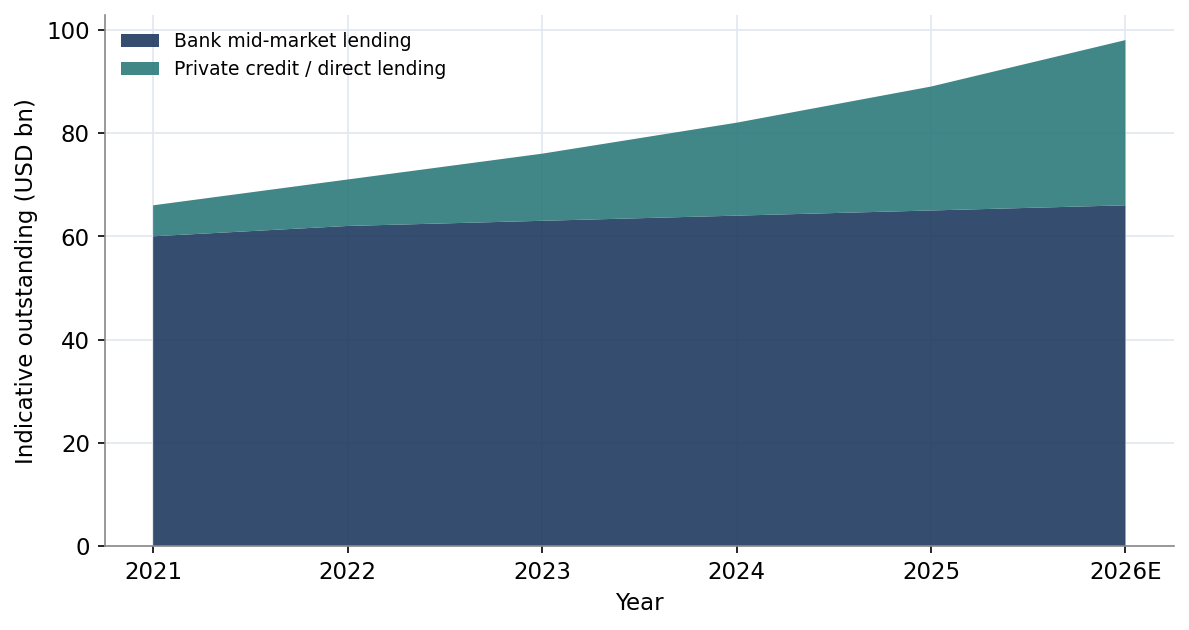
A decade ago, a mid-market company in the Gulf seeking debt had essentially one option: its relationship bank. Today it has many. Direct-lending funds, family offices investing through credit structures, and specialist private credit platforms now compete actively to lend to the GCC mid-market, offering capital that is more expensive than bank debt but faster, more flexible and more certain. This shift, from a bank-dominated to a diversified financing market, is one of the most consequential developments in regional finance, and it is the subject of this paper.
Private credit, the provision of debt by non-bank lenders directly to borrowers, has grown from a niche to a structural pillar of the GCC mid-market in a remarkably short time. The growth reflects forces on both the demand and the supply side: borrowers underserved by conservative bank lending have sought alternatives, and investors seeking yield have provided the capital to meet that demand. The result is a market that has expanded rapidly and that shows every sign of continuing to grow, reshaping how mid-market companies in the Gulf finance themselves.
The central argument of this paper is that private credit is not simply more expensive bank debt but a distinct product, offering speed, certainty, flexibility and tailoring that justify its premium for many borrowers and many situations. A borrower that understands private credit as a different product, suited to different needs, rather than as a costly substitute for bank debt, can use it well, deploying it where its advantages are worth paying for and using cheaper bank debt where they are not. The paper develops a framework for this choice and examines the market from the perspectives of both the borrower and the investor.
The figures used throughout are indicative, calibrated to observable GCC conditions in early 2026 but not drawn from any specific transaction. The paper proceeds from the growth of the market (Section 2), through its drivers (Section 3), the spectrum of private credit products (Section 4), the comparison with bank lending (Section 5), the borrower decision framework (Section 6), pricing and structuring (Section 7), the investor perspective (Section 8), risk (Section 9), GCC-specific considerations (Section 10), three case studies (Section 11), sensitivity analysis (Section 12), an international comparison (Section 13), the outlook for the market (Section 14), common errors (Section 15), an implementation roadmap (Section 16), a strategic perspective (Section 17), a conclusion (Section 18) and limitations (Section 19).
The Spectrum of Private Credit Products
Private credit is not a single product but a spectrum, ranging from senior direct lending at the lower-risk, lower-cost end through unitranche and mezzanine to special situations at the higher-risk, higher-cost end. Table 1 sets out the principal products, and Figure 3 their indicative cost.
Figure 3. Indicative Cost Across the Private Credit Spectrum
Table 1. The Private Credit Product Spectrum
Indicative ranges calibrated to GCC conditions in early 2026. Not transaction-specific.
Senior direct lending is the core of the market, providing senior secured debt to mid-market companies at a cost above bank senior but with greater speed and flexibility. Unitranche, a single facility that blends senior and subordinated debt into one tranche at a blended rate, simplifies the capital structure for the borrower and is a popular private credit product, particularly for acquisition financing. Mezzanine fills the gap above senior debt at a higher cost, as examined in a companion paper, and special situations funds the complex, stressed or time-critical situations that other lenders avoid, at the highest cost.
The breadth of the spectrum means that private credit can serve a wide range of borrower needs, from the mid-market company seeking core senior debt to the sponsor seeking acquisition financing to the company in a complex or stressed situation. A borrower should understand where on the spectrum its need sits, because the cost and the appropriate provider vary across it, and a borrower seeking core senior debt should not pay special-situations pricing, nor should a borrower in a complex situation expect senior-direct-lending terms. Matching the need to the right point on the spectrum is the first step in using private credit well.
The spectrum is not static but is itself widening as the market matures. Early GCC private credit was concentrated in senior direct lending and asset-backed structures, the safer end of the spectrum, but as the market has deepened and managers have grown more confident, the unitranche, mezzanine and special-situations segments have developed, extending the spectrum toward higher risk and return. This widening is a sign of maturation, and it means a borrower can increasingly find a private credit product matched to almost any need, which further entrenches private credit as a complement to, and in places a substitute for, the banks.
The Borrower Decision Framework
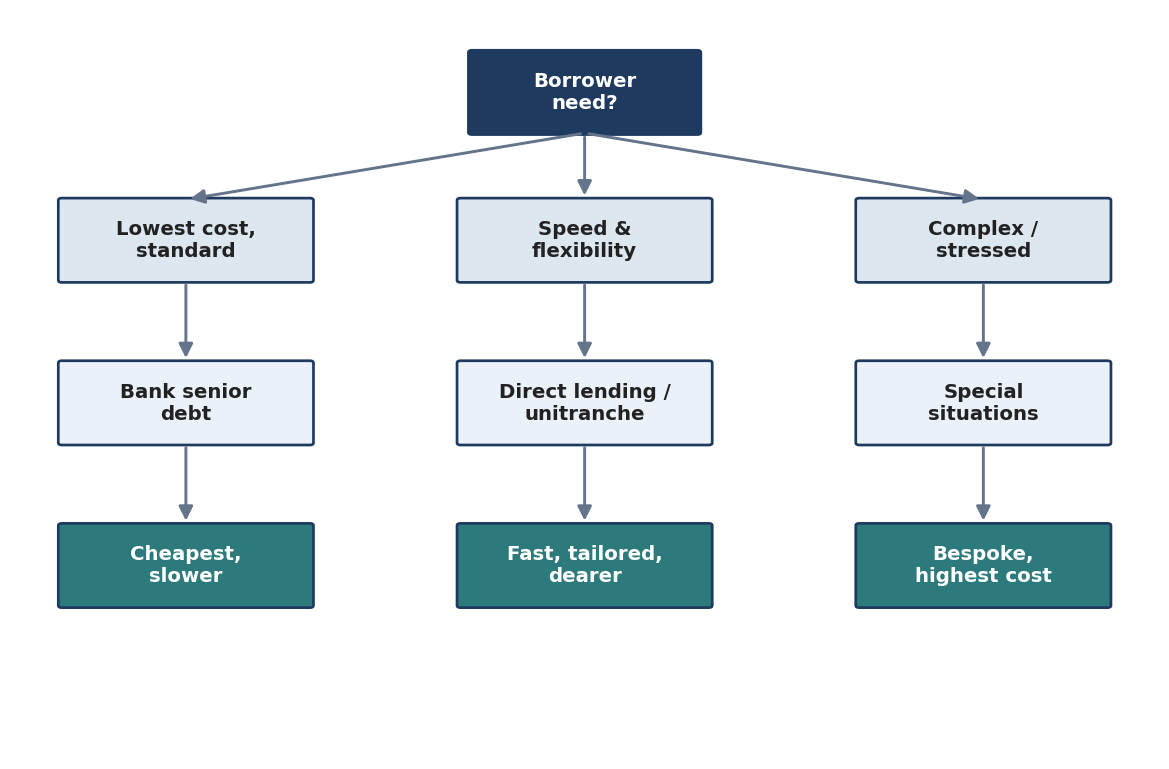
The decision framework matches the borrower need to the appropriate financing, and Figure 5 presents it as a decision tree.
Figure 5. Financing Choice by Borrower Need
Indicative framework. The borrower need determines the appropriate source.
A borrower whose need is for the lowest-cost, standard financing, and who can satisfy a bank and accept its process and covenants, should choose bank senior debt, accepting the slower process and tighter covenants in exchange for the lower cost. A borrower whose need is for speed and flexibility, perhaps for a time-critical acquisition or a situation a bank cannot accommodate quickly, should choose direct lending or unitranche, paying the premium for the speed and tailoring. A borrower in a complex or stressed situation that no conventional lender will fund should turn to special situations capital, accepting the highest cost for the only capital available.
The framework also points to combining the sources. A sophisticated borrower may use bank debt for the cheap, standard core of its financing and private credit for the part that requires speed, flexibility or leverage beyond what the bank will provide, assembling a capital structure that draws on each source for what it does best. This combination, using each lender for the purpose it serves most cheaply, is the most efficient approach for a borrower with varied needs, and it is increasingly common as borrowers grow sophisticated in their use of the diversified financing market.
Pricing and Structuring
Private credit pricing reflects the risk the lender takes, the cost of its capital, and the competitive conditions of the market. A private credit fund prices to deliver its investors a target return after expected losses, which sets its pricing above bank lending, but competition among the growing number of private credit providers disciplines the pricing, preventing it from rising as far above bank debt as the lenders might wish. The borrower benefits from this competition, and a borrower that runs a competitive process among private credit providers can secure keener pricing than one that approaches a single fund.
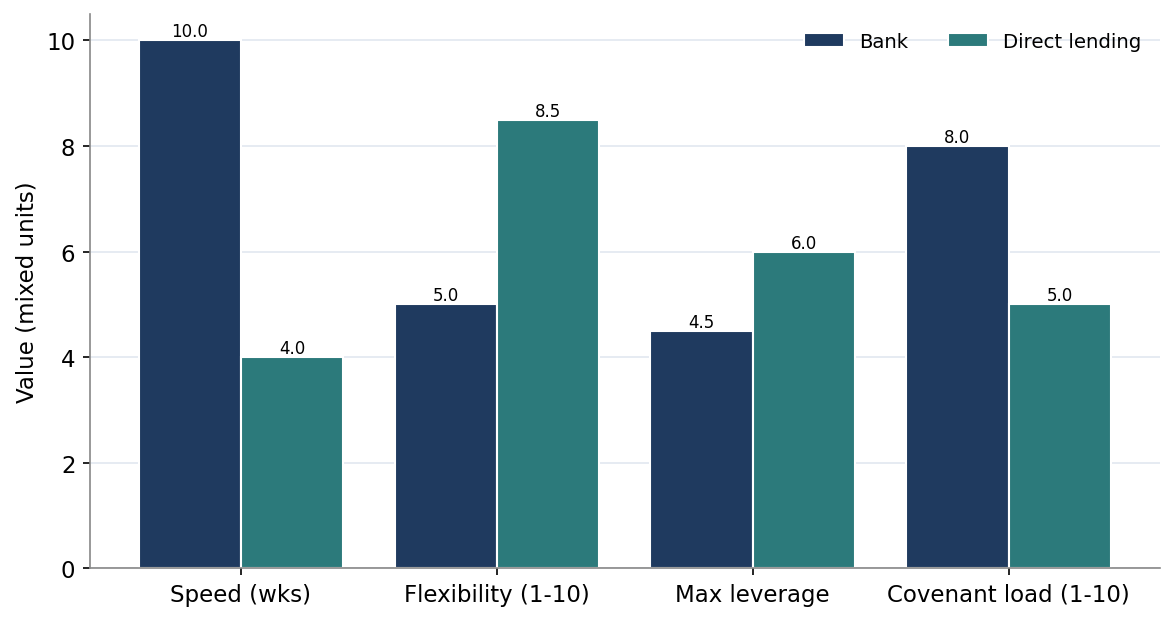
The structuring of private credit is where its flexibility is realised. A private credit facility can be tailored in its drawdown schedule, its amortisation, its covenants, its security and its other terms to fit the borrower situation, in ways that a standardised bank facility cannot. This flexibility is valuable to a borrower with a non-standard situation, and it is part of what the borrower pays for. A borrower should engage with the structuring actively, shaping the facility to its needs rather than accepting a standard structure, because the ability to tailor the facility is one of the principal advantages of private credit over a bank.
The covenant package is a particular point of structuring. Private credit covenants are often lighter or more bespoke than bank covenants, with some facilities offering covenant-lite or covenant-loose structures that give the borrower more operational freedom. This lighter covenant load is attractive to borrowers, but it comes at a cost in pricing and it should be weighed against the discipline that covenants provide. A borrower should negotiate a covenant package that gives it the freedom it needs while accepting the monitoring the lender reasonably requires, and it should understand that a lighter covenant package is paid for in the pricing.
A practical implication of the bank-versus-private-credit comparison is that the two are often best used together rather than as alternatives. A borrower can place the cheap, standard core of its financing with a bank and layer private credit on top for the incremental leverage, the speed, or the flexibility that the bank will not provide, achieving a blended cost lower than an all-private-credit structure while capturing the advantages the bank cannot offer. The most sophisticated borrowers think in exactly these terms, treating banks and private credit as complementary instruments in a single capital structure rather than as competing answers to the same question.
| Product | Risk | Indicative cost | Typical use |
|---|---|---|---|
| Senior direct lending | Lower | ~8.8% | Core mid-market debt |
| Unitranche | Moderate | ~11.0% | Single blended facility |
| Mezzanine | Higher | ~15.0% | Gap above senior |
| Special situations | Highest | ~18.5%+ | Complex, stressed, time-critical |
| Asset-based | Variable | ~9-13% | Secured against assets |
Risk Considerations
The risks of private credit, for both borrowers and investors, deserve careful attention as the market grows. For the borrower, the principal risk is the higher cost, which must be justified by the speed, flexibility or access that private credit provides; a borrower that pays the private credit premium for a need that a bank could have met more cheaply has overpaid. The borrower also faces the risk of a less relationship-based lender that may be less accommodating in difficulty than a long-standing relationship bank, though this varies by provider.
For the investor and the market as a whole, the principal risk is credit losses, particularly through a downturn that the rapidly grown market has not yet been fully tested by. A private credit market that has grown quickly in benign conditions may face elevated losses in a downturn, and the quality of the origination and underwriting through the growth phase will determine how well it weathers the test. The dependence on manager skill, the illiquidity of the asset class, and the potential for losses to cluster in a downturn are the genuine risks that investors and observers of the market should weigh against its attractive growth and yield.
A systemic consideration is whether the growth of private credit, by moving lending outside the regulated banking system, creates risks that are less visible and less regulated than bank lending. This is a live question in global private credit, and it applies to the GCC as the market grows. The market resilience through its first genuine downturn will be an important test, and participants should not assume that the benign conditions of the growth phase will persist. A prudent borrower, investor or observer treats the rapidly grown market with appropriate caution, recognising that its quality will be revealed only when conditions turn.
The manager-selection problem for investors is sharpened in a young market like the GCC, where many managers lack a track record through a full cycle and where the dispersion in origination quality is therefore hard to observe. An investor cannot rely on a long record of realised losses to distinguish the disciplined manager from the undisciplined, and must instead assess the underwriting process, the alignment of the manager with its investors, and the experience of the team, often gained in more mature markets. This difficulty makes diversification across managers, and a preference for managers with cycle-tested experience, particularly valuable for an investor entering the GCC private credit market.
Considerations Specific to the GCC
The GCC private credit market has distinctive features. The dirham and other pegged currencies allow dollar-denominated international private credit to participate without currency friction, deepening the pool of capital. The depth of regional family-office and institutional capital provides a local investor base for the asset class alongside the global funds. And the conservative posture of the regional banks, which creates the financing gap, is a structural feature that supports the private credit market growth, since the gap private credit fills is unlikely to close quickly.
The regulatory and legal frameworks for private credit in the region are developing, and the enforceability of security and the predictability of recovery, which underpin the lenders willingness to lend, are improving as the frameworks mature. A private credit lender in the region assesses the enforceability of its security and its recovery prospects, and the maturation of the frameworks supports the market growth by giving lenders greater confidence. The development of these frameworks, alongside the deepening of the capital and the persistence of the bank financing gap, supports the continued growth of the GCC private credit market.
The compliant dimension is also relevant: a portion of the regional capital and a portion of the borrower demand is for Shariah-compliant structures, and private credit can be provided in compliant form, widening the market. A private credit provider able to offer compliant structures accesses the compliant capital and serves the compliant borrowers that conventional structures cannot, which is an advantage in the region. The compliant private credit market is a growing segment of the broader market, and it benefits from the same drivers, the bank gap, the speed and flexibility, the investor yield, that drive the conventional market.
Indicative Case Studies
Three indicative cases show private credit in action. The figures are synthetic and constructed for analytical clarity, not drawn from any specific transaction.
Case A: mid-market unitranche
Case A is a mid-market company seeking debt to fund its growth, which secures a unitranche facility from a direct-lending fund. The unitranche blends senior and subordinated debt into a single facility at a blended rate, providing the company with the leverage it needs in a simple structure, funded quickly and tailored to its situation. The company pays more than bank senior debt would cost, but it obtains higher leverage, a simpler structure and faster funding than a bank would provide, which suits its growth need.
Case B: growth financing
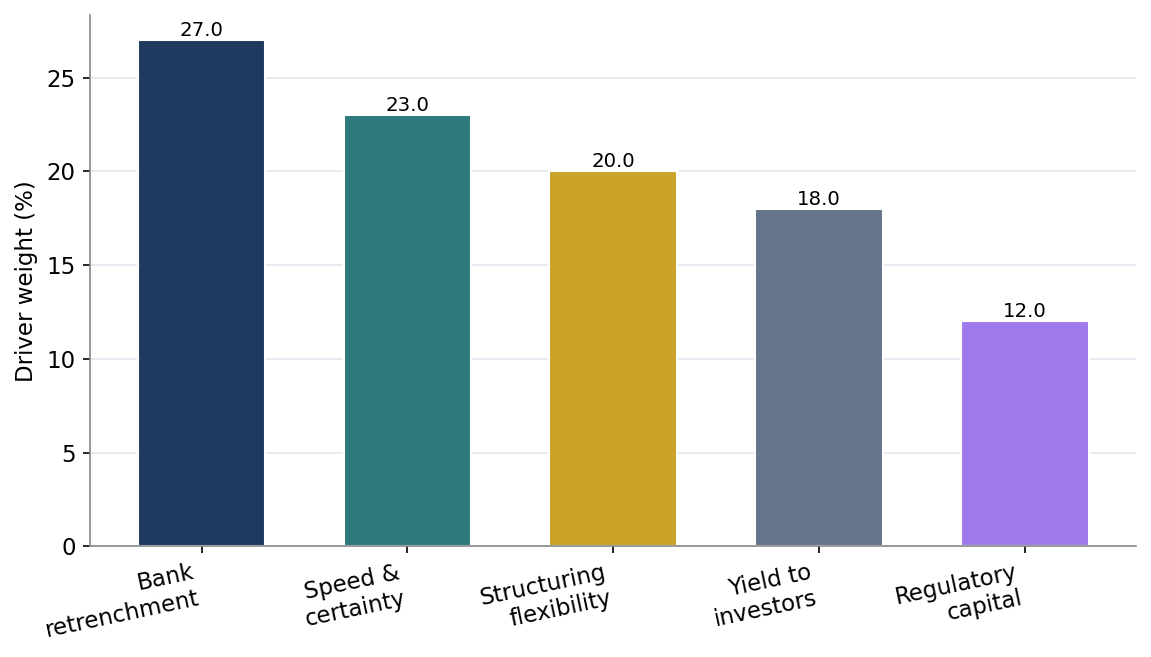
Case B is a growth company that a bank will not fund because its cash flow is still building, which secures growth financing from a private credit fund willing to lend against its prospects and its assets. The fund provides the capital that the bank declined, accepting the risk in exchange for a higher return and appropriate security, and the company obtains the capital it needs to grow. The case illustrates private credit filling the gap that bank retrenchment leaves, funding a viable borrower that the conservative bank market will not.
Case C: acquisition finance
Case C is a sponsor making a time-critical acquisition that requires fast, certain financing, which a private credit fund provides as acquisition finance with the speed and certainty the bank process cannot match. The fund commits and funds quickly, allowing the sponsor to complete the acquisition against a deadline, and the sponsor pays the premium for the speed and certainty that secured the deal. The case illustrates the speed and certainty advantage of private credit, which justifies its premium for a time-critical need.
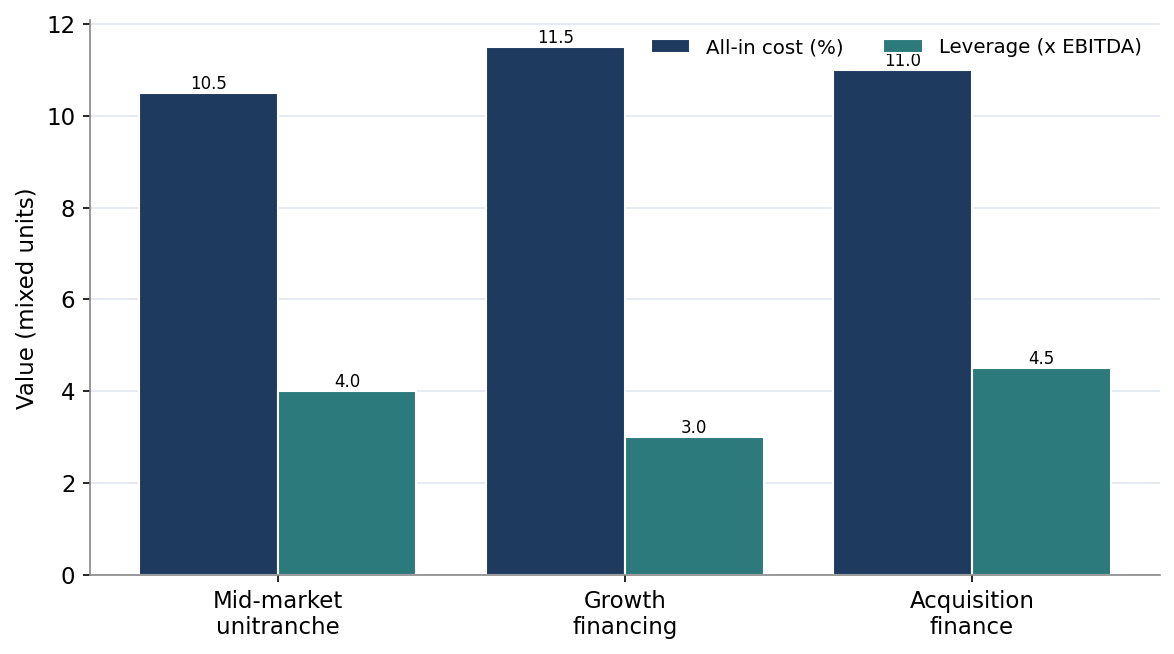
Figure 7. Cost and Leverage by Case
Synthetic figures for analytical comparison. Not a forecast.
Figure 7 compares the three cases on cost and leverage. Each pays a private credit premium over bank debt, but each obtains something a bank would not provide: higher leverage and a simpler structure in Case A, capital the bank declined in Case B, and speed and certainty in Case C. The cases illustrate that the private credit premium buys genuine advantages, and that a borrower paying it is buying speed, flexibility, leverage or access rather than simply overpaying for debt a bank would have provided more cheaply.
International Comparison
Private credit is a mature, large asset class in the United States and Europe, where it has grown over two decades to become a central part of mid-market financing, rivalling the banks in some segments. The GCC market is following the same trajectory, with a lag, and the international experience offers a guide to where the regional market is heading: continued growth, increasing institutionalisation, a widening spectrum of products, and an eventual test through a downturn that will separate the strong managers from the weak.
The international experience also offers lessons. It shows that private credit is a durable, structural part of the financing system rather than a passing phenomenon, that it complements rather than wholly replaces bank lending, and that the quality of origination and underwriting, revealed through cycles, is what distinguishes the managers that endure. The GCC market can learn from the mature markets, both in the opportunities the asset class offers and in the disciplines required to navigate it successfully. As regional managers absorb these lessons and the market institutionalises, the GCC private credit market is likely to mature toward the depth and sophistication of the international markets.
The international comparison also tempers expectations about the pace of the coming maturation. The United States and European private credit markets took two decades to reach their present depth, developing through several cycles that progressively tested and refined the managers and the structures. The GCC market, though it can learn from and compress some of that journey, will still need time and at least one genuine downturn to mature fully, and observers should expect the process to unfold over years rather than months.
Implementation Roadmap
Identify the nature of the financing need, standard or non-standard, relaxed or time-critical, simple or complex, to determine where on the bank-to-private-credit spectrum it sits.
Use bank debt for the cheap, standard core of the financing and private credit for the part requiring speed, flexibility, leverage or access beyond what the bank provides.
Run a competitive process among private credit providers to discipline the pricing.
Engage actively with the structuring to tailor the facility, including the covenant package, to the borrower needs.
For investors, assess the manager origination and underwriting discipline and track record through a cycle, not merely the headline yield.
Consider the compliant route where the capital or the borrower requires it, to access the compliant segment of the market.
Prepare for a downturn, recognising that the rapidly grown market has not yet been fully tested and that discipline through the growth phase determines resilience.
Conclusion
Private credit has risen from a niche to a structural pillar of GCC mid-market financing, driven by bank retrenchment, the speed and flexibility it offers borrowers, and the attractive yield it offers investors. This paper has argued that private credit is a distinct product rather than expensive bank debt, offering speed, certainty, flexibility and access that justify its premium for many borrowers and situations, and that a borrower that understands it as such can use it well, deploying it where its advantages are worth paying for and using cheaper bank debt where they are not.
The rise of private credit has transformed the regional financing market from bank-dependent to diversified, with benefits for borrowers, investors and the resilience of the system as a whole. The principal uncertainty is how the rapidly grown market will perform through its first genuine downturn, which will test the quality of its origination and underwriting and separate the disciplined from the undisciplined. The borrowers, investors and advisers that understand the diversified market and approach it with discipline will benefit from it, while those that misjudge it will overpay or take losses. The frameworks in this paper are intended to help participants understand and use the diversified financing market that the rise of private credit has created.
Limitations and Directions for Further Research
This paper is framework-oriented and relies on indicative data, and its conclusions are directional rather than precise. The growth figures, costs, yields and default rates are calibrated to observable conditions but are not empirical estimates, and they vary with conditions and across segments of the market. The market has not yet been tested through a genuine downturn at its current scale, which limits the confidence with which its resilience can be assessed.
Several extensions would strengthen the analysis. An empirical study of the size, growth and composition of the GCC private credit market would replace the indicative figures with data. An analysis of realised default and recovery rates across the market would test the risk assumptions. And a study of how the market performs through a downturn, when it eventually arrives, would provide the test that the growth phase has not yet supplied. Each is a natural subject for a later paper in this series.
| Scenario | Default rate | Base rate | Net return |
|---|---|---|---|
| Benign | Low | Elevated | ~12% |
| Base | Moderate | Moderate | ~10.5% |
| Downturn | Elevated | Falling | ~7% |
| Severe | High | Falling | ~4% |
