
Introduction
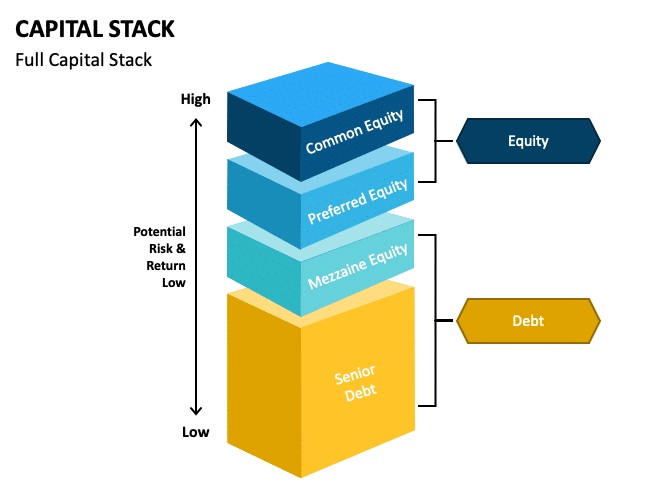
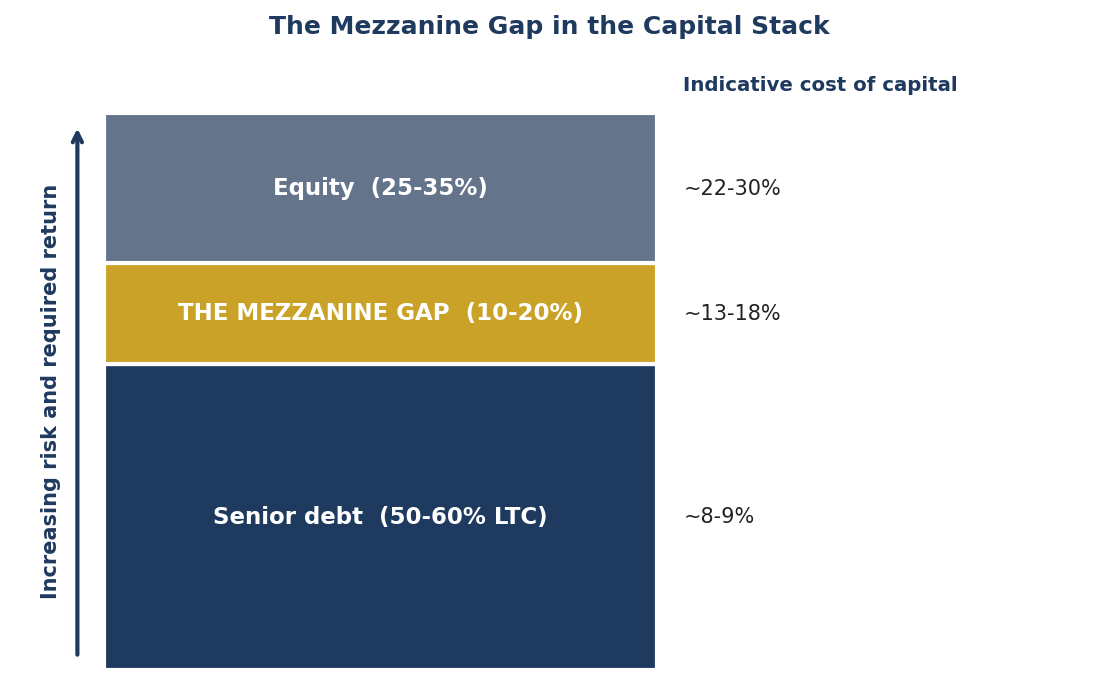
Every leveraged real asset transaction has a gap. The senior lender will fund a portion of the cost, typically half to sixty percent, and no more, because beyond that its security thins and its risk rises. The sponsor can raise a portion as equity, but equity is expensive and dilutive. Between the senior debt and the equity lies a gap, a slice of the capital structure that the senior lender will not reach and that the sponsor would prefer not to fill with costly common equity. This is the mezzanine gap, and how a sponsor fills it materially affects its returns.
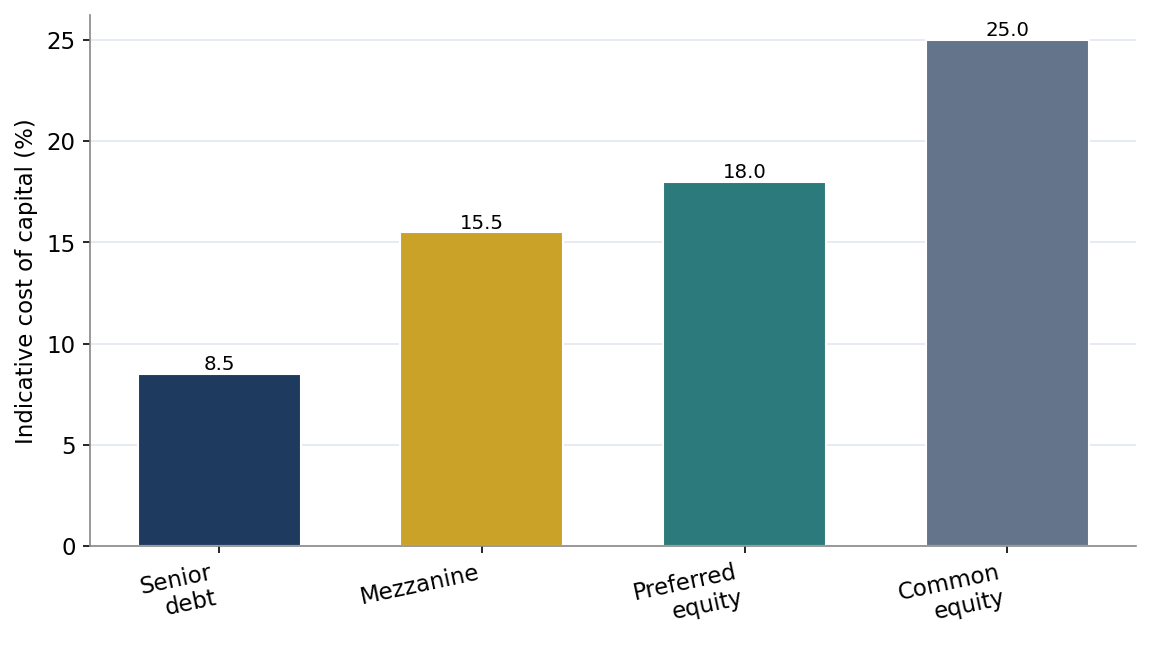
Mezzanine capital exists to fill this gap. Sitting between senior debt and equity in priority, it is subordinated to the senior lender but ranks ahead of equity, and it provides capital that increases the total leverage and reduces the common equity required, at a cost between that of senior debt and equity. For a sponsor, mezzanine is the instrument that bridges the gap between what the senior lender will provide and what the sponsor can raise as equity, and using it well is a genuine source of return.
The central argument of this paper is that mezzanine creates value for a sponsor whenever the return on the equity it releases exceeds its cost, and that it is most valuable in the mid-sized transactions where the equity gap is material but common equity is too dilutive. A sponsor that understands when and how to use mezzanine can increase its leverage, reduce its equity, and improve its returns, while one that defaults to filling the gap with common equity leaves value on the table. The paper develops the framework for this decision and examines the GCC mezzanine market, which, though underdeveloped relative to the senior and equity markets, is growing as private credit deepens.
The figures used throughout are indicative, calibrated to observable GCC conditions in early 2026 but not drawn from any specific transaction. The paper proceeds from the position of mezzanine in the capital stack (Section 2), through its forms (Section 3), its effect on returns (Section 4), the decision framework (Section 5), structuring and the intercreditor relationship (Section 6), the mezzanine provider perspective (Section 7), risk (Section 8), the GCC market (Section 9), three case studies (Section 10), sensitivity analysis (Section 11), an international comparison (Section 12), common errors (Section 13), an implementation roadmap (Section 14), a strategic perspective (Section 15), a conclusion (Section 16) and limitations (Section 17).
The Effect of Mezzanine on Returns
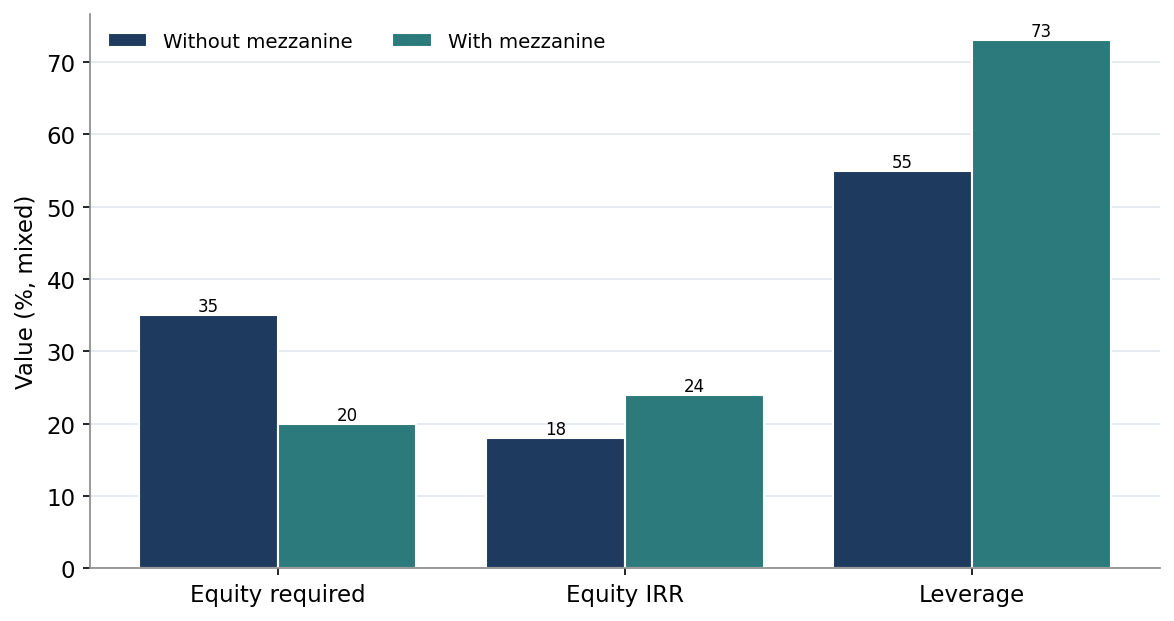
The value of mezzanine to a sponsor is in its effect on the equity return, illustrated in Figure 4. By filling part of the gap with mezzanine rather than equity, the sponsor reduces the equity it must invest, and because the project return is then spread over a smaller equity base, the equity return rises. The mezzanine, in effect, leverages the equity, amplifying its return, at the cost of the mezzanine coupon and the increased risk that leverage brings.
Figure 4. The Effect of Mezzanine on Equity Required, IRR and Leverage
Mezzanine reduces equity required and raises equity IRR and leverage. Not a forecast.
The condition for mezzanine to create value is simple: the return the sponsor earns on the equity that mezzanine releases must exceed the cost of the mezzanine. If the project earns more on the released equity than the mezzanine costs, the substitution is value-creating; if it earns less, the mezzanine destroys value. Because the project equity return typically exceeds the mezzanine cost in a healthy transaction, mezzanine usually creates value, but the margin narrows as the mezzanine cost rises or the project return falls, and in a marginal or stressed transaction mezzanine can destroy value.
The effect of mezzanine on returns is therefore a leverage effect, with the benefits and risks that leverage brings. Figure 7, presented later, shows that the equity IRR rises with leverage in a base case but falls sharply in a stressed case as the fixed mezzanine obligations overwhelm the diminished cash flow. Mezzanine, like all leverage, amplifies both the upside and the downside, and a sponsor using it must be comfortable that the transaction can service the mezzanine through a reasonable downside, not merely in the base case. The decision to use mezzanine is thus a decision about leverage and risk appetite as much as about cost.
The Decision Framework
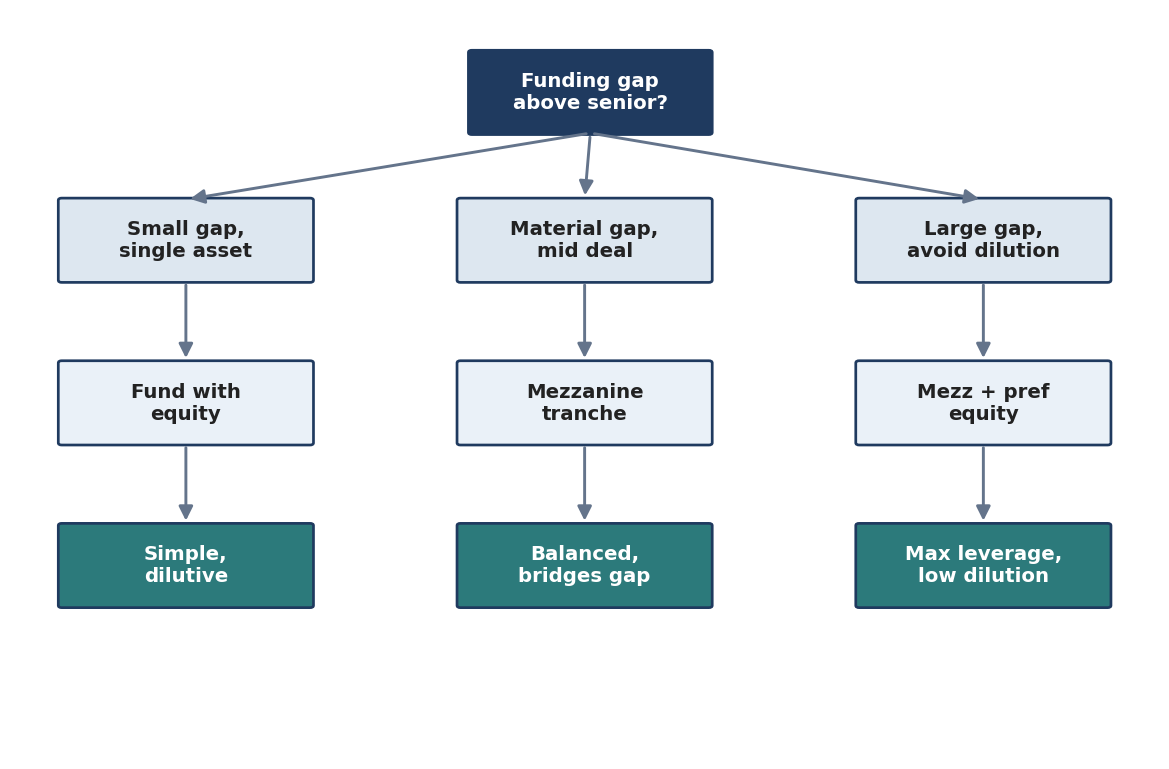
The framework for deciding whether to use mezzanine matches the instrument to the size of the funding gap and the sponsor objectives, illustrated in Figure 5. A small gap on a single asset may be best filled with equity, because the cost and complexity of arranging mezzanine, including the intercreditor negotiation, may not be justified by the small quantum. A material gap on a mid-sized transaction is the natural home of mezzanine, where the gap is large enough to justify the instrument and common equity would be materially dilutive. A large gap where the sponsor wishes to maximise leverage and minimise dilution may justify both mezzanine and preferred equity.
Figure 5. Mezzanine Decision Framework by Funding Gap
Indicative framework. The size of the gap and the sponsor objectives determine the approach.
The mid-sized transaction is where mezzanine earns its place, as in the capital stack framework of a companion paper. At this size, the equity gap above senior debt is large enough that filling it entirely with common equity is both expensive and dilutive, but the transaction is large enough to justify the cost and complexity of a mezzanine tranche. The sponsor that fills the gap with mezzanine at this size reaches a higher leverage, limits its equity and its dilution, and improves its return, while accepting the intercreditor negotiation and the mezzanine cost. This is the core use case for the instrument.
The framework also depends on the availability of mezzanine, which in the GCC cannot be taken for granted. A sponsor that can access mezzanine, increasingly through private credit, has the option the framework describes; a sponsor that cannot must fill the gap with equity regardless of the framework. The growth of the GCC mezzanine market is therefore expanding the set of sponsors that can use the instrument, and a sponsor that builds relationships with mezzanine providers gains access to a tool that improves its returns and that less-connected sponsors cannot use. Access to mezzanine is itself a competitive advantage in the region.
Structuring and the Intercreditor Relationship
The defining structural feature of mezzanine is its subordination to the senior lender, and the relationship between the senior and mezzanine lenders is governed by an intercreditor agreement that is central to the structure. The intercreditor agreement defines the ranking of the claims, the circumstances in which the mezzanine lender may take enforcement action, the standstill the mezzanine accepts while the senior is being repaid, and the allocation of recoveries in a default. It is the document that makes the two layers of debt coexist, and negotiating it is frequently the critical-path item in arranging a mezzanine-inclusive structure.
The intercreditor negotiation reflects the tension between the senior and mezzanine lenders. The senior lender wants the mezzanine deeply subordinated, prevented from enforcing or interfering while the senior is at risk, and clearly behind the senior in recoveries. The mezzanine lender wants enough rights to protect its position, including the ability to cure a senior default, to receive its coupon while the senior is performing, and to have a voice in a restructuring. The agreement balances these, and the balance struck reflects the relative bargaining power of the two lenders and the norms of the market. A sponsor must allow time for this negotiation, because a structure that is sound on a spreadsheet can stall while the lenders negotiate their relative rights.
Beyond the intercreditor, the mezzanine structure includes its security, often a second-ranking charge or a share pledge rather than a first mortgage, its covenants, which are typically lighter than the senior covenants but still present, and its return structure, chosen from the forms discussed earlier to fit the transaction cash flow. The structuring must ensure that the mezzanine can be serviced or accrued through the project, that its security and rights are clear, and that its relationship with the senior is well-defined. A well-structured mezzanine coexists smoothly with the senior debt and the equity; a poorly structured one creates conflict that can impair the transaction.
| Form | Return paid | Suits | Note |
|---|---|---|---|
| Cash coupon | Periodically in cash | Cash-generating asset | Like dearer senior |
| PIK / accruing | Accrued to principal | Development, pre-stabilisation | Deferred to exit |
| Cash + PIK | Part cash, part accrued | Mixed cash profile | Balanced |
| Coupon + exit fee | Cash + payment on exit | Boost provider return | Common |
| Coupon + warrant | Cash + equity upside | Align with equity | Higher provider return |
Risk Considerations
Mezzanine carries risks for the sponsor that flow from its nature as leverage and subordinated debt. The principal risk is that the additional leverage that mezzanine provides amplifies the downside as well as the upside, so that a transaction that uses mezzanine is more exposed to a downturn than one that does not. The fixed mezzanine obligations, whether cash or accruing, continue regardless of the project performance, and a project that underperforms may struggle to service or repay the mezzanine, which can precipitate a default that the equity cushion alone would have absorbed.
Figure 6. Equity IRR Against Leverage Including Mezzanine, Base and Stress
Mezzanine raises the IRR in the base case but the stress case falls sharply at high leverage. Not a forecast.
Figure 6 illustrates this risk. In the base case, the equity IRR rises with the leverage that mezzanine provides, up to a point; in the stress case, the IRR rises briefly and then falls sharply as the fixed mezzanine obligations overwhelm the diminished cash flow. The gap between the two curves at high leverage is the risk that mezzanine introduces, and it widens as the leverage rises. A sponsor must size its mezzanine against the stress case, not the base case, ensuring that the transaction can service the mezzanine through a reasonable downturn, because a mezzanine sized to the base case can turn a manageable downturn into a default.
A second risk is the intercreditor risk: in a default, the relationship between the senior and mezzanine lenders, governed by the intercreditor agreement, determines the outcome, and a poorly negotiated agreement can leave the sponsor or the mezzanine in a weak position. A third risk is the refinancing risk for accruing mezzanine, where the accrued amount must be repaid on exit or refinancing, and a delay in the exit allows the accrued amount to grow, increasing the burden. These risks are manageable through prudent sizing, careful structuring and a conservative view of the exit, but they are real, and a sponsor using mezzanine must understand and manage them.
The GCC Mezzanine Market
The GCC mezzanine market is less developed than the senior debt and equity markets, which is the underserved gap this paper identifies. Historically, a sponsor seeking to fill the gap above senior debt had few mezzanine providers to turn to, and frequently filled the gap with equity by default. This underdevelopment of the mezzanine market is a feature of the regional financing system, and it has meant that the value mezzanine could create has frequently been left uncaptured.
The growth of private credit, examined in a companion paper, is developing the mezzanine market, as private credit funds increasingly provide mezzanine alongside senior direct lending. This growth is expanding the set of sponsors that can access mezzanine and capturing the value that the underserved gap left uncaptured. A sponsor that builds relationships with the growing pool of mezzanine providers can increasingly use the instrument, and the development of the market is, on balance, improving the efficiency of regional capital structures by allowing the gap to be filled with appropriately priced mezzanine rather than expensive equity.
The compliant dimension is relevant here too. Mezzanine can be structured in Shariah-compliant form, and a portion of the regional capital and borrower demand is for compliant structures, so a provider able to offer compliant mezzanine accesses a wider market. The development of compliant mezzanine alongside conventional mezzanine is part of the broadening of the regional mezzanine market, and it serves the compliant sponsors and capital that conventional structures cannot. As the market develops, the availability of both conventional and compliant mezzanine is increasing, which benefits the sponsors that can use the instrument.
Indicative Case Studies
Three indicative cases show mezzanine in action. The figures are synthetic and constructed for analytical clarity, not drawn from any specific transaction.
Case A: real estate development mezzanine
Case A is a mid-sized real estate development where the sponsor fills the gap above senior debt with a mezzanine tranche structured as a cash coupon plus PIK, deferring part of the cost to exit when the units are sold. The mezzanine allows the sponsor to reach a higher leverage and limit its equity, improving its return, and the deferred PIK element suits the development cash flow, which generates little cash before the units are sold. The sponsor accepts the intercreditor negotiation and the mezzanine cost in exchange for the reduced equity and the improved return.
Case B: acquisition mezzanine
Case B is an acquisition where the sponsor uses mezzanine to bridge the gap between the senior acquisition debt and its equity, allowing it to complete the acquisition with less equity than an all-equity gap would require. The mezzanine, structured as a cash coupon plus an exit fee, leverages the acquisition and improves the sponsor return, and it allows the sponsor to pursue an acquisition that its equity alone could not have funded. The case illustrates mezzanine enabling a transaction by bridging the gap, not merely improving the return on one the sponsor could have funded anyway.
Case C: growth mezzanine
Case C is a growth company that uses mezzanine to fund its expansion without diluting its equity, structured as a cash coupon plus a warrant that gives the provider a share of the upside. The mezzanine funds the growth, the warrant aligns the provider with the company success, and the company avoids the dilution that an equity raise would have caused. The case illustrates mezzanine as a tool to fund growth while preserving ownership, with the warrant aligning the provider, which is a common structure for growth mezzanine.
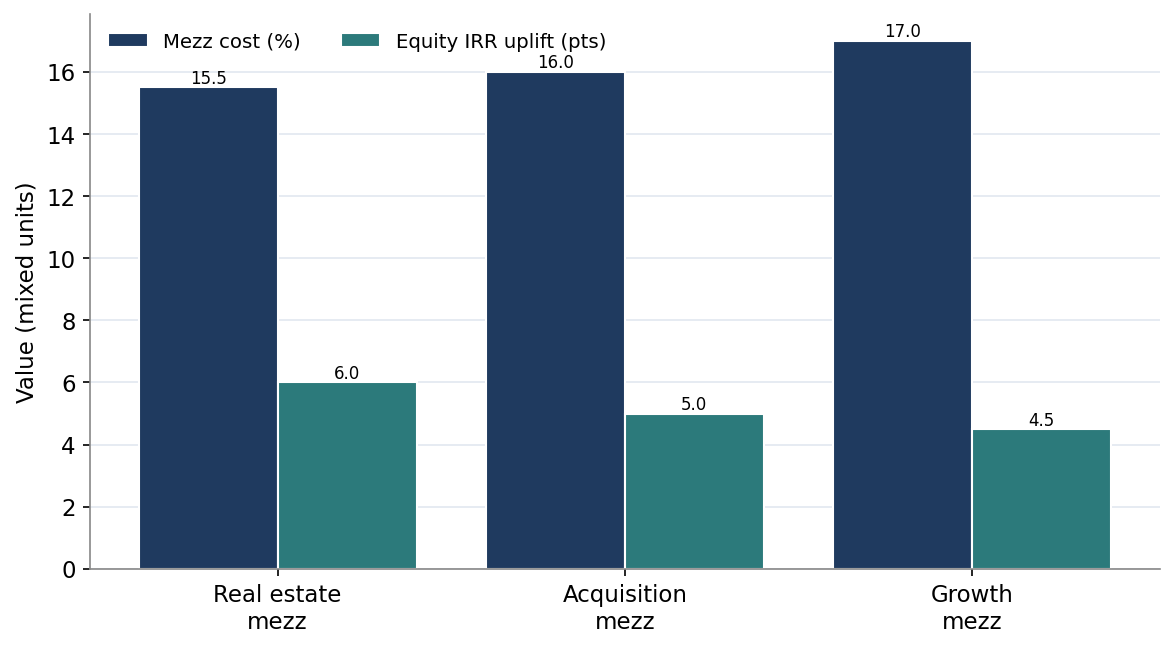
Figure 7. Mezzanine Cost and Equity IRR Uplift by Case
Synthetic figures for analytical comparison. Not a forecast.
Figure 7 compares the three cases on the mezzanine cost and the equity IRR uplift it provides. In each case, the mezzanine costs more than senior debt but less than equity, and it provides an uplift to the equity IRR by reducing the equity required and leveraging the return. The cases illustrate the range of uses, development, acquisition and growth, and the consistent value mezzanine provides when the project return exceeds its cost, while reminding that the uplift comes with the increased leverage and risk that the instrument introduces.
International Comparison
Mezzanine is a mature, well-established instrument in the United States and Europe, where a deep market of mezzanine and subordinated-debt providers serves the gap above senior debt across real estate and corporate transactions. The structures, the intercreditor norms and the pricing are well developed, and mezzanine is a routine part of the capital structure for mid-sized leveraged transactions. The GCC market is following this trajectory, with a lag, as private credit develops the regional mezzanine market toward the depth of the mature markets.
The international experience offers lessons for the developing GCC market. It shows that mezzanine is a durable, valuable instrument that fills a genuine structural gap, that its intercreditor norms can be standardised to reduce the negotiation burden, and that a deep mezzanine market improves the efficiency of capital structures by allowing the gap to be filled appropriately. As the GCC market develops and standardises, the cost and complexity of arranging mezzanine should fall, making the instrument more accessible and capturing more of the value that the underserved gap has left uncaptured. The regional market can draw on the mature-market structures and norms while adapting them to the regional context and the compliant dimension.
Implementation Roadmap
Determine the size of the funding gap above senior debt and assess whether it is large enough, and the transaction big enough, to justify mezzanine over equity.
Confirm that the project return on the equity that mezzanine would release exceeds the mezzanine cost, the condition for mezzanine to create value.
Choose the form of mezzanine, cash, PIK, exit fee, warrant, to fit the transaction cash flow and the parties objectives.
Size the mezzanine against a reasonable downside, ensuring the transaction can service it through a stress scenario.
Begin the intercreditor negotiation early, allowing time for the senior and mezzanine lenders to agree their relative rights.
Demonstrate a solid equity cushion and a credible project to the mezzanine provider, to place the tranche on good terms.
Underwrite the exit conservatively, particularly for accruing mezzanine where a delayed exit grows the accrued cost.
Conclusion
The mezzanine gap, the space in the capital structure between the senior debt a lender will provide and the equity a sponsor can raise, is a structural feature of every leveraged transaction, and how a sponsor fills it materially affects its returns. This paper has argued that mezzanine, by filling the gap with capital cheaper than equity and without diluting common ownership, creates value whenever the return on the equity it releases exceeds its cost, and that it is most valuable in the mid-sized transactions where the gap is material but common equity is dilutive.
In the GCC, the mezzanine gap is frequently underserved, and sponsors have often filled it with equity by default, leaving value uncaptured, but the growth of private credit is developing the market and expanding access. A sponsor that can access mezzanine, that understands when and how to use it, and that sizes and structures it prudently, can increase its leverage, reduce its equity, and improve its returns, while managing the risks that the instrument introduces. In a developing market, access to mezzanine is itself an advantage, and mastering the mezzanine gap is part of the broader discipline of treating the capital structure as a source of return. The frameworks in this paper are intended to help sponsors capture the value the gap offers.
Limitations and Directions for Further Research
This paper is framework-oriented and relies on indicative data, and its conclusions are directional rather than precise. The costs, returns and leverage figures are calibrated to observable conditions but are not empirical estimates, and they vary with the transaction and the market. The GCC mezzanine market is developing, and its depth and pricing are evolving.
Several extensions would strengthen the analysis. An empirical study of mezzanine pricing and availability in the GCC would replace the indicative figures with data. An analysis of intercreditor norms in the regional market would sharpen the structuring discussion. And a study of how mezzanine-inclusive structures perform through a downturn, when the leverage risk is tested, would illuminate the risk that the framework emphasises. Each is a natural subject for a later paper in this series.
| Scenario | Project margin | Exit timing | Equity IRR |
|---|---|---|---|
| Upside | Strong | Early | 30% |
| Base | Moderate | On plan | 22% |
| Mild stress | Weak | Late | 14% |
| Severe stress | Poor | Very late | 5% |
