

1. Start with the obligation carried by every cash receipt
A resort or leisure business can receive cash well before it has delivered the promised experience. Joining fees, annual dues, prepaid stays, points, vouchers, event deposits, maintenance charges and financed vacation products create different rights and obligations. A buyer should therefore avoid treating gross cash receipts as current-period revenue or unrestricted working capital. The first diligence question is what the target must still deliver, refund, preserve or transfer after completion.
The transaction model should create a contract-to-cash ledger at member or contract level. Each record should identify the customer, programme, contract date, term, price, billing schedule, cash collected, receivable, promised benefits, usage, expiry, cancellation, refund rights, recognition policy and remaining obligation. The ledger should reconcile to the customer system, general ledger, bank, tax records and reported revenue. Differences should be explained before the buyer relies on earnings.
The obligation can survive a change of control even where accounting revenue has already been recognised. A lifetime access promise, preferential rate, complimentary entitlement, points balance or maintenance commitment may require future capacity and cost. Contract terms, applicable law and historical practice determine enforceability and customer expectations. Legal and accounting workstreams should use the same contract population and exception register.
The investment thesis should describe value after meeting inherited promises. A strong member base can support recurring cash, advocacy and ancillary spend. The same base can become a liability if benefits are underpriced, capacity is constrained, facilities need substantial renewal or members can obtain refunds. The buyer should value the relationship and the remaining service burden together.
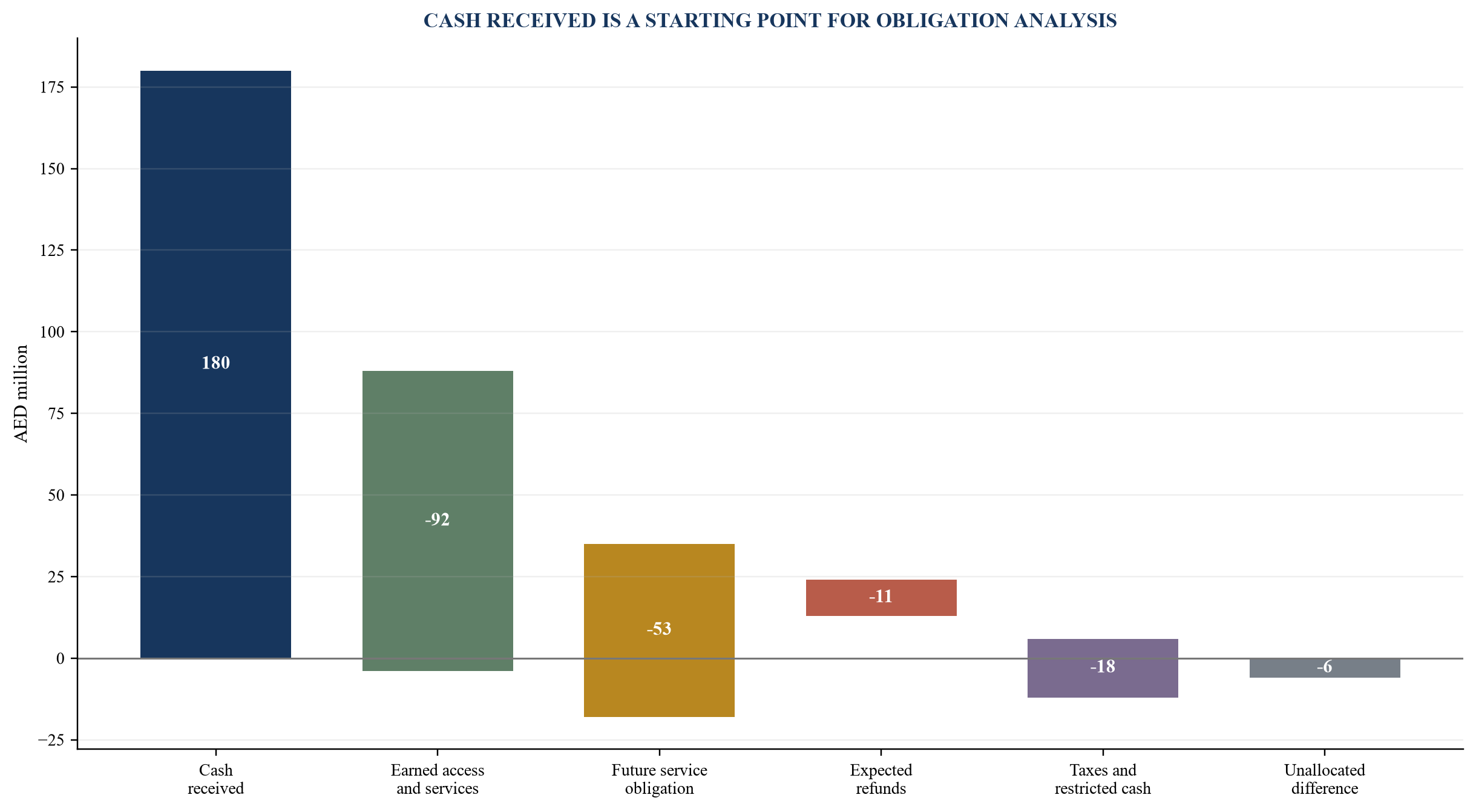
Values are hypothetical AED millions and demonstrate the classification of cash received from members.
2. Define the legal, operating and property perimeter
The resort brand, land, buildings, club, marina, golf course, attraction, restaurants, residences, management company and membership programme may sit in different entities. The buyer should map ownership, leases, licences, management contracts, intellectual property, bank accounts, employees, customer contracts and debt. Consolidated earnings can include assets or cash that do not transfer with the acquired shares or business.
Property and operating rights require separate review. A resort operator may own the freehold, lease the site, hold a usufruct, manage property owned by another party or operate shared facilities under a community agreement. The remaining term, renewal, assignment, change-of-control, repair, capital and termination provisions influence both continuity and value. The buyer should identify third-party consents and the consequence of failing to obtain them.
Membership programmes can cross the legal perimeter. One entity may sell memberships, another may operate the facilities and a third may hold deposits or reserves. Benefits can be redeemable across affiliates or partner properties. Intercompany agreements should specify who funds the service, who carries breakage or refund risk and what happens when a property leaves the network.
The perimeter exercise should end with an entity-and-obligation map. Each source of earnings, asset, liability and customer promise should be assigned to the transferring entity or to a documented post-completion arrangement. Any value attributed to an excluded asset or unsupported affiliate service should be removed from the base case or protected contractually.
Table 1. Resort and leisure transaction perimeter
| Perimeter item | Evidence | Buyer question | Transaction response |
|---|---|---|---|
| land, buildings and leases | title, lease, plot, valuation and consents | which property rights transfer and for how long? | condition, consent, price allocation and security |
| operating and tourism licences | licence register, inspections and correspondence | can each activity continue after control changes? | regulatory condition and compliance covenant |
| membership contracts | terms, amendments, member ledger and complaints | which benefits, refunds and access rights survive? | liability schedule, warranty and adjustment |
| brand and digital systems | licences, domains, data rights and vendor contracts | can the buyer operate and communicate from Day One? | assignment, transitional services and separation plan |
| shared facilities and reserves | association records, budgets and bank controls | who owns cash and who funds future work? | ring-fencing, completion statement and governance rights |
Ownership, control, cash and customer obligations should be tested separately.
3. Segment the membership catalogue before testing value
Membership labels can conceal materially different economics. A joining fee may buy a fixed term, renewable access, lifetime access, points, an ownership interest, priority booking, discounted services or participation in a club. Annual dues may fund current operations, capital reserves or both. A buyer should group contracts by enforceable rights rather than marketing name.
The catalogue should record duration, transferability, cancellation, refund, suspension, inheritance, guest access, blackout dates, capacity priority, renewal price, indexation and facility scope. Legacy contracts may be more generous than current terms. Founder, employee, corporate, family and complimentary memberships should be separated. Side letters and manual exceptions can create obligations absent from standard templates.
Price and service should be reconstructed by vintage. A low historic price may carry substantial future access. A recently sold premium tier may include benefits that have not yet been delivered. Memberships transferred from an acquired programme may have different legal terms and customer expectations. Cohort analysis depends on preserving these differences.
The catalogue also supports integration decisions. The buyer may retain programmes, harmonise benefits, close new sales, offer voluntary migration or create a separate legacy pool. Each option has revenue, capacity, customer, legal and accounting consequences. A decision made before the contract population is known can turn a commercial simplification into an unpriced liability.
4. Reconcile contract liabilities, refunds and recognition
IFRS 15 requires an entity to identify contracts and performance obligations, determine and allocate transaction price, and recognise revenue as promised goods or services transfer.[6] A membership contract may contain distinct promises for access, stays, amenities, points, events, joining services or third-party benefits. The accounting analysis should be performed by qualified advisers and reconciled to actual contractual rights.
Contract liabilities should be analysed by programme, vintage and expected delivery pattern. The buyer should identify cash received before performance, points or vouchers expected to be redeemed, refundable consideration and amounts paid to third parties. Assumptions for breakage, expiry and redemption should be supported by history and current member behaviour. A change in estimate can affect reported revenue without changing current cash.
Refund rights require a separate bridge. Contract terms may permit cancellation during a cooling-off period, after service failure, on health or relocation grounds, or under local consumer law. Historical refund rates can understate exposure if complaints are rising or facilities are unavailable. Pending disputes, credit notes and informal concessions should be included.
The buyer should connect the accounting balance to economic service cost. A contract liability measures accounting obligations under the applicable standard; it may not equal the cash required to serve members or settle claims. Capacity, variable cost, maintenance and future pricing determine the economic burden. Both measures should appear in the diligence report.
5. Build a cash-to-revenue waterfall for every programme
The cash-to-revenue waterfall explains how billing becomes reported revenue and cash contribution. It should begin with gross billings, then show discounts, taxes, refunds, uncollected receivables, deferred amounts, recognised revenue, direct service cost, programme support and capital reserve. The bridge should reconcile to audited or reviewed accounts and bank collections.
Timing differences should be visible by month. Annual dues collected in advance can produce strong first-quarter cash while revenue is recognised over the service period. Event deposits can reverse if bookings cancel. Prepaid stays may be redeemed during peak periods when capacity and variable cost are highest. A buyer using the collection month as run-rate revenue can overstate both earnings and liquidity.
Cash quality also depends on payment method. Card settlements, instalment plans, direct debits, post-dated cheques, payroll deduction and finance arrangements have different failure, chargeback and timing characteristics. Gross receivables should be reduced for expected credit loss, cancellations and unearned financing income where relevant. The collection curve should be analysed by sales channel and cohort.
The waterfall becomes a transaction control. The seller can warrant the completeness of contract liabilities, refund requests and restricted balances. The completion statement can use agreed definitions for cash, debt, working capital and member-related items. The buyer's first hundred days can continue the same monthly reconciliation.
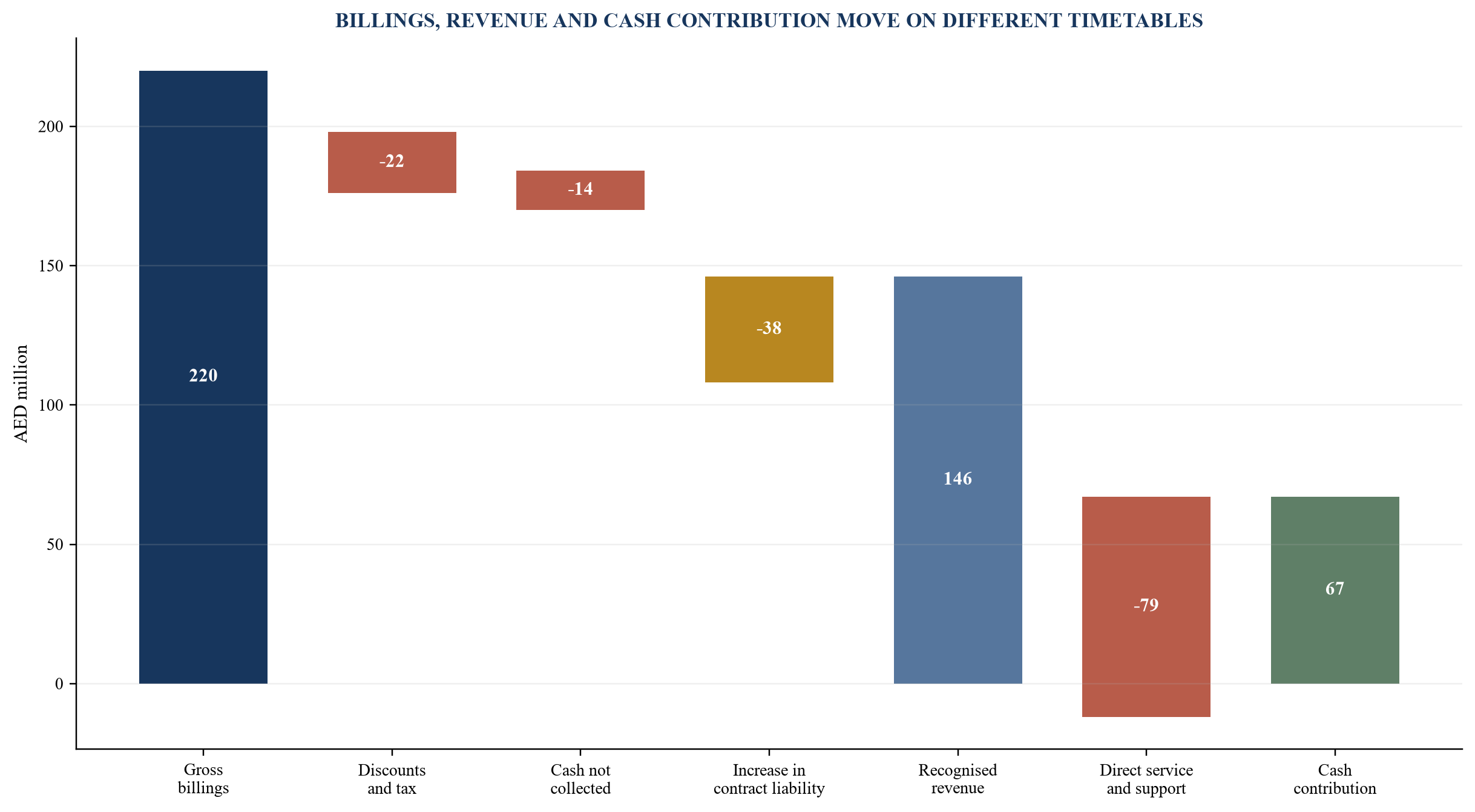
Values are hypothetical AED millions for one annual reporting period.
6. Test utilisation, redemption and capacity together
An outstanding point or membership benefit becomes economically significant when members can use it during constrained periods. The buyer should measure utilisation by facility, day, season, member tier and booking window. Average annual utilisation can hide peak congestion that damages paying guest revenue and member satisfaction.
Capacity should be defined operationally. A hotel room, golf tee time, beach bed, marina berth, event seat or attraction slot cannot always be substituted. Maintenance closures, staffing, weather, private events and owner use reduce availability. The contract may grant priority or blackout protection. The model should reflect these rules rather than assume all theoretical capacity can serve members.
Redemption cost includes more than the immediate variable cost. A complimentary room may displace a cash booking, create housekeeping and amenity cost, earn ancillary spend or support future retention. The analysis should separate incremental cost, displaced contribution and strategic benefit. Peak and off-peak outcomes should be tested independently.
The buyer should identify benefits delivered by third parties. Airline miles, restaurant vouchers, reciprocal clubs and partner attractions can create cash settlement obligations. Partner contracts may terminate on change of control or reprice after expiry. A points balance whose service provider leaves the network may require an alternative benefit or member compensation.
7. Analyse retention through joining cohorts
Headline member count can rise while underlying retention weakens. The business may replace departing members with heavily discounted new sales or retain inactive accounts that generate no cash. Cohort analysis tracks each joining vintage through renewal, utilisation, spend, complaints and contribution.
The cohort table should begin with members eligible to renew. It should show renewed, cancelled, suspended, delinquent, migrated and expired accounts. Renewal price, discount, sales commission and service cost should be attached. Voluntary and involuntary attrition should remain separate because payment failure requires a different response from dissatisfaction or changed travel patterns.
Retention should be linked to experience. Facility closures, booking denials, crowding, service quality, asset condition and benefit changes can affect cohorts differently. A member who purchased lifetime access may not appear in annual renewal data but can still consume capacity and influence complaints. The business needs measures suitable for each contract type.
The acquisition model should avoid assuming one retention rate across the estate. Mature cohorts often behave differently from early cohorts, premium tiers and corporate programmes. Forecasts should use observed transitions and disclose management judgement. Any marketing intervention should include its cost and expected duration.
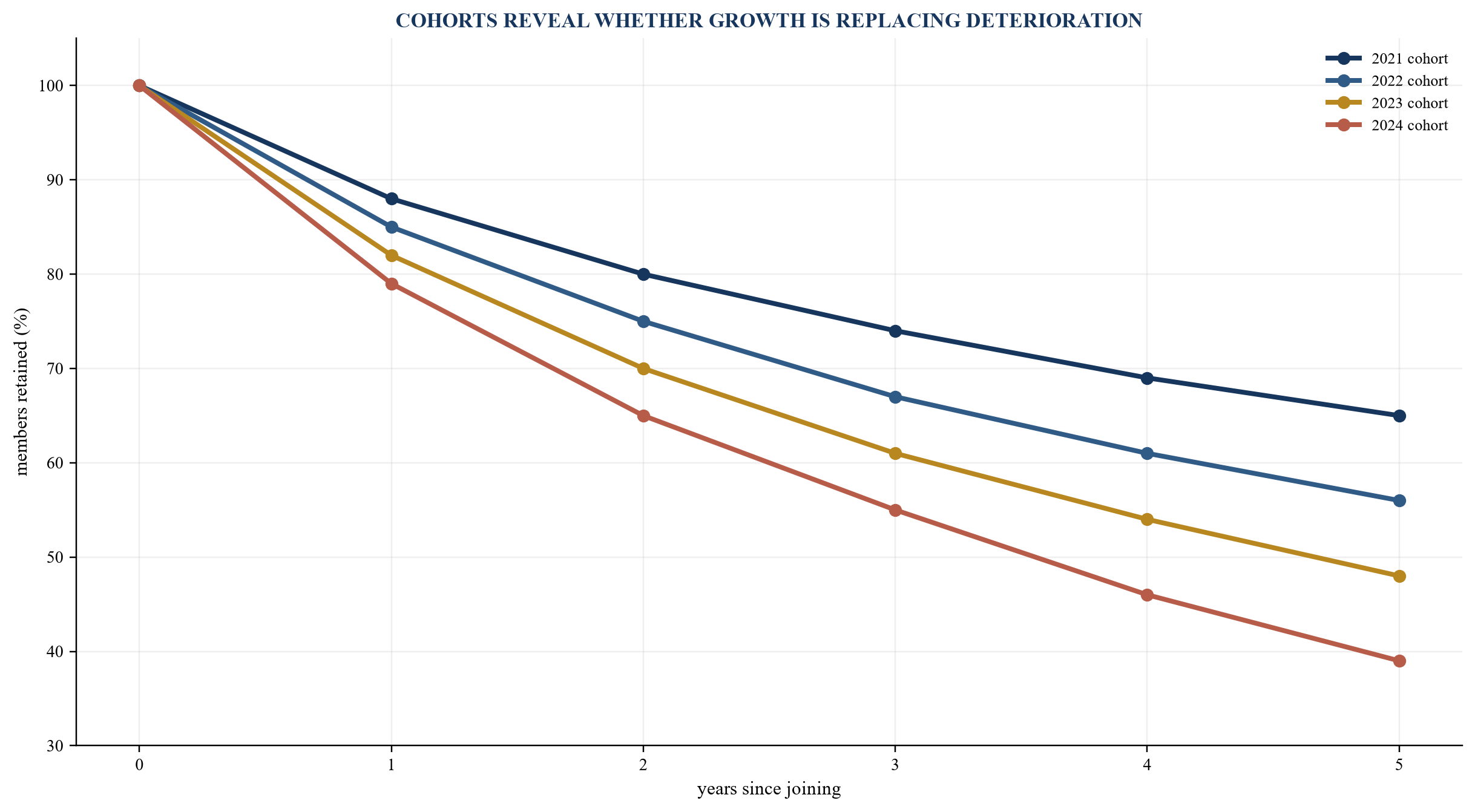
Retention rates are hypothetical and demonstrate why vintages should be analysed separately.
Table 2. Membership cohort diligence dashboard
| Measure | Evidence | Transaction question | Control response |
|---|---|---|---|
| eligible members | contract ledger and status rules | which members could renew or use benefits? | reconcile active population monthly |
| renewal and cancellation | invoices, payments, cancellations and refunds | is retention genuine at the current price? | cohort transition table and exception review |
| utilisation | bookings, admissions and capacity logs | are members active and can facilities serve them? | peak capacity and denial analysis |
| member contribution | dues, ancillary spend, service and acquisition cost | which cohorts create cash after full cost? | vintage contribution and payback model |
| complaints and concessions | cases, credits, legal correspondence and surveys | is attrition preceded by service failure? | issue root cause and remediation owner |
Definitions should remain consistent across vintages and programmes.
8. Reconstruct member lifetime value after acquisition cost
Member lifetime value should be built from recurring cash contribution rather than gross fees. The model should include joining and renewal cash, ancillary spend, discounts, sales commission, marketing, finance cost, service delivery, refunds, bad debt and capital consumption. Corporate overhead should be allocated where it grows with the membership base.
Acquisition cost can be paid before retention is known. Commissions, gifts, trial access, events and digital marketing should be attributed to the acquiring channel and cohort. A high first-year margin can disappear when sales cost is capitalised or omitted. The buyer should reconcile marketing and commission records to member origin.
Value should be sensitive to price and utilisation. Higher renewal prices may lift short-term cash and increase attrition. Lower utilisation may reduce current service cost but signal weak engagement. Frequent utilisation may support loyalty while increasing congestion or maintenance. The model should reflect observed relationships rather than assign a simple multiple to annual dues.
The diligence report should show payback and contribution distribution. Averages can hide a small group of valuable members and a large group with negative economics. Member concentration, corporate account dependence and related-party memberships should be identified. Personal data should be handled within applicable privacy and contractual restrictions.
9. Review sales practices and member promises
Revenue quality can be weakened before a contract reaches the ledger. Sales teams may use oral assurances, side letters, unofficial upgrade rights, guaranteed availability or refund promises that are not captured in standard terms. The buyer should review scripts, training, complaints, recordings where lawfully available, incentive plans and regulator correspondence.
Commission design can encourage unsuitable or premature sales. Large upfront payments may reward gross billings even when cooling-off cancellations, defaults or refunds follow. Clawback rules, quality measures and complaint outcomes should be tested by salesperson and channel. A concentrated salesforce can create conduct and continuity risk.
Member communications should match operational capacity. Marketing a premium tier without reserving inventory can increase booking denials. Announcing a future facility before funding and approvals are secured can create expectations or contractual claims. The buyer should distinguish binding promises, documented policy and aspirational marketing.
Conduct findings should change the transaction. The response may include a liability adjustment, specific indemnity, escrow, remediation covenant, sales pause, revised commission structure or exclusion of disputed contracts. Material issues should also inform regulatory and consumer-law advice.
10. Separate membership receivables from operating cash
Some leisure and vacation products are sold through instalments or financed receivables. The buyer should separate product economics, credit economics and servicing economics. Gross contract value is not current cash, and the receivable may be linked to cancellation, service access or collateral rights.
The receivables tape should include original price, down payment, term, rate, outstanding principal, arrears, modification, cancellation, recovery, channel, salesperson and member cohort. Collections should reconcile to bank. Delinquency, prepayment and default should be analysed by origination vintage and underwriting standard.
Expected credit losses and financing income require accounting analysis under applicable standards, including IFRS 9 where relevant.[7] The buyer should identify whether receivables are sold, pledged, securitised or subject to recourse. Restrictions can affect cash available at completion and the ability to change servicing.
Purchase-price mechanics should prevent double counting. A receivable included in working capital or net debt should not also support an unadjusted earnings multiple without a clear definition. The completion statement should specify treatment of accrued interest, unearned income, expected losses, refunds and collections after the effective time.
11. Distinguish operating dues from maintenance reserves
Annual charges may fund current services, future capital work, owner associations or restricted reserves. The buyer should trace legal ownership and permitted use. A balance held for members or property owners may not be available to fund corporate operations or distributions.
The reserve study should compare opening balance, collections, interest, authorised expenditure, closing balance and forecast obligations. Bank statements and approvals should support the ledger. Intercompany borrowing, delayed transfers or use for unrelated expenditure can create a completion shortfall and governance issue.
The annual budget should distinguish routine operating maintenance from major renewal. Underfunded reserves can reduce dues temporarily and shift capital burden to the buyer. Overfunded balances may still be restricted. The economic analysis should compare reserve assets with the expected cost and timing of the work they are intended to fund.
Transaction documents should address control of member and association funds between signing and completion. Leakage protections, ordinary-course covenants and consent thresholds can restrict transfers or deferred work. Post-completion governance should preserve reporting and approval rights required by contracts or law.
12. Rebuild maintenance capital expenditure from asset condition
Historical capital expenditure is evidence of what management spent, not necessarily what the estate required. A resort can protect current earnings by postponing room refurbishment, mechanical renewal, pool work, landscaping, ride overhaul, kitchen replacement or digital infrastructure. The buyer should commission engineering, condition and safety reviews appropriate to the asset.
The fixed-asset register should reconcile to physical assets, depreciation, projects and maintenance systems. Age, condition, failure history, warranty, parts availability and regulatory inspection should be recorded. The analysis should separate immediate remediation, near-term lifecycle renewal, growth investment and discretionary enhancement.
Guest-facing condition affects revenue and retention before an asset becomes unusable. Worn rooms, unavailable amenities and repeated closures can reduce rate, reviews and member renewal. The capital plan should connect each major project to operating disruption, lost capacity and recovery benefits. A project budget without downtime can understate cash need.
The buyer should compare the target's standards with brand, insurer, licensor and regulator requirements. A change of control, rebranding or new management agreement may trigger work. Cost estimates should include design, approvals, professional fees, contingency, taxes, pre-opening, operating support and interest where relevant.
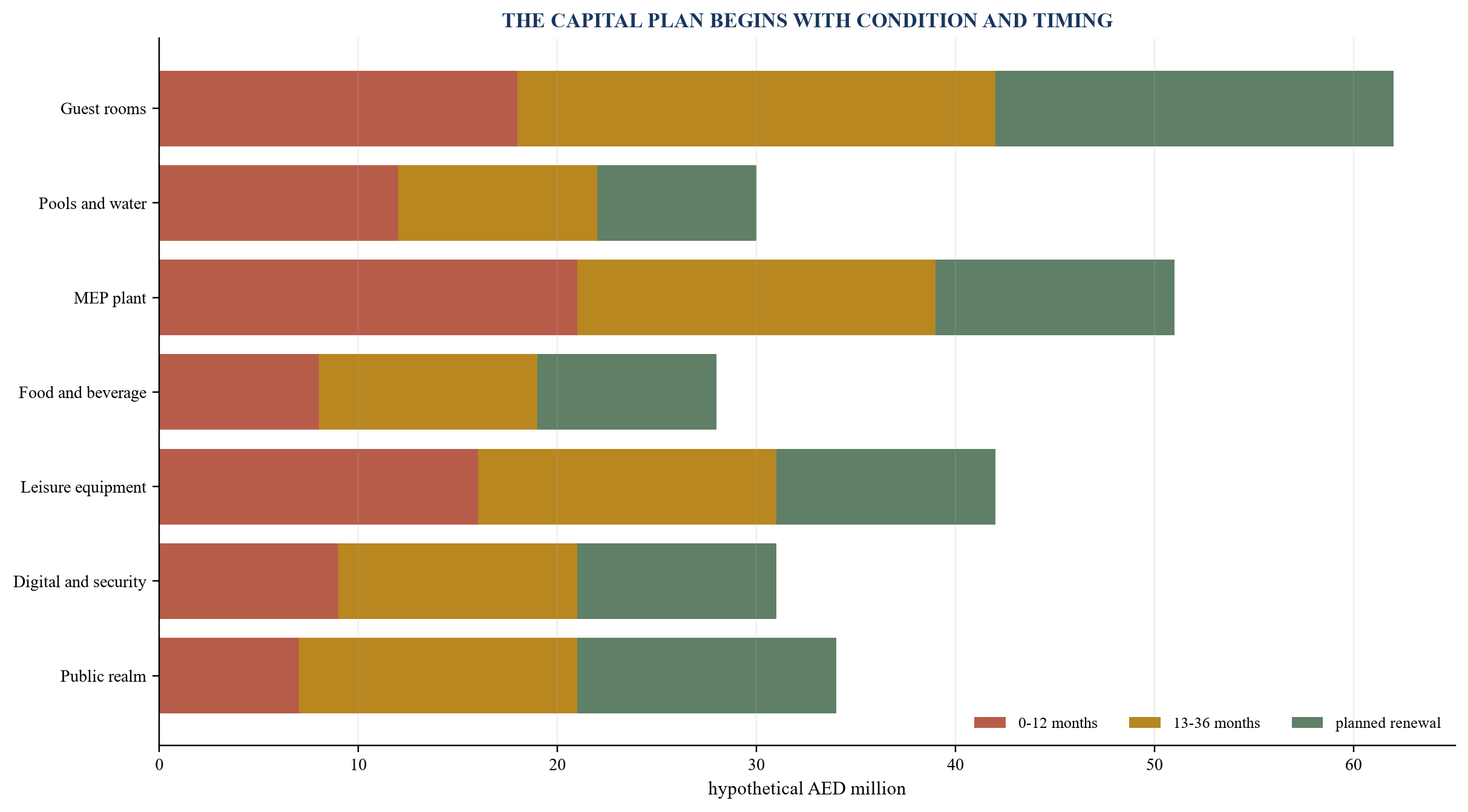
Values and urgency scores are hypothetical and demonstrate a condition-led capital plan.
Table 3. Capital-expenditure classification and transaction treatment
| Capital category | Evidence | Valuation treatment | Completion response |
|---|---|---|---|
| immediate compliance or safety | inspection, notice, test and engineer estimate | unavoidable near-term cash | specific adjustment, escrow or seller cure |
| deferred maintenance | condition survey, work orders and failure history | normalised sustaining capex | price bridge and funded programme |
| lifecycle renewal | asset age, standard and replacement cycle | through-cycle cash requirement | reserve and post-close schedule |
| growth project | approved business case, permit and incremental cash | separate investment case | exclude from maintenance adjustment |
| brand or change-of-control work | brand plan, consent and property improvement plan | transaction-dependent cash | condition, covenant and allocation |
Classification should follow verified condition, obligation and economic purpose.
13. Measure downtime and lost capacity during renewal
Capital expenditure affects value through timing as well as amount. Rooms, pools, golf holes, restaurants, rides and event spaces can leave service during construction. The buyer should model the capacity removed, displaced revenue, variable cost avoided, fixed cost retained and time to recover rate and utilisation.
Phasing should protect service promises. Members may have priority rights or minimum facility access. Closing several amenities simultaneously can increase refunds and cancellations. Contractors, guests and operating staff also create safety and logistics constraints. The project programme should reflect seasonality, events and approval windows.
The construction case should include cost-to-complete and liquidity. A partially executed refurbishment can require additional spend before it creates revenue. Uncommitted scope, provisional sums, imported equipment and hidden conditions should be visible. Draw controls and contingency should follow independent evidence.
Transaction timing can interact with work. Signing-to-completion covenants should control new projects, deferrals and changes in scope. The buyer should receive updated condition, spend and completion evidence. A locked-box price may require leakage and conduct protection; completion accounts may require an agreed capital adjustment.
14. Reconstruct revenue quality by business line
Resort and leisure groups can report rooms, food and beverage, attractions, events, memberships, residences, management fees, retail, spa, golf, marina and sponsorship. Each line has different margin, working capital, capital intensity, customer concentration and recognition. The diligence model should preserve those differences before consolidation.
Recurring revenue should be defined by behaviour, not label. Annual dues can recur while retention declines. Management fees can recur while the contract is terminable. Events can repeat while depending on a few customers. Residence-linked fees can be durable while service obligations rise. The buyer should identify renewal, cancellation and price-reset mechanics.
Reported growth should be split into volume, price, mix, new capacity, acquisitions and accounting changes. Destination-wide performance can support demand context, as shown by official Dubai, Abu Dhabi, Saudi and GCC statistics.[1][2][3][4] Target performance must still be reconciled to source systems and its competitive set.
Quality of earnings should continue into cash. Card settlement timing, deposits, advance sales, taxes, supplier terms and restricted balances affect conversion. A business can show strong EBITDA and weak distributable cash because capex, lease payments and member obligations sit below or outside the reported measure.
15. Normalise earnings for maintenance, memberships and owner support
Normalised earnings should remove one-off items and incorporate recurring economic costs. The buyer should test management add-backs, owner charges, related-party services, launch cost, closure effects, insurance recoveries, grants, capitalised labour and deferred maintenance. Every adjustment needs an evidence source and a cash rationale.
Membership programmes can create several normalisation issues. Sales commissions may be expensed or capitalised. Joining fees may be recognised over time. Breakage estimates can change revenue. Refund provisions can be incomplete. Service cost may be carried in another entity. The normalisation bridge should connect the accounting treatment to actual cash and remaining obligations.
Property ownership can also distort comparisons. Owned assets, leases and management contracts have different rent, depreciation, financing and capital profiles. EBITDA before rent can make a leased operation appear stronger than the cash available after fixed obligations. The valuation should use consistent enterprise and cash-flow definitions.
The diligence report should present base, downside and buyer cases. The base should use verified historical relationships and contracted changes. The downside should capture plausible retention, utilisation, pricing, capex and closure stress. Buyer initiatives should remain separate until ownership, cost, timing and evidence support them.
16. Separate property, operating, contract and brand value
A resort transaction can contain land and buildings, an operating company, memberships, management or franchise contracts, brand, digital platforms and development rights. One multiple applied to consolidated EBITDA can conceal which components create value and which require capital. The buyer should build a sum-of-parts bridge that reconciles to the legal perimeter.
Property value should reflect tenure, permitted use, condition, capital needs, cash generation and market evidence. Operating value should reflect sustainable revenue and full operating cost. Membership value should reflect future cash contribution after service and retention. Management and franchise value should reflect contract duration, termination, owner concentration and support cost.
IFRS 13 provides the framework for fair value measurement, while IAS 36 addresses impairment and IFRS 3 addresses acquisition accounting.[8][9][10] Transaction value and accounting carrying value serve different purposes. Qualified specialists should complete the purchase-price allocation, which should not replace the buyer's commercial valuation.
Future development should be valued separately from current operations. Land, approvals, infrastructure, financing and market demand determine the cost and probability of expansion. A seller's masterplan does not create current cash. Milestone or contingent consideration may bridge evidence gaps where appropriate.
17. Diligence licences, safety and operating compliance
Resorts and leisure assets can require tourism, accommodation, food, alcohol, events, entertainment, marine, pool, spa, fire, environmental, building and other approvals. Requirements vary by jurisdiction and activity. Saudi regulations, for example, set a framework for tourism accommodation facilities, licensing and inspection.[11] Local counsel should identify the applicable rules for each target.
The licence register should record holder, activity, site, expiry, conditions, inspections, violations, remediation and change-of-control treatment. The buyer should confirm whether licences transfer, require reissue or depend on property or management agreements. Closing conditions should reflect lead times and business criticality.
Safety diligence should connect documents to physical practice. Certificates, maintenance logs, incident records, emergency plans, water testing, ride inspections and staff training should be reviewed. Repeated minor incidents can indicate a control weakness even where no major claim has occurred.
Compliance findings should affect capital, operations and transaction protection. The buyer may require remediation before completion, a specific indemnity, retention, escrow, insurance or a funded post-close plan. A general compliance warranty may provide inadequate protection where the cost and timing are already identifiable.
18. Assess merger control early across the GCC
Economic concentration analysis should begin when the target and relevant markets are defined. The UAE Ministry of Economy and Tourism states that it reviews economic concentrations under Federal Decree-Law No. 36 of 2023.[12] Cabinet Resolution No. 3 of 2025 sets notification thresholds based on AED 300 million of annual sales in the relevant UAE market or a combined share exceeding 40%.[13] Cabinet Resolution No. 59 of 2026 provides current executive regulations and became effective on 30 July 2026.[14]
Saudi Arabia's General Authority for Competition publishes Economic Concentration Review Guidelines explaining notification and substantive review.[15] Other GCC jurisdictions have their own laws, authorities, thresholds and procedures. The buyer should obtain current jurisdiction-specific advice rather than assume one regional filing.
Market definition in leisure can be fact-sensitive. A resort, beach club, golf club, attraction and hotel may compete differently by location, customer, price, membership and experience. Membership data, catchments, capacity and pricing can become relevant to review. The commercial team should preserve reliable evidence and avoid speculative market-share claims.
The transaction timetable should include filing preparation, information requests, approvals and remedies where applicable. Conditions precedent, long-stop date, cooperation, risk allocation and conduct obligations should match the regulatory plan. Integration should remain within legal boundaries before completion.
19. Convert diligence into acquisition accounting inputs
IFRS 3 requires an acquirer to recognise and measure acquired assets and liabilities and determine goodwill or a bargain purchase.[9] Resort transactions may involve property, contracts, customer relationships, brands, licences, leases, provisions and contingencies. The commercial diligence should produce evidence that can support, but not substitute for, the specialist accounting analysis.
Contract liabilities require careful treatment because the acquired balance and post-acquisition revenue pattern may differ from management expectations. Customer relationships and brands may be identifiable intangible assets under applicable criteria. Reacquired rights, unfavourable contracts and contingent liabilities can require separate consideration. Qualified advisers should determine the accounting.
The buyer should prepare a provisional purchase-price allocation plan before completion. Data requirements can include contract populations, retention, forecast cash flows, royalty assumptions, useful lives, property values and legal analyses. Missing source data can delay reporting and weaken governance.
Goodwill should be connected to specific acquisition benefits and monitored at the appropriate cash-generating units. IAS 36 requires impairment assessment and annual testing for goodwill and certain intangible assets.[10] A transaction model dependent on deferred capex or aggressive retention should show the sensitivity before the board approves the deal.
20. Build the enterprise-to-equity purchase-price bridge
The headline enterprise value should reconcile to equity consideration through agreed definitions. Common items include cash, debt, debt-like liabilities, normalised working capital, capital expenditure, leakage, minority interests, transaction bonuses and other specific adjustments. Membership balances can fall into several categories and should be treated once.
Cash collected for future services may be included in contract liabilities and working capital, while the associated cash may remain in the business. If the seller extracts the cash and leaves the obligation, the buyer inherits a funding gap. If both cash and obligation remain, the economic cost may differ from the accounting amount. The completion mechanism should reflect the agreed principle.
Deferred maintenance can be addressed through enterprise value, a specific adjustment, seller completion work, escrow or a funded covenant. The buyer should avoid deducting the same amount in normalised earnings and again as a debt-like item without explaining the distinction. One bridge should show every effect from diligence finding to equity value.
Definitions should be illustrated with worked examples before signing. The parties should agree account sources, policies, dispute process and expert determination. A complex formula does not resolve ambiguous classification. The schedule should identify named member, reserve, capex and property items where material.
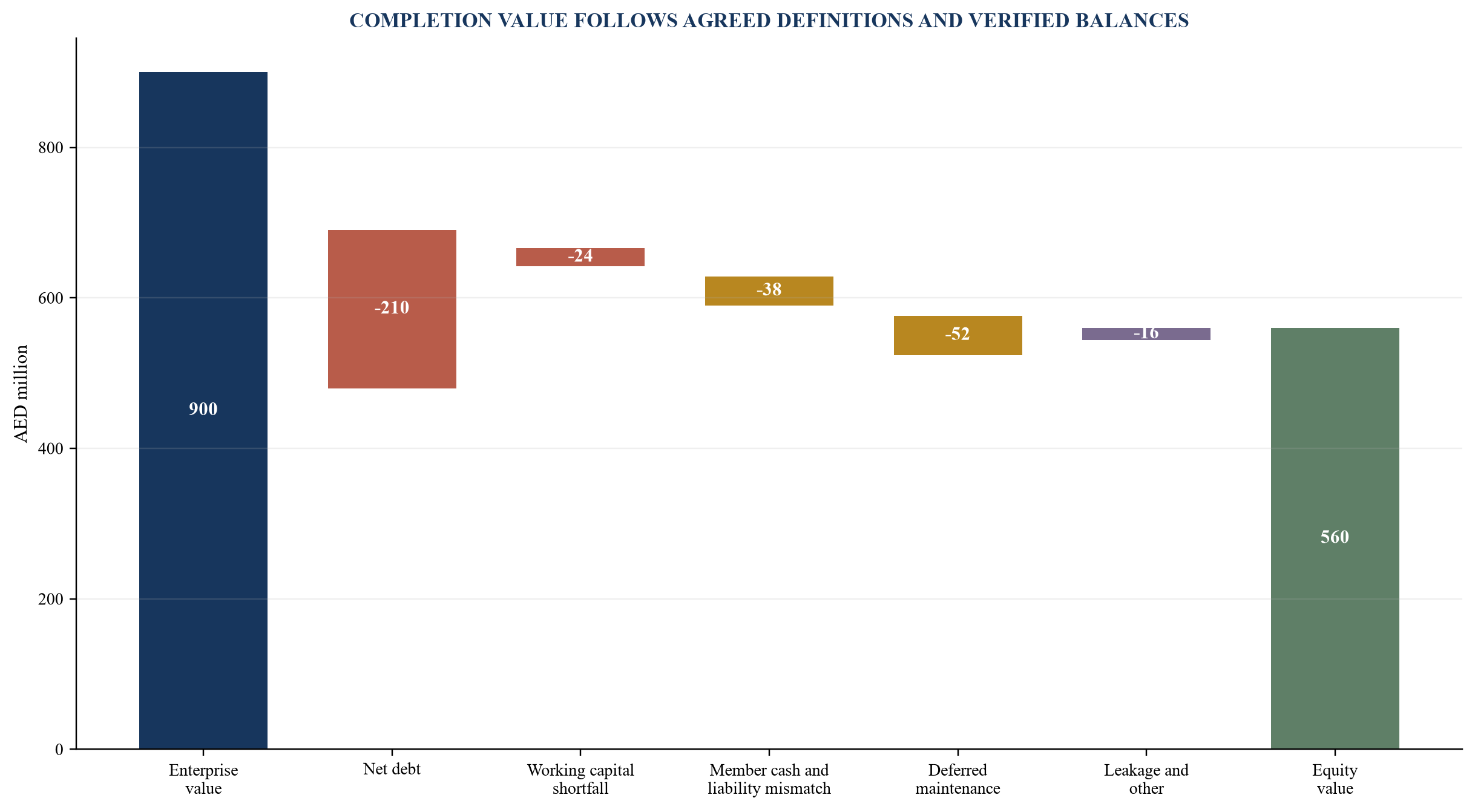
Values are hypothetical AED millions and demonstrate one completion bridge.
Table 4. Purchase-price issue map
| Diligence finding | Earnings effect | Balance-sheet effect | Possible transaction treatment |
|---|---|---|---|
| unearned member cash extracted | none or timing-dependent | unfunded contract liability | debt-like adjustment or cash retention |
| understated refunds | normalised revenue and cost | refund liability | specific adjustment and indemnity |
| deferred maintenance | sustaining capex and downtime | future cash requirement | enterprise-value bridge, escrow or seller cure |
| restricted member reserve deficit | limited current earnings effect | restricted-fund shortfall | completion adjustment and covenant |
| weak retention cohort | recurring revenue and acquisition cost | possible impairment indicator | valuation change or contingent consideration |
Exact treatment depends on the SPA definitions and verified facts.
21. Draft warranties, indemnities and covenants from evidence
General warranties should be supported by specific schedules. The seller should disclose membership terms, side letters, refunds, complaints, points, reserves, receivables, capital projects, closures, licences and incidents. The buyer should define materiality and knowledge consistently with the risk being allocated.
Known liabilities may require specific protection. An indemnity can address identified claims, while escrow, retention or price adjustment can provide funding. Limitations, time periods, conduct of claims and insurance should match the exposure. Legal advisers should design the mechanism for the transaction and jurisdictions.
Interim covenants should preserve the business between signing and completion. Relevant actions can include new lifetime memberships, discount campaigns, changes to benefits, use of reserves, cancellation of capex, new leases, related-party payments and material closures. Consent thresholds should allow ordinary operations while protecting value.
Post-completion covenants can support data migration, claims handling, licence transfer, member communication and capital work. Transitional services should define systems, personnel, data, service levels, cost and exit. A broad promise to cooperate offers less execution certainty than named deliverables and acceptance tests.
22. Protect Day One member and guest continuity
Day One should preserve access, bookings, payments, safety, service, complaints and authority. The integration team should know which entity accepts member cash, honours benefits, issues refunds, controls capacity and communicates changes. Customer-facing systems and terms should remain consistent unless a legally reviewed change is ready.
The buyer should avoid immediate programme harmonisation before contract rights and system data are reconciled. Renaming tiers, changing booking priority or moving points can create disputes and accounting errors. Legacy and new programmes can operate in controlled parallel while the migration plan is tested.
Operational continuity depends on staff, suppliers, technology and property access. Key sales, membership, finance, engineering and guest-service personnel should have clear authority. Booking, property management, point-of-sale, access control, payment, CRM and complaint systems should be tested. Manual fallback should be documented.
Member communication should be accurate and sequenced. The announcement can explain ownership and continuity without promising unapproved benefits. Questions, cancellations and media response should be monitored. The first weeks provide evidence about trust and attrition that should feed the integration dashboard.
23. Govern the first hundred days through one value ledger
The integration office should maintain one ledger linking each diligence finding to financial effect, owner, action, milestone and evidence. Membership liabilities, refunds, capex, retention, licences, property rights and purchase-price items should not disappear when functional workstreams take over.
During the first thirty days, the buyer should complete bank, member-ledger, contract-liability and reserve reconciliations; confirm critical licences and safety controls; freeze unauthorised benefit changes; and validate the first capital priorities. The completion statement process should use the same data definitions.
By day sixty, management should have a verified cohort dashboard, lifecycle capital plan, capacity model, member complaint root causes and programme profitability. Quick wins can address booking denials, communication, maintenance and collection controls. Structural changes should wait for legal, customer and system readiness.
By day one hundred, the board should approve the future programme architecture, funded capex sequence and performance scorecard. The dashboard should distinguish reported revenue, billings, cash, contract liabilities, refunds, utilisation, retention, service cost, maintenance and free cash. Synergy claims should appear only with baseline, cost, timing, owner and evidence.
Table 5. First hundred days control plan
| Period | Membership and cash | Assets and operations | Governance evidence |
|---|---|---|---|
| Day 1-10 | protect bookings, access, receipts and refunds | confirm safety, licences and critical suppliers | authority map and continuity log |
| Day 11-30 | reconcile contracts, liabilities, reserves and bank | validate immediate capital and closure plan | completion data and exceptions register |
| Day 31-60 | launch cohort, utilisation and contribution dashboard | approve funded lifecycle programme | owners, milestones and decision log |
| Day 61-100 | decide programme migration and pricing tests | sequence renewal with member capacity | board-approved value and control ledger |
| ongoing | monthly contract-to-cash reconciliation | condition, downtime and capex reporting | audit trail, escalation and acceptance evidence |
Timing should be adapted to transaction conditions and operational risk.
24. Make the investment committee decide on verified cash and obligations
The investment committee paper should present one traceable bridge from member contracts to cash, revenue, service cost, capital expenditure and equity value. It should identify the obligations that remain after completion, the assets and capacity required to serve them, and the capital needed to protect the experience.
The board should see the target as a portfolio of cash engines and promises. Property, rooms, attractions, memberships, management contracts and development rights can each create value. The acquisition should proceed only where the buyer can verify legal control, sustainable cash contribution, funded maintenance, licence continuity and an executable integration plan.
Scenario analysis should show slower retention, greater redemption, lower ancillary spend, refunds, delayed approvals, higher capex and longer downtime. The lowest cash point and funding source should be visible. Stop conditions should be defined for unresolved liabilities, missing data, unsafe assets, unavailable licences or completion mechanics that leave the buyer with unfunded obligations.
The disciplined conclusion is practical. Cash received should be reconciled to performance delivered and remaining. Reported earnings should absorb recurring service and maintenance cost. Member relationships should be valued by cohort. Property and operating components should be separated. The equity bridge should reflect each verified liability and capital need once. This structure gives buyer and seller a common evidence system for price, protection, completion and the first hundred days.
References
- GCC Statistical Centre, Tourism, Culture and Antiquities Statistics Platform, 2025 indicators. https://online.gccstat.org/?lang=en
- Dubai Department of Economy and Tourism, Dubai welcomes 19.59 million visitors in third record year, 2025 performance. https://www.dubaidet.gov.ae/en/newsroom/press-releases/dubais-tourism-industry-achieves-third-successive-record-breaking-year
- Department of Culture and Tourism Abu Dhabi, Annual Report 2025. https://dct.gov.ae/Pages/2025/assets/pdfs/Annual-Report-2025-Final-1.pdf
- General Authority for Statistics, Saudi Arabia, Tourism Establishments Statistics, Q1 2026 and current series. https://www.stats.gov.sa/en/statistics-tabs/-/categories/124304?category=124304&tab=436312
- General Authority for Statistics, Saudi Arabia, Methodology and Quality Report for Tourism Establishments Statistics, updated 20 July 2026. https://stats.gov.sa/en/w/methodology-and-quality-report-for-tourism-establishments-statistics-4.1
- IFRS Foundation, IFRS 15 Revenue from Contracts with Customers. https://www.ifrs.org/issued-standards/list-of-standards/ifrs-15-revenue-from-contracts-with-customers/
- IFRS Foundation, IFRS 9 Financial Instruments. https://www.ifrs.org/issued-standards/list-of-standards/ifrs-9-financial-instruments/
- IFRS Foundation, IFRS 13 Fair Value Measurement. https://www.ifrs.org/issued-standards/list-of-standards/ifrs-13-fair-value-measurement/
- IFRS Foundation, IFRS 3 Business Combinations. https://www.ifrs.org/issued-standards/list-of-standards/ifrs-3-business-combinations/
- IFRS Foundation, IAS 36 Impairment of Assets. https://www.ifrs.org/issued-standards/list-of-standards/ias-36-impairment-of-assets/
- Ministry of Tourism, Saudi Arabia, Regulations of Tourist Accommodation Facility. https://cdn.mt.gov.sa/mtportal/mt-fe-production/content/policies-regulations/documents/tourism-regulations/Hospitality-Facilities-Regulations-En-V013.pdf
- Ministry of Economy and Tourism, UAE, Economic Concentration. https://www.moet.gov.ae/en/economic-concentration
- UAE Legislation, Cabinet Resolution No. 3 of 2025 regarding competition thresholds. https://uaelegislation.gov.ae/en/legislations/2788/download
- UAE Legislation, Cabinet Resolution No. 59 of 2026, Executive Regulations of Federal Decree-Law No. 36 of 2023. https://uaelegislation.gov.ae/en/legislations/4451
- General Authority for Competition, Saudi Arabia, Economic Concentration Review Guidelines. https://gacbep.gac.gov.sa/cms/b9376edc-79a1-4573-a36d-4f3effaba838.pdf
- Emaar Properties PJSC, Integrated Annual Report 2025. https://uae-cms.emaar.com/uploads/Emaar_Properties_IR_2025_English_F_1_3ad06ed115.pdf
- Marriott International, Inc., Annual Report 2025, guest loyalty programme and deferred revenue disclosures. https://marriott.gcs-web.com/static-files/b82978a6-9d28-4e38-9855-fc4ae2cebe11
- Marriott Vacations Worldwide Corporation, Annual Report on Form 10-K for 2025, filed 2 March 2026. https://ir.marriottvacationsworldwide.com/sec-filings/sec-filing/10-k/0001524358-26-000010
- IFRS Foundation, IAS 37 Provisions, Contingent Liabilities and Contingent Assets. https://www.ifrs.org/issued-standards/list-of-standards/ias-37-provisions-contingent-liabilities-and-contingent-assets/
- IFRS Foundation, IAS 16 Property, Plant and Equipment. https://www.ifrs.org/issued-standards/list-of-standards/ias-16-property-plant-and-equipment/
- IFRS Foundation, IFRS 16 Leases. https://www.ifrs.org/issued-standards/list-of-standards/ifrs-16-leases/
- IFRS Foundation, IAS 38 Intangible Assets. https://www.ifrs.org/issued-standards/list-of-standards/ias-38-intangible-assets/
