
1. Treat the concession as a regulated operating system
A water utility does not create value merely by owning pumps, pipes, meters and treatment assets. Value arises when an enforceable operating right, an approved revenue mechanism, a functioning network and a capable organisation convert water delivered into reliable service and collectible cash. An acquirer therefore needs to underwrite a regulated operating system rather than a collection of physical assets.
The World Bank distinguishes a concession from shorter management or operation-and-maintenance arrangements. A concession commonly gives a private party a long-term right to use utility assets, responsibility for operations and some investment, and a direct relationship with consumers, while ownership and residual control remain with the public authority.[1] A management contract may pay an operator a fixed or performance-linked fee and leave asset-condition and tariff risk largely with the authority.[2] The legal label used in a transaction is less useful than the actual allocation of revenue, investment, operating and residual-value obligations.
The first acquisition record should identify the grantor, regulated entity, operator, asset owner, customers, bulk supplier, wastewater interface, land provider, regulator, subsidy provider, lenders and material contractors. It should show which party controls price, service scope, capital approval, asset replacement, billing, collection, enforcement and handback. It should also identify where rights require public consent before a change of control.
The investment thesis should be stated as a causal chain. Approved tariffs and support mechanisms produce allowed revenue; metered and billable service produces invoices; collection converts invoices into cash; operating performance and capital investment preserve service and regulatory standing; and residual cash supports financing and equity value. Each link must have evidence, an owner, a downside case and a transaction response.
An acquisition can fail economically even when the concession remains legally valid. Tariff resets can lag cost, collection can deteriorate, assets can require accelerated renewal, and service obligations can expand. Diligence should therefore reconcile law, contract, regulatory decisions, physical evidence, accounting records and bank receipts into one controlled model.
2. Fix the transaction perimeter before valuing cash flow
Water businesses often contain overlapping legal and operational perimeters. The target may hold the concession while another group company owns vehicles, laboratories, digital systems, employees or maintenance inventory. The public authority may own trunk assets, reservoirs or land. A shared-service entity may control billing, procurement, treasury, cybersecurity or customer contact. The buyer needs a schedule that maps every critical capability to ownership, contract, licence and transfer mechanism.
The perimeter should distinguish regulated and unregulated activity. Connection fees, tanker services, laboratory work, wastewater treatment, recycled-water sales, engineering services and property income can follow different tariff, tax and accounting rules. Revenue presented in consolidated accounts may include activities that cannot transfer with the concession or cannot be increased without separate approval.
Asset ownership requires legal and engineering reconciliation. Registers can contain assets that have been retired, replaced, transferred or never commissioned. Conversely, buried networks, customer meters and easements can support service without complete accounting records. Title, right of use, concession access and maintenance responsibility should be verified by asset class and location. A buyer should avoid paying twice for public assets that the operator uses but does not control.
IFRIC 12 explains that an operator within its scope does not recognise concession infrastructure as its own property, plant and equipment when the grantor controls the services, recipients, price and significant residual interest. The operator may instead recognise a financial asset, an intangible right to charge users, or both, depending on the consideration.[3] This accounting framework affects reported assets, earnings and cash-flow presentation. It does not replace contractual and technical diligence.
The transaction perimeter should also capture consents. These may include grantor approval, licence transfer, competition clearance, lender consent, land or easement confirmation, government contract approval, data-transfer authority and foreign-ownership clearance. A consent matrix should state application requirements, decision authority, statutory timing, conditions, appeal and long-stop consequences.
3. Build the tariff-to-cash bridge
The tariff-to-cash bridge is the core valuation control. It begins with the legally or contractually allowed revenue, then reconciles tariff categories, forecast consumption, customer eligibility, subsidy, connection charges, metering, billing, credit notes, arrears, bad debts, cash receipts and regulatory true-ups. Each difference should have an identifiable cause and documentary source.
Abu Dhabi's Department of Energy states that sector transactions occur on an economic basis while government can set customer tariffs below cost and make up the shortfall through subsidy. It also describes bulk supply, transmission and customer tariffs as distinct layers.[4] The same authority describes multi-year incentive-based price controls and a CPI-X revenue-cap structure for regulated water, wastewater, recycled-water and electricity companies.[5] These arrangements illustrate why a customer tariff cannot be treated as the entire revenue mechanism.
Oman Water and Wastewater Services Company's 2024 financial statements separately report metered water sales, wastewater and other service income, government subsidy, a regulated-revenue shortfall and a regulatory asset-base adjustment.[6] The evidence demonstrates the need to separate billed customer revenue, public support and regulatory true-up when analysing maintainable cash flow. The specific treatment in another transaction depends on its law, licence and accounting policy.
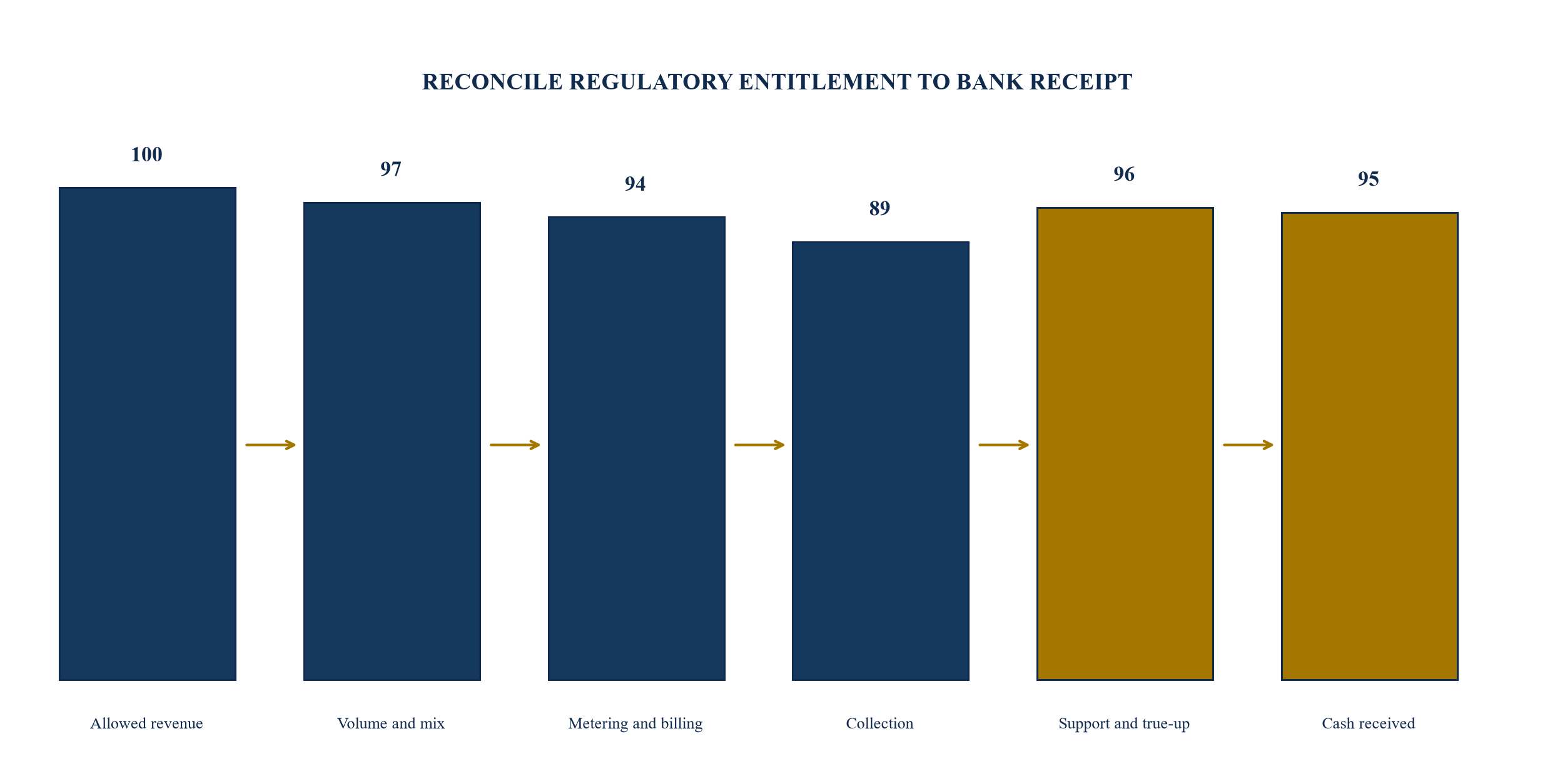
The bridge is an analytical control; actual tariff and subsidy mechanisms depend on the jurisdiction and concession.
Table 1. Tariff-to-cash diligence register
| Bridge item | Primary evidence | Common valuation error | Transaction response |
|---|---|---|---|
| Allowed revenue | licence, price control or concession formula | treating billed revenue as full entitlement | regulatory model and true-up schedule |
| Volume and mix | meter data, customer classes and demand history | using total production as billable volume | billed-volume and loss reconciliation |
| Billing | tariff master, invoices and credit notes | ignoring incorrect classification or meter failure | billing-quality adjustment and warranty |
| Collection | ageing, receipts and enforcement records | applying a single collection percentage | cohort recovery curve and bad-debt reserve |
| Subsidy or support | law, appropriation, agreement and receipts | assuming political intent equals enforceable cash | condition, escrow or downside case |
| Regulatory true-up | approved decision and ledger | recognising uncertain recovery at face value | timing discount and specific protection |
Each item should be reconciled for a representative historical period and the forecast horizon.
4. Understand tariff authority, indexation and reset risk
The buyer should identify who sets each tariff, what legal instrument creates the right, how the tariff is calculated, when it can change and what happens when the decision is delayed. A tariff schedule can be visible while the adjustment process remains exposed to discretion, affordability policy, performance conditions or incomplete cost recovery.
The World Bank notes that user-paid concession tariffs may be controlled through contract, regulation or both. Formulae can establish initial tariffs and automatic indexation, while periodic resets may consider other factors.[7] The acquisition model should therefore separate automatic indexation from discretionary review, pass-through from efficiency exposure, and temporary deferral from permanent disallowance.
Indexation requires a line-by-line bridge. Inputs can include domestic inflation, foreign inflation, energy cost, chemicals, labour, exchange rates, interest rates and productivity factors. A cap, floor, lag, rebasing rule or replacement index can materially change recovery. The model should reproduce historical adjustments from source indices and approval dates.
Reset risk becomes more significant when the concession requires large investment. A buyer may fund capex before it enters the regulated asset base or before a tariff review recognises depreciation and return. The diligence team should identify eligibility, efficiency tests, commissioning evidence, approval timing and the return applied to work in progress. Capital presented as recoverable should be distinguished from capital merely requested by management.
Affordability and public policy remain relevant. A government may hold customer tariffs below economic cost and compensate the operator through subsidy. The buyer should verify the legal basis, budgeting process, payment history, ranking, timing and dispute mechanism. Scenario analysis should test delayed, reduced and unrecoverable support without asserting that public ownership or policy importance creates a guarantee.
5. Reconcile water balance, non-revenue water and billable service
Water produced or purchased does not equal water billed. The difference can include authorised unbilled consumption, physical leakage, reservoir overflow, network flushing, meter under-registration, data error, theft and billing failure. The buyer should construct a water balance using consistent boundaries, units and periods, then connect each component to operating cost and revenue.
Non-revenue water is both an engineering and commercial issue. Physical losses consume production, treatment, pumping and chemical capacity. Commercial losses reduce bills or collections despite service delivered. The two require different remedies and investment. A headline percentage without meter confidence, network zoning and customer reconciliation can conceal the source of loss.
Bulk input meters, district meters and customer meters should have calibration, replacement and exception records. Meter age and technology can influence under-registration. Digital meters can improve data frequency while introducing communications, cybersecurity and system-integration risks. The diligence team should test whether billing data can be traced to a governing meter and whether manual estimates are controlled.
The base case should translate loss reduction into cash conservatively. Avoid multiplying all recovered cubic metres by the full retail tariff. Additional billed volume may displace production, defer capacity investment, reduce bulk-purchase cost or create new revenue depending on demand and tariff design. The benefit also requires implementation capex, field access, customer acceptance and sustained operating control.
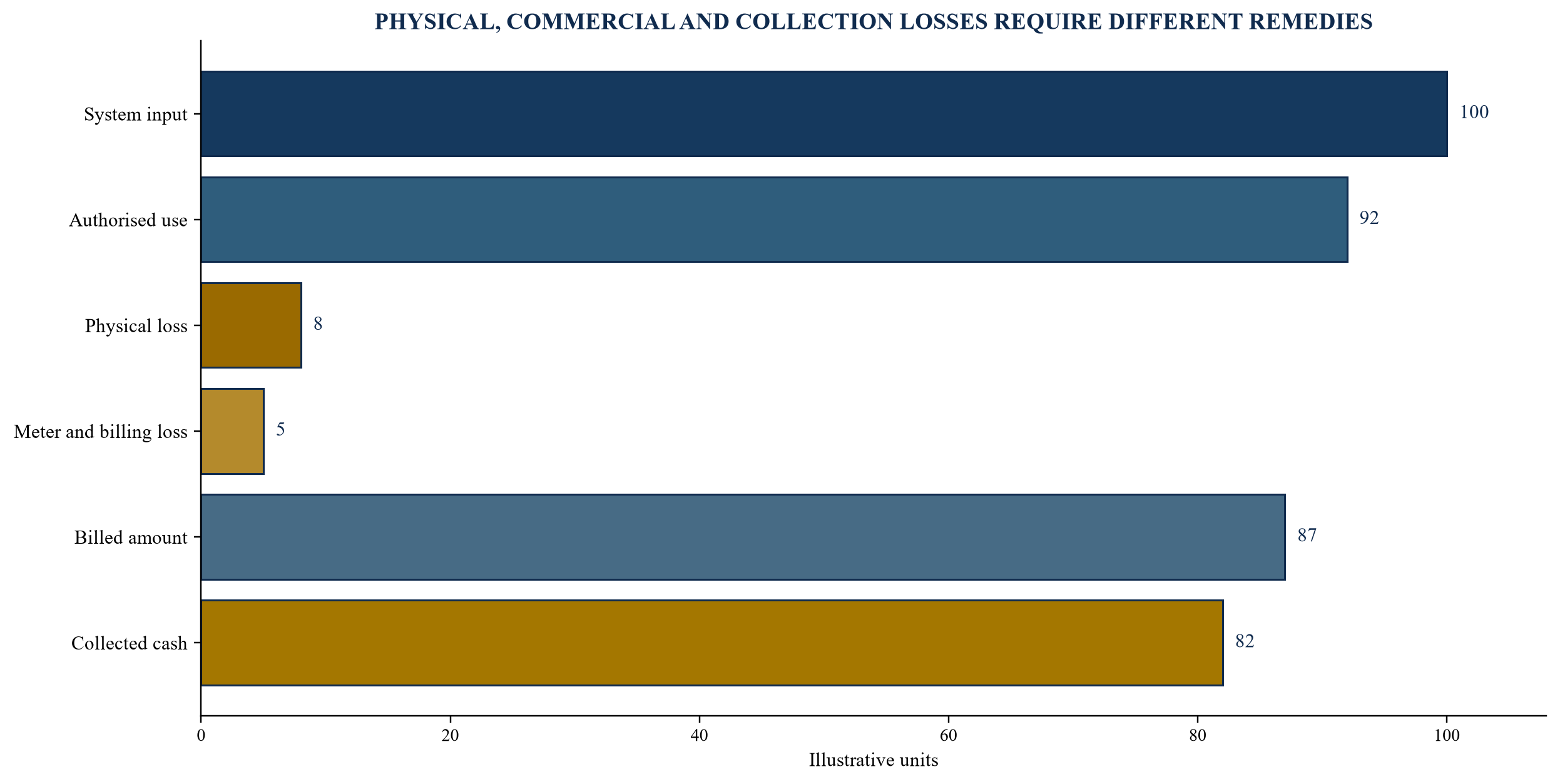
The illustration separates physical and commercial losses before collection.
6. Assess customer mix, billing quality and collection
Customer classes can carry different tariffs, subsidy eligibility, payment behaviour and enforcement constraints. Residential citizens, other residents, government entities, commercial users, industry, agriculture and bulk customers may have distinct rules. Oman utility tariff schedules, for example, publish different water and wastewater tariffs by customer category.[8] A transaction requires the current applicable schedule and customer-level classification evidence.
The buyer should analyse billing through complete populations rather than samples alone. Tests should identify inactive accounts with consumption, active accounts without meters, estimated bills, negative consumption, repeated reversals, duplicate customers, tariff overrides, abnormal usage and delayed meter reads. Exceptions should be valued by cause and remediation path.
Receivables ageing should be rebuilt from invoices, adjustments and receipts. A reported ageing bucket can include government balances, disputed bills, deceased customers, vacant properties, instalment plans or amounts subject to enforcement limits. Collection curves should be calculated by customer class and invoice cohort. Cash received after the balance-sheet date can provide direct evidence.
Bad-debt policy should be compared with actual recovery and legal enforcement. Disconnect rights can be constrained for essential service, vulnerable customers or public entities. Security deposits, guarantees and prepaid meters can reduce exposure but may carry refund obligations. The acquisition agreement should address ownership and treatment of deposits, overpayments and unidentified receipts.
Collection improvement can create value through data cleansing, digital payment, customer communication, targeted enforcement and dispute resolution. The integration plan should preserve service fairness, privacy and regulatory compliance. A buyer should not assume that aggressive enforcement is commercially or legally available.
7. Establish an evidence-backed asset-condition baseline
Water networks are difficult to diligence because material assets are buried, distributed and continuously operating. Accounting age does not establish physical condition. A young asset can be poorly installed or exposed to corrosive conditions; an older asset can remain reliable after disciplined maintenance. The buyer needs a risk-based condition baseline.
The baseline should combine asset register, geographic information system, maintenance history, failure records, pressure data, leakage, water quality, criticality, material, diameter, age, soil, loading and inspection evidence. Treatment plants, pumping stations, reservoirs, transmission mains, distribution mains, meters, laboratories, control systems and fleet should be assessed separately.
Sampling should target risk rather than convenience. High-consequence transmission assets, single points of failure, repeated bursts, pressure zones, corrosion environments and assets approaching major overhaul deserve deeper work. Non-destructive testing, CCTV, wall-thickness measurement, vibration, oil analysis, electrical testing and process-performance data can supplement visual inspection.
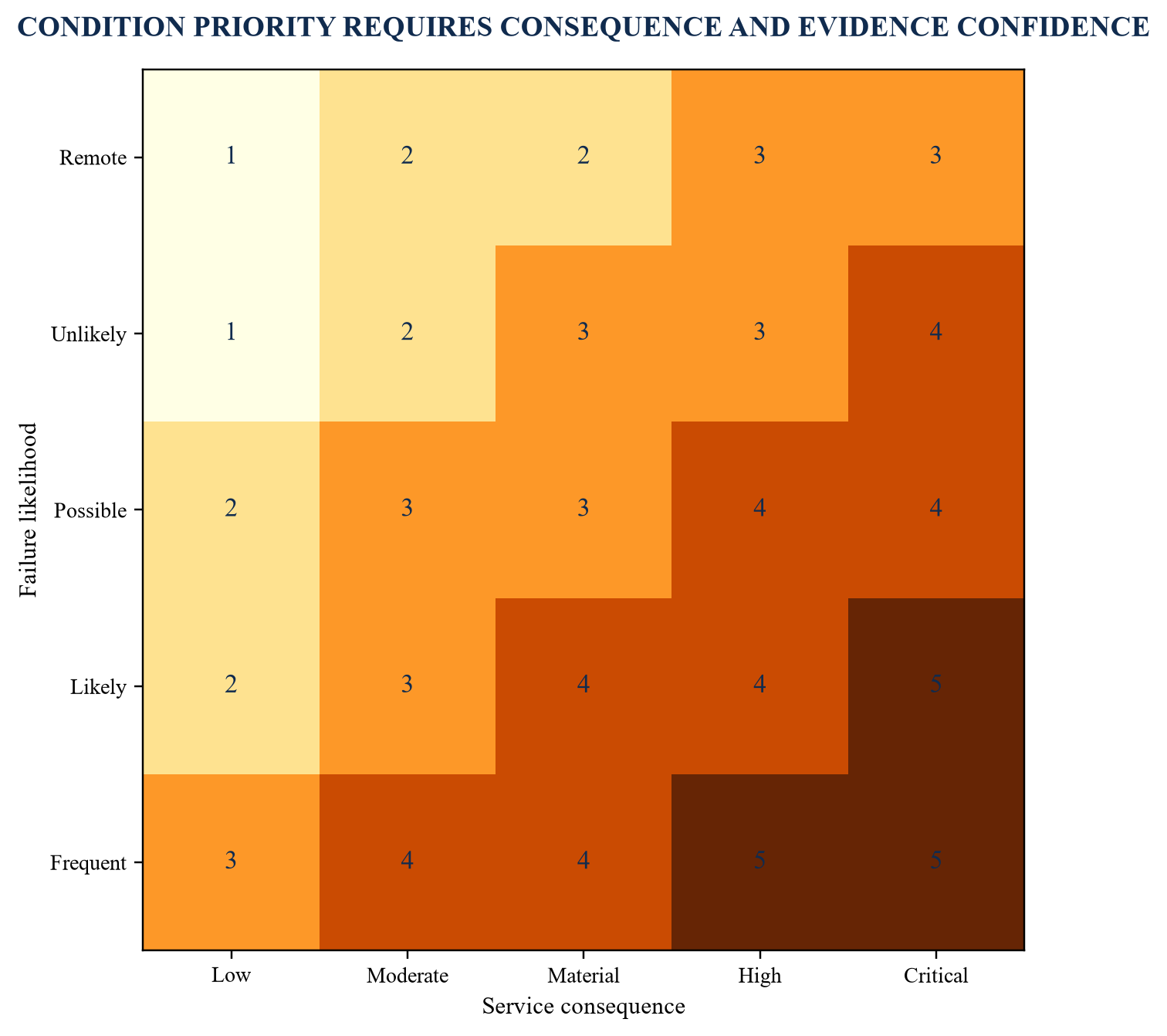
Prioritisation should combine probability of failure, service consequence and evidence confidence.
Table 2. Asset-condition evidence and acquisition consequence
| Asset group | Evidence | Red flag | Valuation or protection response |
|---|---|---|---|
| Transmission mains | failure, pressure and inspection history | single-point exposure or undocumented repair | specific renewal allowance and contingency |
| Distribution network | bursts, leakage and material map | persistent loss with weak zoning | phased rehabilitation plan |
| Treatment assets | capacity, quality and maintenance data | output depends on deferred overhaul | outage and capex adjustment |
| Pumps and power | efficiency, vibration and standby tests | unavailable redundancy | immediate replacement condition |
| Meters and systems | age, accuracy and interface testing | billing depends on estimates or manual overrides | data remediation and warranty |
| Land and access | title, easement and permit register | critical asset lacks durable access | condition precedent or indemnity |
Findings should state source, date, confidence and owner.
8. Convert maintenance history into forward-looking reliability
Maintenance expense can understate the work required to sustain service. A seller can preserve short-term earnings by delaying preventive maintenance, inspections, spares or overhaul. The buyer should compare actual work orders with manufacturer recommendations, regulatory obligations and risk-based plans.
The computerised maintenance management system should be tested for asset coverage, work-order closure, backlog age, repeat failures, emergency work, labour hours, parts use and data integrity. Closure without evidence, generic fault codes and repeated temporary repairs can indicate weak control. A clean-looking dashboard deserves less reliance when field records and invoices do not reconcile.
Spare-parts strategy matters for critical pumps, drives, membranes, valves, instruments and control equipment. Long lead times can extend outages. The buyer should verify inventory existence, ownership, condition, obsolescence, reorder rules and compatibility. Consignment stock and shared-group inventory require transfer arrangements.
Reliability analysis should distinguish design redundancy from available redundancy. Two installed units do not provide N+1 protection when one is under repair or both share power, controls or suction. Emergency response should be tested against actual incidents, mobilisation times, isolation plans, alternative supply and customer communication.
The operating model should translate reliability gaps into cost, service exposure and capital timing. This creates a bridge from engineering diligence to valuation and purchase protection rather than a descriptive technical report that remains outside the financial model.
9. Identify capex backlog, growth capex and regulatory eligibility
Capital expenditure should be divided into immediate safety or compliance work, condition-driven renewal, lifecycle replacement, resilience, service improvement, loss reduction, customer growth and discretionary expansion. Each category has different urgency, tariff treatment and value effect.
The backlog should begin with identified defects and overdue work, then extend to forecast renewal based on asset condition and criticality. Management budgets should be reconciled to procurement plans, approvals, committed contracts and delivery capacity. A low budget can reflect constraint rather than low need.
Regulatory eligibility must be tested. Capital may enter a regulated asset base only after approval, efficient procurement, commissioning and evidence. Some expenditure may be recovered through tariff, some through connection fees or grant, and some may remain at shareholder risk. The buyer should avoid treating all capex as both a purchase-price reduction and a future value uplift without consistent modelling.
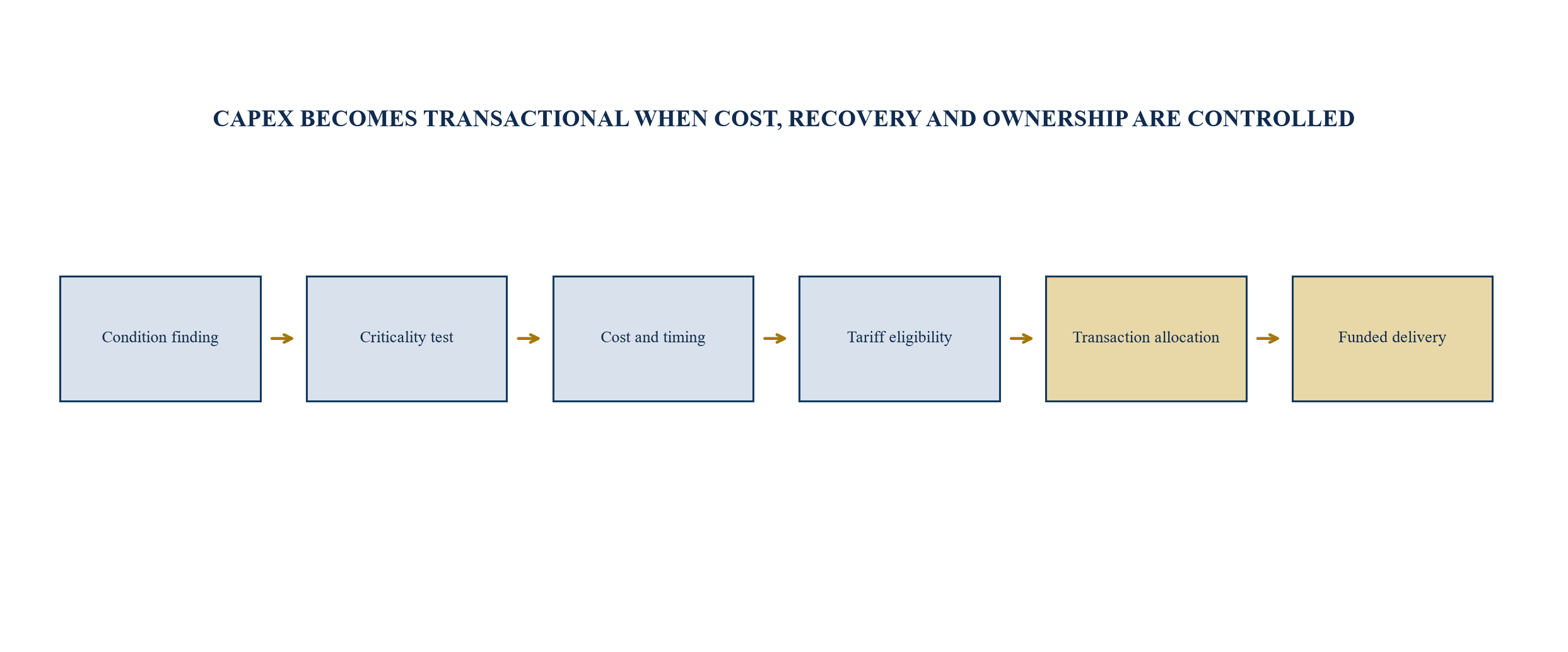
Every material finding should have timing, cost, recovery status and transaction treatment.
Table 3. Capex-backlog schedule
| Workstream | Trigger | Timing | Recovery evidence | Deal treatment |
|---|---|---|---|---|
| Safety and compliance | legal or permit breach | before or immediately after close | specific approval or no recovery | condition, escrow or price adjustment |
| Critical renewal | high failure consequence | near term | regulatory plan and commissioning rule | debt-like adjustment or funded programme |
| Loss reduction | measured physical or commercial loss | phased | incentive or allowed-revenue mechanism | shared upside or earn-out |
| Growth connections | committed demand | aligned to customers | connection fee or approved allowance | working-capital and capex schedule |
| Resilience | climate, power or supply vulnerability | risk based | grant, tariff or shareholder funding | explicit downside and covenant |
Cost ranges should retain estimate class, base date, contingency and source.
10. Translate service obligations into measurable exposure
Water concessions provide an essential service. Obligations can cover continuity, pressure, quality, response time, connection, complaint handling, billing accuracy, vulnerable customers, environmental discharge, reporting and emergency response. The buyer should map each obligation to definition, measurement, baseline, consequence and cure.
The World Bank notes that concession contracts can specify service standards, tariff rules, monitoring and dispute mechanisms.[9] The contract may use performance indicators such as water quality, access and non-revenue water. The buyer should verify whether the indicator is measured by the operator, regulator or independent engineer and whether historical reporting used the contractual definition.
Service data should be tested against underlying records. A continuity percentage can hide localised outages. Average pressure can conceal low-pressure zones. Complaint closure can reflect administrative closure rather than restoration. Water-quality compliance can depend on sampling design, laboratory accreditation and reporting of failed results.
Consequences can include deductions, liquidated damages, remediation orders, tariff disallowance, licence action, customer compensation, public intervention or termination. Repeated failure can also affect political support for tariff increases. The valuation model should include direct cash cost and the effect on revenue approval, collection and capital requirements.
Table 4. Service-KPI matrix for transaction diligence
| KPI | Measurement basis | Diligence test | Transaction consequence |
|---|---|---|---|
| Continuity | hours of supply by zone | reconcile outage logs and customer records | penalty reserve and reliability capex |
| Pressure | compliant readings at defined points | test low-pressure and peak-demand periods | network reinforcement allowance |
| Water quality | accredited samples and limits | review failures, resampling and notification | indemnity, remediation and permit condition |
| Response | elapsed time by incident class | sample timestamps and closure evidence | operating-cost and staffing adjustment |
| Billing accuracy | correct meter, class and tariff | reperform invoices and exception controls | receivable and systems adjustment |
| Loss performance | agreed water-balance definition | validate meters, boundary and calculation | capex plan and incentive sensitivity |
The buyer should retain contractual definition, data lineage and historical exceptions.
11. Diligence water quality, environmental and social obligations
Water quality can create immediate public-health and licence exposure. The buyer should review source-water characteristics, treatment barriers, laboratory controls, disinfectant residual, storage, network age, sampling locations, failed results, corrective action and regulator communication. Compliance should be assessed against the applicable legal and contractual standard.
Wastewater concessions add influent quality, treatment performance, sludge, discharge, odour and recycled-water obligations. Industrial discharges can damage treatment performance or create contamination. The buyer should understand enforcement rights, monitoring, pre-treatment and the allocation of clean-up cost.
Environmental liabilities can attach to land, chemicals, fuel, sludge, historic leaks, disposal sites and construction. A site review should cover permits, incidents, notices, monitoring, hazardous materials, groundwater and remediation. The acquisition agreement should allocate pre-close contamination and known remediation with suitable survival and security.
The IFC Performance Standards provide a framework for identifying and managing environmental and social risk in private-sector projects.[10] The Equator Principles provide a financial-industry framework for applicable project finance.[11] Their application depends on the transaction and financing. The buyer should align diligence with legal requirements, concession commitments and lender standards.
Community and workforce issues can affect continuity. Land access, construction disruption, affordability, customer complaints, contractor safety and labour transfer need explicit plans. Water service has limited tolerance for a poorly controlled transition.
12. Test operating costs and pass-through boundaries
Operating costs should be rebuilt from activity and contract rather than extrapolated from the latest year. Major categories can include bulk water, energy, chemicals, labour, contractors, maintenance, laboratory, sludge, fleet, technology, insurance, concession fees and corporate allocations.
Energy can be a major cost in desalination, pumping and treatment. The buyer should identify tariff, demand charge, power-factor cost, indexation, embedded generation and pass-through. Efficiency initiatives should distinguish proven performance from management targets. Energy savings may require capex and may affect regulated sharing.
Bulk water or wastewater payments should be reconciled to measured quantity, quality, availability and take-or-pay terms. A downstream operator can bear the cost of upstream interruption when contract relief is incomplete. Related public entities should be analysed as separate legal counterparties.
Corporate allocations deserve scrutiny. Shared procurement, finance, human resources, customer systems and treasury may be removed after sale. A low historical allocation can understate standalone cost; a high allocation can create value when services are replaced efficiently. Transition-service agreements need scope, service levels, security, pricing, term, exit support and data rights.
Cost pass-through should be linked to regulatory evidence. A cost can be economically necessary but disallowed because of inefficiency, timing or missing approval. The model should separate recoverable, shared and shareholder-borne expenditure. This prevents a broad pass-through assumption from obscuring retained risk.
13. Reconcile accounting presentation with concession economics
Reported EBITDA can differ from distributable cash because concession accounting, regulatory balances, capitalised costs, provisions, grants and customer contributions affect timing and classification. The quality-of-earnings review should bridge statutory results to cash available under the concession and financing documents.
IFRIC 12 can result in financial-asset, intangible-asset or mixed accounting for an operator.[3] Construction and upgrade services, operating services, contractual restoration obligations and borrowing costs can follow different requirements. IAS 37 is relevant to obligations to maintain or restore infrastructure to a specified condition. A buyer should involve accounting advisers early because classification can affect enterprise-value multiples, net debt and deferred tax.
Regulatory balances require legal and accounting evidence. The buyer should identify the approved mechanism, amount, recovery period, return, performance conditions and counterparty. A management estimate of future recovery should not be valued as cash without an enforceable basis and timing analysis.
Provisions should be compared with engineering cost. Handback, restoration, environmental, litigation and employee obligations can be understated or measured on different assumptions. The acquisition model should avoid netting a provision against capex without confirming scope and tax treatment.
Working capital should reflect billing cycles, arrears, subsidy timing, supplier terms, deposits and seasonal demand. Completion accounts need definitions adapted to concession economics. Regulatory receivables, customer contributions, restricted cash and restoration reserves should be classified explicitly rather than left to generic accounting labels.
14. Build a valuation model that preserves contractual causality
The valuation model should link every material revenue and cost driver to contract, regulation, operating evidence and capital requirement. A discounted cash-flow model is useful when it retains tariff resets, concession tenor, capex eligibility, working capital, tax, financing restrictions and handback. A simple EBITDA multiple can obscure these features.
The forecast should separate allowed revenue, billed revenue and collected cash. It should also separate maintenance expense, renewal capex, growth capex and regulated recovery. Service penalties, bad debt, regulatory lag and outage should be visible. Sensitivities should change causal drivers rather than apply arbitrary percentage cuts to all cash flows.
Terminal value requires discipline. A concession can expire, transfer or require retender. Residual value depends on renewal rights, handback condition, remaining asset life and permitted compensation. A terminal multiple can overstate value when the operator does not control the infrastructure after expiry.
Comparable transactions can provide a market check if contract type, tariff model, capex responsibility, geography, tenor and accounting basis are comparable. Headline enterprise value to EBITDA should be adjusted for concession liabilities, regulated assets, grants, customer deposits and capital backlog.
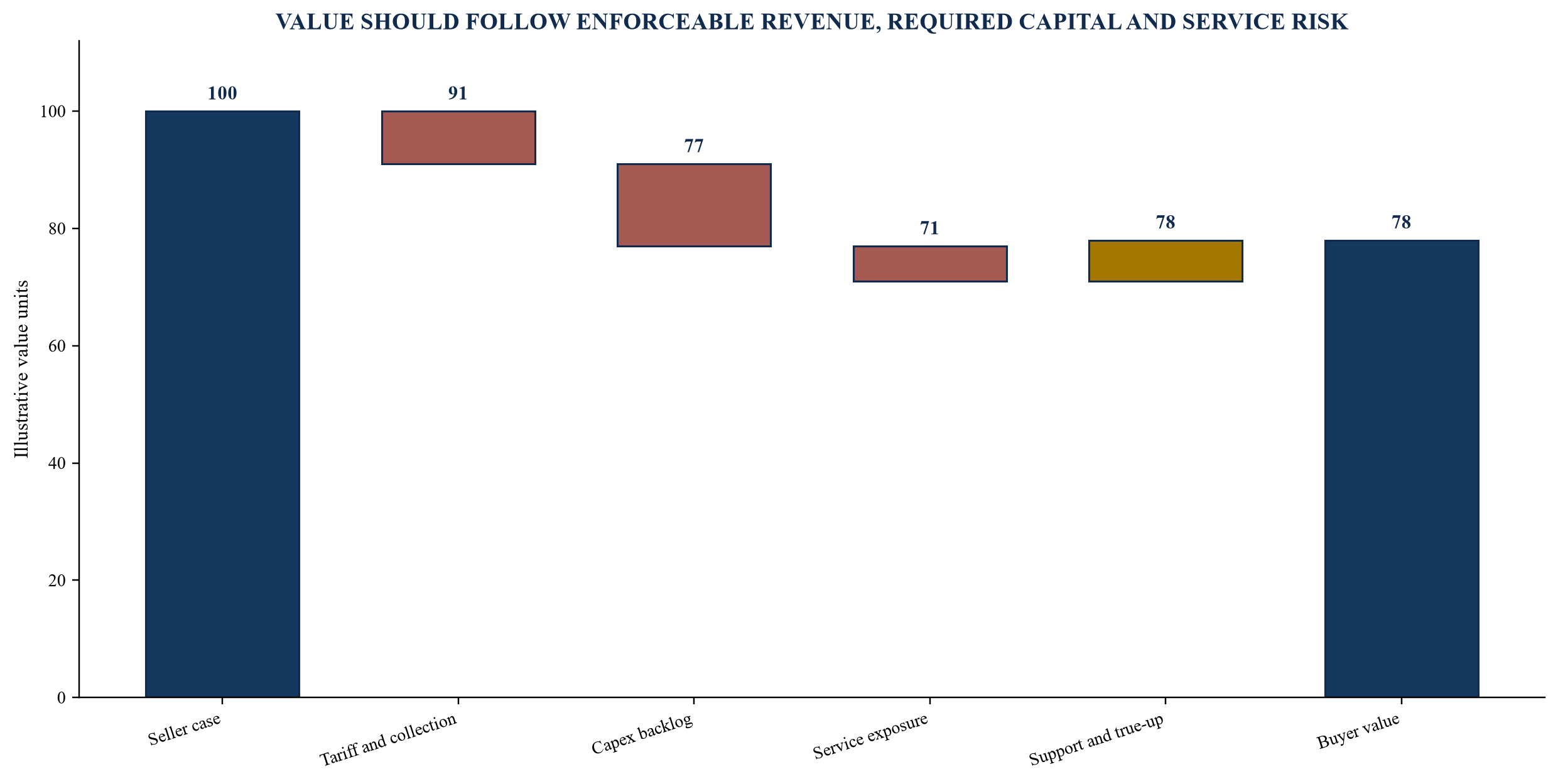
The illustration shows the sequence of adjustments; it does not prescribe valuation amounts.
Table 5. Valuation adjustment and protection matrix
| Exposure | Model treatment | Purchase-price treatment | Continuing protection |
|---|---|---|---|
| Tariff delay | timing and probability sensitivity | value adjustment where pre-close | covenant and information right |
| Uncollectible receivables | cohort recovery and bad debt | working-capital exclusion or specific deduction | collection earn-out if appropriate |
| Capex backlog | dated cash-flow schedule | debt-like or enterprise-value adjustment | escrow and funded plan |
| Service breach | penalty and remediation case | specific provision | indemnity and remediation covenant |
| Regulatory true-up | timing-discounted recovery | separately identified asset | contingent value right |
| Handback obligation | terminal cash flow | debt-like adjustment where assumed | reserve and completion test |
The same exposure should not be counted twice across price, provision and indemnity.
15. Design completion accounts for a regulated utility
Generic completion-account definitions can misprice a water concession. Net debt, working capital and debt-like items should be tailored to restricted cash, customer deposits, regulatory balances, unpaid capex, grants, concession fees, restoration obligations and public support.
The reference balance sheet should use consistent accounting policies and a normal operating cut-off. The buyer should test whether billing was accelerated, supplier invoices delayed, capex reclassified, provisions released or maintenance deferred before closing. Meter reads and consumption estimates around the cut-off deserve specific procedures.
Receivables should be classified by customer, age, dispute and collectibility. Regulatory and subsidy receivables should be separately identified. Cash can be restricted for debt service, capital works, customer deposits or grant conditions. It should not automatically reduce purchase price as freely available cash.
Unpaid capital commitments can be debt-like when the buyer receives the asset or obligation without the associated funding. Accrued maintenance and identified backlog require a clear boundary to avoid double counting. The schedule should state which items are reflected in enterprise value, working capital, net debt, specific indemnity or seller-funded remedy.
Dispute procedures should include technical and regulatory expertise. An accountant may determine ledger classification while an engineer determines whether work is maintenance or capital and a regulatory adviser determines recoverability. The agreement should allocate these questions to the appropriate expert.
16. Allocate risk through the acquisition agreement
Diligence findings should flow into conditions precedent, warranties, covenants, indemnities, escrow, retention, earn-out and price. General warranties are insufficient for a known material exposure. The protection should match cause, timing, evidence and remedy.
Conditions precedent can address grantor consent, licence continuity, lender approval, title, critical permit, remediation, key contract novation and release of prohibited security. A condition should have objective evidence and a long-stop consequence. Waiver authority should be controlled.
Warranties should cover concession validity, regulatory submissions, tariff decisions, service reports, asset registers, maintenance records, water quality, environmental matters, billing, receivables, capital commitments, customer deposits, data protection and cybersecurity. Disclosure should identify specific facts rather than bury them in a data room.
Indemnities can allocate pre-close contamination, regulatory breach, customer restitution, tax, litigation or false reporting. Escrow or retention should reflect recovery timing and counterparty credit. Caps, baskets, survival and exclusions should be calibrated to the exposure.
Earn-outs and contingent value rights can bridge uncertainty in tariff approval, regulatory recovery, collection or performance. The agreement must define control of the business, operating covenants, calculation, information, dispute and avoidance. A contingent mechanism should not encourage underinvestment or customer harm.
17. Preserve continuity through signing, closing and transition
Water service must continue throughout the transaction. The separation and transition plan should cover people, control room, field response, laboratories, permits, suppliers, customer channels, billing, collections, bank accounts, systems, data, cybersecurity, insurance and emergency command.
Signing-to-closing covenants should protect ordinary-course maintenance, staffing, inventory, capex, regulatory communication and service performance. The seller should not defer work or change customer treatment to improve closing metrics. Material incidents and regulator notices should be reported promptly.
Transition-service agreements should define service levels, business continuity, incident response, cybersecurity, data ownership, audit, pricing and exit. Billing and meter systems are especially sensitive because a failed cutover can interrupt invoices and damage customer trust. Parallel runs and reconciliation should precede migration.
Employee transfer should preserve licences, technical competence, emergency rosters and institutional knowledge. Critical personnel risk should be addressed through retention, succession and documented procedures. Contractor novation should maintain warranties, performance security and access.
The first hundred days should prioritise service continuity, safety, cash control and evidence quality. Value-creation initiatives should follow a verified baseline. The buyer should avoid changing tariff, collection or maintenance practice before understanding regulatory and customer consequences.
18. Finance the acquisition around concession cash and obligations
Acquisition debt should be sized from cash legally available after operating cost, mandatory capex, service deductions, taxes, reserves and concession restrictions. Reported EBITDA can overstate debt capacity when regulatory recovery is delayed or capital renewal is essential.
Security may include shares, accounts, receivables and permitted assignments. Concession, licence, land and government agreements may restrict security or enforcement. Direct agreements can provide notice, cure and step-in, subject to public-service continuity and approval. A share pledge has limited practical value when change of control terminates the operating right.
Reserve design should cover debt service, major maintenance, handback, environmental obligations and tariff or subsidy delay. Funding and release rules should reflect the underlying risk. A reserve is most effective when replenishment and distribution blockage respond before cash failure.
Covenants should track tariff approval, collection, non-revenue water, service compliance, capex delivery, reserve adequacy, concession tenor and licence status. Financial ratios should use cash definitions aligned to the concession. Equity cures should not conceal repeated operating underperformance.
Refinancing risk should be tested against remaining tenor, asset condition and future capex. Debt maturity should allow time before concession expiry or material handback. The financing case should not rely on extension without evidence of the legal and procurement route.
19. Govern post-close value creation with evidence
The post-close programme should retain the five decision records created in diligence. The tariff bridge becomes monthly revenue control. The asset-condition heat map drives inspection and renewal. The capex schedule becomes a funded delivery plan. The service matrix becomes operating governance. The valuation waterfall becomes a benefits and risk register.
Initiatives should have baseline, owner, investment, regulatory treatment, customer effect, timing and evidence. Loss reduction, billing improvement, energy efficiency, predictive maintenance and digital customer service can create value. Each should be evaluated against legal obligations, service outcomes and tariff sharing.
Digital and artificial-intelligence tools can support leak detection, demand forecasting, meter anomaly detection, maintenance prioritisation and customer triage. Their use requires reliable data, validation, cybersecurity, privacy, human oversight and fallback. A model output should not override water-quality, safety or customer rights without authorised review.
Benefits should be recognised when measured against a controlled baseline and linked to cash or risk reduction. Avoid counting avoided capex, operating savings and regulatory reward from the same intervention without reconciling overlap. Service improvement should remain visible even when the benefit is indirect.
Board reporting should present tariff, cash, service, assets, capex and obligations together. A favourable collection result alongside deteriorating maintenance is not sustainable value creation. The governance system should expose these trade-offs early.
20. Create a repeatable water-concession M&A control system
The framework is repeatable when the transaction team uses controlled definitions, source links, reviewers and decision rights. Core records are the transaction perimeter, tariff bridge, water balance, asset-condition heat map, capex schedule, service-KPI matrix, valuation waterfall, protection matrix and transition plan.
Quality assurance should test contract version, regulatory decision, meter boundary, unit, formula, accounting treatment, estimate class and approval. Every material model input should identify whether it is contractual, observed, professionally estimated or management-provided. Changes should be logged and reviewed.
The investment committee should receive a concise bridge from evidence to value and protection. It should understand which cash flows are enforceable, which depend on future approval, which assets require investment, which service failures remain open and which protections survive closing. The committee should also see the downside if protection fails.
Implementation can begin with a bounded diagnostic. The buyer selects a complete historical period and reconciles water input, billable volume, tariffs, invoices, collections, subsidy or true-up, operating cost and bank receipts. In parallel, the engineering team traces the ten highest-criticality assets from register to field evidence and maintenance history. The regulatory team traces the last tariff decision from submission to ledger and cash. Breaks become diligence actions.
The same controls can continue after closing. Monthly reconciliation identifies revenue leakage. Condition and capex governance protect service. KPI evidence supports regulatory dialogue. A controlled system enables the buyer to preserve essential service, meet public obligations and convert operational improvement into defensible value.
Periodic assurance should retest meter boundaries, tariff parameters, critical-asset condition, capex completion and service evidence. Independent review is especially useful after a major incident, regulatory reset, system migration or material change in demand. Findings should update both the operating plan and the valuation record so that governance remains connected to current evidence.
References
- World Bank Group, Concessions, Build-Operate-Transfer and Design-Build-Operate Projects, https://ppp.worldbank.org/agreements/concessions-bots-dbos
- World Bank Group, Structuring Management, Operation and Maintenance Services PPPs, https://ppp.worldbank.org/structuring-management-operation-and-maintenance-services
- IFRS Foundation, IFRIC 12 Service Concession Arrangements, https://www.ifrs.org/issued-standards/list-of-standards/ifric-12-service-concession-arrangements/
- Abu Dhabi Department of Energy, Tariffs and Charges, https://www.doe.gov.ae/en/Legislation-and-Compliance/Economic-Regulations/Tariffs-and-charges
- Abu Dhabi Department of Energy, Price Controls, https://www.doe.gov.ae/Legislation-and-Compliance/Economic-Regulations/Price-Controls
- Oman Water and Wastewater Services Company, Financial Statements for the Year Ended 31 December 2024, https://nws.nama.om/Portals/0/OWWSC%20FS%20-%20English%20Financial%20Statements%2031%20December%202024.pdf
- World Bank Group, Payment Mechanism, https://ppp.worldbank.org/payment-mechanism
- Oman Water and Wastewater Services Company, Services Tariffs and Fees, https://nws.nama.om/en-us/Services-and-Products/Services-Tariffs-and-Fees
- World Bank Group, Establishing Contract Management Structures, https://ppp.worldbank.org/establishing-contract-management-structures
- International Finance Corporation, Performance Standards on Environmental and Social Sustainability, https://www.ifc.org/en/insights-reports/2012/ifc-performance-standards
- Equator Principles Association, The Equator Principles, July 2020, https://equator-principles.com/app/uploads/The-Equator-Principles_EP4_July2020.pdf
- Saudi Water Partnership Company, 2024 Sustainability Report, https://www.swpc.sa/wp-content/uploads/2025/09/SWPC-2024-Sustainability-Report-Digital.pdf
- World Bank Group, Asset Recycling Models, https://ppp.worldbank.org/asset-recycling-models
- World Bank Group, Regulation by Contract, https://ppp.worldbank.org/regulation-contract
- World Bank Group, PPP Contract Types and Terminology, https://ppp.worldbank.org/ppp-contract-types-and-terminology
- World Bank Group, Water Concession Agreement Sample and Guidance, https://ppp.worldbank.org/sites/default/files/2024-09/waterconcession1.pdf
- IFRS Foundation, IFRS 3 Business Combinations, https://www.ifrs.org/issued-standards/list-of-standards/ifrs-3-business-combinations/
- IFRS Foundation, IAS 37 Provisions, Contingent Liabilities and Contingent Assets, https://www.ifrs.org/issued-standards/list-of-standards/ias-37-provisions-contingent-liabilities-and-contingent-assets/
- IFRS Foundation, IFRS 13 Fair Value Measurement, https://www.ifrs.org/issued-standards/list-of-standards/ifrs-13-fair-value-measurement/
- World Bank Group, Private Participation in Infrastructure Database, https://ppi.worldbank.org/en/ppi
