

1. Underwrite the evidence state
Government traction should be described through observable evidence. An innovation-program acceptance shows that an organisation passed a selection process. A pilot agreement shows scope and commitment. A tender response shows willingness to compete. An award notice identifies an intended supplier. A signed contract creates contractual rights and obligations. A purchase order can authorise defined spend. Delivery and acceptance establish performance evidence. An invoice creates a payment claim subject to its terms. Cleared cash confirms collection.
These states should not be combined into one pipeline number. The distance from interest to collection affects probability, time, working capital and valuation. A board should be able to reconcile every public-sector opportunity to the buyer, budget owner, procurement authority, route, evidence document, next decision, delivery requirement, contractual value and expected cash date.
The first underwriting question is therefore precise: what has happened? Management should preserve the relevant notice, registration, qualification, tender, evaluation communication, award, contract, order, acceptance record, invoice and bank receipt. Forecast probability should follow the company's observed conversion by comparable stage. Where the company lacks history, the scenario should be identified as a hypothetical management assumption and sensitised.
Government credibility can be commercially valuable. Its value depends on whether the buyer permits a reference, whether the delivered use case represents the target market and whether another customer can purchase a substantially standard offer. A prestigious logo tied to confidential, heavily customised work can provide limited repeatability.
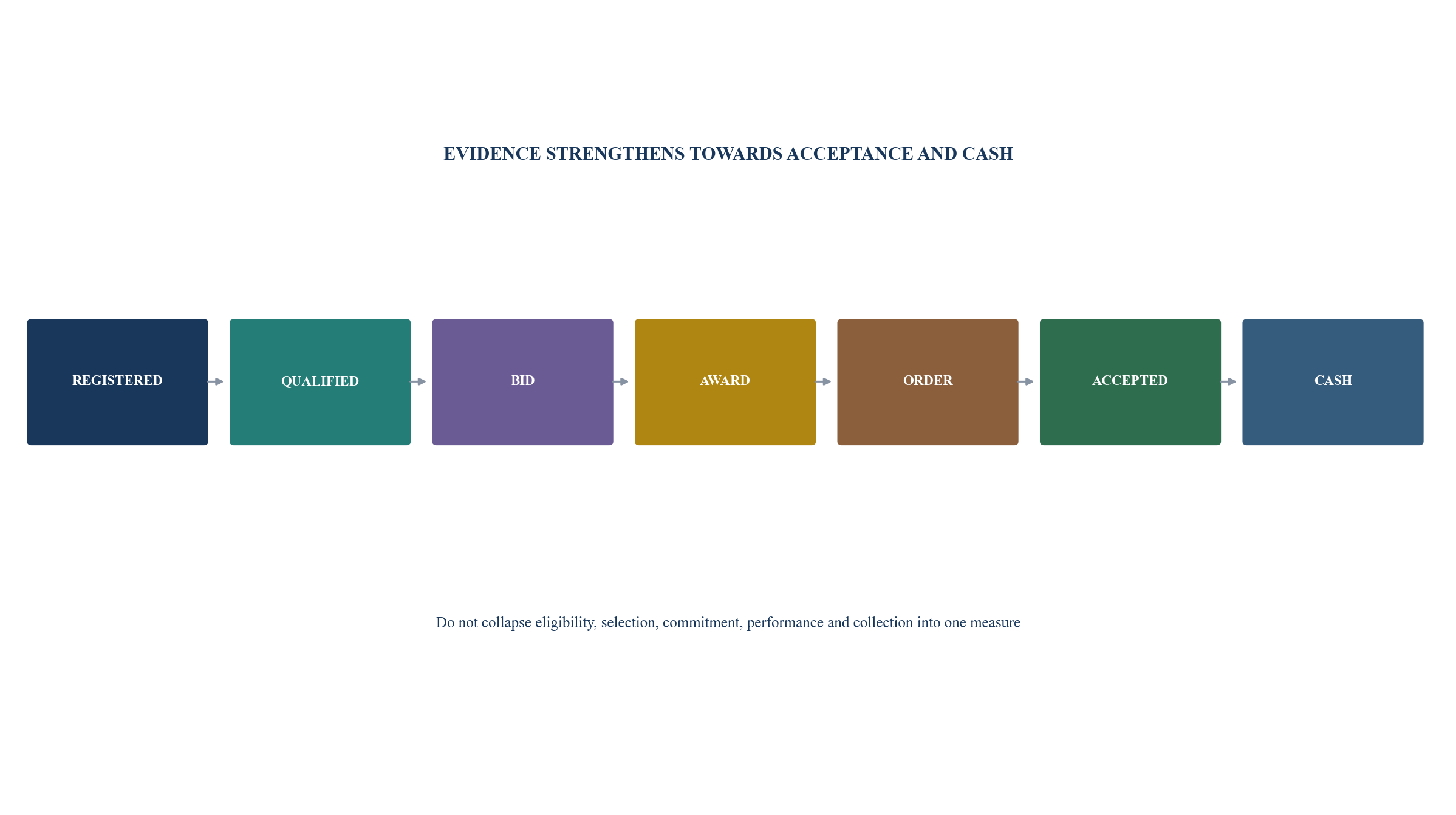
Author framework. Each stage requires a dated source document and should remain separate in pipeline, revenue and cash reporting.
2. Map the buyer, budget and authority
Government is a collection of ministries, departments, authorities, state-linked organisations and delivery bodies with distinct mandates. A product user may recognise the problem while another official controls budget, procurement, information security, legal approval, data, finance or acceptance. The company should map the whole decision system.
The opportunity record should identify the sponsoring function, accountable executive, procurement owner, budget source, financial year, approval threshold, technical evaluator, security approver, legal counterparty and invoice approver. A strong champion without budget or procurement authority provides valuable discovery evidence and weak commitment evidence.
Budget timing can shape the commercial cycle. A buyer may need an approved line item, transfer, framework, tender or purchase order before work begins. The company should verify the permitted route and avoid delivering beyond an authorised scope. An email expressing intent should not be treated as a substitute for the required authority.
Acceptance authority deserves particular attention. The contract can link payment to milestones, test results, documentation, deployment, training or user sign-off. The operating plan should specify who accepts each deliverable, which evidence satisfies the test and how disputes or changes are resolved.
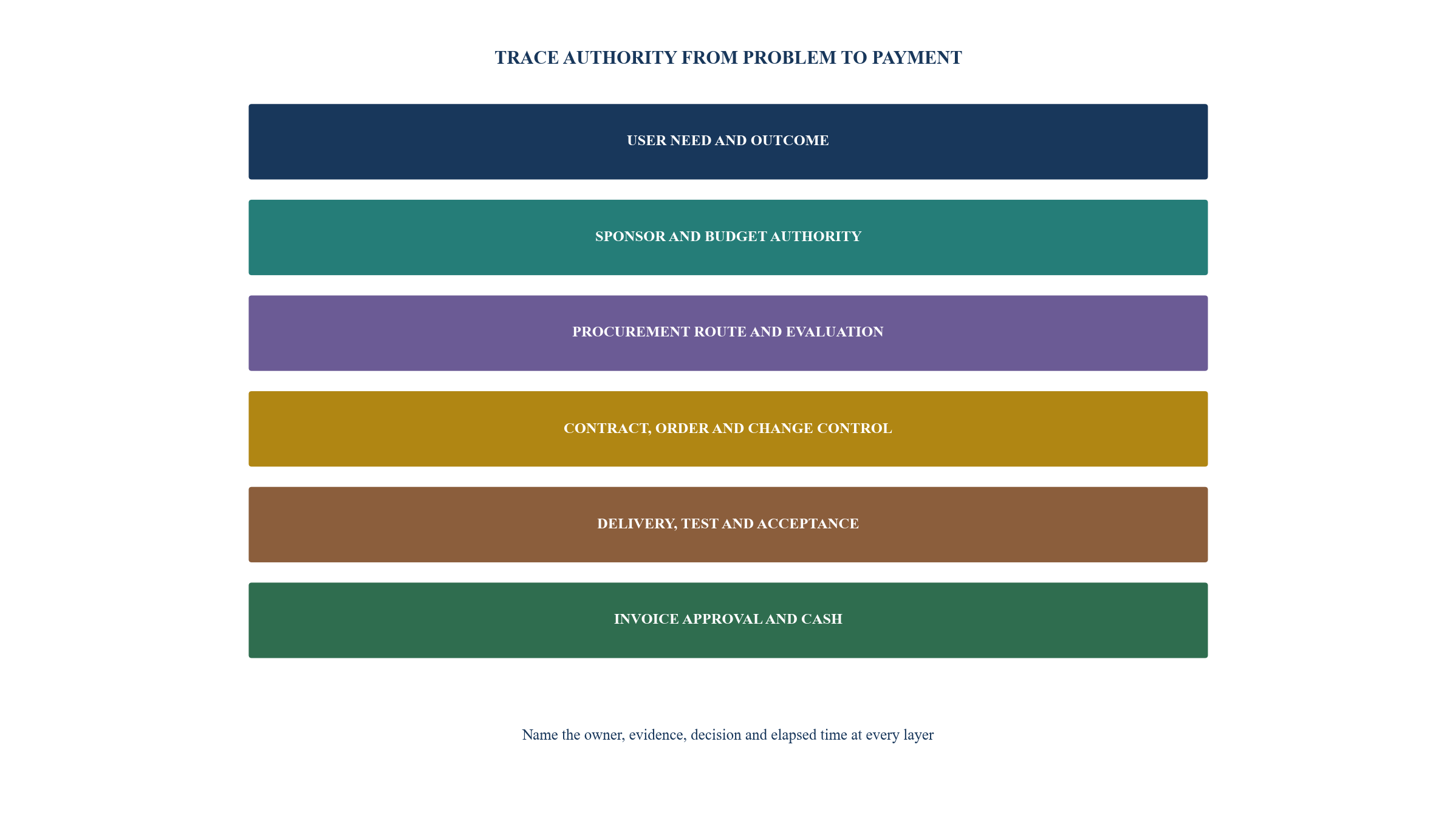
Author framework. Commercial diligence should trace the opportunity through use, budget, procurement, contract, acceptance and payment authority.
3. Use the UAE federal procurement route as evidence
The UAE Ministry of Finance describes the Federal Supplier Register and Digital Procurement Platform as the route through which registered suppliers can access federal tendering processes. Its service page states that the platform supports tender participation, contract negotiation, purchase-order acknowledgement and invoice submission.[1] This sequence demonstrates why registration should be separated from later commercial evidence.
The federal procurement framework is governed by Federal Decree-Law No. 11 of 2023 concerning procurement in the Federal Government.[2] A venture pursuing federal business should review the applicable procurement documents, entity requirements and tender terms for its specific opportunity. Platform access does not remove the need to understand authority, evaluation, security, contract, delivery and payment.
The diligence file should contain current supplier-registration evidence, tender documents, questions and answers, bid submission, clarifications, evaluation communications, award, executed contract, order, performance evidence and invoice records as each becomes available. Access rights should be controlled because government documents can contain confidential or security-sensitive information.
The company should also classify the opportunity. A challenge, grant, accelerator, sandbox, proof of concept, direct purchase, competitive tender, framework agreement and subcontract through a prime can create different rights and economics. The label used in marketing should follow the legal instrument.
4. Navigate Abu Dhabi supplier and tender processes
Abu Dhabi Government Procurement Gate provides supplier registration, public tenders and a Digital Marketplace for participating government entities.[3] Its supplier-registration guidance states that organisations wishing to do business with Abu Dhabi government entities must complete central registration. It also states that qualification is not shortlisting and does not guarantee business, and that entities can perform their own screening and technical evaluation.[4]
This official distinction is directly relevant to venture reporting. A company can legitimately report that it is registered or qualified. It should not describe the status as an award, contract or revenue. The board pack should show the exact status and date.
Registration documents can include corporate, tax, authorised-signatory and banking evidence. The company should keep them current, assign an owner and maintain a calendar for renewals. Expired or inconsistent records can delay eligibility while a live opportunity progresses.
Public tender visibility can support disciplined market mapping. The venture should record buyer, category, scope, closing date, evaluation basis, required certifications, bid security where applicable, contractual conditions and reasons to bid. A large number of superficially relevant notices can inflate pipeline while consuming scarce bid capacity. The bid decision should use an approved qualification threshold.
Table 1. Government-opportunity qualification scorecard
| Domain | Evidence required | Proceed signal | Stop or redesign signal |
|---|---|---|---|
| Problem and mandate | named user, quantified problem and public mandate | material outcome with accountable sponsor | generic interest without funded need |
| Budget and authority | budget source, financial year and approval path | verified funding and authorised route | no budget owner or authority cannot be identified |
| Procurement fit | eligible route, tender requirements and timetable | company can compete and evidence compliance | mandatory qualification or term cannot be met |
| Product fit | specification, integrations, security and data | substantially standard product meets need | bespoke build changes the core platform |
| Delivery fit | milestones, acceptance, staffing and support | capacity and owners are funded | hidden implementation burden or impossible schedule |
| Economics and cash | price, complete cost, tax, security and payment | risk-adjusted contribution clears hurdle | negative contribution or working-capital breach |
| Strategic portability | reference rights, repeatable use case and adjacent buyers | proof can travel to named next customers | confidential one-off with no reusable capability |
Scores and weights should be approved in advance. Any example rating is a hypothetical management assumption.
5. Compare international procurement systems carefully
Official international systems reinforce several common disciplines. The United Kingdom's Contracts Finder allows suppliers to search opportunities and prior awards. It directs higher-value opportunities to Find a Tender and identifies separate systems for Scotland, Wales and Northern Ireland.[5] Publication creates visibility; each procurement still carries its own scope and terms.
United States federal purchasing operates through the Federal Acquisition Regulation and agency-specific procedures. Acquisition.gov identifies the System for Award Management as a primary source of vendor information for contracting officers under simplified acquisition procedures.[6] FAR Part 19 provides small-business programme rules.[7] The Small Business Innovation Research programme can support research and development and later commercialisation routes, but an innovation award and a scaled procurement contract remain distinct evidence.
Singapore publishes opportunities and awards through GeBIZ. Ministry of Finance guidance explains that procurement is decentralised to individual agencies within central guidelines and that procedures can include small-value purchases, quotations, open tenders, selective tenders and limited tenders.[8] It also explains that supplier registration may be required when stated in a notice.[9]
The systems differ in law, thresholds, policy and process. The transferable underwriting principles are to verify registration, authority, competitive route, award instrument, contractual commitment, delivery, acceptance, invoice and collection. A company entering another jurisdiction should obtain current local advice rather than transplant UAE assumptions.
Table 2. Illustrative international public-procurement evidence map
| Jurisdiction | Official discovery or registration route | Underwriting focus | Evidence that remains separate |
|---|---|---|---|
| UAE federal | Federal Supplier Register and Digital Procurement Platform | registration, tender, contract, order and invoice sequence | platform access, bid, award, accepted delivery and cash |
| Abu Dhabi | Government Procurement Gate and Digital Marketplace | central registration plus entity screening and technical evaluation | qualification, shortlisting, contract and payment |
| United Kingdom | Contracts Finder and Find a Tender, with devolved systems | publication, procedure, award and contract terms | opportunity notice, award notice, executed contract and cash |
| United States | SAM, FAR-based procurement and agency programmes | eligibility, acquisition route, clauses, IP and appropriations | innovation award, prime contract, order and collection |
| Singapore | GeBIZ and applicable supplier registration | purchase method, agency evaluation and value-for-money case | registration, quotation or tender, award and acceptance |
Current official opportunity documents and applicable law govern each procurement.
6. Classify pilots, grants and contracts
The commercial model should name the instrument. A grant can fund eligible activity without creating customer revenue. An accelerator or challenge can provide access, visibility or prize funding. A paid proof of concept can create customer evidence with a bounded test. A contract can commit the buyer to specified deliverables and payment. A framework can establish terms while individual call-offs or orders create spend.
Accounting treatment should follow the instrument and applicable standards. Investor reporting should also disclose the economic character. A one-time implementation fee, reimbursed cost, grant and recurring software subscription have different margins, durability and valuation implications.
The pilot should have a defined hypothesis, scope, data, responsibilities, success criteria, acceptance authority, duration, price, rights and conversion decision. An open-ended free pilot creates weak evidence and consumes delivery capacity. A paid pilot can still be strategically poor when the company accepts broad IP transfer or custom work that cannot be reused.
Conversion should be measured from pilot to production contract, production deployment, cash and renewal. The denominator should include every completed pilot within the measurement cohort. Removing unsuccessful tests from the denominator would overstate repeatability.
7. Build a procurement evidence funnel
Opportunity management should use stage-entry and exit criteria. Discovery requires a named user and problem. Qualification requires sponsor, budget and route. Bid requires an approved response and compliance matrix. Preferred-bidder or award stage requires the official communication and outstanding conditions. Contract stage requires execution by authorised parties. Order stage requires the applicable order or call-off. Delivery stage requires performance evidence. Collection requires cleared cash.
Every stage should record elapsed time and probability basis. The company can then learn which buyer categories, procurement routes and use cases convert. A generic probability such as 50 per cent for every submitted tender conceals differences in competition, budget, timing and technical fit.
Bid cost should be measured. It includes commercial time, solution design, security, legal review, finance, certifications, partner coordination and executive attention. Win rate without bid cost can reward an uneconomic engine.
The pipeline should also distinguish sourced opportunities from invitations linked to an incumbent relationship. A large public tender can be technically open while specification, timetable or reference requirements favour an established supplier. The company should document its reason to win before committing the bid team.
8. Diligence the contract architecture
Contract value should be decomposed into committed, optional, contingent and reimbursable elements. Maximum framework value may not be a guaranteed purchase. Renewal options may sit solely with the buyer. Usage estimates may carry no minimum. Milestones may depend on acceptance. The forecast should follow enforceable commitment and realistic delivery.
The diligence review should cover scope, deliverables, dependencies, milestones, acceptance, price, invoicing, payment, tax, performance security, service levels, warranties, indemnities, liability, insurance, audit, confidentiality, data, intellectual property, change, subcontracting, assignment, termination, suspension, dispute and governing law.
Government contracts can include termination rights, audit access and public-law obligations that differ from commercial templates. The company should evaluate downside under delay, rejection, change, termination and dispute. Any required bond, guarantee or holdback affects liquidity.
Change control is important for early-stage companies. Users can request additional features during delivery. Work should enter an authorised change process with scope, timing, price and acceptance. Informal delivery can create cost without contractual recovery and can confuse the product roadmap.
Table 3. Public-sector contract diligence register
| Clause area | Evidence question | Economic effect | Board escalation |
|---|---|---|---|
| Commitment | which value is binding, optional or usage-dependent? | forecast value and capacity | headline value materially exceeds committed value |
| Scope and acceptance | who tests what, when and against which criteria? | revenue timing, rework and collection | subjective acceptance or missing dependency owner |
| Payment and security | invoice trigger, term, retention, bond or guarantee? | working capital and liquidity | downside exceeds approved cash buffer |
| Liability and remedies | caps, exclusions, service credit, indemnity and warranty? | tail loss and insurance | uncapped or uninsured material exposure |
| IP, data and confidentiality | ownership, licence, access, localisation and publication? | product reuse, architecture and reference value | core IP transfer or prohibited operating model |
| Change and termination | authority, pricing, convenience rights and transition? | cost recovery and stranded capacity | buyer can terminate after material unrecoverable spend |
Legal review should use the actual tender and contract and identify unresolved departures.
9. Protect intellectual property and product reuse
A venture's value can depend on pre-existing software, models, data structures, documentation, methods and know-how. The contract should distinguish background intellectual property from deliverables created for the customer. It should define ownership and licences for each category, including improvements, configurations, interfaces and feedback.
The company should maintain an ownership chain from founders, employees, contractors, universities and vendors. Open-source and third-party components need an inventory and licence review. Public funding or innovation programmes can carry specific rights that should be understood before the proposal is submitted.
Customer requirements can legitimately call for rights in commissioned work or data. The commercial decision should reflect the value surrendered. A licence can sometimes meet the public purpose while preserving a reusable platform. This requires advice on the actual instrument and jurisdiction.
Reference rights should be explicit. The ability to name a government customer, publish a case study or disclose performance may be restricted. Investor diligence should treat unapproved logo use as a risk. Confidential delivery can still provide internal learning, while its external commercial proof may be limited.
10. Design data, security and assurance early
Public-sector customers can require data classification, hosting, access control, personnel screening, encryption, logging, resilience, incident notification, vulnerability management, supplier assurance and audit evidence. The company should identify requirements during qualification, before committing a delivery date and price.
The data map should show data owner, category, source, purpose, legal basis where relevant, location, transfer, vendor, retention, access and deletion. Architecture promises made in a bid should reconcile to the actual product and cloud configuration. A bid team should not promise a certification or local-hosting model that has not been costed and approved.
Assurance evidence can become a reusable asset. A standard security pack, architecture diagram, control matrix, penetration-test process, incident plan and subcontractor register can accelerate future diligence. The company should track expiry dates and exceptions.
AI products need additional governance. Model purpose, training and evaluation data, human oversight, performance limits, monitoring, security, explainability and change control should match the use case. Government reference value can weaken if the implementation depends on undocumented manual intervention.
11. Select the direct, prime or framework route
A venture can sell directly, subcontract under a prime contractor, join a consortium, use a reseller, participate in an innovation route or access work through a framework or marketplace. Each path changes customer ownership, control, margin, liability, data access and collection timing.
Direct contracting can preserve customer insight and economics. It can require qualifications, security, delivery capacity and balance-sheet support that an early company lacks. A prime can provide route access, implementation and contracting capability. The venture should understand margin, exclusivity, account control, bid transparency, flow-down clauses, acceptance, payment and rights to reuse the relationship.
A framework or marketplace can reduce some transaction friction while work still depends on call-offs, orders or customer selection. Admission should not be recorded as contracted revenue. Management should track activity and conversion after admission.
The route choice should follow verified constraints and complete economics. Partner prestige alone does not establish channel performance. The company should inspect the partner's relevant customers, incentives, team, pipeline, delivery role and payment record.
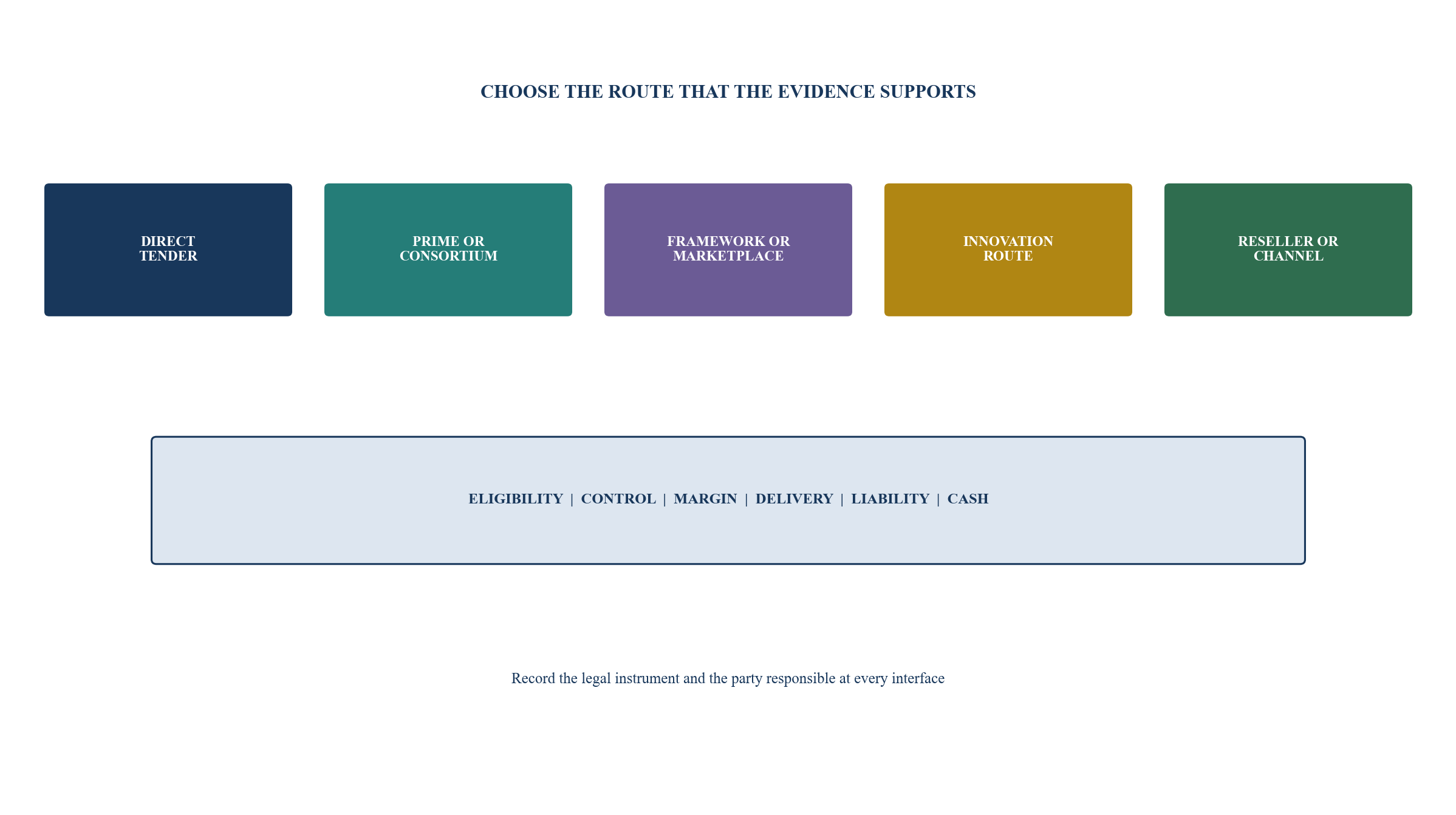
Author framework. Compare control, eligibility, speed, delivery, economics and collection for each permitted route.
12. Calculate complete contract economics
Gross contract value is the start of the model. The company should deduct discount, partner share, taxes borne by the supplier, product and cloud cost, implementation, integration, assurance, support, travel, bid cost, financing and expected remediation. It should then measure contribution against elapsed delivery and constrained-role capacity.
Staff cost should use realistic time by role. Founder time, security work and product customisation are economic costs even when they are not separately invoiced. Reusable platform improvements can have strategic value; the board should still see the cash and capacity consumed by the first contract.
The worked example assumes a hypothetical AED 2.4 million gross contract. It deducts a hypothetical AED 120,000 commercial concession, AED 360,000 implementation, AED 210,000 product and cloud cost, AED 150,000 assurance and compliance, AED 180,000 support, AED 90,000 bid and legal cost and AED 75,000 financing and collection cost. The resulting AED 1.215 million contribution is illustrative and should not be treated as a benchmark.
The model should run downside cases for slower acceptance, additional integration, delayed collection, partner margin and termination. A high nominal margin can coexist with a liquidity problem when cost precedes payment.
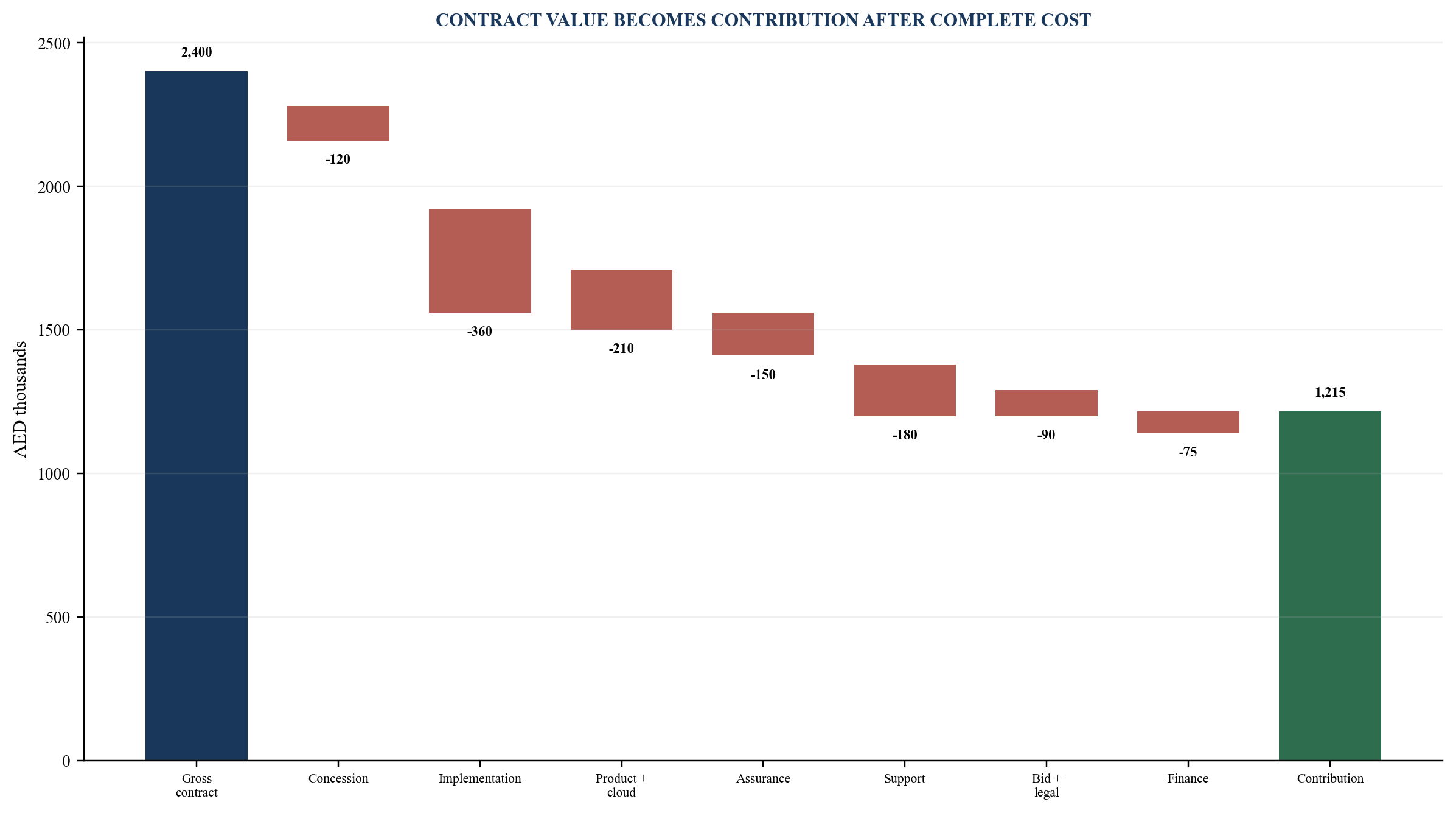
Every value is a hypothetical management assumption in AED thousands and demonstrates the method only.
Table 4. Hypothetical government-contract economics
| Measure | Base case | Downside case | Underwriting use |
|---|---|---|---|
| Gross contractual value | AED 2,400,000 | AED 2,400,000 | reconcile committed scope to executed instrument |
| Complete attributable cost | AED 1,185,000 | AED 1,620,000 | include bid, delivery, assurance, support and finance |
| Contribution | AED 1,215,000 | AED 780,000 | compare with hurdle and constrained capacity |
| Delivery to acceptance | 150 days | 240 days | model rework and milestone slippage |
| Invoice to cash | 60 days | 150 days | model liquidity and financing need |
| Peak net cash exposure | AED 720,000 | AED 1,280,000 | size buffer and capital release |
| Reusable product share | 70% | 40% | test whether the next contract needs the same effort |
Every amount and timing assumption is hypothetical and demonstrates the framework only.
13. Model working capital from bid to cash
Government revenue can be attractive and cash-intensive. Bid work begins before award. Certifications, bonds, integrations and hiring can precede delivery. Invoicing may require purchase order, milestone acceptance or portal submission. Queries, documentation gaps or disputes can extend collection.
The cash model should be weekly or monthly and linked to contractual milestones. It should include bid cost, mobilisation, payroll, vendors, tax, security, guarantee fees, retention, acceptance, invoice and payment. The company should confirm whether the contract permits advance, milestone or annual prepayment and whether a partner receives cash before remitting the venture's share.
Peak exposure matters more than average margin. A company can show positive contribution and run out of liquidity before collection. The board should approve a cash ceiling and stop condition before mobilisation.
Receivables should be reconciled to accepted deliverables and invoice status. A government counterparty can have strong ultimate credit while an incomplete acceptance package delays the claim. Finance and delivery should share the same milestone register.
14. Distinguish product revenue from services intensity
A first government customer often requests integration, configuration, training, reporting and change. These activities can establish the product and create reusable capability. They can also turn a venture into a project business without management recognising the transition.
The company should separate standard product, configurable component, reusable integration, customer-specific development, implementation, managed service and support. Time and cost should be captured by category. Product gross margin should not absorb unmeasured services work.
The second-customer test is decisive. Management should ask which artefacts, controls, connectors and evidence can be reused, which requirements are unique and how deployment time changes. A repeatable contract should become faster and less dependent on founders.
Roadmap authority should remain clear. A government sponsor can be influential. Product changes should follow the target market, architecture and economic case. A funded one-off feature can be accepted deliberately if the contract compensates the cost and does not impair the platform.
15. Measure concentration and repeatability
Government concentration can occur at counterparty, department, programme, budget, prime contractor or policy level. Several contracts can appear diversified while relying on one approval, framework or relationship. The risk register should identify the common dependency.
Revenue concentration should be measured through contracted, recognised and collected value. Renewal and new awards should remain distinct. Backlog should separate committed orders from options and expected call-offs.
Repeatability combines customer similarity, procurement route, product configuration, delivery effort, sales cycle, price, acceptance and cash. A high-quality reference can improve access to the next buyer. Management should document whether the next opportunity arose from the delivered outcome, a relationship, a policy programme or a partner.
The portfolio can be plotted by repeatability and concentration. A standard product across several independent agencies has a different risk profile from one large bespoke programme. The objective is not to avoid every concentrated first contract. The objective is to understand the exposure, capitalise it appropriately and create a deliberate diversification path.
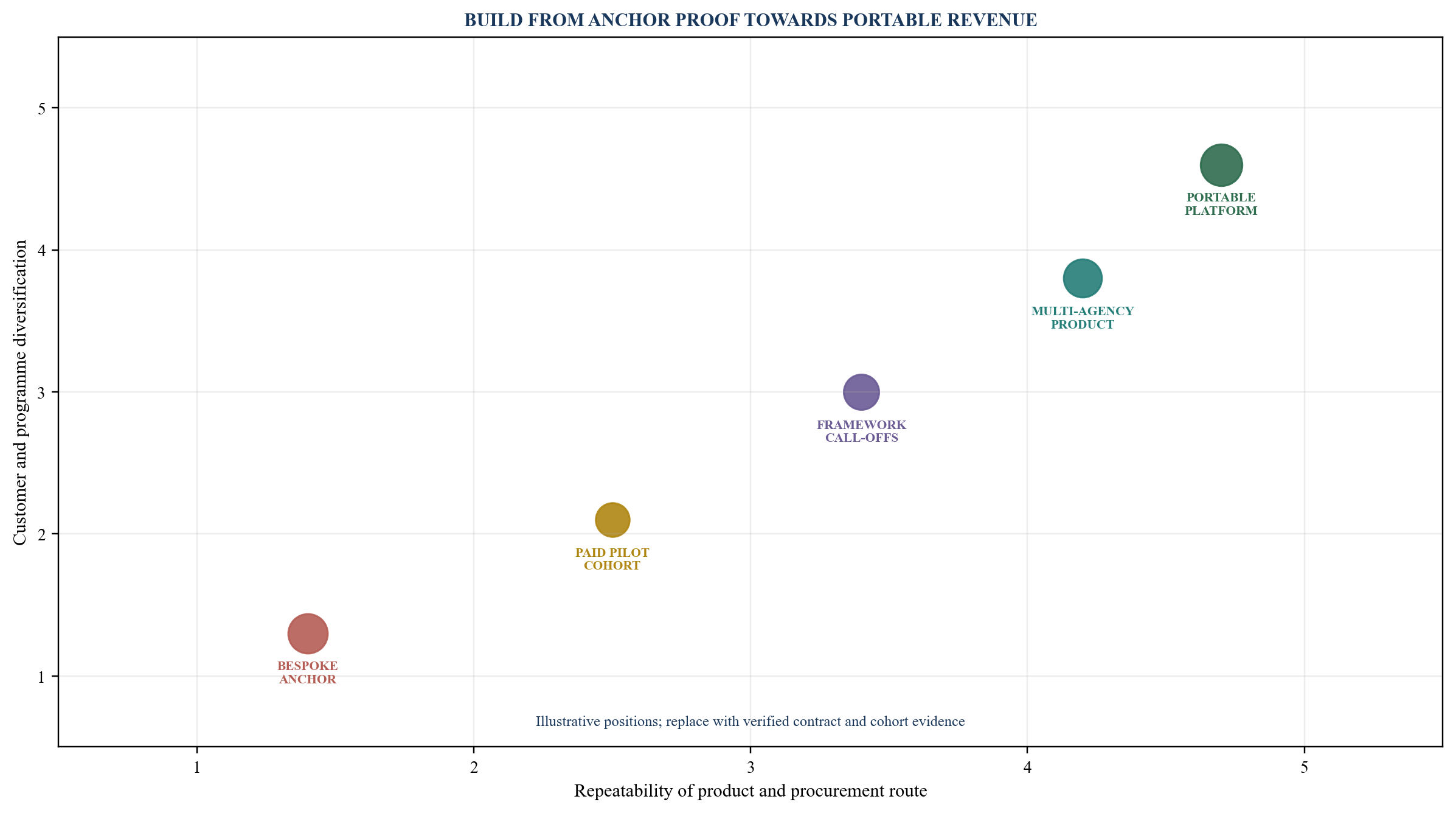
Positions are hypothetical management assumptions used solely to demonstrate the framework.
16. Convert the reference into portable proof
Reference portability should be planned during contracting and delivery. The company should seek permission for an approved description, outcome metrics, case study, reference call or anonymised evidence. Security and confidentiality requirements govern what can be disclosed.
The reference pack should describe the customer problem, baseline, product scope, implementation, adoption, measured outcome, limitations and time period. It should avoid implying government endorsement. Claims should reconcile to accepted customer evidence.
The next buyer should face a similar problem and procurement logic. A successful deployment in one authority can provide technical credibility while another jurisdiction requires different registration, security, data or contract terms. The company should identify portable proof and local requirements separately.
International comparisons can strengthen strategy. UK procurement visibility, US federal contracting and innovation routes, and Singapore's GeBIZ system illustrate alternative buyer structures. A UAE reference may open discovery conversations. It does not remove the need to qualify each opportunity through the local system.
17. Govern post-award delivery and acceptance
Award is the beginning of execution. The company should establish a joint governance calendar, responsibility matrix, dependency register, change process, milestone evidence, acceptance plan, invoice pack and risk escalation. Commercial, delivery and finance data should reconcile.
The baseline plan should identify customer-provided data, access, infrastructure, decisions and personnel. Delays caused by missing dependencies should be documented promptly under the contract. Teams should avoid absorbing every delay informally.
Acceptance evidence should be prepared during delivery. Test results, deployment records, training attendance, documentation, service reports and authorised sign-off can support the invoice. The responsible customer official should be known before the milestone date.
Post-award controls should also protect product quality and staff capacity. A founder-led rescue can conceal an unsustainable delivery model. Root causes, rework and support demand should enter the economics and product roadmap.
Table 5. Post-award delivery and cash dashboard
| Control | Current evidence | Forward test | Escalation trigger |
|---|---|---|---|
| Scope and change | baseline, approved changes and open requests | remaining effort and authority | team performs material work without approved recovery |
| Dependencies | customer and supplier actions with dates | critical-path impact | missing input threatens acceptance or security |
| Delivery quality | test results, defects and remediation | completion and operational stability | repeated failure or undocumented manual workaround |
| Acceptance | milestone criteria, evidence pack and approver | planned sign-off date | subjective test or unknown acceptance authority |
| Invoice and collection | accepted value, invoice status and queries | cash date and downside | cash delay breaches liquidity ceiling |
| Reuse and capacity | standard versus bespoke effort | second-customer deployment time | founder or specialist bottleneck persists |
The dashboard should reconcile to the contract, delivery system and accounting records.
18. Run a 180-day procurement-led growth programme
During the first thirty days, management should define target government problems, map eligible entities, complete registrations, build the qualification scorecard and conduct buyer discovery. Finance should create contract-cohort and cash models. Legal, data and security owners should establish the minimum evidence pack.
During days 31 to 60, the team should qualify a small opportunity set, verify procurement routes, select bid or pilot candidates and document the reason to win. Product should map requirements against the standard platform. The board should approve bid cost and a pre-award capital ceiling.
During days 61 to 120, management should submit or negotiate the selected opportunities while testing delivery, contract and security assumptions. Every stage change should carry evidence. The team should decline weak bids that fail the approved threshold.
During days 121 to 180, the company should mobilise only against valid authority, operate the delivery and acceptance dashboard, reconcile invoices and cash and prepare the reference-portability pack. The board should decide whether evidence supports a second buyer, partner route, product change, additional capital or pause.
19. Build the investor diligence room
Investor diligence should reconcile the procurement story across presentations, CRM, tender files, contracts, delivery systems, accounting and bank records. The same opportunity should not carry different value or stage in separate reports.
The room should include registration status, opportunity register, qualification decisions, tender and bid files, award communications, executed contracts, orders, change controls, acceptance, invoices, collections, security evidence, IP chain, partner agreements, delivery effort and customer references. Confidential government information should be access-controlled and disclosed only as permitted.
The reviewer should sample opportunities at every stage. For a registration claim, inspect the current registration. For a submitted bid, inspect the submission and closing date. For an award, inspect the official instrument and conditions. For contracted backlog, inspect commitment and options. For revenue, reconcile performance and accounting. For cash, inspect collection.
Management should disclose scenarios as assumptions. Unawarded pipeline and optional framework value should not be presented as committed revenue. A transparent evidence system can improve board decisions even when it reduces a headline pipeline number.
Table 6. Procurement-led venture diligence plan
| Workstream | Core evidence | Principal question | Escalation trigger |
|---|---|---|---|
| Buyer and authority | mandate, sponsor, budget and procurement route | can the identified entity authorise and pay for the work? | champion lacks budget or decision authority |
| Opportunity and award | notice, bid, evaluation and award instrument | does reported stage match official evidence? | marketing language exceeds the documented status |
| Contract and order | executed terms, commitment, order and changes | which value is enforceable and deliverable? | options or maximum value reported as backlog |
| Product and delivery | requirements, effort, acceptance and support | can the next deployment use the same product and process? | bespoke services or founder dependence remain hidden |
| Economics and cash | complete cost, invoices, receivables and bank | does collected contribution support venture growth? | working-capital exposure exceeds approved liquidity |
| Governance and portability | owners, gates, concentration and reference rights | can the board scale, diversify or stop promptly? | continued spend after failed evidence gate |
Evidence should be attributable, current and reconciled across commercial, operational and financial systems.
20. Use a board gate that can release or stop capital
The board gate should combine six conditions: verified buyer problem, budget and authority, permitted procurement route, acceptable contract and IP position, controlled delivery and acceptance, and attractive risk-adjusted cash economics. Reference portability and diversification strengthen the scale case.
The decision can be to bid, negotiate, pilot, mobilise, scale, use a prime, redesign, defer or stop. Each approval should name the capital ceiling, owner, evidence, date and stop condition. A pipeline target without a cash ceiling can encourage expensive participation.
The board should preserve stage integrity in external communications. Registered, qualified, selected, awarded, contracted, delivered, invoiced and collected are useful words when supported by evidence. Precision builds trust with customers, employees and investors.
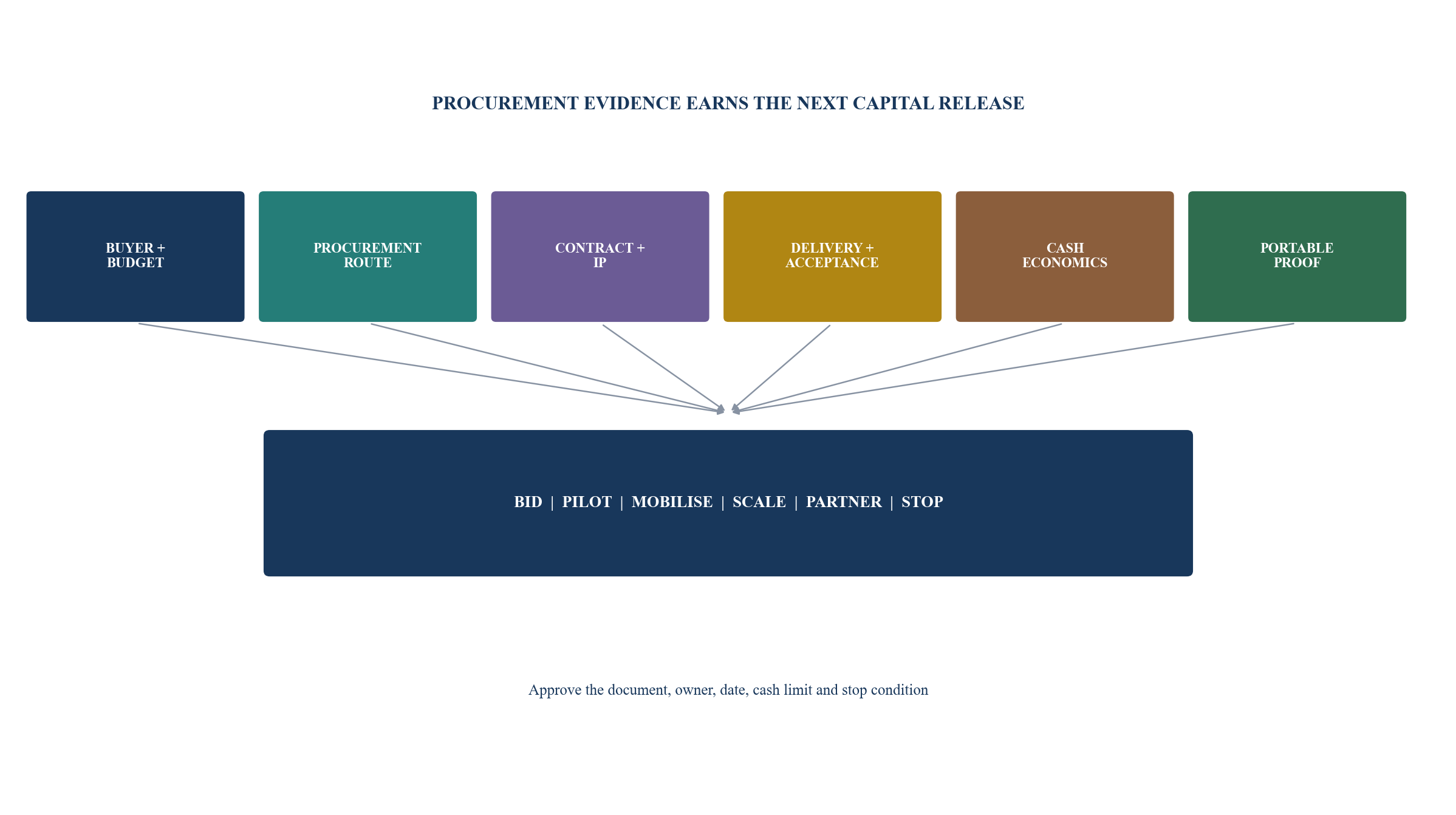
Author framework. Capital follows evidence across authority, procurement, contract, delivery, cash and portability.
Conclusion
Government can be an important first customer when a venture solves a material public problem and can meet the procurement, security, delivery and accountability standard. The resulting reference can support product development, talent, financing and access to adjacent buyers.
The investment case should remain anchored to evidence. Registration establishes eligibility. Qualification supports participation. A bid creates competitive exposure. An award can identify an intended supplier. Contract and order establish commitment. Accepted delivery supports invoicing. Collected cash validates the contract-to-cash path.
The company should underwrite complete economics and liquidity, protect intellectual property, measure services intensity, control change and build the reference for portability. UAE federal and Abu Dhabi digital procurement routes provide structured access. Official systems in the United Kingdom, United States and Singapore show that registration and published opportunities form part of a wider process in every market.
A bounded procurement-growth programme and board gate can convert government traction into a controlled venture asset. The strongest outcome is a repeatable product, supported by accepted delivery, attractive collected contribution and proof that travels to the next customer.
References
- United Arab Emirates Ministry of Finance, Register Suppliers in the Federal Supplier Register, https://mof.gov.ae/en/services/register-suppliers-in-the-federal-supplier-register/
- UAE Legislation, Federal Decree-Law No. 11 of 2023 Concerning Procurement in the Federal Government, https://uaelegislation.gov.ae/en/legislations/2165/download
- Abu Dhabi Government Procurement Gate, https://adgpg.gov.ae/
- Abu Dhabi Government Procurement Gate, Becoming a Registered Supplier, https://www.adgpg.gov.ae/en/Trading-With-Government/Becoming-a-Registered-Supplier
- UK Government, Contracts Finder, https://www.gov.uk/contracts-finder
- United States Acquisition.gov, FAR Subpart 13.1, Procedures, https://www.acquisition.gov/far/subpart-13.1
- United States Acquisition.gov, FAR Part 19, Small Business Programs, https://www.acquisition.gov/far/part-19
- Singapore Government Electronic Business, Guide to Singapore Procurement, https://www.gebiz.gov.sg/singapore-government-procurement-regime.html
- Singapore Government Electronic Business, Supplier Registration Guide, https://www.gebiz.gov.sg/cmw/content/4/page3/Create_New_Application.html
- United States Small Business Innovation Research, About, https://www.sbir.gov/about
- UK Government, Procurement Act 2023 guidance documents, https://www.gov.uk/government/collections/procurement-act-2023-guidance-documents
- Singapore Ministry of Finance, Government Procurement Guide for Suppliers, https://www.gebiz.gov.sg/docs/supplier_guide_detailed.pdf
About the Author
Chennakeshav Adya is an independent researcher and Managing Partner of Matchpoint Partners. His work examines strategy, capital formation, valuation, transactions and operating execution across private and public markets.
