

1. Define the investment thesis
State the decisions, users, workflows, economic outcomes, ownership horizon and valuation purpose.
The controlled record includes scope; authority; source; passage; fact; calculation; reviewer; decision. The immediate deliverable is an approved knowledge-platform thesis. Preserve jurisdiction, effective date, version, transformation, reviewer, approval and unresolved exceptions.
The principal failure occurs when technical novelty is mistaken for investable enterprise value. Reviewers should reconstruct the evidence path, test consequence under adverse conditions and identify who may approve or withhold the recommendation.
Enterprise knowledge value arises when structured domain meaning changes a paid workflow, cash flow, risk or strategic option. Architecture alone does not establish economic value.
The decision pack for define the investment thesis should show the prior view, correction, consequence at stake, alternatives, owner, due date, next evidence gate and observed outcome. Exceptions require closure evidence and an explicit effect on retrieval, citation, abstention, review or release.
2. Set the asset perimeter
Separate source data, taxonomies, ontologies, graph structures, embeddings, software, workflows, contracts and people.
The controlled record includes scope; authority; source; passage; fact; calculation; reviewer; decision. The immediate deliverable is an asset-perimeter map. Preserve jurisdiction, effective date, version, transformation, reviewer, approval and unresolved exceptions.
The principal failure occurs when one platform label conceals assets with different rights, lives and economics. Reviewers should reconstruct the evidence path, test consequence under adverse conditions and identify who may approve or withhold the recommendation.
The platform combines separable and complementary assets. Rights, data, semantic models, software, domain expertise, distribution and customer integration should be evaluated distinctly before value is allocated.
The decision pack for set the asset perimeter should show the prior view, correction, consequence at stake, alternatives, owner, due date, next evidence gate and observed outcome. Exceptions require closure evidence and an explicit effect on retrieval, citation, abstention, review or release.
3. Distinguish taxonomy, ontology and graph
Define controlled vocabularies, semantic rules, entities, relationships and inference requirements.
The controlled record includes scope; authority; source; passage; fact; calculation; reviewer; decision. The immediate deliverable is a semantic-layer classification. Preserve jurisdiction, effective date, version, transformation, reviewer, approval and unresolved exceptions.
The principal failure occurs when buyers treat every connected dataset as a proprietary ontology. Reviewers should reconstruct the evidence path, test consequence under adverse conditions and identify who may approve or withhold the recommendation.
Graph-assisted retrieval should be benchmarked against credible vector, keyword and hybrid baselines. Incremental quality, latency, cost and workflow outcomes require reproducible evidence.
The decision pack for distinguish taxonomy, ontology and graph should show the prior view, correction, consequence at stake, alternatives, owner, due date, next evidence gate and observed outcome. Exceptions require closure evidence and an explicit effect on retrieval, citation, abstention, review or release.
4. Map the knowledge lifecycle
Trace capture, cleaning, entity resolution, modelling, validation, publishing, use, feedback, change and retirement.
The controlled record includes scope; authority; source; passage; fact; calculation; reviewer; decision. The immediate deliverable is a lifecycle and cost map. Preserve jurisdiction, effective date, version, transformation, reviewer, approval and unresolved exceptions.
The principal failure occurs when valuation ignores the continuing work required to keep knowledge current. Reviewers should reconstruct the evidence path, test consequence under adverse conditions and identify who may approve or withhold the recommendation.
Valuation should triangulate income, market and cost evidence while testing adoption, decay, maintenance, dependency, transferability, obsolescence and value-capture execution.
The decision pack for map the knowledge lifecycle should show the prior view, correction, consequence at stake, alternatives, owner, due date, next evidence gate and observed outcome. Exceptions require closure evidence and an explicit effect on retrieval, citation, abstention, review or release.
5. Verify rights and control
Test ownership, licences, consents, contractual rights, portability and restrictions for every data and model component.
The controlled record includes scope; authority; source; passage; fact; calculation; reviewer; decision. The immediate deliverable is a rights and control register. Preserve jurisdiction, effective date, version, transformation, reviewer, approval and unresolved exceptions.
The principal failure occurs when the target cannot transfer or continue using a material knowledge asset. Reviewers should reconstruct the evidence path, test consequence under adverse conditions and identify who may approve or withhold the recommendation.
Enterprise knowledge value arises when structured domain meaning changes a paid workflow, cash flow, risk or strategic option. Architecture alone does not establish economic value.
The decision pack for verify rights and control should show the prior view, correction, consequence at stake, alternatives, owner, due date, next evidence gate and observed outcome. Exceptions require closure evidence and an explicit effect on retrieval, citation, abstention, review or release.
6. Measure source-corpus quality
Score authority, coverage, uniqueness, freshness, consistency, lineage, permissions and replacement difficulty.
The controlled record includes scope; authority; source; passage; fact; calculation; reviewer; decision. The immediate deliverable is a source-quality scorecard. Preserve jurisdiction, effective date, version, transformation, reviewer, approval and unresolved exceptions.
The principal failure occurs when volume is used as a proxy for useful or defensible knowledge. Reviewers should reconstruct the evidence path, test consequence under adverse conditions and identify who may approve or withhold the recommendation.
The platform combines separable and complementary assets. Rights, data, semantic models, software, domain expertise, distribution and customer integration should be evaluated distinctly before value is allocated.
The decision pack for measure source-corpus quality should show the prior view, correction, consequence at stake, alternatives, owner, due date, next evidence gate and observed outcome. Exceptions require closure evidence and an explicit effect on retrieval, citation, abstention, review or release.
7. Test entity resolution
Measure precision, recall, duplication, identity drift and exception handling across high-value entities.
The controlled record includes scope; authority; source; passage; fact; calculation; reviewer; decision. The immediate deliverable is an entity-resolution benchmark. Preserve jurisdiction, effective date, version, transformation, reviewer, approval and unresolved exceptions.
The principal failure occurs when false merges and missed links contaminate retrieval and analytics silently. Reviewers should reconstruct the evidence path, test consequence under adverse conditions and identify who may approve or withhold the recommendation.
Graph-assisted retrieval should be benchmarked against credible vector, keyword and hybrid baselines. Incremental quality, latency, cost and workflow outcomes require reproducible evidence.
The decision pack for test entity resolution should show the prior view, correction, consequence at stake, alternatives, owner, due date, next evidence gate and observed outcome. Exceptions require closure evidence and an explicit effect on retrieval, citation, abstention, review or release.
8. Govern ontology design
Assign domain ownership, definitions, modelling rules, approvals, versioning and deprecation.
The controlled record includes scope; authority; source; passage; fact; calculation; reviewer; decision. The immediate deliverable is an ontology governance model. Preserve jurisdiction, effective date, version, transformation, reviewer, approval and unresolved exceptions.
The principal failure occurs when the semantic layer becomes an undocumented expert artefact. Reviewers should reconstruct the evidence path, test consequence under adverse conditions and identify who may approve or withhold the recommendation.
Valuation should triangulate income, market and cost evidence while testing adoption, decay, maintenance, dependency, transferability, obsolescence and value-capture execution.
The decision pack for govern ontology design should show the prior view, correction, consequence at stake, alternatives, owner, due date, next evidence gate and observed outcome. Exceptions require closure evidence and an explicit effect on retrieval, citation, abstention, review or release.
Table 1. Enterprise knowledge asset layers
| Layer | Value driver | Required evidence |
|---|---|---|
| source data | rights, uniqueness and quality | corpus audit |
| semantic model | definitions and relationships | governed ontology |
| retrieval system | decision-relevant performance | controlled benchmark |
| workflow | adoption and economic outcome | cohort evidence |
Illustrative controls require use-, consequence-, jurisdiction-, firm- and period-specific approval.
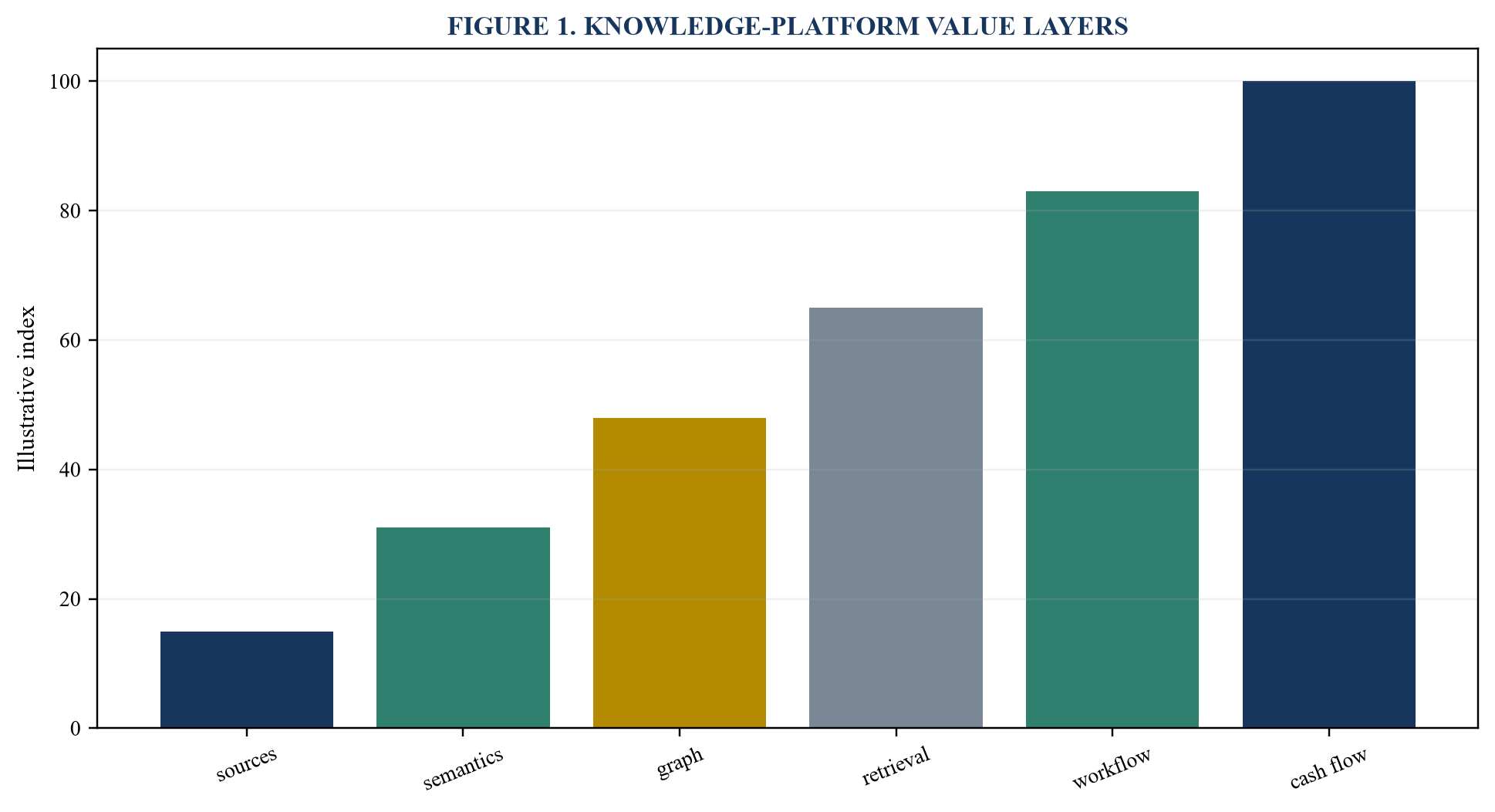
Values are illustrative indices and require replacement with approved validation evidence.
9. Test standards interoperability
Map RDF, OWL, SKOS, SHACL, SPARQL, JSON-LD and customer schemas to portability requirements.
The controlled record includes scope; authority; source; passage; fact; calculation; reviewer; decision. The immediate deliverable is an interoperability assessment. Preserve jurisdiction, effective date, version, transformation, reviewer, approval and unresolved exceptions.
The principal failure occurs when proprietary structures create avoidable integration and exit risk. Reviewers should reconstruct the evidence path, test consequence under adverse conditions and identify who may approve or withhold the recommendation.
Enterprise knowledge value arises when structured domain meaning changes a paid workflow, cash flow, risk or strategic option. Architecture alone does not establish economic value.
The decision pack for test standards interoperability should show the prior view, correction, consequence at stake, alternatives, owner, due date, next evidence gate and observed outcome. Exceptions require closure evidence and an explicit effect on retrieval, citation, abstention, review or release.
10. Preserve provenance and lineage
Connect assertions to source, transformation, confidence, owner, version and effective date.
The controlled record includes scope; authority; source; passage; fact; calculation; reviewer; decision. The immediate deliverable is a knowledge-provenance graph. Preserve jurisdiction, effective date, version, transformation, reviewer, approval and unresolved exceptions.
The principal failure occurs when the graph cannot explain why a relationship or conclusion exists. Reviewers should reconstruct the evidence path, test consequence under adverse conditions and identify who may approve or withhold the recommendation.
The platform combines separable and complementary assets. Rights, data, semantic models, software, domain expertise, distribution and customer integration should be evaluated distinctly before value is allocated.
The decision pack for preserve provenance and lineage should show the prior view, correction, consequence at stake, alternatives, owner, due date, next evidence gate and observed outcome. Exceptions require closure evidence and an explicit effect on retrieval, citation, abstention, review or release.
11. Benchmark against conventional RAG
Compare graph-assisted retrieval with vector, keyword and hybrid baselines on the same query set.
The controlled record includes scope; authority; source; passage; fact; calculation; reviewer; decision. The immediate deliverable is a controlled baseline study. Preserve jurisdiction, effective date, version, transformation, reviewer, approval and unresolved exceptions.
The principal failure occurs when GraphRAG is credited for gains caused by better data preparation or prompting. Reviewers should reconstruct the evidence path, test consequence under adverse conditions and identify who may approve or withhold the recommendation.
Graph-assisted retrieval should be benchmarked against credible vector, keyword and hybrid baselines. Incremental quality, latency, cost and workflow outcomes require reproducible evidence.
The decision pack for benchmark against conventional rag should show the prior view, correction, consequence at stake, alternatives, owner, due date, next evidence gate and observed outcome. Exceptions require closure evidence and an explicit effect on retrieval, citation, abstention, review or release.
12. Build a decision-relevant query portfolio
Sample global, local, multihop, temporal, comparative, exception and sparse-evidence questions.
The controlled record includes scope; authority; source; passage; fact; calculation; reviewer; decision. The immediate deliverable is a representative query suite. Preserve jurisdiction, effective date, version, transformation, reviewer, approval and unresolved exceptions.
The principal failure occurs when evaluation uses easy demonstration queries that do not represent paid workflows. Reviewers should reconstruct the evidence path, test consequence under adverse conditions and identify who may approve or withhold the recommendation.
Valuation should triangulate income, market and cost evidence while testing adoption, decay, maintenance, dependency, transferability, obsolescence and value-capture execution.
The decision pack for build a decision-relevant query portfolio should show the prior view, correction, consequence at stake, alternatives, owner, due date, next evidence gate and observed outcome. Exceptions require closure evidence and an explicit effect on retrieval, citation, abstention, review or release.
13. Test global and local retrieval
Measure whether community summaries and entity neighbourhoods improve corpus-level and fact-level discovery.
The controlled record includes scope; authority; source; passage; fact; calculation; reviewer; decision. The immediate deliverable is a retrieval-mode benchmark. Preserve jurisdiction, effective date, version, transformation, reviewer, approval and unresolved exceptions.
The principal failure occurs when global summaries obscure specific evidence or local retrieval misses system-wide patterns. Reviewers should reconstruct the evidence path, test consequence under adverse conditions and identify who may approve or withhold the recommendation.
Enterprise knowledge value arises when structured domain meaning changes a paid workflow, cash flow, risk or strategic option. Architecture alone does not establish economic value.
The decision pack for test global and local retrieval should show the prior view, correction, consequence at stake, alternatives, owner, due date, next evidence gate and observed outcome. Exceptions require closure evidence and an explicit effect on retrieval, citation, abstention, review or release.
14. Measure retrieval performance
Track coverage, relevance, ranking, latency, cost, stability and failure by query class.
The controlled record includes scope; authority; source; passage; fact; calculation; reviewer; decision. The immediate deliverable is a segmented retrieval scorecard. Preserve jurisdiction, effective date, version, transformation, reviewer, approval and unresolved exceptions.
The principal failure occurs when one aggregate score conceals weak performance in material workflows. Reviewers should reconstruct the evidence path, test consequence under adverse conditions and identify who may approve or withhold the recommendation.
The platform combines separable and complementary assets. Rights, data, semantic models, software, domain expertise, distribution and customer integration should be evaluated distinctly before value is allocated.
The decision pack for measure retrieval performance should show the prior view, correction, consequence at stake, alternatives, owner, due date, next evidence gate and observed outcome. Exceptions require closure evidence and an explicit effect on retrieval, citation, abstention, review or release.
15. Test answer quality and evidence
Measure correctness, completeness, citation support, contradiction, abstention and reproducibility.
The controlled record includes scope; authority; source; passage; fact; calculation; reviewer; decision. The immediate deliverable is an answer-quality evaluation. Preserve jurisdiction, effective date, version, transformation, reviewer, approval and unresolved exceptions.
The principal failure occurs when plausible prose increases while decision quality remains unchanged. Reviewers should reconstruct the evidence path, test consequence under adverse conditions and identify who may approve or withhold the recommendation.
Graph-assisted retrieval should be benchmarked against credible vector, keyword and hybrid baselines. Incremental quality, latency, cost and workflow outcomes require reproducible evidence.
The decision pack for test answer quality and evidence should show the prior view, correction, consequence at stake, alternatives, owner, due date, next evidence gate and observed outcome. Exceptions require closure evidence and an explicit effect on retrieval, citation, abstention, review or release.
16. Prove workflow outcomes
Compare time, rework, error, decision cycle, conversion, loss avoidance and user adoption against a baseline.
The controlled record includes scope; authority; source; passage; fact; calculation; reviewer; decision. The immediate deliverable is a workflow outcome bridge. Preserve jurisdiction, effective date, version, transformation, reviewer, approval and unresolved exceptions.
The principal failure occurs when platform use is presented as value without an observed operating outcome. Reviewers should reconstruct the evidence path, test consequence under adverse conditions and identify who may approve or withhold the recommendation.
Valuation should triangulate income, market and cost evidence while testing adoption, decay, maintenance, dependency, transferability, obsolescence and value-capture execution.
The decision pack for prove workflow outcomes should show the prior view, correction, consequence at stake, alternatives, owner, due date, next evidence gate and observed outcome. Exceptions require closure evidence and an explicit effect on retrieval, citation, abstention, review or release.
Table 2. Retrieval value benchmark
| Dimension | Test | Decision evidence |
|---|---|---|
| coverage | global and local query suite | baseline delta |
| correctness | supported answers and conflicts | error distribution |
| economics | latency, compute and review | cost per outcome |
| stability | updates, drift and repeatability | variance by segment |
Illustrative controls require use-, consequence-, jurisdiction-, firm- and period-specific approval.
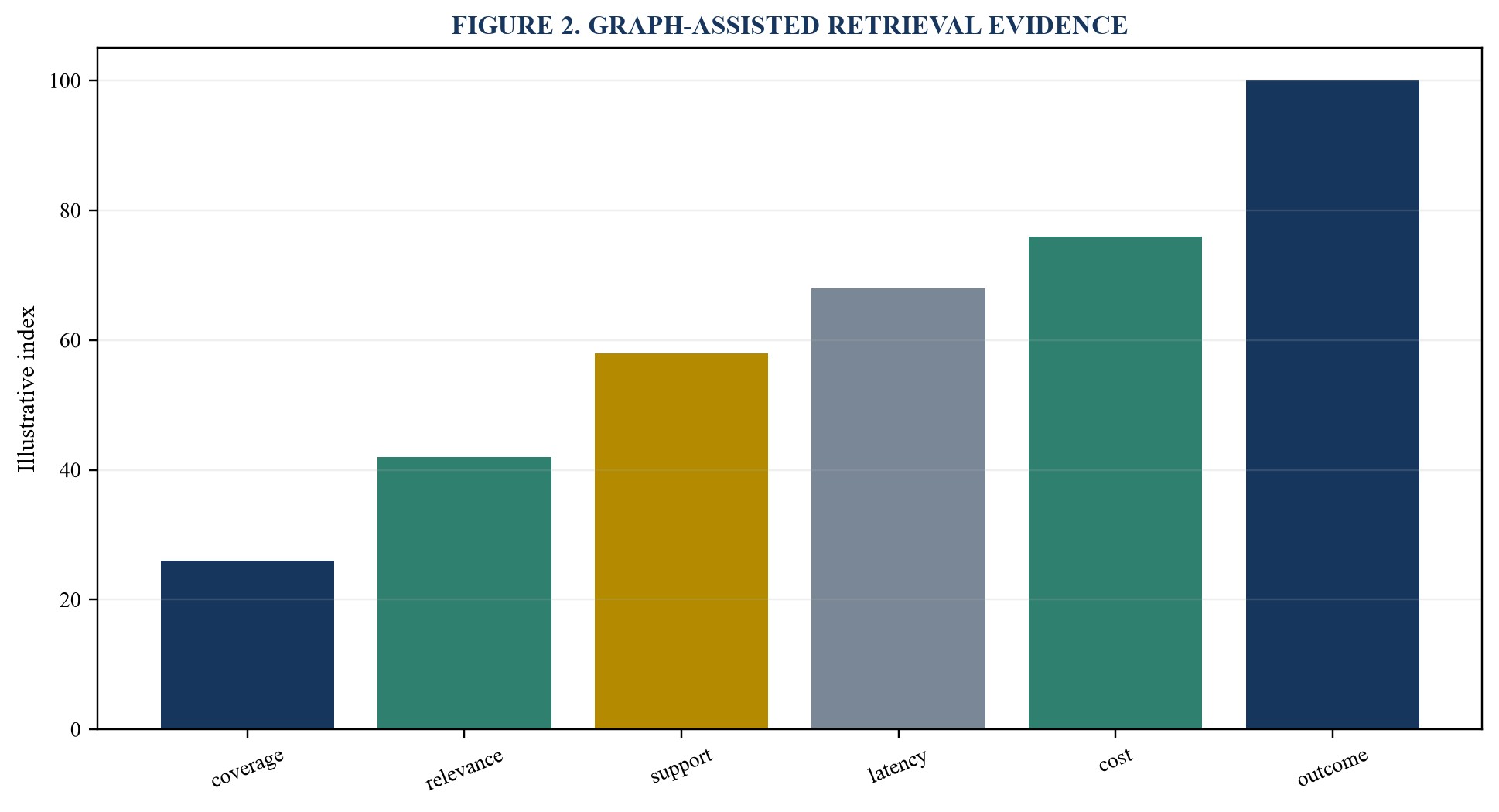
Values are illustrative indices and require replacement with approved validation evidence.
17. Map economic value pools
Separate revenue, retention, pricing, cost, risk, capital, speed, reuse and option value.
The controlled record includes scope; authority; source; passage; fact; calculation; reviewer; decision. The immediate deliverable is an economic value map. Preserve jurisdiction, effective date, version, transformation, reviewer, approval and unresolved exceptions.
The principal failure occurs when benefits overlap and are counted more than once. Reviewers should reconstruct the evidence path, test consequence under adverse conditions and identify who may approve or withhold the recommendation.
Enterprise knowledge value arises when structured domain meaning changes a paid workflow, cash flow, risk or strategic option. Architecture alone does not establish economic value.
The decision pack for map economic value pools should show the prior view, correction, consequence at stake, alternatives, owner, due date, next evidence gate and observed outcome. Exceptions require closure evidence and an explicit effect on retrieval, citation, abstention, review or release.
18. Evidence revenue effects
Test whether knowledge improves recommendation, cross-sell, win rate, price, retention or market access.
The controlled record includes scope; authority; source; passage; fact; calculation; reviewer; decision. The immediate deliverable is a revenue attribution model. Preserve jurisdiction, effective date, version, transformation, reviewer, approval and unresolved exceptions.
The principal failure occurs when revenue uplift relies on management aspiration rather than cohorts or experiments. Reviewers should reconstruct the evidence path, test consequence under adverse conditions and identify who may approve or withhold the recommendation.
The platform combines separable and complementary assets. Rights, data, semantic models, software, domain expertise, distribution and customer integration should be evaluated distinctly before value is allocated.
The decision pack for evidence revenue effects should show the prior view, correction, consequence at stake, alternatives, owner, due date, next evidence gate and observed outcome. Exceptions require closure evidence and an explicit effect on retrieval, citation, abstention, review or release.
19. Evidence cost and productivity effects
Measure avoided search, duplication, manual reconciliation, rework, escalation and onboarding cost.
The controlled record includes scope; authority; source; passage; fact; calculation; reviewer; decision. The immediate deliverable is a net productivity model. Preserve jurisdiction, effective date, version, transformation, reviewer, approval and unresolved exceptions.
The principal failure occurs when gross time savings ignore review, maintenance and exception labour. Reviewers should reconstruct the evidence path, test consequence under adverse conditions and identify who may approve or withhold the recommendation.
Graph-assisted retrieval should be benchmarked against credible vector, keyword and hybrid baselines. Incremental quality, latency, cost and workflow outcomes require reproducible evidence.
The decision pack for evidence cost and productivity effects should show the prior view, correction, consequence at stake, alternatives, owner, due date, next evidence gate and observed outcome. Exceptions require closure evidence and an explicit effect on retrieval, citation, abstention, review or release.
20. Value risk reduction
Quantify avoided errors, leakage, regulatory breaches, contractual failures and operational concentration.
The controlled record includes scope; authority; source; passage; fact; calculation; reviewer; decision. The immediate deliverable is a risk-adjusted benefit model. Preserve jurisdiction, effective date, version, transformation, reviewer, approval and unresolved exceptions.
The principal failure occurs when remote loss scenarios are capitalised without probability or control evidence. Reviewers should reconstruct the evidence path, test consequence under adverse conditions and identify who may approve or withhold the recommendation.
Valuation should triangulate income, market and cost evidence while testing adoption, decay, maintenance, dependency, transferability, obsolescence and value-capture execution.
The decision pack for value risk reduction should show the prior view, correction, consequence at stake, alternatives, owner, due date, next evidence gate and observed outcome. Exceptions require closure evidence and an explicit effect on retrieval, citation, abstention, review or release.
21. Test switching costs
Measure data migration, ontology dependence, workflow redesign, integrations, retraining and contractual friction.
The controlled record includes scope; authority; source; passage; fact; calculation; reviewer; decision. The immediate deliverable is a switching-cost evidence pack. Preserve jurisdiction, effective date, version, transformation, reviewer, approval and unresolved exceptions.
The principal failure occurs when technical inconvenience is labelled durable customer lock-in. Reviewers should reconstruct the evidence path, test consequence under adverse conditions and identify who may approve or withhold the recommendation.
Enterprise knowledge value arises when structured domain meaning changes a paid workflow, cash flow, risk or strategic option. Architecture alone does not establish economic value.
The decision pack for test switching costs should show the prior view, correction, consequence at stake, alternatives, owner, due date, next evidence gate and observed outcome. Exceptions require closure evidence and an explicit effect on retrieval, citation, abstention, review or release.
22. Test data and learning effects
Measure whether use creates unique corrections, relationships, feedback and performance improvement.
The controlled record includes scope; authority; source; passage; fact; calculation; reviewer; decision. The immediate deliverable is a learning-effect assessment. Preserve jurisdiction, effective date, version, transformation, reviewer, approval and unresolved exceptions.
The principal failure occurs when scale is assumed to create a network effect without cross-user benefit. Reviewers should reconstruct the evidence path, test consequence under adverse conditions and identify who may approve or withhold the recommendation.
The platform combines separable and complementary assets. Rights, data, semantic models, software, domain expertise, distribution and customer integration should be evaluated distinctly before value is allocated.
The decision pack for test data and learning effects should show the prior view, correction, consequence at stake, alternatives, owner, due date, next evidence gate and observed outcome. Exceptions require closure evidence and an explicit effect on retrieval, citation, abstention, review or release.
23. Measure complementarities
Identify value created only with proprietary data, domain experts, distribution, workflow software and customer integration.
The controlled record includes scope; authority; source; passage; fact; calculation; reviewer; decision. The immediate deliverable is a complementary-assets map. Preserve jurisdiction, effective date, version, transformation, reviewer, approval and unresolved exceptions.
The principal failure occurs when the knowledge layer is valued independently from assets required to realise benefits. Reviewers should reconstruct the evidence path, test consequence under adverse conditions and identify who may approve or withhold the recommendation.
Graph-assisted retrieval should be benchmarked against credible vector, keyword and hybrid baselines. Incremental quality, latency, cost and workflow outcomes require reproducible evidence.
The decision pack for measure complementarities should show the prior view, correction, consequence at stake, alternatives, owner, due date, next evidence gate and observed outcome. Exceptions require closure evidence and an explicit effect on retrieval, citation, abstention, review or release.
24. Prove adoption and change
Track active expert use, decision penetration, override, trust, training and process redesign.
The controlled record includes scope; authority; source; passage; fact; calculation; reviewer; decision. The immediate deliverable is an adoption-quality dashboard. Preserve jurisdiction, effective date, version, transformation, reviewer, approval and unresolved exceptions.
The principal failure occurs when licence counts conceal shallow adoption and parallel manual work. Reviewers should reconstruct the evidence path, test consequence under adverse conditions and identify who may approve or withhold the recommendation.
Valuation should triangulate income, market and cost evidence while testing adoption, decay, maintenance, dependency, transferability, obsolescence and value-capture execution.
The decision pack for prove adoption and change should show the prior view, correction, consequence at stake, alternatives, owner, due date, next evidence gate and observed outcome. Exceptions require closure evidence and an explicit effect on retrieval, citation, abstention, review or release.
Table 3. Economic value bridge
| Value pool | Measure | Deduction |
|---|---|---|
| revenue | cohort conversion and retention | other growth drivers |
| productivity | net cycle-time reduction | review and upkeep |
| risk | probability-weighted avoided loss | control cost |
| option value | new workflow or market access | execution investment |
Illustrative controls require use-, consequence-, jurisdiction-, firm- and period-specific approval.
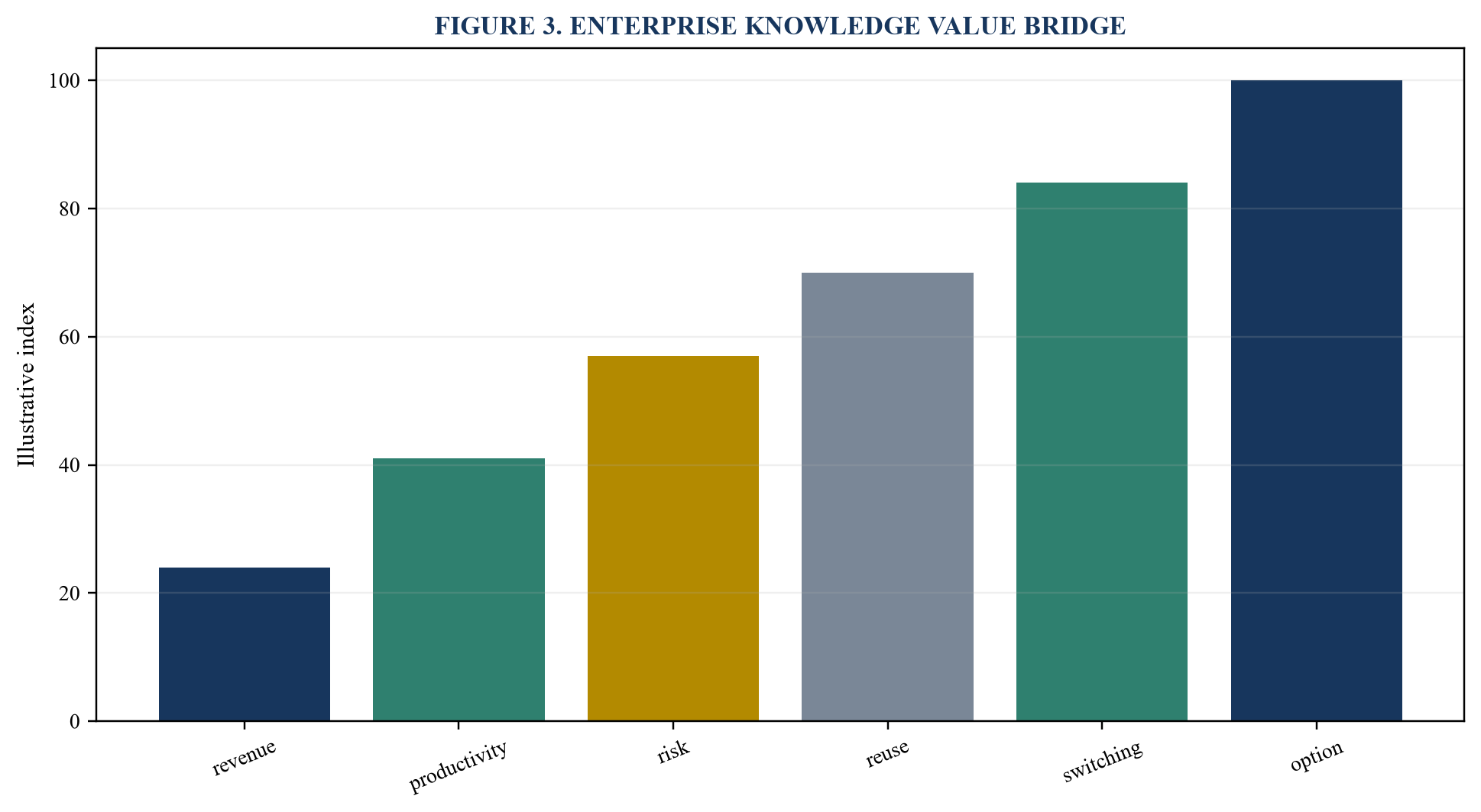
Values are illustrative indices and require replacement with approved validation evidence.
25. Model maintenance burden
Forecast curation, schema change, source refresh, reconciliation, validation and domain-expert cost.
The controlled record includes scope; authority; source; passage; fact; calculation; reviewer; decision. The immediate deliverable is a maintenance cost model. Preserve jurisdiction, effective date, version, transformation, reviewer, approval and unresolved exceptions.
The principal failure occurs when replacement cost is capitalised while recurring upkeep is omitted. Reviewers should reconstruct the evidence path, test consequence under adverse conditions and identify who may approve or withhold the recommendation.
Enterprise knowledge value arises when structured domain meaning changes a paid workflow, cash flow, risk or strategic option. Architecture alone does not establish economic value.
The decision pack for model maintenance burden should show the prior view, correction, consequence at stake, alternatives, owner, due date, next evidence gate and observed outcome. Exceptions require closure evidence and an explicit effect on retrieval, citation, abstention, review or release.
26. Control model and vendor dependence
Map LLM, embedding, graph database, cloud, tooling and specialist dependencies with substitution tests.
The controlled record includes scope; authority; source; passage; fact; calculation; reviewer; decision. The immediate deliverable is a dependency and portability register. Preserve jurisdiction, effective date, version, transformation, reviewer, approval and unresolved exceptions.
The principal failure occurs when economics depend on a vendor whose pricing or product path can change. Reviewers should reconstruct the evidence path, test consequence under adverse conditions and identify who may approve or withhold the recommendation.
The platform combines separable and complementary assets. Rights, data, semantic models, software, domain expertise, distribution and customer integration should be evaluated distinctly before value is allocated.
The decision pack for control model and vendor dependence should show the prior view, correction, consequence at stake, alternatives, owner, due date, next evidence gate and observed outcome. Exceptions require closure evidence and an explicit effect on retrieval, citation, abstention, review or release.
27. Protect security and privacy
Assess permissions, tenant boundaries, sensitive relationships, inference risk, logging and deletion.
The controlled record includes scope; authority; source; passage; fact; calculation; reviewer; decision. The immediate deliverable is a knowledge-security control map. Preserve jurisdiction, effective date, version, transformation, reviewer, approval and unresolved exceptions.
The principal failure occurs when the graph amplifies access by connecting facts that were previously separated. Reviewers should reconstruct the evidence path, test consequence under adverse conditions and identify who may approve or withhold the recommendation.
Graph-assisted retrieval should be benchmarked against credible vector, keyword and hybrid baselines. Incremental quality, latency, cost and workflow outcomes require reproducible evidence.
The decision pack for protect security and privacy should show the prior view, correction, consequence at stake, alternatives, owner, due date, next evidence gate and observed outcome. Exceptions require closure evidence and an explicit effect on retrieval, citation, abstention, review or release.
28. Verify intellectual property
Test copyright, database rights, trade secrets, patents, open-source obligations and employee or contractor assignments.
The controlled record includes scope; authority; source; passage; fact; calculation; reviewer; decision. The immediate deliverable is an IP and freedom-to-operate record. Preserve jurisdiction, effective date, version, transformation, reviewer, approval and unresolved exceptions.
The principal failure occurs when valuable structure cannot be defended or transferred. Reviewers should reconstruct the evidence path, test consequence under adverse conditions and identify who may approve or withhold the recommendation.
Valuation should triangulate income, market and cost evidence while testing adoption, decay, maintenance, dependency, transferability, obsolescence and value-capture execution.
The decision pack for verify intellectual property should show the prior view, correction, consequence at stake, alternatives, owner, due date, next evidence gate and observed outcome. Exceptions require closure evidence and an explicit effect on retrieval, citation, abstention, review or release.
29. Quantify technical debt
Measure undocumented schemas, brittle pipelines, stale entities, manual fixes, unsupported code and key-person dependence.
The controlled record includes scope; authority; source; passage; fact; calculation; reviewer; decision. The immediate deliverable is a technical-debt estimate. Preserve jurisdiction, effective date, version, transformation, reviewer, approval and unresolved exceptions.
The principal failure occurs when a polished interface masks costly remediation behind the graph. Reviewers should reconstruct the evidence path, test consequence under adverse conditions and identify who may approve or withhold the recommendation.
Enterprise knowledge value arises when structured domain meaning changes a paid workflow, cash flow, risk or strategic option. Architecture alone does not establish economic value.
The decision pack for quantify technical debt should show the prior view, correction, consequence at stake, alternatives, owner, due date, next evidence gate and observed outcome. Exceptions require closure evidence and an explicit effect on retrieval, citation, abstention, review or release.
30. Test scalability and resilience
Benchmark ingestion, updates, traversal, retrieval, isolation, recovery and cost under production loads.
The controlled record includes scope; authority; source; passage; fact; calculation; reviewer; decision. The immediate deliverable is a production-scale benchmark. Preserve jurisdiction, effective date, version, transformation, reviewer, approval and unresolved exceptions.
The principal failure occurs when prototype performance is extrapolated to enterprise scale. Reviewers should reconstruct the evidence path, test consequence under adverse conditions and identify who may approve or withhold the recommendation.
The platform combines separable and complementary assets. Rights, data, semantic models, software, domain expertise, distribution and customer integration should be evaluated distinctly before value is allocated.
The decision pack for test scalability and resilience should show the prior view, correction, consequence at stake, alternatives, owner, due date, next evidence gate and observed outcome. Exceptions require closure evidence and an explicit effect on retrieval, citation, abstention, review or release.
31. Build unit economics
Link query and workflow volume to compute, storage, graph operations, curation, support and gross margin.
The controlled record includes scope; authority; source; passage; fact; calculation; reviewer; decision. The immediate deliverable is a knowledge-platform unit model. Preserve jurisdiction, effective date, version, transformation, reviewer, approval and unresolved exceptions.
The principal failure occurs when usage growth reduces contribution because retrieval and maintenance costs are unpriced. Reviewers should reconstruct the evidence path, test consequence under adverse conditions and identify who may approve or withhold the recommendation.
Graph-assisted retrieval should be benchmarked against credible vector, keyword and hybrid baselines. Incremental quality, latency, cost and workflow outcomes require reproducible evidence.
The decision pack for build unit economics should show the prior view, correction, consequence at stake, alternatives, owner, due date, next evidence gate and observed outcome. Exceptions require closure evidence and an explicit effect on retrieval, citation, abstention, review or release.
32. Separate accounting from economic value
Assess recognition under applicable accounting standards while preserving unrecognised economic assets and expenditure.
The controlled record includes scope; authority; source; passage; fact; calculation; reviewer; decision. The immediate deliverable is an accounting-to-economics bridge. Preserve jurisdiction, effective date, version, transformation, reviewer, approval and unresolved exceptions.
The principal failure occurs when book value is used as a ceiling or proxy for transaction value. Reviewers should reconstruct the evidence path, test consequence under adverse conditions and identify who may approve or withhold the recommendation.
Valuation should triangulate income, market and cost evidence while testing adoption, decay, maintenance, dependency, transferability, obsolescence and value-capture execution.
The decision pack for separate accounting from economic value should show the prior view, correction, consequence at stake, alternatives, owner, due date, next evidence gate and observed outcome. Exceptions require closure evidence and an explicit effect on retrieval, citation, abstention, review or release.
Table 4. Valuation method selection
| Method | Best evidence | Primary limitation |
|---|---|---|
| income | incremental attributable cash flow | allocation and forecast risk |
| market | comparable rights and economics | scarce comparability |
| cost | replicable service potential | ignores unique earnings |
| relief or excess earnings | defensible rights and cash flows | assumption sensitivity |
Illustrative controls require use-, consequence-, jurisdiction-, firm- and period-specific approval.
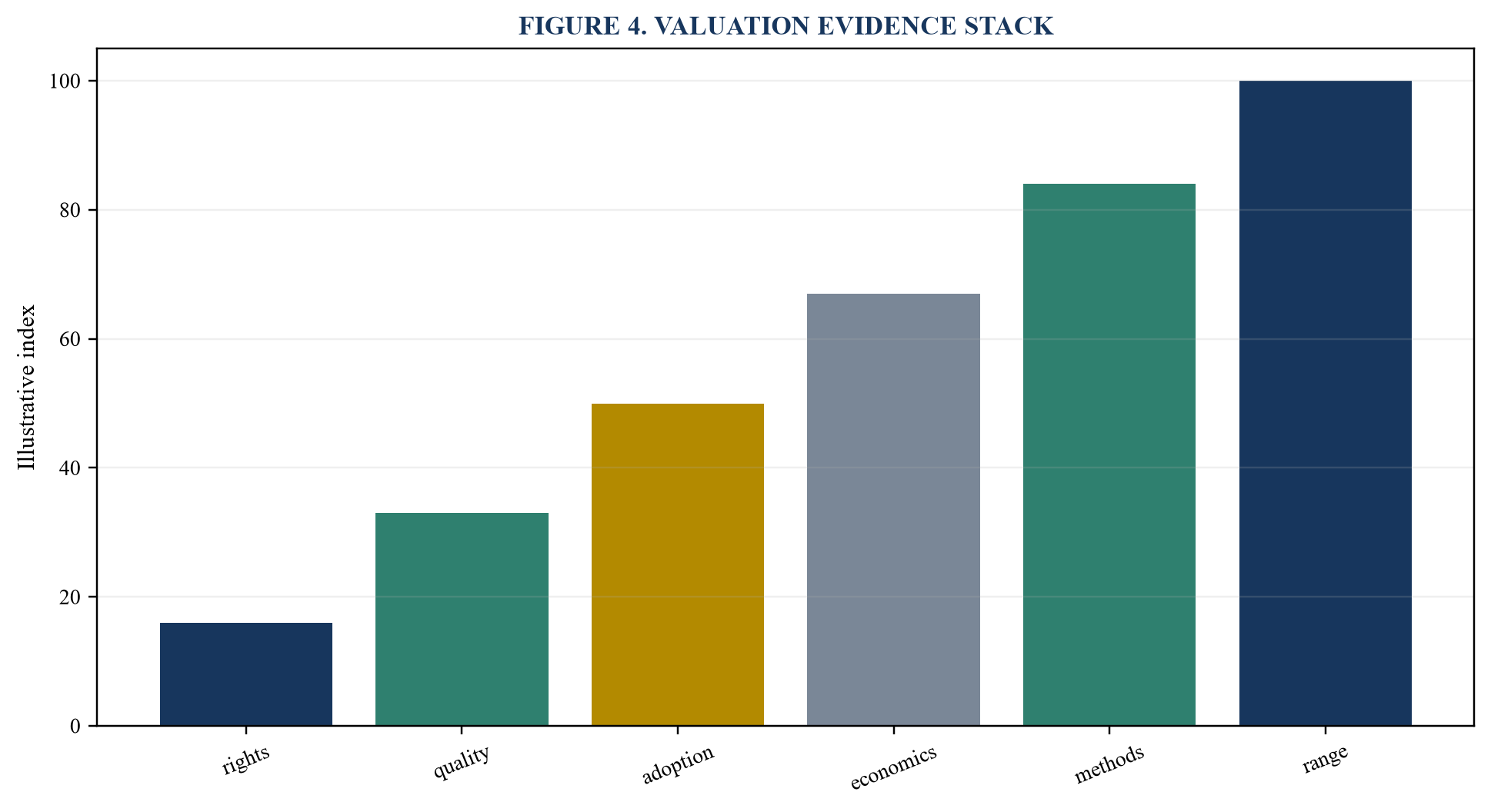
Values are illustrative indices and require replacement with approved validation evidence.
33. Select valuation approaches
Choose income, market and cost methods by asset control, cash-flow evidence, comparability, lifecycle and purpose.
The controlled record includes scope; authority; source; passage; fact; calculation; reviewer; decision. The immediate deliverable is a valuation-method decision tree. Preserve jurisdiction, effective date, version, transformation, reviewer, approval and unresolved exceptions.
The principal failure occurs when one fashionable multiple substitutes for triangulation. Reviewers should reconstruct the evidence path, test consequence under adverse conditions and identify who may approve or withhold the recommendation.
Enterprise knowledge value arises when structured domain meaning changes a paid workflow, cash flow, risk or strategic option. Architecture alone does not establish economic value.
The decision pack for select valuation approaches should show the prior view, correction, consequence at stake, alternatives, owner, due date, next evidence gate and observed outcome. Exceptions require closure evidence and an explicit effect on retrieval, citation, abstention, review or release.
34. Build the income approach
Forecast incremental cash flows, adoption, decay, maintenance, tax, contributory assets, risk and terminal assumptions.
The controlled record includes scope; authority; source; passage; fact; calculation; reviewer; decision. The immediate deliverable is an incremental cash-flow model. Preserve jurisdiction, effective date, version, transformation, reviewer, approval and unresolved exceptions.
The principal failure occurs when all platform growth is attributed to the knowledge layer. Reviewers should reconstruct the evidence path, test consequence under adverse conditions and identify who may approve or withhold the recommendation.
The platform combines separable and complementary assets. Rights, data, semantic models, software, domain expertise, distribution and customer integration should be evaluated distinctly before value is allocated.
The decision pack for build the income approach should show the prior view, correction, consequence at stake, alternatives, owner, due date, next evidence gate and observed outcome. Exceptions require closure evidence and an explicit effect on retrieval, citation, abstention, review or release.
35. Build the cost approach
Estimate reproduction or replacement cost, obsolescence, opportunity time and developer profit.
The controlled record includes scope; authority; source; passage; fact; calculation; reviewer; decision. The immediate deliverable is a replacement-cost model. Preserve jurisdiction, effective date, version, transformation, reviewer, approval and unresolved exceptions.
The principal failure occurs when historic spend is mistaken for current service potential. Reviewers should reconstruct the evidence path, test consequence under adverse conditions and identify who may approve or withhold the recommendation.
Graph-assisted retrieval should be benchmarked against credible vector, keyword and hybrid baselines. Incremental quality, latency, cost and workflow outcomes require reproducible evidence.
The decision pack for build the cost approach should show the prior view, correction, consequence at stake, alternatives, owner, due date, next evidence gate and observed outcome. Exceptions require closure evidence and an explicit effect on retrieval, citation, abstention, review or release.
36. Build the market approach
Normalise comparable companies and transactions for data rights, workflow depth, growth, margin, concentration and maturity.
The controlled record includes scope; authority; source; passage; fact; calculation; reviewer; decision. The immediate deliverable is a comparable-evidence matrix. Preserve jurisdiction, effective date, version, transformation, reviewer, approval and unresolved exceptions.
The principal failure occurs when generic software multiples are applied to dissimilar knowledge assets. Reviewers should reconstruct the evidence path, test consequence under adverse conditions and identify who may approve or withhold the recommendation.
Valuation should triangulate income, market and cost evidence while testing adoption, decay, maintenance, dependency, transferability, obsolescence and value-capture execution.
The decision pack for build the market approach should show the prior view, correction, consequence at stake, alternatives, owner, due date, next evidence gate and observed outcome. Exceptions require closure evidence and an explicit effect on retrieval, citation, abstention, review or release.
37. Run scenarios and sensitivity
Test adoption, quality uplift, maintenance, model cost, rights loss, key-person exit and technology substitution.
The controlled record includes scope; authority; source; passage; fact; calculation; reviewer; decision. The immediate deliverable is a valuation sensitivity map. Preserve jurisdiction, effective date, version, transformation, reviewer, approval and unresolved exceptions.
The principal failure occurs when a single base case hides the variables that actually determine value. Reviewers should reconstruct the evidence path, test consequence under adverse conditions and identify who may approve or withhold the recommendation.
Enterprise knowledge value arises when structured domain meaning changes a paid workflow, cash flow, risk or strategic option. Architecture alone does not establish economic value.
The decision pack for run scenarios and sensitivity should show the prior view, correction, consequence at stake, alternatives, owner, due date, next evidence gate and observed outcome. Exceptions require closure evidence and an explicit effect on retrieval, citation, abstention, review or release.
38. Design technical and commercial diligence
Verify architecture, benchmarks, rights, customers, economics, security, people and roadmap through evidence.
The controlled record includes scope; authority; source; passage; fact; calculation; reviewer; decision. The immediate deliverable is an evidence-gated diligence plan. Preserve jurisdiction, effective date, version, transformation, reviewer, approval and unresolved exceptions.
The principal failure occurs when management demonstrations substitute for reproducible diligence. Reviewers should reconstruct the evidence path, test consequence under adverse conditions and identify who may approve or withhold the recommendation.
The platform combines separable and complementary assets. Rights, data, semantic models, software, domain expertise, distribution and customer integration should be evaluated distinctly before value is allocated.
The decision pack for design technical and commercial diligence should show the prior view, correction, consequence at stake, alternatives, owner, due date, next evidence gate and observed outcome. Exceptions require closure evidence and an explicit effect on retrieval, citation, abstention, review or release.
39. Plan integration and value capture
Define ontology ownership, source migration, product integration, expert retention, customer continuity and synergy tracking.
The controlled record includes scope; authority; source; passage; fact; calculation; reviewer; decision. The immediate deliverable is a 100-day value-capture plan. Preserve jurisdiction, effective date, version, transformation, reviewer, approval and unresolved exceptions.
The principal failure occurs when the buyer damages the tacit and technical system that created value. Reviewers should reconstruct the evidence path, test consequence under adverse conditions and identify who may approve or withhold the recommendation.
Graph-assisted retrieval should be benchmarked against credible vector, keyword and hybrid baselines. Incremental quality, latency, cost and workflow outcomes require reproducible evidence.
The decision pack for plan integration and value capture should show the prior view, correction, consequence at stake, alternatives, owner, due date, next evidence gate and observed outcome. Exceptions require closure evidence and an explicit effect on retrieval, citation, abstention, review or release.
40. Close through investment gates
Require asset control, benchmarked outcomes, defensible economics, valuation triangulation, risks and accountable value capture.
The controlled record includes scope; authority; source; passage; fact; calculation; reviewer; decision. The immediate deliverable is an evidence-gated investment decision. Preserve jurisdiction, effective date, version, transformation, reviewer, approval and unresolved exceptions.
The principal failure occurs when a sophisticated knowledge graph is mistaken for a valuable enterprise platform. Reviewers should reconstruct the evidence path, test consequence under adverse conditions and identify who may approve or withhold the recommendation.
Valuation should triangulate income, market and cost evidence while testing adoption, decay, maintenance, dependency, transferability, obsolescence and value-capture execution.
The decision pack for close through investment gates should show the prior view, correction, consequence at stake, alternatives, owner, due date, next evidence gate and observed outcome. Exceptions require closure evidence and an explicit effect on retrieval, citation, abstention, review or release.
Table 5. Investment gates
| Gate | Primary work | Completion evidence |
|---|---|---|
| asset | rights, quality and governance | controlled perimeter |
| performance | retrieval and workflow benchmark | incremental outcome |
| economics | unit model and valuation | triangulated range |
| execution | integration and value capture | accountable plan |
Illustrative controls require use-, consequence-, jurisdiction-, firm- and period-specific approval.
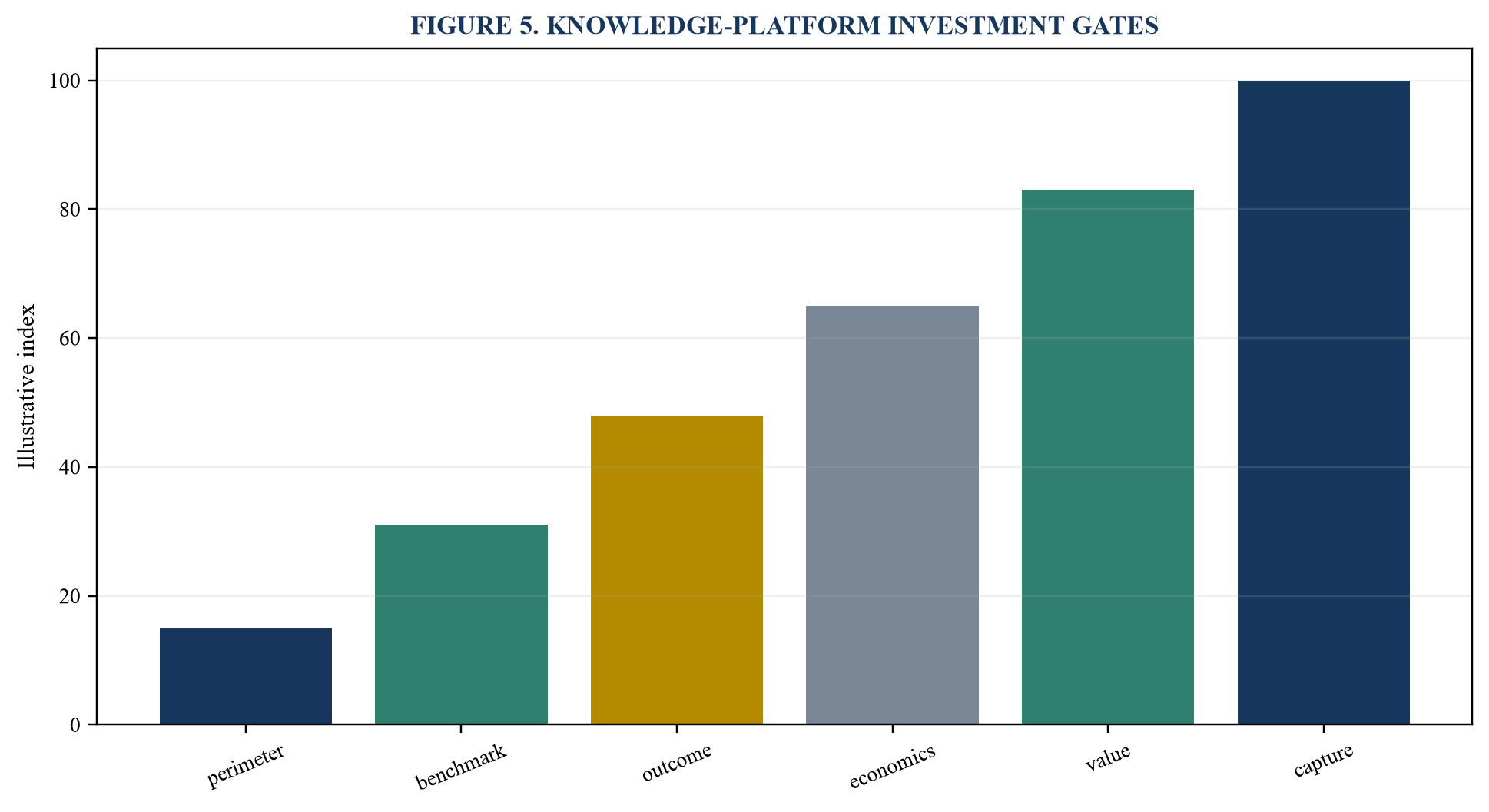
Values are illustrative indices and require replacement with approved validation evidence.
References
- Microsoft Research, Project GraphRAG, https://www.microsoft.com/en-us/research/project/graphrag/
- Microsoft Research, GraphRAG: Unlocking LLM Discovery on Narrative Private Data, https://www.microsoft.com/en-us/research/publication/from-local-to-global-a-graph-rag-approach-to-query-focused-summarization/
- Microsoft, GraphRAG Open-Source Repository, https://github.com/microsoft/graphrag
- World Wide Web Consortium, RDF 1.1 Concepts and Abstract Syntax, https://www.w3.org/TR/rdf11-concepts/
- World Wide Web Consortium, OWL 2 Web Ontology Language Document Overview, https://www.w3.org/TR/owl2-overview/
- World Wide Web Consortium, SKOS Simple Knowledge Organization System Reference, https://www.w3.org/TR/skos-reference/
- World Wide Web Consortium, Shapes Constraint Language SHACL, https://www.w3.org/TR/shacl/
- World Wide Web Consortium, PROV-O: The PROV Ontology, https://www.w3.org/TR/prov-o/
- World Wide Web Consortium, SPARQL 1.1 Query Language, https://www.w3.org/TR/sparql11-query/
- World Wide Web Consortium, JSON-LD 1.1, https://www.w3.org/TR/json-ld11/
- National Institute of Standards and Technology, AI Risk Management Framework 1.0, https://www.nist.gov/publications/artificial-intelligence-risk-management-framework-ai-rmf-10
- National Institute of Standards and Technology, Generative AI Profile, https://nvlpubs.nist.gov/nistpubs/ai/NIST.AI.600-1.pdf
- IFRS Foundation, IAS 38 Intangible Assets, https://www.ifrs.org/issued-standards/list-of-standards/ias-38-intangible-assets/
- IFRS Foundation, IFRS 3 Business Combinations, https://www.ifrs.org/issued-standards/list-of-standards/ifrs-3-business-combinations/
- IFRS Foundation, Intangible Assets Research Project, https://www.ifrs.org/projects/work-plan/intangible-assets/
- International Valuation Standards Council, International Valuation Standards, https://ivsc.org/standards/
- International Valuation Standards Council, Perspectives Paper: Value and Data, https://ivsc.org/perspectives-paper-value-and-data/
- International Valuation Standards Council, Perspectives Paper: Deciphering Technology, https://ivsc.org/perspectives-paper-deciphering-technology/
- International Valuation Standards Council, IVS Exposure Draft Consultation 2026, https://ivsc.org/consultations/ivs-exposure-draft-for-consultation-2026//
- Organisation for Economic Co-operation and Development, Measuring the Digital Transformation, https://www.oecd.org/digital/measuring-the-digital-transformation-9789264311992-en.htm
- European Union, Data Act Regulation EU 2023/2854, https://eur-lex.europa.eu/eli/reg/2023/2854/oj
- European Union, Data Governance Act Regulation EU 2022/868, https://eur-lex.europa.eu/eli/reg/2022/868/oj
- International Organization for Standardization, ISO/IEC 42001 AI Management Systems, https://www.iso.org/standard/81230.html
- International Organization for Standardization, ISO/IEC 27001 Information Security Management Systems, https://www.iso.org/standard/27001
- Central Bank of the UAE, Data Quality, Privacy and Security for AI and ML, https://rulebook.centralbank.ae/en/rulebook/5-data-quality-privacy-and-security
- UK Competition and Markets Authority, AI Foundation Models Initial Report, https://www.gov.uk/government/publications/ai-foundation-models-initial-report
