

Introduction
The electricity sector has to expand reliable supply while changing the composition and emissions profile of generation. Utilities rarely begin that process with a clean portfolio. A typical group may own solar and wind projects, transmission or distribution assets, batteries, gas-fired plants, minority stakes, contracted independent power projects and older thermal units. Each asset has its own dispatch role, revenue model, remaining life, financing covenants and regulatory context. The resulting bond-design question is therefore specific: which part of the issuer or capital programme is being financed, what environmental claim is made, and what evidence supports that claim?
The market offers several instruments. The Green Bond Principles organise green bonds around four core components: use of proceeds, project evaluation and selection, management of proceeds, and reporting. The European Green Bond Standard adds a regulatory route for issuers that voluntarily use the EuGB designation, including taxonomy alignment, allocation and external-review requirements. Climate transition finance guidance focuses on the credibility of an issuer's strategy and the consistency of financed activity with a pathway. Climate Transition Bond Guidelines provide a use-of-proceeds route for credible transition projects. Sustainability-Linked Bond Principles provide an issuer-level structure in which financial or structural characteristics respond to performance against key performance indicators and sustainability performance targets. These structures answer different questions and should not be treated as interchangeable labels.
This paper develops a transaction framework for a mixed-generation utility. It does not assume that a thermal asset becomes green because the issuer owns renewables. It does not assume that an issuer-wide target is credible merely because a coupon adjustment exists. The framework begins with the operational and financial perimeter, tests transition-plan credibility, matches the funding need to the relevant instrument, and translates the chosen claim into bond documentation, reporting and assurance.
1. Define the financing decision precisely
The first decision is the object of finance. A bond can finance identified eligible projects, a defined transition programme, or the general corporate purposes of an issuer whose bond economics depend on sustainability performance. Those alternatives require different evidence. A project-finance refinancing for operating solar assets has a traceable asset base and cash-flow perimeter. A corporate bond funding a multi-year fleet transformation draws on the full issuer's credit and requires a credible capital-allocation plan. An issuer-wide sustainability-linked bond may fund general corporate purposes, yet its integrity depends on material KPIs, ambitious targets and reliable verification.
The board should write a one-sentence financing purpose before selecting a label. A useful formulation identifies the amount, expenditure or liability being financed, eligible period, legal borrower, repayment source and transition outcome. This prevents the label from determining the transaction before treasury has defined the need. It also exposes mismatches early. A proposed green bond that mainly refinances general corporate debt may lack a sufficiently specific eligible portfolio. A transition bond financing a gas-plant life extension may fail a pathway or lock-in test. A sustainability-linked bond with a remote or weakly calibrated target may create disclosure risk without changing the issuer's funding capacity.
2. Separate the project claim from the issuer claim
Sustainable-finance analysis operates at two levels. The first is the financed asset or expenditure. The second is the issuer's overall transition strategy. A green use-of-proceeds bond can be evaluated primarily through eligible projects and proceeds tracking, while investors may still examine controversies and the issuer's wider conduct. A climate transition bond requires a stronger connection between the financed project and an entity-level transition plan because the transition claim concerns movement from a higher-emitting state. A sustainability-linked bond is explicitly issuer-level: the KPI, target and bond consequence must represent a material part of the issuer's business and transition.
This distinction matters for mixed fleets. Renewable additions can be eligible green projects even when the issuer retains thermal assets, subject to the applicable framework and investor assessment. The issuer should avoid suggesting that the green label applies to the whole enterprise. A transition bond can finance conversion, retirement, grid flexibility or other activities that contribute to a credible pathway, provided the eligibility, safeguards and expected effects are clear. An issuer-wide instrument requires transparent treatment of acquisitions, disposals, changes in generation mix and baseline recalculations because those events can alter performance without changing underlying operations.
3. Map the utility before choosing the instrument
The financing team should build an asset and obligation map covering ownership, technology, fuel, capacity, dispatch role, operating status, revenue contract, remaining life, emissions profile, capital needs, existing security and retirement or conversion plan. It should also identify group-level debt, guarantees, cross-defaults, restricted subsidiaries, dividend constraints and public-service obligations. This map prevents an environmental perimeter from conflicting with the legal and financial perimeter.
The map needs sufficient granularity to distinguish an operating renewable project from development expenditure, a network reinforcement from a new fossil connection, and reliability reserves from baseload operation. It should also identify expenditure that is technically necessary for transition yet may not qualify as green under a chosen standard. Early classification allows the issuer to combine instruments where appropriate instead of forcing all expenditure into one label.
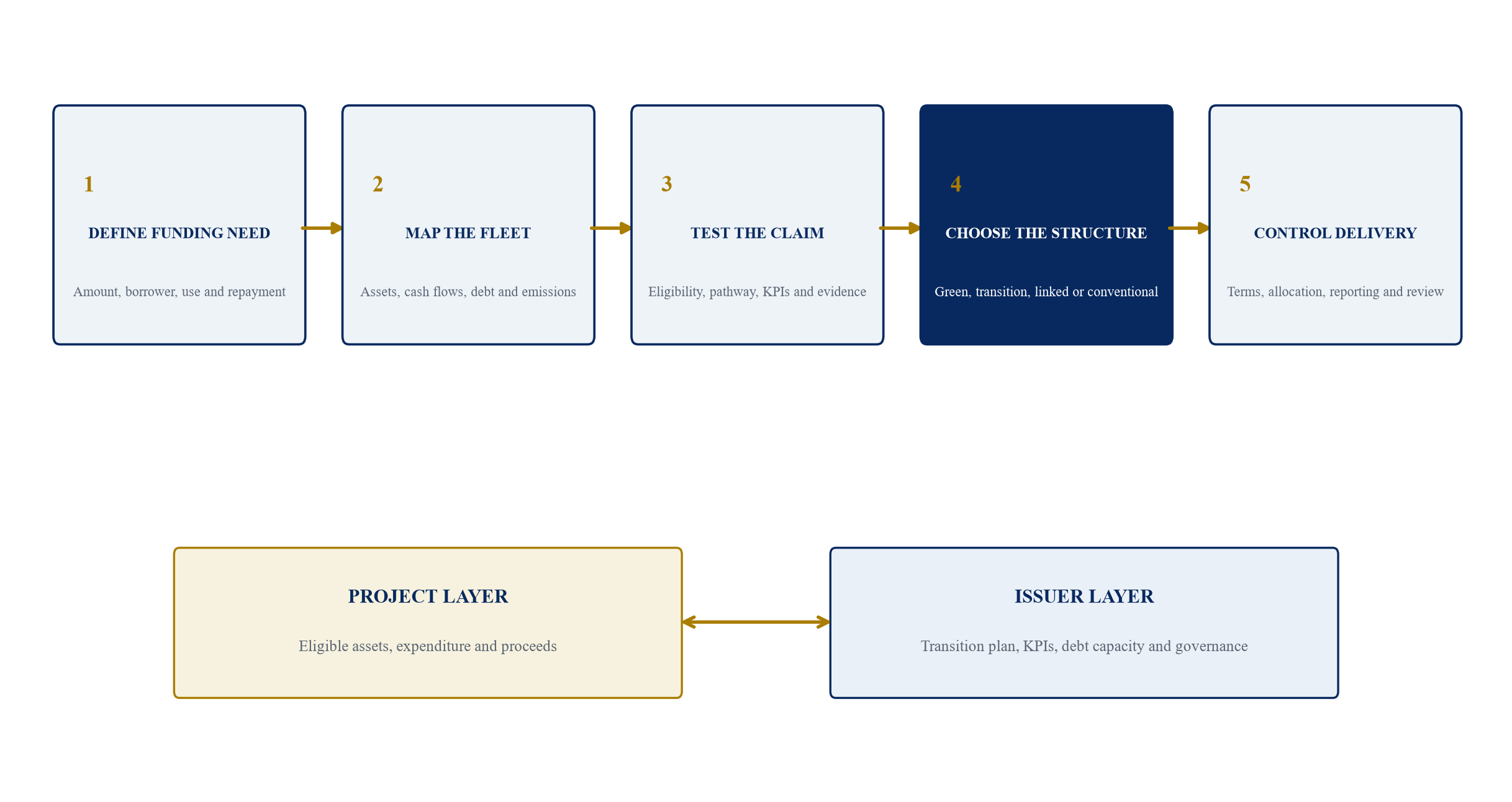
The sequence separates the financing purpose, eligible perimeter and issuer-level claim before bond terms are fixed.
4. Use a four-instrument decision set
The practical menu contains four choices. A green bond is a use-of-proceeds instrument for eligible green projects. A climate transition bond is a use-of-proceeds instrument for projects that support a credible transition and meet applicable safeguards. A sustainability-linked bond is a performance-based instrument linked to issuer-level KPIs and targets. A conventional bond with detailed transition disclosure remains appropriate where the planned expenditure does not meet the relevant eligibility criteria or where the issuer cannot yet support a labelled claim.
The fourth option is important. A conventional instrument can preserve market access and disclosure discipline without making a claim that exceeds available evidence. It may be paired with project-level green financing later, after the issuer creates an eligible asset register or strengthens its transition plan. The selection process should therefore optimise credibility and execution, rather than maximise the number of labelled securities.
Table 1. Decision matrix for the principal bond structures
| Structure | Primary financing logic | Evidence needed | Principal design risk | Best fit |
|---|---|---|---|---|
| Green use-of-proceeds bond | Finance or refinance eligible green projects | Eligible project register, allocation process, proceeds tracking and impact reporting | Overbroad eligibility or weak traceability | Identifiable eligible renewable, storage, grid or efficiency expenditure |
| Climate transition bond | Finance defined activities that advance a credible transition | Transition plan, pathway, project criteria, safeguards, allocation and outcome reporting | Lock-in, weak pathway alignment or unsupported transition claim | Mixed or higher-emitting issuer with a credible financed transformation programme |
| Sustainability-linked bond | Link bond characteristics to issuer-wide sustainability performance | Material KPI, baseline, ambitious targets, calculation method, reporting and verification | Immaterial KPI, target gaming or weak economic consequence | Issuer with reliable group data and a measurable transition strategy |
| Conventional bond with transition disclosure | Fund general corporate or non-eligible needs without a labelled claim | Ordinary credit disclosure plus transparent transition risks and plans | Under-disclosure of transition exposure | Funding need lacks a defensible labelled perimeter or data readiness |
The matrix is a decision aid. Eligibility and disclosure requirements depend on the governing framework, jurisdiction and transaction documents.
5. Establish the green eligibility perimeter
A green bond requires a defensible eligible project portfolio. The issuer should specify categories, exclusion criteria, look-back period, expected allocation period and treatment of unallocated proceeds. It should document the process for project evaluation and selection, including the responsible committee, technical review, controversy screen and change-control procedure. The proceeds-management method should reconcile the bond balance to eligible expenditure and prevent double allocation across multiple instruments.
For a utility, potentially eligible categories may include renewable generation, storage, network investments that enable renewable integration, energy efficiency and certain low-carbon infrastructure. Eligibility depends on the chosen framework. The issuer should state the standard or taxonomy used and retain asset-level evidence. Where an activity is subject to technical screening criteria, safeguards or thresholds, the file should show how those conditions are met. A broad description such as "cleaner generation" does not substitute for technical eligibility.
6. Test a transition project against pathway and lock-in risk
Transition finance addresses activities that move toward a credible pathway and may not already be classified as green. The analysis should therefore examine the starting emissions profile, the intended destination, the timing of change, consistency with a sector pathway and the risk that financed assets prolong high-emitting operation. The IEA's transition-finance work emphasises the need for clear definitions, credible plans and safeguards. ICMA's transition guidance similarly places entity-level strategy and science-aligned pathways at the centre of credibility.
A mixed utility should document how a proposed project changes emissions, generation mix or system flexibility. A plant conversion, early retirement, storage retrofit or grid investment should be assessed against a counterfactual. The counterfactual should identify what would occur without financing, including expected dispatch, replacement capacity, reliability requirements and economic life. The transaction should also disclose material dependencies. A retirement programme may require replacement renewables, storage, transmission and workforce measures. A gas project may only be defensible under narrow conditions and should be tested against applicable taxonomy criteria, methane exposure, utilisation assumptions, carbon lock-in and the availability of lower-emitting alternatives.
7. Make the transition plan financeable
A credible transition plan should connect strategy to funded actions. It needs board oversight, a defined base year, interim milestones, capital-expenditure allocation, operational measures, policy dependencies and accountability. Targets should cover the material sources of emissions and should explain the treatment of Scope 1, Scope 2 and material Scope 3 categories. The plan should distinguish committed expenditure from aspiration and identify projects that still require permits, power-purchase agreements, network access or regulatory approval.
Financeability requires reconciliation between the transition plan and the business plan. The generation forecast, fuel costs, carbon costs, maintenance plan, retirement dates, capacity payments, renewable build schedule and debt profile should be consistent. If the transition plan assumes declining thermal dispatch, the financial model should reflect the resulting effect on revenue, variable cost and fixed-cost absorption. If the business plan assumes prolonged high utilisation, a public target based on rapid emissions reduction requires explanation or revision.
8. Build a fleet emissions and cash-flow bridge
The issuer should translate operational change into both emissions and financial outcomes. The bridge begins with current generation by asset, fuel consumption, emissions factors, contractual revenue and operating margin. It then applies retirement, conversion, renewable additions, storage, network investment, demand growth and dispatch assumptions. The output shows annual generation, emissions, emissions intensity, capital expenditure, EBITDA contribution and debt service by major asset group.
This bridge is a governance tool because it reveals where a target depends on external factors. A reduction in emissions intensity can result from renewable additions while absolute emissions rise if demand grows faster. A reduction in owned emissions can result from an asset sale while the plant continues operating under another owner. A lower annual dispatch level can reflect weak demand rather than structural transition. Each effect should be separated so investors can understand whether performance reflects management action, portfolio change or market conditions.
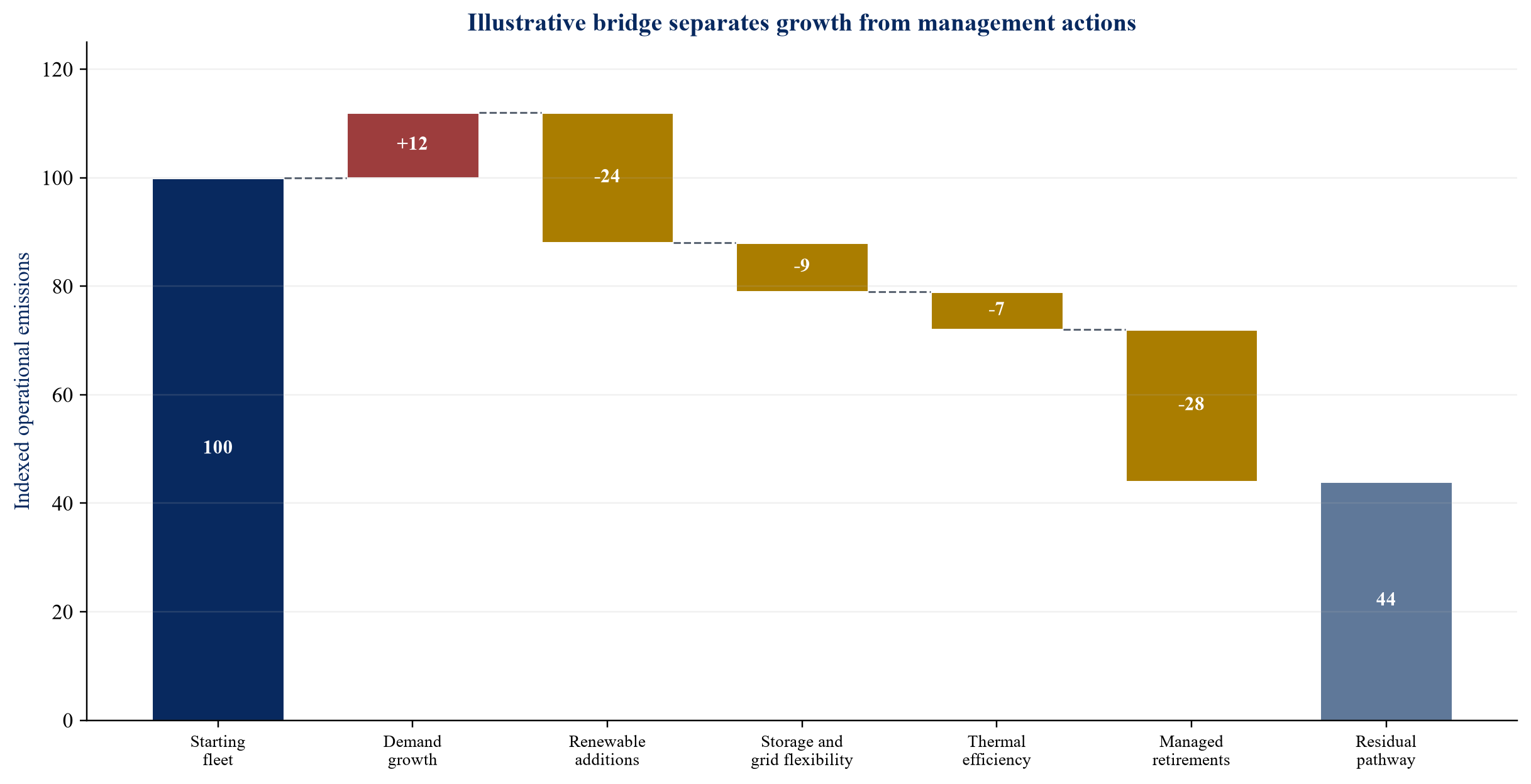
Indexed hypothetical values illustrate the direction of effects. They are not a forecast, valuation or claim about any identified utility.
9. Decide whether proceeds can be ring-fenced
Use-of-proceeds structures require a process that tracks an amount equal to net proceeds. A utility can use a sub-account, portfolio allocation register or other documented internal method, depending on the framework and transaction. The treasury team should reconcile eligible expenditure, allocation dates, refinancing amounts, temporary holdings and outstanding bond proceeds. The register should prevent the same expenditure from supporting multiple labelled instruments unless the allocation methodology expressly and transparently permits it.
Ring-fencing does not necessarily create legal security over assets. Bondholders may remain unsecured creditors of the issuer. The documentation should distinguish proceeds allocation from collateral, structural subordination and repayment source. If the economic case depends on cash flows from eligible assets, the issuer should consider whether project finance, secured debt, a special-purpose vehicle or a portfolio financing provides a more accurate legal structure than a corporate green bond.
10. Design sustainability-linked KPIs around material outcomes
A sustainability-linked bond needs KPIs that are relevant, core and material to the issuer's strategy. For a mixed utility, possible measures include absolute operational emissions, generation emissions intensity, renewable share, retirement of specified capacity, methane performance, capital expenditure aligned with the transition plan, or grid reliability measures that enable renewable integration. Each KPI has strengths and weaknesses. Absolute emissions capture total climate impact but can be influenced by demand and acquisitions. Intensity supports comparison across output levels but can improve while total emissions rise. Renewable share can increase without reducing high-emitting generation. Retirement milestones are tangible but require safeguards against transfer to another owner.
The issuer should normally select a small number of complementary indicators rather than a long list. One outcome KPI can be paired with a delivery milestone where both are material. The definition should specify organisational boundary, calculation formula, energy units, emissions factors, data hierarchy, treatment of imports and exports, minority interests, acquisitions, disposals, force majeure and restatements. The baseline and target should be independently verifiable.
11. Calibrate targets that survive scrutiny
The sustainability performance target should represent a meaningful improvement beyond business as usual and should be consistent with the issuer's transition pathway. Calibration should use historical performance, approved business plan, peer or sector benchmarks where appropriate, regulatory requirements and a relevant science-based or policy pathway. The target date should fit the bond tenor, with one or more observation dates that occur early enough for the contractual consequence to matter.
Targets become vulnerable when their achievement depends mainly on an already completed acquisition, a planned disposal, a methodological change or a forecast decline in demand. The framework should therefore separate organic operational performance from portfolio effects. Recalculation clauses should preserve comparability when the group changes materially. The issuer should disclose the threshold for recalculation, the process for restating the baseline and target, and the role of an external verifier.
12. Link performance to a meaningful bond consequence
The contractual consequence can include a coupon step-up, step-down, premium at redemption or another financial or structural feature. Its design should be clear, economically meaningful and operationally feasible. The documentation must define the trigger, observation date, verification deadline, notice process, calculation agent and consequence of missing or late data. It should address partial achievement where multiple targets apply and prevent a later improvement from reversing a consequence unless the terms expressly allow it.
A small consequence can create a reputational signal without materially changing incentives. An excessive consequence may impair refinancing or complicate ratings analysis. The board should assess the expected economic effect under base, missed-target and delayed-verification scenarios. It should also test accounting, tax, regulatory-capital and derivatives implications with qualified advisers.
13. Address managed phase-out directly
Early retirement of high-emitting generation can reduce cumulative emissions, yet it raises complex questions. The issuer must establish additionality, avoid simple ownership transfer, maintain system reliability, fund decommissioning and manage workers and communities. Financing should identify the affected assets, baseline retirement dates, revised closure dates, expected utilisation before closure, replacement capacity and governance that restricts life extension.
A managed phase-out structure may combine a transition bond, concessional capital, policy support, a special-purpose vehicle or contracted replacement generation. The cash-flow source must remain credible after dispatch declines. Capacity payments, regulatory recovery, transition credits or other mechanisms require legal and policy diligence. The transaction should state which assumptions depend on government action or market reform and should avoid treating those assumptions as committed revenue.
14. Apply special scrutiny to gas-fired generation
Gas-fired generation can provide flexibility and system adequacy in some markets, while it remains a fossil-fuel activity with carbon dioxide and methane exposure. A financing claim should consider plant efficiency, utilisation, role in the system, retirement or conversion pathway, upstream emissions, alternative technologies, carbon-price exposure and applicable taxonomy requirements. The EU taxonomy includes specified conditions for certain gas-related activities, and the European Green Bond regime requires relevant disclosures where proceeds are allocated to specified gas or nuclear activities.
The presence of a gas asset does not determine the instrument for the entire group. A green bond can finance a separate eligible portfolio if the framework and disclosure are accurate. A transition bond that includes gas expenditure requires a stronger case: why the investment supports the pathway, how lock-in is limited, what alternatives were assessed and how performance will be monitored. If those questions cannot be answered with evidence, the expenditure should remain outside the labelled perimeter.
15. Integrate storage, networks and reliability
Generation transition depends on enabling infrastructure. Storage can shift energy, provide reserves and reduce curtailment. Network investment can connect renewable projects and relieve congestion. Demand response and digital control can reduce peak requirements. Their environmental contribution depends on system use, charging source, losses, counterfactual operation and applicable eligibility criteria.
The financing case should connect enabling assets to measurable system outcomes. For example, the issuer can disclose connected renewable capacity, avoided curtailment, storage dispatch profile, network losses and reliability performance. These indicators should be defined carefully because an asset may provide several services. The model should also account for revenue stacking, degradation, augmentation, market-rule changes and contracted versus merchant income.
16. Preserve debt capacity during transformation
Fleet transformation can increase capital expenditure before new assets contribute cash flow. At the same time, declining thermal utilisation may reduce earnings and asset values. The financing plan should therefore model funds from operations, leverage, interest coverage, liquidity, covenant headroom and refinancing concentration through the transition period. It should include delayed commissioning, cost overruns, lower renewable capture prices, higher fuel prices, carbon costs and accelerated retirement.
Labelled debt does not change the issuer's underlying repayment capacity. Investors and rating agencies will examine the same cash flows, regulation, market position and financial policy that support conventional debt. The board should align dividend policy, asset recycling, equity contributions, project financing and corporate debt issuance so that the transition programme does not rely on repeated refinancing under favourable market conditions.
17. Reconcile bond design with existing covenants
Existing project and corporate debt may restrict disposals, additional indebtedness, security, distributions and changes in business. A green project portfolio may sit inside restricted subsidiaries whose cash cannot be freely upstreamed. A transition transaction may require asset retirement or conversion that conflicts with operating covenants, concession obligations or reserve requirements. A sustainability-linked consequence may affect interest expense and covenant forecasts.
The legal diligence should map negative pledges, cross-defaults, financial covenants, permitted debt baskets, change-of-control clauses and consent requirements. Treasury should also assess whether proceeds allocation or reporting undertakings create events of default, contractual claims or only disclosure obligations. The intended remedy for misallocation, loss of eligibility or target failure should be explicit.
18. Treat acquisitions and disposals as part of KPI design
M&A can change the emissions and financial perimeter materially. Acquiring a renewable platform may improve intensity while increasing leverage and integration risk. Selling a high-emitting plant may reduce reported emissions while leaving system emissions unchanged. Acquiring a thermal fleet can make the original target incomparable. The bond framework should define how material transactions affect baselines, targets, eligible assets and reporting.
The issuer should set a quantitative or qualitative recalculation threshold and appoint a governance body to approve changes. The calculation should be independently reviewed where required by the framework or terms. Transaction due diligence should include data quality, historical emissions, permits, retirement obligations, decommissioning liabilities, fuel contracts and eligibility of planned capital expenditure. The acquisition model should show whether a target improvement comes from operational change or perimeter movement.
19. Align the instrument with the corporate structure
The issuing entity determines which assets, cash flows and obligations support repayment. A parent-level bond may have broad access to group value but can be structurally subordinated to project debt and operating-company liabilities. An operating-company issue can be closer to regulated cash flows yet may have a narrower asset base. A special-purpose vehicle can isolate eligible projects, although it requires legal separation, cash-flow controls and contractual rights that support debt service.
The sustainable-finance label should follow the legal structure. A parent can issue a green bond and allocate proceeds through intercompany loans to eligible subsidiaries, provided the allocation and tracking arrangements are clear. A transition bond can fund a defined programme across entities if the issuer can demonstrate control and reporting. A project or portfolio financing may be preferable where investors require direct security and a ring-fenced repayment source. The analysis should address guarantees, upstreaming, minority shareholders, withholding tax, foreign exchange and insolvency remoteness.
20. Build reporting around investor decisions
Reporting should allow investors to answer three questions: where the money went, whether the financed activities remain eligible, and what environmental outcome is being delivered. Allocation reporting should show proceeds allocated, refinancing share, project categories, unallocated balance and temporary holdings. Impact reporting should explain methodologies, assumptions and indicators. Transition reporting should connect project progress to the entity plan. Sustainability-linked reporting should publish KPI performance, target comparison, calculation detail and verification.
The reporting architecture should use the same asset identifiers, organisational perimeter and data definitions as treasury and operational systems. A reporting pack assembled manually from unrelated spreadsheets increases error and control risk. The issuer should document data ownership, validation, evidence retention, change approval and sign-off. It should also provide a clear explanation when a project becomes ineligible, is delayed, is cancelled or is replaced.
21. Use external review for the claim actually made
External review can include pre-issuance assessment of the framework, verification of allocations, assurance of KPI performance and review under a regulatory standard. The scope should match the instrument. A second-party opinion on a green bond framework does not verify later allocation. Assurance of a sustainability KPI does not determine whether the target was ambitious when selected. A taxonomy-alignment review requires evidence against the relevant technical criteria and safeguards.
The engagement letter should specify the standard, scope, level of assurance, exclusions, evidence, reporting period and treatment of methodological changes. Management remains responsible for the underlying information and representation. The issuer should publish the review where the applicable framework requires it and should retain the supporting evidence for the life of the instrument.
22. Prevent transition washing through transaction controls
Transition washing arises when the claim exceeds the financed change or the issuer's wider plan. Controls should therefore operate at selection, issuance and monitoring. Selection controls test eligibility, pathway consistency and lock-in. Issuance controls reconcile the framework, offering document and investor presentation. Monitoring controls track allocation, performance, controversies, project changes and target recalculation.
The disclosure committee should include treasury, sustainability, operations, legal, finance and risk. It should have authority to reject an eligibility claim and to require corrective disclosure. Board or committee reporting should show exceptions and unresolved evidence gaps. Marketing language should be reconciled to the framework and bond terms. Statements such as "fully green utility" or "Paris-aligned financing" should only appear when the issuer has evidence for the precise claim and its scope.
23. Compare jurisdictions and investor expectations
The legal effect of a label varies by jurisdiction. ICMA principles are voluntary market standards. The European Green Bond Standard creates an optional regulated designation for bonds that meet its requirements. Taxonomies and disclosure regimes differ in activity coverage, thresholds, safeguards and treatment of transition activities. ASEAN's taxonomy uses a traffic-light approach and includes technical screening criteria for the power sector. National transition-finance frameworks may provide sector roadmaps or additional expectations.
An issuer offering bonds across markets should identify the governing bond law, listing rules, disclosure obligations, taxonomy references and investor mandate constraints. It should avoid implying equivalence where frameworks differ. A project that qualifies under one taxonomy may require additional evidence under another. The framework can state multiple alignments, provided each is separately assessed and the basis is transparent.
24. Apply a hypothetical mixed-utility case
Consider a hypothetical utility with operating renewables, network assets, batteries, flexible gas generation and an older thermal plant. Management plans to build additional renewables, expand storage, reinforce the network and retire the older unit earlier than its technical life. The financing requirement includes new capital expenditure and refinancing of prior eligible spending. The company also wants an issuer-level commitment to reduce operational emissions.
The financing can be separated into three layers. A green bond can finance eligible renewable, storage and network expenditure that meets the selected framework. A transition bond can be considered for the managed phase-out and associated system transformation if the project criteria, pathway, safeguards and lock-in controls are credible. An issuer-level sustainability-linked instrument can address absolute emissions or intensity and a retirement milestone, subject to material KPIs, ambitious targets and reliable data. The issuer does not need to issue all three. The framework selects the instrument that corresponds to the immediate funding need and evidence readiness.
Table 2. Hypothetical mixed-utility portfolio and financing treatment
| Portfolio component | Operational role | Principal financing need | Potential treatment | Critical evidence |
|---|---|---|---|---|
| Operating solar and wind | Low-emitting generation | Refinancing and expansion | Green use-of-proceeds portfolio | Ownership, eligible expenditure, operating data and allocation history |
| Battery storage | Flexibility and balancing | New build and augmentation | Potential green allocation subject to criteria | Charging profile, system use, degradation plan and applicable eligibility test |
| Transmission and distribution upgrades | Renewable connection and reliability | Multi-year capital programme | Potential green allocation subject to criteria | Connected capacity, congestion or loss benefit, asset register and regulatory approval |
| Flexible gas generation | Adequacy and balancing | Maintenance or selective upgrade | Transition assessment or conventional finance | Utilisation, efficiency, methane exposure, alternatives, lock-in safeguards and retirement pathway |
| Older high-emitting unit | System supply pending replacement | Early retirement and decommissioning | Potential transition or managed phase-out structure | Baseline closure date, revised closure commitment, replacement plan, worker measures and transfer restrictions |
| Group-level emissions programme | Issuer-wide transition | General corporate financing | Potential sustainability-linked structure | Material KPI, baseline, SPT calibration, recalculation policy and verification |
The example is hypothetical. Potential treatment does not establish eligibility under any framework or jurisdiction.
25. Test the case under downside scenarios
The base case should be accompanied by combined downside tests. Delayed renewable construction can extend thermal dispatch. Lower power prices can reduce cash flow from merchant renewables. Higher fuel or carbon costs can weaken thermal economics. Network delays can increase curtailment. Storage revenue can compress as markets mature. Interest rates and refinancing spreads can rise while capital expenditure remains committed.
Each scenario should show effects on emissions, target achievement, liquidity, covenant headroom and debt service. A sustainability-linked target can be missed even when the issuer remains solvent. A green project can remain eligible while its economics deteriorate. A transition programme can lose credibility if an early-retirement date moves without a transparent reason and corrective plan. The financing structure should therefore include liquidity, contingency and disclosure arrangements that address both credit and transition outcomes.
26. Assess valuation and impairment consequences
Transition can change useful lives, residual values and cash-flow forecasts. An announced retirement may accelerate depreciation or trigger impairment analysis. Carbon costs, lower load factors and required environmental capital expenditure can reduce recoverable value. Renewable and network investment can create growth but also expose the issuer to construction, capture-price and regulatory risk. The financing process should use accounting judgements that are consistent with the board-approved transition plan and public disclosure.
The bond framework should not present avoided impairment or valuation uplift as an environmental outcome. Those are financial effects that require separate analysis. Transaction models should identify assumptions, sensitivities and accounting dependencies. Qualified accounting and valuation advisers should assess the applicable standards and evidence.
27. Link the financing to M&A and capital recycling
A utility can use asset sales, minority investments, joint ventures and project refinancings to fund transition. Capital recycling can release equity from mature eligible assets and redeploy it into development. The value case depends on transaction costs, retained exposure, governance rights, dividend capacity and the cost of replacement capital. A green bond can refinance eligible expenditure without selling assets. A portfolio sale can alter the issuer's emissions boundary and KPI baseline. A joint venture can complicate data rights and control over transition commitments.
M&A documents should preserve reporting access, environmental representations, decommissioning responsibility and treatment of labelled debt. If an eligible project is sold, the issuer should determine whether it can substitute another project within the allocation period. If a high-emitting asset is divested, the issuer should disclose the effect on target performance and avoid presenting the transfer as an operational reduction. Sale agreements can include retirement or operating covenants where legally and commercially feasible, subject to competition, enforcement and fiduciary analysis.
28. Construct an issuance governance calendar
The execution plan should begin well before launch. The first phase defines the financing purpose, transaction perimeter and framework. The second phase completes eligibility, transition-plan, data, legal, tax, accounting and credit diligence. The third phase prepares external review, board approvals, offering disclosure and investor materials. The fourth phase launches, prices and settles the bond. The fifth phase allocates proceeds, monitors KPIs, publishes reports and manages changes.
Every workstream needs an owner, evidence list and decision date. A red-flag register should record uncertain eligibility, data gaps, covenant conflicts, regulatory dependencies and public claims requiring substantiation. Treasury should maintain one controlled set of definitions across the framework, bond terms, offering document, investor presentation and reporting template.
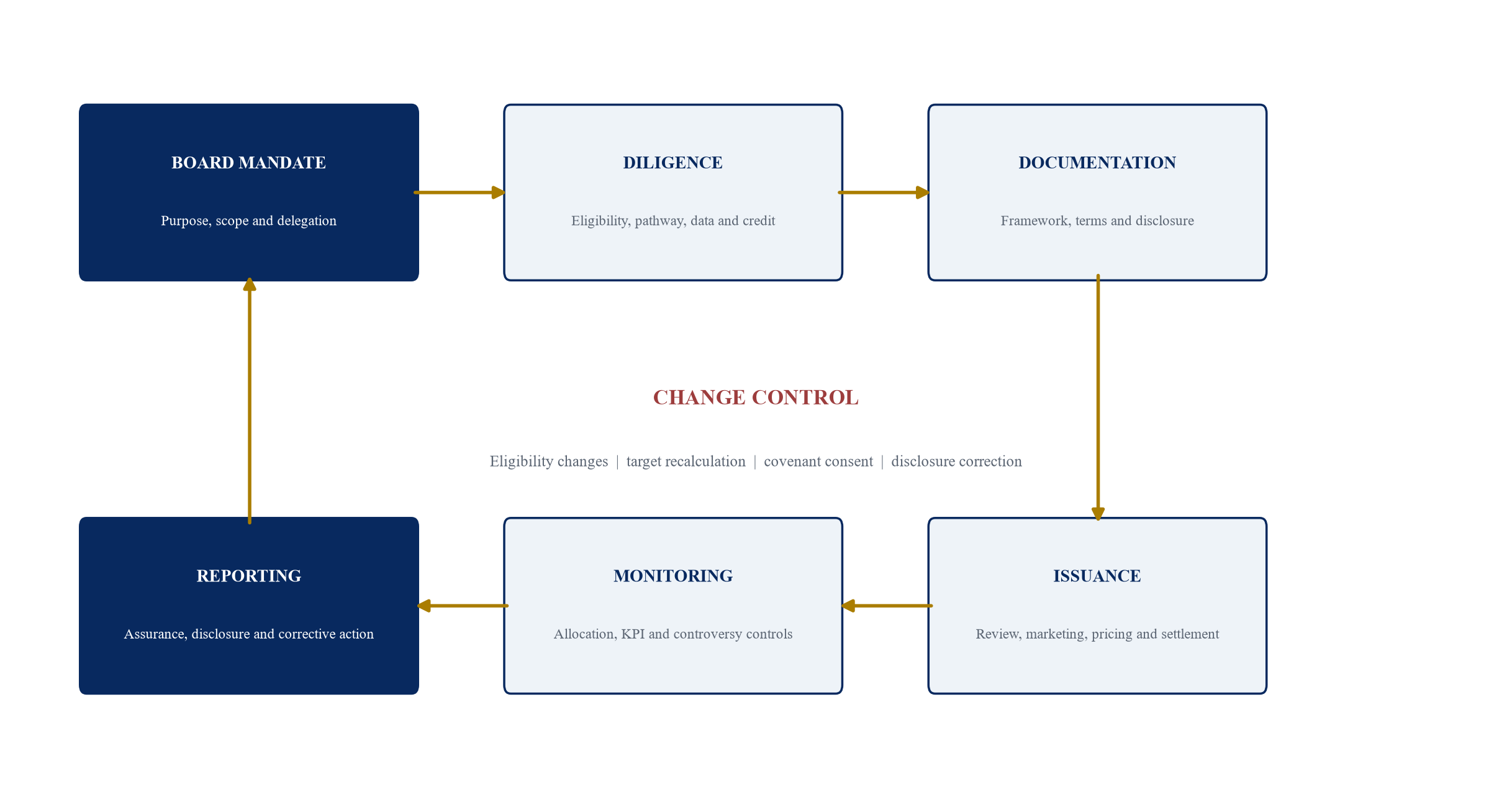
Governance continues after issuance. Eligibility changes, target recalculations and reporting exceptions require documented decisions.
29. Allocate risks to the party that can manage them
Risk allocation should follow control. The issuer controls asset selection, proceeds tracking, capital allocation and reporting. Project counterparties may control construction, availability, fuel supply or offtake. Regulators influence tariffs, retirement approvals and cost recovery. Investors bear issuer credit and market risk, subject to the bond terms. External reviewers assess specified information within an agreed scope; they do not assume management responsibility.
The transaction documents should identify remedies and information rights. Construction contracts can address delay and performance. Power-purchase agreements can allocate volume, price and change-in-law exposure. Fuel and transport contracts can address supply and indexation. Bond terms can define reporting undertakings and sustainability consequences. None of these mechanisms substitutes for a viable transition plan and repayment case.
Table 3. Principal bond-design risks and controls
| Risk | How it arises | Primary control | Monitoring evidence | Escalation |
|---|---|---|---|---|
| Ineligible allocation | Project fails the chosen criteria or becomes ineligible | Documented eligibility matrix and approval committee | Asset register, invoices, technical evidence and reviewer findings | Remove or replace allocation and disclose under the framework |
| Transition lock-in | Financing extends high-emitting operation beyond the pathway | Counterfactual, retirement condition and alternative assessment | Dispatch, capital spend, retirement milestones and board reporting | Reassess project, suspend allocation or revise financing claim |
| KPI gaming | Performance improves through perimeter or methodology change | Detailed definitions and recalculation policy | Reconciled KPI workbook and independent verification | Restate baseline or target and publish rationale |
| Data failure | Operational systems cannot support reported values | Data ownership, validation and evidence retention | Control testing, exception logs and assurance report | Correct data, delay claim where necessary and explain effect |
| Covenant conflict | Transition action breaches existing finance terms | Debt-document diligence and consent plan | Covenant model, legal opinions and lender approvals | Obtain consent, restructure action or change financing perimeter |
| Refinancing stress | Capital programme and declining legacy cash flow tighten liquidity | Integrated funding plan and downside testing | Liquidity forecast, headroom and refinancing calendar | Reduce discretionary spending, raise equity or adjust sequencing |
| Misleading communication | Marketing exceeds the evidence or scope | Disclosure committee and claim reconciliation | Approved framework, offering document and communication log | Correct public statement and strengthen approval controls |
Controls should be adapted to the issuer, jurisdiction and governing transaction documents.
30. Use a board decision memo
The board decision should be supported by a concise memorandum that sets out the financing need, instrument alternatives, selected structure, eligible perimeter, transition-plan test, principal risks, external-review scope, financial impact, disclosure obligations and recommendation. The memo should include reasons for rejecting other structures. It should identify any reliance on future regulation, policy support, target recalibration or uncommitted projects.
Approval should cover the framework and delegation of execution authority. Material changes after approval should return to the designated committee or board. Minutes should record the evidence considered and any conditions. This governance record supports consistency if the transaction is later reviewed by investors, regulators, auditors or courts.
31. Recognise the limits of labels
A label cannot resolve weak asset economics, unreliable regulation, inadequate data or an unfinanceable transition plan. It does not guarantee lower funding cost, investor demand, credit improvement or environmental impact. Market pricing depends on issuer credit, instrument terms, liquidity and prevailing conditions. Environmental outcomes depend on execution, system operation and policy.
Frameworks also evolve. Technical criteria, disclosure rules and investor expectations can change during a long-dated bond. The issuer should monitor developments and state which version of a framework applies. It should avoid retrospective claims that were not part of the original documentation. Where evidence becomes uncertain, transparent disclosure is more credible than expanding the claim.
32. Practical decision rules
Five decision rules summarise the framework. First, use a green bond when the funding need is dominated by identifiable eligible assets and allocation can be traced. Second, consider a climate transition bond when the financed project moves a mixed or higher-emitting issuer along a credible pathway and lock-in is controlled. Third, use a sustainability-linked bond when issuer-wide KPIs and targets are material, ambitious, measurable and verifiable. Fourth, use conventional finance with clear transition disclosure when eligibility or data readiness is insufficient. Fifth, combine structures only when each has a distinct purpose and the reporting system prevents double counting or contradictory claims.
These rules do not predetermine the answer. They force the issuer to match its claim to evidence. A utility may begin with a green bond for a mature eligible portfolio while improving the data and governance needed for a later issuer-wide instrument. Another may prioritise a transition bond for early retirement and replacement infrastructure. The right sequence depends on capital needs, asset mix, legal structure and transition maturity.
Conclusion
Mixed-generation utilities require a financing architecture that reflects the different roles of assets and the different meanings of sustainable-finance instruments. A green bond is a project-allocation structure. A climate transition bond is a use-of-proceeds structure for credible transition activities. A sustainability-linked bond is an issuer-performance structure. A conventional bond remains available when the evidence does not support a labelled claim.
Credible design starts with a precise financing purpose and a granular map of assets, liabilities, emissions and capital expenditure. It then applies an eligible-project test, an entity-transition test and a credit test. The chosen claim must be translated into proceeds controls, KPI definitions, recalculation rules, contractual consequences, assurance and reporting. Managed phase-out, gas investment, M&A and changes in group perimeter require special scrutiny because they can create lock-in or apparent progress without operational change.
The framework supports disciplined board decisions. It helps issuers finance real transition while preserving access to capital and protecting the accuracy of public claims. It also helps investors distinguish an eligible green asset from a credible transition programme and from an issuer-level performance commitment.
Frequently Asked Questions
1. Can a utility with gas or coal assets issue a green bond?
A mixed utility can issue a green bond for eligible projects if the chosen framework permits the projects and the proceeds, disclosures and controls are accurate. The green label applies to the use of proceeds; it should not imply that every issuer asset is green. Investors may still assess the issuer's wider strategy and controversies.
2. When is a transition bond more suitable than a green bond?
A transition bond may be more suitable when the financed activity is central to moving a mixed or higher-emitting business toward a credible pathway and is not already an eligible green activity. The issuer needs a credible transition plan, clear project criteria, safeguards, lock-in analysis and outcome reporting.
3. How does a sustainability-linked bond differ from a use-of-proceeds bond?
A sustainability-linked bond generally funds corporate purposes while changing financial or structural characteristics according to performance against defined KPIs and targets. A use-of-proceeds bond allocates an amount equal to proceeds to eligible projects. The evidence, reporting and contractual mechanics differ.
4. Can the same renewable project support two labelled bonds?
The issuer should prevent double allocation unless the disclosed methodology permits a transparent proportional allocation. The asset register should reconcile eligible expenditure, prior financing and outstanding labelled proceeds.
5. What happens if an eligible project is sold or cancelled?
The issuer should follow the framework and bond documentation. It may need to remove the project from the allocation register, substitute another eligible project, reallocate proceeds and disclose the change. The treatment should be defined before issuance.
6. Is an emissions-intensity KPI sufficient for a mixed utility?
An intensity KPI can be material, yet it may improve while absolute emissions rise. The issuer should explain expected demand growth and consider a complementary absolute-emissions or retirement measure where material. KPI selection depends on the issuer's strategy and data.
7. Does a labelled bond guarantee cheaper financing?
No. Pricing depends on issuer credit, instrument terms, investor demand, liquidity and market conditions. A label can broaden the investor conversation and improve disclosure discipline; it does not guarantee a pricing benefit.
8. Should a utility finance a managed phase-out through a bond?
It may be feasible where the transaction has a credible baseline, earlier retirement commitment, replacement and reliability plan, worker and community measures, enforceable governance and a viable repayment source. The issuer should assess jurisdiction-specific legal, regulatory, accounting, tax and policy requirements.
References
- ASEAN Taxonomy Board. ASEAN Taxonomy for Sustainable Finance, Version 3, 2024. https://afcwp.asean.org/wp-content/uploads/2024/12/ASEAN-Taxonomy-Finalised-Version-3.pdf
- European Parliament and Council of the European Union. Regulation (EU) 2023/2631 on European Green Bonds and optional disclosures for bonds marketed as environmentally sustainable and for sustainability-linked bonds, 2023. https://eur-lex.europa.eu/legal-content/en/TXT/?uri=CELEX:32023R2631
- European Commission. Commission Delegated Regulation (EU) 2021/2139, consolidated text current to 1 January 2026. https://eur-lex.europa.eu/legal-content/EN/TXT/?uri=CELEX:02021R2139-20260101
- International Capital Market Association. Green Bond Principles, 2025. https://www.icmagroup.org/sustainable-finance/the-principles-guidelines-and-handbooks/green-bond-principles-gbp
- International Capital Market Association. Climate Transition Finance Handbook, November 2025. https://www.icmagroup.org/assets/documents/Sustainable-finance/2025-updates/Climate-Transition-Finance-Handbook-November-2025.pdf
- International Capital Market Association. Climate Transition Bond Guidelines, November 2025. https://www.icmagroup.org/assets/documents/Sustainable-finance/2025-updates/Climate-Transition-Bond-Guidelines-CTBG-November-2025.pdf
- International Capital Market Association. Sustainability-Linked Bond Principles, 2024. https://www.icmagroup.org/sustainable-finance/the-principles-guidelines-and-handbooks/sustainability-linked-bond-principles-slbp
- International Capital Market Association. Guidance Handbook, June 2025. https://www.icmagroup.org/assets/documents/Sustainable-finance/2025-updates/The-Principles-Guidance-Handbook-June-2025.pdf
- International Energy Agency. Scaling Up Transition Finance, 2025. https://www.iea.org/reports/scaling-up-transition-finance
- International Energy Agency. Electricity 2025: Emissions. https://www.iea.org/reports/electricity-2025/emissions
- International Energy Agency. Electricity 2026: Executive Summary. https://www.iea.org/reports/electricity-2026/executive-summary
- International Energy Agency. Global Energy Review 2026: Electricity Supply. https://www.iea.org/reports/global-energy-review-2026/electricity-supply
- Organisation for Economic Co-operation and Development. OECD Guidance on Transition Finance, 2022. https://www.oecd.org/environment/oecd-guidance-on-transition-finance-7c68a1ee-en.htm
- Glasgow Financial Alliance for Net Zero. The Managed Phaseout of High-emitting Assets, 2022. https://www.gfanzero.com/our-work/managed-phaseout/
- Network for Greening the Financial System. NGFS Climate Scenarios for central banks and supervisors, 2024. https://www.ngfs.net/ngfs-scenarios-portal/
- IFRS Foundation. IFRS S2 Climate-related Disclosures, 2023. https://www.ifrs.org/issued-standards/ifrs-sustainability-standards-navigator/ifrs-s2-climate-related-disclosures/
- Task Force on Climate-related Financial Disclosures. Guidance on Metrics, Targets, and Transition Plans, 2021. https://www.fsb-tcfd.org/publications/
- Science Based Targets initiative. Power Sector Science Based Target Setting Guidance, 2020. https://sciencebasedtargets.org/resources/files/SBTi-Power-Sector-15C-guide-FINAL.pdf
- United Nations Framework Convention on Climate Change. Paris Agreement, 2015. https://unfccc.int/process-and-meetings/the-paris-agreement/the-paris-agreement
- International Organization for Standardization. ISO 14030-1 Environmental performance evaluation: Green debt instruments, Part 1, 2021. https://www.iso.org/standard/43254.html
About the Author
Chennakeshav (CK) is a corporate finance and investment banking executive with 25+ years of global experience in deal origination, structuring and execution across M&A, growth capital and corporate strategy. He has led value-creation mandates for founders, corporates and funds — bridging the boardroom view to hands-on execution and close.
His career spans Morgan Stanley, HSBC, Lloyds Banking Group, EWEC, ADQ portfolio companies and Emirates Growth Fund, across TMT, real estate, fintech, deeptech, cleantech, infrastructure and energy. He has partnered with C-suite leaders, private equity and venture funds, sovereign wealth funds and family offices to finance complex fund raises and scale-up ventures, and has led M&A due diligence, post-merger integration and business-transformation initiatives to create value.
At Matchpoint Partners he is Managing Partner, leading the firm's corporate finance, M&A and capital-raising practice. He holds an MBA from London Business School, an engineering degree from VTU and a Master of Laws (LLM, in progress) from UCL London.
An active start-up mentor, CK mentors at Techstars, DIFC FinTech Hive, Startup Grind, Founder Institute and IN5, serves as Entrepreneur Mentor in Residence (EMiR) at London Business School, and judges the Entrepreneurship World Cup.
