

1. Make pre-closing conduct a board-controlled workstream
Gun-jumping control is the system that keeps transaction preparation from becoming premature control or coordination. It should begin when serious negotiations create a foreseeable need for sensitive information or joint planning, rather than waiting for a filing or signed agreement. The board needs a practical operating model because the risk appears through ordinary transaction activity: consent clauses, management calls, customer meetings, synergy work, financing diligence, integration workshops and decisions about preserving the target's value.
The central board decision is how to reach closing with sufficient knowledge and readiness while both businesses remain independent. That decision requires four outputs. The first is a jurisdiction map showing notification, standstill, competition and interim-measure exposure. The second is a phase map defining what may occur at letter of intent, signing, filing, clearance and closing. The third is an activity register assigning every joint task to an owner and approval route. The fourth is an evidence file showing that the controls operated.
The programme should have one accountable transaction executive, one legal control owner and one integration planning lead. Business functions can propose activities. They should not decide their own legal boundaries. Each proposed task should identify the decision it supports, the minimum information required, the people involved, the permitted output, the earliest start date and the event that authorises implementation.
A board-approved protocol also protects value. Teams can work quickly when they know which lane to use. Matters with low competitive sensitivity can proceed under ordinary confidentiality. Restricted information can pass through a clean team. Integration design can use aggregated outputs. Decisions that affect current commercial conduct can remain with the target until closing. The protocol turns a broad warning into executable rules.
2. Start from continued independence
The governing operational principle is that the parties remain separate businesses before lawful closing. The US Federal Trade Commission has warned that parties must continue to act independently during pre-merger negotiations, diligence and integration planning. It identifies current and future pricing, strategic plans and costs as information requiring special care, and it recommends effective protocols, clean teams and third-party advisers where sensitive information is necessary. [1]
The US Department of Justice has stated that gun-jumping concerns can arise through integration planning and through interim covenants that give a buyer substantial influence over the seller's competitive decisions. Its public remarks describe consent rights affecting future competitive bids as an example of a provision requiring careful review. [2] In January 2025, the FTC announced a USD 5.6 million settlement concerning alleged pre-merger coordination in an oil and gas transaction. The public complaint focused on conduct that allegedly transferred significant operational control before the waiting period expired. [3]
European Union rules require qualifying concentrations to be notified and prohibit implementation before clearance. [4] The Court of Justice's Altice judgment examined contractual rights and conduct that could give an acquirer decisive influence before closing. [5] The European Commission states that concentrations with an EU dimension may not be implemented before notification or a compatibility decision. [6]
The UK system permits voluntary notification, yet the Competition and Markets Authority may impose interim measures in completed mergers and require independent operation, information restrictions, staff retention and the unwinding of unauthorised integration. [7] Australia introduced a mandatory merger-control regime from 1 January 2026, with a requirement to wait for approval for notifiable acquisitions. [8] The regulatory route differs across jurisdictions, while the operating need for disciplined independence remains.
| Source | Public principle | Operating implication | Evidence to retain |
|---|---|---|---|
| FTC pre-merger guidance | Parties should remain independent and control sensitive information flows | Separate diligence, clean-team analysis and ordinary commercial decisions | Protocols, access logs, release approvals and meeting records |
| DOJ public remarks | Integration planning and interim covenants can create gun-jumping concerns | Review consent rights and joint activities for practical influence over competitive conduct | Covenant matrix, approval rationale and escalation record |
| EU Merger Regulation and Altice judgment | Qualifying transactions are subject to notification and standstill duties | Do not transfer decisive influence or implement the concentration before the legal trigger | Rights analysis, conduct log and clearance record |
| UK CMA interim-measures guidance | The CMA may preserve separate operation and require unwinding or monitoring | Plan for hold-separate obligations and authority-specific derogations | Order matrix, compliance statements and derogation approvals |
| Australia mandatory regime | Notifiable acquisitions require approval before proceeding | Add Australian filing and standstill gates to global transaction plans | Threshold assessment, notification status and closing certificate |
This is a management summary of selected public sources, not a statement of the complete legal test in any jurisdiction.
3. Build a phase map before the workplan
The same activity can carry different risk at different points. A generic operating-model workshop may be suitable before signing. A customer-by-customer pricing plan may remain restricted after clearance and before closing. A system cutover can require both legal closing and technical readiness. Teams need a phase map that precedes the integration plan.
At the letter-of-intent phase, the principal purposes are valuation, confirmatory diligence, financing feasibility, regulatory planning and transaction design. Information should be limited to the minimum needed for those decisions. The parties should agree confidentiality, data-room and clean-team arrangements before sharing sensitive material. Operating teams should remain outside discussions that could affect current price, output, customers, suppliers or innovation.
At signing, the transaction documents create enforceable rights and obligations. The parties should convert the legal terms into a consent and conduct matrix. The matrix should explain which decisions remain entirely with the target, which extraordinary actions require buyer consent, who may request consent, who decides and how the rationale is recorded. Signing also activates the formal integration planning protocol.
During filing and review, the programme should reflect every authority's process and any interim order, undertaking, monitoring arrangement or information restriction. The legal team should control changes to the workplan. Clearance does not necessarily transfer control. Conditions precedent, foreign investment approvals, financing conditions and contractual closing mechanics may remain outstanding.
At closing, a defined release event should change access and decision rights. The transaction secretary should confirm that all required approvals and conditions have been satisfied or waived, that the legal transfer has occurred and that any continuing restrictions are known. The release should be documented before sealed integration packs or operational instructions are distributed.
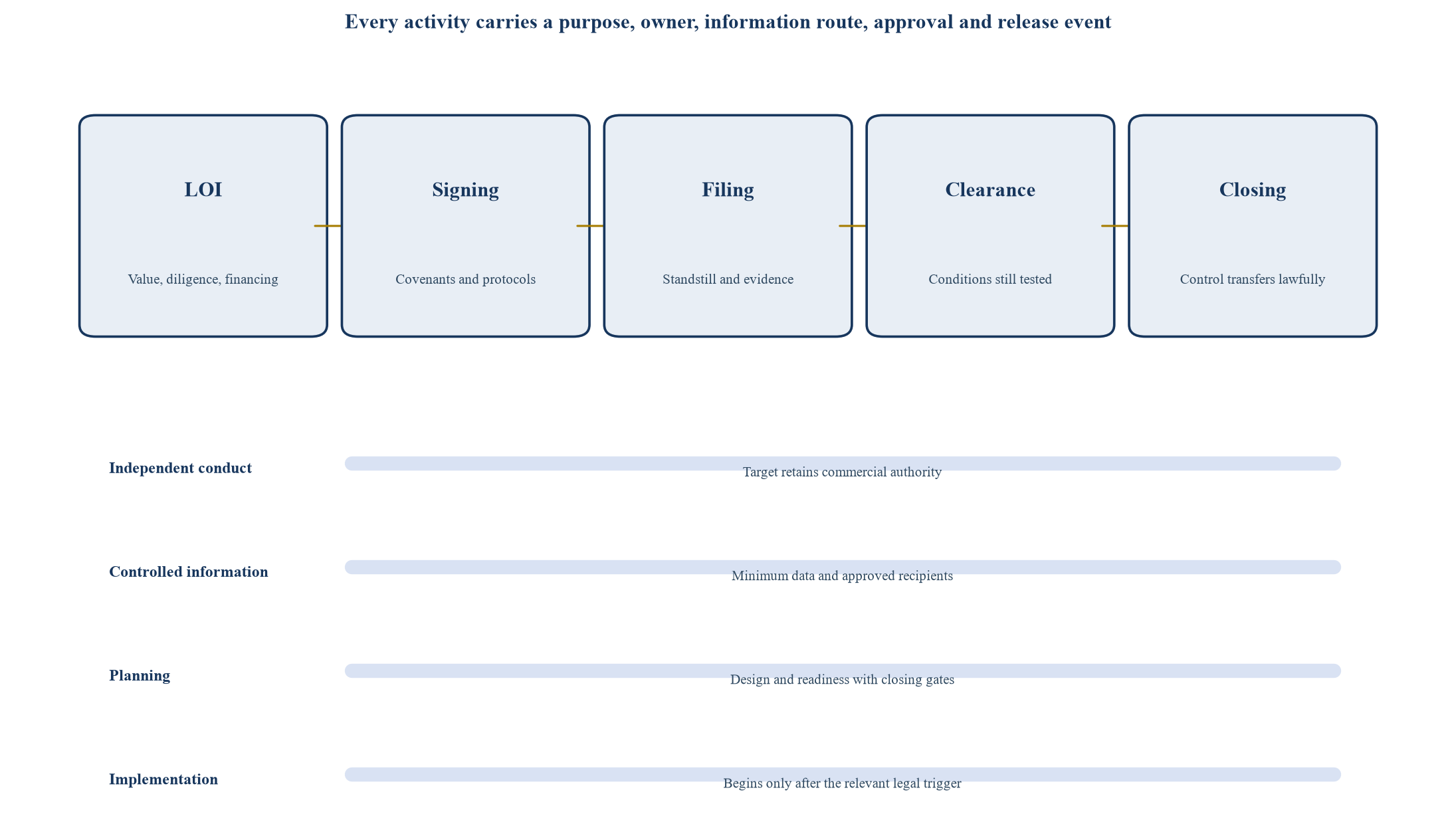
The map is a proposed governance model. Transaction-specific advice determines the actual legal gates.
4. Separate diligence, planning and implementation
Diligence tests the investment and transaction. Integration planning prepares choices and capabilities. Implementation changes the businesses. Confusion between these categories is a common source of weak control because a team may describe an operational step as planning when it already affects market conduct.
Diligence asks whether the board should proceed, at what price, on which terms and with which protections. It can examine financial quality, customers, contracts, products, technology, people, compliance and regulatory exposure. Sensitive diligence should use controlled recipients and outputs. The decision record should explain why a field or document was necessary.
Integration planning designs governance, workstreams, decision calendars, generic Day 1 controls, communication templates, system migration methods and contingency plans. It may estimate resources and sequence activities. Planning should contain explicit closing gates where an action affects customers, prices, suppliers, employees, output, products, data or systems.
Implementation gives instructions, changes decisions, combines operations, migrates systems, redirects customers, negotiates jointly, changes commercial terms or transfers authority. These activities usually require the relevant legal trigger. Some preparatory steps can also amount to implementation if they confer decisive influence or alter current competition. Labels do not determine the answer; practical effect matters.
The activity register should contain a plain description of what people will do, rather than a workstream label. “Commercial integration” is too vague. “Compare anonymised discount distributions through the clean team and prepare a sealed post-closing policy options paper” is reviewable. “Direct the target to adopt the buyer's current discount limits” describes an operational change and should be treated accordingly.
5. Control the letter-of-intent phase
A letter of intent can create momentum, exclusivity and an expectation of collaboration before the definitive agreement establishes a full control framework. The parties should therefore attach or adopt an interim transaction protocol when the anticipated diligence will involve competitors, sensitive data or extensive management contact.
The protocol should identify the permitted purpose, participating entities, approved contacts, data classes, repositories, clean-team route, prohibited topics, meeting rules, incident process and termination obligations. It should also state that each party continues to determine its own prices, bids, customers, suppliers, output, capacity, products, hiring and strategy.
Exclusivity should not become commercial alignment. The target should continue competing and serving customers in the ordinary course. The buyer may test value and negotiate protections. It should not use access or leverage to direct current conduct. The target should retain a record of material decisions taken during exclusivity so that later questions about influence can be answered with evidence.
Management meetings need agendas and defined attendees. Transaction topics should be separated from current competitive decisions. Where a question requires restricted information, the meeting should stop that line of discussion and route the issue to the approved process. Minutes should capture the decision and next route without reproducing sensitive content broadly.
The letter-of-intent phase should also establish a failed-deal plan. Sensitive information may remain valuable if the transaction ends. The protocol should address return or deletion, legal holds, continuing confidentiality, cooling-off restrictions for clean-team members where appropriate and the treatment of analyses derived from target information.
6. Translate signing documents into operating rules
Transaction agreements contain ordinary-course covenants, consent rights, access clauses, cooperation duties, efforts standards, regulatory provisions and termination rights. Business teams cannot safely operate from the legal text alone. A transaction control office should translate each relevant clause into a plain-language matrix approved by counsel.
The matrix should state the protected interest, the seller's decision right, the buyer's contractual right, the people authorised to communicate, the response time, the evidence required and the escalation path. It should distinguish notification from approval. It should also distinguish extraordinary actions that may threaten transaction value from ordinary competitive decisions that remain with the target.
Buyer consent should be based on a defined contractual protection and assessed case by case. A threshold may be necessary for capital expenditure, acquisitions, disposals, debt, litigation settlements or changes outside the ordinary course. The process should avoid giving the buyer routine approval over pricing, bids, customer terms, supplier selection, production or product strategy.
The target should frame a request around the proposed action and contractual provision. It should avoid disclosing sensitive detail that is unnecessary for the decision. The buyer's response should record approval, rejection or conditions and the transaction rationale. Where the matter touches competition, legal counsel should review it before any response reaches the business.
Repeated use of a broad consent right can create practical influence even if each request appears small. The control office should monitor volume, subject matter, decision time and commercial effect. A monthly pattern review can identify whether a protective covenant is becoming a management channel.
| Activity | Likely purpose | Controlled pre-closing route | Evidence required |
|---|---|---|---|
| Confirm historical earnings and working capital | Valuation and financing | Ordinary diligence or restricted team depending on detail | Request, reconciliation and model linkage |
| Review current named-customer prices | Valuation or regulatory analysis | Clean team with reviewed aggregate output | Purpose, field specification, access and release logs |
| Draft Day 1 governance and delegations | Closing readiness | Generic design with a closing release gate | Approved plan and activation condition |
| Require buyer consent for extraordinary capital expenditure | Preserve transaction value | Contractual consent process with documented rationale | Clause, request, decision and competition review |
| Agree current customer prices or bid strategy | Current commercial conduct | Remain separate; do not use joint decision-making | Separate decision records |
| Meet a customer about transaction continuity | Stakeholder assurance | Approved script, separate responsibilities and no joint selling | Agenda, attendees, script and note |
| Migrate systems or redirect orders | Operational implementation | Post-closing or under specific lawful authority | Closing certificate and implementation approval |
The examples are governance prompts. Legal treatment depends on the facts, market, jurisdiction and transaction documents.
7. Preserve ordinary-course autonomy
Ordinary-course covenants protect the value of the business that the buyer agreed to acquire. They can also create risk when drafted or applied so broadly that the buyer determines how the target competes. The operating system should focus on proportionality, necessity and evidence.
The target should continue to operate under its existing governance. Its board and management should retain responsibility for ordinary decisions. The buyer's transaction team should not sit in target pricing, bid, capacity, product or customer committees. Joint meetings should address transaction cooperation and approved planning, not current competitive choices.
Materiality thresholds should reflect the size and nature of the target. A fixed threshold can become intrusive if it captures routine activity. A qualitative trigger can be too vague. The parties should review the practical request volume after signing and adjust the protocol or seek advice if the process captures ordinary conduct.
Urgent decisions need a rapid route. Delay caused by buyer consent can harm the target and may itself influence competition. The matrix should define response deadlines, deemed outcomes where contractually appropriate, weekend coverage and escalation. The buyer should maintain enough resourcing to decide permitted requests without becoming a bottleneck.
The record should show the transaction-protection rationale. Approval conditions should relate to preserving value or complying with the agreement. A condition that directs current competitive behaviour should be escalated. The legal team should examine both the contractual right and the practical effect.
8. Design decision rights around legal control
An effective decision-rights architecture has three zones. The first contains decisions that remain entirely with each party before closing. The second contains transaction-protection matters subject to a defined contractual process. The third contains joint planning matters that prepare post-closing choices without implementing them.
Zone one includes current prices, discounts, bids, customer selection, supplier negotiations, production, capacity, product launches, research priorities, hiring for current operations and competitive strategy. The parties may need to exchange limited information about some of these matters for legitimate diligence. Information exchange does not transfer the decision right.
Zone two includes specified extraordinary actions such as major acquisitions, disposals, financing, unusual capital expenditure, material litigation settlements or changes outside the ordinary course. The agreement and advice determine the boundary. The consent process should be narrow, documented and separate from ordinary management.
Zone three includes integration governance, generic process design, Day 1 controls, communications preparation, systems discovery, regulatory implementation and resource planning. Outputs should contain closing gates. Detailed planning based on restricted information should stay with approved clean-team or integration-clean-team members until release.
The architecture should name the accountable owner in both businesses. RACI language can help, but the matrix needs a legal trigger as well as responsibility. An initiative cannot move merely because all workstream owners agree. The release event must be confirmed by the transaction secretary or designated legal owner.
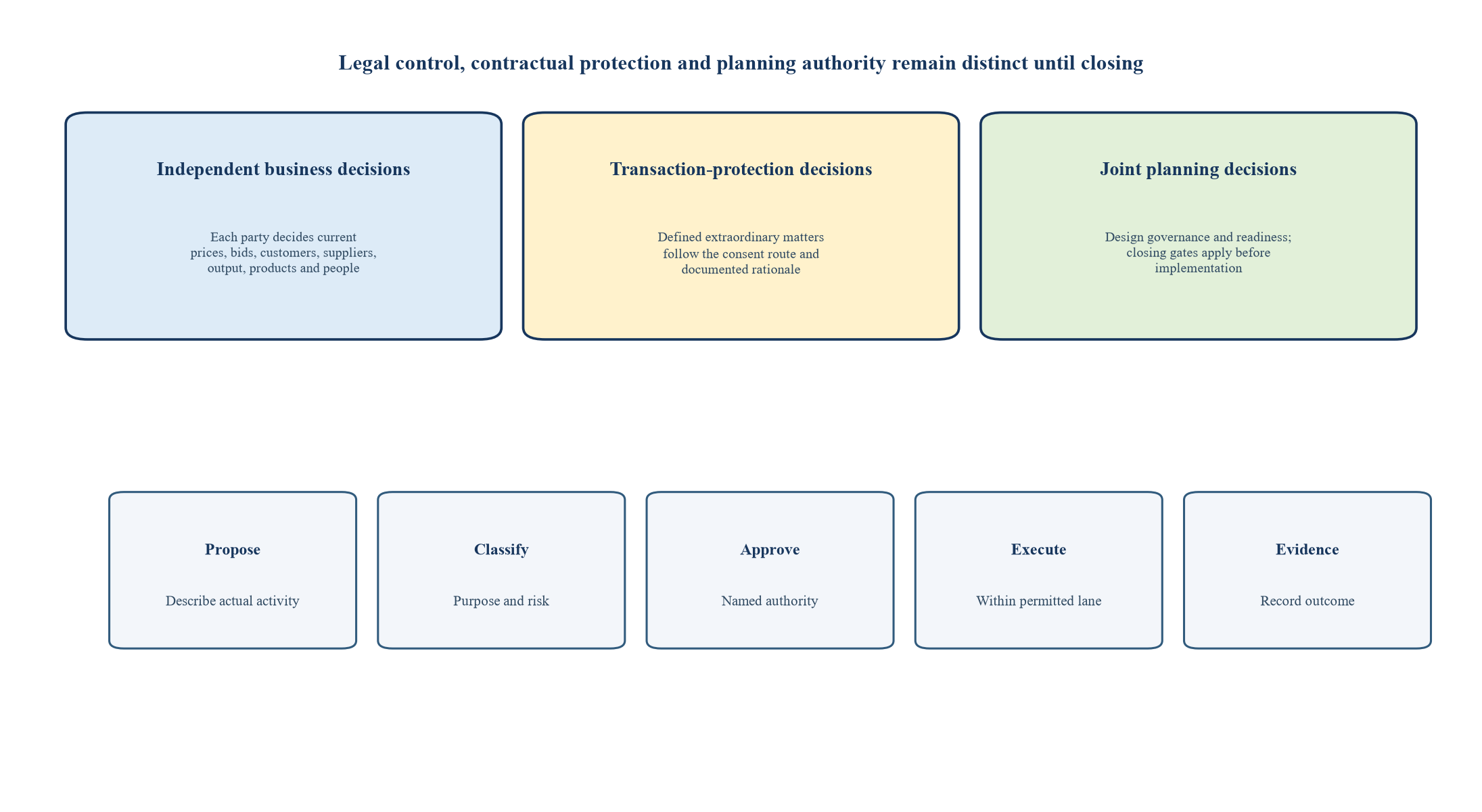
The diagram is a proposed management framework and does not determine legal rights.
9. Control management contact
Senior executives often have legitimate reasons to meet before closing. They may need to negotiate the agreement, support financing, explain the transaction to authorities, assess leadership continuity and prepare communications. The risk increases when frequent contact creates an informal management channel.
The protocol should classify meetings by purpose. Transaction negotiation, regulatory preparation, controlled diligence and approved integration planning can proceed through defined routes. Current operating reviews, commercial performance calls and routine management instruction should remain separate unless a specific lawful basis and approval exist.
Every joint meeting should have an agenda, attendee list and chair. The chair should understand the stop topics. Minutes should record decisions, actions and escalations. They should not circulate sensitive detail beyond approved recipients. A meeting that changes purpose should be reclassified before continuing.
Shadow reporting lines should be prohibited. Target executives should not begin reporting to future buyer leaders before closing. Future organisation design can be planned using role profiles and sealed decisions. Performance assessment, current objectives, compensation decisions and operational instructions should remain under the target's governance.
Informal channels require explicit coverage. Messaging applications, personal calls, dinners and side conversations can bypass the formal process. Training should explain that the protocol applies to every medium. Participants should have a simple way to ask for rapid guidance and to report a discussion that crossed a boundary.
10. Govern customer and supplier contact
Customers and suppliers may request reassurance after announcement. They may also become evidence sources for merger review. Joint contact can be appropriate for limited transaction purposes, while joint selling, allocation, negotiation or direction of current terms can compromise independence.
The transaction team should maintain a stakeholder-contact plan. Each proposed contact should state the purpose, party leading the conversation, approved attendees, script, prohibited topics and follow-up owner. The target should continue handling its current commercial relationship. The buyer may explain transaction intent or future capability in carefully defined circumstances.
The script should avoid promises that assume clearance or closing. It should not present the businesses as already combined. It should avoid joint pricing, bundled offers, customer allocation, shared bid strategy or pressure to alter current arrangements. Questions about future terms should be deferred to the appropriate post-closing process.
Supplier contact follows the same principle. Teams may need to identify change-of-control consents, continuity risks or financing conditions. They should not jointly renegotiate current procurement or allocate suppliers before authority exists. Sensitive supplier terms may need clean-team treatment where the parties compete for inputs.
The contact note should record what was discussed and any unexpected question. If the customer reveals one party's sensitive information in front of the other, the team should stop and follow the incident route. The control system needs to address information received from third parties as well as information deliberately exchanged.
11. Use clean teams for necessary restricted information
Clean teams allow approved people to analyse restricted information and release only the output needed for a transaction decision. They are useful when valuation, regulatory analysis, financing or planning requires evidence that ordinary business personnel should not receive. They do not authorise joint commercial conduct.
The clean-team mandate should connect every dataset to a question. It should define fields, period, granularity, recipients, analytical method, release rule, retention and deletion. Current named-customer prices, active bids, product roadmaps, capacity plans, unit costs and future strategy often require enhanced controls when the parties compete.
External advisers can provide separation. Selected internal personnel may also serve where their current and future roles permit it and counsel approves. People who set current price, bids, customers, capacity or product strategy may be unsuitable. Access should use named accounts, multifactor authentication, restricted repositories, expiry and logs.
Outputs should answer a decision without exposing a competitive playbook. Aggregation, anonymisation, banding, redaction and historical cut-offs may help. The reviewer should test whether small cohorts or obvious outliers make identity recoverable. Cumulative disclosure across several outputs also requires review.
The FTC and OECD identify clean teams and controlled information methods as practical safeguards. [1][9] The design remains transaction-specific. A clean team needs a lawful purpose, appropriate members and enforced output controls. It cannot repair an activity whose practical effect is premature control.
12. Keep commercial communications independent
Announcement creates pressure for a unified story. Communications teams can prepare coordinated transaction messages, yet each company must continue speaking accurately about its own business and current operations. The protocol should distinguish transaction communications from commercial communications.
Joint press releases, investor materials and regulatory announcements should follow the agreement and applicable disclosure rules. Statements should describe the transaction as proposed or pending where appropriate. They should avoid language suggesting that control has already transferred or that commercial policies have already been combined.
Sales, marketing and product communications should remain separate before closing. Joint campaigns, shared lead lists, coordinated promotions or cross-referrals can affect competition. A future brand architecture may be designed in a restricted planning lane, with activation gated to closing.
Internal communications also matter. Employees should understand that the parties remain separate and that existing reporting lines continue. Messages should explain where transaction questions go and which topics cannot be discussed jointly. Repeated reminders are useful during a long review because teams may otherwise begin behaving as though completion is inevitable.
The communications log should retain approved scripts and material stakeholder contacts. Changes prompted by regulator feedback, delayed closing or remedies should be versioned. The log supports consistent conduct and helps investigate incidents.
13. Integrate regulatory orders into the workplan
Authorities may impose interim measures, hold-separate obligations, monitoring arrangements, information restrictions or restorative requirements. These instruments should become operating requirements inside the transaction plan, rather than sitting as legal documents outside it.
The UK CMA's public guidance explains that interim measures may require businesses to pause integration, continue competing, maintain separate brands and sales, retain staff and restrict confidential information. It may require regular compliance statements, monitoring trustees or unwinding. [7][10] The workplan should map each obligation to a business owner, control, evidence source and reporting date.
Derogations or consents should be treated as precise permissions. The team should record the activity authorised, conditions, recipients, time period and evidence. A permission for one system, employee group or continuity step does not extend automatically to related work.
Regulatory reporting needs reliable source records. Access logs, meeting minutes, consent decisions, training records, incident reports and workstream certifications should be retained in a controlled evidence repository. The transaction executive should certify based on evidence from responsible owners, not on general assurance.
Where several jurisdictions apply, the strictest operational constraint may govern a global workstream unless the team can segregate regions, data and personnel. The jurisdiction map should show these dependencies. A local clearance should not trigger global implementation while another standstill duty remains.
14. Connect financing and synergy work to controls
Financing diligence may require detailed information about revenue, customers, margins, cash flows, contracts, assets and forecasts. Lenders, rating advisers, insurers and placement agents should enter the information protocol with defined purposes and recipients. Their professional role does not make unrestricted access appropriate.
The financing plan should identify which outputs can be supplied from ordinary diligence and which require clean-team transformation. Credit decisions may be supported by concentration bands, contract maturity profiles, stress scenarios and reconciled earnings without disclosing every current named-customer term to operating personnel.
Synergy work requires similar discipline. The board may need an evidence-based range before signing. Clean-team analysts can test overlaps, procurement categories, systems, locations and capability duplication. They should separate observed facts, management estimates and transaction assumptions. Detailed actions that affect current operations should remain sealed until the trigger.
The synergy model should assign each initiative a source, confidence, timing, cost, dependency and control classification. A synergy should not enter the base case merely because a team can imagine it. A clean-team output may support the size of an opportunity without authorising implementation.
Financing and value protection also interact with delay. A longer review period may increase financing carry, retention cost and execution risk. The control model should quantify these effects as scenario assumptions. It should avoid treating faster integration as a solution where legal authority is absent.
15. Define the hypothetical transaction case
The case concerns a global engineering software group acquiring a direct competitor. The assumed enterprise value is USD 2.40 billion. Signing occurs after confirmatory diligence, and closing is expected 180 days later subject to competition and foreign-investment approvals. The companies overlap in several enterprise software modules and compete for large industrial customers.
Management identifies USD 145 million of gross synergy present value. The estimate contains procurement, infrastructure, duplicated corporate costs, product rationalisation and revenue opportunities. The board applies separate probabilities and implementation costs. The model assumes USD 12 million of annual delay cost arising from financing carry, retention and postponed synergies. These values are wholly hypothetical.
The integration management office proposes 68 initiatives. Initial screening places 28 in the ordinary low-risk planning lane, 18 in a controlled planning lane and 22 in enhanced legal review. The enhanced group includes named-customer analysis, pricing architecture, product roadmaps, supplier negotiations, data migration, employee selections and market communications.
The parties establish a USD 2.20 million control programme covering competition advice, clean-team analysis, secure technology, training, monitoring and evidence management. Twelve restricted participants support valuation, regulatory and integration questions. Ordinary business teams receive approved outputs, generic planning assumptions and sealed post-closing packs.
The transaction committee reviews the activity register every two weeks. Legal counsel can pause an initiative. The target retains current commercial authority. A transaction secretary controls milestone changes and records the closing release. The scenario tests whether a structured system can preserve useful preparation without allowing the parties to operate as one business.
| Item | Scenario assumption | Decision use | Control implication |
|---|---|---|---|
| Enterprise value | 2,400.0 | Price and financing | Board evidence threshold |
| Gross synergy present value | 145.0 | Strategic value case | Separate observed, estimated and optional components |
| Annual delay cost | 12.0 | Timetable and financing | Model timing without assuming early implementation |
| Control programme cost | 2.2 | Transaction budget | Stage resources to risk and review duration |
| Signing-to-closing period | 180 days | Workplan | Use milestone-based permissions |
| Integration initiatives | 68 | Programme scope | Classify every actual activity |
| Initiatives under enhanced review | 22 | Legal and clean-team workload | Require named approval and evidence |
| Restricted participants | 12 people | Analysis capacity | Use named access, role review and expiry |
Every value and outcome in this table is a scenario assumption. USD millions unless stated otherwise.
16. Screen every initiative before work begins
The initiative screen should ask six questions. What transaction decision or closing outcome does the activity support? Does it require restricted information? Could it influence current price, bids, customers, suppliers, output, capacity, products, people or strategy? Does it give one party practical control over the other? Which jurisdiction or order applies? What event authorises release or implementation?
An initiative that cannot answer the first question should not enter the plan. A legitimate purpose is the foundation for information access and joint effort. The minimum dataset and permitted recipients follow from that purpose.
Activities affecting current competitive conduct should default to separate execution. A need for information can be routed through a clean team. A need for readiness can be addressed through generic design, contingency planning or a sealed pack. A desire for early economic benefit does not create authority.
The screen should assign a risk level and control lane. Green activities can proceed under the protocol. Amber activities require legal or clean-team approval. Red activities remain prohibited before the specified trigger or require an authority's permission. The designation should reflect practical effect, not only the workstream name.
Re-screening is necessary when scope, participants, data or timing changes. A generic systems inventory may become restricted if it expands into live migration. A customer communication may become a commercial negotiation. Workstream owners should have a duty to resubmit changed activities.
17. Use a risk heat map to allocate attention
Risk should be assessed across several dimensions: degree of competitive overlap, sensitivity of information, influence over current decisions, reversibility, customer or supplier impact, regulatory exposure and ability to evidence independent conduct. The heat map directs review effort; it does not replace legal analysis.
High-overlap transactions require stricter controls around price, bids, customers, output and innovation. A non-horizontal transaction can still create concerns through sensitive information, vertical relationships, ecosystem effects or control rights. The risk analysis should follow the actual market relationships.
Irreversibility matters. A shared pricing decision, customer allocation or system migration may be difficult to unwind. Generic training material or a draft governance chart can usually remain dormant. The control system should require stronger authority for steps that change third-party behaviour or destroy separate capability.
Detection also matters. Conduct may appear in emails, meeting notes, data-room records, customer complaints, regulator interviews or employee reports. The programme should assume that decisions will be reviewed later. Clear records support compliance and improve discipline at the moment of decision.
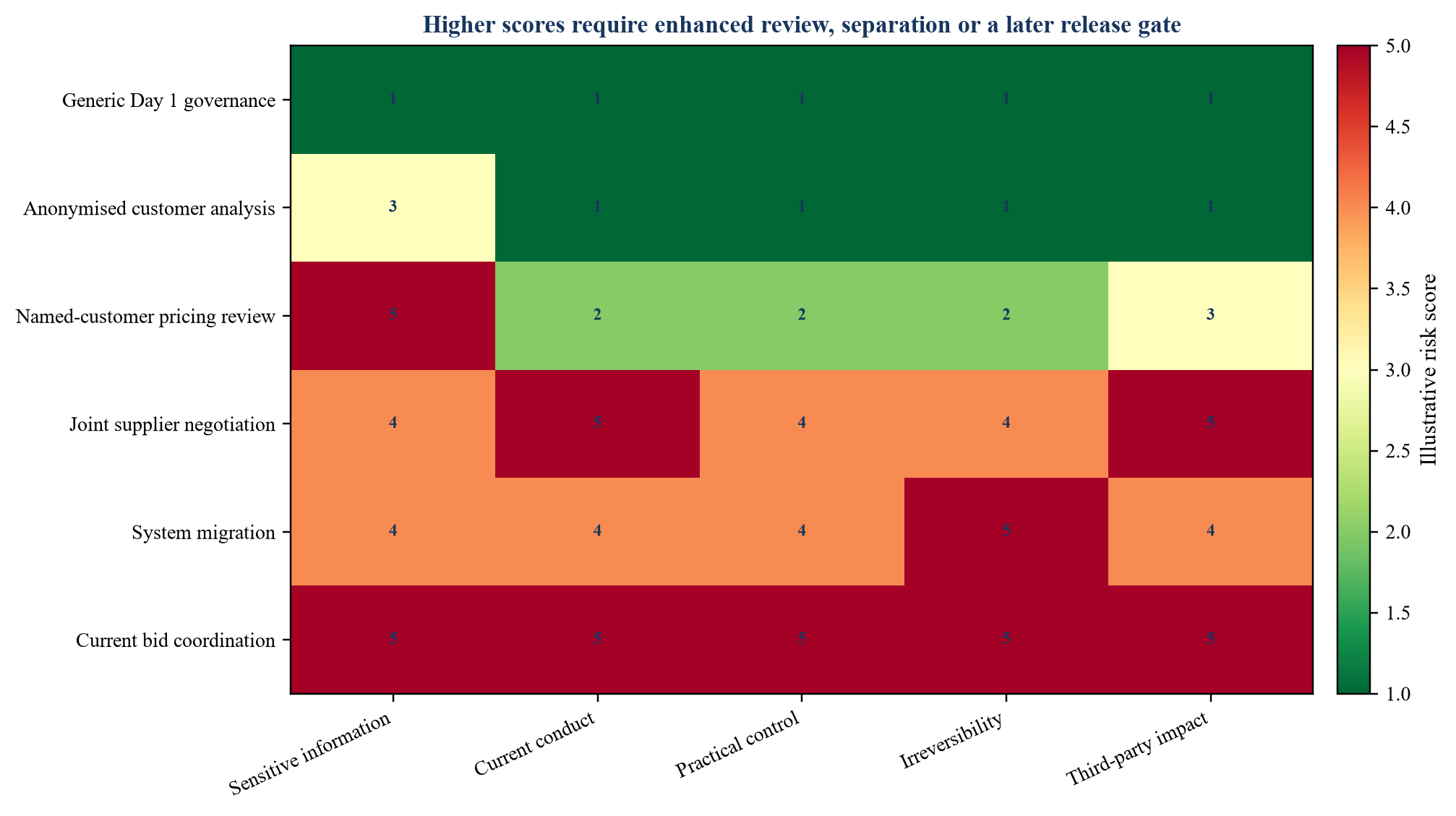
Scores are scenario assumptions for programme triage and do not state a legal conclusion.
18. Operate a rapid incident process
An incident can involve accidental disclosure, an unauthorised attendee, a commercial instruction, an improperly shared document, a customer conversation or a workstream acting before its release gate. The response should preserve evidence, stop further effect and obtain prompt advice.
The first recipient should stop the discussion or activity and notify the designated legal owner. Access should be suspended where necessary. The incident lead should preserve messages, files, logs, meeting records and decision history. People should avoid deleting or rewriting records.
The initial assessment should identify the information or conduct, people involved, timing, recipients, current commercial relevance, decisions affected, jurisdictions and any authority order. The team should consider containment, recusal, data deletion or isolation, corrective communication, decision re-performance and regulator notification where required.
The programme should maintain a privileged legal review where appropriate and a separate operational incident log. The log should record the event, containment, owners, due dates and closure evidence without circulating legal advice broadly. Material incidents should reach the transaction committee and board under defined thresholds.
Lessons should update the protocol. Repeated incidents may show unclear training, excessive access, weak meeting discipline or pressure created by the timetable. Corrective action should address the system as well as the individual event.
19. Prepare for delay, remedies and a failed deal
A long review can change personnel, financing, markets and operating plans. Controls need endurance. Access lists should expire and be recertified. New hires and advisers should receive training. Transaction communications should be refreshed when the timetable changes.
Remedies can require divestiture, access commitments, behavioural obligations, monitoring or separation. Integration plans should preserve optionality until the remedy structure is known. Teams should avoid designing a single irreversible operating model that becomes unsuitable if assets, customers, systems or personnel must be separated.
The failed-deal plan should cover raw information, analyses, sealed packs, devices, email, messaging, backups and adviser files. Return or deletion should follow the protocol, legal holds and professional obligations. The parties should determine whether clean-team members need continuing restrictions before returning to commercial roles.
The buyer should not retain competitive intelligence for future use. Derived analyses may contain sensitive conclusions even when raw data is deleted. The disposition review should examine models, presentations, code, notes and decisions as well as source documents.
Customers, suppliers and employees may need corrective communications if the transaction ends. Each party should resume independent communication. The plan should avoid revealing restricted information or attributing blame without an approved basis.
20. Implement the framework through a ninety-day roadmap
The first ten days should establish governance. The board or transaction committee approves the protocol, owners, phase map, activity register, jurisdiction map and evidence repository. The parties nominate clean-team members and issue meeting and communications rules.
Days eleven to thirty should convert the workplan. Every diligence and integration initiative receives a purpose, owner, data class, approval route and release event. The transaction documents are translated into the consent matrix. Training covers executives, workstream leads, clean-team members and communications personnel.
Days thirty-one to sixty should test operation. The control office reviews access, meetings, consents, customer contacts and initiative changes. A tabletop exercise tests accidental disclosure and premature action. The team checks that sealed packs cannot be opened before the release event.
Days sixty-one to ninety should prepare for sustained review and closing. Owners certify their registers. The team tests the closing release process, continuing restrictions and failed-deal disposition. Any authority order is mapped to evidence and reporting. The board receives a risk and readiness dashboard.
The roadmap should repeat where the review lasts longer. Monthly recertification, training for new participants and transaction-committee reviews keep the system active. The final closing rehearsal should confirm that legal closing, system access and operational instruction occur in the right sequence.
| Period | Required output | Accountable owner | Verification |
|---|---|---|---|
| Days 1-10 | Protocol, phase map, owners, jurisdiction map and evidence repository | Transaction executive and legal control owner | Board or transaction-committee approval |
| Days 11-30 | Activity register, covenant matrix, clean-team membership and training | Control office and workstream leads | Complete population and attendance evidence |
| Days 31-60 | Access review, meeting review, consent review and incident exercise | Legal control owner and security lead | Exceptions closed or escalated |
| Days 61-90 | Owner certifications, closing-release rehearsal and failed-deal test | Transaction secretary and integration lead | Signed certifications and test results |
| Monthly thereafter | Recertification, protocol refresh and dashboard | Transaction executive | Committee minutes and evidence index |
| At closing | Formal release, continuing-restriction check and access transition | Transaction secretary | Closing certificate and release log |
Timing is illustrative and should be adapted to the transaction timetable and authority process.
21. Give the board a compact control dashboard
The board dashboard should show exposure and action. Useful indicators include active initiatives by control lane, overdue approvals, restricted-access exceptions, customer contacts, covenant requests, incidents, authority obligations, training completion and closing-release readiness.
Volume alone is insufficient. A single current-pricing incident can matter more than many low-risk planning tasks. The dashboard should identify severity, affected jurisdiction, containment and decision needed. It should also show trends such as rising consent volume or increased management contact.
The board should receive a statement on independence. Management can confirm whether each party retained current commercial decision rights and whether any exception occurred. The statement should be supported by owner certifications and evidence sampling.
Readiness should be separated from implementation. A workstream can be fully prepared and still correctly gated. The dashboard should show whether the post-closing pack is complete, approved and sealed, along with the event that permits release.
The transaction committee should review detailed registers. The board needs material risks, unresolved decisions and assurance over the control system. Escalation thresholds should be agreed before an incident occurs.
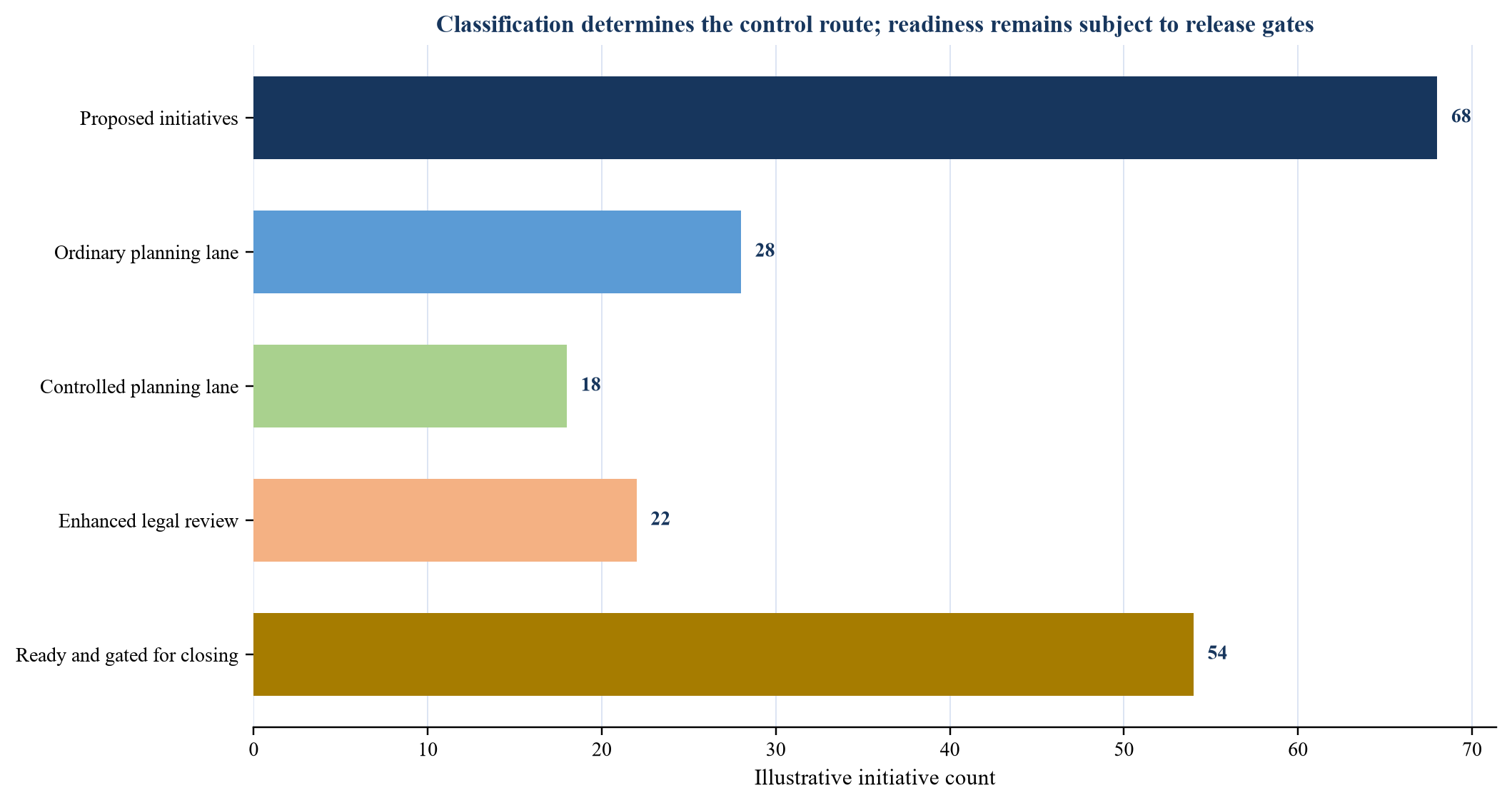
Counts are scenario assumptions for the worked case.
22. Closing discipline protects both legality and value
Gun-jumping control should be treated as a transaction operating system. It connects legal requirements to people, data, decisions, meetings, communications and workstream activity. The system becomes useful when every participant can identify the permitted lane and obtain a quick decision.
The core disciplines are practical. Define the transaction decision before requesting information. Keep current commercial authority separate. Translate covenants into a narrow, documented consent process. Use clean teams for restricted analysis. Put closing gates into integration plans. Record customer and supplier contact. Map authority orders to owners and evidence. Prepare for delay and failure as well as closing.
The hypothetical case shows how 68 proposed initiatives can be sorted into ordinary planning, controlled planning and enhanced review. That classification does not prevent readiness. It directs sensitive work into a controlled route and keeps operational implementation behind the proper trigger.
Boards should ask whether the parties can prove continued independence, explain each joint activity, identify who accessed sensitive information and show why an action occurred when it did. A disciplined evidence file improves those answers. It also helps the team move quickly at closing because the release conditions and sealed packs have already been tested.
This paper provides a management framework. It does not determine the legal treatment of any transaction. Parties should obtain current advice for each relevant jurisdiction, agreement, market relationship and authority process.
Sources
- US Federal Trade Commission, Avoiding Antitrust Pitfalls During Pre-Merger Negotiations and Due Diligence, 20 March 2018. Read the primary source
- US Department of Justice, Deputy Assistant Attorney General Andrew Forman Delivers Remarks to the ABA M&A Committee, 16 September 2022. Read the primary source
- US Federal Trade Commission, Oil Companies to Pay Record FTC Gun-Jumping Fine for Antitrust Law Violation, 7 January 2025. Read the primary source
- Council of the European Union, Council Regulation (EC) No 139/2004 on the Control of Concentrations Between Undertakings, 20 January 2004. Read the primary source
- Court of Justice of the European Union, Altice Group Lux v European Commission, Case C-746/21 P, Judgment, 9 November 2023. Read the primary source
- European Commission, Merger Control Procedures. Read the primary source
- UK Competition and Markets Authority, Interim Measures in Merger Investigations: Summary for Businesses, updated 23 June 2025. Read the primary source
- Australian Competition and Consumer Commission, Mergers and Acquisitions, mandatory regime effective 1 January 2026. Read the primary source
- OECD, Suspensory Effects of Merger Notifications and Gun Jumping, Competition Policy Paper No. 276, 28 March 2018. Read the primary source
- UK Competition and Markets Authority, Interim Measures and Derogations in Merger Investigations, updated 23 June 2025. Read the primary source
- UK Competition and Markets Authority, Merger Assessment Guidelines, updated 3 September 2026. Read the primary source
- Australian Competition and Consumer Commission, Gun Jumping Risks for Merger Transactions, 23 May 2019. Read the primary source
- Australian Competition and Consumer Commission, Cryosite to Pay AUD 1.05 Million for Gun Jumping Cartel Conduct, 13 February 2019. Read the primary source
- US Department of Justice and Federal Trade Commission, Merger Guidelines, 18 December 2023. Read the primary source
- US Federal Trade Commission, Premerger Notification Program, current filing and waiting-period notices. Read the primary source
- Competition Bureau Canada, Overview of the Merger Review Process, updated 2025. Read the primary source
- Competition and Consumer Commission of Singapore, Merger Assessment Process, updated 23 May 2025. Read the primary source
