

Introduction
Semiconductor manufacturing partnerships combine industrial policy, construction, intellectual property, equipment, materials, utilities, workforce and customer qualification. Each workstream can progress on a different clock. A government approval can precede a fiscal support agreement. A technology licence can be signed before process recipes are transferred. A cleanroom can be mechanically complete while power quality, ultra-pure water or tool-hookup systems remain unavailable. A pilot wafer can pass an engineering test before a customer accepts the product. These differences create valuation risk when transaction documents collapse several stages into a single word such as approved, transferred, installed or operational.
India provides a current setting for this problem. The national programme launched with an INR 760 billion outlay and support across silicon fabs, display fabs, compound semiconductors, packaging and design [1-4]. Official releases identify projects involving Tata Electronics and Powerchip Semiconductor Manufacturing Corporation, Micron, Tata Semiconductor Assembly and Test, CG Power with Renesas and Stars Microelectronics, Kaynes Semicon, HCL and Foxconn, and additional compound-semiconductor and packaging investments [8-14]. Tata Electronics has disclosed a definitive technology-transfer agreement with PSMC for a planned 300 millimetre fab spanning 28 nanometre to 110 nanometre technologies and capacity of up to 50,000 wafers per month [15-17]. Micron announced in February 2026 that its Sanand assembly and test facility had begun commercial production [18-20].
The transaction question is therefore practical: what support is legally available and when will cash arrive; what manufacturing capability will the technology partner actually deliver; what infrastructure and people must exist before that capability can operate; how quickly can products reach qualified economic yield; and how should capital providers price, fund and govern the remaining risk? This paper answers those questions through a staged evidence architecture. It is intended for corporate-development teams, strategic investors, private-equity funds, lenders, family offices, public bodies and boards. It does not provide engineering, legal, tax, accounting, regulatory or investment advice. Each project requires current specialist review.
1 Convert partnership announcements into a controlled project perimeter
The first task is to define the project that capital will actually fund. Public announcements often combine several legal entities, sites, phases and forms of support. The investment perimeter should specify land, buildings, utilities, tools, process technologies, product families, design enablement, packaging, test, intellectual property, people, shared services and working capital. Each item should be classified as owned, licensed, leased, contributed, grant funded, supplied by an affiliate, delivered under a services agreement or excluded.
The legal entity receiving an incentive may differ from the entity owning land, borrowing debt, employing engineers or contracting with customers. The technology partner may license process technology to one entity while providing engineering support to another. State support can be delivered through land, electricity, water, tax or infrastructure rather than cash. The model should map every right and obligation to a named entity and identify guarantees, restrictions, change-of-control provisions, related-party contracts and termination consequences.
The perimeter should also distinguish the first production line from future phases. Announced project cost can include expansion modules, optional equipment, capitalised interest, contingency and infrastructure shared with later lines. Valuation should use the funded phase and its stand-alone economics. Expansion options can be modelled separately when land, utilities, permits, process rights and financing capacity make them credible.
Official scheme guidelines require applicants to provide project financials, funding sources, ownership, projected financial statements, operational requirements, ramp-up timelines, manpower, capital goods, raw materials, market assessment, technology-upgrade plans, research collaboration and regulatory treatment [3,4]. That information is also a useful transaction perimeter. The buyer should reconcile the approval submission, fiscal support agreement, board-approved investment case, financing model, engineering budget and current procurement schedule. Differences should be explained before value is assigned.
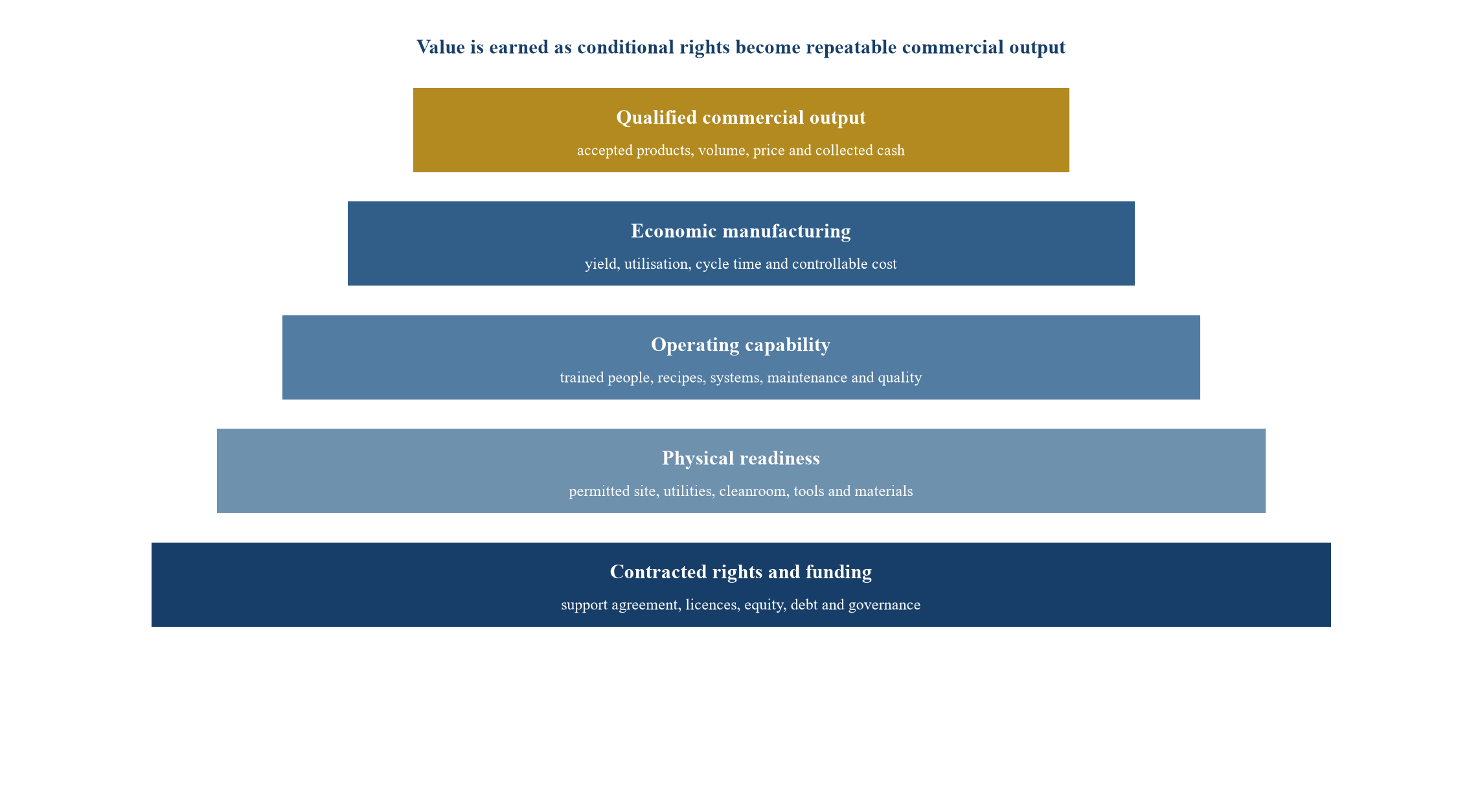
Proposed transaction architecture; each layer depends on the evidence below it.
| Value layer | Minimum evidence | Principal question | Failure consequence |
|---|---|---|---|
| public support | approval, fiscal support agreement, eligible-cost schedule, claim evidence | when is each amount legally claimable and payable | nominal support is treated as available cash |
| technology | licence, process list, deliverables, acceptance, support and upgrade rights | what capability can be used independently in India | know-how remains dependent on the partner |
| physical plant | land, permits, utilities, cleanroom, tool plan and commissioning tests | can the funded phase reach controlled production | schedule and capital are understated |
| operating organisation | named roles, training, procedures, systems and escalation | can local teams operate and improve the process | ramp depends on scarce external personnel |
| commercial output | qualified products, design wins, orders, acceptance and cash | will usable capacity produce profitable demand | capacity is valued without customers or yield |
Proposed diligence structure; transaction-specific legal and technical review is required.
2 Value fiscal support as milestone-dependent cash
A support percentage is an upper boundary, not an opening cash balance. The model should begin with the executed support instrument and its eligible-cost definition. Land, buildings, tools, taxes, duties, financing costs, working capital, related-party expenditure, used equipment and cost overruns can receive different treatment. Claims may require sponsor spending, certification, physical progress, invoice evidence, bank guarantees or compliance with a project schedule. Pari-passu support can still create timing gaps because government and sponsor verification cycles differ.
Each support line should therefore be modelled through six dates: cost commitment, invoice, payment, claim eligibility, claim submission and cash receipt. The model should show disallowed costs, claim holdbacks, documentation lag, foreign-exchange effects and audit adjustments. A delay in support cash can increase bridge debt and capitalised interest even when the nominal amount is ultimately received. Lenders should size liquidity against the longest credible lag rather than the base-case claim calendar.
Central and state support should be separated. A state package can include subsidised land, water, electricity, stamp duty, employment incentives or reimbursement. The economic value depends on actual consumption and enforceability. A power tariff concession has limited value before production and can expire before full utilisation. Infrastructure delivered outside the project company should be valued through availability and performance rather than construction budget.
The illustrative case assumes nominal support of USD 5.6 billion. Management assumes USD 4.7 billion is eligible cash support linked to certified project cost, USD 0.5 billion is the discounted value of state infrastructure and operating concessions, and USD 0.4 billion is held as contingent or disputed value. The base case assumes support cash arrives an average of six months after the underlying sponsor payment. These are management assumptions. A transaction should replace them with the executed agreements and claim history.
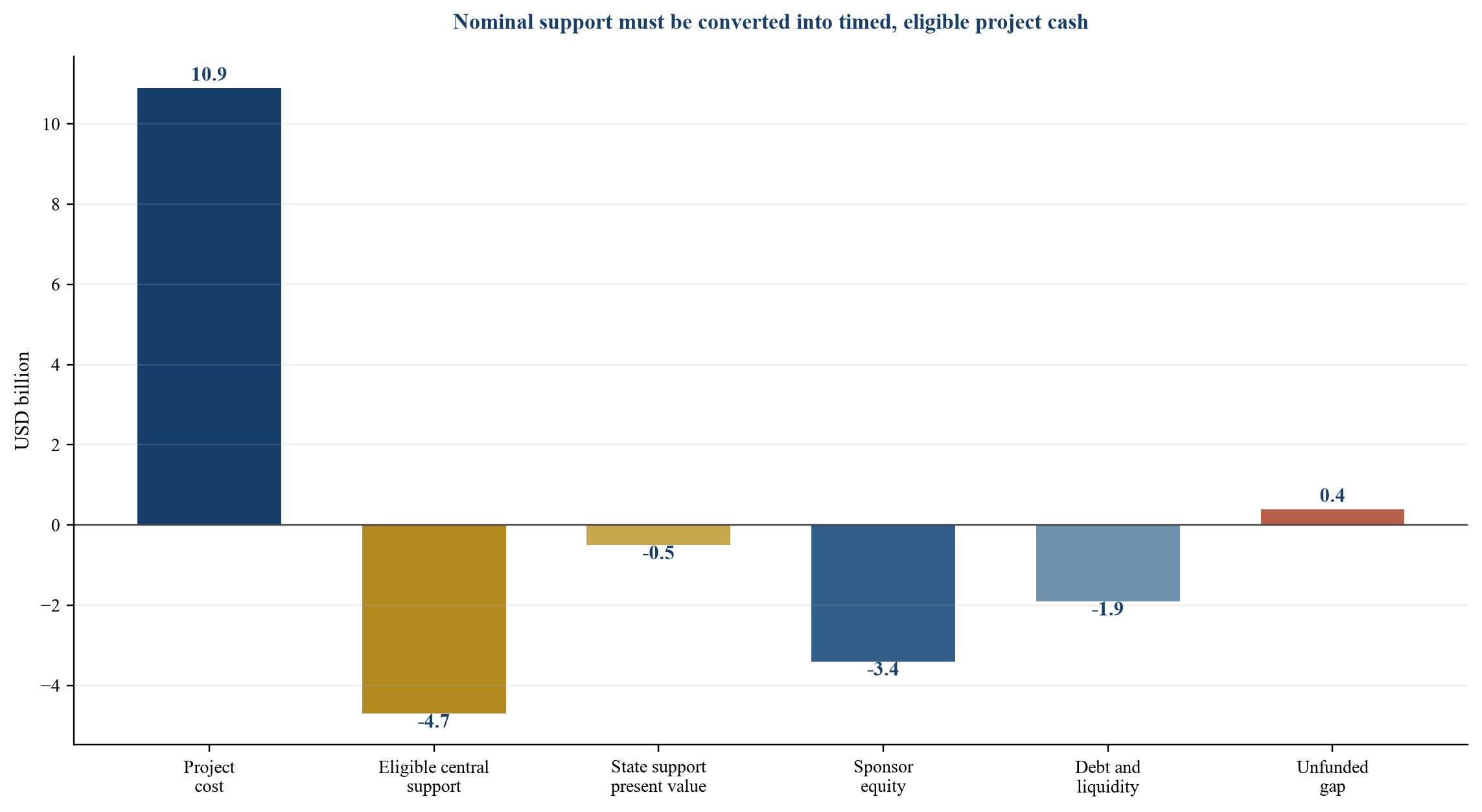
All amounts are management assumptions in USD billions and do not describe an identified project.
| Support component | Evidence required | Model treatment | Transaction protection |
|---|---|---|---|
| project-cost grant | executed agreement, eligible-cost rules, certifications and receipts | probability-weighted cash by claim and receipt date | minimum sponsor liquidity and delayed-disbursement reserve |
| state land or infrastructure | title, access, completion tests and service obligation | value only when available to the funded phase | condition precedent and completion covenant |
| electricity or water concession | tariff, volume, term, escalation and performance | operating-cost benefit linked to actual production | downside tariff and outage sensitivity |
| tax or duty support | eligibility, taxable base, refund method and expiry | cash-tax or landed-cost benefit by period | covenant to maintain qualifying conditions |
| training or employment support | eligible roles, evidence and retention period | offset only against supported cost | clawback reserve and reporting control |
Proposed control schedule; the executed programme and project documents govern.
3 Decompose technology transfer into accepted deliverables
Technology transfer should be a deliverable register rather than a contractual label. For a foundry, the register can include process flows, unit-process windows, device models, design rules, process design kits, standard-cell and analogue intellectual property, mask data requirements, metrology methods, control plans, defect taxonomies, reliability methods, equipment recipes, maintenance procedures, supplier qualifications, yield-learning methods and engineering escalation. Packaging and test projects require equivalent detail for package design, materials, assembly, inspection, test programmes, burn-in, reliability and customer qualification.
Tata Electronics states that PSMC will provide design and construction support, license a portfolio of technologies and support engineering transfer to the Dholera fab [15,16]. Tata also identifies intended collaboration with Synopsys on TCAD flows, process design kits, design enablement, intellectual property and yield data analytics [21]. Partnerships with equipment and materials companies address further parts of the operating system [22-27]. These disclosures demonstrate the breadth of the ecosystem. The exact legal rights, acceptance criteria, duration, staffing and remedies for an unidentified project cannot be verified from public announcements.
Every deliverable should have an owner, source, format, due date, acceptance test, dependency, permitted use, confidentiality classification and post-transfer support obligation. Acceptance should demonstrate usability in the local operating environment. A document repository is weak evidence when recipes cannot run on installed tools, design kits cannot produce qualified test vehicles, or local engineers cannot diagnose deviations without partner intervention.
The licence should be mapped across territory, legal entity, site, process node, product, customer, field of use, sublicensing, modification, derivative works, confidentiality, audit, infringement, termination and change of control. Improvements created during ramp require clear ownership and use rights. The project should also define access to future corrections and upgrades. A static licence can become less valuable when customers, equipment or materials change.
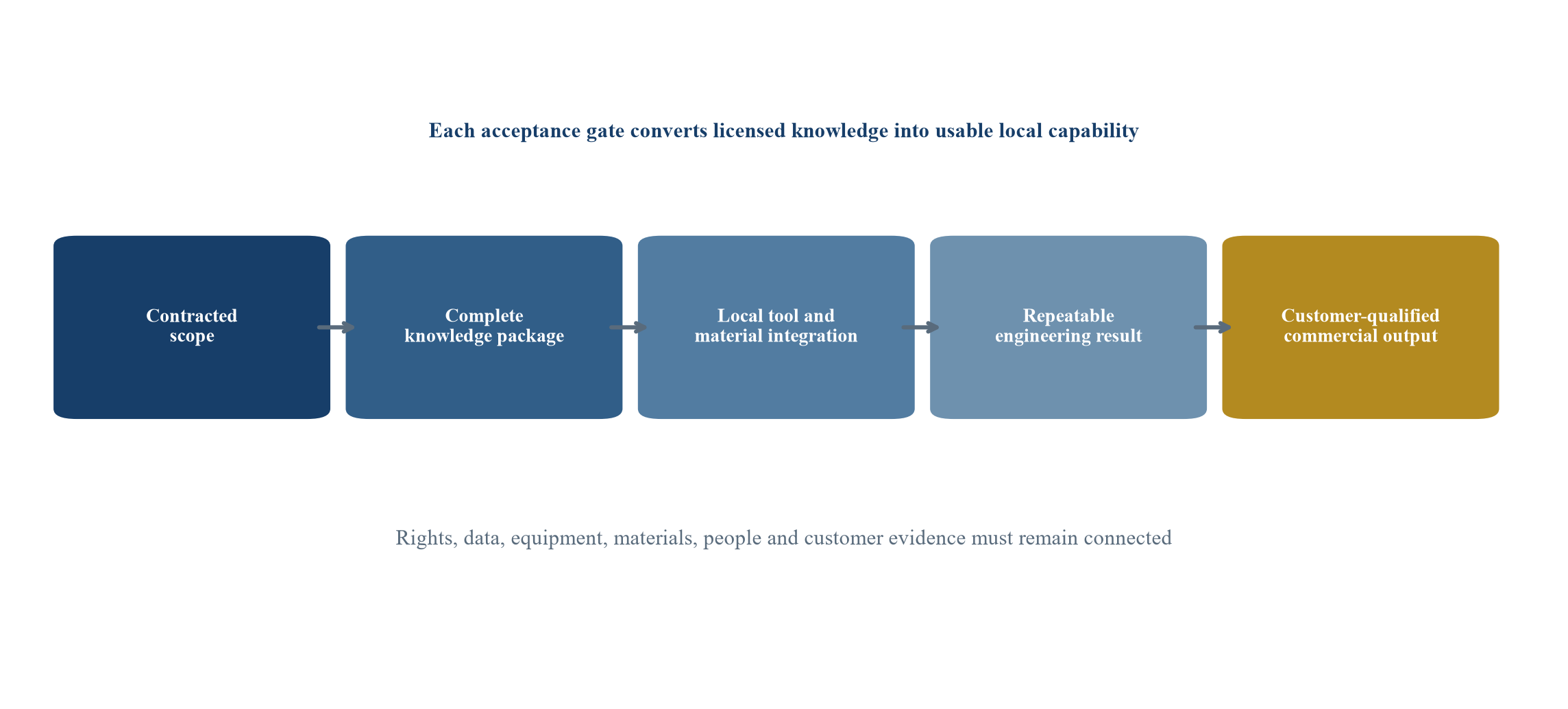
Proposed acceptance sequence; documentary delivery alone does not establish manufacturing independence.
4 Align process nodes, product portfolio and market demand
A semiconductor fab earns returns from products rather than wafer-start capacity. The investment case should connect each process technology to qualified product families, addressable customers, mask and qualification requirements, expected wafer demand, die size, gross die per wafer, yield, selling price and product life. A broad node range can create strategic flexibility while increasing process integration, equipment configuration, design enablement and qualification work.
Mature-node technologies serve automotive, industrial, power management, display, connectivity and embedded-control applications. These markets often require reliability, long product lives and change control. A customer may require automotive qualification, production-part approval, traceability, business continuity and multi-year supply commitments. The project should identify which qualifications belong to the process, product, package, site and customer. Revenue should enter the base case only when the path from design to accepted shipment is evidenced.
The design-win pipeline should separate interest, technical engagement, tape-out, test wafer, qualification, nominated programme, purchase commitment and production order. Customer names and forecast quantities should reconcile to agreements and account plans. The buyer should test whether demand is incremental or transferred from the technology partner, affiliated companies or another foundry. It should also examine concentration, cancellation, pricing, allocation rights and minimum commitments.
Product mix affects economics. Larger die reduce gross die per wafer. More masks and process steps increase cycle time and cost. Automotive qualification can delay revenue while supporting longer product life. Commodity products can fill capacity but expose the project to price cycles. The model should therefore forecast wafer starts, good die, package and test yield, revenue and contribution by product cohort.
| Stage | Minimum evidence | Forecast treatment | Key risk |
|---|---|---|---|
| market interest | documented application and addressable demand | excluded from contracted case | demand is thematic rather than customer backed |
| technical engagement | product requirements and process-fit review | option case only | process or package cannot meet specification |
| tape-out committed | design kit, mask plan, funded engineering and schedule | probability-weighted engineering volume | redesign or schedule slippage |
| qualification | test plan, lots, reliability and customer acceptance route | staged ramp after passing gates | yield and reliability remain unproven |
| design win | nomination, programme timing and commercial terms | risk-adjusted production forecast | end-market volume or launch can change |
| production order | accepted qualification, order and shipment schedule | base case subject to capacity and credit | execution, price and collection |
Proposed commercial classification; contracts and customer-specific qualification evidence control the conclusion.
5 Build an integrated critical path from site to qualified wafer
The project schedule should connect permits, civil works, cleanroom readiness, utilities, equipment delivery, hook-up, facilities acceptance, process installation, engineering lots, reliability, customer qualification and production. Separate schedules can conceal a dependency. A lithography tool cannot produce qualified wafers when vibration, temperature, gases, chemicals, waste treatment, automation or metrology are unavailable.
Semiconductor fabs require reliable electricity, ultra-pure water, bulk and specialty gases, chemicals, environmental controls, wastewater treatment, logistics and emergency response. The transaction team should test contracted capacity, redundancy, quality, commissioning, tariffs and expansion headroom. It should identify infrastructure supplied by government or park authorities and define performance remedies. A completed connection is not the same as stable quality under production load.
Long-lead equipment should be mapped to process capability and the construction critical path. Purchase orders should identify specification, factory acceptance, shipping, import, site acceptance, installation, warranty, service, spare parts, software, export authorisation and payment. The project should distinguish firm orders, cancellable reservations, vendor forecasts and future options. Equipment changes can require recipe redevelopment and requalification.
The schedule should include learning time. Mechanical completion, tool acceptance, process qualification and customer qualification are distinct. Accelerating civil work cannot remove the cycles needed to identify defects, adjust process windows, validate reliability and demonstrate consistency. The investment committee should see schedule ranges and the cash consequence of each gate.
6 Model ramp through engineering yield, customer yield and economic yield
Yield should be defined at several levels. Equipment availability measures whether tools can run. Process yield measures whether wafers complete the flow. Parametric yield measures electrical performance. Functional die yield measures usable devices. Package and final-test yield determine shipped units. Customer yield can incorporate application and reliability acceptance. Economic yield includes scrap, rework, cycle time, consumables, test cost, warranty and realised selling price.
Public-company disclosures repeatedly identify manufacturing yield, qualification and ramp as material risks [28-34]. Process and design interactions can delay identification of root causes. A yield percentage without product, layer, defect, test and period definitions is therefore weak evidence. The model should use lot-level data, control limits, defect pareto, hold and rework, equipment history, material genealogy and product outcomes.
The ramp plan should separate technology-transfer maturity from local learning. A transferred process may have an established result at the source fab. Different tools, materials, facilities, staff, measurement systems and product designs can create local variation. Golden-tool matching, correlation wafers, split lots and reference materials can help establish equivalence. The acceptance plan should define the statistically relevant evidence for each process and product.
Management assumes the illustrative fab reaches monthly output equivalent to 10% of installed capacity in the first production year, 35% in the second, 62% in the third, 78% in the fourth and 88% in the fifth. Management assumes economic yield rises from 42% to 88% across the same period. These values are assumptions. The transaction should replace them with process-specific learning curves, tool availability, product qualification and customer demand.
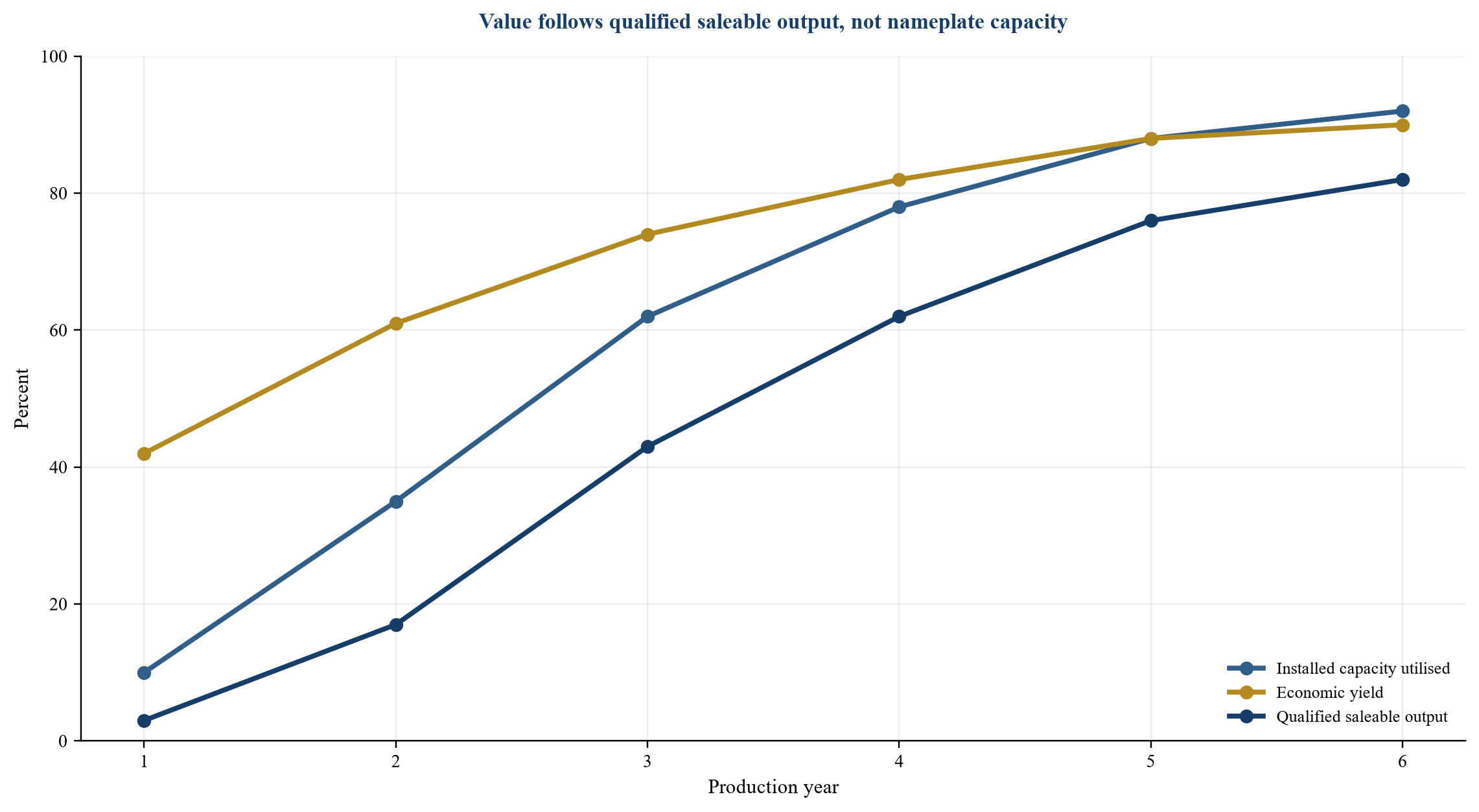
Percentages are management assumptions used solely to demonstrate the method.
| Ramp signal | Evidence | Investment interpretation | Required response |
|---|---|---|---|
| tool availability below plan | uptime, alarm, maintenance and spare records | capacity cannot be converted into learning cycles | vendor escalation, spares and maintenance recovery plan |
| stable process but low die yield | parametric maps, defect pareto and design interaction | process-design window or contamination issue | controlled experiments and product-specific corrective action |
| engineering yield improving but qualification late | reliability lots, test failures and customer gates | technical progress has not converted to revenue | qualification owner, schedule and customer decision map |
| output rising with weak economics | scrap, rework, consumables, cycle time and price | volume is consuming cash | product mix, cost and pricing intervention |
| one product succeeds while others fail | product-level lot and test history | platform transfer is incomplete | separate proven and unproven process variants |
Proposed operating framework; thresholds should be set for the specific process and product.
7 Treat utilities, materials and service support as production assets
Utilities and materials determine process stability. The project should map electricity quality, backup, water intake, ultra-pure water, waste treatment, gases, chemicals, bulk delivery, storage, hazardous-material handling and environmental permits. Capacity should be tested at each ramp stage with maintenance and contingency. A single-source utility or material can become the true production constraint.
Materials require purity, lot consistency, shelf life, logistics, qualification and change control. A local supplier can reduce lead time and foreign-exchange exposure after qualification. Early localisation can create yield risk when material equivalence is unproven. Tata Electronics announced collaborations in September 2026 addressing semiconductor chemicals, materials and supply-chain logistics for its Dholera fab [24-27]. Those announcements illustrate the need to build local supply capability alongside process technology.
Equipment service should be treated as part of production availability. The project should verify local field engineers, response commitments, spare depots, repair routes, remote diagnostics, software licences, calibration and export permissions. Tata's collaborations with Tokyo Electron and ASML explicitly mention equipment support, training, ramp-up and supply-chain resilience [22,23]. The transaction model should convert those commitments into named service capabilities and tested response plans.
The buyer should also evaluate dependency concentration. A critical chemical can come from one qualified source. A metrology tool can rely on one specialist. A foreign service engineer can require immigration and export permission. The risk register should connect each dependency to inventory, alternative qualification, contractual support, insurance, schedule and valuation.
8 Measure workforce readiness through demonstrated competence
Headcount is an input. Manufacturing readiness requires competent teams across process integration, module engineering, equipment, facilities, manufacturing, quality, product engineering, yield, reliability, test, supply chain, safety, cybersecurity and finance. Each critical role should have a staffing plan, experience requirement, training path, certification, shift coverage and succession.
Technology-transfer personnel should be mapped to deliverables. The plan should identify who teaches, who learns, where training occurs, which language and documents apply, how long secondments last, and what performance demonstrates independence. Classroom attendance does not prove the ability to control a process excursion, qualify a material change or recover a tool. Proficiency gates should include supervised operation, problem diagnosis, recipe control, statistical process control and independent sign-off.
India has a large semiconductor design workforce and government programmes report expanded access to electronic design automation tools and training [5-7,35-38]. Manufacturing requires additional tacit capability. The project should distinguish design talent from high-volume manufacturing experience. Retention packages should focus on roles whose departure can stop a module, customer programme or regulatory approval.
The operating model should define escalation after the initial transfer. A ramp produces new defects and process interactions. The technology partner's support term, response, on-site commitment, remote access, confidentiality and cost should extend through relevant qualification and yield gates. The board should monitor the decline in external dependency as a positive operating indicator.
| Capability | Evidence of readiness | Dependency indicator | Board metric |
|---|---|---|---|
| process integration | independently released flow and controlled change | partner approves routine decisions | percent of releases completed locally |
| module engineering | stable control charts and resolved excursions | repeated remote troubleshooting | closure time and repeat-defect rate |
| equipment engineering | preventive maintenance and recovery competence | vendor engineer required for common faults | tool availability and local first-time fix |
| yield and product | lot genealogy, pareto and corrective action | analysis depends on partner systems | learning-cycle time and verified yield gain |
| quality and reliability | passed audits, reliability plans and traceability | customer evidence assembled externally | qualification pass rate and audit findings |
| facilities | stable utility quality under load | critical operation relies on expatriates | excursions, outages and independent shift coverage |
Proposed readiness schedule; role counts and proficiency thresholds are project specific.
9 Protect intellectual property, data and cyber operations
Semiconductor partnerships exchange sensitive process knowledge, design data, equipment data, customer information and manufacturing analytics. The project should classify information by owner, licence, purpose, location, access, retention and export-control status. It should separate the technology partner's background intellectual property, project-created improvements, customer intellectual property and the project company's operational data.
Process recipes and design kits should be controlled through approved repositories, identity, logging, change management and segregation. Customer data can require contractual isolation. Equipment vendors may need remote access. The project should test whether cybersecurity architecture allows support while protecting trade secrets and production. NIST and IEC guidance provide useful control frameworks, while customer requirements and Indian law govern the actual implementation [39-42].
Change of control can affect licences, support and data permissions. An investor should review assignment, sublicensing, termination, escrow, source access, continuity and step-in rights before underwriting value. A lender should understand which assets remain usable following enforcement. A partnership can have valuable physical plant and limited recoverable process capability when licences terminate.
Intellectual-property disputes can also interrupt ramp. The project should maintain provenance for transferred documents, recipes, software and improvements. Freedom-to-operate work should match products and jurisdictions. Representations and indemnities allocate historical exposure. Operating controls reduce the chance of contamination after closing.
10 Build customer qualification into the financing plan
Customer qualification consumes wafers, masks, test capacity, engineering time and calendar. The financing plan should therefore fund qualification as a defined work package. Each product should have requirements, sample plan, reliability tests, acceptance criteria, owner, schedule, cost and commercial consequence. The model should include failed lots, redesign, repeat testing and customer decision time.
Qualification evidence should connect to revenue. A passed generic process qualification may allow customer engagement while leaving product and application approval outstanding. Automotive, industrial and infrastructure applications can require extensive reliability and change-control evidence. Customers can also require site audits, quality-system certification, business-continuity plans and approved suppliers.
Commercial agreements should address engineering charges, masks, samples, reserved capacity, pricing, yield allocation, forecasts, cancellations and liability. A take-or-pay commitment can support financing when it is enforceable, creditworthy and aligned with qualification. A non-binding forecast should remain a demand scenario. The investment committee should see the contractual category rather than a blended pipeline value.
Micron's February 2026 announcement describes commercial production at Sanand and an initial shipment of made-in-India memory modules to a customer [18]. That is a concrete conversion from facility investment to shipment. It does not establish the ramp profile or economics of other projects. Each partnership needs its own customer-evidence ladder.
11 Separate project completion from economic completion
Project completion can be defined through construction, commissioning and budget. Economic completion requires sustained qualified output, customer acceptance, cost performance and cash collection. Debt documents and sponsor support should distinguish these stages. A plant can meet mechanical completion while requiring substantial cash for yield, qualification, inventory and operating losses.
Completion tests should cover physical scope, permits, utility performance, tool acceptance, process capability, production volume, yield, quality, qualified products and liquidity. Tests should be objective, measurable and aligned with the downside case. Waivers should require a funded cure plan rather than a change in terminology.
The financing structure can include sponsor equity first-loss, delayed-draw debt, cost-overrun support, liquidity reserves, public-support bridge facilities and working-capital lines. Interest should be modelled through the ramp. Covenants should allow engineering variation while protecting against unsupported expansion, related-party leakage and loss of key licences.
Insurance should be reviewed for construction, marine cargo, delay in start-up, property damage, machinery breakdown, business interruption, cyber, environmental and liability exposure. Coverage should match the long lead times and concentration of critical tools. Insurance cannot replace operational resilience; exclusions, deductibles and claim periods should enter the liquidity model.
| Gate | Illustrative evidence | Capital consequence | Failure response |
|---|---|---|---|
| physical completion | certified scope, permits, utilities and tool hook-up | release commissioning tranche | sponsor-funded cure and schedule reset |
| process readiness | stable modules, control limits and repeatable test vehicles | release engineering-ramp tranche | retain contingency and partner support |
| customer qualification | accepted product and reliability evidence | permit commercial working capital | restrict revenue-backed leverage |
| economic completion | sustained output, yield, cost and liquidity | convert completion support and normalise covenants | extend support or restructure debt |
| independent operation | local staff, systems, service and licence continuity | release holdback or contingent value | extend services, escrow or step-in rights |
Proposed financing framework; legal documents should define project-specific tests and remedies.
12 Translate risk into valuation rather than one discount rate
A single discount-rate premium obscures the source of risk. Valuation should separate proven assets, conditional public support, technology rights, construction, ramp, customer demand and expansion options. Each component should use evidence-appropriate cash flows and probabilities. Correlated risks should be modelled together. A support delay can increase debt exactly when a yield delay consumes cash.
The base enterprise value should use cash flows after remaining capital expenditure, support timing, ramp losses, maintenance capital, working capital and taxes. The model should show value at current evidence, value after defined milestones and sponsor value after financing. Comparables should be adjusted for business model, process maturity, utilisation, customer concentration, support and capital intensity.
Replacement cost can inform downside analysis but does not establish earning value. Equipment can be site specific, technologically configured and expensive to relocate. Public support can be repayable or non-transferable. Intellectual property can terminate. The liquidation case should therefore assess tool marketability, removal, decontamination, export restrictions, liens, licence survival and time.
In the illustrative case, management assumes a fully ramped discounted cash-flow value of USD 12.8 billion before execution adjustments. Management deducts USD 2.1 billion for remaining unfunded capital and support timing, USD 1.3 billion for construction and utility risk, USD 1.6 billion for yield and qualification risk, and USD 0.8 billion for customer and price risk. It adds USD 0.6 billion for separately funded expansion options, producing an illustrative current enterprise value of USD 7.6 billion. Every value is a management assumption.
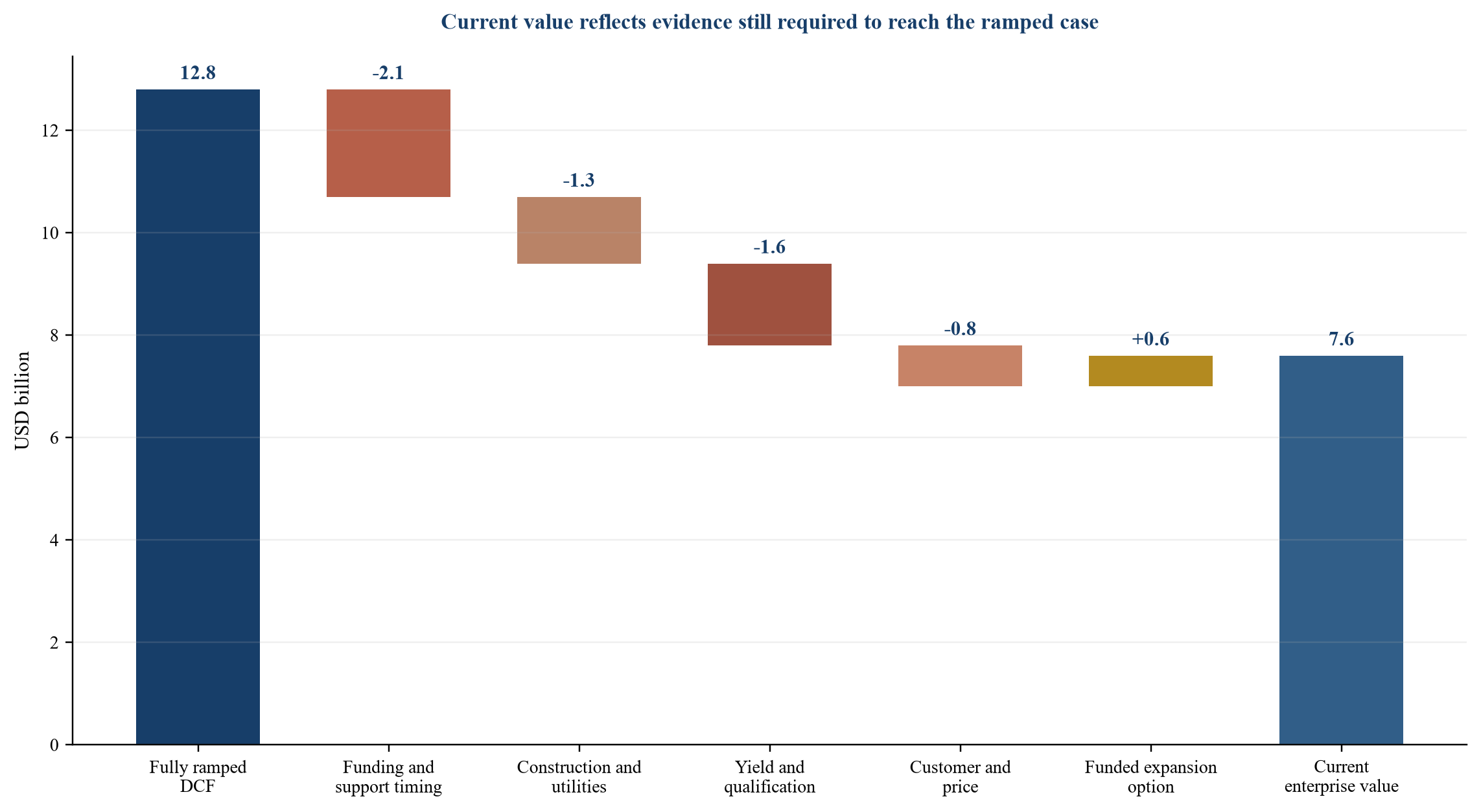
All amounts are management assumptions in USD billions and do not describe an identified project.
13 Use transaction structure to fund proof and allocate uncertainty
Transaction structure should match the evidence sequence. A minority investor can subscribe capital in tranches tied to support agreements, construction, tool acceptance, process readiness and customer qualification. An acquirer can use completion accounts, holdbacks, earn-outs, warranties and specific indemnities. A lender can link drawdowns and covenant step-downs to completion tests. A strategic partner can contribute licences, people or customer access with acceptance-based vesting.
The shareholder agreement should reserve decisions that can change the investment case: budget, financing, technology licence, related-party contracts, expansion, customer concentration, material sourcing, capital disposal, intellectual-property changes and settlement of support claims. Deadlock and exit provisions should account for strategic dependence. A put right has limited value without a funded counterparty or enforceable security.
Contingent value should use metrics within the responsible party's control and protected from manipulation. Useful milestones can include accepted process modules, customer qualification, support cash receipt, sustained good-wafer output or economic yield. Metrics should define product mix, measurement period, accounting, extraordinary events, audit and dispute resolution. Revenue alone can reward low-margin output or inventory loading.
The project should also plan for failure. Step-in rights, licence continuity, source escrow, access to technical documentation, transitional services, key-person retention, spare parts and data portability can preserve option value. A staged stop-loss process should define when the board pauses expansion, changes product mix, seeks another partner, restructures financing or exits.
14 Build governance around evidence, cash and corrective action
The board needs one integrated dashboard that connects schedule, spend, support claims, technology transfer, utilities, tools, people, yield, customers and liquidity. Separate functional dashboards can show green while the combined critical path is late. Each metric should have a definition, source system, owner, baseline, threshold, corrective action and audit trail.
Schedule reporting should distinguish original, approved and current forecast dates. Cost reporting should show commitments, invoices, paid cash, eligible claims, submitted claims and received support. Technology reporting should show deliverables accepted and demonstrated locally. Ramp reporting should show lot-level learning, qualification and economic output. Commercial reporting should show design-win stage, contract category, forecast changes and collections.
An independent technical adviser can validate gates for lenders or minority investors. The adviser should have access to raw evidence and defined scope. Management remains responsible for operation. The board should receive exceptions and decisions rather than a volume of unprioritised data.
Governance should protect reporting integrity. Related-party purchases, technology fees, service charges and cost allocations require transparent approval. Support compliance and claims should be independently reviewed. Cybersecurity and intellectual-property incidents should have escalation. Whistleblowing and safety systems are relevant to both legal compliance and production continuity.
| Dimension | Core metric | Evidence source | Board decision triggered |
|---|---|---|---|
| funding | cash runway, undrawn facilities, eligible support and claim lag | treasury, claim ledger and lender certificates | equity call, bridge draw or spending restriction |
| schedule | critical-path float and gate forecast | integrated project schedule | recovery plan or phase resequencing |
| technology | accepted deliverables and local independent demonstrations | transfer register and acceptance records | release milestone payment or require cure |
| operations | tool availability, excursions and utility stability | manufacturing and facilities systems | vendor escalation or capacity restriction |
| yield | good die, economic yield and learning-cycle closure | lot genealogy, test and cost systems | product focus, process intervention or stop-loss |
| customer | qualifications, design wins, orders and collections | customer records and contracts | working-capital release or forecast reset |
| people | critical-role coverage, proficiency and attrition | workforce and certification records | retention, training or partner-support extension |
Proposed governance schedule; cadence and thresholds should follow the funded project's risk.
15 Stress test correlated downside and liquidity
Semiconductor project risks are correlated. A construction delay can postpone claims, increase interest and compress training. A utility problem can delay tool acceptance and create storage or warranty issues. A low-yield ramp can consume materials, reduce customer confidence and extend operating losses. A market downturn can weaken prices exactly when the project needs volume.
The downside model should therefore use integrated scenarios rather than independent percentage changes. A delayed-support scenario should combine receipt lag, bridge interest and covenant headroom. A slow-ramp scenario should combine additional engineering lots, lower saleable output, extended partner support and customer delay. A technology scenario should include licence dispute, missing deliverables or loss of key personnel. A demand scenario should include product mix, price, utilisation and inventory.
Liquidity should cover downside cash through the next controllable gate. The project should maintain a rolling 13-week cash view and a multi-year completion model. Contingency should be accessible under the conditions that create the need. A reserve trapped behind an unmet covenant provides weak protection.
Management's illustrative downside assumes a 12-month schedule delay, average fiscal-support receipt delay of 15 months, two additional years to reach 80% economic yield, and a 12% reduction in average selling price during the first three commercial years. Management estimates an incremental USD 2.3 billion liquidity requirement under that combined scenario. This is a management assumption and is not a forecast for an identified project.
16 Execute the first thousand days through decision gates
The first thousand days should be governed through a sequence of irreversible and reversible decisions. Early work should secure land, permits, utilities, financing, support instruments, technology rights and the integrated schedule. Procurement should follow frozen process requirements and facility interfaces. Workforce and customer qualification should start before tools arrive because both have long lead times.
During construction, the project should control design changes, contingency, interface risk and long-lead items. Claims should be prepared with the same records used for project controls. Technology deliverables should arrive in time to affect tool specifications, systems, hiring and training. Customer design enablement should progress with the process baseline.
Commissioning should move from facilities to tools, modules, integrated process, test vehicles, products and customers. Each gate should have entry criteria, evidence, accountable owner and capital decision. Failed evidence should trigger corrective action and an updated cash view. Schedule pressure should not convert an engineering lot into commercial proof.
After initial production, governance should shift toward stability, yield, cost, customer quality and cash. The project should compare actual learning with the investment case and update product priorities. External partner support should decline only when local capability has passed objective proficiency gates. Expansion should begin after the first line has demonstrated a repeatable operating system or when separately funded strategic reasons justify the risk.
17 Convert findings into price, terms and actions
Diligence has value when findings change the transaction. A support agreement with clear eligible cost, claim history and current compliance can increase funded value. A nominal approval with unresolved conditions should remain contingent. A complete technology package demonstrated on local tools can support milestone payment. A broad licence with dependence on unnamed experts should require support, retention and holdback.
Construction and utility findings should change capital, schedule, conditions and contingency. Yield evidence should change the ramp curve, product mix and valuation. Customer qualification should change revenue probability and working-capital release. Licence, cybersecurity, export-control and data findings should change representations, covenants, conditions and operating design.
The final investment memorandum should state which value is proven, which value is conditional and which value is excluded. It should show the next evidence required, the capital needed to obtain it, the party responsible and the downside if it fails. This creates an auditable bridge from diligence to price and governance.
The board should approve a milestone-value map alongside the transaction. The map should identify current value, cash to the next gate, expected value after the gate and stop-loss action. That discipline prevents sunk cost from replacing evidence as the reason to continue.
Conclusion
India's semiconductor programme has created a substantial policy platform, approved projects, technology partnerships and an expanding manufacturing ecosystem. Semicon 2.0 broadens that platform across design, materials, machines, manufacturing, research and talent [5-7]. The resulting opportunities combine strategic importance with execution complexity.
An investable partnership requires five connected proofs. Public support must become eligible and received cash. Technology rights must become usable local capability. Buildings and tools must become a stable production system. Engineering output must become customer-qualified economic yield. Qualified output must become collected cash. Each transition can be measured and governed.
The transaction framework developed here values the project at its current evidence, funds the next controlled step and preserves upside through staged capital and contractual rights. It also protects liquidity through completion support, reserves and integrated downside scenarios. This approach gives strategic partners, investors, lenders and public bodies a common language for converting semiconductor ambition into accountable execution.
Sources
- India Semiconductor Mission, programme and schemes, Read the primary source
- Government of India, Cabinet modifications to the semiconductor programme, 21 September 2022, Read the primary source
- Ministry of Electronics and Information Technology, Guidelines for the Scheme for Setting Up of Semiconductor Fabs in India, Read the primary source
- India Semiconductor Mission, IPHW scheme overview, Read the primary source
- Government of India, Cabinet approves Semicon 2.0, 15 July 2026, Read the primary source
- Government of India, Semicon 2.0 programme implementation outline, September 2026, Read the primary source
- Government of India, Building the Complete Semiconductor Ecosystem, September 2026, Read the primary source
- Government of India, Cabinet approves three semiconductor units, 29 February 2024, Read the primary source
- Government of India, Mapping India's Semiconductor Ecosystem, August 2025, Read the primary source
- Government of India, Semicon India Programme project progress, 1 April 2026, Read the primary source
- Government of India, Semiconductor manufacturing fiscal support and global cooperation, 2 April 2025, Read the primary source
- Government of India, HCL-Foxconn semiconductor unit approval, May 2025, Read the primary source
- Ministry of Electronics and Information Technology, Annual Report 2025-2026, Read the primary source
- Government of India, additional semiconductor projects approved in 2025, Read the primary source
- Tata Electronics, PSMC technology-transfer agreement, 26 September 2024, Read the primary source
- Tata Electronics, semiconductor foundry overview, Read the primary source
- Tata Electronics, corporate journey and semiconductor partnerships, Read the primary source
- Micron Technology, opening of India's first semiconductor assembly and test facility, 28 February 2026, Read the primary source
- Micron Technology, 2025 Annual Report, Read the primary source
- Micron Technology, fiscal 2026 investor presentation, Read the primary source
- Tata Electronics, collaboration with Synopsys on design and ramp, 25 June 2024, Read the primary source
- Tata Electronics, strategic partnership with Tokyo Electron, 10 September 2024, Read the primary source
- Tata Electronics, strategic partnership with ASML, 16 May 2026, Read the primary source
- Tata Electronics, Sumitomo Chemical materials partnership, 18 September 2026, Read the primary source
- Tata Electronics, semiconductor newsroom, Read the primary source
- ASML, 2025 Annual Report, Read the primary source
- Tokyo Electron, Annual Report 2025, Read the primary source
- Taiwan Semiconductor Manufacturing Company, 2025 Annual Report on Form 20-F, Read the primary source
- GlobalFoundries, 2025 Annual Report on Form 20-F, Read the primary source
- KLA Corporation, 2025 Annual Report, Read the primary source
- PDF Solutions, 2024 Annual Report, Read the primary source
- Applied Materials, 2025 Annual Report, Read the primary source
- Lam Research, 2025 Annual Report, Read the primary source
- SEMI, semiconductor manufacturing standards catalogue, Read the primary source
- Government of India, semiconductor design and workforce development, 18 September 2026, Read the primary source
- Government of India, SEMICON India 2026 conclusions, 19 September 2026, Read the primary source
- India Semiconductor Mission, Design Linked Incentive Scheme, Read the primary source
- Centre for Development of Advanced Computing, Chips to Startup programme, Read the primary source
- National Institute of Standards and Technology, Cybersecurity Framework 2.0, Read the primary source
- National Institute of Standards and Technology, Secure Software Development Framework, Read the primary source
- International Electrotechnical Commission, IEC 62443 industrial cybersecurity, Read the primary source
- Digital Personal Data Protection Act 2023, Government of India, Read the primary source
- US Bureau of Industry and Security, Export Administration Regulations, Read the primary source
- Wassenaar Arrangement, control lists, Read the primary source
- IFRS Foundation, IAS 20 Accounting for Government Grants, Read the primary source
- IFRS Foundation, IAS 36 Impairment of Assets, Read the primary source
- IFRS Foundation, IFRS 12 Disclosure of Interests in Other Entities, Read the primary source
- IFRS Foundation, IFRS 11 Joint Arrangements, Read the primary source
- OECD, transfer-pricing guidelines for multinational enterprises and tax administrations, Read the primary source
- World Intellectual Property Organization, intellectual-property valuation, Read the primary source
