

Introduction
Artificial-intelligence accelerators require large volumes of data to move between memory and compute with high bandwidth and manageable power consumption. HBM addresses that requirement by stacking DRAM dies and placing memory close to the processor through advanced packaging. JEDEC standards define successive generations and interfaces [1-5]. Public supplier disclosures show rapid product development, qualification and capacity investment [6-27]. The same disclosures also identify manufacturing complexity, yield, capital intensity, customer dependence and technology transitions as material commercial risks.
The valuation problem begins with the word capacity. It can refer to wafer starts, good DRAM dies, stacked cubes, packaged accelerator assemblies, qualified units, allocated output or accepted shipments. Each denominator produces a different conclusion. A buyer can overvalue a target by applying an HBM growth multiple to nominal output that lacks acceptable yield or an approved route into customer systems. A buyer can also undervalue a target whose process knowledge, customer qualification and packaging relationships create durable conversion advantages that financial statements do not separately identify.
This paper is designed for strategic buyers, private-equity investors, corporate-development teams, founders, lenders and investment committees. It provides a transaction system for diligence, valuation, deal terms and post-closing control. It does not provide engineering, legal, tax, accounting, regulatory or investment advice. Each transaction requires current specialist review of the target's products, contracts, intellectual property, manufacturing route, export position and customer evidence.
1 Define the acquisition perimeter before applying an HBM multiple
An HBM-related target may be an integrated device manufacturer, a packaging or test provider, an equipment supplier, a base-die or interface business, a materials company, a thermal-management specialist or a software and process-control provider. The buyer should identify where the target sits in the economic chain and which bottleneck it controls. A business that owns valuable process knowledge while depending on third-party wafer supply and customer-controlled packaging has a different risk profile from an integrated producer with qualified output and direct contracts.
The asset map should connect legal rights, technical capability, physical resources, customer evidence and cash. Relevant assets can include patents, recipes, masks, process-control software, test programmes, equipment, facilities, reserved capacity, supplier agreements, qualification records, reliability data, customer contracts and trained teams. A press release, development sample or customer discussion can demonstrate progress. It should remain distinct from production acceptance and recurring economics.
The buyer should classify dependencies as controlled, contracted, replaceable or unresolved. A process step performed by a strategic partner can support scale when capacity, pricing, priority, change control and continuity are enforceable. The same relationship can reduce value when access depends on goodwill or one customer's allocation. The valuation should follow the rights and evidence available to the target after a change of control.
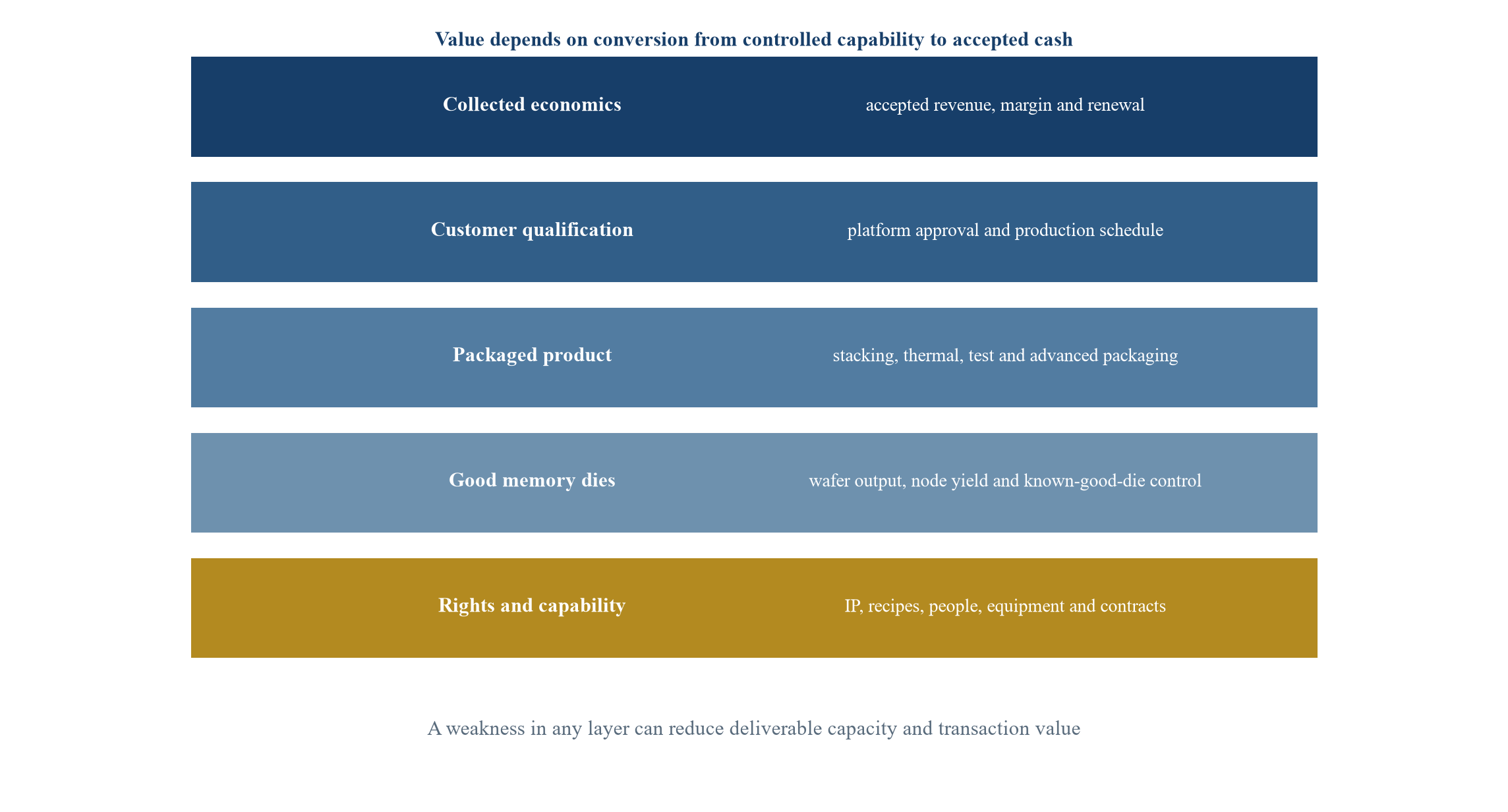
Proposed diligence architecture; each layer requires target-specific evidence.
| Value layer | Claimed asset | Minimum evidence | Principal transaction risk |
|---|---|---|---|
| technology | architecture, process, thermal and test know-how | controlled specifications, revisions, reproducible results and ownership map | capability depends on individuals or third-party rights |
| wafer supply | leading-edge DRAM output | executed allocation, node roadmap, wafer history and known-good-die yield | nominal allocation does not produce adequate good dies |
| assembly and packaging | stacking, bonding, substrate and integration route | line qualification, throughput, yield, reliability and supplier terms | packaging becomes the binding bottleneck |
| customer qualification | approved product and programme | dated acceptance, approved vendor status and production schedule | sample status is counted as recurring demand |
| economics | price, volume, margin and cash | contract, invoice, cost record, credit note and collection | scarcity price is treated as permanent structural margin |
Proposed diligence structure; documents and tests should be reconciled to source systems.
2 Reconstruct usable capacity from wafers to accepted product
HBM consumes substantial leading-edge DRAM and requires multiple dies per stack. Micron states that HBM requires more wafers to produce the same number of bits as conventional DRAM in the same technology node [6-10]. The buyer should therefore avoid treating a general DRAM wafer figure as equivalent HBM capacity. The model should identify wafer starts, die size, dies per wafer, electrical yield, dies per stack, stacking yield, packaging yield, final test, qualification and product mix.
Capacity should be measured over time. A newly installed tool or announced facility does not immediately create qualified output. Installation, process tuning, customer sampling, reliability testing and production approval can create a long conversion path. The model should show when each unit becomes available, qualified, allocated, shipped and accepted. It should also show the generation and customer programme for which it can be used.
Management assumes nominal input sufficient for 300 thousand equivalent annual stacks. Management further assumes wafer and known-good-die conversion of 82%, stacking and assembly yield of 78%, final test yield of 94% and qualification or mix availability of 95%. The illustrative chain produces approximately 172 thousand qualified equivalent units. These assumptions demonstrate the method and do not describe an identified company.
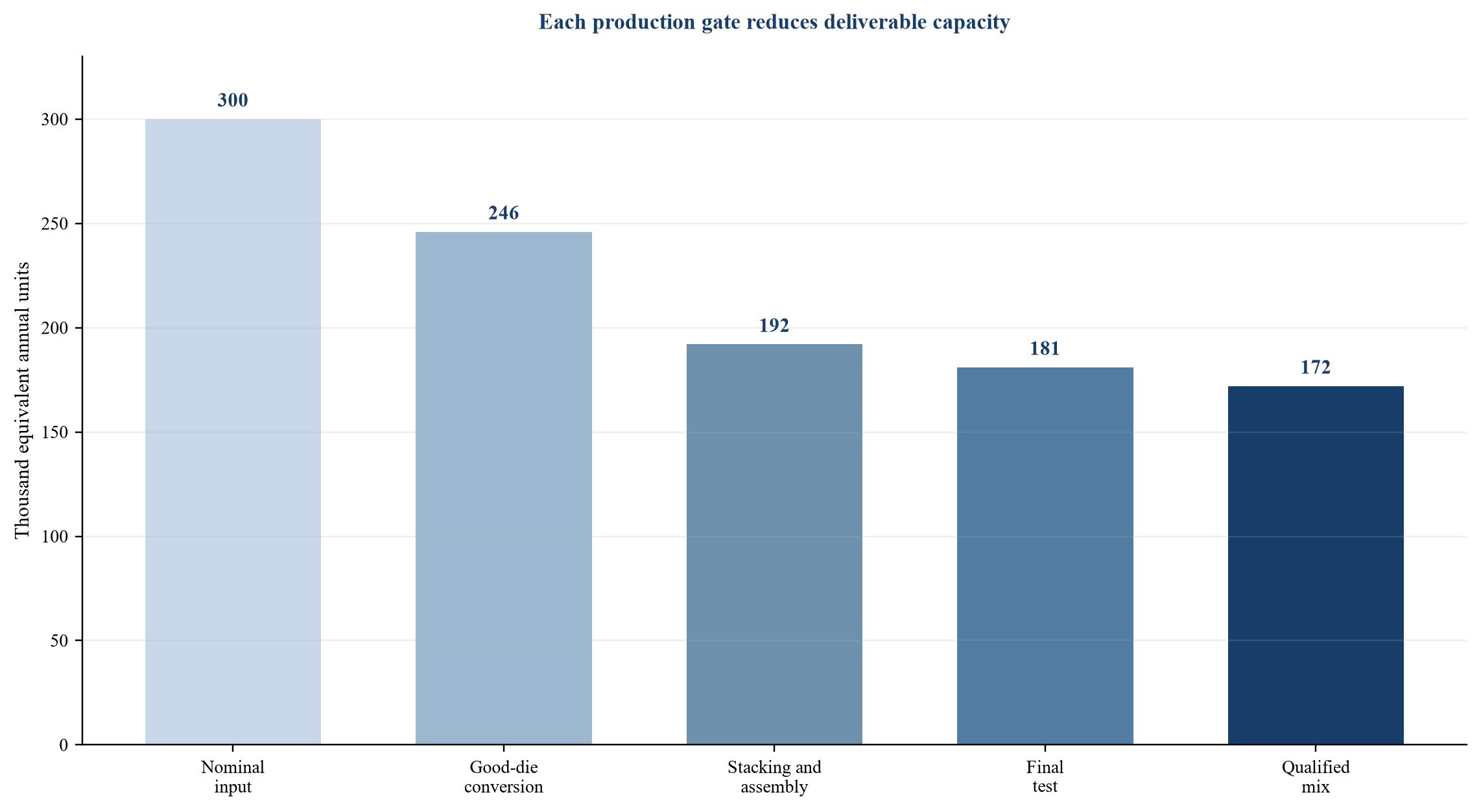
Volumes and conversion rates are management assumptions used to demonstrate the method.
| Stage | Evidence required | Valuation treatment | Common overstatement |
|---|---|---|---|
| announced | board-approved project, site, budget and schedule | option value after probability and capital | public announcement counted as operating capacity |
| installed | commissioned tools, utilities and trained team | capacity under ramp with separate yield curve | installed tool rated at nameplate throughput |
| yielding | lot-level output, scrap and rework | expected good output after sustained evidence | best lot presented as steady-state yield |
| qualified | customer approval for product and line | programme-specific saleable capacity | one qualification applied across customers and generations |
| accepted | shipment, acceptance, invoice and collection | evidenced operating economics | shipment treated as final cash without credits or returns |
Proposed classification; the buyer should use target-specific units and evidence.
The capacity bridge should reconcile units with financial statements. Production records, inventory movements, shipments, credits and collection should use consistent products and periods. Where the target cannot provide a common denominator, the buyer should retain separate physical schedules rather than force incompatible units into one headline number.
The buyer should also distinguish committed capacity from economically usable capacity. A take-or-pay reservation can secure throughput while exposing the target to cost if a customer programme slips. A customer-funded reservation can reduce financing needs while creating refund, priority or exclusivity obligations. Internal allocation can be changed by a diversified parent when another product becomes more attractive. Each capacity category should therefore state the legal right, economic burden, product restriction, time period and decision authority. The valuation should reflect capacity that the acquired business can actually use after closing.
3 Treat customer qualification as an economic asset
HBM is integrated with accelerators, base dies, interposers, substrates and system designs. Customer qualification can therefore be specific to generation, density, stack height, packaging route and platform. Micron describes customer sampling and platform qualification as important steps in its HBM roadmap [6-12]. SK hynix similarly reports sample delivery, mass-production readiness and customer collaboration [13-19]. These disclosures show why qualification is a commercial gate. They do not establish a universal timetable or customer commitment.
The buyer should inspect dated qualification plans, sample results, engineering-change records, failure analysis, customer approvals, production forecasts, purchase commitments and cancellation rights. A design win can mean technical selection, approved-vendor status, scheduled volume or an executed minimum. The diligence file should use one controlled vocabulary and require evidence before a programme moves to a higher value state.
Qualification also affects concentration. A supplier may serve several accelerator products while relying on one customer group, one packaging route or one base-die design. The model should identify economic independence rather than count programme names. It should show which revenue can survive a platform delay, redesign, supplier reallocation or generation transition.
Qualification knowledge can be an intangible asset when it shortens time to acceptance across products and customers. Its value depends on reproducible test assets, retained staff, controlled data and the right to reuse learning. Customer-specific engineering that cannot be transferred or reused should be valued through the relevant programme rather than treated as a separate platform asset.
4 Separate HBM economics from the wider DRAM cycle
Memory markets have historically experienced cycles of investment, inventory correction, pricing pressure and recovery. HBM can earn scarcity premiums and carry differentiated qualification, while still drawing on shared wafer capacity, capital budgets and customer demand. A buyer should build an HBM-specific profit bridge instead of applying the consolidated margin of a diversified memory producer or assuming that current HBM pricing remains unchanged through the forecast.
Revenue should be decomposed by product generation, capacity, unit price, customer, contract term and acceptance. Cost should include wafer input, known-good-die loss, stacking, packaging, test, freight, warranty, engineering support, qualification, depreciation and reserved-capacity commitments. The model should isolate launch inefficiency and show the path to sustainable cost. It should also include downside cases for price normalisation, slower customer ramp and a shift in product mix.
| Item | Central case | Downside case | Diligence focus |
|---|---|---|---|
| realised selling price | USD 4,800 | USD 4,080 | contract duration, rebates, mix and reset clauses |
| wafer and die input | USD 1,620 | USD 1,740 | good-die yield, allocation and node cost |
| stacking, packaging and test | USD 980 | USD 1,130 | throughput, scrap, rework and supplier pricing |
| support, warranty and logistics | USD 300 | USD 360 | qualification cost, field quality and credits |
| contribution before fixed cost | USD 1,900 | USD 850 | sustainability after scarcity and launch effects |
All values are management assumptions per equivalent unit and are presented solely to demonstrate the method.
The margin should be tested against actual invoices and production records. A product can command a high quoted price while requiring costly engineering support, expedited logistics or yield loss. A supplier can also improve margin through yield learning and mix, creating value that is not captured by a static market-price assumption. The buyer should separate repeatable operating advantage from temporary market imbalance.
Contracted price does not equal realised price when mix, acceptance, credits, penalties or customer-funded items affect the invoice. The forecast should show gross price, contractual adjustments, quality credits, logistics, warranty and collection. The same reconciliation should be available by customer and product generation.
5 Make yield a first-class valuation variable
HBM yield combines several processes. The relevant measure is not only wafer yield. It includes good-die identification, through-silicon-via formation, thinning, stacking, bonding, encapsulation, thermal performance, advanced packaging, final test and reliability. A defect in one die or assembly step can affect the entire stack. Yield should therefore be measured at each gate and reconciled to shipped and accepted product.
The target should provide lot-level histories, control limits, failure categories, rework, scrap, test escapes, customer returns and corrective actions. The buyer should examine whether improvements came from stable process learning, favourable product mix, selective reporting or additional cost. It should also test whether the process can transfer to another site, supplier or generation.
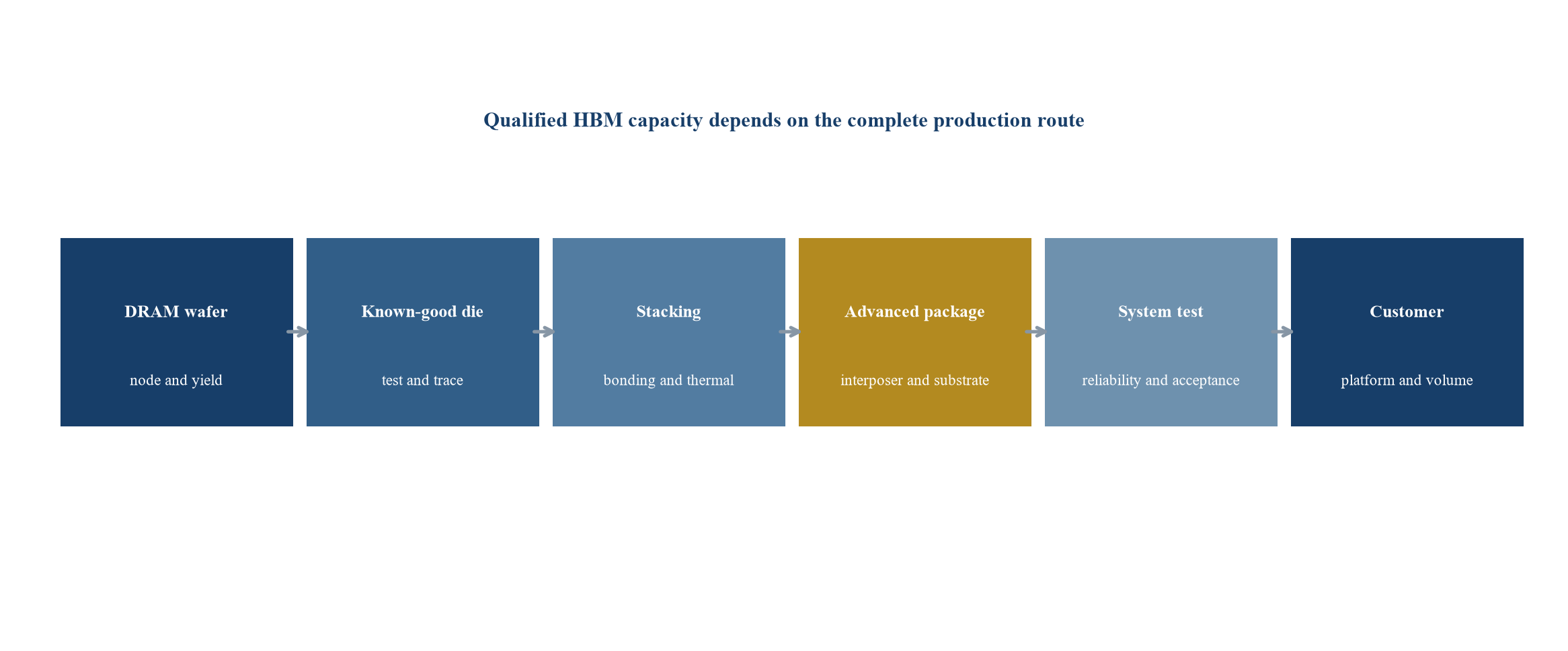
Proposed evidence chain; each hand-off requires qualified capacity, data and contractual responsibility.
Yield improvement has option value when it is supported by a credible plan, resources and observable leading indicators. The base case should use sustained evidence. Further improvement can enter as a probability-weighted initiative with owner, cost, timetable and gate. A buyer-specific capability may accelerate improvement, but its cost and execution risk belong in the synergy model rather than the target's stand-alone value.
The yield model should also test measurement definitions. A supplier may report wafer yield, stack yield or final test yield over different populations. Excluding engineering lots, rework or product variants can change the result. The investment committee should receive a reconciled definition and the sensitivity of value to each conversion gate.
6 Map packaging, foundry and equipment bottlenecks
HBM economics extend beyond the memory supplier. Advanced packaging can determine whether qualified stacks become saleable accelerator assemblies. TSMC reports strong CoWoS growth and continued development of larger package formats [24-27]. Equipment, substrates, bonding materials and test capacity can also constrain the route. A target's capacity claim should identify each external dependency and the weakest available step.
The buyer should inspect supplier agreements, allocation, take-or-pay obligations, price adjustment, priority, quality responsibility, change control, tooling ownership, second-source status and change-of-control provisions. A nominal alternative should not be treated as a second source if it requires new qualification, redesign, customer consent or material capital.
Dependency can create strategic value when the target has enforceable access to scarce resources or a process that increases throughput. It can reduce value when the target's economics depend on one partner without durable rights. The model should quantify the effect of lost allocation, delayed packaging, lower yield and customer rescheduling. It should also identify whether a buyer relationship can improve access without creating competition, neutrality or governance concerns.
Supplier concentration should be measured across products, sites and programmes. A target can appear to have several vendors while using one essential equipment type, substrate source or qualified line. The contingency plan should state the time, cost, capacity and customer approval needed to activate an alternative.
7 Value the roadmap as a sequence of gated investments
HBM generations develop rapidly. Public disclosures describe HBM3E, HBM4 and customised logic-base-die options [6-19]. A roadmap can support premium value when the target has demonstrated design readiness, samples, qualification, manufacturing capability and customer demand. A slide that lists future products without controlled evidence should remain outside the base valuation.
| Roadmap state | Evidence | Valuation treatment | Required protection |
|---|---|---|---|
| research concept | architecture, responsible team and funded plan | limited option value | budget and decision gate |
| verified design | simulation, test vehicle and controlled revision | development value after remaining cost | IP ownership and milestone definition |
| customer sample | delivered sample and test plan | programme option with timing risk | acceptance criteria and resource plan |
| qualified product | dated approval and production route | probability-weighted commercial value | capacity, quality and customer terms |
| accepted volume | shipment, acceptance and collected cash | operating cash-flow value | renewal, pricing and continuity controls |
Proposed framework; probabilities require target-specific calibration.
The roadmap model should identify common assets and product-specific work. A base-die transition, process-node change or package redesign can affect several programmes simultaneously. The buyer should avoid counting one platform investment as separate value in every customer forecast. It should also include the cost of supporting older generations while engineering resources move to the next release.
Useful life should follow customer platforms, standards, process support and competitive alternatives. A qualified generation may produce cash for several years, yet its terminal value should not assume indefinite pricing or capacity. The model can include reuse of process knowledge and test assets when the target demonstrates that those assets transfer to later generations.
8 Test customer concentration, pricing power and contract quality
HBM demand can be concentrated among a small number of accelerator and cloud ecosystems. Customer concentration should be measured by current revenue, contracted value, qualified capacity, engineering resources, receivables and forecast programme value. The buyer should identify which customers are economically independent and which programmes share one platform decision.
Contract diligence should cover committed volume, forecasts, price, resets, capacity reservation, cancellation, take-or-pay, quality, warranty, liability, credits, audit, confidentiality, intellectual property, exclusivity, assignment and change of control. A non-binding forecast can help operating planning. It should not be valued as contracted cash. A long-term supply agreement can improve visibility while fixing price, requiring capacity investment or creating penalties if qualification or delivery fails.
Pricing power should be tested through realised price, contract duration, customer alternatives, qualification cost and switching time. Scarcity can strengthen near-term price while encouraging customers to qualify alternatives or redesign systems. Structural power is stronger when the target combines performance, yield, energy efficiency, quality, customer trust and a credible roadmap. The valuation should show how much margin depends on scarcity and how much is supported by durable differentiation.
Customer evidence should be reviewed through a clean and lawful process. The buyer should distinguish management representations from direct confirmations, contracts and operating data. Customer calls should follow agreed protocols and avoid requests for competitively sensitive future information beyond what is necessary for the transaction.
Receivables and credits provide an additional test. A programme with high reported shipment growth can generate weaker economics when acceptance is slow, quality credits rise or payment terms expand. The buyer should reconcile customer revenue to invoices, credit notes, cash receipts and product records. It should examine whether one favourable quarter reflects launch inventory, backlog release or accelerated purchasing. Sustainable value depends on recurring accepted use and payment rather than movement into a customer's supply chain.
9 Price the stand-alone business from accepted programme cash flows
A top-down market share model can hide the conversion risk of HBM supply. The stand-alone valuation should begin with named programmes and qualified production routes. For each programme, forecast available units, yield, accepted volume, realised price, direct cost, support cost, capital, working capital, tax and timing. Use evidence-weighted probabilities and retain an explicit reconciliation to physical capacity.
Management assumes five programme cohorts. Accepted production contributes USD 1.25 billion of present value, qualified expansion USD 620 million, sampled programmes USD 310 million and longer-dated roadmap options USD 260 million. Management deducts USD 170 million for customer concentration, USD 120 million for packaging dependence and USD 410 million of remaining investment, producing an illustrative stand-alone enterprise value of USD 1.74 billion before central platform and other adjustments. A separate platform-value allowance of USD 410 million produces the assumed USD 2.15 billion enterprise value. All figures are management assumptions.
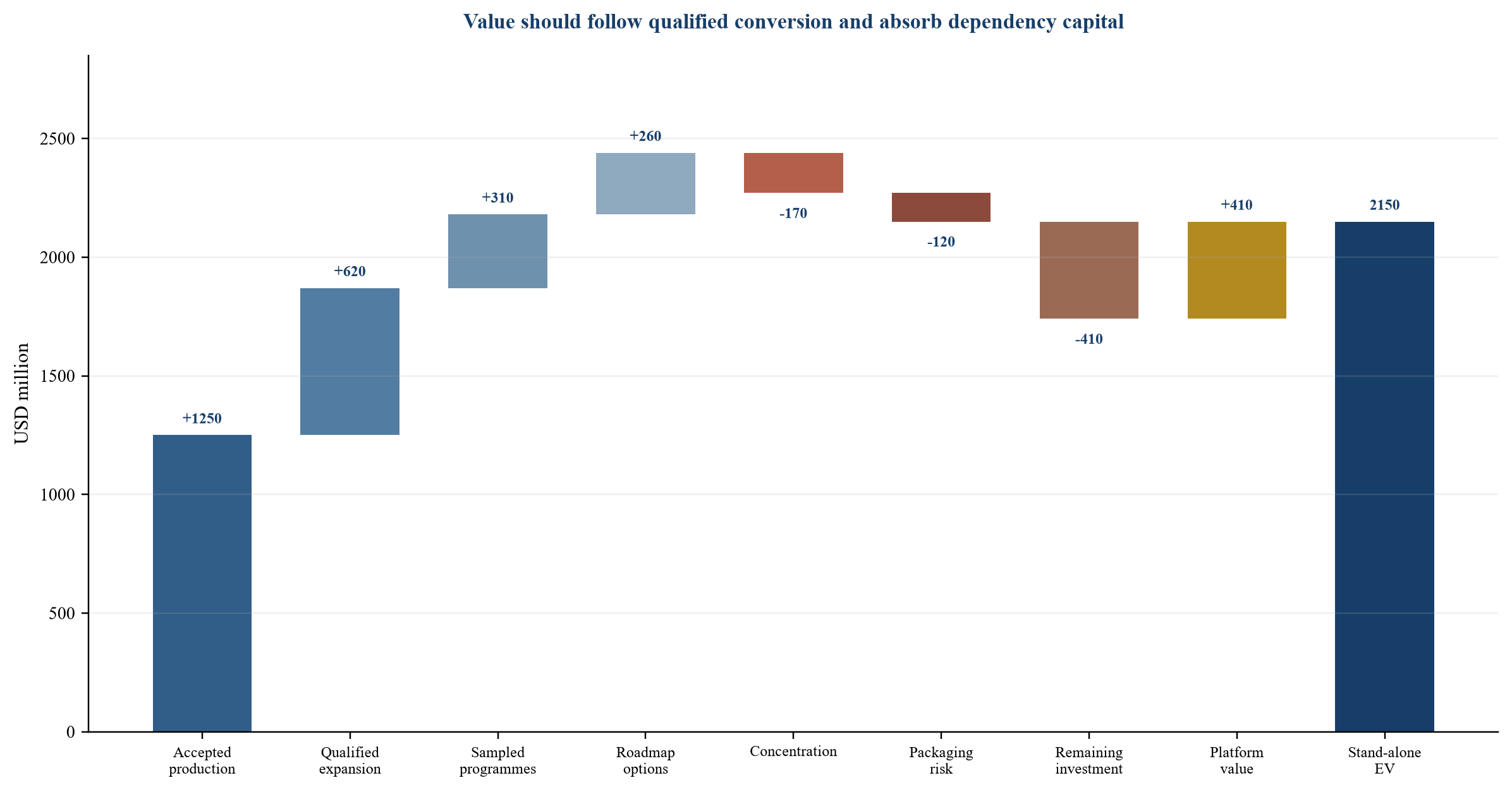
All amounts are management assumptions in USD millions and do not describe an identified company.
| Programme state | Cohorts | Illustrative probability | Average present value per cohort | Probability-weighted value |
|---|---|---|---|---|
| accepted production | 5 | 100% | USD 250m | USD 1,250m |
| qualified expansion | 4 | 80% | USD 194m | USD 620m |
| customer sample | 4 | 50% | USD 155m | USD 310m |
| roadmap option | 4 | 25% | USD 260m | USD 260m |
| gross programme value | 17 | mixed | mixed | USD 2,440m |
Values and probabilities are management assumptions for method demonstration only.
The model should avoid double counting. Qualification can appear in programme probability, margin, timing and discount rate. It should not be deducted repeatedly without a defined bridge. Market multiples can provide a reasonableness check when comparator product mix, capacity, cycle position, customer base and capital intensity are understood. Consolidated memory-company multiples should not be applied mechanically to an HBM-specific asset.
Terminal value should reflect a continuing capability rather than one product generation. The buyer should identify which customer relationships, process assets, teams and supplier rights support cash after the explicit forecast. A high terminal growth rate cannot substitute for the capital and qualification needed to remain competitive.
10 Build buyer-specific synergy without transferring execution risk to price
Buyer value can arise from improved yield, accelerated qualification, secured packaging, customer access, procurement, shared research, manufacturing scale and reduced duplicated cost. Each synergy should have a baseline, action, owner, timing, cost, dependency and evidence source. A strategic narrative should remain outside purchase price until it can be converted into an executable initiative.
Yield synergy requires process access, capable teams, usable data and authority to change the production route. Capacity synergy requires actual tools, utilities, supplier rights and qualification. Revenue synergy requires a customer, product, timing and acceptable channel position. Cost synergy should preserve the engineering and quality resources that support qualification and roadmap delivery.
The buyer should distinguish value available to any owner from value specific to its assets. Competitive tension can support sharing some buyer-specific value with the seller. The committee should know the portion, the implementation cost and the downside if the synergy fails. Earn-outs, staged consideration or seller rollover can align uncertain future value when metrics are measurable and buyer control is addressed.
Synergies can conflict. Integrating procurement can reduce cost while disrupting qualified materials. Consolidating sites can reduce overhead while requiring customer requalification. Moving tools or software can weaken yield learning. The integration model should quantify trade-offs and protect the operating capabilities that support the acquisition case.
11 Stress the model for cycle, concentration and common-cause risk
HBM suppliers can appear diversified across products while sharing one customer platform, wafer node, packaging route, equipment type or engineering team. Common-cause risk should be measured across the full programme portfolio. A packaging delay can affect several customers. A yield problem can consume scarce wafers. A customer architecture change can remove both revenue and a reference that supports other qualifications.
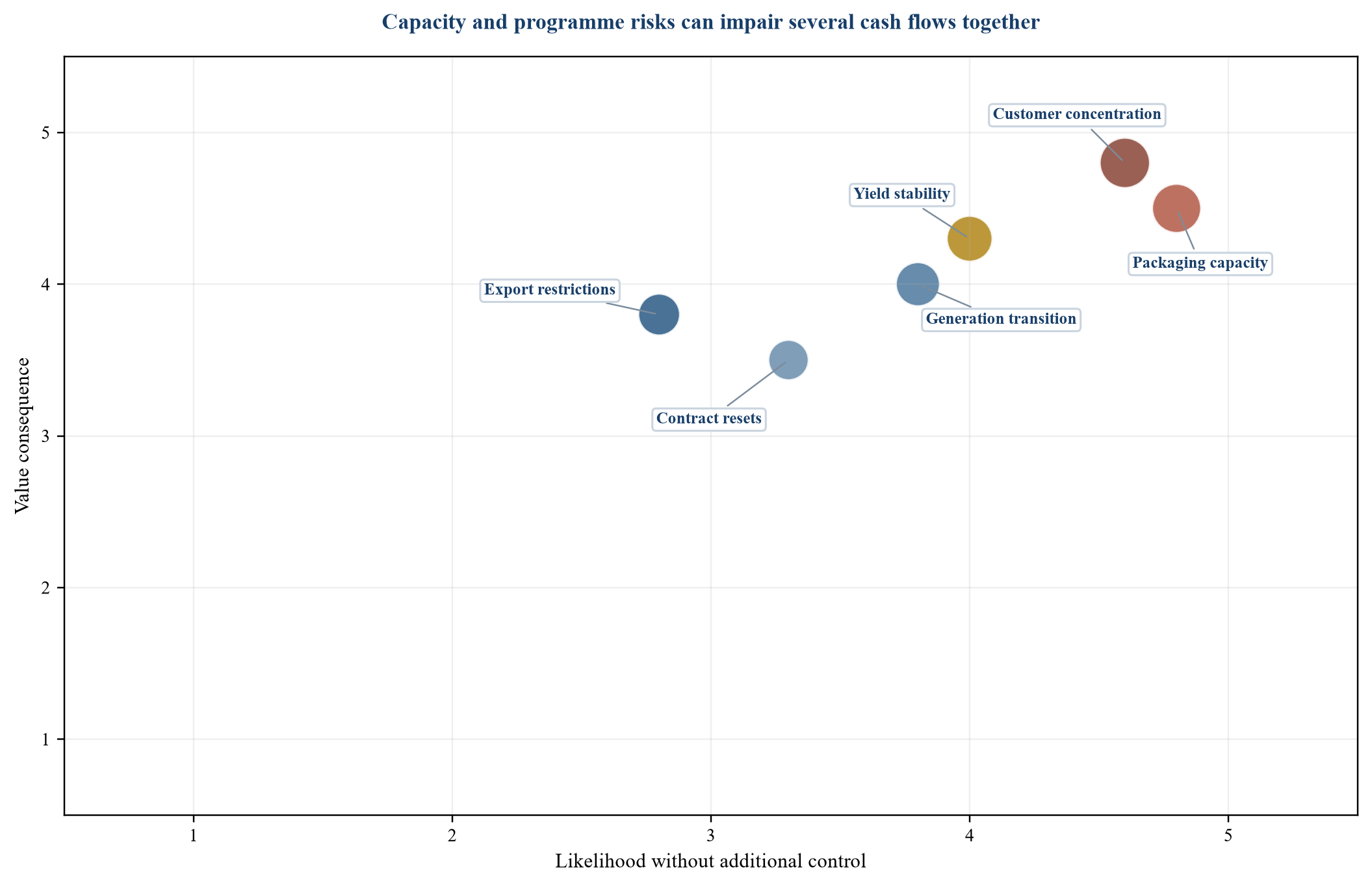
Scores are management assumptions on a one-to-five scale used to demonstrate prioritisation.
Stress cases should combine related variables. A price decline may coincide with customer reallocation and lower utilisation. A yield shortfall can increase unit cost and delay qualification. A generation transition can require new capital while reducing the useful life of current equipment and inventory. The model should include central, delayed-ramp, lower-yield, price-normalisation and combined cases, with liquidity and covenant effects where debt is involved.
Risk should change both value and terms. A known capital requirement can be deducted and funded. Uncertain qualification can be addressed through contingent consideration. Supplier dependence can require a closing condition, capacity covenant or transition plan. Customer concentration can affect price, earn-out design, financing and governance.
12 Choose a transaction structure that matches evidence maturity
A full acquisition transfers control and supports deep integration, while concentrating technology, capacity and customer risk at closing. A staged acquisition can link control and consideration to qualification or capacity gates. A minority investment can secure learning and commercial rights while preserving supplier neutrality. A joint venture can combine complementary manufacturing assets and create governance, IP and funding complexity. A long-term supply agreement or capacity prepayment can address access without buying the entire company.
| Structure | Suitable evidence state | Buyer control | Principal protection | Principal limitation |
|---|---|---|---|---|
| full acquisition | qualified output, durable contracts and integration plan | high | conditions, indemnity, retention and covenants | upfront exposure to cycle and customer concentration |
| staged acquisition | strong technical evidence with remaining qualification or ramp | high after gates | milestone consideration and call or put mechanics | future pricing and governance complexity |
| minority investment | developing roadmap with strategic learning value | limited | information, consent and participation rights | limited authority over capital and execution |
| joint venture | complementary wafer, packaging or customer assets | shared | field, funding, contribution and deadlock rules | divided authority and IP leakage risk |
| supply or capacity agreement | need for access with limited ownership rationale | contractual | allocation, priority, price and continuity | supplier remains responsible for execution |
Proposed decision framework; legal, tax, accounting and regulatory consequences require specialist advice.
Consideration can combine cash, shares, rollover, retention and contingent payments. Milestones should reflect events the seller can influence and the buyer can verify. Technical gates need objective test conditions. Capacity gates need defined denominators, sustained yield and qualification. Revenue gates need accepted shipments, agreed accounting, price, credits and collection. The agreement should address buyer resource obligations without creating an impractical promise to guarantee outcomes.
Governance matters before full control. Information rights, reserved matters, funding obligations, related-party transactions, IP use, customer allocation and deadlock should match the structure. A strategic investor should avoid receiving competitively sensitive information beyond the legitimate scope of its rights and applicable law.
13 Reconcile capital expenditure, depreciation and working capital
HBM expansion can require large investments in wafer fabrication, equipment, clean-room capacity, stacking, packaging, test, utilities and customer qualification. The buyer should separate maintenance capital, committed expansion, discretionary growth and customer-funded or government-supported investment. Announced capital should be reconciled to purchase orders, construction, payments, commissioning and useful output.
Depreciation should follow the assets and economic lives that support the forecast. A short generation cycle can reduce the economic life of specialised equipment even when its accounting life is longer. Equipment may be reusable across products, require modification or become constrained by throughput and specification. The valuation should include conversion capital and downtime needed to support the roadmap.
Working capital can expand when the supplier builds wafers or stacks ahead of qualification, reserves materials, carries customer-specific inventory or experiences acceptance delays. Inventory should be classified by generation, customer, stage and recoverability. Prepayments and capacity reservations should be analysed for refund, offset and performance conditions. The cash-flow model should include the funding effect of slow acceptance, rework, credits and long supplier lead times.
Government support and incentives should be assessed separately from operating advantage. Conditions can include location, investment, employment, security, reporting and repayment obligations. The buyer should identify assignability, change-of-control consequences and the portion already received or embedded in asset cost.
14 Protect customer trust and engineering continuity through integration
The integration plan should preserve product roadmaps, customer confidentiality, quality systems, engineering speed, supplier relationships and accountable decision rights. Customers may worry that a strategic acquirer will favour its own products, access sensitive plans or reduce supplier neutrality. Communication should address continuity, security, pricing, capacity allocation and governance without making unsupported commitments.
Key-person risk extends beyond executives. Process integration, yield learning, failure analysis, customer qualification and supplier coordination may depend on small teams. Retention should be connected to role, authority, roadmap and knowledge transfer. Documentation should include recipes, control plans, test programmes, product histories, known issues and decision records. A retention payment without operating authority and resources can preserve employment while losing capability.
| Workstream | Required evidence | Day-one control | First-hundred-day outcome |
|---|---|---|---|
| customers | contracts, qualification and communication map | named relationship owner and confidentiality protocol | verified programme baseline and escalation route |
| manufacturing | lot, yield, capacity and quality records | frozen definitions and daily exception review | reconciled capacity-to-acceptance dashboard |
| suppliers | allocation, pricing, priority and continuity terms | accountable owner for each critical dependency | renewed rights and tested contingency plan |
| roadmap | controlled designs, samples, gates and resources | protected programme teams and version control | board-approved roadmap and capital release gates |
| value | signing model, synergy bridge and costs | one controlled baseline and change log | measured conversion, cost and net synergy report |
Proposed control plan; timing should be adapted to transaction approvals and customer obligations.
Integration sequencing should follow qualification and production risk. Immediate changes to process, materials, tools or reporting can require validation and customer approval. The buyer should establish which systems can change at day one, which require controlled testing and which should remain separate until a generation or programme gate.
15 Establish practical transaction controls
The transaction team should maintain one programme register, one capacity bridge, one dependency map and one valuation model. The programme register should connect customer evidence to physical output and cash. The capacity bridge should reconcile nominal input through yield, qualification, allocation, shipment, acceptance and collection. The dependency map should identify supplier, equipment, site, people, regulatory and customer conditions. The valuation should reconcile stand-alone cash flow, remaining capital, dependency adjustments, synergy, integration cost and consideration.
Version control is essential because product, yield, customer and market assumptions can change rapidly. Every investment-committee paper should state the data cut, model version and open issues. A customer programme should change status only when the required evidence is present. Yield should link to the lot population and measurement definition. Capacity should identify the product and time period. Valuation should refresh after a qualification event, yield change, supplier allocation, customer decision or material price reset.
Confidential information should be restricted by role and purpose. Customer designs, product roadmaps, process recipes and supplier terms may carry contractual or competition constraints. Clean teams may be required where parties compete or share customers. The diligence room should preserve access logs, export conditions, return obligations and a controlled record of conclusions.
The board dashboard should focus on conversion and cash rather than isolated technical activity. Useful measures include qualified capacity, sustained yield, accepted units, realised margin, customer concentration, supplier allocation, roadmap gates, committed capital, integration cost and net synergy.
Control frequency should match the pace of risk. Yield, quality incidents and critical supplier interruptions may require daily review during a ramp. Qualification, capital and customer schedules may require weekly review. Price, portfolio concentration and valuation may be reviewed monthly or at material events. Escalation thresholds should be defined before closing so that teams can act without debating the meaning of a metric during a disruption. The dashboard should retain the evidence behind each measure and record management action, owner and deadline.
16 Use a signing-to-accepted-production control model
The interval between signing and the first full production cycle can contain substantial value risk. A buyer can complete the acquisition while yield, qualification, packaging, customer schedules and product generations continue to move. The control model should cover the period from the final diligence cut through closing, integration and at least the first audited cycle of accepted shipments and collection.
The model should begin with a frozen signing baseline. That baseline should list programme status, capacity denominator, yield, expected qualification, customer economics, supplier route, required staff, capital, regulatory conditions and forecast cash. Changes should be recorded against the baseline. A delayed qualification, lower sustained yield, packaging reallocation or customer platform shift can affect value before it becomes visible in reported revenue.
Interim operating covenants should be linked to material assets and programmes. The seller should preserve key teams, product revisions, quality systems, equipment, supplier allocation and customer relationships in the ordinary course. Material customer amendments, new exclusivity, broad IP grants, unplanned capital and capacity cancellation may require consent, subject to applicable law and negotiated thresholds. The purpose is to preserve the agreed asset while maintaining lawful operating responsibility.
Closing readiness should include tested access to repositories, quality systems, equipment records, supplier contacts and customer escalation. The buyer should know which credentials and data can transfer, which require consent and which must remain segregated. A transition plan should assign every dependency and unresolved condition.
17 Translate diligence findings into price, terms and integration actions
Diligence creates value when findings change a decision. Every material finding should be classified as a price adjustment, structural item, closing condition, contractual protection, integration action or monitored risk. The classification should identify the evidence, financial exposure, timing, owner, accountable decision and deadline. A long issue list without treatment can create the appearance of control while leaving the investment case unchanged.
A price adjustment can address lower qualified capacity, unsupported yield, required capital or weaker programme cash. A closing condition can address a material customer approval, supplier consent or financing. A representation, indemnity or escrow can address an identified exposure. A covenant can preserve allocation, teams, qualification activity or records. An integration action can fix a controllable weakness after closing.
Representations and warranties should match the nature and duration of the risk. They can cover IP ownership, product quality, customer contracts, capacity rights, supplier arrangements, regulatory compliance, export controls and financial statements. Insurance can support some contractual risks. It does not replace technical diligence, customer evidence, capacity analysis or a funded integration plan.
The final investment paper should reconcile headline price, net debt, working capital, contingent value, retention, transaction cost and integration funding. It should present stand-alone value, buyer-specific value and consideration on the same basis. It should show how each major diligence finding changed the model or terms. This record supports disciplined governance and post-closing accountability.
Conclusion
HBM scarcity has created substantial commercial opportunity and complex valuation risk. A credible transaction case follows a reproducible chain from controlled technology and wafer input through good dies, qualified stacking, advanced packaging, customer acceptance and collected cash. Nameplate capacity, market growth and sample announcements can support strategic context. They require conversion evidence before they support full operating value.
The strongest HBM supplier combines sustained yield, qualified capacity, customer trust, contractual supply access, roadmap execution and disciplined capital. Its premium derives from repeatable conversion rather than a single favourable market period. Buyers should separate scarcity rent from structural advantage, model customer and packaging concentration, fund the required roadmap, and connect diligence findings to price, terms and integration controls.
The resulting discipline is practical. Define the asset. Reconstruct physical and contractual capacity. Verify qualification and acceptance. Build programme-level cash flows. Stress yield, price, customer and generation transition together. Price buyer-specific synergy after implementation cost. Select a transaction structure that matches evidence maturity. Maintain one controlled baseline through closing and the first accepted production cycle.
Sources
- JEDEC, High Bandwidth Memory standards and technology focus, Read the primary source
- JEDEC, Standards search and publications, Read the primary source
- JEDEC, HBM3 standard announcement, Read the primary source
- JEDEC, Main memory technology focus, Read the primary source
- JEDEC, Solid State Technology Association publications, Read the primary source
- Micron Technology, 2025 Annual Report on Form 10-K, Read the primary source
- Micron Technology, 2025 Annual Report PDF, Read the primary source
- Micron Technology, 2025 Annual Report highlights, Read the primary source
- Micron Technology, 2025 proxy operational goals and HBM yield, Read the primary source
- Micron Technology, fiscal third-quarter 2025 filing and HBM manufacturing risk, Read the primary source
- Micron Technology, HBM4 customer sample announcement, Read the primary source
- Micron Technology, fiscal first-quarter 2026 earnings materials, Read the primary source
- SK hynix, 2025 financial results, Read the primary source
- SK hynix, HBM4 development and mass-production readiness, Read the primary source
- SK hynix, AI ecosystem and memory innovation, Read the primary source
- SK hynix, HBM business planning and roadmap, Read the primary source
- SK hynix, HBM technology journey and HBM4 performance, Read the primary source
- SK hynix, MR-MUF and HBM thermal technology, Read the primary source
- SK hynix, 2026 annual general meeting and HBM4 production system, Read the primary source
- Samsung Electronics, 2025 Business Report, Read the primary source
- Samsung Electronics, 2025 letter to shareholders, Read the primary source
- Samsung Electronics, annual reports and disclosures, Read the primary source
- Samsung Electronics, integrated reports, Read the primary source
- Taiwan Semiconductor Manufacturing Company, 2025 Annual Report, Read the primary source
- Taiwan Semiconductor Manufacturing Company, 2025 Annual Report PDF, Read the primary source
- Taiwan Semiconductor Manufacturing Company, 3DFabric and advanced packaging, Read the primary source
- Taiwan Semiconductor Manufacturing Company, CoWoS technology, Read the primary source
- NVIDIA, annual reports and filings, Read the primary source
- Advanced Micro Devices, 2025 Annual Report on Form 10-K, Read the primary source
- Broadcom, annual reports and filings, Read the primary source
- Rambus, 2025 Annual Report and HBM4 interface products, Read the primary source
- Amkor Technology, annual reports, Read the primary source
- ASE Technology Holding, annual reports, Read the primary source
- SEMI, advanced packaging and heterogeneous integration resources, Read the primary source
- US Department of Commerce, CHIPS for America, Read the primary source
- National Institute of Standards and Technology, CHIPS research and development, Read the primary source
- National Advanced Packaging Manufacturing Program, Read the primary source
- Micron Technology, US investment announcement, Read the primary source
- European Commission, European Chips Act, Read the primary source
- European Commission, Chips for Europe Initiative, Read the primary source
- US Bureau of Industry and Security, export administration regulations, Read the primary source
- US Department of Justice and Federal Trade Commission, 2023 Merger Guidelines, Read the primary source
- Federal Trade Commission, Hart-Scott-Rodino premerger notification programme, Read the primary source
- IFRS Foundation, IFRS 3 Business Combinations, Read the primary source
- IFRS Foundation, IAS 38 Intangible Assets, Read the primary source
- IFRS Foundation, IAS 36 Impairment of Assets, Read the primary source
- IFRS Foundation, IFRS 13 Fair Value Measurement, Read the primary source
- Financial Accounting Standards Board, Topic 805 Business Combinations, Read the primary source
- World Intellectual Property Organization, IP valuation, Read the primary source
- National Institute of Standards and Technology, Cybersecurity Framework 2.0, Read the primary source
